2
CONTENTS
What ischaracterization of materials?
What is its significance?
Techniques of characterization
Description
Comparison
Application
Conclusion
References
3.
What is characterizationof
materials?
Characterization refers to the process of understanding
the structure, composition, and properties of materials.
It involves using various techniques and instruments to
gather data about a material’s physical, chemical,
mechanical, thermal and microstructural properties.
Characterization helps identify how materials behave and
why, which is essential in material development, quality
control and failure analysis
4.
4
Why Materials Characterization
isImportant?
Development of new materials: It helps in discovering and
fine-tuning materials for advanced applications
Quality control: Industries use it to ensure materials meet
required specifications.
Failure analysis:When a product fails, characterization helps
in identifying the root cause.
Understanding properties: It connects the microstructure with
the performance of the material (e.g., strength, corrosion
resistance).
5.
5
Techniques of Material
Characterization
Thereare several techniques of characterization for testing
various properties of material such as:
•MICROSCOPY TECHNIQUE
Microscopy is probing and mapping a materials surface and sub-
surface structure, to view the surface of the samples & objects that
cannot be seen with the unaided eye by using photons, electrons and
ions.
•SPECTROSCOPY TECHNIQUE
Spectroscopy is the study of the absorption and emission of light and
other radiation by matter to reveal the chemical composition,
composition variation, crystal structure and photoelectric of materials.
6.
6
Scanning Electron Microscopy(SEM)
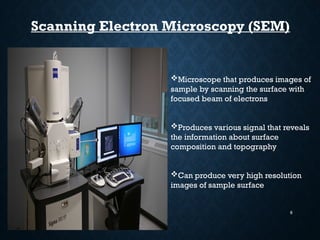
Microscope that produces images of
sample by scanning the surface with
focused beam of electrons
Produces various signal that reveals
the information about surface
composition and topography
Can produce very high resolution
images of sample surface
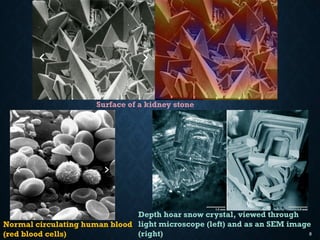
Surface of akidney stone
Normal circulating human blood
(red blood cells)
Depth hoar snow crystal, viewed through
light microscope (left) and as an SEM image
(right) 8
9.
9
Application
SEM in FoodTechnology:
Scenario:
A chocolate manufacturing company receives complaints about white
discoloration on chocolate surfaces (called bloom), making the product look
unappealing.
How SEM helped:
SEM was used to examine the chocolate surface.
It revealed fat crystals migrating and forming a layer on the surface.
This confirmed the bloom was fat bloom, not sugar bloom.
Outcome:
The company adjusted cooling rates and storage temperatures to prevent fat
migration, improving product appearance and shelf-life.
10.
10
Application
SEM in Pharmaceuticals– Tablet Coating Defects
Scenario:
A pharmaceutical company finds that some coated tablets have cracks in the
coating, affecting drug release timing.
How SEM helped:
SEM provided high-resolution images of the tablet cross-sections.
Cracks and voids in the polymer coating were visible, caused by improper
drying.
Outcome:
Drying conditions and coating formulation were optimized. SEM is now part of
routine quality control for coated tablets.
13
Application
TEM in DisplayTechnology – OLED Layer Characterization
Scenario:
An electronics company finds that their OLED displays have inconsistent brightness
and short lifespan.
How TEM helped:
TEM imaging showed uneven thickness in the organic layers.
Identified impurities in the electron transport layer causing degradation.
Outcome:
Layer deposition techniques were improved, increasing display life and reducing
waste in production.
14.
14
SEM TEM
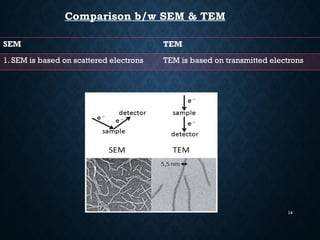
1. SEMis based on scattered electrons TEM is based on transmitted electrons
Comparison b/w SEM & TEM
15.
15
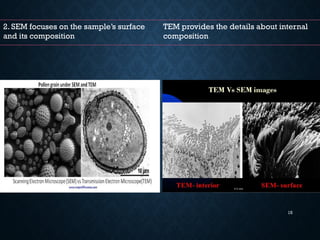
2. SEM focuseson the sample’s surface
and its composition
TEM provides the details about internal
composition
17
SPECTROSCOPY
X-Ray Diffraction(XRD)
X-Ray Photoelectron Spectroscopy (XPS)
Raman Spectroscopy - used for Molecular vibrations,
crystal structure, and stress/strain in materials.
18.
18
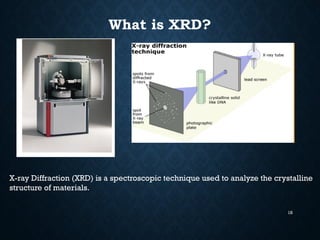
What is XRD?
X-rayDiffraction (XRD) is a spectroscopic technique used to analyze the crystalline
structure of materials.
19.
19
Application
Short Example: XRDfor Quality Control in Ceramic Manufacturing
Scenario: A factory producing ceramic tiles is experiencing unexpected cracking
during firing.
How XRD helped:
XRD analysis of the raw clay revealed the presence of excess quartz and illite.
These minerals expand unevenly during heating, causing internal stress.
Conclusion:
By adjusting the raw material composition based on XRD results, the company
improved product strength and reduced firing defects—increasing production
efficiency and reducing waste.
20.
20
Application
Short Example: XRDin Starch Analysis for Instant Rice Products
Scenario:
A food company is developing instant rice and wants to optimize
its rehydration time and texture.
How XRD helped:
XRD was used to compare the crystallinity of rice before and after
processing.
The results showed that gelatinization during pre-cooking reduced the
crystalline peaks, indicating partial breakdown of starch structure.
Conclusion:
XRD helped determine the ideal cooking and drying conditions to
balance fast rehydration with desirable texture, improving product quality
and consumer satisfaction.
21.
21
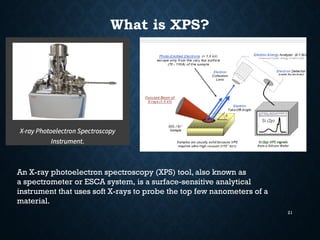
What is XPS?
AnX-ray photoelectron spectroscopy (XPS) tool, also known as
a spectrometer or ESCA system, is a surface-sensitive analytical
instrument that uses soft X-rays to probe the top few nanometers of a
material.
22.
22
Application
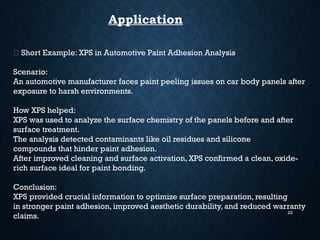
🚗 Short Example:XPS in Automotive Paint Adhesion Analysis
Scenario:
An automotive manufacturer faces paint peeling issues on car body panels after
exposure to harsh environments.
How XPS helped:
XPS was used to analyze the surface chemistry of the panels before and after
surface treatment.
The analysis detected contaminants like oil residues and silicone
compounds that hinder paint adhesion.
After improved cleaning and surface activation, XPS confirmed a clean, oxide-
rich surface ideal for paint bonding.
Conclusion:
XPS provided crucial information to optimize surface preparation, resulting
in stronger paint adhesion, improved aesthetic durability, and reduced warranty
claims.
23.
23
Application
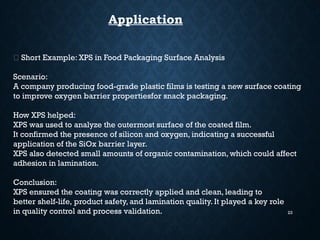
🧴 Short Example:XPS in Food Packaging Surface Analysis
Scenario:
A company producing food-grade plastic films is testing a new surface coating
to improve oxygen barrier propertiesfor snack packaging.
How XPS helped:
XPS was used to analyze the outermost surface of the coated film.
It confirmed the presence of silicon and oxygen, indicating a successful
application of the SiOx barrier layer.
XPS also detected small amounts of organic contamination, which could affect
adhesion in lamination.
Conclusion:
XPS ensured the coating was correctly applied and clean, leading to
better shelf-life, product safety, and lamination quality. It played a key role
in quality control and process validation.
24.
24
Comparison between XRDand XPS
XRD looks inside the material to understand how atoms
are arranged in the crystal structure. It’s best when
the internal structure or phase identity is important (e.g.,
ensuring a metal alloy has the right hardness phase).
XPS focuses only on the very top surface, making it
essential for surface engineering, thin coatings,
and detecting surface contamination or oxidation (e.g.,
checking if a surface is clean enough for bonding or
coating).
25.
25
Conclusion
In short, materialcharacterization bridges the gap
between raw materials and functional, high-
performance products, making it essential for progress
in modern manufacturing, research, and industrial
innovation.
#3 In simple terms, it’s like giving materials a “diagnostic check” to understand what they are made of and how they will perform in different environments.
#4 Without proper characterization, we risk using materials inappropriately or inefficiently, which can lead to product failure or increased costs.
Without material characterization, innovation becomes guesswork, and manufacturing becomes riskier. It ensures that the materials chosen are fit for its purpose, and it forms the backbone of product development, quality control, and sustainable manufacturing.
#5 Each technique provides different insights, and using a combination of them gives a complete understanding of a material's properties.
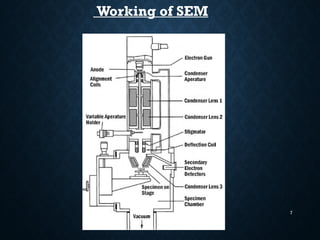
#7 These illustration shows the detailed image of the features of the tool SEM
#8 Scanning Electron Microscope (SEM) – for high-resolution surface imaging and microstructure analysis.
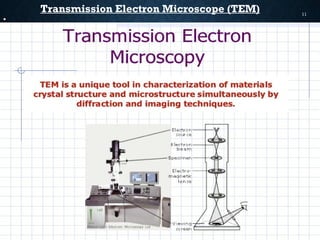
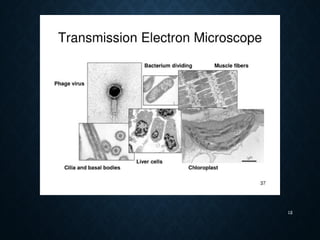
#11 Principle: Electrons transmitted through a very thin specimen provide atomic-scale images.
Used for: Observing atomic arrangements, defects, dislocations, and crystal orientation.
#12 With advances in TEM and other microscopy tools, we can now see individual atoms and their behavior.
#18 When X-rays hit a crystalline substance, they diffract in specific patterns. XRD reads these patterns to determine:
What materials (phases) are present
How the atoms are arranged
The size of crystals or grains
The presence of stress, defects, or impurities
#21
XPS (X-ray Photoelectron Spectroscopy) is a surface-sensitive analytical technique that measures the elemental composition and chemical state of elements within the top 1–10 nanometers of a material's surface.
#25 Materials characterization is a cornerstone of materials science and engineering. It allows us to understand materials at multiple scales, optimize their use, and drive innovation.