RADIATION
THERAPY
Prepared by : Ms. Nimisha Chacko
INTRODUCTION
The modality of treatment of cancer are surgery, radiotherapy
and chemotherapy. Operating team must first ascertain all
relevant information about tumor and patient. Key tumor
variables are histological type and stage. Those related to patient
are age, general health, occupation, and social support. Both
surgery and radiotherapy are local treatments, either in
combination or individually both often effect a cure.
DEFINITION
According to JOHN BEUMER AND THOMAS A. CURTIS.
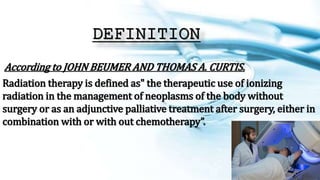
Radiation therapy is defined as" the therapeutic use of ionizing
radiation in the management of neoplasms of the body without
surgery or as an adjunctive palliative treatment after surgery, either in
combination with or with out chemotherapy”.
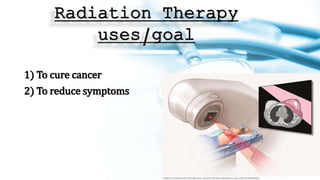
Radiation Therapy
uses/goal
1) To cure cancer
2) To reduce symptoms
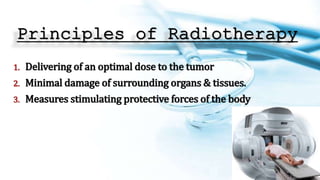
Principles of Radiotherapy
1. Delivering of an optimal dose to the tumor
2. Minimal damage of surrounding organs & tissues.
3. Measures stimulating protective forces of the body
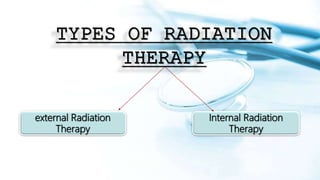
TYPES OF RADIATION
THERAPY
external Radiation
Therapy
Internal Radiation
Therapy
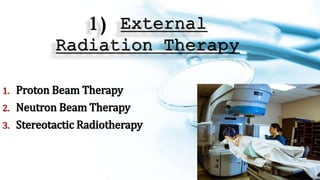
1) External
Radiation Therapy
1. Proton Beam Therapy
2. Neutron Beam Therapy
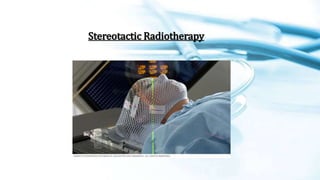
3. Stereotactic Radiotherapy
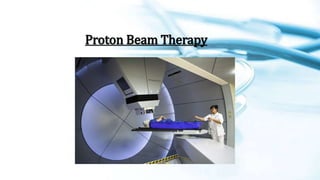
Proton Beam Therapy
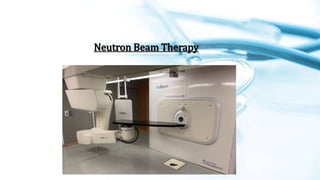
Neutron Beam Therapy
Stereotactic Radiotherapy
2)Internal Radiation
Therapy
 Places radioactive material into tumor or surrounding
tissue.
 Also called brachytherapy – brachy Greek for “short
distance.”
 Radiation sources placed close to the tumor so large doses
can hit the cancer cells.
NURSING MANAGEMENT
 The nurse explain the procedure for delivering
radiation, describe the equipment, duration of
procedure, possible need for immobilization
 If implant is used the nurse informs patient and family
about restrictions placed on visitors
 Explain to the patient his role before, during and after
procedure
 Assess patient skin, nutritional status, oral mucosa for
change
CONTI…
 Patient skin protected from irritation and instructed to
avoid using ointment, lotions or powder on the area
 Provide oral hygiene to remove debris and promote
healing
 If patient feel fatigue assist him in activity of daily living
 Explain that fatigue and malaise are SE from Rx and not
indicate deterioration
 Explain purpose from isolating patient
Side effects of
radiation therapy
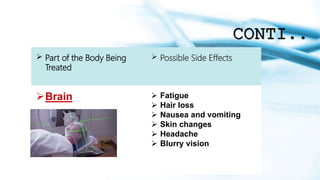
CONTI..
 Part of the Body Being
Treated
 Possible Side Effects
Brain  Fatigue
 Hair loss
 Nausea and vomiting
 Skin changes
 Headache
 Blurry vision
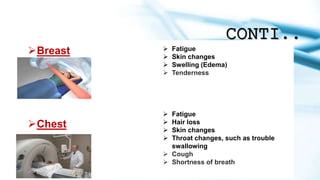
CONTI..
Breast  Fatigue
 Skin changes
 Swelling (Edema)
 Tenderness
Chest
 Fatigue
 Hair loss
 Skin changes
 Throat changes, such as trouble
swallowing
 Cough
 Shortness of breath
CONTI..
Head and Neck Fatigue
Hair loss
Mouth changes
Skin changes
Taste changes
Throat changes, such as
trouble swallowing
Less active thyroid gland
CONTI..
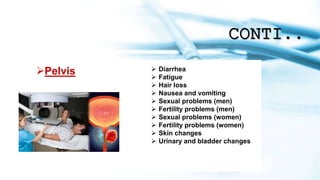
Pelvis  Diarrhea
 Fatigue
 Hair loss
 Nausea and vomiting
 Sexual problems (men)
 Fertility problems (men)
 Sexual problems (women)
 Fertility problems (women)
 Skin changes
 Urinary and bladder changes
CONTI..
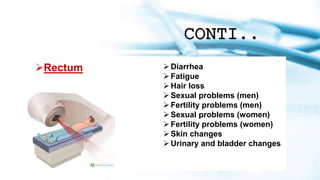
Rectum Diarrhea
Fatigue
Hair loss
Sexual problems (men)
Fertility problems (men)
Sexual problems (women)
Fertility problems (women)
Skin changes
Urinary and bladder changes
CONTI..
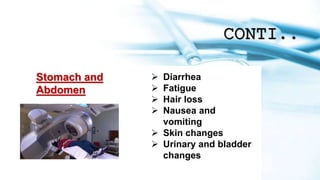
Stomach and
Abdomen
 Diarrhea
 Fatigue
 Hair loss
 Nausea and
vomiting
 Skin changes
 Urinary and bladder
changes
CONCLUSION
Radiotherapy has an essential role in radical and
palliative management of cancer patients. Family
physicians participating in care of cancer patients can
help facilitate referral for radiotherapy when they
encounter patients with oncologic problems or
complications amenable to radiotherapy treatment.
Radiation therapy

Radiation therapy

  • 1.
  • 2.
    INTRODUCTION The modality oftreatment of cancer are surgery, radiotherapy and chemotherapy. Operating team must first ascertain all relevant information about tumor and patient. Key tumor variables are histological type and stage. Those related to patient are age, general health, occupation, and social support. Both surgery and radiotherapy are local treatments, either in combination or individually both often effect a cure.
  • 3.
    DEFINITION According to JOHNBEUMER AND THOMAS A. CURTIS. Radiation therapy is defined as" the therapeutic use of ionizing radiation in the management of neoplasms of the body without surgery or as an adjunctive palliative treatment after surgery, either in combination with or with out chemotherapy”.
  • 4.
    Radiation Therapy uses/goal 1) Tocure cancer 2) To reduce symptoms
  • 5.
    Principles of Radiotherapy 1.Delivering of an optimal dose to the tumor 2. Minimal damage of surrounding organs & tissues. 3. Measures stimulating protective forces of the body
  • 6.
    TYPES OF RADIATION THERAPY externalRadiation Therapy Internal Radiation Therapy
  • 7.
    1) External Radiation Therapy 1.Proton Beam Therapy 2. Neutron Beam Therapy 3. Stereotactic Radiotherapy
  • 8.
  • 9.
  • 10.
  • 11.
    2)Internal Radiation Therapy  Placesradioactive material into tumor or surrounding tissue.  Also called brachytherapy – brachy Greek for “short distance.”  Radiation sources placed close to the tumor so large doses can hit the cancer cells.
  • 12.
    NURSING MANAGEMENT  Thenurse explain the procedure for delivering radiation, describe the equipment, duration of procedure, possible need for immobilization  If implant is used the nurse informs patient and family about restrictions placed on visitors  Explain to the patient his role before, during and after procedure  Assess patient skin, nutritional status, oral mucosa for change
  • 13.
    CONTI…  Patient skinprotected from irritation and instructed to avoid using ointment, lotions or powder on the area  Provide oral hygiene to remove debris and promote healing  If patient feel fatigue assist him in activity of daily living  Explain that fatigue and malaise are SE from Rx and not indicate deterioration  Explain purpose from isolating patient
  • 14.
  • 15.
    CONTI..  Part ofthe Body Being Treated  Possible Side Effects Brain  Fatigue  Hair loss  Nausea and vomiting  Skin changes  Headache  Blurry vision
  • 16.
    CONTI.. Breast  Fatigue Skin changes  Swelling (Edema)  Tenderness Chest  Fatigue  Hair loss  Skin changes  Throat changes, such as trouble swallowing  Cough  Shortness of breath
  • 17.
    CONTI.. Head and NeckFatigue Hair loss Mouth changes Skin changes Taste changes Throat changes, such as trouble swallowing Less active thyroid gland
  • 18.
    CONTI.. Pelvis  Diarrhea Fatigue  Hair loss  Nausea and vomiting  Sexual problems (men)  Fertility problems (men)  Sexual problems (women)  Fertility problems (women)  Skin changes  Urinary and bladder changes
  • 19.
    CONTI.. Rectum Diarrhea Fatigue Hair loss Sexualproblems (men) Fertility problems (men) Sexual problems (women) Fertility problems (women) Skin changes Urinary and bladder changes
  • 20.
    CONTI.. Stomach and Abdomen  Diarrhea Fatigue  Hair loss  Nausea and vomiting  Skin changes  Urinary and bladder changes
  • 21.
    CONCLUSION Radiotherapy has anessential role in radical and palliative management of cancer patients. Family physicians participating in care of cancer patients can help facilitate referral for radiotherapy when they encounter patients with oncologic problems or complications amenable to radiotherapy treatment.