Bone tumors:
• Bonetumors develop when cells within a bone divide uncontrollably,
forming a lump or mass of abnormal tissue.
• Most bone tumors are benign (not cancerous).
• Benign tumors are usually not life-threatening and, in most cases, will
not spread to other parts of the body. Depending upon the type of
tumor, treatment options are wide-ranging — from simple
observation to surgery to remove the tumor.
3.
• Some bonetumors are malignant (cancerous).
• Malignant bone tumors can metastasize — or cause cancer cells to
spread throughout the body.
• In almost all cases, treatment for malignant tumors involves a
combination of chemotherapy, radiation, and surgery.
4.
Description
• Bone tumorscan affect any bone in the body and develop in any part
of the bone — from the surface to the center of the bone, called the
bone marrow.
• A growing bone tumor — even a benign tumor — destroys healthy
tissue and weakens bone, making it more vulnerable to fracture.
5.
• When abone tumor is cancerous, it is either a primary bone cancer or
a secondary bone cancer.
• A primary bone cancer actually begins in bone e.g osteosarcoma
• A secondary bone cancer begins somewhere else in the body and
then metastasizes or spreads to bone. Secondary bone cancer is also
called metastatic bone disease. E.g stage 4 cancers
6.
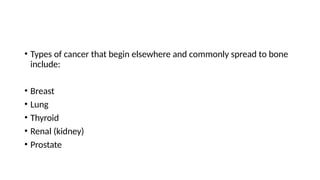
• Types ofcancer that begin elsewhere and commonly spread to bone
include:
• Breast
• Lung
• Thyroid
• Renal (kidney)
• Prostate
7.
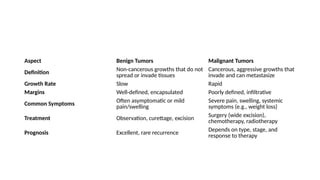
Aspect Benign TumorsMalignant Tumors
Definition
Non-cancerous growths that do not
spread or invade tissues
Cancerous, aggressive growths that
invade and can metastasize
Growth Rate Slow Rapid
Margins Well-defined, encapsulated Poorly defined, infiltrative
Common Symptoms
Often asymptomatic or mild
pain/swelling
Severe pain, swelling, systemic
symptoms (e.g., weight loss)
Treatment Observation, curettage, excision Surgery (wide excision),
chemotherapy, radiotherapy
Prognosis Excellent, rare recurrence
Depends on type, stage, and
response to therapy
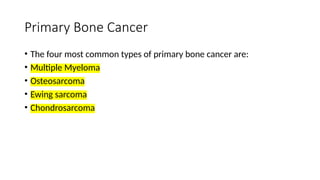
Primary Bone Cancer
•The four most common types of primary bone cancer are:
• Multiple Myeloma
• Osteosarcoma
• Ewing sarcoma
• Chondrosarcoma
10.
Multiple Myeloma
• Multiplemyeloma is the most common primary bone cancer. It is a
malignant tumor of bone marrow — the soft tissue in the center of
many bones that produces blood cells. Any bone can be affected by
this cancer.
• a blood cancer that develops in plasma cells in the bone marrow
• Multiple myeloma is typically treated with chemotherapy, radiation
therapy and, occasionally, surgery.
11.
Osteosarcoma
• Osteosarcoma isthe second most common primary bone cancer.
• develops in the osteoblast cells that form new bone.
• with most cases in teenagers and children.
• Most tumors develop around the knee in either the femur (thighbone) or tibia
(shinbone).
Other common locations include the hip and shoulder. Osteosarcoma is typically treated
with chemotherapy and surgery.
12.
Ewing Sarcoma
• atype of cancer that begins as a growth of cells in the bones and the
soft tissue around the bones.
• Ewing's sarcoma usually occurs in patients between the ages of 5 and
20.
• The most common locations affected are the upper and lower leg,
pelvis, upper arm, and ribs.
• Ewing's sarcoma is typically treated with chemotherapy and either
surgery or radiation therapy.
13.
Chondrosarcoma.
• Chondrosarcoma isa malignant tumor composed of cartilage-
producing cells.
• It is most often seen in patients between the ages of 40 and 70.
• Most cases occur around the hip, pelvis, or shoulder area.
In most cases, surgery is the only treatment used for chondrosarcoma.
14.
Symptoms
• Patients witha bone tumor will often experience pain in the area of
the tumor. This pain is generally described as dull and aching. It may
worsen at night and increase with activity.
• Other symptoms of a bone tumor can include fever and night sweats.
15.
Dx
• X-rays. X-raysprovide images of dense structures, such as bone. In
most cases, your doctor will order an X-ray to help diagnose a bone
tumor.
• Different types of tumors may look different on X-ray. Some dissolve
bone or make a hole in the bone. Others cause additional bone to
form. Some may do both.
16.
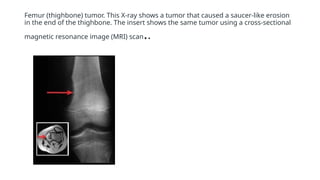
Femur (thighbone) tumor.This X-ray shows a tumor that caused a saucer-like erosion
in the end of the thighbone. The insert shows the same tumor using a cross-sectional
magnetic resonance image (MRI) scan..
17.
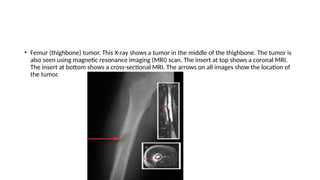
• Femur (thighbone)tumor. This X-ray shows a tumor in the middle of the thighbone. The tumor is
also seen using magnetic resonance imaging (MRI) scan. The insert at top shows a coronal MRI.
The insert at bottom shows a cross-sectional MRI. The arrows on all images show the location of
the tumor.
18.
DX
• Biopsy. Abiopsy may be necessary to confirm the diagnosis of a bone
tumor.
• In a biopsy, a sample of tissue is taken from the tumor. This sample is
examined under a microscope and analyzed by a pathologist (a doctor
who identifies diseases by studying abnormal cells).
19.
There are twobasic methods of performing a
biopsy:
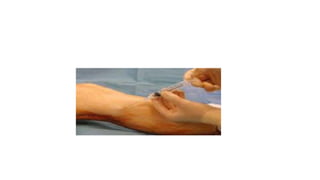
• 1.Needle biopsy: In this procedure, a needle is inserted into the tumor
to remove some tissue.
• You will first be given a local anesthetic. A needle biopsy of a bone
tumor is most often done by a radiologist.
• An imaging study, such as an X-ray, CT scan, or MRI scan, will be used
to help direct the needle.
21.
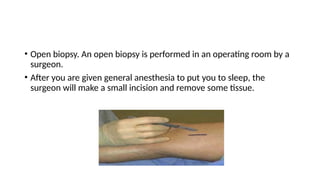
• Open biopsy.An open biopsy is performed in an operating room by a
surgeon.
• After you are given general anesthesia to put you to sleep, the
surgeon will make a small incision and remove some tissue.
22.
Tx
• Treatment dependsupon several factors, including the stage of the
cancer.
• If the cancer is localized, cancer cells are contained to the tumor and
the immediate surrounding area.
• When the cancer has reached a metastatic stage, it has spread
elsewhere in the body and may be more serious and harder to cure.
TNM classification
23.
Radiation therapy
• Radiationtherapy uses high-dose X-rays to kill cancer cells and shrink
tumors. This only treats the cancer in the area of the beam. It does
not treat cancer elsewhere in the body. Your doctor will determine if
radiation therapy is the best choice of treatment in your situation.
24.
Chemotherapy
• Chemotherapy (systemictreatment). Chemotherapy is often used to
kill tumor cells when they have spread into the bloodstream but
cannot yet be detected on tests and scans.
• It is generally used when cancerous tumors have a very high chance
of spreading.
• Chemotherapy is usually given intravenously (injection into a vein) or
in a pill or capsule that is swallowed.
25.
Surgical Tx
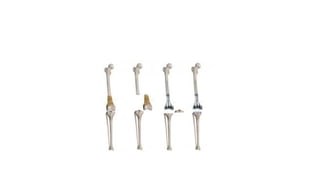
• Limbsalvage surgery:
• This surgery removes the cancerous section of bone but keeps nearby
muscles, tendons, nerves, and blood vessels intact where possible.
• The surgeon will take out the tumor and a portion of healthy tissue
around it.
• The excised bone is replaced with a metallic implant (prosthesis),
bone from elsewhere in your body, or bone from a donor.
27.
Amputation
• Amputation issurgery to remove all or part of an arm or leg. It is
usually used when a tumor is large and/or nerves and blood vessels
are involved.
• A prosthetic limb can aid function after amputation.
28.
Recurrence
• After treatment,you will continue to see your doctor for regular
follow-up visits and tests every few months.
• Even though the tumor has disappeared, it is important to monitor
your body for signs of recurrence.
• Tumors that come back may pose serious problems so it is important
to detect them early.
29.
Soft tissue tumors
•malignant soft tissue tumors include liposarcoma,
• leiomyosarcoma, and
• rhabdomyosarcoma.
30.
Liposarcoma
• a raretype of cancer that develops in the fatty tissue of the body,
often appearing as a lump.
• While liposarcomas can occur anywhere, they are commonly found in
the trunk, limbs, and retroperitoneum.
• Liposarcomas arise from lipoblasts, the precursor cells of fat cells.
31.
• There arefour main types:
• well-differentiated(most common),
• dedifferentiated,
• myxoid, and
• pleomorphic liposarcoma.( least Common)
• Treatment typically involves surgery, and sometimes radiation therapy
or chemotherapy
32.
Leiomyosarcoma
• Rare smoothmuscle cancer
• can occur in various parts of the body, including the uterus, abdomen,
and retroperitoneum.
• Symptoms depend on the location and size of the tumor and can
include pain, bloating, nausea, and unintentional weight loss.
33.
Dx and Tx
•Diagnosis: Diagnosis often involves a biopsy to examine the tumor
tissue.
• Treatment: Treatment typically involves surgery to remove the tumor,
and may also include chemotherapy and radiation therapy.
34.
Rhabdomyosarcoma
• a malignanttumor, a type of soft tissue sarcoma, that develops from
the cells that would normally develop into skeletal muscle
• most common in children and adolescents,
• It develops from mesenchymal cells, the cells that give rise to various
connective tissues, including skeletal muscle.
35.
Tx and Dx
•Diagnosis:
• Diagnosis is usually confirmed by biopsy, along with imaging like CT
scans or MRIs.
• Treatment:
• Treatment typically involves surgery, chemotherapy, and radiation
therapy, often in combination.
36.
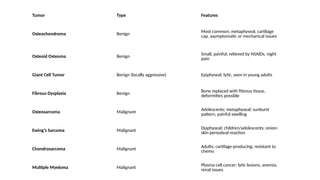
Tumor Type Features
OsteochondromaBenign
Most common; metaphyseal, cartilage
cap, asymptomatic or mechanical issues
Osteoid Osteoma Benign
Small, painful, relieved by NSAIDs, night
pain
Giant Cell Tumor Benign (locally aggressive) Epiphyseal, lytic, seen in young adults
Fibrous Dysplasia Benign
Bone replaced with fibrous tissue,
deformities possible
Osteosarcoma Malignant
Adolescents; metaphyseal; sunburst
pattern, painful swelling
Ewing’s Sarcoma Malignant
Diaphyseal; children/adolescents; onion-
skin periosteal reaction
Chondrosarcoma Malignant Adults; cartilage-producing; resistant to
chemo
Multiple Myeloma Malignant
Plasma cell cancer; lytic lesions, anemia,
renal issues
37.
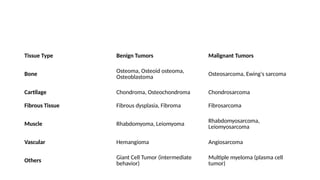
Benign Musculoskeletal Tumors:
•Benign tumors are non-cancerous and grow slowly. They generally do
not invade or spread to other parts of the body.
• Common benign bone tumors include non-ossifying fibroma, simple
bone cysts, osteochondroma, giant cell tumors, enchondroma, and
fibrous dysplasia.
• Benign soft tissue tumors include lipomas and schwanomas.
38.
Benign Tumors
• Osteochondroma:Most common benign bone tumor, metaphyseal,
cartilage-capped growth; often asymptomatic
• Osteoid Osteoma: Painful, nocturnal pain relieved by NSAIDs,
diaphyseal cortex of long bones
• Giant Cell Tumor: Occurs at epiphysis, locally aggressive, often in
young adults
• Fibrous Dysplasia: Bone replaced by fibrous tissue, may cause
deformities
39.
• Benign tumorsmay cause pain, swelling, or a palpable lump. They can
sometimes lead to fractures, particularly in young individuals with
tumors like osteochondromas.
• Many benign tumors can be monitored over time or treated with
medication. Some may require surgical removal or other techniques
to reduce the risk of fracture or disability.




![CTEV [ clubfoot] DR ARUN LAL ,DR MOHAMED ASHRAF travancore medical college k...](https://cdn.slidesharecdn.com/ss_thumbnails/ctevclubfootdrarunlaldrmohamedashraftravancoremedicalcollegekollamkeralaindia-260208063247-18fc466c-thumbnail.jpg?width=640&height=640&fit=bounds)


