INTRODUCTION TO
RADIATION ONCOLOGY
NURSING
MATHEW VARGHESE V
MSN(RAK),FHNP (CMC Vellore),CPEPC
Nursing officer
AIIMS Delhi
1
Radiation Therapy
 Definition
 Sources of radiation.
 Goals of radiotherapy.
 Mechanism of action.
 Principles of radiation protection.
 Types of radiation therapy.
 Care of clients receiving radiation
therapy.
 Side effects & symptom management.
2
RADIOTHERAPY
◦ One way to stop the cancer
from growing is to interfere
with the cancer cell’s ability to
multiply.
◦ Radiation at high dosages
causes changes in the cancer
cells that stops the cell’s
ability to multiply and
eventually kills the cancer cell.
◦ In some cases, it destroys
cancer cell, while in others, it
slows down the growth.
3
Radiotherapy
 RADIOTHERAPY is the treatment of neoplastic
disease using high energy ionizing rays (x-rays or
gamma rays) to kill cancer cells.
 These may be generated by radioactive sources or
linear accelerators.
 THE HIGHER THE ENERGY OF THE PHOTON,
THE DEEPER IT CAN PENETRATE THE BODY
BEFORE LOSING ITS EFFECT.
 Radiation deters the proliferation of malignant cells
by decreasing the rate of mitosis or impairing DNA
synthesis.
4
Sources of Radiation
 COLBALT 60
 CESIUM 137
 IODINE 131
 IRIDIUM 192
 RADIUM 226
 RADON 222
 STRONTIUM 90
5
Gamma & X-rays
High Energy
Ionizing
6
Goals of Radiotherapy
 Curative
 Control:
Adjuvant
Pre/Post Operative
Intraoperative
 Palliation
7
 Radiation therapy may be in many types of
cancer if they are localized to one area of the body.
 It may also be used as a part of therapy,
e.g.. after performing surgery for removing a primary
malignant tumor, it can be used to prevent tumor
recurrence ( for example, early stages of breast
cancer). It is common to combine radiation therapy
with surgery, chemotherapy, hormone therapy and
immunotherapy.
 It is , and has been
used before, during and after chemotherapy in
susceptible cancers.
 It may also be used as treatment where
cure is not possible and the aim is for local disease
control or symptomatic relief.
8
 Ionizing radiation works by damaging the DNA
of cancerous tissue leading to cellular death.
 To spare normal tissues, shaped radiation
beams are aimed from several angles of
exposure to intersect at the tumor, providing a
much larger absorbed dose there than in the
surrounding healthy tissues.
9
Radiation Protection:
Principles
ALARA Principle The physical protection against
external radiation is based on the
following three principles:
-distance from the source of
radiation (distance),
-limitation of the time of irradiation
(time),
-absorption of radiation (shielding).
10
Time
 Minimize time spent in close
proximity to the patient. Radiation
exposure is directly related to the
time spent within a specific distance
of radiation source. Care giver
should not exceed 1/2 to 1 hour
exposure per shift.
◦ Organize care, prior to entering room.
◦ Assemble all equipment, prior to room
entry
◦ In room, place supplies/equipment
within easy quick access.
◦ Post time guidelines on door. 11
Distance
 The amount of radiation decreases with
increase in distance.
 Doubling the distance from the radiation
source, Quarters the amount of radiation
received.
 If the exposure at 1 meter from the Radiation
Source is X, the exposure at 2m is ¼ of x, and
at 4m, one sixteenth.
Interventions:
 Teach patient self-care & rationale for isolation.
 Limit patient care by individual caregiver.
 Use communication devices outside room to
interact whenever possible.
12
Shielding
 When used properly, lead shielding
can provide added protection from
radiation.
 In practice, nurses find lead shielding
apron cumbersome to work with.
 Nurses wear a film badge.
 NB: Pregnant nurses should not care
for radiation patients.
13
Types of Radiation Therapy
 External Beam or Teletherapy
• most common type of radiation therapy using
machine (linear accelerator).
• patient is not radioactive.
 Internal radiation or Brachytherapy
• implant is placed inside patient
temporary/permanent.
• patient is radioactive.
14
Teletherapy
 Delivering radiation from a source at a
distance from the target.
 Radiation department administers the
dose.
 Advantage: skin sparring effect, giving
max radiation to tumor not the skin.
 Patient is monitored via TV or intercom
 Treatment approx. 10 minutes.
 Not painful, though patient may feels
heat or tingling.
15
EXTERNAL BEAM RADIATION
THERAPY
16
Brachytherapy
 Delivers a high dose of radiation to a localized area.
 The specific radioisotope is chosen on the basis of
its half-life
Brachytherapy may be sealed or unsealed:
SEALED:
Interstitial
Intracavitary
UNSEALED:
Systemic (IV, oral)
17
Brachytherapy
SEALED
 Emits low energy
continuously
 Interstitial &
intracavitary
implants
 Ex. Seeds,
APPLICATORS
 PATIENT EMITS
RADIATION but
NONE IN EXCRETA
UNSEALED
Injected, instilled or
oral.
Systemically
EX. I131
PATIENT AND
EXCRETA are
RADIOACTIVE
18
Sealed Brachytherapy:
Intracavitary:
 Radioisotopes (cesium or radium) put inside
the applicator & placed in body cavity for a
specific amount of time (24-72hours)
 When treatment completed, applicator &
radioactive material removed
 treats cancer of uterus & cervix.
Interstitial:
 needles, beads, seeds, ribbons or catheters
are placed directly into tumor (breast,
prostrate)
 Radioisotopes: iridium, cesium, gold, radon
 Placement can be temporary or permanent
 Treats Prostrate, cervical, esophagus
cancer etc.
19
BRACHYTHERAPY
APPLICATORS
Fletcher-Suit applicator
Radioactive seeds implanted in prostate 20
Nursing Care of the patient with
Sealed Implant
 Provide Private room with bathroom
 Radioactive material sign should be placed
outside
 Wear dosimeter
 No pregnant staff
 Visitors limited to 30 mins per day
 Visitors are restricted and must remain at 6 feet
distance
 All dressings & linens saved until implant
removed
 LEAD CONTAINER & LONG HANDLED
FORCEPS,LEAD GLOVES KEPT IN ROOM IN
EVENT OF DISLODGEMENT
 REMEMBER ALARA
TIME
DISTANCE
SHEILDING 21
Nursing Care of patient with
UNSEALED Implant
 Presents potential contamination hazard.
 All articles in room are considered
contaminated.
 After discharge, articles are discarded but
taken to protected area ‘till detectable
radioactivity decays’.
 Rubber gloves worn with direct care
 No pregnant staff
 Articles in room: phone, call light, floors
covered with plastic.
 Disposable plastic /paper should be used for
dietary trays & utensils.
 Flush toilet used by patient several times.
 Keep linen & gowns kept in separate isolation
bags 22
Loss of Radioactive Material
 Considered an emergency.
 Search should initiated by radiation
staff.
 Removes nothing from the room
while patient has radioactive
material in place.
 If radioactive material is found, use
long handled forceps & gloves.
 Notify Atomic Energy Center.
23
RADIATION THERAPY : INJURY
Phases of Radiation Injury:
Early (acute) Phase: occurs within weeks and resolve
4-6 weeks post radiation. Usually temporary and
affect tissues with rapidly dividing cells (skin,
mucous membranes)
Late Phase: may occur months/years later and
usually result from damage to the micro-circulation.
Affect any/all tissues especially: lymph, thyroid,
pituitary, breast, brain, bone, cartilage, pancreas
and bile ducts.
24
SIDE EFFECTS OF RADIATION
THERAPY
Factors influencing degree & occurrence of
side effects due to Radiotherapy
 Body site irradiated
 Dosage
 Extent of body area treated
 Method of radiation delivery
 Age of client
 General health of client
 Previous surgeries & chemotherapy
 Radiosensitivity of tissue/organ treated.
25
Symptom Management in
Radiation Oncology
 Nausea & vomiting
 Diarrhea
 Xerostomia
 Ocular symptoms ( edema, dryness, photophobia)
 Oral mucositis
 Alopecia
 Hyperthermia
 Headache
 Cystitis
 Esophagitis
26
Skin Reactions
 Acute: begin about 2 weeks after start
of treatment and resolve over next 3-4
weeks. Reactions include erythema,
dry desquamation, wet desquamation
 Chronic: may occur years later and
include atrophy, pigment changes,
fibrosis and telangiectasia.
27
Dry desquamation
 Begins within 7-10 days of treatment
 Erythema that may progress to dry, itchy skin
 May be scaling, flaking, peeling
 Result of partial loss of the epidermal basal
cell layer.
Wet desquamation
 Result of complete destruction of the basal cell
layer
 Blister, vesicles, and serous oozing occur
 Pain may occur if nerve endings are exposed
 Occurs more often in areas of friction &
moisture (skin fold, groins)
 Increased risk of infection (may require break
in treatment)
28
General Skin Care
 Wash daily with water or mild scent-free soap
 Use hand to wash the area.
 Rinse soap well.
 Pat skin dry.
 Don't use powders, creams unless ordered by
Oncologist.
 Wear soft clothing over radiation site (cotton).
 Avoid belts, straps & tight clothing.
 Avoid sun exposure.
 Shave with electric razor.
 Do not use tape over site.
29
Alopecia
 May occur within the treatment field.
 Extent depends upon area of
treatment and dose of XRT.
 Often patchy in appearance.
 Usually begins 2 weeks after start of
XRT.
 Usually temporary, but may be
permanent.
 Regrowth usually begins 3-6months.
30
Mucositis
 Inflammation of the mucosal lining of the G.I.
tract
• If oral cavity - stomatitis
• If esophagus – esophagitis
 Common in patients receiving RT to head & neck
 Severity depends on dose, size of field, and
fractionation schedule of RT
Symptoms include:
 Soreness or burning in mouth/ throat
 Difficulty swallowing
 Sensation of “having lump in throat”
 Redness, tenderness, or ulcerations
in the mouth
31
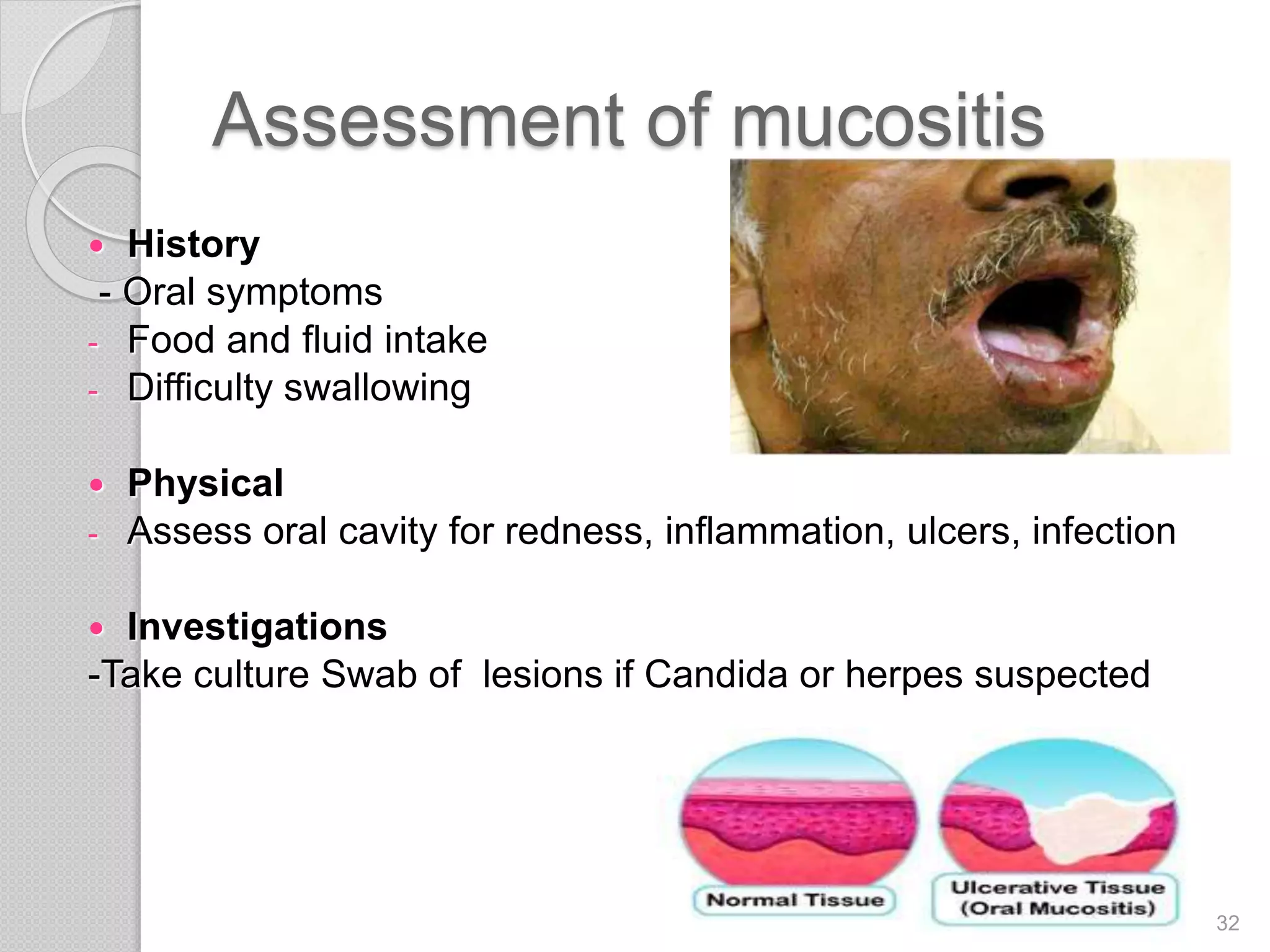
Assessment of mucositis
 History
- Oral symptoms
- Food and fluid intake
- Difficulty swallowing
 Physical
- Assess oral cavity for redness, inflammation, ulcers, infection
 Investigations
-Take culture Swab of lesions if Candida or herpes suspected
32
MUCOSITIS
INTERVENTION
Instruct patient/caregiver to:
 Gently brush all surfaces of teeth, gums, and tongue
with a soft nylon brush.
 Brush with a nonirritating dentifrice such as baking
soda.
 Remove and brush dentures thoroughly during and
after meals and as needed.
 Rinse the mouth thoroughly during and after brushing
 Avoid alcohol-containing mouthwashes.
 Use recommended mouth rinses:
o Hydrogen peroxide and saline or water (1:2 or 1:4).
o Baking soda and water (1 tsp in 500 ml).
o Salt (.5 tsp), baking soda (1 tsp), and water (100 ml).
 Keep lips moist.
 Avoid use of tobacco and alcohol.
33
Xerostomia
 Dryness in the mouth caused by lack
of normal secretion of saliva
 Salivary glands very sensitive to RT
 Severity related to dose
 May be permanent with higher doses
 Lack of moisture to mucosa causes
irritation to the mucosa, fissures may
develop on the corners of the mouth
 Xerostomia promotes accumulation
of bacteria and plaque increasing
susceptibility to infection, dental
caries, and periodontal disease
34
Xerostomia Interventions
 Good oral hygiene
 Frequent sips water, sugarless gum, avoid dry
foods, liquids with meals
 Avoid alcohol and smoking
 Humidifier
 Artificial saliva i.e. Moistir ac meals, hs, & prn
 Pilocarpine for radiation induced Xerostomia
35
Diarrhea
 Passage of frequent (more than 3/24hrs), loose,
watery stool
 Can lead to dehydration, malabsorption, fatigue,
hemorrhoids, and perianal skin breakdown
 Caused by irritation/inflammation of the bowel
lining
 Risk for Diarrhea
 Higher in patients undergoing chemo or RT to
abdomen or pelvis
 With XRT usually develops 10-15 days into
treatment
 Lasts 2-3 weeks after treatment
36
Assessment of Diarrhea
 History - onset, pattern, number of
B.M.’s/24 hrs.
 Physical – vital signs, assess
hydration status
 Psychological – anxiety, stress
 Investigations – serum electrolytes,
creatinine & urea, stool cultures &
stool for c. difficile
37
Interventions
 Radiation induced diarrhea usually managed
initially with dietary changes
- Small freq. meals
- Drink 8-10 glasses of fluids
- Low fat, low fiber diet
- Avoid gas producing foods
- Avoid caffeinated beverages
 Loperamide – if patient has more than 3 watery
B.M.’s per day
 Protect peri-anal area form skin breakdown
- Keep area clean and dry
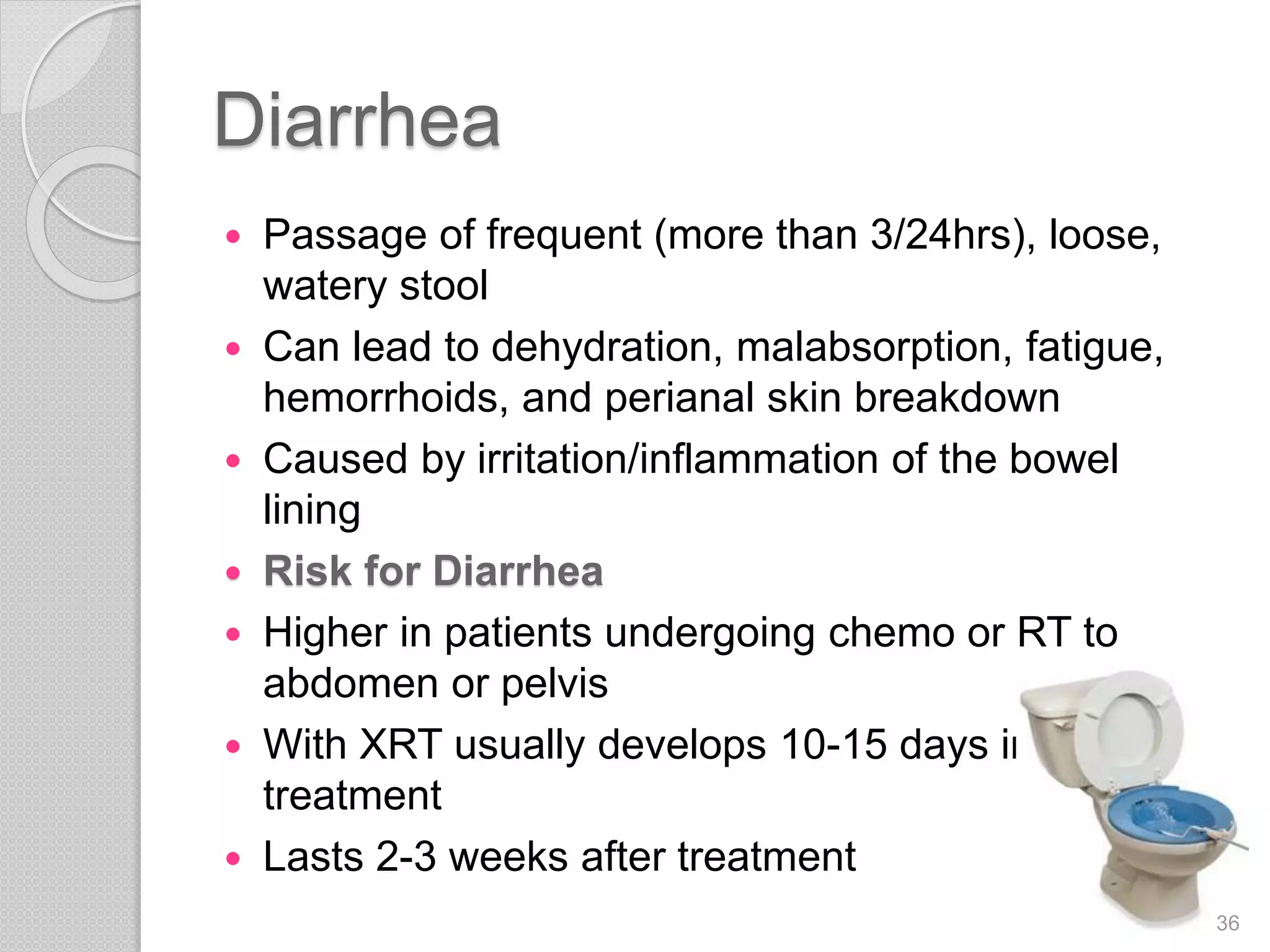
- Sitz bathes several times a day can ease
discomfort
38
Other complications radiation
treatment
 Cystitis (usually occurs 1-2 weeks
post XRT and subsides 2 weeks after
XRT complete
 Lhermitte’s syndrome – after spinal
cord radiation
 Vaginal stenosis – after XRT to pelvis
 Radiation pneumonitis – after XRT to
lungs
39
40

Introduction to radiation oncology nursing

  • 1.
    INTRODUCTION TO RADIATION ONCOLOGY NURSING MATHEWVARGHESE V MSN(RAK),FHNP (CMC Vellore),CPEPC Nursing officer AIIMS Delhi 1
  • 2.
    Radiation Therapy  Definition Sources of radiation.  Goals of radiotherapy.  Mechanism of action.  Principles of radiation protection.  Types of radiation therapy.  Care of clients receiving radiation therapy.  Side effects & symptom management. 2
  • 3.
    RADIOTHERAPY ◦ One wayto stop the cancer from growing is to interfere with the cancer cell’s ability to multiply. ◦ Radiation at high dosages causes changes in the cancer cells that stops the cell’s ability to multiply and eventually kills the cancer cell. ◦ In some cases, it destroys cancer cell, while in others, it slows down the growth. 3
  • 4.
    Radiotherapy  RADIOTHERAPY isthe treatment of neoplastic disease using high energy ionizing rays (x-rays or gamma rays) to kill cancer cells.  These may be generated by radioactive sources or linear accelerators.  THE HIGHER THE ENERGY OF THE PHOTON, THE DEEPER IT CAN PENETRATE THE BODY BEFORE LOSING ITS EFFECT.  Radiation deters the proliferation of malignant cells by decreasing the rate of mitosis or impairing DNA synthesis. 4
  • 5.
    Sources of Radiation COLBALT 60  CESIUM 137  IODINE 131  IRIDIUM 192  RADIUM 226  RADON 222  STRONTIUM 90 5
  • 6.
    Gamma & X-rays HighEnergy Ionizing 6
  • 7.
    Goals of Radiotherapy Curative  Control: Adjuvant Pre/Post Operative Intraoperative  Palliation 7
  • 8.
     Radiation therapymay be in many types of cancer if they are localized to one area of the body.  It may also be used as a part of therapy, e.g.. after performing surgery for removing a primary malignant tumor, it can be used to prevent tumor recurrence ( for example, early stages of breast cancer). It is common to combine radiation therapy with surgery, chemotherapy, hormone therapy and immunotherapy.  It is , and has been used before, during and after chemotherapy in susceptible cancers.  It may also be used as treatment where cure is not possible and the aim is for local disease control or symptomatic relief. 8
  • 9.
     Ionizing radiationworks by damaging the DNA of cancerous tissue leading to cellular death.  To spare normal tissues, shaped radiation beams are aimed from several angles of exposure to intersect at the tumor, providing a much larger absorbed dose there than in the surrounding healthy tissues. 9
  • 10.
    Radiation Protection: Principles ALARA PrincipleThe physical protection against external radiation is based on the following three principles: -distance from the source of radiation (distance), -limitation of the time of irradiation (time), -absorption of radiation (shielding). 10
  • 11.
    Time  Minimize timespent in close proximity to the patient. Radiation exposure is directly related to the time spent within a specific distance of radiation source. Care giver should not exceed 1/2 to 1 hour exposure per shift. ◦ Organize care, prior to entering room. ◦ Assemble all equipment, prior to room entry ◦ In room, place supplies/equipment within easy quick access. ◦ Post time guidelines on door. 11
  • 12.
    Distance  The amountof radiation decreases with increase in distance.  Doubling the distance from the radiation source, Quarters the amount of radiation received.  If the exposure at 1 meter from the Radiation Source is X, the exposure at 2m is ¼ of x, and at 4m, one sixteenth. Interventions:  Teach patient self-care & rationale for isolation.  Limit patient care by individual caregiver.  Use communication devices outside room to interact whenever possible. 12
  • 13.
    Shielding  When usedproperly, lead shielding can provide added protection from radiation.  In practice, nurses find lead shielding apron cumbersome to work with.  Nurses wear a film badge.  NB: Pregnant nurses should not care for radiation patients. 13
  • 14.
    Types of RadiationTherapy  External Beam or Teletherapy • most common type of radiation therapy using machine (linear accelerator). • patient is not radioactive.  Internal radiation or Brachytherapy • implant is placed inside patient temporary/permanent. • patient is radioactive. 14
  • 15.
    Teletherapy  Delivering radiationfrom a source at a distance from the target.  Radiation department administers the dose.  Advantage: skin sparring effect, giving max radiation to tumor not the skin.  Patient is monitored via TV or intercom  Treatment approx. 10 minutes.  Not painful, though patient may feels heat or tingling. 15
  • 16.
  • 17.
    Brachytherapy  Delivers ahigh dose of radiation to a localized area.  The specific radioisotope is chosen on the basis of its half-life Brachytherapy may be sealed or unsealed: SEALED: Interstitial Intracavitary UNSEALED: Systemic (IV, oral) 17
  • 18.
    Brachytherapy SEALED  Emits lowenergy continuously  Interstitial & intracavitary implants  Ex. Seeds, APPLICATORS  PATIENT EMITS RADIATION but NONE IN EXCRETA UNSEALED Injected, instilled or oral. Systemically EX. I131 PATIENT AND EXCRETA are RADIOACTIVE 18
  • 19.
    Sealed Brachytherapy: Intracavitary:  Radioisotopes(cesium or radium) put inside the applicator & placed in body cavity for a specific amount of time (24-72hours)  When treatment completed, applicator & radioactive material removed  treats cancer of uterus & cervix. Interstitial:  needles, beads, seeds, ribbons or catheters are placed directly into tumor (breast, prostrate)  Radioisotopes: iridium, cesium, gold, radon  Placement can be temporary or permanent  Treats Prostrate, cervical, esophagus cancer etc. 19
  • 20.
  • 21.
    Nursing Care ofthe patient with Sealed Implant  Provide Private room with bathroom  Radioactive material sign should be placed outside  Wear dosimeter  No pregnant staff  Visitors limited to 30 mins per day  Visitors are restricted and must remain at 6 feet distance  All dressings & linens saved until implant removed  LEAD CONTAINER & LONG HANDLED FORCEPS,LEAD GLOVES KEPT IN ROOM IN EVENT OF DISLODGEMENT  REMEMBER ALARA TIME DISTANCE SHEILDING 21
  • 22.
    Nursing Care ofpatient with UNSEALED Implant  Presents potential contamination hazard.  All articles in room are considered contaminated.  After discharge, articles are discarded but taken to protected area ‘till detectable radioactivity decays’.  Rubber gloves worn with direct care  No pregnant staff  Articles in room: phone, call light, floors covered with plastic.  Disposable plastic /paper should be used for dietary trays & utensils.  Flush toilet used by patient several times.  Keep linen & gowns kept in separate isolation bags 22
  • 23.
    Loss of RadioactiveMaterial  Considered an emergency.  Search should initiated by radiation staff.  Removes nothing from the room while patient has radioactive material in place.  If radioactive material is found, use long handled forceps & gloves.  Notify Atomic Energy Center. 23
  • 24.
    RADIATION THERAPY :INJURY Phases of Radiation Injury: Early (acute) Phase: occurs within weeks and resolve 4-6 weeks post radiation. Usually temporary and affect tissues with rapidly dividing cells (skin, mucous membranes) Late Phase: may occur months/years later and usually result from damage to the micro-circulation. Affect any/all tissues especially: lymph, thyroid, pituitary, breast, brain, bone, cartilage, pancreas and bile ducts. 24
  • 25.
    SIDE EFFECTS OFRADIATION THERAPY Factors influencing degree & occurrence of side effects due to Radiotherapy  Body site irradiated  Dosage  Extent of body area treated  Method of radiation delivery  Age of client  General health of client  Previous surgeries & chemotherapy  Radiosensitivity of tissue/organ treated. 25
  • 26.
    Symptom Management in RadiationOncology  Nausea & vomiting  Diarrhea  Xerostomia  Ocular symptoms ( edema, dryness, photophobia)  Oral mucositis  Alopecia  Hyperthermia  Headache  Cystitis  Esophagitis 26
  • 27.
    Skin Reactions  Acute:begin about 2 weeks after start of treatment and resolve over next 3-4 weeks. Reactions include erythema, dry desquamation, wet desquamation  Chronic: may occur years later and include atrophy, pigment changes, fibrosis and telangiectasia. 27
  • 28.
    Dry desquamation  Beginswithin 7-10 days of treatment  Erythema that may progress to dry, itchy skin  May be scaling, flaking, peeling  Result of partial loss of the epidermal basal cell layer. Wet desquamation  Result of complete destruction of the basal cell layer  Blister, vesicles, and serous oozing occur  Pain may occur if nerve endings are exposed  Occurs more often in areas of friction & moisture (skin fold, groins)  Increased risk of infection (may require break in treatment) 28
  • 29.
    General Skin Care Wash daily with water or mild scent-free soap  Use hand to wash the area.  Rinse soap well.  Pat skin dry.  Don't use powders, creams unless ordered by Oncologist.  Wear soft clothing over radiation site (cotton).  Avoid belts, straps & tight clothing.  Avoid sun exposure.  Shave with electric razor.  Do not use tape over site. 29
  • 30.
    Alopecia  May occurwithin the treatment field.  Extent depends upon area of treatment and dose of XRT.  Often patchy in appearance.  Usually begins 2 weeks after start of XRT.  Usually temporary, but may be permanent.  Regrowth usually begins 3-6months. 30
  • 31.
    Mucositis  Inflammation ofthe mucosal lining of the G.I. tract • If oral cavity - stomatitis • If esophagus – esophagitis  Common in patients receiving RT to head & neck  Severity depends on dose, size of field, and fractionation schedule of RT Symptoms include:  Soreness or burning in mouth/ throat  Difficulty swallowing  Sensation of “having lump in throat”  Redness, tenderness, or ulcerations in the mouth 31
  • 32.
    Assessment of mucositis History - Oral symptoms - Food and fluid intake - Difficulty swallowing  Physical - Assess oral cavity for redness, inflammation, ulcers, infection  Investigations -Take culture Swab of lesions if Candida or herpes suspected 32
  • 33.
    MUCOSITIS INTERVENTION Instruct patient/caregiver to: Gently brush all surfaces of teeth, gums, and tongue with a soft nylon brush.  Brush with a nonirritating dentifrice such as baking soda.  Remove and brush dentures thoroughly during and after meals and as needed.  Rinse the mouth thoroughly during and after brushing  Avoid alcohol-containing mouthwashes.  Use recommended mouth rinses: o Hydrogen peroxide and saline or water (1:2 or 1:4). o Baking soda and water (1 tsp in 500 ml). o Salt (.5 tsp), baking soda (1 tsp), and water (100 ml).  Keep lips moist.  Avoid use of tobacco and alcohol. 33
  • 34.
    Xerostomia  Dryness inthe mouth caused by lack of normal secretion of saliva  Salivary glands very sensitive to RT  Severity related to dose  May be permanent with higher doses  Lack of moisture to mucosa causes irritation to the mucosa, fissures may develop on the corners of the mouth  Xerostomia promotes accumulation of bacteria and plaque increasing susceptibility to infection, dental caries, and periodontal disease 34
  • 35.
    Xerostomia Interventions  Goodoral hygiene  Frequent sips water, sugarless gum, avoid dry foods, liquids with meals  Avoid alcohol and smoking  Humidifier  Artificial saliva i.e. Moistir ac meals, hs, & prn  Pilocarpine for radiation induced Xerostomia 35
  • 36.
    Diarrhea  Passage offrequent (more than 3/24hrs), loose, watery stool  Can lead to dehydration, malabsorption, fatigue, hemorrhoids, and perianal skin breakdown  Caused by irritation/inflammation of the bowel lining  Risk for Diarrhea  Higher in patients undergoing chemo or RT to abdomen or pelvis  With XRT usually develops 10-15 days into treatment  Lasts 2-3 weeks after treatment 36
  • 37.
    Assessment of Diarrhea History - onset, pattern, number of B.M.’s/24 hrs.  Physical – vital signs, assess hydration status  Psychological – anxiety, stress  Investigations – serum electrolytes, creatinine & urea, stool cultures & stool for c. difficile 37
  • 38.
    Interventions  Radiation induceddiarrhea usually managed initially with dietary changes - Small freq. meals - Drink 8-10 glasses of fluids - Low fat, low fiber diet - Avoid gas producing foods - Avoid caffeinated beverages  Loperamide – if patient has more than 3 watery B.M.’s per day  Protect peri-anal area form skin breakdown - Keep area clean and dry - Sitz bathes several times a day can ease discomfort 38
  • 39.
    Other complications radiation treatment Cystitis (usually occurs 1-2 weeks post XRT and subsides 2 weeks after XRT complete  Lhermitte’s syndrome – after spinal cord radiation  Vaginal stenosis – after XRT to pelvis  Radiation pneumonitis – after XRT to lungs 39
  • 40.