SECURITY ANALYSIS
&
PORTFOLIO MANAGEMENT
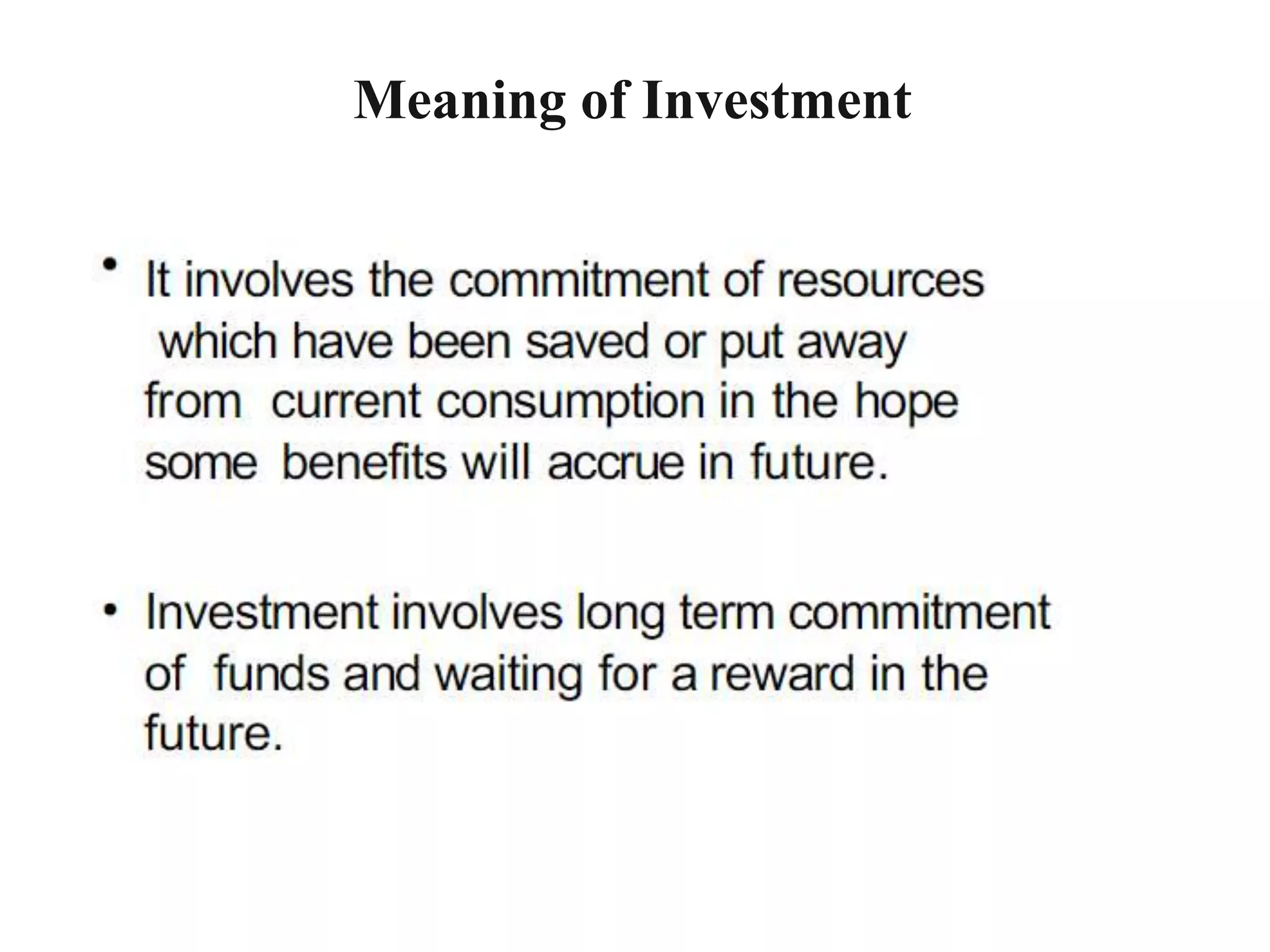
Meaning of Investment
Definition of Investment
Meaning of Investment
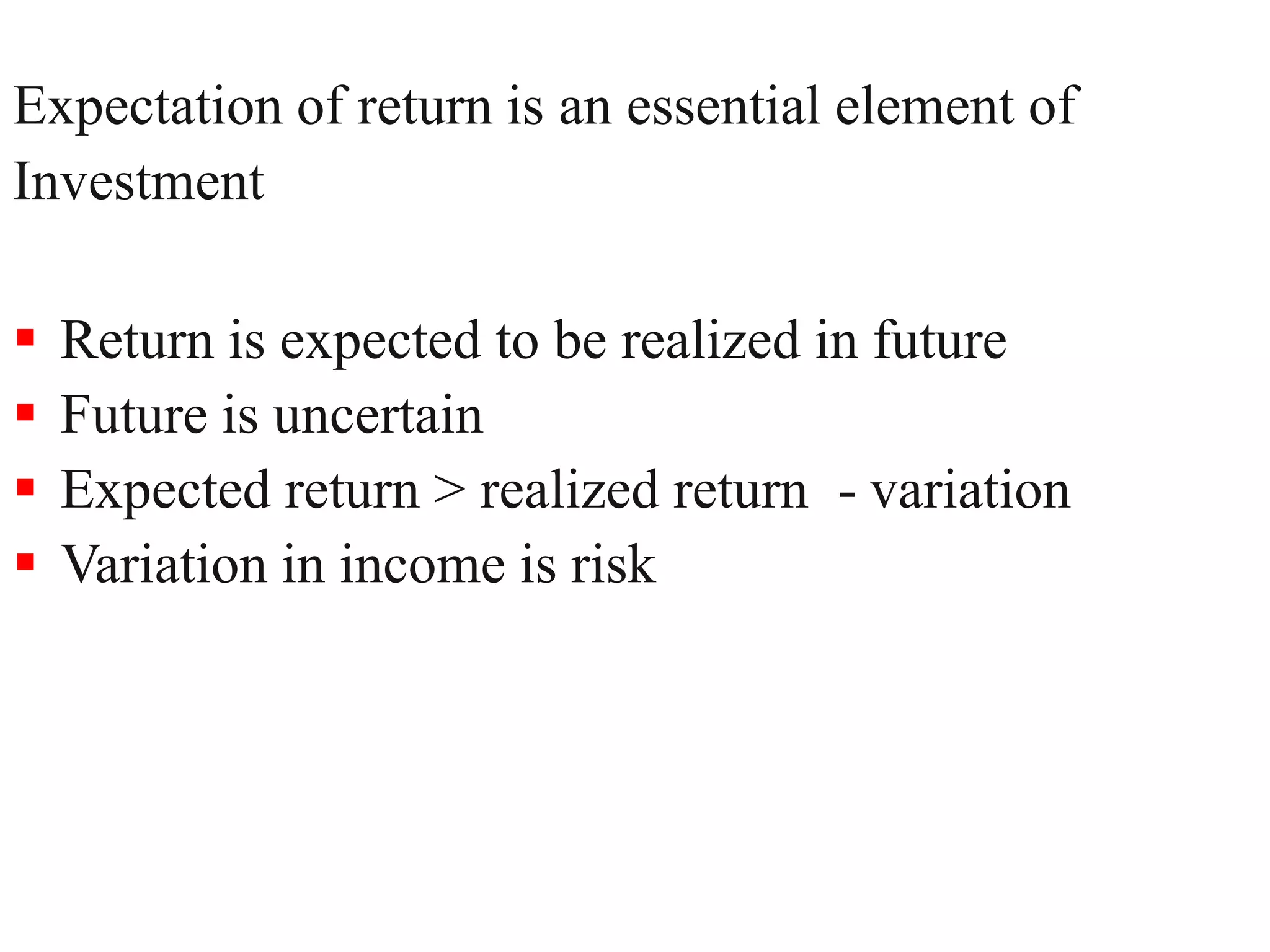
Expectation of return is an essential element of
Investment
 Return is expected to be realized in future
 Future is uncertain
 Expected return > realized return - variation
 Variation in income is risk
6
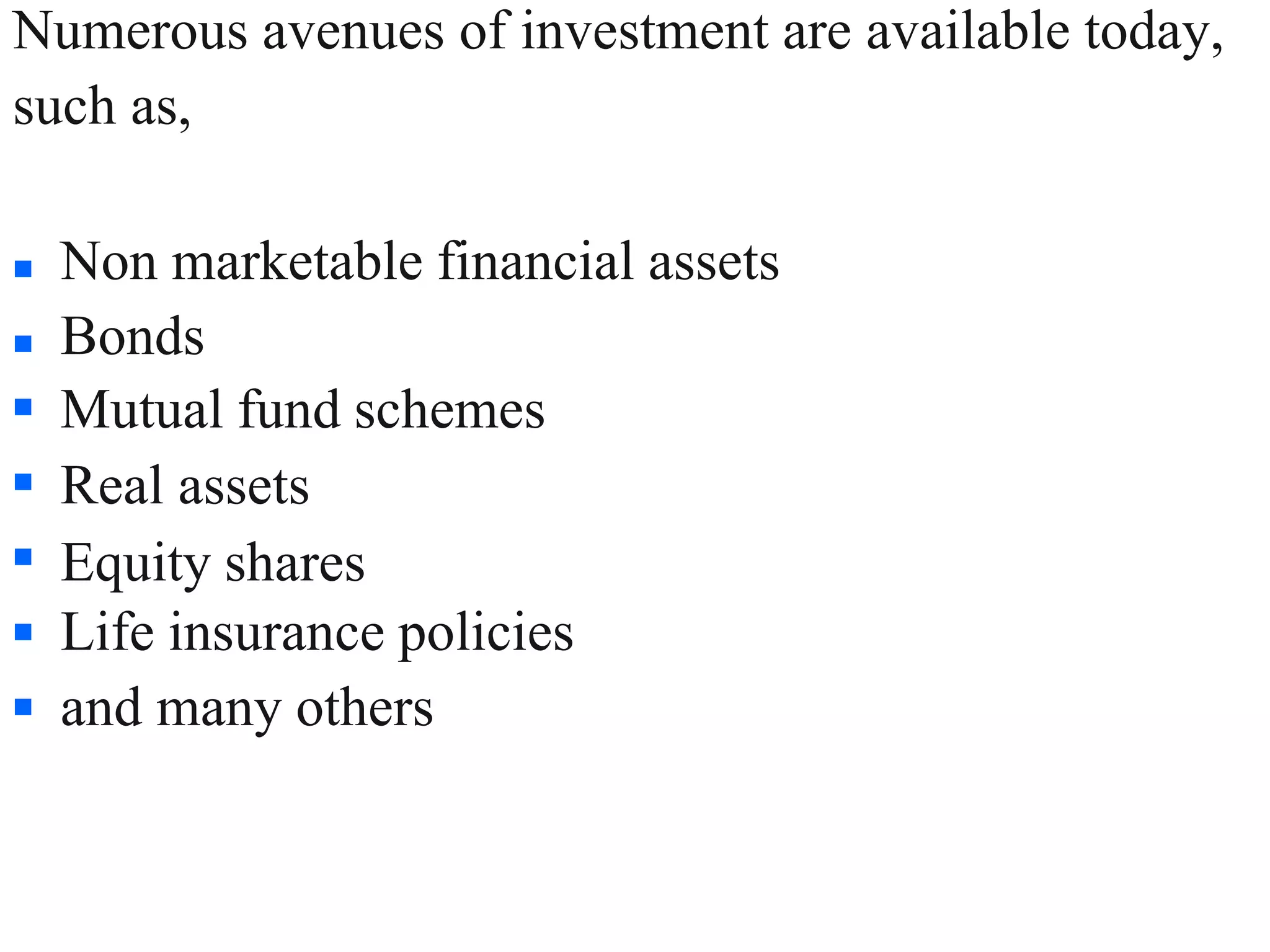
Numerous avenues of investment are available today,
such as,
7
 Non marketable financial assets





 Bonds
Mutual fund schemes
Real assets
Equity shares
Life insurance policies
and many others
8
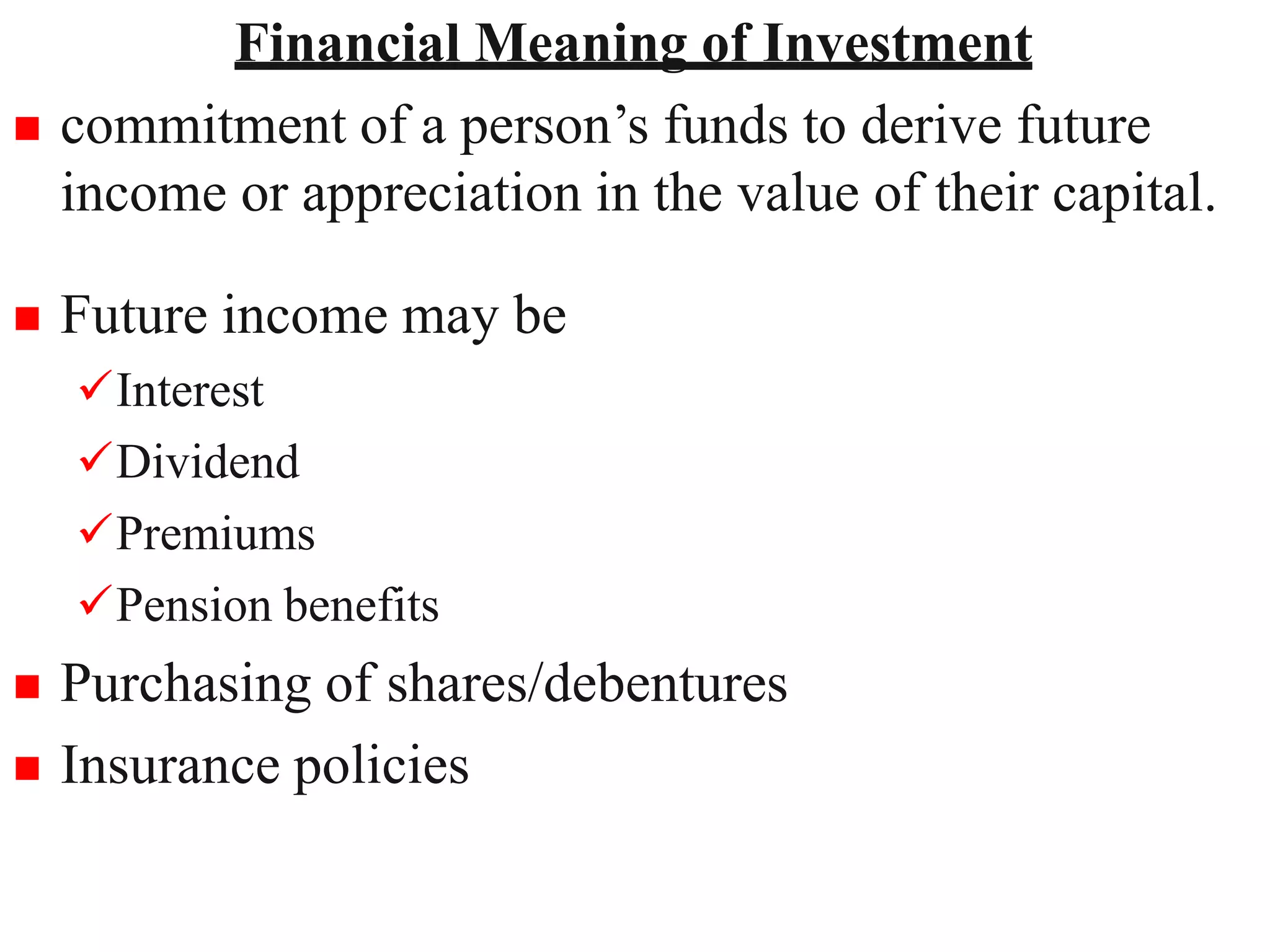
Financial Meaning of Investment
 commitment of a person’s funds to derive future
income or appreciation in the value of their capital.
 Future income may be
Interest
Dividend
Premiums
Pension benefits
 Purchasing of shares/debentures
 Insurance policies
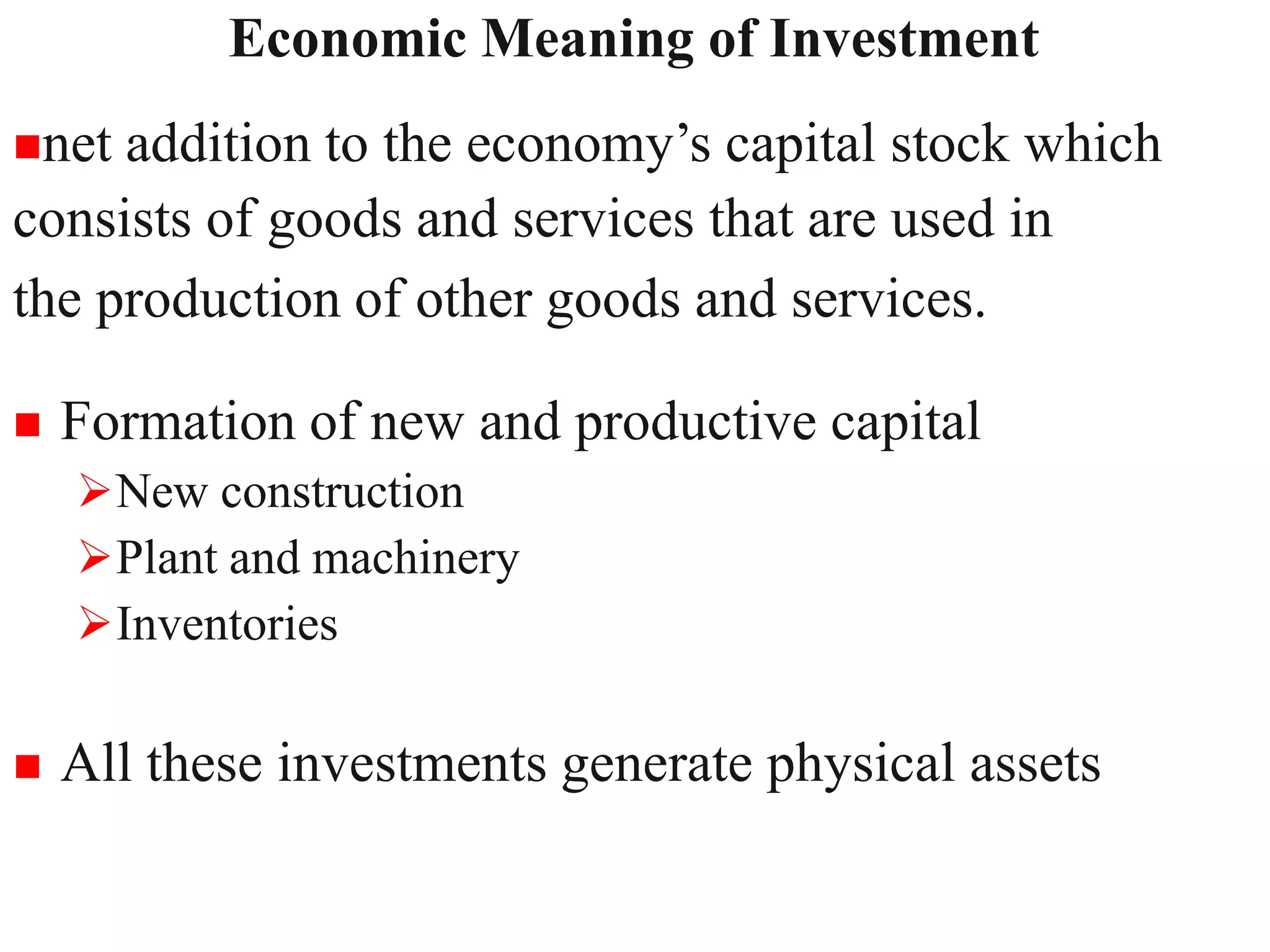
Economic Meaning of Investment
9
net addition to the economy’s capital stock which
consists of goods and services that are used in
the production of other goods and services.
 Formation of new and productive capital
New construction
Plant and machinery
Inventories
 All these investments generate physical assets
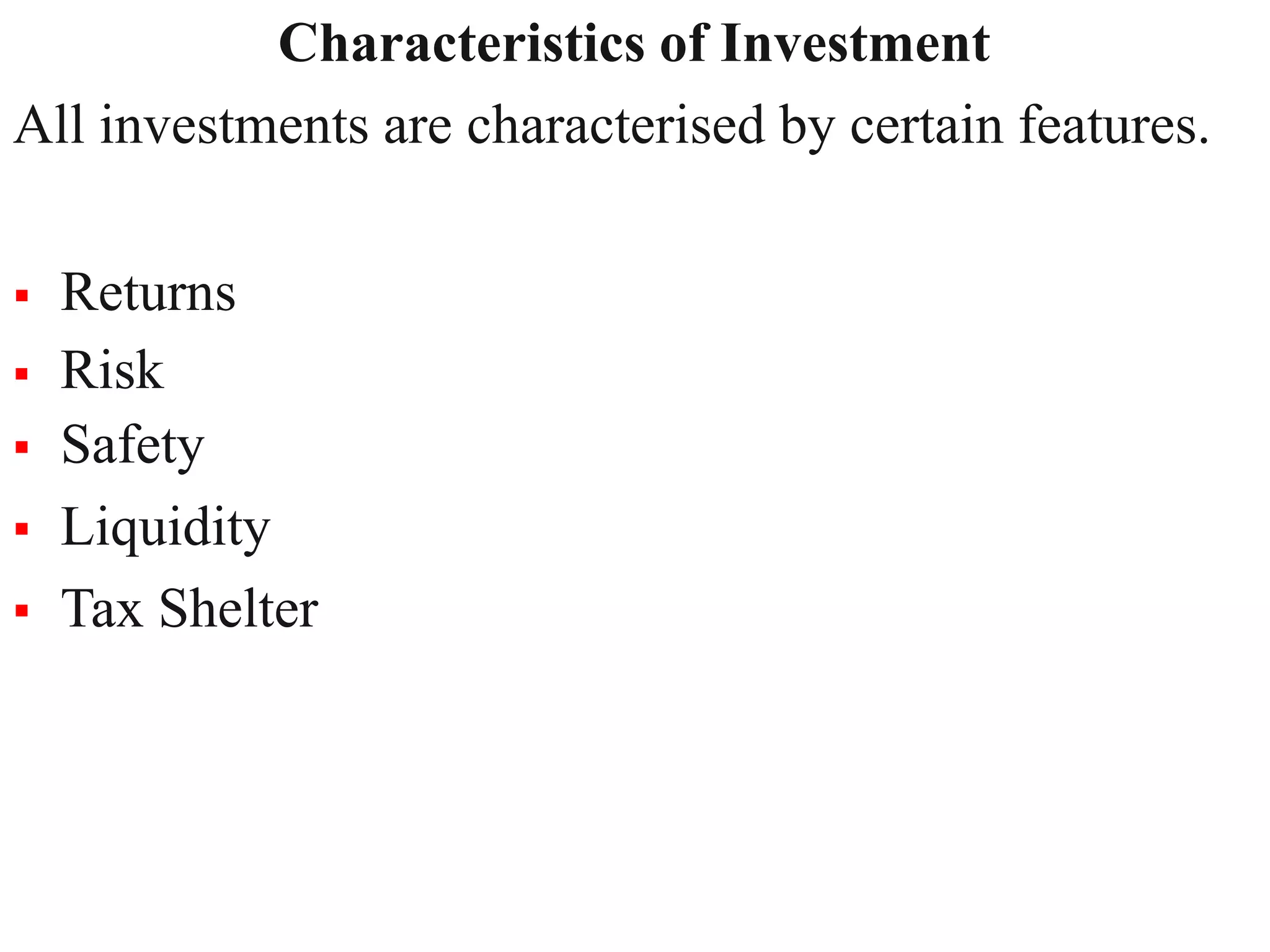
Characteristics of Investment
10
All investments are characterised by certain features.
 Returns



 Risk
Safety
Liquidity
Tax Shelter
Return
11
Returns depends upon
 nature of the investment
 the maturity period
 host of other factors
Received return in the form of
Yield[dividend or interest] + capital
appreciation[difference between sales price and
purchase price]
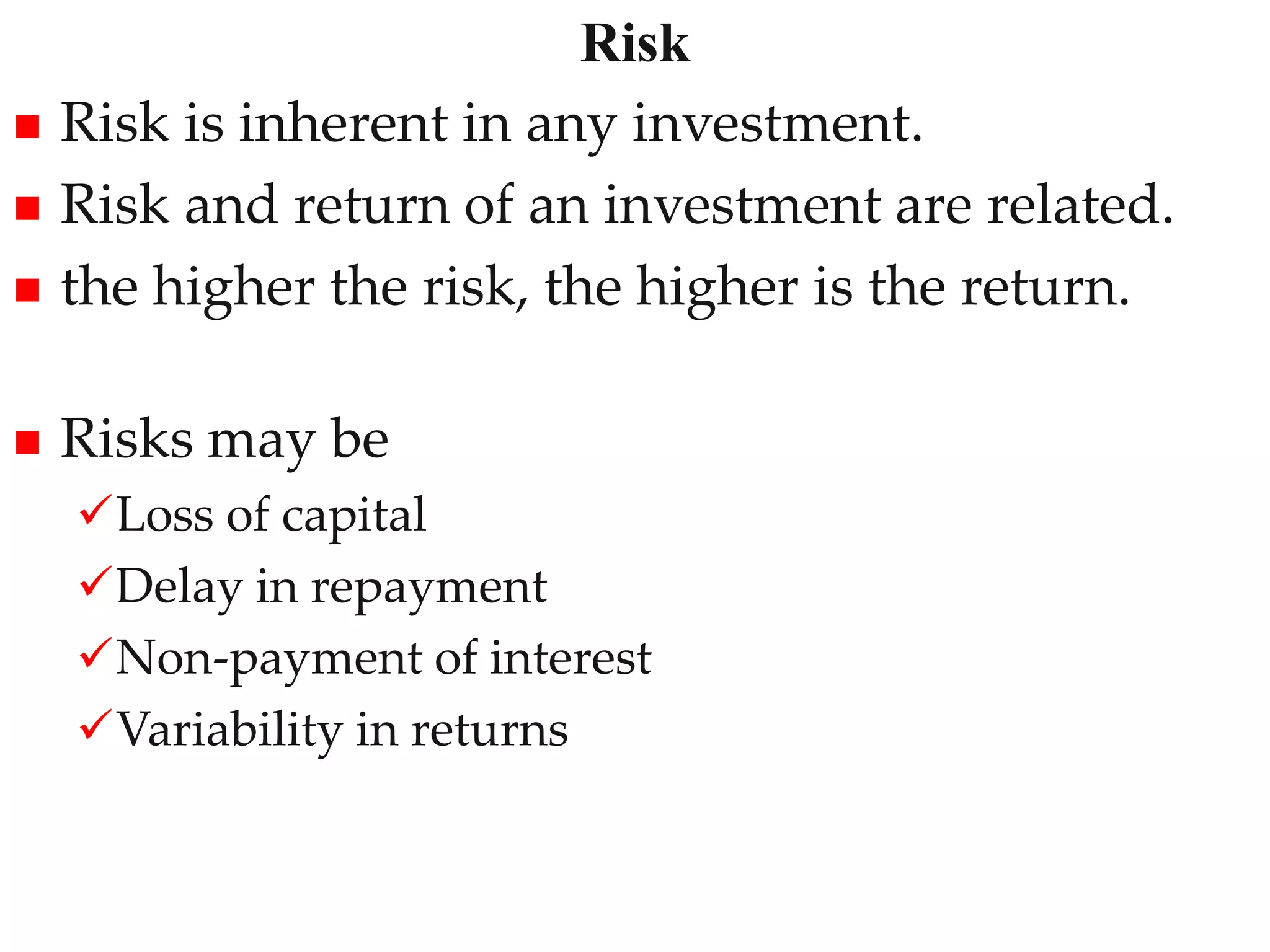
Risk
12
 Risk is inherent in any investment.
 Risk and return of an investment are related.
 the higher the risk, the higher is the return.
 Risks may be
Loss of capital
Delay in repayment
Non-payment of interest
Variability in returns
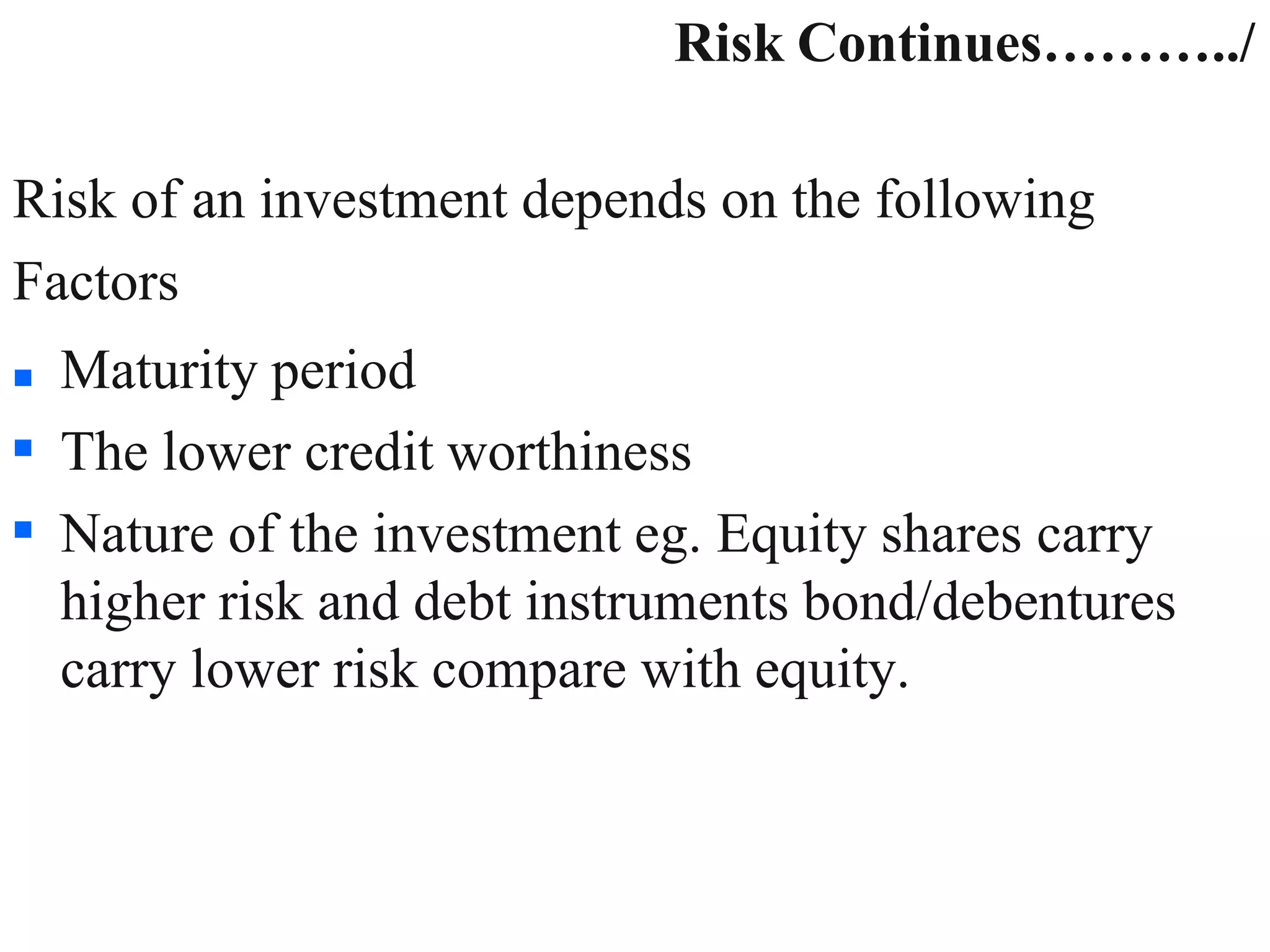
Risk Continues………../
13
Risk of an investment depends on the following
Factors


 Maturity period
The lower credit worthiness
Nature of the investment eg. Equity shares carry
higher risk and debt instruments bond/debentures
carry lower risk compare with equity.
Safety
14
 Every investor expects to get back his capital on
maturity without loss and without delay
 Safety is another feature which an investor
desires for his investments
 safety implies the certainty of return of capital
without loss of money or time.
Liquidity
15
An investment which is easily saleable or
marketable

 without loss of money
without loss of time
is said to be possess liquidity.
Tax Shelter
Tax benefits are in the following three kinds
 Initial tax benefit
 Continuing tax benefit
 Terminal tax benefit
16
17
Initial tax benefit
The tax relief enjoyed at the time of making the
Investment.
Continuing Tax benefit
A continuing tax benefit represents the tax shield
associated with the periodic returns from the
Investment.
18
Terminal Tax benefit
Relief from taxation when an investment is realized
or liquidate
Ex:
withdrawal from a public provident fund
account is not subject to tax
It is considered as an involvement of funds of high risk
and more uncertain expectation of returns. It is basically a
short term phenomenon where people tend to buy assets
with the hope that a profit can be earned from a
subsequent price change. It is based on the expectation
that some change will occur.
The stock brokers may be cited as an
example. Some brokers buy shares with a view to make
quick profit by selling within few days, when the prices of
such shares shoot up.
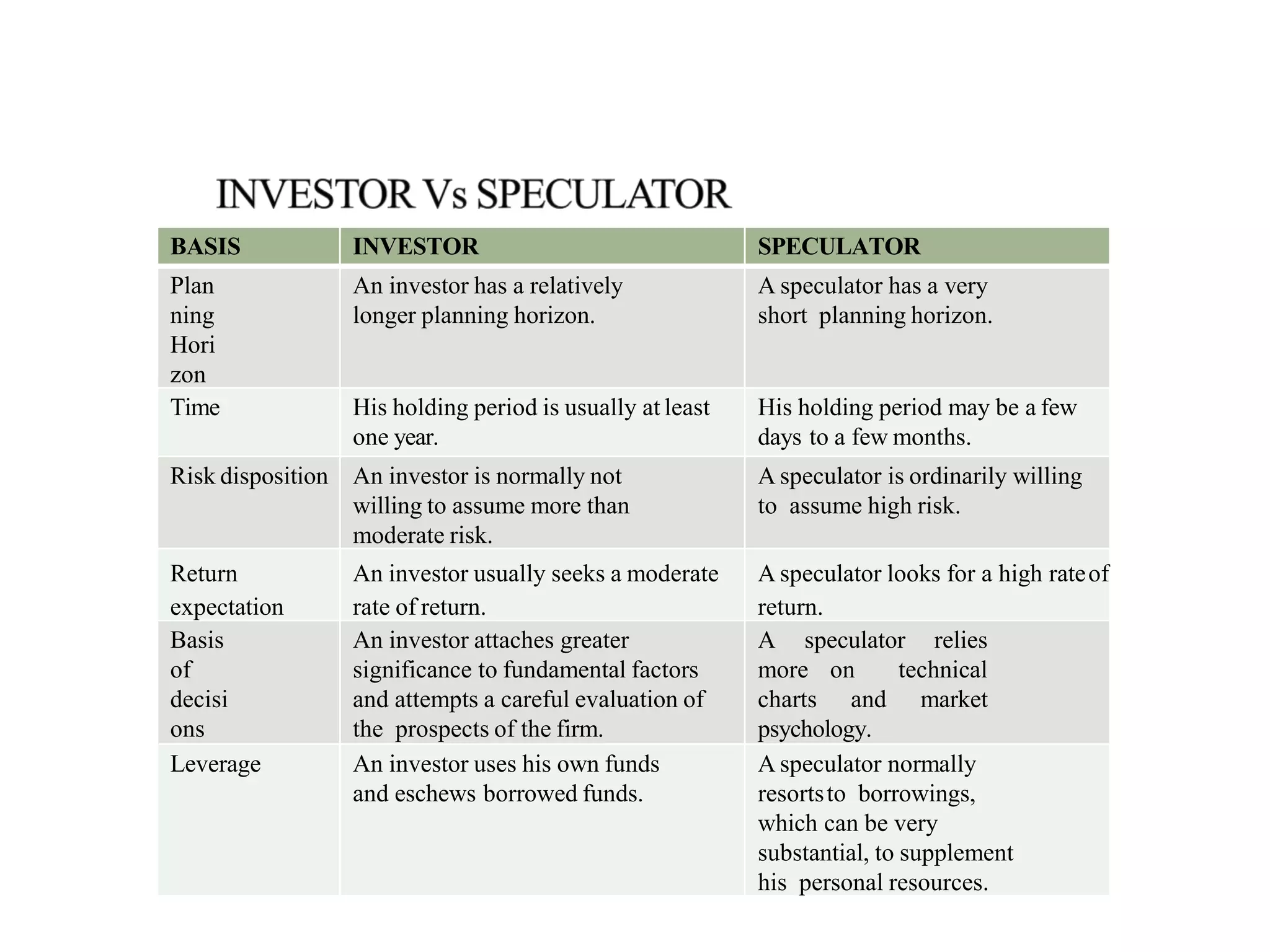
BASIS INVESTOR SPECULATOR
Plan
ning
Hori
zon
An investor has a relatively
longer planning horizon.
A speculator has a very
short planning horizon.
Time His holding period is usually at least
one year.
His holding period may be a few
days to a few months.
Risk disposition An investor is normally not
willing to assume more than
moderate risk.
A speculator is ordinarily willing
to assume high risk.
Return
expectation
An investor usually seeks a moderate
rate of return.
A speculator looks for a high rateof
return.
Basis
of
decisi
ons
An investor attaches greater
significance to fundamental factors
and attempts a careful evaluation of
the prospects of the firm.
A speculator relies
more on technical
charts and market
psychology.
Leverage An investor uses his own funds
and eschews borrowed funds.
A speculator normally
resortsto borrowings,
which can be very
substantial, to supplement
his personal resources.
A gamble is a very short term investment in a game of
chance. Gambling involved high risk and the expectations
of high returns. It consists of uncertainty and high stackers
for thrill and excitement.
The example of gambling are horse racing, card
game, lottery etc.
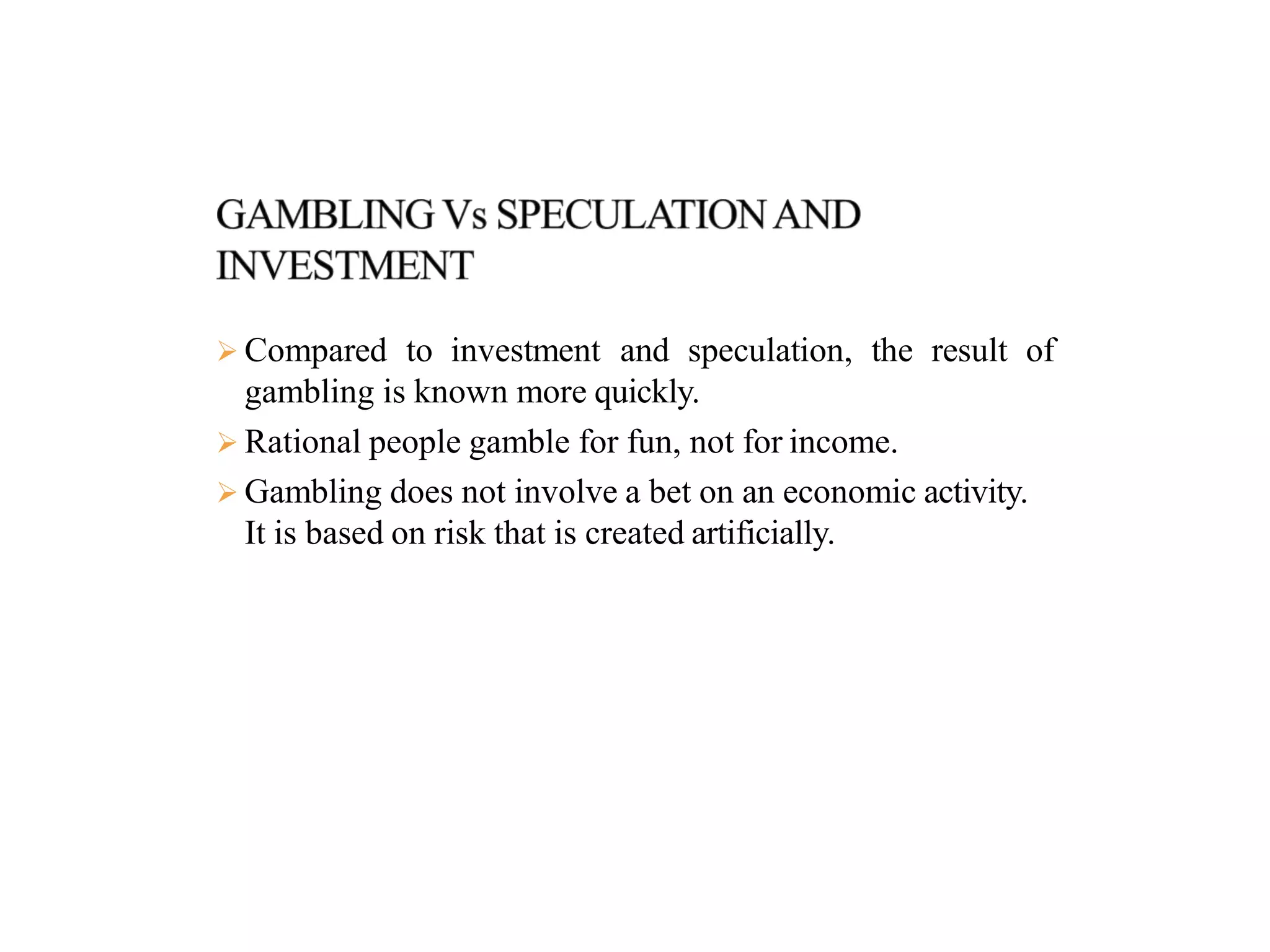
 Compared to investment and speculation, the result of
gambling is known more quickly.
 Rational people gamble for fun, not for income.
 Gambling does not involve a bet on an economic activity.
It is based on risk that is created artificially.
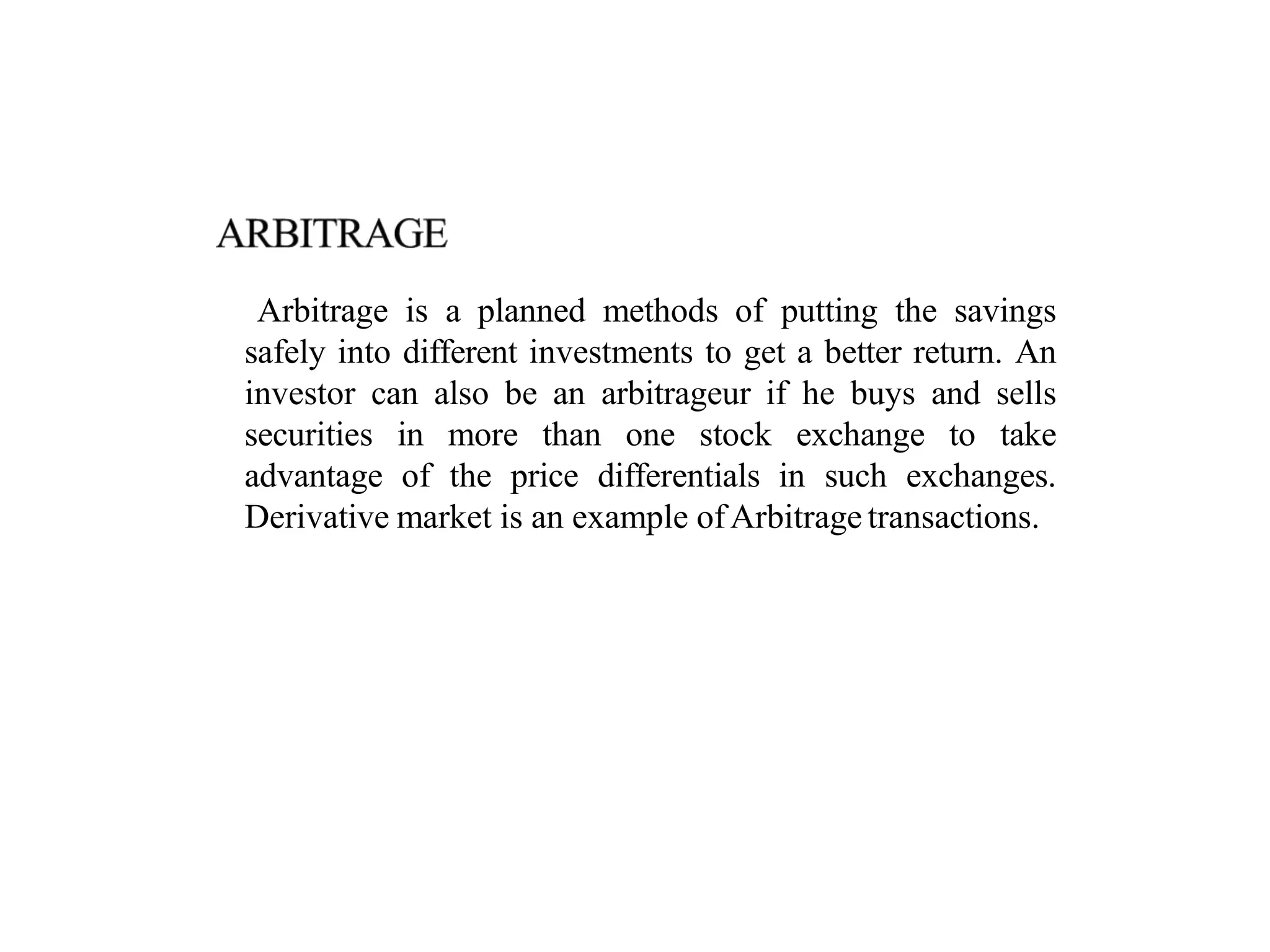
Arbitrage is a planned methods of putting the savings
safely into different investments to get a better return. An
investor can also be an arbitrageur if he buys and sells
securities in more than one stock exchange to take
advantage of the price differentials in such exchanges.
Derivative market is an example ofArbitrage transactions.
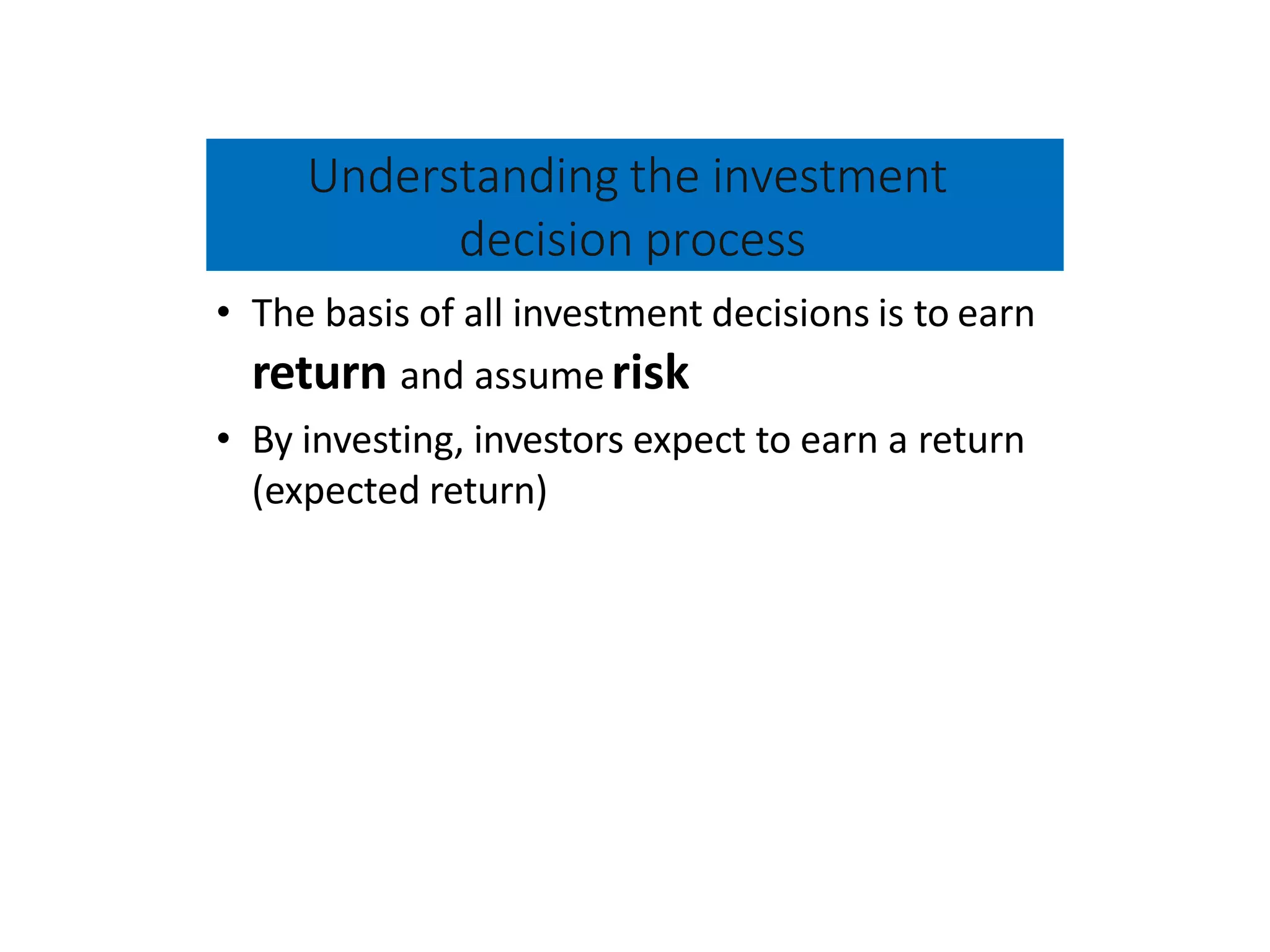
Understanding the investment
decision process
• The basis of all investment decisions is to earn
return and assume risk
• By investing, investors expect to earn a return
(expected return)
Investment Decision Process
There are 5 investment process steps that help you in selecting
and investing in the best asset class according to your needs and
preferences.
Step 1- Understanding the need
The first and the foremost step of investment process is to
understand the client or the investor his/her needs, his risk taking
capacity and his tax status. After getting an insight of the goals and
restraints , it is important to set a benchmark for the one’s portfolio
management process which will help in evaluating the
performance and check whether the objectives are achieved or
not.
Step 2- Asset allocation decision
This step involves decision on how to allocate the
investment across different asset classes, i.e. fixed income
securities, equity, real estate etc. It also involves decision of
whether to invest in domestic assets or in foreign assets.
The investor will make this decision after considering the
macroeconomic conditions and overall market status.
Step 3- Portfolio strategy selection
Third step in the investment process is to select
the proper strategy of portfolio creation. Choosing
the right strategy for portfolio creation is very
important as it forms the basis of selecting the
assets that will be added in the portfolio
management process. The strategy that conforms
to the investment policies and investment
objectives should be selected.
There are two types of portfolio strategy-
1.Active Management
2.Passive Management
Active portfolio management process refers to a strategy
where the objective of investing is to outperform the market
return compared to a specific benchmark by either buying
securities that are undervalued or by short selling securities
that are overvalued. In this strategy, risk and return both are
high. This strategy is a proactive strategy it requires close
attention by the investor or the fund manager.
Passive portfolio management process refers to the strategy
where the purpose is to generate returns equal to that of the
market. It is a reactive strategy as the fund manager or the
investor reacts after the market has responded.
Step 4- Asset selection decision
The investor needs to select the assets to be placed in the
portfolio management process in the fourth step. Within each
asset class, there are different sub asset-classes. For example,
in equity, which stocks should be chosen? Within the fixed
income securities class, which bonds should be chosen?
Also, the investment objectives should conform to the
investment policies because otherwise the main purpose of
investment management process would become meaningless.
Step 5- Evaluating portfolio performance
This is the final step in the investment process
which evaluates
performance. This
the portfolio management
is an important step as it
measures the performance of the investment with
benchmark.
respect to a
The investor would determine
whether his objectives are being achieved or not.
After all the above
investor needs to
points have been followed, the
keep monitoring the portfolio
management performance at an appropriate interval. If
the investor finds that any asset is not performing well,
he/she should ‘re balance’ the portfolio. Re balancing
means adding or removing (or better call it adjusting)
some assets from the portfolio to maintain the target
level. Re balancing helps the investor to maintain his/her
level of risk and return.

SAPM Unit 1 ppt.pptx

  • 1.
  • 3.
  • 4.
  • 5.
  • 6.
    Expectation of returnis an essential element of Investment  Return is expected to be realized in future  Future is uncertain  Expected return > realized return - variation  Variation in income is risk 6
  • 7.
    Numerous avenues ofinvestment are available today, such as, 7  Non marketable financial assets       Bonds Mutual fund schemes Real assets Equity shares Life insurance policies and many others
  • 8.
    8 Financial Meaning ofInvestment  commitment of a person’s funds to derive future income or appreciation in the value of their capital.  Future income may be Interest Dividend Premiums Pension benefits  Purchasing of shares/debentures  Insurance policies
  • 9.
    Economic Meaning ofInvestment 9 net addition to the economy’s capital stock which consists of goods and services that are used in the production of other goods and services.  Formation of new and productive capital New construction Plant and machinery Inventories  All these investments generate physical assets
  • 10.
    Characteristics of Investment 10 Allinvestments are characterised by certain features.  Returns     Risk Safety Liquidity Tax Shelter
  • 11.
    Return 11 Returns depends upon nature of the investment  the maturity period  host of other factors Received return in the form of Yield[dividend or interest] + capital appreciation[difference between sales price and purchase price]
  • 12.
    Risk 12  Risk isinherent in any investment.  Risk and return of an investment are related.  the higher the risk, the higher is the return.  Risks may be Loss of capital Delay in repayment Non-payment of interest Variability in returns
  • 13.
    Risk Continues………../ 13 Risk ofan investment depends on the following Factors    Maturity period The lower credit worthiness Nature of the investment eg. Equity shares carry higher risk and debt instruments bond/debentures carry lower risk compare with equity.
  • 14.
    Safety 14  Every investorexpects to get back his capital on maturity without loss and without delay  Safety is another feature which an investor desires for his investments  safety implies the certainty of return of capital without loss of money or time.
  • 15.
    Liquidity 15 An investment whichis easily saleable or marketable   without loss of money without loss of time is said to be possess liquidity.
  • 16.
    Tax Shelter Tax benefitsare in the following three kinds  Initial tax benefit  Continuing tax benefit  Terminal tax benefit 16
  • 17.
    17 Initial tax benefit Thetax relief enjoyed at the time of making the Investment. Continuing Tax benefit A continuing tax benefit represents the tax shield associated with the periodic returns from the Investment.
  • 18.
    18 Terminal Tax benefit Relieffrom taxation when an investment is realized or liquidate Ex: withdrawal from a public provident fund account is not subject to tax
  • 19.
    It is consideredas an involvement of funds of high risk and more uncertain expectation of returns. It is basically a short term phenomenon where people tend to buy assets with the hope that a profit can be earned from a subsequent price change. It is based on the expectation that some change will occur. The stock brokers may be cited as an example. Some brokers buy shares with a view to make quick profit by selling within few days, when the prices of such shares shoot up.
  • 20.
    BASIS INVESTOR SPECULATOR Plan ning Hori zon Aninvestor has a relatively longer planning horizon. A speculator has a very short planning horizon. Time His holding period is usually at least one year. His holding period may be a few days to a few months. Risk disposition An investor is normally not willing to assume more than moderate risk. A speculator is ordinarily willing to assume high risk. Return expectation An investor usually seeks a moderate rate of return. A speculator looks for a high rateof return. Basis of decisi ons An investor attaches greater significance to fundamental factors and attempts a careful evaluation of the prospects of the firm. A speculator relies more on technical charts and market psychology. Leverage An investor uses his own funds and eschews borrowed funds. A speculator normally resortsto borrowings, which can be very substantial, to supplement his personal resources.
  • 21.
    A gamble isa very short term investment in a game of chance. Gambling involved high risk and the expectations of high returns. It consists of uncertainty and high stackers for thrill and excitement. The example of gambling are horse racing, card game, lottery etc.
  • 22.
     Compared toinvestment and speculation, the result of gambling is known more quickly.  Rational people gamble for fun, not for income.  Gambling does not involve a bet on an economic activity. It is based on risk that is created artificially.
  • 23.
    Arbitrage is aplanned methods of putting the savings safely into different investments to get a better return. An investor can also be an arbitrageur if he buys and sells securities in more than one stock exchange to take advantage of the price differentials in such exchanges. Derivative market is an example ofArbitrage transactions.
  • 24.
    Understanding the investment decisionprocess • The basis of all investment decisions is to earn return and assume risk • By investing, investors expect to earn a return (expected return)
  • 25.
  • 26.
    There are 5investment process steps that help you in selecting and investing in the best asset class according to your needs and preferences. Step 1- Understanding the need The first and the foremost step of investment process is to understand the client or the investor his/her needs, his risk taking capacity and his tax status. After getting an insight of the goals and restraints , it is important to set a benchmark for the one’s portfolio management process which will help in evaluating the performance and check whether the objectives are achieved or not.
  • 27.
    Step 2- Assetallocation decision This step involves decision on how to allocate the investment across different asset classes, i.e. fixed income securities, equity, real estate etc. It also involves decision of whether to invest in domestic assets or in foreign assets. The investor will make this decision after considering the macroeconomic conditions and overall market status.
  • 28.
    Step 3- Portfoliostrategy selection Third step in the investment process is to select the proper strategy of portfolio creation. Choosing the right strategy for portfolio creation is very important as it forms the basis of selecting the assets that will be added in the portfolio management process. The strategy that conforms to the investment policies and investment objectives should be selected.
  • 29.
    There are twotypes of portfolio strategy- 1.Active Management 2.Passive Management Active portfolio management process refers to a strategy where the objective of investing is to outperform the market return compared to a specific benchmark by either buying securities that are undervalued or by short selling securities that are overvalued. In this strategy, risk and return both are high. This strategy is a proactive strategy it requires close attention by the investor or the fund manager. Passive portfolio management process refers to the strategy where the purpose is to generate returns equal to that of the market. It is a reactive strategy as the fund manager or the investor reacts after the market has responded.
  • 30.
    Step 4- Assetselection decision The investor needs to select the assets to be placed in the portfolio management process in the fourth step. Within each asset class, there are different sub asset-classes. For example, in equity, which stocks should be chosen? Within the fixed income securities class, which bonds should be chosen? Also, the investment objectives should conform to the investment policies because otherwise the main purpose of investment management process would become meaningless.
  • 31.
    Step 5- Evaluatingportfolio performance This is the final step in the investment process which evaluates performance. This the portfolio management is an important step as it measures the performance of the investment with benchmark. respect to a The investor would determine whether his objectives are being achieved or not.
  • 32.
    After all theabove investor needs to points have been followed, the keep monitoring the portfolio management performance at an appropriate interval. If the investor finds that any asset is not performing well, he/she should ‘re balance’ the portfolio. Re balancing means adding or removing (or better call it adjusting) some assets from the portfolio to maintain the target level. Re balancing helps the investor to maintain his/her level of risk and return.