Investment Management
By Rakesh Bisht
From BBA(B&I) 2 year, 3sem
Roll No. 01690201823
Shift 1
INDEX
 WHAT IS INVESTMENT
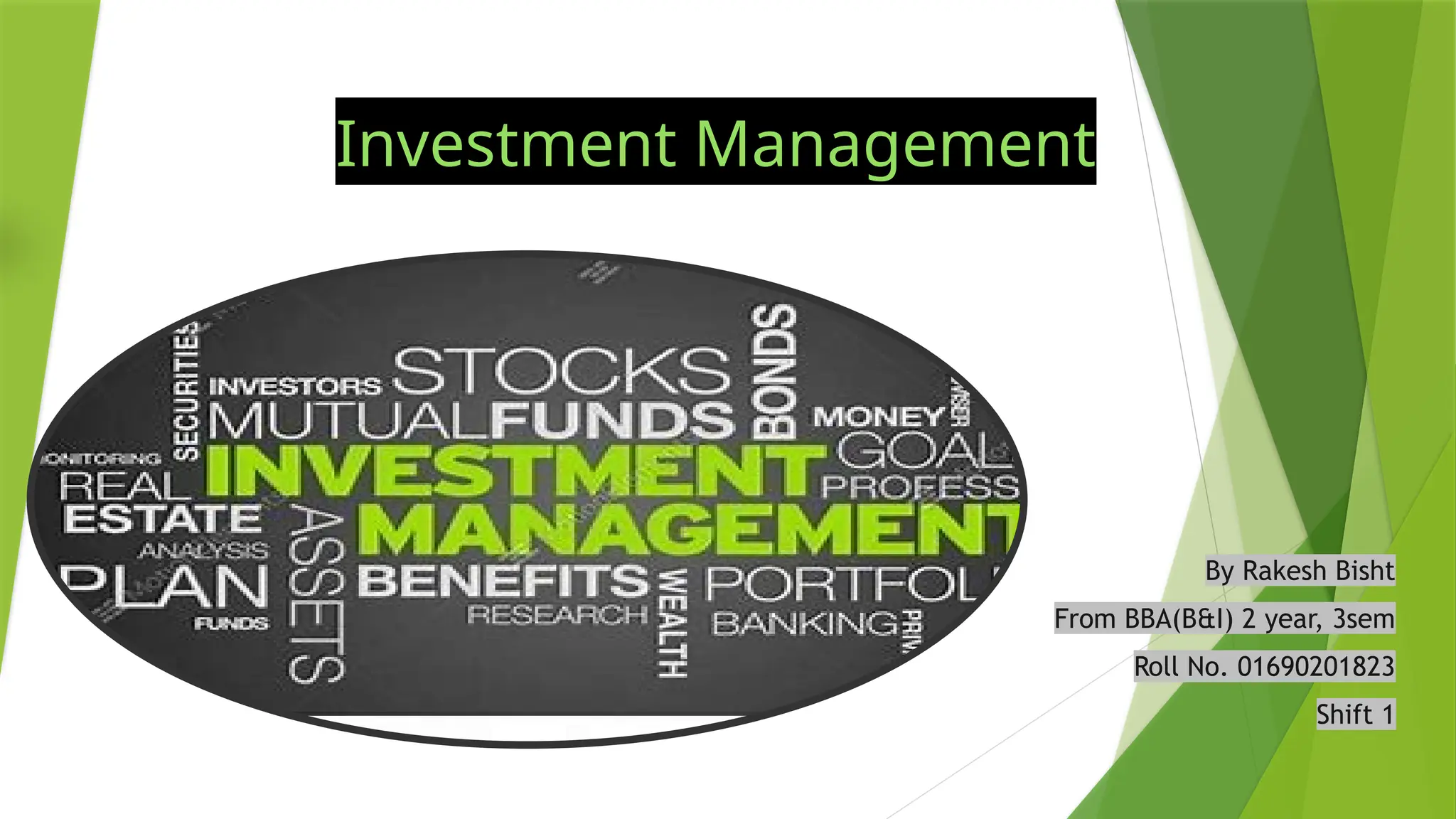
 WHAT IS INVESTMENT MANAGEMENT
 EXAMPLES/ INVESTMENT AVENUES
 HOW DOES INVESTMENT MANAGEMENT WORKS
 OBJECTIVE OF INVESTMENT MANAGEMENT
 PROCESS OF INVESTMENT MANAGEMENT
 TYPES OF INVESTING MANAGEMENT
 ADVANTAGES AND DISADVANTAGES OF INVESTMENT MANAGEMENT
WHAT IS INVESTMENT
 Investment is defined as a sacrifice made now to obtain a
return later. It is current consumption that is sacrificed.
 Two forms of investment can be defined
 Real investment is the purchase of land, machinery, etc.
 Financial investment is the purchase of a "paper" contract
What is Investment management
 Investment management entails dynamically managing a basket of financial
assets to ensure that the returns from the investments meet investors'
financial goals. It is an ongoing process that involves devising and
implementing strategies tailored to their objectives, risk tolerance and
horizons. Although investment management is usually done with the help of a
professional experienced in the financial markets, investors may also choose
to do it independently instead
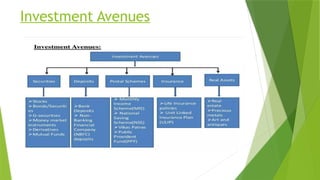
Investment Avenues
How does Investment Management work
 Investment management involves overseeing a portfolio of assets to meet
specific financial goals. An investment manager first assesses the client's
financial objectives, risk tolerance and time horizon. Based on this, the
manager develops a tailored investment strategy and selects suitable assets
such as stocks, bonds, real estate or even alternative investments.The
manager then buys the assets in the client's preferred asset allocation,
monitors and makes adjustments as market conditions change and sells these
investments to generate returns as needed. Regular reviews and rebalancing
ensure that the portfolio remains aligned with the client's goals.
Objective of Investment Management
 The primary objective of investment management is to maximise the return-
generation potential of your portfolio while simultaneously minimising risks.
Return maximisation is often achieved by investing in financial assets suited
to the investor's specific financial goals. Risk minimisation, on the other hand,
is achieved with the help of risk management strategies. These include
diversification of investments, asset allocation, hedging and stop-loss
orders, among others.
 …maximization of retun, minimization of risk, capital appreciation, tax
considerations
Process of Investment Management
 step- by-step overview of how the process works.
 •Determination of Investment Objectives: The first step in investment
management is to find out what your investment objectives are, whether they are
short- term or long-term. Your investment objectives play a huge role in determining
the kind of investment plan you need to opt for and the type of assets you need to
include in your portfolio. While establishing your objectives, it is a good idea to also
determine your risk tolerance and investment horizon
 Formulation of an Investment : PlanOnce you have determined your investment
goals, risk tolerance and time horizon, the next step is to come up with an
investment plan. Here, you can decide the kind of approach you wish to take. For
example, if you wish to generate returns higher than the overall market, an active
investment strategy may be suitable. On the other hand, if you are content with
simply earning returns that match the overall market, you could consider opting for
a passive strategy
 • Selection of Investment Options : Once you have formulated your
investment plan, you need to select the financial assets that are suitable
for you. For example, if you are a young individual whose financial
objective is to create long-term wealth, investing in the equity market
through stocks or mutual funds may be ideal . On the other hand, if you
are closer to retirement and tend to focus more on capital preservation
than returns, you could consider investing in debt instruments or
government securities.
 • Portfolio Monitoring : Investment management is not just about
choosing the right investments. It is about managing the various risks
effectively and ensuring that your assets perform according to your
expectations. To do that, you need to monitor your portfolio periodically
and stay informed about market news and other developments that could
potentially impact the value of your investments. Monitoring your portfolio
regularly lets you take timely corrective action in the case of
underperformance.
 • Portfolio Rebalancing : As time passes, the value of your portfolio
changes. This could potentially skew your asset mix, reducing its ability to
generate returns according to your expectations. This is why it is necessary
to rebalance your portfolio. Rebalancing is an important part of investment
management and ensures that your investments are in line with
your objectives.
Types of Investment Management
 Depending on the type of investments or the asset classes in a portfolio,
investment management can come in any one of the following forms.
 • Traditional investing : Traditional investment management is the process of
investing in conventional assets like equity stocks, bonds, gold, money market
instruments and the like.
 • Mutual funds : Management of mutual fund investments is all about
deciding which assets to hold in the fund portfolio, the proportion of those
asset holdings and their redemption cycle.
 • Hedge fund investments :This kind of investment management involves
administration of holdings in hedge funds, which employ sophisticated
strategies to capitalise on market opportunities while simultaneously
hedging to reduce risks.
 Real estate investing : Management of real estate investments includes
handling property holdings as well as investments in REITs.
 • Private equity : In this type of investment management, experts oversee
the purchase and redemption of equity in private companies that are not
listed on the stock exchange.
 • Quantitative investments : Quantitative investment management revolves
around the use of algorithms and data analytics to identify opportunities in
the market and leverage them before they pass
 Cryptocurrency and alternative investments : This type of investment
management includes overseeing the purchase, holding and sale of
cryptocurrencies, other digital assets and alternative investments
like art and bullion
 • Portfolio management : Portfolio management is a broad form of
investment management that involves monitoring several investment
portfolios with various asset types and categories.
Advantages of Investment Management
 Investment management can be beneficial to investors at all stages of their
financial journey. The top advantages of relying on investment management
solutions include the following:
 • Professional expertise to help you make informed investment decisions
 • Reduced risk through diversification and ideal asset allocation
 • Adjustable strategies to capitalise on market opportunities
 • Access to unique investment opportunities and strategies
 • Tailored strategies aligned with your goals and risk tolerance
 • Ongoing investment monitoring and rebalancing to keep your
portfolio on track
Disadvantages Of Investment Management
 Investment management also has some limitations that you need to be aware
of, such as the following:
 • Limited control over individual investment decisions
 • Potential for conflicts over investment manager's decisions• Possibility of
fees eroding net returns over time
 • Difficulty in finding a suitable investment manager
THANK YOU………..

PRESENTATION INVESTMENT MANAGEMENT[1].pptx

  • 1.
    Investment Management By RakeshBisht From BBA(B&I) 2 year, 3sem Roll No. 01690201823 Shift 1
  • 2.
    INDEX  WHAT ISINVESTMENT  WHAT IS INVESTMENT MANAGEMENT  EXAMPLES/ INVESTMENT AVENUES  HOW DOES INVESTMENT MANAGEMENT WORKS  OBJECTIVE OF INVESTMENT MANAGEMENT  PROCESS OF INVESTMENT MANAGEMENT  TYPES OF INVESTING MANAGEMENT  ADVANTAGES AND DISADVANTAGES OF INVESTMENT MANAGEMENT
  • 3.
    WHAT IS INVESTMENT Investment is defined as a sacrifice made now to obtain a return later. It is current consumption that is sacrificed.  Two forms of investment can be defined  Real investment is the purchase of land, machinery, etc.  Financial investment is the purchase of a "paper" contract
  • 4.
    What is Investmentmanagement  Investment management entails dynamically managing a basket of financial assets to ensure that the returns from the investments meet investors' financial goals. It is an ongoing process that involves devising and implementing strategies tailored to their objectives, risk tolerance and horizons. Although investment management is usually done with the help of a professional experienced in the financial markets, investors may also choose to do it independently instead
  • 5.
  • 6.
    How does InvestmentManagement work  Investment management involves overseeing a portfolio of assets to meet specific financial goals. An investment manager first assesses the client's financial objectives, risk tolerance and time horizon. Based on this, the manager develops a tailored investment strategy and selects suitable assets such as stocks, bonds, real estate or even alternative investments.The manager then buys the assets in the client's preferred asset allocation, monitors and makes adjustments as market conditions change and sells these investments to generate returns as needed. Regular reviews and rebalancing ensure that the portfolio remains aligned with the client's goals.
  • 7.
    Objective of InvestmentManagement  The primary objective of investment management is to maximise the return- generation potential of your portfolio while simultaneously minimising risks. Return maximisation is often achieved by investing in financial assets suited to the investor's specific financial goals. Risk minimisation, on the other hand, is achieved with the help of risk management strategies. These include diversification of investments, asset allocation, hedging and stop-loss orders, among others.  …maximization of retun, minimization of risk, capital appreciation, tax considerations
  • 8.
    Process of InvestmentManagement  step- by-step overview of how the process works.  •Determination of Investment Objectives: The first step in investment management is to find out what your investment objectives are, whether they are short- term or long-term. Your investment objectives play a huge role in determining the kind of investment plan you need to opt for and the type of assets you need to include in your portfolio. While establishing your objectives, it is a good idea to also determine your risk tolerance and investment horizon  Formulation of an Investment : PlanOnce you have determined your investment goals, risk tolerance and time horizon, the next step is to come up with an investment plan. Here, you can decide the kind of approach you wish to take. For example, if you wish to generate returns higher than the overall market, an active investment strategy may be suitable. On the other hand, if you are content with simply earning returns that match the overall market, you could consider opting for a passive strategy
  • 9.
     • Selectionof Investment Options : Once you have formulated your investment plan, you need to select the financial assets that are suitable for you. For example, if you are a young individual whose financial objective is to create long-term wealth, investing in the equity market through stocks or mutual funds may be ideal . On the other hand, if you are closer to retirement and tend to focus more on capital preservation than returns, you could consider investing in debt instruments or government securities.  • Portfolio Monitoring : Investment management is not just about choosing the right investments. It is about managing the various risks effectively and ensuring that your assets perform according to your expectations. To do that, you need to monitor your portfolio periodically and stay informed about market news and other developments that could potentially impact the value of your investments. Monitoring your portfolio regularly lets you take timely corrective action in the case of underperformance.  • Portfolio Rebalancing : As time passes, the value of your portfolio changes. This could potentially skew your asset mix, reducing its ability to generate returns according to your expectations. This is why it is necessary to rebalance your portfolio. Rebalancing is an important part of investment management and ensures that your investments are in line with your objectives.
  • 10.
    Types of InvestmentManagement  Depending on the type of investments or the asset classes in a portfolio, investment management can come in any one of the following forms.  • Traditional investing : Traditional investment management is the process of investing in conventional assets like equity stocks, bonds, gold, money market instruments and the like.  • Mutual funds : Management of mutual fund investments is all about deciding which assets to hold in the fund portfolio, the proportion of those asset holdings and their redemption cycle.  • Hedge fund investments :This kind of investment management involves administration of holdings in hedge funds, which employ sophisticated strategies to capitalise on market opportunities while simultaneously hedging to reduce risks.
  • 11.
     Real estateinvesting : Management of real estate investments includes handling property holdings as well as investments in REITs.  • Private equity : In this type of investment management, experts oversee the purchase and redemption of equity in private companies that are not listed on the stock exchange.  • Quantitative investments : Quantitative investment management revolves around the use of algorithms and data analytics to identify opportunities in the market and leverage them before they pass  Cryptocurrency and alternative investments : This type of investment management includes overseeing the purchase, holding and sale of cryptocurrencies, other digital assets and alternative investments like art and bullion  • Portfolio management : Portfolio management is a broad form of investment management that involves monitoring several investment portfolios with various asset types and categories.
  • 12.
    Advantages of InvestmentManagement  Investment management can be beneficial to investors at all stages of their financial journey. The top advantages of relying on investment management solutions include the following:  • Professional expertise to help you make informed investment decisions  • Reduced risk through diversification and ideal asset allocation  • Adjustable strategies to capitalise on market opportunities  • Access to unique investment opportunities and strategies  • Tailored strategies aligned with your goals and risk tolerance  • Ongoing investment monitoring and rebalancing to keep your portfolio on track
  • 13.
    Disadvantages Of InvestmentManagement  Investment management also has some limitations that you need to be aware of, such as the following:  • Limited control over individual investment decisions  • Potential for conflicts over investment manager's decisions• Possibility of fees eroding net returns over time  • Difficulty in finding a suitable investment manager
  • 14.