Customer   Relationship Management Present by :- Ravi Jain
Contents Introduction Why need CRM Goals of CRM Types of CRM Implementation Type of CRM Web Based CRM Benefits of CRM Cost Calculations Q&A Thank you !!! Appendix A - Market Capitalization  Appendix B – CRM Definition
Introduction  Customer Relationship Management (CRM) is the term given to the concepts that a company employs to manage its relationship with their customer.
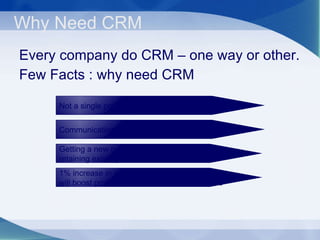
Why Need CRM Every company do CRM – one way or other. Few Facts : why need CRM Communication Gap Getting a new customer cost 5 times then  retaining existing customer   Not a single point of contact  1% increase in sale with existing customer  will boost profit by 17% while 3% in other case
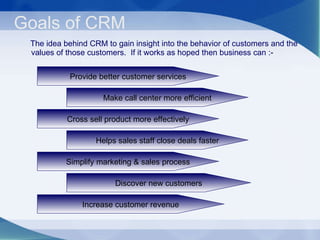
Goals of CRM The idea behind CRM to gain insight into the behavior of customers and the values of those customers.  If it works as hoped then business can :- Provide better customer services Make call center more efficient Cross sell product more effectively Helps sales staff close deals faster Simplify marketing & sales process Discover new customers Increase customer revenue
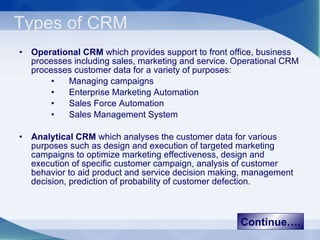
Types of CRM Operational CRM  which provides support to front office, business processes including sales, marketing and service. Operational CRM processes customer data for a variety of purposes: Managing campaigns Enterprise Marketing Automation Sales Force Automation Sales Management System Analytical CRM  which analyses the customer data for various purposes such as design and execution of targeted marketing campaigns to optimize marketing effectiveness, design and execution of specific customer campaign, analysis of customer behavior to aid product and service decision making, management decision, prediction of probability of customer defection. Continue….
Types of CRM Consumer Relationship CRM  covers aspects of a company's dealing with customers handled by the Consumer Affairs and Customer Relations contact centers within a company. Representatives handle in-bound contact from anonymous consumers and customers.  Sales Intelligence CRM  is similar to Analytical CRM, but is intended as a more direct sales tool. Features include alerts sent to sales staff regarding: Cross-selling/Up-selling/Switch-selling opportunities  Customer Drift Sales performance  Customer trends  Customer margins  Customer alignment   Continue….
Types of CRM Collaborative CRM  covers aspects of a company's dealings with customers that are handled by various departments within a company, such as sales, technical support and marketing. Collaborative CRM's ultimate goal is to use information collected by all departments to improve the quality of services provided by the company. Campaign Management  combines elements of Operational and Analytical CRM. Campaign management functions include: Target groups formed from the client base according to selected criteria  Sending campaign-related material (e.g. on special offers) to selected recipients using various channels (e.g. e-mail, telephone, SMS, post)  Tracking, storing, and analyzing campaign statistics, including tracking responses and analyzing trends
Implementation type of CRM  Two Category to implement CRM : REMOTELY HOSTED :- Smooth running Free upgrade Secure Application Continuous Support   Possible    misuse of    data LOCALLY HOSTED :- Complete Control Customize in our own way   Technical Support    Security concerns Problematic  upgrade
Web Based CRM Web based CRM are different from traditional CRM in look and feel. Benefits :- Low implementation Cost Rapid Development Accessibility Instant Information Sharing Light Weight Features :- Power Dialing Voice Messaging Fax / email Customization
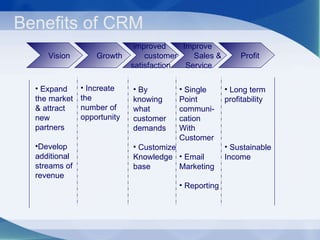
Benefits of CRM Growth Vision Improve  Sales &  Service Increate  the number of  opportunity Expand  the market & attract  new  partners Develop  additional  streams of  revenue Single  Point  communi- cation  With  Customer Email  Marketing Reporting  Profit Long term profitability  Sustainable  Income improved  customer  satisfaction By  knowing what  customer demands Customize Knowledge base
Cost Calculations  CRM Cost Includes :- Hardware Cost Software Cost Professional Services Approx Cost :-  0.5 M $ or 2.5 Cr Rs
Q&A
Thank you !!
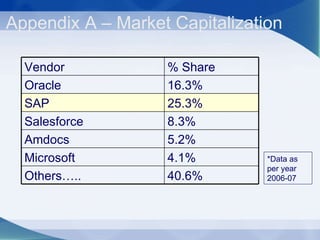
Appendix A – Market Capitalization  *Data as  per year 2006-07 4.1% Microsoft 40.6% Others….. 5.2% Amdocs 8.3% Salesforce 25.3% SAP 16.3% Oracle % Share Vendor
Appendix B – CRM Definition  CRM is an IT-enabled business strategy, the outcomes of which optimize profitability, revenue and customer satisfaction by organizing around customer segments, fostering customer-satisfying behaviors and implementing customer-centric processes. -  Gartner Group  “ CRM is a business strategy to select and manage customers to optimize long – term value” – CRMGuru.Com "CRM is an enterprise – wide mindset, mantra and set of business processes and policies that are designed to acquire, retain and service customers.  - Scott Fletcher, VP, i2.

Sap Crm

  • 1.
    Customer Relationship Management Present by :- Ravi Jain
  • 2.
    Contents Introduction Whyneed CRM Goals of CRM Types of CRM Implementation Type of CRM Web Based CRM Benefits of CRM Cost Calculations Q&A Thank you !!! Appendix A - Market Capitalization Appendix B – CRM Definition
  • 3.
    Introduction CustomerRelationship Management (CRM) is the term given to the concepts that a company employs to manage its relationship with their customer.
  • 4.
    Why Need CRMEvery company do CRM – one way or other. Few Facts : why need CRM Communication Gap Getting a new customer cost 5 times then retaining existing customer Not a single point of contact 1% increase in sale with existing customer will boost profit by 17% while 3% in other case
  • 5.
    Goals of CRMThe idea behind CRM to gain insight into the behavior of customers and the values of those customers. If it works as hoped then business can :- Provide better customer services Make call center more efficient Cross sell product more effectively Helps sales staff close deals faster Simplify marketing & sales process Discover new customers Increase customer revenue
  • 6.
    Types of CRMOperational CRM which provides support to front office, business processes including sales, marketing and service. Operational CRM processes customer data for a variety of purposes: Managing campaigns Enterprise Marketing Automation Sales Force Automation Sales Management System Analytical CRM which analyses the customer data for various purposes such as design and execution of targeted marketing campaigns to optimize marketing effectiveness, design and execution of specific customer campaign, analysis of customer behavior to aid product and service decision making, management decision, prediction of probability of customer defection. Continue….
  • 7.
    Types of CRMConsumer Relationship CRM covers aspects of a company's dealing with customers handled by the Consumer Affairs and Customer Relations contact centers within a company. Representatives handle in-bound contact from anonymous consumers and customers. Sales Intelligence CRM is similar to Analytical CRM, but is intended as a more direct sales tool. Features include alerts sent to sales staff regarding: Cross-selling/Up-selling/Switch-selling opportunities Customer Drift Sales performance Customer trends Customer margins Customer alignment Continue….
  • 8.
    Types of CRMCollaborative CRM covers aspects of a company's dealings with customers that are handled by various departments within a company, such as sales, technical support and marketing. Collaborative CRM's ultimate goal is to use information collected by all departments to improve the quality of services provided by the company. Campaign Management combines elements of Operational and Analytical CRM. Campaign management functions include: Target groups formed from the client base according to selected criteria Sending campaign-related material (e.g. on special offers) to selected recipients using various channels (e.g. e-mail, telephone, SMS, post) Tracking, storing, and analyzing campaign statistics, including tracking responses and analyzing trends
  • 9.
    Implementation type ofCRM Two Category to implement CRM : REMOTELY HOSTED :- Smooth running Free upgrade Secure Application Continuous Support Possible misuse of data LOCALLY HOSTED :- Complete Control Customize in our own way Technical Support Security concerns Problematic upgrade
  • 10.
    Web Based CRMWeb based CRM are different from traditional CRM in look and feel. Benefits :- Low implementation Cost Rapid Development Accessibility Instant Information Sharing Light Weight Features :- Power Dialing Voice Messaging Fax / email Customization
  • 11.
    Benefits of CRMGrowth Vision Improve Sales & Service Increate the number of opportunity Expand the market & attract new partners Develop additional streams of revenue Single Point communi- cation With Customer Email Marketing Reporting Profit Long term profitability Sustainable Income improved customer satisfaction By knowing what customer demands Customize Knowledge base
  • 12.
    Cost Calculations CRM Cost Includes :- Hardware Cost Software Cost Professional Services Approx Cost :- 0.5 M $ or 2.5 Cr Rs
  • 13.
  • 14.
  • 15.
    Appendix A –Market Capitalization *Data as per year 2006-07 4.1% Microsoft 40.6% Others….. 5.2% Amdocs 8.3% Salesforce 25.3% SAP 16.3% Oracle % Share Vendor
  • 16.
    Appendix B –CRM Definition CRM is an IT-enabled business strategy, the outcomes of which optimize profitability, revenue and customer satisfaction by organizing around customer segments, fostering customer-satisfying behaviors and implementing customer-centric processes. - Gartner Group “ CRM is a business strategy to select and manage customers to optimize long – term value” – CRMGuru.Com "CRM is an enterprise – wide mindset, mantra and set of business processes and policies that are designed to acquire, retain and service customers. - Scott Fletcher, VP, i2.