Nikhilesh Modgil
What is CRM
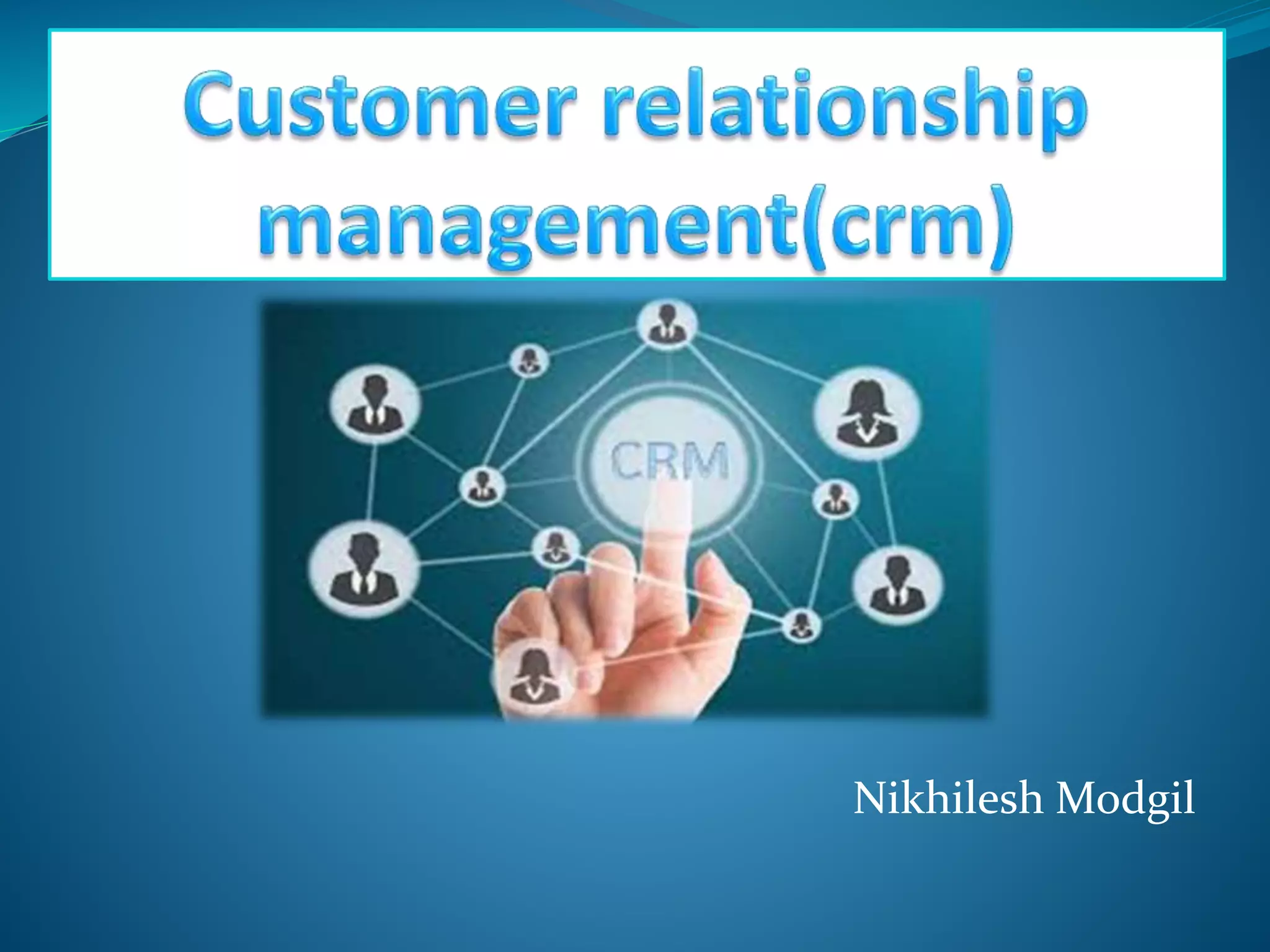
 Customer relationship management(CRM) is a model
for managing a company’s interactions with current
and future customers. It involve using technology to
organize, automate and synchronize sales, marketing,
customer service and technical support.
 CRM is a business strategy that aims to understand,
predict and manage the needs of an organisation’s
current and potential customers
Definition of CRM
“CRM is concerned with the creation, development and
enhancement of individualised customer relationships
with carefully targeted customers and customer group
resulting in maximizing their total customer life-time
value”
Roles Of CRM
 CUSTOMER HISTORY
 SEGMENTING
 TRACKING
 PROMOTIONS
 LOYALTY
 COST EFFECTIVE
Customer History
 CRM stores all the customers information and profile
like their last purchase, business cards, phone number.
This helps in recording all the history of a customer so
you know each one of them individually and you know
who are your regular customers and what are their
needs. Which also helps you in for seeing the demands
and getting better business and makes the customers
experience better at you store.
Segmenting, Tracking and
Promotions
Segmenting
 Collecting all the information about the customers
allow it to put your customers in different section so
you can attend them accordingly. This way you can
segment your market.
Tracking
 CRM software helps you in tracking all the customer
individually. This provides you the clean information
as to which customers are beneficial for you and which
are not.
Promotions
 Promotions helps you target the right audience s it
tracks each customers.
Loyalty and Cost effective
Loyalty
 CRM allow you to focus on each customer individually
hence you can pay attention to their needs more
closely. This way you can also focus on your long term
customers and provide them with points, bonus and
rewards which will helps you gain customers loyalty.
Cost effective
 It allow you to manage the customers in the most cost
effective way. You can send out bulk sms and email
easily updating them about the upcoming sales, offers
and also allows you to take care of them individually by
focusing on their individually needs.
Types of CRM
 Analytical CRM
 Collaborative CRM
 Operational CRM
 Geographic CRM
 Sales Intelligence CRM
1. ANALYTICAL CRM
Analytical CRM is designed to analyze deeply the
customer’s information and data and unwrap or
disclose the essential convention and intention of
behaviour of customers on which capitalization can
be done by the organization.
2. COLLABORATIVE CRM
Collaborative CRM deals with synchronization and integration of
customer interaction and channels of communication like phone, email,
fax, web etc. With the intent of referencing the customers a consistent
and systematic way.
3. OPERTIONAL CRM
Operational CRM is mainly focused on automation, improvement and
enhancement of business processes which are based on customer facing
or customer supporting.
4. GEOGRAPHICAL CRM
GCRM combine geographical information system and traditional CRM.
Geographical data can be analyzed to provide a snapshot of potential
customers in a region or to plan routs for customer visits.
5. SALES INTELLIGENCE CRM
Top performing sales organization are meeting the challenges of
identifying the most likely buyers of their products and service through
the development of sales intelligence solutions that introduce a wide
variety of data streams to their product.
Process of CRM
1. Clearly identify your target market and value
proposition
2. Define your overall CRM strategy and consider costs
3. Define How each customer type will be handled
4. Select a CRM software to measure performance
5. Continue to Re-engage customer
Clearly identify your target market
and value proposition
 This is the first step in establishing the CRM process.
Most of the business owners will have this well
documented in a business plan, although as many as
50% won’t. Ensure you know exactly who the target
market is and a clean value proposition being offered.
 List customer profile in priority, for example A, B & C.
“A” would be your most valuable customer. “B” would
be second priority.
Cont.....
Let’s look at how the customers priority list in a CRM
process:
1. Customer A- past/ Repeat Buyer(Conversion rate of 75%)
2. Customer B- Subscribed to E-mail list(Conversion rate of
34%)
3. Customer C- Walk in customer(Conversion rate of 15%)
Different customers may also have different value
proposition, but knowing what is important to each type
of customer is what sets the CRM process up for success.
Define your overall CRM strategy
and consider costs
 This is based on what type of customer service and
relationship management will work better for your
business and your customers. These can include co-
creating the CRM process with customers, having a
dedicated online social CRM community for your
business.
 For example:-
1. Dedicated Personal Assistance
This one is a more “hands on” type of personal
assistance. Usually, it’s one person that works directly
with, or represents, a customer. A good example of
this type of CRM being used in real estate agents.
Define How each customer type
will be handled
 Headway Themes sells an online product. They have two
different pricing levels.
1. The lowest pricing level is for consumers, offering a base
level version of the product. This customer receives less
dedicated customer service, in the form of access to an
online support community where customers help each
other. These customers are a lower priority, due to the fact
they’ll likely only purchase the product once for personal
use.
2. The higher pricing level is for B2B customers. These are
developers who use the product to customize and then
resell to their clients. This pricing level is much higher so
these customers receive lifetime dedicated customer
support. These are also headway theme’s repeat buyer.
Select a CRM software to measure
performance
Continue to Re-engage customer
INDIAN COMANIES ADOPTING
CRM
Benefits of CRM
 Reduce cost because the right things are being done(i.e
effective and efficient operation)
 Increased customer satisfaction, because they are getting
exactly what they want(i.e meeting and exceeding
expectation).
 Ensuring that the focus of the organisation is external.
 Growth in number of customers.
 Maximisation of opportunities
 Long term profitability and sustainability
 Increased access to a source of market and competitor
information
Marker of strategically significant
customers
1. Customers with high life-time value
2. Customers who serve as benchmarks for other
customer e.g. In a hospital library consultant who
teach on academic courses
3. Customers who inspire change in the supplier
Strategically significant customer
 CRM focuses on strategically significant markets not
all customers are equally important.
 Therefore relationship should be built with customers
that are likely to provide value for service
 Building relationship with customers that will provide
little value could result in a loss of time, staff and
financial resources
Customer relationship management

Customer relationship management

  • 1.
  • 2.
    What is CRM Customer relationship management(CRM) is a model for managing a company’s interactions with current and future customers. It involve using technology to organize, automate and synchronize sales, marketing, customer service and technical support.  CRM is a business strategy that aims to understand, predict and manage the needs of an organisation’s current and potential customers
  • 3.
    Definition of CRM “CRMis concerned with the creation, development and enhancement of individualised customer relationships with carefully targeted customers and customer group resulting in maximizing their total customer life-time value”
  • 4.
    Roles Of CRM CUSTOMER HISTORY  SEGMENTING  TRACKING  PROMOTIONS  LOYALTY  COST EFFECTIVE
  • 5.
    Customer History  CRMstores all the customers information and profile like their last purchase, business cards, phone number. This helps in recording all the history of a customer so you know each one of them individually and you know who are your regular customers and what are their needs. Which also helps you in for seeing the demands and getting better business and makes the customers experience better at you store.
  • 6.
    Segmenting, Tracking and Promotions Segmenting Collecting all the information about the customers allow it to put your customers in different section so you can attend them accordingly. This way you can segment your market. Tracking  CRM software helps you in tracking all the customer individually. This provides you the clean information as to which customers are beneficial for you and which are not. Promotions  Promotions helps you target the right audience s it tracks each customers.
  • 7.
    Loyalty and Costeffective Loyalty  CRM allow you to focus on each customer individually hence you can pay attention to their needs more closely. This way you can also focus on your long term customers and provide them with points, bonus and rewards which will helps you gain customers loyalty. Cost effective  It allow you to manage the customers in the most cost effective way. You can send out bulk sms and email easily updating them about the upcoming sales, offers and also allows you to take care of them individually by focusing on their individually needs.
  • 8.
    Types of CRM Analytical CRM  Collaborative CRM  Operational CRM  Geographic CRM  Sales Intelligence CRM 1. ANALYTICAL CRM Analytical CRM is designed to analyze deeply the customer’s information and data and unwrap or disclose the essential convention and intention of behaviour of customers on which capitalization can be done by the organization.
  • 9.
    2. COLLABORATIVE CRM CollaborativeCRM deals with synchronization and integration of customer interaction and channels of communication like phone, email, fax, web etc. With the intent of referencing the customers a consistent and systematic way. 3. OPERTIONAL CRM Operational CRM is mainly focused on automation, improvement and enhancement of business processes which are based on customer facing or customer supporting. 4. GEOGRAPHICAL CRM GCRM combine geographical information system and traditional CRM. Geographical data can be analyzed to provide a snapshot of potential customers in a region or to plan routs for customer visits. 5. SALES INTELLIGENCE CRM Top performing sales organization are meeting the challenges of identifying the most likely buyers of their products and service through the development of sales intelligence solutions that introduce a wide variety of data streams to their product.
  • 10.
    Process of CRM 1.Clearly identify your target market and value proposition 2. Define your overall CRM strategy and consider costs 3. Define How each customer type will be handled 4. Select a CRM software to measure performance 5. Continue to Re-engage customer
  • 11.
    Clearly identify yourtarget market and value proposition  This is the first step in establishing the CRM process. Most of the business owners will have this well documented in a business plan, although as many as 50% won’t. Ensure you know exactly who the target market is and a clean value proposition being offered.  List customer profile in priority, for example A, B & C. “A” would be your most valuable customer. “B” would be second priority.
  • 12.
    Cont..... Let’s look athow the customers priority list in a CRM process: 1. Customer A- past/ Repeat Buyer(Conversion rate of 75%) 2. Customer B- Subscribed to E-mail list(Conversion rate of 34%) 3. Customer C- Walk in customer(Conversion rate of 15%) Different customers may also have different value proposition, but knowing what is important to each type of customer is what sets the CRM process up for success.
  • 13.
    Define your overallCRM strategy and consider costs  This is based on what type of customer service and relationship management will work better for your business and your customers. These can include co- creating the CRM process with customers, having a dedicated online social CRM community for your business.  For example:- 1. Dedicated Personal Assistance This one is a more “hands on” type of personal assistance. Usually, it’s one person that works directly with, or represents, a customer. A good example of this type of CRM being used in real estate agents.
  • 14.
    Define How eachcustomer type will be handled  Headway Themes sells an online product. They have two different pricing levels. 1. The lowest pricing level is for consumers, offering a base level version of the product. This customer receives less dedicated customer service, in the form of access to an online support community where customers help each other. These customers are a lower priority, due to the fact they’ll likely only purchase the product once for personal use. 2. The higher pricing level is for B2B customers. These are developers who use the product to customize and then resell to their clients. This pricing level is much higher so these customers receive lifetime dedicated customer support. These are also headway theme’s repeat buyer.
  • 15.
    Select a CRMsoftware to measure performance
  • 16.
  • 17.
  • 18.
    Benefits of CRM Reduce cost because the right things are being done(i.e effective and efficient operation)  Increased customer satisfaction, because they are getting exactly what they want(i.e meeting and exceeding expectation).  Ensuring that the focus of the organisation is external.  Growth in number of customers.  Maximisation of opportunities  Long term profitability and sustainability  Increased access to a source of market and competitor information
  • 19.
    Marker of strategicallysignificant customers 1. Customers with high life-time value 2. Customers who serve as benchmarks for other customer e.g. In a hospital library consultant who teach on academic courses 3. Customers who inspire change in the supplier
  • 20.
    Strategically significant customer CRM focuses on strategically significant markets not all customers are equally important.  Therefore relationship should be built with customers that are likely to provide value for service  Building relationship with customers that will provide little value could result in a loss of time, staff and financial resources