CUSTOMER RELATIONSHIP MANAGEMENT
CRM
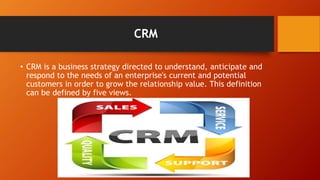
• CRM is a business strategy directed to understand, anticipate and
respond to the needs of an enterprise's current and potential
customers in order to grow the relationship value. This definition
can be defined by five views.
THE PURPOSE OF CRM
• he focus of CRM is on creating value for the customer and the
company over the longer term.
• When customers value the customer service that they receive
from suppliers, they are less likely to look to alternative suppliers
for their needs .
• CRM enables organizations to gain ‘competitive advantage’ over
competitors that supply similar products or services
WHY DID CRM DEVELOP ?
• CRM developed for a number of reasons:
• The 1980’s onwards saw rapid shifts in business that changed
customer power . Supply exceeded demands for most products.
• Sellers had little pricing power .
• The only protection available to suppliers of goods and services
was in their relationships with customers .
WHAT DOES CRM INVOLVE ?
CRM involves the following:
• Organizations must become customer focused
• Organizations must be prepared to adapt so that it take customer
needs into account and delivers them
• Market research must be undertaken to assess customer needs
and satisfaction
TYPES OF CRM
• Types of CRM are:
• 1. Analytical CRM
• 2. Collaborative CRM
• 3. Operational CRM
• 4. Geographic CRM
• 5. Sales Intelligence CRM
TYPES OF CRM
• ANALYTICAL CRM:- Analytical CRM is designed to analyze deeply the customer’s
information and data and unwrap or disclose the essential convention and intension of
behavior of customers on which capitalization can be done by the organization
• COLLABORATIVE CRM:- Collaborative CRM deals with synchronization and integration of
customer interaction and channels of communications like phone, email, fax, web etc.
with the intent of referencing the customers a consistent and systematic way.
• OPERATIONAL CRM:- Operational CRM is mainly focused on automation, improvement and
enhancement of business processes which are based on customer-facing or customer
supporting
TYPES OF CRM
• GEOGRAPHICAL CRM:- Geographic CRM (GCRM) combines geographic information system and
traditional CRM. Geographic data can be analyzed to provide a snapshot of potential customers
in a region or to plan routes for customer visits.
• SALES INTELLIGENCE CRM:-Top-performing sales organizations are meeting the challenges of
identifying the most likely buyers of their products and services through the deployment of
sales intelligence solutions that introduce a wide variety of data streams to their front-line
staff. By empowering their sellers with better information about their prospect companies,
markets and individuals, these firms are able to maximize their chances of hitting quota, and
at the same time create efficiencies within the sales operations environment
IMPLEMENTING CRM:
• When introducing or developing CRM, a strategic review of the organization's current position
should be undertaken
Organizations need to address four issues :
1. What is our core business and how will it evolve in the future?
2. What form of CRM is appropriate for our business now and in the future?
3. What IT infrastructure do we have and what do we need to support the future organisation
needs?
4. What vendors and partners do we need to choose?
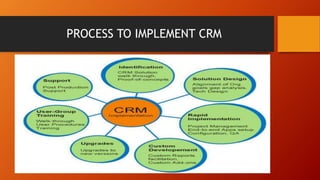
PROCESS TO IMPLEMENT CRM
WAY OF CRM
INFORMATION TECHNOLO: –
• Technological approaches involving the use of databases, data mining and one-to-one
marketing can assist organizations to increase customer value and their own profitability.
CRM software- “Front office” solutions :-
• Many call centers use CRM software to store all of their customer's details. When a
customer calls, the system can be used to retrieve and store information relevant to the
customer.
FACE-TO-FACE CRM :-
• CRM can also be carried out in face-to-face interactions without the use of technology
BENEFITS OF CRM :
1.Reduced costs, because the right things are being done (i.e.., effective and efficient
operation) .
2. Increased customer satisfaction, because they are getting exactly what they want
(i.e.. meeting and exceeding expectations) .
3. Ensuring that the focus of the organization is external .
4. Growth in numbers of customers .
5. Maximization of opportunities (eg. increased services, referrals, etc.)
6. Highlighting poor operational processes
7. Long term profitability and sustainability

Customer relationship management

  • 1.
  • 2.
    CRM • CRM isa business strategy directed to understand, anticipate and respond to the needs of an enterprise's current and potential customers in order to grow the relationship value. This definition can be defined by five views.
  • 3.
    THE PURPOSE OFCRM • he focus of CRM is on creating value for the customer and the company over the longer term. • When customers value the customer service that they receive from suppliers, they are less likely to look to alternative suppliers for their needs . • CRM enables organizations to gain ‘competitive advantage’ over competitors that supply similar products or services
  • 4.
    WHY DID CRMDEVELOP ? • CRM developed for a number of reasons: • The 1980’s onwards saw rapid shifts in business that changed customer power . Supply exceeded demands for most products. • Sellers had little pricing power . • The only protection available to suppliers of goods and services was in their relationships with customers .
  • 5.
    WHAT DOES CRMINVOLVE ? CRM involves the following: • Organizations must become customer focused • Organizations must be prepared to adapt so that it take customer needs into account and delivers them • Market research must be undertaken to assess customer needs and satisfaction
  • 6.
    TYPES OF CRM •Types of CRM are: • 1. Analytical CRM • 2. Collaborative CRM • 3. Operational CRM • 4. Geographic CRM • 5. Sales Intelligence CRM
  • 7.
    TYPES OF CRM •ANALYTICAL CRM:- Analytical CRM is designed to analyze deeply the customer’s information and data and unwrap or disclose the essential convention and intension of behavior of customers on which capitalization can be done by the organization • COLLABORATIVE CRM:- Collaborative CRM deals with synchronization and integration of customer interaction and channels of communications like phone, email, fax, web etc. with the intent of referencing the customers a consistent and systematic way. • OPERATIONAL CRM:- Operational CRM is mainly focused on automation, improvement and enhancement of business processes which are based on customer-facing or customer supporting
  • 8.
    TYPES OF CRM •GEOGRAPHICAL CRM:- Geographic CRM (GCRM) combines geographic information system and traditional CRM. Geographic data can be analyzed to provide a snapshot of potential customers in a region or to plan routes for customer visits. • SALES INTELLIGENCE CRM:-Top-performing sales organizations are meeting the challenges of identifying the most likely buyers of their products and services through the deployment of sales intelligence solutions that introduce a wide variety of data streams to their front-line staff. By empowering their sellers with better information about their prospect companies, markets and individuals, these firms are able to maximize their chances of hitting quota, and at the same time create efficiencies within the sales operations environment
  • 9.
    IMPLEMENTING CRM: • Whenintroducing or developing CRM, a strategic review of the organization's current position should be undertaken Organizations need to address four issues : 1. What is our core business and how will it evolve in the future? 2. What form of CRM is appropriate for our business now and in the future? 3. What IT infrastructure do we have and what do we need to support the future organisation needs? 4. What vendors and partners do we need to choose?
  • 10.
  • 11.
    WAY OF CRM INFORMATIONTECHNOLO: – • Technological approaches involving the use of databases, data mining and one-to-one marketing can assist organizations to increase customer value and their own profitability. CRM software- “Front office” solutions :- • Many call centers use CRM software to store all of their customer's details. When a customer calls, the system can be used to retrieve and store information relevant to the customer. FACE-TO-FACE CRM :- • CRM can also be carried out in face-to-face interactions without the use of technology
  • 12.
    BENEFITS OF CRM: 1.Reduced costs, because the right things are being done (i.e.., effective and efficient operation) . 2. Increased customer satisfaction, because they are getting exactly what they want (i.e.. meeting and exceeding expectations) . 3. Ensuring that the focus of the organization is external . 4. Growth in numbers of customers . 5. Maximization of opportunities (eg. increased services, referrals, etc.) 6. Highlighting poor operational processes 7. Long term profitability and sustainability