Customer relationship Management
Unit1: Introduction
VARUN KESAVAN,
E – MAIL ID – VARUNKESAVAN@YAHOO.COM
1
Contents
 Definitions
 Concepts and context of relationship management
 Evolution
 Transactional Vs relationship approach
 CRM as a strategic marketing tool
 CRM significance to the stakeholders
2
Meaning of CRM
 Customer relationship management can be defined as
a business philosophy and set of strategies, programs,
and systems that focuses on identifying and building
loyalty with a marketer’s profitable customers.
 The goal is to develop a base of loyal customers who
patronize the retailer frequently
3
Definition of CRM
 According to Gartner, “CRM is a business strategy
designed to optimize profitability, revenue and
customer satisfaction”.
 According to PWC consulting, “CRM is a business
strategy that aims to understand/appreciate, manage
and personalize the needs of an organization’s current
and potential customers”.
4
 CRM consists of three definitional components in its
architectural structure:
1. Customer
2. Relationship
3. Management
5
Concepts and context of
relationship management
 Relationship management is a strategy employed by
an organization in which a continuous level of
engagement is maintained between the organization
and its audience.
 Relationship management aims to create a partnership
between the organization and its audience rather than
consider relationship merely transactional.
6
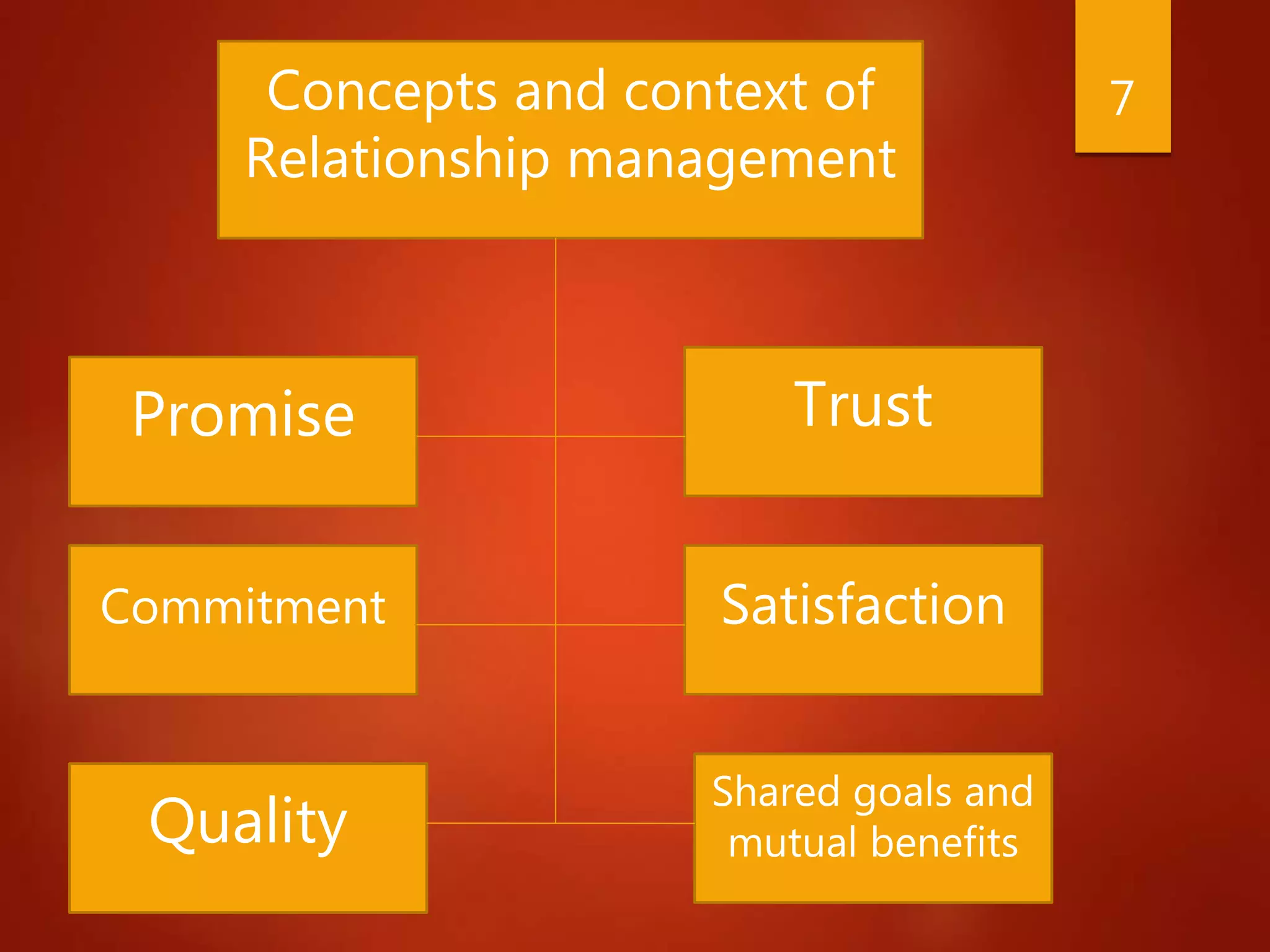
Concepts and context of
Relationship management
Quality
Commitment
Promise Trust
Shared goals and
mutual benefits
Satisfaction
7
Evolution of CRM
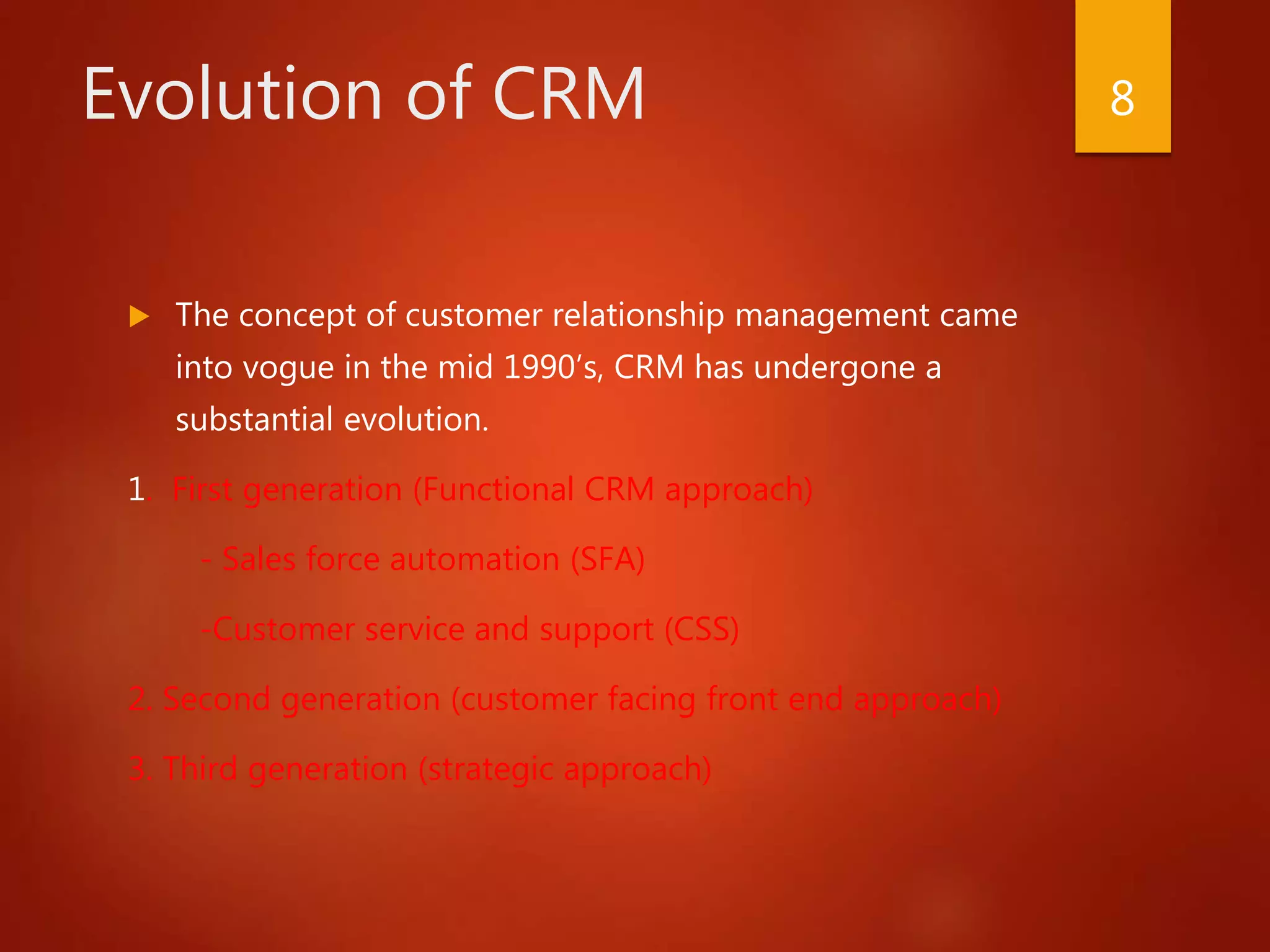
 The concept of customer relationship management came
into vogue in the mid 1990’s, CRM has undergone a
substantial evolution.
1. First generation (Functional CRM approach)
- Sales force automation (SFA)
-Customer service and support (CSS)
2. Second generation (customer facing front end approach)
3. Third generation (strategic approach)
8
Types of CRM and its
domain characteristics
1. Strategic CRM: is a core customer centric business
strategy aims at winning and keeping profitable
customers
2. Operational CRM: focuses on the automation of
customer facing processes such as selling, marketing
and customer service
9
Contd…
3. Analytical CRM: focuses on the intelligent mining of
customer related data for strategical or tactical
purposes
4. Collaborative CRM: applies technology across
organizational boundaries with a view to optimizing
company, partner and customer value
10
Strategic CRM
 Product oriented
 Production oriented
 Sales oriented
 A customer / Market oriented
11
Operational Crm
1. Marketing automation
 Market segmentation
 Campaign management
 Event based marketing
2. Sale force
automation
Account Management
Lead management
Opportunity
management
Pipeline management
Contract management
Quotation and
proposal
management
Product configuration
12
Contd…
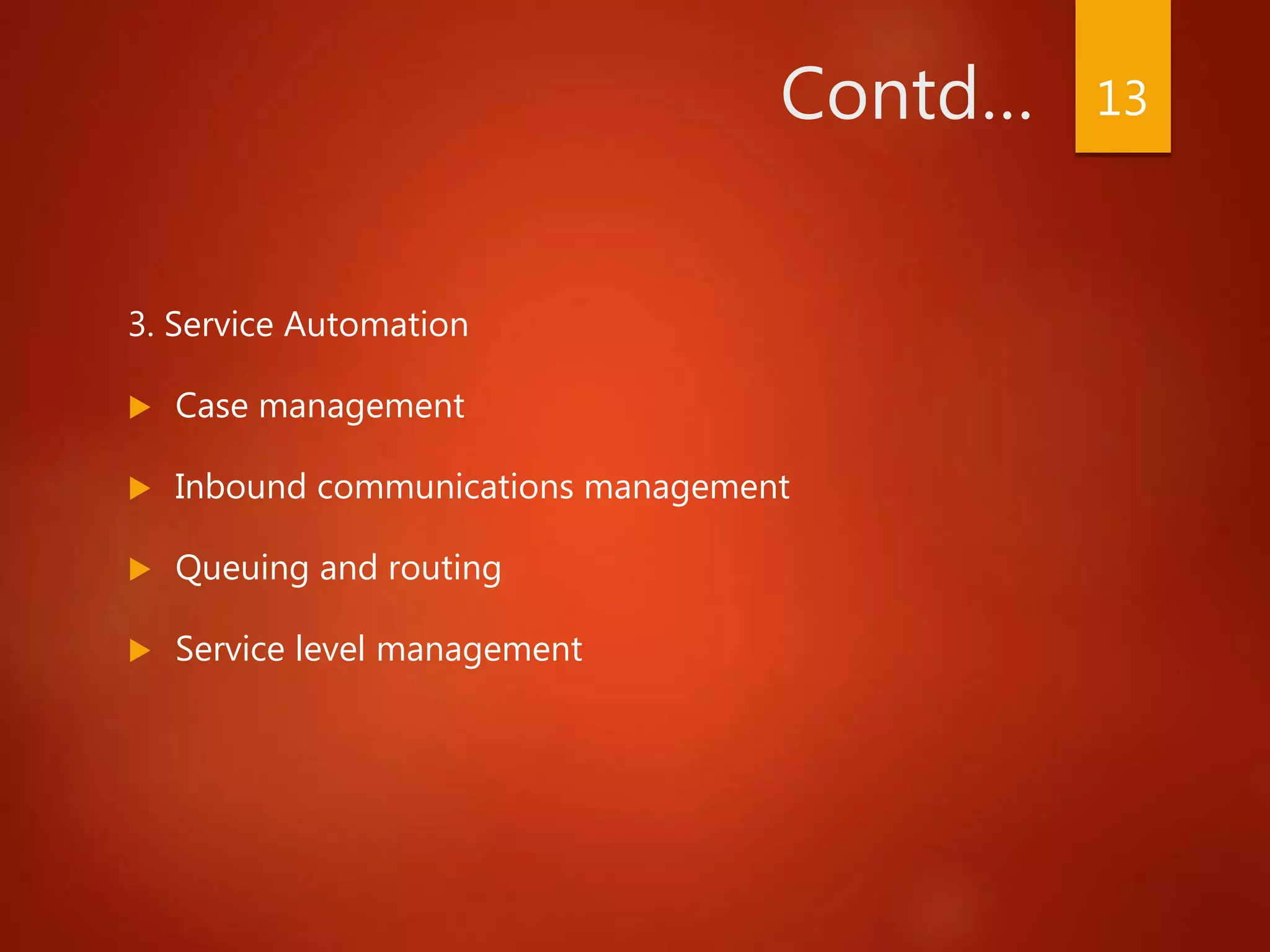
3. Service Automation
 Case management
 Inbound communications management
 Queuing and routing
 Service level management
13
Transactional Vs relationship
marketing
 Transactional marketing or mass marketing is on
individual transaction and does not concern
continuous relationship with customers
 Relationship marketing focus on continuous multiple
transactions rather than isolated individual
transactions.
14
Transition from traditional
marketing to relationship
Customer
retention
Customer
acquisition
Functionally
based
marketing
Cross- Functionally based
marketing
15
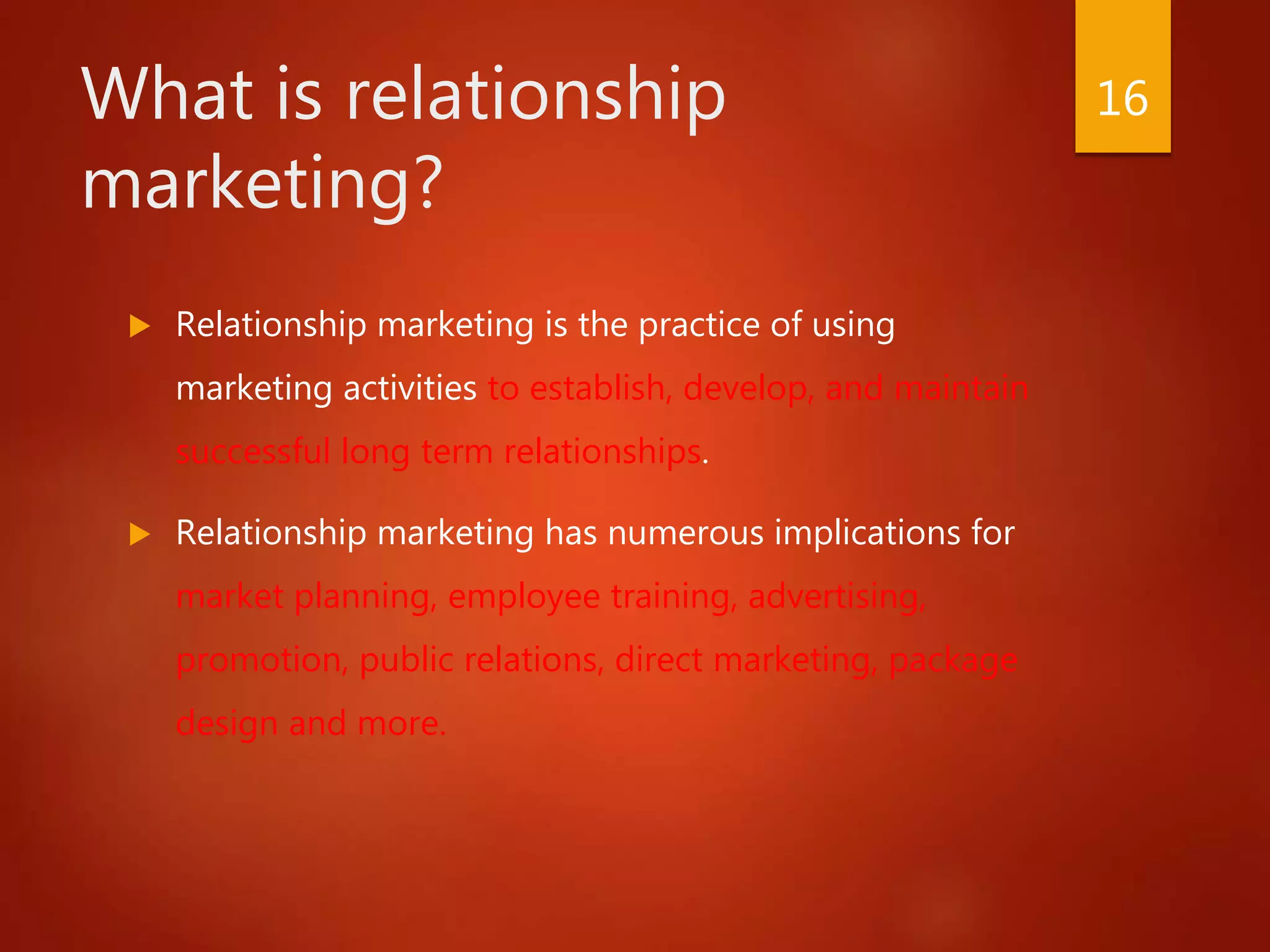
What is relationship
marketing?
 Relationship marketing is the practice of using
marketing activities to establish, develop, and maintain
successful long term relationships.
 Relationship marketing has numerous implications for
market planning, employee training, advertising,
promotion, public relations, direct marketing, package
design and more.
16
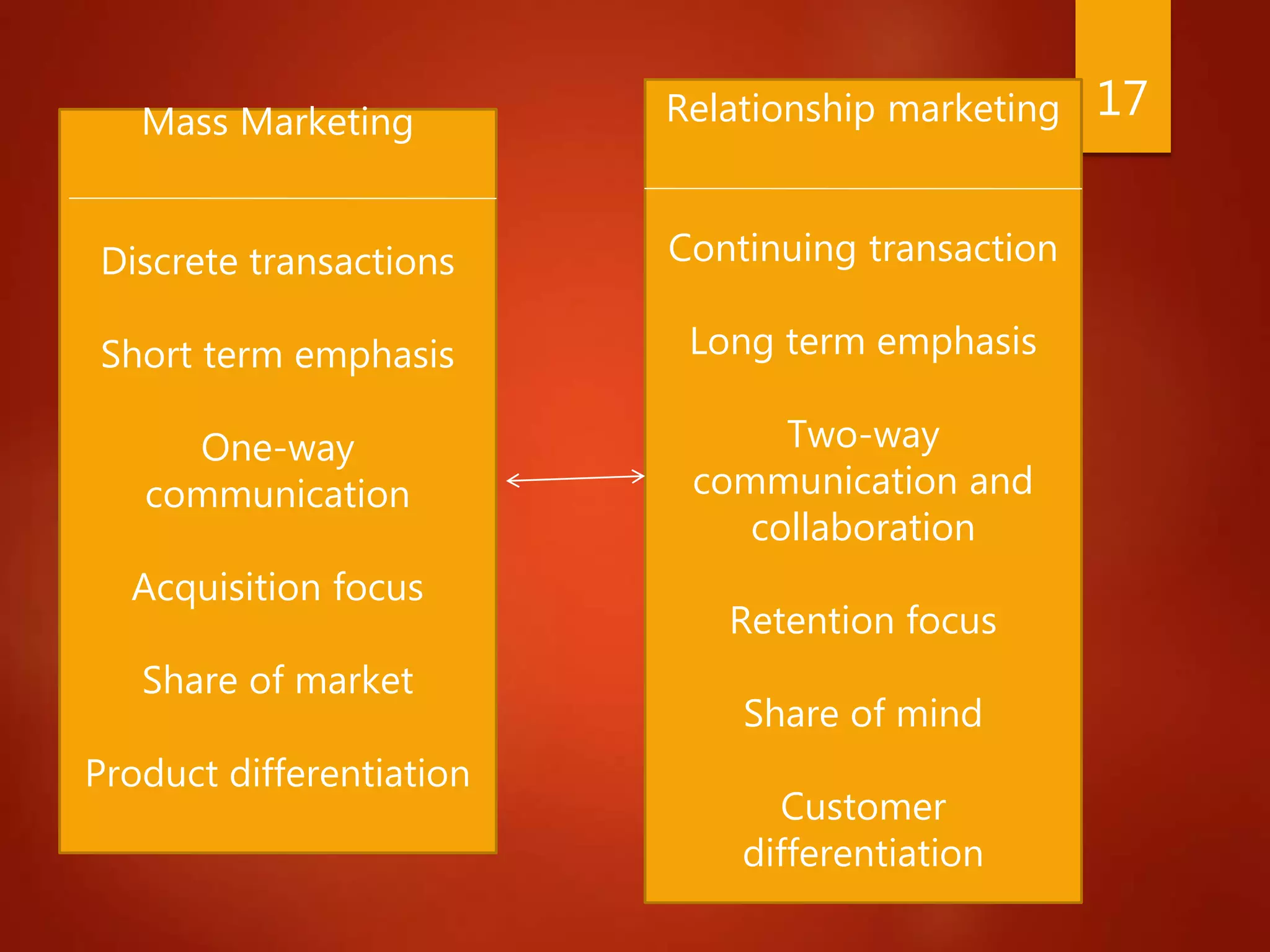
Mass Marketing
Discrete transactions
Short term emphasis
One-way
communication
Acquisition focus
Share of market
Product differentiation
Relationship marketing
Continuing transaction
Long term emphasis
Two-way
communication and
collaboration
Retention focus
Share of mind
Customer
differentiation
17
Characteristics of CRM
 Share of customer
 Lifetime value of customers
 Customer equity
 Greater focus on high value customers
 Use of technology
18
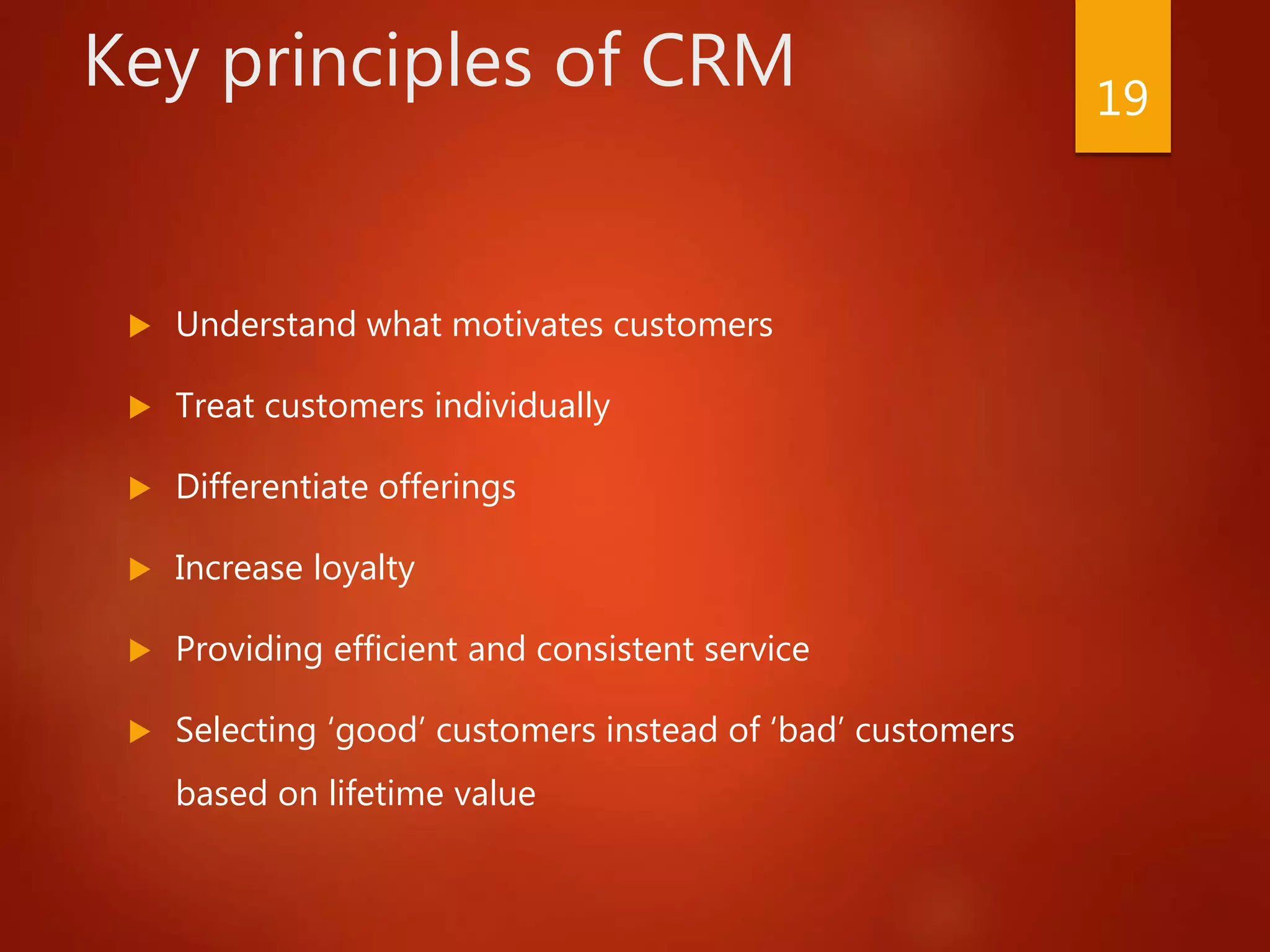
Key principles of CRM
 Understand what motivates customers
 Treat customers individually
 Differentiate offerings
 Increase loyalty
 Providing efficient and consistent service
 Selecting ‘good’ customers instead of ‘bad’ customers
based on lifetime value
19
 Manage customer as an asset
 Rate customers on the basis of their profit stream – current
and future potential
 Using information based decision making capabilities
 Implement innovative ways and means to get close to the
customer – Hear the voice of customers
20
Goals of crm
 To provide updated information
 To customize strategies
 To anticipate problems
 To prompt follow-up
 To establish problem solving mechanism
 To assess customer interest
 To integrate functional system
21
CRm as a strategic marketing
tool
 Strategic CRM is a core customer centric business
strategy aims at winning and keeping profitable
customers
 CRM as a effective strategic marketing tool acts as a
competitive advantage
 CRM helps in strategic planning and reduces cost to
serve
22
CRM significance to
stakeholders
 Business owners
 VP of sales and sales manager
 Salespeople
 Customer service/ support manager
 Customer service representatives
 Business development/ marketing manager
 Financial perspective – CFO/Controller/Accounting
 IT department
 All other employees
23
Significance of CRM
 Increased sales revenue and reduced cost of sales
 Increased customer satisfaction
 Lower costs of recruiting customers
 Increased customer retention
 Evaluation of customer profitability
 Excellent customer service
24
Contd…
 Customer knowledge
 Customization
 Positive referral creation
 Reduced cost through customer self-service
 Opportunity to Cross-sell and up-sell
 Decreased general sales and marketing administrative costs
25
Limitations of CRM
 Requires top management support
 Confusion in attributes
 Problem in implementation
 Building relationship
 Not functionally organized
 Customer dissatisfaction
 Front line staff
26
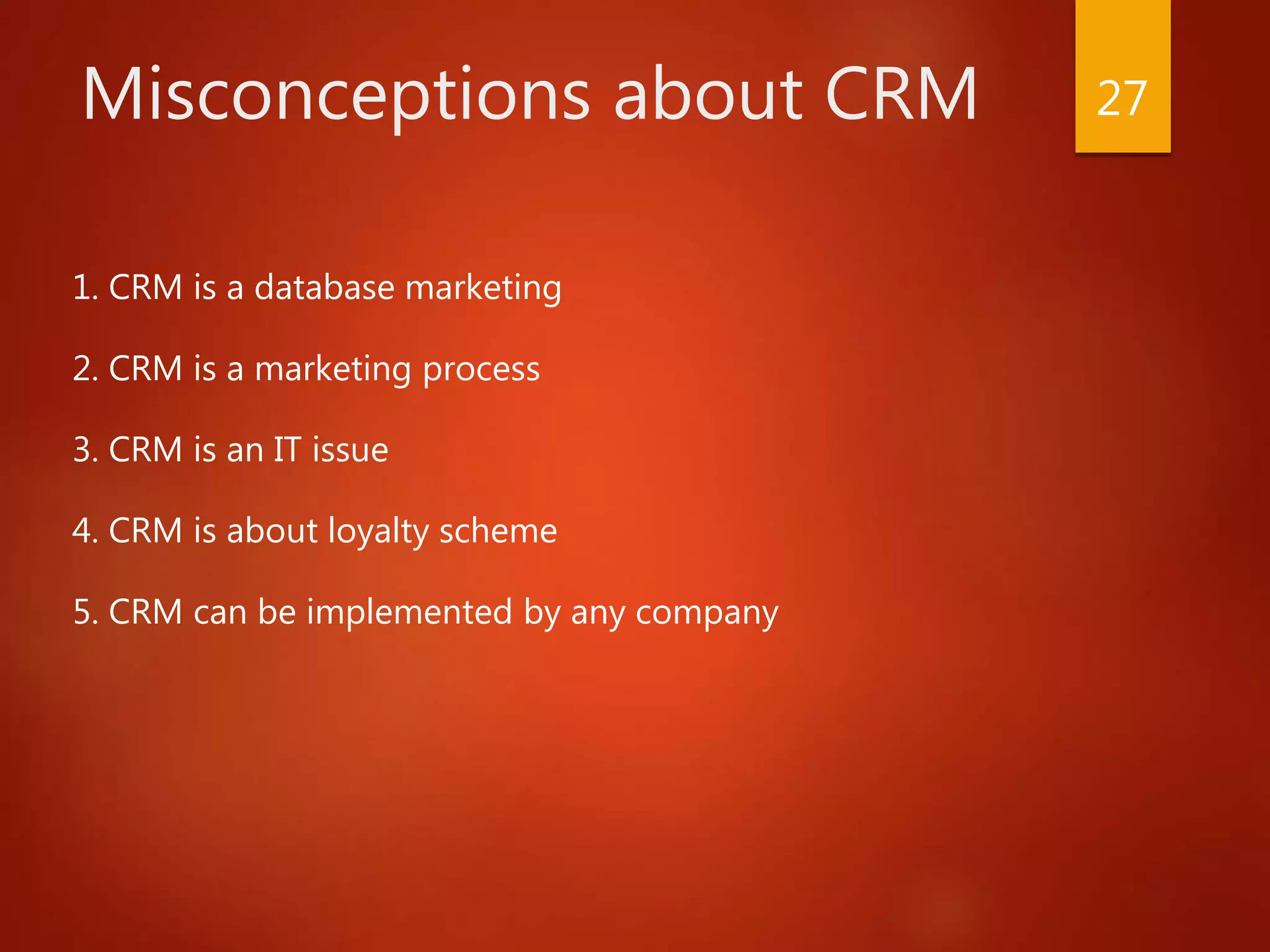
Misconceptions about CRM
1. CRM is a database marketing
2. CRM is a marketing process
3. CRM is an IT issue
4. CRM is about loyalty scheme
5. CRM can be implemented by any company
27
Why companies want
relationships with customers
 Reduced marketing costs
 Better customer insight
 Life time value
The goal of maintaining customer base must be to
retain existing customers and recruit new customers
that have future profit potential or are important for
other strategic purposes
28
B2C context
1. Recognition
2. Personalization
3. Power
4. Risk reduction
5. Status
6. Affiliation
29
Thank you
30

UNIT - 1 INTORDUCTION TO CRM

  • 1.
    Customer relationship Management Unit1:Introduction VARUN KESAVAN, E – MAIL ID – VARUNKESAVAN@YAHOO.COM 1
  • 2.
    Contents  Definitions  Conceptsand context of relationship management  Evolution  Transactional Vs relationship approach  CRM as a strategic marketing tool  CRM significance to the stakeholders 2
  • 3.
    Meaning of CRM Customer relationship management can be defined as a business philosophy and set of strategies, programs, and systems that focuses on identifying and building loyalty with a marketer’s profitable customers.  The goal is to develop a base of loyal customers who patronize the retailer frequently 3
  • 4.
    Definition of CRM According to Gartner, “CRM is a business strategy designed to optimize profitability, revenue and customer satisfaction”.  According to PWC consulting, “CRM is a business strategy that aims to understand/appreciate, manage and personalize the needs of an organization’s current and potential customers”. 4
  • 5.
     CRM consistsof three definitional components in its architectural structure: 1. Customer 2. Relationship 3. Management 5
  • 6.
    Concepts and contextof relationship management  Relationship management is a strategy employed by an organization in which a continuous level of engagement is maintained between the organization and its audience.  Relationship management aims to create a partnership between the organization and its audience rather than consider relationship merely transactional. 6
  • 7.
    Concepts and contextof Relationship management Quality Commitment Promise Trust Shared goals and mutual benefits Satisfaction 7
  • 8.
    Evolution of CRM The concept of customer relationship management came into vogue in the mid 1990’s, CRM has undergone a substantial evolution. 1. First generation (Functional CRM approach) - Sales force automation (SFA) -Customer service and support (CSS) 2. Second generation (customer facing front end approach) 3. Third generation (strategic approach) 8
  • 9.
    Types of CRMand its domain characteristics 1. Strategic CRM: is a core customer centric business strategy aims at winning and keeping profitable customers 2. Operational CRM: focuses on the automation of customer facing processes such as selling, marketing and customer service 9
  • 10.
    Contd… 3. Analytical CRM:focuses on the intelligent mining of customer related data for strategical or tactical purposes 4. Collaborative CRM: applies technology across organizational boundaries with a view to optimizing company, partner and customer value 10
  • 11.
    Strategic CRM  Productoriented  Production oriented  Sales oriented  A customer / Market oriented 11
  • 12.
    Operational Crm 1. Marketingautomation  Market segmentation  Campaign management  Event based marketing 2. Sale force automation Account Management Lead management Opportunity management Pipeline management Contract management Quotation and proposal management Product configuration 12
  • 13.
    Contd… 3. Service Automation Case management  Inbound communications management  Queuing and routing  Service level management 13
  • 14.
    Transactional Vs relationship marketing Transactional marketing or mass marketing is on individual transaction and does not concern continuous relationship with customers  Relationship marketing focus on continuous multiple transactions rather than isolated individual transactions. 14
  • 15.
    Transition from traditional marketingto relationship Customer retention Customer acquisition Functionally based marketing Cross- Functionally based marketing 15
  • 16.
    What is relationship marketing? Relationship marketing is the practice of using marketing activities to establish, develop, and maintain successful long term relationships.  Relationship marketing has numerous implications for market planning, employee training, advertising, promotion, public relations, direct marketing, package design and more. 16
  • 17.
    Mass Marketing Discrete transactions Shortterm emphasis One-way communication Acquisition focus Share of market Product differentiation Relationship marketing Continuing transaction Long term emphasis Two-way communication and collaboration Retention focus Share of mind Customer differentiation 17
  • 18.
    Characteristics of CRM Share of customer  Lifetime value of customers  Customer equity  Greater focus on high value customers  Use of technology 18
  • 19.
    Key principles ofCRM  Understand what motivates customers  Treat customers individually  Differentiate offerings  Increase loyalty  Providing efficient and consistent service  Selecting ‘good’ customers instead of ‘bad’ customers based on lifetime value 19
  • 20.
     Manage customeras an asset  Rate customers on the basis of their profit stream – current and future potential  Using information based decision making capabilities  Implement innovative ways and means to get close to the customer – Hear the voice of customers 20
  • 21.
    Goals of crm To provide updated information  To customize strategies  To anticipate problems  To prompt follow-up  To establish problem solving mechanism  To assess customer interest  To integrate functional system 21
  • 22.
    CRm as astrategic marketing tool  Strategic CRM is a core customer centric business strategy aims at winning and keeping profitable customers  CRM as a effective strategic marketing tool acts as a competitive advantage  CRM helps in strategic planning and reduces cost to serve 22
  • 23.
    CRM significance to stakeholders Business owners  VP of sales and sales manager  Salespeople  Customer service/ support manager  Customer service representatives  Business development/ marketing manager  Financial perspective – CFO/Controller/Accounting  IT department  All other employees 23
  • 24.
    Significance of CRM Increased sales revenue and reduced cost of sales  Increased customer satisfaction  Lower costs of recruiting customers  Increased customer retention  Evaluation of customer profitability  Excellent customer service 24
  • 25.
    Contd…  Customer knowledge Customization  Positive referral creation  Reduced cost through customer self-service  Opportunity to Cross-sell and up-sell  Decreased general sales and marketing administrative costs 25
  • 26.
    Limitations of CRM Requires top management support  Confusion in attributes  Problem in implementation  Building relationship  Not functionally organized  Customer dissatisfaction  Front line staff 26
  • 27.
    Misconceptions about CRM 1.CRM is a database marketing 2. CRM is a marketing process 3. CRM is an IT issue 4. CRM is about loyalty scheme 5. CRM can be implemented by any company 27
  • 28.
    Why companies want relationshipswith customers  Reduced marketing costs  Better customer insight  Life time value The goal of maintaining customer base must be to retain existing customers and recruit new customers that have future profit potential or are important for other strategic purposes 28
  • 29.
    B2C context 1. Recognition 2.Personalization 3. Power 4. Risk reduction 5. Status 6. Affiliation 29
  • 30.