SUBMITED BY
     SANDHYA.M
     SIF-CUSAT
What is infra structure?
               The domestic fish marketing system in India
  is neither efficient nor modern and is mainly carried out
  by private traders with a large no. of inter mediaries
  between producers and consumers. These by reducing
  the fisherman’s share in consumers rupee. Physical
  facilities and infra structure in all types of fish markets
  are far from satisfactory. Infrastructures are common
  facilities enjoyed by a person or community as a whole.
• Physical infrastructure include 2,244 landing centers
  ,primary markets,6-major fishery harbors and 28 minor
  harbors.
Infra structures are classified in
to…….
1. Physical infra structure facilities in primary
   markets.
2. Infra structure facilities in the distribution
   system.
Marketing infra structures…
1. Infra structure for storage.
2. Infra structure for transportation.
3. Infra structure for assembling and selling.
4. Infra structure for distribution.
5. Infra structure for market linked
   communication.
6. For drying facilities.
7. For cleaning facilities.
8. For grading and standardization facilities.
Continue…..
9.For packaging facilities.
10.For weighing facilities.
11.Infra structure for market price determination.
Market linked communications

         Market linked up with road ways, river
  ways, rail ways and air ways. Attract large number of
  producers to come up with their product for sale.
Assembling facilities
          Presently there are 7 major fishing
  harbors,61 minor fishing harbors,1376 fish landing
  centers are available in India. Covered auction
  platform protect the produces from natural
  disasters. These provide facilities for
  display, storage, distribution etc. Which facilitating
  better marketing.
Drying facilities

      Fishes having less moisture content get
 premium in price fixation. It includes drying
 yard, modern drying equipments, machines etc
Cleaning facilities
        Clean product always attract buyers ,thus
 getting better market price. Other than manual
 cleaning some mechanical cleaning devices are
 available.
Grading and standardization facilities

    Done by eye estimation ,by considering the
 shape and size, healthy and non healthy, bright
 and fed etc..
Packaging facilities
    Normally plastic bags are used. It is
 necessary to ensure the availability of low cost
 packaging technology and packaging material.
Storage facilities

         It avoid wastage and quality deterioration
  and help to retain the product till the market of
  favorable price. There are about 484 cold
  storages present in India mainly under the
  authority of fisheries cooperation. The total
  capacity amounts to about 1,08,800 tones and
  216 other storages with a capacity of 11,500
  tones.
Transportation facilities

          It start from farm gate to market yard. It
 include refrigerated van, railway wagons, public
 carriers et . It is mainly under the authority of
 state government, central government.
Facility for weighing
         Proper grading is one of the ingredient of
 receiving due price.
Infrastructure for market price dissemination

         Complete knowledge of marketing
  information help the farmers to arrive at a
  decision for selling of his product. It help in
  future planning of marketing of products both at
  personal level and state level.
• It can done by using display boards, news
  papers, all India radio,doordarshan etc.
Selling and distribution facilities

         Distribution include wholesale
  market, retail market, venders etc.. Majority of
  these markets are owned by co operative or
  panchayat.
• There are 20 organized retail market present in
  India.
• These are classified into
Wholesale market
• Fish handled by wholesale market in India range
  from 1 tones to 100 tones.
• Most wholesale market where very old
  ,unhygienic, without proper facilities for
  handling fish and with limited or no facilities for
  cold/chilled storage and ice plants.
• The poor fish handling at the wholesale market
  result in poor quality of fish with low keeping
  quality.
Retail market
• Retail fish market are miniature of wholesale
  markets in our country; the variation being in size of
  the market in terms of quantity of fish, number of
  traders facilities, proximity to the consumer etc.
• Most retailers where selling fish by the road side
  without maintenance of quality or hygiene and
  without access to drinking water and fish dressing
  platform.
• Retail markets where crowded with excess number
  of traders selling fish even in the passages ,leading
  to in convenience and hygiene problem.
Fish retail outlet
• Retail outlet are fish shops operated by both
  government bodies and private individuals at
  consumer friendly location of cities. for eg:NIFHAT
  fish stall.
• The retail outlet were comparatively cleaner and
  more hygiene than the retail market.
• Retail outlet aim to replace the middlemen involved
  in fish marketing.
• It ensures the high returns to fisherman and
  hygienic fishes to consumers at effortable prices.
• The state government of
  Kerala, Thamilnadu, Karnataka entered in to the
  fish retailing industry .In Tamilnadu the
  Thamilnadu fish developing cooperation
  Ltd(TNFDC) operates fish retail outlet under the
  name of “Neidhal”.
• In Kerala matsyafed has started a fish retailing
  outlet under the name of “fresh fish point”.
• These retail outlet purchase fish directly from
  fisherman/fisherman cooperative society and sell to
  customers at reasonable prices under modern
  hygienic condition.
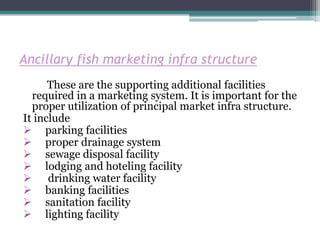
Ancillary fish marketing infra structure
      These are the supporting additional facilities
  required in a marketing system. It is important for the
  proper utilization of principal market infra structure.
It include
 parking facilities
 proper drainage system
 sewage disposal facility
 lodging and hoteling facility
 drinking water facility
 banking facilities
 sanitation facility
 lighting facility
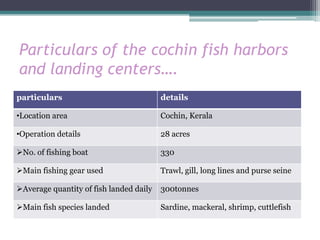
Particulars of the cochin fish harbors
and landing centers….
particulars                              details

•Location area                           Cochin, Kerala

•Operation details                       28 acres

No. of fishing boat                     330

Main fishing gear used                  Trawl, gill, long lines and purse seine

Average quantity of fish landed daily   300tonnes

Main fish species landed                Sardine, mackeral, shrimp, cuttlefish
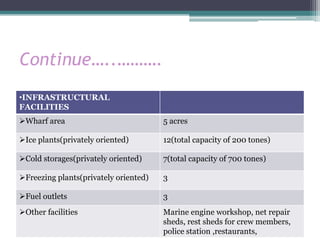
Continue…..……….
•INFRASTRUCTURAL
FACILITIES
Wharf area                            5 acres

Ice plants(privately oriented)        12(total capacity of 200 tones)

Cold storages(privately oriented)     7(total capacity of 700 tones)

Freezing plants(privately oriented)   3

Fuel outlets                          3
Other facilities                      Marine engine workshop, net repair
                                       sheds, rest sheds for crew members,
                                       police station ,restaurants,
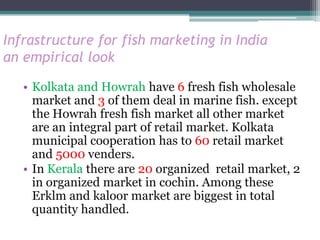
Infrastructure for fish marketing in India
an empirical look

   • Kolkata and Howrah have 6 fresh fish wholesale
     market and 3 of them deal in marine fish. except
     the Howrah fresh fish market all other market
     are an integral part of retail market. Kolkata
     municipal cooperation has to 60 retail market
     and 5000 venders.
   • In Kerala there are 20 organized retail market, 2
     in organized market in cochin. Among these
     Erklm and kaloor market are biggest in total
     quantity handled.
Continue……..
• In Tuticorin there are 3 organized retail fish
  markets. In addition there are 43 venders for fresh
  fish distribution .The max. no. of fish retailers are in
  the cooperation markets.
• Majority of fish market in Andra Pradesh as an
  integral part of meat and vegetables market and of
  an avenue by municipal cooperation.
• In Tamilnadu there are some week market for the
  wholesaling of dry fish .now majority of the fish
  market either wholesale or retail are part of the
  vegetable or fish market.
Thank you

MARKETING INFRASTRUCTURE

  • 1.
    SUBMITED BY SANDHYA.M SIF-CUSAT
  • 2.
    What is infrastructure? The domestic fish marketing system in India is neither efficient nor modern and is mainly carried out by private traders with a large no. of inter mediaries between producers and consumers. These by reducing the fisherman’s share in consumers rupee. Physical facilities and infra structure in all types of fish markets are far from satisfactory. Infrastructures are common facilities enjoyed by a person or community as a whole. • Physical infrastructure include 2,244 landing centers ,primary markets,6-major fishery harbors and 28 minor harbors.
  • 3.
    Infra structures areclassified in to……. 1. Physical infra structure facilities in primary markets. 2. Infra structure facilities in the distribution system.
  • 4.
    Marketing infra structures… 1.Infra structure for storage. 2. Infra structure for transportation. 3. Infra structure for assembling and selling. 4. Infra structure for distribution. 5. Infra structure for market linked communication. 6. For drying facilities. 7. For cleaning facilities. 8. For grading and standardization facilities.
  • 5.
    Continue….. 9.For packaging facilities. 10.Forweighing facilities. 11.Infra structure for market price determination.
  • 6.
    Market linked communications Market linked up with road ways, river ways, rail ways and air ways. Attract large number of producers to come up with their product for sale. Assembling facilities Presently there are 7 major fishing harbors,61 minor fishing harbors,1376 fish landing centers are available in India. Covered auction platform protect the produces from natural disasters. These provide facilities for display, storage, distribution etc. Which facilitating better marketing.
  • 7.
    Drying facilities Fishes having less moisture content get premium in price fixation. It includes drying yard, modern drying equipments, machines etc Cleaning facilities Clean product always attract buyers ,thus getting better market price. Other than manual cleaning some mechanical cleaning devices are available.
  • 8.
    Grading and standardizationfacilities Done by eye estimation ,by considering the shape and size, healthy and non healthy, bright and fed etc.. Packaging facilities Normally plastic bags are used. It is necessary to ensure the availability of low cost packaging technology and packaging material.
  • 9.
    Storage facilities It avoid wastage and quality deterioration and help to retain the product till the market of favorable price. There are about 484 cold storages present in India mainly under the authority of fisheries cooperation. The total capacity amounts to about 1,08,800 tones and 216 other storages with a capacity of 11,500 tones.
  • 10.
    Transportation facilities It start from farm gate to market yard. It include refrigerated van, railway wagons, public carriers et . It is mainly under the authority of state government, central government. Facility for weighing Proper grading is one of the ingredient of receiving due price.
  • 11.
    Infrastructure for marketprice dissemination Complete knowledge of marketing information help the farmers to arrive at a decision for selling of his product. It help in future planning of marketing of products both at personal level and state level. • It can done by using display boards, news papers, all India radio,doordarshan etc.
  • 12.
    Selling and distributionfacilities Distribution include wholesale market, retail market, venders etc.. Majority of these markets are owned by co operative or panchayat. • There are 20 organized retail market present in India. • These are classified into
  • 13.
    Wholesale market • Fishhandled by wholesale market in India range from 1 tones to 100 tones. • Most wholesale market where very old ,unhygienic, without proper facilities for handling fish and with limited or no facilities for cold/chilled storage and ice plants. • The poor fish handling at the wholesale market result in poor quality of fish with low keeping quality.
  • 14.
    Retail market • Retailfish market are miniature of wholesale markets in our country; the variation being in size of the market in terms of quantity of fish, number of traders facilities, proximity to the consumer etc. • Most retailers where selling fish by the road side without maintenance of quality or hygiene and without access to drinking water and fish dressing platform. • Retail markets where crowded with excess number of traders selling fish even in the passages ,leading to in convenience and hygiene problem.
  • 15.
    Fish retail outlet •Retail outlet are fish shops operated by both government bodies and private individuals at consumer friendly location of cities. for eg:NIFHAT fish stall. • The retail outlet were comparatively cleaner and more hygiene than the retail market. • Retail outlet aim to replace the middlemen involved in fish marketing. • It ensures the high returns to fisherman and hygienic fishes to consumers at effortable prices.
  • 16.
    • The stategovernment of Kerala, Thamilnadu, Karnataka entered in to the fish retailing industry .In Tamilnadu the Thamilnadu fish developing cooperation Ltd(TNFDC) operates fish retail outlet under the name of “Neidhal”. • In Kerala matsyafed has started a fish retailing outlet under the name of “fresh fish point”. • These retail outlet purchase fish directly from fisherman/fisherman cooperative society and sell to customers at reasonable prices under modern hygienic condition.
  • 17.
    Ancillary fish marketinginfra structure These are the supporting additional facilities required in a marketing system. It is important for the proper utilization of principal market infra structure. It include  parking facilities  proper drainage system  sewage disposal facility  lodging and hoteling facility  drinking water facility  banking facilities  sanitation facility  lighting facility
  • 18.
    Particulars of thecochin fish harbors and landing centers…. particulars details •Location area Cochin, Kerala •Operation details 28 acres No. of fishing boat 330 Main fishing gear used Trawl, gill, long lines and purse seine Average quantity of fish landed daily 300tonnes Main fish species landed Sardine, mackeral, shrimp, cuttlefish
  • 19.
    Continue…..………. •INFRASTRUCTURAL FACILITIES Wharf area 5 acres Ice plants(privately oriented) 12(total capacity of 200 tones) Cold storages(privately oriented) 7(total capacity of 700 tones) Freezing plants(privately oriented) 3 Fuel outlets 3 Other facilities Marine engine workshop, net repair sheds, rest sheds for crew members, police station ,restaurants,
  • 20.
    Infrastructure for fishmarketing in India an empirical look • Kolkata and Howrah have 6 fresh fish wholesale market and 3 of them deal in marine fish. except the Howrah fresh fish market all other market are an integral part of retail market. Kolkata municipal cooperation has to 60 retail market and 5000 venders. • In Kerala there are 20 organized retail market, 2 in organized market in cochin. Among these Erklm and kaloor market are biggest in total quantity handled.
  • 21.
    Continue…….. • In Tuticorinthere are 3 organized retail fish markets. In addition there are 43 venders for fresh fish distribution .The max. no. of fish retailers are in the cooperation markets. • Majority of fish market in Andra Pradesh as an integral part of meat and vegetables market and of an avenue by municipal cooperation. • In Tamilnadu there are some week market for the wholesaling of dry fish .now majority of the fish market either wholesale or retail are part of the vegetable or fish market.
  • 22.