SUBMITTED
BY-
Chhoto Kisku
Seminar on
MARKET STRUCTURE AND PRICE
FORMATION IN INLAND FISH MARKET.
INTRODUCTION:
A fish market is a marketplace for
selling fish products. It can be dedicated to wholesale
trade between fishermen and fish merchants, or to the
sale of seafood to individual consumers, or to both.
Retail fish markets, a type of wet market often
sell street food as well.
Fish markets range in size from small fish stalls,
medium and large depend on the demand.
DEFINITION:
A market is a medium that allows buyers and sellers of a
specific good or service to interact in order to facilitate
an exchange. This type of market may either be a
physical marketplace where people come together to
exchange goods and services in person, as in a bazaar or
shopping center, or a virtual market wherein buyers and
sellers do not interact, as in an online market.
DIFFERENT TYPE OF MARKETS:
In market economies, there are different
market systems that exist, depending on the supply
and the demand within that industry. It is
important for small business owners to understand
what type of market system they are operating in
when making pricing and production decisions, or
when determining whether to enter or leave a
particular industry.
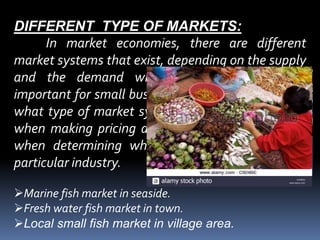
Marine fish market in seaside.
Fresh water fish market in town.
Local small fish market in village area.
DEVELOPMENT:
Fish markets are historically most often
found in seaside towns. Once ice or other simple
cooling methods became available, some were
also established in large inland cities that had
good trade routes to the coast.
Since refrigeration and rapid transport became
available in the 19th and 20th century, fish
markets can technically be established at any
place.
MARKET STRUCTURE:
•Market structure is best defined as the
organizational and other characteristics of a
market. We focus on those characteristics which
affect the nature of competition and pricing – but it
is important not to place too much emphasis simply
on the market share of the existing firms in an
industry.There are 4 main type of market, these are
 PERFECT COMPETITION
 MONOPOLY
 MONOPOLISITC COMPETITION
 OLIGOPOLY
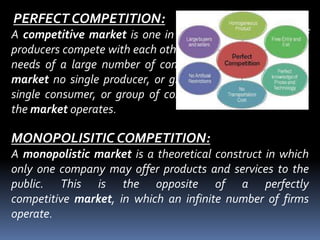
PERFECT COMPETITION:
A competitive market is one in which a large numbers of
producers compete with each other to satisfy the wants and
needs of a large number of consumers. In a competitive
market no single producer, or group of producers, and no
single consumer, or group of consumers, can dictate how
the market operates.
MONOPOLISITIC COMPETITION:
A monopolistic market is a theoretical construct in which
only one company may offer products and services to the
public. This is the opposite of a perfectly
competitive market, in which an infinite number of firms
operate.
OLIGOPOLY :
Oligopoly is a market structure in which a small number of
firms has the large majority of market share. An oligopoly is
similar to a monopoly, except that rather than one firm, two
or more firms dominate the market.
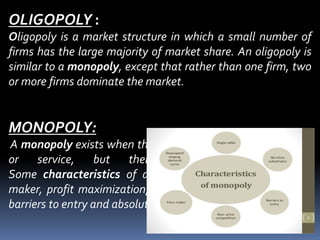
MONOPOLY:
A monopoly exists when there is only one supplier of a good
or service, but there are many consumers.
Some characteristics of a monopolistic market are price
maker, profit maximization, one seller and producer, higher
barriers to entry and absolute product differentiation.
PRICE:
price is the quantity of payment or compensation given by
one party to another in return for goods or services.
PRICE FORMATON CRITERIA.
The primary role of a market price is to establish
equilibrium between supply and demand. Price
formation is one of the key elements of market economy
functioning.The price of a commodity or a service
is formed as a result of numerous economic, political and
social processes and this is true for traditional commodity
relations as well as for financial markets. Price formation
mainly depend on
 public demand
availability and
 quality of product
MARINE FISHES PRICE FORMATION.
Marine fish price are formed through the
auction. Auctions remain the preferred method for
the sale of most wild caught species. Most fresh
fishes are sold through auction markets in the
located around the coastline. Specially of pelagic
fish, is marketed through Producer or sold direct to
export.
PROCESS:
Fish is normally transported to a sales location, such
as a producer's market or auction room. The buyers are
wholesalers, retailers and restaurants. If there is no first
sale facility near the landing point, fishermen deal directly
with the wholesalers.
Another channel is direct sale on the dock from the vessel
to consumers, or to restaurant owners and traditional
retailers without intermediaries. Small amounts of fish are
sold on the quayside, directly from fishermen to the
distributors and caterers.
FACTORS INFLUENCES OF FISH PRICE:
There are so many factors which influences the fish
prices. These are
 Market type,
 Form of preservation,
 type,
 Length of fish,
 Weight of fish,
 Distance to the market,
 Distance from the main city were examined using multiple
regression analysis to find their influence on price.
It was found out that species type, weight, form of
preservation and market type influenced the prices of fish more
than the other variables.
CONCLUSION:
In a free or competitive market,
buyers and sellers are free to enter or
leave the market. There is no collusion
among buyers or sellers to control the
price, and no price-fixing by government.
The price is formed in the market by
supply and demand.
REFERENCES:
www.google.com
www.wikipedia.com
www.Researchgate.net
www.slideshare.net
THANKYOU

Market structure (

  • 1.
    SUBMITTED BY- Chhoto Kisku Seminar on MARKETSTRUCTURE AND PRICE FORMATION IN INLAND FISH MARKET.
  • 2.
    INTRODUCTION: A fish marketis a marketplace for selling fish products. It can be dedicated to wholesale trade between fishermen and fish merchants, or to the sale of seafood to individual consumers, or to both. Retail fish markets, a type of wet market often sell street food as well. Fish markets range in size from small fish stalls, medium and large depend on the demand.
  • 3.
    DEFINITION: A market isa medium that allows buyers and sellers of a specific good or service to interact in order to facilitate an exchange. This type of market may either be a physical marketplace where people come together to exchange goods and services in person, as in a bazaar or shopping center, or a virtual market wherein buyers and sellers do not interact, as in an online market.
  • 4.
    DIFFERENT TYPE OFMARKETS: In market economies, there are different market systems that exist, depending on the supply and the demand within that industry. It is important for small business owners to understand what type of market system they are operating in when making pricing and production decisions, or when determining whether to enter or leave a particular industry. Marine fish market in seaside. Fresh water fish market in town. Local small fish market in village area.
  • 5.
    DEVELOPMENT: Fish markets arehistorically most often found in seaside towns. Once ice or other simple cooling methods became available, some were also established in large inland cities that had good trade routes to the coast. Since refrigeration and rapid transport became available in the 19th and 20th century, fish markets can technically be established at any place.
  • 6.
    MARKET STRUCTURE: •Market structureis best defined as the organizational and other characteristics of a market. We focus on those characteristics which affect the nature of competition and pricing – but it is important not to place too much emphasis simply on the market share of the existing firms in an industry.There are 4 main type of market, these are  PERFECT COMPETITION  MONOPOLY  MONOPOLISITC COMPETITION  OLIGOPOLY
  • 7.
    PERFECT COMPETITION: A competitivemarket is one in which a large numbers of producers compete with each other to satisfy the wants and needs of a large number of consumers. In a competitive market no single producer, or group of producers, and no single consumer, or group of consumers, can dictate how the market operates. MONOPOLISITIC COMPETITION: A monopolistic market is a theoretical construct in which only one company may offer products and services to the public. This is the opposite of a perfectly competitive market, in which an infinite number of firms operate.
  • 8.
    OLIGOPOLY : Oligopoly isa market structure in which a small number of firms has the large majority of market share. An oligopoly is similar to a monopoly, except that rather than one firm, two or more firms dominate the market. MONOPOLY: A monopoly exists when there is only one supplier of a good or service, but there are many consumers. Some characteristics of a monopolistic market are price maker, profit maximization, one seller and producer, higher barriers to entry and absolute product differentiation.
  • 9.
    PRICE: price is thequantity of payment or compensation given by one party to another in return for goods or services. PRICE FORMATON CRITERIA. The primary role of a market price is to establish equilibrium between supply and demand. Price formation is one of the key elements of market economy functioning.The price of a commodity or a service is formed as a result of numerous economic, political and social processes and this is true for traditional commodity relations as well as for financial markets. Price formation mainly depend on  public demand availability and  quality of product
  • 10.
    MARINE FISHES PRICEFORMATION. Marine fish price are formed through the auction. Auctions remain the preferred method for the sale of most wild caught species. Most fresh fishes are sold through auction markets in the located around the coastline. Specially of pelagic fish, is marketed through Producer or sold direct to export.
  • 11.
    PROCESS: Fish is normallytransported to a sales location, such as a producer's market or auction room. The buyers are wholesalers, retailers and restaurants. If there is no first sale facility near the landing point, fishermen deal directly with the wholesalers. Another channel is direct sale on the dock from the vessel to consumers, or to restaurant owners and traditional retailers without intermediaries. Small amounts of fish are sold on the quayside, directly from fishermen to the distributors and caterers.
  • 12.
    FACTORS INFLUENCES OFFISH PRICE: There are so many factors which influences the fish prices. These are  Market type,  Form of preservation,  type,  Length of fish,  Weight of fish,  Distance to the market,  Distance from the main city were examined using multiple regression analysis to find their influence on price. It was found out that species type, weight, form of preservation and market type influenced the prices of fish more than the other variables.
  • 13.
    CONCLUSION: In a freeor competitive market, buyers and sellers are free to enter or leave the market. There is no collusion among buyers or sellers to control the price, and no price-fixing by government. The price is formed in the market by supply and demand.
  • 14.
  • 15.