MARKETING OF FISH IN
   INDIA (SUPPLY)


              Presented by,
             Reshmi soman.s
                3rd sem IF
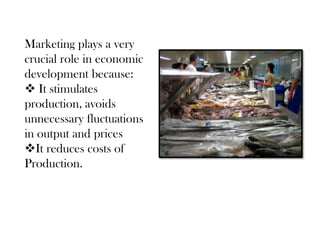
Marketing plays a very
crucial role in economic
development because:
 It stimulates
production, avoids
unnecessary fluctuations
in output and prices
It reduces costs of
Production.
 Marketing stimulates
production mainly by creating new
demand dimensions.
 It can convert latest demand
into effective demand.
Though it cannot in itself create
purchasing power, it can uncover
and channel purchasing power
that exists and thus create
conditions for a much higher level
of economic activity than existed
before and create opportunities
for entrepreneur.
Markets determine the price of any product.
The price of any product highly depends on its
demand.
Demand virtually influences the supply and both supply
and demand together decides the marketability.
This is more true in the case of open access or
common property resources in which demand creates its
own supply, contrary to the
“supply creates its own demand” theory formulated by
the famous economist Say’s law of supply.
In India, the fish production (both inland
and marine) has increased from 0.75 million
tonnes (1950-51) to 7.85 million tonnes
(2009-10).
While the inland fish production has
increased over the years, the marine fish catch
remained stagnant for the last two decades.
The value of the marine fish landings have
been estimated at 22,648 crores at point of
first sales and at 36,964 crores at point of last
sales in 2010, which underscores the potential
earning capacity of the sector. The sector has
earned a foreign exchange of 10,000 crores
(2009-10) through the export of 6 lakh tonnes
of sea food products.
Marine fisheries contribute
significantly to the Indian economy
by way of foreign exchange
earnings and employment
generation to a large section of the
population in the coastal areas of
the country. In addition, it plays a
major role in ensuring the food
security of the nation through
supply of cheap and affordable fish
protein to a large majority of the
population.
According to the Food and Agriculture Organization of the
United Nations (FAO), “An estimated 25 per cent of major
marine fish stocks are under-exploited or moderately
exploited. About 47 per cent of the main stocks or species
groups are fully exploited and are producing catches that
have reached, or are very close to, their maximum
sustainable limits. Another 18 per cent of stocks or species
groups are reported as over-exploited. The remaining ten
per cent of stocks have become significantly depleted, or are
recovering from depletion and are far less productive than
they used to be… Catches of commercially-valuable fish
species may be surpassing permitted levels by over 300 per
cent due to illegal and unregulated fishing (FAO 2002).”
The projected supply of fish is 9.60 mt (by 2012) with
major share from two area,
 5.34mt from inland aquaculture.
 3.10mt from marine fisheries.

The fisheries sector contributed Rs. 67,913 crores to
the GDP during 2009-2010.
Sustainability issues in which fish supply
chain

 Lack of knowledge, information flow &communication.
 Lack of traceability.
 Depletion of stocks.
Sustainability issues in prepared &
preserved fish supply chain.
  Growing public concern for wild life that was
being       killed as a by product of tuna
fishing.
  Waste disposal in canning & processed plants.
  High rate of mercury contamination in canned
tuna.
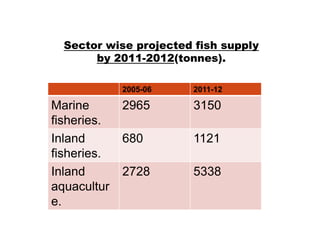
Sector wise projected fish supply
       by 2011-2012(tonnes).

             2005-06   2011-12

Marine       2965      3150
fisheries.
Inland       680       1121
fisheries.
Inland       2728      5338
aquacultur
e.
PREVIOUS YEAR QUESTIONS.


  Give an account of the recent trends of
supply of different varieties in India?
                            (Nov2006)
  Give an account of the future prospects of
fish marketing on the basis of current supply of
fish in India?
THANK YOU

Resmi

  • 1.
    MARKETING OF FISHIN INDIA (SUPPLY) Presented by, Reshmi soman.s 3rd sem IF
  • 2.
    Marketing plays avery crucial role in economic development because:  It stimulates production, avoids unnecessary fluctuations in output and prices It reduces costs of Production.
  • 3.
     Marketing stimulates productionmainly by creating new demand dimensions.  It can convert latest demand into effective demand. Though it cannot in itself create purchasing power, it can uncover and channel purchasing power that exists and thus create conditions for a much higher level of economic activity than existed before and create opportunities for entrepreneur.
  • 4.
    Markets determine theprice of any product. The price of any product highly depends on its demand. Demand virtually influences the supply and both supply and demand together decides the marketability. This is more true in the case of open access or common property resources in which demand creates its own supply, contrary to the “supply creates its own demand” theory formulated by the famous economist Say’s law of supply.
  • 5.
    In India, thefish production (both inland and marine) has increased from 0.75 million tonnes (1950-51) to 7.85 million tonnes (2009-10). While the inland fish production has increased over the years, the marine fish catch remained stagnant for the last two decades. The value of the marine fish landings have been estimated at 22,648 crores at point of first sales and at 36,964 crores at point of last sales in 2010, which underscores the potential earning capacity of the sector. The sector has earned a foreign exchange of 10,000 crores (2009-10) through the export of 6 lakh tonnes of sea food products.
  • 6.
    Marine fisheries contribute significantlyto the Indian economy by way of foreign exchange earnings and employment generation to a large section of the population in the coastal areas of the country. In addition, it plays a major role in ensuring the food security of the nation through supply of cheap and affordable fish protein to a large majority of the population.
  • 7.
    According to theFood and Agriculture Organization of the United Nations (FAO), “An estimated 25 per cent of major marine fish stocks are under-exploited or moderately exploited. About 47 per cent of the main stocks or species groups are fully exploited and are producing catches that have reached, or are very close to, their maximum sustainable limits. Another 18 per cent of stocks or species groups are reported as over-exploited. The remaining ten per cent of stocks have become significantly depleted, or are recovering from depletion and are far less productive than they used to be… Catches of commercially-valuable fish species may be surpassing permitted levels by over 300 per cent due to illegal and unregulated fishing (FAO 2002).”
  • 8.
    The projected supplyof fish is 9.60 mt (by 2012) with major share from two area,  5.34mt from inland aquaculture.  3.10mt from marine fisheries. The fisheries sector contributed Rs. 67,913 crores to the GDP during 2009-2010.
  • 9.
    Sustainability issues inwhich fish supply chain  Lack of knowledge, information flow &communication.  Lack of traceability.  Depletion of stocks.
  • 10.
    Sustainability issues inprepared & preserved fish supply chain. Growing public concern for wild life that was being killed as a by product of tuna fishing. Waste disposal in canning & processed plants. High rate of mercury contamination in canned tuna.
  • 11.
    Sector wise projectedfish supply by 2011-2012(tonnes). 2005-06 2011-12 Marine 2965 3150 fisheries. Inland 680 1121 fisheries. Inland 2728 5338 aquacultur e.
  • 12.
    PREVIOUS YEAR QUESTIONS. Give an account of the recent trends of supply of different varieties in India? (Nov2006) Give an account of the future prospects of fish marketing on the basis of current supply of fish in India?
  • 13.

Editor's Notes