The document discusses the importance of sampling techniques in research, highlighting their role in ensuring valid and reliable findings. It distinguishes between probability and non-probability sampling methods, detailing their advantages and disadvantages, as well as the challenges associated with sample size determination and potential biases. Ethical considerations in sampling, such as fairness, participant privacy, and informed consent, are also emphasized to ensure high-quality research outcomes.
Introduction to
Sampling
Techniques
Sampling isa fundamental concept in research and data
analysis, where a subset of a population is selected to
represent the whole. Understanding the various sampling
techniques is crucial for ensuring the validity and reliability
of research findings.
by Dr.Narendranath Guria
narengeo2012@gmail.com
2.
Importance of Sampling
inResearch/Thesis
Sampling is crucial in research and thesis work, as it
allows researchers to draw meaningful conclusions from a
manageable subset of a larger population. Proper
sampling techniques ensure the data collected is
representative, enabling reliable statistical analysis and
generalization of findings.
@GeographyNG by Dr.Narendranath Guria
www.youtube.com/@geographyng
3.
Types of SamplingTechniques
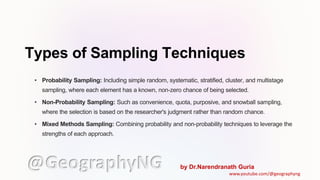
• Probability Sampling: Including simple random, systematic, stratified, cluster, and multistage
sampling, where each element has a known, non-zero chance of being selected.
• Non-Probability Sampling: Such as convenience, quota, purposive, and snowball sampling,
where the selection is based on the researcher's judgment rather than random chance.
• Mixed Methods Sampling: Combining probability and non-probability techniques to leverage the
strengths of each approach.
@GeographyNG by Dr.Narendranath Guria
www.youtube.com/@geographyng
4.
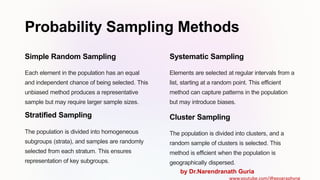
Probability Sampling Methods
SimpleRandom Sampling
Each element in the population has an equal
and independent chance of being selected. This
unbiased method produces a representative
sample but may require larger sample sizes.
Systematic Sampling
Elements are selected at regular intervals from a
list, starting at a random point. This efficient
method can capture patterns in the population
but may introduce biases.
Stratified Sampling
The population is divided into homogeneous
subgroups (strata), and samples are randomly
selected from each stratum. This ensures
representation of key subgroups.
Cluster Sampling
The population is divided into clusters, and a
random sample of clusters is selected. This
method is efficient when the population is
geographically dispersed.
by Dr.Narendranath Guria
www.youtube.com/@geographyng
5.
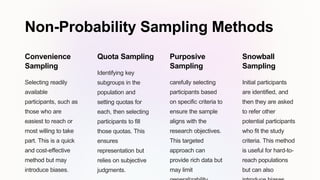
Non-Probability Sampling Methods
Convenience
Sampling
Selectingreadily
available
participants, such as
those who are
easiest to reach or
most willing to take
part. This is a quick
and cost-effective
method but may
introduce biases.
Quota Sampling
Identifying key
subgroups in the
population and
setting quotas for
each, then selecting
participants to fill
those quotas. This
ensures
representation but
relies on subjective
judgments.
Purposive
Sampling
carefully selecting
participants based
on specific criteria to
ensure the sample
aligns with the
research objectives.
This targeted
approach can
provide rich data but
may limit
Snowball
Sampling
Initial participants
are identified, and
then they are asked
to refer other
potential participants
who fit the study
criteria. This method
is useful for hard-to-
reach populations
but can also
6.
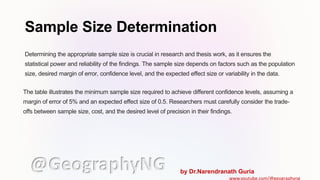
Sample Size Determination
Determiningthe appropriate sample size is crucial in research and thesis work, as it ensures the
statistical power and reliability of the findings. The sample size depends on factors such as the population
size, desired margin of error, confidence level, and the expected effect size or variability in the data.
The table illustrates the minimum sample size required to achieve different confidence levels, assuming a
margin of error of 5% and an expected effect size of 0.5. Researchers must carefully consider the trade-
offs between sample size, cost, and the desired level of precision in their findings.
@GeographyNG by Dr.Narendranath Guria
www.youtube.com/@geographyng
7.
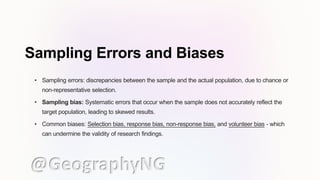
Sampling Errors andBiases
• Sampling errors: discrepancies between the sample and the actual population, due to chance or
non-representative selection.
• Sampling bias: Systematic errors that occur when the sample does not accurately reflect the
target population, leading to skewed results.
• Common biases: Selection bias, response bias, non-response bias, and volunteer bias - which
can undermine the validity of research findings.
@GeographyNG
8.
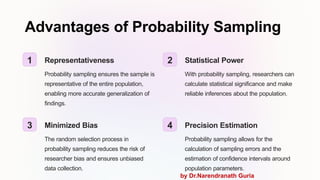
Advantages of ProbabilitySampling
1 Representativeness
Probability sampling ensures the sample is
representative of the entire population,
enabling more accurate generalization of
findings.
2 Statistical Power
With probability sampling, researchers can
calculate statistical significance and make
reliable inferences about the population.
3 Minimized Bias
The random selection process in
probability sampling reduces the risk of
researcher bias and ensures unbiased
data collection.
4 Precision Estimation
Probability sampling allows for the
calculation of sampling errors and the
estimation of confidence intervals around
population parameters.
by Dr.Narendranath Guria
9.
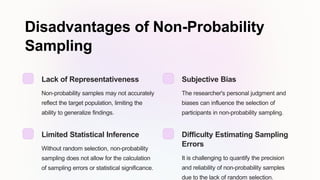
Disadvantages of Non-Probability
Sampling
Lackof Representativeness
Non-probability samples may not accurately
reflect the target population, limiting the
ability to generalize findings.
Subjective Bias
The researcher's personal judgment and
biases can influence the selection of
participants in non-probability sampling.
Limited Statistical Inference
Without random selection, non-probability
sampling does not allow for the calculation
of sampling errors or statistical significance.
Difficulty Estimating Sampling
Errors
It is challenging to quantify the precision
and reliability of non-probability samples
due to the lack of random selection.
10.
Impact of Sampling
onData Quality
Sampling techniques have a significant impact on the quality of research data. Proper sampling
ensures the collected data is representative, minimizing biases and errors that can undermine the
validity and reliability of findings.
Careful consideration of sampling methods, sample size, and potential sources of bias is crucial to
obtaining high-quality, trustworthy data that supports robust conclusions and generalizations.
@GeographyNG by Dr.Narendranath Guria
www.youtube.com/@geographyng
11.
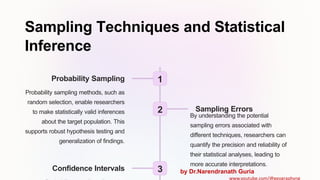
Sampling Techniques andStatistical
Inference
1
Probability Sampling
Probability sampling methods, such as
random selection, enable researchers
to make statistically valid inferences
about the target population. This
supports robust hypothesis testing and
generalization of findings.
2 Sampling Errors
By understanding the potential
sampling errors associated with
different techniques, researchers can
quantify the precision and reliability of
their statistical analyses, leading to
more accurate interpretations.
3
Confidence Intervals by Dr.Narendranath Guria
www.youtube.com/@geographyng
12.
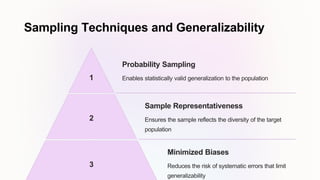
Sampling Techniques andGeneralizability
1
Probability Sampling
Enables statistically valid generalization to the population
2
Sample Representativeness
Ensures the sample reflects the diversity of the target
population
3
Minimized Biases
Reduces the risk of systematic errors that limit
generalizability
13.
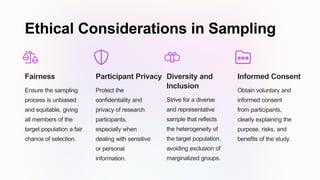
Ethical Considerations inSampling
Fairness
Ensure the sampling
process is unbiased
and equitable, giving
all members of the
target population a fair
chance of selection.
Participant Privacy
Protect the
confidentiality and
privacy of research
participants,
especially when
dealing with sensitive
or personal
information.
Diversity and
Inclusion
Strive for a diverse
and representative
sample that reflects
the heterogeneity of
the target population,
avoiding exclusion of
marginalized groups.
Informed Consent
Obtain voluntary and
informed consent
from participants,
clearly explaining the
purpose, risks, and
benefits of the study.
14.
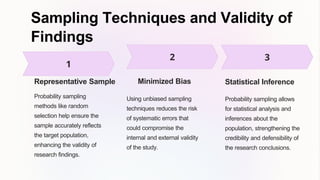
Sampling Techniques andValidity of
Findings
Representative Sample
Probability sampling
methods like random
selection help ensure the
sample accurately reflects
the target population,
enhancing the validity of
research findings.
Minimized Bias
Using unbiased sampling
techniques reduces the risk
of systematic errors that
could compromise the
internal and external validity
of the study.
Statistical Inference
Probability sampling allows
for statistical analysis and
inferences about the
population, strengthening the
credibility and defensibility of
the research conclusions.
15.
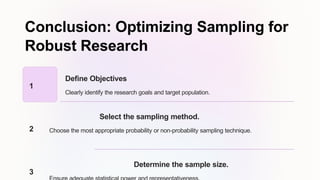
Conclusion: Optimizing Samplingfor
Robust Research
1
Define Objectives
Clearly identify the research goals and target population.
2
Select the sampling method.
Choose the most appropriate probability or non-probability sampling technique.
3
Determine the sample size.
16.
Minimize Biases
Implement strategiesto reduce the risk of
systematic errors.
Optimizing the sampling process is crucial for conducting robust, high-quality research. By carefully
defining research objectives, selecting the right sampling methods, determining an appropriate sample
size, and minimizing potential biases, researchers can ensure their findings are statistically valid,
representative, and generalizable.
by Dr.Narendranath Guria
www.youtube.com/@geographyng