Module 5: SamplingTechniques
By:
Kishlay Kumar
Assistant Professor
Faculty of Business Management
Sarala Birla University, Ranchi
2.
Meaning & typesof Sampling Techniques and Methods of Data
Collection
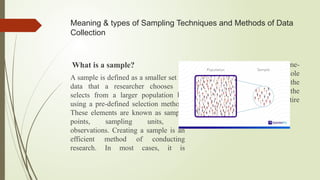
What is a sample?
A sample is defined as a smaller set of
data that a researcher chooses or
selects from a larger population by
using a pre-defined selection method.
These elements are known as sample
points, sampling units, or
observations. Creating a sample is an
efficient method of conducting
research. In most cases, it is
impossible or costly and time-
consuming to research the whole
population. Hence, examining the
sample provides insights that the
researcher can apply to the entire
population.
3.
Types of samples
Theprocess of deriving a sample is
called a sampling method. Sampling
forms an integral part of the research
design as this method derives the
quantitative data and the qualitative
data that can be collected as part of a
research study. Sampling Methods are
characterized into two distinct
approaches: probability sampling and
non-probability sampling.
4.
Probability sampling
Probability Samplingis a sampling technique where a researcher sets a selection of a few
criteria and chooses members of a population randomly. All the members have an equal
opportunity to be a part of the sample with this selection parameter. Hence, there is no bias
whatsoever in this type of sample. Each person in the population can subsequently be a part
of the research. The selection criteria are decided at the outset of the market research study
and form an important component of research.
Types of probability sampling
Simple Random Sampling
Cluster Sampling
Systematic Sampling
Stratified Random Sampling
6.
Simple randomsampling: One of the best probability sampling techniques that helps
in saving time and resources, is the Simple Random Sampling method. It is a reliable
method of obtaining information where every single member of a population is chosen
randomly, merely by chance. Each individual has the same probability of being chosen
to be a part of a sample.
For Examples:
1. In an organization of 500 employees, if the HR team decides on conducting team
building activities, it is highly likely that they would prefer picking chits out of a
bowl. In this case, each of the 500 employees has an equal opportunity of being
selected.
2. If a university dean would like to collect feedback from students about their
perception of the teachers and level of education, all 1000 students in the University
could be a part of this sample. Any 100 students can be selected at random to be a
part of this sample.
7.
Cluster sampling:Cluster Sampling is
a method where the researchers divide
the entire population into sections or
clusters that represent a population.
Clusters are identified and included in
a sample based on demographic
parameters like age, sex, location, etc.
This makes it very simple for a survey
creator to derive effective inference
from the feedback.
Types of Cluster Sampling
8.
1. Single-stage clustersampling:
As the name suggests, sampling is done just once. An example of single-stage cluster
sampling – if you were to conduct a study on the consumption of soda in a particular city,
you could use area sampling to divide the city into different areas, called clusters, and then
select certain clusters to be a part of the sample group.
2. Two-stage cluster sampling:
Two-stage sampling is a more feasible and realistic method of sampling in cases where the
population is too large or is scattered over a large geographical area. In this method, simple
random sampling (sometimes other sampling methods like systematic sampling are also used)
is used to select elements from the selected clusters, further narrowing down to the desired
sample size.
Carrying forward the previous example, if your sample is too large even after
eliminating the clusters that weren’t selected, you may use two-stage sampling to further
narrow down the sample. With two-stage sampling, you can use simple random sampling to
select elements from each one of the selected clusters. The units of the narrowed down
sample group will be the selected respondents for the study on soda consumption.
9.
3. Multistage Sampling
Multistagesampling takes two-stage sampling further by adding a step, or a few
more steps, to the process of obtaining the desired sample group. This means that
the researchers use multiple steps to obtain the desired sample, and at each stage
they are left with a smaller and smaller sample group. This is the most complex of
the three, but is also the most advantageous for very large populations and/or
geographically dispersed populations.
10.
Systematic sampling:Researchers use the systematic sampling method to
choose the sample members of a population at regular intervals. It requires the
selection of a starting point for the sample and sample size that can be repeated
at regular intervals. This type of sampling method has a predefined range, and
hence this sampling technique is the least time-consuming.
For example, a researcher intends to collect a systematic sample of 500
people in a population of 5000. He/she numbers each element of the population
from 1-5000 and will choose every 10th individual to be a part of the sample (Total
population/ Sample Size = 5000/500 = 10).
11.
Stratified Sampling
Stratified randomsampling is a method of sampling that involves the division of a
population into smaller sub-groups known as strata. In stratified random sampling, or
stratification, the strata are formed based on members' shared attributes or
characteristics such as income or educational attainment.
Stratified Sampling is a category under probability sampling which is based on
dividing a population into strata, and members for the sample are selected randomly
from these strata. In stratified sampling, the strata must be homogenous and also
collectively exhaustive(Complete), and mutually exclusive as well.
12.
Non- Probability Sampling
Non-probabilitysampling is a branch of sample selection that uses non-
random ways to select a group of people to participate in research.
Unlike probability sampling and its methods, non-probability sampling
doesn’t focus on accurately representing all members of a large population
within a smaller sample group of participants. As a result, not all members of
the population have an equal chance of participating in the study.
13.
Types of Non-Probability Sampling
Convenience sampling: Convenience Sampling is a non-probability
sampling technique where samples are selected from the population only
because they are conveniently available to the researcher. Researchers
choose these samples just because they are easy to recruit, and the
researcher did not consider selecting a sample that represents the entire
population.
14.
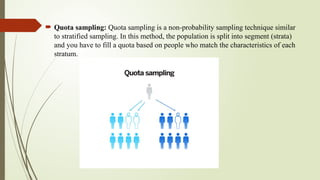
Quota sampling:Quota sampling is a non-probability sampling technique similar
to stratified sampling. In this method, the population is split into segment (strata)
and you have to fill a quota based on people who match the characteristics of each
stratum.
15.
• Judgmental orPurposive sampling: In the judgmental sampling method,
researchers select the samples based purely on the researcher’s knowledge and
credibility. In other words, researchers choose only those people who they deem
fit to participate in the research study. Judgmental or purposive sampling is not
a scientific method of sampling, and the downside to this sampling technique is
that the preconceived notions of a researcher can influence the results. Thus,
this research technique involves a high amount of ambiguity ( vague).
16.
Snowball sampling:Snowball Sampling helps researchers find a sample when they are
difficult to locate. Researchers use this technique when the sample size is small and not
easily available. This sampling system works like the referral program. This ongoing
pattern can be perfectly described by a snowball rolling downhill: increasing in size as it
collects more snow (in this case, participants).
17.
Probability Sampling Non-Probability Sampling
The sample is selected at random.
Sample selection based on the
subjective judgment of the researcher.
Everyone in the population has an
equal chance of getting selected.
Not everyone has an equal chance to
participate.
Used to create an accurate sample.
The sample does not accurately
represent the population
These involve a long time to get the
data.
These are easy ways to collect the data
quickly.
18.
Characteristics of aGood Sample
Goal-oriented: A sample design should be goal oriented. It is means and
should be oriented to the research objectives and fitted to the survey
conditions.
Accurate representative of the universe: A sample should be an accurate
representative of the universe from which it is taken. There are different
methods for selecting a sample. It will be truly representative only when it
represents all types of units or groups in the total population in fair
proportions. In brief sample should be selected carefully as improper
sampling is a source of error in the survey.
Proportional: A sample should be proportional. It should be large enough
to represent the universe properly. The sample size should be sufficiently
large to provide statistical stability or reliability. The sample size should
give accuracy required for the purpose of particular study.
19.
Random selection:A sample should be selected at random. This means that
any item in the group has a full and equal chance of being selected and included
in the sample. This makes the selected sample truly representative in character.
Economical: A sample should be economical. The objectives of the survey
should be achieved with minimum cost and effort.
Practical: A sample design should be practical. The sample design should be
simple i.e. it should be capable of being understood and followed in the
fieldwork.
Actual information provider: A sample should be designed so as to provide
actual information required for the study and also provide an adequate basis for
the measurement of its own reliability.