



Reasoning &
Decision making.
THE NATURE OF INDUCTIVE
REASONING
In inductive reasoning, conclusions are
suggested, with varying degrees of certainty,
but
do not definitely follow from premises.
Observation 1 : All the crows I’ve seen in Pittsburgh are
black. When I visited my brother in
Washington, DC, the crows I saw there were
black too.
Conclusion: I think it is a pretty good bet that all crows are
black.
Observation 2 : Here in Tucson, the sun has risen every
morning.
Conclusion: The sun is going to rise in Tucson tomorrow.
In evaluating inductive arguments, we decide how strong the
argument is.
Strong arguments result in conclusions that are more likely to be
true, and weak arguments
result in conclusions that are not as likely to be true.
Also, Inductive arguments lead to what is probably true, not what
is definitely true.
Factors contributing to the strength
of inductive arguments
 Representativeness of observations
 Number of observations
 Quality of the evidence
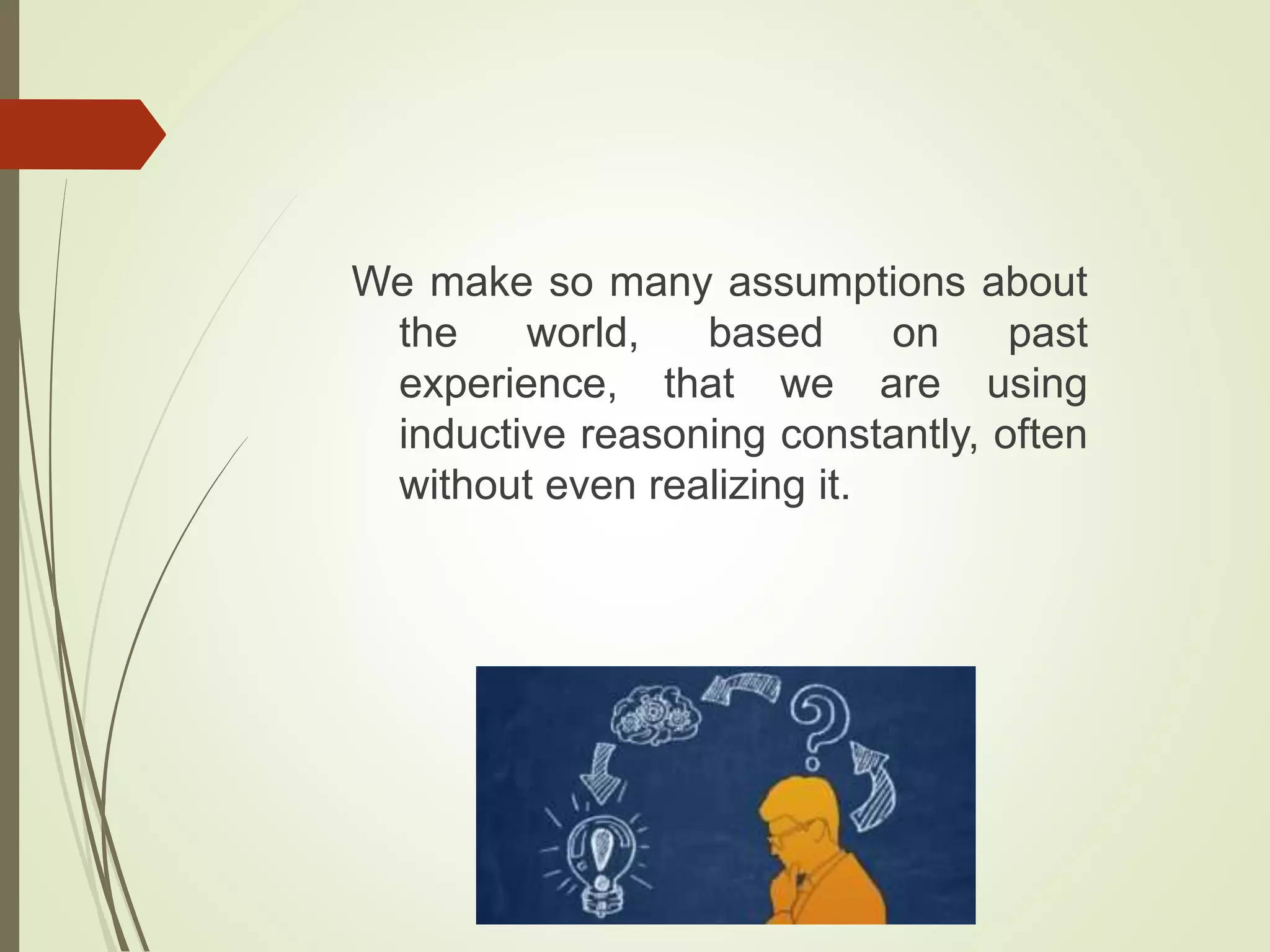
We make so many assumptions about
the world, based on past
experience, that we are using
inductive reasoning constantly, often
without even realizing it.
Inductive reasoning is so automatic that you are
not aware that any kind of “reasoning” is
happening at all.
When people use past experience to guide present
behavior, they often use shortcuts to help them reach
conclusions rapidly.
These shortcuts take the form of heuristics.
Heuristics
People use a number of heuristics in reasoning that often
lead to the correct conclusion, but sometimes do not.
The availability heuristic
The representative heuristic.
THE AVAILABILITY
HEURISTIC
The availability heuristic states that events that
are more easily remembered are judged as
being more probable than events that are
less easily remembered.
E.g.
After seeing several news reports about car
thefts, you might make a judgment that
vehicle theft is much more common than it
really is in your area.
 This type of availability heuristic can be
helpful and important in decision-making.
 Faced with the need to an immediate
decision, the availability heuristic allows
people to quickly arrive at a conclusion.
Since heuristics is an approach to
problem solving based on our past
experiences, it is a practical method
not guaranteed to be optimal or
perfect.
It happens, when less frequently
occurring events stand out in our
memory.
It can lead to Illusory correlations
Illusory correlations
Occur when a
correlation between
two events appears
to exist, but in reality
there is no correlation
or it is much weaker
than it is assumed to
be.
The expectations from Illusory
correlations may take the form of a
stereotype, an oversimplified
generalization about a group or class
of people that often focuses on the
negative.
 Presented By Tarun Chauhan

Reasoning & Decision Making

  • 1.
  • 2.
    THE NATURE OFINDUCTIVE REASONING In inductive reasoning, conclusions are suggested, with varying degrees of certainty, but do not definitely follow from premises.
  • 3.
    Observation 1 :All the crows I’ve seen in Pittsburgh are black. When I visited my brother in Washington, DC, the crows I saw there were black too. Conclusion: I think it is a pretty good bet that all crows are black. Observation 2 : Here in Tucson, the sun has risen every morning. Conclusion: The sun is going to rise in Tucson tomorrow.
  • 4.
    In evaluating inductivearguments, we decide how strong the argument is. Strong arguments result in conclusions that are more likely to be true, and weak arguments result in conclusions that are not as likely to be true. Also, Inductive arguments lead to what is probably true, not what is definitely true.
  • 5.
    Factors contributing tothe strength of inductive arguments  Representativeness of observations  Number of observations  Quality of the evidence
  • 6.
    We make somany assumptions about the world, based on past experience, that we are using inductive reasoning constantly, often without even realizing it.
  • 7.
    Inductive reasoning isso automatic that you are not aware that any kind of “reasoning” is happening at all. When people use past experience to guide present behavior, they often use shortcuts to help them reach conclusions rapidly. These shortcuts take the form of heuristics.
  • 8.
    Heuristics People use anumber of heuristics in reasoning that often lead to the correct conclusion, but sometimes do not. The availability heuristic The representative heuristic.
  • 9.
    THE AVAILABILITY HEURISTIC The availabilityheuristic states that events that are more easily remembered are judged as being more probable than events that are less easily remembered.
  • 11.
    E.g. After seeing severalnews reports about car thefts, you might make a judgment that vehicle theft is much more common than it really is in your area.
  • 12.
     This typeof availability heuristic can be helpful and important in decision-making.  Faced with the need to an immediate decision, the availability heuristic allows people to quickly arrive at a conclusion.
  • 13.
    Since heuristics isan approach to problem solving based on our past experiences, it is a practical method not guaranteed to be optimal or perfect. It happens, when less frequently occurring events stand out in our memory. It can lead to Illusory correlations
  • 14.
    Illusory correlations Occur whena correlation between two events appears to exist, but in reality there is no correlation or it is much weaker than it is assumed to be.
  • 16.
    The expectations fromIllusory correlations may take the form of a stereotype, an oversimplified generalization about a group or class of people that often focuses on the negative.
  • 17.
     Presented ByTarun Chauhan