Research Methods

 (Whitehead / Arthur)
Laboratory experiment:
         - carried out in a lab setting
- Highest level of control      - Loss of validity (esp.
- Repeatable, therefore           ecological validity)
  reliable if similar results   - Demand characteristics.
  are produced
- Can use sophisticated
  measuring equipment in a
  lab
- More control over
  variables (could lead to
  knowing the cause/effect)
Field Experiment:
   - carried out in their natural environment
• Improved ecological        • Less control over IV and
  validity                     measuring DV. With
• Reduction of demand          addition of EV’s
  characteristics (though      (extraneous variables)
  there may still be some)   • Results cannot be
                               generalised to other
                               situations
                             • Often more costly (as
                               things have to be
                               arranged outside – could
                               inc. technical equipment)
Natural experiment:
          - IV is naturally occurring
• Reduction of demand         • Loss of control – The
  characteristics               investigator doesn’t
• The investigator doesn’t      control the IV.
  intervene (however, the     • A cause/effect
  presence of an                relationship is difficult
  investigator could affect     to establish
  ppts behaviour)
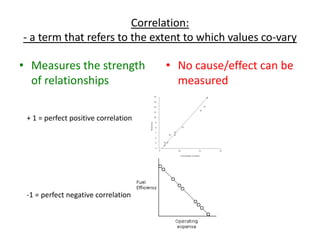
Correlation:
- a term that refers to the extent to which values co-vary

• Measures the strength               • No cause/effect can be
  of relationships                      measured

 + 1 = perfect positive correlation


 -1 = perfect negative correlation
Observation:
 - No deliberate manipulation of the variables
Naturalistic:
 Observed in a natural environment, e.g.
 school or workplace.

Lab-based observation:
  Labs can be ‘dressed up’ to look more natural,
  like a playroom, where children can be
  observed using a one-way mirror.
Observation – evaluation:
• Good research can be      • Control – cause/effect
  collected                   relationship cannot be
• Ecological validity can     established
  be good                   • Replication may be
                              difficult due to variables
                            • Observer
                              effects/demand
                              characteristics
                            • Ecological validity may
                              be lower
                            • Costs can be high
Self report: Questionnaires:
• Closed questions –        • Simple
  Tickboxes                 • Cheap & quite quick
• Open ended questions      • Researcher doesn’t
  – ‘What are your views      intrude
  on…?’                     • Ambiguous questions
• Leading questions – You     could be misconstrued
  love this PowerPoint,     • Leading Q’s
  don’t you?
                            • Social desirability bias
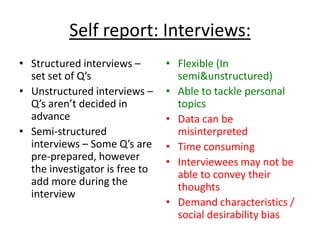
Self report: Interviews:
• Structured interviews –       • Flexible (In
  set set of Q’s                  semi&unstructured)
• Unstructured interviews –     • Able to tackle personal
  Q’s aren’t decided in           topics
  advance                       • Data can be
• Semi-structured                 misinterpreted
  interviews – Some Q’s are     • Time consuming
  pre-prepared, however         • Interviewees may not be
  the investigator is free to     able to convey their
  add more during the             thoughts
  interview
                                • Demand characteristics /
                                  social desirability bias
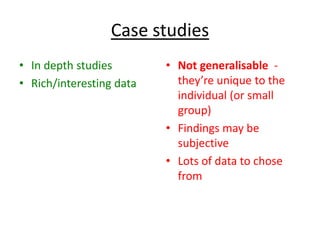
Case studies
• In depth studies        • Not generalisable -
• Rich/interesting data     they’re unique to the
                            individual (or small
                            group)
                          • Findings may be
                            subjective
                          • Lots of data to chose
                            from
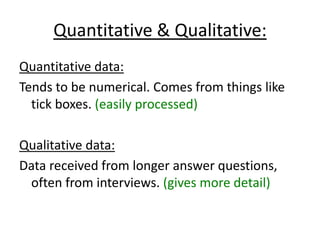
Quantitative & Qualitative:
Quantitative data:
Tends to be numerical. Comes from things like
  tick boxes. (easily processed)

Qualitative data:
Data received from longer answer questions,
 often from interviews. (gives more detail)
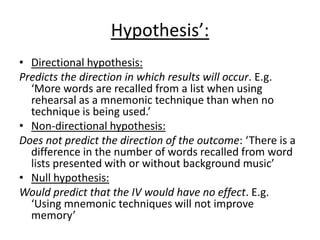
Hypothesis’:
• Directional hypothesis:
Predicts the direction in which results will occur. E.g.
  ‘More words are recalled from a list when using
  rehearsal as a mnemonic technique than when no
  technique is being used.’
• Non-directional hypothesis:
Does not predict the direction of the outcome: ‘There is a
  difference in the number of words recalled from word
  lists presented with or without background music’
• Null hypothesis:
Would predict that the IV would have no effect. E.g.
  ‘Using mnemonic techniques will not improve
  memory’
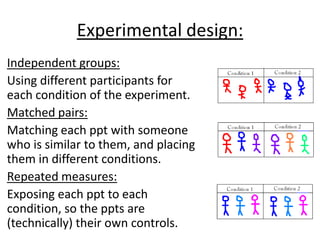
Experimental design:
Independent groups:
Using different participants for
each condition of the experiment.
Matched pairs:
Matching each ppt with someone
who is similar to them, and placing
them in different conditions.
Repeated measures:
Exposing each ppt to each
condition, so the ppts are
(technically) their own controls.
DV and IV
• Dependent variable:
The variable that is assumed to be effected by
the IV. Changes in the DV are presumed to have
been caused by the IV.

• Independent variable:
The variable which is manipulated by the
experimenter that is presumed to effect the DV.
Operationalising the variable:
General statement: ‘Mnemonics improve
 memory’

It means ‘narrowing down the research focus’

So, figuring out the most simple IV and DV from
  a question.
Pilot study:
• Small scale trial run of the actual experiment
• Allows the investigator to identify flaws of the
  experiment
• Tests for problems with
  - design of the experiment
  - Clarity of instructions for the ppts
  - Measuring instruments
• Also allows a time scale of the actual
  experiment to be estimated
Extraneous variables:
• Should (try to) be controlled so as not to affect
  the IV or the DV
Reliability & Validity:
Reliability:
Test whether something is reliable or not by doing
  repeats & seeing if similar results are gathered.

Validity:
Ecological validity – the extent to which the findings
  can be generalised to outside the research setting
Population validity – the extent to which the
  findings can be generalised to other groups of
  people
Subjective & objective:
Subjective:
‘Based on or influenced by personal feelings,
  tastes, or opinions.’

Objective:
Data which is based on scientific information.
 Eg. Using blood samples would be considered
 objective.
Ethical issues:
• Informed consent (though, sometimes
  presumptive consent is used on the basis that the
  investigator would think that they’d get consent)
• Confidentiality
• Right to withdraw
• Deception
• Protection from harm
• Debriefing
Cost-benefit analysis:
Is the cost of the experiment worth the amount
   of data we would get?
Types of sampling:
1. Random sampling
   - Everyone in the population has an equal chance of
   participating. E.g. using a random number generator
   to find numbers
2. Opportunity sampling
   - Unlikely to generate a representative sample, so
   investigation could be offered to everyone at a school,
   but then results couldn’t be generalised externally.
3. Volunteer sampling
   - People sign up to the experiment (e.g. in Milgram
   1960) Unlikely to be generalisable, as people who sign
   up are most likely to have a certain personality type
Demand characteristics:
• Predicting what the experiment is going to
  measure and acting accordingly – which could
  hinder results
• Acting out-of-character due to surrounding
  environment
• Displaying social desirability bias

Investigator effects – When the investigator can get
  too involved in the experiment, causing a change
  in results
Measures of central tendency and
               dispersion:
•   Central tendency:
-   Mean (add up all no. Divide by amount of data)
-   Median (middle number when arranged numerically)
-   Mode (most frequently occurring no.)
•   Dispersion – ‘shows the spread of data’:
-   Range (highest score – lowest score)
-   Standard deviation
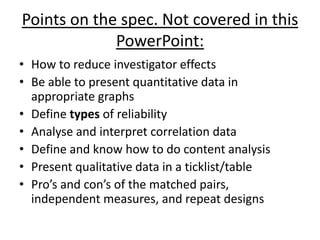
Points on the spec. Not covered in this
             PowerPoint:
• How to reduce investigator effects
• Be able to present quantitative data in
  appropriate graphs
• Define types of reliability
• Analyse and interpret correlation data
• Define and know how to do content analysis
• Present qualitative data in a ticklist/table
• Pro’s and con’s of the matched pairs,
  independent measures, and repeat designs

Research methods - PSYA1 psychology AS

  • 1.
  • 2.
    Laboratory experiment: - carried out in a lab setting - Highest level of control - Loss of validity (esp. - Repeatable, therefore ecological validity) reliable if similar results - Demand characteristics. are produced - Can use sophisticated measuring equipment in a lab - More control over variables (could lead to knowing the cause/effect)
  • 3.
    Field Experiment: - carried out in their natural environment • Improved ecological • Less control over IV and validity measuring DV. With • Reduction of demand addition of EV’s characteristics (though (extraneous variables) there may still be some) • Results cannot be generalised to other situations • Often more costly (as things have to be arranged outside – could inc. technical equipment)
  • 4.
    Natural experiment: - IV is naturally occurring • Reduction of demand • Loss of control – The characteristics investigator doesn’t • The investigator doesn’t control the IV. intervene (however, the • A cause/effect presence of an relationship is difficult investigator could affect to establish ppts behaviour)
  • 5.
    Correlation: - a termthat refers to the extent to which values co-vary • Measures the strength • No cause/effect can be of relationships measured + 1 = perfect positive correlation -1 = perfect negative correlation
  • 6.
    Observation: - Nodeliberate manipulation of the variables Naturalistic: Observed in a natural environment, e.g. school or workplace. Lab-based observation: Labs can be ‘dressed up’ to look more natural, like a playroom, where children can be observed using a one-way mirror.
  • 7.
    Observation – evaluation: •Good research can be • Control – cause/effect collected relationship cannot be • Ecological validity can established be good • Replication may be difficult due to variables • Observer effects/demand characteristics • Ecological validity may be lower • Costs can be high
  • 8.
    Self report: Questionnaires: •Closed questions – • Simple Tickboxes • Cheap & quite quick • Open ended questions • Researcher doesn’t – ‘What are your views intrude on…?’ • Ambiguous questions • Leading questions – You could be misconstrued love this PowerPoint, • Leading Q’s don’t you? • Social desirability bias
  • 9.
    Self report: Interviews: •Structured interviews – • Flexible (In set set of Q’s semi&unstructured) • Unstructured interviews – • Able to tackle personal Q’s aren’t decided in topics advance • Data can be • Semi-structured misinterpreted interviews – Some Q’s are • Time consuming pre-prepared, however • Interviewees may not be the investigator is free to able to convey their add more during the thoughts interview • Demand characteristics / social desirability bias
  • 10.
    Case studies • Indepth studies • Not generalisable - • Rich/interesting data they’re unique to the individual (or small group) • Findings may be subjective • Lots of data to chose from
  • 11.
    Quantitative & Qualitative: Quantitativedata: Tends to be numerical. Comes from things like tick boxes. (easily processed) Qualitative data: Data received from longer answer questions, often from interviews. (gives more detail)
  • 12.
    Hypothesis’: • Directional hypothesis: Predictsthe direction in which results will occur. E.g. ‘More words are recalled from a list when using rehearsal as a mnemonic technique than when no technique is being used.’ • Non-directional hypothesis: Does not predict the direction of the outcome: ‘There is a difference in the number of words recalled from word lists presented with or without background music’ • Null hypothesis: Would predict that the IV would have no effect. E.g. ‘Using mnemonic techniques will not improve memory’
  • 13.
    Experimental design: Independent groups: Usingdifferent participants for each condition of the experiment. Matched pairs: Matching each ppt with someone who is similar to them, and placing them in different conditions. Repeated measures: Exposing each ppt to each condition, so the ppts are (technically) their own controls.
  • 14.
    DV and IV •Dependent variable: The variable that is assumed to be effected by the IV. Changes in the DV are presumed to have been caused by the IV. • Independent variable: The variable which is manipulated by the experimenter that is presumed to effect the DV.
  • 15.
    Operationalising the variable: Generalstatement: ‘Mnemonics improve memory’ It means ‘narrowing down the research focus’ So, figuring out the most simple IV and DV from a question.
  • 16.
    Pilot study: • Smallscale trial run of the actual experiment • Allows the investigator to identify flaws of the experiment • Tests for problems with - design of the experiment - Clarity of instructions for the ppts - Measuring instruments • Also allows a time scale of the actual experiment to be estimated
  • 17.
    Extraneous variables: • Should(try to) be controlled so as not to affect the IV or the DV
  • 18.
    Reliability & Validity: Reliability: Testwhether something is reliable or not by doing repeats & seeing if similar results are gathered. Validity: Ecological validity – the extent to which the findings can be generalised to outside the research setting Population validity – the extent to which the findings can be generalised to other groups of people
  • 19.
    Subjective & objective: Subjective: ‘Basedon or influenced by personal feelings, tastes, or opinions.’ Objective: Data which is based on scientific information. Eg. Using blood samples would be considered objective.
  • 20.
    Ethical issues: • Informedconsent (though, sometimes presumptive consent is used on the basis that the investigator would think that they’d get consent) • Confidentiality • Right to withdraw • Deception • Protection from harm • Debriefing
  • 21.
    Cost-benefit analysis: Is thecost of the experiment worth the amount of data we would get?
  • 22.
    Types of sampling: 1.Random sampling - Everyone in the population has an equal chance of participating. E.g. using a random number generator to find numbers 2. Opportunity sampling - Unlikely to generate a representative sample, so investigation could be offered to everyone at a school, but then results couldn’t be generalised externally. 3. Volunteer sampling - People sign up to the experiment (e.g. in Milgram 1960) Unlikely to be generalisable, as people who sign up are most likely to have a certain personality type
  • 23.
    Demand characteristics: • Predictingwhat the experiment is going to measure and acting accordingly – which could hinder results • Acting out-of-character due to surrounding environment • Displaying social desirability bias Investigator effects – When the investigator can get too involved in the experiment, causing a change in results
  • 24.
    Measures of centraltendency and dispersion: • Central tendency: - Mean (add up all no. Divide by amount of data) - Median (middle number when arranged numerically) - Mode (most frequently occurring no.) • Dispersion – ‘shows the spread of data’: - Range (highest score – lowest score) - Standard deviation
  • 25.
    Points on thespec. Not covered in this PowerPoint: • How to reduce investigator effects • Be able to present quantitative data in appropriate graphs • Define types of reliability • Analyse and interpret correlation data • Define and know how to do content analysis • Present qualitative data in a ticklist/table • Pro’s and con’s of the matched pairs, independent measures, and repeat designs