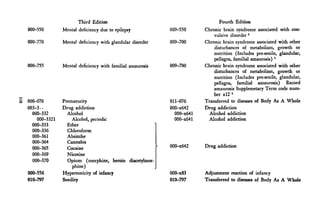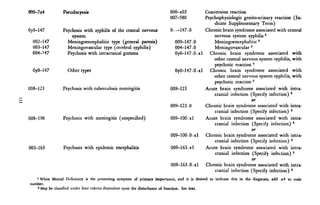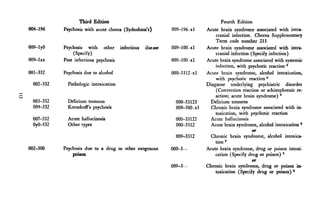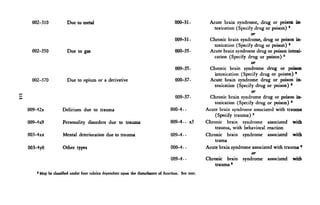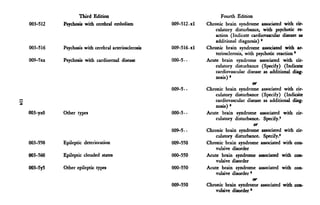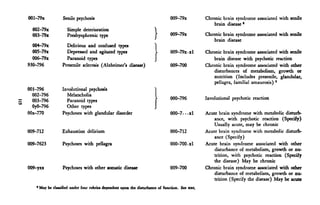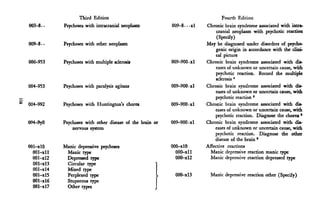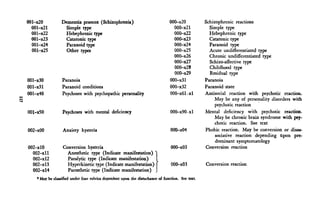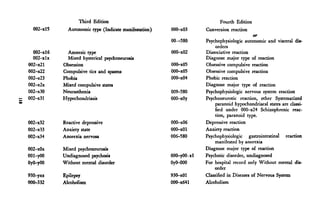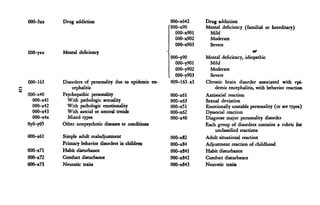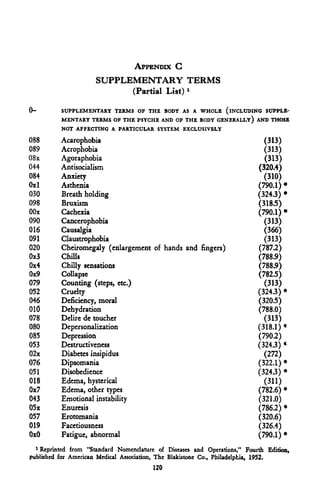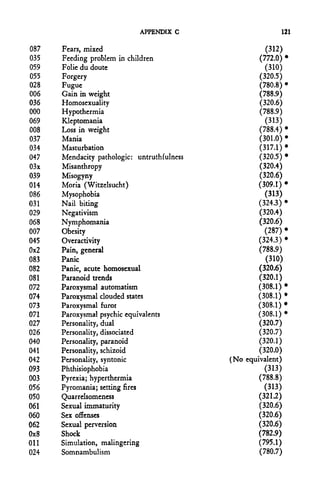
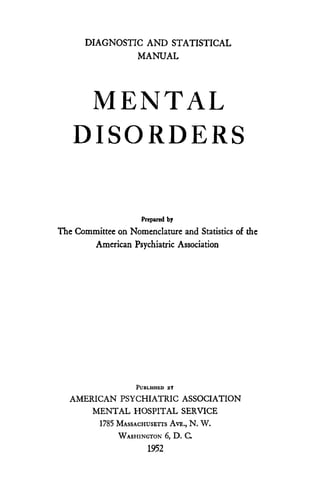

DIAGNOSTIC AND STATISTICAL
                MANUAL


    MENTAL
   DISORDERS

                     Prepared by
The Committee on Nomenclature and Statistics of the
        American Psychiatric Association


                    PUBLISHED By
   AMERICAN PSYCHIATRIC ASSOCIATION
       MENTAL HOSPITAL SERVICE
          1785 MASSACHUSETTS AVE., N. W.
               WASHINGTON 6, D. C.
                       1952
COPYRIGHT 1952
AMERICAN PSYCHIATRIC ASSOCIATION
Click Table of Contents entries to
reach corresponding book sections.

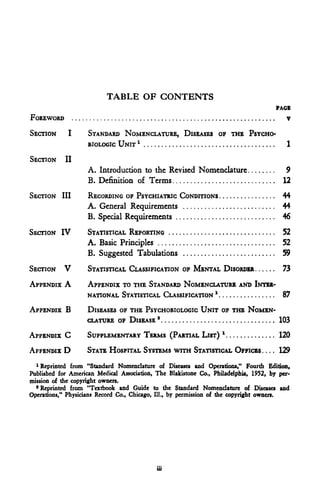
                           TABLE OF CONTENTS
                                                                                      PAGE
FOREWORD                                                                                 v
SECTION      I      STANDARD NOMENCLATURE, DISEASES OF THE PSYCHO-
                    BIOLOGIC UNIT *                                                      1
SECTION     II
                    A. Introduction to the Revised Nomenclature                          9
                    B. Definition of Terms                                              12
SECTION III         RECORDING OF PSYCHIATRIC CONDITIONS                                 44
                    A. General Requirements                                             44
                    B. Special Requirements                                             46
SECTION IV          STATISTICAL REPORTING                                               52
                    A. Basic Principles                                                 52
                    B. Suggested Tabulations                                            59
SECTION     V       STATISTICAL CLASSIFICATION OF MENTAL DISORDER                       73
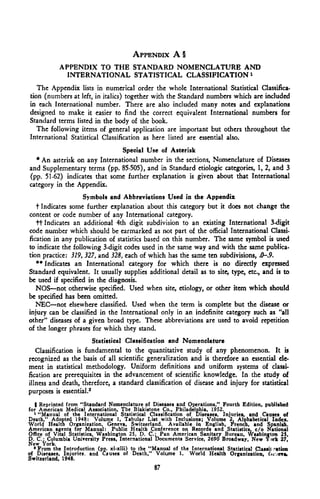
APPENDIX A          APPENDIX TO THE STANDARD NOMENCLATURE AND INTER-
                    NATIONAL STATISTICAL CLASSIFICATIONl             87
APPENDIX B          DISEASES OF THE PSYCHOBIOLOGIC UNIT OF THE NOMEN-
                    CLATURE OF DISEASE 2                              103
APPENDIX C          SUPPLEMENTARY TERMS (PARTIAL LIST) x                              120
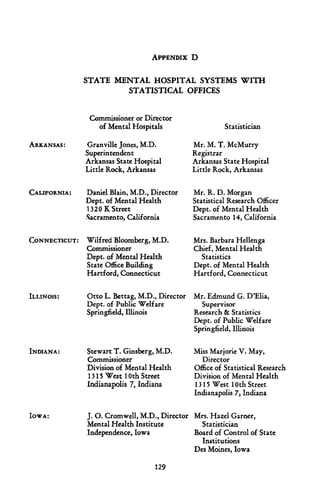
APPENDIX D          STATE HOSPITAL SYSTEMS WITH STATISTICAL OFFICES                    129
  1
    Reprinted from "Standard Nomenclature of Diseases and Operations," Fourth Edition,
Published for American Medical Association, The Blakistone Co., Philadelphia, 1952, by per-
mission of the copyright owners.
  2
    Reprinted from "Textbook and Guide to the Standard Nomenclature of Disease* and
Operations," Physicians Record Co., Chicago, 111., by permission of the copyright owners.


                                            iii
This page intentionally left blank
FOREWORD

   The development of a uniform nomenclature of disease in the United
States is comparatively recent. In the late twenties, each large teaching center
employed a system of its own origination, no one of which met more than
the immediate needs of the local institution. Despite their local origins,
for lack of suitable alternatives, these systems were spread in use throughout
the nation, ordinarily by individuals who had been trained in a particular
center, hence had become accustomed to that special system of nomenclature.
Modifications in the transplanted nomenclatures immediately became neces-
sary, and were made as expediency dictated. There resulted a polyglot
of diagnostic labels and systems, effectively blocking communication and
the collection of medical statistics.
   In late 1927, the New York Academy of Medicine spearheaded a move-
ment out of this chaos towards a nationally accepted standard nomenclature
of disease. In March, 1928, the first National Conference on Nomenclature
of Disease met at the Academy; this conference was composed of representa-
tives of interested governmental agencies and of the national societies repre-
senting the medical specialties. A trial edition of the proposed new nomen-
clature was published in 1932, and distributed to selected hospitals for a
test run. Following the success of these tests, the first official edition of
the Standard Classified Nomenclature of Disease was published in 1933,
and was widely adopted in the next two years.1 Two subsequent revisions
have been made, the last in 1942. The nomenclature in this manual consti-
tutes the section on Diseases of the Psychobiologic Unit from the Fourth
Edition of the Standard Nomenclature of Diseases and Operations, 1952.
   Prior to the first edition of the Standard, psychiatry was in a somewhat
more favorable situation regarding standardized nomenclature than was the
large body of American medicine. The Committee on Statistics of the
American Psychiatric Association (then the American Medico-psychological
Association) had formulated a plan for uniform statistics in hospitals for
mental disease which was officially adopted by the Association in May, 1917.
This plan included a classification of mental disease which, although pri-
marily a statistical classification, was usable in a limited way as a nomen-
clature. The National Committee for Mental Hygiene introduced the new
  1
    For details of the development of the Standard, see "Textbook and Guide to the Standard
Nomenclature of Diseases and Operations," Physicians Record Co., Chicago, Illinois.
                                            V
Ti                           MENTAL DISORDERS

classification and statistical system in hospitals throughout the country, and
continued to publish the "Statistical Manual for the Use of Hospitals for
Mental Diseases" through the years. The Committee on Nomenclature
and Statistics of the American Psychiatric Association collaborated with the
National Committee in this publication. With approval of the Council, and
by agreement with the National Committee for Mental Hygiene (now the
National Association for Mental Health), the Mental Hospital Service of
the American Psychiatric Association now assumes responsibility for future
publication of the Statistical Manual, which has been re-titled, "Diagnostic
and Statistical Manual for Mental Disorders," a f id is presented here in its
first edition.
   The American Psychiatric Association cooperated, as the representative
national society, in the establishment of the Standard Nomenclature of
Disease. With the publication of the first edition of the Standard, a con-
siderable revision in the Statistical Manual became necessary. This revision
was accomplished in the Eighth Edition of the Statistical Manual, 1934.
The classification system of the new Standard Nomenclature was included,
together with a condensed list for statistical use. For the first time the
difference in a system of nomenclature and a system of statistical classifica-
tion was underscored (see Appendix A).
   Only minor changes were made in the section on Mental Disorders in
later revisions of the Standard, this section being essentially the same in the
1933 and 1942 editions. Many teaching centers devised modified systems of
nomenclature for their own use, but the official nomenclature into which
diagnoses were coded for statistical and medical record files remained the
original 1933 nomenclature, as published in the Standard. As a result, at
the beginning of World War II, American psychiatry, civilian and military,
was utilizing a system of naming developed primarily for the needs and case
loads of public mental hospitals. The origin of this system was in itself
predictive of the difficulties which would soon be encountered.
   The Armed Forces faced an increasing psychiatric case load as mobiliza-
tion and the war went on. There was need to account accurately for all
causes of morbidity, hence the need for a suitable diagnosis for every case
seen by the psychiatrist, a situation not faced in civilian life. Only about
W% of the total cases seen fell into any of the categories ordinarily seen
in public mental hospitals. Military psychiatrists, induction station psychia-
trists, and Veterans Administration psychiatrists, found themselves operating
within the limits of a nomenclature specifically not designed for 9Q% of
the cases handled. Relatively minor personality disturbances, which became
FOREWORD                                    Tii

 of importance only in the military setting, had to be classified as "Psycho-
pathic Personality." Psychosomatic disorders turned up in the nomenclature
under the various organ systems by whatever name a gastroenterologist or
cardiologist had devised for them. The "psychoneurotic label" had to be
applied to men reacting briefly with neurotic symptoms to considerable
stress; individuals who, as subsequent studies have shown, were not ordi-
narily psychoneurotic in the usual meaning of the term. No provision existed
for diagnosing psychological reactions to the stress of combat, and terms had
to be invented to meet this need. The official system of nomenclature rapidly
became untenable.
   In 1944, the Navy made a partial revision of its nomenclature to meet the
deficiencies mentioned, but attempted to stay within the limits of the Stand-
ard where possible. In 1945, the Army established a much more sweeping
revision, abandoning the basic outline of the Standard and attempting to
express present day concepts of mental disturbance. This nomenclature
eventually was adopted by all Armed Forces, and in 1946 the Veterans
Administration adopted a new nomenclature which resembled closely that
of the Armed Forces. In 1948, a revised International Statistical Classification
was adopted, and categorized mental disorders in rubrics similar to those of
the Armed Forces nomenclature.
   By 1948, then, the situation in psychiatric nomenclature had deteriorated
almost to the point of confusion which existed throughout medical nomen-
clature in the twenties. At least three nomenclatures (Standard, Armed
Forces, and Veterans Administration) were in general use, and none of them
fell accurately into line with the International Statistical Classification. One
agency found itself in the uncomfortable position of using one nomenclature
for clinical use, a different one for disability rating, and the International for
statistical work. In addition, practically every teaching center had made
modifications of the Standard for its own use and assorted modifications of
the Armed Forces nomenclature had been introduced into many clinics and
hospitals by psychiatrists returning from military duty.
   Following the adoption of new nomenclatures by the Army and Veterans
Administration, the Committee on Nomenclature and Statistics of the Ameri-
can Psychiatric Association postponed change in its recommended official
nomenclature pending some evidence as to the usability of the new systems.
In 1948, the Committee undertook to learn from the Army and Veterans
Administration how successful the changes had been, and what the short-
comings of the new systems were. Simultaneously, an effort was made to
determine the sentiments of the membership regarding the need for a change
in the then current Standard.
Tiii                          MENTAL DISORDERS

  A high percentage of psychiatrists contacted felt that change in the nomen-
clature was urgently needed, with special attention to the areas of personality
disorders and transient reactions to special stress. The need for change
seemed to be felt more strongly by those in clinic and private practice than
by those in mental hospital or institutional work. However, a considerable
proportion of mental hospital staffs urged change; this was especially true
where outpatient clinics had been established in connection with the
hospitals.
  The Army and Veterans Administration reported that their revisions were
considered successful by clinicians and statisticians. Statistically, the revisions
were said to be more easily handled than the old nomenclatures, particularly
when it became necessary to code diagnoses into the revised International.
After some expected initial difficulties in using the new terms, clinicians
reported that the revisions were much more useful than the old listing.
Psychiatrists who had become accustomed to the revised nomenclature in
the Army were unwilling to return to the Standard Nomenclature upon
return to civilian life. The major shortcoming in both revisions was reported
to be the classification of mental disorders accompanying organic brain
disease, a minor problem in military psychiatry but a major item in civilian
psychiatry.
   With a need for a revision established, and guidelines drawn from the
experience of the Armed Forces and Veterans Administration, the Com-
mittee set about drafting a proposed revision. Source material received by
the Army and Veterans Administration during the process of their revisions
was utilized, psychiatric teaching units were contacted for ideas, especially
concerning the organic brain disorders, and eflorts were made to obtain all
possible suggestions from the body of American psychiatry, as well as from
the literature. From March, 1950, the Chief of the Biometrics Branch, Na-
tional Institute of Mental Health, served as a consultant to the Committee
to assist with the statistical aspects of the revision.
   In April, 1950, the Committee distributed mimeographed copies of a pro-
posed revision of the psychiatric nomenclature to approximately 10% of the
membership of the American Psychiatric Association. Addressees were
picked from the geographical listing of members, 10% of the members in
each State and Canada being selected. In addition, addressees were selected
by position held, in order to give complete coverage to all areas of psychiatry.
Attention was paid to membership in other organizations (American
Neurological Association, American Psychoanalytic Association, Academy
of Neurology, American Psychopathological Association, etc.), so that a fair
FOREWORD                                    n

sampling of those groups was included. Members of the staffs of State
Departments of Mental Health were included in order to obtain an expres-
sion of opinion from such departments concerning the statistical and clinical
impact of the proposed revision.
   The proposed revision was accompanied by a nine-page questionnaire
asking for opinions and suggestions on all sections of the revision. A dead-
line of July 1, 1950, was set for return of the questionnaire in order that the
work might be completed in time for the November, 1950 meeting of
Council. As the questionnaires were returned, they were broken down into
sections and mailed out to individual members of the Committee, each of
whom had been assigned a specific area of the revision for study. A master
file of questionnaire returns was established in the Office of the Medical
Director for quick reference.
   There were 520 questionnaires distributed; 241 were returned in time for
consideration by the Committee. Of these, 224 (93%) expressed general
approval of the suggested revision, 11 (5%) expressed general disapproval,
and 6 (2%) were neutral. Such overwhelming approval was not accorded
all sections of the revision, but the lowest approval rate on any section was
72%. The returns were not simply blanket approvals or disapprovals; more
than half contained specific suggestions and recommendations. An unex-
pectedly high proportion of addressees had made the revision and question-
naire points of extensive discussion with colleagues. Several mental hospitals
held a number of staff meetings devoted to such discussions, other clinics
and administrative groups did the same. It therefore appeared that the
Committee had received the considered opinion of a very large portion of
American psychiatry.
   Armed with this wealth of thoughtful material, the Committee prepared
a second revision, incorporating the information obtained from the question-
naires. As had been done in the case of the first revision, this second revision
was sent to the Editor of the Standard Nomenclature for comment, and
particularly to learn whether it could be incorporated in the general frame-
work of the Standard. With minor changes in wording and coding, this
second revision was acceptable to the Standard.
   Accordingly, the revision was presented to Council of the American Psy-
chiatric Association at its meetings on November 6, 1950, with the recom-
mendations that it be adopted as the officially supported nomenclature of
the American Psychiatric Association, that it be recommended by Council
to the Standard Nomenclature for inclusion in the 1951 edition, and that
the Committee be authorized to prepare this Diagnostic and Statistical
z                             MENTAL DISORDERS

Manual for publication by the Association. These recommendations were
approved by Council.
   The collection of statistics on mental illness morbidity has long been a
stepchild of Federal Government. Delegated from year to year on a fiscal
basis to the Bureau of the Census, morbidity statistics in this most important
area perhaps would never have been collected had it not been for the untiring
efforts of former Committees on Statistics of the American Psychiatric
Association and the National Committee on Mental Hygiene. It has there-
fore been most important in the past that this manual devote most of its
attention to statistics, as was indicated by its name.
   In 1946, an Act of Congress authorized the establishment of the National
Institute of Mental Health, under the United States Public Health Service.
A Biometrics Branch has been established in that Institute, and concerns
itself with the operational features of statistical reporting. It is, therefore,
no longer necessary for the American Psychiatric Association to remain in
the operational field as far as statistics are concerned. In keeping with the
status of this Association as a scientific professional society, it has seemed
appropriate to limit the statistical section of this Manual to a statement of
general principles and procedures, leaving the preparation of detailed operat-
ing manuals to the operational agency created for that purpose, this Com-
mittee acting in a consultant capacity to that agency.
   Despite its recent origin, the Biometrics Branch of the National Institute
of Mental Health has made handsome strides toward major statistical ob-
jectives. A conference has been held of statisticians and mental hygiene
administrators from 11 States, having together 55% of the average daily
resident patient population in all State hospitals. The need for basic agree-
ment concerning definition of terms and minimum tabulations has been
emphasized. A model area for the reporting of morbidity statistics on
the hospitalized mentally ill has been established. Further progress along
these lines can be expected. Valuable operational data in the field of statistics
has been, and is being, brought together, and is available to those who have
detailed operational questions not covered by this Manual. This information
may be obtained by correspondence with the Chief of the Biometrics Branch,
National Institute of Mental Health, Bethesda 14, Maryland.
   Dr. Morton Kramer, Chief, Biometrics Branch, National Institute of Men-
tal Health, has worked with this Committee as Consultant in Statistics, and
has prepared the majority of Sections IV and V. In addition, he and mem-
bers of the Committee have worked assiduously with Dr. Selwyn Collins,
Head Statistician, Division of Public Health Methods, United States Public
FOREWORD                                  xl

Health Service, and his assistant, Mrs. Louise E. Bollo, Nosologist, in pre-
paring the crosscoding of Diseases of the Psychobiologic Unit of the Stand-
ard, with the International Classification, an effort of no small note. Dr.
Richard J. Plunkett, Editor of the Standard Nomenclature of Diseases and
Operations, has been most cooperative and helpful. His Associate Editor,
Mrs. Adaline C. Hayden, has been doubly assistive in her role of associate
editor of the Standard and as co-author of the "Textbook and Guide to
the Standard Nomenclature of Diseases and Operations," with Dr. Edward
T. Thompson, who himself has spent much time working with such tedious
problems as crosscoding the old and new nomenclatures.
   The American Medical Association and P. Blakiston and Sons, Inc.,
publishers of the Standard Nomenclature, have permitted republication of
several portions of the Standard necessary to make this Manual complete.
The Physicians Record Company, publisher of "Textbook and Guide to the
Standard Nomenclature of Diseases and Operations," has permitted repub-
lication of parts of that book. These are indicated appropriately in the
footnotes of the Manual.
   As may be surmised from the narrative account above, it would be impossi-
ble to acknowledge the assistance received from various members of the
American Psychiatric Association and others, as they number many.
   It would be unjust to list here only the names of those who were members
of the Committee on Nomenclature and Statistics at the time of completion
of this revision, since those who went before each contributed in some way
to the information which finally led to this particular revision. For that
reason, the names of those who have served on the Committee since 1946,
with their terms of service, are listed.


                              George N. Raines, M. D
                              Chairman
                              Committee on Nomenclature and Statistics
Washington, D. C.
November, 1951
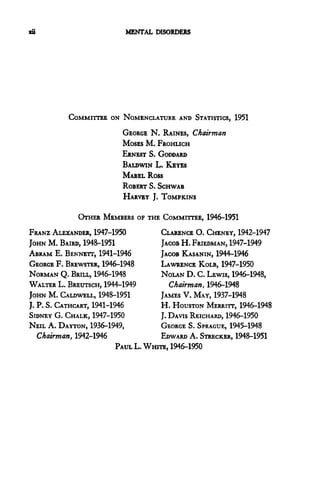
zii                       MENTAL DISORDERS


          COMMITTEE ON NOMENCLATURE AND STATISTICS, 1951
                         GEORGE N. RAINES, Chairman
                         MOSES M. FROHLICH
                         ERNEST S. GODDARD
                         BALDWIN L. KEYES
                         MABEL Ross
                         ROBERT S. SCHWAB
                         HARVEY J. TOMPKINS

             OTHER MEMBERS OF THE COMMITTEE, 1946-1951
FRANZ ALEXANDER, 1947-1950            CLARENCE O. CHENEY, 1942-1947
JOHN M. BAIRD, 1948-1951              JACOB H. FRIEDMAN, 1947-1949
ABRAM E. BENNETT, 1941-1946           JACOB KASANIN, 1944-1946
GEORGE F. BREWSTER, 1946-1948         LAWRENCE KOLB, 1947-1950
NORMAN Q. BRILL, 1946-1948            NOLAN D. C. LEWIS, 1946-1948,
WALTER L. BREUTSCH, 1944-1949            Chairman, 1946-1948
JOHN M. CALDWELL, 1948-1951           JAMES V. MAY, 1937-1948
J. P. S. CATHCART, 1941-1946          H. HOUSTON MERRITT, 1946-1948
SIDNEY G. CHALK, 1947-1950            J. DAVIS REICHARD, 1946-1950
NEIL A. DAYTON, 1936-1949,            GEORGE S. SPRAGUE, 1945-1948
   Chairman, 1942-1946                EDWARD A. STRECKER, 1948-1951
                          PAUL L. WHITE, 1946-1950
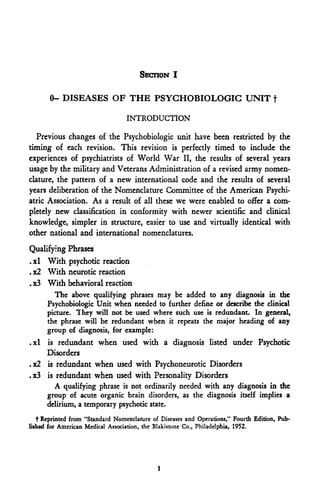
SECTION I

       0- DISEASES OF THE PSYGHOBIOLOGIG UNIT f
                                  INTRODUCTION

  Previous changes of the Psychobiologic unit have been restricted by the
timing of each revision. This revision is perfectly timed to include the
experiences of psychiatrists of World War II, the results of several years
usage by the military and Veterans Administration of a revised army nomen-
clature, the pattern of a new international code and the results of several
years deliberation of the Nomenclature Committee of the American Psychi-
atric Association. As a result of all these we were enabled to offer a com-
pletely new classification in conformity with newer scientific and clinical
knowledge, simpler in structure, easier to use and virtually identical with
other national and international nomenclatures.
Qualifying Phrases
.xl With psychotic reaction
. x2 With neurotic reaction
. x3 With behavioral reaction
       The above qualifying phrases may be added to any diagnosis in the
     Psychobiologic Unit when needed to further define or describe the clinical
     picture. They will not be used where such use is redundant. In general,
     the phrase will be redundant when it repeats the major heading of any
     group of diagnosis, for example:
.xl is redundant when used with a diagnosis listed under Psychotic
    Disorders
.x2 is redundant when used with Psychoneurotic Disorders
.x3 is redundant when used with Personality Disorders
      A qualifying phrase is not ordinarily needed with any diagnosis in the
    group of acute organic brain disorders, as the diagnosis itself implies a
    delirium, a temporary psychotic state.
   t Reprinted from "Standard Nomenclature of Diseases and Operations," Fourth Edition, Pub-
lished for American Medical Association, the Blakistone Co., Philadelphia, 1952.


                                             1
2                                MENTAL DISORDERS


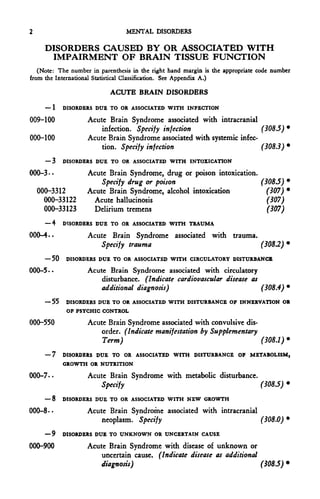
      DISORDERS CAUSED BY OR ASSOCIATED WITH
       IMPAIRMENT OF BRAIN TISSUE FUNCTION
   (Note: The number in parenthesis in the right hand margin is the appropriate code number
from the International Statistical Classification. See Appendix A.)

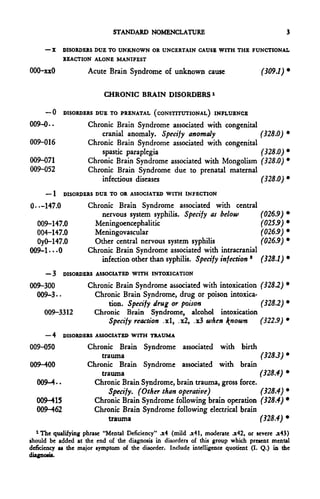
                            ACUTE BRAIN DISORDERS

      -1 DISORDERS DUE TO OR ASSOCIATED WITH INFECTION
009-100             Acute Brain Syndrome associated with intracranial
                        infection. Specify injection                     (3085) *
000-100             Acute Brain Syndrome associated with systemic infec-
                        tion. Specify infection                          (308.3) *
      -3     DISORDERS DUE TO OR ASSOCIATED WITH INTOXICATION

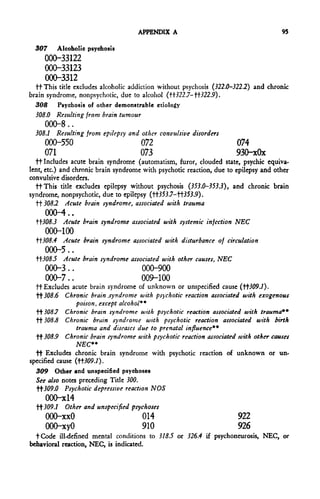
000-3-.             Acute Brain Syndrome, drug or poison intoxication.
                        Specify drug or poison                         (308.5) *
    000-3312        Acute Brain Syndrome, alcohol intoxication           (30?) *
      000-33122       Acute hallucinosis                                  (307)
      000-33123       Delirium tremens                                    (307)
      —4     DISORDERS DUE TO OR ASSOCIATED WITH TRAUMA

000-4..             Acute Brain Syndrome associated with trauma.
                        Specify trauma                           (308.2)
    -50       DISORDERS DUE TO OR ASSOCIATED WITH CIRCULATORY DISTURBANCE

000-5-.             Acute Brain Syndrome associated with circulatory
                        disturbance. (Indicate cardiovascular disease as
                        additional diagnosis)                            (308.4) *
      — 55   DISORDERS DUE TO OR ASSOCIATED WITH DISTURBANCE OF INNERVATION OR
              OF PSYCHIC CONTROL

000-550             Acute Brain Syndrome associated with convulsive dis-
                        order. (Indicate manifestation by Supplementary
                        Term)                                            (308.1)»
      —7     DISORDERS DUE TO OR ASSOCIATED WITH DISTURBANCE OF              METABOLISM,
             GROWTH OR NUTRITION

000-7- •            Acute Brain Syndrome with metabolic disturbance.
                        Specify                                      (308.5) *
      —8     DISORDERS DUE TO OR ASSOCIATED WITH NEW GROWTH

000-8..             Acute Brain Syndrome associated with intracranial
                        neoplasm. Specify                             (308.0)*
      —9     DISORDERS DUE TO UNKNOWN OR UNCERTAIN CAUSE

000-900             Acute Brain Syndrome with disease of unknown or
                        uncertain cause. (Indicate disease as additional
                        diagnosis)                                       (3083) •
STANDARD NOMENCLATURE                                         3

      —X     DISORDERS DUE TO UNKNOWN OR UNCERTAIN CAUSE WITH THE FUNCTIONAL
             REACTION ALONE MANIFEST

000-xxO              Acute Brain Syndrome of unknown cause                        (309.1) •

                          CHRONIC BRAIN DISORDERS 1

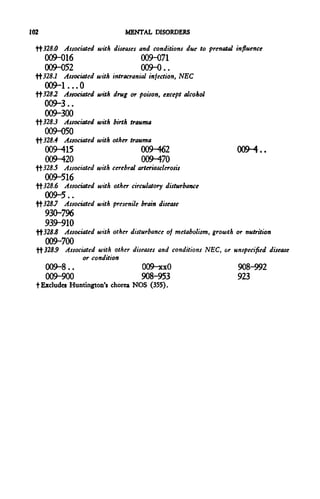
      —0     DISORDERS DUE TO PRENATAL (CONSTITUTIONAL) INFLUENCE

009-0..              Chronic Brain Syndrome associated with congenital
                         cranial anomaly. Specify anomaly                         (328.0) *
009-016              Chronic Brain Syndrome associated with congenital
                         spastic paraplegia                                       (328.0) *
009-071              Chronic Brain Syndrome associated with Mongolism             (328.0) *
009-052              Chronic Brain Syndrome due to prenatal maternal
                         infectious diseases                                      (328.0) *
      —1     DISORDERS DUE TO OR ASSOCIATED WITH INFECTION

0-.-147.0            Chronic Brain Syndrome associated with central
                         nervous system syphilis. Specify as below                (026.9)   *
  009-147.0            Meningoencephalitic                                        (025.9)   *
  004-147.0            Meningovascular                                            (026.9)   *
  OyO-147.0            Other central nervous system syphilis                      (026.9)   *
009-1-..0            Chronic Brain Syndrome associated with intracranial
                         infection other than syphilis. Specify infection *       (328.1) *
      —3     DISORDERS ASSOCIATED WITH INTOXICATION

009-300             Chronic Brain Syndrome associated with intoxication (328.2) *
  009-3 •.            Chronic Brain Syndrome, drug or poison intoxica-
                          tion. Specify drug or poison                  (328.2) *
      009-3312       Chronic Brain Syndrome, alcohol intoxication
                          Specify reaction .xl, .x2, .x3 when nown     (322.9) *
      —4     DISORDERS ASSOCIATED WITH TRAUMA

009-050             Chronic Brain Syndrome associated with birth
                        trauma                                                    (3283) *
009-400             Chronic Brain Syndrome associated with brain
                        trauma                                                    (328.4) *
  009-4..             Chronic Brain Syndrome, brain trauma, gross force.
                           Specify. (Other than operative)                        (328.4) *
  009-415             Chronic Brain Syndrome following brain operation            (328.4) *
  009—462             Chronic Brain Syndrome following electrical brain
                           trauma                                                 (328.4) *
  1
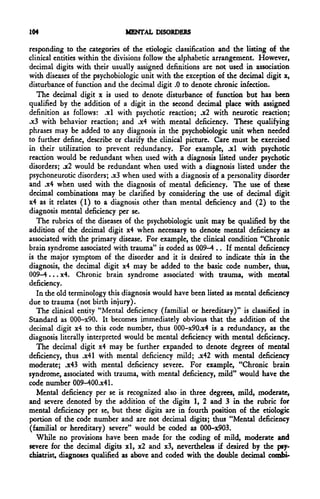
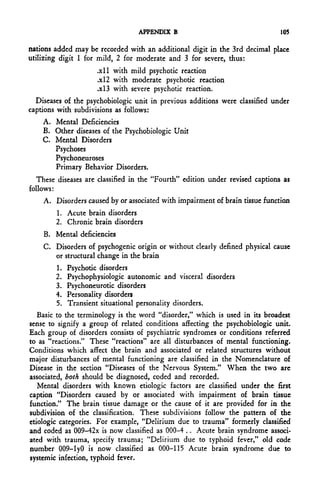
    The qualifying phrase "Mental Deficiency" jc4 (mild .x41, moderate Jt42, or severe a43)
should be added at the end of the diagnosis in disorders of this group which present mental
deficiency a* the major symptom of the disorder. Include intelligence quotient (I. Q.) in the
diagnosis.
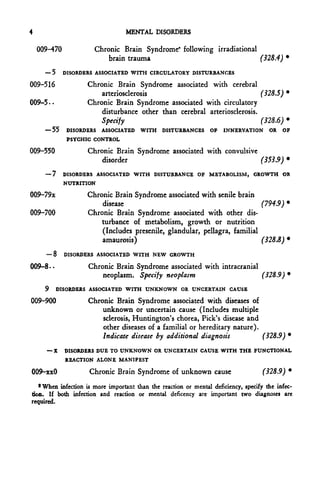
4                                 MENTAL DISORDERS


    009-470            Chronic Brain Syndrome* following irradiational
                           brain trauma                                (328.4) *
      —5      DISORDERS ASSOCIATED WITH CIRCULATORY DISTURBANCES

009-516              Chronic Brain Syndrome associated with cerebral
                         arteriosclerosis                                  (328.5) *
009-5 • •            Chronic Brain Syndrome associated with circulatory
                         disturbance other than cerebral arteriosclerosis.
                         Specify                                           (328.6) *
      — 55     DISORDERS ASSOCIATED WITH       DISTURBANCES      OF   INNERVATION     OR OF
               PSYCHIC CONTROL

009-550              Chronic Brain Syndrome associated with convulsive
                         disorder                                      (353.9) *
      —7      DISORDERS ASSOCIATED WITH DISTURBANCE OF METABOLISM, GROWTH OR
              NUTRITION

009-79x              Chronic Brain Syndrome associated with senile brain
                         disease                                            (794.9) *
009-700              Chronic Brain Syndrome associated with other dis-
                         turbance of metabolism, growth or nutrition
                         (Includes presenile, glandular, pellagra, familial
                         amaurosis)                                         (328.8) *
      —8      DISORDERS ASSOCIATED WITH NEW GROWTH

009-8 • •            Chronic Brain Syndrome associated with intracranial
                         neoplasm. Specify neoplasm                      (328.9) *
      9     DISORDERS ASSOCIATED WITH UNKNOWN OR UNCERTAIN CAUSE

009-900              Chronic Brain Syndrome associated with diseases of
                         unknown or uncertain cause (Includes multiple
                         sclerosis, Huntington's chorea, Pick's disease and
                         other diseases of a familial or hereditary nature).
                         Indicate disease by additional diagnosis            (328.9) *
      —X      DISORDERS DUE TO UNKNOWN OR UNCERTAIN CAUSE WITH THE FUNCTIONAL
              REACTION ALONE MANIFEST

009-xxO              Chronic Brain Syndrome of unknown cause                        (328.9) *
   *When infection is more important than the reaction or mental deficiency, specify the infec-
tion. If both infection and reaction or mental deficency are important two diagnoses are
required.
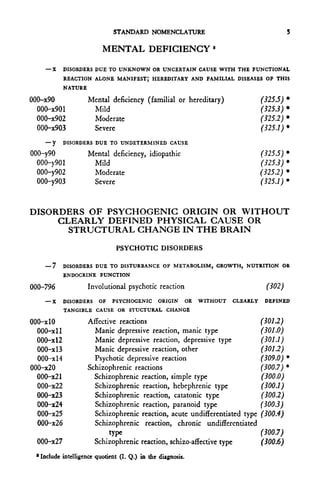
STANDARD NOMENCLATURE                                    5


                          MENTAL DEFICIENCY •

    —X      DISORDERS DUE TO UNKNOWN OR UNCERTAIN CAUSE WITH THE FUNCTIONAL
            REACTION ALONE MANIFEST; HEREDITARY AND FAMILIAL DISEASES OF THIS
            NATURE

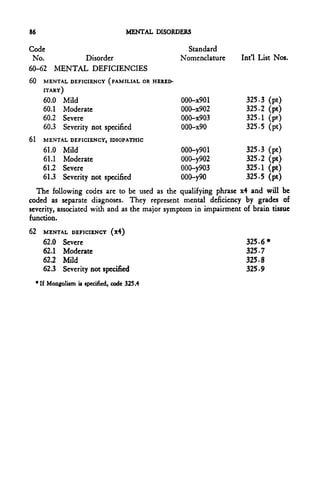
000-x90              Mental deficiency (familial or hereditary)              (325.5)   *
  000-x901            Mild                                                   (325.3)   *
  000-x902            Moderate                                               (325.2)   *
  000-x903            Severe                                                 (325.1)   *
    —y      DISORDERS DUE TO UNDETERMINED CAUSE
000-y90              Mental deficiency, idiopathic                           (325.5)   *
  000-y901            Mild                                                   (325.3)   *
  000-y902            Moderate                                               (325.2)   *
  000-y903            Severe                                                 (325.1)   *


DISORDERS OF PSYCHOGENIC ORIGIN OR WITHOUT
     CLEARLY DEFINED PHYSICAL CAUSE OR
       STRUCTURAL CHANGE IN THE BRAIN
                               PSYCHOTIC DISORDERS

    —7      DISORDERS DUE TO DISTURBANCE OF METABOLISM, GROWTH, NUTRITION OR
            ENDOCRINE FUNCTION

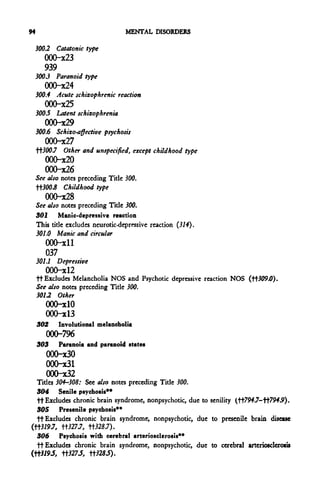
000-796              Involutional psychotic reaction                           (302)
    —X      DISORDERS OF PSYCHOGENIC ORIGIN OR WITHOUT            CLEARLY     DEFINED
            TANGIBLE CAUSE OR STUCTURAL CHANGE

000-xlO              Affective reactions                                     (301.2)
  000-xll              Manic depressive reaction, manic type                  (301.0)
  000-xl2              Manic depressive reaction, depressive type             (301.1)
  000-xl3              Manic depressive reaction, other                       (301.2)
  000-xl4              Psychotic depressive reaction                         (309.0) *
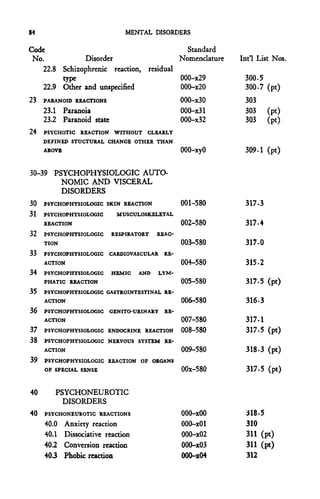
000-x20              Schizophrenic reactions                                 (300.7) *
  000~x21              Schizophrenic reaction, simple type                    (300.0)
  000-x22              Schizophrenic reaction, hebephrenic type               (300.1)
  000-x23              Schizophrenic reaction, catatonic type                 (300.2)
  000-x24              Schizophrenic reaction, paranoid type                 (300.3)
  000-x25              Schizophrenic reaction, acute undifferentiated type    (300.4)
  000-x26              Schizophrenic reaction, chronic undiffercntiated
                            type                                             (300.7)
  000-x27              Schizophrenic reaction, schizo-affective type         (300.6)
 * Include intelligence quotient (I. Q.) in the diagnosis.
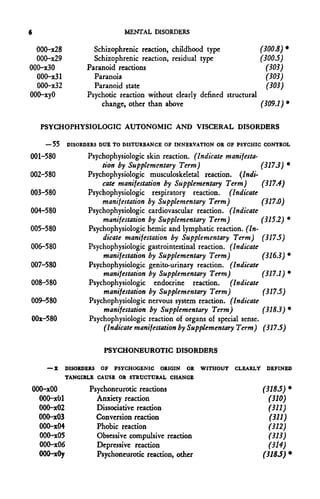
6                              MENTAL DISORDERS

  000-x28           Schizophrenic reaction, childhood type              (300.8) •
  000-x29           Schizophrenic reaction, residual type               (300.5)
000-x30           Paranoid reactions                                      (303)
  000-x31           Paranoia                                              (303)
  000-x32           Paranoid state                                        (303)
000-xyO           Psychotic reaction without clearly defined structural
                      change, other than above                          (309.1) »

    PSYCHOPHYSIOLOGIC AUTONOMIC AND VISCERAL DISORDERS

     — 55   DISORDERS DUE TO DISTURBANCE OF INNERVATION OR OF PSYCHIC CONTROL

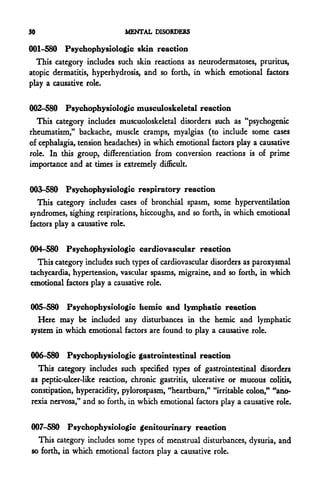
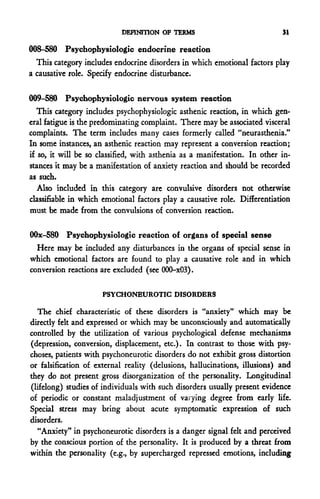
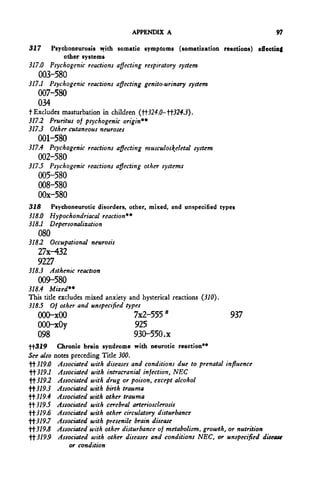
001-580           Psychophysiologic skin reaction. (Indicate manifesta-
                      tion by Supplementary Term)                        (3173) «
002-580           Psychophysiologic musculoskeletal reaction. (Indi-
                      cate manifestation by Supplementary Term)          (317.4)
003-580           Psychophysiologic respiratory reaction. (Indicate
                      manifestation by Supplementary Term)               (317.0)
004-580           Psychophysiologic cardiovascular reaction. (Indicate
                      manifestation by Supplementary Term)               (315.2) *
005-580           Psychophysiologic hemic and lymphatic reaction. (In-
                      dicate manifestation by Supplementary Term) (317.5)
006-580           Psychophysiologic gastrointestinal reaction. (Indicate
                      manifestation by Supplementary Term)               (316.3) *
007-580           Psychophysiologic genito-urinary reaction. (Indicate
                      manifestation by Supplementary Term)               (317 .1) *
008-580           Psychophysiologic endocrine reaction. (Indicate
                       manifestation by Supplementary Term)               (317.5)
009-580           Psychophysiologic nervous system reaction. (Indicate
                       manifestation by Supplementary Term)               (318.3) *
OOx-580           Psychophysiologic reaction of organs of special sense.
                       (Indicate manifestation by Supplementary Term) (317.5)


                        PSYCHONEUROTIC DISORDERS

     —X     DISORDERS   OF   PSYCHOGENIC   ORIGIN   OR WITHOUT CLEARLY     DEFINED
            TANGIBLE CAUSE OR STRUCTURAL CHANGE

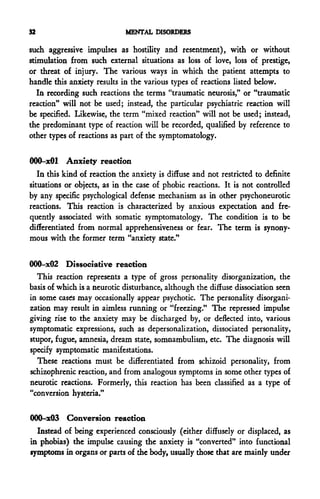
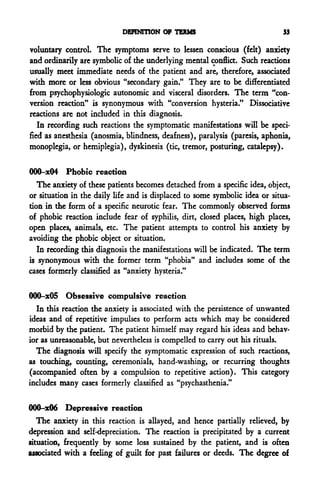
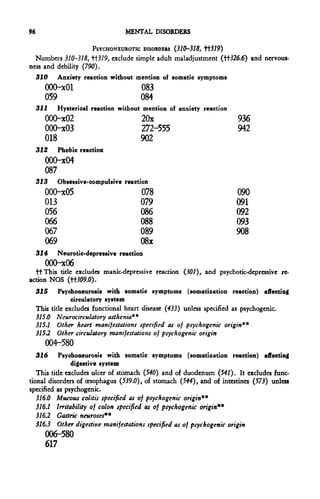
000-xOO            Psychoneurotic reactions                              (3183) *
  000-xOl            Anxiety reaction                                      (310)
  000-x02            Dissociative reaction                                 (311)
  000-x03            Conversion reaction                                   (311)
  000-x04            Phobic reaction                                       (312)
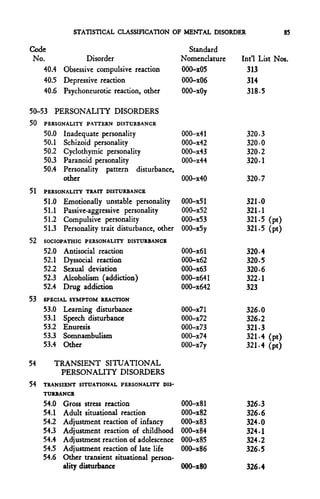
  000-x05            Obsessive compulsive reaction                         (313)
  000-x06            Depressive reaction                                   (314)
  000-xOy            Psychoneurotic reaction, other                      (318 J) •
STANDARD NOMENCLATURE                                     7

                          PERSONALITY DISORDERS

    —X   DISORDERS   OF   PSYCHOGENIC   ORIGIN   OR   WITHOUT   CLEARLY    DEFINED
         TANGIBLE CAUSE OR STRUCTURAL CHANGE

000-x40         Personality pattern disturbance                           (320.7) •
  000-x41         Inadequate personality                                  (3203)
  000-x42         Schizoid personality                                    (320.0)
  000-x43         Cyclothymic personality                                 (320.2)
  000-x44         Paranoid personality                                    (320.1)
000-x50         Personality trait disturbance                             (321.5)*
  000-x51         Emotionally unstable personality                        (321.0)
  000-x52         Passive-aggressive personality                          (321.1) •
  000-x53         Compulsive personality                                  (321.5)
  000-x5y         Personality trait disturbance, other                    (321.5) •
000-x60         Sociopathic personality disturbance                       (320.7) •
  000-x61         Antisocial reaction                                     (320.4)
  000-x62         Dyssocial reaction                                      (3205)
  000-x63         Sexual deviation. Specify Supplementary Term            (320.6)
  000-x64         Addiction
    000-x641        Alcoholism                                            (322.1)
    000-x642        Drug addiction                                          (323)
000-x70         Special symptom reactions                                 (321.4)   *
  000-x71         Learning disturbance                                    (326.0)   •
  000-x72         Speech disturbance                                      (326.2)   •
  000-x73         Enuresis                                                (321.3)
  000-x74        Somnambulism                                             (321.4)
  000-x7y         Other                                                   (321.4)   *


         TRANSIENT SITUATIONAL PERSONALITY DISORDERS

000-x80         Transient situational personality disturbance             (326.4) •
  000-x81         Gross stress reaction                                   (3263) «
  000-x82         Adult situational reaction                              (326.6) *
  000-x83         Adjustment reaction of infancy                          (3244) *
  000-x84         Adjustment reaction of childhood                        (324.1) *
    000-x841        Habit disturbance                                     (324.1) »
    000-x842        Conduct disturbance                                   (324.1) *
    000-x843        Neurotic traits                                       (324.1) »
  000-x85         Adjustment reaction of adolescence                      (324.2) *
  000-x86         Adjustment reaction of late life                        (326 5) *
8                      MENTAL DISORDERS

    NONDIAGNOSTIG TERMS FOR HOSPITAL RECORD

011-332    Alcoholic intoxication (simple drunkenness)            (322.0)
yOO-yOl    Boarder                                                 (Y09) *
yOO-yyy    Dead on admission                                      (795.5)
yOO-yOO    Diagnosis deferred. Change as many of first three (795.5)
               digits as possible, to indicate site
yOO-000    Disease none. Change first digit to indicate         (793.2) *
               suspected system if any
y00-002    Examination only. Change first three digits as      (YOO.O)
                needed
yOO-004    Experiment only. Change first three digits as needed (Y09)
yOO-005    Malingerer                                             (795.1)
yOO-001    Observation. Change first three digits as needed      (793,2) *
yOO-003    Tests only. Change first three digits as needed      (Y003) *
SECTION II A

INTRODUCTION TO THE REVISED NOMENCLATURE

   This revision of psychiatric nomenclature attempts to provide a classifica-
tion system consistent with the concepts of modern psychiatry and neurology.
It recognizes the present day descriptive nature of all psychiatric diagnoses,
and attempts to make possible the gathering of data for future clarification
of ideas concerning etiology, pathology, prognosis, and treatment in mental
disorders. It attempts to provide for inclusion of new ideas and advances
yet to be made without radical revision of the system of nomenclature.
   This nomenclature limits itself to the classification of the disturbances of
mental functioning. It does not include neurologic diagnoses or diagnoses
of intracranial pathology, per se. Such conditions should be diagnosed
separately, whether or not a mental disturbance is associated with them.
When an intracranial lesion is accompanied by a mental disorder, it is the
mental disorder which is diagnosed in this present classification. Provision
is made for contributory etiological factors to be stated as a part of the
diagnosis, or as an additional diagnosis, as necessary (see Section III).
   This diagnostic scheme employs the term "disorder" generically to desig-
nate a group of related psychiatric syndromes. Insofar as is possible, each
group is further divided into more specific psychiatric conditions termed
"reactions." The code numbers are assigned in accordance with the over-
all plan of the Standard Nomenclature of Diseases and Operations, a system
fully explained in that publication.
  All mental disorders are divided into two major groups:
    (1) those in which there is disturbance of mental function resulting
    from, or precipitated by, a primary impairment of the function of the
    brain, generally due to diffuse impairment of brain tissue; and
    (2) those which are the result of a more general difficulty in adaptation
    of the individual, and in which any associated brain function disturbance
    is secondary to the psychiatric disorder.
  Perhaps the greatest change in this revision from previous listings lies
in the handling of the disorders with known organic etiological factors. In
these disorders [Group (1)] the psychiatric picture is characterized by im-
pairment of intellectual functions, including memory, orientation, and
                                      9
10                           MENTAL DISORDERS

judgment, and by shallowness and lability o£ affect. This is a basic condi-
tion, and may be mild, moderate, or severe. It may be, and more often than
not is, the only mental disturbance present, or it may be associated with addi-
tional disturbances which in this nomenclature are descriptively classified
as "psychotic," "neurotic," or "behavioral" reactions (see Qualifying Phrases).
These associated reactions are not necessarily related in severity to the degree
of the organic brain syndrome, and are as much determined by inherent
personality patterns, the social setting, and the stresses of interpersonal
relations as by the precipitating organic impairment. For this reason, these
associated reactions are to be looked upon as being released by the organic
brain syndrome and superimposed upon it. The organic brain syndrome
thereupon becomes the proper focus of diagnosis; associated reactions should
be specified, when necessary, by adding to the diagnosis a qualifying phrase
describing the manifestation: .xl with psychotic reaction, jc2 with neurotic
reaction, or .x3 with behavioral reaction. It is anticipated that the majority
of organic disorders will require no qualifying phrase (see Qualifying
Phrases).
   When the organic brain syndrome is produced by prenatal or natal factors
or in the formative years of infancy and childhood, the disturbance in
intellectual development and learning ability may be prominent. Such
disturbances, formerly diagnosed "Mental deficiency, secondary," are here
listed under the chronic brain syndromes, where they seem more properly
to belong. In these cases, when it is desired to stress the disorder of intelli-
gence as the primary clinical problem, the diagnosis may be qualified with
the phrase, .x4 with Mental deficiency, .x41 mild, .x42 moderate, or .x43
severe, and the current intelligence quotient will be included in the diagnosis.
This categorization relegates the defect of intelligence to the sphere of
symptomatology, rather than recognizing it as a primary mental disturbance.
   An unsuccessful attempt was made to find a substitute for the long used
term "mental deficiency." Mental deficiency is a legal term, comparable
to the term "insanity," it has little meaning in clinical psychiatry. The
term has been defined by law in England, and in some parts of the United
States. The same objection is raised to the terms "idiot," "imbecile," and
"moron." They have the further fault of being based upon psychological
testing alone. In the borderline areas of each term, groupings vary with the
immediate condition of the patient, as well as with the skill and training of
the examiner. These last named terms have been eliminated.
   It was necessary to retain a term for those cases presenting clinically
primarily a disturbance of intellect, with no recognizable organic brain
INTRODUCTION TO THE REVISED NOMENCLATURE                         11

impairment prenatally, at birth, or in childhood. Since no adequate substitute
could be found, the title, "Mental Deficiency" was retained for this group.
Degree is indicated by the terms "mild," "moderate," or "severe." No I.Q.
limit has been set for these qualifying terms (see Section IIB), as it is believed
that such arbitrary usage of a variable measure is not justifiable in clinical
work. Authorities in this field have stated that persons classified under the
older groupings of idiot and imbecile (in this classification both are included
under "severe") always show postmortem evidence of chronic brain disorder.
It would then appear that a primary diagnosis of Mental deficiency, severe,
is inaccurate.
   The Schizophrenic reactions have been increased in number and type to
allow more detailed diagnosis. The Manic depressive reactions have been
reduced in number, and, with a Psychotic depressive reaction, have been
grouped into the "Affective reactions."
   The "psychosomatic" disorders have been given a separate category to
allow more accurate accumulation of data concerning them. The generic term,
"Psychophysiologic Autonomic and Visceral Disorders," has been selected
for this group because it seems to express best the interplay of psychic and
somatic factors involved in these disturbances.
   The Psychoneurotic Disorders have been classified on the basis of their
psychopathology as it is generally understood today. The titles for Person-
ality Disorders and Transient Situational Disorders have been elaborated and
expanded.
   Attention is called to the fact that the Section on Diseases of the Psycho-
biologic Unit is only one section of the Standard Nomenclature of Diseases
and Operations; adequate use of any one section requires knowledge and
use of the entire Standard Nomenclature of Diseases and Operations.
   More detailed instructions concerning the use of diagnostic terms applied
to Disorders of the Psychobiologic Unit are to be found in the section which
follows.
SECTION II B

                      DEFINITION OF TERMS
                          QUALIFYING PHRASES

  The basic division in this nomenclature is into those mental disorders
associated with organic brain disturbance, and those occurring without
such primary disturbance of brain function, and not into psychoses, psycho-
neuroses, and personality disorders. Other categorizations are secondary to
the basic division.
   This nomenclature permits the modification of any of the primary psychi-
atric diagnoses by the qualifying phrases, .xl with psychotic reaction, .x2
with neurotic reaction, and .x3 with behavioral reaction. These are intended
to describe any major alteration of the clinical picture of a diagnosed con-
dition which may appear when further mental symptoms are superimposed
on the basic disorder.
   Grouped together under Psychotic Disorders are: (1) affective dis-
orders, characterized by severe mood disturbance, with associated alterations
in thought and behavior, in consonance with the affect; (2) schizophrenic
reactions, characterized by fundamental disturbances in reality relationships
and concept formations, with associated affective, behavioral, and intellectual
disturbances, marked by a tendency to retreat from reality, by regressive
trends, by bizarre behavior, by disturbances in stream of thought, and by
formation of delusions and hallucinations; (3) paranoid reactions, character-
ized by persistent delusions and other evidence of the projective mechanism.
   From this grouping, a psychotic reaction may be defined as one in which
the personality, in its struggle for adjustment to internal and external stresses,
utilizes severe affective disturbance, profound autism and withdrawal from
reality, and/or formation of delusions or hallucinations. The qualifying
phrase, .xl with psychotic reaction, may be used to amplify the diagnosis
when, in the presence of another psychiatric disturbance, a symptomatic
clinical picture appears which might be diagnosed under Psychotic Disorders
in this nomenclature. Specific examples may be seen in severe depression
occurring in Chronic Brain Syndrome associated with senile brain disease,
or paranoid delusions accompanying Chronic Brain Syndrome, alcohol
intoxication.
   Grouped as Psychoneurotic Disorders are those disturbances in which
"anxiety" is a chief characteristic, directly felt and expressed, or automatically
controlled by such defenses as depression, conversion, dissociation, displace-
ment, phobia formation, or repetitive thoughts and acts.
                                       12
DEFINITION OF TERMS                             13

  For this nomenclature, a psychoneurotic reaction may be defined as one
in which the personality, in its struggle for adjustment to internal and ex-
ternal stresses, utilizes the mechanisms listed above to handle the anxiety
created. The qualifying phrase, .x2 with neurotic reaction, may be used
to amplify the diagnosis when, in the presence of another psychiatric dis-
turbance, a symptomatic clinical picture appears which might be diagnosed
under Psychoneurotic Disorders in this nomenclature. A specific example
may be seen in an episode of acute anxiety occurring in a homosexual.
  Grouped as Personality Disorders are those cases in which the personality
utilizes primarily a pattern of action or behavior in its adjustment struggle,
rather than symptoms in the mental, somatic, or emotional spheres.
  For this nomenclature a behavioral reaction (personality disorder) may
be defined as one in which the personality, in its struggle for adjustment
to internal and external stresses, utilizes primarily a pattern of action or
behavior. The qualifying phrase, .x3 with behavioral reaction, may be used
to amplify the diagnosis when, in the presence of another psychiatric dis-
turbance, a symptomatic clinical picture appears which might be diagnosed
Personality Disorder in this nomenclature. The changes in behavior, suffi-
ciently gross to require diagnostic recognition, occurring in many of the
chronic brain syndromes (Alzheimer's, cerebral arteriosclerosis, epidemic
encephalitis, trauma) are specific examples.
  In general, it should be noted that the qualifying phrases are provided
when needed to further define or describe the clinical picture. They are
applied only when superimposed symptoms are so marked that they defi-
nitely color the clinical picture. Mild or transient superimposed symptoms
will not justify the use of a qualifying phrase. It is anticipated that a diag-
nosis of chronic brain syndrome will be sufficient in itself under ordinary
conditions, and qualifying phrases will be needed only for further refinement
of the diagnosis.
  A qualifying phrase will not be used where such use is redundant. In
general, the phrase will be redundant when it repeats the major heading of
any group of diagnoses, for example: .xl is redundant when used with a
diagnosis listed under Psychotic Disorders; jc2 is redundant when used with
Psychoneurotic Disorders; .x3 is redundant when used with Personality
Disorders (see Section III A, "Multiple psychiatric diagnoses" for incom-
patible diagnoses).
  A qualifying phrase is not ordinarily needed with a diagnosis of acute
brain syndrome but a qualifying phrase may be used when superimposed
manifestations warrant such use by their significant modification of the
clinical picture.
14                             MENTAL DISORDERS

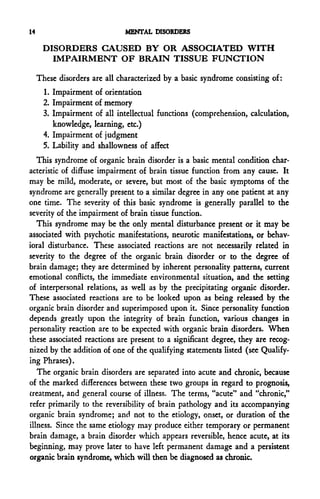
      DISORDERS CAUSED BY OR ASSOCIATED WITH
        IMPAIRMENT OF BRAIN TISSUE FUNCTION

     These disorders are all characterized by a basic syndrome consisting of:
       1. Impairment of orientation
       2. Impairment of memory
       3. Impairment of all intellectual functions (comprehension, calculation,
          knowledge, learning, etc.)
       4. Impairment of judgment
       5. Lability and shallowness of affect
   This syndrome of organic brain disorder is a basic mental condition char-
acteristic of diffuse impairment of brain tissue function from any cause. It
may be mild, moderate, or severe, but most of the basic symptoms of the
syndrome are generally present to a similar degree in any one patient at any
one time. The severity of this basic syndrome is generally parallel to the
severity of the impairment of brain tissue function.
   This syndrome may be the only mental disturbance present or it may be
associated with psychotic manifestations, neurotic manifestations, or behav-
ioral disturbance. These associated reactions are not necessarily related in
severity to the degree of the organic brain disorder or to the degree of
brain damage; they are determined by inherent personality patterns, current
emotional conflicts, the immediate environmental situation, and the setting
of interpersonal relations, as well as by the precipitating organic disorder.
These associated reactions are to be looked upon as being released by the
organic brain disorder and superimposed upon it. Since personality function
depends greatly upon the integrity of brain function, various changes in
personality reaction are to be expected with organic brain disorders. When
these associated reactions are present to a significant degree, they are recog-
nized by the addition of one of the qualifying statements listed (see Qualify-
ing Phrases).
   The organic brain disorders are separated into acute and chronic, because
of the marked differences between these two groups in regard to prognosis,
treatment, and general course of illness. The terms, "acute" and "chronic,"
refer primarily to the reversibility of brain pathology and its accompanying
organic brain syndrome; and not to the etiology, onset, or duration of the
illness. Since the same etiology may produce either temporary or permanent
brain damage, a brain disorder which appears reversible, hence acute, at its
beginning, may prove later to have left permanent damage and a persistent
organic brain syndrome, which will then be diagnosed as chronic.
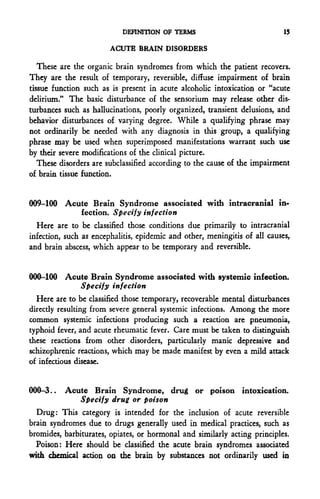
DEFINITION OF TERMS                              15

                        ACUTE BRAIN DISORDERS

   These are the organic brain syndromes from which the padent recovers.
They are the result of temporary, reversible, diffuse impairment of brain
tissue function such as is present in acute alcoholic intoxicadon or "acute
delirium." The basic disturbance of the sensorium may release other dis-
turbances such as hallucinations, poorly organized, transient delusions, and
behavior disturbances of varying degree. While a qualifying phrase may
not ordinarily be needed with any diagnosis in this group, a qualifying
phrase may be used when superimposed manifestations warrant such use
by their severe modifications of the clinical picture.
   These disorders are subclassified according to the cause of the impairment
of brain tissue function.


009-100 Acute Brain Syndrome associated with intracranial in-
                fection. Specify infection
  Here are to be classified those conditions due primarily to intracranial
infection, such as encephalitis, epidemic and other, meningitis of all causes,
and brain abscess, which appear to be temporary and reversible.


000-100 Acute Brain Syndrome associated with systemic infection.
                Specify infection
  Here are to be classified those temporary, recoverable mental disturbances
direcdy resulting from severe general systemic infections. Among the more
common systemic infections producing such a reaction are pneumonia,
typhoid fever, and acute rheumatic fever. Care must be taken to distinguish
these reactions from other disorders, particularly manic depressive and
schizophrenic reactions, which may be made manifest by even a mild attack
of infectious disease.


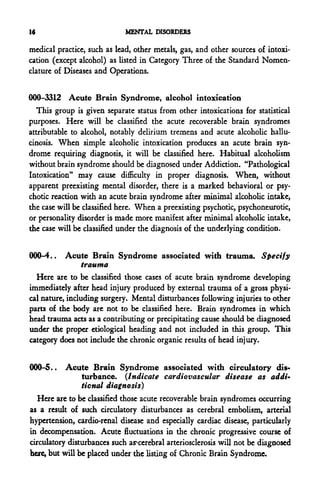
000-3..   Acute Brain Syndrome, drug or poison intoxication.
              Specify drug or poison
  Drug: This category is intended for the inclusion of acute reversible
brain syndromes due to drugs generally used in medical practices, such as
bromides, barbiturates, opiates, or hormonal and similarly acting principles.
  Poison: Here should be classified the acute brain syndromes associated
with chemical action on the brain by substances not ordinarily used in
16                           MENTAL DISORDERS

medical practice, such as lead, other metals, gas, and other sources of intoxi-
cation (except alcohol) as listed in Category Three of the Standard Nomen-
clature of Diseases and Operations.


000-3312 Acute Brain Syndrome, alcohol intoxication
   This group is given separate status from other intoxications for statistical
purposes. Here will be classified the acute recoverable brain syndromes
attributable to alcohol, notably delirium tremens and acute alcoholic hallu-
cinosis. When simple alcoholic intoxication produces an acute brain syn-
drome requiring diagnosis, it will be classified here. Habitual alcoholism
without brain syndrome should be diagnosed under Addiction. "Pathological
Intoxication" may cause difficulty in proper diagnosis. When, without
apparent preexisting mental disorder, there is a marked behavioral or psy-
chotic reaction with an acute brain syndrome after minimal alcoholic intake,
the case will be classified here. When a preexisting psychotic, psychoneurotic,
or personality disorder is made more manifest after minimal alcoholic intake,
the case will be classified under the diagnosis of the underlying condition.


000-4.. Acute Brain Syndrome associated with trauma. Specify
                 trauma
  Here are to be classified those cases of acute brain syndrome developing
immediately after head injury produced by external trauma of a gross physi-
cal nature, including surgery. Mental disturbances following injuries to other
parts of the body are not to be classified here. Brain syndromes in which
head trauma acts as a contributing or precipitating cause should be diagnosed
under the proper etiological heading and not included in this group. This
category does not include the chronic organic results of head injury.


000-5.. Acute Brain Syndrome associated with circulatory dis-
                turbance. (Indicate cardiovascular disease as addi-
                tional diagnosis)
   Here arc to be classified those acute recoverable brain syndromes occurring
as a result of such circulatory disturbances as cerebral embolism, arterial
hypertension, cardio-renal disease and especially cardiac disease, particularly
in decompensation. Acute fluctuations in the chronic progressive course of
circulatory disturbances such asxcerebral arteriosclerosis will not be diagnosed
here, but will be placed under the listing of Chronic Brain Syndrome.
DEFINITION OF TERMS                             17

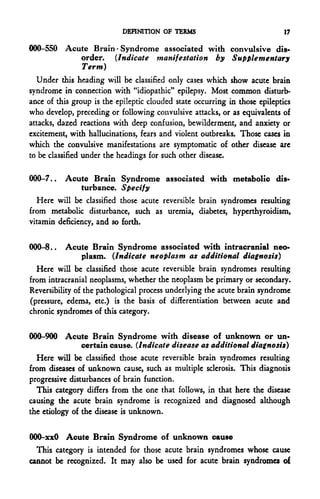
000-550 Acute Brain • Syndrome associated with convulsive dis-
           order. (Indicate manifestation by Supplementary
           Term)
   Under this heading will be classified only cases which show acute brain
syndrome in connection with "idiopathic" epilepsy. Most common disturb-
ance of this group is the epileptic clouded state occurring in those epileptics
who develop, preceding or following convulsive attacks, or as equivalents of
attacks, dazed reactions with deep confusion, bewilderment, and anxiety or
excitement, with hallucinations, fears and violent outbreaks. Those cases in
which the convulsive manifestations are symptomatic of other disease are
to be classified under the headings for such other disease.

000-7.. Acute Brain Syndrome associated with metabolic dis-
           turbance. Specify
  Here will be classified those acute reversible brain syndromes resulting
from metabolic disturbance, such as uremia, diabetes, hyperthyroidism,
vitamin deficiency, and so forth.

000-8.. Acute Brain Syndrome associated with intracranial neo-
           plasm. (Indicate neoplasm as additional diagnosis)
  Here will be classified those acute reversible brain syndromes resulting
from intracranial neoplasms, whether the neoplasm be primary or secondary.
Reversibility of the pathological process underlying the acute brain syndrome
(pressure, edema, etc.) is the basis of differentiation between acute and
chronic syndromes of this category.

000-900 Acute Brain Syndrome with disease of unknown or un-
                certain cause. (Indicate disease as additional diagnosis)
  Here will be classified those acute reversible brain syndromes resulting
from diseases of unknown cause, such as multiple sclerosis. This diagnosis
progressive disturbances of brain function.
  This category differs from the one that follows, in that here the disease
causing the acute brain syndrome is recognized and diagnosed although
the etiology of the disease is unknown.


000-xxO Acute Brain Syndrome of unknown cause
  This category is intended for those acute brain syndromes whose cause
cannot be recognized. It may also be used for acute brain syndromes of
18                           MENTAL DISORDERS

known cause, not elsewhere classifiable, in which case the causadve disease
will be separately diagnosed. Record librarians and statisticians may use
this category for incomplete diagnoses.

                       CHRONIC BRAIN DISORDERS

  The chronic organic brain syndromes result from relatively permanent,
more or less irreversible, diffuse impairment of cerebral tissue function.
While the underlying pathological process may partially subside, or respond
ta specific treatment, as in syphilis, there remains always a certain irreducible
minimum of brain tissue destruction which cannot be reversed, even though
the loss of function may be almost imperceptible clinically. The chronic brain
syndrome may become milder, vary in degree, or progress, but some dis-
turbance of memory, judgment, orientation, comprehension and affect
persists permanently.
  Other mental disturbances of psychotic, neurotic, or behavioral type may
be superimposed on the chronic brain syndrome; when clinically significant,
these will be recognized by addition of the appropriate qualifying phrase to
the diagnosis (see Qualifying Phrases). When the chronic organic dis-
order is present during infancy and childhood, and results in significantly
disturbed intellectual development, this may be recognized by addition of
the qualifying phrase, .x4 with Mental deficiency.
  These disorders are classified according to the cause of the impairment of
brain function. Some of the diagnostic categories are identical with those
of the acute brain syndromes; the differentiation is based on the permanent
impairment of brain function in the chronic group.


009-0.., 009-016,009-071,009-052,009-050 Chronic Brain Syndrome
               associated with congenital cranial anomaly, congenital
               spastic paraplegia, Mongolism, prenatal maternal in-
               fectious disease, birth trauma
  These categories are provided for the group of mental disturbances for-
merly diagnosed as secondary mental deficiency. Clinically, a general devel-
opmental defect of mentation is superimposed on the chronic brain syndrome,
and when prominent may require the addition of the qualifying phrase .x4
Mental deficiency. The degree of defective intelligence will be specified as
mild, moderate, or severe, and the current IQ rating will be added to the
diagnosis (see Mental deficiency).
DEFINITION OF TERMS                              19

009-147.0 Chronic Brain Syndrome associated with central nervous
             system syphilis (Meningoencephalitic)
  Here will be classified the cases formerly diagnosed as general paresis.
In addition to the organic brain syndrome, these cases show physical signs
and symptoms of parenchymatous syphilis of the nervous system, and usually
positive serology, including the paretic gold curve. The psychotic reaction,
when such occurs, may simulate one of the "functional" psychoses but is
to be classified here, with the Qualifying Phrase, .xl with psychotic reaction.


004-147.0 Chronic Brain Syndrome associated with central nervous
                   system syphilis (Meningovascular)
  The mental disturbance is that of the chronic brain syndrome, and is
indistinguishable from the mental disturbance of Meningoencephalitic
syphilis. A differential diagnosis may be possible in those cases in which
the history, signs, and symptoms, including serology, suggest a primary and
predominating involvement of the meninges and blood vessels rather than
of the parenchyma of the nervous system. Suggestive of this type of
syphilis (cerebral) rather than general paresis, are: comparatively early onset
after infection, sudden onset of mental disturbance, focal signs, particularly
cranial nerve palsy, apoplectiform seizures, very high spinal fluid cell count,
positive blood and spinal fluid serology, and prompt response to general
systemic antisyphilitic treatment. Cases showing mental disturbances on a
basis of cerebral lesions from syphilitic vascular disease will be classified
here rather than under the heading Chronic Brain Syndrome associated
with disturbance of circulation.


OyO-147.0 Chronic Brain Syndrome associated with other central
                  nervous system syphilis
  Here will be classified the comparatively infrequent cases of chronic brain
syndrome associated with syphilis of the central nervous system not covered
in the previous groups, including intracranial gumma.


009-1...0 Chronic Brain Syndrome associated with intracranial
                   infection other than syphilis. Specify infection
  Here arc to be classified chronic brain syndromes associated with intra-
cranial infection other than syphilis. Many of these disorders will have been
diagnosed acute brain syndrome early in the course of the illness. The case
20                           MENTAL DISORDERS

should be categorized here when it becomes apparent that there is diffuse,
permanent damage to brain function. In addition to the primary diagnosis,
many of these cases will require the use of a qualifying phrase; for example,
encephalitides occurring in adolescence often develop a chronic brain syn-
drome with behavioral reaction.


009-300 Chronic Brain Syndrome associated with intoxication.
           Specify
  In these two groups will be classified those chronic, organic reactions
which remain permanently following toxic insult to the brain by such agents
as lead, arsenic, mercury, carbon monoxide, illuminating gas, miscellaneous
drugs and alcohol.
  Chronic Brain Syndrome, alcohol intoxication, includes all degrees of
permanent brain damage resulting from the use of alcohol, ranging from
very mild up to and including severe. The latter may manifest itself by the
type of chronic delirium formerly diagnosed as KorsakofFs psychosis. Under
such conditions the psychosis will be recognized by the proper qualifying
phrase.
  Many of these reactions are ushered in with an acute brain reaction to the
intoxicant. The case will be placed in the chronic category when it becomes
apparent that permanent, irreversible damage to the brain has occurred.

009-400 Chronic Brain Syndrome associated with brain trauma
  Here will be classified the post-traumatic chronic brain disorders, which
produce impairment of mental function. Permanent brain damage which
produces only neurologic changes because of its focal nature, without signifi-
cant changes in the areas of sensorium and affect, will not be classified here.
Generally, trauma producing a chronic brain syndrome would have to be
diffuse and would have to leave permanent brain damage. Post-traumatic
personality disorder associated with chronic brain syndrome will be placed
in this group with the appropriate qualifying phrase.
   If the brain injury occurs in early life, it may manifest itself primarily in
a developmental defect of intelligence. Such cases will be qualified by the
phrase .x4 Mental deficiency, and the current I.Q. included in the diagnosis.
   A head injury may usher in, or expedite the course of, a chronic brain
disease, especially cerebral arteriosclerosis. The differential diagnosis in such
cases may be extremely difficult. If the case history shows symptoms of
circulatory disturbance, particularly arteriosclerosis, before the injury, and
DEFINITION OF TERMS                            21

the physical examination confirms the presence of arteriosclerosis, the case
will be classified under Chronic Brain Syndrome associated with cerebral
arteriosclerosis.


009-516 Chronic Brain Syndrome associated with cerebral arterio-
           sclerosis
   Here are to be classified those chronic, progressive, mental disturbances
occurring in connection with cerebral arteriosclerosis. Clinical differentia-
tion of the chronic brain syndrome associated with cerebral arteriosclerosis
from that associated with senile sclerosis and presenile sclerosis may be
impossible. Both underlying pathological changes may be present simul-
taneously. The age, history, and careful survey of the symptoms may
assist in determining the predominate pathology. Commonly, the organic
brain syndrome will be the only mental disturbance present. When signifi-
cant psychotic, neurotic, or behavioral reactions are superimposed, the diag-
nosis will be qualified by the appropriate phrases (see Qualifying Phrases).


009-5..   Chronic Brain Syndrome associated with circulatory dis-
             turbance other than cerebral arteriosclerosis. Specify
   Here are to be classified those chronic organic mental disturbances oc-
curring in connection with circulatory disturbance other than cerebral
arteriosclerosis, such as cerebral embolism, cerebral hemorrhages, arterial
hypertension, and other chronic cardiovascular disease. Differentiation
from the acute brain syndrome of like cause must be made on the irreversi-
bility of the underlying brain damage. The circulatory disturbance will be
specified.


009-550 Chronic Brain Syndrome associated with convulsive dis-
           order
   Here will be included only those cases which show chronic brain syndrome
in connection with "idiopathic" epilepsy. Most of the etiological agents
underlying chronic brain syndromes can and do cause convulsions. Con-
vulsions are particularly common in the presence of syphilis, intoxication,
trauma, cerebral arteriosclerosis, and intracranial neoplasm. When the con-
vulsions are symptomatic of such other etiological agents, the chronic brain
syndrome will be classified under the headings for those disturbances rather
than here.
22                           MENTAL DISORDERS

   The most common type of case to be categorized here is seen in those
epileptics who show a gradual development of mental dullness, slowness
of associative thinking, impairment of memory and other intellectual func-
tions, as well as apathy. Qualifying phrases are to be used when indicated.

009-79x Chronic Brain Syndrome associated with senile brain
                disease
  This category is designed for the classification of organic brain syndrome
occurring with senile brain disease, whether this be mild, moderate or
severe. These cases vary from mild organic brain syndrome with self-
centering of interest, difficulty in assimilating new experiences, and "child-
ish" emotionality, up to and including those so severely affected by senile
brain disease as to require institutional care. Deterioration may be minimal
or it may progress to a state of vegetative existence, with or without super-
imposed psychotic, neurotic, or behavioral reactions (see Qualifying Phrases).


009-700 Chronic Brain Syndrome associated with other disturbance
           of metabolism, growth or nutrition (includes pre-
           senile, glandular, pellagra, familial amaurosis). Specify
   This category includes the chronic brain syndromes associated with dis-
orders formerly classified separately, such as Alzheimer's disease, endocrine
disorders, pellagra, and others of a similar nature.
   In Alzheimer's disease, the brain pathology is characteristic. Clinically,
the disorder may be suspected in severe progressive brain syndromes occur-
ring at a comparatively early age period, as in the forties. The degree of
brain atrophy, which is generalized, is usually severe, and can be demon-
strated by pneumoencephalogram.
   Chronic brain syndromes associated with complications of diabetes (not
due. to accompanying cerebral arteriosclerosis), disorders of the thyroid,
pituitary, adrenals, and other disorders of metabolism, are to be classified
under this heading. The majority of organic reactions occurring on a
glandular or metabolic basis are acute and recoverable. They will be classified
here only when there is evidence of permanent impairment of brain function.
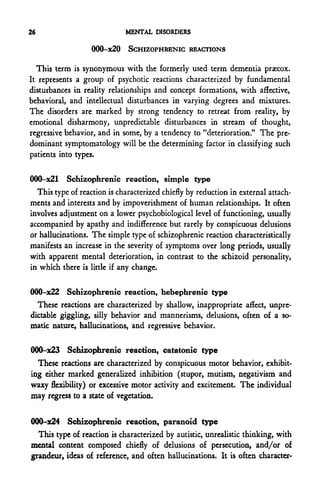
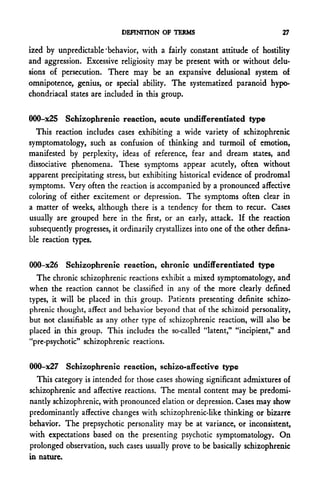
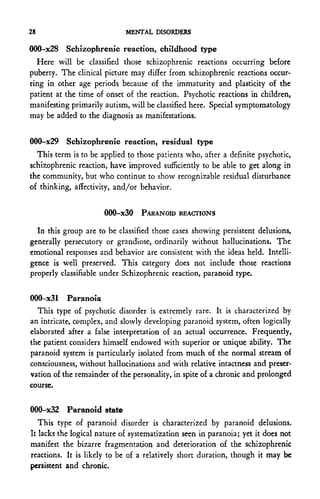
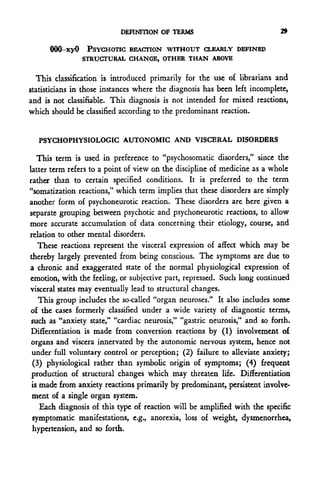
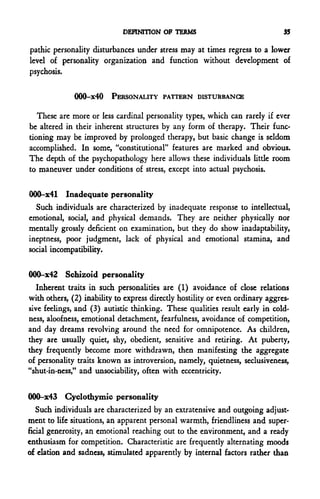
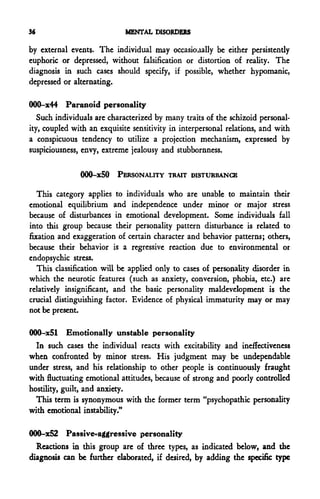
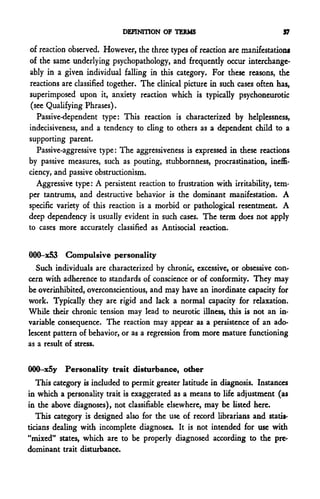
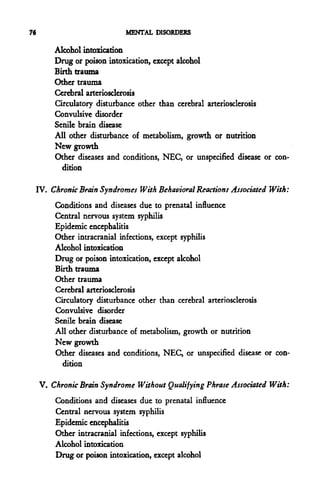
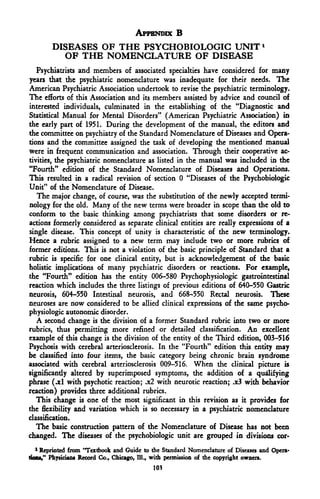
   Chronic brain syndromes associated with pellagra or other avitaminosis
are included in this group. Cases developing pellagra or avitaminosis during
the course of some other psychiatric disorder will not be classified under
this heading, unless permanent brain damage occurs as a result of the
avitaminosis.
DEFINITION OF TERMS                              23

009-8.. Chronic Brain Syndrome associated with intracranial neo-
           plasm. Specify neoplasm
  This category includes the chronic brain syndromes resulting from intra-
cranial neoplasms, whether the neoplasm be primary or secondary. This
category does not include reactions to new growths elsewhere in the body
than in the cranium. Differentiation from the acute brain syndrome of like
cause is made by the presence of irreversible brain damage.


009-900 Chronic Brain Syndrome associated with diseases of un-
                 known or uncertain cause (includes multiple sclerosis,
                 Huntington's chorea, Pick's disease and other diseases
                 of a familial or hereditary nature). Indicate disease
                 by additional diagnosis
   Here will be classified those chronic brain syndromes associated with
irreversible disruption of brain function by such disorders of unknown eti-
ology as multiple sclerosis, Pick's disease, and Huntington's chorea.
   This category differs from the one that follows (009-xxO), in that here the
disease causing the chronic brain syndrome is recognized and diagnosed,
although the etiology of the disease is unknown.


009-xxO Chronic Brain Syndrome of unknown cause
  This category is intended for those chronic brain syndromes whose cause
cannot be recognized. It may also be used for chronic brain syndrome of
known cause, not elsewhere classifiable, in which case the causative disease
will be specified. Record librarians and statisticians may use this category
for incomplete diagnoses.


                       MENTAL DEFICIENCY

000-x90 and 000-y90 Mental deficiency
   Here will be classified those cases presenting primarily a defect of intelli-
gence existing since birth, without demonstrated organic brain disease or
known prenatal cause. This group will include only those cases formerly
known as familial or "idiopathic" mental deficiencies. The degree of intelli-
gence defect will be specified as mild, moderate, or severe, and the current
I.Q. rating, with the name of the test used, will be added to the diagnosis. In
general, mild refers to functional (vocational) impairment, as would be ex-
24                            MENTAL DISORDERS

pected with I.Q.'s of approximately 70 to 85; moderate is used for functional
impairment requiring special training and guidance, such as would be
expected with I.Q.'s of about 50-70; severe refers to the functional impairment
requiring custodial or complete protective care, as would be expected with
I.Q.'s below 50. The degree of defect is estimated from other factors than
merely psychological test scores, namely, consideration of cultural, physical
and emotional determinants, as well as school, vocational and social effective-
ness. The diagnosis may be modified by the appropriate qualifying phrase,
when, in addition to the intellectual defects, there are significant psychotic,
neurotic, or behavioral reactions.

DISORDERS OF PSYGHOGENIG ORIGIN OR WITHOUT
     CLEARLY DEFINED PHYSICAL CAUSE OR
       STRUCTURAL CHANGE IN THE BRAIN
                           PSYCHOTIC DISORDERS

  These disorders are characterized by a varying degree of personality dis-
integration and failure to test and evaluate correctly external reality in various
spheres. In addition, individuals with such disorders fail in their ability to
relate themselves effectively to other people or to their own work.

000-796 Involutiohal psychotic reaction
   In this category may be included psychotic reactions characterized most
commonly by depression occurring in the involutional period, without
previous history of manic depressive reaction, and usually in individuals of
compulsive personality type. The reaction tends to have a prolonged course
and may be manifested by worry, intractable insomnia, guilt, anxiety, agita-
tion, delusional ideas, and somatic concerns. Some cases are characterized
chiefly by depression and others chiefly by paranoid ideas. Often there
are somatic preoccupations to a delusional degree.
   Differentiation may be most difficult from other psychotic reactions with
onset in the involutional period; reactions will not be included in this
category merely because of their occurrence in this age group.

                       000-xlO AFFECTIVE REACTIONS

  These psychotic reactions are characterized by a primary, severe, disorder
of mood, with resultant disturbance of thought and behavior, in consonance
with the affect.
DEFINITION OF TERMS                               25

000-xll—000-xl3 Manic depressive reactions
  These groups comprise the psychotic reactions which fundamentally are
marked by severe mood swings, and a tendency to remission and recurrence.
Various accessory symptoms such as illusions, delusions, and hallucinations
may be added to the fundamental affective alteration.
  Manic depressive reaction is synonymous with the term manic depressive
psychosis. The reaction will be further classified into the appropriate one of
the following types: manic, depressed, or other.


000-xll Manic depressive reaction, manic type
   This group is characterized by elation or irritability, with overtalkativeness,
flight of ideas, and increased motor activity. Transitory, often momentary,
episodes of depression may occur, but will not change the classification
from the manic type of reaction.


000-xl2   Manic depressive reaction, depressed type
    Here will be classified those cases with outstanding depression of mood
and with mental and motor retardation and inhibition; in some cases there is
much uneasiness and apprehension. Perplexity, stupor or agitation may be
prominent symptoms, and may be added to the diagnosis as manifestations.


000-xl3 Manic depressive reaction, other
  Here will be classified only those cases with marked mixtures of the
cardinal manifestations of the above two phases (mixed type), or those
cases where continuous alternation of the two phases occur (circular type).
Other specified varieties of manic depressive reaction (manic stupor or un-
productive mania) will also be included here.


000-xl4 Psychotic depressive reaction
  These patients are severely depressed and manifest evidence of gross mis-
interpretation of reality, including, at times, delusions and hallucinations.
This reaction differs from the manic depressive reaction, depressed type,
principally in (1) absence of history of repeated depressions or of marked
cyclothymic mood swings, (2) frequent presence of environmental precipitat-
ing factors. This diagnostic category will be used when a "reactive depres-
sion" is of such quality as to place it in the group of psychoses (see 000-x06
Depressive reaction).
26                           MENTAL DISORDERS

                   000-x20 SCHIZOPHRENIC REACTIONS

  This term is synonymous with the formerly used term dementia praecox.
It represents a group of psychotic reactions characterized by fundamental
disturbances in reality relationships and concept formations, with affective,
behavioral, and intellectual disturbances in varying degrees and mixtures.
The disorders are marked by strong tendency to retreat from reality, by
emotional disharmony, unpredictable disturbances in stream of thought,
regressive behavior, and in some, by a tendency to "deterioration." The pre-
dominant symptomatology will be the determining factor in classifying such
patients into types.

000-x21 Schizophrenic reaction, simple type
  This type of reaction is characterized chiefly by reduction in external attach-
ments and interests and by impoverishment of human relationships. It often
involves adjustment on a lower psychobiological level of functioning, usually
accompanied by apathy and indifference but rarely by conspicuous delusions
or hallucinations. The simple type of schizophrenic reaction characteristically
manifests an increase in the severity of symptoms over long periods, usually
with apparent mental deterioration, in contrast to the schizoid personality,
in which there is little if any change.

000-x22 Schizophrenic reaction, hebephrenic type
  These reactions are characterized by shallow, inappropriate affect, unpre-
dictable giggling, silly behavior and mannerisms, delusions, often of a so-
matic nature, hallucinations, and regressive behavior.

000-x23 Schizophrenic reaction, catatonic type
  These reactions are characterized by conspicuous motor behavior, exhibit-
ing either marked generalized inhibition (stupor, mutism, negativism and
waxy flexibility) or excessive motor activity and excitement. The individual
may regress to a state of vegetation.


000-x24 Schizophrenic reaction, paranoid type
  This type of reaction is characterized by autistic, unrealistic thinking, with
mental content composed chiefly of delusions of persecution, and/or of
grandeur, ideas of reference, and often hallucinations. It is often character-
DEFINITION OF TERMS                               27

ized by unpredictable'behavior, with a fairly constant attitude of hostility
and aggression. Excessive religiosity may be present with or without delu-
sions of persecution. There may be an expansive delusional system of
omnipotence, genius, or special ability. The systematized paranoid hypo-
chondriacal states are included in this group.

000-x25 Schizophrenic reaction, acute undifferentiated type
  This reaction includes cases exhibiting a wide variety of schizophrenic
symptomatology, such as confusion of thinking and turmoil of emotion,
manifested by perplexity, ideas of reference, fear and dream states, and
dissociative phenomena. These symptoms appear acutely, often without
apparent precipitating stress, but exhibiting historical evidence of prodromal
symptoms. Very often the reaction is accompanied by a pronounced affective
coloring of either excitement or depression. The symptoms often clear in
a matter of weeks, although there is a tendency for them to recur. Cases
usually are grouped here in the first, or an early, attack. If the reaction
subsequently progresses, it ordinarily crystallizes into one of the other defina-
ble reaction types.

000-x26 Schizophrenic reaction, chronic undifferentiated type
  The chronic schizophrenic reactions exhibit a mixed symptomatology, and
when the reaction cannot be classified in any of the more clearly defined
types, it will be placed in this group. Patients presenting definite schizo-
phrenic thought, affect and behavior beyond that of the schizoid personality,
but not classifiable as any other type of schizophrenic reaction, will also be
placed in this group. This includes the so-called "latent," "incipient," and
"pre-psychotic" schizophrenic reactions.

OOQ-x27 Schizophrenic reaction, schizo-affective type
  This category is intended for those cases showing significant admixtures of
schizophrenic and affective reactions. The mental content may be predomi-
nantly schizophrenic, with pronounced elation or depression. Cases may show
predominantly affective changes with schizophrenic-like thinking or bizarre
behavior. The prepsychotic personality may be at variance, or inconsistent,
with expectations based on the presenting psychotic symptomatology. On
prolonged observation, such cases usually prove to be basically schizophrenic
in nature.
28                           MENTAL DISORDERS

000-x28 Schizophrenic reaction, childhood type
  Here will be classified those schizophrenic reactions occurring before
puberty. The clinical picture may differ from schizophrenic reactions occur-
ring in other age periods because of the immaturity and plasticity of the
patient at the time of onset of the reaction. Psychotic reactions in children,
manifesting primarily autism, will be classified here. Special symptomatology
may be added to the diagnosis as manifestations.


000-x29 Schizophrenic reaction, residual type
  This term is to be applied to those patients who, after a definite psychotic,
schizophrenic reaction, have improved sufficiently to be able to get along in
the community, but who continue to show recognizable residual disturbance
of thinking, affectivity, and/or behavior.


                      000-x30 PARANOID REACTIONS

  In this group are to be classified those cases showing persistent delusions,
generally persecutory or grandiose, ordinarily without hallucinations. The
emotional responses and behavior are consistent with the ideas held. Intelli-
gence is well preserved. This category does not include those reactions
properly classifiable under Schizophrenic reaction, paranoid type.

000-x31 Paranoia
  This type of psychotic disorder is extremely rare. It is characterized by
an intricate, complex, and slowly developing paranoid system, often logically
elaborated after a false interpretation of an actual occurrence. Frequently,
the patient considers himself endowed with superior or unique ability. The
paranoid system is particularly isolated from much of the normal stream of
consciousness, without hallucinations and with relative intactness and preser-
vation of the remainder of the personality, in spite of a chronic and prolonged
course.

000-x32 Paranoid state
   This type of paranoid disorder is characterized by paranoid delusions.
It lacks the logical nature of systematization seen in paranoia; yet it does not
manifest the bizarre fragmentation and deterioration of the schizophrenic
reactions. It is likely to be of a relatively short duration, though it may be
persistent and chronic.
DEFINITION OF TERMS                             29

      000-xyO PSYCHOTIC REACTION WITHOUT CLEARLY DEFINED
                STRUCTURAL CHANGE, OTHER THAN ABOVE


  This classification is introduced primarily for the use of librarians and
statisticians in those instances where the diagnosis has been left incomplete,
and is not classifiable. This diagnosis is not intended for mixed reactions,
which should be classified according to the predominant reaction.


   PSYCHOPHYSIOLOGIC AUTONOMIC AND VISCERAL DISORDERS

   This term is used in preference to "psychosomatic disorders," since the
latter term refers to a point of view on the discipline of medicine as a whole
rather than to certain specified conditions. It is preferred to the term
"somatization reactions," which term implies that these disorders are simply
another form of psychoneurotic reaction. These disorders are here given a
separate grouping between psychotic and psychoneurotic reactions, to allow
more accurate accumulation of data concerning their etiology, course, and
relation to other mental disorders.
   These reactions represent the visceral expression of affect which may be
thereby largely prevented from being conscious. The symptoms are due to
a chronic and exaggerated state of the normal physiological expression of
emotion, with the feeling, or subjective part, repressed. Such long continued
visceral states may eventually lead to structural changes.
   This group includes the so-called "organ neuroses." It also includes some
of the cases formerly classified under a wide variety of diagnostic terms,
such as "anxiety state," "cardiac neurosis," "gastric neurosis," and so forth.
Differentiation is made from conversion reactions by (1) involvement of
organs and viscera innervated by the autonomic nervous system, hence not
 under full voluntary control or perception; (2) failure to alleviate anxiety;
 (3) physiological rather than symbolic origin of symptoms; (4) frequent
production of structural changes which may threaten life. Differentiation
is made from anxiety reactions primarily by predominant, persistent involve-
 ment of a single organ system.
   Each diagnosis of this type of reaction will be amplified with the specific
 symptomatic manifestations, e.g., anorexia, loss of weight, dysmenorrhea,
 hypertension, and so forth.
30                          MENTAL DISORDERS

001-580 Psychophysiologic skin reaction
  This category includes such skin reactions as neurodermatoses, pruritus,
atopic dermatitis, hyperhydrosis, and so forth, in which emotional factors
play a causative role.

002-580 Psychophysiologic musculoskeletal reaction
  This category includes muscuoloskeletal disorders such as "psychogenic
rheumatism," backache, muscle cramps, myalgias (to include some cases
of cephalagia, tension headaches) in which emotional factors play a causative
role. In this group, differentiation from conversion reactions is of prime
importance and at times is extremely difficult.

003-580 Psychophysiologic respiratory reaction
  This category includes cases of bronchial spasm, some hyperventilation
syndromes, sighing respirations, hiccoughs, and so forth, in which emotional
factors play a causative role.

004-580 Psychophysiologic cardiovascular reaction
  This category includes such types of cardiovascular disorders as paroxysmal
tachycardia, hypertension, vascular spasms, migraine, and so forth, in which
emotional factors play a causative role.

005-580 Psychophysiologic hemic and lymphatic reaction
  Here may be included any disturbances in the hemic and lymphatic
system in which emotional factors are found to play a causative role.


006-580 Psychophysiologic gastrointestinal reaction
  This category includes such specified types of gastrointestinal disorders
as peptic-ulccr-like reaction, chronic gastritis, ulcerative or mucous colitis,
constipation, hyperacidity, pylorospasm, "heartburn," "irritable colon," "ano-
rexia nervosa," and so forth, in which emotional factors play a causative role.


007-580 Psychophysiologic genitourinary reaction
  This category includes some types of menstrual disturbances, dysuria, and
so forth, in which emotional factors play a causative role.
DEFINITION OF TERMS                              31

008-580 Psychophysiologic endocrine reaction
  This category includes endocrine disorders in which emotional factors play
a causative role. Specify endocrine disturbance.

009-580 Psychophysiologic nervous system reaction
   This category includes psychophysiologic asthenic reaction, in which gen-
eral fatigue is the predominating complaint. There may be associated visceral
complaints. The term includes many cases formerly called "neurasthenia."
In some instances, an asthenic reaction may represent a conversion reaction;
if so, it will be so classified, with asthenia as a manifestation. In other in-
stances it may be a manifestation of anxiety reaction and should be recorded
as such.
   Also included in this category are convulsive disorders not otherwise
classifiable in which emotional factors play a causative role. Differentiation
must be made from the convulsions of conversion reaction.

OOx-580 Psychophysiologic reaction of organs of special sense
  Here may be included any disturbances in the organs of special sense in
which emotional factors are found to play a causative role and in which
conversion reactions are excluded (see 000-x03).

                      PSYCHONEUROTIC DISORDERS

   The chief characteristic of these disorders is "anxiety" which may be
directly felt and expressed or which may be unconsciously and automatically
controlled by the utilization of various psychological defense mechanisms
(depression, conversion, displacement, etc.). In contrast to those with psy-
choses, patients with psychoneurotic disorders do not exhibit gross distortion
or falsification of external reality (delusions, hallucinations, illusions) and
they do not present gross disorganization of the personality. Longitudinal
(lifelong) studies of individuals with such disorders usually present evidence
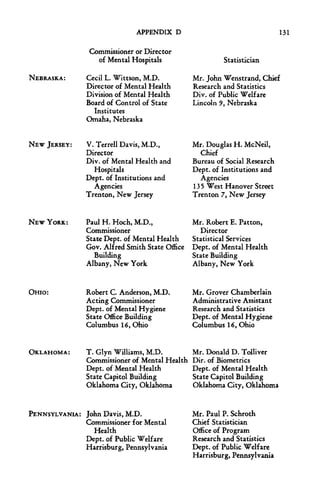
of periodic or constant maladjustment of varying degree from early life.
Special stress may bring about acute symptomatic expression of such
disorders.
   "Anxiety" in psychoneurotic disorders is a danger signal felt and perceived
by the conscious portion of the personality. It is produced by a threat from
within the personality (e.g., by supercharged repressed emotions, including
32                           MENTAL DISORDERS

such aggressive impulses as hostility and resentment), with or without
stimulation from such external situations as loss of love, loss of prestige,
or threat of injury. The various ways in which the patient attempts to
handle this anxiety results in the various types of reactions listed below.
   In recording such reactions the terms "traumatic neurosis," or "traumatic
reaction" will not be used; instead, the particular psychiatric reaction will
be specified. Likewise, the term "mixed reaction" will not be used; instead,
the predominant type of reaction will be recorded, qualified by reference to
other types of reactions as part of the symptomatology.

000-xOl Anxiety reaction
   In this kind of reaction the anxiety is diffuse and not restricted to definite
situations or objects, as in the case of phobic reactions. It is not controlled
by any specific psychological defense mechanism as in other psychoneurotic
reactions. This reaction is characterized by anxious expectation and fre-
quently associated with somatic symptomatology. The condition is to be
differentiated from normal apprehensiveness or fear. The term is synony-
mous with the former term "anxiety state."


000-x02 Dissociative reaction
  This reaction represents a type of gross personality disorganization, the
basis of which is a neurotic disturbance, although the diffuse dissociation seen
in some casts may occasionally appear psychotic. The personality disorgani-
zation may result in aimless running or "freezing." The repressed impulse
giving rise to the anxiety may be discharged by, or deflected into, various
symptomatic expressions, such as depersonalization, dissociated personality,
stupor, fugue, amnesia, dream state, somnambulism, etc. The diagnosis will
specify symptomatic manifestations.
  These reactions must be differentiated from schizoid personality, from
schizophrenic reaction, and from analogous symptoms in some other types of
neurotic reactions. Formerly, this reaction has been classified as a type of
"conversion hysteria."

000-x03 Conversion reaction
  Instead of being experienced consciously (either diffusely or displaced, as
in phobias) the impulse causing the anxiety is "converted" into functional
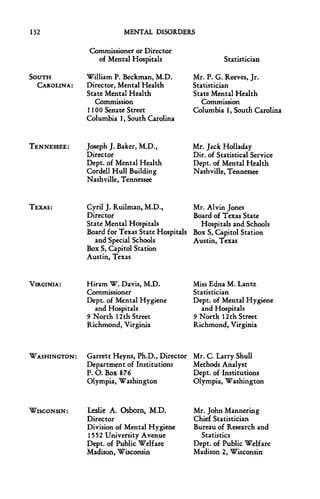
symptoms in organs or parts of the body, usually those that are mainly under
DEFINITION OF TERMS                             33

voluntary control. The symptoms serve to lessen conscious (felt) anxiety
and ordinarily are symbolic of the underlying mental conflict. Such reactions
usually meet immediate needs of the patient and are, therefore, associated
with more or less obvious "secondary gain." They are to be differentiated
from psychophysiologic autonomic and visceral disorders. The term "con-
version reaction" is synonymous with "conversion hysteria." Dissociative
reactions are not included in this diagnosis.
   In recording such reactions the symptomatic manifestations will be speci-
fied as anesthesia (anosmia, blindness, deafness), paralysis (paresis, aphonia,
monoplegia, or hemiplegia), dyskinesis (tic, tremor, posturing, catalepsy).

000-x04 Phobic reaction
   The anxiety of these patients becomes detached from a specific idea, object,
or situation in the daily life and is displaced to some symbolic idea or situa-
tion in the form of a specific neurotic fear. The commonly observed forms
of phobic reaction include fear of syphilis, dirt, closed places, high places,
open places, animals, etc. The patient attempts to control his anxiety by
avoiding the phobic object or situation.
   In recording this diagnosis the manifestations will be indicated. The term
is synonymous with the former term "phobia" and includes some of the
cases formerly classified as "anxiety hysteria."

000-x05 Obsessive compulsive reaction
  In this reaction the anxiety is associated with the persistence of unwanted
ideas and of repetitive impulses to perform acts which may be considered
morbid by the patient. The patient himself may regard his ideas and behav-
ior as unreasonable, but nevertheless is compelled to carry out his rituals.
  The diagnosis will specify the symptomatic expression of such reactions,
as touching, counting, ceremonials, hand-washing, or recurring thoughts
(accompanied often by a compulsion to repetitive action). This category
includes many cases formerly classified as "psychasthenia."

000-x06 Depressive reaction
   The anxiety in this reaction is allayed, and hence partially relieved, by
depression and self-depreciation. The reaction is precipitated by a current
situation, frequently by some loss sustained by the patient, and is often
associated with a feeling of guilt for past failures or deeds. The degree of
34                           MENTAL DISORDERS

the reaction in such cases is dependent upon the intensity of the patient's
ambivalent feeling toward his loss (love, possession) as well as upon the
realistic circumstances of the loss.
   The term is synonymous with "reactive depression" and is to be differenti-
ated from the corresponding psychotic reaction. In this differentiation, points
to be considered are (1) life history of patient, with special reference to
mood swings (suggestive of psychotic reaction), to the personality structure
(neurotic or cyclothymic) and to precipitating environmental factors and
(2) absence of malignant symptoms (hypochondriacal preoccupation, agita-
tion, delusions, particularly somatic, hallucinations, severe guilt feelings,
intractable insomnia, suicidal ruminations, severe psychomotor retardation,
profound retardation of thought, stupor).

000-xOy Psychoneurotic reaction, other
  Under this classification will come all reactions considered psychoneurotic
and not elsewhere classified. (Psychoneurotic manic reactions, etc.) This
category is designed also for the use of record librarians and statisticians
dealing with incomplete diagnoses. It does not include "mixed" reactions,
which are to be diagnosed according to the predominant reaction.


                        PERSONALITY DISORDERS

   These disorders are characterized by developmental defects or pathological
trends in the personality structure, with minimal subjective anxiety, and
little or no sense of distress. In most instances, the disorder is manifested by
a lifelong pattern of action or behavior, rather than by mental or emotional
symptoms. Occasionally, organic diseases of the brain (epidemic encepha-
litis, head injury, Alzheimer's disease, etc.) will produce clinical pictures
resembling a personality disorder. In such instances, the condition is properly
diagnosed as a Chronic Brain Syndrome (of appropriate origin) with behav-
ioral reaction.
   The personality disorders are divided into three main groups with one
additional grouping for flexibility in diagnosis (Special symptom reactions).
Although the groupings are largely descriptive, the division has been made
partially on the basis of the dynamics of personality development. The
Personality pattern disturbances are considered deep seated disturbances,
with little room for regression. Personality trait disturbances and Socio-
DEFINITION OF TERMS                               35

pathic personality disturbances under stress may at times regress to a lower
level of personality organization and function without development of
psychosis.

              000-x40 PERSONALITY PATTERN DISTURBANCE

   These are more or less cardinal personality types, which can rarely if ever
be altered in their inherent structures by any form of therapy. Their func-
tioning may be improved by prolonged therapy, but basic change is seldom
accomplished. In some, "constitutional" features are marked and obvious.
The depth of the psychopathology here allows these individuals little room
to maneuver under conditions of stress, except into actual psychosis.

000-x41 Inadequate personality
  Such individuals are characterized by inadequate response to intellectual,
emotional, social, and physical demands. They are neither physically nor
mentally grossly deficient on examination, but they do show inadaptability,
ineptness, poor judgment, lack of physical and emotional stamina, and
social incompatibility.

000-x42 Schizoid personality
   Inherent traits in such personalities are (1) avoidance of close relations
with others, (2) inability to express directly hostility or even ordinary aggres-
sive feelings, and (3) autistic thinking. These qualities result early in cold-
ness, aloofness, emotional detachment, fearfulness, avoidance of competition,
and day dreams revolving around the need for omnipotence. As children,
they are usually quiet, shy, obedient, sensitive and rearing. At puberty,
they frequently become more withdrawn, then manifesting the aggregate
of personality traits known as introversion, namely, quietness, seclusiveness,
"shut-in-ness," and unsociability, often with eccentricity.


000-x43 Cyclothymia personality
   Such individuals are characterized by an extratensive and outgoing adjust-
ment to life situations, an apparent personal warmth, friendliness and super-
ficial generosity, an emotional reaching out to the environment, and a ready
enthusiasm for competition. Characteristic are frequently alternating moods
of elation and sadness, stimulated apparently by internal factors rather than
36                           MENTAL DISORDERS

by external events. The individual may occasionally be either persistently
euphoric or depressed, without falsification or distortion of reality. The
diagnosis in such cases should specify, if possible, whether hypomanic,
depressed or alternating.

000-x44 Paranoid personality
   Such individuals are characterized by many traits of the schizoid personal-
ity, coupled with an exquisite sensitivity in interpersonal relations, and with
a conspicuous tendency to utilize a projection mechanism, expressed by
suspiciousness, envy, extreme jealousy and stubbornness.

               000-x50 PERSONALITY TRAIT DISTURBANCE

   This category applies to individuals who are unable to maintain their
emotional equilibrium and independence under minor or major stress
because of disturbances in emotional development. Some individuals fall
into thii group because their personality pattern disturbance is related to
fixation and exaggeration of certain character and behavior patterns; others,
because their behavior is a regressive reaction due to environmental or
endopsychic stress.
   This classification will be applied only to cases of personality disorder in
which the neurotic features (such as anxiety, conversion, phobia, etc.) are
relatively insignificant, and the basic personality maldevelopment is the
crucial distinguishing factor. Evidence of physical immaturity may or may
not be present.

000-x51 Emotionally unstable personality
  In such cases the individual reacts with excitability and ineffectiveness
when confronted by minor stress. His judgment may be undependable
under stress, and his relationship to other people is continuously fraught
with fluctuating emotional attitudes, because of strong and poorly controlled
hostility, guilt, and anxiety.
  This term is synonymous with the former term "psychopathic personality
with emotional instability."

000-x52 Passive-aggressive personality
  Reactions in this group are of three types, as indicated below, and the
diagnosis can be further elaborated, if desired, by adding the specific type
DEFINITION OF TERMS                              37

of reaction observed. However, the three types of reaction are manifestation*
of the same underlying psychopathology, and frequently occur interchange-
ably in a given individual falling in this category. For these reasons, the
reactions are classified together. The clinical picture in such cases often has,
superimposed upon it, anxiety reaction which is typically psychoneurotic
 (see Qualifying Phrases).
   Passive-dependent type: This reaction is characterized by helplessness,
indecisiveness, and a tendency to cling to others as a dependent child to a
supporting parent.
   Passive-aggressive type: The aggressiveness is expressed in these reactions
by passive measures, such as pouting, stubbornness, procrastination, ineffi-
ciency, and passive obstructionism.
   Aggressive type: A persistent reaction to frustration with irritability, tem-
per tantrums, and destructive behavior is the dominant manifestation. A
specific variety of this reaction is a morbid or pathological resentment. A
deep dependency is usually evident in such cases. The term does not apply
to cases more accurately classified as Antisocial reaction.


000-x53 Compulsive personality
   Such individuals are characterized by chronic, excessive, or obsessive con
cern with adherence to standards of conscience or of conformity. They may
be overinhibited, overconscientious, and may have an inordinate capacity for
work. Typically they are rigid and lack a normal capacity for relaxation.
While their chronic tension may lead to neurotic illness, this is not an in-
variable consequence. The reaction may appear as a persistence of an ado-
lescent pattern of behavior, or as a regression from more mature functioning
as a result of stress.


000-x5y Personality trait disturbance, other
   This category is included to permit greater latitude in diagnosis. Instances
in which a personality trait is exaggerated as a means to life adjustment (as
in the above diagnoses), not classifiable elsewhere, may be listed here.
   This category is designed also for the use of record librarians and statis-
ticians dealing with incomplete diagnoses. It is not intended for use with
"mixed" states, which are to be properly diagnosed according to the pre-
dominant trait disturbance.
38                           MENTAL DISORDERS

           000-X60     SodOPATHIC PERSONALITY DISTURBANCE

  Individuals to be placed in this category are ill primarily in terms of
society and of conformity with the prevailing cultural milieu, and not only
in terms of personal discomfort and relations with other individuals. How-
ever, sociopathic reactions are very often symptomatic of severe underlying
personality disorder, neurosis, or psychosis, or occur as the result of organic
brain injury or disease. Before a definitive diagnosis in this group is em-
ployed, strict attention must be paid to the possibility of the presence of a
more primary personality disturbance; such underlying disturbance will be
diagnosed when recognized. Reactions will be differentiated as defined
below.

000-x61 Antisocial reaction
   This term refers to chronically antisocial individuals who are always in
trouble, profiting neither from experience nor punishment, and maintaining
no real loyalties to any person, group, or code. They are frequently callous
and hedonistic, showing marked emotional immaturity, with lack of sense
of responsibility, lack of judgment, and an ability to rationalize their behavior
so that it appears warranted, reasonable, and justified.
   The term includes cases previously classified as "constitutional psycho-
pathic state" and "psychopathic personality." As defined here the term is
more limited, as well as more specific in its application.

OOQ-x62 Dyssocial reaction
   This term applies to individuals who manifest disregard for the usual
social codes, and often come in conflict with them, as the result of having
lived all their lives in an abnormal moral environment. They may be
capable of strong loyalties. These individuals typically do not show signifi-
cant personality deviations other than those implied by adherence to the
values or code of their own predatory, criminal, or other social group. The
term includes such diagnoses as "pseudosocial personality" and "psychopathic
personality with asocial and amoral trends."

OOQ-x63 Sexual deviation
  This diagnosis is reserved for deviant sexuality which is not symptomatic
of more extensive syndromes, such as schizophrenic and obsessional reactions.
DEFINITION OF TERMS                              39

The term includes most of the cases formerly classed as "psychopathic
personality with pathologic sexuality." The diagnosis will specify the type
of the pathologic behavior, such as homosexuality, transvestism, pedophilia,
fetishism and sexual sadism (including rape, sexual assault, mutilation).


000-x64 Addiction
  Addictions will be classified as defined below.


000-x641 Alcoholism
  Included in this category will be cases in which there is well established
addiction to alcohol without recognizable underlying disorder. Simple
drunkenness and acute poisoning due to alcohol are not included in this
category.


000-x642 Drug addiction
  Drug addiction is usually symptomatic of a personality disorder, and will
be classified here while the individual is actually addicted; the proper
personality classification is to be made as an additional diagnosis. Drug
addictions symptomatic of organic brain disorders, psychotic disorders, psy-
chophysiologic disorders, and psychoneurotic disorders are classified here as
a secondary diagnosis.


                 000-x70 SPECIAL SYMPTOM REACTIONS

  This category is useful in occasional situations where a specific symptom is
the single outstanding expression of the psychopathology. This term will
not be used as a diagnosis, however, when the symptoms are associated with,
or are secondary to, organic illnesses and defects, or to other psychiatric
disorders. Thus, for example, the diagnosis Special symptom reaction,
speech disturbance would be used for certain disturbances in speech in
which there are insufficient other symptoms to justify any other definite
diagnosis. This type of speech disturbance often develops in childhood. It
would not be used for a speech impairment that was a temporary symptom
of conversion hysteria or the result of any organic disease or defect.
  The diagnosis should specify the particular "habit." (000-x71 Learning
disturbance; OOQ-x72 Speech disturbance; 000-x73 Enuresis; 000-x74 Som-
nambulism; 000-x7y Other.)
40                           MENTAL DISORDERS

        TRANSIENT SITUATIONAL PERSONALITY DISORDERS

   This general classification should be restricted to reactions which are more
or less transient in character and which appear to be an acute symptom
response to a situation without apparent underlying personality disturbance.
   The symptoms are the immediate means used by the individual in his
struggle to adjust to an overwhelming situation. In the presence of good
adaptive capacity, recession of symptoms generally occurs when the situa-
tional stress diminishes. Persistent failure to resolve will indicate a more
severe underlying disturbance and will be classified elsewhere.


000-x80 Transient situational personality disturbance
  Transient situational disorders which cannot be given a more definite
diagnosis in the group, because of their fluidity, or because of the limitation
of time permitted for their study, may be included in this general category.
This category is designed also for the use of record librarians and statisticians
dealing with incomplete diagnoses.


000-x81 Gross stress reaction
  Under conditions of great or unusual stress, a normal personality may
utilize established patterns of reaction to deal with overwhelming fear. The
patterns of such reactions differ from those of neurosis or psychosis chiefly
with respect to clinical history, reversibility of reaction, and its transient
character. When promptly and adequately treated, the condition may clear
rapidly. It is also possible that the condition may progress to one of the
neurotic reactions. If the reaction persists, this term is to be regarded as a
temporary diagnosis to be used only until a more definitive diagnosis is
established.
  This diagnosis is justified only in situations in which the individual has
been exposed to severe physical demands or extreme emotional stress, such
as in combat or in civilian catastrophe (fire, earthquake, explosion, etc.).
In many instances this diagnosis applies to previously more or less "normal"
persons who have experienced intolerable stress.
  The particular stress involved will be specified as (1) combat or (2)
civilian catastrophe.
DEFINITION OF TERMS                               41

000-x82 Adult situational reaction
  This diagnosis is to be used when the clinical picture is primarily one of
superficial maladjustment to a difficult situation or to newly experienced
environmental factors, with no evidence of any serious underlying personality
defects or chronic patterns. It may be manifested by anxiety, alcoholism,
asthenia, poor efficiency, low morale, unconventional behavior, etc. If
untreated or not relieved such reactions may, in some instances, progress
into typical psychoneurotic reactions or personality disorders. This term
will also include some cases formerly classified as "simple adult mal-
adjustment."

000-x83 Adjustment reaction of infancy
   Under this term are to be classified those transient reactions in infants
occurring on a psychogenic basis without organic disease. In most instances
these will be outgrowths of the infant's interaction with significant persons
in the environment or a response to the lack of such persons. Undue apathy,
undue excitability, feeding and sleeping difficulties are common manifesta-
tions of such psychic disturbances in infants.

000-x84 Adjustment reaction of childhood
  Under this heading are included only the transient symptomatic reactions
of children to some immediate situation or internal emotional conflict. The
more prolonged and definitive disturbances will be classified elsewhere.
  Although the symptomatic manifestations are usually mixed, one type of
manifestation may predominate. This group may be subclassified according
to the most prominent manifestations as follows:

000-x841 Habit disturbance
  When the transient reaction manifests itself primarily as a so-called "habit"
disturbance, such as repetitive, simple activities, it may be subclassified here.
  Indicate symptomatic manifestations under this diagnosis; for example,
nail biting, thumb sucking, enuresis, masturbation, tantrums, etc.

000-x842 Conduct disturbance
  When the transient reaction manifests itself primarily as a disturbance
in social conduct or behavior, it will be classified here. Manifestations may
42                            MENTAL DISORDERS

occur chiefly in the home, in the school, or in the community, or may occur
in all three. Conduct disturbances are to be regarded as secondary phenom-
ena when seen in cases of mental deficiency, epilepsy, epidemic encephalitis,
and other well-recognized organic diseases.
  Indicate symptomatic manifestations under this diagnosis; for example,
truancy, stealing, destructiveness, cruelty, sexual offenses, use of alcohol,
etc.

000-x843 Neurotic traits
    When the transient reaction manifests itself primarily as physical or
emotional symptoms, it will be classified here. Care must be taken to dif-
ferentiate these transitory situational responses from the psychoneurotic
reactions.
    Neurotic traits are closely related to habit disturbances and a distinction
between the two is not always possible or desirable. Tics of organic origin
should be classified under organic nervous diesase.
    Under this diagnosis indicate symptomatic manifestations; for example,
t-ics, habit spasms, somnambulism, stammering, over-activity, phobias, etc.

000-x85 Adjustment reaction of adolescence
   Under this diagnosis are to be included those transient reactions of the
adolescent which are the expression of his emancipatory strivings and vacilla-
tions with reference to impulses and emotional tendencies. The superficial
pattern of the behavior may resemble any of the personality or psychoneu-
rotic disorders. Differentiation between transient adolescent reactions and
deep-seated personality trait disorders or psychoneurotic reactions must be
made.

000-x86 Adjustment reaction of late life
  Under this diagnosis will be included those transient reactions of later life
which are an expression of the problems of physiological, situational, and
environmental readjustment. Involutional physiological changes, retirement
from work, breaking up of families through death, or other life situation
changes frequently precipitate transient undesirable personality disturbances,
or accentuate previous personality disorders. Such disturbances arc to be
differentiated from other psychogenic reactions and from reactions associated
with cerebral arteriosclerosis, pre-senile psychosis, and other organic disorders.
DEFINITION OF TERMS                             43

  NON-DIAGNOSTIC TERMS FOR HOSPITAL RECORD

   These terms are included in the Standard Nomenclature of Diseases and
Operations, and reprinted here for the use of hospitals in completing records
and statistics. The reprinted list represents only a portion of those listed
in the Standard Nomenclature, but includes the terms most commonly used
by hospitals for mental disease and psychiatric services in general hospitals.
The terms Diagnosis deferred, Disease none, Examination only, Experiment
only, Observation, and Tests only, must be elaborated by the addition of
explanatory phrases, such as, Observation (psychiatric).
   The terms themselves are self-explanatory. In the six diagnoses listed in
the preceding paragraph, it is necessary to change the code number to indi-
cate more specifically the cause of hospital admission. The Psychobiologic
Unit takes a first code number of 0.. The y must be retained in the first
three digits, hence is moved to second position when the first digit is changed
to indicate the Psychobiologic Unit. The diagnosis, Observation, Psychiatric,
then receives the code number of Oy0-001. Similarly, observation for disease
of the nervous system will be recorded as 9yO-001, Observation, Neurological.
Admission for psychological tests will be recorded under OyO-003, Tests only
 (psychological tests).
SECTION III

       RECORDING OF PSYCHIATRIC CONDITIONS
A. General Requirements
  1. Lowest sub-classification to be used in recording diagnoses: The specific
psychiatric conditions (reactions) are sufficiently well defined to justify their
use' without inclusion of the terms indicating the broader generic groups
(disorders). In recording a psychiatric condition, the lowest sub-classification
of the disorder will be used without being prefaced by generic terms such
as "Personality disorder," "psychoneurosis" (psychoneurotic disorder), "Psy-
chosis" (psychotic disorder), or to intermediate classifications such as "Per-
sonality pattern" and "Sociopathic personality." Examples:
    (a)   Schizophrenic reaction, catatonic type.
    (b)   Psychophysiologic gastro-intestinal reaction.
    (c)   Phobic reaction.
    (d)   Paranoid personality.
    (e)   Adjustment reaction of childhood: conduct disturbance.
   2. Qualifying terms: In addition to the diagnostic term used for specifying
the particular psychiatric condition, the diagnosis may also include terms
qualifying the severity of the condition. The term "severity" refers to the
seriousness of the condition. It will not be determined solely by the degree
of ineffectiveness, since other factors, such as underlying attitudes, or other
psychiatric or physical conditions might have contributed to the total ineffec-
tiveness. Severity will be described as "mild," "moderate," or "severe." Such
terms as "moderately severe" or "mildly severe" are not sanctioned. Out-
standing or conspicuous symptomatology may be added to the diagnosis as
manifestations. Example: "Anxiety reaction, mild, manifested by loss of
appetite and insomnia."
   3. Order of diagnosis: The general principles for recording diagnoses as
prescribed in the Standard Nomenclature of Diseases and Operations apply
to the recording of psychiatric diagnoses. The immediate condition which
necessitated the current admission of the patient will be considered as the
primary cause of admission, and so recorded. In cases of several related
conditions simultaneously necessitating treatment or hospitalization, the
condition which is first in the chain of etiology will be designated as the
                                       44
RECORDING OF PSYCHIATRIC CONDITIONS                           45

primary cause of admission. For unrelated conditions simultaneously neces-
sitating treatment or hospitalization, the most serious condition will be re-
corded as the primary cause of admission. Within the limits of these general
principles the following specific conditions will be considered with respect
to cases involving psychiatric disorders.
    (a) Unrelated diagnoses:
  Physical and mental disorders may coexist but be causally unrelated. In
such instances all conditions will be listed as separate diagnoses with the
primary diagnosis being selected as above.
    (b) Related diagnoses:
  Physical and mental disorders may coexist and be causally related. The
nature of the coexisting conditions determines whether the conditions will
be recorded as separate diagnoses or as only one diagnosis.
       (1) Related conditions requiring only one diagnosis:
  In some instances, the mental reaction, although related to the physical
disorder, is not sufficiently developed as a clinical psychiatric entity to require
a formal psychiatric diagnosis. For example, a patient with pneumonia may
be apprehensive and tense. While this mental status should be described in
the patient's clinical history, or in his physical examination, along with any
other symptoms or signs, on the individual medical record, the diagnosis
will state only the non-psychiatric condition.
  There are other instances where physical and mental disorders may coexist
and where the physical disorder is a manifestation of the psychiatric con-
dition, rather than a separate condition. Whenever this is true, only the
psychiatric condition will be listed as a diagnosis, and the physical condition
will be shown by a supplementary term. Example: Psychophysiologic skin
reaction, severe (pruritis ani).
       (2) Related conditions requiring separate diagnoses:
  Physical and mental disorders may coexist and be causally related, with
both conditions being sufficiently marked and well defined to justify sepa-
rate diagnoses. In such cases the causal relationship of the diagnoses should
be indicated. The condition which caused or directly led to the other con-
dition will precede the other condition in the order of diagnoses. This
diagnostic procedure will be followed despite the fact that the psychiatric
symptomatology is related to personality factors which existed prior to the
immediate physical disease or trauma. For example in the illustration above
46                             MENTAL DISORDERS

[Paragraph (b) (1)], should the state of apprehension or tension associated
with pneumonia progress to a severe delirium, the double condition will
require separate diagnoses of "Pneumonia, etc." and "Acute Brain Syndrome
associated with systemic infection, pneumonia."
        (3) Multiple psychiatric diagnoses:
           (a) Whenever two separate psychiatric conditions exist, such as
Acute Brain Syndrome, drug or poison intoxication, and Depressive reac-
tion, both will be recorded. If a diagnostic entity (which would be recorded
as the only diagnosis, if encountered as an isolated personality disturbance)
is a part of a more extensive process or secondary to it, the primary condi-
tion will be recorded as the diagnosis, with the less important or secondary
condition given as a manifestation. Examples:
                   (1) Anxiety reaction manifested by somnambulism.
                   (2) Passive-aggressive reaction, manifested by enuresis.
            (b) Some psychiatric diagnoses are incompatible with certain
other diagnoses and will not be recorded as existing together, such as psycho-
neurotic and psychotic reactions. Many conditions may progress from one
to another but are not present simultaneously. Only one type of psychoneu-
rotic reaction will be used as a diagnosis, even in the presence of symptoms
of another type. The diagnosis will be based on the predominant type,
followed by a statement of its manifestations, including symptoms of the
other types of of reaction. Examples:
                   (1) Anxiety reaction with minor conversion symptom.
                   (2) Phobic reaction, manifested by claustrophobia, with ob-
                       sessive-compulsive symptoms, counting and recurring
                       thoughts.


B. Special Requirements
     1. General.
  The general requirements outlines above for the recording of diagnoses
for statistical purposes, apply also to the recording of diagnoses on the clinical
records. In view of the fact, however, that the clinical records fulfill wider
function than the statistical records, the mere stating of the diagnosis (includ-
ing its qualifying terms) is not sufficient for certain conditions, since it docs
not furnish enough information to describe the clinical picture. For example,
a diagnosis "Anxiety reaction" does not convey whether the illness has oc-
RECORDING OF PSYCHIATRIC CONDITIONS                        47

curred in a previously normal or previously neurotic personality. Further-
more, it does not indicate the degree and nature of the external stress nor
does it reveal the extremely important information as to the degree to which
the patient's functional capacity has been impaired by the psychiatric condi-
tion. Therefore, for most conditions a complementary evaluation must be
entered in the clinical records. This additional evaluation will consist of the
following elements:
    (a) External precipitating stress.
    (b) Premorbid personality and predisposition.
    (c) Degree of psychiatric impairment.
Under this system the diagnosis becomes one of four factors to be considered
in evaluating a case. It is essential to recognize that the time element is all-
important in this evaluation. The diagnostic formulation on any particular
date may be changed on a subsequent date. A patient may show severe im-
pairment of function upon admission but at the time of discharge may have
mild or no impairment. For this reason, it is essential that a beginning and
terminating evaluation be recorded in each case. Degree of impairment is
not synonymous with the terms, "Recovered," "Improved," and "Unim-
proved." The latter terms are more inclusive, inasmuch as they indicate a
change in the patient's total condition over a period of time.

  2. Conditions Requiring Complementary Diagnostic Evaluation.
  All disorders in this nomenclature will be given complementary diagnostic
evaluation except those grouped under Mental Deficiency.

  3. External Precipitating Stress.
   While it is recognized that multicausal factors operate, the apparent or
obvious external stress precipitating the condition is to be evaluated as to
type, degree, and duration. The stress will generally refer to the immediate
emotional, economic, environmental, or cultural situation which is directly
related to the reaction manifest in the patient. Unconscious internal con-
flicts are not to be considered as external stress. Whenever the stress cannot
be determined, it should be recorded as "undetermined." The degree of
stress must be evaluated in terms of its effect on the "average man" of the
society from which the patient comes. It must not be presumed that a par-
ticular environmental stress is severe because of one or even several indi-
viduals reacting poorly to it, since these individuals may have had poor
48                            MENTAL DISORDERS

resistance to that particular stress. Stress will be classified as "none," "mild,"
"moderate," or "severe." Severe stress is such that the average individual
when exposed to it could be expected to develop psychiatric symptoms.
Moderate stress is such that some evidence of a causal relationship can be
established between the symptoms and the precipitating factors. Mild stress
is such that the average individual could be exposed to it without developing
psychiatric symptoms. In classifying the stress according to one of these
terms, the actual stress should be described in a brief phrase in order to allow
more accurate evaluation of the case. Example: "Moderate stress (business
failure)."

     4. Pre-Morbid Personality and Predisposition.
   The description of predisposition will consist of the patient's outstanding
personality traits or weaknesses, which have resulted from inheritance and
development, and an evaluation of the degree of this predisposition based
on the patient's past history and personality traits. Frequently, the premorbid
personality may be such that classification can be made as one of the per-
sonality disorders. When the predisposition cannot be determined, it will be
recorded as "undetermined." The degree of predisposition will be reported
as "none," "mild," "moderate," or "severe."
     (a) None: No predisposition evident. This description will be used
when the patient shows no evidence of previous personality traits or make-up
appearing to be related to his present illness (and when there has been no
positive history of a mental illness in the immediate family).
     (b) Mild predisposition: This description will be used when the patient's
history reveals mild, transient, emotional upsets, and/or abnormal personality
traits or defects of intelligence which, however, do not significantly inca-
pacitate or did not require medical care. (It will be used also where there
is a past history of mental illness in the patient's family.) Examples: History
of mild, transient, psychoneurotic reaction or mild personality disorder, or
borderline mental deficiency.
      (c) Moderate predisposition. This description will be used when the
patient has a personal history of partially incapacitating emotional upsets,
or definitely abnormal personality traits, or defects in intelligence, which
have resulted in social maladjustment. Examples: Mild, chronic, psycho-
neurotic reaction; moderate psychoneurotic reaction of limited duration;
mental deficiency of mild degree.
      (d) Severe predisposition. This description will be used in the presence
of a definite history of previous overt mental disorder. Examples: Definite
RECORDING OF PSYCHIATRIC CONDITIONS                          49

psychotic reaction, moderate or severe chronic psychoneurotic reaction,
marked degree of personality disorder, moderate or marked mental deficiency.

  5. Degree of Psychiatric Impairment.
   The psychiatric impairment represents the degree to which the indi-
vidual's total functional capacity is affected by the psychiatric condition.
This is not necessarily the same as general ineffectiveness. The degree of
effectiveness in any particular job is a result of the individual's emotional
stability, intellect, physical condition, attitudes, motivation, training, etc., as
well as of the degree and type of his psychiatric impairment. Under some
circumstances, an individual with a moderate psychiatric impairment may
be more effective than another individual with a minimal impairment. De-
gree of impairment, as used here, refers only to ineffectiveness resulting from
the current psychiatric impairment.
  The degree of the impairment at the time of original consultation or
admission will often vary from the degree of impairment after treatment.
Impairment after termination of treatment represents the residual or persis-
tent impairment. Depending on the degree of the impairment, it will be
recorded as, "No Impairment," "Minimal Impairment," "Mild Impairment,"
"Moderate Impairment," "Severe Impairment." The individual's pre-illness
capacity in terms of occupational and social adjustment will be used as a
base line for estimating the degree of impairment.
    (a) No impairment.
  This term will be used whenever there are no medical reasons for changing
employment or life situation.
    (b) Minimal impairment.
  This term will be used to indicate incapacity of perceptible degree and,
in terms of percentage, not to exceed 10%.
    (c) Mild impairment.
  This term will be used to indicate impairment in social and occupational
adjustment, such as a 20 to 30% disability.
    (d) Moderate impairment.
  This term will be used to indicate a degree of impairment which seriously,
but not totally, interferes with the patient's ability to carry on his pre-illness
social and vocational adjustment, such as a 30 to 50% disability.
50                              MENTAL DISORDERS

       (e) Severe impairment.
  This term will be used to indicate a degree of impairment which for
practical purposes prevents a patient from functioning at his pre-illness social
and vocational levels. Over 50 % disability.

     6. Manner of Recording.
  The manner of recording diagnosis on clinical records is illustrated by
the following examples:

(a) Acute brain syndrome associated with drug intoxication
       (bromide)
       Stress: none apparent.
       Predisposition: moderate; history of emotional instability requiring
                       medical care.
       Impairment: none; recovered under treatment.

(b) Chronic brain syndrome associated with cerebral arterio-
       sclerosis
       Stress: mild; malnutrition and minor respiratory infection.
       Predisposition: none.
       Impairment: moderate; able to adjust outside hospital under supervision.

(c) Schizophrenic reaction, hebephrenic type, severe.
       Stress: none.
       Predisposition: severe; Schizoid personality since childhood.
       Impairment: severe; requires hospitalization.

(d) Psychophysiologic gastro-intestinal reaction, moderate, mani-
       fested by nausea, vomiting, loss of appetite and epigastric
       pains.
       Stress: moderate; in train wreck with a number of people killed.
       Predisposition: moderate; emotionally unstable personality since child-
                        hood.
       Impairment: mild; able to return to previous social and vocational situa-
                     tion under treatment.
RECORDING OF PSYCHIATRIC CONDITIONS                       51

(e) Obsessive-compulsive reaction, moderate, manifested by count-
       ing, recurring thoughts and ceremonials.
   Stress: Mild; promotion to a more responsible job.
   Predisposition: moderate; compulsive personality and history of emo-
                   tional upsets since childhood.
   Impairment: moderate; able to carry less responsible job after treatment.

(f) Passive aggressive personality.
   Stress: none apparent.
   Predisposition: mild; sister hospitalized with schizophrenic reaction.
   Impairment: mild; returned to work but shows increase in unauthorized
                 absences.

(g) Adult situational reaction, severe, manifested by anxiety,
       asthenia and poor efficiency.
   Stress: Severe; sudden loss of immediate family.
   Predisposition: none.
   Impairment: none; recovered under psychotherapy.
SECTION IV

                        STATISTICAL REPORTING

                                A. BASIC PRINCIPLES

Mental Hospitals
   There is an increasing need for adequate statistical data on the mental
hospital population of the country. As a result, many State hospital systems
have expressed a desire for guidance in the development of statistical systems.
   On the basis of the records described in the Statistical Manual for the Use
of Hospitals for Mental Disease,1 and modifications of them, several States
already have developed extensive record systems which include procedures
for establishing punch card files and for carrying out machine tabulations.
These State systems are not identical in their details of operation or in the
record forms used. Nevertheless, they all have certain elements in common
and can yield certain common types of basic statistical information.
   The following discussion is not intended to serve as an operations manual.
Its purpose is to provide a guide line to those States and hospitals that con-
template organizing or revising their statistical systems by focusing attention
on the minimum elements found in existing State systems which are essential
to adequate reporting. Persons interested in obtaining operating details may
do so by writing to the Mental Hospital Authorities in the States listed in
Appendix D for copies of manuals which describe their reporting systems,
forms, punch cards, codes and machine tabulating procedures.
   A primary requisite in the establishment of a reporting system is that the
basic objectives of the system should be clearly stated at the outset. With
these objectives in mind, the system should be set up and kept in operation
by a person who is familiar with statistical methods, preferably a trained
statistician with some experience in the application of statistical methods to
hospital and public health problems. Such a person can design record forms
and procedures needed to collect pertinent data, can set up the appropriate
tabulations needed to answer specific questions, and can analyze the data
adequately. There are available sorting and tabulating machines (such as
International Business Machines and Remington Rand Powers Equipment)
  1
    Statistical Manual for the Use of Hospitals for Mental Disease, 10th Edition, 1942, National
Association for Mental Health.
                                              52
STATISTICAL REPORTING                                      53

which help produce tacts rapidly and accurately by eliminating tedious hand
operations and which make possible certain operations and tabulations that
are impractical to carry out by hand. It should be kept in mind, however,
that such machines arc not a substitute for the well-trained statistician but
merely a tool to help the statistician perform the sorting and other operations
incidental to obtaining the necessary tabulations.
  A reporting system does not have to be complex to be effective. An efficient
reporting system can be designed to provide basic facts concerning the
admissions, patients under treatment, discharges, and deaths by having a
limited number of basic variables reported to a central office for every patient
admitted to the hospital system. For example, the following items should be
reported at time of admission:
    (1) Patient's name
    (2) Residence (street address, city or town, county, state)
   (3) Serial number assigned to patient
   (4) Hospital to which admitted
   (5) Date of current admission
    (6) Birth date (month, day, year)
   (7) Age (last birthday) on admission
   (8) Sex (male, female)
   (9) Race (White, Negro, American Indian, Chinese, Japanese, etc.)
  (10) Marital status (single,-married, widowed, divorced, separated)
  (11) Admission status (first, readmission, transfer)
  (12) Type of commitment2 (voluntary; medical certification, standard
        nonjudicial procedure; medical certification, emergency procedure;
        without medical certification, emergency procedure; court order,
        judicial procedure)
  (13) Mental disorder.
  The following facts should be reported subsequent to admission at the
time each event occurs:
    (1) Changes in diagnosis
    (2) Dates of placement on trial visit, family care or temporary visit and
        return from such leave
    (3) Dates of escape and return from escape
    (4) Dates of transfer
    'These terms are the ones used in the Draft Act Governing Hospitalization of the Mentally
III, Federal Security Agency, Public Health Service, Publication No. 51. Types of commitment
procedures practiced in a given State can be substituted for these.
54                                  MENTAL DISORDERS

     (5) Date of discharge and whether discharge is from hospital direct,
         trial visit, family care, temporary visit or while otherwise absent
     (6) Date of death and whether death occurred in hospital, on trial visit,
         family care, temporary visit, or while otherwise absent
     (7) Causes of death."
These items should be collected on a single card, such as is shown in figure 1.
Included on the card are several other items which may be found useful for
identification or other purposes such as religion, usual occupation,4 business
or industry, veteran status, social security number, patient's birthplace,
parents' names and birthplaces. Spaces arc also provided for recording the
degree of psychiatric impairment patient was found to have at time of
admission, discharge, and intermediate dates as well as the outcome of
hospitalization.
   It should be pointed out that certain basic facts are needed on the book
population of the hospital—that is, the residents in hospital and patients
on trial visit, family care, escape, etc.—as of the date the reporting system
starts. To obtain these facts entails carrying out a census of the book popula-
tion as of the appropriate date (for example, January 1), recording for these
individuals the same items as are to be obtained on the patients admitted
after that date. By making the appropriate additions to and subtractions from
   8
      Causes of death should be recorded in the same manner as on the Medical Certification Sec-
tion of the Standard Certificate of Death. For information on the completion of this section of
the death certificate see "Physicians Handbook on Death and Birth Registration/' 10th Edition,
Government Printing Office, Washington 25, D. C. (15 cents.) The classification of causes of
death for statistical tabulation should be done in accordance with the "International Statistical
Classification of Diseases, Injuries and Causes of Death." Volume I includes an Introduction,
List of Categories, Tabular List of Inclusions, a section on medical certification and rules for
classification, and special lists for tabulation purposes. Volume II is the Alphabetical Index to
the List. The index is a working tool for use in coding medical records and death certificates.
The manual also contains rules for uniform selection of underlying cause of death and three
lists recommended for use by all member nations of the World Health Organization in tabulat-
ing morbidity and mortality data. The manual can be obtained from the Columbia University
Press, International Documents Service, 2960 Broadway, New York 27, N. Y.
    * "Usual occupation" refers to the occupation the patient pursued for the longest part of his
working life. It is the one occupation out of several the patient may have had that accounted
for the greatest number of years of his working life. This item and "kind of business or industry"
are useful for identification and, if death occurs, for completing the death certificate. It is also
of some use in research, although studies of association between occupation and mental illness
would probably require detailed occupational histories. If the patient was retired prior to hos-
pitalization, enter his usual occupation and industry in items 12 and 13 and insert "ret" after
the usual occupation. For more specific details regarding terms to be used in the recording of
occupation and industry see "Guide for Reporting Occupation and Industry on Death Certifi-
cates" issued by the Public Health Service, National Office of Vital Statistics, Washington 25,
D. C., and "Alphabetical Index of Occupations and Industries," Bureau of the Census, Wash-
ington 25, D. C.
STATISTICAL REPORTING                             55

the various categories of patients, it is then possible to keep the book popu-
lation up-to-date.
   If additional information is desired, as for example on the type of therapy
each patient receives, the occurrence of non-psychiatric illness such as cancer,
tuberculosis, diabetes, etc., the form could be enlarged to provide additional
fields for such data or special forms could be designed to obtain such data
which could later be collated with the basic record outlined above.
   From the basic facts collected on the patients the following kinds of statis-
tical tabulations may be obtained (these tables are set up in outline form at
the end of this Section):
   (1) Gross movement table which tells how many patients are admitted to,
die in, or are discharged from the hospital, how many are on trial visit,
escape, etc. These data are needed to compute crude separation, discharge
and death rates (table 1).
  (2) More specific data about the characteristics of the patients who are
admitted, discharged, on extramural care (trial visit and family care) or
resident in the hospital at the end of the year. For example:
    (a) Annual Admissions:
        1. By mental disorder, sex, race, age at admission and admission
           status (table 2)
    (b) Annual Discharges:
        1. By mental disorder, sex, race, age at discharge and admission
           status (table 3)
        2. By mental disorder, sex, race, admission status and net length of
           time in hospital for this admission (table 4)
        3. By mental disorder, sex, race and condition on discharge (table 5)
    (c) Annual Deaths:
        1. By mental disorder, sex, race, age at death and admission status
           (table 6)
        2. By mental disorder, sex, race, admission status and net length of
           time in hospital for this admission (table 7)
    (d) Resident Patients at the End of the Year:
        1. By mental disorder, sex, race, and age at the end of the year
           (table 8)
        2. By mental disorder, sex, race and time on books (table 9)
INSTITUTION

1. PATIENT'S NAME (La*t. tirmt. middle)                                                                         I 3. SERIAL NUMBER


2. PATIENT'S ADDRESS (No., afreet, city or torn, county, atate)                                                   4. DATE ADMITTED


5. LEGAL RESIDENCE (State or         I 6. PATIENT'S BIRTHPLACE   |7. DATE OF BIRTH) «. ADMISSION AGE |9. S E X 1 0 . RACE     I 1 1.   RELIGION
                    county)           (State or foreign country)                   (Yrm. la*t birthday)

12. MARITAL STATUS                     13 a USUAL OCCURAT ION                               |   I3b KIND OF BUSINESS OR INDUSTRY


14. WAS PATIENT EVER IN U.S.           143 IF YES. GIVE WAR OR DATES OF I 173 FATHER'S NAME                                     I7b BIRTHPLACE
    ARMED FORCES?                          SERVICE
        YES          NO        UNR
15. SOCIAL SECURITY NUMBER             16. CITIZEN OF WHAT COUNTRY?        lea MOTHER'S MAIDEN NAME                             18b BIRTHPLACE§


l». TYPE OF ADMISSION                        20. ADMISSION STATUS          21. RECORD OF PREVIOUS HOSPITALIZATIONS FOR MENTAL DISORDER
                                                   FIRST ADMISSION                        INSTITUTION                          DATES OF
        VOLUNTARY
                                                                          ( Include public and private mental hospitals
        MED. CERTIF., STAND. NON- JUDICIAL                                aid general hoapttala rith piychiatric ward* ) ADMISSION   DISCHARGEg
     MED. CERTIF., EMERGENCY                         READMISSION
        WITHOUT MED. CERTIF.. EMERGENCY
        COURT ORDER, JUDICIAL PROCEDURE              TRANSFER IN
        OTHER (Specify)
22. DIAGNOSIS OF MENTAL DISORDER (Include severity)                        23. DATE OF I 25. DISCHARGED FROM                I 26. OUTCOME
                                                                               DISCHARGE                                            RECOVERED
 DATE                                  DIAGNOSIS                                             HOSPITAL              TEMP.
                                                                                             TRIAL                 VISIT               IMPROVED
                                                                                              VISIT                ESCAPE
                                                                           24.AGE AT                                                   UNIMPROVED
                                                                                DISCHARGE    FAMILY                OTHER
                                                                                             CARE                                      DEAD

                                                                          27. TRANSFERRED TO               DATE                        WITHOUT MENTAL
                                                                                                                                       DISORDER


                                     Fro. 1. Statistical card for use in hospitals for mental illness (front)
28..RECORD OF CHANGES OF STATUS (Enter date patient is placed on          29. LENGTH OF HOSPITALIZATION FOR THIS ADMISSION
    mod returned from trial v i s i t , family care, temporary visit,
    escape , etc.
                                                  DATE OF                                                           YRS.             MOs.              DAYS
         TYPE OF LEAVE                DATE OUT    REnjRN    DAYS ABSENT   (a,   TIME   ON BOOKS


                                                                                           (Except on
                                                                          (b) TIME ABSENT
                                                                                        temporary visit)
                                                                          NET   LENGTH   OF
                                                                          RESIDENCE (• minus b)

                                                                          30. DEGREE OF IMPAIRMENT (Enter dates at which evaluations are
                                                                               made and check appropriate column. Minimum evaluation dates
                                                                              are   date of   admission and date of   discharge)
                                                                                                                           IMPAIRMENT
                                                                                 DATE
                                                                                                   NONE       MINIMAL         MILD          MODERATE     SEVERE


                                                                          31. CAUSES OF DEATH (As recorded on death                         INTERVAL BETWEEN
                                                                                               certificate)                                 ONSET AND DEATH


                                                                                 a. DISEASE OR CONDITION DIRECTLY
                                                                                    LEADING TO DEATH

                                                                                     ANTECEDENT CAUSES DUE TO
                                                                                b.
                                                                                c.
                                                                                 d. OTHER S I G N I F I C A N T CONDITIONS


                               FIG. 1. (Cont'd.) Statistical card for use in hospitals for mental illness (back)
58                                MENTAL DISORDERS

     (c) Patients on Extramural Care (trial visit plus family care) at End of
         Year:
         1. By mental disorder, sex, race and age at the end of year (table 10)
         2. By mental disorder, sex, race and time on books (table 11)
  (3) Data that tell what happens to a cohort of patients admitted in a
specific year, i.e., follow-up data on a group of annual admissions to deter-
mine how many of the first admissions of 1948, for example, were in the
hospital, discharged, on trial visit, in family care or otherwise absent or
dead twelve months following their date of admission, by such factors as
mental disorder, sex, and race (table 12).
  Additional tables can be prepared that may be useful for administrative
and other purposes within a State hospital system. For example:
     (a) Resident population as of end of year by county of residence at
         time of admission, and sex with corresponding rates per 100,000
         population
     (b) Annual first admissions and readmissions to State mental hospitals
         by county of residence and sex with corresponding rates per 100,000
         population
     (c) Overcrowding: Excess of average daily resident patients over rated
         capacity of hospital
     (d) Administrative staff, full-time, by occupation and ratio of patients
         to various occupational categories as for example, physicians, nurses,
         attendants and social workers.
  Actual examples of tabulations such as those mentioned above may be
obtained by writing to the State Mental Hospital Authority in the list of
States in Appendix D for copies of their annual reports or to the Biometrics
Branch, National Institute of Mental Health of the Public Health Service.
  The annual reports of New York, New Jersey, Virginia and California
and the monthly bulletin of the Ohio Department of Public Welfare are
particularly useful in this respect.5 Mention should also be made of the
annual Census of Patients in Mental Institutions, issued by the National
   •The Ohio Bulletin for the months of May 1947, May 1948 and May 1949, and a paper in
the American Journal of Psychiatry, Vol. 104, No. 9, March 1948, "New Facts on Prognosis
in Mental Disease," by Robert H. Israel, M. D. and Nelson A. Johnson, B. A., contain good
examples of tabulations that show the status of a group of annual admissions on the anniversary
of their admission.
STATISTICAL REPORTING                            59


Institute of Mental Health, Public Health Service. This volume includes
the following data for each State and for the United States:
  1.   Movement of population by sex
  2.   First admissions by sex, age and mental disorder
  3.   Discharges by sex, mental disorder and condition on discharge
  4.   Administrative stafl as of end of year
  5.   Expenditures by purpose.
Copies of the Census and of Mental Health Statistics—Current Reports, a
series of special studies on mental hospital data and other pertinent subjects
may be obtained from the National Institute of Mental Health, Public Health
Service, Bethesda 14, Maryland.

Outpatient Psychiatric Clinics
  Relatively little has been done in the development of statistical reporting
and record systems in outpatient psychiatric clinics. Several States have
instituted reporting systems, in particular, California, New York, Ohio,
Michigan, New Jersey and Virginia. Copies of record forms and operating
manuals may be obtained by writing to the Mental Hospital Authority in
each of these States (Appendix D). In the interim, operational information
will be collected by the Biometrics Branch, National Institute of Mental
Health, and may be obtained, as it becomes available, by letter to that agency.
  It is anticipated that in the next few years more work will be done in
the development of this important area of psychiatric statistics. As additional
data become available they will be collected for publication in future manuals.


                      B. SUGGESTED TABULATIONS

Definitions of Terms in Movement Table
  First Admission: A patient admitted for the first time to any hospital for
the treatment of mental disease, except institutions for temporary care only.
  Readmission: A patient admitted who has previously been under treatment
in a hospital for mental disease, excepting transfers and those who have
been hospitalized only in institutions for temporary care.
  Transfer: A patient brought directly from one hospital to another without
a break in custody and without being formally discharged from the first
hospital and formally admitted by the second.
  Trial visit (conditional discharge, convalescent status, convalescent care,
60                           MENTAL DISORDERS

indefinite leave): 'Status of patients absent from the hospital but still on the
books or in its custody. This is a type of care for patients, usually in their
homes, in which the ability of the patient to adjust to normal community
life is tested. He might be returned to the hospital at any time before dis-
charge for his own protection or that of the community.
   Family Care: Status of patients who have been placed in the community in
private families other than their own, under State supervision. The expense
of maintenance may be borne by the State, the patient's estate, relatives, Old
Age Assistance or some other person or agency.
   Temporary Visit (leave of absence): Status of patients temporarily absent
from the hospital for short periods of time with the understanding that the
patient will return to the hospital within a specified time.
   Otherwise Absent: Status of patients leaving the hospital without permis-
sion (escape or elopement) or remaining away without leave and who are
not discharged from the hospital books.
   Discharge: Status of patients removed from the hospital books (except by
death).
   Death: Patients who die while on the hospital books.
TABLE 1

                                 HOSPITAL FOR MENTAL DISEASE

                          MOVEMENT OF PATIENT POPULATION BT SEX *

                  Report for Year Ending
                                             (Month)       (Day)           (Year)
                                                                   Total            Male   Female
A. Total Population.
   1. On books beginning of year (total)
         In hospital
         On trial visit
         In family care
         On temporary visit
         Otherwise absent
   2. Admissions during year (total)
         First admissions
         Readmissions
         Transfers from other hospitals for mental disease.
   3. Separations during year (total)
         Discharges direct from hospital
         Discharges while on trial visit
         Discharges from family care
         Discharges from temporary visit
         Discharges while otherwise absent
         Deaths in hospital
         Deaths on trial visit
         Deaths in family care
         Deaths on temporary visit
         Deaths while otherwise absent
         Transfers to other hospitals for mental disease....
   4. On books end of year (total)
         In hospital
         On trial visit
         In family care
         On temporary visit
         Otherwise absent
B. Population on Leave (trial visit, family care, on tem-
   porary visit, or otherwise absent)
    1. On leave beginning of year (total)
           On trial visit
           In family care
           On temporary visit
          Otherwise absent
   2. Placed on leave from hospital during year (total).. .
          To trial visit
           To family care
          To temporary visit
          To otherwise absent
   3. Returns to hospital from leave during year (total). . .
          From trial visit
          From family care
          From temporary visit
          From otherwise absent
   4. Separations from leave by discharge, death or
       transfer during year (total)
          From trial visit
          From family care
          From temporary visit
          From otherwise absent
   5. On leave end of year (total)
          On trial visit
          In family care
          On temporary visit
          Otherwise absent
 1
   Similar tabulations should be made by race
                                            61
TABLE 2

                                                              HOSPITAL FOR MENTAL DISEASE
                                                    1
                               FIRST ADMISSIONS DURING THE TEAR BY AGE AT ADMISSION AND MENTAL DISORDER:
                                                            WHITE   MALE *

                                            Report for Year Ending
                                                                           (Month)          (Day)     (Year)

                                                                                  AGE (in yean)
        MENTAL DISORDER*            Total                                                                                                      85   ARC
                                            Under       15-   20-   25-   30-   35-   40-     45-   50-   55-   60-   65-   70-   75-   80-   and   tin-
                                             IS         19    24    29    34    39    44      49    54    59    64    69    74    79    84    over known
 I Acute Brain Syndromes


II Chronic Brain Syndrome* with
   psychotic reaction


III Chronic Brain Syndromes with
    neurotic reaction


Etc.*
  1
  1
    Similar tabulations should be made for readmissions.
    Similar tabulations should be made for white females and for non-white males and females.
  • The statistical classification of mental disorder is given in detail in Section V.
TABLE 3
                                                         HOSPITAL FOR MENTAL DISEASE
                                                               ALL DISCHARGES1
                                        FIRST ADMISSIONS 2 BY AGE AT DISCHARGE AND MENTAL DISORDER:
                                                               WHITE    MALE *

                                           Report for Year Ending
                                                                      D


                                                                                        AGE (in years)
                                                                                                 A^
        MEKTAL DISOKDKB*            Total                                                                                                85  Age
                                            )


                                        6 Under    IS-   20-   25-    30- 35-     40-   45-     50-   55-   60-   65-   70-   75-   80- and  un-
                                           IS      19    24    29     34 ^9       44    49      54    59    64    69    74    79    84 over known
 I Acute Brain Syndromes


II Chronic Brain Syndromes with
   psychotic reaction


III Chronic Brain Syndromes with
    neurotic reaction


Etc.*
  1
    Include all first admissions discharged from the books of the hospital.
  * Similar tabulations should be made for readmissions.
  1
    Similar tabulations should be made for white females and for non-white males and females.
  * The statistical classification of mental disorder is given in detail in Section V.
TABLE 4

                                                           HOSPITAL FOR MENTAL DISEASE
                                                                  ALL DISCHARGES1
                                FUST ADMISSIONS * BT NET LENGTH OF TIME * IN HOSPITAL AND MENTAL DISORDER:
                                                              WHITE   MALE *

                                              Report for Year Ending
                                                                        (Month)       (EajFJ(Year)

                                                                       NET LENGTH or TIME » HOSPITAL FO* THIS ADMISSION
        MEHTAL DISORDER*              Total    Undef    3.5    6.n      i     2      3     4      5-9   10-14 15-19 20-24             25-29 30years
                                               3 moa.   mot.   moa.    year  years years years years years years years                 years and over
 I Acute Brain Syndromes


n Chronic Brain Syndromes with
  psychotic reaction


m Chronic Brain Syndromes with
  neurotic reaction


Etc.»
  1
    Include all first admissions discharged from the books of the hospital.
  * Similar tabulations should be made for readmissions.
  • Net length of time is total time on books for this admission minus time OB trial visit or otherwise absent, that is. on escape or away without leave.
  4
    Similar tabulations should be made for white females and for non-white males and females.
  ' The statistical classification of mental disorder is given in detail in Section V.
TABLE 5
                                                          HOSPITAI, FO» MENTAL. DISEASE
                                      ALL DISCHARGES1 BT CONDITION ON DISCHARGE AND MENTAL DISOftDEft:
                                                              WHITE   KALE1
                                           Report for Year Ending
                                                                       D
                                                                                             CONDITION on DISCHAMGK
        MENTAL DISOXOEK*                     Total
                                                                 Recovered                 Improved          Unimproved   Unclassified
 I Acute Brain Syndromes


II Chronic Brain Syndromes with
   psychotic reaction


HI Chronic Brain Syndromes with
   neurotic reaction


Etc.'
  1
    Include all patients discharged from the books of the hospital.
  * Similar tables should be made for white females and for non-white males and females.
  • The statistical classification of mental disorder is given in detail in Section V.
TABLE 6
                                                          HOSPITAL FOR MENTAL DISEASE
                                   ALL DEATHS,1 FIRST ADMISSIONS 2 BY AGE AT DEATH AND MENTAL DISORDER:
                                                               WHITE MALE*
                                            Report for Year Ending
                                                                       (Month)      (Day)        (Year)

                                                                                        AGK (in yean)
        MENTAL DISORDER*            Total                                                                                    I                85   Ace
                                            Under   15-   20-   25-   30-   35-   40-   45-    50-   55-   60-   65-   70-       75-   80-   and tin-
                                             IS     19    24    29    34    39    44    49     54    59    64    69    74        79    84    over known
 I Acute Brain Syndromes


II Chronic Brain Syndromes with
   psychotic reaction


III Chronic Brain Syndromes with
    neurotic reaction


Etc*
 1
   Include all deaths occurring: among first admissions while on the books of the hospital.
 * Similar tabulations should be made for readmissions.
 ' Similar tabulations should be made for white females and for non-white males and females.
 • The statistical classification of mental disorder is given in detail in Section V.
TABLE 7
                                                                HOSPITAL FOR MENTAL DISEASE
                                                ALL DEATHS,1 FIRST ADMISSIONS 2 BY NET LENGTH OF TIME 8
                                                        IN HOSPITAL AND MENTAL DISORDER:
                                                                  WHITE    MALE *
                                               Report for Year Ending
                                                                          (Month)       (Day)       (Year)

                                                                         NET LENGTH OF TIME IN HOSPITAL FOB THIS ADMISSION
          MENTAL DISORDER*             Total    Under    3,s      6-11    1      2        3       4      5-9     10-14    15-19    20-24    25-29 30 years
                                                3 mos.   mos.     mos.   year   years    years   years   years    years    years    years    years and over
 I Acute Brain Syndromes


II Chronic Brain Syndromes with
   psychotic reaction


III Chronic Brain Syndromes with
    neurone reaction


Etc." ,
  1
  1
    Include   all deaths occurring among first admissions while on the books of the hospital.
     Similar tabulations should be made for readmissions.
  '4 Net length of time is total time on books for this admission minus time on trial visit or otherwise absent, that is, on escape or away without leave.
     Similar tabulations should be made for white females and for non-white males and female*.
   • The statistical classification of mental disorder is given in detail in Section V.
TABLE 8
                                                               HOSPITAL TO*. MENTAL DISEASE
                                                     1
                               RESIDENT PATIENTS AT END OF TEAR BT AGE AT END OF TEAR AND MENTAL DISORDER:
                                                             WHITE   UALE *

                                             Report for Year Ending
                                                                            (Month)      (Day)(Year)

                                                                                             AGE (in years)
        MKNTAL DISOKDKX •            Total                                                                         ]                           85   Age
                                             Under       15-   20-   25-   30-   35-   40-   45-    50-   55-   60- 65- 70- 75-         80-   and   un-
                                              IS         19    24    29    34    39    44    49     54    59    64 ^g^ 74 _79           84    over known
 I Acute Brain Syndromes


II Chronic Brain Syndromes with
   psychotic reaction


II Chronic Brain Syndromes with
   neurotic reaction


Etc.'
  1
  1
    Tabulations  should be made separately for first admissions and for readmissions. Patients on temporary visit are considered as in residence.
    Similar tabulations should be made for white females and for non-white male* and females.
  ' The statistical classification of mental disorder is given in detail in Section V.
TABLE 9
                                                                   HOSPITAL FOR MENTAL DISEASE
                                 RESIDENT PATIENTS AT END OF YEAR BY TIME ON BOOKS 2 AND MENTAL DISORDER:
                                                        X

                                                             WHITE    MALE 8
                                              Report for Year Ending
                                                                             (Month)       (Day)    (Year)

                                                                                             "TIME ON BOOKS
        MENTAL DXSORDB* *             Total    Undef        3.5      6-11    1       2      3       4     5-9   10-14   15-19   20-24   25-29 30 years
                                               3 mos.       mos.     mos.   year   years   years years years    years   years   yeara   years and over
 I Acute Brain Syndromes


II Chronic Brain Syndromes with
   psychotic reaction


III Chronic Brain Syndromes with
    neurotic reaction


Etc.*
  1
    Tabulations should be made separately for first admissions and for readmissions. Patients on temporary visit are considered as in residence.
  * Time on books is interval between date of admission for this admission and last day of year covered by this report.
  1
    Similar tabulations should be made separately for females and for non-white patients.
  * The statistical classification of mental disorder is given in detail in Section V.
TABLE 10
                                                            HOSPITAL FOB MENTAL DISEASE
                                                  PATIENTS IN EXTRAMURAL CARE 1 AT END OF YEAR
                                                   BY AGE AT END OF YEAR AND MENTAL DISORDER:
                                                                 WHITE   MALE3

                                              Report for Year Ending
                                                                         (Month)       (Day)(Year)

                                                                                           AGE (in Tears)
         MENTAL DISORDER*             Total                                                                                                    85  Age
                                              Under   15-   20-   2S-    30-   35-   40-     45-   50-      55-   60-   65-   70-   75-   80- and un-
                                               15     19    24    29     34    39    44      49    54       59    64    69    74    79    84 over known
 I Acute Brain Syndromes


II Chronic Brain Syndromes with
   psychotic reaction


III Chronic Brain Syndromes with
    neurotic reaction


Etc.*
  1
    Tabulations should be made separately for first admissions and for read missions. Patients in extramural care are patients on trial visit and those in
family care.
  ' Similar tabulations should be made for white females and for non-white males and females.
  •The statistical classification of mental disorder is given in detail in Section V.
D
                                                             HOSPITAL FOR MENTAL DISEASE
                                                  PATIENTS IN EXTRAMURAL CARE 1 AT END OF TEAR
                                                    BY TIME ON BOOKS 2 AND MENTAL DISORDER:
                                                                WHITE    MALE *
                                           Report for Year Ending
                                                                        (Month)       (Day)(Year)

                                                                                        |TIME ON BOOKS
        MENTAL DISOKDKK*             Total 'Under     ^        £^[     J~       2      3       4 5 - 9         10-14   15-19   20-24    25-29 3 0 year
                                            3 mos.    moa.     mot,   year    years   years years years        years   years   years    years and over
 I Acute Brain Syndromes


II Chronic Brain Syndromes with
   psychotic reaction


(II Chronic Brain Syndromes with
    neurotic reaction


Etc.*
  1
    Tabulations should be made separately for first admissions and for readmissions. Patients in extramural care are patients on trial visit and those in
family care.
  * Time on books is interval between date of admission for this admission and last day of year covered by this report.
  1
    Similar tabulations should be made separately for white females and for non-white males and females.
  ' The statistical classification of mental disorder is given in detail in Section V.
TABLE 12
                                                           HOSPITAL FOR MENTAL DISEASE
                          DISPOSITION ! OF FIRST ADMISSIONS WITHIN THE TWELVE MONTH PERIOD FOLLOWING ADMISSION
                                                            BY MENTAL DISORDER:
                                                              WHITE   MALE *
                           Report for Admissions during Year Ending
                                                                        (Month)       (Day)       (Year)

                                                                                                   DISPOSITION
         MENTAL DISORDER*              Total first   Resident in                      OUT OF HOSPITAL
                                       admissions     hospital '
                                                                                     On trial     In family    Otherwise                  Transfers
                                                                   Discharges *       visit         care        absent •     Deaths •       out'
 I Acute Brain Syndromes


II Chronic Brain Syndromes with
   psychotic reaction


Ill Chronic Brain Syndromes with
    neurotic reaction


Etc.8
     Ajl first admissions occurring during a given year are considered a cohort. Each person in the cohort is traced for a year. The disposition of
each individual patient as of the end of 12 months following admission to the State hospital system is recorded.
   1
     Similar tabulations should be made separately for white females and for non-white males and females.
   * Include first admissions resident in the hospital at the end of the 12 month period following admission. Patients on temporary visit are considered
as 4in residence.
     Include only first admissions discharged from the books of the hospital within the 12 month period following admission.
   ' Include first admissions who at the end of the 12 month period following admission are on escape, elopement, or out of the hospital against advice
or authorization and who are not discharged from the hospital books.
   •Include only first admissions who died while on the books of the hospital within the 12 month period following admission.
   T
     Include patients who are transferred from one hospital for mental disease to another without a break in custody, that is, without a formal dis-
charge from the first hospital or a formal admission to the second.
   • The statistical classification of mental disorder is given in detail in Section V.
SECTION V

STATISTICAL CLASSIFICATION OF MENTAL DISORDER

  As discussed in Appendix A, the International Statistical Classification,1
1948 revision, has been used to convert the entire Standard Nomenclature
into a form suitable for statistical purposes. However, certain problems were
encountered in making Section V of the International Classification, which
deals with mental, psychoneurotic and personality disorders, conform to the
concepts of the Psychobiological Unit of the Standard Nomenclature. For
example, the International Classification provides for the coding of Chronic
Brain Syndromes with psychotic reaction associated with various diseases
and conditions in terms of psychoses of demonstrable etiology under titles
304-3082 and in titles 020.1, 025, 083.2 and 688.1. It does not provide for
coding Chronic Brain Syndrome associated with any disease or condition
with neurotic reaction, behavioral reaction or without qualifying phrase
except in tide 083.1—postencephalitic, personality and character disorders.
Nor docs it provide for coding acute brain syndrome within the group of
psychotic conditions, except alcoholic delirium (included in 307) and ex-
haustion delirium (included in 309).
  In the process of converting the above terms and certain others in the
section dealing with Diseases of the Psychobiological Unit to the Inter-
national equivalent codes, certain amendments and additional 4-digit sub-
divisions and three special 3-digit codes were set up for use with the Standard
Nomenclature only. Since it was necessary to stay within the basic frame-
work of the International Classification, certain limitations were imposed
upon the number of additions that could be made. As a result of these
limitations, the International Statistical Classification contains some cate-
gories which may be too inclusive for adequate tabulation of diagnostic data,
especially with respect to diagnostic distribution of patients under treatment
in mental hospitals. For example, the categories 307, 308.1 and 308.5 in the
International Statistical Classification include the following diagnoses:
     307.    Alcoholic Psychosis, includes
             (a) Acute Brain Syndrome associated with alcohol intoxication
             (b) Chronic Brain Syndrome associated with alcohol intoxication
                 with psychotic reaction.
  1
    Manual of the International Statistical Classification of Diseases, Injuries and Causes of
Death, Vols. I and II, World Health Organization, Geneva, Switzerland, 1948. This may be
obtained from Columbia University Press, International Documents Service, 2960 Broadway,
New York 27, N. Y.
                                             73
74                            MENTAL DISORDERS

     308.1 Psychosis of other demonstrable etiology resulting from epilepsy
           and other convulsive disorders: includes
           (a) Acute Brain Syndrome with convulsive disorder
           (b) Chronic Brain Syndrome with convulsive disorder with
               psychotic reaction.
     308.5 Acute Brain Syndrome associated with other causes not elsewhere
           classified includes
           Acute Brain Syndrome associated with:
              (a) Intracranial infection, except encephalitis
              (b) Drug or poison intoxication, except alcohol
              (c) Metabolic disturbance
              (d) Diseases of unknown or uncertain cause.

   In order to provide mental hospitals with a scheme that permits detailed
tabulation of diagnostic data as well as easy contraction of the detailed classi-
fication into summary form, a code suitable for machine tabulation has been
devised for the titles in the Psychobiological Unit of the Standard Nomen-
clature. This is presented in detail at the end of this section. The inclusions
for each category are cross-referenced with the appropriate International List
and Standard Nomenclature numbers. This code consists of four digits in
which the first represents the broad class .of mental disorder; the second,
major categories within each of these broad classes; the third, subdivisions
within major categories; and the fourth, qualifying phrases where applicable.
   The new nomenclature is somewhat of a departure from that being used
currently in mental hospitals. The use of the terms acute and chronic brain
syndromes is new, as well as the use of the qualifying phrases, with psychotic
reaction, with neurotic reaction and with behavioral reaction. In addition,
the categories dealing with psychoneuroses, psychophysiologic autonomic
and visceral disorders and personality disorders are considerably expanded
over what was included in the 1934 Classification of Mental Disorders. Be-
cause of these differences between the 1934 Classification of Mental Disorders
and the present one, it is desirable for hospitals to classify diagnoses by both
codes for at least a year in order to determine what differences the new
classification will effect in their historical statistical series dealing with ad-
missions, discharges and resident patients by diagnosis.
   Below is a scheme for presenting tabulations of mental disorder. The
arrangement follows essentially the underlying subdivisions of the new
nomenclature.
STATISTICAL CLASSIFICATION OF MENTAL DISORDER             75

 I. Acute Brain Syndromes Associated With:

     Epidemic encephalitis
     Other intracranial infections
     Systemic infections
     Alcohol intoxication
     Drug or poison intoxication, except alcohol
     Trauma
     Circulatory disturbance
     Convulsive disorder
     Disturbance of metabolism, growth or nutrition
     New growth
     Other diseases and conditions, NEC (not elsewhere classified), or
       unspecified disease or condition

II. Chronic Brain Syndromes With Psychotic Reaction, Associated With:
     Conditions and diseases due to prenatal influence
     Central nervous system syphilis
     Epidemic encephalitis
     Other intracranial infections, except syphilis
     Alcohol intoxication
     Drug or poison intoxication, except alcohol
     Birth trauma
     Other trauma
     Cerebral arteriosclerosis
     Circulatory disturbance other than cerebral arteriosclerosis
     Convulsive disorder
     Senile brain disease
     All other disturbance of metabolism, growth or nutrition
     New growth
     Other diseases and conditions, NEC, or unspecified disease or con-
       dition

III. Chronic Brain Syndromes With Neurotic Reaction, Associated With:
     Conditions and diseases due to prenatal influence
     Central nervous system syphilis
     Epidemic encephalitis
     Other intracranial infections, except syphilis
76                           MENTAL DISORDERS

         Alcohol intoxication
         Drug or poison intoxication, except alcohol
         Birth trauma
         Other trauma
         Cerebral arteriosclerosis
         Circulatory disturbance other than cerebral arteriosclerosis
         Convulsive disorder
         Senile brain disease
         All other disturbance of metabolism, growth or nutrition
         New growth
         Other diseases and conditions, NEC, or unspecified disease or con-
           dition

 IV. Chronic Brain Syndromes With Behavioral Reactions Associated With:
         Conditions and diseases due to prenatal influence
         Central nervous system syphilis
         Epidemic encephalitis
         Other intracranial infections, except syphilis
         Alcohol intoxication
         Drug or poison intoxication, except alcohol
         Birth trauma
         Other trauma
         Cerebral arteriosclerosis
         Circulatory disturbance other than cerebral arteriosclerosis
         Convulsive disorder
         Senile brain disease
         All other disturbance of metabolism, growth or nutrition
         New growth
         Other diseases and conditions, NEC, or unspecified disease or con-
           dition

     V. Chronic Brain Syndrome Without Qualifying Phrase Associated With:
         Conditions and diseases due to prenatal influence
         Central nervous system syphilis
         Epidemic encephalitis
         Other intracranial infections, except syphilis
         Alcohol intoxication
         Drug or poison intoxication, except alcohol
STATISTICAL CLASSIFICATION OF MENTAL DISORDER              77

      Birth trauma
      Other trauma
      Cerebral arteriosclerosis
      Circulatory disturbance other than cerebral arteriosclerosis
      Convulsive disorder
      Senile brain disease
      All other disturbance of metabolism, growth or nutrition
      New growth
      Other diseases and conditions, NEC, or unspecified disease or con-
        dition

 VI. Psychotic Disorders
      Involutional psychotic reaction
      Affective reactions
      Schizophrenic reactions
      Paranoid reactions
      Psychotic reactions without clearly defined structural change other
        than above

VII. Psychophysiologic Autonomic and Visceral Disorders

VIII. Psychoneurotic Disorders

 IX. Personality Disorders
       Alcoholism (addiction)
       Drug addiction
       All other personality disorders

  X. Transient Situational Personality Disorder.

 XI. Mental Deficiency
TABULATING SCHEME BASED ON STRUCTURE OF
   NEW NOMENCLATURE WITH CORRESPONDING
        STANDARD NOMENCLATURE AND
             INTERNATIONAL LIST
                  NUMBERS
Code                                                            Standard
No.1        Disorder                                           Nomenclature    Int'l List Nos
01-09 ACUTE BRAIN DISORDERS
01       ACUTE BRAIN SYNDROME ASSOCIATED WITH
         INFECTION
         01.0 Intracranial infection, except epi-
              demic encephalitis                  009-100                        308.5 (pt a )
         01.1 Epidemic encephalitis               009-163                        083-2 (pt)
         01.2 With systemic infection, NEC        000-100                        308-3
02       ACUTE BRAIN SYNDROME ASSOCIATED WITH
         INTOXICATION
         02.1 Alcohol intoxication             000-3312                          307 (pt)
         02.2 Drug or poison intoxication (ex-
              cept alcohol)                    000-3..                           308-5 (pt)
03       ACUTE BRAIN SYNDROME ASSOCIATED WITH
         TRAUMA                                                000-4..           308.2
04       ACUTE BRAIN SYNDROME ASSOCIATED WITH
         CIRCULATORY DISTURBANCE                               000-5••           308*4
05       ACUTE BRAIN SYNDROME ASSOCIATED WITH
         CONVULSIVE DISORDER                                   000-550           308-1 (pt)
06       ACUTE BRAIN SYNDROME ASSOCIATED WITH
         METABOLIC DISTURBANCE                                 000-7* >          308*5 (pt)

     1
    This code consists of four digits in which the first represents the broad class of mental dis-
order; the second, major categories within each of these broad classes; the third, subdvisions
within these major categories; and the fourth, qualifying phrases where applicable. Where no
subdivision exists within a major category the third digit should be punched with an "X" punch.
Where no qualifying phrase is applicable the fourth digit should also be punched with an "X"
punch, except in the Chronic Brain Syndromes where diagnoses without qualifying phrase are
coded "0" in the fourth digit.
  2
    The abbreviation "pt" following an International List Number means that the Standard
Nomenclature dde is only one part of the titles included under the indicated International List
Number. For example, International List No. 308.5 Acute Brain Syndrome Associated with
Other Causes Not Elsewhere Classified includes the following Standard Nomenclature tides:
         Acute   Brain Syndrome associated with:
           (a)   Intracranial infection, except encephalitis
           (b)   Drug or poison intoxication, except alcohol
           (c)   Metabolic disturbance
           (d)   Diseases of unknown or uncertain cause.
                                                    78
STATISTICAL CLASSIFICATION OF MENTAL DISORDER                    79

Code                                             Standard
 No.              Disorder                     Nomenclature   Int'l List Nos.
07   ACUTE BRAIN SYNDROME ASSOCIATED WITH
     INTRACRANIAL NEOPLASM                     000-8 • -       308 • 0
08   ACUTE BRAIN SYNDROME WITH DISEASE OF
     UNKNOWN OR UNCERTAIN CAUSE                000-900         308-5 (pt)
09   ACUTE   BRAIN SYNDROME OF     UNKNOWN
     CAUSE                                     000-xxO         309-1 (pt

10-19   CHRONIC BRAIN DISORDERS
10   CHRONIC   BRAIN   SYNDROME ASSOCIATED
     WITH DISEASES AND CONDITIONS DUE TO
     PRENATAL (CONSTITUTIONAL)    INFLUENCE
     10.0 With congenital cranial anomaly
          10.00 Without qualifying phrase      009-0..         328-0     (pt)
          10.01 With psychotic reaction        009-0...xl      308-8     (pt
          10.02 With neurotic reaction         009-0...x2      319-0     (pt)
          10.03 With behavioral reaction       009-0...x3      327-0     (pt)
     10.1 With congenital spastic paraplegia
          10.10 Without qualifying phrase      009-016         328-0     (pt
          10.11 With psychotic reaction        009-016-xl      308-8     (pt)
          10.12 With neurotic reaction         009-016-x2      319-0     (pt
          10.13 With behavioral reaction       009-016-x3      327-0     (pt)
     10.2 With mongolism
          10.20 Without qualifying phrase      009-071         328-0     (pt)
          10.21 With psychotic reaction        009-071-xl      308-8     (pt)
          10.22 With neurotic reaction         009-071-x2      319-0     (pt)
          10.23 With behavioral reaction       009-071-x3      327-0     (pt
     10.3 Due to prenatal maternal infec-
          tious diseases
          10.30 Without qualifying phrase      009-052         328-0     (pt
          10.31 With psychotic reaction        009-052-xl      308-8     (pt
          10.32 With neurotic reaction         009-052-x2      319-0     (pt)
          10.33 With behavioral reaction       009-052-x3      327-0     (pt
11   CHRONIC   BRAIN   SYNDROME   ASSOCIATED
     WITH CENTRAL NERVOUS SYSTEM SYPHILIS
     11.0 Meningoencephalitic
          11.00 Without qualifying phrase      009-147-0       025-9
          11.01 With psychotic reaction        009-147-0-xl    025-6
          11.02 With neurotic reaction         009-147-0-x2    025-7
          11.03 With behavioral reaction       009-147-0-x3    025-8
     11.1 Mcningovascular
          11.10 Without qualifying phrase      004-147-0       026-9 (pt)
          11.11 With psychotic reaction        004-147-0-xl    026-6 (pt
80                              MENTAL DISORDERS

Code                                        Standard
 No.              Disorder                Nomenclature          Int'l List Nos.
          11.12 With neurotic reaction    004-147.0-x2            026-7 (pt)
          11.13 With behavioral reaction  004-147.0-x3            026-8 (pt)
     11.2 Other central nervous system
          syphilis
          11.20 Without qualifying phrase OyO-147-0              026-9   (pt)
          11.21 With psychotic reaction   OyO-147-O-xl           026-6   (pt)
          11.22 With neurotic reaction    OyO-147-0-x2           026-7   (pt)
          11.23 With behavioral reaction  OyO-147-0.x3           026-8   (pt)
12   CHRONIC    BRAIN    SYNDROME   ASSOCIATED
     WITH    INTRACRANIAL INFECTION     OTHER
     THAN SYPHILIS

     12.0   Epidemic encephalitis
            12.00 Without qualifying phrase      009-163-0       083-9
            12.01 With psychotic reaction        009-163-0-xl    083-2 (pt)
            12.02 With neurotic reaction         009-163-0-x2    083.7
            12.03 With behavioral reaction       009-163-0-x3    083-1
     12.1   Other intracranial infections
            12.10 Without qualifying phrase      009-1---0       328-1
            12.11 With psychotic reaction        009-l-..0-xl    308-9 (pt)
            12.12 With neurotic reaction         009-l-.-0-x2     319.1
            12.13 With behavioral reaction       009-1...0-x3    327-1
13   CHRONIC    BRAIN    SYNDROME   ASSOCIATED
     WITH INTOXICATION

     13.0 Alcohol intoxication
          13.00 Without qualifying phrase        009-3312        322-9
          13.01 With psychotic reaction          009-3312-xl     307   (pt)
          13.02 With neurotic reaction           009-3312-x2     322-7
          13.03 With behavioral reaction         009-3312-x3     322-8
     13.1 Drug or poison intoxication, ex-
          cept alcohol
          13.10 Without qualifying phrase        009-3-•         328-2
          13.11 With psychotic reaction          009-3-.-xl      308-6
          13.12 With neurotic reaction           009-3-.-x2      319-2
          13.13 With behavioral reaction         009-3---x3      327-2
14   CHRONIC    BRAIN    SYNDROME   ASSOCIATED
     WITH TRAUMA

     14.0   Birth   trauma
            14.00    Without qualifying phrase   009-050         328-3
            14.01    With psychotic reaction     009-050-xl      308-8 (pt)
            14.02    With neurotic reaction      009-050-x2      319-3
            14.03    With behavioral reaction    009-050-x3      327.3
STATISTICAL CLASSIFICATION OF MENTAL DISORDER                   81

Code                                              Standard
 No.            Disorder                        Nomenclature   Int'l List Nos.
    14.1 Brain trauma, gross force
         14.10 Without qualifying phrase        009-4..         328-4   (pt)
         14.11 With psychotic reaction          009-4...xl      308-7   (pt)
         14.12 With neurotic reaction           009-4...x2      319-4   (pt)
         14.13 With behavioral reaction         009-4---x3      327-4   (pt)
    14.2 Following brain operation
         14.20 Without qualifying phrase        009-415         328-4   (pt)
         14.21 With psychotic reaction          009-415-xl      308-7   (pt)
         14.22 With neurotic reaction           009-415.x2      319-4   (pt)
         14.23 With behavioral reaction         009-415-x3      327-4   (pt)
    14.3 Following electrical brain trauma
         14.30 Without qualifying phrase        009-462         328-4   (pt)
         14.31 With psychotic reaction          009-462-xl      308-7   (pt)
         14.32 With neurotic reaction           009-462-x2      319-4   (pt)
         14.33 With behavioral reaction         009-462.x3      327.4   (pt)
    14.4 Following    irradiational   brain
         trauma
         14.40 Without qualifying phrase        009-470         328-4   (pt)
         14.41 With psychotic reaction          009-470-xl      308-7   (pt)
         14.42 With neurotic reaction           009-470-x2      319-4   (pt)
         14.43 With behavioral reaction         009^70-x3       327-4   (pt)
    14.5 Following other trauma
         14.50 Without qualifying phrase        009-400         328-4   (pt)
         14.51 With psychotic reaction          009-400-xl      308-7   (pt)
         14.52 With neurotic reaction           009-400-x2      319-4   (pt)
         14.53 With behavioral reaction         009-400.x3      327-4   (pt)
15   CHRONIC    BRAIN   SYNDROME   ASSOCIATED
     WITH CIRCULATORY    DISTURBANCE
     15.0 With cerebral arteriosclerosis
          15.00 Without qualifying phrase 009-516               328-5
          15.01 With psychotic reaction      009-516-xl         306
          15.02 With neurotic reaction       009-516-x2         319-5
          15.03 With behavioral reaction     009-516-x3         327-5
     15.1 With circulatory disturbance other
          than cerebral arteriosclerosis
          15.10 Without qualifying phrase 009-5--               328-6
          15.11 With psychotic reaction      009-5...xl         308-9 (pt)
          15.12 With neurotic reaction       009-5...x2         319-6
          15.13 With behavioral reaction     009-5...x3         327-6
16   CHRONIC   BRAIN    SYNDROME   ASSOCIATED
     WITH CONVULSIVE    DISORDER
          16.00 Without qualifying phrase       009-550         353-9
          16.01 With psychotic reaction         009-550-xl      308-1 (pt)
82                              MENTAL DISORDERS


Code                                              Standard
 No.              Disorder                      Nomenclature   Int'l List Nos.
            16.02 With neurotic reaction        009-550-x2       353-7
            16.03 With behavioral reaction      009-550-x3       353-8
17   CHRONIC   BRAIN   SYNDROME    ASSOCIATED
     WITH    DISTURBANCE   OF    METABOLISM,
     GROWTH OR NUTRITION
     17.1 With senile brain disease
          17.10 Without qualifying phrase       009-79x         794-9
          17.11 With psychotic reaction         009-79x-xl      304
          17.12 With neurotic reaction          009-79x-x2      794-7
          17.13 With behavioral reaction        009-79x-x3      794-8
     17.2 Prcsenilc brain disease
          17.20 Without qualifying phrase       009-700         328-7
          17.21 With psychotic reaction         009-700-xl      305   (pt)
          17.22 With neurotic reaction          009-700-x2      319-7
          17.23 With behavioral reaction        009-700-x3      327-7
     17.3 With other disturbance of metab-
          olism, etc., except presenile brain
          disease
          17.30 Without qualifying phrase       009-700         328-8
          1731 With psychotic reaction          009-700-xl      308-9 (pt)
          17.32 With neurotic reaction          009-700-x2      319-8
          17.33 With behavioral reaction        009-700-x3      327-8
18   CHRONIC   BRAIN   SYNDROME    ASSOCIATED
     WITH NEW GROWTH
     18.0 With    intracranial neoplasm
          18.00    Without qualifying phrase    009-8--         328-9   (pt)
          18.01    With psychotic reaction      009-8...xl      308-0   (pt)
          18.02    With neurotic reaction       009-8-.-x2      319-9   (pt)
          18.03    With behavioral reaction     009-8---x3      327-9   (pt)
19   CHRONIC   BRAIN   SYNDROME    ASSOCIATED
     WITH DISEASES OF UNKNOWN OR UNCER-
     TAIN CAUSE; CHRONIC BRAIN SYNDROME OF
     UNKNOWN OR UNSPECIFIED CAUSE
     19.0 Multiple sclerosis
          19.00 Without qualifying phrase       009-900         328-9   (pt)
          19.01 With psychotic reaction         009-900-xl      308-9   (pt)
          19.02 With neurotic reaction          009-900-x2      319-9   (pt)
          19.03 With behavioral reaction        009-900-x3      327-9   (pt)
     19.1 Huntington's chorea
          19.10 Without qualifying phrase       009-900         328-9   (pt)
          19.11 With psychotic reaction         009-900-xl      308-9   (pt)
          19.12 With neurotic reaction          009-900-x2      319-9   (pt)
          19.13 With neurotic reaction          009-900-x3      327-9   (pt)
STATISTICAL CLASSIFICATION OF MENTAL DISORDER                  83

Code                                              Standard
 No.             Disorder                       Nomenclature   Int'l List Nos.
    19.2 Pick's disease
         19.20 Without qualifying phrase        009-900         328-9 (pt)
         19.21 With psychotic reaction          009-900-xl      305 (pt)
         19.22 With neurotic reaction           009-900-x2      319-9 (pt)
         19.23 With behavioral reaction         009-900-x3      327-9 (pt)
    19.3 Other diseases of unknown or un-
         certain cause
         1930 Without qualifying phrase         009-900         328-9 (pt)
         19.31 With psychotic reaction          009-900-xl      308-9 (pt)
         19.32 With neurotic reaction           009-900-x2      319-9 (pt)
         1933 With behavioral reaction          009-900-x3      327.9 (pt)
    19.4 Chronic brain syndrome of un-
         known or unspecified cause
         19.40 Without qualifying phrase        009-xxO         328-9 (pt)
         19.41 With psychotic reaction          009-xxO-xl      309-1 (pt)
         19.42 With neurotic reaction           009-xxO-x2      319-9 (pt)
         19.43 With behavioral reaction         009-xxO-x3      327-9 (pt)

20-24 PSYCHOTIC DISORDERS
20   INVOLUTIONAL PSYCHOTIC REACTION            000-796         302
21   AFFECTIVE REACTIONS                        000-xlO         301,309-0
     21.0 Manic depressive reaction, manic
          type                                  000-xll         301-0
     21.1 Manic depressive reaction, de-
          pressed type                          000-xl2         301-1
     21.2 Manic depressive reaction, other      000-xl3         301-2
     213 Psychotic depressive reaction          000-xl4         309-0
22   SCHIZOPHRENIC REACTIONS                    000-X20         300
     22.0 Schizophrenic reaction, simple type   000-x21         300-0
     22.1 Schizophrenic     reaction,   hebe-
          phrenic type                          000-x22        300-1
     22.2 Schizophrenic reaction, catatonic
          type                                  000-x23        300-2
     22.3 Schizophrenic reaction, paranoid
          type                                  000-x24        300-3
     22.4 Schizophrenic reaction, acute un-
          differentiated type                   000-x25        300-4
     22.5 Schizophrenic reaction, chronic
          undifferentiated type                 000-x26        300-7 (pt)
     22.6 Schizophrenic reaction, schizo-
          affective type                        000-x27        300-6
     22.7 Schizophrenic reaction, childhood
           type                                 000-x28        300.8
84                              MENTAL DISORDERS


Code                                            Standard
 No.               Disorder                   Nomenclature   Int'l List Nos.
    22.8     Schizophrenic reaction, residual
             type                             000-x29         300-5
     22.9    Other and unspecified             000-x20        300-7 (pt)
?3   PARANOID REACTIONS                           000-x30      303
     23.1 Paranoia                                000-x31     303 (pt)
     23.2 Paranoid state                          000-x32      303 (pt)
24   PSYCHOTIC REACTION WITHOUT CLEARLY
     DEFINED STUCTURAL CHANGE OTHER THAN
     ABOVE                                        000-xyO     309.1 (pt)

30-39 PSYCHOPHYSIOLOGIC AUTO-
         NOMIC AND VISCERAL
         DISORDERS
30 PSYCHOPHYSIOLOGIC SKIN REACTION      001-580               317-3
31 PSYCHOPHYSIOLOGIC    MUSCULOSKELETAL
    REACTION                            002-580               317-4
32 PSYCHOPHYSIOLOGIC RESPIRATORY REAC-
    TION                                003-580               317-0
33   PSYCHOPHYSIOLOGIC     CARDIOVASCULAR RE-
     ACTION                                       004-580     315-2
34 ' PSYCHOPHYSIOLOGIC      HEMIC    AND    LYM-
     PHATIC REACTION                              005-580     317-5 (pt
35   PSYCHOPHYSIOLOGIC GASTROINTESTINAL RE-
     ACTION                                       006-580     316-3
36   PSYCHOPHYSIOLOGIC     GENITO-URINARY   RE-
     ACTION                                       007-580     317-1
37   PSYCHOPHYSIOLOGIC ENDOCRINE REACTION         008-580     317-5 (pt)
38   PSYCHOPHYSIOLOGIC     NERVOUS SYSTEM RE-
     ACTION                                       009-580     318-3 (pt)
39   PSYCHOPHYSIOLOGIC REACTION OF ORGANS
     OF SPECIAL SENSE                             OOx-580      317-5 (pt)


40          PSYCHONEUROTIC
             DISORDERS
40   PSYCHONEUROTIC REACTIONS                     000-xOO     318-5
     40.0    Anxiety reaction                     000-xOl     310
     40.1    Dissociative reaction                000-x02     311 (pt)
     40.2    Conversion reaction                  000-x03     311 (pt)
     40.3    Phobic reaction                      000-x04     312
STATISTICAL CLASSIFICATION OF MENTAL DISORDER                   85

Code                                                 Standard
 No.            Disorder                           Nomenclature   Int'l List Nos.
    40.4 Obsessive compulsive reaction             000-x05          313
    40.5 Depressive reaction                       000-x06         314
    40.6 Psychoneurotic reaction, other            000-xOy          318-5

50-53 PERSONALITY DISORDERS
50   PERSONALITY PATTERN DISTURBANCE
     50.0   Inadequate personality                 000-x41         320-3
     50.1   Schizoid personality                   000-x42         320-0
     50.2   Cyclothymic personality                000-x43         320-2
     50.3   Paranoid personality                   000-x44         320-1
     50.4   Personality pattern disturbance,
            other                                  000-x40         320-7
51   PERSONALITY TRAIT DISTURBANCE
     51.0   Emotionally unstable personality       000-x51         321-0
     51.1   Passive-aggressive personality         000-x52         321-1
     51.2   Compulsive personality                 000-x53         321-5 (pt)
     51.3   Personality trait disturbance, other   000-x5y         321-5 (pt)
52   SOCIOPATHIC PERSONALITY DISTURBANCE
     52.0   Antisocial reaction                    000-x61         320-4
     52.1   Dyssocial reaction                     000-x62         320-5
     52.2   Sexual deviation                       000-x63         320-6
     52.3   Alcoholism (addiction)                 000-x641        322-1
     52.4   Drug addiction                         000-x642        323
53   SPECIAL SYMPTOM REACTION
     53.0   Learning disturbance                   000-x7l         326-0
     53.1   Speech disturbance                     000-x72         326-2
     53.2   Enuresis                               000-x73         321-3
     53.3   Somnambulism                           000-x74         321-4 (pt)
     53.4   Other                                  000-x7y         321-4 (pt)

54      TRANSIENT SITUATIONAL
         PERSONALITY DISORDERS
54   TRANSIENT SITUATIONAL PERSONALITY DIS-
     TURBANCE
     54.0   Gross stress reaction                  000-x81         326-3
     54.1   Adult situational reaction             000-x82         326-6
     54.2   Adjustment reaction of infancy         000-x83         324-0
     543    Adjustment reaction of childhood       000-x84         324-1
     54.4   Adjustment reaction of adolescence     000-x85         324-2
     54.5   Adjustment reaction of late life       000-x86         326-5
     54.6   Other transient situational person-
            ality disturbance                      OOO-xSO         326-4
86                                    MENTAL DISORDERS

Code                                                 Standard
 No.        Disorder                               Nomenclature   Int'l List Nos.
60-62 MENTAL DEFICIENCIES
60     MENTAL DEFICIENCY (FAMILIAL OR HERED-
       ITARY)
       60.0    Mild                                000-x901        325-3   (pt)
       60.1    Moderate                            000-x902        325-2   (pt)
       60.2    Severe                              000-x903        325-1   (pt)
       60.3    Severity not specified              000-x90         325-5   (pt)
61     MENTAL DEFICIENCY, IDIOPATHIC
       61.0    Mild                                000-y901        325-3   (pt)
       61.1    Moderate                            000-y902        325-2   (pt)
       61.2    Severe                              000-y903        325-1   (pt)
       61.3    Severity not specified              000-y90         325-5   (pt)
  The following codes are to be used as the qualifying phrase x4 and will be
coded as separate diagnoses. They represent mental deficiency by grades of
severity, associated with and as the major symptom in impairment of brain tissue
function.
62      MENTAL DEFICIENCY          (x4)
       62.0 Severe                                                 325.6 •
       62.1 Moderate                                               325-7
       62.2 Mild                                                   325-8
       62.3 Severity not specified                                 325-9
     ' If Mongolism is specified, code 325.4
APPENDIX A §
            APPENDIX TO THE STANDARD NOMENCLATURE AND
              INTERNATIONAL STATISTICAL CLASSIFICATION 1
   The Appendix lists in numerical order the whole International Statistical Classifica-
tion (numbers at left, in italics) together with the Standard numbers which are included
in each International number. There are also included many notes and explanations
designed to make it easier to find the correct equivalent International numbers for
Standard terms listed in the body of the book.
   The following items of general application are important but others throughout the
International Statistical Classification as here listed are essential also.
                              Special Use of Asterisk
  * An asterisk on any International number in the sections, Nomenclature of Diseases
and Supplementary terms (pp. 85-505), and in Standard etiologic categories, 1, 2, and 3
(pp. 51-62) indicates that some further explanation is given about that International
category in the Appendix.
                    Symbols and Abbreviations Used in the Appendix
   t Indicates some further explanation about this category but it does not change the
content or code number of any International category.
   ft Indicates an additional 4th digit subdivision to an existing International 3-digit
code number which should be earmarked as not part of the official International Classi-
fication in any publication of statistics based on this number. The same symbol is used
to indicate the following 3-digit codes used in the same way and with the same publica-
tion practice: 379, 327, and 325, each of which has the same ten subdivisions, .0-.9.
   ** Indicates an International category for which there is no directly expressed
Standard equivalent. It usually supplies additional detail as to site, type, etc., and is to
be used if specified in the diagnosis.
   NOS—not otherwise specified. Used when site, etiology, or other item which should
be specified has been omitted.
   NEC—not elsewhere classified. Used when the term is complete but the disease or
injury can be classified in the International only in an indefinite category such as "all
other" diseases of a given broad type. These abbreviations are used to avoid repetition
of the longer phrases for which they stand.
                        Statistical Classification and Nomenclature
   Classification is fundamental to the quantitative study of any phenomenon. It is
recognized as the basis of all scientific generalization and is therefore an essential cle-
ment in statistical methodology. Uniform definitions and uniform systems of classi-
fication arc prerequisites in the advancement of scientific knowledge. In the study of
illness and death, therefore, a standard classification of disease and injury for statistical
purposes is essential.2
   | Reprinted from "Standard Nomenclature of Diseases and Operations," Fourth Edition, publishe
for1 American Medical Association, The Blakistone Co., Philadelphia, 1952.
     "Manual of the International Statistical Classification of Diseases, Injuries, and Causes of
Death," Adopted 1948: Volume 1, Tabular List with Inclusions; Volume 2, Alphabetical Index.
World Health Organization, Geneva, Switzerland. Available in English, French, and Spanish.
American agents for Manual: Public Health Conference on Records and Statistics, c/o National
Office of Vital Statistics, Washington 25, D. C.: Pan American Sanitary Bureau, Washington 25,
D. C.; Columbia University Press, International Documents Service, 2690 Broadway, New Y >rk 27.
New York.
   • From the Introduction (pp. xi-xiii) to the "Manual of the International Statistical Classh Cation
of Diseases, Injuries, and Cauies of Death," Volume 1. World Health Organization. (W eva,
Switzerland, 1948.
                                                 87
88                                MENTAL DISORDERS

   The purpose of a statistical classification is often confused with that of a nomenclature.
Basically a medical nomenclature is a list or catalogue of approved terms for describing
and recording clinical and pathological observations. To serve its full function, it
should be extensive, so that any pathological condition can be accurately recorded. As
medical science advances, a nomenclature must expand to include new terms necessary
to record new observations. Any morbid condition that can be specifically described
will need a specific designation in a nomenclature.2
   This complete specificity of a nomenclature prevents it from serving satisfactorily as
a statistical classification. When one speaks of statistics, it is at once inferred that the
interest is in a group of cases and not in individual occurrences. The purpose of a
statistical compilation of disease data is primarily to furnish quantitative data that will
answer questions about groups of cases.2
   A statistical classification of disease must be confined to a limited number of cate-
gories which will encompass the entire range of morbid conditions. The categories
should be chosen so that they will facilitate the statistical study of disease phenomena.
A specific disease entity should have a separate title in the classification only when its
separation is warranted because the frequency of its occurrence, or its importance as a
morbid condition, justifies its isolation as a separate category. On the other hand, many
titles in the classification will refer to groups of separate but usually related morbid
conditions. Every disease or morbid condition, however, must have a definite and
appropriate place as an inclusion in one of the categories of the statistical classification.
A few items of the statistical list will be residual titles for other and miscellaneous con-
ditions which cannot be classified under the more specific titles. These miscellaneous
categories should be kept to a minimum.2
   The construction of a practical scheme of classification of disease and injury for
general statistical use involves various compromises. Efforts to provide a statistical
classification upon a strictly logical arrangement of morbid conditions have failed in the
past. The various titles will represent a series of necessary compromises between classi-
fications based on etiology, anatomical site, and circumstance of onset, as well as the
quality of information available on medical reports. Adjustments must also be made
to meet the varied requirements of vital statistics offices, hospitals of different types,
medical services of the armed forces, social insurance organizations, sickness surveys,
and numerous other agencies. While no single classification will fit the specialized needs
for all these purposes, it should provide a common basis of classification for general
statistical use.2
   The above paragraphs are taken from the Introduction to the International Statistical
Classification of Diseases, Injuries, and Causes of Death, 1948. That list represents the
 result of much thought and work on the part of many committees and subcommittees,
and an assembly of representatives of various countries throughout the world. For the
most part these representatives were skilled in statistical methods and the classification
of diseases and causes of death for statistical purposes. The two-volume book includes
 not only a numerical listing of the disease and accident categories with a list of repre-
sentative diseases and injuries included under each title, but an extensive alphabetical
 index of diseases and injuries with the proper code number attached.
    Although this International Classification is not infrequently designated as a nomen-
 clature, it is not and was not intended to serve as a nomenclature. The function of a
 nomenclature is to train the medical student and practicing physician to use the clearest
 and most acceptable diagnostic terms to describe a particular clinical case; the function
 of this coding manual is to aid a capable diagnosis coder or record librarian, with
 occasional medical advice, to assign the terms and disease names used by the attending
APPENDIX A                                           89

physician to the proper category in the list for the purpose of statistical tabulations. The
better the nomenclature'the more accurate will be the assignment of diagnoses for
statistical purposes.8
   The index to the International Classification includes both good and poor terminology
because all diagnoses must be given a code number even when the assignment is to
an ill-defined or completely unknown cause. It is designed to help a diagnosis coder
after the physician has determined the diagnosis to his satisfaction and has recorded
it in the proper hospital, clinic, or private records.
                         Conversion of Standard Numbers into
                          International Classification Numbers
   Some description of the details of the conversion process should be given. The cor-
responding International number appears in parentheses and in italics at the right of
the Standard title. Usually there will be only one International number for a given
Standard term, but occassionally there will be two International numbers, and for
neoplasms a few categories have three such numbers. Obviously some footnotes of
explanation are needed but to avoid confusion between notes pertaining to the Standard
and those pertaining to the International Classification, all such explanations pertaining
to International numbers appear in this Appendix (pp. 847-1034).
   An asterisk on any number in the body of the Standard means to refer to that Inter-
national number as it appears in the Appendix for notes and explanations that may
affect the International number to be assigned. Probably the most frequent type of
explanation refers to what may be designated as "open-end terms" where some item
must be supplied by the attending physician before the term can be coded. Any such
"open-end terms" can be given only a more or less ill-defined International number until
the missing information is supplied. Reference to the International number in the
Appendix supplies one or more other International numbers which may be appropriate
and the one selected will depend upon the information supplied by the attending
physician.
                           Uses for the Cross-Classification of
                              Numbers in the Two Systems
   The Standard Nomenclature is set up for use by physicians, specialists, and hospitals
to secure standard and uniform terminology in the diagnosis of the diseases of individual
patients. For that purpose it must be detailed and specific, because the attending
physician must record the specific disease which he is treating and cannot be satisfied
with knowing only die general or semispecific category of diseases of this kind.
   The very specificity and detail of a nomenclature makes it cumbersome as a list
of diseases for use in statistical tabulations. As already noted, statistical analysis deals
with groups of patients rather than individual therapeutic problems. The clinician's
problem is the individual patient but the problems of the epidemiologist and statistician
are the "herd" or group, and in studying an outbreak of typhoid, influenza, typhus, or
cholera, rneir problem is to find the source of the infection and its mode of spread so
the epidemic can be stamped out. In this work they want data on groups of persons
and they are more quickly summarized in the form of the International Statistical
Classification. With the conversion of the detailed Standard Nomenclature into the
shorter International Statistical Classification arranged especially for statistical purposes,
one can have the advantages of careful and detailed individual diagnoses classified into
useful categories for statistical analysis. Some hospitals and institutions are already
converting their records of Standard diagnoses into the International Statistical Classi-
  ' In part from "Manual for Coding Causes of Illness," Miscellaneous Publication No. 32 of the
U. S. Public Health Service. Government Printing Office. Washington. 1944.
90                              MENTAL DISORDERS

fication for statistical analysis. This dual Standard Manual will make that job much
easier, and for those hosptals which record diagnoses on punchcards, both the Standard
and the International Statistical Classification numbers can be put on the same card for
use of the data according to either classification.
   As already noted, the International numbers with their titles are listed in numerical
order in the Appendix. With each International number and title there is listed every
Standard number to which that particular International number has been assigned.
A single International code, such as 753.7—"Other congenital malformations of the
nervous system and sense organs," includes a considerable number of Standard diagnosis
numbers. This situation arises because the Standard lists a different number and title
for each specific diagnosis whether it occurs frequently or infrequently, whereas the
International Statistical Classification puts many similar but infrequent diagnoses into
one category.


           V. MENTAL, PSYCHONEUROTIC, AND                   PERSONALITY
                            DISORDERS
                    (ttFor mental disorders classified elsewhere, see
                      Titles 020, 025, 026, 083, 353, 688.1, and 794.)
  The International Classification, 1948 Revision, provides for the coding of Chronic
Brain Syndrome with psychotic reaction associated with various diseases and conditions
in terms of Psychoses of Demonstrable Etiology, under titles 304-308.2, and in titles
020.1, 025, 083.2, and 688.1. It docs not provide for coding Chronic Brain Syndrome
associated with any disease or condition with neurotic reaction, behavioral reaction, or
without qualifying phrase, except in title 083.1—postencephalitic personality and char-
acter disorders. Nor does it provide for coding Acute Brain Syndrome, or acute tem-
porary recoverable mental disturbances, within the group of psychotic conditions, except
alcoholic delirium (included in 307) and exhaustion delirium (included in 309).
             Adjustments In The International Classification To Provide
                         Equivalents For Standard Terms
  In the process of converting the revised terminology in Section O—Diseases of the
Psychobiological Unit—to the International equivalent codes, certain amendments and
additional 4th digit subdivisions and three special 3-digit codes (319, 327, and 325)
have been set up, for use with the Standard Nomenclature only. Without these new
subdivisions and codes it seemed impossible to maintain the concepts of the Psycho-
biological Unit of the Standard Nomenclature.
  These codes (with tt)> (p- 847) and any others which are in addition to or an
expansion of the existing International codes, should always be indicated as being such
in published tabulations making use of them. They are listed, also, in their numerical
position throughout the appendix with the Standard code numbers to which they are
equivalent.
  Agencies who so desire may code also the physical conditions or diseases giving rise
to the various types of mental reactions.
  020.1 Juvenile neurosyphilis
                 Includes chronic brain syndrome with psychotic reaction due to
          juvenile neurosyphilis.
  tt020.7 Chronic brain syndrome u>ith neurotic reaction         ~ due to
  tt020.5 Chronic brain syndrome with behavioral reaction         Vjuvenile
   tt020.9 Chronic brain syndrome NOS                            J neurosyphilis
APPENDIX A                                        91

  ft025.0 General paralysis of insane, except as below
  tt025.6   Chronic   brain syndrome   with psychotic reaction          1 due to
  tt025.7   Chronic   brain syndrome   with neurotic reaction            I syphilitic
  tf025.S   Chronic   brain syndrome   with behavioral reaction          | meningo-
  tt025.9   Chronic   brain syndrome   NOS                              j encephalitis
  tt026.0 Other syphilis of central nervous system except as below
                                                                          due to me-
  ff026.6   Chronic   brain syndrome   with psychotic reaction           ningo-vascular
  tt026.7   Chronic   brain syndrome   with neurotic reaction            and other
  tt026.5   Chronic   brain syndrome   with behavioral reaction          syphilis of
  tt026.9   Chronic   brain syndrome   NOS                               central nerv-
                                                                         ous system
  083.1 Postencephalitic personality and character disorders
              Includes chronic brain syndrome with behavioral reaction.
  0832 Postencephalitic psychosis
              Includes acute brain syndrome or chronic brain syndrome with psy-
       chotic reaction.
  tt0#3.7 Chronic brain syndrome with neurotic reaction, postencephalitic
  tt0<&3.9 Chronic brain syndrome NOS, postencephalitic
  300      Schizophrenic disorders
     tt300.7 Other and unspecified except childhood type
     •H-300.S Childhood type
   301     Manic-depressive reaction
   301.1 Depressive
   ft Excludes Melancholia NOS and Psychotic depressive reaction NOS (tf309.0).
   Titles 304-308.2 include acute brain syndrome or chronic brain syndrome with
psychotic reaction associated with the diseases and conditions in those titles. They ex-
clude chronic brain syndrome due to those conditions with neurotic reaction, behavioral
reaction, or without qualifying phrase (319, 322, }327, ^328, ft353, ^794, with
the appropriate 4th digit). Titles 305, 308.1 have been amended, and 3082 has been
expanded, as follows:
   305 Presenile psychosis
   ft Excludes conditions assigned to this title (Alzheimer's disease, Circumscribed
atrophy of brain, Pick's disease of brain, Presenile sclerosis): with neurotic reaction
(tt3/9.7); with behavioral reaction (ff327.7); and NOS (tt325.7).
   308.1 Resulting from epilepsy and other convulsive disorders
              ft Includes acute brain syndrome (automatism, furor, clouded state,
                 psychic equivalent, etc.), and chronic brain syndrome with psychotic
                 reaction, due to epilepsy and other convulsive disorders.
   3082 Acute brain syndrome associated with trauma
  3083 Acute brain syndrome associated with systemic injection, NEC
  308.4 Acute brain syndrome associated with disturbance oj circulation
                Note: In rare cases when the additional diagnosis is cerebral arterio-
                        sclerosis the cases should be coded to 306.
92                                  MENTAL DISORDERS

     tt-305.5 Acute brain syndrome associated with other causes, NEC
                  Excludes acute brain syndrome of unknown or unspecified cause
              (tt309j).
     308.6 Chronic brain syndrome with psychotic reaction associated with exogenous
                      poison, except alcohol
     tt-?0S.7 Chronic brain syndrome with psychotic reaction associated with trauma,
                      except birth trauma
     ^308J$ Chronic brain syndrome with psychotic reaction associated with birth
                      trauma and diseases due to prenatal influence
     •^308.9 Chronic brain syndrome with psychotic reaction associated with other
                      causes, NEC
                       Excludes chronic brain syndrome with psychotic reaction of unknown
                  or unspecified cause (tt309./).
     509 Other and unspecified psychoses
         tt?09.0 Psychotic depressive reactions NOS
                        Includes Melancholia NOS
         ^309.1 Other and unspecified psychoses
                        ft Includes acute brain syndrome or chronic brain syndrome with
                     psychotic reaction of unknown or unspecified cause.
                        ft Excludes mental deterioration NOS and chronic brain syndrome
                     NOS (HJ25.9).
     tt319 Chronic brain syndrome with neurotic reaction
     tt327 Chronic brain syndrome wtih behavioral reaction
     tt32S Chronic brain syndrome NOS
                     The following 4th digit subdivisions are to be used with tt3/9, tf327, or
               •ft328 to indicate the associated disease or condition:
               .0 Associated with diseases and conditions due to prenatal influence
               . 1 Associated with intracranial infection, NEC
               . 2 Associated with drug or poison, except alcohol
               . 3 Associated with birth trauma
               . 4 Associated with other trauma
                . 5 Associated with cerebral arteriosclerosis
                . 6 Associated with other circulatory disturbance
                .7 Associated with presenile brain disease
                . 8 Associated with other disturbance of metabolism, growth, or nutrition
                . 9 Associated with other diseases and conditions, NEC, or unspecified diseas
                     or condition
     321 .1 Passive dependency
                        ft Includes passive-aggressive personality.
      321 A t Includes special symptom reactions NEC, personality disorder,
      327 5 t Includes personality trait disturbance, other and unspecified.
      322 Alcoholism
          tt322.7 Chronic brain syndrome with neurotic reaction ] due
          •H~.322.tf Chronic brain syndrome with behavioral reaction >to
          tt322.9 Chronic brain syndrome NOS                            ] alcohol
      324 Primary childhood behaviour disorders
                ft The age limits herein specified are to be used in coding only in the absence
             of a complete diagnosis by the clinician.
          tt324.0 In infancy (under 2 years)
          K324.1 In childhood (2-11 years)
APPENDIX A                                       93

   3242 In adolescence (12-19 years)
   •ft3243 Period not specified
325 Mental deficiency
          Idiopathic or hereditary:
           d
              3257 }5WW* (LQ- Under 5°^
              5252 Moderate (I.Q. from 50 to 69)
              3253 Mild (I.Q. from 70 to 85)
              3255 Severity not specified
           Associated with (and major symptom in) specified brain impairments,
                to be used as equivalents for the Standard qualifying phrase "X4," and
                to be coded as second diagnoses:
           tt325.6 Severe (I.Q. under 50) (If Mongolism is specified, code 325.4)
           •H-325.7 Moderate (I.Q. from 50 to 69)
           •H-325.5 Mild (I.Q. from 70 to 85)
           tt325.9 Severity not specified
3263 Acute situational maladjustment
             ft Includes "Gross stress reaction"; excludes abnormal excitability under
          minor stress (321.0).
H326.4 Other and unspecified character, behavior, and intelligence disorders, except
          as below
tt326.5 Adjustment reaction of late life (ages 65 and over)
             The age limits specified in this title and in tt326.6 arc to be used only
          in the absence of a complete diagnosis by the clinician.
tt326.6 Adult situational reaction (ages 20 and over)
             Includes simple adult maladjustment.
             Excludes adjustment reaction of late life ("H-326.5).
W27 and tf328—See notes following ^319.
353 Epilepsy
    tt353.7 Chronic brain syndrome with neurotic reaction 1 due to
    tt353.5 Chronic brain syndrome with behavioral reaction ^epilepsy
    tt353.9 Chronic brain syndrome NOS                             ] (any type)
665.7 Puerperal psychosis
          Includes acute brain syndrome or chronic brain syndrome with psychotic
        reaction, after delivery.
794 Senility without mention of psychosis
    tt794.0 Senility, except as below
    H794.7 Chronic brain syndrome with neurotic reaction "j due
    tt794.5 Chronic brain syndrome with behavioral reaction Vto
    tt794.9 Chronic brain syndrome NOS                             } senility


                               PSYCHOSES (300-309)
300   Schizophrenic disorders (dementia praecox)
300.0 Simple type
   000-X21
300.1 Hebephrenic type
   000-X22
94                                  MENTAL DISORDERS

     300.2 Catatonic type
        000-X23
        939
     3003 Paranoid type
        000-x24
     300.4 Acute schizophrenic reaction
        000-x25
     300.5 Latent schizophrenia
        000-x29
     300.6 Schizo-affective psychosis
        000-x27
     H300.7 Other and unspecified, except childhood type
        000-x20
        000-x26
     See also notes preceding Title 300.
     300JS Childhood type
         000-X28
     See also notes preceding Title 300.
     301 Manic-depressive reaction
     This title excludes neurotic-depressive reaction (314}.
     301.0 Manic and circular
        000-xll
        037
     301.1 Depressive
        000-X12
     ft Excludes Melancholia NOS and Psychotic depressive reaction NOS (^309.0).
     See also notes preceding Title 300.
     3012 Other
        000-xlO
        000-X13
     302 Involutional melancholia
        000-796
     303      Paranoia and paranoid states
        000-x30
        (XXH61
        000-x32
  Titles 304-308: See also notes preceding Title 300.
  304 Senile psychosis**
  ft Excludes chronic brain syndrome, nonpsychotic, due to senility (tt79^7-tf79^J>).
  305 Presenile psychosis**
  ft Excludes chronic brain syndrome, nonpsychotic, due to presenile brain disease
(tt3797, tt327.7, ttJ2&7).
  306 Psychosis with cerebral arteriosclerosis**
  ft Excludes chronic brain syndrome, nonpsychotic, due to cerebral arteriosclerosis
W19J, K327S, tttfSJ).
APPENDIX A                                      95

  307       Alcoholic psychosis
     000-33122
     000-33123
     000-3312
  tt This title excludes alcoholic addiction without psychosis (322.0-322.2) and chronic
brain syndrome, nonpsychotic, due to alcohol (tt322.7-tt322.9).
  308    Psychosis of other demonstrable etiology
  308.0 Resulting from brain tumour
     000-8..
  308.1 Resulting from epilepsy and other convulsive disorders
     000-550                           072                             074
     071                               073                             930-xOx
  tt Includes acute brain syndrome (automatism, furor, clouded state, psychic equiva-
lent, etc.) and chronic brain syndrome with psychotic reaction, due to epilepsy and other
convulsive disorders.
  ttThis title excludes epilepsy without psychosis (353.0-353.3), and chronic brain
syndrome, nonpsychotic, due to epilepsy (tt353.7-tt353.9).
  tt 3082 Acute brain syndrome, associated with trauma
     000-4..
  ft308.3     Acute brain syndrome associated with systemic injection NEC
     000-100
  ft308.4     Acute brain syndrome associated with disturbance of circulation
     000-5..
  308.5 Acute brain syndrome associated with other causes, NEC
     000-3..                           000-900
     000-7..                           009-100
  tt Excludes acute brain syndrome of unknown or unspecified cause (tt309J).
  ft 308.6 Chronic brain .syndrome with psychotic reaction associated with exogenous
                poison, except alcohol**
  tt 308.7 Chronic brain syndrome with psychotic reaction associated with trauma**
  tt 308.8 Chronic brain syndrome with psychotic reaction associated with birth
                trauma and diseases due to prenatal influence**
  •ft 308.9 Chronic brain syndrome with psychotic reaction associated with other causes
                NEC**
  tt Excludes chronic brain syndrome with psychotic reaction of unknown or un-
specified cause (ft309.1).
  309 Other and unspecified psychoses
  See also notes preceding Title 300.
  ft309.0DDPsychotic depressive reaction NOS
     000-xH
  ft309.1Other and unspecified psychoses
     000-xxO                           014                             922
     000-xyO                           910                             926
  tCode ill-defined mental conditions to 3/5.5 or 326.4 if psychoneurosis, NEC, or
behavioral reaction, NEC, is indicated.
96                                MENTAL DISORDERS

                       PSYCHONEUROTIC DISORDERS (310-318, M319)
  Numbers 310-318, ^319, exclude simple adult maladjustment (tt326.6) and nervous-
ness and debility (790).
     310    Anxiety reaction without mention of somatic symptoms
        000-xOl                        083
        059                            084
     311    Hysterical reaction without mention of anxiety reaction
        000-x02                        20x                             936
        000-x03                        272-555                         942
        018                            902
     312    Phobic reaction
        000-x04
        087
     313    Obsessive-compulsive reaction
        000-x05                        078                            090
        013                            079                            091
        056                            086                            092
        066                            088                            093
        067                            089                            908
        069                            08x
     314    Neurotic-depressive reaction
        000-x06
  ttThis title excludes manic-depressive reaction (301), and psychotic-depressive re-
action NOS (tt309.0).
     315     Psychoneurosis with somatic symptoms (somatization reaction) affecting
                  circulatory system
     This title excludes functional heart disease (433) unless specified as psychogenic.
     315.0 Neurocirculatory asthenia**
     315.1 Other heart manifestations specified as of psychogenic origin**
     3152 Other circulatory manifestations of psychogenic origin
        004-580
     316   Psychoneurosis with somatic symptoms (somatization reaction) affecting
                digestive system
   This title excludes ulcer of stomach (540) and of duodenum (541). It excludes func-
tional disorders of oesophagus (539.0), of stomach (544), and of intestines (573) unless
specified as psychogenic.
   316.0 Mucous colitis specified as of psychogenic origin**
   316.1 Irritability of colon specified as of psychogenic origin**
   316.2 Gastric neuroses**
   316.3 Other digestive manifestations specified as of psychogenic origin
        006-580
        617
APPENDIX A                                 97

317     Psychoneurosis with somatic symptoms (somatization reactions)     affecting
            other systems
317.0   Psychogenic reactions affecting respiratory system
   003-580
317.1   Psychogenic reactions affecting   genito-urinary system
   007-580
   034
t Excludes masturbation in children (^324.0-^324.3).
317.2 Pruritus of psychogenic origin**
317.3 Other cutaneous neuroses
   001-580
317.4   Psychogenic reactions affecting   musculoskeletal system
   002-580
317.5   Psychogenic reactions affecting   other systems
   005-580
   008-580
   OOx-580
318     Psychoneurotic disorders, other, mixed, and unspecified types
318.0   Hypochondriacal reaction**
318.1   Depersonalization
   080
375.2   Occupational neurosis
   27x-432
   9227
318.3   Asthenic reaction
   002-580
318.4 Mixed**
This title excludes mixed anxiety and hysterical reactions (310).
318.5 Of other and unspecified types
   000-xOO                            7x2-555B                      937
   000-xOy                            925
   098                                930-550.X
tf319 Chronic brain syndrome with neurotic reaction**
See also notes preceding Title 300.
ft 319.0 Associated with diseases and conditions due to prenatal influence
 ft 319.1 Associated with intracranial injection, NEC
ft 3 19.2 Associated with drug or poison, except alcohol
^319.3 Associated with birth trauma
ft 3/9.4 Associated with other trauma
ft 3/9.5 Associated with cerebral arteriosclerosis
ft 319.6 Associated with other circulatory disturbance
ft 3/9.7 Associated with presenile brain disease
•H" 3/9.5 Associated with other disturbance of metabolism, growth, or nutrition
ft 3/9.9 Associated with other diseases and conditions NEC, or unspecified disease
              or condition
98                                   MENTAL DISORDERS

                   DISORDERS OF CHARACTER, BEHAVIOUR, AND INTELLIGENCE
                                     (320-326, ttJ27, tt325)
 See also notes preceding Title 300.
 320     Pathological personality
 320.0 Schizoid personality
        000-x42
        041
 320.1DDParanoid personality
        000-x44
        040
        081
 This title excludes paranoia and paranoid states (303).
 320.2 Cyclothymic personality
        000-x43
 3203 Inadequate personality
        000-x41
 320.4 Antisocial personality
        000-x61                           03x
        029                               044
 3205 Asocial personality
        000-x62                            047                       049
        046                               048                        055
     t Excludes childhood behavior problems (^324.0-^324.3).
     320.6—Sexual deviation
        000-x63                           057                        062
        036                               060                        068
        039                               061                        082
     320.7 Other and unspecified
        000-x40                            026
        000-x60                            027
     321     Immature personality
     321.0   Emotional instability
        000-x51
        043
     327.7 Passive dependency
         000-x52
         050
     ft Includes passive-aggressive personality.
     327.2 Aggressiveness
     ttSec title tt327.7.
     327 J Enuresis characterizing immature personality
         000-x73
APPENDIX A                                     99

  321.4 Other symptomatic habits except speech impediments
     000-x70
     000-x74
     000-x7y
  t Includes special symptom reaction NEC, personality disorder.
  3215 Other and unspecified
     000-x50
     000-x53
     000-x5y
  t Includes personality trait disturbance other and unspecified.
  322 Alcoholism
  This title excludes alcoholic psychosis (307), and acute poisoning by alcohol (961).
For primary cause classification it excludes cirrhosis of liver with alcoholism (581.1).
  322.0 Acute
     011-332
  322.1 Chronic
     000-x641                             076
     011-3312                             410-3312
  322.2     Unspecified
     075
  ft322.7 Chronic brain syndrome with neurotic reaction due to alcohol**
  ft322.8 Chronic brain syndrome with behavioral reaction due to alcohol**
  ft322.9 Chronic brain syndrome NOS due to alcohol
     00^-3312
  323       Other drug addiction
     000-x642
     011-3217
     058
  324     Primary childhood behaviour disorders
  fAny term coded 324 occurring in adults (ages 20 and over) should be coded to
320, 321 according to type: cruelty (sexual) 320.6; stealing 320.5, etc.
  ft The age limits herein specified are to be used only in the absence of a complete
diagnosis by the clinician.
  ft324.0 In infancy (under 2 years)
     000-x83
  ft324.1     In childhood (2-11 years)
     000-x841                             000-x843
     000-x842                             000-x84
  ft 3242 In adolescence (12-19 years)
      000-X85
  ft 324.3 Period not specified
     030                                  045                         053
     031                                  04x                         054
     032                                  051
     033                                  052
100                             MENTAL DISORDERS

 325 Mental deficiency
 Idiopathic or hereditary (325.0-325S):
 325.0 Idiocy**
 ft Includes severe mental deficiency (I.Q. under 20).
 325.7 Imbecility
      00(Ht903
      000-y903
  ft Includes severe mental deficiency (I.Q. under 50, except as in 325.0 and 325.4).
  325.2 Moron
      000-x902
      000-y902
      921
  ft Includes moderate mental deficiency (I.Q. from 50 to 69).
  325J Borderline intelligence
      000-x901
      000-y901
  ft Includes mild mental deficiency (I.Q. from 70 to 85).
  325.4 Mongolism
      010-071fl
      x20-071
  325.5 Other and unspecified types
      000-x90                         902-755                          x25-996
      000-y90                         91x                              x27-996
      902-7551                        90
                                       31                              x28-996
      902-7552                        x25-9111
  ft Includes mental deficiency, severity not specified.
  ft Associated with specified brain impairments (tt325.6-tf325.9). (See also notes
preceding Title 300).
  ft325.6 Severe (I.Q. under 50)**
  If Mongolism is specified, code 325.4.
  ft325.7 Moderate (I.Q. from 50 to 69)**
  ft 325.5 Mild (I.Q. from 70 to 85)**
  tt325.9 Severity not specified**
  326     Other and unspecified character, behaviour, and intelligence disorders
  326.0 Specific learning dejects
      000-x71                         951                              992
      932-0453                        952                              x!24
      932-0454                        958
      932-0455                        974
  This title includes alexia (word blindness) and agraphia of unspecified or nonorganic
origin.
  t Any term coded 326.0 will be coded 781.6 if secondary to organic lesion,
  t Excludes word deafness (3262).
  326.1 Stammering and stuttering of nonorganic origin
      9302
  This tide includes any condition in 781.5 of unspecified or nonorganic origin.
  t Any term coded 326.1 will be coded 7815 if secondary to organic lesion.
APPENDIX A                                       101

  326.2 Other speech impediments of nonorganic origin
     000-x72                          954                              9562
     928                             D
                                     9550                              9563
     9 3                             D                                 D
     9304                            9552                              957
     932-452                          9553                             95x
     932-456                         9554                              971
     932-458                         9555                              973
     946                             9557                              hx0
     9501                            9558
     950                             955x
     953                            9561
  t This title includes any condition in 781.6 of unspecified or nonorganic origin, except
specific learning defects (326.0).
  t Any term coded 326.2 will be coded 781.6 if secondary to organic lesion.
  326J Acute situational maladjustment
     000-x81
  ft Includes "Gross stress reaction."
  ft Excludes abnormal excitability under minor stress (321.0).
  ft326.4 Other and unspecified except as below
     000-x80                          90x                               932-045
     019                              932-0451
     608                              932-0457
  ft 326.5 Adjustment reaction of late life (ages 65 and over)
     000-x86
  The age limits specified in this title and in tt326.6 arc to be used in coding only in
the absence of a complete diagnosis by the clinician,
  ft 326.6 Adult situational reaction (ages 20 and over)
     000-x82
 Includes simple adult maladjustment.
 Excludes adjustment reaction of late life (ff326.5).
 ft327 Chronic brain syndrome with behavioral reaction**
 See also notes preceding Title 300.
 ft 327.0 Associated with diseases and conditions due to prenatal influence
 ft327.7 Associated with intracranial injection, NEC
 ft327.2 Associated with drug or poison, except alcohol
 ft 327.3 Associated with birth trauma
 ft 327.4 Associated with other trauma
 ft 327.5 Associated with cerebral arteriosclerosis
 ft 327.6 Associated with other circulatory disturbance
 •ft 327.7 Associated with presenile brain disease
 ft 327.5 Associated with other disturbance of metabolism, growth or nutrition
 tt 327.9 Associated with other diseases and conditions NEC, or unspecified disease
               or condition
 ft 328 Chronic brain syndrome NOS
 See also notes preceding Title 300.
102                             MENTAL DISORDERS

 ft 328.0 Associated with diseases and conditions due to prenatal influence
      009-016                         009-071
      009-052                         009-0
 ft 328.1 Associated with intracranial infection, NEC
      009-1. ..0
 3282 Associated with drug or poison, except alcohol
      009-300
    D
 ft 325.3 Associated with birth trauma
      009-050
  ft 328. 4 Associated with other trauma
      009^15                          009-462                      009-4..
      009^20                          009-470
 •ff 325.5 Associated with cerebral arteriosclerosis
      009-516
  ft 328.6 Associated with other circulatory disturbance
      009-5..
  ft 325.7 Associated with prescnile brain disease
      930-796
      939-910
  ft 325.5 Associated with other disturbance of metabolism, growth or nutrition
      009-700
  ft 325.9 Associated with other diseases and conditions NEC, or unspecified disease
                 or condition
      00^-8 . .                      09 x O
                                       -x                          908-992
      009-900                         908-953                      923
  t Excludes Huntington's chorea NOS (355).
APPENDIX B
        DISEASES OF THE PSYGHOBIOLOGIG UNIT *
          OF THE NOMENCLATURE OF DISEASE
   Psychiatrists and members of associated specialties have considered for many
years that the psychiatric nomenclature was inadequate for their needs. The
American Psychiatric Association undertook to revise the psychiatric terminology.
The efforts of this Association and its members assisted by advice and council of
interested individuals, culminated in the establishing of the "Diagnostic and
Statistical Manual for Mental Disorders" (American Psychiatric Association) in
the early part of 1951. During the development of the manual, the editors and
the committee on psychiatry of the Standard Nomenclature of Diseases and Opera-
tions and the committee assigned the task of developing the mentioned manual
were in frequent communication and association. Through their cooperative ac-
tivities, the psychiatric nomenclature as listed in the manual was included in the
"Fourth" edition of the Standard Nomenclature of Diseases and Operations.
This resulted in a radical revision of section 0 "Diseases of the Psychobiologic
Unit" of the Nomenclature of Disease.
   The major change, of course, was the substitution of the newly accepted termi-
nology for the old. Many of the new terms were broader in scope than the old to
conform to the basic thinking among psychiatrists that some disorders or re-
actions formerly considered as separate clinical entities are really expressions of a
single disease. This concept of unity is characteristic of the new terminology.
Hence a rubric assigned to a new term may include two or more rubrics of
former editions. This is not a violation of the basic principle of Standard that a
rubric is specific for one clinical entity, but is acknowledgement of the basic
holistic implications of many psychiatric disorders or reactions. For example,
the "Fourth" edition has the entity 006-580 Psychophysiologic gastrointestinal
reaction which includes the three listings of previous editions of 640-550 Gastric
neurosis, 604-550 Intestinal neurosis, and 668-550 Rectal neurosis. These
neuroses are now considered to be allied clinical expressions of the same psycho-
physiologic autonomic disorder.
   A second change is the division of a former Standard rubric into two or more
rubrics, thus permitting more refined or detailed classification. An excellent
example of this change is the division of the entity of the Third edition, 003-516
Psychosis with cerebral arteriosclerosis. In the "Fourth" edition this entity may
be classified into four items, the basic category being chronic brain syndrome
associated with cerebral arteriosclerosis 009-516. When the clinical picture is
significantly altered by superimposed symptoms, the addition of a qualifying
phrase (.xl with psychotic reaction; .x2 with neurotic reaction; .x3 with behavior
reaction) provides three additional rubrics.
   This change is one of the most significant in this revision as it provides for
the flexibility and variation which is so necessary in a psychiatric nomenclature
classification.
   The basic construction pattern of the Nomenclature of Disease has not been
changed. The diseases of the psychobiologic unit are grouped in divisions cor-
   1
     Reprinted from "Textbook and Guide to the Standard Nomenclature of Diseases and Opera*
tiofu," Physician* Record Co., Chicago, 111., with permission of the copyright owners.
                                           103
104                            MENTAL DISORDERS

responding to the categories of the etiologic classification and the listing of the
clinical entities within the divisions follow the alphabetic arrangement. However,
decimal digits with their usually assigned definitions are not used in association
with diseases of the psychobiologic unit with the exception of the decimal digit x,
disturbance of function and the decimal digit .0 to denote chronic infection.
   The decimal digit x is used to denote disturbance of function but has been
qualified by the addition of a digit in the second decimal place with assigned
definition as follows: .xl with psychotic reaction; .x2 with neurotic reaction;
.x3 with behavior reaction; and .x4 with mental deficiency. These qualifying
phrases may be added to any diagnosis in the psychobiologic unit when needed
to further define, describe or clarify the clinical picture. Care must be exercised
in their utilization to prevent redundancy. For example, .xl with psychotic
reaction would be redundant when used with a diagnosis listed under psychotic
disorders; .x2 would be redundant when used with a diagnosis listed under the
psychoneurotic disorders; .x3 when used with a diagnosis of a personality disorder
and .x4 when used with the diagnosis of mental deficiency. The use of these
decimal combinations may be clarified by considering the use of decimal digit
x4 as it relates (1) to a diagnosis other than mental deficiency and (2) to the
diagnosis mental deficiency per se.
   The rubrics of the diseases of the psychobiologic unit may be qualified by the
addition of the decimal digit x4 when necessary to denote mental deficiency as
associated with the primary disease. For example, the clinical condition "Chronic
brain syndrome associated with trauma" is coded as 009-4 .. If mental deficiency
is the major symptom of the disorder and it is desired to indicate this in the
diagnosis, the decimal digit x4 may be added to the basic code number, thus,
009-4... x4. Chronic brain syndrome associated with trauma, with mental
deficiency.
   In the old terminology this diagnosis would have been listed as mental deficiency
due to trauma (not birth injury).
   The clinical entity "Mental deficiency (familial or hereditary)" is classified in
Standard as 000-x90. It becomes immediately obvious that the addition of the
decimal digit x4 to this code number, thus 000-x90.x4 is a redundancy, as the
diagnosis literally interpreted would be mental deficiency with mental deficiency.
   The decimal digit x4 may be further expanded to denote degrees of mental
deficiency, thus .x41 with mental deficiency mild; .x42 with mental deficiency
moderate; .x43 with mental deficiency severe. For example, "Chronic brain
syndrome, associated with trauma, with mental deficiency, mild" would have the
code number 009^00.x41.
   Mental deficiency per se is recognized also in three degrees, mild, moderate,
and severe denoted by the addition of the digits 1, 2 and 3 in the rubric for
mental deficiency per se, but these digits are in fourth position of the etiologic
portion of the code number and are not decimal digits; thus "Mental deficiency
(familial or hereditary) severe" would be coded as 000-x903.
   While no provisions have been made for the coding of mild, moderate and
severe for the decimal digits xl, x2 and x3, nevertheless if desired by the psy-
chiatrist, diagnoses qualified as above and coded with the double decimal combi-
APPENDIX B                                  105

nations added may be recorded with an additional digit in the 3rd decimal place
utilizing digit 1 for mild, 2 for moderate and 3 for severe, thus:
                      .xll with mild psychotic reaction
                      .x!2 with moderate psychotic reaction
                      .x!3 with severe psychotic reaction.
  Diseases of the psychobiologic unit in previous additions were classified under
captions with subdivisions as follows:
    A. Mental Deficiencies
    B. Other diseases of the Psychobiologic Unit
    C. Mental Disorders
       Psychoses
       Psychoneuroses
       Primary Behavior Disorders.
  These diseases are classified in the "Fourth" edition under revised captions as
follows:
    A. Disorders caused by or associated with impairment of brain tissue function
        1. Acute brain disorders
        2. Chronic brain disorders
    B. Mental deficiencies
    C. Disorders of psychogenic origin or without clearly defined physical cause
       or structural change in the brain
        1.   Psychotic disorders
        2.   Psychophysiologic autonomic and visceral disorders
        3.   Psychoneurotic disorders
        4.   Personality disorders
        5.   Transient situational personality disorders.
   Basic to the terminology is the word "disorder," which is used in its broadest
sense to signify a group of related conditions affecting the psychobiologic unit.
Each group of disorders consists of psychiatric syndromes or conditions referred
to as "reactions." These "reactions" are all disturbances of mental functioning.
Conditions which affect the brain and associated or related structures without
major disturbances of mental functioning are classified in the Nomenclature of
Disease in the section "Diseases of the Nervous System." When the two are
associated, both should be diagnosed, coded and recorded.
   Mental disorders with known etiologic factors are classified under the first
caption "Disorders caused by or associated with impairment of brain tissue
function." The brain tissue damage or the cause of it are provided for in the
subdivision of the classification. These subdivisions follow the pattern of the
etiologic categories. For example, "Delirium due to trauma" formerly classified
and coded as 009-42x is now classified as 000-4 .. Acute brain syndrome associ-
ated with trauma, specify trauma; "Delirium due to typhoid fever," old code
number 009-lyO is now classified as 000-115 Acute brain syndrome due to
systemic infection, typhoid fever.
106                            MENTAL DISORDERS

       The classification of Mental deficiency has been restricted to hereditary, or
    familial and idiopathic. Mental deficiency as a part of the clinical picture associ-
    ated with organic brain syndromes is compensated for by the use of the decimal
    digit combination x4.
       Psychiatric disorders of psychogenic origin, or without brain tissue impairment
    are classified under the second caption. A change from previous editions is the
    expansion of the schizophrenic reactions and the reduction in the number of
    manic depressive reactions. The major change however, has been the inclusion
    of the classification of "Psychophysiologic autonomic and visceral disorders."
    These disorders formerly were classified under the various topographic disease
    sections of the nomenclature but have now been transferred to this section in
    recognition of the involvement of both psychic and somatic factors in these con-
    ditions. Some of the conditions transferred to this section are:

 Code       Code     Code
  No.        No.     Supp.
3rd Ed.    4th Ed.   Term      Old Diagnosis                         New Diagnosis
110-550    001-580           Neurotic excoriations           Psychophysiologic skin reac-
                                                               tion
631-550   006-580            Neurosis of pharynx             Psychophysiologic   gastroin-
                                                               testinal reaction (Indicate
                                                               manifestation by Supple-
                                                               mentary Term)
631-555    000-x03    9222 Spasm of pharynx, hysteri-        Conversion reaction
                             cal
646-558    006-580    662 Achylia gastric, neurotic          Psychophysiologic     gastroin-
                                                               testinal reaction   (Indicate
                                                               manifestation by      Supple-
                                                               mentary Term)
648-558    006-580    272    Atony of stomach, neurotic      Psychophysiologic     gastroin-
                                                               testinal reaction   (Indicate
                                                               manifestation by      Supple-
                                                               mentary Term)
642-559    006-580    663    Hyperchlorhydria, neurotic      Psychophysiologic     gastroin-
                                                               testinal reaction   (Indicate
                                                               manifestation by      Supple-
                                                               mentary Term)
640-550    006-580           Gastric neurosis                Psychophysiologic     gastroin-
                                                               testinal reaction   (Indicate
                                                               manifestation by      Supple-
                                                               mentary Term)
640-556    006-580    614    Nervous vomiting                Psychophysiologic     gastroin-
                                                               testinal reaction   (Indicate
                                                               manifestation by      Supple-
                                                               mentary Term)
APPENDIX B                                  107

 Code      Code   Code
 No.        No.   Supp.
3rd Ed.   4th Ed. Term      Old Diagnosis                        New Diagnosis
604-550   006-580       Intestinal neurosis             Psychophysiologic      gastroin-
                                                          testinal reaction (Indicate
                                                          manifestation by Supple-
                                                          mentary Term)
604-556   006-580   635   Nervous diarrhea              Psychophysiologic     gastroin-
                                                          testinal reaction (Indicate
                                                          manifestation by Supple-
                                                          mentary Term)
668-550   006-580         Rectal neurosis               Psychophysiologic     gastroin-
                                                          testinal reaction (Indicate
                                                          manifestation by Supple-
                                                          mentary Term)
730-550   007-580         Neurosis of bladder           Psychophysiologic genitouri-
                                                          nary reaction (Indicate
                                                          manifestation by Supple-
                                                          mentary Term)
733-558             705   Retention of urine, psycho-   Since these are symptomatic
                            genie                         diagnoses, they will be clas-
705-550             778   Sex impotence, psychogenic      sified under any of several
                    767   Leukorrhea, psychogenic         diagnoses dependent upon
705-557
                                                          the clinician's opinion as to
781-550             768   Dyspareunia
                                                          the basis. When the basic
780-556             765   Dysmenorrhea, psychogenic       mechanism has not been de-
785-585             761   Amenorrhea due to mental        termined or specified a
                            disorder                      choice of rubric may be
782-550             764   Metrorrhagia, psychogenic       made in the following order
                                                          of priority
                                                           1. Conversion        reaction
                                                               000-x03
                                                          2. Psychophysiologic reac-
                                                               tion 007-580
                                                        Manifestation numbers should
                                                          also be used
7x4-555   007-580         Parturition due to psychic    Psychophysiologic genitouri-
                            shock                         nary reaction (Indicate
                                                          manifestation by Supple-
                                                          mentary Term)
24—551    000-x03   241   Contracturc of, due to hys-   Conversion reaction
                           teria
27--555   000-x03   231   Cramps, hysteria              Conversion reaction
xOO-555   000-x03         Psychic anosmia               Conversion reaction
108                           MENTAL DISORDERS

 Code      Code      Code
  No.       No.      Supp.
3rd Ed.   4th Ed.    Term     Old Diagnosis                       New Diagnosis
336-550   000-x03          Neurosis, incoordination of      Conversion reaction
                             vocal cords
330-551   000-x03          Neurosis of larynx, hysteria     Conversion   reaction
330-552   000-x03     902 Anesthesia of larynx              Conversion   reaction
330-553   000-x03     905 Hyperesthesia                     Conversion   reaction
330-554   000-x03     907 Paresthesia                       Conversion   reaction
339-555   000-x03          Paralysis of larynx, hysteria    Conversion   reaction
339-556   000-x03     9222 Spasm of larynx, hysteria        Conversion   reaction
617-550   000-x03          Paralysis of uvula, hysteria     Conversion   reaction
620-550   000-x03     610 Ptyalism, hysterical              Conversion   reaction
631-552   000-x03     902 Anesthesia                        Conversion   reaction
631-553   000-x03     905 Hyperesthesia                     Conversion   reaction
631-554   000-x03     907 Paresthesia                       Conversion   reaction
672-550   000-x03     721 Incontinence, hysteria            Conversion   reaction
x23-551   000-x03     x!3 Amblyopia, hysteria               Conversion   reaction
X23-552   000-x03     x!2 Hysterical amaurosis              Conversion   reaction
x30-555   000-x03          Asthenopia hysteria              Conversion   reaction
X39-555   000-x03          Hysterical paralysis of ac-      Conversion   reaction
                             commodation
x70-551   000-x03     x06 Deafness, hysteria                 Conversion reaction

       The "Diagnostic and Statistical Manual for Mental Disorders" (American
    Psychiatric Association) explains in detail the definitions of the new terminology
    and gives by example the relationship between the old and the new terminology.
    The coder and classifier of diseases of the psychobiologic unit must become
    familiar with the definitions of the new terminology as expressed in the manual
    if classification and coding is to be accurate.
       To simplify this task and as a guide, the old terminology as listed in previous
    editions of Standard is tabulated below with a cross reference to the new
    terminology as listed in the "Fourth" edition of Standard. The code numbers for
    the old terminology are included as well as the code numbers for the new
    terminology. (See tabulation following.)
       In the maintenance of the disease classification index file it is suggested that
    new disease classification index cards be prepared at an appropriate time in con-
    formity with the new terminology and rubrics. It is not considered advisable to
    transfer the old terms with their rubrics to the new cards. The old cards should
    be balanced as of the date of installation of the new cards and maintained as an
    appendix or an addendum to the active disease classification index file until such
    time as there is no further reference to them. They should then be placed in the
    inactive disease classification index file.
Third Edition                                                               Fourth Edition
000-046           Familial mental deficiency                               000-x90            Mental deficiency (familial or hereditary) *
                                                                             000-x901           Mild
                                                                             000-x902           Moderate
                                                                             000-x903          Severe
000-071           Mongolism                                                009-071            Chronic brain syndrome associated with mon-
                                                                                                  golism
000-077           Mental deficiency with developmental cranial             009-0 • •          Chronic brain syndrome associated with con-
                     anomaly. Specify type such as, micro-                                        genital cranial anomaly (Specify anom-
                     cephalic or oxycephalic                                                       aly) 1
000-016.9         Mental deficiency with congenital cerebral               009-016            Chronic brain syndrome associated with con-
                     spastic infantile paraplegia                                                 genital spastic paraplegia1
000-lxx           Mental deficiency, due to infection. Specify             009-1 • • • 0      Chronic brain syndrome associated with intra-
                     organism when known                                                          cranial infection other than syphilis
                                                                                                  (Specify infection) l
000-050           Mental deficiency due to trauma during birth             009-050            Chronic brain syndrome associated with birth
                                                                                                  trauma *
000-4xx           Mental deficiency due to trauma after birth              009-4 . .          Chronic brain syndrome associated with
                                                                                                  trauma (Specify as below) 1
                                                                              009-4 — x4        Chronic brain syndrome, brain trauma gross
                                                                                                  force (Specify other than operative), with
                                                                                                  mental deficiency
                                                                             009-4 15 -x4       Chronic brain syndrome following brain
                                                                                                  operation, with mental deficiency
                                                                             009-462 • x4       Chronic brain syndrome following electrical
                                                                                                  brain trauma, with mental deficiency
                                                                             009-470 -x4       Chronic brain syndrome following irradia-
                                                                                                  tional brain trauma, with mental defi-
                                                                                                  ciency
   1
     When Mental Deficiency is the presenting symptom of primary importance, and it is desired to indicate this in the diagnosis, add .x4 to code
number.
Third Edition                                            Fourth Edition
000-550        Mental deficiency due to epilepsy           009-550      Chronic brain syndrome associated with con-
                                                                            vulsive disorderl
000-770        Mental deficiency with glandular disorder   009-700      Chronic brain syndrome associated with other
                                                                            disturbances of metabolism, growth or
                                                                            nutrition (Includes pre-senile, glandular,
                                                                            pellagra, familial amaurosis) l
000-755        Mental deficiency with familial amaurosis   009-700      Chronic brain syndrome associated with other
                                                                            disturbances of metabolism, growth or
                                                                            nutrition (Includes pre-senile, glandular,
                                                                            pellagra, familial amaurosis) Record
                                                                            amaurosis Supplemetary Term code num-
                                                                            ber x!2 x
000-076        Prematurity                                 011-076      Transferred to diseases of Body As A Whole
003-3.-        Drug addiction                              000-x642     Drug addiction
  000-332        Alcohol                                     000-x641     Alcohol addiction
    000-3321        Alcohol, periodic                        000-x641     Alcohol addiction
  000-333        Ether
  000-336        Chloroform
  000-361        Absinthe
  000-364        Cannabis
  000-365        Cocaine                                   000-x642     Drug addiction
  000-369        Nicotine
  000-370        Opium (morphine, heroin diacetylmor-
                    phine)
000-556        Hypertonicity of infancy                    000-x83      Adjustment reaction of infancy
010-797        Senility                                    010-797      Transferred to diseases of Body As A Whole
000-7x4          Pseudocycsis                                             000-x03       Conversion reaction
                                                                          007-580       Psychophysiologic genito-urinary reaction (In-
                                                                                            dicate Supplementary Term)
OyO-147          Psychosis with syphilis of the central nervous           0 —147-0      Chronic brain syndrome associated with central
                     system                                                                 nervous system syphilis 2
 002-147           Meningoencephalitic type (general paresis)               009-147-0       Meningoencephalitic2
 003-147           Meningovascular type (cerebral syphilis)                 004-147-0       Meningovascular 2
 004-147           Psychosis with intracranial gumma                        OyO-147-O-xl Chronic brain syndrome associated with
                                                                                            other central nervous system syphilis, with
                                                                                            psychotic reaction 2
 OyO-147            Other types                                             OyO-147-0-xl Chronic brain syndrome associated with
                                                                                            other central nervous system syphilis, with
                                                                                            psychotic reaction 2
008-123          Psychosis with tuberculosis meningitis                   009-123       Acute brain syndrome associated with intra-
                                                                                            cranial infection (Specify infection) 2
                                                                                                               or
                                                                          009-123-0     Chronic brain syndrome associated with intra-
                                                                                            cranial infection (Specify infection) 2
008-190          Psychosis with meningitis (unspecified)                  009-100-xl    Acute brain syndrome associated with intra-
                                                                                            cranial infection (Specify infection) z
                                                                                                               or
                                                                          009-100-0-xl Chronic brain syndrome associated with intra-
                                                                                            cranial infection (Specify infection) 2
003-163          Psychosis with epidemic encephalitis                     009-163-xt    Acute brain syndrome associated with intra-
                                                                                            cranial infection (Specify infection) 2
                                                                                                               or
                                                                          009-163-0-xl Chronic brain syndrome associated with intra-
                                                                                            cranial infection (Specify infection) 2
   1
     When Mental Deficiency is the presenting symptom of primary importance, and it is desired to indicate this in the diagnosis, add .x4 to code
number.
   2
     May be classified under four rubrics dependent upon the disturbance of function. See text.
Third Edition                                                     Fourth Edition
004-196     Psychosis with acute chorea (Sydenham's)           009-196-xl     Acute brain syndrome associated with intra-
                                                                                  cranial infection. Chorea Supplementary
                                                                                  Term code number 213
009-1 yO    Psychosis with other        infectious   disease   009-100-xl     Acute brain syndrome associated with intra-
                 (Specify)                                                        cranial infection (Specify infection)
009-1xx     Post infectious psychosis                          000-100-xl     Acute brain syndrome associated with systemic
                                                                                  infection, with psychotic reaction 2
001-332     Psychosis due to alcohol                           000-3312-xl    Acute brain syndrome, alcohol intoxication,
                                                                                  with psychotic reaction 2
  002-332     Pathologic intoxication                                         Diagnose underlying psychiatric disorder
                                                                                  (Conversion reaction or schizophrenic re-
                                                                                  action; acute brain syndrome) 2
  003-332     Delirium tremens                                   000-33123      Delirium tremens
  004-332     Korsakoff's psychosis                              009-300-xl     Chronic brain syndrome associated with in-
                                                                                  toxication, with psychotic reaction
  007-332     Acute hallucinosis                                 000-33122      Acute hallucinosis
  OyO-332     Other types                                        000-3312       Acute brain syndrome, alcohol intoxication a
                                                                                                     or
                                                                 009-3312       Chronic brain syndrome, alcohol intoxica-
                                                                                  tion 2
002-300     Psychosis due to a drug or other exogenous         000-3 • •      Acute brain syndrome, drug or poison intoxi-
                poison                                                            cation (Specify drug or poison) 2
                                                                                                     or
                                                               009-3 • •      Chronic brain syndrome, drug or poison in-
                                                                                  toxication (Specify drug or poison) *
002-310              Due to metal                                                  000-31-          Acute brain syndrome, drug or poison in-
                                                                                                         toxication (Specify drug or poison) *
                                                                                                                           or
                                                                                      009-31.         Chronic brain syndrome, drug or poison in-
                                                                                                         toxication (Specify drug or poison) a
  002-350              Due to gas                                                     000-35 •        Acute brain syndrome drug or poison intoxi-
                                                                                                         cation (Specify drug or poison) a
                                                                                                                            or
                                                                                      009-35.         Chronic brain syndrome drug or poison
                                                                                                         intoxication (Specify drug or poison) *
  002-370              Due to opium or a derivative                                   000-37.         Acute brain syndrome drug or poison in-
                                                                                                         toxication (Specify drug or poison) a
                                                                                                                            or
                                                                                      009-37-         Chronic brain syndrome drug or poison in-
                                                                                                         toxication (Specify drug or poison) a
009-42x              Delirium due to trauma                                        000-4 • •         Acute brain syndrome associated with trauma
                                                                                                         (Specify trauma) 2
009-4x9              Personality disorders due to trauma                           009-4 • • x3      Chronic brain syndrome associated with
                                                                                                         trauma, with behavioral reaction
003-4xx              Mental deterioration due to trauma                            009-4 •.          Chronic brain syndrome associated with
                                                                                                         trama
003-4yO              Other types                                                   000-4 • •         Acute brain syndrome associated with trauma '
                                                                                                                            or
                                                                                   009-4 •.          Chronic brain syndrome associated with
                                                                                                         trauma a
    2
        May be classified under four rubrics dependent upon the disturbance of function. See text.
Third Edition                                           Fourth Edition
003-512   Psychosis with cerebral embolism           009-512-xl   Chronic brain syndrome associated with cir-
                                                                      culatory disturbance, with psychotic re-
                                                                      action (Indicate cardiovascular disease as
                                                                      additional diagnosis) *
003-516   Psychosis with cerebral arteriosclerosis   009-516-xl   Chronic brain syndrome associated with ar-
                                                                      teriosclerosis, with psychotic reaction *
009-5xx   Psychosis with cardiorenal disease         000-5 • •    Acute brain syndrome associated with cir-
                                                                      culatory disturbance (Specify) (Indicate
                                                                      cardiovascular disease as additional diag-
                                                                      nosis) a
                                                                                       or
                                                     009-5 • •    Chronic brain syndrome associated with cir-
                                                                      culatory disturbance (Specify) (Indicate
                                                                      cardiovascular disease as additional diag-
                                                                      nosis) *
003-yxO   Other types                                000-5 • •    Acute brain syndrome associated with cir-
                                                                      culatory disturbance. Specify.2
                                                                                         or
                                                     009-5 • •    Chronic brain syndrome associated with cir-
                                                                      culatory disturbance. Specify.2
003-550   Epileptic deterioration                    009-550      Chronic brain syndrome associated with con-
                                                                      vulsive disorder
003-560   Epileptic clouded states                   000-550      Acute brain syndrome associated with con-
                                                                      vulsive disorder
003-5y5   Other epileptic types                      000-550      Acute brain syndrome associated with con-
                                                                      vulsive disorder2
                                                                                        or
                                                     009-550      Chronic brain syndrome associated with con-
                                                                      vulsive disorder1
001-79x           Senile psychosis                                             009-79x           Chronic brain syndrome associated with senile
                                                                                                     brain disease *
  002-79x           Simple deterioration
  003-79x           Presbyophrenic type                                        009-79x           Chronic brain syndrome associated with senile
                                                                                                     brain disease
  004-79x          Delirious and confused types
  005-79x          Depressed and agitated types                                009-79x-xl        Chronic brain syndrome associated with senile
  006-79x          Paranoid types                                                                    brain disease with psychotic reaction
930-796          Presenile sclerosis (Alzheimer's disease)                     009-700           Chronic brain syndrome associated with other
                                                                                                     disturbances of metabolism, growth or
                                                                                                     nutrition (Includes presenile, glandular,
                                                                                                     pellagra, familial amaurosis) 2
001-796          Involutional psychosis
  002-796          Melancholia
                                                                               000-796           Involutional psychotic reaction
  003-796          Paranoid types
  OyO-796          Other types
OOx-770          Psychoses with glandular disorder                             000-7...xl        Acute brain syndrome with metabolic disturb-
                                                                                                     ance, with psychotic reaction (Specify)
                                                                                                     Usually acute, may be chronic
009-712          Exhaustion delirium                                           000-712           Acute brain syndrome with metabolic disturb-
                                                                                                     ance (Specify)
009-7623         Psychoses with pellagra                                       000-700-xl        Acute brain syndrome associated with other
                                                                                                     disturbance of metabolism, growth or nu-
                                                                                                     trition, with psychotic reaction (Specify
                                                                                                     the disease) May be chronic
009-yxx           Psychoses with other somatic disease                         009-700           Chronic brain syndrome associated with other
                                                                                                     disturbance of metabolism, growth or nu-
                                                                                                     trition (Specify the disease) May be acute
   * May be classified under four rubrics dependent upon the disturbance of function. See text
Third Edition                                                 Fourth Edition
003-8-.     Psychoses with intracranial neoplasm           009-8- • -xl   Chronic brain syndrome associated with intra-
                                                                               cranial neoplasm with psychotic reaction
                                                                               (Specify)
009-8-.     Psychoses with other neoplasm                                 May be diagnosed under disorders of psycho-
                                                                               genie origin in accordance with the clini-
                                                                               cal picture
006-953     Psychoses with multiple sclerosis              009-900-xl     Chronic brain syndrome associated with dis-
                                                                               eases of unknown or uncertain cause, with
                                                                               psychotic reaction. Record the multiple
                                                                               sclerosis 2
004-953     Psychoses with paralysis agitans               009-900-xl     Chronic brain syndrome associated with dis-
                                                                               eases of unknown or uncertain cause, with
                                                                              psychotic reaction 2
004-992     Psychoses with Huntington's chorea             009-900-xl     Chronic brain syndrome associated with dis-
                                                                              eases of unknown or uncertain cause, with
                                                                              psychotic reaction. Diagnose the chorea *
004-9yO     Psychoses with other disease of the brain or   009-900-xl     Chronic brain syndrome associated with dis-
                nervous system                                                eases of unknown or uncertain cause, with
                                                                              psychotic reaction. Diagnose the other
                                                                              disease of the brain a
001-xlO     Manic depressive psychoses                     000-xlO        Affective reactions
  001-xll    Manic type                                      000-xll        Manic depressive reaction manic type
  001-X12    Depressed type                                  000-xl2        Manic depressive reaction depressed type
  001-xl3    Circular type
  001-xl4    Mixed type
  001-xl5    Perplexed type                                 000-xl3         Manic depressive reaction other (Specify)
  001-xl6    Stuporous type
  001-xl7    Other types
001-x20             Dementia praecox (Schizophrenia)                              000-x20            Schizophrenic reactions
  001-x21             Simple type                                                   000-x21            Simple type
  001-x22             Hebephrcnic type                                              000-x22            Hebephrenic type
  001-x23             Catatonic type                                                000-x23            Catatonic type
  001-x24             Paranoid type                                                 000-x24            Paranoid type
  001-x25             Other types                                                   000-x25            Acute undifferentiated type
                                                                                    000-x26            Chronic undifferentiated type
                                                                                    000-x27            Schizo-affective type
                                                                                    000-x28            Childhood type
                                                                                    000-x29            Residual type
001-x30             Paranoia                                                      000-x31            Paranoia
001-x31             Paranoid conditions                                           000-x32            Paranoid state
001-x40             Psychoses with psychopathic personality                       000-x61.xl         Antisocial reaction with psychotic reaction.
                                                                                                         May be any of personality disorders with
                                                                                                          psychotic reaction
001-x50              Psychoses with mental deficiency                              000-x90.xl        Mental deficiency with psychotic reaction.
                                                                                                          May be chronic brain syndrome with psy-
                                                                                                          chotic reaction. See text
002-xOO              Anxiety hysteria                                              000-x04           Phobic reaction. May be conversion or disas-
                                                                                                          sociative reaction depending upon pre-
                                                                                                          dominant symptomatology
002-xlO              Conversion hysteria                                           000-x03           Conversion reaction
  002-xll              Anesthetic type (Indicate manifestation)
  002-xl2              Paralytic type (Indicate manifestation)
  002-xl3              Hyperkinetic type (Indicate manifestation)                  000-x03           Conversion reaction
  002-xl4              Paresthetic type (Indicate manifestation)
    2
        May be classified under four rubrics dependent upon the disturbance of function. See text.
Third Edition                                            Fourth Edition
  002-xl5     Autonomic type (Indicate manifestation)   000-x03      Conversion reaction
                                                                                             or
                                                        00.-580      Psychophysiologic autonomic and visceral dis-
                                                                          orders
  002-xl6     Amnesic type                              000-x02      Dissociative reaction
  002-xlx     Mixed hysterical psychoneurosis                        Diagnose major type of reaction
002-x21     Obsession                                   000-x05      Obsessive compulsive reaction
002-x22     Compulsive tics and spasms                  000-x05      Obsessive compulsive reaction
002-x23     Phobia                                      000-x04      Phobic reaction
002-x2x     Mixed compulsive states                                  Diagnose major type of reaction
002-x30     Neurasthenia                                009-580      Psychophysiologic nervous system reaction
002-x31     Hypochondriasis                             000-xOy      Psychoneurotic reaction, other Systematized
                                                                          paranoid hypochondriacal states are classi-
                                                                          fied under 000-x24 Schizophrenic reac-
                                                                          tion, paranoid type.
002-x32     Reactive depressive                         000-x06      Depressive reaction
002-x33     Anxiety state                               000-xOl      Anxiety reaction
002-x34     Anorexia nervosa                            006-580      Psychophysiologic gastrointestinal reaction
                                                                          manifested by anorexia
002-xOx     Mixed psychoneurosis                                     Diagnose major type of reaction
001-yOO     Undiagnosed psychosis                       000-yOO-xl   Psychotic disorder, undiagnosed
OyO-yOO     Without mental disorder                     OyO-000      For hospital record only Without mental dis-
                                                                         order
930-yxx     Epilepsy                                    930-xOl      Classified in Diseases of Nervous System
000-332     Alcoholism                                  000-x641     Alcoholism
000-3xx     Drug addiction                                 000-x642      Drug addiction
                                                           000-x90       Mental deficiency (familial or hereditary)
                                                             000-x901      Mild
                                                             000-x902     Moderate
                                                             000-x903      Severe
000-yxx     Mental deficiency                                                                  Of
                                                           000-y90       Mental deficiency, idiopathic
                                                             000-y901      Mild
                                                             000-y902      Moderate
                                                             000-y903      Severe
000-163     Disorders of personality due to epidemic en-   009-163 -x3   Chronic brain disorder associated with epi-
                cephalitis                                                   demic encephalitis, with behavior reaction
000-x40     Psychopathic personality                       000-x61       Antisocial reaction
  000-x41     With pathologic sexuality                    000-x63       Sexual deviation
  000-x42     With pathologic emotionality                 000-x51       Emotionally unstable personality (or see types)
  000-x43     With asocial or amoral trends                000-x62       Dyssocial reaction
  000-x4x     Mixed types                                  000-x40       Diagnose major personality disorder
OyO-y05     Other nonpsychotic diseases or conditions                    Each group of disorders contains a rubric for
                                                                             unclassified reactions
000-x61     Simple adult maladjustment                     000-x82       Adult situational reaction
            Primary behavior disorders in children         000-x84       Adjustment reaction of childhood
000-x71     Habit disturbance                              000-x841      Habit disturbance
000-x72     Conduct disturbance                            000-x842      Conduct disturbance
000-x73     Neurotic traits                                000-x843      Neurotic traits
APPENDIX G
                     SUPPLEMENTARY TERMS
                           (Partial List) x

0-        SUPPLEMENTARY TERMS OF THE BODY AS A WHOLE (INCLUDING SUPPLE-
          MENTARY TERMS OF THE PSYCHE AND OF THE BODY GENERALLY) AND THOSE
          NOT AFFECTING A PARTICULAR SYSTEM EXCLUSIVELY

088       Acarophobia                                                          (313)
089       Acrophobia                                                           (313)
08x       Agoraphobia                                                          (313)
044       Antisocialism                                                    (320.4)
084       Anxiety                                                              (310)
Oxl       Asthenia                                                         (790.1)»
030       Breath holding                                                   (324.3) *
098       Bruxism                                                          (318.5)
OOx       Cachexia                                                         (790.1) *
090       Canccrophobia                                                        (313)
016       Causalgia                                                            (366)
091       Claustrophobia                                                       (313)
020       Cheiromegaly (enlargement of hands and fingers)                  (787.
0x3       Chills                                                           (788.9)
0x4       Chilly sensations                                                (788.9)
0x9       Collapse                                                         (782.5)
079       Counting (steps, etc.)                                               (313)
052       Cruelty                                                          (324.3) *
046       Deficiency, moral                                                (320.5)
010       Dehydration                                                       (788.0)
078       Delire de toucher                                                    (313)
080       Depersonalization                                                (318.1) *
085       Depression                                                       (790.2)
053       Destructiveness                                                  (324.3) «
02x       Diabetes insipidus                                                  (272)
076       Dipsomania                                                       (322.1) *
051       Disobedience                                                     (324.3) *
018       Edema, hysterical                                                   (311)
0x7       Edema, other types                                               (782.6) *
043       Emotional instability                                            ( 321.0)
05x       Enuresis                                                         (786.2) *
057       Erotomania                                                        (320.6)
019       Facetiousness                                                    (326.4)
0x0       Fatigue, abnormal                                                (790.1) *
  1
    Reprinted from "Standard Nomenclature of Diseases and Operations," Fourth Edition,
published for American Medical Association, The Blakistone Co., Philadelphia, 1952.
                                        120
APPENDIX C                     121

087   Fears, mixed                                        (312)
035   Feeding problem in children                     (772.0) *
059   Folie du doutc                                     (310)
055   Forgery                                         (320.5)
028   Fugue                                           (780.8) *
006   Gain in weight                                  (788.9)
036   Homosexuality                                   (320.6)
000   Hypothermia                                      (788.9)
069   Kleptomania                                        (313)
008   Loss in weight                                  (788.4) *
037   Mania                                           (301.0) *
034   Masturbation                                    (317.1) *
047   Mendacity pathologic: untruth fulness           (320.5) *
03x   Misanthropy                                      (320.4)
039   Misogyny                                         (320.6)
014   Moria (Witzelsucht)                             (309.1) *
086   Mysophobia                                          (313)
031   Nail biting                                     (324.3) *
029   Negativism                                      (320.4)
068   Nymphomania                                     (320.6)
007   Obesity                                            (287)«
045   Overactivity                                    (324.3) *
0x2   Pain, general                                   (788.9)
083   Panic                                               (310)
082   Panic, acute homosexual                         (320.6)
081   Paranoid trends                                 (320.1)
072   Paroxysmal automatism                           (308.1) *
074   Paroxysmal clouded states                       (308.1)*
073   Paroxysmal furor                                (308.1) *
071   Paroxysmal psychic equivalents                  (308.1)*
027   Personality, dual                                (320.7)
026   Personality, dissociated                        (320.7)
040   Personality, paranoid                           (320.1)
041   Personality, schizoid                           (320.0)
042   Personality, syntonic                   (No equivalent)
093   Phthisiophobia                                      (313)
003   Pyrexia; hyperthcrmia                            (788.8)
056   Pyromania; setting                                fires
050   Quarrelsomeness                                 (321.2)
061   Sexual immaturity                               (320.6)
060   Sex offenses                                     (320.6)
062   Sexual perversion                               (320.6)
0x8   Shock                                           (782.9)
Oil   Simulation, malingering                         (795.1)
024   Somnambulism                                     (780.7)
122                      MENTAL DISORDERS

025   Somniloquism                                           (780.7)
054   Stealing                                               (324.3)»
Oxx   Syncope                                                (782.5)
092   Syphilophobia                                             (313)
033   Tantrums                                               (324.3) *
0x5   Tetany                                                 (788.5)
0x6   Tetany due to hyperventilation                         (783.2)
032   Thumb sucking                                          (324.3) *
038   Tongue swallowing                                         (538)
012   Trance                                                 (795.0)
066   Trichokryptomania                                         (313)
067   Trichotillomania                                          (313)
04x   Truancy                                                (324.3) *
013   Urge to say words                                         (313)
075   Use of alcohol                                         (322.2)»
058   Use of drugs                                              (323)
048   Vagabondage                                             (320.5)
049   Vagrancy                                               (320.5)
009   Xanthomatosis (symptomatic)                            (289.0)

1-    SUPPLEMENTARY TERMS OF THE INTEGUMENTARY SYSTEM (INCLUDING SUB-
      CUTANEOUS AREOLAR TISSUE, MUCOUS MEMBRANES OF ORIFICES AND THE
      BREAST)
121   Acroasphyxia                                           (453.0)
122   Acrocyanosis                                           (453.3)
155   Anhidrosis                                             (714.0)
103   Blushing                                               (782.3)
104   Cyanosis                                               (7823)
132   Dermatographia (excessive local circulatory reaction
           due to scratching the skin)                          (716)
105   Erythema, general                                       (705.5)
106   Erythema, local                                        (705.5)
161   Hirsutism                                                 (713)
153   Hyperhidrosis, general                                 (788.1)
154   Hyperhidrosis, local                                   (788.1)
156   Hyperhidrosis, nocturnal                               (788.1)
162   Loss of hair                                              (713)
125   Night sweats                                           (788.1)
101   Pallor                                                 (7823)
182   Pilomotor disturbances                                 (731.7)
143   Pruritis                                               (708.5) *
152   Trophoneuroses                                           (368) *
159   Ulceration                                               (715) *
APPENDIX C                         123

2-     SUPPLEMENTARY TERMS OF THE MUSCULOSKELETAL SYSTEM

206   Arthralgia, general joint pain                       (787.3)
246   Arthropathy                                             (738)
271   Ataxia; incoordination                                (780.5)
272   Atonia (loss of muscle tone)                         (744.2)
208   Coccygodynia                                          (787.5)
241   Contracture                                          (744.2) *
202   Hydrarthrosis                                           (738)
207   Lumbago, lumbosacral pain                            (726.0)
231   Muscular cramp                                       (787.1)
251   Myalgia (muscle pain)                                (726.3)
230   Myoidema (local increased muscular irritability)     (744.2)
232   Myotonia (increased muscular irritability)           (744.1)
20x   Postures hysterical                                    (311)

3-    SUPPLEMENTARY TERMS OF THE RESPIRATORY SYSTEM

326   Asthma                                                 (241) •
31x   Bronchial spasm                                      (527.2)
320   Change in voice                                      (783.5)
314   Cough                                                (783.3)
311   Dyspnea                                              (783.2)
321   Hoarseness                                           (783.5)
310   Incoordination of vocal cords                           (517)
312   Orthopnea                                            (783.2)
330   Pain in thorax (noncardiac)                          (783.7)
323   Paralysis of larynx                                     (517)
313   Paroxysmal dyspnea                                   (783.2)
318   Sneezing, intractable                                   (517)

4-    SUPPLEMENTARY TERMS OF THE CARDIOVASCULAR SYSTEM

401   Anginal syndrome                                     (420.2) *
451   Arrhythymia (generally and unspecified)              (433.1)
412   Arrhythmia (sinus)                                    (433.1)
425   Atrial paroxysmalfibrillation                        (433.1
423   Atrial paroxysmal                                    (433.1)
422   Atrial paroxysmal tachycardia                        (433.1)
421   Atrial premature contraction                         (433.1)
413   Bradycardia (sinus)                                  (433.1)
402   Palpitation                                          (782.1)
400   Precordial pain of cardiac origin                    (782.0)
456   Premature beats, unspecified                         (433.1)
441   Ventricular premature contractions                   (433.1)
124                      MENTAL DISORDERS

5-    SUPPLEMENTARY TERMS OF THE HEMIC AND LYMPHATIC SYSTEMS
542   Acidosis                                             (788.6)
541   Alkalosis                                            (788.7)
554   Disturbance of creatine and creatinine metabolism    (289.2)
571   Hyperglycemia                                          (260)
574   Hypoglycemia                                           (270)
531   Leukemoid blood picture                                (299)
510   Leukocytosis, simple                                   (299)

6-    SUPPLEMENTARY TERMS OF THE DIGESTIVE SYSTEM
645   Abnormality of duodenal filling                         (545)
647   Abnormality of intestinal                               filling
661   Achlorhydria                                          (544.0)
662   Achylia                                               (544.0)
617   Aerophagia                                           (316.3)
612   Anorexia (loss of appetite)                           (784.0)
668   Blood in gastric contents                             (784.5)
669   Blood in feces, occult                                (785.8)
616   Bulimia (excessive appetite)                         (788.9)
630   Constipation                                          (573.0)
635   Diarrhea                                             (785.6) *
631   Dysphagia (difficulty in swallowing)                  (784.4)
615   Eructation                                            (784.8)
643   Gastric hypermotility                                (544.1)
64*   Gastric hypomotility                                  (544.1)
o42   Gastric stasis                                       (544.2)
619   Halitosis                                            (788.9)
671   Hiccup, singultus                                    (784.7)
663   Hyperchlorhydria                                      (544.0)
664   Hypersecretion, gastric                               (544.0)
666   Hypochlorhydria                                      (544.0)
639   Incontinence of feces                                (785.7)
649   Intestinal hypermotility                             (573.2)
64x   Intestinal hypomotility                              (573.3)
632   Intestinal stasis                                       (578)
611   Nausea                                                (784.1)
648   Obstipation                                          (573.0)
625   Pain in the abdomen                                  (785.5)
624   Pain in epigastrium, (544.2); heartburn, (784.3);
           purosis, (784.3); cardialgia, (782.0)
628   Paralysis of uvula                                     (517)
618   Pyloric obstruction                                    (545)
626   Rigidity of abdomen, general' or local               (788.9)
623   Rumination or merycism                               (784.8)
610   Salivation                                           (784.6)
APPENDIX C                   125

61x   Thirst, excessive; polydipsia                  (788.9)
614   Vomiting                                       (784.1)

7-    SUPPLEMENTARY TERMS OF THE UROGENITAL SYSTEM

730   Abnormal acidity of urine                      (789.9)
731   Abnormal alkalinity of urine                   (7895)
761   Amenorrhea                                       (634)
708   Ammoniacal urine                               (789.9)
703   Anuria                                         (786.5)
772   Aspermia                                         (616)
777   Asthenospermia                                   (616)
766   Delayed menstruation                             (634)
765   Dysmenorrhea                                     (634)
768   Dyspareuiiia                                   (786.7)
704   Dysuria                                        (786.0)
706   Frequency of micturition                       (786.3)
707   Frequency of micturition, nocturnal            (786.3)
76x   Frigidity                                      (781.7)
778   Impotence                                         (617)
721   Incontinence of urine                          (786.2)
767   Leukorrhea                                     (637.0)
763   Menorrhagia                                      (634)
764   Metrorrhagia                                     (634)
724   Nocturnal emissions                               (617)
762   Oligomenorrhea                                   (634)
773   Oligospermia                                      (616)
702   Oliguria                                       (786.5)
780   Ovulation pain (Mittelschmerz)                   (634)
770   Pain referable to female genital organs        (786.7)
775   Pain referable to male genital organs          (786.7)
710   Pain referable to urinary system               (786.0)
701   Polyuria                                       (786.4)
725   Premature ejaculation of semen                   (617)
776   Priapism                                       (786.6)
705   Retention of urine                             (786.1)
760   Vaginal bleeding                               (637.1)
717   Vaginismus                                     (637.1)
712   Vesical pain                                   (786.0)

8-    SUPPLEMENTARY TERMS OF THE ENDOCRINE SYSTEM

802   Depressed basal metabolism                      (788.9)
801   Elevated basal metabolism                      (788.9)
811   Hibernation and somnolence                     (780.7)
806   Male climacteric                                  (617)
805   Menopausal syndrome                               (635)
803   Thyroid crisis                                 (252.0)
126                        MENTAL DISORDERS

9-     SUPPLEMENTARY TERMS OF THE NERVOUS SYSTEM

9525   Absence of sensation of cold                                 (781.7)
9521   Absence of sensation of heat                                 (781.7)
9531   Absence of vibratory sensibility                             (781.7)
992    Acalculia (inability to do simple arithmetic)                (326.0) *
976    Acroparcsthesia                                              (453.3)
911    Amnesia                                                      (780.8)
9552   Amnestic aphasia (loss of memory for words)                  (326.2) *
989    Amusia                                                       (781.3)
903    Analgesia (loss of pain sensitivity)                         (781.7)
957    Anarthria (inability to express words or symbols properly)   (326.2) *
902    Anesthesia, hysterical                                         (311) *
956    Aphonia (inability to vocalize speech)                       (783.5) *
9632   Apraxia, ideational                                          (780.5)
942    Astasia abasia (hysterical inability to stand)                 (311)
944    Asyncrgia (ataxia) (disturbance in coordination)             (780.5)
9211   Athetosis (successive pattern movements,
           vermicular in character)                                 (780.4)
975    Autotopagnosia (phantom limb)                                (781.7)
936    Cataplexy (falling caused by emotional influences)             (311)
939    Catatonia (maintenance of fixed postures)                    (300.2)
9215   Choreoathetosis (combination of chorea and athetosis)        (780.4)
932    Coma                                                         (780.0)
922x   Combined forms of abnormal involuntary movements             (780.4)
908    Compulsive talking                                              (313)
9631   Constructional apraxia                                       (780.5)
934    Convulsions, generalized                                     (780.2)
918    Crying, forced                                               (781.8)
931    Delirium                                                     (780.1)
925    Delusions                                                    (318.5)
922    Dementia                                                     (309.1) *
9522   Diminution of sensation of heat                              (781.7)
9526   Diminution of sensation of cold                              (781.7)
904    Dream states                                                 (781.9)
943    Dysbasia (difficulty in standing)                            (787.6)
906    Dysesthesia (perverted objective sensitivity)                (781.7)
958    Dyslexia (difficulty in reading)                             (326.0) *
945    Dysmetria (incorrect measuring of movements)                 (780.5)
953    Dysphasia (difficulty in speech)                             (326.2) *
959    Dyspraxia (difficulty in performance of skilled acts)        (780.5)
9216   Dystonic movements (intermittent hyper- and hypotonia)       (780.4)
928    Echolalia (echoing speech of examiner)                       (326.2) *
938    Erythromelalgia (pain and redness of extremities due to
            nervous influence)                                      (453.3)
937    Flexibilitas cerea (cataleptic retention of postures)        (318.5)
APPENDIX C                                 127

9226   Habit spasm                                                 (780.4)
910    Hallucinosis, general                                       (309.1) •
9101   Hallucinosis, hypnagogic (on going to sleep)                (780.7)
9102   Hallucinosis, hypnopompic (on awakening)                    (780.7)
961    Headache; cephalalgia                                         (791)
9513    Hemianalgesia                                              (781.7)
901    Hemianesthesia                                              (781.7)
9212   Hemiathetosis                                               (780.4)
9210   Hemiballismus (gross throwing movements of upper
            and/or lower extremities)                              (780.4)
9514   Hemihy palgesia                                             (781.7)
917    Hemihypesthesia                                             (781.7)
968    Hemiparesis                                                   (352) •
9512   Hypalgesia (reduction of pain sensitivity)                  (781.7)
9515   Hyperalgesia (increased pain sensitivity)                   (781.7)
905    Hyperesthesia (increased sensitivity)                       (781.7)
9516   Hyperpathia (increased effect from painful stimuli)         (781.7)
914    Hypersomnia                                                 (780.7)
913    Hypesthesia (reduction of feeling)                          (781.7)
926    Illusions                                                   (309.1) *
9527   Increase of sensation of cold                               (781.7)
9523   Increase of sensation of heat                               (781.7)
916    Insomnia; hyposomnia                                        (780.7)
9555   Interjectional speech                                       (326.2) •
919    Laughter, forced                                            (781.8)
923    Mental deterioration                                        (328.9) •
92x    Migraine                                                      (354)
948    Monoplegia                                                    (352) *
9219   Myoclonus (muscle contractions of a rhythmical character)   (780.4)
930    Narcolepsy (excessive inclination to sleep)                 (780.7)
9519   Neuralgia, facial, atypical                                   (360)
915    Neurotic excoriations                                       (708.4)
9227   Occupational spasm or tic                                   (318.2)
973    Palilalia (repetition of words)                             (326.2) •
9558   Paragrammatism (ungrammatical speech)                       (362.2) •
971    Paraphasia (misuse of words)                                (326.2) *
941    Paraplegia                                                    (352) *
907    Paresthesia (tingling, numbness, burning, bursting,
            crawling, tickling, etc.)                              (781.7)
929    Perseveration (repetition of patient's own words,
            phrases or movements)                                  (781.8)
940    Pyknolepsy (short lapses of consciousness)                  (353.3)
9222   Spasm (780.4); torticollis (726.2); hemispasm
            facialis (780.4)
9330   Spasm of glottis                                              (517)
9224   Spasmus nutans (nodding of head)                            (780.4)
128                        MENTAL DISORDERS

933    Stupor                                                     (780.0)
9302   Stuttering (including stammering)                          (326.1) *
9225   Tic (muscle contraction, irregular)                        (780.4)
9223   Torsion spasm (torsion of shoulder or pelvic girdle)         (355)
9228   Tremor                                                     (780.4)
995    Vasomotor disturbances                                     (453.3)

X-     SUPPLEMENTARY TERMS OF THE ORGANS OF SPECIAL SENSE

x!2    Amaurosis (blindness)                                      (389.1) *
x!3    Amblyopia (dimness of vision)                               (388.9)
x41    Anosmia                                                    (781.7)
x22    Diplopia                                                   (781.1)
x07    Disturbances of hearing                                    (781.3) *
x40    Disturbances of olfactory nerve                             (781.4)
x50    Disturbances of optic nerve                                (781.0) *
x78    Disturbances of secretory and vasomotor nerves             (781.4)
x20    Enophthalmos                                               (781.1)
x21    Exophthalmos                                               (781.1)
x31    Extrinsic muscles (eye), spasm (including blepharospasm)   (388.9)
x43    Hallucinations                                             (781.9)
x432   Hallucinations of hearing                                  (781.9)
x435   Hallucinations of smell                                    (781.9)
x431   Hallucinations of taste: ageusia, parageusia                (781.9)
x433   Hallucinations of vision                                   (781.9)
x34    Intrinsic muscles (eye), spasm                             (388.9)
xOO    Meniere syndrome (labyrinthine syndrome)                      (395)
x2x    Nystagmus                                                  (781.1) *
x!23   Psychic blindness                                             (355)
x04    Tinnitus                                                   (781.3)
xOx    Vertigo                                                     (780.6)
x!24   Word blindness                                             (326.0) *
x03    Word deafness                                              (326.2) *
APPENDIX D

               STATE MENTAL HOSPITAL SYSTEMS WITH
                       STATISTICAL OFFICES


                Commissioner or Director
                  of Mental Hospitals                     Statistician

ARKANSAS:      Granville Jones, M.D.            Mr. M. T. McMurry
               Superintendent                   Registrar
               Arkansas State Hospital          Arkansas State Hospital
               Little Rock, Arkansas            Little Rock, Arkansas

CALIFORNIA:    Daniel Blain, M.D., Director     Mr. R. D. Morgan
               Dept. of Mental Health           Statistical Research Officer
               1320 K Street                    Dept. of Mental Health
               Sacramento, California           Sacramento 14, California

CONNECTICUT:   Wilfred Bloomberg, M.D.          Mrs. Barbara Hellenga
               Commissioner                     Chief, Mental Health
               Dept. of Mental Health             Statistics
               State Office Building            Dept. of Mental Health
               Hartford, Connecticut            Hartford, Connecticut

ILLINOIS:      Otto L. Bettag, M.D., Director   Mr. Edmund G. D'Elia,
               Dept. of Public Welfare            Supervisor
               Springfield, Illinois            Research & Statistics
                                                Dept. of Public Welfare
                                                Springfield, Illinois

INDIANA:       Stewart T. Ginsberg, M.D.        Miss Marjorie V. May,
               Commissioner                       Director
               Division of Mental Health        Office of Statistical Research
               1315 West 10th Street            Division of Mental Health
               Indianapolis 7, Indiana          1315 West 10th Street
                                                Indianapolis 7, Indiana

IOWA:          J. O. Cromwell, M.D., Director Mrs. Hazel Garner,
               Mental Health Institute          Statistician
               Independence, Iowa             Board of Control of State
                                                Institutions
                                              Des Moines, Iowa

                                    129
130                         MENTAL DISORDERS

                 Commissioner or Director
                   of Mental Hospitals                    Statistician

KANSAS:         George W. Jackson, M.D.          Mrs. Arthur E. Schaaf
                Director of Institutions         Biometrics Supervisor
                State Dept. of Social "Welfare   State Dept. of Social Welfare
                Topeka, Kansas                   801 Harrison Street
                                                 Topeka, Kansas


KENTUCKY:       Harold L. McPheeters, M.D.       Mrs. Anna Barker, Chief
                Commissioner                     Statistical Research
                Dept. of Mental Health           Dept. of Mental Health
                620 South Third Street           620 South Third Street
                Louisville 2, Kentucky           Louisville 2, Kentucky


LOUISIANA:      Charles Rosenblum, M.D.          Mr. Cecil R. Wurster, Chief
                Director                         Div. of Research and
                Dept. of Hospitals                 Statistics
                State Capitol Building           Dept. of Hospitals
                Baton Rouge, Louisiana           State Capitol Building
                                                 Baton Rouge, Louisiana


MASSACHUSETTS: Harry Solomon, M.D.               Thomas Pugh, M.D.
               Commissioner                      Director
               Dept. of Mental Health            Division of Mental Statistics
               15 Ashburton Place                  and Research
               Botson 8, Massachusetts           Dept. of Mental Health
                                                 Boston, Massachusetts


MICHIGAN:       Mr. Charles F. Wagg              Miss Gwen Andrew
                Director                         Chief, Research
                Dept. of Mental Health           Dept. of Mental Health
                Cass Building                    Cass Building
                Lansing 13, Michigan             Lansing 13, Michigan


MINNESOTA:      David J. Vail, M.D.              Miss Thyrza Tyrrell
                Medical Director                 Institutions Statistician
                Division of Mental Service       Dept. of Public Welfare
                Minnesota Dept. of Public        Centennial Building
                   Welfare                       St. Paul, Minnesota
                St. Paul 1, Minnesota
APPENDIX D                                    131

                Commissioner or Director
                  of Mental Hospitals                    Statistician

NEBRASKA:      Cecil L. Wittson, M.D.           Mr. John Wenstrand, Chief
               Director of Mental Health        Research and Statistics
               Division of Mental Health        Div. of Public Welfare
               Board of Control of State        Lincoln 9, Nebraska
                 Institutes
               Omaha, Nebraska


NEW JERSEY:    V. Terrell Davis, M.D.,          Mr. Douglas H. McNeil,
               Director                           Chief
               Div. of Mental Health and        Bureau of Social Research
                 Hospitals                      Dept. of Institutions and
               Dept. of Institutions and          Agencies
                 Agencies                       135 West Hanover Street
               Trenton, New Jersey              Trenton 7, New Jersey


NEW YORK:      Paul H. Hoch, M.D.,              Mr. Robert E. Patton,
               Commissioner                       Director
               State Dept. of Mental Health     Statistical Services
               Gov. Alfred Smith State Office   Dept. of Mental Health
                 Building                       State Building
               Albany, New York                 Albany, New York


OHIO:          Robert C. Anderson, M.D.         Mr. Grover Chamberlain
               Acting Commissioner              Administrative Assistant
               Dept. of Mental Hygiene          Research and Statistics
               State Office Building            Dept. of Mental Hygiene
               Columbus 16, Ohio                Columbus 16, Ohio


OKLAHOMA:      T. Glyn Williams, M.D.           Mr. Donald D. Tolliver
               Commissioner of Mental Health    Dir. of Biometrics
               Dept. of Mental Health           Dept. of Mental Health
               State Capitol Building           State Capitol Building
               Oklahoma City, Oklahoma          Oklahoma City, Oklahoma


PENNSYLVANIA: John Davis, M.D.                  Mr. Paul P. Schroth
              Commissioner for Mental           Chief Statistician
                Health                          Office of Program
              Dept. of Public Welfare           Research and Statistics
              Harrisburg, Pennsylvania          Dept. of Public Welfare
                                                Harrisburg, Pennsylvania
132                      MENTAL DISORDERS

              Commissioner or Director
                of Mental Hospitals                       Statistician

SOUTH         William P. Beckman, M.D.          Mr. P. G. Reeves, Jr.
  CAROLINA:   Director, Mental Health           Statistician
              State Mental Health               State Mental Health
                Commission                         Commission
              1100 Senate Street                Columbia 1, South Carolina
              Columbia 1, South Carolina


TENNESSEE:    Joseph J. Baker, M.D.,            Mr. Jack Holladay
              Director                          Dir. of Statistical Service
              Dept. of Mental Health            Dept. of Mental Health
              Cordell Hull Building             Nashville, Tennessee
              Nashville, Tennessee


TEXAS:        Cyril J. Ruilman, M.D.,           Mr. Alvin Jones
              Director                          Board of Texas State
              State Mental Hospitals              Hospitals and Schools
              Board for Texas State Hospitals   Box S, Capitol Station
                and Special Schools             Austin, Texas
              Box S, Capitol Station
              Austin, Texas


VIRGINIA:     Hiram W. Davis, M.D.              Miss Edna M. Lantz
              Commissioner                      Statistician
              Dept. of Mental Hygiene           Dept. of Mental Hygiene
                and Hospitals                      and Hospitals
              9 North 12th Street               9 North 12th Street
              Richmond, Virginia                Richmond, Virginia


WASHINGTON:   Garrett Heyns, Ph.D., Director    Mr. C. Larry Shull
              Department of Institutions        Methods Analyst
              P. O. Box 876                     Dept. of Institutions
              Olympia, Washington               Olympia, Washington


WISCONSIN:    Leslie A. Osborn, M.D.            Mr. John Mannering
              Director                          Chief Statistician
              Division of Mental Hygiene        Bureau of Research and
              1552 University Avenue              Statistics
              Dept. of Public Welfare           Dept. of Public Welfare
              Madison, Wisconsin                Madison 2, Wisconsin

DSM I

  • 2.
    DIAGNOSTIC AND STATISTICAL MANUAL MENTAL DISORDERS Prepared by The Committee on Nomenclature and Statistics of the American Psychiatric Association PUBLISHED By AMERICAN PSYCHIATRIC ASSOCIATION MENTAL HOSPITAL SERVICE 1785 MASSACHUSETTS AVE., N. W. WASHINGTON 6, D. C. 1952
  • 3.
  • 4.
    Click Table ofContents entries to reach corresponding book sections. TABLE OF CONTENTS PAGE FOREWORD v SECTION I STANDARD NOMENCLATURE, DISEASES OF THE PSYCHO- BIOLOGIC UNIT * 1 SECTION II A. Introduction to the Revised Nomenclature 9 B. Definition of Terms 12 SECTION III RECORDING OF PSYCHIATRIC CONDITIONS 44 A. General Requirements 44 B. Special Requirements 46 SECTION IV STATISTICAL REPORTING 52 A. Basic Principles 52 B. Suggested Tabulations 59 SECTION V STATISTICAL CLASSIFICATION OF MENTAL DISORDER 73 APPENDIX A APPENDIX TO THE STANDARD NOMENCLATURE AND INTER- NATIONAL STATISTICAL CLASSIFICATIONl 87 APPENDIX B DISEASES OF THE PSYCHOBIOLOGIC UNIT OF THE NOMEN- CLATURE OF DISEASE 2 103 APPENDIX C SUPPLEMENTARY TERMS (PARTIAL LIST) x 120 APPENDIX D STATE HOSPITAL SYSTEMS WITH STATISTICAL OFFICES 129 1 Reprinted from "Standard Nomenclature of Diseases and Operations," Fourth Edition, Published for American Medical Association, The Blakistone Co., Philadelphia, 1952, by per- mission of the copyright owners. 2 Reprinted from "Textbook and Guide to the Standard Nomenclature of Disease* and Operations," Physicians Record Co., Chicago, 111., by permission of the copyright owners. iii
  • 5.
  • 6.
    FOREWORD The development of a uniform nomenclature of disease in the United States is comparatively recent. In the late twenties, each large teaching center employed a system of its own origination, no one of which met more than the immediate needs of the local institution. Despite their local origins, for lack of suitable alternatives, these systems were spread in use throughout the nation, ordinarily by individuals who had been trained in a particular center, hence had become accustomed to that special system of nomenclature. Modifications in the transplanted nomenclatures immediately became neces- sary, and were made as expediency dictated. There resulted a polyglot of diagnostic labels and systems, effectively blocking communication and the collection of medical statistics. In late 1927, the New York Academy of Medicine spearheaded a move- ment out of this chaos towards a nationally accepted standard nomenclature of disease. In March, 1928, the first National Conference on Nomenclature of Disease met at the Academy; this conference was composed of representa- tives of interested governmental agencies and of the national societies repre- senting the medical specialties. A trial edition of the proposed new nomen- clature was published in 1932, and distributed to selected hospitals for a test run. Following the success of these tests, the first official edition of the Standard Classified Nomenclature of Disease was published in 1933, and was widely adopted in the next two years.1 Two subsequent revisions have been made, the last in 1942. The nomenclature in this manual consti- tutes the section on Diseases of the Psychobiologic Unit from the Fourth Edition of the Standard Nomenclature of Diseases and Operations, 1952. Prior to the first edition of the Standard, psychiatry was in a somewhat more favorable situation regarding standardized nomenclature than was the large body of American medicine. The Committee on Statistics of the American Psychiatric Association (then the American Medico-psychological Association) had formulated a plan for uniform statistics in hospitals for mental disease which was officially adopted by the Association in May, 1917. This plan included a classification of mental disease which, although pri- marily a statistical classification, was usable in a limited way as a nomen- clature. The National Committee for Mental Hygiene introduced the new 1 For details of the development of the Standard, see "Textbook and Guide to the Standard Nomenclature of Diseases and Operations," Physicians Record Co., Chicago, Illinois. V
  • 7.
    Ti MENTAL DISORDERS classification and statistical system in hospitals throughout the country, and continued to publish the "Statistical Manual for the Use of Hospitals for Mental Diseases" through the years. The Committee on Nomenclature and Statistics of the American Psychiatric Association collaborated with the National Committee in this publication. With approval of the Council, and by agreement with the National Committee for Mental Hygiene (now the National Association for Mental Health), the Mental Hospital Service of the American Psychiatric Association now assumes responsibility for future publication of the Statistical Manual, which has been re-titled, "Diagnostic and Statistical Manual for Mental Disorders," a f id is presented here in its first edition. The American Psychiatric Association cooperated, as the representative national society, in the establishment of the Standard Nomenclature of Disease. With the publication of the first edition of the Standard, a con- siderable revision in the Statistical Manual became necessary. This revision was accomplished in the Eighth Edition of the Statistical Manual, 1934. The classification system of the new Standard Nomenclature was included, together with a condensed list for statistical use. For the first time the difference in a system of nomenclature and a system of statistical classifica- tion was underscored (see Appendix A). Only minor changes were made in the section on Mental Disorders in later revisions of the Standard, this section being essentially the same in the 1933 and 1942 editions. Many teaching centers devised modified systems of nomenclature for their own use, but the official nomenclature into which diagnoses were coded for statistical and medical record files remained the original 1933 nomenclature, as published in the Standard. As a result, at the beginning of World War II, American psychiatry, civilian and military, was utilizing a system of naming developed primarily for the needs and case loads of public mental hospitals. The origin of this system was in itself predictive of the difficulties which would soon be encountered. The Armed Forces faced an increasing psychiatric case load as mobiliza- tion and the war went on. There was need to account accurately for all causes of morbidity, hence the need for a suitable diagnosis for every case seen by the psychiatrist, a situation not faced in civilian life. Only about W% of the total cases seen fell into any of the categories ordinarily seen in public mental hospitals. Military psychiatrists, induction station psychia- trists, and Veterans Administration psychiatrists, found themselves operating within the limits of a nomenclature specifically not designed for 9Q% of the cases handled. Relatively minor personality disturbances, which became
  • 8.
    FOREWORD Tii of importance only in the military setting, had to be classified as "Psycho- pathic Personality." Psychosomatic disorders turned up in the nomenclature under the various organ systems by whatever name a gastroenterologist or cardiologist had devised for them. The "psychoneurotic label" had to be applied to men reacting briefly with neurotic symptoms to considerable stress; individuals who, as subsequent studies have shown, were not ordi- narily psychoneurotic in the usual meaning of the term. No provision existed for diagnosing psychological reactions to the stress of combat, and terms had to be invented to meet this need. The official system of nomenclature rapidly became untenable. In 1944, the Navy made a partial revision of its nomenclature to meet the deficiencies mentioned, but attempted to stay within the limits of the Stand- ard where possible. In 1945, the Army established a much more sweeping revision, abandoning the basic outline of the Standard and attempting to express present day concepts of mental disturbance. This nomenclature eventually was adopted by all Armed Forces, and in 1946 the Veterans Administration adopted a new nomenclature which resembled closely that of the Armed Forces. In 1948, a revised International Statistical Classification was adopted, and categorized mental disorders in rubrics similar to those of the Armed Forces nomenclature. By 1948, then, the situation in psychiatric nomenclature had deteriorated almost to the point of confusion which existed throughout medical nomen- clature in the twenties. At least three nomenclatures (Standard, Armed Forces, and Veterans Administration) were in general use, and none of them fell accurately into line with the International Statistical Classification. One agency found itself in the uncomfortable position of using one nomenclature for clinical use, a different one for disability rating, and the International for statistical work. In addition, practically every teaching center had made modifications of the Standard for its own use and assorted modifications of the Armed Forces nomenclature had been introduced into many clinics and hospitals by psychiatrists returning from military duty. Following the adoption of new nomenclatures by the Army and Veterans Administration, the Committee on Nomenclature and Statistics of the Ameri- can Psychiatric Association postponed change in its recommended official nomenclature pending some evidence as to the usability of the new systems. In 1948, the Committee undertook to learn from the Army and Veterans Administration how successful the changes had been, and what the short- comings of the new systems were. Simultaneously, an effort was made to determine the sentiments of the membership regarding the need for a change in the then current Standard.
  • 9.
    Tiii MENTAL DISORDERS A high percentage of psychiatrists contacted felt that change in the nomen- clature was urgently needed, with special attention to the areas of personality disorders and transient reactions to special stress. The need for change seemed to be felt more strongly by those in clinic and private practice than by those in mental hospital or institutional work. However, a considerable proportion of mental hospital staffs urged change; this was especially true where outpatient clinics had been established in connection with the hospitals. The Army and Veterans Administration reported that their revisions were considered successful by clinicians and statisticians. Statistically, the revisions were said to be more easily handled than the old nomenclatures, particularly when it became necessary to code diagnoses into the revised International. After some expected initial difficulties in using the new terms, clinicians reported that the revisions were much more useful than the old listing. Psychiatrists who had become accustomed to the revised nomenclature in the Army were unwilling to return to the Standard Nomenclature upon return to civilian life. The major shortcoming in both revisions was reported to be the classification of mental disorders accompanying organic brain disease, a minor problem in military psychiatry but a major item in civilian psychiatry. With a need for a revision established, and guidelines drawn from the experience of the Armed Forces and Veterans Administration, the Com- mittee set about drafting a proposed revision. Source material received by the Army and Veterans Administration during the process of their revisions was utilized, psychiatric teaching units were contacted for ideas, especially concerning the organic brain disorders, and eflorts were made to obtain all possible suggestions from the body of American psychiatry, as well as from the literature. From March, 1950, the Chief of the Biometrics Branch, Na- tional Institute of Mental Health, served as a consultant to the Committee to assist with the statistical aspects of the revision. In April, 1950, the Committee distributed mimeographed copies of a pro- posed revision of the psychiatric nomenclature to approximately 10% of the membership of the American Psychiatric Association. Addressees were picked from the geographical listing of members, 10% of the members in each State and Canada being selected. In addition, addressees were selected by position held, in order to give complete coverage to all areas of psychiatry. Attention was paid to membership in other organizations (American Neurological Association, American Psychoanalytic Association, Academy of Neurology, American Psychopathological Association, etc.), so that a fair
  • 10.
    FOREWORD n sampling of those groups was included. Members of the staffs of State Departments of Mental Health were included in order to obtain an expres- sion of opinion from such departments concerning the statistical and clinical impact of the proposed revision. The proposed revision was accompanied by a nine-page questionnaire asking for opinions and suggestions on all sections of the revision. A dead- line of July 1, 1950, was set for return of the questionnaire in order that the work might be completed in time for the November, 1950 meeting of Council. As the questionnaires were returned, they were broken down into sections and mailed out to individual members of the Committee, each of whom had been assigned a specific area of the revision for study. A master file of questionnaire returns was established in the Office of the Medical Director for quick reference. There were 520 questionnaires distributed; 241 were returned in time for consideration by the Committee. Of these, 224 (93%) expressed general approval of the suggested revision, 11 (5%) expressed general disapproval, and 6 (2%) were neutral. Such overwhelming approval was not accorded all sections of the revision, but the lowest approval rate on any section was 72%. The returns were not simply blanket approvals or disapprovals; more than half contained specific suggestions and recommendations. An unex- pectedly high proportion of addressees had made the revision and question- naire points of extensive discussion with colleagues. Several mental hospitals held a number of staff meetings devoted to such discussions, other clinics and administrative groups did the same. It therefore appeared that the Committee had received the considered opinion of a very large portion of American psychiatry. Armed with this wealth of thoughtful material, the Committee prepared a second revision, incorporating the information obtained from the question- naires. As had been done in the case of the first revision, this second revision was sent to the Editor of the Standard Nomenclature for comment, and particularly to learn whether it could be incorporated in the general frame- work of the Standard. With minor changes in wording and coding, this second revision was acceptable to the Standard. Accordingly, the revision was presented to Council of the American Psy- chiatric Association at its meetings on November 6, 1950, with the recom- mendations that it be adopted as the officially supported nomenclature of the American Psychiatric Association, that it be recommended by Council to the Standard Nomenclature for inclusion in the 1951 edition, and that the Committee be authorized to prepare this Diagnostic and Statistical
  • 11.
    z MENTAL DISORDERS Manual for publication by the Association. These recommendations were approved by Council. The collection of statistics on mental illness morbidity has long been a stepchild of Federal Government. Delegated from year to year on a fiscal basis to the Bureau of the Census, morbidity statistics in this most important area perhaps would never have been collected had it not been for the untiring efforts of former Committees on Statistics of the American Psychiatric Association and the National Committee on Mental Hygiene. It has there- fore been most important in the past that this manual devote most of its attention to statistics, as was indicated by its name. In 1946, an Act of Congress authorized the establishment of the National Institute of Mental Health, under the United States Public Health Service. A Biometrics Branch has been established in that Institute, and concerns itself with the operational features of statistical reporting. It is, therefore, no longer necessary for the American Psychiatric Association to remain in the operational field as far as statistics are concerned. In keeping with the status of this Association as a scientific professional society, it has seemed appropriate to limit the statistical section of this Manual to a statement of general principles and procedures, leaving the preparation of detailed operat- ing manuals to the operational agency created for that purpose, this Com- mittee acting in a consultant capacity to that agency. Despite its recent origin, the Biometrics Branch of the National Institute of Mental Health has made handsome strides toward major statistical ob- jectives. A conference has been held of statisticians and mental hygiene administrators from 11 States, having together 55% of the average daily resident patient population in all State hospitals. The need for basic agree- ment concerning definition of terms and minimum tabulations has been emphasized. A model area for the reporting of morbidity statistics on the hospitalized mentally ill has been established. Further progress along these lines can be expected. Valuable operational data in the field of statistics has been, and is being, brought together, and is available to those who have detailed operational questions not covered by this Manual. This information may be obtained by correspondence with the Chief of the Biometrics Branch, National Institute of Mental Health, Bethesda 14, Maryland. Dr. Morton Kramer, Chief, Biometrics Branch, National Institute of Men- tal Health, has worked with this Committee as Consultant in Statistics, and has prepared the majority of Sections IV and V. In addition, he and mem- bers of the Committee have worked assiduously with Dr. Selwyn Collins, Head Statistician, Division of Public Health Methods, United States Public
  • 12.
    FOREWORD xl Health Service, and his assistant, Mrs. Louise E. Bollo, Nosologist, in pre- paring the crosscoding of Diseases of the Psychobiologic Unit of the Stand- ard, with the International Classification, an effort of no small note. Dr. Richard J. Plunkett, Editor of the Standard Nomenclature of Diseases and Operations, has been most cooperative and helpful. His Associate Editor, Mrs. Adaline C. Hayden, has been doubly assistive in her role of associate editor of the Standard and as co-author of the "Textbook and Guide to the Standard Nomenclature of Diseases and Operations," with Dr. Edward T. Thompson, who himself has spent much time working with such tedious problems as crosscoding the old and new nomenclatures. The American Medical Association and P. Blakiston and Sons, Inc., publishers of the Standard Nomenclature, have permitted republication of several portions of the Standard necessary to make this Manual complete. The Physicians Record Company, publisher of "Textbook and Guide to the Standard Nomenclature of Diseases and Operations," has permitted repub- lication of parts of that book. These are indicated appropriately in the footnotes of the Manual. As may be surmised from the narrative account above, it would be impossi- ble to acknowledge the assistance received from various members of the American Psychiatric Association and others, as they number many. It would be unjust to list here only the names of those who were members of the Committee on Nomenclature and Statistics at the time of completion of this revision, since those who went before each contributed in some way to the information which finally led to this particular revision. For that reason, the names of those who have served on the Committee since 1946, with their terms of service, are listed. George N. Raines, M. D Chairman Committee on Nomenclature and Statistics Washington, D. C. November, 1951
  • 13.
    zii MENTAL DISORDERS COMMITTEE ON NOMENCLATURE AND STATISTICS, 1951 GEORGE N. RAINES, Chairman MOSES M. FROHLICH ERNEST S. GODDARD BALDWIN L. KEYES MABEL Ross ROBERT S. SCHWAB HARVEY J. TOMPKINS OTHER MEMBERS OF THE COMMITTEE, 1946-1951 FRANZ ALEXANDER, 1947-1950 CLARENCE O. CHENEY, 1942-1947 JOHN M. BAIRD, 1948-1951 JACOB H. FRIEDMAN, 1947-1949 ABRAM E. BENNETT, 1941-1946 JACOB KASANIN, 1944-1946 GEORGE F. BREWSTER, 1946-1948 LAWRENCE KOLB, 1947-1950 NORMAN Q. BRILL, 1946-1948 NOLAN D. C. LEWIS, 1946-1948, WALTER L. BREUTSCH, 1944-1949 Chairman, 1946-1948 JOHN M. CALDWELL, 1948-1951 JAMES V. MAY, 1937-1948 J. P. S. CATHCART, 1941-1946 H. HOUSTON MERRITT, 1946-1948 SIDNEY G. CHALK, 1947-1950 J. DAVIS REICHARD, 1946-1950 NEIL A. DAYTON, 1936-1949, GEORGE S. SPRAGUE, 1945-1948 Chairman, 1942-1946 EDWARD A. STRECKER, 1948-1951 PAUL L. WHITE, 1946-1950
  • 14.
    SECTION I 0- DISEASES OF THE PSYGHOBIOLOGIG UNIT f INTRODUCTION Previous changes of the Psychobiologic unit have been restricted by the timing of each revision. This revision is perfectly timed to include the experiences of psychiatrists of World War II, the results of several years usage by the military and Veterans Administration of a revised army nomen- clature, the pattern of a new international code and the results of several years deliberation of the Nomenclature Committee of the American Psychi- atric Association. As a result of all these we were enabled to offer a com- pletely new classification in conformity with newer scientific and clinical knowledge, simpler in structure, easier to use and virtually identical with other national and international nomenclatures. Qualifying Phrases .xl With psychotic reaction . x2 With neurotic reaction . x3 With behavioral reaction The above qualifying phrases may be added to any diagnosis in the Psychobiologic Unit when needed to further define or describe the clinical picture. They will not be used where such use is redundant. In general, the phrase will be redundant when it repeats the major heading of any group of diagnosis, for example: .xl is redundant when used with a diagnosis listed under Psychotic Disorders .x2 is redundant when used with Psychoneurotic Disorders .x3 is redundant when used with Personality Disorders A qualifying phrase is not ordinarily needed with any diagnosis in the group of acute organic brain disorders, as the diagnosis itself implies a delirium, a temporary psychotic state. t Reprinted from "Standard Nomenclature of Diseases and Operations," Fourth Edition, Pub- lished for American Medical Association, the Blakistone Co., Philadelphia, 1952. 1
  • 15.
    2 MENTAL DISORDERS DISORDERS CAUSED BY OR ASSOCIATED WITH IMPAIRMENT OF BRAIN TISSUE FUNCTION (Note: The number in parenthesis in the right hand margin is the appropriate code number from the International Statistical Classification. See Appendix A.) ACUTE BRAIN DISORDERS -1 DISORDERS DUE TO OR ASSOCIATED WITH INFECTION 009-100 Acute Brain Syndrome associated with intracranial infection. Specify injection (3085) * 000-100 Acute Brain Syndrome associated with systemic infec- tion. Specify infection (308.3) * -3 DISORDERS DUE TO OR ASSOCIATED WITH INTOXICATION 000-3-. Acute Brain Syndrome, drug or poison intoxication. Specify drug or poison (308.5) * 000-3312 Acute Brain Syndrome, alcohol intoxication (30?) * 000-33122 Acute hallucinosis (307) 000-33123 Delirium tremens (307) —4 DISORDERS DUE TO OR ASSOCIATED WITH TRAUMA 000-4.. Acute Brain Syndrome associated with trauma. Specify trauma (308.2) -50 DISORDERS DUE TO OR ASSOCIATED WITH CIRCULATORY DISTURBANCE 000-5-. Acute Brain Syndrome associated with circulatory disturbance. (Indicate cardiovascular disease as additional diagnosis) (308.4) * — 55 DISORDERS DUE TO OR ASSOCIATED WITH DISTURBANCE OF INNERVATION OR OF PSYCHIC CONTROL 000-550 Acute Brain Syndrome associated with convulsive dis- order. (Indicate manifestation by Supplementary Term) (308.1)» —7 DISORDERS DUE TO OR ASSOCIATED WITH DISTURBANCE OF METABOLISM, GROWTH OR NUTRITION 000-7- • Acute Brain Syndrome with metabolic disturbance. Specify (308.5) * —8 DISORDERS DUE TO OR ASSOCIATED WITH NEW GROWTH 000-8.. Acute Brain Syndrome associated with intracranial neoplasm. Specify (308.0)* —9 DISORDERS DUE TO UNKNOWN OR UNCERTAIN CAUSE 000-900 Acute Brain Syndrome with disease of unknown or uncertain cause. (Indicate disease as additional diagnosis) (3083) •
  • 16.
    STANDARD NOMENCLATURE 3 —X DISORDERS DUE TO UNKNOWN OR UNCERTAIN CAUSE WITH THE FUNCTIONAL REACTION ALONE MANIFEST 000-xxO Acute Brain Syndrome of unknown cause (309.1) • CHRONIC BRAIN DISORDERS 1 —0 DISORDERS DUE TO PRENATAL (CONSTITUTIONAL) INFLUENCE 009-0.. Chronic Brain Syndrome associated with congenital cranial anomaly. Specify anomaly (328.0) * 009-016 Chronic Brain Syndrome associated with congenital spastic paraplegia (328.0) * 009-071 Chronic Brain Syndrome associated with Mongolism (328.0) * 009-052 Chronic Brain Syndrome due to prenatal maternal infectious diseases (328.0) * —1 DISORDERS DUE TO OR ASSOCIATED WITH INFECTION 0-.-147.0 Chronic Brain Syndrome associated with central nervous system syphilis. Specify as below (026.9) * 009-147.0 Meningoencephalitic (025.9) * 004-147.0 Meningovascular (026.9) * OyO-147.0 Other central nervous system syphilis (026.9) * 009-1-..0 Chronic Brain Syndrome associated with intracranial infection other than syphilis. Specify infection * (328.1) * —3 DISORDERS ASSOCIATED WITH INTOXICATION 009-300 Chronic Brain Syndrome associated with intoxication (328.2) * 009-3 •. Chronic Brain Syndrome, drug or poison intoxica- tion. Specify drug or poison (328.2) * 009-3312 Chronic Brain Syndrome, alcohol intoxication Specify reaction .xl, .x2, .x3 when nown (322.9) * —4 DISORDERS ASSOCIATED WITH TRAUMA 009-050 Chronic Brain Syndrome associated with birth trauma (3283) * 009-400 Chronic Brain Syndrome associated with brain trauma (328.4) * 009-4.. Chronic Brain Syndrome, brain trauma, gross force. Specify. (Other than operative) (328.4) * 009-415 Chronic Brain Syndrome following brain operation (328.4) * 009—462 Chronic Brain Syndrome following electrical brain trauma (328.4) * 1 The qualifying phrase "Mental Deficiency" jc4 (mild .x41, moderate Jt42, or severe a43) should be added at the end of the diagnosis in disorders of this group which present mental deficiency a* the major symptom of the disorder. Include intelligence quotient (I. Q.) in the diagnosis.
  • 17.
    4 MENTAL DISORDERS 009-470 Chronic Brain Syndrome* following irradiational brain trauma (328.4) * —5 DISORDERS ASSOCIATED WITH CIRCULATORY DISTURBANCES 009-516 Chronic Brain Syndrome associated with cerebral arteriosclerosis (328.5) * 009-5 • • Chronic Brain Syndrome associated with circulatory disturbance other than cerebral arteriosclerosis. Specify (328.6) * — 55 DISORDERS ASSOCIATED WITH DISTURBANCES OF INNERVATION OR OF PSYCHIC CONTROL 009-550 Chronic Brain Syndrome associated with convulsive disorder (353.9) * —7 DISORDERS ASSOCIATED WITH DISTURBANCE OF METABOLISM, GROWTH OR NUTRITION 009-79x Chronic Brain Syndrome associated with senile brain disease (794.9) * 009-700 Chronic Brain Syndrome associated with other dis- turbance of metabolism, growth or nutrition (Includes presenile, glandular, pellagra, familial amaurosis) (328.8) * —8 DISORDERS ASSOCIATED WITH NEW GROWTH 009-8 • • Chronic Brain Syndrome associated with intracranial neoplasm. Specify neoplasm (328.9) * 9 DISORDERS ASSOCIATED WITH UNKNOWN OR UNCERTAIN CAUSE 009-900 Chronic Brain Syndrome associated with diseases of unknown or uncertain cause (Includes multiple sclerosis, Huntington's chorea, Pick's disease and other diseases of a familial or hereditary nature). Indicate disease by additional diagnosis (328.9) * —X DISORDERS DUE TO UNKNOWN OR UNCERTAIN CAUSE WITH THE FUNCTIONAL REACTION ALONE MANIFEST 009-xxO Chronic Brain Syndrome of unknown cause (328.9) * *When infection is more important than the reaction or mental deficiency, specify the infec- tion. If both infection and reaction or mental deficency are important two diagnoses are required.
  • 18.
    STANDARD NOMENCLATURE 5 MENTAL DEFICIENCY • —X DISORDERS DUE TO UNKNOWN OR UNCERTAIN CAUSE WITH THE FUNCTIONAL REACTION ALONE MANIFEST; HEREDITARY AND FAMILIAL DISEASES OF THIS NATURE 000-x90 Mental deficiency (familial or hereditary) (325.5) * 000-x901 Mild (325.3) * 000-x902 Moderate (325.2) * 000-x903 Severe (325.1) * —y DISORDERS DUE TO UNDETERMINED CAUSE 000-y90 Mental deficiency, idiopathic (325.5) * 000-y901 Mild (325.3) * 000-y902 Moderate (325.2) * 000-y903 Severe (325.1) * DISORDERS OF PSYCHOGENIC ORIGIN OR WITHOUT CLEARLY DEFINED PHYSICAL CAUSE OR STRUCTURAL CHANGE IN THE BRAIN PSYCHOTIC DISORDERS —7 DISORDERS DUE TO DISTURBANCE OF METABOLISM, GROWTH, NUTRITION OR ENDOCRINE FUNCTION 000-796 Involutional psychotic reaction (302) —X DISORDERS OF PSYCHOGENIC ORIGIN OR WITHOUT CLEARLY DEFINED TANGIBLE CAUSE OR STUCTURAL CHANGE 000-xlO Affective reactions (301.2) 000-xll Manic depressive reaction, manic type (301.0) 000-xl2 Manic depressive reaction, depressive type (301.1) 000-xl3 Manic depressive reaction, other (301.2) 000-xl4 Psychotic depressive reaction (309.0) * 000-x20 Schizophrenic reactions (300.7) * 000~x21 Schizophrenic reaction, simple type (300.0) 000-x22 Schizophrenic reaction, hebephrenic type (300.1) 000-x23 Schizophrenic reaction, catatonic type (300.2) 000-x24 Schizophrenic reaction, paranoid type (300.3) 000-x25 Schizophrenic reaction, acute undifferentiated type (300.4) 000-x26 Schizophrenic reaction, chronic undiffercntiated type (300.7) 000-x27 Schizophrenic reaction, schizo-affective type (300.6) * Include intelligence quotient (I. Q.) in the diagnosis.
  • 19.
    6 MENTAL DISORDERS 000-x28 Schizophrenic reaction, childhood type (300.8) • 000-x29 Schizophrenic reaction, residual type (300.5) 000-x30 Paranoid reactions (303) 000-x31 Paranoia (303) 000-x32 Paranoid state (303) 000-xyO Psychotic reaction without clearly defined structural change, other than above (309.1) » PSYCHOPHYSIOLOGIC AUTONOMIC AND VISCERAL DISORDERS — 55 DISORDERS DUE TO DISTURBANCE OF INNERVATION OR OF PSYCHIC CONTROL 001-580 Psychophysiologic skin reaction. (Indicate manifesta- tion by Supplementary Term) (3173) « 002-580 Psychophysiologic musculoskeletal reaction. (Indi- cate manifestation by Supplementary Term) (317.4) 003-580 Psychophysiologic respiratory reaction. (Indicate manifestation by Supplementary Term) (317.0) 004-580 Psychophysiologic cardiovascular reaction. (Indicate manifestation by Supplementary Term) (315.2) * 005-580 Psychophysiologic hemic and lymphatic reaction. (In- dicate manifestation by Supplementary Term) (317.5) 006-580 Psychophysiologic gastrointestinal reaction. (Indicate manifestation by Supplementary Term) (316.3) * 007-580 Psychophysiologic genito-urinary reaction. (Indicate manifestation by Supplementary Term) (317 .1) * 008-580 Psychophysiologic endocrine reaction. (Indicate manifestation by Supplementary Term) (317.5) 009-580 Psychophysiologic nervous system reaction. (Indicate manifestation by Supplementary Term) (318.3) * OOx-580 Psychophysiologic reaction of organs of special sense. (Indicate manifestation by Supplementary Term) (317.5) PSYCHONEUROTIC DISORDERS —X DISORDERS OF PSYCHOGENIC ORIGIN OR WITHOUT CLEARLY DEFINED TANGIBLE CAUSE OR STRUCTURAL CHANGE 000-xOO Psychoneurotic reactions (3183) * 000-xOl Anxiety reaction (310) 000-x02 Dissociative reaction (311) 000-x03 Conversion reaction (311) 000-x04 Phobic reaction (312) 000-x05 Obsessive compulsive reaction (313) 000-x06 Depressive reaction (314) 000-xOy Psychoneurotic reaction, other (318 J) •
  • 20.
    STANDARD NOMENCLATURE 7 PERSONALITY DISORDERS —X DISORDERS OF PSYCHOGENIC ORIGIN OR WITHOUT CLEARLY DEFINED TANGIBLE CAUSE OR STRUCTURAL CHANGE 000-x40 Personality pattern disturbance (320.7) • 000-x41 Inadequate personality (3203) 000-x42 Schizoid personality (320.0) 000-x43 Cyclothymic personality (320.2) 000-x44 Paranoid personality (320.1) 000-x50 Personality trait disturbance (321.5)* 000-x51 Emotionally unstable personality (321.0) 000-x52 Passive-aggressive personality (321.1) • 000-x53 Compulsive personality (321.5) 000-x5y Personality trait disturbance, other (321.5) • 000-x60 Sociopathic personality disturbance (320.7) • 000-x61 Antisocial reaction (320.4) 000-x62 Dyssocial reaction (3205) 000-x63 Sexual deviation. Specify Supplementary Term (320.6) 000-x64 Addiction 000-x641 Alcoholism (322.1) 000-x642 Drug addiction (323) 000-x70 Special symptom reactions (321.4) * 000-x71 Learning disturbance (326.0) • 000-x72 Speech disturbance (326.2) • 000-x73 Enuresis (321.3) 000-x74 Somnambulism (321.4) 000-x7y Other (321.4) * TRANSIENT SITUATIONAL PERSONALITY DISORDERS 000-x80 Transient situational personality disturbance (326.4) • 000-x81 Gross stress reaction (3263) « 000-x82 Adult situational reaction (326.6) * 000-x83 Adjustment reaction of infancy (3244) * 000-x84 Adjustment reaction of childhood (324.1) * 000-x841 Habit disturbance (324.1) » 000-x842 Conduct disturbance (324.1) * 000-x843 Neurotic traits (324.1) » 000-x85 Adjustment reaction of adolescence (324.2) * 000-x86 Adjustment reaction of late life (326 5) *
  • 21.
    8 MENTAL DISORDERS NONDIAGNOSTIG TERMS FOR HOSPITAL RECORD 011-332 Alcoholic intoxication (simple drunkenness) (322.0) yOO-yOl Boarder (Y09) * yOO-yyy Dead on admission (795.5) yOO-yOO Diagnosis deferred. Change as many of first three (795.5) digits as possible, to indicate site yOO-000 Disease none. Change first digit to indicate (793.2) * suspected system if any y00-002 Examination only. Change first three digits as (YOO.O) needed yOO-004 Experiment only. Change first three digits as needed (Y09) yOO-005 Malingerer (795.1) yOO-001 Observation. Change first three digits as needed (793,2) * yOO-003 Tests only. Change first three digits as needed (Y003) *
  • 22.
    SECTION II A INTRODUCTIONTO THE REVISED NOMENCLATURE This revision of psychiatric nomenclature attempts to provide a classifica- tion system consistent with the concepts of modern psychiatry and neurology. It recognizes the present day descriptive nature of all psychiatric diagnoses, and attempts to make possible the gathering of data for future clarification of ideas concerning etiology, pathology, prognosis, and treatment in mental disorders. It attempts to provide for inclusion of new ideas and advances yet to be made without radical revision of the system of nomenclature. This nomenclature limits itself to the classification of the disturbances of mental functioning. It does not include neurologic diagnoses or diagnoses of intracranial pathology, per se. Such conditions should be diagnosed separately, whether or not a mental disturbance is associated with them. When an intracranial lesion is accompanied by a mental disorder, it is the mental disorder which is diagnosed in this present classification. Provision is made for contributory etiological factors to be stated as a part of the diagnosis, or as an additional diagnosis, as necessary (see Section III). This diagnostic scheme employs the term "disorder" generically to desig- nate a group of related psychiatric syndromes. Insofar as is possible, each group is further divided into more specific psychiatric conditions termed "reactions." The code numbers are assigned in accordance with the over- all plan of the Standard Nomenclature of Diseases and Operations, a system fully explained in that publication. All mental disorders are divided into two major groups: (1) those in which there is disturbance of mental function resulting from, or precipitated by, a primary impairment of the function of the brain, generally due to diffuse impairment of brain tissue; and (2) those which are the result of a more general difficulty in adaptation of the individual, and in which any associated brain function disturbance is secondary to the psychiatric disorder. Perhaps the greatest change in this revision from previous listings lies in the handling of the disorders with known organic etiological factors. In these disorders [Group (1)] the psychiatric picture is characterized by im- pairment of intellectual functions, including memory, orientation, and 9
  • 23.
    10 MENTAL DISORDERS judgment, and by shallowness and lability o£ affect. This is a basic condi- tion, and may be mild, moderate, or severe. It may be, and more often than not is, the only mental disturbance present, or it may be associated with addi- tional disturbances which in this nomenclature are descriptively classified as "psychotic," "neurotic," or "behavioral" reactions (see Qualifying Phrases). These associated reactions are not necessarily related in severity to the degree of the organic brain syndrome, and are as much determined by inherent personality patterns, the social setting, and the stresses of interpersonal relations as by the precipitating organic impairment. For this reason, these associated reactions are to be looked upon as being released by the organic brain syndrome and superimposed upon it. The organic brain syndrome thereupon becomes the proper focus of diagnosis; associated reactions should be specified, when necessary, by adding to the diagnosis a qualifying phrase describing the manifestation: .xl with psychotic reaction, jc2 with neurotic reaction, or .x3 with behavioral reaction. It is anticipated that the majority of organic disorders will require no qualifying phrase (see Qualifying Phrases). When the organic brain syndrome is produced by prenatal or natal factors or in the formative years of infancy and childhood, the disturbance in intellectual development and learning ability may be prominent. Such disturbances, formerly diagnosed "Mental deficiency, secondary," are here listed under the chronic brain syndromes, where they seem more properly to belong. In these cases, when it is desired to stress the disorder of intelli- gence as the primary clinical problem, the diagnosis may be qualified with the phrase, .x4 with Mental deficiency, .x41 mild, .x42 moderate, or .x43 severe, and the current intelligence quotient will be included in the diagnosis. This categorization relegates the defect of intelligence to the sphere of symptomatology, rather than recognizing it as a primary mental disturbance. An unsuccessful attempt was made to find a substitute for the long used term "mental deficiency." Mental deficiency is a legal term, comparable to the term "insanity," it has little meaning in clinical psychiatry. The term has been defined by law in England, and in some parts of the United States. The same objection is raised to the terms "idiot," "imbecile," and "moron." They have the further fault of being based upon psychological testing alone. In the borderline areas of each term, groupings vary with the immediate condition of the patient, as well as with the skill and training of the examiner. These last named terms have been eliminated. It was necessary to retain a term for those cases presenting clinically primarily a disturbance of intellect, with no recognizable organic brain
  • 24.
    INTRODUCTION TO THEREVISED NOMENCLATURE 11 impairment prenatally, at birth, or in childhood. Since no adequate substitute could be found, the title, "Mental Deficiency" was retained for this group. Degree is indicated by the terms "mild," "moderate," or "severe." No I.Q. limit has been set for these qualifying terms (see Section IIB), as it is believed that such arbitrary usage of a variable measure is not justifiable in clinical work. Authorities in this field have stated that persons classified under the older groupings of idiot and imbecile (in this classification both are included under "severe") always show postmortem evidence of chronic brain disorder. It would then appear that a primary diagnosis of Mental deficiency, severe, is inaccurate. The Schizophrenic reactions have been increased in number and type to allow more detailed diagnosis. The Manic depressive reactions have been reduced in number, and, with a Psychotic depressive reaction, have been grouped into the "Affective reactions." The "psychosomatic" disorders have been given a separate category to allow more accurate accumulation of data concerning them. The generic term, "Psychophysiologic Autonomic and Visceral Disorders," has been selected for this group because it seems to express best the interplay of psychic and somatic factors involved in these disturbances. The Psychoneurotic Disorders have been classified on the basis of their psychopathology as it is generally understood today. The titles for Person- ality Disorders and Transient Situational Disorders have been elaborated and expanded. Attention is called to the fact that the Section on Diseases of the Psycho- biologic Unit is only one section of the Standard Nomenclature of Diseases and Operations; adequate use of any one section requires knowledge and use of the entire Standard Nomenclature of Diseases and Operations. More detailed instructions concerning the use of diagnostic terms applied to Disorders of the Psychobiologic Unit are to be found in the section which follows.
  • 25.
    SECTION II B DEFINITION OF TERMS QUALIFYING PHRASES The basic division in this nomenclature is into those mental disorders associated with organic brain disturbance, and those occurring without such primary disturbance of brain function, and not into psychoses, psycho- neuroses, and personality disorders. Other categorizations are secondary to the basic division. This nomenclature permits the modification of any of the primary psychi- atric diagnoses by the qualifying phrases, .xl with psychotic reaction, .x2 with neurotic reaction, and .x3 with behavioral reaction. These are intended to describe any major alteration of the clinical picture of a diagnosed con- dition which may appear when further mental symptoms are superimposed on the basic disorder. Grouped together under Psychotic Disorders are: (1) affective dis- orders, characterized by severe mood disturbance, with associated alterations in thought and behavior, in consonance with the affect; (2) schizophrenic reactions, characterized by fundamental disturbances in reality relationships and concept formations, with associated affective, behavioral, and intellectual disturbances, marked by a tendency to retreat from reality, by regressive trends, by bizarre behavior, by disturbances in stream of thought, and by formation of delusions and hallucinations; (3) paranoid reactions, character- ized by persistent delusions and other evidence of the projective mechanism. From this grouping, a psychotic reaction may be defined as one in which the personality, in its struggle for adjustment to internal and external stresses, utilizes severe affective disturbance, profound autism and withdrawal from reality, and/or formation of delusions or hallucinations. The qualifying phrase, .xl with psychotic reaction, may be used to amplify the diagnosis when, in the presence of another psychiatric disturbance, a symptomatic clinical picture appears which might be diagnosed under Psychotic Disorders in this nomenclature. Specific examples may be seen in severe depression occurring in Chronic Brain Syndrome associated with senile brain disease, or paranoid delusions accompanying Chronic Brain Syndrome, alcohol intoxication. Grouped as Psychoneurotic Disorders are those disturbances in which "anxiety" is a chief characteristic, directly felt and expressed, or automatically controlled by such defenses as depression, conversion, dissociation, displace- ment, phobia formation, or repetitive thoughts and acts. 12
  • 26.
    DEFINITION OF TERMS 13 For this nomenclature, a psychoneurotic reaction may be defined as one in which the personality, in its struggle for adjustment to internal and ex- ternal stresses, utilizes the mechanisms listed above to handle the anxiety created. The qualifying phrase, .x2 with neurotic reaction, may be used to amplify the diagnosis when, in the presence of another psychiatric dis- turbance, a symptomatic clinical picture appears which might be diagnosed under Psychoneurotic Disorders in this nomenclature. A specific example may be seen in an episode of acute anxiety occurring in a homosexual. Grouped as Personality Disorders are those cases in which the personality utilizes primarily a pattern of action or behavior in its adjustment struggle, rather than symptoms in the mental, somatic, or emotional spheres. For this nomenclature a behavioral reaction (personality disorder) may be defined as one in which the personality, in its struggle for adjustment to internal and external stresses, utilizes primarily a pattern of action or behavior. The qualifying phrase, .x3 with behavioral reaction, may be used to amplify the diagnosis when, in the presence of another psychiatric dis- turbance, a symptomatic clinical picture appears which might be diagnosed Personality Disorder in this nomenclature. The changes in behavior, suffi- ciently gross to require diagnostic recognition, occurring in many of the chronic brain syndromes (Alzheimer's, cerebral arteriosclerosis, epidemic encephalitis, trauma) are specific examples. In general, it should be noted that the qualifying phrases are provided when needed to further define or describe the clinical picture. They are applied only when superimposed symptoms are so marked that they defi- nitely color the clinical picture. Mild or transient superimposed symptoms will not justify the use of a qualifying phrase. It is anticipated that a diag- nosis of chronic brain syndrome will be sufficient in itself under ordinary conditions, and qualifying phrases will be needed only for further refinement of the diagnosis. A qualifying phrase will not be used where such use is redundant. In general, the phrase will be redundant when it repeats the major heading of any group of diagnoses, for example: .xl is redundant when used with a diagnosis listed under Psychotic Disorders; jc2 is redundant when used with Psychoneurotic Disorders; .x3 is redundant when used with Personality Disorders (see Section III A, "Multiple psychiatric diagnoses" for incom- patible diagnoses). A qualifying phrase is not ordinarily needed with a diagnosis of acute brain syndrome but a qualifying phrase may be used when superimposed manifestations warrant such use by their significant modification of the clinical picture.
  • 27.
    14 MENTAL DISORDERS DISORDERS CAUSED BY OR ASSOCIATED WITH IMPAIRMENT OF BRAIN TISSUE FUNCTION These disorders are all characterized by a basic syndrome consisting of: 1. Impairment of orientation 2. Impairment of memory 3. Impairment of all intellectual functions (comprehension, calculation, knowledge, learning, etc.) 4. Impairment of judgment 5. Lability and shallowness of affect This syndrome of organic brain disorder is a basic mental condition char- acteristic of diffuse impairment of brain tissue function from any cause. It may be mild, moderate, or severe, but most of the basic symptoms of the syndrome are generally present to a similar degree in any one patient at any one time. The severity of this basic syndrome is generally parallel to the severity of the impairment of brain tissue function. This syndrome may be the only mental disturbance present or it may be associated with psychotic manifestations, neurotic manifestations, or behav- ioral disturbance. These associated reactions are not necessarily related in severity to the degree of the organic brain disorder or to the degree of brain damage; they are determined by inherent personality patterns, current emotional conflicts, the immediate environmental situation, and the setting of interpersonal relations, as well as by the precipitating organic disorder. These associated reactions are to be looked upon as being released by the organic brain disorder and superimposed upon it. Since personality function depends greatly upon the integrity of brain function, various changes in personality reaction are to be expected with organic brain disorders. When these associated reactions are present to a significant degree, they are recog- nized by the addition of one of the qualifying statements listed (see Qualify- ing Phrases). The organic brain disorders are separated into acute and chronic, because of the marked differences between these two groups in regard to prognosis, treatment, and general course of illness. The terms, "acute" and "chronic," refer primarily to the reversibility of brain pathology and its accompanying organic brain syndrome; and not to the etiology, onset, or duration of the illness. Since the same etiology may produce either temporary or permanent brain damage, a brain disorder which appears reversible, hence acute, at its beginning, may prove later to have left permanent damage and a persistent organic brain syndrome, which will then be diagnosed as chronic.
  • 28.
    DEFINITION OF TERMS 15 ACUTE BRAIN DISORDERS These are the organic brain syndromes from which the padent recovers. They are the result of temporary, reversible, diffuse impairment of brain tissue function such as is present in acute alcoholic intoxicadon or "acute delirium." The basic disturbance of the sensorium may release other dis- turbances such as hallucinations, poorly organized, transient delusions, and behavior disturbances of varying degree. While a qualifying phrase may not ordinarily be needed with any diagnosis in this group, a qualifying phrase may be used when superimposed manifestations warrant such use by their severe modifications of the clinical picture. These disorders are subclassified according to the cause of the impairment of brain tissue function. 009-100 Acute Brain Syndrome associated with intracranial in- fection. Specify infection Here are to be classified those conditions due primarily to intracranial infection, such as encephalitis, epidemic and other, meningitis of all causes, and brain abscess, which appear to be temporary and reversible. 000-100 Acute Brain Syndrome associated with systemic infection. Specify infection Here are to be classified those temporary, recoverable mental disturbances direcdy resulting from severe general systemic infections. Among the more common systemic infections producing such a reaction are pneumonia, typhoid fever, and acute rheumatic fever. Care must be taken to distinguish these reactions from other disorders, particularly manic depressive and schizophrenic reactions, which may be made manifest by even a mild attack of infectious disease. 000-3.. Acute Brain Syndrome, drug or poison intoxication. Specify drug or poison Drug: This category is intended for the inclusion of acute reversible brain syndromes due to drugs generally used in medical practices, such as bromides, barbiturates, opiates, or hormonal and similarly acting principles. Poison: Here should be classified the acute brain syndromes associated with chemical action on the brain by substances not ordinarily used in
  • 29.
    16 MENTAL DISORDERS medical practice, such as lead, other metals, gas, and other sources of intoxi- cation (except alcohol) as listed in Category Three of the Standard Nomen- clature of Diseases and Operations. 000-3312 Acute Brain Syndrome, alcohol intoxication This group is given separate status from other intoxications for statistical purposes. Here will be classified the acute recoverable brain syndromes attributable to alcohol, notably delirium tremens and acute alcoholic hallu- cinosis. When simple alcoholic intoxication produces an acute brain syn- drome requiring diagnosis, it will be classified here. Habitual alcoholism without brain syndrome should be diagnosed under Addiction. "Pathological Intoxication" may cause difficulty in proper diagnosis. When, without apparent preexisting mental disorder, there is a marked behavioral or psy- chotic reaction with an acute brain syndrome after minimal alcoholic intake, the case will be classified here. When a preexisting psychotic, psychoneurotic, or personality disorder is made more manifest after minimal alcoholic intake, the case will be classified under the diagnosis of the underlying condition. 000-4.. Acute Brain Syndrome associated with trauma. Specify trauma Here are to be classified those cases of acute brain syndrome developing immediately after head injury produced by external trauma of a gross physi- cal nature, including surgery. Mental disturbances following injuries to other parts of the body are not to be classified here. Brain syndromes in which head trauma acts as a contributing or precipitating cause should be diagnosed under the proper etiological heading and not included in this group. This category does not include the chronic organic results of head injury. 000-5.. Acute Brain Syndrome associated with circulatory dis- turbance. (Indicate cardiovascular disease as addi- tional diagnosis) Here arc to be classified those acute recoverable brain syndromes occurring as a result of such circulatory disturbances as cerebral embolism, arterial hypertension, cardio-renal disease and especially cardiac disease, particularly in decompensation. Acute fluctuations in the chronic progressive course of circulatory disturbances such asxcerebral arteriosclerosis will not be diagnosed here, but will be placed under the listing of Chronic Brain Syndrome.
  • 30.
    DEFINITION OF TERMS 17 000-550 Acute Brain • Syndrome associated with convulsive dis- order. (Indicate manifestation by Supplementary Term) Under this heading will be classified only cases which show acute brain syndrome in connection with "idiopathic" epilepsy. Most common disturb- ance of this group is the epileptic clouded state occurring in those epileptics who develop, preceding or following convulsive attacks, or as equivalents of attacks, dazed reactions with deep confusion, bewilderment, and anxiety or excitement, with hallucinations, fears and violent outbreaks. Those cases in which the convulsive manifestations are symptomatic of other disease are to be classified under the headings for such other disease. 000-7.. Acute Brain Syndrome associated with metabolic dis- turbance. Specify Here will be classified those acute reversible brain syndromes resulting from metabolic disturbance, such as uremia, diabetes, hyperthyroidism, vitamin deficiency, and so forth. 000-8.. Acute Brain Syndrome associated with intracranial neo- plasm. (Indicate neoplasm as additional diagnosis) Here will be classified those acute reversible brain syndromes resulting from intracranial neoplasms, whether the neoplasm be primary or secondary. Reversibility of the pathological process underlying the acute brain syndrome (pressure, edema, etc.) is the basis of differentiation between acute and chronic syndromes of this category. 000-900 Acute Brain Syndrome with disease of unknown or un- certain cause. (Indicate disease as additional diagnosis) Here will be classified those acute reversible brain syndromes resulting from diseases of unknown cause, such as multiple sclerosis. This diagnosis progressive disturbances of brain function. This category differs from the one that follows, in that here the disease causing the acute brain syndrome is recognized and diagnosed although the etiology of the disease is unknown. 000-xxO Acute Brain Syndrome of unknown cause This category is intended for those acute brain syndromes whose cause cannot be recognized. It may also be used for acute brain syndromes of
  • 31.
    18 MENTAL DISORDERS known cause, not elsewhere classifiable, in which case the causadve disease will be separately diagnosed. Record librarians and statisticians may use this category for incomplete diagnoses. CHRONIC BRAIN DISORDERS The chronic organic brain syndromes result from relatively permanent, more or less irreversible, diffuse impairment of cerebral tissue function. While the underlying pathological process may partially subside, or respond ta specific treatment, as in syphilis, there remains always a certain irreducible minimum of brain tissue destruction which cannot be reversed, even though the loss of function may be almost imperceptible clinically. The chronic brain syndrome may become milder, vary in degree, or progress, but some dis- turbance of memory, judgment, orientation, comprehension and affect persists permanently. Other mental disturbances of psychotic, neurotic, or behavioral type may be superimposed on the chronic brain syndrome; when clinically significant, these will be recognized by addition of the appropriate qualifying phrase to the diagnosis (see Qualifying Phrases). When the chronic organic dis- order is present during infancy and childhood, and results in significantly disturbed intellectual development, this may be recognized by addition of the qualifying phrase, .x4 with Mental deficiency. These disorders are classified according to the cause of the impairment of brain function. Some of the diagnostic categories are identical with those of the acute brain syndromes; the differentiation is based on the permanent impairment of brain function in the chronic group. 009-0.., 009-016,009-071,009-052,009-050 Chronic Brain Syndrome associated with congenital cranial anomaly, congenital spastic paraplegia, Mongolism, prenatal maternal in- fectious disease, birth trauma These categories are provided for the group of mental disturbances for- merly diagnosed as secondary mental deficiency. Clinically, a general devel- opmental defect of mentation is superimposed on the chronic brain syndrome, and when prominent may require the addition of the qualifying phrase .x4 Mental deficiency. The degree of defective intelligence will be specified as mild, moderate, or severe, and the current IQ rating will be added to the diagnosis (see Mental deficiency).
  • 32.
    DEFINITION OF TERMS 19 009-147.0 Chronic Brain Syndrome associated with central nervous system syphilis (Meningoencephalitic) Here will be classified the cases formerly diagnosed as general paresis. In addition to the organic brain syndrome, these cases show physical signs and symptoms of parenchymatous syphilis of the nervous system, and usually positive serology, including the paretic gold curve. The psychotic reaction, when such occurs, may simulate one of the "functional" psychoses but is to be classified here, with the Qualifying Phrase, .xl with psychotic reaction. 004-147.0 Chronic Brain Syndrome associated with central nervous system syphilis (Meningovascular) The mental disturbance is that of the chronic brain syndrome, and is indistinguishable from the mental disturbance of Meningoencephalitic syphilis. A differential diagnosis may be possible in those cases in which the history, signs, and symptoms, including serology, suggest a primary and predominating involvement of the meninges and blood vessels rather than of the parenchyma of the nervous system. Suggestive of this type of syphilis (cerebral) rather than general paresis, are: comparatively early onset after infection, sudden onset of mental disturbance, focal signs, particularly cranial nerve palsy, apoplectiform seizures, very high spinal fluid cell count, positive blood and spinal fluid serology, and prompt response to general systemic antisyphilitic treatment. Cases showing mental disturbances on a basis of cerebral lesions from syphilitic vascular disease will be classified here rather than under the heading Chronic Brain Syndrome associated with disturbance of circulation. OyO-147.0 Chronic Brain Syndrome associated with other central nervous system syphilis Here will be classified the comparatively infrequent cases of chronic brain syndrome associated with syphilis of the central nervous system not covered in the previous groups, including intracranial gumma. 009-1...0 Chronic Brain Syndrome associated with intracranial infection other than syphilis. Specify infection Here arc to be classified chronic brain syndromes associated with intra- cranial infection other than syphilis. Many of these disorders will have been diagnosed acute brain syndrome early in the course of the illness. The case
  • 33.
    20 MENTAL DISORDERS should be categorized here when it becomes apparent that there is diffuse, permanent damage to brain function. In addition to the primary diagnosis, many of these cases will require the use of a qualifying phrase; for example, encephalitides occurring in adolescence often develop a chronic brain syn- drome with behavioral reaction. 009-300 Chronic Brain Syndrome associated with intoxication. Specify In these two groups will be classified those chronic, organic reactions which remain permanently following toxic insult to the brain by such agents as lead, arsenic, mercury, carbon monoxide, illuminating gas, miscellaneous drugs and alcohol. Chronic Brain Syndrome, alcohol intoxication, includes all degrees of permanent brain damage resulting from the use of alcohol, ranging from very mild up to and including severe. The latter may manifest itself by the type of chronic delirium formerly diagnosed as KorsakofFs psychosis. Under such conditions the psychosis will be recognized by the proper qualifying phrase. Many of these reactions are ushered in with an acute brain reaction to the intoxicant. The case will be placed in the chronic category when it becomes apparent that permanent, irreversible damage to the brain has occurred. 009-400 Chronic Brain Syndrome associated with brain trauma Here will be classified the post-traumatic chronic brain disorders, which produce impairment of mental function. Permanent brain damage which produces only neurologic changes because of its focal nature, without signifi- cant changes in the areas of sensorium and affect, will not be classified here. Generally, trauma producing a chronic brain syndrome would have to be diffuse and would have to leave permanent brain damage. Post-traumatic personality disorder associated with chronic brain syndrome will be placed in this group with the appropriate qualifying phrase. If the brain injury occurs in early life, it may manifest itself primarily in a developmental defect of intelligence. Such cases will be qualified by the phrase .x4 Mental deficiency, and the current I.Q. included in the diagnosis. A head injury may usher in, or expedite the course of, a chronic brain disease, especially cerebral arteriosclerosis. The differential diagnosis in such cases may be extremely difficult. If the case history shows symptoms of circulatory disturbance, particularly arteriosclerosis, before the injury, and
  • 34.
    DEFINITION OF TERMS 21 the physical examination confirms the presence of arteriosclerosis, the case will be classified under Chronic Brain Syndrome associated with cerebral arteriosclerosis. 009-516 Chronic Brain Syndrome associated with cerebral arterio- sclerosis Here are to be classified those chronic, progressive, mental disturbances occurring in connection with cerebral arteriosclerosis. Clinical differentia- tion of the chronic brain syndrome associated with cerebral arteriosclerosis from that associated with senile sclerosis and presenile sclerosis may be impossible. Both underlying pathological changes may be present simul- taneously. The age, history, and careful survey of the symptoms may assist in determining the predominate pathology. Commonly, the organic brain syndrome will be the only mental disturbance present. When signifi- cant psychotic, neurotic, or behavioral reactions are superimposed, the diag- nosis will be qualified by the appropriate phrases (see Qualifying Phrases). 009-5.. Chronic Brain Syndrome associated with circulatory dis- turbance other than cerebral arteriosclerosis. Specify Here are to be classified those chronic organic mental disturbances oc- curring in connection with circulatory disturbance other than cerebral arteriosclerosis, such as cerebral embolism, cerebral hemorrhages, arterial hypertension, and other chronic cardiovascular disease. Differentiation from the acute brain syndrome of like cause must be made on the irreversi- bility of the underlying brain damage. The circulatory disturbance will be specified. 009-550 Chronic Brain Syndrome associated with convulsive dis- order Here will be included only those cases which show chronic brain syndrome in connection with "idiopathic" epilepsy. Most of the etiological agents underlying chronic brain syndromes can and do cause convulsions. Con- vulsions are particularly common in the presence of syphilis, intoxication, trauma, cerebral arteriosclerosis, and intracranial neoplasm. When the con- vulsions are symptomatic of such other etiological agents, the chronic brain syndrome will be classified under the headings for those disturbances rather than here.
  • 35.
    22 MENTAL DISORDERS The most common type of case to be categorized here is seen in those epileptics who show a gradual development of mental dullness, slowness of associative thinking, impairment of memory and other intellectual func- tions, as well as apathy. Qualifying phrases are to be used when indicated. 009-79x Chronic Brain Syndrome associated with senile brain disease This category is designed for the classification of organic brain syndrome occurring with senile brain disease, whether this be mild, moderate or severe. These cases vary from mild organic brain syndrome with self- centering of interest, difficulty in assimilating new experiences, and "child- ish" emotionality, up to and including those so severely affected by senile brain disease as to require institutional care. Deterioration may be minimal or it may progress to a state of vegetative existence, with or without super- imposed psychotic, neurotic, or behavioral reactions (see Qualifying Phrases). 009-700 Chronic Brain Syndrome associated with other disturbance of metabolism, growth or nutrition (includes pre- senile, glandular, pellagra, familial amaurosis). Specify This category includes the chronic brain syndromes associated with dis- orders formerly classified separately, such as Alzheimer's disease, endocrine disorders, pellagra, and others of a similar nature. In Alzheimer's disease, the brain pathology is characteristic. Clinically, the disorder may be suspected in severe progressive brain syndromes occur- ring at a comparatively early age period, as in the forties. The degree of brain atrophy, which is generalized, is usually severe, and can be demon- strated by pneumoencephalogram. Chronic brain syndromes associated with complications of diabetes (not due. to accompanying cerebral arteriosclerosis), disorders of the thyroid, pituitary, adrenals, and other disorders of metabolism, are to be classified under this heading. The majority of organic reactions occurring on a glandular or metabolic basis are acute and recoverable. They will be classified here only when there is evidence of permanent impairment of brain function. Chronic brain syndromes associated with pellagra or other avitaminosis are included in this group. Cases developing pellagra or avitaminosis during the course of some other psychiatric disorder will not be classified under this heading, unless permanent brain damage occurs as a result of the avitaminosis.
  • 36.
    DEFINITION OF TERMS 23 009-8.. Chronic Brain Syndrome associated with intracranial neo- plasm. Specify neoplasm This category includes the chronic brain syndromes resulting from intra- cranial neoplasms, whether the neoplasm be primary or secondary. This category does not include reactions to new growths elsewhere in the body than in the cranium. Differentiation from the acute brain syndrome of like cause is made by the presence of irreversible brain damage. 009-900 Chronic Brain Syndrome associated with diseases of un- known or uncertain cause (includes multiple sclerosis, Huntington's chorea, Pick's disease and other diseases of a familial or hereditary nature). Indicate disease by additional diagnosis Here will be classified those chronic brain syndromes associated with irreversible disruption of brain function by such disorders of unknown eti- ology as multiple sclerosis, Pick's disease, and Huntington's chorea. This category differs from the one that follows (009-xxO), in that here the disease causing the chronic brain syndrome is recognized and diagnosed, although the etiology of the disease is unknown. 009-xxO Chronic Brain Syndrome of unknown cause This category is intended for those chronic brain syndromes whose cause cannot be recognized. It may also be used for chronic brain syndrome of known cause, not elsewhere classifiable, in which case the causative disease will be specified. Record librarians and statisticians may use this category for incomplete diagnoses. MENTAL DEFICIENCY 000-x90 and 000-y90 Mental deficiency Here will be classified those cases presenting primarily a defect of intelli- gence existing since birth, without demonstrated organic brain disease or known prenatal cause. This group will include only those cases formerly known as familial or "idiopathic" mental deficiencies. The degree of intelli- gence defect will be specified as mild, moderate, or severe, and the current I.Q. rating, with the name of the test used, will be added to the diagnosis. In general, mild refers to functional (vocational) impairment, as would be ex-
  • 37.
    24 MENTAL DISORDERS pected with I.Q.'s of approximately 70 to 85; moderate is used for functional impairment requiring special training and guidance, such as would be expected with I.Q.'s of about 50-70; severe refers to the functional impairment requiring custodial or complete protective care, as would be expected with I.Q.'s below 50. The degree of defect is estimated from other factors than merely psychological test scores, namely, consideration of cultural, physical and emotional determinants, as well as school, vocational and social effective- ness. The diagnosis may be modified by the appropriate qualifying phrase, when, in addition to the intellectual defects, there are significant psychotic, neurotic, or behavioral reactions. DISORDERS OF PSYGHOGENIG ORIGIN OR WITHOUT CLEARLY DEFINED PHYSICAL CAUSE OR STRUCTURAL CHANGE IN THE BRAIN PSYCHOTIC DISORDERS These disorders are characterized by a varying degree of personality dis- integration and failure to test and evaluate correctly external reality in various spheres. In addition, individuals with such disorders fail in their ability to relate themselves effectively to other people or to their own work. 000-796 Involutiohal psychotic reaction In this category may be included psychotic reactions characterized most commonly by depression occurring in the involutional period, without previous history of manic depressive reaction, and usually in individuals of compulsive personality type. The reaction tends to have a prolonged course and may be manifested by worry, intractable insomnia, guilt, anxiety, agita- tion, delusional ideas, and somatic concerns. Some cases are characterized chiefly by depression and others chiefly by paranoid ideas. Often there are somatic preoccupations to a delusional degree. Differentiation may be most difficult from other psychotic reactions with onset in the involutional period; reactions will not be included in this category merely because of their occurrence in this age group. 000-xlO AFFECTIVE REACTIONS These psychotic reactions are characterized by a primary, severe, disorder of mood, with resultant disturbance of thought and behavior, in consonance with the affect.
  • 38.
    DEFINITION OF TERMS 25 000-xll—000-xl3 Manic depressive reactions These groups comprise the psychotic reactions which fundamentally are marked by severe mood swings, and a tendency to remission and recurrence. Various accessory symptoms such as illusions, delusions, and hallucinations may be added to the fundamental affective alteration. Manic depressive reaction is synonymous with the term manic depressive psychosis. The reaction will be further classified into the appropriate one of the following types: manic, depressed, or other. 000-xll Manic depressive reaction, manic type This group is characterized by elation or irritability, with overtalkativeness, flight of ideas, and increased motor activity. Transitory, often momentary, episodes of depression may occur, but will not change the classification from the manic type of reaction. 000-xl2 Manic depressive reaction, depressed type Here will be classified those cases with outstanding depression of mood and with mental and motor retardation and inhibition; in some cases there is much uneasiness and apprehension. Perplexity, stupor or agitation may be prominent symptoms, and may be added to the diagnosis as manifestations. 000-xl3 Manic depressive reaction, other Here will be classified only those cases with marked mixtures of the cardinal manifestations of the above two phases (mixed type), or those cases where continuous alternation of the two phases occur (circular type). Other specified varieties of manic depressive reaction (manic stupor or un- productive mania) will also be included here. 000-xl4 Psychotic depressive reaction These patients are severely depressed and manifest evidence of gross mis- interpretation of reality, including, at times, delusions and hallucinations. This reaction differs from the manic depressive reaction, depressed type, principally in (1) absence of history of repeated depressions or of marked cyclothymic mood swings, (2) frequent presence of environmental precipitat- ing factors. This diagnostic category will be used when a "reactive depres- sion" is of such quality as to place it in the group of psychoses (see 000-x06 Depressive reaction).
  • 39.
    26 MENTAL DISORDERS 000-x20 SCHIZOPHRENIC REACTIONS This term is synonymous with the formerly used term dementia praecox. It represents a group of psychotic reactions characterized by fundamental disturbances in reality relationships and concept formations, with affective, behavioral, and intellectual disturbances in varying degrees and mixtures. The disorders are marked by strong tendency to retreat from reality, by emotional disharmony, unpredictable disturbances in stream of thought, regressive behavior, and in some, by a tendency to "deterioration." The pre- dominant symptomatology will be the determining factor in classifying such patients into types. 000-x21 Schizophrenic reaction, simple type This type of reaction is characterized chiefly by reduction in external attach- ments and interests and by impoverishment of human relationships. It often involves adjustment on a lower psychobiological level of functioning, usually accompanied by apathy and indifference but rarely by conspicuous delusions or hallucinations. The simple type of schizophrenic reaction characteristically manifests an increase in the severity of symptoms over long periods, usually with apparent mental deterioration, in contrast to the schizoid personality, in which there is little if any change. 000-x22 Schizophrenic reaction, hebephrenic type These reactions are characterized by shallow, inappropriate affect, unpre- dictable giggling, silly behavior and mannerisms, delusions, often of a so- matic nature, hallucinations, and regressive behavior. 000-x23 Schizophrenic reaction, catatonic type These reactions are characterized by conspicuous motor behavior, exhibit- ing either marked generalized inhibition (stupor, mutism, negativism and waxy flexibility) or excessive motor activity and excitement. The individual may regress to a state of vegetation. 000-x24 Schizophrenic reaction, paranoid type This type of reaction is characterized by autistic, unrealistic thinking, with mental content composed chiefly of delusions of persecution, and/or of grandeur, ideas of reference, and often hallucinations. It is often character-
  • 40.
    DEFINITION OF TERMS 27 ized by unpredictable'behavior, with a fairly constant attitude of hostility and aggression. Excessive religiosity may be present with or without delu- sions of persecution. There may be an expansive delusional system of omnipotence, genius, or special ability. The systematized paranoid hypo- chondriacal states are included in this group. 000-x25 Schizophrenic reaction, acute undifferentiated type This reaction includes cases exhibiting a wide variety of schizophrenic symptomatology, such as confusion of thinking and turmoil of emotion, manifested by perplexity, ideas of reference, fear and dream states, and dissociative phenomena. These symptoms appear acutely, often without apparent precipitating stress, but exhibiting historical evidence of prodromal symptoms. Very often the reaction is accompanied by a pronounced affective coloring of either excitement or depression. The symptoms often clear in a matter of weeks, although there is a tendency for them to recur. Cases usually are grouped here in the first, or an early, attack. If the reaction subsequently progresses, it ordinarily crystallizes into one of the other defina- ble reaction types. 000-x26 Schizophrenic reaction, chronic undifferentiated type The chronic schizophrenic reactions exhibit a mixed symptomatology, and when the reaction cannot be classified in any of the more clearly defined types, it will be placed in this group. Patients presenting definite schizo- phrenic thought, affect and behavior beyond that of the schizoid personality, but not classifiable as any other type of schizophrenic reaction, will also be placed in this group. This includes the so-called "latent," "incipient," and "pre-psychotic" schizophrenic reactions. OOQ-x27 Schizophrenic reaction, schizo-affective type This category is intended for those cases showing significant admixtures of schizophrenic and affective reactions. The mental content may be predomi- nantly schizophrenic, with pronounced elation or depression. Cases may show predominantly affective changes with schizophrenic-like thinking or bizarre behavior. The prepsychotic personality may be at variance, or inconsistent, with expectations based on the presenting psychotic symptomatology. On prolonged observation, such cases usually prove to be basically schizophrenic in nature.
  • 41.
    28 MENTAL DISORDERS 000-x28 Schizophrenic reaction, childhood type Here will be classified those schizophrenic reactions occurring before puberty. The clinical picture may differ from schizophrenic reactions occur- ring in other age periods because of the immaturity and plasticity of the patient at the time of onset of the reaction. Psychotic reactions in children, manifesting primarily autism, will be classified here. Special symptomatology may be added to the diagnosis as manifestations. 000-x29 Schizophrenic reaction, residual type This term is to be applied to those patients who, after a definite psychotic, schizophrenic reaction, have improved sufficiently to be able to get along in the community, but who continue to show recognizable residual disturbance of thinking, affectivity, and/or behavior. 000-x30 PARANOID REACTIONS In this group are to be classified those cases showing persistent delusions, generally persecutory or grandiose, ordinarily without hallucinations. The emotional responses and behavior are consistent with the ideas held. Intelli- gence is well preserved. This category does not include those reactions properly classifiable under Schizophrenic reaction, paranoid type. 000-x31 Paranoia This type of psychotic disorder is extremely rare. It is characterized by an intricate, complex, and slowly developing paranoid system, often logically elaborated after a false interpretation of an actual occurrence. Frequently, the patient considers himself endowed with superior or unique ability. The paranoid system is particularly isolated from much of the normal stream of consciousness, without hallucinations and with relative intactness and preser- vation of the remainder of the personality, in spite of a chronic and prolonged course. 000-x32 Paranoid state This type of paranoid disorder is characterized by paranoid delusions. It lacks the logical nature of systematization seen in paranoia; yet it does not manifest the bizarre fragmentation and deterioration of the schizophrenic reactions. It is likely to be of a relatively short duration, though it may be persistent and chronic.
  • 42.
    DEFINITION OF TERMS 29 000-xyO PSYCHOTIC REACTION WITHOUT CLEARLY DEFINED STRUCTURAL CHANGE, OTHER THAN ABOVE This classification is introduced primarily for the use of librarians and statisticians in those instances where the diagnosis has been left incomplete, and is not classifiable. This diagnosis is not intended for mixed reactions, which should be classified according to the predominant reaction. PSYCHOPHYSIOLOGIC AUTONOMIC AND VISCERAL DISORDERS This term is used in preference to "psychosomatic disorders," since the latter term refers to a point of view on the discipline of medicine as a whole rather than to certain specified conditions. It is preferred to the term "somatization reactions," which term implies that these disorders are simply another form of psychoneurotic reaction. These disorders are here given a separate grouping between psychotic and psychoneurotic reactions, to allow more accurate accumulation of data concerning their etiology, course, and relation to other mental disorders. These reactions represent the visceral expression of affect which may be thereby largely prevented from being conscious. The symptoms are due to a chronic and exaggerated state of the normal physiological expression of emotion, with the feeling, or subjective part, repressed. Such long continued visceral states may eventually lead to structural changes. This group includes the so-called "organ neuroses." It also includes some of the cases formerly classified under a wide variety of diagnostic terms, such as "anxiety state," "cardiac neurosis," "gastric neurosis," and so forth. Differentiation is made from conversion reactions by (1) involvement of organs and viscera innervated by the autonomic nervous system, hence not under full voluntary control or perception; (2) failure to alleviate anxiety; (3) physiological rather than symbolic origin of symptoms; (4) frequent production of structural changes which may threaten life. Differentiation is made from anxiety reactions primarily by predominant, persistent involve- ment of a single organ system. Each diagnosis of this type of reaction will be amplified with the specific symptomatic manifestations, e.g., anorexia, loss of weight, dysmenorrhea, hypertension, and so forth.
  • 43.
    30 MENTAL DISORDERS 001-580 Psychophysiologic skin reaction This category includes such skin reactions as neurodermatoses, pruritus, atopic dermatitis, hyperhydrosis, and so forth, in which emotional factors play a causative role. 002-580 Psychophysiologic musculoskeletal reaction This category includes muscuoloskeletal disorders such as "psychogenic rheumatism," backache, muscle cramps, myalgias (to include some cases of cephalagia, tension headaches) in which emotional factors play a causative role. In this group, differentiation from conversion reactions is of prime importance and at times is extremely difficult. 003-580 Psychophysiologic respiratory reaction This category includes cases of bronchial spasm, some hyperventilation syndromes, sighing respirations, hiccoughs, and so forth, in which emotional factors play a causative role. 004-580 Psychophysiologic cardiovascular reaction This category includes such types of cardiovascular disorders as paroxysmal tachycardia, hypertension, vascular spasms, migraine, and so forth, in which emotional factors play a causative role. 005-580 Psychophysiologic hemic and lymphatic reaction Here may be included any disturbances in the hemic and lymphatic system in which emotional factors are found to play a causative role. 006-580 Psychophysiologic gastrointestinal reaction This category includes such specified types of gastrointestinal disorders as peptic-ulccr-like reaction, chronic gastritis, ulcerative or mucous colitis, constipation, hyperacidity, pylorospasm, "heartburn," "irritable colon," "ano- rexia nervosa," and so forth, in which emotional factors play a causative role. 007-580 Psychophysiologic genitourinary reaction This category includes some types of menstrual disturbances, dysuria, and so forth, in which emotional factors play a causative role.
  • 44.
    DEFINITION OF TERMS 31 008-580 Psychophysiologic endocrine reaction This category includes endocrine disorders in which emotional factors play a causative role. Specify endocrine disturbance. 009-580 Psychophysiologic nervous system reaction This category includes psychophysiologic asthenic reaction, in which gen- eral fatigue is the predominating complaint. There may be associated visceral complaints. The term includes many cases formerly called "neurasthenia." In some instances, an asthenic reaction may represent a conversion reaction; if so, it will be so classified, with asthenia as a manifestation. In other in- stances it may be a manifestation of anxiety reaction and should be recorded as such. Also included in this category are convulsive disorders not otherwise classifiable in which emotional factors play a causative role. Differentiation must be made from the convulsions of conversion reaction. OOx-580 Psychophysiologic reaction of organs of special sense Here may be included any disturbances in the organs of special sense in which emotional factors are found to play a causative role and in which conversion reactions are excluded (see 000-x03). PSYCHONEUROTIC DISORDERS The chief characteristic of these disorders is "anxiety" which may be directly felt and expressed or which may be unconsciously and automatically controlled by the utilization of various psychological defense mechanisms (depression, conversion, displacement, etc.). In contrast to those with psy- choses, patients with psychoneurotic disorders do not exhibit gross distortion or falsification of external reality (delusions, hallucinations, illusions) and they do not present gross disorganization of the personality. Longitudinal (lifelong) studies of individuals with such disorders usually present evidence of periodic or constant maladjustment of varying degree from early life. Special stress may bring about acute symptomatic expression of such disorders. "Anxiety" in psychoneurotic disorders is a danger signal felt and perceived by the conscious portion of the personality. It is produced by a threat from within the personality (e.g., by supercharged repressed emotions, including
  • 45.
    32 MENTAL DISORDERS such aggressive impulses as hostility and resentment), with or without stimulation from such external situations as loss of love, loss of prestige, or threat of injury. The various ways in which the patient attempts to handle this anxiety results in the various types of reactions listed below. In recording such reactions the terms "traumatic neurosis," or "traumatic reaction" will not be used; instead, the particular psychiatric reaction will be specified. Likewise, the term "mixed reaction" will not be used; instead, the predominant type of reaction will be recorded, qualified by reference to other types of reactions as part of the symptomatology. 000-xOl Anxiety reaction In this kind of reaction the anxiety is diffuse and not restricted to definite situations or objects, as in the case of phobic reactions. It is not controlled by any specific psychological defense mechanism as in other psychoneurotic reactions. This reaction is characterized by anxious expectation and fre- quently associated with somatic symptomatology. The condition is to be differentiated from normal apprehensiveness or fear. The term is synony- mous with the former term "anxiety state." 000-x02 Dissociative reaction This reaction represents a type of gross personality disorganization, the basis of which is a neurotic disturbance, although the diffuse dissociation seen in some casts may occasionally appear psychotic. The personality disorgani- zation may result in aimless running or "freezing." The repressed impulse giving rise to the anxiety may be discharged by, or deflected into, various symptomatic expressions, such as depersonalization, dissociated personality, stupor, fugue, amnesia, dream state, somnambulism, etc. The diagnosis will specify symptomatic manifestations. These reactions must be differentiated from schizoid personality, from schizophrenic reaction, and from analogous symptoms in some other types of neurotic reactions. Formerly, this reaction has been classified as a type of "conversion hysteria." 000-x03 Conversion reaction Instead of being experienced consciously (either diffusely or displaced, as in phobias) the impulse causing the anxiety is "converted" into functional symptoms in organs or parts of the body, usually those that are mainly under
  • 46.
    DEFINITION OF TERMS 33 voluntary control. The symptoms serve to lessen conscious (felt) anxiety and ordinarily are symbolic of the underlying mental conflict. Such reactions usually meet immediate needs of the patient and are, therefore, associated with more or less obvious "secondary gain." They are to be differentiated from psychophysiologic autonomic and visceral disorders. The term "con- version reaction" is synonymous with "conversion hysteria." Dissociative reactions are not included in this diagnosis. In recording such reactions the symptomatic manifestations will be speci- fied as anesthesia (anosmia, blindness, deafness), paralysis (paresis, aphonia, monoplegia, or hemiplegia), dyskinesis (tic, tremor, posturing, catalepsy). 000-x04 Phobic reaction The anxiety of these patients becomes detached from a specific idea, object, or situation in the daily life and is displaced to some symbolic idea or situa- tion in the form of a specific neurotic fear. The commonly observed forms of phobic reaction include fear of syphilis, dirt, closed places, high places, open places, animals, etc. The patient attempts to control his anxiety by avoiding the phobic object or situation. In recording this diagnosis the manifestations will be indicated. The term is synonymous with the former term "phobia" and includes some of the cases formerly classified as "anxiety hysteria." 000-x05 Obsessive compulsive reaction In this reaction the anxiety is associated with the persistence of unwanted ideas and of repetitive impulses to perform acts which may be considered morbid by the patient. The patient himself may regard his ideas and behav- ior as unreasonable, but nevertheless is compelled to carry out his rituals. The diagnosis will specify the symptomatic expression of such reactions, as touching, counting, ceremonials, hand-washing, or recurring thoughts (accompanied often by a compulsion to repetitive action). This category includes many cases formerly classified as "psychasthenia." 000-x06 Depressive reaction The anxiety in this reaction is allayed, and hence partially relieved, by depression and self-depreciation. The reaction is precipitated by a current situation, frequently by some loss sustained by the patient, and is often associated with a feeling of guilt for past failures or deeds. The degree of
  • 47.
    34 MENTAL DISORDERS the reaction in such cases is dependent upon the intensity of the patient's ambivalent feeling toward his loss (love, possession) as well as upon the realistic circumstances of the loss. The term is synonymous with "reactive depression" and is to be differenti- ated from the corresponding psychotic reaction. In this differentiation, points to be considered are (1) life history of patient, with special reference to mood swings (suggestive of psychotic reaction), to the personality structure (neurotic or cyclothymic) and to precipitating environmental factors and (2) absence of malignant symptoms (hypochondriacal preoccupation, agita- tion, delusions, particularly somatic, hallucinations, severe guilt feelings, intractable insomnia, suicidal ruminations, severe psychomotor retardation, profound retardation of thought, stupor). 000-xOy Psychoneurotic reaction, other Under this classification will come all reactions considered psychoneurotic and not elsewhere classified. (Psychoneurotic manic reactions, etc.) This category is designed also for the use of record librarians and statisticians dealing with incomplete diagnoses. It does not include "mixed" reactions, which are to be diagnosed according to the predominant reaction. PERSONALITY DISORDERS These disorders are characterized by developmental defects or pathological trends in the personality structure, with minimal subjective anxiety, and little or no sense of distress. In most instances, the disorder is manifested by a lifelong pattern of action or behavior, rather than by mental or emotional symptoms. Occasionally, organic diseases of the brain (epidemic encepha- litis, head injury, Alzheimer's disease, etc.) will produce clinical pictures resembling a personality disorder. In such instances, the condition is properly diagnosed as a Chronic Brain Syndrome (of appropriate origin) with behav- ioral reaction. The personality disorders are divided into three main groups with one additional grouping for flexibility in diagnosis (Special symptom reactions). Although the groupings are largely descriptive, the division has been made partially on the basis of the dynamics of personality development. The Personality pattern disturbances are considered deep seated disturbances, with little room for regression. Personality trait disturbances and Socio-
  • 48.
    DEFINITION OF TERMS 35 pathic personality disturbances under stress may at times regress to a lower level of personality organization and function without development of psychosis. 000-x40 PERSONALITY PATTERN DISTURBANCE These are more or less cardinal personality types, which can rarely if ever be altered in their inherent structures by any form of therapy. Their func- tioning may be improved by prolonged therapy, but basic change is seldom accomplished. In some, "constitutional" features are marked and obvious. The depth of the psychopathology here allows these individuals little room to maneuver under conditions of stress, except into actual psychosis. 000-x41 Inadequate personality Such individuals are characterized by inadequate response to intellectual, emotional, social, and physical demands. They are neither physically nor mentally grossly deficient on examination, but they do show inadaptability, ineptness, poor judgment, lack of physical and emotional stamina, and social incompatibility. 000-x42 Schizoid personality Inherent traits in such personalities are (1) avoidance of close relations with others, (2) inability to express directly hostility or even ordinary aggres- sive feelings, and (3) autistic thinking. These qualities result early in cold- ness, aloofness, emotional detachment, fearfulness, avoidance of competition, and day dreams revolving around the need for omnipotence. As children, they are usually quiet, shy, obedient, sensitive and rearing. At puberty, they frequently become more withdrawn, then manifesting the aggregate of personality traits known as introversion, namely, quietness, seclusiveness, "shut-in-ness," and unsociability, often with eccentricity. 000-x43 Cyclothymia personality Such individuals are characterized by an extratensive and outgoing adjust- ment to life situations, an apparent personal warmth, friendliness and super- ficial generosity, an emotional reaching out to the environment, and a ready enthusiasm for competition. Characteristic are frequently alternating moods of elation and sadness, stimulated apparently by internal factors rather than
  • 49.
    36 MENTAL DISORDERS by external events. The individual may occasionally be either persistently euphoric or depressed, without falsification or distortion of reality. The diagnosis in such cases should specify, if possible, whether hypomanic, depressed or alternating. 000-x44 Paranoid personality Such individuals are characterized by many traits of the schizoid personal- ity, coupled with an exquisite sensitivity in interpersonal relations, and with a conspicuous tendency to utilize a projection mechanism, expressed by suspiciousness, envy, extreme jealousy and stubbornness. 000-x50 PERSONALITY TRAIT DISTURBANCE This category applies to individuals who are unable to maintain their emotional equilibrium and independence under minor or major stress because of disturbances in emotional development. Some individuals fall into thii group because their personality pattern disturbance is related to fixation and exaggeration of certain character and behavior patterns; others, because their behavior is a regressive reaction due to environmental or endopsychic stress. This classification will be applied only to cases of personality disorder in which the neurotic features (such as anxiety, conversion, phobia, etc.) are relatively insignificant, and the basic personality maldevelopment is the crucial distinguishing factor. Evidence of physical immaturity may or may not be present. 000-x51 Emotionally unstable personality In such cases the individual reacts with excitability and ineffectiveness when confronted by minor stress. His judgment may be undependable under stress, and his relationship to other people is continuously fraught with fluctuating emotional attitudes, because of strong and poorly controlled hostility, guilt, and anxiety. This term is synonymous with the former term "psychopathic personality with emotional instability." 000-x52 Passive-aggressive personality Reactions in this group are of three types, as indicated below, and the diagnosis can be further elaborated, if desired, by adding the specific type
  • 50.
    DEFINITION OF TERMS 37 of reaction observed. However, the three types of reaction are manifestation* of the same underlying psychopathology, and frequently occur interchange- ably in a given individual falling in this category. For these reasons, the reactions are classified together. The clinical picture in such cases often has, superimposed upon it, anxiety reaction which is typically psychoneurotic (see Qualifying Phrases). Passive-dependent type: This reaction is characterized by helplessness, indecisiveness, and a tendency to cling to others as a dependent child to a supporting parent. Passive-aggressive type: The aggressiveness is expressed in these reactions by passive measures, such as pouting, stubbornness, procrastination, ineffi- ciency, and passive obstructionism. Aggressive type: A persistent reaction to frustration with irritability, tem- per tantrums, and destructive behavior is the dominant manifestation. A specific variety of this reaction is a morbid or pathological resentment. A deep dependency is usually evident in such cases. The term does not apply to cases more accurately classified as Antisocial reaction. 000-x53 Compulsive personality Such individuals are characterized by chronic, excessive, or obsessive con cern with adherence to standards of conscience or of conformity. They may be overinhibited, overconscientious, and may have an inordinate capacity for work. Typically they are rigid and lack a normal capacity for relaxation. While their chronic tension may lead to neurotic illness, this is not an in- variable consequence. The reaction may appear as a persistence of an ado- lescent pattern of behavior, or as a regression from more mature functioning as a result of stress. 000-x5y Personality trait disturbance, other This category is included to permit greater latitude in diagnosis. Instances in which a personality trait is exaggerated as a means to life adjustment (as in the above diagnoses), not classifiable elsewhere, may be listed here. This category is designed also for the use of record librarians and statis- ticians dealing with incomplete diagnoses. It is not intended for use with "mixed" states, which are to be properly diagnosed according to the pre- dominant trait disturbance.
  • 51.
    38 MENTAL DISORDERS 000-X60 SodOPATHIC PERSONALITY DISTURBANCE Individuals to be placed in this category are ill primarily in terms of society and of conformity with the prevailing cultural milieu, and not only in terms of personal discomfort and relations with other individuals. How- ever, sociopathic reactions are very often symptomatic of severe underlying personality disorder, neurosis, or psychosis, or occur as the result of organic brain injury or disease. Before a definitive diagnosis in this group is em- ployed, strict attention must be paid to the possibility of the presence of a more primary personality disturbance; such underlying disturbance will be diagnosed when recognized. Reactions will be differentiated as defined below. 000-x61 Antisocial reaction This term refers to chronically antisocial individuals who are always in trouble, profiting neither from experience nor punishment, and maintaining no real loyalties to any person, group, or code. They are frequently callous and hedonistic, showing marked emotional immaturity, with lack of sense of responsibility, lack of judgment, and an ability to rationalize their behavior so that it appears warranted, reasonable, and justified. The term includes cases previously classified as "constitutional psycho- pathic state" and "psychopathic personality." As defined here the term is more limited, as well as more specific in its application. OOQ-x62 Dyssocial reaction This term applies to individuals who manifest disregard for the usual social codes, and often come in conflict with them, as the result of having lived all their lives in an abnormal moral environment. They may be capable of strong loyalties. These individuals typically do not show signifi- cant personality deviations other than those implied by adherence to the values or code of their own predatory, criminal, or other social group. The term includes such diagnoses as "pseudosocial personality" and "psychopathic personality with asocial and amoral trends." OOQ-x63 Sexual deviation This diagnosis is reserved for deviant sexuality which is not symptomatic of more extensive syndromes, such as schizophrenic and obsessional reactions.
  • 52.
    DEFINITION OF TERMS 39 The term includes most of the cases formerly classed as "psychopathic personality with pathologic sexuality." The diagnosis will specify the type of the pathologic behavior, such as homosexuality, transvestism, pedophilia, fetishism and sexual sadism (including rape, sexual assault, mutilation). 000-x64 Addiction Addictions will be classified as defined below. 000-x641 Alcoholism Included in this category will be cases in which there is well established addiction to alcohol without recognizable underlying disorder. Simple drunkenness and acute poisoning due to alcohol are not included in this category. 000-x642 Drug addiction Drug addiction is usually symptomatic of a personality disorder, and will be classified here while the individual is actually addicted; the proper personality classification is to be made as an additional diagnosis. Drug addictions symptomatic of organic brain disorders, psychotic disorders, psy- chophysiologic disorders, and psychoneurotic disorders are classified here as a secondary diagnosis. 000-x70 SPECIAL SYMPTOM REACTIONS This category is useful in occasional situations where a specific symptom is the single outstanding expression of the psychopathology. This term will not be used as a diagnosis, however, when the symptoms are associated with, or are secondary to, organic illnesses and defects, or to other psychiatric disorders. Thus, for example, the diagnosis Special symptom reaction, speech disturbance would be used for certain disturbances in speech in which there are insufficient other symptoms to justify any other definite diagnosis. This type of speech disturbance often develops in childhood. It would not be used for a speech impairment that was a temporary symptom of conversion hysteria or the result of any organic disease or defect. The diagnosis should specify the particular "habit." (000-x71 Learning disturbance; OOQ-x72 Speech disturbance; 000-x73 Enuresis; 000-x74 Som- nambulism; 000-x7y Other.)
  • 53.
    40 MENTAL DISORDERS TRANSIENT SITUATIONAL PERSONALITY DISORDERS This general classification should be restricted to reactions which are more or less transient in character and which appear to be an acute symptom response to a situation without apparent underlying personality disturbance. The symptoms are the immediate means used by the individual in his struggle to adjust to an overwhelming situation. In the presence of good adaptive capacity, recession of symptoms generally occurs when the situa- tional stress diminishes. Persistent failure to resolve will indicate a more severe underlying disturbance and will be classified elsewhere. 000-x80 Transient situational personality disturbance Transient situational disorders which cannot be given a more definite diagnosis in the group, because of their fluidity, or because of the limitation of time permitted for their study, may be included in this general category. This category is designed also for the use of record librarians and statisticians dealing with incomplete diagnoses. 000-x81 Gross stress reaction Under conditions of great or unusual stress, a normal personality may utilize established patterns of reaction to deal with overwhelming fear. The patterns of such reactions differ from those of neurosis or psychosis chiefly with respect to clinical history, reversibility of reaction, and its transient character. When promptly and adequately treated, the condition may clear rapidly. It is also possible that the condition may progress to one of the neurotic reactions. If the reaction persists, this term is to be regarded as a temporary diagnosis to be used only until a more definitive diagnosis is established. This diagnosis is justified only in situations in which the individual has been exposed to severe physical demands or extreme emotional stress, such as in combat or in civilian catastrophe (fire, earthquake, explosion, etc.). In many instances this diagnosis applies to previously more or less "normal" persons who have experienced intolerable stress. The particular stress involved will be specified as (1) combat or (2) civilian catastrophe.
  • 54.
    DEFINITION OF TERMS 41 000-x82 Adult situational reaction This diagnosis is to be used when the clinical picture is primarily one of superficial maladjustment to a difficult situation or to newly experienced environmental factors, with no evidence of any serious underlying personality defects or chronic patterns. It may be manifested by anxiety, alcoholism, asthenia, poor efficiency, low morale, unconventional behavior, etc. If untreated or not relieved such reactions may, in some instances, progress into typical psychoneurotic reactions or personality disorders. This term will also include some cases formerly classified as "simple adult mal- adjustment." 000-x83 Adjustment reaction of infancy Under this term are to be classified those transient reactions in infants occurring on a psychogenic basis without organic disease. In most instances these will be outgrowths of the infant's interaction with significant persons in the environment or a response to the lack of such persons. Undue apathy, undue excitability, feeding and sleeping difficulties are common manifesta- tions of such psychic disturbances in infants. 000-x84 Adjustment reaction of childhood Under this heading are included only the transient symptomatic reactions of children to some immediate situation or internal emotional conflict. The more prolonged and definitive disturbances will be classified elsewhere. Although the symptomatic manifestations are usually mixed, one type of manifestation may predominate. This group may be subclassified according to the most prominent manifestations as follows: 000-x841 Habit disturbance When the transient reaction manifests itself primarily as a so-called "habit" disturbance, such as repetitive, simple activities, it may be subclassified here. Indicate symptomatic manifestations under this diagnosis; for example, nail biting, thumb sucking, enuresis, masturbation, tantrums, etc. 000-x842 Conduct disturbance When the transient reaction manifests itself primarily as a disturbance in social conduct or behavior, it will be classified here. Manifestations may
  • 55.
    42 MENTAL DISORDERS occur chiefly in the home, in the school, or in the community, or may occur in all three. Conduct disturbances are to be regarded as secondary phenom- ena when seen in cases of mental deficiency, epilepsy, epidemic encephalitis, and other well-recognized organic diseases. Indicate symptomatic manifestations under this diagnosis; for example, truancy, stealing, destructiveness, cruelty, sexual offenses, use of alcohol, etc. 000-x843 Neurotic traits When the transient reaction manifests itself primarily as physical or emotional symptoms, it will be classified here. Care must be taken to dif- ferentiate these transitory situational responses from the psychoneurotic reactions. Neurotic traits are closely related to habit disturbances and a distinction between the two is not always possible or desirable. Tics of organic origin should be classified under organic nervous diesase. Under this diagnosis indicate symptomatic manifestations; for example, t-ics, habit spasms, somnambulism, stammering, over-activity, phobias, etc. 000-x85 Adjustment reaction of adolescence Under this diagnosis are to be included those transient reactions of the adolescent which are the expression of his emancipatory strivings and vacilla- tions with reference to impulses and emotional tendencies. The superficial pattern of the behavior may resemble any of the personality or psychoneu- rotic disorders. Differentiation between transient adolescent reactions and deep-seated personality trait disorders or psychoneurotic reactions must be made. 000-x86 Adjustment reaction of late life Under this diagnosis will be included those transient reactions of later life which are an expression of the problems of physiological, situational, and environmental readjustment. Involutional physiological changes, retirement from work, breaking up of families through death, or other life situation changes frequently precipitate transient undesirable personality disturbances, or accentuate previous personality disorders. Such disturbances arc to be differentiated from other psychogenic reactions and from reactions associated with cerebral arteriosclerosis, pre-senile psychosis, and other organic disorders.
  • 56.
    DEFINITION OF TERMS 43 NON-DIAGNOSTIC TERMS FOR HOSPITAL RECORD These terms are included in the Standard Nomenclature of Diseases and Operations, and reprinted here for the use of hospitals in completing records and statistics. The reprinted list represents only a portion of those listed in the Standard Nomenclature, but includes the terms most commonly used by hospitals for mental disease and psychiatric services in general hospitals. The terms Diagnosis deferred, Disease none, Examination only, Experiment only, Observation, and Tests only, must be elaborated by the addition of explanatory phrases, such as, Observation (psychiatric). The terms themselves are self-explanatory. In the six diagnoses listed in the preceding paragraph, it is necessary to change the code number to indi- cate more specifically the cause of hospital admission. The Psychobiologic Unit takes a first code number of 0.. The y must be retained in the first three digits, hence is moved to second position when the first digit is changed to indicate the Psychobiologic Unit. The diagnosis, Observation, Psychiatric, then receives the code number of Oy0-001. Similarly, observation for disease of the nervous system will be recorded as 9yO-001, Observation, Neurological. Admission for psychological tests will be recorded under OyO-003, Tests only (psychological tests).
  • 57.
    SECTION III RECORDING OF PSYCHIATRIC CONDITIONS A. General Requirements 1. Lowest sub-classification to be used in recording diagnoses: The specific psychiatric conditions (reactions) are sufficiently well defined to justify their use' without inclusion of the terms indicating the broader generic groups (disorders). In recording a psychiatric condition, the lowest sub-classification of the disorder will be used without being prefaced by generic terms such as "Personality disorder," "psychoneurosis" (psychoneurotic disorder), "Psy- chosis" (psychotic disorder), or to intermediate classifications such as "Per- sonality pattern" and "Sociopathic personality." Examples: (a) Schizophrenic reaction, catatonic type. (b) Psychophysiologic gastro-intestinal reaction. (c) Phobic reaction. (d) Paranoid personality. (e) Adjustment reaction of childhood: conduct disturbance. 2. Qualifying terms: In addition to the diagnostic term used for specifying the particular psychiatric condition, the diagnosis may also include terms qualifying the severity of the condition. The term "severity" refers to the seriousness of the condition. It will not be determined solely by the degree of ineffectiveness, since other factors, such as underlying attitudes, or other psychiatric or physical conditions might have contributed to the total ineffec- tiveness. Severity will be described as "mild," "moderate," or "severe." Such terms as "moderately severe" or "mildly severe" are not sanctioned. Out- standing or conspicuous symptomatology may be added to the diagnosis as manifestations. Example: "Anxiety reaction, mild, manifested by loss of appetite and insomnia." 3. Order of diagnosis: The general principles for recording diagnoses as prescribed in the Standard Nomenclature of Diseases and Operations apply to the recording of psychiatric diagnoses. The immediate condition which necessitated the current admission of the patient will be considered as the primary cause of admission, and so recorded. In cases of several related conditions simultaneously necessitating treatment or hospitalization, the condition which is first in the chain of etiology will be designated as the 44
  • 58.
    RECORDING OF PSYCHIATRICCONDITIONS 45 primary cause of admission. For unrelated conditions simultaneously neces- sitating treatment or hospitalization, the most serious condition will be re- corded as the primary cause of admission. Within the limits of these general principles the following specific conditions will be considered with respect to cases involving psychiatric disorders. (a) Unrelated diagnoses: Physical and mental disorders may coexist but be causally unrelated. In such instances all conditions will be listed as separate diagnoses with the primary diagnosis being selected as above. (b) Related diagnoses: Physical and mental disorders may coexist and be causally related. The nature of the coexisting conditions determines whether the conditions will be recorded as separate diagnoses or as only one diagnosis. (1) Related conditions requiring only one diagnosis: In some instances, the mental reaction, although related to the physical disorder, is not sufficiently developed as a clinical psychiatric entity to require a formal psychiatric diagnosis. For example, a patient with pneumonia may be apprehensive and tense. While this mental status should be described in the patient's clinical history, or in his physical examination, along with any other symptoms or signs, on the individual medical record, the diagnosis will state only the non-psychiatric condition. There are other instances where physical and mental disorders may coexist and where the physical disorder is a manifestation of the psychiatric con- dition, rather than a separate condition. Whenever this is true, only the psychiatric condition will be listed as a diagnosis, and the physical condition will be shown by a supplementary term. Example: Psychophysiologic skin reaction, severe (pruritis ani). (2) Related conditions requiring separate diagnoses: Physical and mental disorders may coexist and be causally related, with both conditions being sufficiently marked and well defined to justify sepa- rate diagnoses. In such cases the causal relationship of the diagnoses should be indicated. The condition which caused or directly led to the other con- dition will precede the other condition in the order of diagnoses. This diagnostic procedure will be followed despite the fact that the psychiatric symptomatology is related to personality factors which existed prior to the immediate physical disease or trauma. For example in the illustration above
  • 59.
    46 MENTAL DISORDERS [Paragraph (b) (1)], should the state of apprehension or tension associated with pneumonia progress to a severe delirium, the double condition will require separate diagnoses of "Pneumonia, etc." and "Acute Brain Syndrome associated with systemic infection, pneumonia." (3) Multiple psychiatric diagnoses: (a) Whenever two separate psychiatric conditions exist, such as Acute Brain Syndrome, drug or poison intoxication, and Depressive reac- tion, both will be recorded. If a diagnostic entity (which would be recorded as the only diagnosis, if encountered as an isolated personality disturbance) is a part of a more extensive process or secondary to it, the primary condi- tion will be recorded as the diagnosis, with the less important or secondary condition given as a manifestation. Examples: (1) Anxiety reaction manifested by somnambulism. (2) Passive-aggressive reaction, manifested by enuresis. (b) Some psychiatric diagnoses are incompatible with certain other diagnoses and will not be recorded as existing together, such as psycho- neurotic and psychotic reactions. Many conditions may progress from one to another but are not present simultaneously. Only one type of psychoneu- rotic reaction will be used as a diagnosis, even in the presence of symptoms of another type. The diagnosis will be based on the predominant type, followed by a statement of its manifestations, including symptoms of the other types of of reaction. Examples: (1) Anxiety reaction with minor conversion symptom. (2) Phobic reaction, manifested by claustrophobia, with ob- sessive-compulsive symptoms, counting and recurring thoughts. B. Special Requirements 1. General. The general requirements outlines above for the recording of diagnoses for statistical purposes, apply also to the recording of diagnoses on the clinical records. In view of the fact, however, that the clinical records fulfill wider function than the statistical records, the mere stating of the diagnosis (includ- ing its qualifying terms) is not sufficient for certain conditions, since it docs not furnish enough information to describe the clinical picture. For example, a diagnosis "Anxiety reaction" does not convey whether the illness has oc-
  • 60.
    RECORDING OF PSYCHIATRICCONDITIONS 47 curred in a previously normal or previously neurotic personality. Further- more, it does not indicate the degree and nature of the external stress nor does it reveal the extremely important information as to the degree to which the patient's functional capacity has been impaired by the psychiatric condi- tion. Therefore, for most conditions a complementary evaluation must be entered in the clinical records. This additional evaluation will consist of the following elements: (a) External precipitating stress. (b) Premorbid personality and predisposition. (c) Degree of psychiatric impairment. Under this system the diagnosis becomes one of four factors to be considered in evaluating a case. It is essential to recognize that the time element is all- important in this evaluation. The diagnostic formulation on any particular date may be changed on a subsequent date. A patient may show severe im- pairment of function upon admission but at the time of discharge may have mild or no impairment. For this reason, it is essential that a beginning and terminating evaluation be recorded in each case. Degree of impairment is not synonymous with the terms, "Recovered," "Improved," and "Unim- proved." The latter terms are more inclusive, inasmuch as they indicate a change in the patient's total condition over a period of time. 2. Conditions Requiring Complementary Diagnostic Evaluation. All disorders in this nomenclature will be given complementary diagnostic evaluation except those grouped under Mental Deficiency. 3. External Precipitating Stress. While it is recognized that multicausal factors operate, the apparent or obvious external stress precipitating the condition is to be evaluated as to type, degree, and duration. The stress will generally refer to the immediate emotional, economic, environmental, or cultural situation which is directly related to the reaction manifest in the patient. Unconscious internal con- flicts are not to be considered as external stress. Whenever the stress cannot be determined, it should be recorded as "undetermined." The degree of stress must be evaluated in terms of its effect on the "average man" of the society from which the patient comes. It must not be presumed that a par- ticular environmental stress is severe because of one or even several indi- viduals reacting poorly to it, since these individuals may have had poor
  • 61.
    48 MENTAL DISORDERS resistance to that particular stress. Stress will be classified as "none," "mild," "moderate," or "severe." Severe stress is such that the average individual when exposed to it could be expected to develop psychiatric symptoms. Moderate stress is such that some evidence of a causal relationship can be established between the symptoms and the precipitating factors. Mild stress is such that the average individual could be exposed to it without developing psychiatric symptoms. In classifying the stress according to one of these terms, the actual stress should be described in a brief phrase in order to allow more accurate evaluation of the case. Example: "Moderate stress (business failure)." 4. Pre-Morbid Personality and Predisposition. The description of predisposition will consist of the patient's outstanding personality traits or weaknesses, which have resulted from inheritance and development, and an evaluation of the degree of this predisposition based on the patient's past history and personality traits. Frequently, the premorbid personality may be such that classification can be made as one of the per- sonality disorders. When the predisposition cannot be determined, it will be recorded as "undetermined." The degree of predisposition will be reported as "none," "mild," "moderate," or "severe." (a) None: No predisposition evident. This description will be used when the patient shows no evidence of previous personality traits or make-up appearing to be related to his present illness (and when there has been no positive history of a mental illness in the immediate family). (b) Mild predisposition: This description will be used when the patient's history reveals mild, transient, emotional upsets, and/or abnormal personality traits or defects of intelligence which, however, do not significantly inca- pacitate or did not require medical care. (It will be used also where there is a past history of mental illness in the patient's family.) Examples: History of mild, transient, psychoneurotic reaction or mild personality disorder, or borderline mental deficiency. (c) Moderate predisposition. This description will be used when the patient has a personal history of partially incapacitating emotional upsets, or definitely abnormal personality traits, or defects in intelligence, which have resulted in social maladjustment. Examples: Mild, chronic, psycho- neurotic reaction; moderate psychoneurotic reaction of limited duration; mental deficiency of mild degree. (d) Severe predisposition. This description will be used in the presence of a definite history of previous overt mental disorder. Examples: Definite
  • 62.
    RECORDING OF PSYCHIATRICCONDITIONS 49 psychotic reaction, moderate or severe chronic psychoneurotic reaction, marked degree of personality disorder, moderate or marked mental deficiency. 5. Degree of Psychiatric Impairment. The psychiatric impairment represents the degree to which the indi- vidual's total functional capacity is affected by the psychiatric condition. This is not necessarily the same as general ineffectiveness. The degree of effectiveness in any particular job is a result of the individual's emotional stability, intellect, physical condition, attitudes, motivation, training, etc., as well as of the degree and type of his psychiatric impairment. Under some circumstances, an individual with a moderate psychiatric impairment may be more effective than another individual with a minimal impairment. De- gree of impairment, as used here, refers only to ineffectiveness resulting from the current psychiatric impairment. The degree of the impairment at the time of original consultation or admission will often vary from the degree of impairment after treatment. Impairment after termination of treatment represents the residual or persis- tent impairment. Depending on the degree of the impairment, it will be recorded as, "No Impairment," "Minimal Impairment," "Mild Impairment," "Moderate Impairment," "Severe Impairment." The individual's pre-illness capacity in terms of occupational and social adjustment will be used as a base line for estimating the degree of impairment. (a) No impairment. This term will be used whenever there are no medical reasons for changing employment or life situation. (b) Minimal impairment. This term will be used to indicate incapacity of perceptible degree and, in terms of percentage, not to exceed 10%. (c) Mild impairment. This term will be used to indicate impairment in social and occupational adjustment, such as a 20 to 30% disability. (d) Moderate impairment. This term will be used to indicate a degree of impairment which seriously, but not totally, interferes with the patient's ability to carry on his pre-illness social and vocational adjustment, such as a 30 to 50% disability.
  • 63.
    50 MENTAL DISORDERS (e) Severe impairment. This term will be used to indicate a degree of impairment which for practical purposes prevents a patient from functioning at his pre-illness social and vocational levels. Over 50 % disability. 6. Manner of Recording. The manner of recording diagnosis on clinical records is illustrated by the following examples: (a) Acute brain syndrome associated with drug intoxication (bromide) Stress: none apparent. Predisposition: moderate; history of emotional instability requiring medical care. Impairment: none; recovered under treatment. (b) Chronic brain syndrome associated with cerebral arterio- sclerosis Stress: mild; malnutrition and minor respiratory infection. Predisposition: none. Impairment: moderate; able to adjust outside hospital under supervision. (c) Schizophrenic reaction, hebephrenic type, severe. Stress: none. Predisposition: severe; Schizoid personality since childhood. Impairment: severe; requires hospitalization. (d) Psychophysiologic gastro-intestinal reaction, moderate, mani- fested by nausea, vomiting, loss of appetite and epigastric pains. Stress: moderate; in train wreck with a number of people killed. Predisposition: moderate; emotionally unstable personality since child- hood. Impairment: mild; able to return to previous social and vocational situa- tion under treatment.
  • 64.
    RECORDING OF PSYCHIATRICCONDITIONS 51 (e) Obsessive-compulsive reaction, moderate, manifested by count- ing, recurring thoughts and ceremonials. Stress: Mild; promotion to a more responsible job. Predisposition: moderate; compulsive personality and history of emo- tional upsets since childhood. Impairment: moderate; able to carry less responsible job after treatment. (f) Passive aggressive personality. Stress: none apparent. Predisposition: mild; sister hospitalized with schizophrenic reaction. Impairment: mild; returned to work but shows increase in unauthorized absences. (g) Adult situational reaction, severe, manifested by anxiety, asthenia and poor efficiency. Stress: Severe; sudden loss of immediate family. Predisposition: none. Impairment: none; recovered under psychotherapy.
  • 65.
    SECTION IV STATISTICAL REPORTING A. BASIC PRINCIPLES Mental Hospitals There is an increasing need for adequate statistical data on the mental hospital population of the country. As a result, many State hospital systems have expressed a desire for guidance in the development of statistical systems. On the basis of the records described in the Statistical Manual for the Use of Hospitals for Mental Disease,1 and modifications of them, several States already have developed extensive record systems which include procedures for establishing punch card files and for carrying out machine tabulations. These State systems are not identical in their details of operation or in the record forms used. Nevertheless, they all have certain elements in common and can yield certain common types of basic statistical information. The following discussion is not intended to serve as an operations manual. Its purpose is to provide a guide line to those States and hospitals that con- template organizing or revising their statistical systems by focusing attention on the minimum elements found in existing State systems which are essential to adequate reporting. Persons interested in obtaining operating details may do so by writing to the Mental Hospital Authorities in the States listed in Appendix D for copies of manuals which describe their reporting systems, forms, punch cards, codes and machine tabulating procedures. A primary requisite in the establishment of a reporting system is that the basic objectives of the system should be clearly stated at the outset. With these objectives in mind, the system should be set up and kept in operation by a person who is familiar with statistical methods, preferably a trained statistician with some experience in the application of statistical methods to hospital and public health problems. Such a person can design record forms and procedures needed to collect pertinent data, can set up the appropriate tabulations needed to answer specific questions, and can analyze the data adequately. There are available sorting and tabulating machines (such as International Business Machines and Remington Rand Powers Equipment) 1 Statistical Manual for the Use of Hospitals for Mental Disease, 10th Edition, 1942, National Association for Mental Health. 52
  • 66.
    STATISTICAL REPORTING 53 which help produce tacts rapidly and accurately by eliminating tedious hand operations and which make possible certain operations and tabulations that are impractical to carry out by hand. It should be kept in mind, however, that such machines arc not a substitute for the well-trained statistician but merely a tool to help the statistician perform the sorting and other operations incidental to obtaining the necessary tabulations. A reporting system does not have to be complex to be effective. An efficient reporting system can be designed to provide basic facts concerning the admissions, patients under treatment, discharges, and deaths by having a limited number of basic variables reported to a central office for every patient admitted to the hospital system. For example, the following items should be reported at time of admission: (1) Patient's name (2) Residence (street address, city or town, county, state) (3) Serial number assigned to patient (4) Hospital to which admitted (5) Date of current admission (6) Birth date (month, day, year) (7) Age (last birthday) on admission (8) Sex (male, female) (9) Race (White, Negro, American Indian, Chinese, Japanese, etc.) (10) Marital status (single,-married, widowed, divorced, separated) (11) Admission status (first, readmission, transfer) (12) Type of commitment2 (voluntary; medical certification, standard nonjudicial procedure; medical certification, emergency procedure; without medical certification, emergency procedure; court order, judicial procedure) (13) Mental disorder. The following facts should be reported subsequent to admission at the time each event occurs: (1) Changes in diagnosis (2) Dates of placement on trial visit, family care or temporary visit and return from such leave (3) Dates of escape and return from escape (4) Dates of transfer 'These terms are the ones used in the Draft Act Governing Hospitalization of the Mentally III, Federal Security Agency, Public Health Service, Publication No. 51. Types of commitment procedures practiced in a given State can be substituted for these.
  • 67.
    54 MENTAL DISORDERS (5) Date of discharge and whether discharge is from hospital direct, trial visit, family care, temporary visit or while otherwise absent (6) Date of death and whether death occurred in hospital, on trial visit, family care, temporary visit, or while otherwise absent (7) Causes of death." These items should be collected on a single card, such as is shown in figure 1. Included on the card are several other items which may be found useful for identification or other purposes such as religion, usual occupation,4 business or industry, veteran status, social security number, patient's birthplace, parents' names and birthplaces. Spaces arc also provided for recording the degree of psychiatric impairment patient was found to have at time of admission, discharge, and intermediate dates as well as the outcome of hospitalization. It should be pointed out that certain basic facts are needed on the book population of the hospital—that is, the residents in hospital and patients on trial visit, family care, escape, etc.—as of the date the reporting system starts. To obtain these facts entails carrying out a census of the book popula- tion as of the appropriate date (for example, January 1), recording for these individuals the same items as are to be obtained on the patients admitted after that date. By making the appropriate additions to and subtractions from 8 Causes of death should be recorded in the same manner as on the Medical Certification Sec- tion of the Standard Certificate of Death. For information on the completion of this section of the death certificate see "Physicians Handbook on Death and Birth Registration/' 10th Edition, Government Printing Office, Washington 25, D. C. (15 cents.) The classification of causes of death for statistical tabulation should be done in accordance with the "International Statistical Classification of Diseases, Injuries and Causes of Death." Volume I includes an Introduction, List of Categories, Tabular List of Inclusions, a section on medical certification and rules for classification, and special lists for tabulation purposes. Volume II is the Alphabetical Index to the List. The index is a working tool for use in coding medical records and death certificates. The manual also contains rules for uniform selection of underlying cause of death and three lists recommended for use by all member nations of the World Health Organization in tabulat- ing morbidity and mortality data. The manual can be obtained from the Columbia University Press, International Documents Service, 2960 Broadway, New York 27, N. Y. * "Usual occupation" refers to the occupation the patient pursued for the longest part of his working life. It is the one occupation out of several the patient may have had that accounted for the greatest number of years of his working life. This item and "kind of business or industry" are useful for identification and, if death occurs, for completing the death certificate. It is also of some use in research, although studies of association between occupation and mental illness would probably require detailed occupational histories. If the patient was retired prior to hos- pitalization, enter his usual occupation and industry in items 12 and 13 and insert "ret" after the usual occupation. For more specific details regarding terms to be used in the recording of occupation and industry see "Guide for Reporting Occupation and Industry on Death Certifi- cates" issued by the Public Health Service, National Office of Vital Statistics, Washington 25, D. C., and "Alphabetical Index of Occupations and Industries," Bureau of the Census, Wash- ington 25, D. C.
  • 68.
    STATISTICAL REPORTING 55 the various categories of patients, it is then possible to keep the book popu- lation up-to-date. If additional information is desired, as for example on the type of therapy each patient receives, the occurrence of non-psychiatric illness such as cancer, tuberculosis, diabetes, etc., the form could be enlarged to provide additional fields for such data or special forms could be designed to obtain such data which could later be collated with the basic record outlined above. From the basic facts collected on the patients the following kinds of statis- tical tabulations may be obtained (these tables are set up in outline form at the end of this Section): (1) Gross movement table which tells how many patients are admitted to, die in, or are discharged from the hospital, how many are on trial visit, escape, etc. These data are needed to compute crude separation, discharge and death rates (table 1). (2) More specific data about the characteristics of the patients who are admitted, discharged, on extramural care (trial visit and family care) or resident in the hospital at the end of the year. For example: (a) Annual Admissions: 1. By mental disorder, sex, race, age at admission and admission status (table 2) (b) Annual Discharges: 1. By mental disorder, sex, race, age at discharge and admission status (table 3) 2. By mental disorder, sex, race, admission status and net length of time in hospital for this admission (table 4) 3. By mental disorder, sex, race and condition on discharge (table 5) (c) Annual Deaths: 1. By mental disorder, sex, race, age at death and admission status (table 6) 2. By mental disorder, sex, race, admission status and net length of time in hospital for this admission (table 7) (d) Resident Patients at the End of the Year: 1. By mental disorder, sex, race, and age at the end of the year (table 8) 2. By mental disorder, sex, race and time on books (table 9)
  • 69.
    INSTITUTION 1. PATIENT'S NAME(La*t. tirmt. middle) I 3. SERIAL NUMBER 2. PATIENT'S ADDRESS (No., afreet, city or torn, county, atate) 4. DATE ADMITTED 5. LEGAL RESIDENCE (State or I 6. PATIENT'S BIRTHPLACE |7. DATE OF BIRTH) «. ADMISSION AGE |9. S E X 1 0 . RACE I 1 1. RELIGION county) (State or foreign country) (Yrm. la*t birthday) 12. MARITAL STATUS 13 a USUAL OCCURAT ION | I3b KIND OF BUSINESS OR INDUSTRY 14. WAS PATIENT EVER IN U.S. 143 IF YES. GIVE WAR OR DATES OF I 173 FATHER'S NAME I7b BIRTHPLACE ARMED FORCES? SERVICE YES NO UNR 15. SOCIAL SECURITY NUMBER 16. CITIZEN OF WHAT COUNTRY? lea MOTHER'S MAIDEN NAME 18b BIRTHPLACE§ l». TYPE OF ADMISSION 20. ADMISSION STATUS 21. RECORD OF PREVIOUS HOSPITALIZATIONS FOR MENTAL DISORDER FIRST ADMISSION INSTITUTION DATES OF VOLUNTARY ( Include public and private mental hospitals MED. CERTIF., STAND. NON- JUDICIAL aid general hoapttala rith piychiatric ward* ) ADMISSION DISCHARGEg MED. CERTIF., EMERGENCY READMISSION WITHOUT MED. CERTIF.. EMERGENCY COURT ORDER, JUDICIAL PROCEDURE TRANSFER IN OTHER (Specify) 22. DIAGNOSIS OF MENTAL DISORDER (Include severity) 23. DATE OF I 25. DISCHARGED FROM I 26. OUTCOME DISCHARGE RECOVERED DATE DIAGNOSIS HOSPITAL TEMP. TRIAL VISIT IMPROVED VISIT ESCAPE 24.AGE AT UNIMPROVED DISCHARGE FAMILY OTHER CARE DEAD 27. TRANSFERRED TO DATE WITHOUT MENTAL DISORDER Fro. 1. Statistical card for use in hospitals for mental illness (front)
  • 70.
    28..RECORD OF CHANGESOF STATUS (Enter date patient is placed on 29. LENGTH OF HOSPITALIZATION FOR THIS ADMISSION mod returned from trial v i s i t , family care, temporary visit, escape , etc. DATE OF YRS. MOs. DAYS TYPE OF LEAVE DATE OUT REnjRN DAYS ABSENT (a, TIME ON BOOKS (Except on (b) TIME ABSENT temporary visit) NET LENGTH OF RESIDENCE (• minus b) 30. DEGREE OF IMPAIRMENT (Enter dates at which evaluations are made and check appropriate column. Minimum evaluation dates are date of admission and date of discharge) IMPAIRMENT DATE NONE MINIMAL MILD MODERATE SEVERE 31. CAUSES OF DEATH (As recorded on death INTERVAL BETWEEN certificate) ONSET AND DEATH a. DISEASE OR CONDITION DIRECTLY LEADING TO DEATH ANTECEDENT CAUSES DUE TO b. c. d. OTHER S I G N I F I C A N T CONDITIONS FIG. 1. (Cont'd.) Statistical card for use in hospitals for mental illness (back)
  • 71.
    58 MENTAL DISORDERS (c) Patients on Extramural Care (trial visit plus family care) at End of Year: 1. By mental disorder, sex, race and age at the end of year (table 10) 2. By mental disorder, sex, race and time on books (table 11) (3) Data that tell what happens to a cohort of patients admitted in a specific year, i.e., follow-up data on a group of annual admissions to deter- mine how many of the first admissions of 1948, for example, were in the hospital, discharged, on trial visit, in family care or otherwise absent or dead twelve months following their date of admission, by such factors as mental disorder, sex, and race (table 12). Additional tables can be prepared that may be useful for administrative and other purposes within a State hospital system. For example: (a) Resident population as of end of year by county of residence at time of admission, and sex with corresponding rates per 100,000 population (b) Annual first admissions and readmissions to State mental hospitals by county of residence and sex with corresponding rates per 100,000 population (c) Overcrowding: Excess of average daily resident patients over rated capacity of hospital (d) Administrative staff, full-time, by occupation and ratio of patients to various occupational categories as for example, physicians, nurses, attendants and social workers. Actual examples of tabulations such as those mentioned above may be obtained by writing to the State Mental Hospital Authority in the list of States in Appendix D for copies of their annual reports or to the Biometrics Branch, National Institute of Mental Health of the Public Health Service. The annual reports of New York, New Jersey, Virginia and California and the monthly bulletin of the Ohio Department of Public Welfare are particularly useful in this respect.5 Mention should also be made of the annual Census of Patients in Mental Institutions, issued by the National •The Ohio Bulletin for the months of May 1947, May 1948 and May 1949, and a paper in the American Journal of Psychiatry, Vol. 104, No. 9, March 1948, "New Facts on Prognosis in Mental Disease," by Robert H. Israel, M. D. and Nelson A. Johnson, B. A., contain good examples of tabulations that show the status of a group of annual admissions on the anniversary of their admission.
  • 72.
    STATISTICAL REPORTING 59 Institute of Mental Health, Public Health Service. This volume includes the following data for each State and for the United States: 1. Movement of population by sex 2. First admissions by sex, age and mental disorder 3. Discharges by sex, mental disorder and condition on discharge 4. Administrative stafl as of end of year 5. Expenditures by purpose. Copies of the Census and of Mental Health Statistics—Current Reports, a series of special studies on mental hospital data and other pertinent subjects may be obtained from the National Institute of Mental Health, Public Health Service, Bethesda 14, Maryland. Outpatient Psychiatric Clinics Relatively little has been done in the development of statistical reporting and record systems in outpatient psychiatric clinics. Several States have instituted reporting systems, in particular, California, New York, Ohio, Michigan, New Jersey and Virginia. Copies of record forms and operating manuals may be obtained by writing to the Mental Hospital Authority in each of these States (Appendix D). In the interim, operational information will be collected by the Biometrics Branch, National Institute of Mental Health, and may be obtained, as it becomes available, by letter to that agency. It is anticipated that in the next few years more work will be done in the development of this important area of psychiatric statistics. As additional data become available they will be collected for publication in future manuals. B. SUGGESTED TABULATIONS Definitions of Terms in Movement Table First Admission: A patient admitted for the first time to any hospital for the treatment of mental disease, except institutions for temporary care only. Readmission: A patient admitted who has previously been under treatment in a hospital for mental disease, excepting transfers and those who have been hospitalized only in institutions for temporary care. Transfer: A patient brought directly from one hospital to another without a break in custody and without being formally discharged from the first hospital and formally admitted by the second. Trial visit (conditional discharge, convalescent status, convalescent care,
  • 73.
    60 MENTAL DISORDERS indefinite leave): 'Status of patients absent from the hospital but still on the books or in its custody. This is a type of care for patients, usually in their homes, in which the ability of the patient to adjust to normal community life is tested. He might be returned to the hospital at any time before dis- charge for his own protection or that of the community. Family Care: Status of patients who have been placed in the community in private families other than their own, under State supervision. The expense of maintenance may be borne by the State, the patient's estate, relatives, Old Age Assistance or some other person or agency. Temporary Visit (leave of absence): Status of patients temporarily absent from the hospital for short periods of time with the understanding that the patient will return to the hospital within a specified time. Otherwise Absent: Status of patients leaving the hospital without permis- sion (escape or elopement) or remaining away without leave and who are not discharged from the hospital books. Discharge: Status of patients removed from the hospital books (except by death). Death: Patients who die while on the hospital books.
  • 74.
    TABLE 1 HOSPITAL FOR MENTAL DISEASE MOVEMENT OF PATIENT POPULATION BT SEX * Report for Year Ending (Month) (Day) (Year) Total Male Female A. Total Population. 1. On books beginning of year (total) In hospital On trial visit In family care On temporary visit Otherwise absent 2. Admissions during year (total) First admissions Readmissions Transfers from other hospitals for mental disease. 3. Separations during year (total) Discharges direct from hospital Discharges while on trial visit Discharges from family care Discharges from temporary visit Discharges while otherwise absent Deaths in hospital Deaths on trial visit Deaths in family care Deaths on temporary visit Deaths while otherwise absent Transfers to other hospitals for mental disease.... 4. On books end of year (total) In hospital On trial visit In family care On temporary visit Otherwise absent B. Population on Leave (trial visit, family care, on tem- porary visit, or otherwise absent) 1. On leave beginning of year (total) On trial visit In family care On temporary visit Otherwise absent 2. Placed on leave from hospital during year (total).. . To trial visit To family care To temporary visit To otherwise absent 3. Returns to hospital from leave during year (total). . . From trial visit From family care From temporary visit From otherwise absent 4. Separations from leave by discharge, death or transfer during year (total) From trial visit From family care From temporary visit From otherwise absent 5. On leave end of year (total) On trial visit In family care On temporary visit Otherwise absent 1 Similar tabulations should be made by race 61
  • 75.
    TABLE 2 HOSPITAL FOR MENTAL DISEASE 1 FIRST ADMISSIONS DURING THE TEAR BY AGE AT ADMISSION AND MENTAL DISORDER: WHITE MALE * Report for Year Ending (Month) (Day) (Year) AGE (in yean) MENTAL DISORDER* Total 85 ARC Under 15- 20- 25- 30- 35- 40- 45- 50- 55- 60- 65- 70- 75- 80- and tin- IS 19 24 29 34 39 44 49 54 59 64 69 74 79 84 over known I Acute Brain Syndromes II Chronic Brain Syndrome* with psychotic reaction III Chronic Brain Syndromes with neurotic reaction Etc.* 1 1 Similar tabulations should be made for readmissions. Similar tabulations should be made for white females and for non-white males and females. • The statistical classification of mental disorder is given in detail in Section V.
  • 76.
    TABLE 3 HOSPITAL FOR MENTAL DISEASE ALL DISCHARGES1 FIRST ADMISSIONS 2 BY AGE AT DISCHARGE AND MENTAL DISORDER: WHITE MALE * Report for Year Ending D AGE (in years) A^ MEKTAL DISOKDKB* Total 85 Age ) 6 Under IS- 20- 25- 30- 35- 40- 45- 50- 55- 60- 65- 70- 75- 80- and un- IS 19 24 29 34 ^9 44 49 54 59 64 69 74 79 84 over known I Acute Brain Syndromes II Chronic Brain Syndromes with psychotic reaction III Chronic Brain Syndromes with neurotic reaction Etc.* 1 Include all first admissions discharged from the books of the hospital. * Similar tabulations should be made for readmissions. 1 Similar tabulations should be made for white females and for non-white males and females. * The statistical classification of mental disorder is given in detail in Section V.
  • 77.
    TABLE 4 HOSPITAL FOR MENTAL DISEASE ALL DISCHARGES1 FUST ADMISSIONS * BT NET LENGTH OF TIME * IN HOSPITAL AND MENTAL DISORDER: WHITE MALE * Report for Year Ending (Month) (EajFJ(Year) NET LENGTH or TIME » HOSPITAL FO* THIS ADMISSION MEHTAL DISORDER* Total Undef 3.5 6.n i 2 3 4 5-9 10-14 15-19 20-24 25-29 30years 3 moa. mot. moa. year years years years years years years years years and over I Acute Brain Syndromes n Chronic Brain Syndromes with psychotic reaction m Chronic Brain Syndromes with neurotic reaction Etc.» 1 Include all first admissions discharged from the books of the hospital. * Similar tabulations should be made for readmissions. • Net length of time is total time on books for this admission minus time OB trial visit or otherwise absent, that is. on escape or away without leave. 4 Similar tabulations should be made for white females and for non-white males and females. ' The statistical classification of mental disorder is given in detail in Section V.
  • 78.
    TABLE 5 HOSPITAI, FO» MENTAL. DISEASE ALL DISCHARGES1 BT CONDITION ON DISCHARGE AND MENTAL DISOftDEft: WHITE KALE1 Report for Year Ending D CONDITION on DISCHAMGK MENTAL DISOXOEK* Total Recovered Improved Unimproved Unclassified I Acute Brain Syndromes II Chronic Brain Syndromes with psychotic reaction HI Chronic Brain Syndromes with neurotic reaction Etc.' 1 Include all patients discharged from the books of the hospital. * Similar tables should be made for white females and for non-white males and females. • The statistical classification of mental disorder is given in detail in Section V.
  • 79.
    TABLE 6 HOSPITAL FOR MENTAL DISEASE ALL DEATHS,1 FIRST ADMISSIONS 2 BY AGE AT DEATH AND MENTAL DISORDER: WHITE MALE* Report for Year Ending (Month) (Day) (Year) AGK (in yean) MENTAL DISORDER* Total I 85 Ace Under 15- 20- 25- 30- 35- 40- 45- 50- 55- 60- 65- 70- 75- 80- and tin- IS 19 24 29 34 39 44 49 54 59 64 69 74 79 84 over known I Acute Brain Syndromes II Chronic Brain Syndromes with psychotic reaction III Chronic Brain Syndromes with neurotic reaction Etc* 1 Include all deaths occurring: among first admissions while on the books of the hospital. * Similar tabulations should be made for readmissions. ' Similar tabulations should be made for white females and for non-white males and females. • The statistical classification of mental disorder is given in detail in Section V.
  • 80.
    TABLE 7 HOSPITAL FOR MENTAL DISEASE ALL DEATHS,1 FIRST ADMISSIONS 2 BY NET LENGTH OF TIME 8 IN HOSPITAL AND MENTAL DISORDER: WHITE MALE * Report for Year Ending (Month) (Day) (Year) NET LENGTH OF TIME IN HOSPITAL FOB THIS ADMISSION MENTAL DISORDER* Total Under 3,s 6-11 1 2 3 4 5-9 10-14 15-19 20-24 25-29 30 years 3 mos. mos. mos. year years years years years years years years years and over I Acute Brain Syndromes II Chronic Brain Syndromes with psychotic reaction III Chronic Brain Syndromes with neurone reaction Etc." , 1 1 Include all deaths occurring among first admissions while on the books of the hospital. Similar tabulations should be made for readmissions. '4 Net length of time is total time on books for this admission minus time on trial visit or otherwise absent, that is, on escape or away without leave. Similar tabulations should be made for white females and for non-white males and female*. • The statistical classification of mental disorder is given in detail in Section V.
  • 81.
    TABLE 8 HOSPITAL TO*. MENTAL DISEASE 1 RESIDENT PATIENTS AT END OF TEAR BT AGE AT END OF TEAR AND MENTAL DISORDER: WHITE UALE * Report for Year Ending (Month) (Day)(Year) AGE (in years) MKNTAL DISOKDKX • Total ] 85 Age Under 15- 20- 25- 30- 35- 40- 45- 50- 55- 60- 65- 70- 75- 80- and un- IS 19 24 29 34 39 44 49 54 59 64 ^g^ 74 _79 84 over known I Acute Brain Syndromes II Chronic Brain Syndromes with psychotic reaction II Chronic Brain Syndromes with neurotic reaction Etc.' 1 1 Tabulations should be made separately for first admissions and for readmissions. Patients on temporary visit are considered as in residence. Similar tabulations should be made for white females and for non-white male* and females. ' The statistical classification of mental disorder is given in detail in Section V.
  • 82.
    TABLE 9 HOSPITAL FOR MENTAL DISEASE RESIDENT PATIENTS AT END OF YEAR BY TIME ON BOOKS 2 AND MENTAL DISORDER: X WHITE MALE 8 Report for Year Ending (Month) (Day) (Year) "TIME ON BOOKS MENTAL DXSORDB* * Total Undef 3.5 6-11 1 2 3 4 5-9 10-14 15-19 20-24 25-29 30 years 3 mos. mos. mos. year years years years years years years yeara years and over I Acute Brain Syndromes II Chronic Brain Syndromes with psychotic reaction III Chronic Brain Syndromes with neurotic reaction Etc.* 1 Tabulations should be made separately for first admissions and for readmissions. Patients on temporary visit are considered as in residence. * Time on books is interval between date of admission for this admission and last day of year covered by this report. 1 Similar tabulations should be made separately for females and for non-white patients. * The statistical classification of mental disorder is given in detail in Section V.
  • 83.
    TABLE 10 HOSPITAL FOB MENTAL DISEASE PATIENTS IN EXTRAMURAL CARE 1 AT END OF YEAR BY AGE AT END OF YEAR AND MENTAL DISORDER: WHITE MALE3 Report for Year Ending (Month) (Day)(Year) AGE (in Tears) MENTAL DISORDER* Total 85 Age Under 15- 20- 2S- 30- 35- 40- 45- 50- 55- 60- 65- 70- 75- 80- and un- 15 19 24 29 34 39 44 49 54 59 64 69 74 79 84 over known I Acute Brain Syndromes II Chronic Brain Syndromes with psychotic reaction III Chronic Brain Syndromes with neurotic reaction Etc.* 1 Tabulations should be made separately for first admissions and for read missions. Patients in extramural care are patients on trial visit and those in family care. ' Similar tabulations should be made for white females and for non-white males and females. •The statistical classification of mental disorder is given in detail in Section V.
  • 84.
    D HOSPITAL FOR MENTAL DISEASE PATIENTS IN EXTRAMURAL CARE 1 AT END OF TEAR BY TIME ON BOOKS 2 AND MENTAL DISORDER: WHITE MALE * Report for Year Ending (Month) (Day)(Year) |TIME ON BOOKS MENTAL DISOKDKK* Total 'Under ^ £^[ J~ 2 3 4 5 - 9 10-14 15-19 20-24 25-29 3 0 year 3 mos. moa. mot, year years years years years years years years years and over I Acute Brain Syndromes II Chronic Brain Syndromes with psychotic reaction (II Chronic Brain Syndromes with neurotic reaction Etc.* 1 Tabulations should be made separately for first admissions and for readmissions. Patients in extramural care are patients on trial visit and those in family care. * Time on books is interval between date of admission for this admission and last day of year covered by this report. 1 Similar tabulations should be made separately for white females and for non-white males and females. ' The statistical classification of mental disorder is given in detail in Section V.
  • 85.
    TABLE 12 HOSPITAL FOR MENTAL DISEASE DISPOSITION ! OF FIRST ADMISSIONS WITHIN THE TWELVE MONTH PERIOD FOLLOWING ADMISSION BY MENTAL DISORDER: WHITE MALE * Report for Admissions during Year Ending (Month) (Day) (Year) DISPOSITION MENTAL DISORDER* Total first Resident in OUT OF HOSPITAL admissions hospital ' On trial In family Otherwise Transfers Discharges * visit care absent • Deaths • out' I Acute Brain Syndromes II Chronic Brain Syndromes with psychotic reaction Ill Chronic Brain Syndromes with neurotic reaction Etc.8 Ajl first admissions occurring during a given year are considered a cohort. Each person in the cohort is traced for a year. The disposition of each individual patient as of the end of 12 months following admission to the State hospital system is recorded. 1 Similar tabulations should be made separately for white females and for non-white males and females. * Include first admissions resident in the hospital at the end of the 12 month period following admission. Patients on temporary visit are considered as 4in residence. Include only first admissions discharged from the books of the hospital within the 12 month period following admission. ' Include first admissions who at the end of the 12 month period following admission are on escape, elopement, or out of the hospital against advice or authorization and who are not discharged from the hospital books. •Include only first admissions who died while on the books of the hospital within the 12 month period following admission. T Include patients who are transferred from one hospital for mental disease to another without a break in custody, that is, without a formal dis- charge from the first hospital or a formal admission to the second. • The statistical classification of mental disorder is given in detail in Section V.
  • 86.
    SECTION V STATISTICAL CLASSIFICATIONOF MENTAL DISORDER As discussed in Appendix A, the International Statistical Classification,1 1948 revision, has been used to convert the entire Standard Nomenclature into a form suitable for statistical purposes. However, certain problems were encountered in making Section V of the International Classification, which deals with mental, psychoneurotic and personality disorders, conform to the concepts of the Psychobiological Unit of the Standard Nomenclature. For example, the International Classification provides for the coding of Chronic Brain Syndromes with psychotic reaction associated with various diseases and conditions in terms of psychoses of demonstrable etiology under titles 304-3082 and in titles 020.1, 025, 083.2 and 688.1. It does not provide for coding Chronic Brain Syndrome associated with any disease or condition with neurotic reaction, behavioral reaction or without qualifying phrase except in tide 083.1—postencephalitic, personality and character disorders. Nor docs it provide for coding acute brain syndrome within the group of psychotic conditions, except alcoholic delirium (included in 307) and ex- haustion delirium (included in 309). In the process of converting the above terms and certain others in the section dealing with Diseases of the Psychobiological Unit to the Inter- national equivalent codes, certain amendments and additional 4-digit sub- divisions and three special 3-digit codes were set up for use with the Standard Nomenclature only. Since it was necessary to stay within the basic frame- work of the International Classification, certain limitations were imposed upon the number of additions that could be made. As a result of these limitations, the International Statistical Classification contains some cate- gories which may be too inclusive for adequate tabulation of diagnostic data, especially with respect to diagnostic distribution of patients under treatment in mental hospitals. For example, the categories 307, 308.1 and 308.5 in the International Statistical Classification include the following diagnoses: 307. Alcoholic Psychosis, includes (a) Acute Brain Syndrome associated with alcohol intoxication (b) Chronic Brain Syndrome associated with alcohol intoxication with psychotic reaction. 1 Manual of the International Statistical Classification of Diseases, Injuries and Causes of Death, Vols. I and II, World Health Organization, Geneva, Switzerland, 1948. This may be obtained from Columbia University Press, International Documents Service, 2960 Broadway, New York 27, N. Y. 73
  • 87.
    74 MENTAL DISORDERS 308.1 Psychosis of other demonstrable etiology resulting from epilepsy and other convulsive disorders: includes (a) Acute Brain Syndrome with convulsive disorder (b) Chronic Brain Syndrome with convulsive disorder with psychotic reaction. 308.5 Acute Brain Syndrome associated with other causes not elsewhere classified includes Acute Brain Syndrome associated with: (a) Intracranial infection, except encephalitis (b) Drug or poison intoxication, except alcohol (c) Metabolic disturbance (d) Diseases of unknown or uncertain cause. In order to provide mental hospitals with a scheme that permits detailed tabulation of diagnostic data as well as easy contraction of the detailed classi- fication into summary form, a code suitable for machine tabulation has been devised for the titles in the Psychobiological Unit of the Standard Nomen- clature. This is presented in detail at the end of this section. The inclusions for each category are cross-referenced with the appropriate International List and Standard Nomenclature numbers. This code consists of four digits in which the first represents the broad class .of mental disorder; the second, major categories within each of these broad classes; the third, subdivisions within major categories; and the fourth, qualifying phrases where applicable. The new nomenclature is somewhat of a departure from that being used currently in mental hospitals. The use of the terms acute and chronic brain syndromes is new, as well as the use of the qualifying phrases, with psychotic reaction, with neurotic reaction and with behavioral reaction. In addition, the categories dealing with psychoneuroses, psychophysiologic autonomic and visceral disorders and personality disorders are considerably expanded over what was included in the 1934 Classification of Mental Disorders. Be- cause of these differences between the 1934 Classification of Mental Disorders and the present one, it is desirable for hospitals to classify diagnoses by both codes for at least a year in order to determine what differences the new classification will effect in their historical statistical series dealing with ad- missions, discharges and resident patients by diagnosis. Below is a scheme for presenting tabulations of mental disorder. The arrangement follows essentially the underlying subdivisions of the new nomenclature.
  • 88.
    STATISTICAL CLASSIFICATION OFMENTAL DISORDER 75 I. Acute Brain Syndromes Associated With: Epidemic encephalitis Other intracranial infections Systemic infections Alcohol intoxication Drug or poison intoxication, except alcohol Trauma Circulatory disturbance Convulsive disorder Disturbance of metabolism, growth or nutrition New growth Other diseases and conditions, NEC (not elsewhere classified), or unspecified disease or condition II. Chronic Brain Syndromes With Psychotic Reaction, Associated With: Conditions and diseases due to prenatal influence Central nervous system syphilis Epidemic encephalitis Other intracranial infections, except syphilis Alcohol intoxication Drug or poison intoxication, except alcohol Birth trauma Other trauma Cerebral arteriosclerosis Circulatory disturbance other than cerebral arteriosclerosis Convulsive disorder Senile brain disease All other disturbance of metabolism, growth or nutrition New growth Other diseases and conditions, NEC, or unspecified disease or con- dition III. Chronic Brain Syndromes With Neurotic Reaction, Associated With: Conditions and diseases due to prenatal influence Central nervous system syphilis Epidemic encephalitis Other intracranial infections, except syphilis
  • 89.
    76 MENTAL DISORDERS Alcohol intoxication Drug or poison intoxication, except alcohol Birth trauma Other trauma Cerebral arteriosclerosis Circulatory disturbance other than cerebral arteriosclerosis Convulsive disorder Senile brain disease All other disturbance of metabolism, growth or nutrition New growth Other diseases and conditions, NEC, or unspecified disease or con- dition IV. Chronic Brain Syndromes With Behavioral Reactions Associated With: Conditions and diseases due to prenatal influence Central nervous system syphilis Epidemic encephalitis Other intracranial infections, except syphilis Alcohol intoxication Drug or poison intoxication, except alcohol Birth trauma Other trauma Cerebral arteriosclerosis Circulatory disturbance other than cerebral arteriosclerosis Convulsive disorder Senile brain disease All other disturbance of metabolism, growth or nutrition New growth Other diseases and conditions, NEC, or unspecified disease or con- dition V. Chronic Brain Syndrome Without Qualifying Phrase Associated With: Conditions and diseases due to prenatal influence Central nervous system syphilis Epidemic encephalitis Other intracranial infections, except syphilis Alcohol intoxication Drug or poison intoxication, except alcohol
  • 90.
    STATISTICAL CLASSIFICATION OFMENTAL DISORDER 77 Birth trauma Other trauma Cerebral arteriosclerosis Circulatory disturbance other than cerebral arteriosclerosis Convulsive disorder Senile brain disease All other disturbance of metabolism, growth or nutrition New growth Other diseases and conditions, NEC, or unspecified disease or con- dition VI. Psychotic Disorders Involutional psychotic reaction Affective reactions Schizophrenic reactions Paranoid reactions Psychotic reactions without clearly defined structural change other than above VII. Psychophysiologic Autonomic and Visceral Disorders VIII. Psychoneurotic Disorders IX. Personality Disorders Alcoholism (addiction) Drug addiction All other personality disorders X. Transient Situational Personality Disorder. XI. Mental Deficiency
  • 91.
    TABULATING SCHEME BASEDON STRUCTURE OF NEW NOMENCLATURE WITH CORRESPONDING STANDARD NOMENCLATURE AND INTERNATIONAL LIST NUMBERS Code Standard No.1 Disorder Nomenclature Int'l List Nos 01-09 ACUTE BRAIN DISORDERS 01 ACUTE BRAIN SYNDROME ASSOCIATED WITH INFECTION 01.0 Intracranial infection, except epi- demic encephalitis 009-100 308.5 (pt a ) 01.1 Epidemic encephalitis 009-163 083-2 (pt) 01.2 With systemic infection, NEC 000-100 308-3 02 ACUTE BRAIN SYNDROME ASSOCIATED WITH INTOXICATION 02.1 Alcohol intoxication 000-3312 307 (pt) 02.2 Drug or poison intoxication (ex- cept alcohol) 000-3.. 308-5 (pt) 03 ACUTE BRAIN SYNDROME ASSOCIATED WITH TRAUMA 000-4.. 308.2 04 ACUTE BRAIN SYNDROME ASSOCIATED WITH CIRCULATORY DISTURBANCE 000-5•• 308*4 05 ACUTE BRAIN SYNDROME ASSOCIATED WITH CONVULSIVE DISORDER 000-550 308-1 (pt) 06 ACUTE BRAIN SYNDROME ASSOCIATED WITH METABOLIC DISTURBANCE 000-7* > 308*5 (pt) 1 This code consists of four digits in which the first represents the broad class of mental dis- order; the second, major categories within each of these broad classes; the third, subdvisions within these major categories; and the fourth, qualifying phrases where applicable. Where no subdivision exists within a major category the third digit should be punched with an "X" punch. Where no qualifying phrase is applicable the fourth digit should also be punched with an "X" punch, except in the Chronic Brain Syndromes where diagnoses without qualifying phrase are coded "0" in the fourth digit. 2 The abbreviation "pt" following an International List Number means that the Standard Nomenclature dde is only one part of the titles included under the indicated International List Number. For example, International List No. 308.5 Acute Brain Syndrome Associated with Other Causes Not Elsewhere Classified includes the following Standard Nomenclature tides: Acute Brain Syndrome associated with: (a) Intracranial infection, except encephalitis (b) Drug or poison intoxication, except alcohol (c) Metabolic disturbance (d) Diseases of unknown or uncertain cause. 78
  • 92.
    STATISTICAL CLASSIFICATION OFMENTAL DISORDER 79 Code Standard No. Disorder Nomenclature Int'l List Nos. 07 ACUTE BRAIN SYNDROME ASSOCIATED WITH INTRACRANIAL NEOPLASM 000-8 • - 308 • 0 08 ACUTE BRAIN SYNDROME WITH DISEASE OF UNKNOWN OR UNCERTAIN CAUSE 000-900 308-5 (pt) 09 ACUTE BRAIN SYNDROME OF UNKNOWN CAUSE 000-xxO 309-1 (pt 10-19 CHRONIC BRAIN DISORDERS 10 CHRONIC BRAIN SYNDROME ASSOCIATED WITH DISEASES AND CONDITIONS DUE TO PRENATAL (CONSTITUTIONAL) INFLUENCE 10.0 With congenital cranial anomaly 10.00 Without qualifying phrase 009-0.. 328-0 (pt) 10.01 With psychotic reaction 009-0...xl 308-8 (pt 10.02 With neurotic reaction 009-0...x2 319-0 (pt) 10.03 With behavioral reaction 009-0...x3 327-0 (pt) 10.1 With congenital spastic paraplegia 10.10 Without qualifying phrase 009-016 328-0 (pt 10.11 With psychotic reaction 009-016-xl 308-8 (pt) 10.12 With neurotic reaction 009-016-x2 319-0 (pt 10.13 With behavioral reaction 009-016-x3 327-0 (pt) 10.2 With mongolism 10.20 Without qualifying phrase 009-071 328-0 (pt) 10.21 With psychotic reaction 009-071-xl 308-8 (pt) 10.22 With neurotic reaction 009-071-x2 319-0 (pt) 10.23 With behavioral reaction 009-071-x3 327-0 (pt 10.3 Due to prenatal maternal infec- tious diseases 10.30 Without qualifying phrase 009-052 328-0 (pt 10.31 With psychotic reaction 009-052-xl 308-8 (pt 10.32 With neurotic reaction 009-052-x2 319-0 (pt) 10.33 With behavioral reaction 009-052-x3 327-0 (pt 11 CHRONIC BRAIN SYNDROME ASSOCIATED WITH CENTRAL NERVOUS SYSTEM SYPHILIS 11.0 Meningoencephalitic 11.00 Without qualifying phrase 009-147-0 025-9 11.01 With psychotic reaction 009-147-0-xl 025-6 11.02 With neurotic reaction 009-147-0-x2 025-7 11.03 With behavioral reaction 009-147-0-x3 025-8 11.1 Mcningovascular 11.10 Without qualifying phrase 004-147-0 026-9 (pt) 11.11 With psychotic reaction 004-147-0-xl 026-6 (pt
  • 93.
    80 MENTAL DISORDERS Code Standard No. Disorder Nomenclature Int'l List Nos. 11.12 With neurotic reaction 004-147.0-x2 026-7 (pt) 11.13 With behavioral reaction 004-147.0-x3 026-8 (pt) 11.2 Other central nervous system syphilis 11.20 Without qualifying phrase OyO-147-0 026-9 (pt) 11.21 With psychotic reaction OyO-147-O-xl 026-6 (pt) 11.22 With neurotic reaction OyO-147-0-x2 026-7 (pt) 11.23 With behavioral reaction OyO-147-0.x3 026-8 (pt) 12 CHRONIC BRAIN SYNDROME ASSOCIATED WITH INTRACRANIAL INFECTION OTHER THAN SYPHILIS 12.0 Epidemic encephalitis 12.00 Without qualifying phrase 009-163-0 083-9 12.01 With psychotic reaction 009-163-0-xl 083-2 (pt) 12.02 With neurotic reaction 009-163-0-x2 083.7 12.03 With behavioral reaction 009-163-0-x3 083-1 12.1 Other intracranial infections 12.10 Without qualifying phrase 009-1---0 328-1 12.11 With psychotic reaction 009-l-..0-xl 308-9 (pt) 12.12 With neurotic reaction 009-l-.-0-x2 319.1 12.13 With behavioral reaction 009-1...0-x3 327-1 13 CHRONIC BRAIN SYNDROME ASSOCIATED WITH INTOXICATION 13.0 Alcohol intoxication 13.00 Without qualifying phrase 009-3312 322-9 13.01 With psychotic reaction 009-3312-xl 307 (pt) 13.02 With neurotic reaction 009-3312-x2 322-7 13.03 With behavioral reaction 009-3312-x3 322-8 13.1 Drug or poison intoxication, ex- cept alcohol 13.10 Without qualifying phrase 009-3-• 328-2 13.11 With psychotic reaction 009-3-.-xl 308-6 13.12 With neurotic reaction 009-3-.-x2 319-2 13.13 With behavioral reaction 009-3---x3 327-2 14 CHRONIC BRAIN SYNDROME ASSOCIATED WITH TRAUMA 14.0 Birth trauma 14.00 Without qualifying phrase 009-050 328-3 14.01 With psychotic reaction 009-050-xl 308-8 (pt) 14.02 With neurotic reaction 009-050-x2 319-3 14.03 With behavioral reaction 009-050-x3 327.3
  • 94.
    STATISTICAL CLASSIFICATION OFMENTAL DISORDER 81 Code Standard No. Disorder Nomenclature Int'l List Nos. 14.1 Brain trauma, gross force 14.10 Without qualifying phrase 009-4.. 328-4 (pt) 14.11 With psychotic reaction 009-4...xl 308-7 (pt) 14.12 With neurotic reaction 009-4...x2 319-4 (pt) 14.13 With behavioral reaction 009-4---x3 327-4 (pt) 14.2 Following brain operation 14.20 Without qualifying phrase 009-415 328-4 (pt) 14.21 With psychotic reaction 009-415-xl 308-7 (pt) 14.22 With neurotic reaction 009-415.x2 319-4 (pt) 14.23 With behavioral reaction 009-415-x3 327-4 (pt) 14.3 Following electrical brain trauma 14.30 Without qualifying phrase 009-462 328-4 (pt) 14.31 With psychotic reaction 009-462-xl 308-7 (pt) 14.32 With neurotic reaction 009-462-x2 319-4 (pt) 14.33 With behavioral reaction 009-462.x3 327.4 (pt) 14.4 Following irradiational brain trauma 14.40 Without qualifying phrase 009-470 328-4 (pt) 14.41 With psychotic reaction 009-470-xl 308-7 (pt) 14.42 With neurotic reaction 009-470-x2 319-4 (pt) 14.43 With behavioral reaction 009^70-x3 327-4 (pt) 14.5 Following other trauma 14.50 Without qualifying phrase 009-400 328-4 (pt) 14.51 With psychotic reaction 009-400-xl 308-7 (pt) 14.52 With neurotic reaction 009-400-x2 319-4 (pt) 14.53 With behavioral reaction 009-400.x3 327-4 (pt) 15 CHRONIC BRAIN SYNDROME ASSOCIATED WITH CIRCULATORY DISTURBANCE 15.0 With cerebral arteriosclerosis 15.00 Without qualifying phrase 009-516 328-5 15.01 With psychotic reaction 009-516-xl 306 15.02 With neurotic reaction 009-516-x2 319-5 15.03 With behavioral reaction 009-516-x3 327-5 15.1 With circulatory disturbance other than cerebral arteriosclerosis 15.10 Without qualifying phrase 009-5-- 328-6 15.11 With psychotic reaction 009-5...xl 308-9 (pt) 15.12 With neurotic reaction 009-5...x2 319-6 15.13 With behavioral reaction 009-5...x3 327-6 16 CHRONIC BRAIN SYNDROME ASSOCIATED WITH CONVULSIVE DISORDER 16.00 Without qualifying phrase 009-550 353-9 16.01 With psychotic reaction 009-550-xl 308-1 (pt)
  • 95.
    82 MENTAL DISORDERS Code Standard No. Disorder Nomenclature Int'l List Nos. 16.02 With neurotic reaction 009-550-x2 353-7 16.03 With behavioral reaction 009-550-x3 353-8 17 CHRONIC BRAIN SYNDROME ASSOCIATED WITH DISTURBANCE OF METABOLISM, GROWTH OR NUTRITION 17.1 With senile brain disease 17.10 Without qualifying phrase 009-79x 794-9 17.11 With psychotic reaction 009-79x-xl 304 17.12 With neurotic reaction 009-79x-x2 794-7 17.13 With behavioral reaction 009-79x-x3 794-8 17.2 Prcsenilc brain disease 17.20 Without qualifying phrase 009-700 328-7 17.21 With psychotic reaction 009-700-xl 305 (pt) 17.22 With neurotic reaction 009-700-x2 319-7 17.23 With behavioral reaction 009-700-x3 327-7 17.3 With other disturbance of metab- olism, etc., except presenile brain disease 17.30 Without qualifying phrase 009-700 328-8 1731 With psychotic reaction 009-700-xl 308-9 (pt) 17.32 With neurotic reaction 009-700-x2 319-8 17.33 With behavioral reaction 009-700-x3 327-8 18 CHRONIC BRAIN SYNDROME ASSOCIATED WITH NEW GROWTH 18.0 With intracranial neoplasm 18.00 Without qualifying phrase 009-8-- 328-9 (pt) 18.01 With psychotic reaction 009-8...xl 308-0 (pt) 18.02 With neurotic reaction 009-8-.-x2 319-9 (pt) 18.03 With behavioral reaction 009-8---x3 327-9 (pt) 19 CHRONIC BRAIN SYNDROME ASSOCIATED WITH DISEASES OF UNKNOWN OR UNCER- TAIN CAUSE; CHRONIC BRAIN SYNDROME OF UNKNOWN OR UNSPECIFIED CAUSE 19.0 Multiple sclerosis 19.00 Without qualifying phrase 009-900 328-9 (pt) 19.01 With psychotic reaction 009-900-xl 308-9 (pt) 19.02 With neurotic reaction 009-900-x2 319-9 (pt) 19.03 With behavioral reaction 009-900-x3 327-9 (pt) 19.1 Huntington's chorea 19.10 Without qualifying phrase 009-900 328-9 (pt) 19.11 With psychotic reaction 009-900-xl 308-9 (pt) 19.12 With neurotic reaction 009-900-x2 319-9 (pt) 19.13 With neurotic reaction 009-900-x3 327-9 (pt)
  • 96.
    STATISTICAL CLASSIFICATION OFMENTAL DISORDER 83 Code Standard No. Disorder Nomenclature Int'l List Nos. 19.2 Pick's disease 19.20 Without qualifying phrase 009-900 328-9 (pt) 19.21 With psychotic reaction 009-900-xl 305 (pt) 19.22 With neurotic reaction 009-900-x2 319-9 (pt) 19.23 With behavioral reaction 009-900-x3 327-9 (pt) 19.3 Other diseases of unknown or un- certain cause 1930 Without qualifying phrase 009-900 328-9 (pt) 19.31 With psychotic reaction 009-900-xl 308-9 (pt) 19.32 With neurotic reaction 009-900-x2 319-9 (pt) 1933 With behavioral reaction 009-900-x3 327.9 (pt) 19.4 Chronic brain syndrome of un- known or unspecified cause 19.40 Without qualifying phrase 009-xxO 328-9 (pt) 19.41 With psychotic reaction 009-xxO-xl 309-1 (pt) 19.42 With neurotic reaction 009-xxO-x2 319-9 (pt) 19.43 With behavioral reaction 009-xxO-x3 327-9 (pt) 20-24 PSYCHOTIC DISORDERS 20 INVOLUTIONAL PSYCHOTIC REACTION 000-796 302 21 AFFECTIVE REACTIONS 000-xlO 301,309-0 21.0 Manic depressive reaction, manic type 000-xll 301-0 21.1 Manic depressive reaction, de- pressed type 000-xl2 301-1 21.2 Manic depressive reaction, other 000-xl3 301-2 213 Psychotic depressive reaction 000-xl4 309-0 22 SCHIZOPHRENIC REACTIONS 000-X20 300 22.0 Schizophrenic reaction, simple type 000-x21 300-0 22.1 Schizophrenic reaction, hebe- phrenic type 000-x22 300-1 22.2 Schizophrenic reaction, catatonic type 000-x23 300-2 22.3 Schizophrenic reaction, paranoid type 000-x24 300-3 22.4 Schizophrenic reaction, acute un- differentiated type 000-x25 300-4 22.5 Schizophrenic reaction, chronic undifferentiated type 000-x26 300-7 (pt) 22.6 Schizophrenic reaction, schizo- affective type 000-x27 300-6 22.7 Schizophrenic reaction, childhood type 000-x28 300.8
  • 97.
    84 MENTAL DISORDERS Code Standard No. Disorder Nomenclature Int'l List Nos. 22.8 Schizophrenic reaction, residual type 000-x29 300-5 22.9 Other and unspecified 000-x20 300-7 (pt) ?3 PARANOID REACTIONS 000-x30 303 23.1 Paranoia 000-x31 303 (pt) 23.2 Paranoid state 000-x32 303 (pt) 24 PSYCHOTIC REACTION WITHOUT CLEARLY DEFINED STUCTURAL CHANGE OTHER THAN ABOVE 000-xyO 309.1 (pt) 30-39 PSYCHOPHYSIOLOGIC AUTO- NOMIC AND VISCERAL DISORDERS 30 PSYCHOPHYSIOLOGIC SKIN REACTION 001-580 317-3 31 PSYCHOPHYSIOLOGIC MUSCULOSKELETAL REACTION 002-580 317-4 32 PSYCHOPHYSIOLOGIC RESPIRATORY REAC- TION 003-580 317-0 33 PSYCHOPHYSIOLOGIC CARDIOVASCULAR RE- ACTION 004-580 315-2 34 ' PSYCHOPHYSIOLOGIC HEMIC AND LYM- PHATIC REACTION 005-580 317-5 (pt 35 PSYCHOPHYSIOLOGIC GASTROINTESTINAL RE- ACTION 006-580 316-3 36 PSYCHOPHYSIOLOGIC GENITO-URINARY RE- ACTION 007-580 317-1 37 PSYCHOPHYSIOLOGIC ENDOCRINE REACTION 008-580 317-5 (pt) 38 PSYCHOPHYSIOLOGIC NERVOUS SYSTEM RE- ACTION 009-580 318-3 (pt) 39 PSYCHOPHYSIOLOGIC REACTION OF ORGANS OF SPECIAL SENSE OOx-580 317-5 (pt) 40 PSYCHONEUROTIC DISORDERS 40 PSYCHONEUROTIC REACTIONS 000-xOO 318-5 40.0 Anxiety reaction 000-xOl 310 40.1 Dissociative reaction 000-x02 311 (pt) 40.2 Conversion reaction 000-x03 311 (pt) 40.3 Phobic reaction 000-x04 312
  • 98.
    STATISTICAL CLASSIFICATION OFMENTAL DISORDER 85 Code Standard No. Disorder Nomenclature Int'l List Nos. 40.4 Obsessive compulsive reaction 000-x05 313 40.5 Depressive reaction 000-x06 314 40.6 Psychoneurotic reaction, other 000-xOy 318-5 50-53 PERSONALITY DISORDERS 50 PERSONALITY PATTERN DISTURBANCE 50.0 Inadequate personality 000-x41 320-3 50.1 Schizoid personality 000-x42 320-0 50.2 Cyclothymic personality 000-x43 320-2 50.3 Paranoid personality 000-x44 320-1 50.4 Personality pattern disturbance, other 000-x40 320-7 51 PERSONALITY TRAIT DISTURBANCE 51.0 Emotionally unstable personality 000-x51 321-0 51.1 Passive-aggressive personality 000-x52 321-1 51.2 Compulsive personality 000-x53 321-5 (pt) 51.3 Personality trait disturbance, other 000-x5y 321-5 (pt) 52 SOCIOPATHIC PERSONALITY DISTURBANCE 52.0 Antisocial reaction 000-x61 320-4 52.1 Dyssocial reaction 000-x62 320-5 52.2 Sexual deviation 000-x63 320-6 52.3 Alcoholism (addiction) 000-x641 322-1 52.4 Drug addiction 000-x642 323 53 SPECIAL SYMPTOM REACTION 53.0 Learning disturbance 000-x7l 326-0 53.1 Speech disturbance 000-x72 326-2 53.2 Enuresis 000-x73 321-3 53.3 Somnambulism 000-x74 321-4 (pt) 53.4 Other 000-x7y 321-4 (pt) 54 TRANSIENT SITUATIONAL PERSONALITY DISORDERS 54 TRANSIENT SITUATIONAL PERSONALITY DIS- TURBANCE 54.0 Gross stress reaction 000-x81 326-3 54.1 Adult situational reaction 000-x82 326-6 54.2 Adjustment reaction of infancy 000-x83 324-0 543 Adjustment reaction of childhood 000-x84 324-1 54.4 Adjustment reaction of adolescence 000-x85 324-2 54.5 Adjustment reaction of late life 000-x86 326-5 54.6 Other transient situational person- ality disturbance OOO-xSO 326-4
  • 99.
    86 MENTAL DISORDERS Code Standard No. Disorder Nomenclature Int'l List Nos. 60-62 MENTAL DEFICIENCIES 60 MENTAL DEFICIENCY (FAMILIAL OR HERED- ITARY) 60.0 Mild 000-x901 325-3 (pt) 60.1 Moderate 000-x902 325-2 (pt) 60.2 Severe 000-x903 325-1 (pt) 60.3 Severity not specified 000-x90 325-5 (pt) 61 MENTAL DEFICIENCY, IDIOPATHIC 61.0 Mild 000-y901 325-3 (pt) 61.1 Moderate 000-y902 325-2 (pt) 61.2 Severe 000-y903 325-1 (pt) 61.3 Severity not specified 000-y90 325-5 (pt) The following codes are to be used as the qualifying phrase x4 and will be coded as separate diagnoses. They represent mental deficiency by grades of severity, associated with and as the major symptom in impairment of brain tissue function. 62 MENTAL DEFICIENCY (x4) 62.0 Severe 325.6 • 62.1 Moderate 325-7 62.2 Mild 325-8 62.3 Severity not specified 325-9 ' If Mongolism is specified, code 325.4
  • 100.
    APPENDIX A § APPENDIX TO THE STANDARD NOMENCLATURE AND INTERNATIONAL STATISTICAL CLASSIFICATION 1 The Appendix lists in numerical order the whole International Statistical Classifica- tion (numbers at left, in italics) together with the Standard numbers which are included in each International number. There are also included many notes and explanations designed to make it easier to find the correct equivalent International numbers for Standard terms listed in the body of the book. The following items of general application are important but others throughout the International Statistical Classification as here listed are essential also. Special Use of Asterisk * An asterisk on any International number in the sections, Nomenclature of Diseases and Supplementary terms (pp. 85-505), and in Standard etiologic categories, 1, 2, and 3 (pp. 51-62) indicates that some further explanation is given about that International category in the Appendix. Symbols and Abbreviations Used in the Appendix t Indicates some further explanation about this category but it does not change the content or code number of any International category. ft Indicates an additional 4th digit subdivision to an existing International 3-digit code number which should be earmarked as not part of the official International Classi- fication in any publication of statistics based on this number. The same symbol is used to indicate the following 3-digit codes used in the same way and with the same publica- tion practice: 379, 327, and 325, each of which has the same ten subdivisions, .0-.9. ** Indicates an International category for which there is no directly expressed Standard equivalent. It usually supplies additional detail as to site, type, etc., and is to be used if specified in the diagnosis. NOS—not otherwise specified. Used when site, etiology, or other item which should be specified has been omitted. NEC—not elsewhere classified. Used when the term is complete but the disease or injury can be classified in the International only in an indefinite category such as "all other" diseases of a given broad type. These abbreviations are used to avoid repetition of the longer phrases for which they stand. Statistical Classification and Nomenclature Classification is fundamental to the quantitative study of any phenomenon. It is recognized as the basis of all scientific generalization and is therefore an essential cle- ment in statistical methodology. Uniform definitions and uniform systems of classi- fication arc prerequisites in the advancement of scientific knowledge. In the study of illness and death, therefore, a standard classification of disease and injury for statistical purposes is essential.2 | Reprinted from "Standard Nomenclature of Diseases and Operations," Fourth Edition, publishe for1 American Medical Association, The Blakistone Co., Philadelphia, 1952. "Manual of the International Statistical Classification of Diseases, Injuries, and Causes of Death," Adopted 1948: Volume 1, Tabular List with Inclusions; Volume 2, Alphabetical Index. World Health Organization, Geneva, Switzerland. Available in English, French, and Spanish. American agents for Manual: Public Health Conference on Records and Statistics, c/o National Office of Vital Statistics, Washington 25, D. C.: Pan American Sanitary Bureau, Washington 25, D. C.; Columbia University Press, International Documents Service, 2690 Broadway, New Y >rk 27. New York. • From the Introduction (pp. xi-xiii) to the "Manual of the International Statistical Classh Cation of Diseases, Injuries, and Cauies of Death," Volume 1. World Health Organization. (W eva, Switzerland, 1948. 87
  • 101.
    88 MENTAL DISORDERS The purpose of a statistical classification is often confused with that of a nomenclature. Basically a medical nomenclature is a list or catalogue of approved terms for describing and recording clinical and pathological observations. To serve its full function, it should be extensive, so that any pathological condition can be accurately recorded. As medical science advances, a nomenclature must expand to include new terms necessary to record new observations. Any morbid condition that can be specifically described will need a specific designation in a nomenclature.2 This complete specificity of a nomenclature prevents it from serving satisfactorily as a statistical classification. When one speaks of statistics, it is at once inferred that the interest is in a group of cases and not in individual occurrences. The purpose of a statistical compilation of disease data is primarily to furnish quantitative data that will answer questions about groups of cases.2 A statistical classification of disease must be confined to a limited number of cate- gories which will encompass the entire range of morbid conditions. The categories should be chosen so that they will facilitate the statistical study of disease phenomena. A specific disease entity should have a separate title in the classification only when its separation is warranted because the frequency of its occurrence, or its importance as a morbid condition, justifies its isolation as a separate category. On the other hand, many titles in the classification will refer to groups of separate but usually related morbid conditions. Every disease or morbid condition, however, must have a definite and appropriate place as an inclusion in one of the categories of the statistical classification. A few items of the statistical list will be residual titles for other and miscellaneous con- ditions which cannot be classified under the more specific titles. These miscellaneous categories should be kept to a minimum.2 The construction of a practical scheme of classification of disease and injury for general statistical use involves various compromises. Efforts to provide a statistical classification upon a strictly logical arrangement of morbid conditions have failed in the past. The various titles will represent a series of necessary compromises between classi- fications based on etiology, anatomical site, and circumstance of onset, as well as the quality of information available on medical reports. Adjustments must also be made to meet the varied requirements of vital statistics offices, hospitals of different types, medical services of the armed forces, social insurance organizations, sickness surveys, and numerous other agencies. While no single classification will fit the specialized needs for all these purposes, it should provide a common basis of classification for general statistical use.2 The above paragraphs are taken from the Introduction to the International Statistical Classification of Diseases, Injuries, and Causes of Death, 1948. That list represents the result of much thought and work on the part of many committees and subcommittees, and an assembly of representatives of various countries throughout the world. For the most part these representatives were skilled in statistical methods and the classification of diseases and causes of death for statistical purposes. The two-volume book includes not only a numerical listing of the disease and accident categories with a list of repre- sentative diseases and injuries included under each title, but an extensive alphabetical index of diseases and injuries with the proper code number attached. Although this International Classification is not infrequently designated as a nomen- clature, it is not and was not intended to serve as a nomenclature. The function of a nomenclature is to train the medical student and practicing physician to use the clearest and most acceptable diagnostic terms to describe a particular clinical case; the function of this coding manual is to aid a capable diagnosis coder or record librarian, with occasional medical advice, to assign the terms and disease names used by the attending
  • 102.
    APPENDIX A 89 physician to the proper category in the list for the purpose of statistical tabulations. The better the nomenclature'the more accurate will be the assignment of diagnoses for statistical purposes.8 The index to the International Classification includes both good and poor terminology because all diagnoses must be given a code number even when the assignment is to an ill-defined or completely unknown cause. It is designed to help a diagnosis coder after the physician has determined the diagnosis to his satisfaction and has recorded it in the proper hospital, clinic, or private records. Conversion of Standard Numbers into International Classification Numbers Some description of the details of the conversion process should be given. The cor- responding International number appears in parentheses and in italics at the right of the Standard title. Usually there will be only one International number for a given Standard term, but occassionally there will be two International numbers, and for neoplasms a few categories have three such numbers. Obviously some footnotes of explanation are needed but to avoid confusion between notes pertaining to the Standard and those pertaining to the International Classification, all such explanations pertaining to International numbers appear in this Appendix (pp. 847-1034). An asterisk on any number in the body of the Standard means to refer to that Inter- national number as it appears in the Appendix for notes and explanations that may affect the International number to be assigned. Probably the most frequent type of explanation refers to what may be designated as "open-end terms" where some item must be supplied by the attending physician before the term can be coded. Any such "open-end terms" can be given only a more or less ill-defined International number until the missing information is supplied. Reference to the International number in the Appendix supplies one or more other International numbers which may be appropriate and the one selected will depend upon the information supplied by the attending physician. Uses for the Cross-Classification of Numbers in the Two Systems The Standard Nomenclature is set up for use by physicians, specialists, and hospitals to secure standard and uniform terminology in the diagnosis of the diseases of individual patients. For that purpose it must be detailed and specific, because the attending physician must record the specific disease which he is treating and cannot be satisfied with knowing only die general or semispecific category of diseases of this kind. The very specificity and detail of a nomenclature makes it cumbersome as a list of diseases for use in statistical tabulations. As already noted, statistical analysis deals with groups of patients rather than individual therapeutic problems. The clinician's problem is the individual patient but the problems of the epidemiologist and statistician are the "herd" or group, and in studying an outbreak of typhoid, influenza, typhus, or cholera, rneir problem is to find the source of the infection and its mode of spread so the epidemic can be stamped out. In this work they want data on groups of persons and they are more quickly summarized in the form of the International Statistical Classification. With the conversion of the detailed Standard Nomenclature into the shorter International Statistical Classification arranged especially for statistical purposes, one can have the advantages of careful and detailed individual diagnoses classified into useful categories for statistical analysis. Some hospitals and institutions are already converting their records of Standard diagnoses into the International Statistical Classi- ' In part from "Manual for Coding Causes of Illness," Miscellaneous Publication No. 32 of the U. S. Public Health Service. Government Printing Office. Washington. 1944.
  • 103.
    90 MENTAL DISORDERS fication for statistical analysis. This dual Standard Manual will make that job much easier, and for those hosptals which record diagnoses on punchcards, both the Standard and the International Statistical Classification numbers can be put on the same card for use of the data according to either classification. As already noted, the International numbers with their titles are listed in numerical order in the Appendix. With each International number and title there is listed every Standard number to which that particular International number has been assigned. A single International code, such as 753.7—"Other congenital malformations of the nervous system and sense organs," includes a considerable number of Standard diagnosis numbers. This situation arises because the Standard lists a different number and title for each specific diagnosis whether it occurs frequently or infrequently, whereas the International Statistical Classification puts many similar but infrequent diagnoses into one category. V. MENTAL, PSYCHONEUROTIC, AND PERSONALITY DISORDERS (ttFor mental disorders classified elsewhere, see Titles 020, 025, 026, 083, 353, 688.1, and 794.) The International Classification, 1948 Revision, provides for the coding of Chronic Brain Syndrome with psychotic reaction associated with various diseases and conditions in terms of Psychoses of Demonstrable Etiology, under titles 304-308.2, and in titles 020.1, 025, 083.2, and 688.1. It docs not provide for coding Chronic Brain Syndrome associated with any disease or condition with neurotic reaction, behavioral reaction, or without qualifying phrase, except in title 083.1—postencephalitic personality and char- acter disorders. Nor does it provide for coding Acute Brain Syndrome, or acute tem- porary recoverable mental disturbances, within the group of psychotic conditions, except alcoholic delirium (included in 307) and exhaustion delirium (included in 309). Adjustments In The International Classification To Provide Equivalents For Standard Terms In the process of converting the revised terminology in Section O—Diseases of the Psychobiological Unit—to the International equivalent codes, certain amendments and additional 4th digit subdivisions and three special 3-digit codes (319, 327, and 325) have been set up, for use with the Standard Nomenclature only. Without these new subdivisions and codes it seemed impossible to maintain the concepts of the Psycho- biological Unit of the Standard Nomenclature. These codes (with tt)> (p- 847) and any others which are in addition to or an expansion of the existing International codes, should always be indicated as being such in published tabulations making use of them. They are listed, also, in their numerical position throughout the appendix with the Standard code numbers to which they are equivalent. Agencies who so desire may code also the physical conditions or diseases giving rise to the various types of mental reactions. 020.1 Juvenile neurosyphilis Includes chronic brain syndrome with psychotic reaction due to juvenile neurosyphilis. tt020.7 Chronic brain syndrome u>ith neurotic reaction ~ due to tt020.5 Chronic brain syndrome with behavioral reaction Vjuvenile tt020.9 Chronic brain syndrome NOS J neurosyphilis
  • 104.
    APPENDIX A 91 ft025.0 General paralysis of insane, except as below tt025.6 Chronic brain syndrome with psychotic reaction 1 due to tt025.7 Chronic brain syndrome with neurotic reaction I syphilitic tf025.S Chronic brain syndrome with behavioral reaction | meningo- tt025.9 Chronic brain syndrome NOS j encephalitis tt026.0 Other syphilis of central nervous system except as below due to me- ff026.6 Chronic brain syndrome with psychotic reaction ningo-vascular tt026.7 Chronic brain syndrome with neurotic reaction and other tt026.5 Chronic brain syndrome with behavioral reaction syphilis of tt026.9 Chronic brain syndrome NOS central nerv- ous system 083.1 Postencephalitic personality and character disorders Includes chronic brain syndrome with behavioral reaction. 0832 Postencephalitic psychosis Includes acute brain syndrome or chronic brain syndrome with psy- chotic reaction. tt0#3.7 Chronic brain syndrome with neurotic reaction, postencephalitic tt0<&3.9 Chronic brain syndrome NOS, postencephalitic 300 Schizophrenic disorders tt300.7 Other and unspecified except childhood type •H-300.S Childhood type 301 Manic-depressive reaction 301.1 Depressive ft Excludes Melancholia NOS and Psychotic depressive reaction NOS (tf309.0). Titles 304-308.2 include acute brain syndrome or chronic brain syndrome with psychotic reaction associated with the diseases and conditions in those titles. They ex- clude chronic brain syndrome due to those conditions with neurotic reaction, behavioral reaction, or without qualifying phrase (319, 322, }327, ^328, ft353, ^794, with the appropriate 4th digit). Titles 305, 308.1 have been amended, and 3082 has been expanded, as follows: 305 Presenile psychosis ft Excludes conditions assigned to this title (Alzheimer's disease, Circumscribed atrophy of brain, Pick's disease of brain, Presenile sclerosis): with neurotic reaction (tt3/9.7); with behavioral reaction (ff327.7); and NOS (tt325.7). 308.1 Resulting from epilepsy and other convulsive disorders ft Includes acute brain syndrome (automatism, furor, clouded state, psychic equivalent, etc.), and chronic brain syndrome with psychotic reaction, due to epilepsy and other convulsive disorders. 3082 Acute brain syndrome associated with trauma 3083 Acute brain syndrome associated with systemic injection, NEC 308.4 Acute brain syndrome associated with disturbance oj circulation Note: In rare cases when the additional diagnosis is cerebral arterio- sclerosis the cases should be coded to 306.
  • 105.
    92 MENTAL DISORDERS tt-305.5 Acute brain syndrome associated with other causes, NEC Excludes acute brain syndrome of unknown or unspecified cause (tt309j). 308.6 Chronic brain syndrome with psychotic reaction associated with exogenous poison, except alcohol tt-?0S.7 Chronic brain syndrome with psychotic reaction associated with trauma, except birth trauma ^308J$ Chronic brain syndrome with psychotic reaction associated with birth trauma and diseases due to prenatal influence •^308.9 Chronic brain syndrome with psychotic reaction associated with other causes, NEC Excludes chronic brain syndrome with psychotic reaction of unknown or unspecified cause (tt309./). 509 Other and unspecified psychoses tt?09.0 Psychotic depressive reactions NOS Includes Melancholia NOS ^309.1 Other and unspecified psychoses ft Includes acute brain syndrome or chronic brain syndrome with psychotic reaction of unknown or unspecified cause. ft Excludes mental deterioration NOS and chronic brain syndrome NOS (HJ25.9). tt319 Chronic brain syndrome with neurotic reaction tt327 Chronic brain syndrome wtih behavioral reaction tt32S Chronic brain syndrome NOS The following 4th digit subdivisions are to be used with tt3/9, tf327, or •ft328 to indicate the associated disease or condition: .0 Associated with diseases and conditions due to prenatal influence . 1 Associated with intracranial infection, NEC . 2 Associated with drug or poison, except alcohol . 3 Associated with birth trauma . 4 Associated with other trauma . 5 Associated with cerebral arteriosclerosis . 6 Associated with other circulatory disturbance .7 Associated with presenile brain disease . 8 Associated with other disturbance of metabolism, growth, or nutrition . 9 Associated with other diseases and conditions, NEC, or unspecified diseas or condition 321 .1 Passive dependency ft Includes passive-aggressive personality. 321 A t Includes special symptom reactions NEC, personality disorder, 327 5 t Includes personality trait disturbance, other and unspecified. 322 Alcoholism tt322.7 Chronic brain syndrome with neurotic reaction ] due •H~.322.tf Chronic brain syndrome with behavioral reaction >to tt322.9 Chronic brain syndrome NOS ] alcohol 324 Primary childhood behaviour disorders ft The age limits herein specified are to be used in coding only in the absence of a complete diagnosis by the clinician. tt324.0 In infancy (under 2 years) K324.1 In childhood (2-11 years)
  • 106.
    APPENDIX A 93 3242 In adolescence (12-19 years) •ft3243 Period not specified 325 Mental deficiency Idiopathic or hereditary: d 3257 }5WW* (LQ- Under 5°^ 5252 Moderate (I.Q. from 50 to 69) 3253 Mild (I.Q. from 70 to 85) 3255 Severity not specified Associated with (and major symptom in) specified brain impairments, to be used as equivalents for the Standard qualifying phrase "X4," and to be coded as second diagnoses: tt325.6 Severe (I.Q. under 50) (If Mongolism is specified, code 325.4) •H-325.7 Moderate (I.Q. from 50 to 69) •H-325.5 Mild (I.Q. from 70 to 85) tt325.9 Severity not specified 3263 Acute situational maladjustment ft Includes "Gross stress reaction"; excludes abnormal excitability under minor stress (321.0). H326.4 Other and unspecified character, behavior, and intelligence disorders, except as below tt326.5 Adjustment reaction of late life (ages 65 and over) The age limits specified in this title and in tt326.6 arc to be used only in the absence of a complete diagnosis by the clinician. tt326.6 Adult situational reaction (ages 20 and over) Includes simple adult maladjustment. Excludes adjustment reaction of late life ("H-326.5). W27 and tf328—See notes following ^319. 353 Epilepsy tt353.7 Chronic brain syndrome with neurotic reaction 1 due to tt353.5 Chronic brain syndrome with behavioral reaction ^epilepsy tt353.9 Chronic brain syndrome NOS ] (any type) 665.7 Puerperal psychosis Includes acute brain syndrome or chronic brain syndrome with psychotic reaction, after delivery. 794 Senility without mention of psychosis tt794.0 Senility, except as below H794.7 Chronic brain syndrome with neurotic reaction "j due tt794.5 Chronic brain syndrome with behavioral reaction Vto tt794.9 Chronic brain syndrome NOS } senility PSYCHOSES (300-309) 300 Schizophrenic disorders (dementia praecox) 300.0 Simple type 000-X21 300.1 Hebephrenic type 000-X22
  • 107.
    94 MENTAL DISORDERS 300.2 Catatonic type 000-X23 939 3003 Paranoid type 000-x24 300.4 Acute schizophrenic reaction 000-x25 300.5 Latent schizophrenia 000-x29 300.6 Schizo-affective psychosis 000-x27 H300.7 Other and unspecified, except childhood type 000-x20 000-x26 See also notes preceding Title 300. 300JS Childhood type 000-X28 See also notes preceding Title 300. 301 Manic-depressive reaction This title excludes neurotic-depressive reaction (314}. 301.0 Manic and circular 000-xll 037 301.1 Depressive 000-X12 ft Excludes Melancholia NOS and Psychotic depressive reaction NOS (^309.0). See also notes preceding Title 300. 3012 Other 000-xlO 000-X13 302 Involutional melancholia 000-796 303 Paranoia and paranoid states 000-x30 (XXH61 000-x32 Titles 304-308: See also notes preceding Title 300. 304 Senile psychosis** ft Excludes chronic brain syndrome, nonpsychotic, due to senility (tt79^7-tf79^J>). 305 Presenile psychosis** ft Excludes chronic brain syndrome, nonpsychotic, due to presenile brain disease (tt3797, tt327.7, ttJ2&7). 306 Psychosis with cerebral arteriosclerosis** ft Excludes chronic brain syndrome, nonpsychotic, due to cerebral arteriosclerosis W19J, K327S, tttfSJ).
  • 108.
    APPENDIX A 95 307 Alcoholic psychosis 000-33122 000-33123 000-3312 tt This title excludes alcoholic addiction without psychosis (322.0-322.2) and chronic brain syndrome, nonpsychotic, due to alcohol (tt322.7-tt322.9). 308 Psychosis of other demonstrable etiology 308.0 Resulting from brain tumour 000-8.. 308.1 Resulting from epilepsy and other convulsive disorders 000-550 072 074 071 073 930-xOx tt Includes acute brain syndrome (automatism, furor, clouded state, psychic equiva- lent, etc.) and chronic brain syndrome with psychotic reaction, due to epilepsy and other convulsive disorders. ttThis title excludes epilepsy without psychosis (353.0-353.3), and chronic brain syndrome, nonpsychotic, due to epilepsy (tt353.7-tt353.9). tt 3082 Acute brain syndrome, associated with trauma 000-4.. ft308.3 Acute brain syndrome associated with systemic injection NEC 000-100 ft308.4 Acute brain syndrome associated with disturbance of circulation 000-5.. 308.5 Acute brain syndrome associated with other causes, NEC 000-3.. 000-900 000-7.. 009-100 tt Excludes acute brain syndrome of unknown or unspecified cause (tt309J). ft 308.6 Chronic brain .syndrome with psychotic reaction associated with exogenous poison, except alcohol** tt 308.7 Chronic brain syndrome with psychotic reaction associated with trauma** tt 308.8 Chronic brain syndrome with psychotic reaction associated with birth trauma and diseases due to prenatal influence** •ft 308.9 Chronic brain syndrome with psychotic reaction associated with other causes NEC** tt Excludes chronic brain syndrome with psychotic reaction of unknown or un- specified cause (ft309.1). 309 Other and unspecified psychoses See also notes preceding Title 300. ft309.0DDPsychotic depressive reaction NOS 000-xH ft309.1Other and unspecified psychoses 000-xxO 014 922 000-xyO 910 926 tCode ill-defined mental conditions to 3/5.5 or 326.4 if psychoneurosis, NEC, or behavioral reaction, NEC, is indicated.
  • 109.
    96 MENTAL DISORDERS PSYCHONEUROTIC DISORDERS (310-318, M319) Numbers 310-318, ^319, exclude simple adult maladjustment (tt326.6) and nervous- ness and debility (790). 310 Anxiety reaction without mention of somatic symptoms 000-xOl 083 059 084 311 Hysterical reaction without mention of anxiety reaction 000-x02 20x 936 000-x03 272-555 942 018 902 312 Phobic reaction 000-x04 087 313 Obsessive-compulsive reaction 000-x05 078 090 013 079 091 056 086 092 066 088 093 067 089 908 069 08x 314 Neurotic-depressive reaction 000-x06 ttThis title excludes manic-depressive reaction (301), and psychotic-depressive re- action NOS (tt309.0). 315 Psychoneurosis with somatic symptoms (somatization reaction) affecting circulatory system This title excludes functional heart disease (433) unless specified as psychogenic. 315.0 Neurocirculatory asthenia** 315.1 Other heart manifestations specified as of psychogenic origin** 3152 Other circulatory manifestations of psychogenic origin 004-580 316 Psychoneurosis with somatic symptoms (somatization reaction) affecting digestive system This title excludes ulcer of stomach (540) and of duodenum (541). It excludes func- tional disorders of oesophagus (539.0), of stomach (544), and of intestines (573) unless specified as psychogenic. 316.0 Mucous colitis specified as of psychogenic origin** 316.1 Irritability of colon specified as of psychogenic origin** 316.2 Gastric neuroses** 316.3 Other digestive manifestations specified as of psychogenic origin 006-580 617
  • 110.
    APPENDIX A 97 317 Psychoneurosis with somatic symptoms (somatization reactions) affecting other systems 317.0 Psychogenic reactions affecting respiratory system 003-580 317.1 Psychogenic reactions affecting genito-urinary system 007-580 034 t Excludes masturbation in children (^324.0-^324.3). 317.2 Pruritus of psychogenic origin** 317.3 Other cutaneous neuroses 001-580 317.4 Psychogenic reactions affecting musculoskeletal system 002-580 317.5 Psychogenic reactions affecting other systems 005-580 008-580 OOx-580 318 Psychoneurotic disorders, other, mixed, and unspecified types 318.0 Hypochondriacal reaction** 318.1 Depersonalization 080 375.2 Occupational neurosis 27x-432 9227 318.3 Asthenic reaction 002-580 318.4 Mixed** This title excludes mixed anxiety and hysterical reactions (310). 318.5 Of other and unspecified types 000-xOO 7x2-555B 937 000-xOy 925 098 930-550.X tf319 Chronic brain syndrome with neurotic reaction** See also notes preceding Title 300. ft 319.0 Associated with diseases and conditions due to prenatal influence ft 319.1 Associated with intracranial injection, NEC ft 3 19.2 Associated with drug or poison, except alcohol ^319.3 Associated with birth trauma ft 3/9.4 Associated with other trauma ft 3/9.5 Associated with cerebral arteriosclerosis ft 319.6 Associated with other circulatory disturbance ft 3/9.7 Associated with presenile brain disease •H" 3/9.5 Associated with other disturbance of metabolism, growth, or nutrition ft 3/9.9 Associated with other diseases and conditions NEC, or unspecified disease or condition
  • 111.
    98 MENTAL DISORDERS DISORDERS OF CHARACTER, BEHAVIOUR, AND INTELLIGENCE (320-326, ttJ27, tt325) See also notes preceding Title 300. 320 Pathological personality 320.0 Schizoid personality 000-x42 041 320.1DDParanoid personality 000-x44 040 081 This title excludes paranoia and paranoid states (303). 320.2 Cyclothymic personality 000-x43 3203 Inadequate personality 000-x41 320.4 Antisocial personality 000-x61 03x 029 044 3205 Asocial personality 000-x62 047 049 046 048 055 t Excludes childhood behavior problems (^324.0-^324.3). 320.6—Sexual deviation 000-x63 057 062 036 060 068 039 061 082 320.7 Other and unspecified 000-x40 026 000-x60 027 321 Immature personality 321.0 Emotional instability 000-x51 043 327.7 Passive dependency 000-x52 050 ft Includes passive-aggressive personality. 327.2 Aggressiveness ttSec title tt327.7. 327 J Enuresis characterizing immature personality 000-x73
  • 112.
    APPENDIX A 99 321.4 Other symptomatic habits except speech impediments 000-x70 000-x74 000-x7y t Includes special symptom reaction NEC, personality disorder. 3215 Other and unspecified 000-x50 000-x53 000-x5y t Includes personality trait disturbance other and unspecified. 322 Alcoholism This title excludes alcoholic psychosis (307), and acute poisoning by alcohol (961). For primary cause classification it excludes cirrhosis of liver with alcoholism (581.1). 322.0 Acute 011-332 322.1 Chronic 000-x641 076 011-3312 410-3312 322.2 Unspecified 075 ft322.7 Chronic brain syndrome with neurotic reaction due to alcohol** ft322.8 Chronic brain syndrome with behavioral reaction due to alcohol** ft322.9 Chronic brain syndrome NOS due to alcohol 00^-3312 323 Other drug addiction 000-x642 011-3217 058 324 Primary childhood behaviour disorders fAny term coded 324 occurring in adults (ages 20 and over) should be coded to 320, 321 according to type: cruelty (sexual) 320.6; stealing 320.5, etc. ft The age limits herein specified are to be used only in the absence of a complete diagnosis by the clinician. ft324.0 In infancy (under 2 years) 000-x83 ft324.1 In childhood (2-11 years) 000-x841 000-x843 000-x842 000-x84 ft 3242 In adolescence (12-19 years) 000-X85 ft 324.3 Period not specified 030 045 053 031 04x 054 032 051 033 052
  • 113.
    100 MENTAL DISORDERS 325 Mental deficiency Idiopathic or hereditary (325.0-325S): 325.0 Idiocy** ft Includes severe mental deficiency (I.Q. under 20). 325.7 Imbecility 00(Ht903 000-y903 ft Includes severe mental deficiency (I.Q. under 50, except as in 325.0 and 325.4). 325.2 Moron 000-x902 000-y902 921 ft Includes moderate mental deficiency (I.Q. from 50 to 69). 325J Borderline intelligence 000-x901 000-y901 ft Includes mild mental deficiency (I.Q. from 70 to 85). 325.4 Mongolism 010-071fl x20-071 325.5 Other and unspecified types 000-x90 902-755 x25-996 000-y90 91x x27-996 902-7551 90 31 x28-996 902-7552 x25-9111 ft Includes mental deficiency, severity not specified. ft Associated with specified brain impairments (tt325.6-tf325.9). (See also notes preceding Title 300). ft325.6 Severe (I.Q. under 50)** If Mongolism is specified, code 325.4. ft325.7 Moderate (I.Q. from 50 to 69)** ft 325.5 Mild (I.Q. from 70 to 85)** tt325.9 Severity not specified** 326 Other and unspecified character, behaviour, and intelligence disorders 326.0 Specific learning dejects 000-x71 951 992 932-0453 952 x!24 932-0454 958 932-0455 974 This title includes alexia (word blindness) and agraphia of unspecified or nonorganic origin. t Any term coded 326.0 will be coded 781.6 if secondary to organic lesion, t Excludes word deafness (3262). 326.1 Stammering and stuttering of nonorganic origin 9302 This tide includes any condition in 781.5 of unspecified or nonorganic origin. t Any term coded 326.1 will be coded 7815 if secondary to organic lesion.
  • 114.
    APPENDIX A 101 326.2 Other speech impediments of nonorganic origin 000-x72 954 9562 928 D 9550 9563 9 3 D D 9304 9552 957 932-452 9553 95x 932-456 9554 971 932-458 9555 973 946 9557 hx0 9501 9558 950 955x 953 9561 t This title includes any condition in 781.6 of unspecified or nonorganic origin, except specific learning defects (326.0). t Any term coded 326.2 will be coded 781.6 if secondary to organic lesion. 326J Acute situational maladjustment 000-x81 ft Includes "Gross stress reaction." ft Excludes abnormal excitability under minor stress (321.0). ft326.4 Other and unspecified except as below 000-x80 90x 932-045 019 932-0451 608 932-0457 ft 326.5 Adjustment reaction of late life (ages 65 and over) 000-x86 The age limits specified in this title and in tt326.6 arc to be used in coding only in the absence of a complete diagnosis by the clinician, ft 326.6 Adult situational reaction (ages 20 and over) 000-x82 Includes simple adult maladjustment. Excludes adjustment reaction of late life (ff326.5). ft327 Chronic brain syndrome with behavioral reaction** See also notes preceding Title 300. ft 327.0 Associated with diseases and conditions due to prenatal influence ft327.7 Associated with intracranial injection, NEC ft327.2 Associated with drug or poison, except alcohol ft 327.3 Associated with birth trauma ft 327.4 Associated with other trauma ft 327.5 Associated with cerebral arteriosclerosis ft 327.6 Associated with other circulatory disturbance •ft 327.7 Associated with presenile brain disease ft 327.5 Associated with other disturbance of metabolism, growth or nutrition tt 327.9 Associated with other diseases and conditions NEC, or unspecified disease or condition ft 328 Chronic brain syndrome NOS See also notes preceding Title 300.
  • 115.
    102 MENTAL DISORDERS ft 328.0 Associated with diseases and conditions due to prenatal influence 009-016 009-071 009-052 009-0 ft 328.1 Associated with intracranial infection, NEC 009-1. ..0 3282 Associated with drug or poison, except alcohol 009-300 D ft 325.3 Associated with birth trauma 009-050 ft 328. 4 Associated with other trauma 009^15 009-462 009-4.. 009^20 009-470 •ff 325.5 Associated with cerebral arteriosclerosis 009-516 ft 328.6 Associated with other circulatory disturbance 009-5.. ft 325.7 Associated with prescnile brain disease 930-796 939-910 ft 325.5 Associated with other disturbance of metabolism, growth or nutrition 009-700 ft 325.9 Associated with other diseases and conditions NEC, or unspecified disease or condition 00^-8 . . 09 x O -x 908-992 009-900 908-953 923 t Excludes Huntington's chorea NOS (355).
  • 116.
    APPENDIX B DISEASES OF THE PSYGHOBIOLOGIG UNIT * OF THE NOMENCLATURE OF DISEASE Psychiatrists and members of associated specialties have considered for many years that the psychiatric nomenclature was inadequate for their needs. The American Psychiatric Association undertook to revise the psychiatric terminology. The efforts of this Association and its members assisted by advice and council of interested individuals, culminated in the establishing of the "Diagnostic and Statistical Manual for Mental Disorders" (American Psychiatric Association) in the early part of 1951. During the development of the manual, the editors and the committee on psychiatry of the Standard Nomenclature of Diseases and Opera- tions and the committee assigned the task of developing the mentioned manual were in frequent communication and association. Through their cooperative ac- tivities, the psychiatric nomenclature as listed in the manual was included in the "Fourth" edition of the Standard Nomenclature of Diseases and Operations. This resulted in a radical revision of section 0 "Diseases of the Psychobiologic Unit" of the Nomenclature of Disease. The major change, of course, was the substitution of the newly accepted termi- nology for the old. Many of the new terms were broader in scope than the old to conform to the basic thinking among psychiatrists that some disorders or re- actions formerly considered as separate clinical entities are really expressions of a single disease. This concept of unity is characteristic of the new terminology. Hence a rubric assigned to a new term may include two or more rubrics of former editions. This is not a violation of the basic principle of Standard that a rubric is specific for one clinical entity, but is acknowledgement of the basic holistic implications of many psychiatric disorders or reactions. For example, the "Fourth" edition has the entity 006-580 Psychophysiologic gastrointestinal reaction which includes the three listings of previous editions of 640-550 Gastric neurosis, 604-550 Intestinal neurosis, and 668-550 Rectal neurosis. These neuroses are now considered to be allied clinical expressions of the same psycho- physiologic autonomic disorder. A second change is the division of a former Standard rubric into two or more rubrics, thus permitting more refined or detailed classification. An excellent example of this change is the division of the entity of the Third edition, 003-516 Psychosis with cerebral arteriosclerosis. In the "Fourth" edition this entity may be classified into four items, the basic category being chronic brain syndrome associated with cerebral arteriosclerosis 009-516. When the clinical picture is significantly altered by superimposed symptoms, the addition of a qualifying phrase (.xl with psychotic reaction; .x2 with neurotic reaction; .x3 with behavior reaction) provides three additional rubrics. This change is one of the most significant in this revision as it provides for the flexibility and variation which is so necessary in a psychiatric nomenclature classification. The basic construction pattern of the Nomenclature of Disease has not been changed. The diseases of the psychobiologic unit are grouped in divisions cor- 1 Reprinted from "Textbook and Guide to the Standard Nomenclature of Diseases and Opera* tiofu," Physician* Record Co., Chicago, 111., with permission of the copyright owners. 103
  • 117.
    104 MENTAL DISORDERS responding to the categories of the etiologic classification and the listing of the clinical entities within the divisions follow the alphabetic arrangement. However, decimal digits with their usually assigned definitions are not used in association with diseases of the psychobiologic unit with the exception of the decimal digit x, disturbance of function and the decimal digit .0 to denote chronic infection. The decimal digit x is used to denote disturbance of function but has been qualified by the addition of a digit in the second decimal place with assigned definition as follows: .xl with psychotic reaction; .x2 with neurotic reaction; .x3 with behavior reaction; and .x4 with mental deficiency. These qualifying phrases may be added to any diagnosis in the psychobiologic unit when needed to further define, describe or clarify the clinical picture. Care must be exercised in their utilization to prevent redundancy. For example, .xl with psychotic reaction would be redundant when used with a diagnosis listed under psychotic disorders; .x2 would be redundant when used with a diagnosis listed under the psychoneurotic disorders; .x3 when used with a diagnosis of a personality disorder and .x4 when used with the diagnosis of mental deficiency. The use of these decimal combinations may be clarified by considering the use of decimal digit x4 as it relates (1) to a diagnosis other than mental deficiency and (2) to the diagnosis mental deficiency per se. The rubrics of the diseases of the psychobiologic unit may be qualified by the addition of the decimal digit x4 when necessary to denote mental deficiency as associated with the primary disease. For example, the clinical condition "Chronic brain syndrome associated with trauma" is coded as 009-4 .. If mental deficiency is the major symptom of the disorder and it is desired to indicate this in the diagnosis, the decimal digit x4 may be added to the basic code number, thus, 009-4... x4. Chronic brain syndrome associated with trauma, with mental deficiency. In the old terminology this diagnosis would have been listed as mental deficiency due to trauma (not birth injury). The clinical entity "Mental deficiency (familial or hereditary)" is classified in Standard as 000-x90. It becomes immediately obvious that the addition of the decimal digit x4 to this code number, thus 000-x90.x4 is a redundancy, as the diagnosis literally interpreted would be mental deficiency with mental deficiency. The decimal digit x4 may be further expanded to denote degrees of mental deficiency, thus .x41 with mental deficiency mild; .x42 with mental deficiency moderate; .x43 with mental deficiency severe. For example, "Chronic brain syndrome, associated with trauma, with mental deficiency, mild" would have the code number 009^00.x41. Mental deficiency per se is recognized also in three degrees, mild, moderate, and severe denoted by the addition of the digits 1, 2 and 3 in the rubric for mental deficiency per se, but these digits are in fourth position of the etiologic portion of the code number and are not decimal digits; thus "Mental deficiency (familial or hereditary) severe" would be coded as 000-x903. While no provisions have been made for the coding of mild, moderate and severe for the decimal digits xl, x2 and x3, nevertheless if desired by the psy- chiatrist, diagnoses qualified as above and coded with the double decimal combi-
  • 118.
    APPENDIX B 105 nations added may be recorded with an additional digit in the 3rd decimal place utilizing digit 1 for mild, 2 for moderate and 3 for severe, thus: .xll with mild psychotic reaction .x!2 with moderate psychotic reaction .x!3 with severe psychotic reaction. Diseases of the psychobiologic unit in previous additions were classified under captions with subdivisions as follows: A. Mental Deficiencies B. Other diseases of the Psychobiologic Unit C. Mental Disorders Psychoses Psychoneuroses Primary Behavior Disorders. These diseases are classified in the "Fourth" edition under revised captions as follows: A. Disorders caused by or associated with impairment of brain tissue function 1. Acute brain disorders 2. Chronic brain disorders B. Mental deficiencies C. Disorders of psychogenic origin or without clearly defined physical cause or structural change in the brain 1. Psychotic disorders 2. Psychophysiologic autonomic and visceral disorders 3. Psychoneurotic disorders 4. Personality disorders 5. Transient situational personality disorders. Basic to the terminology is the word "disorder," which is used in its broadest sense to signify a group of related conditions affecting the psychobiologic unit. Each group of disorders consists of psychiatric syndromes or conditions referred to as "reactions." These "reactions" are all disturbances of mental functioning. Conditions which affect the brain and associated or related structures without major disturbances of mental functioning are classified in the Nomenclature of Disease in the section "Diseases of the Nervous System." When the two are associated, both should be diagnosed, coded and recorded. Mental disorders with known etiologic factors are classified under the first caption "Disorders caused by or associated with impairment of brain tissue function." The brain tissue damage or the cause of it are provided for in the subdivision of the classification. These subdivisions follow the pattern of the etiologic categories. For example, "Delirium due to trauma" formerly classified and coded as 009-42x is now classified as 000-4 .. Acute brain syndrome associ- ated with trauma, specify trauma; "Delirium due to typhoid fever," old code number 009-lyO is now classified as 000-115 Acute brain syndrome due to systemic infection, typhoid fever.
  • 119.
    106 MENTAL DISORDERS The classification of Mental deficiency has been restricted to hereditary, or familial and idiopathic. Mental deficiency as a part of the clinical picture associ- ated with organic brain syndromes is compensated for by the use of the decimal digit combination x4. Psychiatric disorders of psychogenic origin, or without brain tissue impairment are classified under the second caption. A change from previous editions is the expansion of the schizophrenic reactions and the reduction in the number of manic depressive reactions. The major change however, has been the inclusion of the classification of "Psychophysiologic autonomic and visceral disorders." These disorders formerly were classified under the various topographic disease sections of the nomenclature but have now been transferred to this section in recognition of the involvement of both psychic and somatic factors in these con- ditions. Some of the conditions transferred to this section are: Code Code Code No. No. Supp. 3rd Ed. 4th Ed. Term Old Diagnosis New Diagnosis 110-550 001-580 Neurotic excoriations Psychophysiologic skin reac- tion 631-550 006-580 Neurosis of pharynx Psychophysiologic gastroin- testinal reaction (Indicate manifestation by Supple- mentary Term) 631-555 000-x03 9222 Spasm of pharynx, hysteri- Conversion reaction cal 646-558 006-580 662 Achylia gastric, neurotic Psychophysiologic gastroin- testinal reaction (Indicate manifestation by Supple- mentary Term) 648-558 006-580 272 Atony of stomach, neurotic Psychophysiologic gastroin- testinal reaction (Indicate manifestation by Supple- mentary Term) 642-559 006-580 663 Hyperchlorhydria, neurotic Psychophysiologic gastroin- testinal reaction (Indicate manifestation by Supple- mentary Term) 640-550 006-580 Gastric neurosis Psychophysiologic gastroin- testinal reaction (Indicate manifestation by Supple- mentary Term) 640-556 006-580 614 Nervous vomiting Psychophysiologic gastroin- testinal reaction (Indicate manifestation by Supple- mentary Term)
  • 120.
    APPENDIX B 107 Code Code Code No. No. Supp. 3rd Ed. 4th Ed. Term Old Diagnosis New Diagnosis 604-550 006-580 Intestinal neurosis Psychophysiologic gastroin- testinal reaction (Indicate manifestation by Supple- mentary Term) 604-556 006-580 635 Nervous diarrhea Psychophysiologic gastroin- testinal reaction (Indicate manifestation by Supple- mentary Term) 668-550 006-580 Rectal neurosis Psychophysiologic gastroin- testinal reaction (Indicate manifestation by Supple- mentary Term) 730-550 007-580 Neurosis of bladder Psychophysiologic genitouri- nary reaction (Indicate manifestation by Supple- mentary Term) 733-558 705 Retention of urine, psycho- Since these are symptomatic genie diagnoses, they will be clas- 705-550 778 Sex impotence, psychogenic sified under any of several 767 Leukorrhea, psychogenic diagnoses dependent upon 705-557 the clinician's opinion as to 781-550 768 Dyspareunia the basis. When the basic 780-556 765 Dysmenorrhea, psychogenic mechanism has not been de- 785-585 761 Amenorrhea due to mental termined or specified a disorder choice of rubric may be 782-550 764 Metrorrhagia, psychogenic made in the following order of priority 1. Conversion reaction 000-x03 2. Psychophysiologic reac- tion 007-580 Manifestation numbers should also be used 7x4-555 007-580 Parturition due to psychic Psychophysiologic genitouri- shock nary reaction (Indicate manifestation by Supple- mentary Term) 24—551 000-x03 241 Contracturc of, due to hys- Conversion reaction teria 27--555 000-x03 231 Cramps, hysteria Conversion reaction xOO-555 000-x03 Psychic anosmia Conversion reaction
  • 121.
    108 MENTAL DISORDERS Code Code Code No. No. Supp. 3rd Ed. 4th Ed. Term Old Diagnosis New Diagnosis 336-550 000-x03 Neurosis, incoordination of Conversion reaction vocal cords 330-551 000-x03 Neurosis of larynx, hysteria Conversion reaction 330-552 000-x03 902 Anesthesia of larynx Conversion reaction 330-553 000-x03 905 Hyperesthesia Conversion reaction 330-554 000-x03 907 Paresthesia Conversion reaction 339-555 000-x03 Paralysis of larynx, hysteria Conversion reaction 339-556 000-x03 9222 Spasm of larynx, hysteria Conversion reaction 617-550 000-x03 Paralysis of uvula, hysteria Conversion reaction 620-550 000-x03 610 Ptyalism, hysterical Conversion reaction 631-552 000-x03 902 Anesthesia Conversion reaction 631-553 000-x03 905 Hyperesthesia Conversion reaction 631-554 000-x03 907 Paresthesia Conversion reaction 672-550 000-x03 721 Incontinence, hysteria Conversion reaction x23-551 000-x03 x!3 Amblyopia, hysteria Conversion reaction X23-552 000-x03 x!2 Hysterical amaurosis Conversion reaction x30-555 000-x03 Asthenopia hysteria Conversion reaction X39-555 000-x03 Hysterical paralysis of ac- Conversion reaction commodation x70-551 000-x03 x06 Deafness, hysteria Conversion reaction The "Diagnostic and Statistical Manual for Mental Disorders" (American Psychiatric Association) explains in detail the definitions of the new terminology and gives by example the relationship between the old and the new terminology. The coder and classifier of diseases of the psychobiologic unit must become familiar with the definitions of the new terminology as expressed in the manual if classification and coding is to be accurate. To simplify this task and as a guide, the old terminology as listed in previous editions of Standard is tabulated below with a cross reference to the new terminology as listed in the "Fourth" edition of Standard. The code numbers for the old terminology are included as well as the code numbers for the new terminology. (See tabulation following.) In the maintenance of the disease classification index file it is suggested that new disease classification index cards be prepared at an appropriate time in con- formity with the new terminology and rubrics. It is not considered advisable to transfer the old terms with their rubrics to the new cards. The old cards should be balanced as of the date of installation of the new cards and maintained as an appendix or an addendum to the active disease classification index file until such time as there is no further reference to them. They should then be placed in the inactive disease classification index file.
  • 122.
    Third Edition Fourth Edition 000-046 Familial mental deficiency 000-x90 Mental deficiency (familial or hereditary) * 000-x901 Mild 000-x902 Moderate 000-x903 Severe 000-071 Mongolism 009-071 Chronic brain syndrome associated with mon- golism 000-077 Mental deficiency with developmental cranial 009-0 • • Chronic brain syndrome associated with con- anomaly. Specify type such as, micro- genital cranial anomaly (Specify anom- cephalic or oxycephalic aly) 1 000-016.9 Mental deficiency with congenital cerebral 009-016 Chronic brain syndrome associated with con- spastic infantile paraplegia genital spastic paraplegia1 000-lxx Mental deficiency, due to infection. Specify 009-1 • • • 0 Chronic brain syndrome associated with intra- organism when known cranial infection other than syphilis (Specify infection) l 000-050 Mental deficiency due to trauma during birth 009-050 Chronic brain syndrome associated with birth trauma * 000-4xx Mental deficiency due to trauma after birth 009-4 . . Chronic brain syndrome associated with trauma (Specify as below) 1 009-4 — x4 Chronic brain syndrome, brain trauma gross force (Specify other than operative), with mental deficiency 009-4 15 -x4 Chronic brain syndrome following brain operation, with mental deficiency 009-462 • x4 Chronic brain syndrome following electrical brain trauma, with mental deficiency 009-470 -x4 Chronic brain syndrome following irradia- tional brain trauma, with mental defi- ciency 1 When Mental Deficiency is the presenting symptom of primary importance, and it is desired to indicate this in the diagnosis, add .x4 to code number.
  • 123.
    Third Edition Fourth Edition 000-550 Mental deficiency due to epilepsy 009-550 Chronic brain syndrome associated with con- vulsive disorderl 000-770 Mental deficiency with glandular disorder 009-700 Chronic brain syndrome associated with other disturbances of metabolism, growth or nutrition (Includes pre-senile, glandular, pellagra, familial amaurosis) l 000-755 Mental deficiency with familial amaurosis 009-700 Chronic brain syndrome associated with other disturbances of metabolism, growth or nutrition (Includes pre-senile, glandular, pellagra, familial amaurosis) Record amaurosis Supplemetary Term code num- ber x!2 x 000-076 Prematurity 011-076 Transferred to diseases of Body As A Whole 003-3.- Drug addiction 000-x642 Drug addiction 000-332 Alcohol 000-x641 Alcohol addiction 000-3321 Alcohol, periodic 000-x641 Alcohol addiction 000-333 Ether 000-336 Chloroform 000-361 Absinthe 000-364 Cannabis 000-365 Cocaine 000-x642 Drug addiction 000-369 Nicotine 000-370 Opium (morphine, heroin diacetylmor- phine) 000-556 Hypertonicity of infancy 000-x83 Adjustment reaction of infancy 010-797 Senility 010-797 Transferred to diseases of Body As A Whole
  • 124.
    000-7x4 Pseudocycsis 000-x03 Conversion reaction 007-580 Psychophysiologic genito-urinary reaction (In- dicate Supplementary Term) OyO-147 Psychosis with syphilis of the central nervous 0 —147-0 Chronic brain syndrome associated with central system nervous system syphilis 2 002-147 Meningoencephalitic type (general paresis) 009-147-0 Meningoencephalitic2 003-147 Meningovascular type (cerebral syphilis) 004-147-0 Meningovascular 2 004-147 Psychosis with intracranial gumma OyO-147-O-xl Chronic brain syndrome associated with other central nervous system syphilis, with psychotic reaction 2 OyO-147 Other types OyO-147-0-xl Chronic brain syndrome associated with other central nervous system syphilis, with psychotic reaction 2 008-123 Psychosis with tuberculosis meningitis 009-123 Acute brain syndrome associated with intra- cranial infection (Specify infection) 2 or 009-123-0 Chronic brain syndrome associated with intra- cranial infection (Specify infection) 2 008-190 Psychosis with meningitis (unspecified) 009-100-xl Acute brain syndrome associated with intra- cranial infection (Specify infection) z or 009-100-0-xl Chronic brain syndrome associated with intra- cranial infection (Specify infection) 2 003-163 Psychosis with epidemic encephalitis 009-163-xt Acute brain syndrome associated with intra- cranial infection (Specify infection) 2 or 009-163-0-xl Chronic brain syndrome associated with intra- cranial infection (Specify infection) 2 1 When Mental Deficiency is the presenting symptom of primary importance, and it is desired to indicate this in the diagnosis, add .x4 to code number. 2 May be classified under four rubrics dependent upon the disturbance of function. See text.
  • 125.
    Third Edition Fourth Edition 004-196 Psychosis with acute chorea (Sydenham's) 009-196-xl Acute brain syndrome associated with intra- cranial infection. Chorea Supplementary Term code number 213 009-1 yO Psychosis with other infectious disease 009-100-xl Acute brain syndrome associated with intra- (Specify) cranial infection (Specify infection) 009-1xx Post infectious psychosis 000-100-xl Acute brain syndrome associated with systemic infection, with psychotic reaction 2 001-332 Psychosis due to alcohol 000-3312-xl Acute brain syndrome, alcohol intoxication, with psychotic reaction 2 002-332 Pathologic intoxication Diagnose underlying psychiatric disorder (Conversion reaction or schizophrenic re- action; acute brain syndrome) 2 003-332 Delirium tremens 000-33123 Delirium tremens 004-332 Korsakoff's psychosis 009-300-xl Chronic brain syndrome associated with in- toxication, with psychotic reaction 007-332 Acute hallucinosis 000-33122 Acute hallucinosis OyO-332 Other types 000-3312 Acute brain syndrome, alcohol intoxication a or 009-3312 Chronic brain syndrome, alcohol intoxica- tion 2 002-300 Psychosis due to a drug or other exogenous 000-3 • • Acute brain syndrome, drug or poison intoxi- poison cation (Specify drug or poison) 2 or 009-3 • • Chronic brain syndrome, drug or poison in- toxication (Specify drug or poison) *
  • 126.
    002-310 Due to metal 000-31- Acute brain syndrome, drug or poison in- toxication (Specify drug or poison) * or 009-31. Chronic brain syndrome, drug or poison in- toxication (Specify drug or poison) a 002-350 Due to gas 000-35 • Acute brain syndrome drug or poison intoxi- cation (Specify drug or poison) a or 009-35. Chronic brain syndrome drug or poison intoxication (Specify drug or poison) * 002-370 Due to opium or a derivative 000-37. Acute brain syndrome drug or poison in- toxication (Specify drug or poison) a or 009-37- Chronic brain syndrome drug or poison in- toxication (Specify drug or poison) a 009-42x Delirium due to trauma 000-4 • • Acute brain syndrome associated with trauma (Specify trauma) 2 009-4x9 Personality disorders due to trauma 009-4 • • x3 Chronic brain syndrome associated with trauma, with behavioral reaction 003-4xx Mental deterioration due to trauma 009-4 •. Chronic brain syndrome associated with trama 003-4yO Other types 000-4 • • Acute brain syndrome associated with trauma ' or 009-4 •. Chronic brain syndrome associated with trauma a 2 May be classified under four rubrics dependent upon the disturbance of function. See text.
  • 127.
    Third Edition Fourth Edition 003-512 Psychosis with cerebral embolism 009-512-xl Chronic brain syndrome associated with cir- culatory disturbance, with psychotic re- action (Indicate cardiovascular disease as additional diagnosis) * 003-516 Psychosis with cerebral arteriosclerosis 009-516-xl Chronic brain syndrome associated with ar- teriosclerosis, with psychotic reaction * 009-5xx Psychosis with cardiorenal disease 000-5 • • Acute brain syndrome associated with cir- culatory disturbance (Specify) (Indicate cardiovascular disease as additional diag- nosis) a or 009-5 • • Chronic brain syndrome associated with cir- culatory disturbance (Specify) (Indicate cardiovascular disease as additional diag- nosis) * 003-yxO Other types 000-5 • • Acute brain syndrome associated with cir- culatory disturbance. Specify.2 or 009-5 • • Chronic brain syndrome associated with cir- culatory disturbance. Specify.2 003-550 Epileptic deterioration 009-550 Chronic brain syndrome associated with con- vulsive disorder 003-560 Epileptic clouded states 000-550 Acute brain syndrome associated with con- vulsive disorder 003-5y5 Other epileptic types 000-550 Acute brain syndrome associated with con- vulsive disorder2 or 009-550 Chronic brain syndrome associated with con- vulsive disorder1
  • 128.
    001-79x Senile psychosis 009-79x Chronic brain syndrome associated with senile brain disease * 002-79x Simple deterioration 003-79x Presbyophrenic type 009-79x Chronic brain syndrome associated with senile brain disease 004-79x Delirious and confused types 005-79x Depressed and agitated types 009-79x-xl Chronic brain syndrome associated with senile 006-79x Paranoid types brain disease with psychotic reaction 930-796 Presenile sclerosis (Alzheimer's disease) 009-700 Chronic brain syndrome associated with other disturbances of metabolism, growth or nutrition (Includes presenile, glandular, pellagra, familial amaurosis) 2 001-796 Involutional psychosis 002-796 Melancholia 000-796 Involutional psychotic reaction 003-796 Paranoid types OyO-796 Other types OOx-770 Psychoses with glandular disorder 000-7...xl Acute brain syndrome with metabolic disturb- ance, with psychotic reaction (Specify) Usually acute, may be chronic 009-712 Exhaustion delirium 000-712 Acute brain syndrome with metabolic disturb- ance (Specify) 009-7623 Psychoses with pellagra 000-700-xl Acute brain syndrome associated with other disturbance of metabolism, growth or nu- trition, with psychotic reaction (Specify the disease) May be chronic 009-yxx Psychoses with other somatic disease 009-700 Chronic brain syndrome associated with other disturbance of metabolism, growth or nu- trition (Specify the disease) May be acute * May be classified under four rubrics dependent upon the disturbance of function. See text
  • 129.
    Third Edition Fourth Edition 003-8-. Psychoses with intracranial neoplasm 009-8- • -xl Chronic brain syndrome associated with intra- cranial neoplasm with psychotic reaction (Specify) 009-8-. Psychoses with other neoplasm May be diagnosed under disorders of psycho- genie origin in accordance with the clini- cal picture 006-953 Psychoses with multiple sclerosis 009-900-xl Chronic brain syndrome associated with dis- eases of unknown or uncertain cause, with psychotic reaction. Record the multiple sclerosis 2 004-953 Psychoses with paralysis agitans 009-900-xl Chronic brain syndrome associated with dis- eases of unknown or uncertain cause, with psychotic reaction 2 004-992 Psychoses with Huntington's chorea 009-900-xl Chronic brain syndrome associated with dis- eases of unknown or uncertain cause, with psychotic reaction. Diagnose the chorea * 004-9yO Psychoses with other disease of the brain or 009-900-xl Chronic brain syndrome associated with dis- nervous system eases of unknown or uncertain cause, with psychotic reaction. Diagnose the other disease of the brain a 001-xlO Manic depressive psychoses 000-xlO Affective reactions 001-xll Manic type 000-xll Manic depressive reaction manic type 001-X12 Depressed type 000-xl2 Manic depressive reaction depressed type 001-xl3 Circular type 001-xl4 Mixed type 001-xl5 Perplexed type 000-xl3 Manic depressive reaction other (Specify) 001-xl6 Stuporous type 001-xl7 Other types
  • 130.
    001-x20 Dementia praecox (Schizophrenia) 000-x20 Schizophrenic reactions 001-x21 Simple type 000-x21 Simple type 001-x22 Hebephrcnic type 000-x22 Hebephrenic type 001-x23 Catatonic type 000-x23 Catatonic type 001-x24 Paranoid type 000-x24 Paranoid type 001-x25 Other types 000-x25 Acute undifferentiated type 000-x26 Chronic undifferentiated type 000-x27 Schizo-affective type 000-x28 Childhood type 000-x29 Residual type 001-x30 Paranoia 000-x31 Paranoia 001-x31 Paranoid conditions 000-x32 Paranoid state 001-x40 Psychoses with psychopathic personality 000-x61.xl Antisocial reaction with psychotic reaction. May be any of personality disorders with psychotic reaction 001-x50 Psychoses with mental deficiency 000-x90.xl Mental deficiency with psychotic reaction. May be chronic brain syndrome with psy- chotic reaction. See text 002-xOO Anxiety hysteria 000-x04 Phobic reaction. May be conversion or disas- sociative reaction depending upon pre- dominant symptomatology 002-xlO Conversion hysteria 000-x03 Conversion reaction 002-xll Anesthetic type (Indicate manifestation) 002-xl2 Paralytic type (Indicate manifestation) 002-xl3 Hyperkinetic type (Indicate manifestation) 000-x03 Conversion reaction 002-xl4 Paresthetic type (Indicate manifestation) 2 May be classified under four rubrics dependent upon the disturbance of function. See text.
  • 131.
    Third Edition Fourth Edition 002-xl5 Autonomic type (Indicate manifestation) 000-x03 Conversion reaction or 00.-580 Psychophysiologic autonomic and visceral dis- orders 002-xl6 Amnesic type 000-x02 Dissociative reaction 002-xlx Mixed hysterical psychoneurosis Diagnose major type of reaction 002-x21 Obsession 000-x05 Obsessive compulsive reaction 002-x22 Compulsive tics and spasms 000-x05 Obsessive compulsive reaction 002-x23 Phobia 000-x04 Phobic reaction 002-x2x Mixed compulsive states Diagnose major type of reaction 002-x30 Neurasthenia 009-580 Psychophysiologic nervous system reaction 002-x31 Hypochondriasis 000-xOy Psychoneurotic reaction, other Systematized paranoid hypochondriacal states are classi- fied under 000-x24 Schizophrenic reac- tion, paranoid type. 002-x32 Reactive depressive 000-x06 Depressive reaction 002-x33 Anxiety state 000-xOl Anxiety reaction 002-x34 Anorexia nervosa 006-580 Psychophysiologic gastrointestinal reaction manifested by anorexia 002-xOx Mixed psychoneurosis Diagnose major type of reaction 001-yOO Undiagnosed psychosis 000-yOO-xl Psychotic disorder, undiagnosed OyO-yOO Without mental disorder OyO-000 For hospital record only Without mental dis- order 930-yxx Epilepsy 930-xOl Classified in Diseases of Nervous System 000-332 Alcoholism 000-x641 Alcoholism
  • 132.
    000-3xx Drug addiction 000-x642 Drug addiction 000-x90 Mental deficiency (familial or hereditary) 000-x901 Mild 000-x902 Moderate 000-x903 Severe 000-yxx Mental deficiency Of 000-y90 Mental deficiency, idiopathic 000-y901 Mild 000-y902 Moderate 000-y903 Severe 000-163 Disorders of personality due to epidemic en- 009-163 -x3 Chronic brain disorder associated with epi- cephalitis demic encephalitis, with behavior reaction 000-x40 Psychopathic personality 000-x61 Antisocial reaction 000-x41 With pathologic sexuality 000-x63 Sexual deviation 000-x42 With pathologic emotionality 000-x51 Emotionally unstable personality (or see types) 000-x43 With asocial or amoral trends 000-x62 Dyssocial reaction 000-x4x Mixed types 000-x40 Diagnose major personality disorder OyO-y05 Other nonpsychotic diseases or conditions Each group of disorders contains a rubric for unclassified reactions 000-x61 Simple adult maladjustment 000-x82 Adult situational reaction Primary behavior disorders in children 000-x84 Adjustment reaction of childhood 000-x71 Habit disturbance 000-x841 Habit disturbance 000-x72 Conduct disturbance 000-x842 Conduct disturbance 000-x73 Neurotic traits 000-x843 Neurotic traits
  • 133.
    APPENDIX G SUPPLEMENTARY TERMS (Partial List) x 0- SUPPLEMENTARY TERMS OF THE BODY AS A WHOLE (INCLUDING SUPPLE- MENTARY TERMS OF THE PSYCHE AND OF THE BODY GENERALLY) AND THOSE NOT AFFECTING A PARTICULAR SYSTEM EXCLUSIVELY 088 Acarophobia (313) 089 Acrophobia (313) 08x Agoraphobia (313) 044 Antisocialism (320.4) 084 Anxiety (310) Oxl Asthenia (790.1)» 030 Breath holding (324.3) * 098 Bruxism (318.5) OOx Cachexia (790.1) * 090 Canccrophobia (313) 016 Causalgia (366) 091 Claustrophobia (313) 020 Cheiromegaly (enlargement of hands and fingers) (787. 0x3 Chills (788.9) 0x4 Chilly sensations (788.9) 0x9 Collapse (782.5) 079 Counting (steps, etc.) (313) 052 Cruelty (324.3) * 046 Deficiency, moral (320.5) 010 Dehydration (788.0) 078 Delire de toucher (313) 080 Depersonalization (318.1) * 085 Depression (790.2) 053 Destructiveness (324.3) « 02x Diabetes insipidus (272) 076 Dipsomania (322.1) * 051 Disobedience (324.3) * 018 Edema, hysterical (311) 0x7 Edema, other types (782.6) * 043 Emotional instability ( 321.0) 05x Enuresis (786.2) * 057 Erotomania (320.6) 019 Facetiousness (326.4) 0x0 Fatigue, abnormal (790.1) * 1 Reprinted from "Standard Nomenclature of Diseases and Operations," Fourth Edition, published for American Medical Association, The Blakistone Co., Philadelphia, 1952. 120
  • 134.
    APPENDIX C 121 087 Fears, mixed (312) 035 Feeding problem in children (772.0) * 059 Folie du doutc (310) 055 Forgery (320.5) 028 Fugue (780.8) * 006 Gain in weight (788.9) 036 Homosexuality (320.6) 000 Hypothermia (788.9) 069 Kleptomania (313) 008 Loss in weight (788.4) * 037 Mania (301.0) * 034 Masturbation (317.1) * 047 Mendacity pathologic: untruth fulness (320.5) * 03x Misanthropy (320.4) 039 Misogyny (320.6) 014 Moria (Witzelsucht) (309.1) * 086 Mysophobia (313) 031 Nail biting (324.3) * 029 Negativism (320.4) 068 Nymphomania (320.6) 007 Obesity (287)« 045 Overactivity (324.3) * 0x2 Pain, general (788.9) 083 Panic (310) 082 Panic, acute homosexual (320.6) 081 Paranoid trends (320.1) 072 Paroxysmal automatism (308.1) * 074 Paroxysmal clouded states (308.1)* 073 Paroxysmal furor (308.1) * 071 Paroxysmal psychic equivalents (308.1)* 027 Personality, dual (320.7) 026 Personality, dissociated (320.7) 040 Personality, paranoid (320.1) 041 Personality, schizoid (320.0) 042 Personality, syntonic (No equivalent) 093 Phthisiophobia (313) 003 Pyrexia; hyperthcrmia (788.8) 056 Pyromania; setting fires 050 Quarrelsomeness (321.2) 061 Sexual immaturity (320.6) 060 Sex offenses (320.6) 062 Sexual perversion (320.6) 0x8 Shock (782.9) Oil Simulation, malingering (795.1) 024 Somnambulism (780.7)
  • 135.
    122 MENTAL DISORDERS 025 Somniloquism (780.7) 054 Stealing (324.3)» Oxx Syncope (782.5) 092 Syphilophobia (313) 033 Tantrums (324.3) * 0x5 Tetany (788.5) 0x6 Tetany due to hyperventilation (783.2) 032 Thumb sucking (324.3) * 038 Tongue swallowing (538) 012 Trance (795.0) 066 Trichokryptomania (313) 067 Trichotillomania (313) 04x Truancy (324.3) * 013 Urge to say words (313) 075 Use of alcohol (322.2)» 058 Use of drugs (323) 048 Vagabondage (320.5) 049 Vagrancy (320.5) 009 Xanthomatosis (symptomatic) (289.0) 1- SUPPLEMENTARY TERMS OF THE INTEGUMENTARY SYSTEM (INCLUDING SUB- CUTANEOUS AREOLAR TISSUE, MUCOUS MEMBRANES OF ORIFICES AND THE BREAST) 121 Acroasphyxia (453.0) 122 Acrocyanosis (453.3) 155 Anhidrosis (714.0) 103 Blushing (782.3) 104 Cyanosis (7823) 132 Dermatographia (excessive local circulatory reaction due to scratching the skin) (716) 105 Erythema, general (705.5) 106 Erythema, local (705.5) 161 Hirsutism (713) 153 Hyperhidrosis, general (788.1) 154 Hyperhidrosis, local (788.1) 156 Hyperhidrosis, nocturnal (788.1) 162 Loss of hair (713) 125 Night sweats (788.1) 101 Pallor (7823) 182 Pilomotor disturbances (731.7) 143 Pruritis (708.5) * 152 Trophoneuroses (368) * 159 Ulceration (715) *
  • 136.
    APPENDIX C 123 2- SUPPLEMENTARY TERMS OF THE MUSCULOSKELETAL SYSTEM 206 Arthralgia, general joint pain (787.3) 246 Arthropathy (738) 271 Ataxia; incoordination (780.5) 272 Atonia (loss of muscle tone) (744.2) 208 Coccygodynia (787.5) 241 Contracture (744.2) * 202 Hydrarthrosis (738) 207 Lumbago, lumbosacral pain (726.0) 231 Muscular cramp (787.1) 251 Myalgia (muscle pain) (726.3) 230 Myoidema (local increased muscular irritability) (744.2) 232 Myotonia (increased muscular irritability) (744.1) 20x Postures hysterical (311) 3- SUPPLEMENTARY TERMS OF THE RESPIRATORY SYSTEM 326 Asthma (241) • 31x Bronchial spasm (527.2) 320 Change in voice (783.5) 314 Cough (783.3) 311 Dyspnea (783.2) 321 Hoarseness (783.5) 310 Incoordination of vocal cords (517) 312 Orthopnea (783.2) 330 Pain in thorax (noncardiac) (783.7) 323 Paralysis of larynx (517) 313 Paroxysmal dyspnea (783.2) 318 Sneezing, intractable (517) 4- SUPPLEMENTARY TERMS OF THE CARDIOVASCULAR SYSTEM 401 Anginal syndrome (420.2) * 451 Arrhythymia (generally and unspecified) (433.1) 412 Arrhythmia (sinus) (433.1) 425 Atrial paroxysmalfibrillation (433.1 423 Atrial paroxysmal (433.1) 422 Atrial paroxysmal tachycardia (433.1) 421 Atrial premature contraction (433.1) 413 Bradycardia (sinus) (433.1) 402 Palpitation (782.1) 400 Precordial pain of cardiac origin (782.0) 456 Premature beats, unspecified (433.1) 441 Ventricular premature contractions (433.1)
  • 137.
    124 MENTAL DISORDERS 5- SUPPLEMENTARY TERMS OF THE HEMIC AND LYMPHATIC SYSTEMS 542 Acidosis (788.6) 541 Alkalosis (788.7) 554 Disturbance of creatine and creatinine metabolism (289.2) 571 Hyperglycemia (260) 574 Hypoglycemia (270) 531 Leukemoid blood picture (299) 510 Leukocytosis, simple (299) 6- SUPPLEMENTARY TERMS OF THE DIGESTIVE SYSTEM 645 Abnormality of duodenal filling (545) 647 Abnormality of intestinal filling 661 Achlorhydria (544.0) 662 Achylia (544.0) 617 Aerophagia (316.3) 612 Anorexia (loss of appetite) (784.0) 668 Blood in gastric contents (784.5) 669 Blood in feces, occult (785.8) 616 Bulimia (excessive appetite) (788.9) 630 Constipation (573.0) 635 Diarrhea (785.6) * 631 Dysphagia (difficulty in swallowing) (784.4) 615 Eructation (784.8) 643 Gastric hypermotility (544.1) 64* Gastric hypomotility (544.1) o42 Gastric stasis (544.2) 619 Halitosis (788.9) 671 Hiccup, singultus (784.7) 663 Hyperchlorhydria (544.0) 664 Hypersecretion, gastric (544.0) 666 Hypochlorhydria (544.0) 639 Incontinence of feces (785.7) 649 Intestinal hypermotility (573.2) 64x Intestinal hypomotility (573.3) 632 Intestinal stasis (578) 611 Nausea (784.1) 648 Obstipation (573.0) 625 Pain in the abdomen (785.5) 624 Pain in epigastrium, (544.2); heartburn, (784.3); purosis, (784.3); cardialgia, (782.0) 628 Paralysis of uvula (517) 618 Pyloric obstruction (545) 626 Rigidity of abdomen, general' or local (788.9) 623 Rumination or merycism (784.8) 610 Salivation (784.6)
  • 138.
    APPENDIX C 125 61x Thirst, excessive; polydipsia (788.9) 614 Vomiting (784.1) 7- SUPPLEMENTARY TERMS OF THE UROGENITAL SYSTEM 730 Abnormal acidity of urine (789.9) 731 Abnormal alkalinity of urine (7895) 761 Amenorrhea (634) 708 Ammoniacal urine (789.9) 703 Anuria (786.5) 772 Aspermia (616) 777 Asthenospermia (616) 766 Delayed menstruation (634) 765 Dysmenorrhea (634) 768 Dyspareuiiia (786.7) 704 Dysuria (786.0) 706 Frequency of micturition (786.3) 707 Frequency of micturition, nocturnal (786.3) 76x Frigidity (781.7) 778 Impotence (617) 721 Incontinence of urine (786.2) 767 Leukorrhea (637.0) 763 Menorrhagia (634) 764 Metrorrhagia (634) 724 Nocturnal emissions (617) 762 Oligomenorrhea (634) 773 Oligospermia (616) 702 Oliguria (786.5) 780 Ovulation pain (Mittelschmerz) (634) 770 Pain referable to female genital organs (786.7) 775 Pain referable to male genital organs (786.7) 710 Pain referable to urinary system (786.0) 701 Polyuria (786.4) 725 Premature ejaculation of semen (617) 776 Priapism (786.6) 705 Retention of urine (786.1) 760 Vaginal bleeding (637.1) 717 Vaginismus (637.1) 712 Vesical pain (786.0) 8- SUPPLEMENTARY TERMS OF THE ENDOCRINE SYSTEM 802 Depressed basal metabolism (788.9) 801 Elevated basal metabolism (788.9) 811 Hibernation and somnolence (780.7) 806 Male climacteric (617) 805 Menopausal syndrome (635) 803 Thyroid crisis (252.0)
  • 139.
    126 MENTAL DISORDERS 9- SUPPLEMENTARY TERMS OF THE NERVOUS SYSTEM 9525 Absence of sensation of cold (781.7) 9521 Absence of sensation of heat (781.7) 9531 Absence of vibratory sensibility (781.7) 992 Acalculia (inability to do simple arithmetic) (326.0) * 976 Acroparcsthesia (453.3) 911 Amnesia (780.8) 9552 Amnestic aphasia (loss of memory for words) (326.2) * 989 Amusia (781.3) 903 Analgesia (loss of pain sensitivity) (781.7) 957 Anarthria (inability to express words or symbols properly) (326.2) * 902 Anesthesia, hysterical (311) * 956 Aphonia (inability to vocalize speech) (783.5) * 9632 Apraxia, ideational (780.5) 942 Astasia abasia (hysterical inability to stand) (311) 944 Asyncrgia (ataxia) (disturbance in coordination) (780.5) 9211 Athetosis (successive pattern movements, vermicular in character) (780.4) 975 Autotopagnosia (phantom limb) (781.7) 936 Cataplexy (falling caused by emotional influences) (311) 939 Catatonia (maintenance of fixed postures) (300.2) 9215 Choreoathetosis (combination of chorea and athetosis) (780.4) 932 Coma (780.0) 922x Combined forms of abnormal involuntary movements (780.4) 908 Compulsive talking (313) 9631 Constructional apraxia (780.5) 934 Convulsions, generalized (780.2) 918 Crying, forced (781.8) 931 Delirium (780.1) 925 Delusions (318.5) 922 Dementia (309.1) * 9522 Diminution of sensation of heat (781.7) 9526 Diminution of sensation of cold (781.7) 904 Dream states (781.9) 943 Dysbasia (difficulty in standing) (787.6) 906 Dysesthesia (perverted objective sensitivity) (781.7) 958 Dyslexia (difficulty in reading) (326.0) * 945 Dysmetria (incorrect measuring of movements) (780.5) 953 Dysphasia (difficulty in speech) (326.2) * 959 Dyspraxia (difficulty in performance of skilled acts) (780.5) 9216 Dystonic movements (intermittent hyper- and hypotonia) (780.4) 928 Echolalia (echoing speech of examiner) (326.2) * 938 Erythromelalgia (pain and redness of extremities due to nervous influence) (453.3) 937 Flexibilitas cerea (cataleptic retention of postures) (318.5)
  • 140.
    APPENDIX C 127 9226 Habit spasm (780.4) 910 Hallucinosis, general (309.1) • 9101 Hallucinosis, hypnagogic (on going to sleep) (780.7) 9102 Hallucinosis, hypnopompic (on awakening) (780.7) 961 Headache; cephalalgia (791) 9513 Hemianalgesia (781.7) 901 Hemianesthesia (781.7) 9212 Hemiathetosis (780.4) 9210 Hemiballismus (gross throwing movements of upper and/or lower extremities) (780.4) 9514 Hemihy palgesia (781.7) 917 Hemihypesthesia (781.7) 968 Hemiparesis (352) • 9512 Hypalgesia (reduction of pain sensitivity) (781.7) 9515 Hyperalgesia (increased pain sensitivity) (781.7) 905 Hyperesthesia (increased sensitivity) (781.7) 9516 Hyperpathia (increased effect from painful stimuli) (781.7) 914 Hypersomnia (780.7) 913 Hypesthesia (reduction of feeling) (781.7) 926 Illusions (309.1) * 9527 Increase of sensation of cold (781.7) 9523 Increase of sensation of heat (781.7) 916 Insomnia; hyposomnia (780.7) 9555 Interjectional speech (326.2) • 919 Laughter, forced (781.8) 923 Mental deterioration (328.9) • 92x Migraine (354) 948 Monoplegia (352) * 9219 Myoclonus (muscle contractions of a rhythmical character) (780.4) 930 Narcolepsy (excessive inclination to sleep) (780.7) 9519 Neuralgia, facial, atypical (360) 915 Neurotic excoriations (708.4) 9227 Occupational spasm or tic (318.2) 973 Palilalia (repetition of words) (326.2) • 9558 Paragrammatism (ungrammatical speech) (362.2) • 971 Paraphasia (misuse of words) (326.2) * 941 Paraplegia (352) * 907 Paresthesia (tingling, numbness, burning, bursting, crawling, tickling, etc.) (781.7) 929 Perseveration (repetition of patient's own words, phrases or movements) (781.8) 940 Pyknolepsy (short lapses of consciousness) (353.3) 9222 Spasm (780.4); torticollis (726.2); hemispasm facialis (780.4) 9330 Spasm of glottis (517) 9224 Spasmus nutans (nodding of head) (780.4)
  • 141.
    128 MENTAL DISORDERS 933 Stupor (780.0) 9302 Stuttering (including stammering) (326.1) * 9225 Tic (muscle contraction, irregular) (780.4) 9223 Torsion spasm (torsion of shoulder or pelvic girdle) (355) 9228 Tremor (780.4) 995 Vasomotor disturbances (453.3) X- SUPPLEMENTARY TERMS OF THE ORGANS OF SPECIAL SENSE x!2 Amaurosis (blindness) (389.1) * x!3 Amblyopia (dimness of vision) (388.9) x41 Anosmia (781.7) x22 Diplopia (781.1) x07 Disturbances of hearing (781.3) * x40 Disturbances of olfactory nerve (781.4) x50 Disturbances of optic nerve (781.0) * x78 Disturbances of secretory and vasomotor nerves (781.4) x20 Enophthalmos (781.1) x21 Exophthalmos (781.1) x31 Extrinsic muscles (eye), spasm (including blepharospasm) (388.9) x43 Hallucinations (781.9) x432 Hallucinations of hearing (781.9) x435 Hallucinations of smell (781.9) x431 Hallucinations of taste: ageusia, parageusia (781.9) x433 Hallucinations of vision (781.9) x34 Intrinsic muscles (eye), spasm (388.9) xOO Meniere syndrome (labyrinthine syndrome) (395) x2x Nystagmus (781.1) * x!23 Psychic blindness (355) x04 Tinnitus (781.3) xOx Vertigo (780.6) x!24 Word blindness (326.0) * x03 Word deafness (326.2) *
  • 142.
    APPENDIX D STATE MENTAL HOSPITAL SYSTEMS WITH STATISTICAL OFFICES Commissioner or Director of Mental Hospitals Statistician ARKANSAS: Granville Jones, M.D. Mr. M. T. McMurry Superintendent Registrar Arkansas State Hospital Arkansas State Hospital Little Rock, Arkansas Little Rock, Arkansas CALIFORNIA: Daniel Blain, M.D., Director Mr. R. D. Morgan Dept. of Mental Health Statistical Research Officer 1320 K Street Dept. of Mental Health Sacramento, California Sacramento 14, California CONNECTICUT: Wilfred Bloomberg, M.D. Mrs. Barbara Hellenga Commissioner Chief, Mental Health Dept. of Mental Health Statistics State Office Building Dept. of Mental Health Hartford, Connecticut Hartford, Connecticut ILLINOIS: Otto L. Bettag, M.D., Director Mr. Edmund G. D'Elia, Dept. of Public Welfare Supervisor Springfield, Illinois Research & Statistics Dept. of Public Welfare Springfield, Illinois INDIANA: Stewart T. Ginsberg, M.D. Miss Marjorie V. May, Commissioner Director Division of Mental Health Office of Statistical Research 1315 West 10th Street Division of Mental Health Indianapolis 7, Indiana 1315 West 10th Street Indianapolis 7, Indiana IOWA: J. O. Cromwell, M.D., Director Mrs. Hazel Garner, Mental Health Institute Statistician Independence, Iowa Board of Control of State Institutions Des Moines, Iowa 129
  • 143.
    130 MENTAL DISORDERS Commissioner or Director of Mental Hospitals Statistician KANSAS: George W. Jackson, M.D. Mrs. Arthur E. Schaaf Director of Institutions Biometrics Supervisor State Dept. of Social "Welfare State Dept. of Social Welfare Topeka, Kansas 801 Harrison Street Topeka, Kansas KENTUCKY: Harold L. McPheeters, M.D. Mrs. Anna Barker, Chief Commissioner Statistical Research Dept. of Mental Health Dept. of Mental Health 620 South Third Street 620 South Third Street Louisville 2, Kentucky Louisville 2, Kentucky LOUISIANA: Charles Rosenblum, M.D. Mr. Cecil R. Wurster, Chief Director Div. of Research and Dept. of Hospitals Statistics State Capitol Building Dept. of Hospitals Baton Rouge, Louisiana State Capitol Building Baton Rouge, Louisiana MASSACHUSETTS: Harry Solomon, M.D. Thomas Pugh, M.D. Commissioner Director Dept. of Mental Health Division of Mental Statistics 15 Ashburton Place and Research Botson 8, Massachusetts Dept. of Mental Health Boston, Massachusetts MICHIGAN: Mr. Charles F. Wagg Miss Gwen Andrew Director Chief, Research Dept. of Mental Health Dept. of Mental Health Cass Building Cass Building Lansing 13, Michigan Lansing 13, Michigan MINNESOTA: David J. Vail, M.D. Miss Thyrza Tyrrell Medical Director Institutions Statistician Division of Mental Service Dept. of Public Welfare Minnesota Dept. of Public Centennial Building Welfare St. Paul, Minnesota St. Paul 1, Minnesota
  • 144.
    APPENDIX D 131 Commissioner or Director of Mental Hospitals Statistician NEBRASKA: Cecil L. Wittson, M.D. Mr. John Wenstrand, Chief Director of Mental Health Research and Statistics Division of Mental Health Div. of Public Welfare Board of Control of State Lincoln 9, Nebraska Institutes Omaha, Nebraska NEW JERSEY: V. Terrell Davis, M.D., Mr. Douglas H. McNeil, Director Chief Div. of Mental Health and Bureau of Social Research Hospitals Dept. of Institutions and Dept. of Institutions and Agencies Agencies 135 West Hanover Street Trenton, New Jersey Trenton 7, New Jersey NEW YORK: Paul H. Hoch, M.D., Mr. Robert E. Patton, Commissioner Director State Dept. of Mental Health Statistical Services Gov. Alfred Smith State Office Dept. of Mental Health Building State Building Albany, New York Albany, New York OHIO: Robert C. Anderson, M.D. Mr. Grover Chamberlain Acting Commissioner Administrative Assistant Dept. of Mental Hygiene Research and Statistics State Office Building Dept. of Mental Hygiene Columbus 16, Ohio Columbus 16, Ohio OKLAHOMA: T. Glyn Williams, M.D. Mr. Donald D. Tolliver Commissioner of Mental Health Dir. of Biometrics Dept. of Mental Health Dept. of Mental Health State Capitol Building State Capitol Building Oklahoma City, Oklahoma Oklahoma City, Oklahoma PENNSYLVANIA: John Davis, M.D. Mr. Paul P. Schroth Commissioner for Mental Chief Statistician Health Office of Program Dept. of Public Welfare Research and Statistics Harrisburg, Pennsylvania Dept. of Public Welfare Harrisburg, Pennsylvania
  • 145.
    132 MENTAL DISORDERS Commissioner or Director of Mental Hospitals Statistician SOUTH William P. Beckman, M.D. Mr. P. G. Reeves, Jr. CAROLINA: Director, Mental Health Statistician State Mental Health State Mental Health Commission Commission 1100 Senate Street Columbia 1, South Carolina Columbia 1, South Carolina TENNESSEE: Joseph J. Baker, M.D., Mr. Jack Holladay Director Dir. of Statistical Service Dept. of Mental Health Dept. of Mental Health Cordell Hull Building Nashville, Tennessee Nashville, Tennessee TEXAS: Cyril J. Ruilman, M.D., Mr. Alvin Jones Director Board of Texas State State Mental Hospitals Hospitals and Schools Board for Texas State Hospitals Box S, Capitol Station and Special Schools Austin, Texas Box S, Capitol Station Austin, Texas VIRGINIA: Hiram W. Davis, M.D. Miss Edna M. Lantz Commissioner Statistician Dept. of Mental Hygiene Dept. of Mental Hygiene and Hospitals and Hospitals 9 North 12th Street 9 North 12th Street Richmond, Virginia Richmond, Virginia WASHINGTON: Garrett Heyns, Ph.D., Director Mr. C. Larry Shull Department of Institutions Methods Analyst P. O. Box 876 Dept. of Institutions Olympia, Washington Olympia, Washington WISCONSIN: Leslie A. Osborn, M.D. Mr. John Mannering Director Chief Statistician Division of Mental Hygiene Bureau of Research and 1552 University Avenue Statistics Dept. of Public Welfare Dept. of Public Welfare Madison, Wisconsin Madison 2, Wisconsin