The Importance of
Objectives in Research
Papers
Clear and specific research objectives are the foundation for a well-designed and impactful research
paper. They provide a roadmap for the study, guide the methodology, and ensure the findings are
meaningful and significant.
by Dr.Narendranath Guria
www.youtube.com/@geographyng
What are Research Paper Objectives?
1. Research paper objectives are the clearly defined goals and aims that
guide the study.
2. They outline the specific questions, hypotheses, or insights the

research aims to explore and uncover.
3. Objectives provide a focused framework for the research process,
from the literature review to data collection and analysis.
by Dr.Narendranath Guria
www.youtube.com/@geographyng
Defining Clear and Specific Objectives
Crafting clear and specific research objectives is crucial for the success of any research paper. These
objectives should be unambiguous, measurable, and aligned with the central purpose of the study.
They serve as a guiding light, ensuring the research stays focused and the findings are meaningful.
by Dr.Narendranath Guria
www.youtube.com/@geographyng
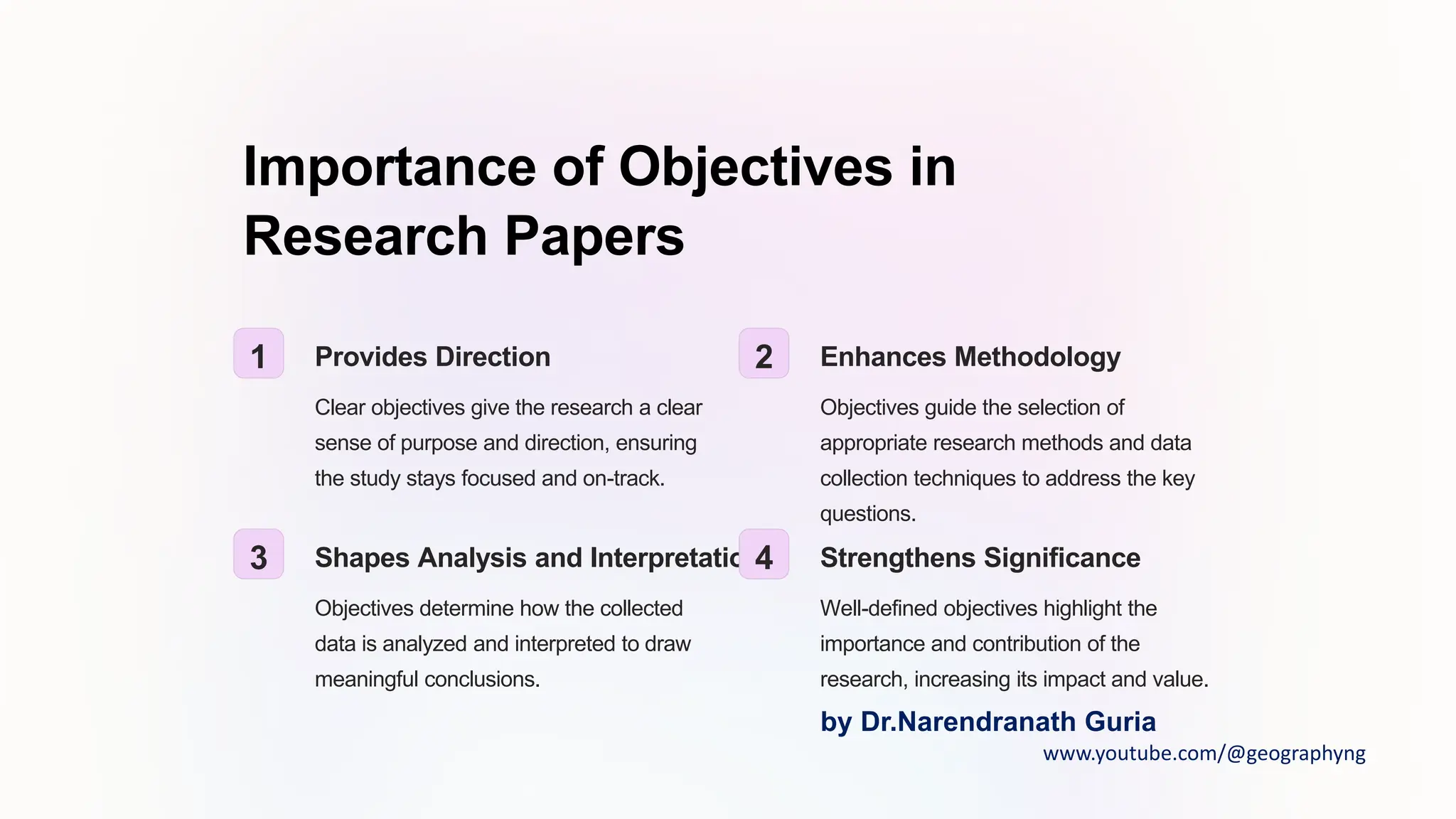
Importance of Objectives in
Research Papers
1 Provides Direction
Clear objectives give the research a clear
sense of purpose and direction, ensuring
the study stays focused and on-track.
2 Enhances Methodology
Objectives guide the selection of
appropriate research methods and data
collection techniques to address the key
questions.
3 Shapes Analysis and Interpretation
Objectives determine how the collected
data is analyzed and interpreted to draw
meaningful conclusions.
4 Strengthens Significance
Well-defined objectives highlight the
importance and contribution of the
research, increasing its impact and value.
by Dr.Narendranath Guria
www.youtube.com/@geographyng
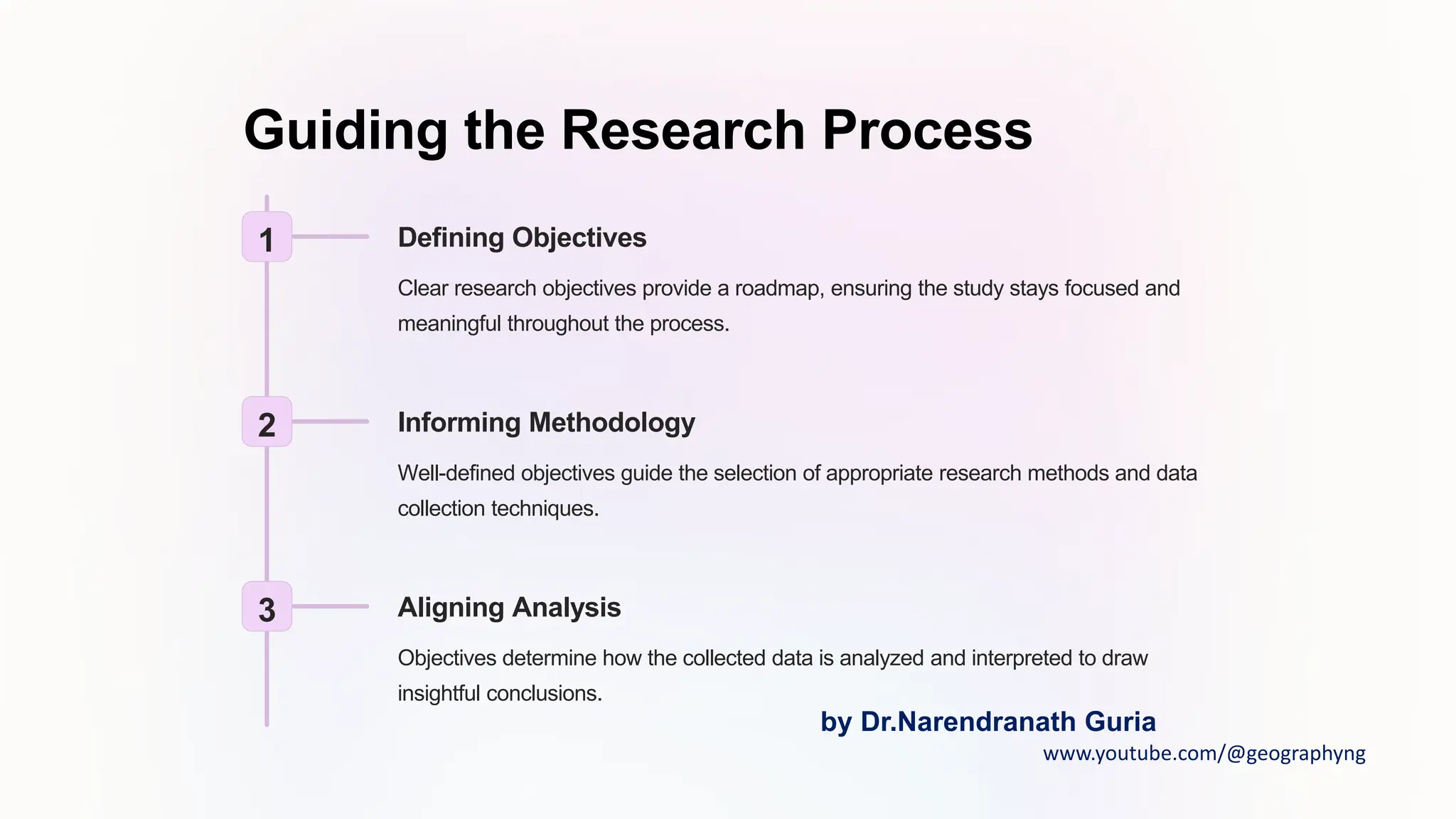
Guiding the Research Process
1 Defining Objectives
Clear research objectives provide a roadmap, ensuring the study stays focused and
meaningful throughout the process.
2 Informing Methodology
Well-defined objectives guide the selection of appropriate research methods and data
collection techniques.
3 Aligning Analysis
Objectives determine how the collected data is analyzed and interpreted to draw
insightful conclusions.
by Dr.Narendranath Guria
www.youtube.com/@geographyng
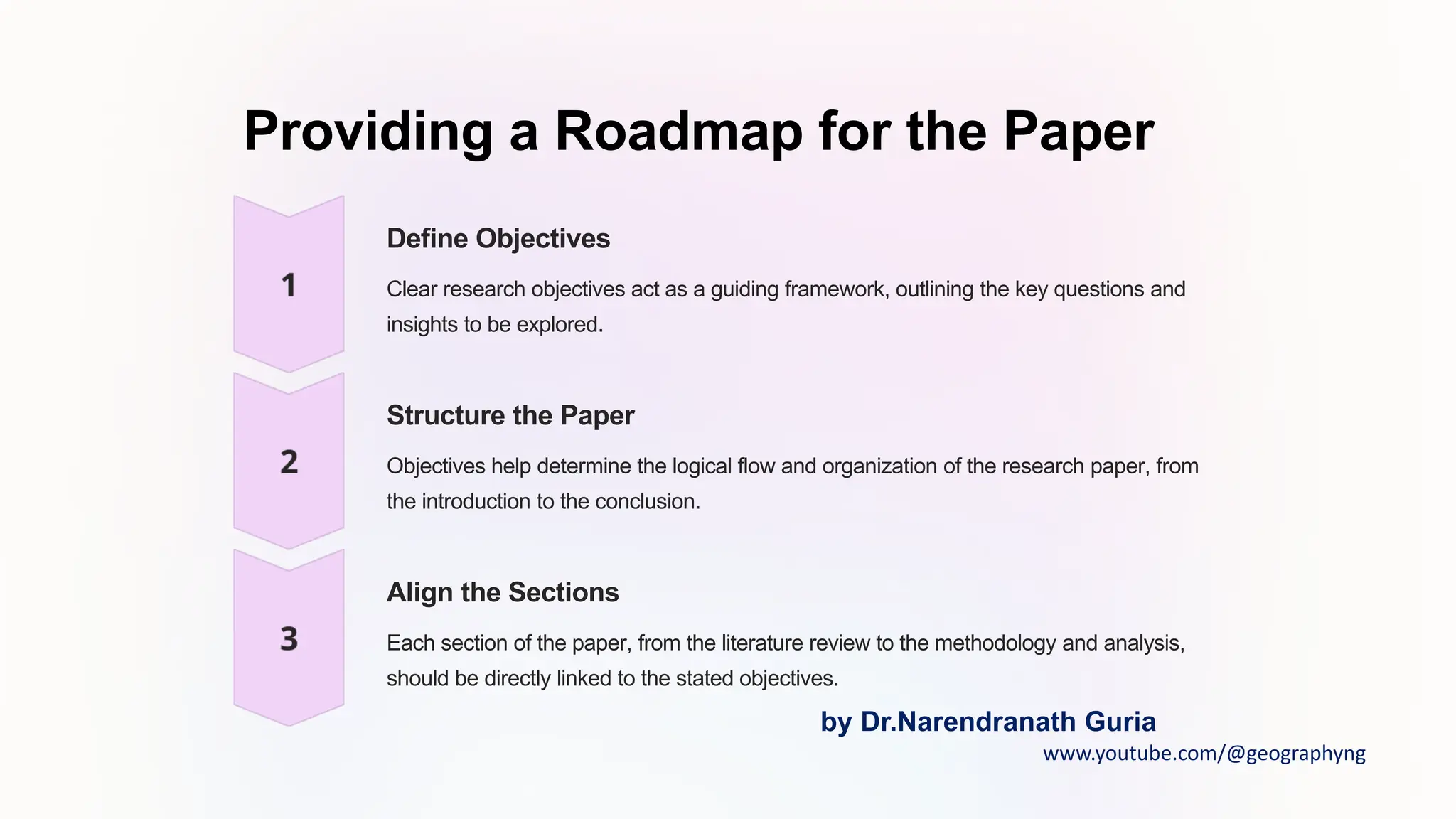
Providing a Roadmap for the Paper
Define Objectives
Clear research objectives act as a guiding framework, outlining the key questions and
insights to be explored.
Structure the Paper
Objectives help determine the logical flow and organization of the research paper, from
the introduction to the conclusion.
Align the Sections
Each section of the paper, from the literature review to the methodology and analysis,
should be directly linked to the stated objectives.
by Dr.Narendranath Guria
www.youtube.com/@geographyng
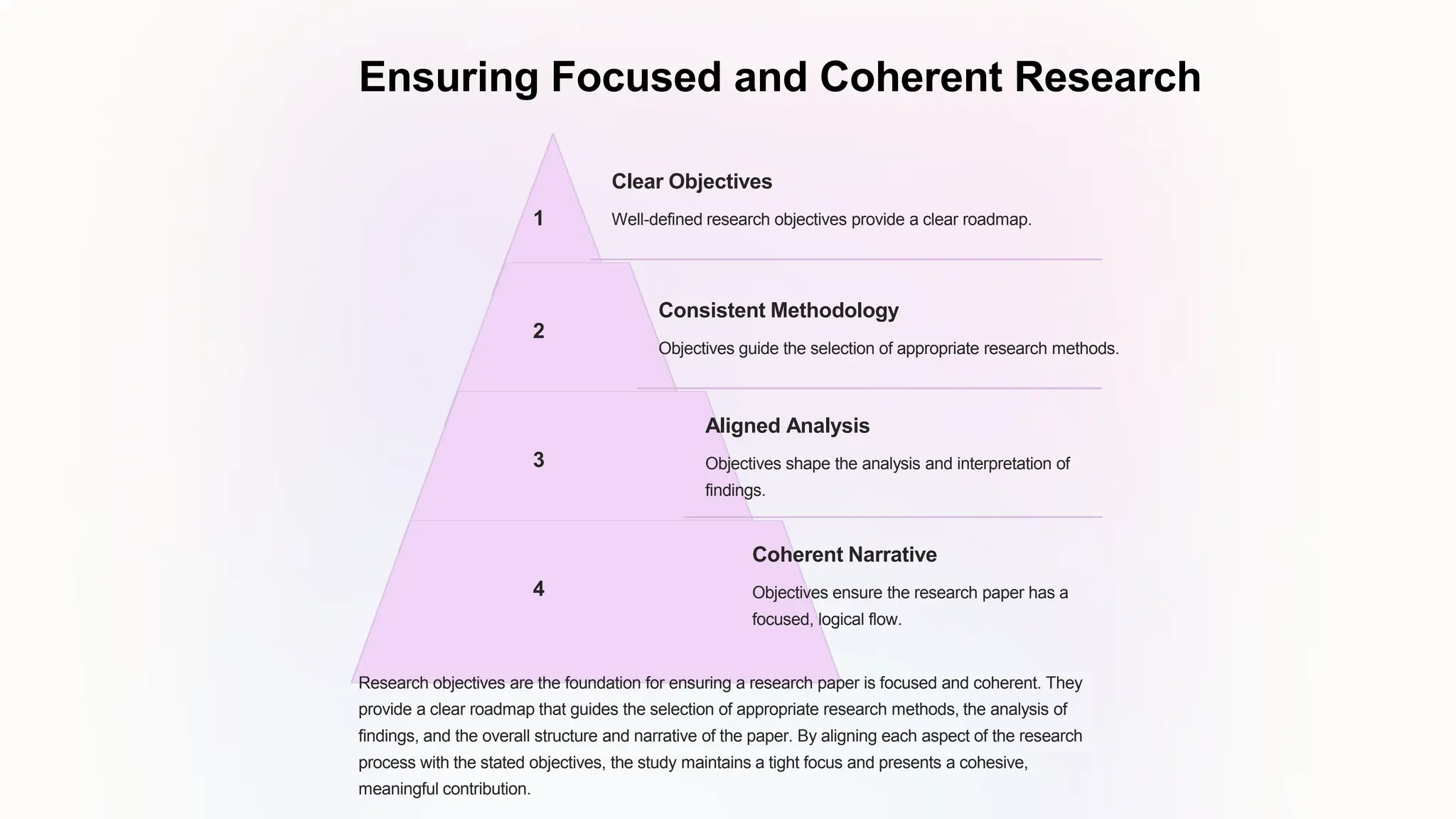
Ensuring Focused and Coherent Research
1
Clear Objectives
Well-defined research objectives provide a clear roadmap.
2
Consistent Methodology
Objectives guide the selection of appropriate research methods.
3
Aligned Analysis
Objectives shape the analysis and interpretation of
findings.
4
Coherent Narrative
Objectives ensure the research paper has a
focused, logical flow.
Research objectives are the foundation for ensuring a research paper is focused and coherent. They
provide a clear roadmap that guides the selection of appropriate research methods, the analysis of
findings, and the overall structure and narrative of the paper. By aligning each aspect of the research
process with the stated objectives, the study maintains a tight focus and presents a cohesive,
meaningful contribution.
Aligning Methodology and Analysis
with Objectives
Robust research objectives serve as a guiding light, ensuring the selected methodology and data
analysis techniques are tightly aligned with the core purpose of the study. This alignment is crucial for
deriving meaningful, impactful insights from the research.
By grounding the research process in well-defined objectives, the analysis and interpretation of findings
can be tailored to directly address the key questions and hypotheses outlined at the start.
by Dr.Narendranath Guria
www.youtube.com/@geographyng
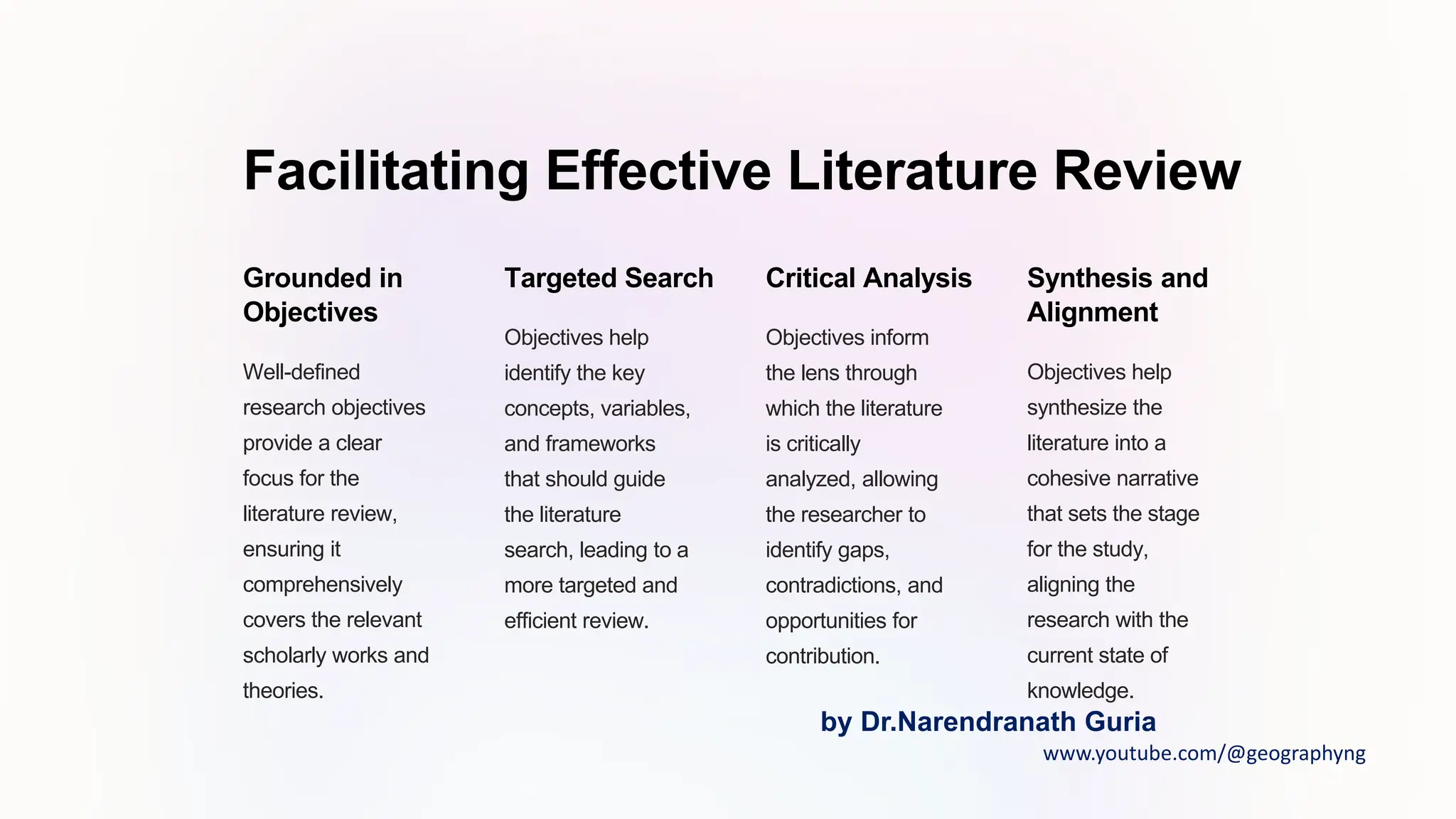
Facilitating Effective Literature Review
Grounded in
Objectives
Well-defined
research objectives
provide a clear
focus for the
literature review,
ensuring it
comprehensively
covers the relevant
scholarly works and
theories.
Targeted Search
Objectives help
identify the key
concepts, variables,
and frameworks
that should guide
the literature
search, leading to a
more targeted and
efficient review.
Critical Analysis
Objectives inform
the lens through
which the literature
is critically
analyzed, allowing
the researcher to
identify gaps,
contradictions, and
opportunities for
contribution.
Synthesis and
Alignment
Objectives help
synthesize the
literature into a
cohesive narrative
that sets the stage
for the study,
aligning the
research with the
current state of
knowledge.
by Dr.Narendranath Guria
www.youtube.com/@geographyng
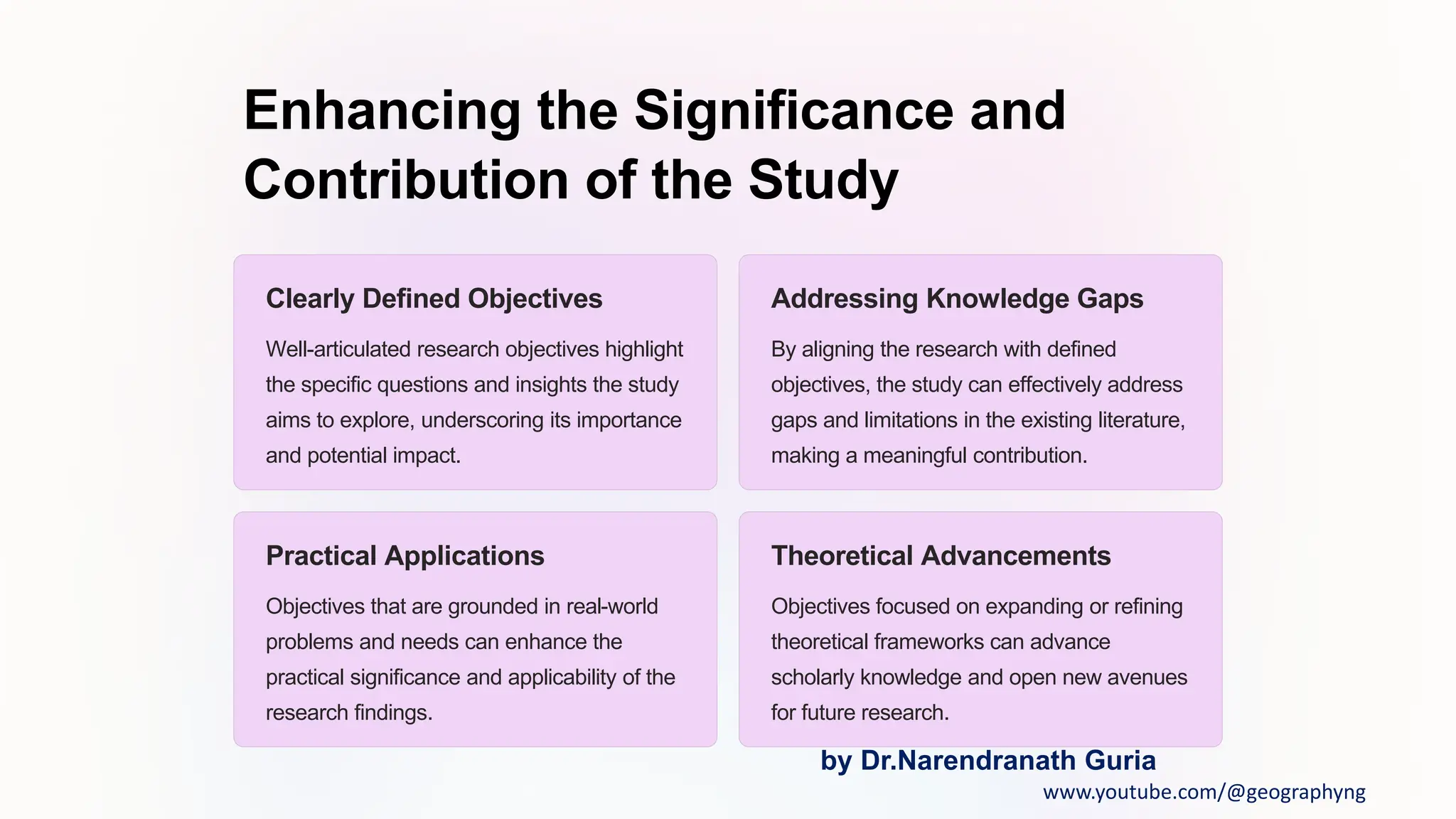
Enhancing the Significance and
Contribution of the Study
Clearly Defined Objectives
Well-articulated research objectives highlight
the specific questions and insights the study
aims to explore, underscoring its importance
and potential impact.
Addressing Knowledge Gaps
By aligning the research with defined
objectives, the study can effectively address
gaps and limitations in the existing literature,
making a meaningful contribution.
Practical Applications
Objectives that are grounded in real-world
problems and needs can enhance the
practical significance and applicability of the
research findings.
Theoretical Advancements
Objectives focused on expanding or refining
theoretical frameworks can advance
scholarly knowledge and open new avenues
for future research.
by Dr.Narendranath Guria
www.youtube.com/@geographyng
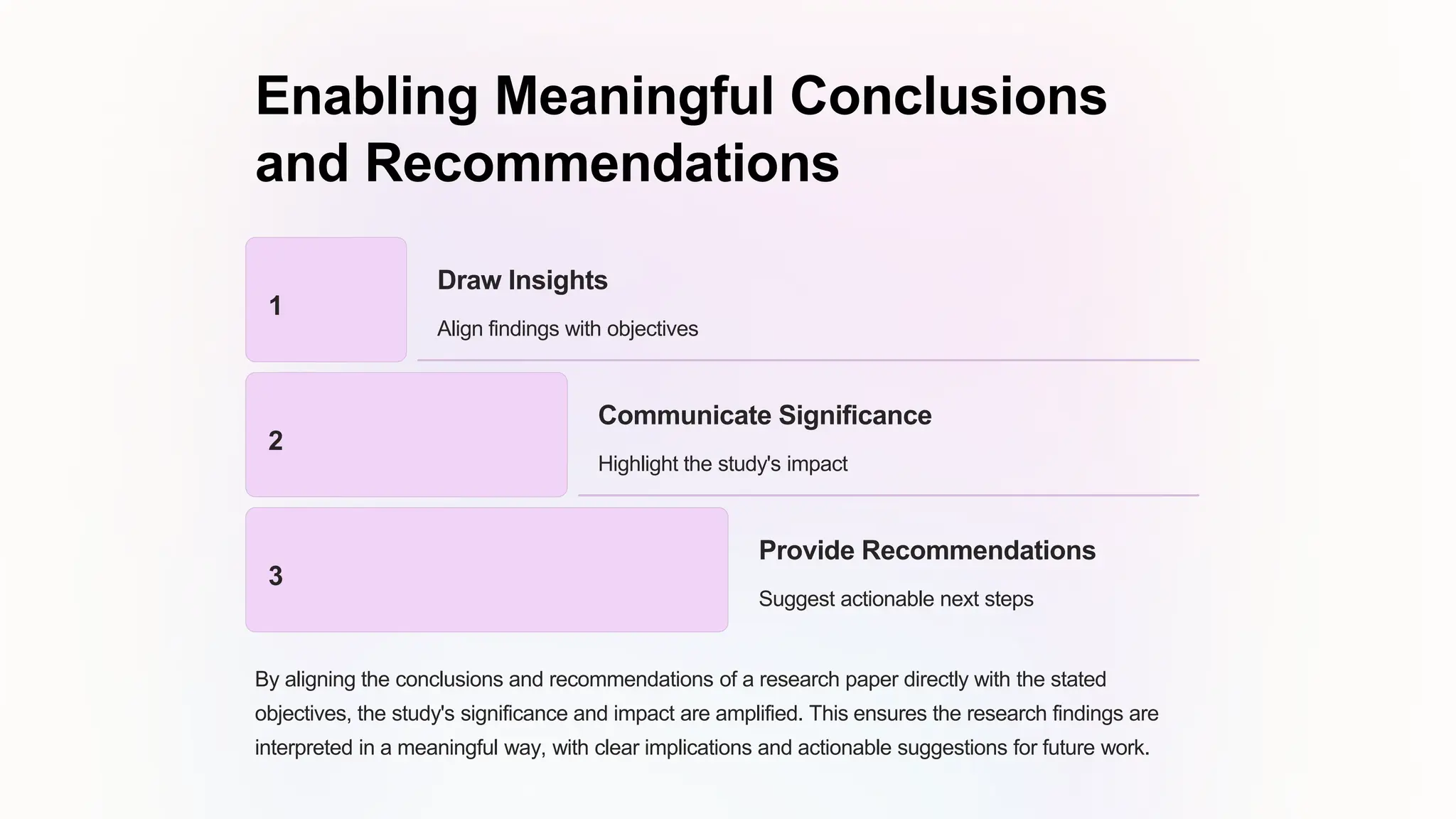
Enabling Meaningful Conclusions
and Recommendations
1
Draw Insights
Align findings with objectives
2
Communicate Significance
Highlight the study's impact
3
Provide Recommendations
Suggest actionable next steps
By aligning the conclusions and recommendations of a research paper directly with the stated
objectives, the study's significance and impact are amplified. This ensures the research findings are
interpreted in a meaningful way, with clear implications and actionable suggestions for future work.
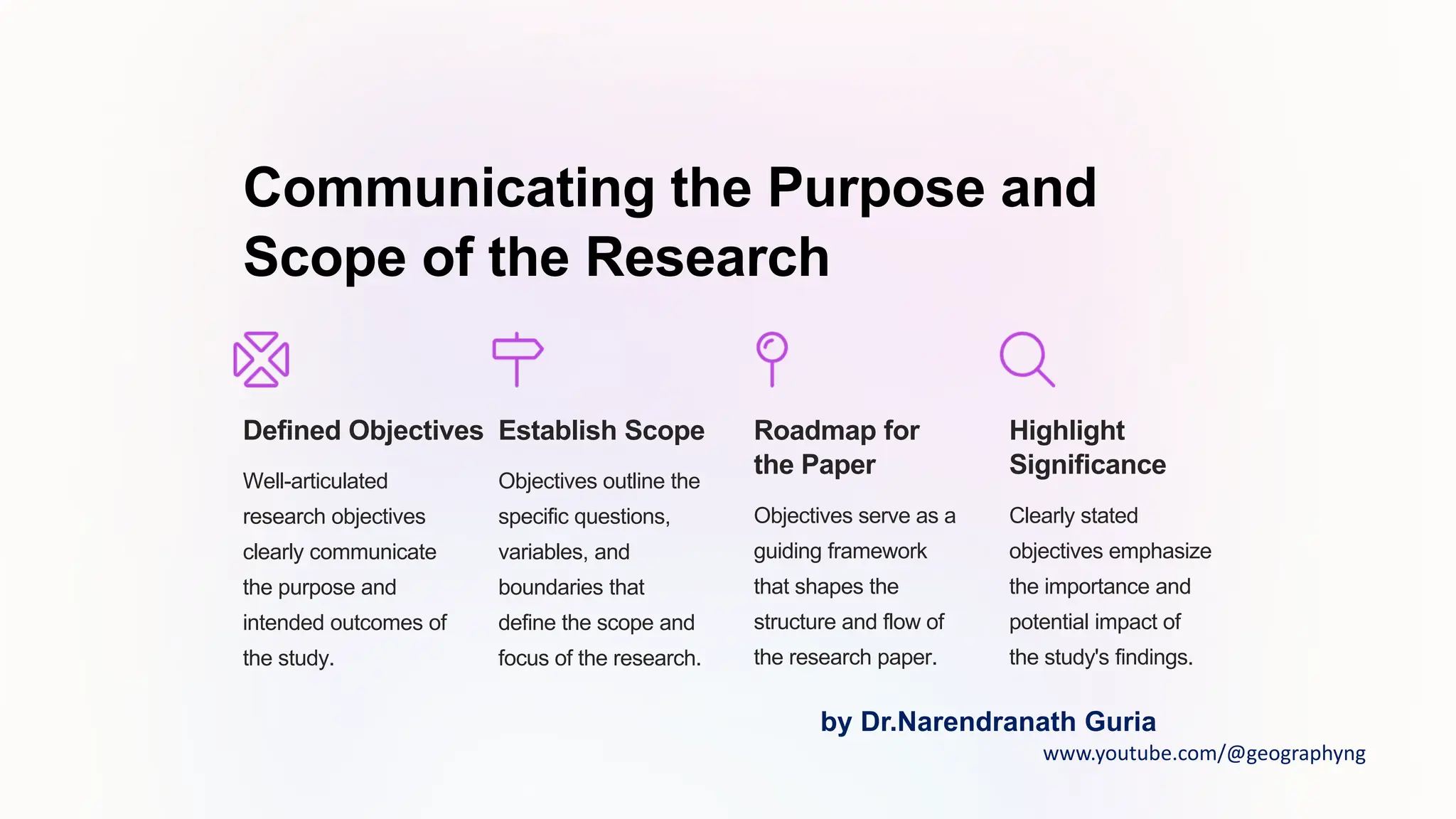
Communicating the Purpose and
Scope of the Research
Defined Objectives
Well-articulated
research objectives
clearly communicate
the purpose and
intended outcomes of
the study.
Establish Scope
Objectives outline the
specific questions,
variables, and
boundaries that
define the scope and
focus of the research.
Roadmap for
the Paper
Objectives serve as a
guiding framework
that shapes the
structure and flow of
the research paper.
Highlight
Significance
Clearly stated
objectives emphasize
the importance and
potential impact of
the study's findings.
by Dr.Narendranath Guria
www.youtube.com/@geographyng
Improving the Overall Quality and
Impact of the Paper
Well-defined research objectives are the foundation for enhancing the overall quality and impact of a
research paper. They provide a clear framework that guides every aspect of the study, from the
literature review to the methodology and analysis.
By aligning the paper's structure, content, and conclusions with the stated objectives, the research can
make a more significant and meaningful contribution to the field. This ensures the study is focused,
coherent, and impactful, ultimately improving its chances of being accepted and having a lasting
influence.
by Dr.Narendranath Guria
www.youtube.com/@geographyng
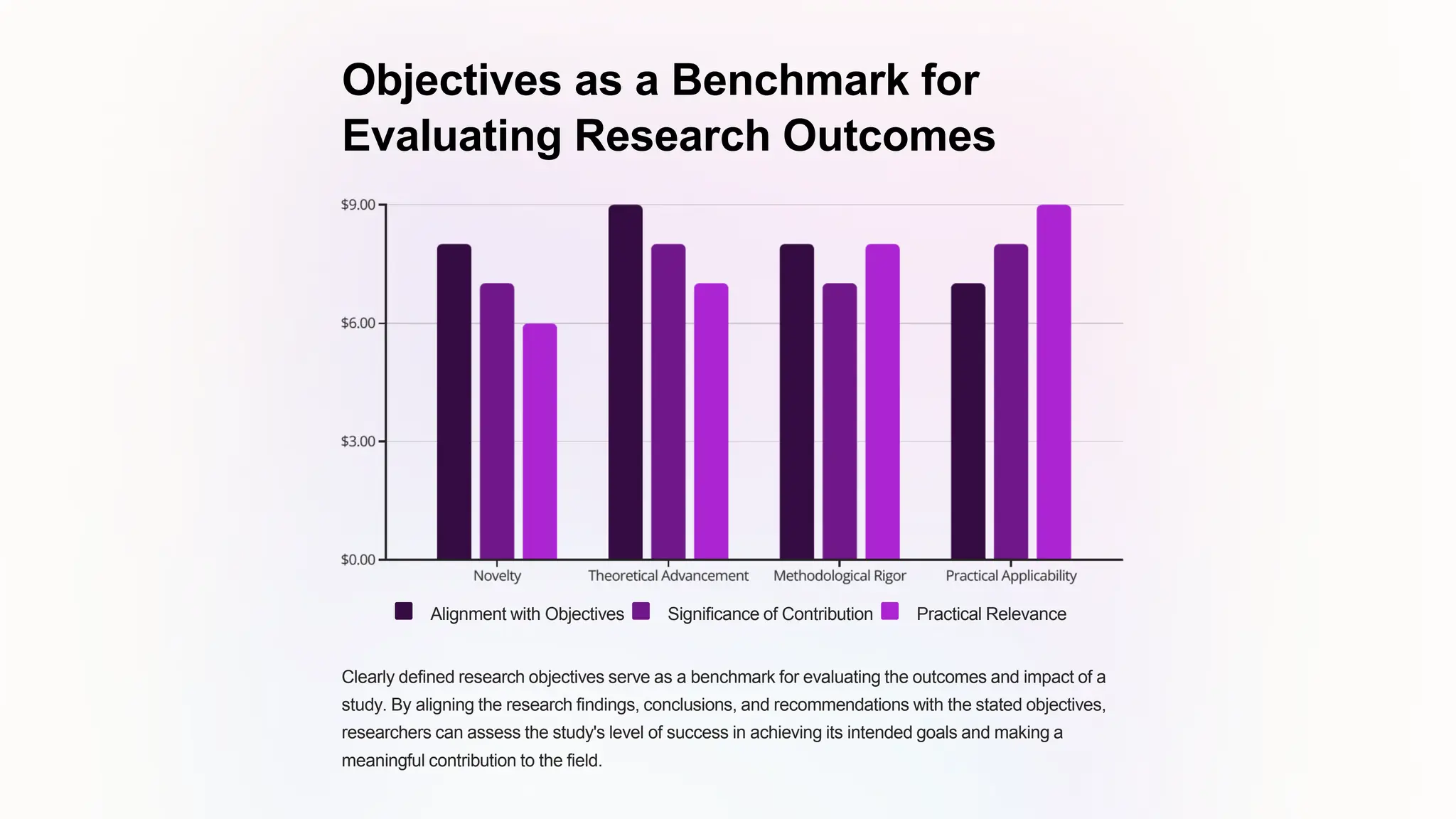
Objectives as a Benchmark for
Evaluating Research Outcomes
Alignment with Objectives Significance of Contribution Practical Relevance
Clearly defined research objectives serve as a benchmark for evaluating the outcomes and impact of a
study. By aligning the research findings, conclusions, and recommendations with the stated objectives,
researchers can assess the study's level of success in achieving its intended goals and making a
meaningful contribution to the field.
Conclusion: The Pivotal Role of
Objectives in Research Papers
Research objectives are the cornerstone of a successful research paper. They guide the entire
research process, from the literature review to the methodology, analysis, and conclusions. Clearly
defined objectives ensure the study remains focused, coherent, and impactful.
1. Objectives provide a clear roadmap, directing the researcher's efforts towards meaningful, targeted insights.
2. They align the various components of the paper, fostering a cohesive narrative that effectively
communicates the study's significance.
3. By grounding the research in well-crafted objectives, the paper can make a substantial
contribution to the field, advancing theoretical knowledge or informing real-world applications.
by Dr.Narendranath Guria
www.youtube.com/@geographyng
Introduction to the
Importance of Research Gap
Understanding the research gap is crucial in academic and scientific endeavors. It helps identify
unexplored areas, refine research questions, and contribute novel insights to a field of study.
Recognizing and addressing the research gap is a fundamental step in producing meaningful, impactful
research and strong thesis arguments.
@GeographyNG by Dr.Narendranath Guria
www.youtube.com/@geographyng
Understanding the
Research Gap
The research gap refers to the areas within a field of study that have not
been adequately investigated or explored. It represents the missing pieces of
knowledge that researchers can uncover through their work. Understanding
the research gap is crucial as it guides the focus and direction of future
research efforts, ultimately leading to advancements in the field.
@GeographyNG by Dr.Narendranath Guria
www.youtube.com/@geographyng
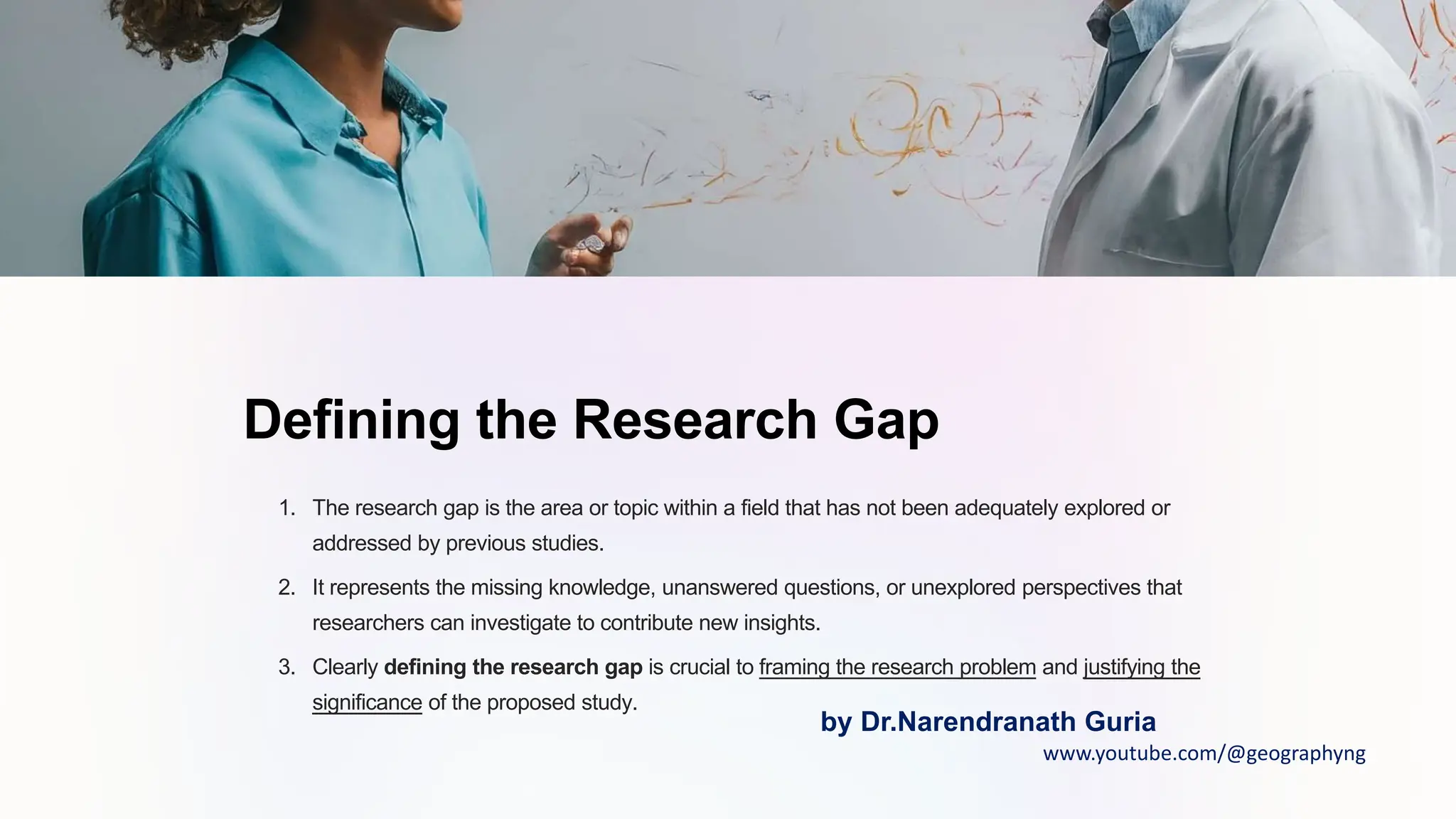
Defining the Research Gap
1. The research gap is the area or topic within a field that has not been adequately explored or
addressed by previous studies.
2. It represents the missing knowledge, unanswered questions, or unexplored perspectives that
researchers can investigate to contribute new insights.
3. Clearly defining the research gap is crucial to framing the research problem and justifying the
significance of the proposed study.
by Dr.Narendranath Guria
www.youtube.com/@geographyng
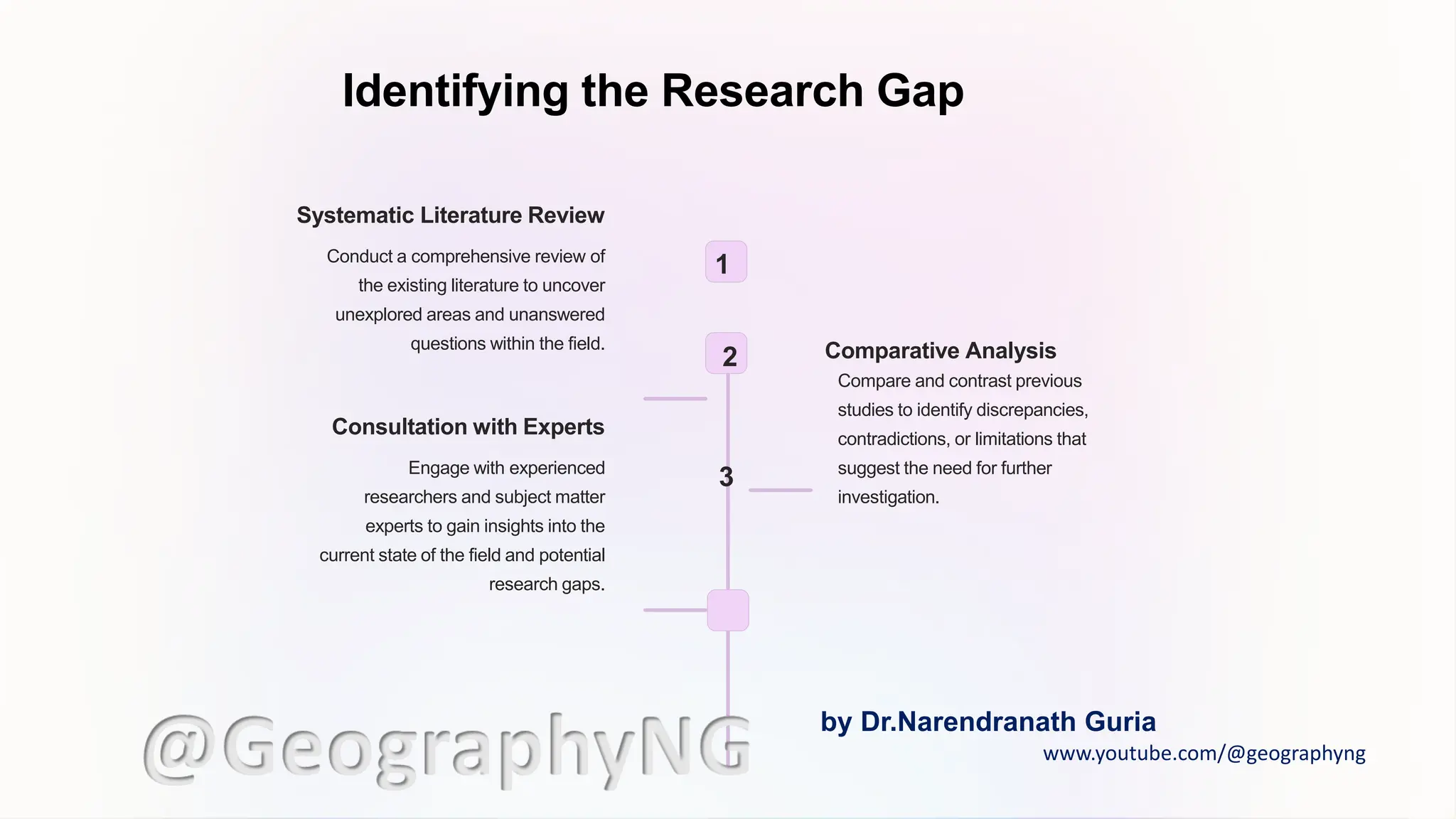
Identifying the Research Gap
1
Systematic Literature Review
Conduct a comprehensive review of
the existing literature to uncover
unexplored areas and unanswered
questions within the field.
2 Comparative Analysis
Compare and contrast previous
studies to identify discrepancies,
contradictions, or limitations that
suggest the need for further
investigation.
3
Consultation with Experts
Engage with experienced
researchers and subject matter
experts to gain insights into the
current state of the field and potential
research gaps.
@GeographyNG by Dr.Narendranath Guria
www.youtube.com/@geographyng
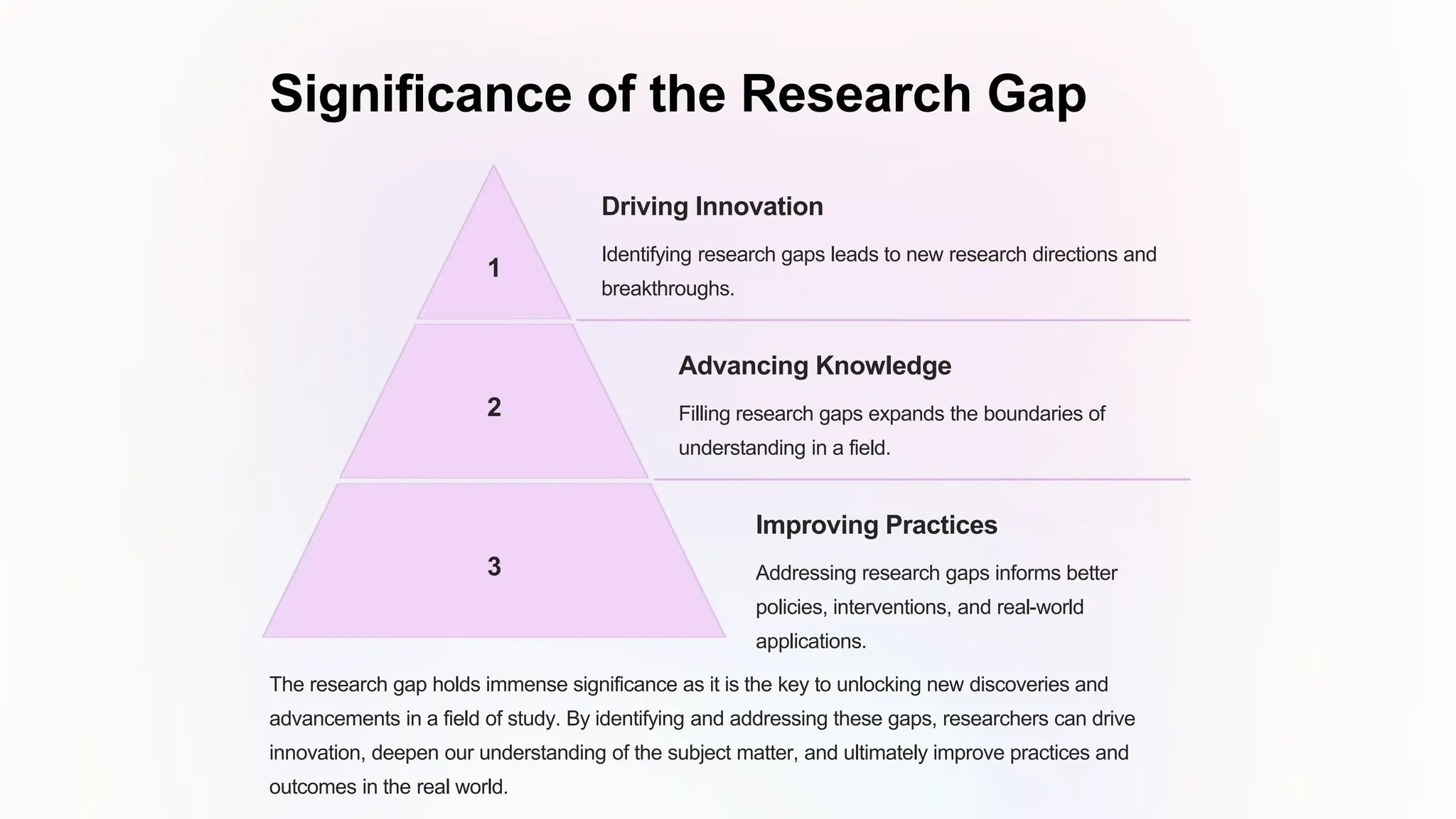
Significance of the Research Gap
1
Driving Innovation
Identifying research gaps leads to new research directions and
breakthroughs.
2
Advancing Knowledge
Filling research gaps expands the boundaries of
understanding in a field.
3
Improving Practices
Addressing research gaps informs better
policies, interventions, and real-world
applications.
The research gap holds immense significance as it is the key to unlocking new discoveries and
advancements in a field of study. By identifying and addressing these gaps, researchers can drive
innovation, deepen our understanding of the subject matter, and ultimately improve practices and
outcomes in the real world.
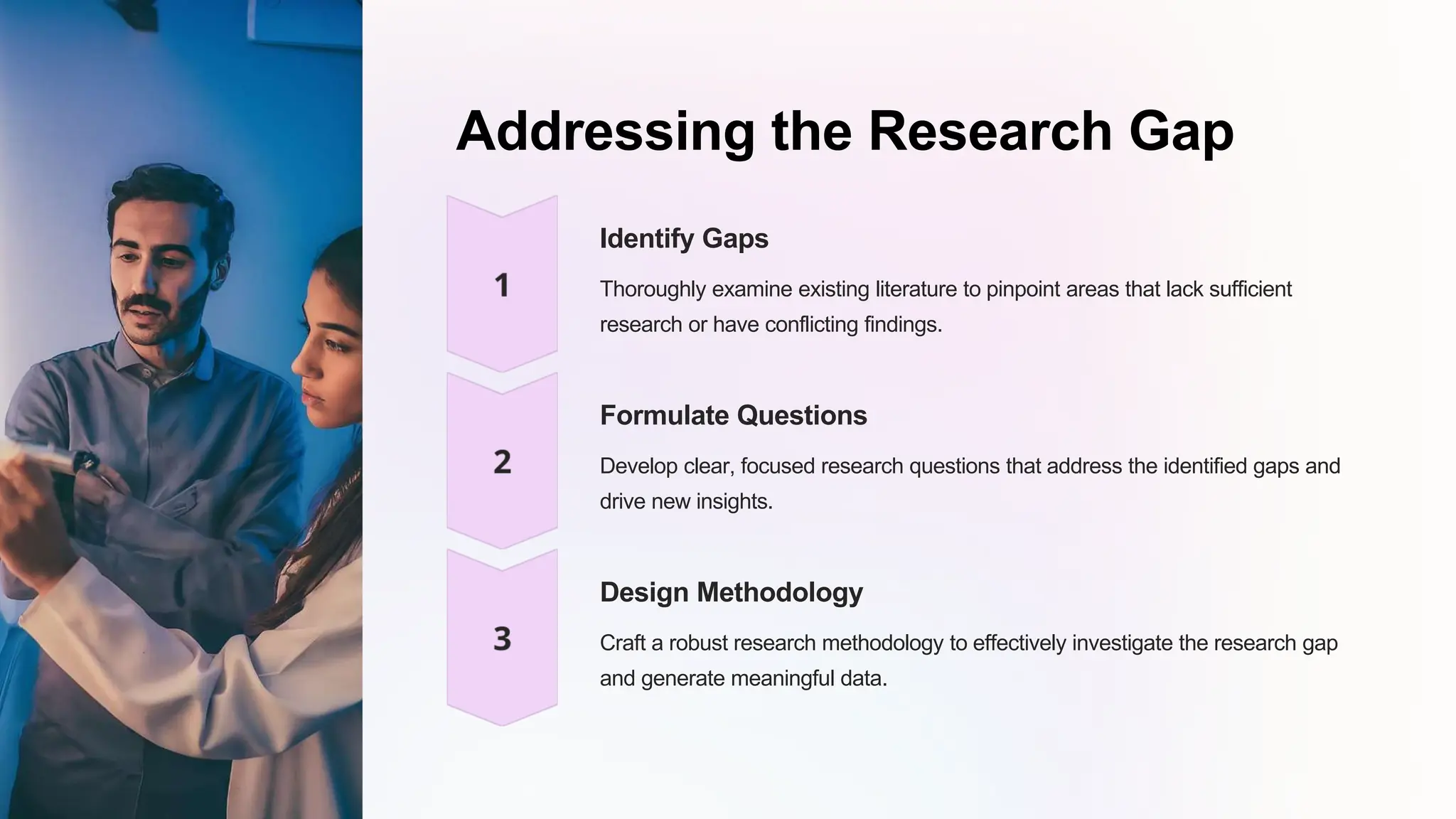
Addressing the Research Gap
Identify Gaps
Thoroughly examine existing literature to pinpoint areas that lack sufficient
research or have conflicting findings.
Formulate Questions
Develop clear, focused research questions that address the identified gaps and
drive new insights.
Design Methodology
Craft a robust research methodology to effectively investigate the research gap
and generate meaningful data.
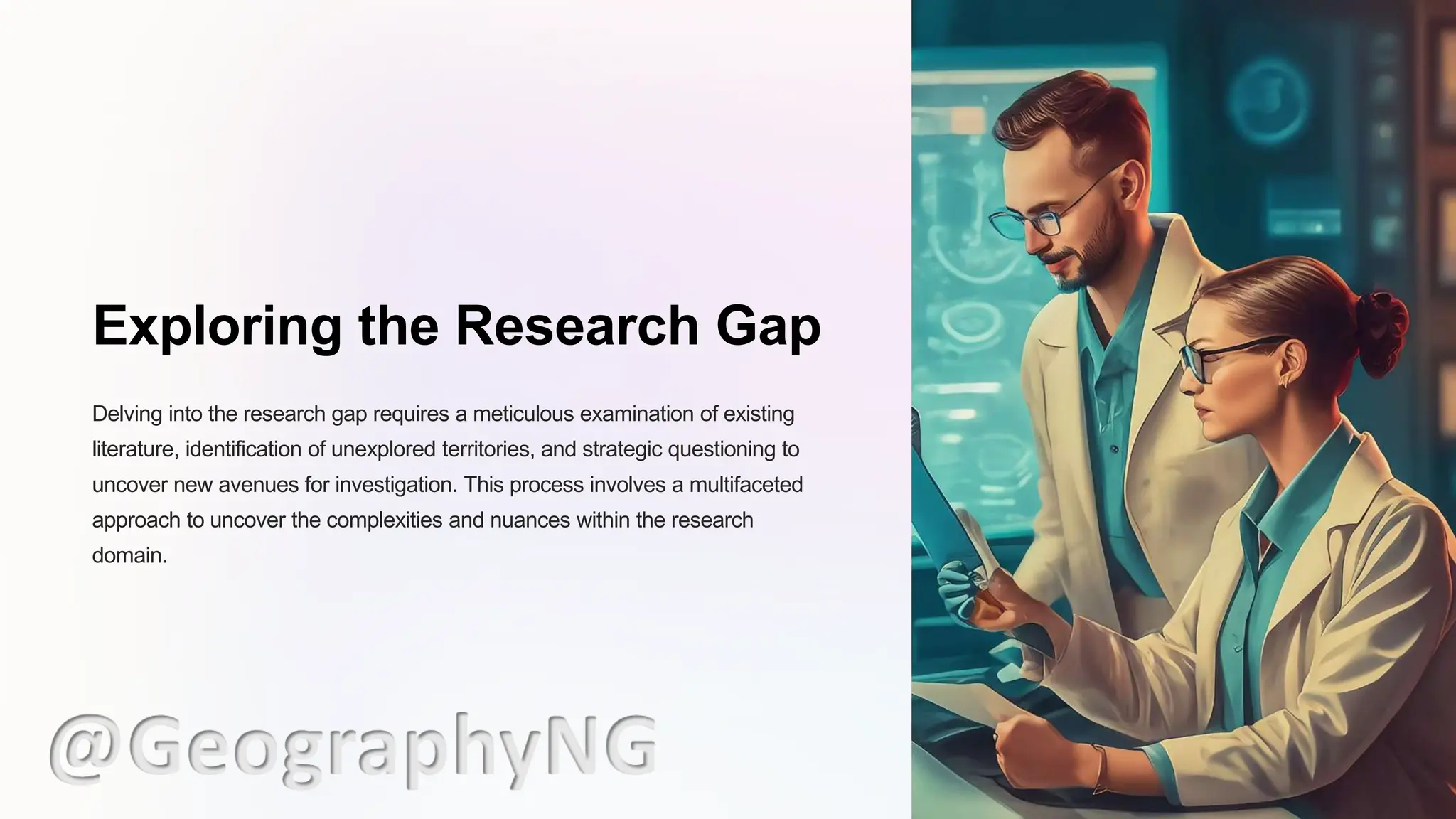
Exploring the Research Gap
Delving into the research gap requires a meticulous examination of existing
literature, identification of unexplored territories, and strategic questioning to
uncover new avenues for investigation. This process involves a multifaceted
approach to uncover the complexities and nuances within the research
domain.
@GeographyNG
Importance of the Research Gap in
Research/Thesis
1 Driving Novel Contributions
Identifying and addressing research gaps
enables researchers to make unique,
impactful contributions that advance the
field.
2 Strengthening Thesis Arguments
Clearly defining and situating the
research gap within the existing literature
bolsters the rationale and significance of
a thesis.
3 Informing Future Directions
Exploring research gaps uncovers new
avenues for investigation, guiding the
direction of future research endeavors.
4 Fostering Deeper Understanding
Filling research gaps deepens our
collective understanding of the topic,
leading to more comprehensive and
insightful findings.
Benefits of Addressing the Research Gap
Advancing Knowledge
Filling research gaps expands the
boundaries of understanding in a field,
leading to groundbreaking insights.
Driving Innovation
Identifying and exploring unexplored
research areas inspires new ideas,
solutions, and technological advancements.
Informing Better Practices
Addressing research gaps can lead to more
effective policies, interventions, and real-
world applications.
Enhancing Academic Impact
Tackling research gaps produces impactful,
highly cited work that elevates a
researcher's academic standing.
@GeographyNG by Dr.Narendranath Guria
www.youtube.com/@geographyng
Challenges in Identifying the
Research Gap
Overcoming
Preconception
s
Researchers can
be biased by their
own assumptions
or the prevailing
views in the field,
making it difficult to
objectively identify
unexplored areas.
Accessing
Comprehensiv
e Data
Thoroughly
reviewing the
existing literature to
uncover research
gaps can be a
daunting task,
especially in rapidly
evolving fields with
vast amounts of
information.
Maintaining
Objectivity
Remaining impartial
and resisting the
temptation to fit
findings into a
predetermined
narrative is crucial
for accurately
identifying research
gaps.
Interdisciplina
ry Barriers
Bridging knowledge
across different
disciplines can be
challenging, making
it difficult to
recognize research
gaps that span
multiple fields.
by Dr.Narendranath Guria
www.youtube.com/@geographyng
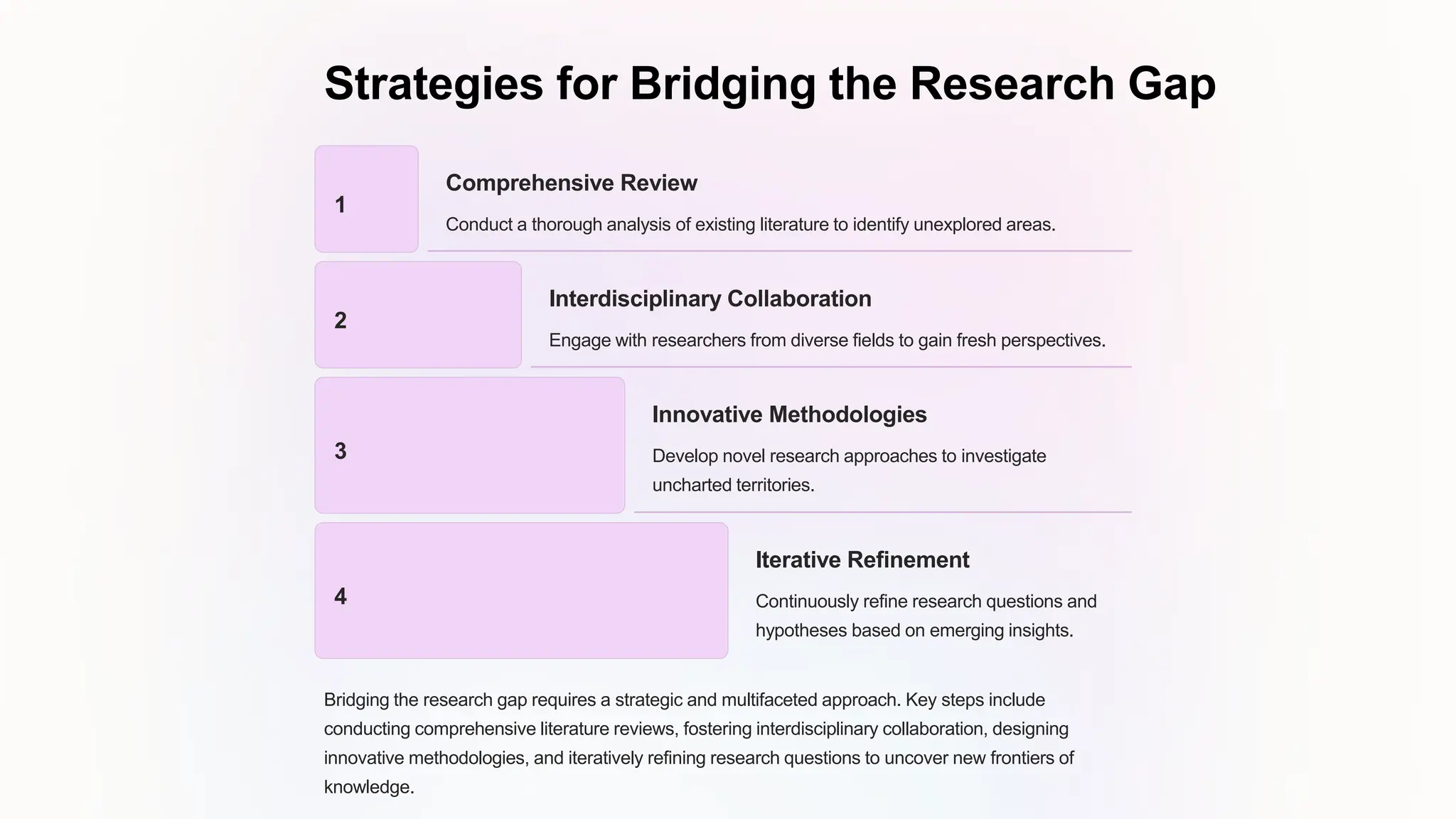
Strategies for Bridging the Research Gap
1
Comprehensive Review
Conduct a thorough analysis of existing literature to identify unexplored areas.
2
Interdisciplinary Collaboration
Engage with researchers from diverse fields to gain fresh perspectives.
3
Innovative Methodologies
Develop novel research approaches to investigate
uncharted territories.
4
Iterative Refinement
Continuously refine research questions and
hypotheses based on emerging insights.
Bridging the research gap requires a strategic and multifaceted approach. Key steps include
conducting comprehensive literature reviews, fostering interdisciplinary collaboration, designing
innovative methodologies, and iteratively refining research questions to uncover new frontiers of
knowledge.
Impact of the Research Gap on Research and
Thesis
The research gap has a profound impact on the research process and the development of a robust
thesis. By identifying and addressing the gaps in existing knowledge, researchers can drive novel
insights that advance the field, strengthen the rationale and significance of their thesis, and inspire
future research endeavors.
@GeographyNG by Dr.Narendranath Guria
www.youtube.com/@geographyng
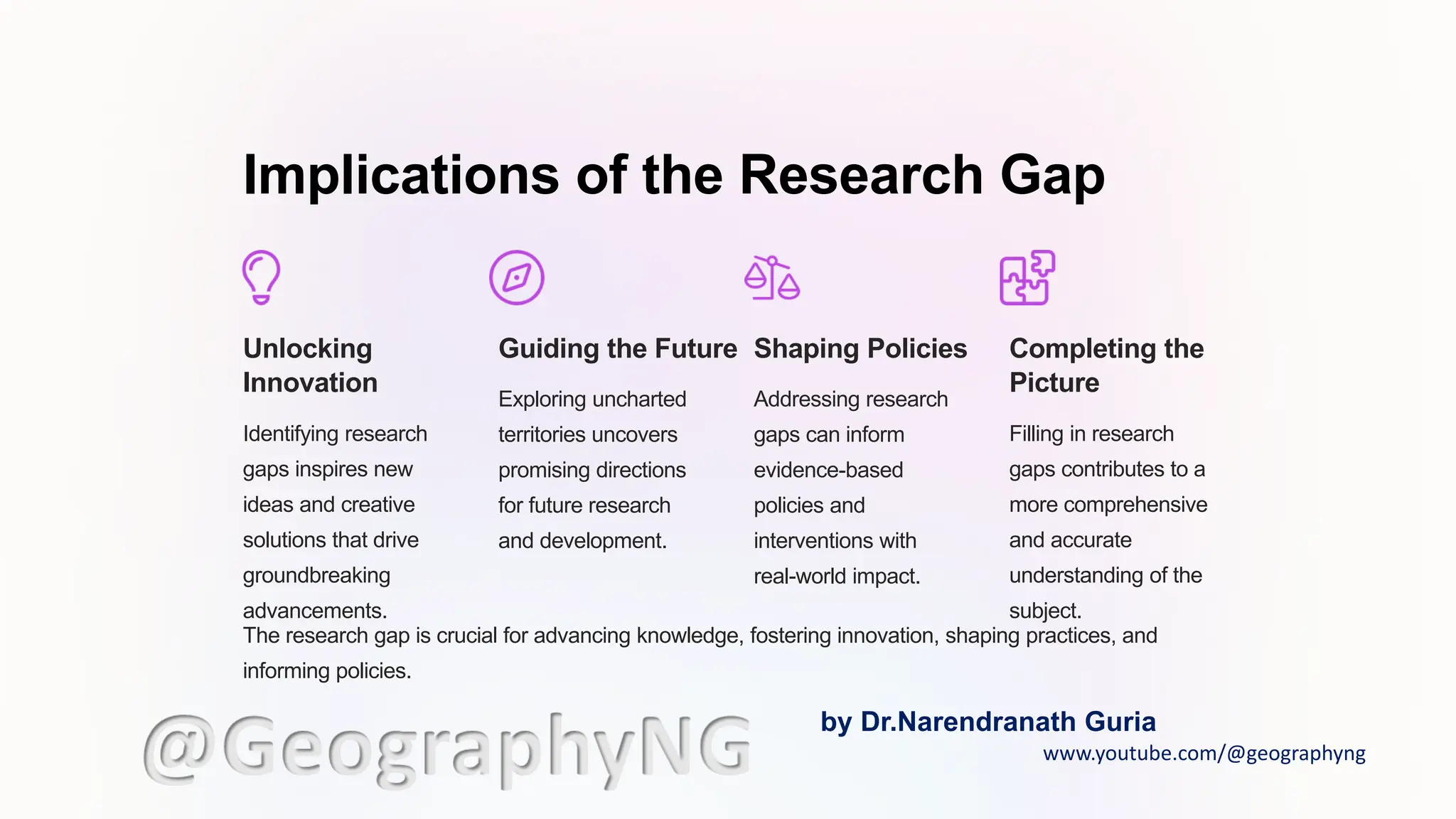
Implications of the Research Gap
Unlocking
Innovation
Identifying research
gaps inspires new
ideas and creative
solutions that drive
groundbreaking
advancements.
Guiding the Future
Exploring uncharted
territories uncovers
promising directions
for future research
and development.
Shaping Policies
Addressing research
gaps can inform
evidence-based
policies and
interventions with
real-world impact.
Completing the
Picture
Filling in research
gaps contributes to a
more comprehensive
and accurate
understanding of the
subject.
The research gap is crucial for advancing knowledge, fostering innovation, shaping practices, and
informing policies.
@GeographyNG by Dr.Narendranath Guria
www.youtube.com/@geographyng
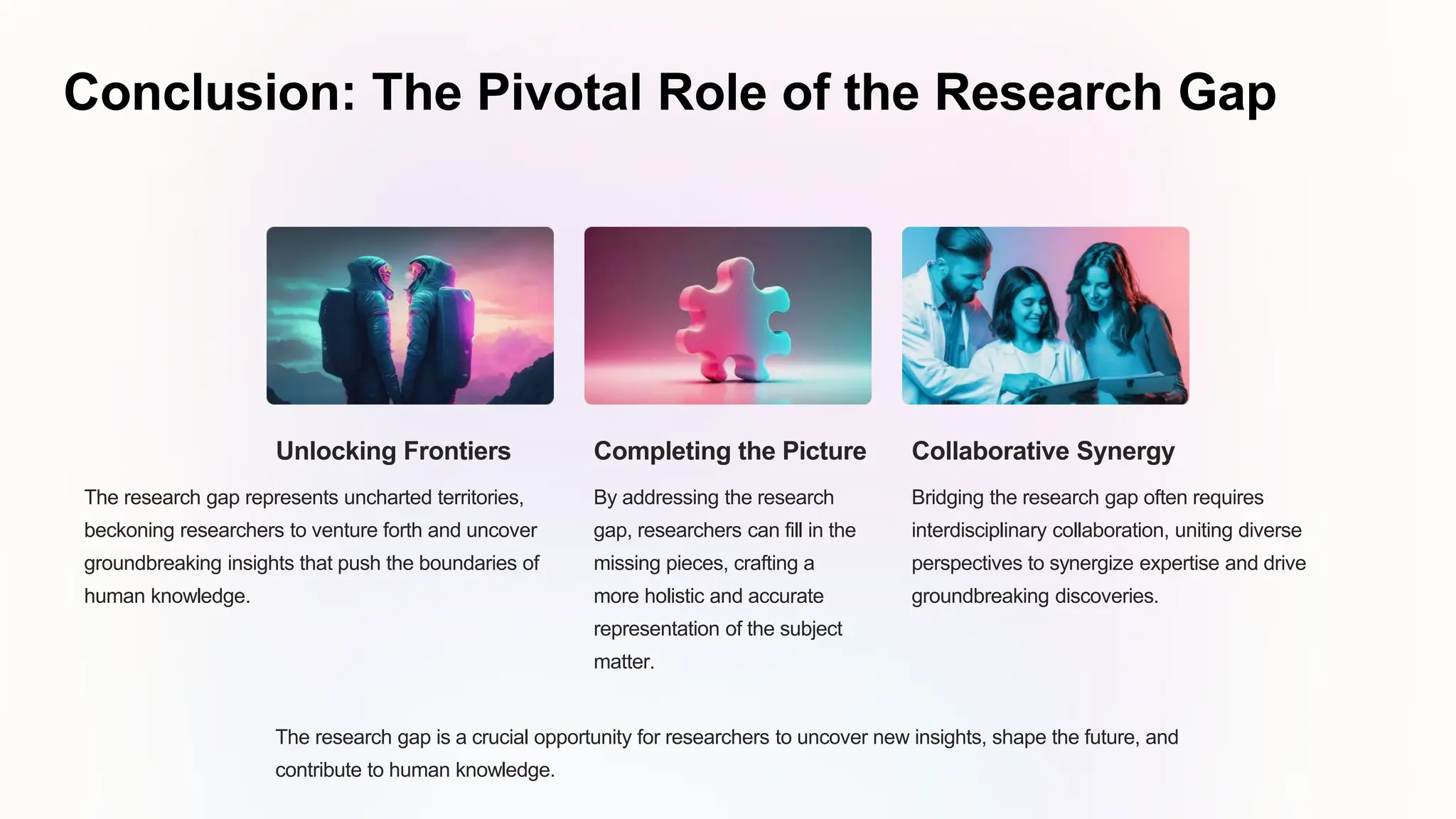
Conclusion: The Pivotal Role of the Research Gap
Unlocking Frontiers
The research gap represents uncharted territories,
beckoning researchers to venture forth and uncover
groundbreaking insights that push the boundaries of
human knowledge.
Completing the Picture
By addressing the research
gap, researchers can fill in the
missing pieces, crafting a
more holistic and accurate
representation of the subject
matter.
Collaborative Synergy
Bridging the research gap often requires
interdisciplinary collaboration, uniting diverse
perspectives to synergize expertise and drive
groundbreaking discoveries.
The research gap is a crucial opportunity for researchers to uncover new insights, shape the future, and
contribute to human knowledge.
Exploring Qualitative
Research Methods
Qualitative research methods offer a deep, nuanced understanding of
complex human experiences and behaviors. These diverse approaches
provide invaluable insights for fields ranging from anthropology to ethics.
by Dr.Narendranath Guria
www.youtube.com/@geographyng
Anthropological Approach
1 Cultural Immersion
Anthropologists embed
themselves in
communities to gain
firsthand understanding
of customs, beliefs, and
social dynamics.
2 Holistic Perspective
This method examines
the interconnectedness
of various cultural
elements, revealing the
bigger picture.
3 Emic Viewpoint
Anthropologists strive to
understand phenomena
from the perspective of
the people being
studied.
by Dr.Narendranath Guria
www.youtube.com/@geographyng
Ethical Inquiry
Normative Ethics
Examines the moral principles
that guide human behavior
and the rightness or
wrongness of actions.
Applied Ethics
Focuses on the practical
application of ethical
principles to real-world
situations and decision-
making.
Metaethics
Investigates the fundamental
nature of moral judgments,
the meaning of moral terms,
and the justification of moral
beliefs.
by Dr.Narendranath Guria
www.youtube.com/@geographyng
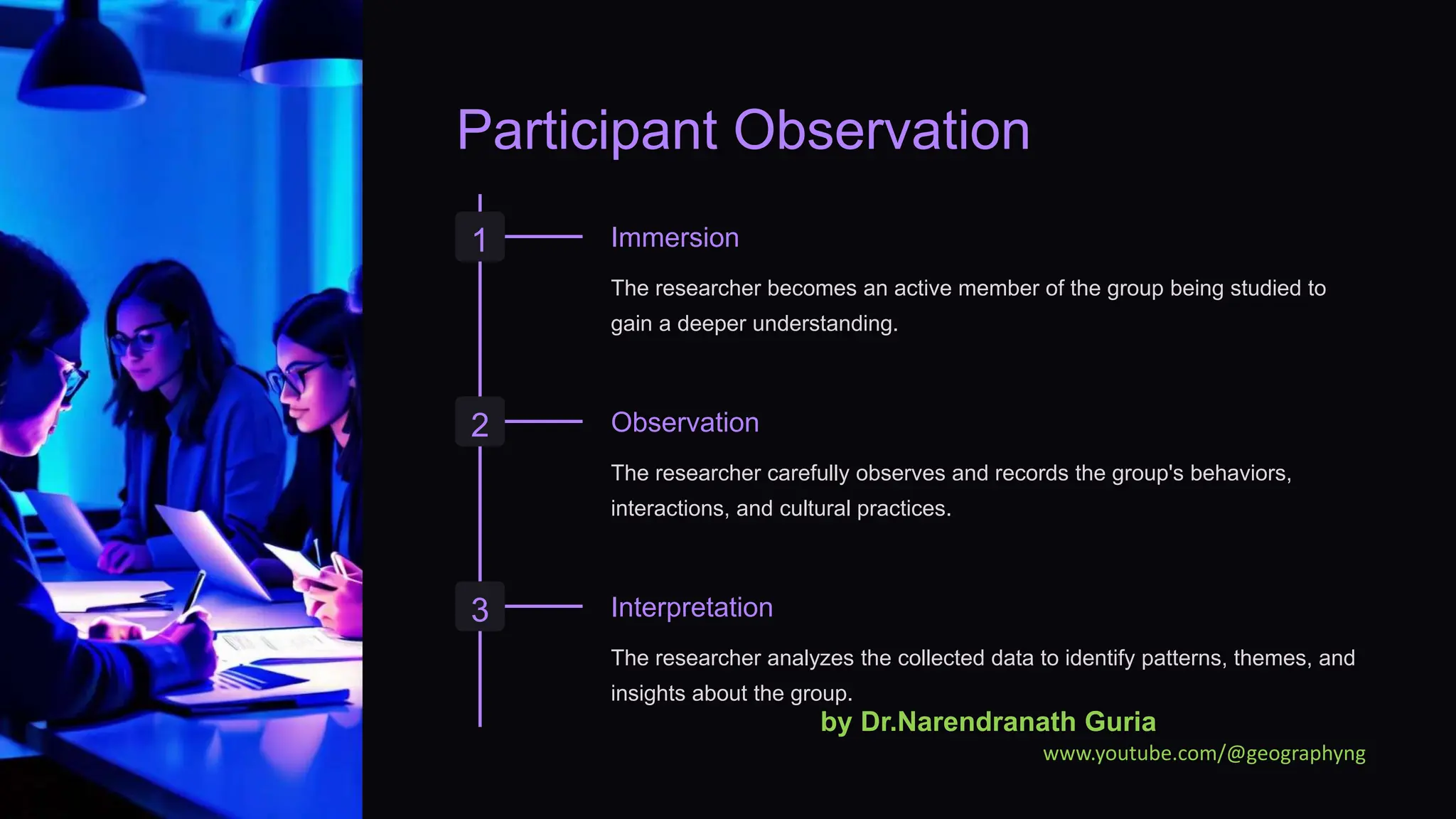
Participant Observation
1 Immersion
The researcher becomes an active member of the group being studied to
gain a deeper understanding.
2 Observation
The researcher carefully observes and records the group's behaviors,
interactions, and cultural practices.
3 Interpretation
The researcher analyzes the collected data to identify patterns, themes, and
insights about the group.
by Dr.Narendranath Guria
www.youtube.com/@geographyng
Face-to-Face Interviews
Dialogue
Allows for open-
ended, in-depth
conversations to
explore complex
topics and gain rich,
contextual data.
Rapport
The personal
interaction facilitates a
deeper understanding
of participants'
perspectives and
experiences.
Interpretation
Researchers can
analyze verbal and
non-verbal cues to
uncover underlying
meaning and nuance.
Flexibility
Interviews can be
adapted and tailored
to the unique needs
and characteristics of
each participant.
by Dr.Narendranath Guria
www.youtube.com/@geographyng
The Power of Quantitative Research
Quantitative research is a powerful tool for collecting and analyzing numerical data to gain insights and make informed
decisions. By studying samples, researchers can uncover trends, test hypotheses, and make generalizations about larger
populations.
by Dr.Narendranath Guria
www.youtube.com/@geographyng
Answering Numerical Questions
Quantitative research excels at answering questions that can be expressed numerically. For example,
researchers can determine the percentage of minority teachers, the gender ratio in college mathematics,
or trends in high school graduation rates.
by Dr.Narendranath Guria
www.youtube.com/@geographyng
Exploring Non-Numerical Topics
While quantitative research relies on numerical data, it can also be used to explore non-numerical topics.
Researchers can survey opinions, attitudes, and perceptions to gain insights on complex issues like
student-teacher relationships or public sentiment on health care reform.
by Dr.Narendranath Guria
www.youtube.com/@geographyng
Key Quantitative Methods
1 Surveys
Collect data directly from a sample
population through questionnaires or
interviews.
2 Secondary Data
Analyze existing datasets and databases
to uncover patterns and make inferences.
3 Experiments
Manipulate variables to test hypotheses
and establish cause-and-effect
relationships.
4 Structured Observation
Systematically observe and record
behaviors, activities, and interactions.
by Dr.Narendranath Guria
www.youtube.com/@geographyng
Surveys: Gathering Insights
Purpose
Surveys are used to collect
self-reported data from a
sample population on their
beliefs, attitudes, behaviors,
and experiences.
Design
Surveys can be conducted
through questionnaires,
interviews, or a combination
of both. The questions must
be carefully crafted to elicit
the desired information.
Analysis
Survey data is analyzed to
identify patterns, trends, and
relationships, allowing
researchers to draw
conclusions about the larger
population.
by Dr.Narendranath Guria
www.youtube.com/@geographyng
Secondary Data: Leveraging Existing
Information
Advantages
Secondary data is readily
available, cost-effective, and
can provide a broader
perspective than primary data
collection.
Sources
Researchers can utilize
government statistics,
academic databases, industry
reports, and other publicly
available datasets.
Analysis
Secondary data is analyzed
to identify trends, patterns,
and relationships that can
inform decision-making and
policy development.
by Dr.Narendranath Guria
www.youtube.com/@geographyng
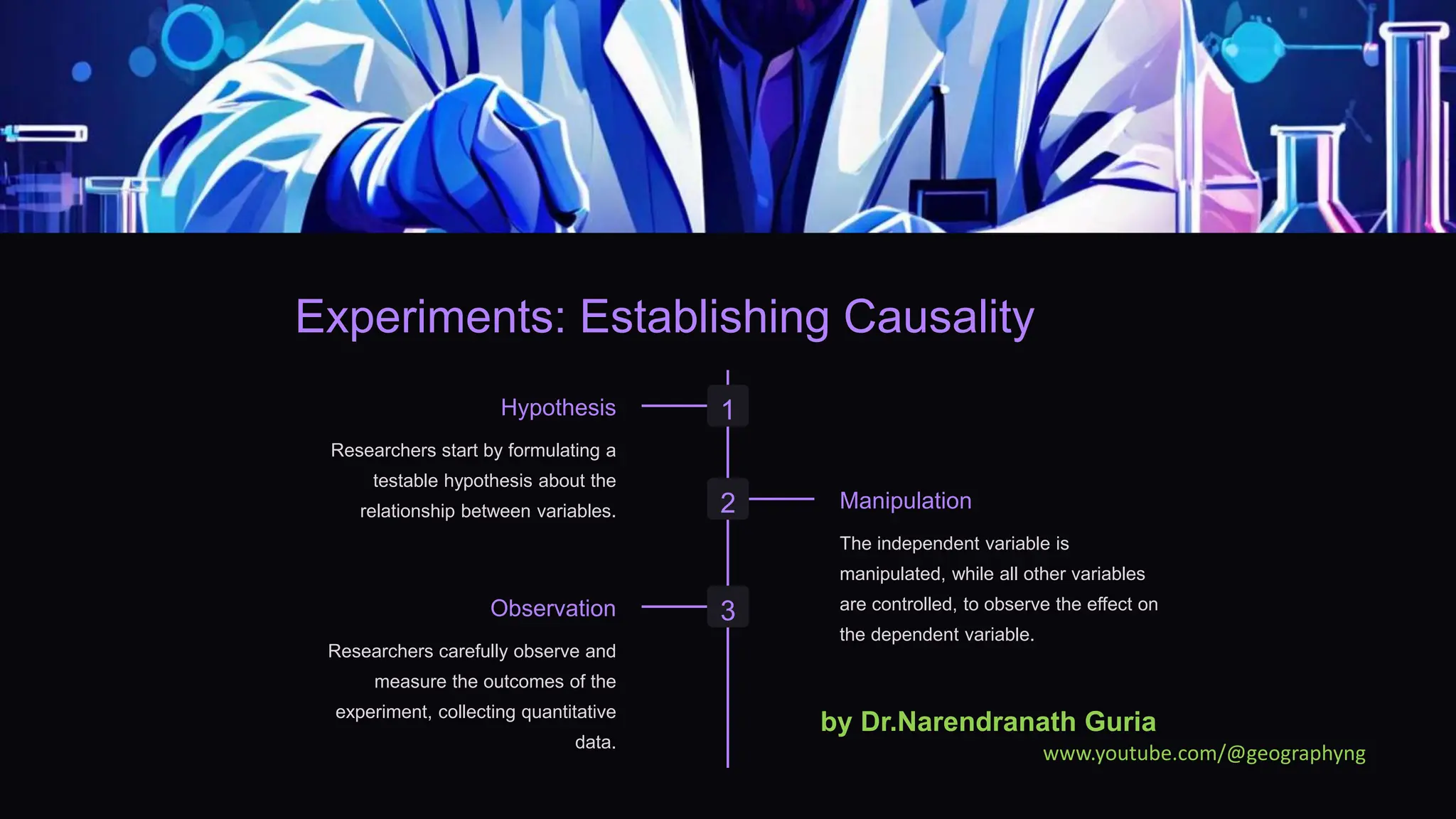
Experiments: Establishing Causality
1
Hypothesis
Researchers start by formulating a
testable hypothesis about the
relationship between variables. 2 Manipulation
The independent variable is
manipulated, while all other variables
are controlled, to observe the effect on
the dependent variable.
3
Observation
Researchers carefully observe and
measure the outcomes of the
experiment, collecting quantitative
data.
by Dr.Narendranath Guria
www.youtube.com/@geographyng
Structured Observation: Systematic Data
Collection
Purpose
Structured observation involves
systematically recording the behaviors,
activities, and interactions of individuals or
groups in a natural setting.
Approach
Researchers use predetermined observation
protocols, checklists, and coding schemes to
ensure consistency and objectivity in data
collection.
Analysis
The quantitative data collected through
structured observation is analyzed to identify
patterns, trends, and relationships.
Applications
Structured observation is commonly used in
fields such as sociology, psychology, and
anthropology to study human behavior in real-
world contexts.
by Dr.Narendranath Guria
www.youtube.com/@geographyng
Panels: Tracking Changes Over Time
Longitudinal
Panels involve
collecting data from
the same sample
group repeatedly over
an extended period,
allowing researchers
to track changes and
trends.
Versatile
Panels can be used to
study a wide range of
phenomena, from
consumer behavior to
political attitudes and
health outcomes.
Participants
Researchers engage
with the same
individuals or
households over time,
building rapport and
gaining valuable
insights.
Data-Rich
Panels generate a
rich longitudinal
dataset that enables
researchers to
analyze complex
relationships and
make robust
predictions.
by Dr.Narendranath Guria
www.youtube.com/@geographyng
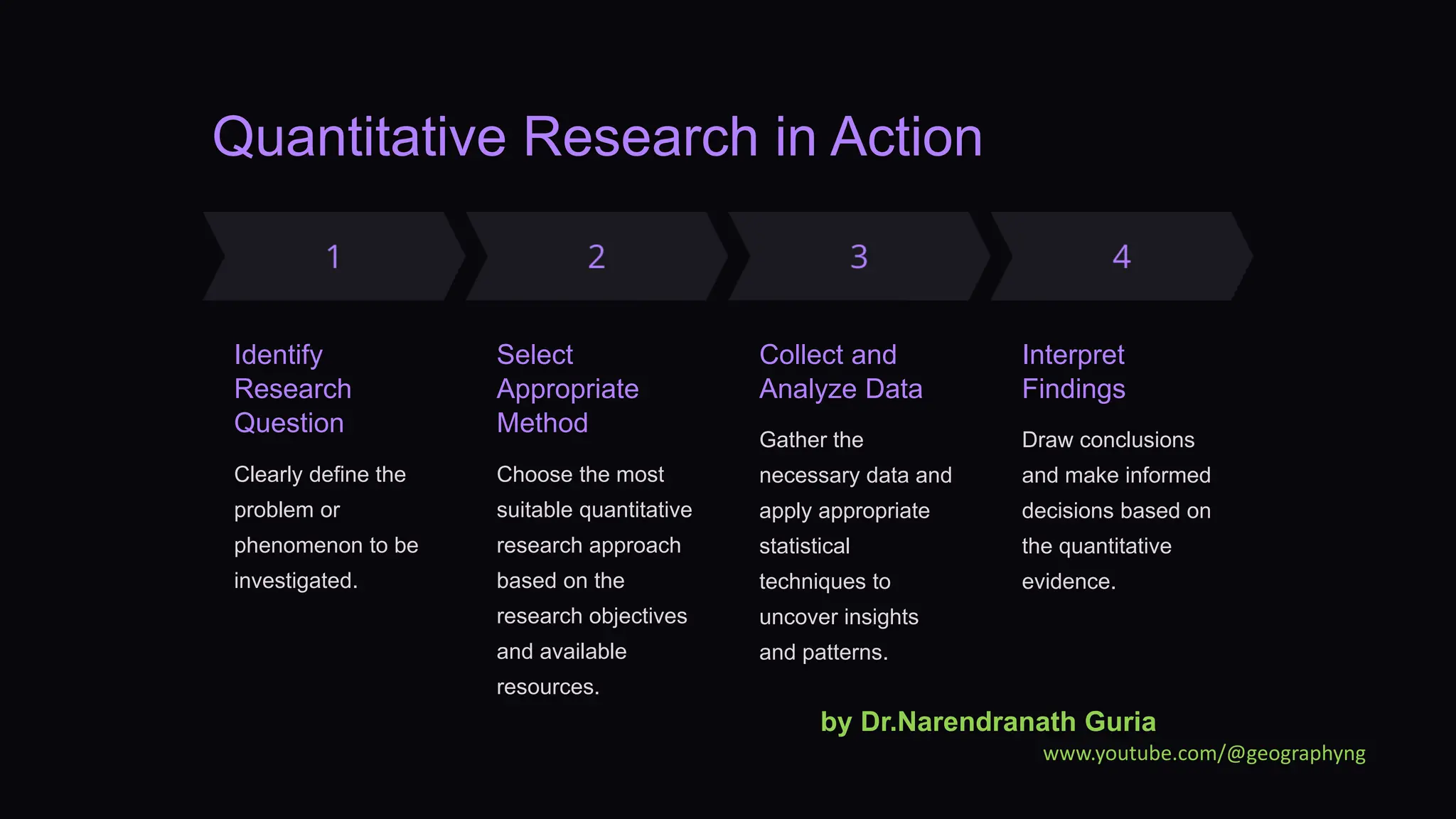
Quantitative Research in Action
Identify
Research
Question
Clearly define the
problem or
phenomenon to be
investigated.
Select
Appropriate
Method
Choose the most
suitable quantitative
research approach
based on the
research objectives
and available
resources.
Collect and
Analyze Data
Gather the
necessary data and
apply appropriate
statistical
techniques to
uncover insights
and patterns.
Interpret
Findings
Draw conclusions
and make informed
decisions based on
the quantitative
evidence.
by Dr.Narendranath Guria
www.youtube.com/@geographyng
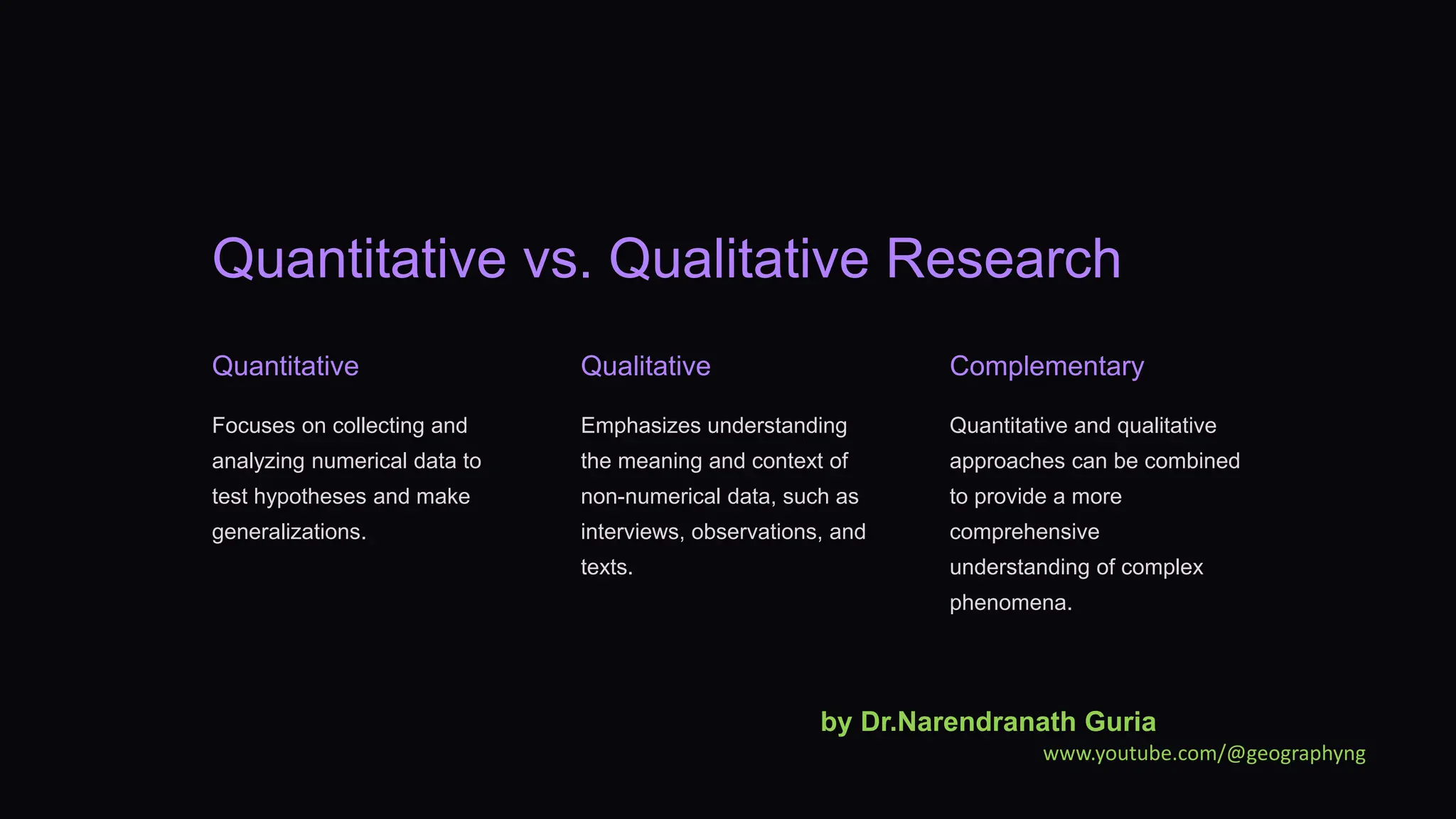
Quantitative vs. Qualitative Research
Quantitative
Focuses on collecting and
analyzing numerical data to
test hypotheses and make
generalizations.
Qualitative
Emphasizes understanding
the meaning and context of
non-numerical data, such as
interviews, observations, and
texts.
Complementary
Quantitative and qualitative
approaches can be combined
to provide a more
comprehensive
understanding of complex
phenomena.
by Dr.Narendranath Guria
www.youtube.com/@geographyng
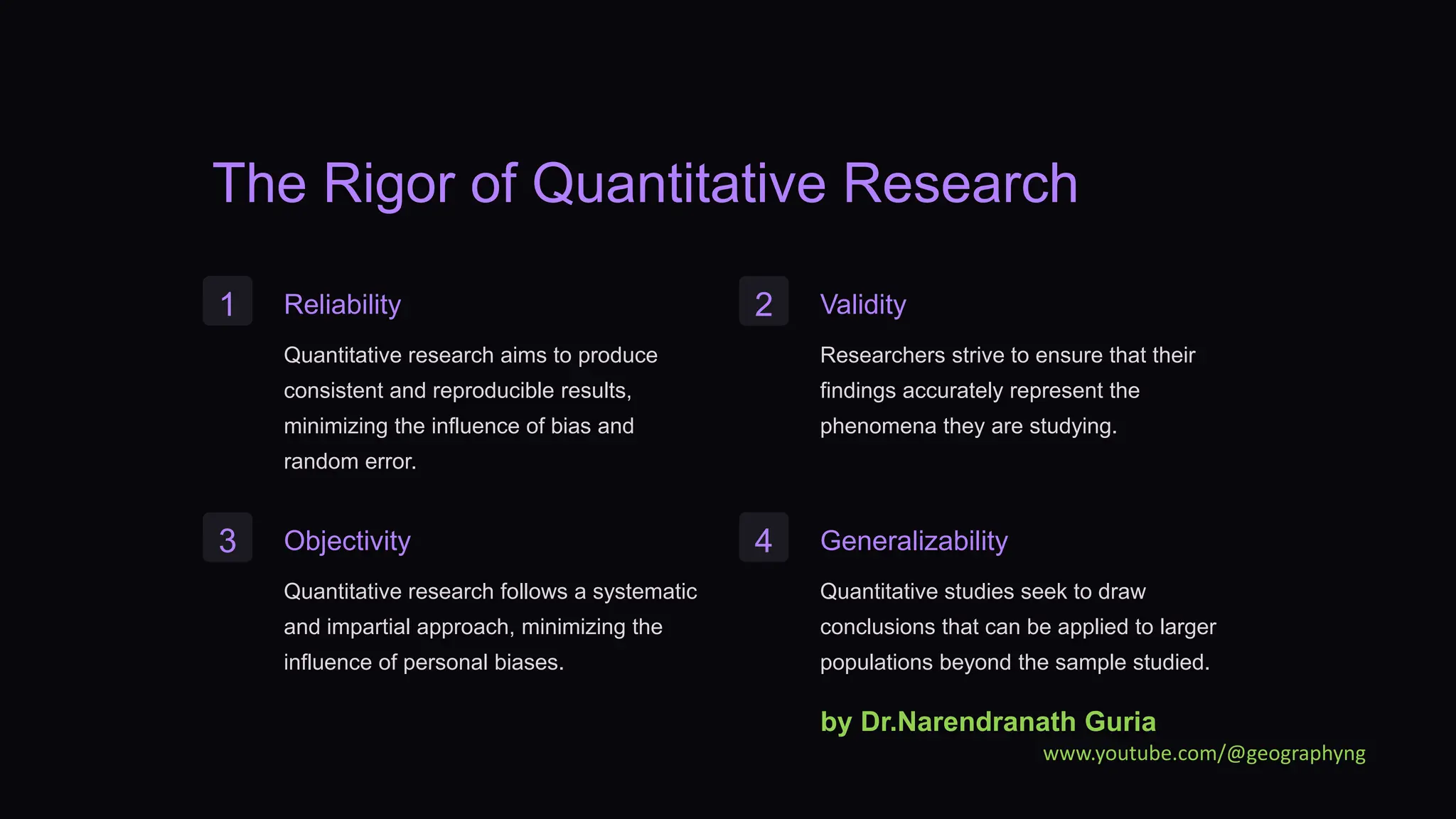
The Rigor of Quantitative Research
1 Reliability
Quantitative research aims to produce
consistent and reproducible results,
minimizing the influence of bias and
random error.
2 Validity
Researchers strive to ensure that their
findings accurately represent the
phenomena they are studying.
3 Objectivity
Quantitative research follows a systematic
and impartial approach, minimizing the
influence of personal biases.
4 Generalizability
Quantitative studies seek to draw
conclusions that can be applied to larger
populations beyond the sample studied.
by Dr.Narendranath Guria
www.youtube.com/@geographyng
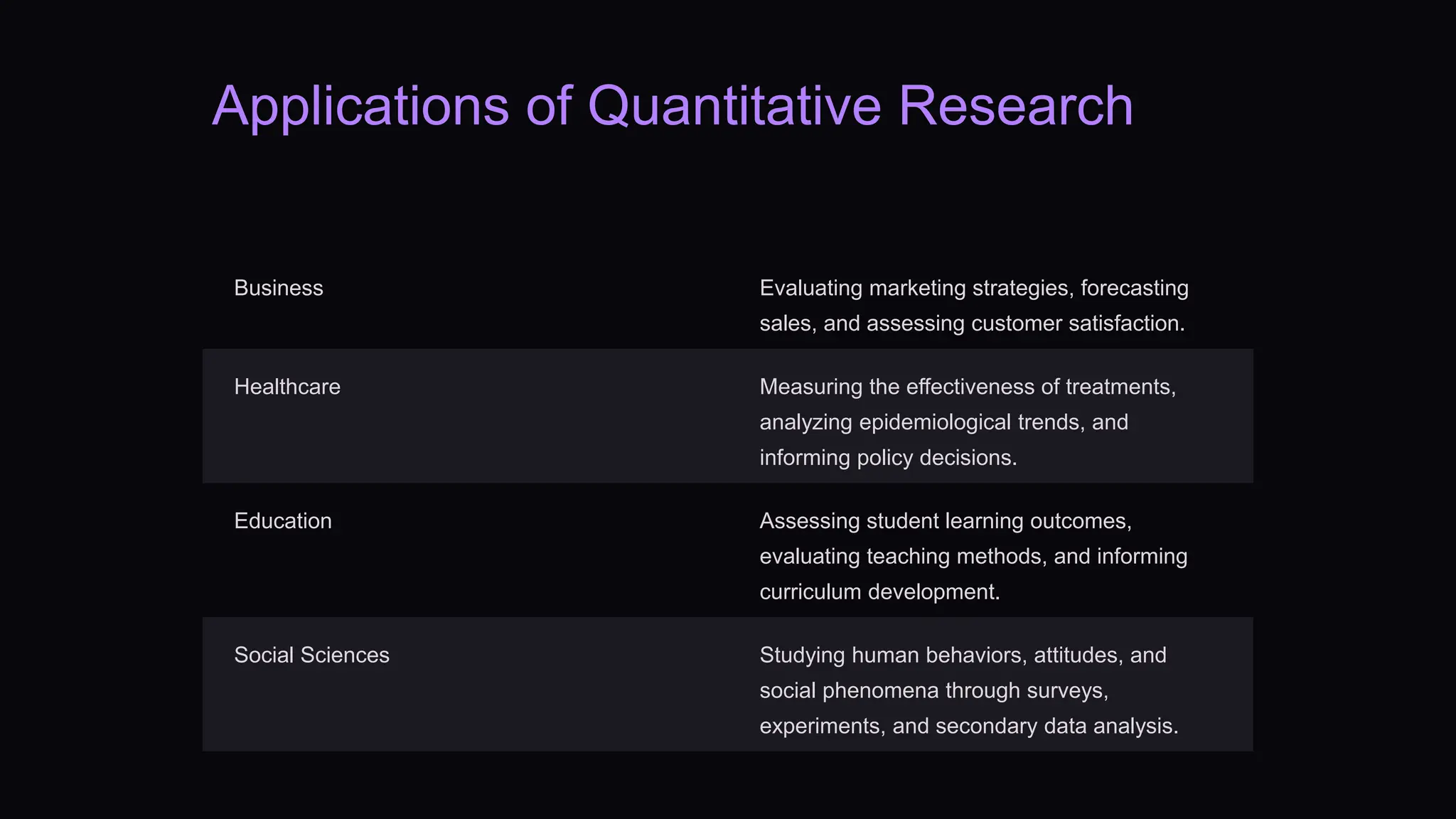
Applications of Quantitative Research
Business Evaluating marketing strategies, forecasting
sales, and assessing customer satisfaction.
Healthcare Measuring the effectiveness of treatments,
analyzing epidemiological trends, and
informing policy decisions.
Education Assessing student learning outcomes,
evaluating teaching methods, and informing
curriculum development.
Social Sciences Studying human behaviors, attitudes, and
social phenomena through surveys,
experiments, and secondary data analysis.
Embracing the Power of Numbers
Insight
Quantitative research
provides valuable
insights and data-
driven decision-
making to address
complex challenges.
Objectivity
The systematic and
impartial approach of
quantitative research
helps minimize bias
and establish
objective findings.
Precision
Quantitative methods
allow researchers to
measure, analyze,
and draw precise
conclusions about the
phenomena under
study.
Impact
The insights gained
from quantitative
research can inform
policies, drive
innovation, and
improve lives on a
global scale.
by Dr.Narendranath Guria
www.youtube.com/@geographyng
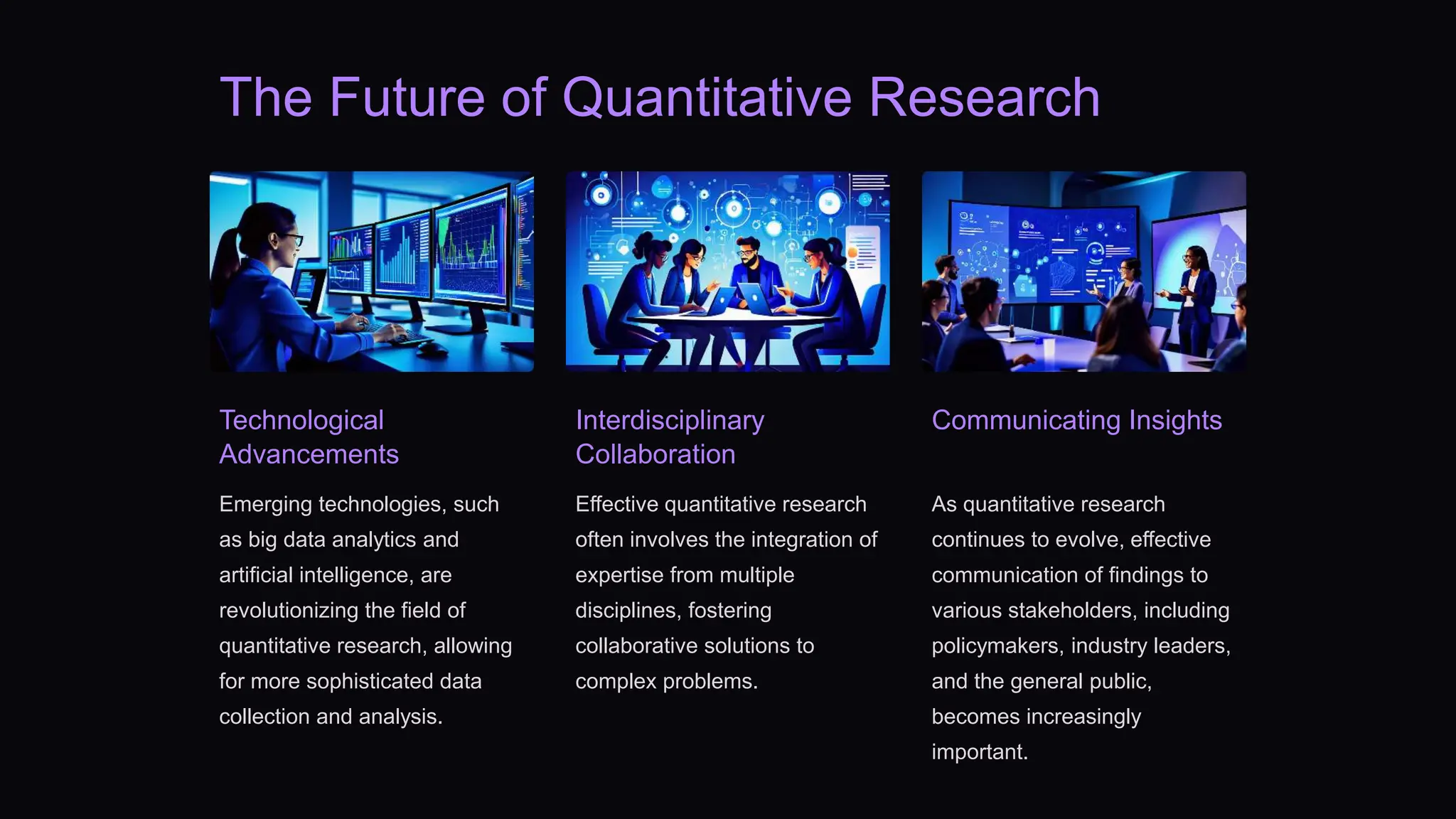
The Future of Quantitative Research
Technological
Advancements
Emerging technologies, such
as big data analytics and
artificial intelligence, are
revolutionizing the field of
quantitative research, allowing
for more sophisticated data
collection and analysis.
Interdisciplinary
Collaboration
Effective quantitative research
often involves the integration of
expertise from multiple
disciplines, fostering
collaborative solutions to
complex problems.
Communicating Insights
As quantitative research
continues to evolve, effective
communication of findings to
various stakeholders, including
policymakers, industry leaders,
and the general public,
becomes increasingly
important.

Objectives in Research Papers | Research Methodology

  • 1.
    The Importance of Objectivesin Research Papers Clear and specific research objectives are the foundation for a well-designed and impactful research paper. They provide a roadmap for the study, guide the methodology, and ensure the findings are meaningful and significant. by Dr.Narendranath Guria by Dr.Narendranath Guria www.youtube.com/@geographyng
  • 2.
    What are ResearchPaper Objectives? 1. Research paper objectives are the clearly defined goals and aims that guide the study. 2. They outline the specific questions, hypotheses, or insights the research aims to explore and uncover. 3. Objectives provide a focused framework for the research process, from the literature review to data collection and analysis. by Dr.Narendranath Guria www.youtube.com/@geographyng
  • 3.
    Defining Clear andSpecific Objectives Crafting clear and specific research objectives is crucial for the success of any research paper. These objectives should be unambiguous, measurable, and aligned with the central purpose of the study. They serve as a guiding light, ensuring the research stays focused and the findings are meaningful. by Dr.Narendranath Guria www.youtube.com/@geographyng
  • 4.
    Importance of Objectivesin Research Papers 1 Provides Direction Clear objectives give the research a clear sense of purpose and direction, ensuring the study stays focused and on-track. 2 Enhances Methodology Objectives guide the selection of appropriate research methods and data collection techniques to address the key questions. 3 Shapes Analysis and Interpretation Objectives determine how the collected data is analyzed and interpreted to draw meaningful conclusions. 4 Strengthens Significance Well-defined objectives highlight the importance and contribution of the research, increasing its impact and value. by Dr.Narendranath Guria www.youtube.com/@geographyng
  • 5.
    Guiding the ResearchProcess 1 Defining Objectives Clear research objectives provide a roadmap, ensuring the study stays focused and meaningful throughout the process. 2 Informing Methodology Well-defined objectives guide the selection of appropriate research methods and data collection techniques. 3 Aligning Analysis Objectives determine how the collected data is analyzed and interpreted to draw insightful conclusions. by Dr.Narendranath Guria www.youtube.com/@geographyng
  • 6.
    Providing a Roadmapfor the Paper Define Objectives Clear research objectives act as a guiding framework, outlining the key questions and insights to be explored. Structure the Paper Objectives help determine the logical flow and organization of the research paper, from the introduction to the conclusion. Align the Sections Each section of the paper, from the literature review to the methodology and analysis, should be directly linked to the stated objectives. by Dr.Narendranath Guria www.youtube.com/@geographyng
  • 7.
    Ensuring Focused andCoherent Research 1 Clear Objectives Well-defined research objectives provide a clear roadmap. 2 Consistent Methodology Objectives guide the selection of appropriate research methods. 3 Aligned Analysis Objectives shape the analysis and interpretation of findings. 4 Coherent Narrative Objectives ensure the research paper has a focused, logical flow. Research objectives are the foundation for ensuring a research paper is focused and coherent. They provide a clear roadmap that guides the selection of appropriate research methods, the analysis of findings, and the overall structure and narrative of the paper. By aligning each aspect of the research process with the stated objectives, the study maintains a tight focus and presents a cohesive, meaningful contribution.
  • 8.
    Aligning Methodology andAnalysis with Objectives Robust research objectives serve as a guiding light, ensuring the selected methodology and data analysis techniques are tightly aligned with the core purpose of the study. This alignment is crucial for deriving meaningful, impactful insights from the research. By grounding the research process in well-defined objectives, the analysis and interpretation of findings can be tailored to directly address the key questions and hypotheses outlined at the start. by Dr.Narendranath Guria www.youtube.com/@geographyng
  • 9.
    Facilitating Effective LiteratureReview Grounded in Objectives Well-defined research objectives provide a clear focus for the literature review, ensuring it comprehensively covers the relevant scholarly works and theories. Targeted Search Objectives help identify the key concepts, variables, and frameworks that should guide the literature search, leading to a more targeted and efficient review. Critical Analysis Objectives inform the lens through which the literature is critically analyzed, allowing the researcher to identify gaps, contradictions, and opportunities for contribution. Synthesis and Alignment Objectives help synthesize the literature into a cohesive narrative that sets the stage for the study, aligning the research with the current state of knowledge. by Dr.Narendranath Guria www.youtube.com/@geographyng
  • 10.
    Enhancing the Significanceand Contribution of the Study Clearly Defined Objectives Well-articulated research objectives highlight the specific questions and insights the study aims to explore, underscoring its importance and potential impact. Addressing Knowledge Gaps By aligning the research with defined objectives, the study can effectively address gaps and limitations in the existing literature, making a meaningful contribution. Practical Applications Objectives that are grounded in real-world problems and needs can enhance the practical significance and applicability of the research findings. Theoretical Advancements Objectives focused on expanding or refining theoretical frameworks can advance scholarly knowledge and open new avenues for future research. by Dr.Narendranath Guria www.youtube.com/@geographyng
  • 11.
    Enabling Meaningful Conclusions andRecommendations 1 Draw Insights Align findings with objectives 2 Communicate Significance Highlight the study's impact 3 Provide Recommendations Suggest actionable next steps By aligning the conclusions and recommendations of a research paper directly with the stated objectives, the study's significance and impact are amplified. This ensures the research findings are interpreted in a meaningful way, with clear implications and actionable suggestions for future work.
  • 12.
    Communicating the Purposeand Scope of the Research Defined Objectives Well-articulated research objectives clearly communicate the purpose and intended outcomes of the study. Establish Scope Objectives outline the specific questions, variables, and boundaries that define the scope and focus of the research. Roadmap for the Paper Objectives serve as a guiding framework that shapes the structure and flow of the research paper. Highlight Significance Clearly stated objectives emphasize the importance and potential impact of the study's findings. by Dr.Narendranath Guria www.youtube.com/@geographyng
  • 13.
    Improving the OverallQuality and Impact of the Paper Well-defined research objectives are the foundation for enhancing the overall quality and impact of a research paper. They provide a clear framework that guides every aspect of the study, from the literature review to the methodology and analysis. By aligning the paper's structure, content, and conclusions with the stated objectives, the research can make a more significant and meaningful contribution to the field. This ensures the study is focused, coherent, and impactful, ultimately improving its chances of being accepted and having a lasting influence. by Dr.Narendranath Guria www.youtube.com/@geographyng
  • 14.
    Objectives as aBenchmark for Evaluating Research Outcomes Alignment with Objectives Significance of Contribution Practical Relevance Clearly defined research objectives serve as a benchmark for evaluating the outcomes and impact of a study. By aligning the research findings, conclusions, and recommendations with the stated objectives, researchers can assess the study's level of success in achieving its intended goals and making a meaningful contribution to the field.
  • 15.
    Conclusion: The PivotalRole of Objectives in Research Papers Research objectives are the cornerstone of a successful research paper. They guide the entire research process, from the literature review to the methodology, analysis, and conclusions. Clearly defined objectives ensure the study remains focused, coherent, and impactful. 1. Objectives provide a clear roadmap, directing the researcher's efforts towards meaningful, targeted insights. 2. They align the various components of the paper, fostering a cohesive narrative that effectively communicates the study's significance. 3. By grounding the research in well-crafted objectives, the paper can make a substantial contribution to the field, advancing theoretical knowledge or informing real-world applications. by Dr.Narendranath Guria www.youtube.com/@geographyng
  • 16.
    Introduction to the Importanceof Research Gap Understanding the research gap is crucial in academic and scientific endeavors. It helps identify unexplored areas, refine research questions, and contribute novel insights to a field of study. Recognizing and addressing the research gap is a fundamental step in producing meaningful, impactful research and strong thesis arguments. @GeographyNG by Dr.Narendranath Guria www.youtube.com/@geographyng
  • 17.
    Understanding the Research Gap Theresearch gap refers to the areas within a field of study that have not been adequately investigated or explored. It represents the missing pieces of knowledge that researchers can uncover through their work. Understanding the research gap is crucial as it guides the focus and direction of future research efforts, ultimately leading to advancements in the field. @GeographyNG by Dr.Narendranath Guria www.youtube.com/@geographyng
  • 18.
    Defining the ResearchGap 1. The research gap is the area or topic within a field that has not been adequately explored or addressed by previous studies. 2. It represents the missing knowledge, unanswered questions, or unexplored perspectives that researchers can investigate to contribute new insights. 3. Clearly defining the research gap is crucial to framing the research problem and justifying the significance of the proposed study. by Dr.Narendranath Guria www.youtube.com/@geographyng
  • 19.
    Identifying the ResearchGap 1 Systematic Literature Review Conduct a comprehensive review of the existing literature to uncover unexplored areas and unanswered questions within the field. 2 Comparative Analysis Compare and contrast previous studies to identify discrepancies, contradictions, or limitations that suggest the need for further investigation. 3 Consultation with Experts Engage with experienced researchers and subject matter experts to gain insights into the current state of the field and potential research gaps. @GeographyNG by Dr.Narendranath Guria www.youtube.com/@geographyng
  • 20.
    Significance of theResearch Gap 1 Driving Innovation Identifying research gaps leads to new research directions and breakthroughs. 2 Advancing Knowledge Filling research gaps expands the boundaries of understanding in a field. 3 Improving Practices Addressing research gaps informs better policies, interventions, and real-world applications. The research gap holds immense significance as it is the key to unlocking new discoveries and advancements in a field of study. By identifying and addressing these gaps, researchers can drive innovation, deepen our understanding of the subject matter, and ultimately improve practices and outcomes in the real world.
  • 21.
    Addressing the ResearchGap Identify Gaps Thoroughly examine existing literature to pinpoint areas that lack sufficient research or have conflicting findings. Formulate Questions Develop clear, focused research questions that address the identified gaps and drive new insights. Design Methodology Craft a robust research methodology to effectively investigate the research gap and generate meaningful data.
  • 22.
    Exploring the ResearchGap Delving into the research gap requires a meticulous examination of existing literature, identification of unexplored territories, and strategic questioning to uncover new avenues for investigation. This process involves a multifaceted approach to uncover the complexities and nuances within the research domain. @GeographyNG
  • 23.
    Importance of theResearch Gap in Research/Thesis 1 Driving Novel Contributions Identifying and addressing research gaps enables researchers to make unique, impactful contributions that advance the field. 2 Strengthening Thesis Arguments Clearly defining and situating the research gap within the existing literature bolsters the rationale and significance of a thesis. 3 Informing Future Directions Exploring research gaps uncovers new avenues for investigation, guiding the direction of future research endeavors. 4 Fostering Deeper Understanding Filling research gaps deepens our collective understanding of the topic, leading to more comprehensive and insightful findings.
  • 24.
    Benefits of Addressingthe Research Gap Advancing Knowledge Filling research gaps expands the boundaries of understanding in a field, leading to groundbreaking insights. Driving Innovation Identifying and exploring unexplored research areas inspires new ideas, solutions, and technological advancements. Informing Better Practices Addressing research gaps can lead to more effective policies, interventions, and real- world applications. Enhancing Academic Impact Tackling research gaps produces impactful, highly cited work that elevates a researcher's academic standing. @GeographyNG by Dr.Narendranath Guria www.youtube.com/@geographyng
  • 25.
    Challenges in Identifyingthe Research Gap Overcoming Preconception s Researchers can be biased by their own assumptions or the prevailing views in the field, making it difficult to objectively identify unexplored areas. Accessing Comprehensiv e Data Thoroughly reviewing the existing literature to uncover research gaps can be a daunting task, especially in rapidly evolving fields with vast amounts of information. Maintaining Objectivity Remaining impartial and resisting the temptation to fit findings into a predetermined narrative is crucial for accurately identifying research gaps. Interdisciplina ry Barriers Bridging knowledge across different disciplines can be challenging, making it difficult to recognize research gaps that span multiple fields. by Dr.Narendranath Guria www.youtube.com/@geographyng
  • 26.
    Strategies for Bridgingthe Research Gap 1 Comprehensive Review Conduct a thorough analysis of existing literature to identify unexplored areas. 2 Interdisciplinary Collaboration Engage with researchers from diverse fields to gain fresh perspectives. 3 Innovative Methodologies Develop novel research approaches to investigate uncharted territories. 4 Iterative Refinement Continuously refine research questions and hypotheses based on emerging insights. Bridging the research gap requires a strategic and multifaceted approach. Key steps include conducting comprehensive literature reviews, fostering interdisciplinary collaboration, designing innovative methodologies, and iteratively refining research questions to uncover new frontiers of knowledge.
  • 27.
    Impact of theResearch Gap on Research and Thesis The research gap has a profound impact on the research process and the development of a robust thesis. By identifying and addressing the gaps in existing knowledge, researchers can drive novel insights that advance the field, strengthen the rationale and significance of their thesis, and inspire future research endeavors. @GeographyNG by Dr.Narendranath Guria www.youtube.com/@geographyng
  • 28.
    Implications of theResearch Gap Unlocking Innovation Identifying research gaps inspires new ideas and creative solutions that drive groundbreaking advancements. Guiding the Future Exploring uncharted territories uncovers promising directions for future research and development. Shaping Policies Addressing research gaps can inform evidence-based policies and interventions with real-world impact. Completing the Picture Filling in research gaps contributes to a more comprehensive and accurate understanding of the subject. The research gap is crucial for advancing knowledge, fostering innovation, shaping practices, and informing policies. @GeographyNG by Dr.Narendranath Guria www.youtube.com/@geographyng
  • 29.
    Conclusion: The PivotalRole of the Research Gap Unlocking Frontiers The research gap represents uncharted territories, beckoning researchers to venture forth and uncover groundbreaking insights that push the boundaries of human knowledge. Completing the Picture By addressing the research gap, researchers can fill in the missing pieces, crafting a more holistic and accurate representation of the subject matter. Collaborative Synergy Bridging the research gap often requires interdisciplinary collaboration, uniting diverse perspectives to synergize expertise and drive groundbreaking discoveries. The research gap is a crucial opportunity for researchers to uncover new insights, shape the future, and contribute to human knowledge.
  • 30.
    Exploring Qualitative Research Methods Qualitativeresearch methods offer a deep, nuanced understanding of complex human experiences and behaviors. These diverse approaches provide invaluable insights for fields ranging from anthropology to ethics. by Dr.Narendranath Guria by Dr.Narendranath Guria www.youtube.com/@geographyng
  • 31.
    Anthropological Approach 1 CulturalImmersion Anthropologists embed themselves in communities to gain firsthand understanding of customs, beliefs, and social dynamics. 2 Holistic Perspective This method examines the interconnectedness of various cultural elements, revealing the bigger picture. 3 Emic Viewpoint Anthropologists strive to understand phenomena from the perspective of the people being studied. by Dr.Narendranath Guria www.youtube.com/@geographyng
  • 32.
    Ethical Inquiry Normative Ethics Examinesthe moral principles that guide human behavior and the rightness or wrongness of actions. Applied Ethics Focuses on the practical application of ethical principles to real-world situations and decision- making. Metaethics Investigates the fundamental nature of moral judgments, the meaning of moral terms, and the justification of moral beliefs. by Dr.Narendranath Guria www.youtube.com/@geographyng
  • 33.
    Participant Observation 1 Immersion Theresearcher becomes an active member of the group being studied to gain a deeper understanding. 2 Observation The researcher carefully observes and records the group's behaviors, interactions, and cultural practices. 3 Interpretation The researcher analyzes the collected data to identify patterns, themes, and insights about the group. by Dr.Narendranath Guria www.youtube.com/@geographyng
  • 34.
    Face-to-Face Interviews Dialogue Allows foropen- ended, in-depth conversations to explore complex topics and gain rich, contextual data. Rapport The personal interaction facilitates a deeper understanding of participants' perspectives and experiences. Interpretation Researchers can analyze verbal and non-verbal cues to uncover underlying meaning and nuance. Flexibility Interviews can be adapted and tailored to the unique needs and characteristics of each participant. by Dr.Narendranath Guria www.youtube.com/@geographyng
  • 35.
    The Power ofQuantitative Research Quantitative research is a powerful tool for collecting and analyzing numerical data to gain insights and make informed decisions. By studying samples, researchers can uncover trends, test hypotheses, and make generalizations about larger populations. by Dr.Narendranath Guria by Dr.Narendranath Guria www.youtube.com/@geographyng
  • 36.
    Answering Numerical Questions Quantitativeresearch excels at answering questions that can be expressed numerically. For example, researchers can determine the percentage of minority teachers, the gender ratio in college mathematics, or trends in high school graduation rates. by Dr.Narendranath Guria www.youtube.com/@geographyng
  • 37.
    Exploring Non-Numerical Topics Whilequantitative research relies on numerical data, it can also be used to explore non-numerical topics. Researchers can survey opinions, attitudes, and perceptions to gain insights on complex issues like student-teacher relationships or public sentiment on health care reform. by Dr.Narendranath Guria www.youtube.com/@geographyng
  • 38.
    Key Quantitative Methods 1Surveys Collect data directly from a sample population through questionnaires or interviews. 2 Secondary Data Analyze existing datasets and databases to uncover patterns and make inferences. 3 Experiments Manipulate variables to test hypotheses and establish cause-and-effect relationships. 4 Structured Observation Systematically observe and record behaviors, activities, and interactions. by Dr.Narendranath Guria www.youtube.com/@geographyng
  • 39.
    Surveys: Gathering Insights Purpose Surveysare used to collect self-reported data from a sample population on their beliefs, attitudes, behaviors, and experiences. Design Surveys can be conducted through questionnaires, interviews, or a combination of both. The questions must be carefully crafted to elicit the desired information. Analysis Survey data is analyzed to identify patterns, trends, and relationships, allowing researchers to draw conclusions about the larger population. by Dr.Narendranath Guria www.youtube.com/@geographyng
  • 40.
    Secondary Data: LeveragingExisting Information Advantages Secondary data is readily available, cost-effective, and can provide a broader perspective than primary data collection. Sources Researchers can utilize government statistics, academic databases, industry reports, and other publicly available datasets. Analysis Secondary data is analyzed to identify trends, patterns, and relationships that can inform decision-making and policy development. by Dr.Narendranath Guria www.youtube.com/@geographyng
  • 41.
    Experiments: Establishing Causality 1 Hypothesis Researchersstart by formulating a testable hypothesis about the relationship between variables. 2 Manipulation The independent variable is manipulated, while all other variables are controlled, to observe the effect on the dependent variable. 3 Observation Researchers carefully observe and measure the outcomes of the experiment, collecting quantitative data. by Dr.Narendranath Guria www.youtube.com/@geographyng
  • 42.
    Structured Observation: SystematicData Collection Purpose Structured observation involves systematically recording the behaviors, activities, and interactions of individuals or groups in a natural setting. Approach Researchers use predetermined observation protocols, checklists, and coding schemes to ensure consistency and objectivity in data collection. Analysis The quantitative data collected through structured observation is analyzed to identify patterns, trends, and relationships. Applications Structured observation is commonly used in fields such as sociology, psychology, and anthropology to study human behavior in real- world contexts. by Dr.Narendranath Guria www.youtube.com/@geographyng
  • 43.
    Panels: Tracking ChangesOver Time Longitudinal Panels involve collecting data from the same sample group repeatedly over an extended period, allowing researchers to track changes and trends. Versatile Panels can be used to study a wide range of phenomena, from consumer behavior to political attitudes and health outcomes. Participants Researchers engage with the same individuals or households over time, building rapport and gaining valuable insights. Data-Rich Panels generate a rich longitudinal dataset that enables researchers to analyze complex relationships and make robust predictions. by Dr.Narendranath Guria www.youtube.com/@geographyng
  • 44.
    Quantitative Research inAction Identify Research Question Clearly define the problem or phenomenon to be investigated. Select Appropriate Method Choose the most suitable quantitative research approach based on the research objectives and available resources. Collect and Analyze Data Gather the necessary data and apply appropriate statistical techniques to uncover insights and patterns. Interpret Findings Draw conclusions and make informed decisions based on the quantitative evidence. by Dr.Narendranath Guria www.youtube.com/@geographyng
  • 45.
    Quantitative vs. QualitativeResearch Quantitative Focuses on collecting and analyzing numerical data to test hypotheses and make generalizations. Qualitative Emphasizes understanding the meaning and context of non-numerical data, such as interviews, observations, and texts. Complementary Quantitative and qualitative approaches can be combined to provide a more comprehensive understanding of complex phenomena. by Dr.Narendranath Guria www.youtube.com/@geographyng
  • 46.
    The Rigor ofQuantitative Research 1 Reliability Quantitative research aims to produce consistent and reproducible results, minimizing the influence of bias and random error. 2 Validity Researchers strive to ensure that their findings accurately represent the phenomena they are studying. 3 Objectivity Quantitative research follows a systematic and impartial approach, minimizing the influence of personal biases. 4 Generalizability Quantitative studies seek to draw conclusions that can be applied to larger populations beyond the sample studied. by Dr.Narendranath Guria www.youtube.com/@geographyng
  • 47.
    Applications of QuantitativeResearch Business Evaluating marketing strategies, forecasting sales, and assessing customer satisfaction. Healthcare Measuring the effectiveness of treatments, analyzing epidemiological trends, and informing policy decisions. Education Assessing student learning outcomes, evaluating teaching methods, and informing curriculum development. Social Sciences Studying human behaviors, attitudes, and social phenomena through surveys, experiments, and secondary data analysis.
  • 48.
    Embracing the Powerof Numbers Insight Quantitative research provides valuable insights and data- driven decision- making to address complex challenges. Objectivity The systematic and impartial approach of quantitative research helps minimize bias and establish objective findings. Precision Quantitative methods allow researchers to measure, analyze, and draw precise conclusions about the phenomena under study. Impact The insights gained from quantitative research can inform policies, drive innovation, and improve lives on a global scale. by Dr.Narendranath Guria www.youtube.com/@geographyng
  • 49.
    The Future ofQuantitative Research Technological Advancements Emerging technologies, such as big data analytics and artificial intelligence, are revolutionizing the field of quantitative research, allowing for more sophisticated data collection and analysis. Interdisciplinary Collaboration Effective quantitative research often involves the integration of expertise from multiple disciplines, fostering collaborative solutions to complex problems. Communicating Insights As quantitative research continues to evolve, effective communication of findings to various stakeholders, including policymakers, industry leaders, and the general public, becomes increasingly important.