 Sampling of solids
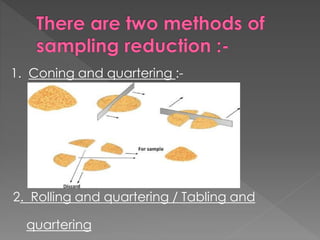
 Two methods of sample reduction
 Sampling of soil
 Importance of soil testing
 Coal sampling
 Particulates sampling
 Hazards in sampling
 It is most difficult sampling because solids
are heterogeneous system. The particles
are made homogenous by grinding and
crushing.
1. Coning and quartering :-
2. Rolling and quartering / Tabling and
quartering
Before sampling :-
1) Develop a soil sampling plan of your field.
2) Obtain the materials you need to
complete your sampling plan.
➢ A composite soil sample should
represent a uniform field area.
➢ Exclude small areas within field that are
obviously different.
➢ The field area represented by a single
composite sample should represent no
more than 40 irrigated acres.
 Collect soil samples from fields used for
crop production after harvest and
before planting the subsequent crop.
 Sampling fields near the same time each
year is recommended for more
consistent results.
 Beware of situations that may cause soil
values to change between sampling
and planting e.g.:- heavy rainfall and
preirrigation.
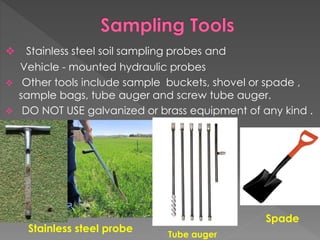
❖ Stainless steel soil sampling probes and
Vehicle - mounted hydraulic probes
❖ Other tools include sample buckets, shovel or spade ,
sample bags, tube auger and screw tube auger.
❖ DO NOT USE galvanized or brass equipment of any kind .
Stainless steel probe
Tube auger
Spade
 Sampling depth for most soil is typically the tillage
depth in six – inch interval.
 Deep rooted crops such as wheat and barley
need deeper samples if nitrogen fertilizer
recommendations are desired.
 Subsoil samples from the 6 to 24- inch depth are
needed to estimate available nitrogen and in
some case sulphur.
 Both surface and subsurface soil samples are
needed to test for available nutrients in the root
zone.
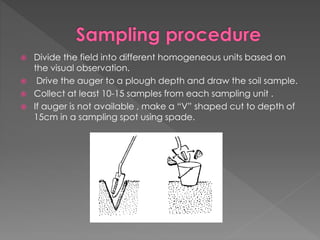
 Divide the field into different homogeneous units based on
the visual observation.
 Drive the auger to a plough depth and draw the soil sample.
 Collect at least 10-15 samples from each sampling unit .
 If auger is not available , make a “V” shaped cut to depth of
15cm in a sampling spot using spade.
 If there is variations in slope , colour and texture of soil, then separate
samples are required from different locations and they should be
analysed separately.
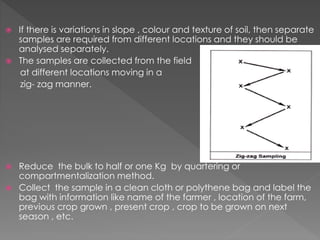
 The samples are collected from the field
at different locations moving in a
zig- zag manner.
 Reduce the bulk to half or one Kg by quartering or
compartmentalization method.
 Collect the sample in a clean cloth or polythene bag and label the
bag with information like name of the farmer , location of the farm,
previous crop grown , present crop , crop to be grown on next
season , etc.
 Determine soil fertility level and make
good nutrient management decisions.
 Facilitate fertilizer composition and
dosage selection for land employed in
both agriculture and horticulture.
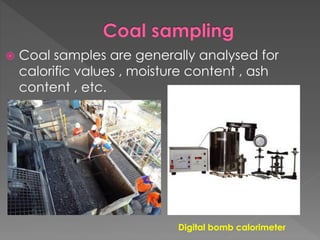
 Coal samples are generally analysed for
calorific values , moisture content , ash
content , etc.
Digital bomb calorimeter
This can be done by two methods :-
a) Dry ashing :- In this method, low temperature
oxidation is done by passing radiofrequency waves
through the sample.
b) Wet digestion:-The sample is dried &
treated with hot boiling oxidising agent .
Ex : HNO3
Such digestion is generally carried out
in a Kjeldahl flask.
 Gravity technique
 Filtration technique
 Inertial Technique
 Precipitation Technique
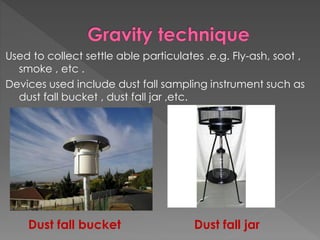
Used to collect settle able particulates .e.g. Fly-ash, soot ,
smoke , etc .
Devices used include dust fall sampling instrument such as
dust fall bucket , dust fall jar ,etc.
Dust fall bucket Dust fall jar
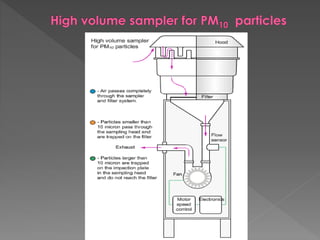
 Used for collecting suspended particulates that do not
settle out early.
 Device used include high volume sampler , paper tape
sampler , etc.
Paper tape sampler
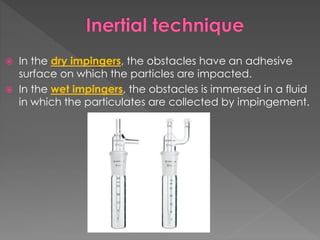
 In the dry impingers, the obstacles have an adhesive
surface on which the particles are impacted.
 In the wet impingers, the obstacles is immersed in a fluid
in which the particulates are collected by impingement.
 Thermal precipitation :- when exposed
to temperature gradient, suspended
particles tend to move to lower
temperature region.
 Electrostatic precipitation :- Electrical
charge is used to force radioactive or
other particulates in the range 0.001μ –
10μ to migrate out of air stream.
➢ The sampler should wear an adequate protective clothing
and should have detailed knowledge of the material which is
being sampled.
➢ When dangers from toxicity exists then necessary antidote
treatment procedure should be available.
➢ In case of solids, operator should wear face mask for
protection until is established that the powdered material is
not hazardous.
➢ Correct sampling of material is therefore of importance in two
main respects:-
1) To obtain representative portion of sample for analysis.
2) To prevent occurrence of accidents.
Thank You

sampling of solid

  • 2.
     Sampling ofsolids  Two methods of sample reduction  Sampling of soil  Importance of soil testing  Coal sampling  Particulates sampling  Hazards in sampling
  • 3.
     It ismost difficult sampling because solids are heterogeneous system. The particles are made homogenous by grinding and crushing.
  • 4.
    1. Coning andquartering :- 2. Rolling and quartering / Tabling and quartering
  • 5.
    Before sampling :- 1)Develop a soil sampling plan of your field. 2) Obtain the materials you need to complete your sampling plan.
  • 6.
    ➢ A compositesoil sample should represent a uniform field area. ➢ Exclude small areas within field that are obviously different. ➢ The field area represented by a single composite sample should represent no more than 40 irrigated acres.
  • 7.
     Collect soilsamples from fields used for crop production after harvest and before planting the subsequent crop.  Sampling fields near the same time each year is recommended for more consistent results.  Beware of situations that may cause soil values to change between sampling and planting e.g.:- heavy rainfall and preirrigation.
  • 8.
    ❖ Stainless steelsoil sampling probes and Vehicle - mounted hydraulic probes ❖ Other tools include sample buckets, shovel or spade , sample bags, tube auger and screw tube auger. ❖ DO NOT USE galvanized or brass equipment of any kind . Stainless steel probe Tube auger Spade
  • 9.
     Sampling depthfor most soil is typically the tillage depth in six – inch interval.  Deep rooted crops such as wheat and barley need deeper samples if nitrogen fertilizer recommendations are desired.  Subsoil samples from the 6 to 24- inch depth are needed to estimate available nitrogen and in some case sulphur.  Both surface and subsurface soil samples are needed to test for available nutrients in the root zone.
  • 10.
     Divide thefield into different homogeneous units based on the visual observation.  Drive the auger to a plough depth and draw the soil sample.  Collect at least 10-15 samples from each sampling unit .  If auger is not available , make a “V” shaped cut to depth of 15cm in a sampling spot using spade.
  • 11.
     If thereis variations in slope , colour and texture of soil, then separate samples are required from different locations and they should be analysed separately.  The samples are collected from the field at different locations moving in a zig- zag manner.  Reduce the bulk to half or one Kg by quartering or compartmentalization method.  Collect the sample in a clean cloth or polythene bag and label the bag with information like name of the farmer , location of the farm, previous crop grown , present crop , crop to be grown on next season , etc.
  • 12.
     Determine soilfertility level and make good nutrient management decisions.  Facilitate fertilizer composition and dosage selection for land employed in both agriculture and horticulture.
  • 13.
     Coal samplesare generally analysed for calorific values , moisture content , ash content , etc. Digital bomb calorimeter
  • 14.
    This can bedone by two methods :- a) Dry ashing :- In this method, low temperature oxidation is done by passing radiofrequency waves through the sample. b) Wet digestion:-The sample is dried & treated with hot boiling oxidising agent . Ex : HNO3 Such digestion is generally carried out in a Kjeldahl flask.
  • 15.
     Gravity technique Filtration technique  Inertial Technique  Precipitation Technique
  • 16.
    Used to collectsettle able particulates .e.g. Fly-ash, soot , smoke , etc . Devices used include dust fall sampling instrument such as dust fall bucket , dust fall jar ,etc. Dust fall bucket Dust fall jar
  • 17.
     Used forcollecting suspended particulates that do not settle out early.  Device used include high volume sampler , paper tape sampler , etc. Paper tape sampler
  • 19.
     In thedry impingers, the obstacles have an adhesive surface on which the particles are impacted.  In the wet impingers, the obstacles is immersed in a fluid in which the particulates are collected by impingement.
  • 20.
     Thermal precipitation:- when exposed to temperature gradient, suspended particles tend to move to lower temperature region.  Electrostatic precipitation :- Electrical charge is used to force radioactive or other particulates in the range 0.001μ – 10μ to migrate out of air stream.
  • 21.
    ➢ The samplershould wear an adequate protective clothing and should have detailed knowledge of the material which is being sampled. ➢ When dangers from toxicity exists then necessary antidote treatment procedure should be available. ➢ In case of solids, operator should wear face mask for protection until is established that the powdered material is not hazardous. ➢ Correct sampling of material is therefore of importance in two main respects:- 1) To obtain representative portion of sample for analysis. 2) To prevent occurrence of accidents.
  • 22.