SAMPLING
INDEX
• SAMPLING DEFINITION
• TYPES OF SAMPLES
• SAMPLING PLAN
• QUALITY OF SAMPLE
• SUB-SAMPLING
• SAMPLING OF LIQUIDS
• SAMPLING OF GASES
• SAMPLE REGISTRATION AND STORAGE
• ACCEPTANCE SAMPLING – INSPECTION BY ATTRIBUTES
SAMPLING DEFINITION
• Sampling is the process of selecting a portion
of material in some manner, to represent or
provide information about a larger body of
material.
• Sampling is the process in which a
representative piece of material is extracted
from a larger amount and readied for analysis.
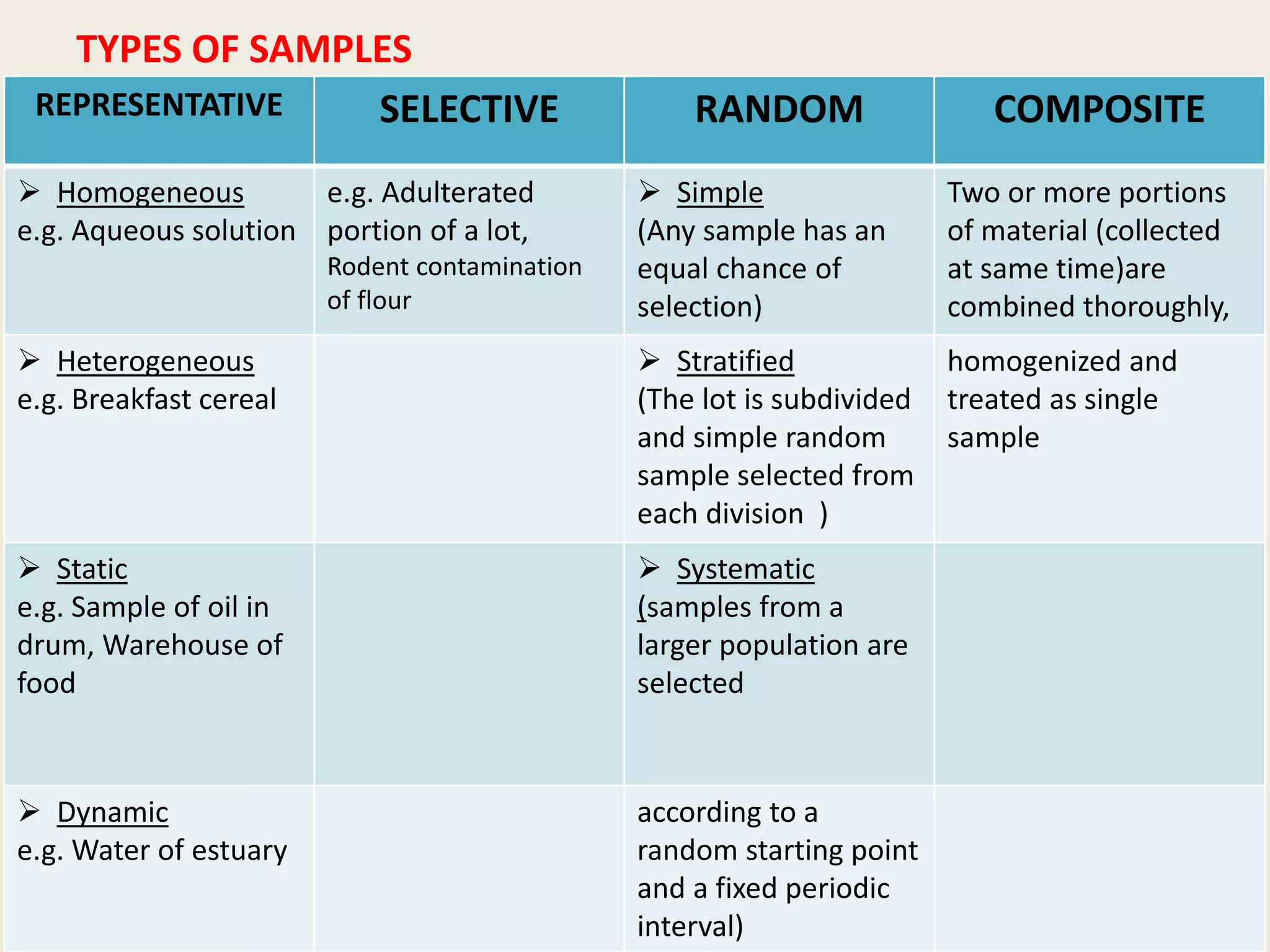
TYPES OF SAMPLES
REPRESENTATIVE SELECTIVE RANDOM COMPOSITE
 Homogeneous
e.g. Aqueous solution
e.g. Adulterated
portion of a lot,
Rodent contamination
of flour
 Simple
(Any sample has an
equal chance of
selection)
Two or more portions
of material (collected
at same time)are
combined thoroughly,
 Heterogeneous
e.g. Breakfast cereal
 Stratified
(The lot is subdivided
and simple random
sample selected from
each division )
homogenized and
treated as single
sample
 Static
e.g. Sample of oil in
drum, Warehouse of
food
 Systematic
(samples from a
larger population are
selected
 Dynamic
e.g. Water of estuary
according to a
random starting point
and a fixed periodic
interval)
SAMPLING PLAN
A sampling plan is a detailed outline of which
measurements will be taken at what times, on which
material, in what manner, and by whom.
STEPS INVOLVED IN DEVELOPING SAMPLING PLAN
1. Identify the parameters to be measured, range of
values etc.
2. Design a sampling scheme
3. Select sample sizes
4. Design storage formats
5. Assign roles and responsibilities
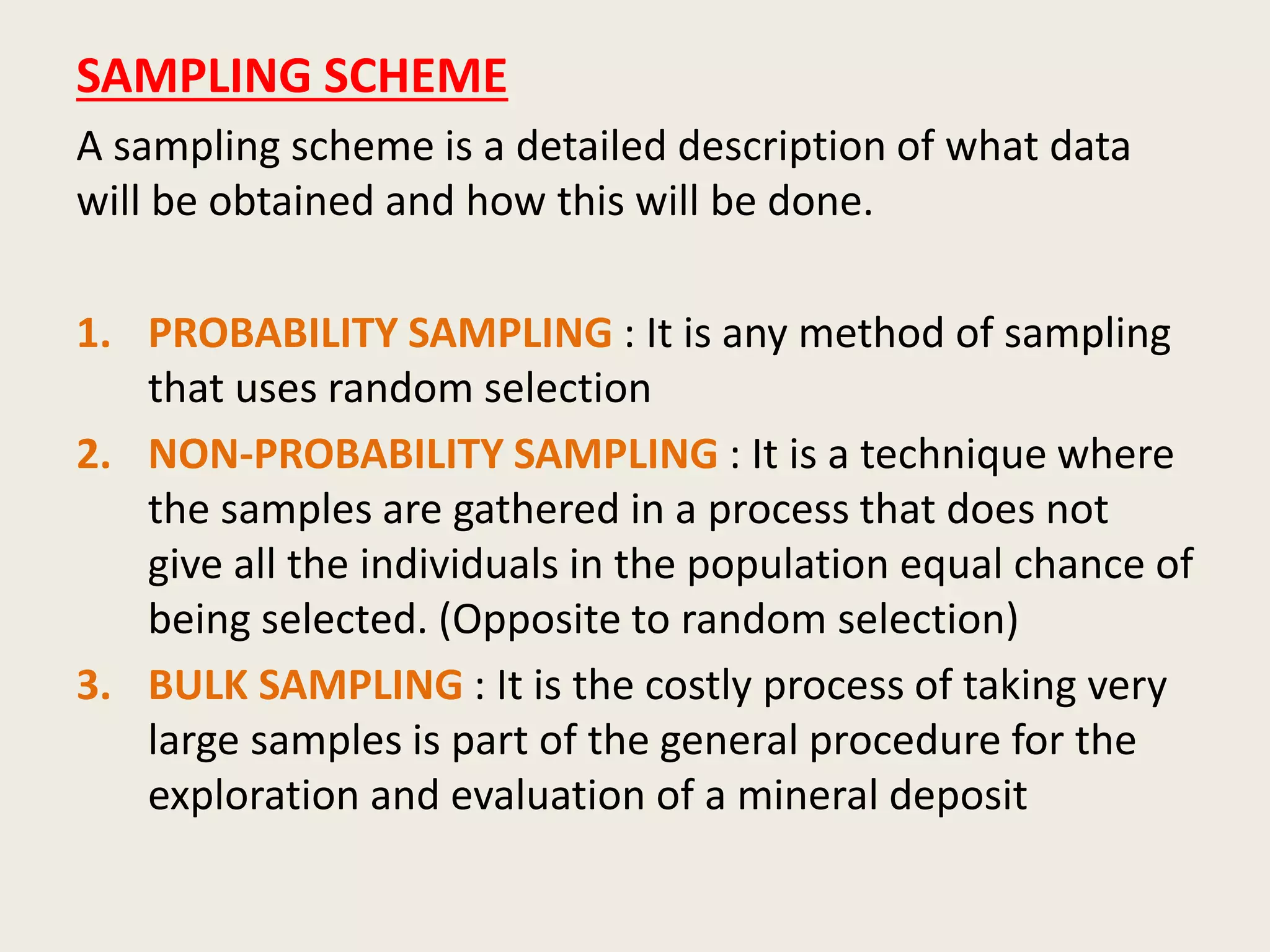
SAMPLING SCHEME
A sampling scheme is a detailed description of what data
will be obtained and how this will be done.
1. PROBABILITY SAMPLING : It is any method of sampling
that uses random selection
2. NON-PROBABILITY SAMPLING : It is a technique where
the samples are gathered in a process that does not
give all the individuals in the population equal chance of
being selected. (Opposite to random selection)
3. BULK SAMPLING : It is the costly process of taking very
large samples is part of the general procedure for the
exploration and evaluation of a mineral deposit
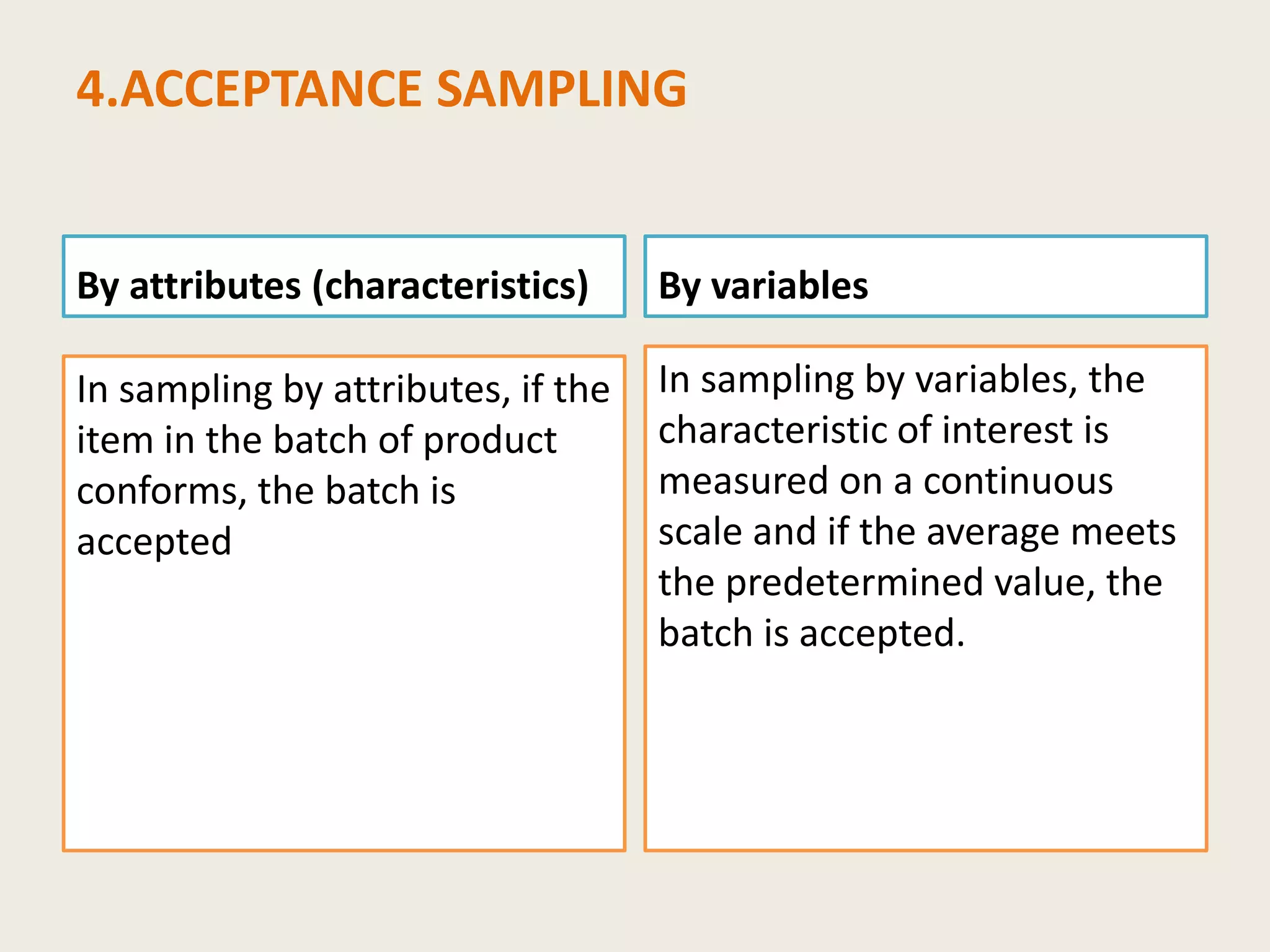
4.ACCEPTANCE SAMPLING
By attributes (characteristics)
In sampling by attributes, if the
item in the batch of product
conforms, the batch is
accepted
By variables
In sampling by variables, the
characteristic of interest is
measured on a continuous
scale and if the average meets
the predetermined value, the
batch is accepted.
QUALITY OF SAMPLE
Processes right from the collection of sample to
the analysis should not affect the quality of
sample.
Properties to be considered to ensure the quality of
sample are;
1. Volatility
2. Sensitivity to light
3. Thermal stability
4. Chemical reactivity
EXAMPLES
1. Low molecular weight polyethylene is totally unsuitable
for hydrocarbon samples. Not only there is loss of
hydrocarbon, the polyethylene may also dissolve in
hydrocarbon
2. Glass containers cannot be used for certain samples as
they may adsorb or desorb elements. Hence is it not
suitable in trace elements analysis.
SUB-SAMPLING
(Question : What is sub-sampling?)
It is a technique by which a small representative sample
is taken from a larger sample.
1.Coning and Quartering 2.Riffle box splitting
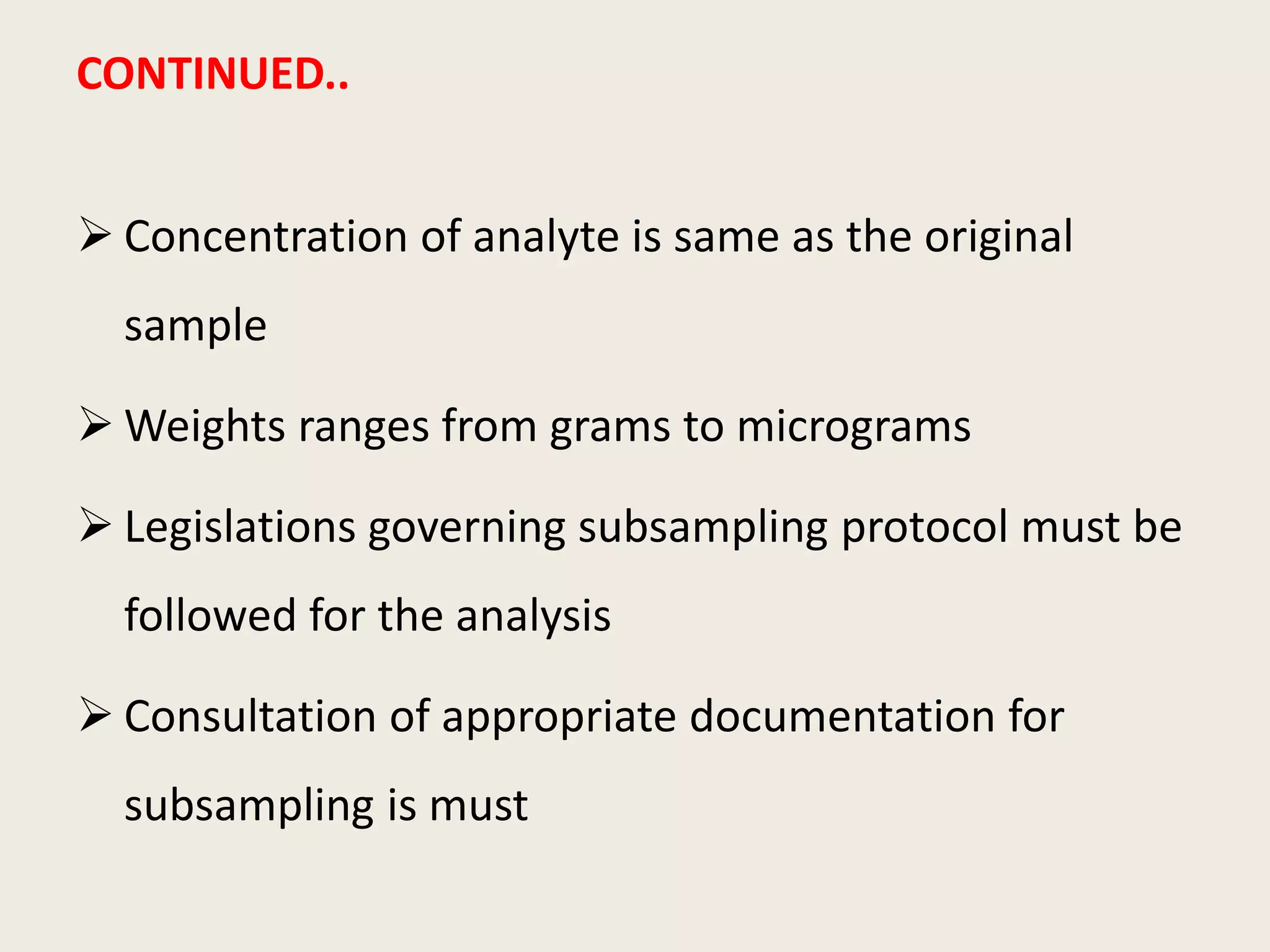
CONTINUED..
 Concentration of analyte is same as the original
sample
 Weights ranges from grams to micrograms
 Legislations governing subsampling protocol must be
followed for the analysis
 Consultation of appropriate documentation for
subsampling is must
SAMPLING OF LIQUIDS
• If the products are non-homogenous due to
their nature, the products must be
homogenised by mixing, shaking, or
circulation through liquid pumps, etc. prior to
sampling.
• If homogenisation is not possible, a larger
number of incremental samples must be taken
at various depths to ensure that a
representative sample is obtained
LIQUID SAMPLING TECHNIQUES
DIPPING TOOL PUMP
SAMPLING OF GASES
 DEVICES USED
1. METERS : used to determine the volume of
gas collected, fitted with manometer and
thermometer
2. PROBES : tubes suitable for penetrating into
the gas stream, should be constructed with
non corrosive material
3. SUCTION DEVICES : vacuum pumps driven by
electric motors are commonly used
SAMPLE REGESTRATION AND STORAGE
(Question : How is sample register maintained? What
points to be documented regarding a particular sample
in the register?)
REGESTRATION
• When a sample is received it should have
unique verification i.e. number or code
• All details about the sample should be
recorded
• Details of the containers and closures should
also be recorded
STORAGE
• Sample should be stored so that there is no hazard to
laboratory staff .
• Quality of sample should be same when it is analysed
as when it was collected.
• There must be no risk of contamination.
• Environmental conditions should also be considered
during storage.
• HOLDING TIME (STORAGE TIME)
Holding time is defined as the maximum period of time
that can pass from sampling to measurement before
the sample has changed significantly.
ACCEPTANCE SAMPLING – INSPECTION BY
ATTRIBUTES
• ISO 2859 refers to inspection by attributes.
• In this, each unit (the sample) is inspected and
classified as acceptable or defective.
METHODS
1. 100% inspection
2. Statistical inspection
3. Ad hoc inspection
ACCEPTANCE CRITERIA OF SAMPLE
(Question : Give an account on acceptance criteria of
sample.)
 After sample collection and transportation to the facility,
the laboratory must check the integrity of the sample by
checking the following items:
1.Signs of Leakage or breakage.
2. Completeness of sample collection forms including date
and time sampled, collector’s name, sample identification,
special reporting requirements, special detection limits,
requested analysis and appropriate signatures.
3.Sample Identification label on legible water resistant or
other suitable non-running ink where applicable.
3. Sample Identification label on legible water resistant or
other suitable non-running ink where applicable.
4. Receipt of all samples listed on the Chain of Custody or
other paperwork.
5. Use of appropriate sample containers, adequate volume,
and preservation.
6. Adherence to specified holding times.
7. Temperature of samples requiring thermal preservation
will be checked and recorded.
8. Chemical preservation will be checked if appropriate.
REFERENCE
• https://www.britannica.com/topic/sample-
preparation
• http://ec.europa.eu/taxation_customs/dds2/SAMANCTA
/EN/GeneralProcedures/SamplingMethods_EN.ht
• http://www.itl.nist.gov/div898/handbook/ppc/section3/
ppc331.htm
• http://www.chemservelab.com/files/Sample%20Accepta
nce%20Criteria.pdf
• Quality in Analytical Chemistry Laboratory (Wiley India)
Sampling

Sampling

  • 1.
  • 2.
    INDEX • SAMPLING DEFINITION •TYPES OF SAMPLES • SAMPLING PLAN • QUALITY OF SAMPLE • SUB-SAMPLING • SAMPLING OF LIQUIDS • SAMPLING OF GASES • SAMPLE REGISTRATION AND STORAGE • ACCEPTANCE SAMPLING – INSPECTION BY ATTRIBUTES
  • 3.
    SAMPLING DEFINITION • Samplingis the process of selecting a portion of material in some manner, to represent or provide information about a larger body of material. • Sampling is the process in which a representative piece of material is extracted from a larger amount and readied for analysis.
  • 4.
    TYPES OF SAMPLES REPRESENTATIVESELECTIVE RANDOM COMPOSITE  Homogeneous e.g. Aqueous solution e.g. Adulterated portion of a lot, Rodent contamination of flour  Simple (Any sample has an equal chance of selection) Two or more portions of material (collected at same time)are combined thoroughly,  Heterogeneous e.g. Breakfast cereal  Stratified (The lot is subdivided and simple random sample selected from each division ) homogenized and treated as single sample  Static e.g. Sample of oil in drum, Warehouse of food  Systematic (samples from a larger population are selected  Dynamic e.g. Water of estuary according to a random starting point and a fixed periodic interval)
  • 5.
    SAMPLING PLAN A samplingplan is a detailed outline of which measurements will be taken at what times, on which material, in what manner, and by whom. STEPS INVOLVED IN DEVELOPING SAMPLING PLAN 1. Identify the parameters to be measured, range of values etc. 2. Design a sampling scheme 3. Select sample sizes 4. Design storage formats 5. Assign roles and responsibilities
  • 6.
    SAMPLING SCHEME A samplingscheme is a detailed description of what data will be obtained and how this will be done. 1. PROBABILITY SAMPLING : It is any method of sampling that uses random selection 2. NON-PROBABILITY SAMPLING : It is a technique where the samples are gathered in a process that does not give all the individuals in the population equal chance of being selected. (Opposite to random selection) 3. BULK SAMPLING : It is the costly process of taking very large samples is part of the general procedure for the exploration and evaluation of a mineral deposit
  • 7.
    4.ACCEPTANCE SAMPLING By attributes(characteristics) In sampling by attributes, if the item in the batch of product conforms, the batch is accepted By variables In sampling by variables, the characteristic of interest is measured on a continuous scale and if the average meets the predetermined value, the batch is accepted.
  • 8.
    QUALITY OF SAMPLE Processesright from the collection of sample to the analysis should not affect the quality of sample. Properties to be considered to ensure the quality of sample are; 1. Volatility 2. Sensitivity to light 3. Thermal stability 4. Chemical reactivity
  • 9.
    EXAMPLES 1. Low molecularweight polyethylene is totally unsuitable for hydrocarbon samples. Not only there is loss of hydrocarbon, the polyethylene may also dissolve in hydrocarbon 2. Glass containers cannot be used for certain samples as they may adsorb or desorb elements. Hence is it not suitable in trace elements analysis.
  • 10.
    SUB-SAMPLING (Question : Whatis sub-sampling?) It is a technique by which a small representative sample is taken from a larger sample. 1.Coning and Quartering 2.Riffle box splitting
  • 11.
    CONTINUED..  Concentration ofanalyte is same as the original sample  Weights ranges from grams to micrograms  Legislations governing subsampling protocol must be followed for the analysis  Consultation of appropriate documentation for subsampling is must
  • 12.
    SAMPLING OF LIQUIDS •If the products are non-homogenous due to their nature, the products must be homogenised by mixing, shaking, or circulation through liquid pumps, etc. prior to sampling. • If homogenisation is not possible, a larger number of incremental samples must be taken at various depths to ensure that a representative sample is obtained
  • 13.
  • 14.
    SAMPLING OF GASES DEVICES USED 1. METERS : used to determine the volume of gas collected, fitted with manometer and thermometer 2. PROBES : tubes suitable for penetrating into the gas stream, should be constructed with non corrosive material 3. SUCTION DEVICES : vacuum pumps driven by electric motors are commonly used
  • 15.
    SAMPLE REGESTRATION ANDSTORAGE (Question : How is sample register maintained? What points to be documented regarding a particular sample in the register?) REGESTRATION • When a sample is received it should have unique verification i.e. number or code • All details about the sample should be recorded • Details of the containers and closures should also be recorded
  • 16.
    STORAGE • Sample shouldbe stored so that there is no hazard to laboratory staff . • Quality of sample should be same when it is analysed as when it was collected. • There must be no risk of contamination. • Environmental conditions should also be considered during storage. • HOLDING TIME (STORAGE TIME) Holding time is defined as the maximum period of time that can pass from sampling to measurement before the sample has changed significantly.
  • 17.
    ACCEPTANCE SAMPLING –INSPECTION BY ATTRIBUTES • ISO 2859 refers to inspection by attributes. • In this, each unit (the sample) is inspected and classified as acceptable or defective. METHODS 1. 100% inspection 2. Statistical inspection 3. Ad hoc inspection
  • 18.
    ACCEPTANCE CRITERIA OFSAMPLE (Question : Give an account on acceptance criteria of sample.)  After sample collection and transportation to the facility, the laboratory must check the integrity of the sample by checking the following items: 1.Signs of Leakage or breakage. 2. Completeness of sample collection forms including date and time sampled, collector’s name, sample identification, special reporting requirements, special detection limits, requested analysis and appropriate signatures. 3.Sample Identification label on legible water resistant or other suitable non-running ink where applicable.
  • 19.
    3. Sample Identificationlabel on legible water resistant or other suitable non-running ink where applicable. 4. Receipt of all samples listed on the Chain of Custody or other paperwork. 5. Use of appropriate sample containers, adequate volume, and preservation. 6. Adherence to specified holding times. 7. Temperature of samples requiring thermal preservation will be checked and recorded. 8. Chemical preservation will be checked if appropriate.
  • 20.
    REFERENCE • https://www.britannica.com/topic/sample- preparation • http://ec.europa.eu/taxation_customs/dds2/SAMANCTA /EN/GeneralProcedures/SamplingMethods_EN.ht •http://www.itl.nist.gov/div898/handbook/ppc/section3/ ppc331.htm • http://www.chemservelab.com/files/Sample%20Accepta nce%20Criteria.pdf • Quality in Analytical Chemistry Laboratory (Wiley India)