FEASIBILITY PLANNING
Prepared By:
Nijaz N
FEASIBILITY PLANNING
• Is the process of determining if a business idea is viable.
• A feasibility study is valuable for:
 Starting a new business
 Expansion of an existing business
 Adding an enterprise to an existing business
 Purchasing an existing business.
FEASIBILITY PLANNING
• A feasible business will:
 Generate adequate cash flow and profits,
 Withstand risks,
 Remain viable in the long-term
 Meet the goals of the founders
Why do a Feasibility Study?
• Provide a thorough examination of all issues and assessment of probability of
business success
• Give focus to the project and outline alternatives
• Narrow business alternatives
• Surface new opportunities through the investigative process
• Identify reasons NOT to proceed
• Enhance the probability of success by addressing and mitigating factors early
on that could affect the project
• Provide quality information for decision making
• Help to increase investment in the company
• Provide documentation that the business venture was thoroughly investigated
• Help in securing funding from lending institutions and other monetary sources
Reasons Not to do a Study
• We already know it is feasible.
• We did a study a couple of years ago.
• Just a way for consultants to make money.
• The company selling us the equipment says it is feasible.
• Lets hire a general manager and have him do the study.
• Waste of time – we need to buy the site and begin construction.
Reasons to Do a Study
• Gives focus to the project.
• Narrows the business alternatives.
• Identifies new opportunities.
• Identifies reasons not to proceed.
• Provides valuable information for “go/no go” decision.
• Increases probability of business success by identifying weaknesses
early.
• Provides documentation that the idea was thoroughly investigated.
• Helps attract funding from lenders, grant providers, etc.
• Helps attract equity investment
Data Sources for a Feasibility Assessment
• Data required for a feasibility study can come from
– primary or secondary sources
• Primary data can include formal interviews and surveys
• Collection of primary data can be expensive and time consuming
• Secondary data can include industry and trade publications, statistics
of industry associations, and government agency reports
Levels of Feasibility Assessment
• A feasibility study of an idea is conducted at three levels
 Operational Feasibility
“Will it work?”
 Technical Feasibility
“Can it be built?”
 Economic Feasibility
“Will it make economic sense if it works and is built?”
“ Will it generate PROFITS?”
Steps for an Economic Feasibility Study
 Identify and Estimate all Capital Expenditures
 Identify and Estimate all Variable Costs related to the Proposed Business
Venture
 Identify People and Skills required to operate
Determine Wages, Salaries, and Benefits
 Identify and Estimate Project Related Costs
 Infrastructure development or improvements
 Advertising and Promotion
 Legal Fees
 Municipal & State Development taxes
 Identify and Estimate all Fixed Costs
Other Feasibility Study Outline
• Market Feasibility
 Industry description.
 Industry competitiveness.
 Market potential
 Access to market outlets.
 Sales projection
• Technical Feasibility
 Determine facility needs.
 Suitability of production
technology.
 Availability and suitable of
site.
 Raw materials.
 Other inputs.
Feasibility Study v/s Business Plan
• Feasibility study answers the bottom line question—Is this venture going
to make money?
• Feasibility study outlines and analyzes several alternatives or methods of
achieving business success
• Feasibility study is conducted before a business plan
• Business plan is prepared only after the venture has been deemed to be
feasible
• Business plan deals with only one alternative or scenario that is
determined to be the “best” alternative
• Business plan considers the management side—goals and objectives of the
planned business venture
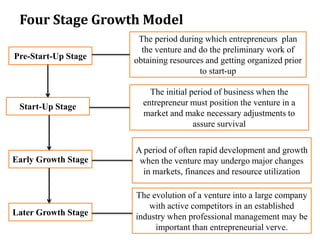
Four Stage Growth Model
Pre-Start-Up Stage
Start-Up Stage
Early Growth Stage
Later Growth Stage
The period during which entrepreneurs plan
the venture and do the preliminary work of
obtaining resources and getting organized prior
to start-up
The initial period of business when the
entrepreneur must position the venture in a
market and make necessary adjustments to
assure survival
A period of often rapid development and growth
when the venture may undergo major changes
in markets, finances and resource utilization
The evolution of a venture into a large company
with active competitors in an established
industry when professional management may be
important than entrepreneurial verve.
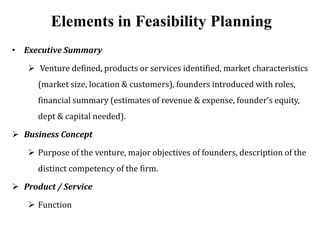
Elements in Feasibility Planning
• Executive Summary
 Venture defined, products or services identified, market characteristics
(market size, location & customers), founders introduced with roles,
financial summary (estimates of revenue & expense, founder’s equity,
dept & capital needed).
 Business Concept
 Purpose of the venture, major objectives of founders, description of the
distinct competency of the firm.
 Product / Service
 Function

Feasibility planning

  • 1.
  • 2.
    FEASIBILITY PLANNING • Isthe process of determining if a business idea is viable. • A feasibility study is valuable for:  Starting a new business  Expansion of an existing business  Adding an enterprise to an existing business  Purchasing an existing business.
  • 3.
    FEASIBILITY PLANNING • Afeasible business will:  Generate adequate cash flow and profits,  Withstand risks,  Remain viable in the long-term  Meet the goals of the founders
  • 4.
    Why do aFeasibility Study? • Provide a thorough examination of all issues and assessment of probability of business success • Give focus to the project and outline alternatives • Narrow business alternatives • Surface new opportunities through the investigative process • Identify reasons NOT to proceed • Enhance the probability of success by addressing and mitigating factors early on that could affect the project • Provide quality information for decision making • Help to increase investment in the company • Provide documentation that the business venture was thoroughly investigated • Help in securing funding from lending institutions and other monetary sources
  • 5.
    Reasons Not todo a Study • We already know it is feasible. • We did a study a couple of years ago. • Just a way for consultants to make money. • The company selling us the equipment says it is feasible. • Lets hire a general manager and have him do the study. • Waste of time – we need to buy the site and begin construction.
  • 6.
    Reasons to Doa Study • Gives focus to the project. • Narrows the business alternatives. • Identifies new opportunities. • Identifies reasons not to proceed. • Provides valuable information for “go/no go” decision. • Increases probability of business success by identifying weaknesses early. • Provides documentation that the idea was thoroughly investigated. • Helps attract funding from lenders, grant providers, etc. • Helps attract equity investment
  • 7.
    Data Sources fora Feasibility Assessment • Data required for a feasibility study can come from – primary or secondary sources • Primary data can include formal interviews and surveys • Collection of primary data can be expensive and time consuming • Secondary data can include industry and trade publications, statistics of industry associations, and government agency reports
  • 8.
    Levels of FeasibilityAssessment • A feasibility study of an idea is conducted at three levels  Operational Feasibility “Will it work?”  Technical Feasibility “Can it be built?”  Economic Feasibility “Will it make economic sense if it works and is built?” “ Will it generate PROFITS?”
  • 9.
    Steps for anEconomic Feasibility Study  Identify and Estimate all Capital Expenditures  Identify and Estimate all Variable Costs related to the Proposed Business Venture  Identify People and Skills required to operate Determine Wages, Salaries, and Benefits  Identify and Estimate Project Related Costs  Infrastructure development or improvements  Advertising and Promotion  Legal Fees  Municipal & State Development taxes  Identify and Estimate all Fixed Costs
  • 10.
    Other Feasibility StudyOutline • Market Feasibility  Industry description.  Industry competitiveness.  Market potential  Access to market outlets.  Sales projection • Technical Feasibility  Determine facility needs.  Suitability of production technology.  Availability and suitable of site.  Raw materials.  Other inputs.
  • 11.
    Feasibility Study v/sBusiness Plan • Feasibility study answers the bottom line question—Is this venture going to make money? • Feasibility study outlines and analyzes several alternatives or methods of achieving business success • Feasibility study is conducted before a business plan • Business plan is prepared only after the venture has been deemed to be feasible • Business plan deals with only one alternative or scenario that is determined to be the “best” alternative • Business plan considers the management side—goals and objectives of the planned business venture
  • 12.
    Four Stage GrowthModel Pre-Start-Up Stage Start-Up Stage Early Growth Stage Later Growth Stage The period during which entrepreneurs plan the venture and do the preliminary work of obtaining resources and getting organized prior to start-up The initial period of business when the entrepreneur must position the venture in a market and make necessary adjustments to assure survival A period of often rapid development and growth when the venture may undergo major changes in markets, finances and resource utilization The evolution of a venture into a large company with active competitors in an established industry when professional management may be important than entrepreneurial verve.
  • 13.
    Elements in FeasibilityPlanning • Executive Summary  Venture defined, products or services identified, market characteristics (market size, location & customers), founders introduced with roles, financial summary (estimates of revenue & expense, founder’s equity, dept & capital needed).  Business Concept  Purpose of the venture, major objectives of founders, description of the distinct competency of the firm.  Product / Service  Function