Simple Random Sampling
Mr. Surajkumar D. Chaudhari
M.Sc. (Statistics), Sem – II, Roll no. : 03
Paper-203 (Sampling Theory)
1
CONTENTS
• Introduction
• Why Simple Random Sampling?
• Method to get Simple Random Sample
• SRSWR
• SRSWOR
• Pir
(Probability of ith
unit to be selected at rth
draw)
2
INTRODUCTION
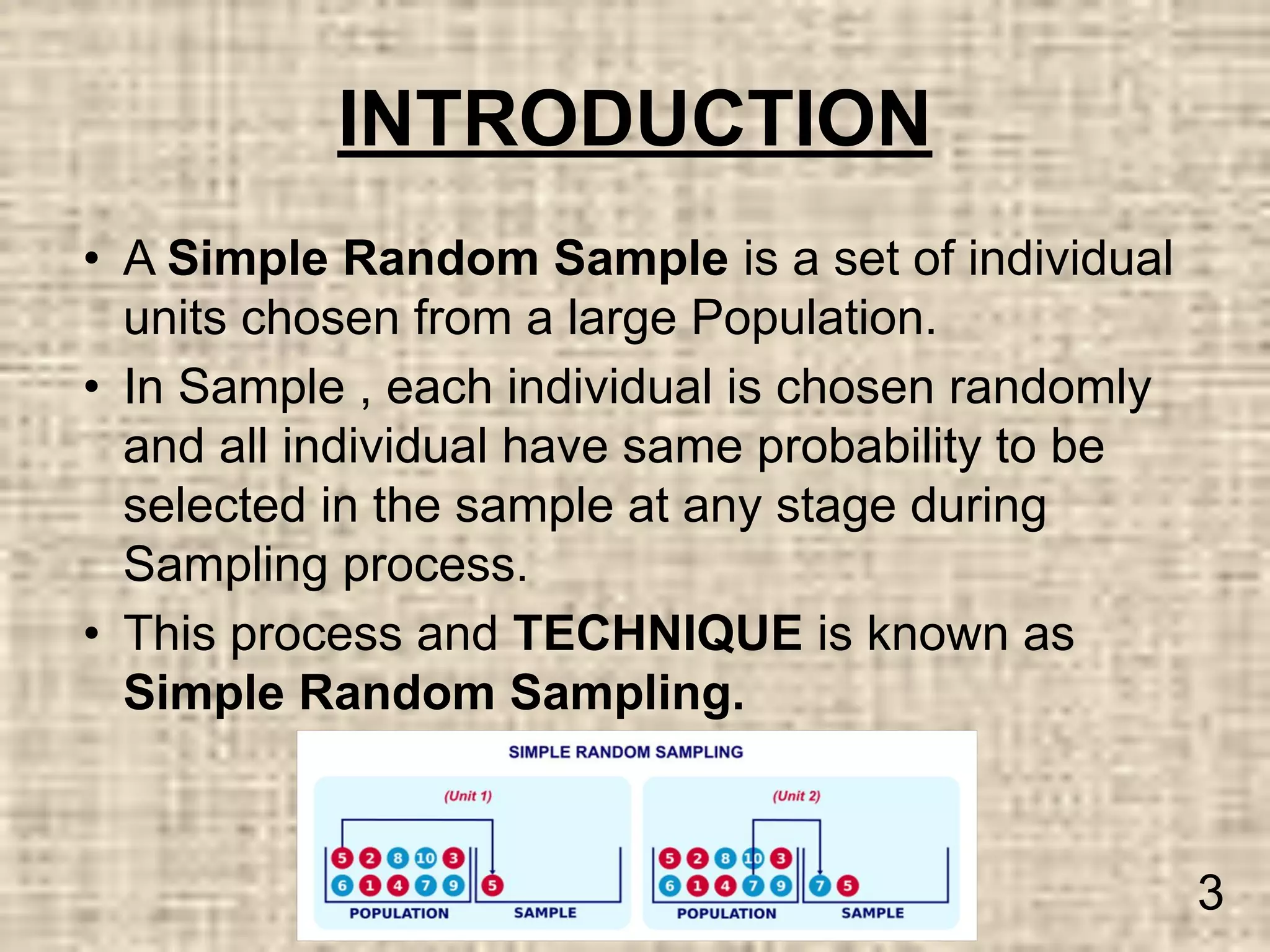
• A Simple Random Sample is a set of individual
units chosen from a large Population.
• In Sample , each individual is chosen randomly
and all individual have same probability to be
selected in the sample at any stage during
Sampling process.
• This process and TECHNIQUE is known as
Simple Random Sampling.
3
Why Simple Random Sampling?
• The members of the sample are selected
randomly.
• Every member has an equal chance of being
selected in the sample.
• Simple Random Sampling is a suitable
technique for a Population which is highly
homogeneous And having complete
sampling frame And having finite number of
units in the population.
• It is a Simplest way to get Random Sample.
4
Method to get Simple Random
Sample
• There are two ways to get a Simple Random
Sample:
1. The Lottery Method
2. Random Number Table
• (1) The Lottery Method :
• First we give unique no. to all population units.
Like 1,2,…
• Each number placed in a card of Similar Size,
Similar Shape and Same Colour.
• All cards put in a bowl and mixed well.
6
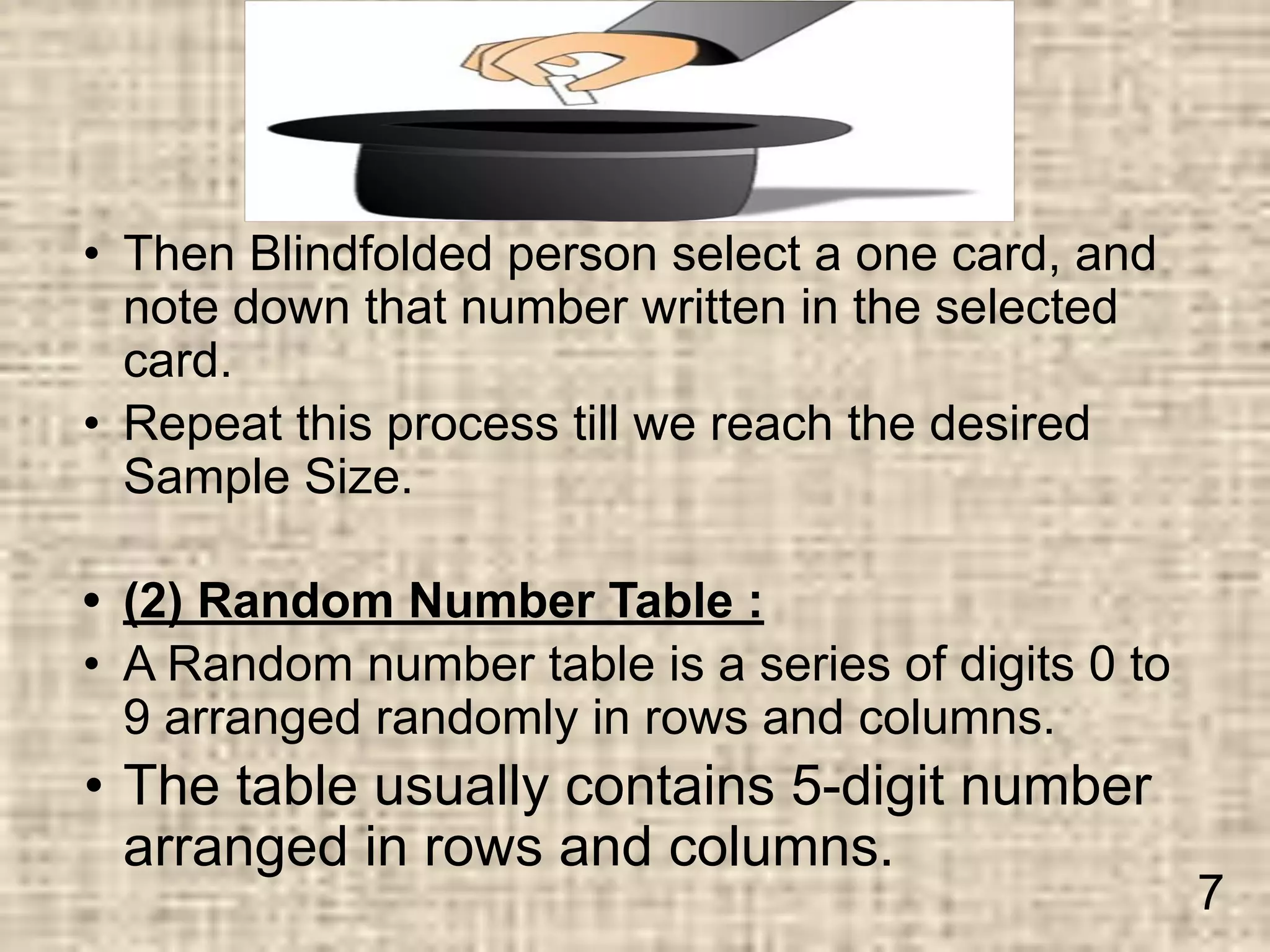
• Then Blindfolded person select a one card, and
note down that number written in the selected
card.
• Repeat this process till we reach the desired
Sample Size.
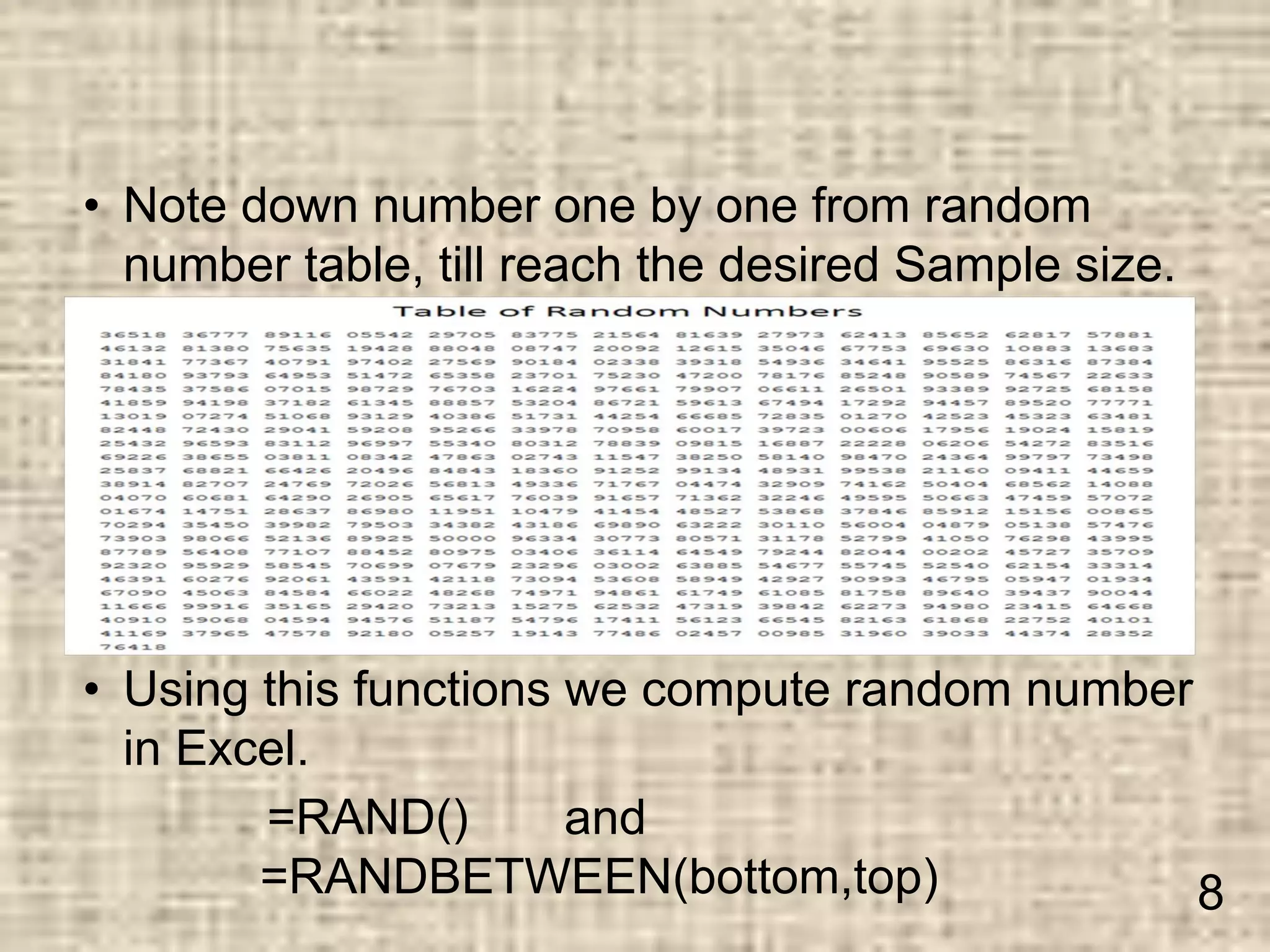
• (2) Random Number Table :
• A Random number table is a series of digits 0 to
9 arranged randomly in rows and columns.
• The table usually contains 5-digit number
arranged in rows and columns.
7
• Note down number one by one from random
number table, till reach the desired Sample size.
• Using this functions we compute random number
in Excel.
=RAND() and
=RANDBETWEEN(bottom,top) 8
SRSWR and SRSWOR
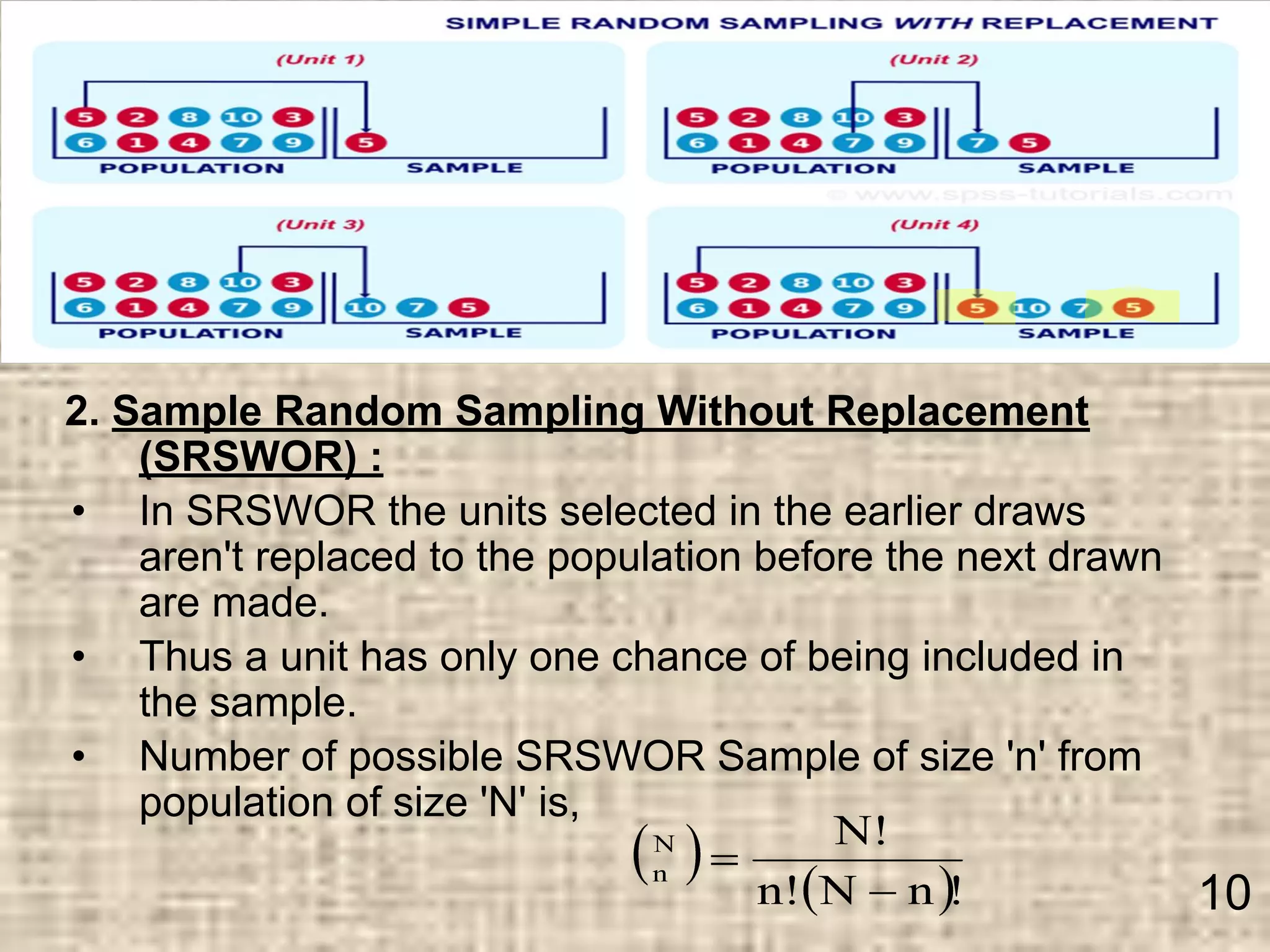
1. Simple Random Sampling With Replacement
(SRSWR) :
• In SRSWR the units selected in the earlier draws are
replaced to the population before the next draws are
made.
• Thus a unit has a chance of being included in the
sample for more than once.
• Number of possible SRSWR sample of size 'n' from
population of size 'N' is, Nn
.
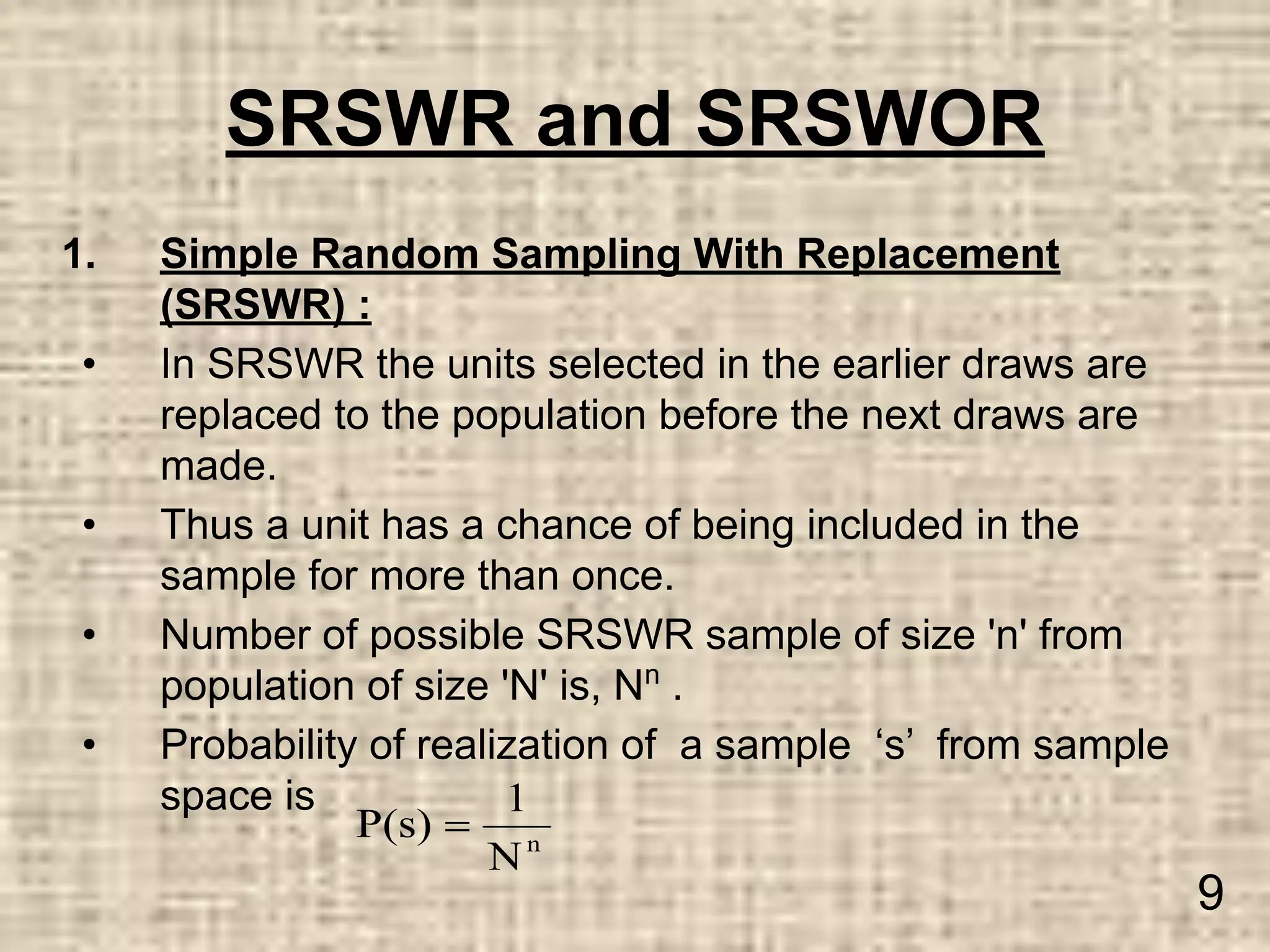
• Probability of realization of a sample ‘s’ from sample
space is
9
2. Sample Random Sampling Without Replacement
(SRSWOR) :
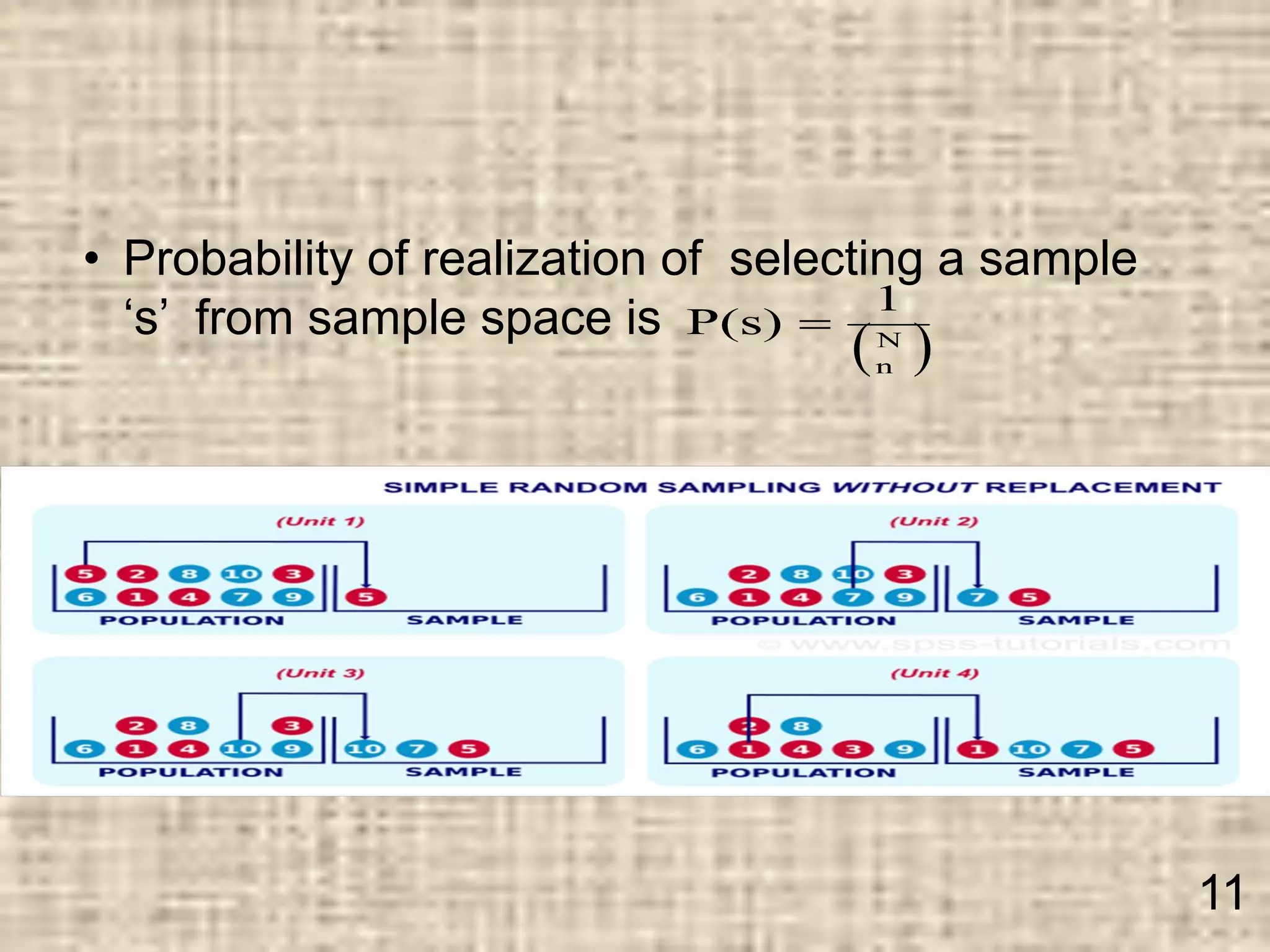
• In SRSWOR the units selected in the earlier draws
aren't replaced to the population before the next drawn
are made.
• Thus a unit has only one chance of being included in
the sample.
• Number of possible SRSWOR Sample of size 'n' from
population of size 'N' is,
10
• Probability of realization of selecting a sample
‘s’ from sample space is
11
Pir
(Probailiy of ith
unit to be
selected at rth
draw)
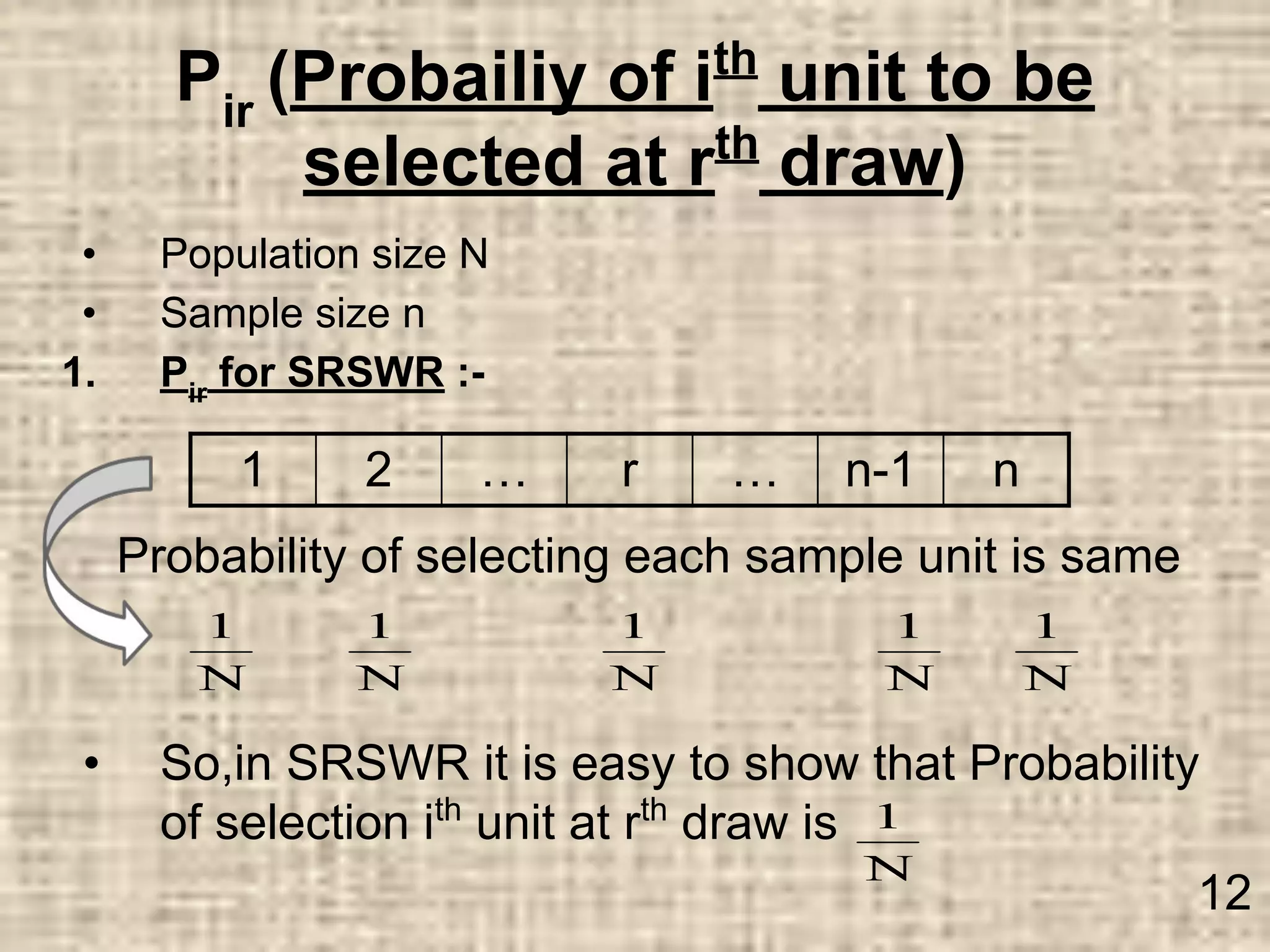
• Population size N
• Sample size n
1. Pir
for SRSWR :-
Probability of selecting each sample unit is same
• So,in SRSWR it is easy to show that Probability
of selection ith
unit at rth
draw is
1 2 … r … n-1 n
12
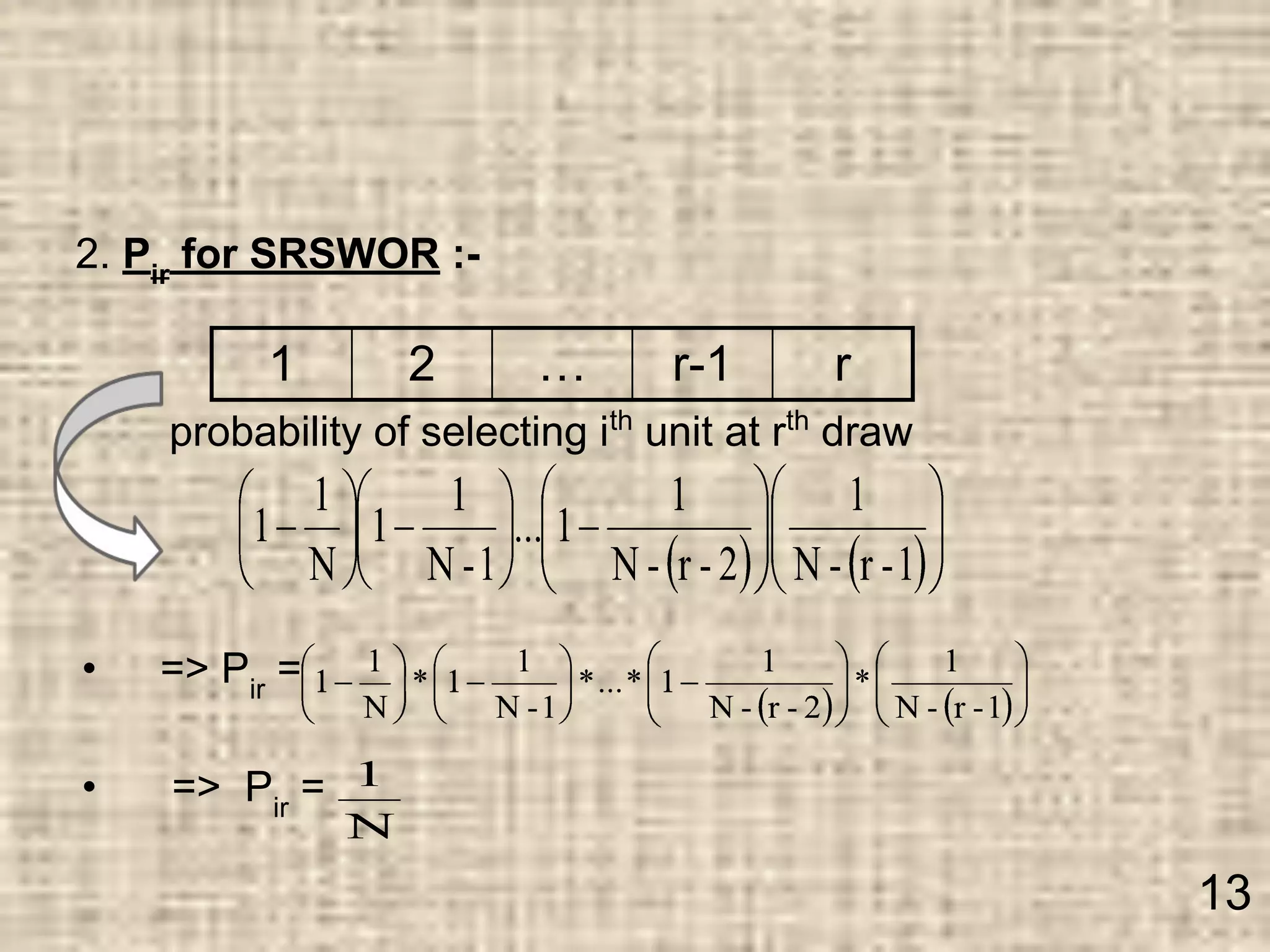
2. Pir
for SRSWOR :-
probability of selecting ith
unit at rth
draw
• => Pir
=
• => Pir
=
1 2 … r-1 r
13
14

Simple Random Sampling

  • 1.
    Simple Random Sampling Mr.Surajkumar D. Chaudhari M.Sc. (Statistics), Sem – II, Roll no. : 03 Paper-203 (Sampling Theory) 1
  • 2.
    CONTENTS • Introduction • WhySimple Random Sampling? • Method to get Simple Random Sample • SRSWR • SRSWOR • Pir (Probability of ith unit to be selected at rth draw) 2
  • 3.
    INTRODUCTION • A SimpleRandom Sample is a set of individual units chosen from a large Population. • In Sample , each individual is chosen randomly and all individual have same probability to be selected in the sample at any stage during Sampling process. • This process and TECHNIQUE is known as Simple Random Sampling. 3
  • 4.
    Why Simple RandomSampling? • The members of the sample are selected randomly. • Every member has an equal chance of being selected in the sample. • Simple Random Sampling is a suitable technique for a Population which is highly homogeneous And having complete sampling frame And having finite number of units in the population. • It is a Simplest way to get Random Sample. 4
  • 5.
    Method to getSimple Random Sample • There are two ways to get a Simple Random Sample: 1. The Lottery Method 2. Random Number Table • (1) The Lottery Method : • First we give unique no. to all population units. Like 1,2,… • Each number placed in a card of Similar Size, Similar Shape and Same Colour. • All cards put in a bowl and mixed well. 6
  • 6.
    • Then Blindfoldedperson select a one card, and note down that number written in the selected card. • Repeat this process till we reach the desired Sample Size. • (2) Random Number Table : • A Random number table is a series of digits 0 to 9 arranged randomly in rows and columns. • The table usually contains 5-digit number arranged in rows and columns. 7
  • 7.
    • Note downnumber one by one from random number table, till reach the desired Sample size. • Using this functions we compute random number in Excel. =RAND() and =RANDBETWEEN(bottom,top) 8
  • 8.
    SRSWR and SRSWOR 1.Simple Random Sampling With Replacement (SRSWR) : • In SRSWR the units selected in the earlier draws are replaced to the population before the next draws are made. • Thus a unit has a chance of being included in the sample for more than once. • Number of possible SRSWR sample of size 'n' from population of size 'N' is, Nn . • Probability of realization of a sample ‘s’ from sample space is 9
  • 9.
    2. Sample RandomSampling Without Replacement (SRSWOR) : • In SRSWOR the units selected in the earlier draws aren't replaced to the population before the next drawn are made. • Thus a unit has only one chance of being included in the sample. • Number of possible SRSWOR Sample of size 'n' from population of size 'N' is, 10
  • 10.
    • Probability ofrealization of selecting a sample ‘s’ from sample space is 11
  • 11.
    Pir (Probailiy of ith unitto be selected at rth draw) • Population size N • Sample size n 1. Pir for SRSWR :- Probability of selecting each sample unit is same • So,in SRSWR it is easy to show that Probability of selection ith unit at rth draw is 1 2 … r … n-1 n 12
  • 12.
    2. Pir for SRSWOR:- probability of selecting ith unit at rth draw • => Pir = • => Pir = 1 2 … r-1 r 13
  • 13.