Sampling and sample preparation
To perform a meaningful chemical analysis, we must obtain a small,
homogenous sample whose composition is representative of the larger object.
Many analytical problems being with the objects that are not suitable for a
laboratory experiment.
General steps in chemical analysis:
1- Formulating the questions.
Translate general questions into specific questions to being answered
through chemical measurements.
2- Selecting analytical procedure.
Find the appropriate procedure to make the required measurements.
3- Sampling.
Obtain a representative bulk sample from the lot.
4- Sample preparation
- Extract from the bulk sample a homogenous laboratory sample.
- Convert the laboratory sample into a form suitable for analysis (i.e.
dissolving the sample).
- Remove or mask the species that interfere with the chemical
analysis.
5- Analysis.
Measure the concentration of the analyte in several aliquots.
6- Reporting and interpretation.
7- Drawing conclusion.
A sample
Sampling
Is the process of selecting a representative bulk sample from the lot sample for
analysis.
From the representative bulk sample, a smaller homogenous laboratory sample
is formed that must have the same composition as the bulk sample.
Sample preparation
Is the process or the steps that converts bulk sample into a homogenous
laboratory sample suitable for chemical analysis.
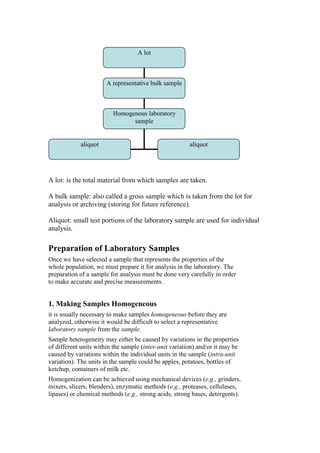
A lot: is the total material from which samples are taken.
A bulk sample: also called a gross sample which is taken from the lot for
analysis or archiving (storing for future reference).
Aliquot: small test portions of the laboratory sample are used for individual
analysis.
Preparation of Laboratory Samples
Once we have selected a sample that represents the properties of the
whole population, we must prepare it for analysis in the laboratory. The
preparation of a sample for analysis must be done very carefully in order
to make accurate and precise measurements.
1. Making Samples Homogeneous
it is usually necessary to make samples homogeneous before they are
analyzed, otherwise it would be difficult to select a representative
laboratory sample from the sample.
Sample heterogeneity may either be caused by variations in the properties
of different units within the sample (inter-unit variation) and/or it may be
caused by variations within the individual units in the sample (intra-unit
variation). The units in the sample could be apples, potatoes, bottles of
ketchup, containers of milk etc.
Homogenization can be achieved using mechanical devices (e.g., grinders,
mixers, slicers, blenders), enzymatic methods (e.g., proteases, cellulases,
lipases) or chemical methods (e.g., strong acids, strong bases, detergents).
A lot
A representative bulk sample
Homogenous laboratory
sample
aliquot aliquot
2. Reducing Sample Size
Once the sample has been made homogeneous, a small more manageable
portion is selected for analysis. Sampling plans often define the method
for reducing the size of a sample in order to obtain reliable and repeatable
results.
3. Preventing Changes in Sample
Once we have selected our sample we have to ensure that it does not
undergo any significant changes in its properties from the moment of
sampling to the time when the actual analysis is carried out, e.g.,
enzymatic, chemical, microbial or physical changes.
4. Sample Identification
Laboratory samples should always be labeled carefully so that if any
problem develops its origin can easily be identified. The information used
to identify a sample includes: a) Sample description, b) Time sample was
taken, c) Location sample was taken from, d) Person who took the sample,
and, e) Method used to select the sample.
Types of sampling
• Probability sampling
-Any method of sampling that utilizes some
form of random selection.
-Requires setting up some process or procedure that assures that the different units in
your population have equal probabilities of beingchosen.
• Simple random sample
Obtained by choosing elementary units in
search a way that each unit in the population
has an equal chance of being selected.
• Systematic random sample
-Obtained by selecting one unit on a random basis and
choosing additional elementary units at evenly spaced
intervals until the desired number of units is obtained.
Example:
– There are 100 students in your class.
– You want a sample of 20.
– You have a class listing in alphabetical order.
– Divide 100 by 20, you will get 5.
– Randomly select any number between 1 and five. That is
your starting number.
– From there select every 5th name until you reach the last
One
– Stratified sample
• A stratified sample is obtained by selecting a separate
simple random sample from each population stratum.
– It assures that you will be able to represent not only the
overall population, but also key subgroups of the
population, especially small minority groups.
– If you want to be able to talk about subgroups, this may be
the only way to effectively assure you'll be able to.
– Cluster sample
• Obtained by selecting clusters from the population on
the basis of simple random sampling.
• Identify groups within the population, and then
randomly sample groups.
– Multistage sampling
• Combine different methods of probability
sampling.
• Nonprobability sampling
– Convenience sampling
• The more convenient elementary units are chosen
from a population for observation.
– Purposive sampling
We have one or more specific predefined
groups we seeking.
.
Modal instance sample
• Sampling the most frequent case, or the "typical"
case.
• Example: interviewing a "typical" voter.
• Problem: How do we know what the "typical" or
"modal" case is?
– We could say that the modal voter is a person who is of
average age, educational level, and income in the
population.
– But are averages the best? (consider the skewed
distribution of income, for instance).
– How do we know that those three variables -- age,
education, income -- are the most relevant for classifying
the typical voter? What if religion or ethnicity is important?
Expert sampling
• Assembling of a sample of persons with
known or demonstrable experience and
expertise in some area - a "panel of experts."
Quota sampling
• Select people nonrandomly according to some fixed
quota.
• Proportional quota sampling:
– Represent the major characteristics of the population by
sampling a proportional amount of each.
• Nonproportional quota sampling:
– Specify the minimum number of sampled units you want in
each category.
– Typically used to assure that smaller groups are adequately
represented in your sample.
Heterogeneity sampling
• Sampling so as to include all opinions or views, but
not representing these views proportionately.
• Purposefully picking a wide range of variation on
dimensions of interest.
– AKA sampling for diversity, maximum variation sampling.
• Documents unique or diverse variations that have
emerged in adapting to different conditions.
• Identifies important common patterns that cut across
variations.
• Example: In interviewing MD students, you may
want to get students of different nationalities,
backgrounds, cultures, work experience…
Snowball sampling
• Begin by identifying someone who meets the criteria
for inclusion in your study.
• Then ask them to recommend others who they may
know who also meet the criteria.
• Does not lead to representative samples.
• May be the best method available for reaching
populations that are inaccessible or hard to find.
• Example: Studying the homeless
– You will not find lists of homeless people.
– However, if you identify one or two, they may know the
other homeless people in their vicinity and how you can
find them.
Extreme and deviant case
sampling
• Learning from highly unusual manifestations
of the phenomenon of interest
• Example: studying outstanding successes,
notable failures, top of the class, dropouts,
exotic events, crises, CI stars
Criterion sampling
• You set a criteria and pick all cases that meet
that criteria
• Example: all women six feet tall, all white cars,
all farmers that have planted onions.
• Most often used in quality assurance.
http://www.bsos.umd.edu/hesp/newman/newman_classes/newman724/sampling6.pdf
Sampling is the process of selecting a number of subjects from all the subjects in a
particular group or "universe."
We sample because we cannot measure every person in the population.
Types of Sampling
When deciding on sample spacings and sampling procedures, one must be fully aware of the
different levels (or scales) of variability with sampled materials and adjust sample
intervals/locations accordingly or use composite samples to represent wide intervals in order
to attain a measure of confidence in the intervals between sample locations.
Sampling can consist of various types:
Point samples: This is can be a single grab sample chosen to represent some mass; or it
can be random samples taken from various source points, generally within a predetermined
area, and can be either in two dimensions or three dimensions (ie. dump pile) and
composited.
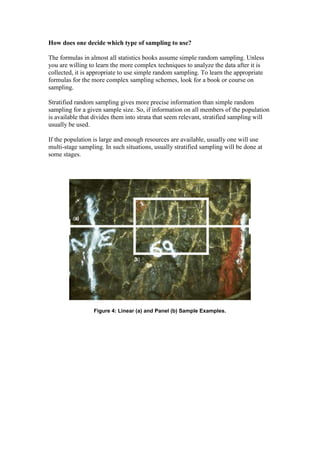
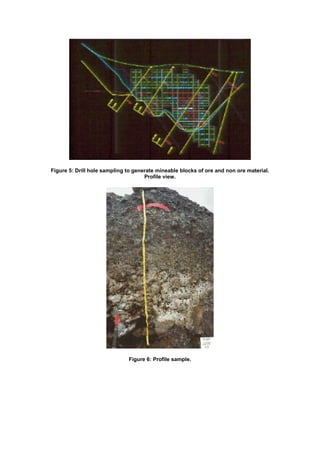
Linear samples: Continuous sampling over an interval in a line such as channel samples
(Figure 4) or drill hole samples, (Figure 5) and profile sampling of overburden (Figure 6).
Panel samples: These are planar samples made up of multiple chips collected from a
surface with dimensions (i.e. one by two metres, Figure 4).
Bulk samples: Sampling of a large mass of material that will be crushed and split into
fractions. Samples may be taken from the various splits.
What are the main types of sampling and how is each done?
Simple Random Sampling: A simple random sample (SRS) of size n is produced by
a scheme which ensures that each subgroup of the population of size n has an equal
probability of being chosen as the sample.
Stratified Random Sampling: Divide the population into "strata". There can be any
number of these. Then choose a simple random sample from each stratum. Combine
those into the overall sample. That is a stratified random sample. (Example: Church A
has 600 women and 400 women as members. One way to get a stratified random
sample of size 30 is to take a SRS of 18 women from the 600 women and another
SRS of 12 men from the 400 men.)
Multi-Stage Sampling: Sometimes the population is too large and scattered for it to
be practical to make a list of the entire population from which to draw a SRS. For
instance, when the a polling organization samples US voters, they do not do a SRS.
Since voter lists are compiled by counties, they might first do a sample of the counties
and then sample within the selected counties. This illustrates two stages. In some
instances, they might use even more stages. At each stage, they might do a stratified
random sample on sex, race, income level, or any other useful variable on which they
could get information before sampling.
How does one decide which type of sampling to use?
The formulas in almost all statistics books assume simple random sampling. Unless
you are willing to learn the more complex techniques to analyze the data after it is
collected, it is appropriate to use simple random sampling. To learn the appropriate
formulas for the more complex sampling schemes, look for a book or course on
sampling.
Stratified random sampling gives more precise information than simple random
sampling for a given sample size. So, if information on all members of the population
is available that divides them into strata that seem relevant, stratified sampling will
usually be used.
If the population is large and enough resources are available, usually one will use
multi-stage sampling. In such situations, usually stratified sampling will be done at
some stages.
Figure 4: Linear (a) and Panel (b) Sample Examples.
Figure 5: Drill hole sampling to generate mineable blocks of ore and non ore material.
Profile view.
Figure 6: Profile sample.

Sampling and sample preparation.slidesdoc

  • 1.
    Sampling and samplepreparation To perform a meaningful chemical analysis, we must obtain a small, homogenous sample whose composition is representative of the larger object. Many analytical problems being with the objects that are not suitable for a laboratory experiment. General steps in chemical analysis: 1- Formulating the questions. Translate general questions into specific questions to being answered through chemical measurements. 2- Selecting analytical procedure. Find the appropriate procedure to make the required measurements. 3- Sampling. Obtain a representative bulk sample from the lot. 4- Sample preparation - Extract from the bulk sample a homogenous laboratory sample. - Convert the laboratory sample into a form suitable for analysis (i.e. dissolving the sample). - Remove or mask the species that interfere with the chemical analysis. 5- Analysis. Measure the concentration of the analyte in several aliquots. 6- Reporting and interpretation. 7- Drawing conclusion. A sample Sampling Is the process of selecting a representative bulk sample from the lot sample for analysis. From the representative bulk sample, a smaller homogenous laboratory sample is formed that must have the same composition as the bulk sample. Sample preparation Is the process or the steps that converts bulk sample into a homogenous laboratory sample suitable for chemical analysis.
  • 2.
    A lot: isthe total material from which samples are taken. A bulk sample: also called a gross sample which is taken from the lot for analysis or archiving (storing for future reference). Aliquot: small test portions of the laboratory sample are used for individual analysis. Preparation of Laboratory Samples Once we have selected a sample that represents the properties of the whole population, we must prepare it for analysis in the laboratory. The preparation of a sample for analysis must be done very carefully in order to make accurate and precise measurements. 1. Making Samples Homogeneous it is usually necessary to make samples homogeneous before they are analyzed, otherwise it would be difficult to select a representative laboratory sample from the sample. Sample heterogeneity may either be caused by variations in the properties of different units within the sample (inter-unit variation) and/or it may be caused by variations within the individual units in the sample (intra-unit variation). The units in the sample could be apples, potatoes, bottles of ketchup, containers of milk etc. Homogenization can be achieved using mechanical devices (e.g., grinders, mixers, slicers, blenders), enzymatic methods (e.g., proteases, cellulases, lipases) or chemical methods (e.g., strong acids, strong bases, detergents). A lot A representative bulk sample Homogenous laboratory sample aliquot aliquot
  • 3.
    2. Reducing SampleSize Once the sample has been made homogeneous, a small more manageable portion is selected for analysis. Sampling plans often define the method for reducing the size of a sample in order to obtain reliable and repeatable results. 3. Preventing Changes in Sample Once we have selected our sample we have to ensure that it does not undergo any significant changes in its properties from the moment of sampling to the time when the actual analysis is carried out, e.g., enzymatic, chemical, microbial or physical changes. 4. Sample Identification Laboratory samples should always be labeled carefully so that if any problem develops its origin can easily be identified. The information used to identify a sample includes: a) Sample description, b) Time sample was taken, c) Location sample was taken from, d) Person who took the sample, and, e) Method used to select the sample. Types of sampling • Probability sampling -Any method of sampling that utilizes some form of random selection. -Requires setting up some process or procedure that assures that the different units in your population have equal probabilities of beingchosen. • Simple random sample Obtained by choosing elementary units in search a way that each unit in the population has an equal chance of being selected. • Systematic random sample -Obtained by selecting one unit on a random basis and choosing additional elementary units at evenly spaced intervals until the desired number of units is obtained. Example: – There are 100 students in your class.
  • 4.
    – You wanta sample of 20. – You have a class listing in alphabetical order. – Divide 100 by 20, you will get 5. – Randomly select any number between 1 and five. That is your starting number. – From there select every 5th name until you reach the last One – Stratified sample • A stratified sample is obtained by selecting a separate simple random sample from each population stratum. – It assures that you will be able to represent not only the overall population, but also key subgroups of the population, especially small minority groups. – If you want to be able to talk about subgroups, this may be the only way to effectively assure you'll be able to. – Cluster sample • Obtained by selecting clusters from the population on the basis of simple random sampling. • Identify groups within the population, and then randomly sample groups. – Multistage sampling • Combine different methods of probability sampling. • Nonprobability sampling – Convenience sampling • The more convenient elementary units are chosen from a population for observation. – Purposive sampling We have one or more specific predefined groups we seeking. . Modal instance sample • Sampling the most frequent case, or the "typical" case. • Example: interviewing a "typical" voter. • Problem: How do we know what the "typical" or "modal" case is? – We could say that the modal voter is a person who is of average age, educational level, and income in the
  • 5.
    population. – But areaverages the best? (consider the skewed distribution of income, for instance). – How do we know that those three variables -- age, education, income -- are the most relevant for classifying the typical voter? What if religion or ethnicity is important? Expert sampling • Assembling of a sample of persons with known or demonstrable experience and expertise in some area - a "panel of experts." Quota sampling • Select people nonrandomly according to some fixed quota. • Proportional quota sampling: – Represent the major characteristics of the population by sampling a proportional amount of each. • Nonproportional quota sampling: – Specify the minimum number of sampled units you want in each category. – Typically used to assure that smaller groups are adequately represented in your sample. Heterogeneity sampling • Sampling so as to include all opinions or views, but not representing these views proportionately. • Purposefully picking a wide range of variation on dimensions of interest. – AKA sampling for diversity, maximum variation sampling. • Documents unique or diverse variations that have emerged in adapting to different conditions. • Identifies important common patterns that cut across variations. • Example: In interviewing MD students, you may want to get students of different nationalities, backgrounds, cultures, work experience… Snowball sampling • Begin by identifying someone who meets the criteria for inclusion in your study. • Then ask them to recommend others who they may know who also meet the criteria. • Does not lead to representative samples. • May be the best method available for reaching populations that are inaccessible or hard to find. • Example: Studying the homeless – You will not find lists of homeless people. – However, if you identify one or two, they may know the other homeless people in their vicinity and how you can find them. Extreme and deviant case sampling • Learning from highly unusual manifestations of the phenomenon of interest • Example: studying outstanding successes, notable failures, top of the class, dropouts, exotic events, crises, CI stars Criterion sampling • You set a criteria and pick all cases that meet that criteria • Example: all women six feet tall, all white cars, all farmers that have planted onions. • Most often used in quality assurance. http://www.bsos.umd.edu/hesp/newman/newman_classes/newman724/sampling6.pdf
  • 6.
    Sampling is theprocess of selecting a number of subjects from all the subjects in a particular group or "universe." We sample because we cannot measure every person in the population. Types of Sampling When deciding on sample spacings and sampling procedures, one must be fully aware of the different levels (or scales) of variability with sampled materials and adjust sample intervals/locations accordingly or use composite samples to represent wide intervals in order to attain a measure of confidence in the intervals between sample locations. Sampling can consist of various types: Point samples: This is can be a single grab sample chosen to represent some mass; or it can be random samples taken from various source points, generally within a predetermined area, and can be either in two dimensions or three dimensions (ie. dump pile) and composited. Linear samples: Continuous sampling over an interval in a line such as channel samples (Figure 4) or drill hole samples, (Figure 5) and profile sampling of overburden (Figure 6). Panel samples: These are planar samples made up of multiple chips collected from a surface with dimensions (i.e. one by two metres, Figure 4). Bulk samples: Sampling of a large mass of material that will be crushed and split into fractions. Samples may be taken from the various splits. What are the main types of sampling and how is each done? Simple Random Sampling: A simple random sample (SRS) of size n is produced by a scheme which ensures that each subgroup of the population of size n has an equal probability of being chosen as the sample. Stratified Random Sampling: Divide the population into "strata". There can be any number of these. Then choose a simple random sample from each stratum. Combine those into the overall sample. That is a stratified random sample. (Example: Church A has 600 women and 400 women as members. One way to get a stratified random sample of size 30 is to take a SRS of 18 women from the 600 women and another SRS of 12 men from the 400 men.) Multi-Stage Sampling: Sometimes the population is too large and scattered for it to be practical to make a list of the entire population from which to draw a SRS. For instance, when the a polling organization samples US voters, they do not do a SRS. Since voter lists are compiled by counties, they might first do a sample of the counties and then sample within the selected counties. This illustrates two stages. In some instances, they might use even more stages. At each stage, they might do a stratified random sample on sex, race, income level, or any other useful variable on which they could get information before sampling.
  • 7.
    How does onedecide which type of sampling to use? The formulas in almost all statistics books assume simple random sampling. Unless you are willing to learn the more complex techniques to analyze the data after it is collected, it is appropriate to use simple random sampling. To learn the appropriate formulas for the more complex sampling schemes, look for a book or course on sampling. Stratified random sampling gives more precise information than simple random sampling for a given sample size. So, if information on all members of the population is available that divides them into strata that seem relevant, stratified sampling will usually be used. If the population is large and enough resources are available, usually one will use multi-stage sampling. In such situations, usually stratified sampling will be done at some stages. Figure 4: Linear (a) and Panel (b) Sample Examples.
  • 8.
    Figure 5: Drillhole sampling to generate mineable blocks of ore and non ore material. Profile view. Figure 6: Profile sample.