SAMPLING
& FOOD
TESTING
ECOSYSTE
M
BY MANISHA
DABRAL
SR. NO. 55
INTRODUCTION
Sampling involves the selection of a certain portion, number of container and product units from a lot of the
particular the same food.Samples are usually collected from a lot of food for random surveillance, collection
of data for a specific purpose, or monitoring/and to determine the conformity to product standards specified
in the regulation .
The broad objectives of testing articles of food / ingredients are:
• Protecting Public Health
• Detecting fraudulent activities
• Providing customers with information to
make informed choices
• Ensuring compliance to the National
Food Standards
• Surveillance and Enforcement
• Promoting fair trade and deterring bad
practice
LEGAL PROVISIONS RELATED TO SAMPLING AND
ANALYSIS
The following provisions provided in the Food Safety and Standards Act (2006) and Food Safety and
Standards Rules and
Regulations, 2011 are related to sampling and analysis of food and functioning of laboratories.
i. Food Safety and Standards Act (FSSAI), 2006 - Section 43, 45, 46, 47 of FSS Act, 2006;
ii. Food Safety and Standards (FSS) Rules, 2011
iii. Food Safety and Standards (Laboratory and Sample Analysis) Regulation, 2011
iv. Food Safety and Standards (Recognition and Notification of Laboratories) Regulation,2018
Compliance to FSSAI : These samples are taken under formal enforcement and
regulatory compliance activities.
Compliance testing is a regulatory control measure to prevent the marketing or
remove from market a product known to be contaminated or adulterated.
RELEVANT DEFINITIONS USED IN SAMPLING PROTOCOLS:-
• Lot (or Population) :A defined quantity of a commodity that has been produced or
manufactured under the same basic conditions on the same day, at the same establishment,
and identified under the same batch number or the entire production for a certain period of
time from which samples are to be taken. The lot may be homogenous or heterogenous.
The lot may be homogenous or heterogenous.
• Lot size : It is the number of units of the product in a lot e.g (100 metric tonnes of
wheat or 500 L of milk or 200 packets of biscuits
• Sample: A sample is the specific group that you will collect data from.
• Primary sample (or increment) : A small quantity of grain/oilseeds/milled/first
transformation products taken at one time from a single position from a stationary
lot.
• Composite (Bulk) Sample : Quantity of commodity (grain / oilseeds / milled / first
transformation product) obtained by combining and mixing the increments taken
from a specific lot.
• Laboratory Sample : Representative quantity of commodity (grain/oilseeds/milled/
first transformation product/packages) obtained by division of the bulk sample and
intended for analysis finally submitted to the laboratory for analysis.
• Surveillance Sample : Taken as part of routine inspections or surveys to identify any
lack of compliance with state, federal or other laws and regulations.
• Representative (Random) sample : A sample in which the characteristics of the lot
from which it is drawn are maintained. It is in particular the case of a simple random
sample where each of the items or increments of the lot has been given the same
probability of entering the sample i.e. all elements in the lot have an equal and
independent chance of being included in the sample.
• Unit size : The particular food portion or container selected as a sample and from which one
or more units will be taken for analysis.
• Sampling plan : predetermined procedure for the selection, withdrawal, preservation,
transportation and preparation of the portions to be removed from a lot as a sample.
• Sampling procedure (or protocol) : operational requirements and / or instructions relating
to the use of a particular sampling plan (i.e., the instructions for the implementation of the
plan).
• Official (Legal) Sample : Sample taken in a manner so that it can serve as the basis for enforcement and/
or legal action and handled in a manner that preserves integrity as evidence including identity , ownership,
traceability and a clear record of chain of custody.
• Investigation Sample : Taken during a food safety inspection to document inspector observations, support regulatory actions or provide
other information.
ACCEPTANCE SAMPLING
Acceptance sampling is one of the main areas of statistical quality control and is an inspection procedure.For food safety and
quality, acceptance sampling techniques are a commonly used procedure used to determine whether to accept or reject a
specific quantity of food lot. Sampling inspection plans are used to assess safety of the food for human consumption and the
“fitness for use” of batches of products. The steps involved are:
1. A random sample is taken from a large quantity of items and tested or measured relative to the quality
and / or safety characteristic of interest.
2. If the sample passes the test, the entire quantity of items is accepted.
3. If the sample fails the test, either (a) the entire quantity of items is subjected to 100 percent inspection and all
defective items repaired or replaced or (b) the entire quantity is returned to the supplier.
• The presence of a well-designed plan is important as it provides a consistent model to guide samplers,
and serves as a reminder of the important elements of the overall sample analysis program. The precise definition
of an acceptance sampling procedure will require the setting or selection of:
1. The characteristic to be measured
2. Lot size
3. An attribute or variables sampling plan
4. The Limiting Quality (LQ) level for isolated lots; or the AQL (Acceptable Quality Level),
for a continuous series of lots
5. The level of inspection
6. The size of the sample
7. The criteria for acceptance or rejection of the lot
8. The procedures to be adopted in cases of dispute
ATTRIBUTE AND VARIABLE PLANS IN ACCEPTANCE SAMPLING
The major sampling plans used in food analysis are:
1. Attribute sampling plan
2. Variable sampling plan
ATTRIBUTE SAMPLING PLAN
In attribute sampling plan, sampling is done to decide the acceptability of a lot based on the number of unacceptable items in
the sample. The acceptability of an item depends on the presence or absence of a characteristic.
There are two types of attribute sampling plan viz., two-class attribute sampling and three-class attribute sampling,
which are often used when assessing microbiological contamination of foods.
• Two-class attribute sampling : The two-class plan is essentially defined by two numbers and two attributes. The first one
'n', determines the number of sample units that are to be drawn independently and randomly from the lot and tested.
The second number c, is the maximum allowable number of defective sample units , which separates acceptable from non
acceptable or defective quality. The value c is usually set to zero for pathogens.
• Three-class attribute sampling : In this case, 'n' is the number of samples selected at random from the lot, the numerical
value 'm' represents acceptable level and 'M' unacceptable concentrations / counts, and acceptable sample units such that if
this c' is the maximum allowable number of marginally number is exceeded, the lot is considered as unacceptable.While 'm'
separates sample units of acceptable quality from those of marginally acceptable quality,'M' separates sample units of
marginally acceptable quality from those of defective quality.
VARIABLE SAMPLING PLAN
When actual quantitative information can be measured on sampled items, rather than simply classifying them as
acceptable or unacceptable, variables sampling plans can be used. Variable plans are those for which a quality
characteristic is measured quantitatively on each item inspected. The average measurement is compared with
the standard and used for the acceptability decision.
SINGLE, DOUBLE, MULTIPLE AND SEQUENTIAL PLANS IN ACCEPTANCE SAMPLING
These variable and attribute plans of acceptance sampling may be single, double,
multiple, or sequential plans.
• Single-sampling plan : The single-sampling plan is a decision rule to accept or reject
a lot based on the results of one random sample from the lot. The procedure is to take a
random sample of size (n) and inspect each item. If the number of defects does not exceed a
specified acceptance number (c), the consumer accepts the entire lot. Any defect found in the
sample are either repaired or returned to the producer.
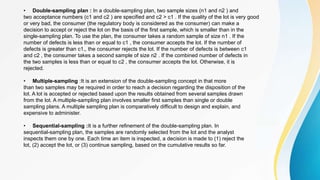
• Double-sampling plan : In a double-sampling plan, two sample sizes (n1 and n2 ) and
two acceptance numbers (c1 and c2 ) are specified and c2 > c1 . If the quality of the lot is very good
or very bad, the consumer (the regulatory body is considered as the consumer) can make a
decision to accept or reject the lot on the basis of the first sample, which is smaller than in the
single-sampling plan. To use the plan, the consumer takes a random sample of size n1 . If the
number of defects is less than or equal to c1 , the consumer accepts the lot. If the number of
defects is greater than c1,, the consumer rejects the lot. If the number of defects is between c1
and c2 , the consumer takes a second sample of size n2 . If the combined number of defects in
the two samples is less than or equal to c2 , the consumer accepts the lot. Otherwise, it is
rejected.
• Multiple-sampling :It is an extension of the double-sampling concept in that more
than two samples may be required in order to reach a decision regarding the disposition of the
lot. A lot is accepted or rejected based upon the results obtained from several samples drawn
from the lot. A multiple-sampling plan involves smaller first samples than single or double
sampling plans. A multiple sampling plan is comparatively difficult to design and explain, and
expensive to administer.
• Sequential-sampling :It is a further refinement of the double-sampling plan. In
sequential-sampling plan, the samples are randomly selected from the lot and the analyst
inspects them one by one. Each time an item is inspected, a decision is made to (1) reject the
lot, (2) accept the lot, or (3) continue sampling, based on the cumulative results so far.
THE ACCEPTABLE QUALITY LEVEL (AQL) AND LIMITING QUALITY (LQ) LEVEL
The inspection of a lot using either an attributes or variables sampling plan will allow
on the quality of the lot.
• The Acceptable Quality Level (AQLfor a given sampling plan is the rate of non_x0002_conforming items at which a lot will be rejected
with a low probability, usually 5 %. AQL is used as an indexing criterion applied to a continuous series of lots which corresponds to
a maximum rate of acceptable defective items in lots (or the maximum number of defective
items per hundred items). This is a quality goal fixed by the profession.
• The Limiting Quality (LQ) for a given sampling plan is the rate of non-conforming items at which a lot will be accepted with
a low probability, usually 10%. The LQ is applied when a lot is considered in isolation. It is a quality level (expressed, for example
, as percentage nonconforming items in the lot) which corresponds to a specified and relatively low probability of acceptance
of a lot having a rate of defective items of LQ. It is recommended that the LQ is set at least three times the desired AQL, in order
to ensure that lots of acceptable quality have a reasonable probability of acceptance. The LQ is generally very low when the
plans aim at the control of food safety criteria. It is often higher when the plans aim at the control of quality criteria, e.g.
a low AQL (e.g. 0.65 %) being allocated to Class A nonconformities (e.g. pesticide content in follow-up milk),and a higher AQL
(e.g. 6,5%) being allocated to Class B nonconformities (e.g. protein content in follow-up milk). If four samples must be collected,
they can be taken simultaneously for practical reasons.
OPERATING CHARACTERISTIC CURVE (OC) : A MEASURE OF THE ACCEPTANCE
SAMPLING PLAN
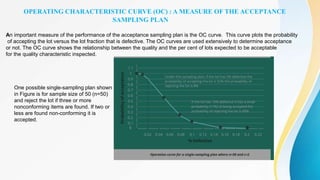
An important measure of the performance of the acceptance sampling plan is the OC curve. This curve plots the probability
of accepting the lot versus the lot fraction that is defective. The OC curves are used extensively to determine acceptance
or not. The OC curve shows the relationship between the quality and the per cent of lots expected to be acceptable
for the quality characteristic inspected.
One possible single-sampling plan shown
in Figure is for sample size of 50 (n=50)
and reject the lot if three or more
nonconforming items are found. If two or
less are found non-conforming it is
accepted.
HEALTH AND SAFETY PRECAUTIONS:
While sampling the following health and safety precautions must be adhered to:
1. Use of protective clothing (lab coat with long sleeves and buttoned up).
2. Wearing gloves and wash hands before and after sampling.
3. Use of eye protection (safety glasses/goggles/face shield).
4. Confining long hair (under a cap or tied and tucked into coat).
5. Use of face masks to protect from toxic fumes.
6. The sampler should have safe access to and egress from the place where the sample is taken, and the places
where the samples are taken for storage.
7. The sample storage areas should have adequate light and ventilation and should be arranged to satisfy the
requirements for safety as well as any special ones arising from the characteristics of the material being sampled.
8.Care should be taken to guard against collapse of stacked containers or solids in bulk.
GENERAL PRINCIPLES FOR COLLECTING SAMPLE FOR LEGAL CONFORMANCE
AND SURVEILLANCE
GENERAL PRINCIPLES
1. Samples should be taken in the presence of the Food Business Operator.
2.All sampling operations shall be carried out over a sufficiently short period of time so as to avoid any alteration in the composition of the samples.
3. Increments from each lot shall be mixed to give a bulk sample of an appropriate quantity. Laboratory samples are obtained by the successive
division and reduction of the bulk sample.
4. Samples shall be as representative as possible of the lots from which they are taken Therefore, as the composition of a lot is seldom uniform, a
sufficient number of increments shall be taken and carefully mixed, thus giving a bulk sample from which , the laboratory samples are obtained
by successive divisions or otherwise.
5. All manual sampling equipment and mechanical samplers used shall be clean, dry and free from foreign odours and made from material, which
will not contaminate the commodity being sample. Manual equipment must be sterilized with 70% alcohol immediately before use.
6. Sampling shall be carried out in such a manner as to protect the samples, sampling instruments, and the containers in which the samples are
placed, from environmental contamination.
7. All precautions to prevent contamination/deterioration of the commodity and damage to pre-packaged units must be adopted.
TOOLS USED IN SAMPLING
All sampling tools must be designed and manufactured so as to serve their intended purpose and preserve the original characteristics
of the sampled goods.Sampling tools must meet these general requirements:
1. They must be robust enough to withstand handling operations;
2. They must be easy to clean.
3. All parts must be made of materials resistant to:
I. the effects of the goods being sampled (e.g. fruit acid or chemicals);
II. the cleaning agents (e.g. bleach or surfactants);
III. they must also conform to safety requirements.
4. They must also conform to safety requirements.
Sampling devices used for different food products depend on the physical form of the food (e.g liquid, powder, granules,seeds,
grains etc.). These include:
• Sampling liquids : vacuum pumps, dipping vessels, pipette-type samplers, sampling scoops, piston-tube samplers etc.
• Sampling solids in powder or granulated form : spear samplers, tube-type samplers, zone samplers, sampling trowels,
spiral samplers,
• Sampling frozen goods : hand-drill samplers, etc.
Some sampling tools are:
1) Stirrer (Plunger) : It is a device used for manual mixing in vessels.t contains a surface sufficient to produce adequate disturbance of the
products for mixing liquids and semi-solid products in large as well as small vessels.
2) Agitator: It is an apparatus used for mechanical agitation of the liquid or semi-solid products. Agitators are mostly provided
with a propeller and are introduced into transport, tanks through the inspection port. Paddles agitators consist of usually
flat blades attached to a vertical shaft and normally operated at low speed (100-rpm).
3) Dipper : This device consists of a small cup fixed to one end of a long handle and is mainly used to collect the sample from the container.
4) Tube Samplers : The tube samplers are advantageous in that a representative sample can be obtained regardless of
how long the milk has stood before sampling. A column of milk which represents the milk from top to bottom of the
container is collected as sample.
5) Piston-tube sampler : Syringe-like sampler consisting of a body and a piston. Made from PTFE or polypropylene (PP) with
a stainless-steel connecting rod. The piston-tube sampler has three different uses:
(i) it can be used like a large syringe to suck in liquids of medium viscosity;or
(ii) it can be transformed by a slight adjustment into a pipette which is especially suitable for drawing of aggressive liquids
foodstuffs; or
(iii) thick or semi-solid materials may be sampled when the end is removed and the sampler is inserted into the material.
After withdrawal the contents of the sampler are pushed out into a wide mouth container using the piston. It can be used
for liquids, oils, emulsions, pastes.
6) Borers : The borers are used for sampling of powdered products. For example, milk powder, flour etc. It should be made entirely of
polished stainless steel.
7) Sampling Trowel (Sampling scoop/hand scoop) : Trowel are made from plastics (PP) or metal (stainless steel),
of variable volumes and different handle lengths. Sampling of solids such as grain, free flowing powders and granules.
8) Spiral screw sampler : the sampler consists of a robust spiral body and a handle made from metal (stainless steel).Usual
dimensions: lengths from 35 cm, diameter up to 3 cm. The spiral sampler is pressed into the sampled material by pushing and twisting,
which ensures the sample is loaded into the spiral.Used for paste-like foodstuffs such as peanut butter vegetable or animal fat, jam or honey.
9) Sampler for frozen foods (ice borer) : The sampler consists of two parts: a borer and a borer head (sampling cylinder). The sampling
cylinder is detachable. The sampler operates on the principle of a screw: the sampler screws into the sample material and simultaneously
extracts and conveys the sample into the sampling cylinder. Sampling from frozen and deep-frozen materials and semi-solid substances
e.g Deep-frozen goods such as meat or fruit juice concentrates.
10) Hand drill sampler : (Conical sampler, tubular sampler): Conical or tubular hand drill with sharp cutting edges and a solid handle,
drilling depth 13 cm.
11) Spear-type sampler : this is a metal or plastic sampler. Made of stainless steel or polypropylene (PP). Usually equipped with a telescopic
rod.Used for taking direct samples of bulk goods from sacks, bags or plastic drums, if these goods are in powder or granulated form.
The sampler is introduced into the product by piercing the packaging. When the desired zone is reached the sample, chamber is opened
using the telescopic handle.
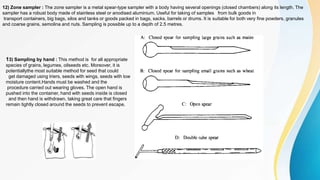
13) Sampling by hand : This method is for all appropriate
species of grains, legumes, oilseeds etc. Moreover, it is
potentiallythe most suitable method for seed that could
get damaged using triers, seeds with wings, seeds with low
moisture content.Hands must be washed and the
procedure carried out wearing gloves. The open hand is
pushed into the container, hand with seeds inside is closed
and then hand is withdrawn, taking great care that fingers
remain tightly closed around the seeds to prevent escape.
12) Zone sampler : The zone sampler is a metal spear-type sampler with a body having several openings (closed chambers) along its length. The
sampler has a robust body made of stainless steel or anodised aluminium. Useful for taking of samples from bulk goods in
transport containers, big bags, silos and tanks or goods packed in bags, sacks, barrels or drums. It is suitable for both very fine powders, granules
and coarse grains, semolina and nuts. Sampling is possible up to a depth of 2.5 metres.
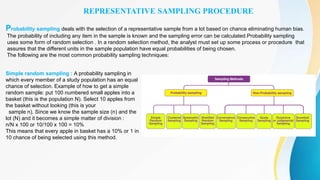
REPRESENTATIVE SAMPLING PROCEDURE
Probability sampling deals with the selection of a representative sample from a lot based on chance eliminating human bias.
The probability of including any item in the sample is known and the sampling error can be calculated.Probability sampling
uses some form of random selection . In a random selection method, the analyst must set up some process or procedure that
assures that the different units in the sample population have equal probabilities of being chosen.
The following are the most common probability sampling techniques:
Simple random sampling : A probability sampling in
which every member of a study population has an equal
chance of selection. Example of how to get a simple
random sample: put 100 numbered small apples into a
basket (this is the population N). Select 10 apples from
the basket without looking (this is your
sample n). Since we know the sample size (n) and the
lot (N) and it becomes a simple matter of division :
n/N x 100 or 10/100 x 100 = 10%
This means that every apple in basket has a 10% or 1 in
10 chance of being selected using this method.
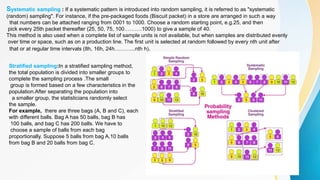
Systematic sampling : If a systematic pattern is introduced into random sampling, it is referred to as "systematic
(random) sampling". For instance, if the pre-packaged foods (Biscuit packet) in a store are arranged in such a way
that numbers can be attached ranging from 0001 to 1000. Choose a random starting point, e.g.25, and then
pick every 25th packet thereafter (25, 50, 75, 100……….1000) to give a sample of 40.
This method is also used when a complete list of sample units is not available, but when samples are distributed evenly
over time or space, such as on a production line. The first unit is selected at random followed by every nth unit after
that or at regular time intervals (8h, 16h, 24h………...nth h).
Stratified sampling:In a stratified sampling method,
the total population is divided into smaller groups to
complete the sampling process .The small
group is formed based on a few characteristics in the
population.After separating the population into
a smaller group, the statisticians randomly select
the sample.
For example, there are three bags (A, B and C), each
with different balls. Bag A has 50 balls, bag B has
100 balls, and bag C has 200 balls. We have to
choose a sample of balls from each bag
proportionally. Suppose 5 balls from bag A,10 balls
from bag B and 20 balls from bag C.
Cluster sampling:In the clustered sampling method, the cluster or group of people are formed from the population set.
The group has similar significatory characteristics. Also, they have an equal chance of being a part of the sample. This
method uses simple random sampling for the cluster of population.
Example:An educational institution has ten branches across the country with almost the number of students. If we want to
collect some data regarding facilities and other things, we can’t travel to every unit to collect the required data. Hence, we
can use random sampling to select three or four branches as clusters.
Composite (Bulk) sampling : This is used to obtain samples from bagged products such as flour, seeds, and larger items
in bulk. Small aliquots are taken from different bags, or containers, and combined into a single sample (the composite
(Bulk sample) that is used for analysis after mass reduction. Collecting the sample can be at random or systematic .
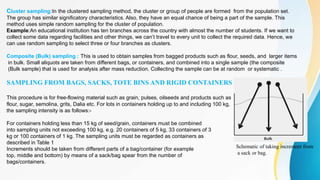
SAMPLING FROM BAGS, SACKS, TOTE BINS AND RIGID CONTAINERS
This procedure is for free-flowing material such as grain, pulses, oilseeds and products such as
flour, sugar, semolina, grits, Dalia etc. For lots in containers holding up to and including 100 kg,
the sampling intensity is as follows:-
For containers holding less than 15 kg of seed/grain, containers must be combined
into sampling units not exceeding 100 kg, e.g. 20 containers of 5 kg, 33 containers of 3
kg or 100 containers of 1 kg. The sampling units must be regarded as containers as
described in Table 1
Increments should be taken from different parts of a bag/container (for example
top, middle and bottom) by means of a sack/bag spear from the number of
bags/containers.
Schematic of taking increment from
a sack or bag.
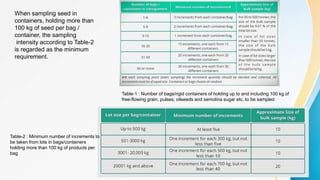
When sampling seed in
containers, holding more than
100 kg of seed per bag /
container, the sampling
intensity according to Table-2
is regarded as the minimum
requirement.
Table-1 : Number of bags/rigid containers of holding up to and including 100 kg of
free-flowing grain, pulses, oilseeds and semolina sugar etc. to be sampled
Table-2 : Minimum number of increments to
be taken from lots in bags/containers
holding more than 100 kg of products per
bag
SAMPLING FROM CARTONS CONTAINING PRE-PACKAGED UNITS OF GRAINS / SUGAR /
FLOUR / SEMOLINA ETC.
Pre-packed units are usually place in outer cases or cartons containing a convenient number of units. The procedure shall be used to determine
the appropriate number of outer cases or cartons to be sampled. Care shall be taken to ensure that a prepacked unit is taken in a random
manner from the entire contents of the case or carton for sampling. The selection of prepacked units occupying the same corresponding
position in a number of cases or cartons shall be avoided. Each prepacked unit taken in this manner shall be considered as increments.
SAMPLING PROCEDURES FOR RETAIL PACKAGE
Retail packages are defined as packages where the weight of the smallest individual pack within the consignment does not usually exceed 5 L
or 5 kg, i.e. various cans, bottles, jars and bags. Several retail packages may be packed in a case.
A retail package should be considered to be any pack specifically prepared for direct sale to an individual for domestic use. The quantity
could be as small as 10–25 g as in herbs and spices. For other commodities it will usually mean a package of between 100 g and 2 kg (or 2 L).
PROCESS OF PREPARING A BULK SAMPLE
The process of getting a bulk (composite) sample from a lot involves 1) drawing increments on random or systematic basis from
various locations of the lot and mixing them together to form a homogeneous sample and 2) dividing this homogenous composite sample
into four representative samples to initiate the process of legal compliance to FSS Rules and Regulations, 2011.
DRAWING INCREMENTS
When taking the number and/or the size of increment, besides meeting the minimum sampling intensity the FSO must ensure that the
bulk sample is sufficient to make four laboratory samples, where one is sent to the primary testing laboratory and three samples are
stored if requested and/or for dispute resolution.Increments of approximately equal size must be taken, irrespective of where in the
lot or container it is taken (e.g. if a minimum of 10 increments are to be taken, all the ten increment must be of the same size e.g
1 kg each)). Taking different size increments is not acceptable.
All sampling apparatus must be sterilised before use to prevent cross contaminations.
At each sampling interval (systematic sampling) or sampling point (static sampling) an increment a minimum of
1 kg can be collected used to make the bulk sample. The bulk sample prepared by combining all the individual
increments and mixing them thoroughly. Divide the bulk sample to obtain four numbers of laboratory samples
by using one of the sample dividers described below.
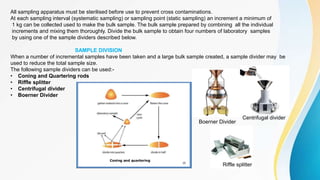
SAMPLE DIVISION
When a number of incremental samples have been taken and a large bulk sample created, a sample divider may be
used to reduce the total sample size.
The following sample dividers can be used:-
• Coning and Quartering rods
• Riffle splitter
• Centrifugal divider
• Boerner Divider
Centrifugal divider
Boerner Divider
Riffle splitter
PREPARING THE LABORATORY SAMPLE FROM BULK SAMPLE
Quantity of Sample : the sample finally submitted to the laboratory by the FSO is described as the laboratory sample and
will take the form of one of the four samples prepared from the Bulk sample.The minimum amount of sample that needs to be
collected from the bulk sample for chemical and physical analysis other than microbiological analysis is defined in the
FSS Rules and Regulations.
Sample integrity:The FSO/ Authorized Officer must always be aware of the perishability of the sample and that, for analytical
significance,the sample must reach the laboratory in a condition similar to that at the time of sampling.
Transportation : A large amount of time and effort is wasted if the sample arrives in a state which is unfit for the analysis.
Samples should be transported in a manner that prevents deterioration of the sample matrix or contamination of the
sample.All samples are handled, packaged, temperature controlled and transported to prevent compromising the identity
or integrity of the sample.
ASEPTIC SAMPLING FOR MICROBIOLOGICAL ANALYSIS
Aseptic sampling is a technique used to prevent contamination by the sampling method. Aseptic sampling involves the
use of sterile sampling implements and containers. Samples are collected and submitted in a manner which will prevent
multiplication or undue reduction of the bacterial population. Contamination from atmospheric conditions or handling
is prevented.
PROCEDURE COLLECTION OF FOOD SAMPLES FOR
MICROBIOLOGICAL ANALYSIS
• Wash your hands before you start with the sample collection.
• Collect all samples aseptically so as to not contaminate the sample.
• Wear clean gloves, clean lab coat, hair net.
• Collect FIFTEEN (where n=5) or FORTY-FIVE (where n=15) sample units per lot
unless otherwise specified
• Select a systematic or random sample from the lot.
• Each sample unit should be at least 250 g of intact, whole food sample in the form
in which it will be sold or distributed.
• Unopened, original containers should be sampled, when possible.
• Place each food sample unit into a separate sterile sealable bag or clean plastic bag.
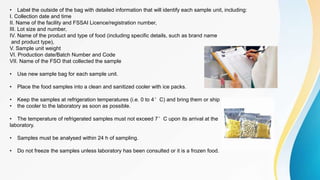
• Label the outside of the bag with detailed information that will identify each sample unit, including:
I. Collection date and time
II. Name of the facility and FSSAI Licence/registration number,
III. Lot size and number,
IV. Name of the product and type of food (including specific details, such as brand name
and product type),
V. Sample unit weight
VI. Production date/Batch Number and Code
VII. Name of the FSO that collected the sample
• Use new sample bag for each sample unit.
• Place the food samples into a clean and sanitized cooler with ice packs.
• Keep the samples at refrigeration temperatures (i.e. 0 to 4°C) and bring them or ship
• the cooler to the laboratory as soon as possible.
• The temperature of refrigerated samples must not exceed 7°C upon its arrival at the
laboratory.
• Samples must be analysed within 24 h of sampling.
• Do not freeze the samples unless laboratory has been consulted or it is a frozen food.
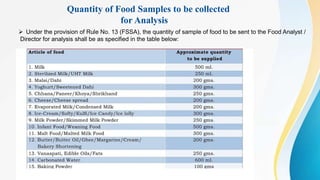
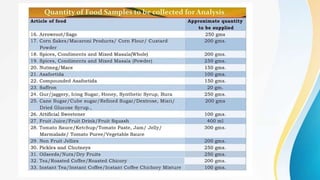
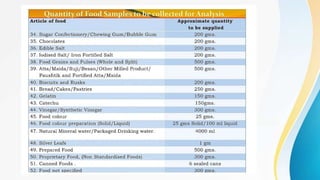
Quantity of Food Samples to be collected
for Analysis
 Under the provision of Rule No. 13 (FSSA), the quantity of sample of food to be sent to the Food Analyst /
Director for analysis shall be as specified in the table below:
PROCEDURE FOR SAMPLING UNDER FOOD SAFETY AND STANDARDS ACT, 2006
Authorized persons for taking food samples:-
• Food Safety Officer may take samples of food for analysis under clause A of sub section 1 of section 38 and clause (c)
of sub section (1) of section 47 of the Food Safety and Standards Act, (2006).
• Authorized Officer may take samples of imported article of food for analysis under sub section (5) of section 47 of the Act.
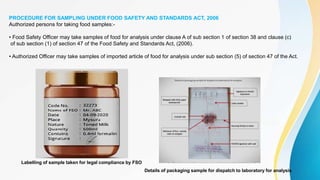
Details of packaging sample for dispatch to laboratory for analysis
Labelling of sample taken for legal compliance by FSO
DISPATCH OF SAMPLE:
• All samples packaged for dispatch must be secured with shock-absorbing materials to protect them from damage
en route.
• Samples Samples of frozen foods to be sent overnight overnight may be packed in insulated cartons containing
dry ice that will last for that length of time.
• If special precautions in handling or storing samples are needed, the FSO/ Authorized Officer should ensure that
persons who will be handling the samples are informed.
DOCUMENTATION REQUIRED WITH RESPECT TO LEGAL COMPLIANCE
Various forms in defined formats have been referred in FSS Rules, 2011 and FSS (Laboratory and Sample Analysis)
Regulation, 2011 which are required to be used at the time of sampling of products and related actions.
• FSO has been given the powers with respect to search, seizure and sampling for adulterants and sealing of
premises (in limited cases).
• It is also recommended that the FSO records in writing any such decision to seize adulterants and provide a copy of
such written record to the FBO if appropriate.
• Apart from this, all other processes, forms, reports etc. with respect to the search, inspection, seizure and sampling
of the adulterants is the same as for any other food article.
FORM III
[Refer rule 3.3.2.(1)]
(to keep any article of food in safe custody of the vender)
To
(Name and address of the vendor)
………………………………….
………………………………….
………………………………….
Whereas *…………………………….intended for food which is in your possession appears to me to be
adulterated/misbranded:
Now therefore under clause (c) of sub-section (1) of section 38 of the Food Safety and Standards Act, 2006
(34
of 2006), I hereby direct you to keep in your safe custody the said sealed stock subject to such orders as may
be
issued subsequently in relation thereto.
Food Safety Officer
Area…………
Place:
Date:
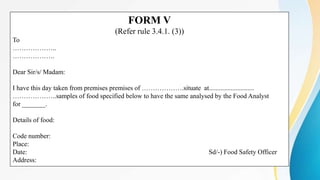
FORM V
(Refer rule 3.4.1. (3))
To
………………..
……………….
Dear Sir/s/ Madam:
I have this day taken from premises premises of ……………….situate at...........................
………………..samples of food specified below to have the same analysed by the Food Analyst
for _______.
Details of food:
Code number:
Place:
Date: Sd/-) Food Safety Officer
Address:
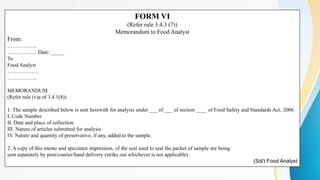
FORM VI
(Refer rule 3.4.3 (7))
Memorandum to Food Analyst
From:
……………..
…………….. Date: _____
To
Food Analyst
………………
……………..
MEMORANDUM
(Refer rule (v)a of 3.4.1(8))
1. The sample described below is sent herewith for analysis under ___ of ___ of section ____ of Food Safety and Standards Act, 2006
I. Code Number
II. Date and place of collection
III. Nature of articles submitted for analysis
IV. Nature and quantity of preservative, if any, added to the sample.
2. A copy of this memo and specimen impression, of the seal used to seal the packet of sample are being
sent separately by post/courier/hand delivery (strike out whichever is not applicable)
(Sd/) Food Analyst
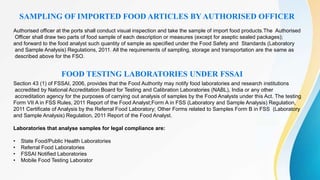
SAMPLING OF IMPORTED FOOD ARTICLES BY AUTHORISED OFFICER
Authorised officer at the ports shall conduct visual inspection and take the sample of import food products.The Authorised
Officer shall draw two parts of food sample of each description or measures (except for aseptic sealed packages);
and forward to the food analyst such quantity of sample as specified under the Food Safety and Standards (Laboratory
and Sample Analysis) Regulations, 2011. All the requirements of sampling, storage and transportation are the same as
described above for the FSO.
FOOD TESTING LABORATORIES UNDER FSSAI
Section 43 (1) of FSSAI, 2006, provides that the Food Authority may notify food laboratories and research institutions
accredited by National Accreditation Board for Testing and Calibration Laboratories (NABL), India or any other
accreditation agency for the purposes of carrying out analysis of samples by the Food Analysts under this Act. The testing
Form VII A in FSS Rules, 2011 Report of the Food Analyst;Form A in FSS (Laboratory and Sample Analysis) Regulation,
2011 Certificate of Analysis by the Referral Food Laboratory; Other Forms related to Samples Form B in FSS (Laboratory
and Sample Analysis) Regulation, 2011 Report of the Food Analyst.
Laboratories that analyse samples for legal compliance are:
• State Food/Public Health Laboratories
• Referral Food Laboratories
• FSSAI Notified Laboratories
• Mobile Food Testing Laborator
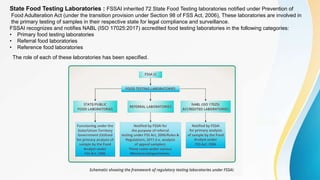
The role of each of these laboratories has been specified.
State Food Testing Laboratories : FSSAI inherited 72 State Food Testing laboratories notified under Prevention of
Food Adulteration Act (under the transition provision under Section 98 of FSS Act, 2006), These laboratories are involved in
the primary testing of samples in their respective state for legal compliance and surveillance.
FSSAI recognizes and notifies NABL (ISO 17025:2017) accredited food testing laboratories in the following categories:
• Primary food testing laboratories
• Referral food laboratories
• Reference food laboratories
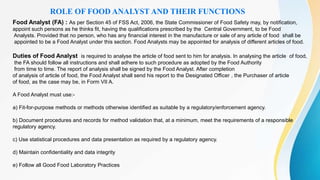
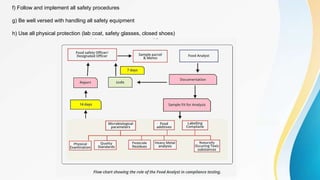
ROLE OF FOOD ANALYST AND THEIR FUNCTIONS
Food Analyst (FA) : As per Section 45 of FSS Act, 2006, the State Commissioner of Food Safety may, by notification,
appoint such persons as he thinks fit, having the qualifications prescribed by the Central Government, to be Food
Analysts. Provided that no person, who has any financial interest in the manufacture or sale of any article of food shall be
appointed to be a Food Analyst under this section. Food Analysts may be appointed for analysis of different articles of food.
Duties of Food Analyst is required to analyse the article of food sent to him for analysis. In analysing the article of food,
the FA should follow all instructions and shall adhere to such procedure as adopted by the Food Authority
from time to time. The report of analysis shall be signed by the Food Analyst. After completion
of analysis of article of food, the Food Analyst shall send his report to the Designated Officer , the Purchaser of article
of food, as the case may be, in Form VII A.
A Food Analyst must use:-
a) Fit-for-purpose methods or methods otherwise identified as suitable by a regulatory/enforcement agency.
b) Document procedures and records for method validation that, at a minimum, meet the requirements of a responsible
regulatory agency.
c) Use statistical procedures and data presentation as required by a regulatory agency.
d) Maintain confidentiality and data integrity
e) Follow all Good Food Laboratory Practices
f) Follow and implement all safety procedures
g) Be well versed with handling all safety equipment
h) Use all physical protection (lab coat, safety glasses, closed shoes)
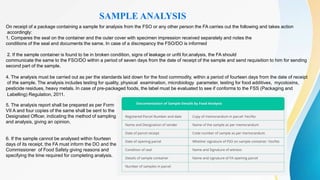
On receipt of a package containing a sample for analysis from the FSO or any other person the FA carries out the following and takes action
accordingly:
1. Compares the seal on the container and the outer cover with specimen impression received separately and notes the
conditions of the seal and documents the same. In case of a discrepancy the FSO/DO is informed
2. If the sample container is found to be in broken condition, signs of leakage or unfit for.analysis, the FA should
communicate the same to the FSO/DO within a period of seven days from the date of receipt of the sample and send requisition to him for sending
second part of the sample.
4. The analysis must be carried out as per the standards laid down for the food commodity, within a period of fourteen days from the date of receipt
of the sample. The analysis includes testing for quality, physical examination, microbiology parameter, testing for food additives, mycotoxins,
pesticide residues, heavy metals. In case of pre-packaged foods, the label must be evaluated to see if conforms to the FSS (Packaging and
Labelling) Regulation, 2011.
SAMPLE ANALYSIS
5. The analysis report shall be prepared as per Form
VII A and four copies of the same shall be sent to the
Designated Officer, indicating the method of sampling
and analysis, giving an opinion.
6. If the sample cannot be analysed within fourteen
days of its receipt, the FA must inform the DO and the
Commissioner of Food Safety giving reasons and
specifying the time required for completing analysis.
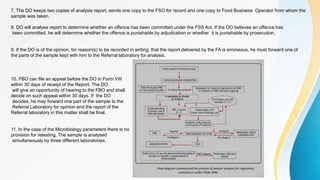
7. The DO keeps two copies of analysis report, sends one copy to the FSO for record and one copy to Food Business Operator from whom the
sample was taken.
8. DO will analyse report to determine whether an offence has been committed under the FSS Act. If the DO believes an offence has
been committed, he will determine whether the offence is punishable by adjudication or whether it is punishable by prosecution.
9. If the DO is of the opinion, for reason(s) to be recorded in writing, that the report delivered by the FA is erroneous, he must forward one of
the parts of the sample kept with him to the Referral laboratory for analysis.
10. FBO can file an appeal before the DO in Form VIII
within 30 days of receipt of the Report. The DO
will give an opportunity of hearing to the FBO and shall
decide on such appeal within 30 days. If the DO
decides, he may forward one part of the sample to the
Referral Laboratory for opinion and the report of the
Referral laboratory in this matter shall be final.
11. In the case of the Microbiology parameters there is no
provision for retesting. The sample is analysed
simultaneously by three different laboratories.
CAPACITY BUILDING IN FOOD TESTING
Food testing is an integral and important part to ensure food safety. FSSAI through its Quality Assurance (QA) Division
works towards fulfilling the vision of providing safe and wholesome food to the citizens of our country by strengthening
its food testing laboratory infrastructure & capacity building across the country.
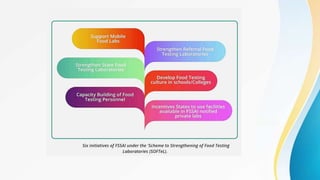
FSSAI has formulated a scheme to provide support to State Food Laboratories for upgrading the laboratory infrastructure along
with trained manpower for utilizing the sophisticated test equipment.
The 'Scheme to Strengthening of Food Testing Laboratories (SOFTeL)' enable the States/UTs:
 To analyse the regulatory and surveillance samples drawn by the FSO within the shortest possible time frame;
 To analyse the safety parameters in food samples such as Heavy metals, Pesticide residues, Antibiotic and drug residues and
Naturally occurring toxic substances along with Microbiological examination;
 To ensure compliance of FSSAI standards on food;
 To enable the laboratories to achieve ISO 17025 certification through NABL, India;
 training and facility up-gradation for other existing Government / Public Food testing laboratories in the State; and to
introduce online laboratory data management system through Laboratory Information Management System (LIMS).
Presentation1.pptx
Presentation1.pptx

Presentation1.pptx

  • 1.
  • 2.
    INTRODUCTION Sampling involves theselection of a certain portion, number of container and product units from a lot of the particular the same food.Samples are usually collected from a lot of food for random surveillance, collection of data for a specific purpose, or monitoring/and to determine the conformity to product standards specified in the regulation . The broad objectives of testing articles of food / ingredients are: • Protecting Public Health • Detecting fraudulent activities • Providing customers with information to make informed choices • Ensuring compliance to the National Food Standards • Surveillance and Enforcement • Surveillance and Enforcement • Promoting fair trade and deterring bad practice
  • 3.
    LEGAL PROVISIONS RELATEDTO SAMPLING AND ANALYSIS The following provisions provided in the Food Safety and Standards Act (2006) and Food Safety and Standards Rules and Regulations, 2011 are related to sampling and analysis of food and functioning of laboratories. i. Food Safety and Standards Act (FSSAI), 2006 - Section 43, 45, 46, 47 of FSS Act, 2006; ii. Food Safety and Standards (FSS) Rules, 2011 iii. Food Safety and Standards (Laboratory and Sample Analysis) Regulation, 2011 iv. Food Safety and Standards (Recognition and Notification of Laboratories) Regulation,2018 Compliance to FSSAI : These samples are taken under formal enforcement and regulatory compliance activities. Compliance testing is a regulatory control measure to prevent the marketing or remove from market a product known to be contaminated or adulterated.
  • 4.
    RELEVANT DEFINITIONS USEDIN SAMPLING PROTOCOLS:- • Lot (or Population) :A defined quantity of a commodity that has been produced or manufactured under the same basic conditions on the same day, at the same establishment, and identified under the same batch number or the entire production for a certain period of time from which samples are to be taken. The lot may be homogenous or heterogenous. The lot may be homogenous or heterogenous. • Lot size : It is the number of units of the product in a lot e.g (100 metric tonnes of wheat or 500 L of milk or 200 packets of biscuits • Sample: A sample is the specific group that you will collect data from. • Primary sample (or increment) : A small quantity of grain/oilseeds/milled/first transformation products taken at one time from a single position from a stationary lot. • Composite (Bulk) Sample : Quantity of commodity (grain / oilseeds / milled / first transformation product) obtained by combining and mixing the increments taken from a specific lot.
  • 5.
    • Laboratory Sample: Representative quantity of commodity (grain/oilseeds/milled/ first transformation product/packages) obtained by division of the bulk sample and intended for analysis finally submitted to the laboratory for analysis. • Surveillance Sample : Taken as part of routine inspections or surveys to identify any lack of compliance with state, federal or other laws and regulations. • Representative (Random) sample : A sample in which the characteristics of the lot from which it is drawn are maintained. It is in particular the case of a simple random sample where each of the items or increments of the lot has been given the same probability of entering the sample i.e. all elements in the lot have an equal and independent chance of being included in the sample. • Unit size : The particular food portion or container selected as a sample and from which one or more units will be taken for analysis. • Sampling plan : predetermined procedure for the selection, withdrawal, preservation, transportation and preparation of the portions to be removed from a lot as a sample. • Sampling procedure (or protocol) : operational requirements and / or instructions relating to the use of a particular sampling plan (i.e., the instructions for the implementation of the plan). • Official (Legal) Sample : Sample taken in a manner so that it can serve as the basis for enforcement and/ or legal action and handled in a manner that preserves integrity as evidence including identity , ownership, traceability and a clear record of chain of custody. • Investigation Sample : Taken during a food safety inspection to document inspector observations, support regulatory actions or provide other information.
  • 6.
    ACCEPTANCE SAMPLING Acceptance samplingis one of the main areas of statistical quality control and is an inspection procedure.For food safety and quality, acceptance sampling techniques are a commonly used procedure used to determine whether to accept or reject a specific quantity of food lot. Sampling inspection plans are used to assess safety of the food for human consumption and the “fitness for use” of batches of products. The steps involved are: 1. A random sample is taken from a large quantity of items and tested or measured relative to the quality and / or safety characteristic of interest. 2. If the sample passes the test, the entire quantity of items is accepted. 3. If the sample fails the test, either (a) the entire quantity of items is subjected to 100 percent inspection and all defective items repaired or replaced or (b) the entire quantity is returned to the supplier. • The presence of a well-designed plan is important as it provides a consistent model to guide samplers, and serves as a reminder of the important elements of the overall sample analysis program. The precise definition of an acceptance sampling procedure will require the setting or selection of: 1. The characteristic to be measured 2. Lot size 3. An attribute or variables sampling plan 4. The Limiting Quality (LQ) level for isolated lots; or the AQL (Acceptable Quality Level), for a continuous series of lots 5. The level of inspection 6. The size of the sample 7. The criteria for acceptance or rejection of the lot 8. The procedures to be adopted in cases of dispute
  • 7.
    ATTRIBUTE AND VARIABLEPLANS IN ACCEPTANCE SAMPLING The major sampling plans used in food analysis are: 1. Attribute sampling plan 2. Variable sampling plan ATTRIBUTE SAMPLING PLAN In attribute sampling plan, sampling is done to decide the acceptability of a lot based on the number of unacceptable items in the sample. The acceptability of an item depends on the presence or absence of a characteristic. There are two types of attribute sampling plan viz., two-class attribute sampling and three-class attribute sampling, which are often used when assessing microbiological contamination of foods. • Two-class attribute sampling : The two-class plan is essentially defined by two numbers and two attributes. The first one 'n', determines the number of sample units that are to be drawn independently and randomly from the lot and tested. The second number c, is the maximum allowable number of defective sample units , which separates acceptable from non acceptable or defective quality. The value c is usually set to zero for pathogens. • Three-class attribute sampling : In this case, 'n' is the number of samples selected at random from the lot, the numerical value 'm' represents acceptable level and 'M' unacceptable concentrations / counts, and acceptable sample units such that if this c' is the maximum allowable number of marginally number is exceeded, the lot is considered as unacceptable.While 'm' separates sample units of acceptable quality from those of marginally acceptable quality,'M' separates sample units of marginally acceptable quality from those of defective quality.
  • 8.
    VARIABLE SAMPLING PLAN Whenactual quantitative information can be measured on sampled items, rather than simply classifying them as acceptable or unacceptable, variables sampling plans can be used. Variable plans are those for which a quality characteristic is measured quantitatively on each item inspected. The average measurement is compared with the standard and used for the acceptability decision. SINGLE, DOUBLE, MULTIPLE AND SEQUENTIAL PLANS IN ACCEPTANCE SAMPLING These variable and attribute plans of acceptance sampling may be single, double, multiple, or sequential plans. • Single-sampling plan : The single-sampling plan is a decision rule to accept or reject a lot based on the results of one random sample from the lot. The procedure is to take a random sample of size (n) and inspect each item. If the number of defects does not exceed a specified acceptance number (c), the consumer accepts the entire lot. Any defect found in the sample are either repaired or returned to the producer.
  • 9.
    • Double-sampling plan: In a double-sampling plan, two sample sizes (n1 and n2 ) and two acceptance numbers (c1 and c2 ) are specified and c2 > c1 . If the quality of the lot is very good or very bad, the consumer (the regulatory body is considered as the consumer) can make a decision to accept or reject the lot on the basis of the first sample, which is smaller than in the single-sampling plan. To use the plan, the consumer takes a random sample of size n1 . If the number of defects is less than or equal to c1 , the consumer accepts the lot. If the number of defects is greater than c1,, the consumer rejects the lot. If the number of defects is between c1 and c2 , the consumer takes a second sample of size n2 . If the combined number of defects in the two samples is less than or equal to c2 , the consumer accepts the lot. Otherwise, it is rejected. • Multiple-sampling :It is an extension of the double-sampling concept in that more than two samples may be required in order to reach a decision regarding the disposition of the lot. A lot is accepted or rejected based upon the results obtained from several samples drawn from the lot. A multiple-sampling plan involves smaller first samples than single or double sampling plans. A multiple sampling plan is comparatively difficult to design and explain, and expensive to administer. • Sequential-sampling :It is a further refinement of the double-sampling plan. In sequential-sampling plan, the samples are randomly selected from the lot and the analyst inspects them one by one. Each time an item is inspected, a decision is made to (1) reject the lot, (2) accept the lot, or (3) continue sampling, based on the cumulative results so far.
  • 10.
    THE ACCEPTABLE QUALITYLEVEL (AQL) AND LIMITING QUALITY (LQ) LEVEL The inspection of a lot using either an attributes or variables sampling plan will allow on the quality of the lot. • The Acceptable Quality Level (AQLfor a given sampling plan is the rate of non_x0002_conforming items at which a lot will be rejected with a low probability, usually 5 %. AQL is used as an indexing criterion applied to a continuous series of lots which corresponds to a maximum rate of acceptable defective items in lots (or the maximum number of defective items per hundred items). This is a quality goal fixed by the profession. • The Limiting Quality (LQ) for a given sampling plan is the rate of non-conforming items at which a lot will be accepted with a low probability, usually 10%. The LQ is applied when a lot is considered in isolation. It is a quality level (expressed, for example , as percentage nonconforming items in the lot) which corresponds to a specified and relatively low probability of acceptance of a lot having a rate of defective items of LQ. It is recommended that the LQ is set at least three times the desired AQL, in order to ensure that lots of acceptable quality have a reasonable probability of acceptance. The LQ is generally very low when the plans aim at the control of food safety criteria. It is often higher when the plans aim at the control of quality criteria, e.g. a low AQL (e.g. 0.65 %) being allocated to Class A nonconformities (e.g. pesticide content in follow-up milk),and a higher AQL (e.g. 6,5%) being allocated to Class B nonconformities (e.g. protein content in follow-up milk). If four samples must be collected, they can be taken simultaneously for practical reasons.
  • 11.
    OPERATING CHARACTERISTIC CURVE(OC) : A MEASURE OF THE ACCEPTANCE SAMPLING PLAN An important measure of the performance of the acceptance sampling plan is the OC curve. This curve plots the probability of accepting the lot versus the lot fraction that is defective. The OC curves are used extensively to determine acceptance or not. The OC curve shows the relationship between the quality and the per cent of lots expected to be acceptable for the quality characteristic inspected. One possible single-sampling plan shown in Figure is for sample size of 50 (n=50) and reject the lot if three or more nonconforming items are found. If two or less are found non-conforming it is accepted.
  • 12.
    HEALTH AND SAFETYPRECAUTIONS: While sampling the following health and safety precautions must be adhered to: 1. Use of protective clothing (lab coat with long sleeves and buttoned up). 2. Wearing gloves and wash hands before and after sampling. 3. Use of eye protection (safety glasses/goggles/face shield). 4. Confining long hair (under a cap or tied and tucked into coat). 5. Use of face masks to protect from toxic fumes. 6. The sampler should have safe access to and egress from the place where the sample is taken, and the places where the samples are taken for storage. 7. The sample storage areas should have adequate light and ventilation and should be arranged to satisfy the requirements for safety as well as any special ones arising from the characteristics of the material being sampled. 8.Care should be taken to guard against collapse of stacked containers or solids in bulk.
  • 13.
    GENERAL PRINCIPLES FORCOLLECTING SAMPLE FOR LEGAL CONFORMANCE AND SURVEILLANCE GENERAL PRINCIPLES 1. Samples should be taken in the presence of the Food Business Operator. 2.All sampling operations shall be carried out over a sufficiently short period of time so as to avoid any alteration in the composition of the samples. 3. Increments from each lot shall be mixed to give a bulk sample of an appropriate quantity. Laboratory samples are obtained by the successive division and reduction of the bulk sample. 4. Samples shall be as representative as possible of the lots from which they are taken Therefore, as the composition of a lot is seldom uniform, a sufficient number of increments shall be taken and carefully mixed, thus giving a bulk sample from which , the laboratory samples are obtained by successive divisions or otherwise. 5. All manual sampling equipment and mechanical samplers used shall be clean, dry and free from foreign odours and made from material, which will not contaminate the commodity being sample. Manual equipment must be sterilized with 70% alcohol immediately before use. 6. Sampling shall be carried out in such a manner as to protect the samples, sampling instruments, and the containers in which the samples are placed, from environmental contamination. 7. All precautions to prevent contamination/deterioration of the commodity and damage to pre-packaged units must be adopted.
  • 14.
    TOOLS USED INSAMPLING All sampling tools must be designed and manufactured so as to serve their intended purpose and preserve the original characteristics of the sampled goods.Sampling tools must meet these general requirements: 1. They must be robust enough to withstand handling operations; 2. They must be easy to clean. 3. All parts must be made of materials resistant to: I. the effects of the goods being sampled (e.g. fruit acid or chemicals); II. the cleaning agents (e.g. bleach or surfactants); III. they must also conform to safety requirements. 4. They must also conform to safety requirements. Sampling devices used for different food products depend on the physical form of the food (e.g liquid, powder, granules,seeds, grains etc.). These include: • Sampling liquids : vacuum pumps, dipping vessels, pipette-type samplers, sampling scoops, piston-tube samplers etc. • Sampling solids in powder or granulated form : spear samplers, tube-type samplers, zone samplers, sampling trowels, spiral samplers, • Sampling frozen goods : hand-drill samplers, etc.
  • 15.
    Some sampling toolsare: 1) Stirrer (Plunger) : It is a device used for manual mixing in vessels.t contains a surface sufficient to produce adequate disturbance of the products for mixing liquids and semi-solid products in large as well as small vessels. 2) Agitator: It is an apparatus used for mechanical agitation of the liquid or semi-solid products. Agitators are mostly provided with a propeller and are introduced into transport, tanks through the inspection port. Paddles agitators consist of usually flat blades attached to a vertical shaft and normally operated at low speed (100-rpm). 3) Dipper : This device consists of a small cup fixed to one end of a long handle and is mainly used to collect the sample from the container. 4) Tube Samplers : The tube samplers are advantageous in that a representative sample can be obtained regardless of how long the milk has stood before sampling. A column of milk which represents the milk from top to bottom of the container is collected as sample. 5) Piston-tube sampler : Syringe-like sampler consisting of a body and a piston. Made from PTFE or polypropylene (PP) with a stainless-steel connecting rod. The piston-tube sampler has three different uses: (i) it can be used like a large syringe to suck in liquids of medium viscosity;or (ii) it can be transformed by a slight adjustment into a pipette which is especially suitable for drawing of aggressive liquids foodstuffs; or (iii) thick or semi-solid materials may be sampled when the end is removed and the sampler is inserted into the material. After withdrawal the contents of the sampler are pushed out into a wide mouth container using the piston. It can be used for liquids, oils, emulsions, pastes.
  • 16.
    6) Borers :The borers are used for sampling of powdered products. For example, milk powder, flour etc. It should be made entirely of polished stainless steel. 7) Sampling Trowel (Sampling scoop/hand scoop) : Trowel are made from plastics (PP) or metal (stainless steel), of variable volumes and different handle lengths. Sampling of solids such as grain, free flowing powders and granules. 8) Spiral screw sampler : the sampler consists of a robust spiral body and a handle made from metal (stainless steel).Usual dimensions: lengths from 35 cm, diameter up to 3 cm. The spiral sampler is pressed into the sampled material by pushing and twisting, which ensures the sample is loaded into the spiral.Used for paste-like foodstuffs such as peanut butter vegetable or animal fat, jam or honey. 9) Sampler for frozen foods (ice borer) : The sampler consists of two parts: a borer and a borer head (sampling cylinder). The sampling cylinder is detachable. The sampler operates on the principle of a screw: the sampler screws into the sample material and simultaneously extracts and conveys the sample into the sampling cylinder. Sampling from frozen and deep-frozen materials and semi-solid substances e.g Deep-frozen goods such as meat or fruit juice concentrates. 10) Hand drill sampler : (Conical sampler, tubular sampler): Conical or tubular hand drill with sharp cutting edges and a solid handle, drilling depth 13 cm. 11) Spear-type sampler : this is a metal or plastic sampler. Made of stainless steel or polypropylene (PP). Usually equipped with a telescopic rod.Used for taking direct samples of bulk goods from sacks, bags or plastic drums, if these goods are in powder or granulated form. The sampler is introduced into the product by piercing the packaging. When the desired zone is reached the sample, chamber is opened using the telescopic handle.
  • 17.
    13) Sampling byhand : This method is for all appropriate species of grains, legumes, oilseeds etc. Moreover, it is potentiallythe most suitable method for seed that could get damaged using triers, seeds with wings, seeds with low moisture content.Hands must be washed and the procedure carried out wearing gloves. The open hand is pushed into the container, hand with seeds inside is closed and then hand is withdrawn, taking great care that fingers remain tightly closed around the seeds to prevent escape. 12) Zone sampler : The zone sampler is a metal spear-type sampler with a body having several openings (closed chambers) along its length. The sampler has a robust body made of stainless steel or anodised aluminium. Useful for taking of samples from bulk goods in transport containers, big bags, silos and tanks or goods packed in bags, sacks, barrels or drums. It is suitable for both very fine powders, granules and coarse grains, semolina and nuts. Sampling is possible up to a depth of 2.5 metres.
  • 18.
    REPRESENTATIVE SAMPLING PROCEDURE Probabilitysampling deals with the selection of a representative sample from a lot based on chance eliminating human bias. The probability of including any item in the sample is known and the sampling error can be calculated.Probability sampling uses some form of random selection . In a random selection method, the analyst must set up some process or procedure that assures that the different units in the sample population have equal probabilities of being chosen. The following are the most common probability sampling techniques: Simple random sampling : A probability sampling in which every member of a study population has an equal chance of selection. Example of how to get a simple random sample: put 100 numbered small apples into a basket (this is the population N). Select 10 apples from the basket without looking (this is your sample n). Since we know the sample size (n) and the lot (N) and it becomes a simple matter of division : n/N x 100 or 10/100 x 100 = 10% This means that every apple in basket has a 10% or 1 in 10 chance of being selected using this method.
  • 19.
    Systematic sampling :If a systematic pattern is introduced into random sampling, it is referred to as "systematic (random) sampling". For instance, if the pre-packaged foods (Biscuit packet) in a store are arranged in such a way that numbers can be attached ranging from 0001 to 1000. Choose a random starting point, e.g.25, and then pick every 25th packet thereafter (25, 50, 75, 100……….1000) to give a sample of 40. This method is also used when a complete list of sample units is not available, but when samples are distributed evenly over time or space, such as on a production line. The first unit is selected at random followed by every nth unit after that or at regular time intervals (8h, 16h, 24h………...nth h). Stratified sampling:In a stratified sampling method, the total population is divided into smaller groups to complete the sampling process .The small group is formed based on a few characteristics in the population.After separating the population into a smaller group, the statisticians randomly select the sample. For example, there are three bags (A, B and C), each with different balls. Bag A has 50 balls, bag B has 100 balls, and bag C has 200 balls. We have to choose a sample of balls from each bag proportionally. Suppose 5 balls from bag A,10 balls from bag B and 20 balls from bag C.
  • 20.
    Cluster sampling:In theclustered sampling method, the cluster or group of people are formed from the population set. The group has similar significatory characteristics. Also, they have an equal chance of being a part of the sample. This method uses simple random sampling for the cluster of population. Example:An educational institution has ten branches across the country with almost the number of students. If we want to collect some data regarding facilities and other things, we can’t travel to every unit to collect the required data. Hence, we can use random sampling to select three or four branches as clusters. Composite (Bulk) sampling : This is used to obtain samples from bagged products such as flour, seeds, and larger items in bulk. Small aliquots are taken from different bags, or containers, and combined into a single sample (the composite (Bulk sample) that is used for analysis after mass reduction. Collecting the sample can be at random or systematic . SAMPLING FROM BAGS, SACKS, TOTE BINS AND RIGID CONTAINERS This procedure is for free-flowing material such as grain, pulses, oilseeds and products such as flour, sugar, semolina, grits, Dalia etc. For lots in containers holding up to and including 100 kg, the sampling intensity is as follows:- For containers holding less than 15 kg of seed/grain, containers must be combined into sampling units not exceeding 100 kg, e.g. 20 containers of 5 kg, 33 containers of 3 kg or 100 containers of 1 kg. The sampling units must be regarded as containers as described in Table 1 Increments should be taken from different parts of a bag/container (for example top, middle and bottom) by means of a sack/bag spear from the number of bags/containers. Schematic of taking increment from a sack or bag.
  • 21.
    When sampling seedin containers, holding more than 100 kg of seed per bag / container, the sampling intensity according to Table-2 is regarded as the minimum requirement. Table-1 : Number of bags/rigid containers of holding up to and including 100 kg of free-flowing grain, pulses, oilseeds and semolina sugar etc. to be sampled Table-2 : Minimum number of increments to be taken from lots in bags/containers holding more than 100 kg of products per bag
  • 22.
    SAMPLING FROM CARTONSCONTAINING PRE-PACKAGED UNITS OF GRAINS / SUGAR / FLOUR / SEMOLINA ETC. Pre-packed units are usually place in outer cases or cartons containing a convenient number of units. The procedure shall be used to determine the appropriate number of outer cases or cartons to be sampled. Care shall be taken to ensure that a prepacked unit is taken in a random manner from the entire contents of the case or carton for sampling. The selection of prepacked units occupying the same corresponding position in a number of cases or cartons shall be avoided. Each prepacked unit taken in this manner shall be considered as increments. SAMPLING PROCEDURES FOR RETAIL PACKAGE Retail packages are defined as packages where the weight of the smallest individual pack within the consignment does not usually exceed 5 L or 5 kg, i.e. various cans, bottles, jars and bags. Several retail packages may be packed in a case. A retail package should be considered to be any pack specifically prepared for direct sale to an individual for domestic use. The quantity could be as small as 10–25 g as in herbs and spices. For other commodities it will usually mean a package of between 100 g and 2 kg (or 2 L). PROCESS OF PREPARING A BULK SAMPLE The process of getting a bulk (composite) sample from a lot involves 1) drawing increments on random or systematic basis from various locations of the lot and mixing them together to form a homogeneous sample and 2) dividing this homogenous composite sample into four representative samples to initiate the process of legal compliance to FSS Rules and Regulations, 2011. DRAWING INCREMENTS When taking the number and/or the size of increment, besides meeting the minimum sampling intensity the FSO must ensure that the bulk sample is sufficient to make four laboratory samples, where one is sent to the primary testing laboratory and three samples are stored if requested and/or for dispute resolution.Increments of approximately equal size must be taken, irrespective of where in the lot or container it is taken (e.g. if a minimum of 10 increments are to be taken, all the ten increment must be of the same size e.g 1 kg each)). Taking different size increments is not acceptable.
  • 23.
    All sampling apparatusmust be sterilised before use to prevent cross contaminations. At each sampling interval (systematic sampling) or sampling point (static sampling) an increment a minimum of 1 kg can be collected used to make the bulk sample. The bulk sample prepared by combining all the individual increments and mixing them thoroughly. Divide the bulk sample to obtain four numbers of laboratory samples by using one of the sample dividers described below. SAMPLE DIVISION When a number of incremental samples have been taken and a large bulk sample created, a sample divider may be used to reduce the total sample size. The following sample dividers can be used:- • Coning and Quartering rods • Riffle splitter • Centrifugal divider • Boerner Divider Centrifugal divider Boerner Divider Riffle splitter
  • 24.
    PREPARING THE LABORATORYSAMPLE FROM BULK SAMPLE Quantity of Sample : the sample finally submitted to the laboratory by the FSO is described as the laboratory sample and will take the form of one of the four samples prepared from the Bulk sample.The minimum amount of sample that needs to be collected from the bulk sample for chemical and physical analysis other than microbiological analysis is defined in the FSS Rules and Regulations. Sample integrity:The FSO/ Authorized Officer must always be aware of the perishability of the sample and that, for analytical significance,the sample must reach the laboratory in a condition similar to that at the time of sampling. Transportation : A large amount of time and effort is wasted if the sample arrives in a state which is unfit for the analysis. Samples should be transported in a manner that prevents deterioration of the sample matrix or contamination of the sample.All samples are handled, packaged, temperature controlled and transported to prevent compromising the identity or integrity of the sample. ASEPTIC SAMPLING FOR MICROBIOLOGICAL ANALYSIS Aseptic sampling is a technique used to prevent contamination by the sampling method. Aseptic sampling involves the use of sterile sampling implements and containers. Samples are collected and submitted in a manner which will prevent multiplication or undue reduction of the bacterial population. Contamination from atmospheric conditions or handling is prevented.
  • 25.
    PROCEDURE COLLECTION OFFOOD SAMPLES FOR MICROBIOLOGICAL ANALYSIS • Wash your hands before you start with the sample collection. • Collect all samples aseptically so as to not contaminate the sample. • Wear clean gloves, clean lab coat, hair net. • Collect FIFTEEN (where n=5) or FORTY-FIVE (where n=15) sample units per lot unless otherwise specified • Select a systematic or random sample from the lot. • Each sample unit should be at least 250 g of intact, whole food sample in the form in which it will be sold or distributed. • Unopened, original containers should be sampled, when possible. • Place each food sample unit into a separate sterile sealable bag or clean plastic bag.
  • 26.
    • Label theoutside of the bag with detailed information that will identify each sample unit, including: I. Collection date and time II. Name of the facility and FSSAI Licence/registration number, III. Lot size and number, IV. Name of the product and type of food (including specific details, such as brand name and product type), V. Sample unit weight VI. Production date/Batch Number and Code VII. Name of the FSO that collected the sample • Use new sample bag for each sample unit. • Place the food samples into a clean and sanitized cooler with ice packs. • Keep the samples at refrigeration temperatures (i.e. 0 to 4°C) and bring them or ship • the cooler to the laboratory as soon as possible. • The temperature of refrigerated samples must not exceed 7°C upon its arrival at the laboratory. • Samples must be analysed within 24 h of sampling. • Do not freeze the samples unless laboratory has been consulted or it is a frozen food.
  • 27.
    Quantity of FoodSamples to be collected for Analysis  Under the provision of Rule No. 13 (FSSA), the quantity of sample of food to be sent to the Food Analyst / Director for analysis shall be as specified in the table below:
  • 30.
    PROCEDURE FOR SAMPLINGUNDER FOOD SAFETY AND STANDARDS ACT, 2006 Authorized persons for taking food samples:- • Food Safety Officer may take samples of food for analysis under clause A of sub section 1 of section 38 and clause (c) of sub section (1) of section 47 of the Food Safety and Standards Act, (2006). • Authorized Officer may take samples of imported article of food for analysis under sub section (5) of section 47 of the Act. Details of packaging sample for dispatch to laboratory for analysis Labelling of sample taken for legal compliance by FSO
  • 31.
    DISPATCH OF SAMPLE: •All samples packaged for dispatch must be secured with shock-absorbing materials to protect them from damage en route. • Samples Samples of frozen foods to be sent overnight overnight may be packed in insulated cartons containing dry ice that will last for that length of time. • If special precautions in handling or storing samples are needed, the FSO/ Authorized Officer should ensure that persons who will be handling the samples are informed. DOCUMENTATION REQUIRED WITH RESPECT TO LEGAL COMPLIANCE Various forms in defined formats have been referred in FSS Rules, 2011 and FSS (Laboratory and Sample Analysis) Regulation, 2011 which are required to be used at the time of sampling of products and related actions. • FSO has been given the powers with respect to search, seizure and sampling for adulterants and sealing of premises (in limited cases). • It is also recommended that the FSO records in writing any such decision to seize adulterants and provide a copy of such written record to the FBO if appropriate. • Apart from this, all other processes, forms, reports etc. with respect to the search, inspection, seizure and sampling of the adulterants is the same as for any other food article.
  • 32.
    FORM III [Refer rule3.3.2.(1)] (to keep any article of food in safe custody of the vender) To (Name and address of the vendor) …………………………………. …………………………………. …………………………………. Whereas *…………………………….intended for food which is in your possession appears to me to be adulterated/misbranded: Now therefore under clause (c) of sub-section (1) of section 38 of the Food Safety and Standards Act, 2006 (34 of 2006), I hereby direct you to keep in your safe custody the said sealed stock subject to such orders as may be issued subsequently in relation thereto. Food Safety Officer Area………… Place: Date:
  • 33.
    FORM V (Refer rule3.4.1. (3)) To ……………….. ………………. Dear Sir/s/ Madam: I have this day taken from premises premises of ……………….situate at........................... ………………..samples of food specified below to have the same analysed by the Food Analyst for _______. Details of food: Code number: Place: Date: Sd/-) Food Safety Officer Address:
  • 34.
    FORM VI (Refer rule3.4.3 (7)) Memorandum to Food Analyst From: …………….. …………….. Date: _____ To Food Analyst ……………… …………….. MEMORANDUM (Refer rule (v)a of 3.4.1(8)) 1. The sample described below is sent herewith for analysis under ___ of ___ of section ____ of Food Safety and Standards Act, 2006 I. Code Number II. Date and place of collection III. Nature of articles submitted for analysis IV. Nature and quantity of preservative, if any, added to the sample. 2. A copy of this memo and specimen impression, of the seal used to seal the packet of sample are being sent separately by post/courier/hand delivery (strike out whichever is not applicable) (Sd/) Food Analyst
  • 35.
    SAMPLING OF IMPORTEDFOOD ARTICLES BY AUTHORISED OFFICER Authorised officer at the ports shall conduct visual inspection and take the sample of import food products.The Authorised Officer shall draw two parts of food sample of each description or measures (except for aseptic sealed packages); and forward to the food analyst such quantity of sample as specified under the Food Safety and Standards (Laboratory and Sample Analysis) Regulations, 2011. All the requirements of sampling, storage and transportation are the same as described above for the FSO. FOOD TESTING LABORATORIES UNDER FSSAI Section 43 (1) of FSSAI, 2006, provides that the Food Authority may notify food laboratories and research institutions accredited by National Accreditation Board for Testing and Calibration Laboratories (NABL), India or any other accreditation agency for the purposes of carrying out analysis of samples by the Food Analysts under this Act. The testing Form VII A in FSS Rules, 2011 Report of the Food Analyst;Form A in FSS (Laboratory and Sample Analysis) Regulation, 2011 Certificate of Analysis by the Referral Food Laboratory; Other Forms related to Samples Form B in FSS (Laboratory and Sample Analysis) Regulation, 2011 Report of the Food Analyst. Laboratories that analyse samples for legal compliance are: • State Food/Public Health Laboratories • Referral Food Laboratories • FSSAI Notified Laboratories • Mobile Food Testing Laborator
  • 36.
    The role ofeach of these laboratories has been specified. State Food Testing Laboratories : FSSAI inherited 72 State Food Testing laboratories notified under Prevention of Food Adulteration Act (under the transition provision under Section 98 of FSS Act, 2006), These laboratories are involved in the primary testing of samples in their respective state for legal compliance and surveillance. FSSAI recognizes and notifies NABL (ISO 17025:2017) accredited food testing laboratories in the following categories: • Primary food testing laboratories • Referral food laboratories • Reference food laboratories
  • 37.
    ROLE OF FOODANALYST AND THEIR FUNCTIONS Food Analyst (FA) : As per Section 45 of FSS Act, 2006, the State Commissioner of Food Safety may, by notification, appoint such persons as he thinks fit, having the qualifications prescribed by the Central Government, to be Food Analysts. Provided that no person, who has any financial interest in the manufacture or sale of any article of food shall be appointed to be a Food Analyst under this section. Food Analysts may be appointed for analysis of different articles of food. Duties of Food Analyst is required to analyse the article of food sent to him for analysis. In analysing the article of food, the FA should follow all instructions and shall adhere to such procedure as adopted by the Food Authority from time to time. The report of analysis shall be signed by the Food Analyst. After completion of analysis of article of food, the Food Analyst shall send his report to the Designated Officer , the Purchaser of article of food, as the case may be, in Form VII A. A Food Analyst must use:- a) Fit-for-purpose methods or methods otherwise identified as suitable by a regulatory/enforcement agency. b) Document procedures and records for method validation that, at a minimum, meet the requirements of a responsible regulatory agency. c) Use statistical procedures and data presentation as required by a regulatory agency. d) Maintain confidentiality and data integrity e) Follow all Good Food Laboratory Practices
  • 38.
    f) Follow andimplement all safety procedures g) Be well versed with handling all safety equipment h) Use all physical protection (lab coat, safety glasses, closed shoes)
  • 39.
    On receipt ofa package containing a sample for analysis from the FSO or any other person the FA carries out the following and takes action accordingly: 1. Compares the seal on the container and the outer cover with specimen impression received separately and notes the conditions of the seal and documents the same. In case of a discrepancy the FSO/DO is informed 2. If the sample container is found to be in broken condition, signs of leakage or unfit for.analysis, the FA should communicate the same to the FSO/DO within a period of seven days from the date of receipt of the sample and send requisition to him for sending second part of the sample. 4. The analysis must be carried out as per the standards laid down for the food commodity, within a period of fourteen days from the date of receipt of the sample. The analysis includes testing for quality, physical examination, microbiology parameter, testing for food additives, mycotoxins, pesticide residues, heavy metals. In case of pre-packaged foods, the label must be evaluated to see if conforms to the FSS (Packaging and Labelling) Regulation, 2011. SAMPLE ANALYSIS 5. The analysis report shall be prepared as per Form VII A and four copies of the same shall be sent to the Designated Officer, indicating the method of sampling and analysis, giving an opinion. 6. If the sample cannot be analysed within fourteen days of its receipt, the FA must inform the DO and the Commissioner of Food Safety giving reasons and specifying the time required for completing analysis.
  • 40.
    7. The DOkeeps two copies of analysis report, sends one copy to the FSO for record and one copy to Food Business Operator from whom the sample was taken. 8. DO will analyse report to determine whether an offence has been committed under the FSS Act. If the DO believes an offence has been committed, he will determine whether the offence is punishable by adjudication or whether it is punishable by prosecution. 9. If the DO is of the opinion, for reason(s) to be recorded in writing, that the report delivered by the FA is erroneous, he must forward one of the parts of the sample kept with him to the Referral laboratory for analysis. 10. FBO can file an appeal before the DO in Form VIII within 30 days of receipt of the Report. The DO will give an opportunity of hearing to the FBO and shall decide on such appeal within 30 days. If the DO decides, he may forward one part of the sample to the Referral Laboratory for opinion and the report of the Referral laboratory in this matter shall be final. 11. In the case of the Microbiology parameters there is no provision for retesting. The sample is analysed simultaneously by three different laboratories.
  • 41.
    CAPACITY BUILDING INFOOD TESTING Food testing is an integral and important part to ensure food safety. FSSAI through its Quality Assurance (QA) Division works towards fulfilling the vision of providing safe and wholesome food to the citizens of our country by strengthening its food testing laboratory infrastructure & capacity building across the country. FSSAI has formulated a scheme to provide support to State Food Laboratories for upgrading the laboratory infrastructure along with trained manpower for utilizing the sophisticated test equipment. The 'Scheme to Strengthening of Food Testing Laboratories (SOFTeL)' enable the States/UTs:  To analyse the regulatory and surveillance samples drawn by the FSO within the shortest possible time frame;  To analyse the safety parameters in food samples such as Heavy metals, Pesticide residues, Antibiotic and drug residues and Naturally occurring toxic substances along with Microbiological examination;  To ensure compliance of FSSAI standards on food;  To enable the laboratories to achieve ISO 17025 certification through NABL, India;  training and facility up-gradation for other existing Government / Public Food testing laboratories in the State; and to introduce online laboratory data management system through Laboratory Information Management System (LIMS).