How To Configure
Samba Server & Client
Md Maksudur Rahman
Id-1178314
Batch -24 -ACSL
IDB-BISEW-Diploma in Networking Technologies
Mail- mr.maksudur@outlook.com
Phone-01722607613
At a glance Samba
• What is Samba
• Why we use Samba
• Configuration file name
• Configuring a Samba Server
• Connecting to a Samba Share
Command Line
Graphical
• Mounting the Share
• Troubleshooting Samba
• Useful Websites
What is Samba
• Samba is a popular freeware program that allows end users to access
and use files, printers, and other commonly shared resources on a
company's intranet or on the Internet. Samba is often referred to as a
network file system and can be installed on a variety of operating
system platforms, including: Linux, most common UNIX platforms,
OpenVMS, and OS/2.
• Samba uses the SMB protocol to share files and printers across a
network connection
Why we use Samba
A Samba server offers the following services:
• Samba is useful if you have a network of both Windows and Linux
machines
• Samba is a strong network service for file and print sharing
• Samba is reliable software that runs on reliable Unix operating system
• Samba has a very nice cost advantage: it's free.
• Share one or more Distributed filesystem (Dfs) trees
• Authenticate clients logging onto a Windows domain
Configuration file name
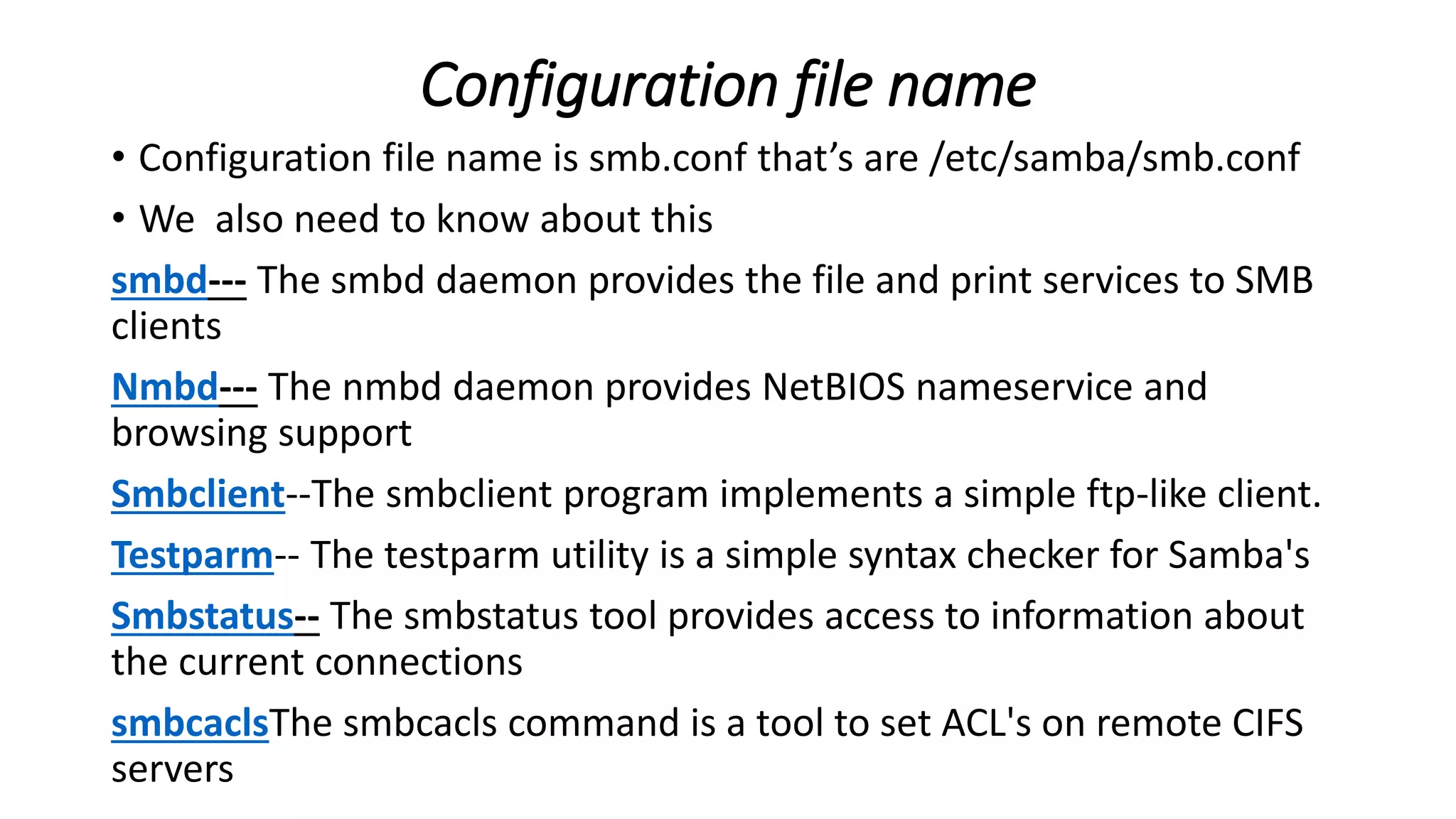
• Configuration file name is smb.conf that’s are /etc/samba/smb.conf
• We also need to know about this
smbd--- The smbd daemon provides the file and print services to SMB
clients
Nmbd--- The nmbd daemon provides NetBIOS nameservice and
browsing support
Smbclient--The smbclient program implements a simple ftp-like client.
Testparm-- The testparm utility is a simple syntax checker for Samba's
Smbstatus-- The smbstatus tool provides access to information about
the current connections
smbcaclsThe smbcacls command is a tool to set ACL's on remote CIFS
servers
Configuring a Samba Server
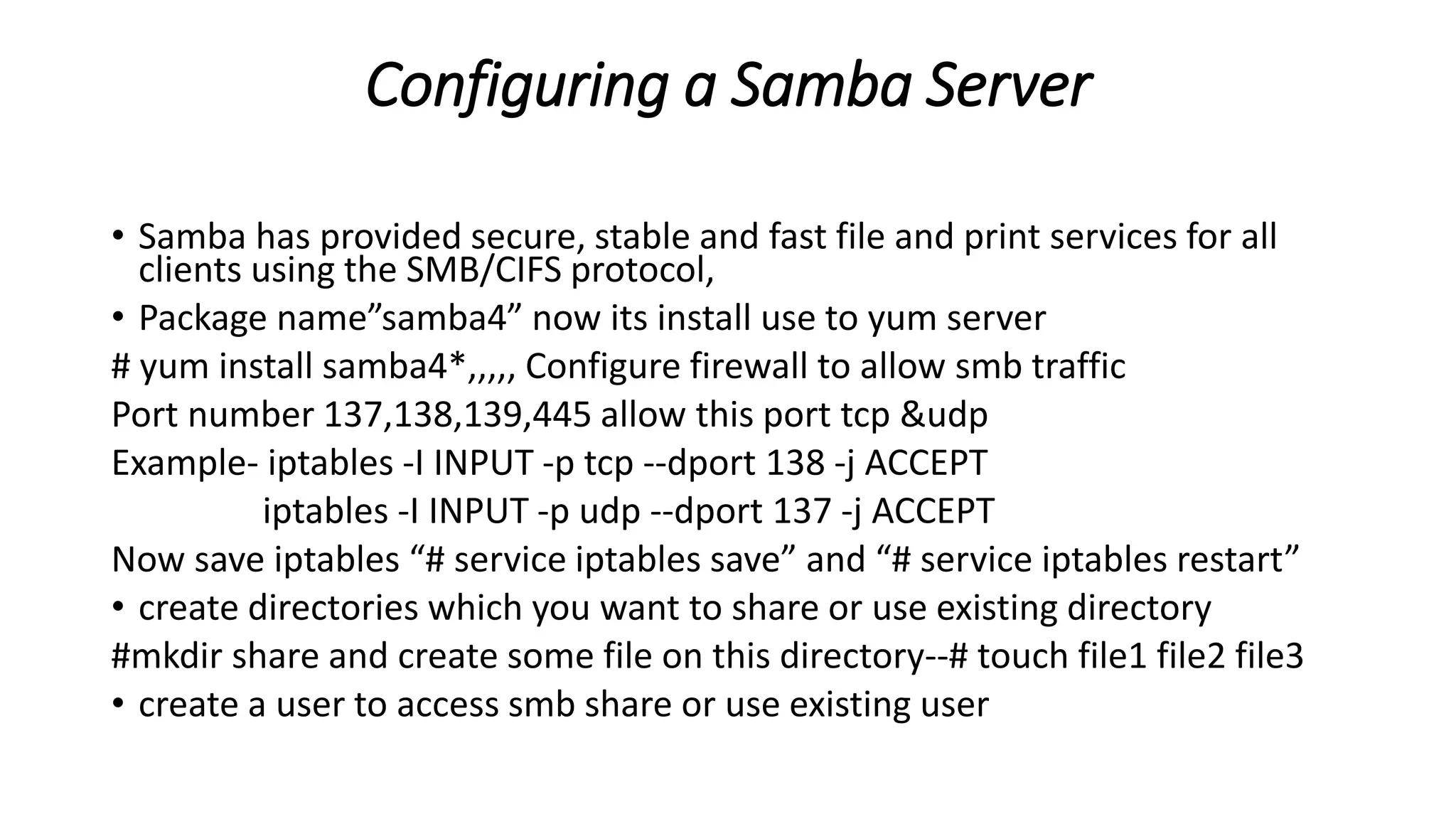
• Samba has provided secure, stable and fast file and print services for all
clients using the SMB/CIFS protocol,
• Package name”samba4” now its install use to yum server
# yum install samba4*,,,,, Configure firewall to allow smb traffic
Port number 137,138,139,445 allow this port tcp &udp
Example- iptables -I INPUT -p tcp --dport 138 -j ACCEPT
iptables -I INPUT -p udp --dport 137 -j ACCEPT
Now save iptables “# service iptables save” and “# service iptables restart”
• create directories which you want to share or use existing directory
#mkdir share and create some file on this directory--# touch file1 file2 file3
• create a user to access smb share or use existing user
# useradd us1,,,,,,,,# passwd us1 [passwd add]
# smbpasswd -a us1 [ if you use existing user then only this command would be
enough]
Now go to # vim /etc/samba/smb.conf then go to # find the line starts with
"workgroup=mygroup"change the mygroup to WORKGROUP
fine the line starts with "host allow=“
remove the semicolon (;) and modify the line to add the networks you want to
give access to
Now go to the last line of the file and insert a new line
• [sharename]
• comment = any comment
• path = /path-of-the-share-directory
• browseable = yes
• writable = yes
• printable = yes
• valid users = username
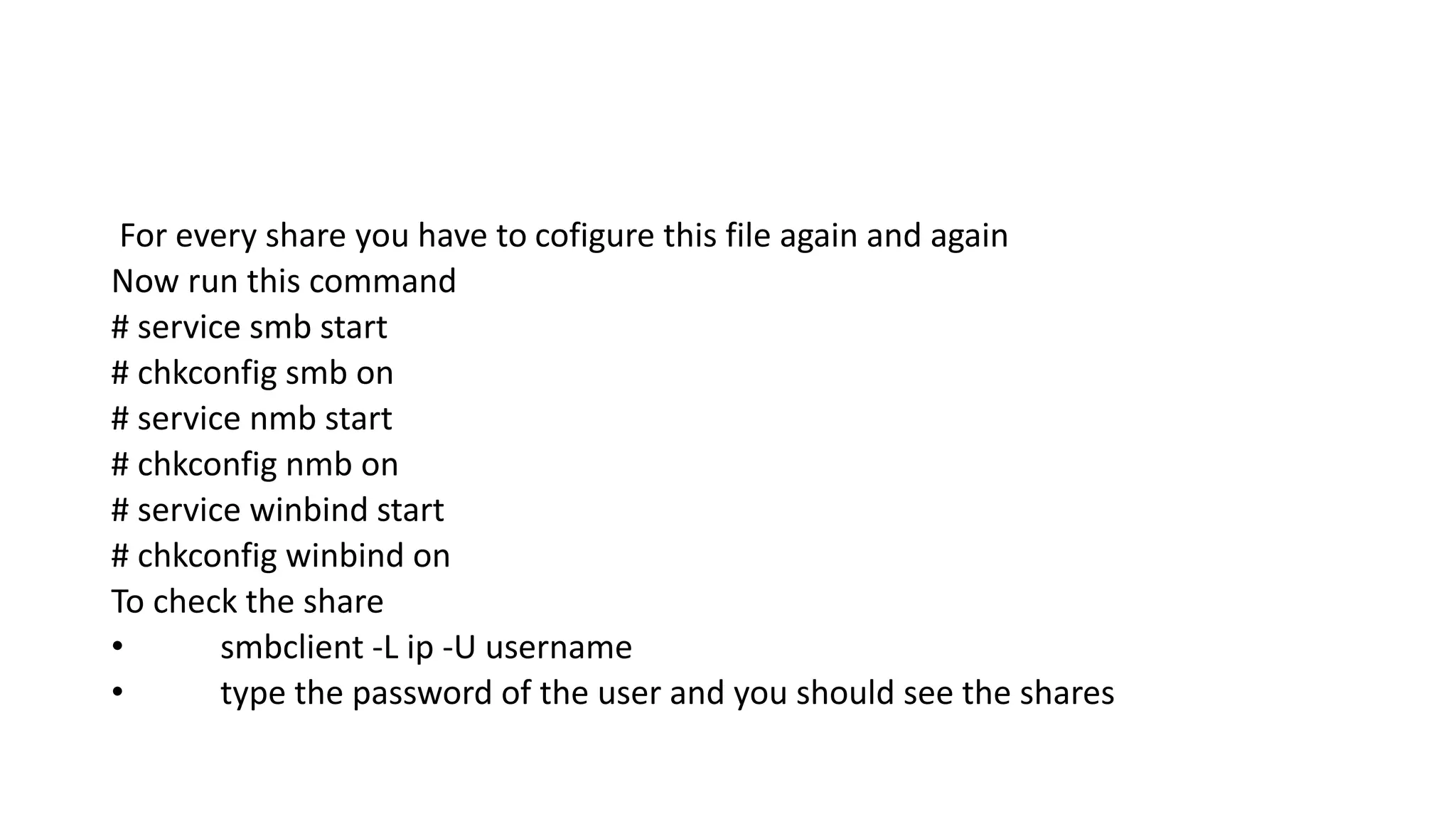
For every share you have to cofigure this file again and again
Now run this command
# service smb start
# chkconfig smb on
# service nmb start
# chkconfig nmb on
# service winbind start
# chkconfig winbind on
To check the share
• smbclient -L ip -U username
• type the password of the user and you should see the shares
Client Configure
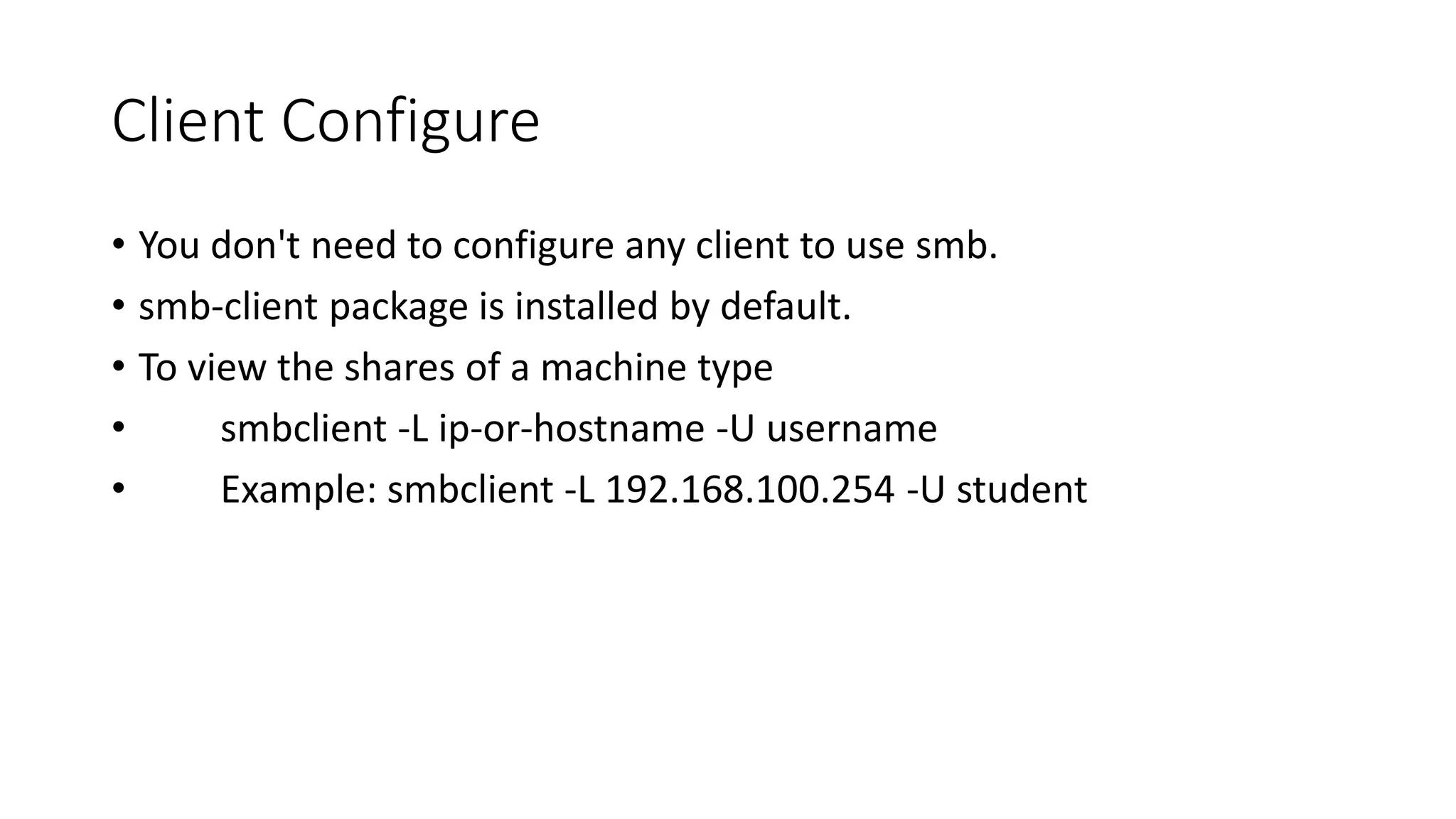
• You don't need to configure any client to use smb.
• smb-client package is installed by default.
• To view the shares of a machine type
• smbclient -L ip-or-hostname -U username
• Example: smbclient -L 192.168.100.254 -U student
Connecting to a Samba Share
• You can use Nautilus to view available Samba shares on your network
• Command Line( smbclient -L ip-or-hostname -U username)
• Mounting the Share
Mounting the Share
• To mount a samba share
• mount.cifs //target/sharename /mounting_directory -o user=username
• Example: mount.cifs //192.168.100.254/share /mountsmb -o user=student
• [assuming that the target server is 192.168.100.254, the sharename is
share,
• the mounting directory is /mountsmb and the user is student]
• enter the password for the user student
• ls /mountsmb
• you should see the contents of the share in the /mountsmb directory.
Troubleshooting Samba
• In addition to checking for spelling and typographical errors, check to
ensure the Linux firewall is permitting Samba traffic. Similarly, if
you're using SELinux on your system, you must explicitly permit
Samba traffic, and finally you must enable Network Discovery on the
Windows client machine.
Useful Websites
• http://www.samba.org/
http://www.samba.org/samba/docs/using_samba/toc.html
• www.google.com to search about Samba
• https://access.redhat.com
Thanks to spend valuable Time

Samba power point presentation

  • 1.
    How To Configure SambaServer & Client Md Maksudur Rahman Id-1178314 Batch -24 -ACSL IDB-BISEW-Diploma in Networking Technologies Mail- mr.maksudur@outlook.com Phone-01722607613
  • 2.
    At a glanceSamba • What is Samba • Why we use Samba • Configuration file name • Configuring a Samba Server • Connecting to a Samba Share Command Line Graphical • Mounting the Share • Troubleshooting Samba • Useful Websites
  • 3.
    What is Samba •Samba is a popular freeware program that allows end users to access and use files, printers, and other commonly shared resources on a company's intranet or on the Internet. Samba is often referred to as a network file system and can be installed on a variety of operating system platforms, including: Linux, most common UNIX platforms, OpenVMS, and OS/2. • Samba uses the SMB protocol to share files and printers across a network connection
  • 4.
    Why we useSamba A Samba server offers the following services: • Samba is useful if you have a network of both Windows and Linux machines • Samba is a strong network service for file and print sharing • Samba is reliable software that runs on reliable Unix operating system • Samba has a very nice cost advantage: it's free. • Share one or more Distributed filesystem (Dfs) trees • Authenticate clients logging onto a Windows domain
  • 5.
    Configuration file name •Configuration file name is smb.conf that’s are /etc/samba/smb.conf • We also need to know about this smbd--- The smbd daemon provides the file and print services to SMB clients Nmbd--- The nmbd daemon provides NetBIOS nameservice and browsing support Smbclient--The smbclient program implements a simple ftp-like client. Testparm-- The testparm utility is a simple syntax checker for Samba's Smbstatus-- The smbstatus tool provides access to information about the current connections smbcaclsThe smbcacls command is a tool to set ACL's on remote CIFS servers
  • 6.
    Configuring a SambaServer • Samba has provided secure, stable and fast file and print services for all clients using the SMB/CIFS protocol, • Package name”samba4” now its install use to yum server # yum install samba4*,,,,, Configure firewall to allow smb traffic Port number 137,138,139,445 allow this port tcp &udp Example- iptables -I INPUT -p tcp --dport 138 -j ACCEPT iptables -I INPUT -p udp --dport 137 -j ACCEPT Now save iptables “# service iptables save” and “# service iptables restart” • create directories which you want to share or use existing directory #mkdir share and create some file on this directory--# touch file1 file2 file3 • create a user to access smb share or use existing user
  • 7.
    # useradd us1,,,,,,,,#passwd us1 [passwd add] # smbpasswd -a us1 [ if you use existing user then only this command would be enough] Now go to # vim /etc/samba/smb.conf then go to # find the line starts with "workgroup=mygroup"change the mygroup to WORKGROUP fine the line starts with "host allow=“ remove the semicolon (;) and modify the line to add the networks you want to give access to Now go to the last line of the file and insert a new line • [sharename] • comment = any comment • path = /path-of-the-share-directory • browseable = yes • writable = yes • printable = yes • valid users = username
  • 8.
    For every shareyou have to cofigure this file again and again Now run this command # service smb start # chkconfig smb on # service nmb start # chkconfig nmb on # service winbind start # chkconfig winbind on To check the share • smbclient -L ip -U username • type the password of the user and you should see the shares
  • 9.
    Client Configure • Youdon't need to configure any client to use smb. • smb-client package is installed by default. • To view the shares of a machine type • smbclient -L ip-or-hostname -U username • Example: smbclient -L 192.168.100.254 -U student
  • 10.
    Connecting to aSamba Share • You can use Nautilus to view available Samba shares on your network • Command Line( smbclient -L ip-or-hostname -U username) • Mounting the Share
  • 11.
    Mounting the Share •To mount a samba share • mount.cifs //target/sharename /mounting_directory -o user=username • Example: mount.cifs //192.168.100.254/share /mountsmb -o user=student • [assuming that the target server is 192.168.100.254, the sharename is share, • the mounting directory is /mountsmb and the user is student] • enter the password for the user student • ls /mountsmb • you should see the contents of the share in the /mountsmb directory.
  • 12.
    Troubleshooting Samba • Inaddition to checking for spelling and typographical errors, check to ensure the Linux firewall is permitting Samba traffic. Similarly, if you're using SELinux on your system, you must explicitly permit Samba traffic, and finally you must enable Network Discovery on the Windows client machine.
  • 13.
    Useful Websites • http://www.samba.org/ http://www.samba.org/samba/docs/using_samba/toc.html •www.google.com to search about Samba • https://access.redhat.com
  • 14.
    Thanks to spendvaluable Time