CheM IstRY    ProJeCtSubmitted By:TARUNMALHOTRAClass :XII- C3
StudyOfConstituentsOfAlloys
AcknowledgementI wish to express my deepgratitude and sincere thanks to the Principal, Dr M.Barsaley, Greenfields Public school for her encouragement and for all the facilities that she provided for this project work. I sincerely appreciate this magnanimity by taking me into her fold for which I shall remain indebted to her. I extend my hearty thanks to Mrs.Alka Tyagi, Chemistry teacher ,who guided me to the successful completion of this project. I take this opportunity to express my deep sense of gratitude for her invaluable guidance, constant encouragement , immense motivation , which has sustained my efforts at all the stages  of thisproject work…I can’t forgot to offer my sincere thanks to parents and also to my classmates who helprd me to carry out this project work successful and for their valuable advice and support , which I received from them time to time….
-: Certificate :-   Guided By :- Mrs. Alka Tyagi
   Class :-           XII – C3
  Year :-            2011- 2012
   Roll No :-     ________________
  School :-      Greenfields Public SchoolCertified to be the bona fide work done by-Master ______________  of class XII-C3 in theChemistry Lab during the year  2011-2012.Date :-________Submitted for Central Board of Secondary Education.Examination held in Chemistry lab at GreenfieldsPublic  School.EXAMINERDate :-_________
-: INDEX :-1--   Introduction2--  Some Common Alloys3--   Preparation of alloys4--  Analysis of an alloy5--  Experiment 1      to analyze  a sample of brass      qualitative6--  Experiment 2      to analyze a sample of bronze      qualitatively7--   Uses of Alloy8--   Bibliography……
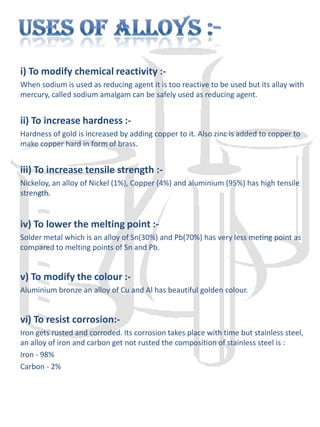
    IntroductionAn Alloyis a homogenous mixture of two or more metals or a non-metal.An alloy of mercury with another metal is called amalgam.Alloysare usually harder than their components but very often less ductile and less malleable. Thus the hardness of gold is increased by addition of copper to it. The melting point of an alloy is always lower than the melting points of the constituent metals. Other properties such as reactivity towards atmospheric oxygen and moisture, mechanical strength, ductility, colour etc. also under goes a change when an alloy is made from its constituents (metals). This change of properties is very useful and makes an alloy beneficial.Some of the alloys along with their composition is given below.1.     Brass :-        It consists copper-50-90%.         Zinc. : 20-40%        and small amounts of tin, lead and iron.2.     Bronze: It consists copper 60-90%.3.     Tin : 5-35%        and also contains small amounts of lead, iron and zinc.        Duralumin : It consists A1 : 95%, Cu = 4%        Mn = 0.5%, Mg = 0.5%4.     Gun Metal : It consists copper 85 - 90%5.     Zinc. : 1-3%6.     Tin : 8-12%        The composition of alloys may differ slightly depending upon the quality of the alloy though the main components remain the same.
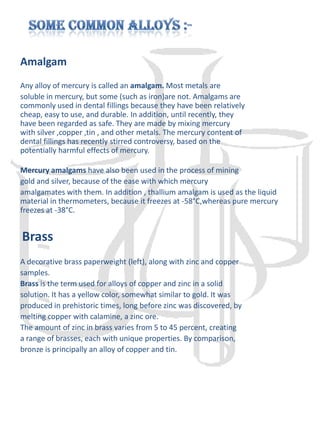
Some Common Alloys :-AmalgamAny alloy of mercury is called an amalgam. Most metals aresoluble in mercury, but some (such as iron)are not. Amalgams arecommonly used in dental fillings because they have been relativelycheap, easy to use, and durable. In addition, until recently, theyhave been regarded as safe. They are made by mixing mercurywith silver ,copper ,tin , and other metals. The mercury content ofdental fillings has recently stirred controversy, based on thepotentially harmful effects of mercury.Mercury amalgams have also been used in the process of mininggold and silver, because of the ease with which mercuryamalgamates with them. In addition , thallium amalgam is used as the liquid material in thermometers, because it freezes at -58°C,whereas pure mercury freezes at -38°C.BrassA decorative brass paperweight (left), along with zinc and coppersamples.Brass is the term used for alloys of copper and zinc in a solidsolution. It has a yellow color, somewhat similar to gold. It wasproduced in prehistoric times, long before zinc was discovered, bymelting copper with calamine, a zinc ore.The amount of zinc in brass varies from 5 to 45 percent, creatinga range of brasses, each with unique properties. By comparison,bronze is principally an alloy of copper and tin.
Despite this distinction, some types of brasses are called bronzes.Brass is relatively resistant to tarnishing and is often used fordecorative purposes. Its malleability and acoustic properties havemade it the metal of choice for musical instruments such as thetrombone, tuba, trumpet, and euphonium. Although saxophonesAnd harmonicas are made out of brass, the saxophone is awoodwind instrument, and the harmonica, a free reed aero phone.In organ pipes designed as "reed" pipes, brass strips are used asthe "reed."Aluminum makes brass stronger and more corrosion-resistant. Itforms a transparent, self-healing, protective layer of aluminumoxide (Al2O3) on the surface. Tin has a similar effect and finds itsuse especially in seawater applications (naval brasses).Combinations of iron, aluminum, silicon, and manganese make brassresistant to wear and tear.BronzeBronze refers to a broad range of copper alloys, usually with tinas the main additive, but sometimes with other element s such asphosphorus,manganese,aluminum, or silicon. Typically, bronze isabout 60 percent copper and 40 percent tin. The use of bronze was particularly significant for early civilizations, leading to the name "Bronze Age." Tools, weapons,armor, and building materials such as decorative tiles were madeof bronze, as they were found to be harder and more durablethan their stone and copper predecessors.
In early use, the natural impurity arsenic sometimes created a superior naturalalloy, called "arsenical bronze."Though not as strong as steel, bronze is superior to iron in nearlyevery application. Bronze develops a patina (a green coating onthe exposed surface), but it does not oxidize beyond the surface.It is considerably less brittle than iron and has a lower castingtemperature. Several bronze alloys resist corrosion (especially byseawater) and metal fatigue better than steel; they also conductHeat and electricity better than most steels.Bronze has myriad uses in industry. It is widely used today forsprings, bearings, bushings, and similar fittings, and is particularlycommon in the bearings of small electric motors. It is also widelyused for cast metal sculpture and is the most popular metal fortop-quality bells and cymbals.Commercial bronze, otherwise known as brass, is 90 percentcopper and 10 percent zinc. It contains no tin
                       Preparation of AlloysAlloys are prepared from the techniques of fusion, compression or simultaneous electro - deposition. Generally the components are mixed together in proper properties in a fuse clay crucible, melted and stirred with a piece of charcoal to avoid oxidation. The molten mixture is now allowed to cool. When an alloy is obtained e.g. brass is prepared by above melted.                        Analysis of an alloyThe complete analysis of an alloy involves two steps.1. Qualitative Analysis :This involves identification of the components of the alloys.2. Quantitative Analysis :This involves determination of the components of the alloy. It involves the separation of the components from the alloy quantitatively followed by determination of percentage of each component volumetrically or gravimetrically.In this project we will carry out qualitative analysis only. Objectives of Project :In this project, our aim is to know the various metals present in the given sample of alloy.
Experiment -1To analyze a sample of brass
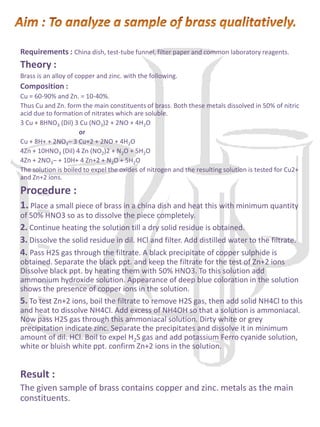
Aim : To analyze a sample of brass qualitatively.Requirements : China dish, test-tube funnel, filter paper and common laboratory reagents.Theory :Brass is an alloy of copper and zinc. with the following.Composition :Cu = 60-90% and Zn. = 10-40%.Thus Cu and Zn. form the main constituents of brass. Both these metals dissolved in 50% of nitric acid due to formation of nitrates which are soluble.3 Cu + 8HNO3 (Dil) 3 Cu (NO3)2 + 2NO + 4H2O                                    orCu + 8H+ + 2NO3– 3 Cu+2 + 2NO + 4H2O4Zn + 10HNO3 (Dil) 4 Zn (NO2)2 + N2O + 5H2O4Zn + 2NO3– + 10H+ 4 Zn+2 + N2O + 5H2OThe solution is boiled to expel the oxides of nitrogen and the resulting solution is tested for Cu2+ and Zn+2 ions.Procedure :1. Place a small piece of brass in a china dish and heat this with minimum quantity of 50% HNO3 so as to dissolve the piece completely.2. Continue heating the solution till a dry solid residue is obtained.3. Dissolve the solid residue in dil. HCl and filter. Add distilled water to the filtrate.4. Pass H2S gas through the filtrate. A black precipitate of copper sulphide is obtained. Separate the black ppt. and keep the filtrate for the test of Zn+2 ions Dissolve black ppt. by heating them with 50% HNO3. To this solution add ammonium hydroxide solution. Appearance of deep blue coloration in the solution shows the presence of copper ions in the solution.5. To test Zn+2 ions, boil the filtrate to remove H2S gas, then add solid NH4Cl to this and heat to dissolve NH4Cl. Add excess of NH4OH so that a solution is ammoniacal. Now pass H2S gas through this ammoniacal solution. Dirty white or grey precipitation indicate zinc. Separate the precipitates and dissolve it in minimum amount of dil. HCl. Boil to expel H2S gas and add potassium Ferro cyanide solution, white or bluish white ppt. confirm Zn+2 ions in the solution.Result :The given sample of brass contains copper and zinc. metals as the main constituents. 
Experiment -2To analyze a sample of bronze

Chemistry project

  • 1.
    CheM IstRY ProJeCtSubmitted By:TARUNMALHOTRAClass :XII- C3
  • 2.
  • 3.
    AcknowledgementI wish toexpress my deepgratitude and sincere thanks to the Principal, Dr M.Barsaley, Greenfields Public school for her encouragement and for all the facilities that she provided for this project work. I sincerely appreciate this magnanimity by taking me into her fold for which I shall remain indebted to her. I extend my hearty thanks to Mrs.Alka Tyagi, Chemistry teacher ,who guided me to the successful completion of this project. I take this opportunity to express my deep sense of gratitude for her invaluable guidance, constant encouragement , immense motivation , which has sustained my efforts at all the stages of thisproject work…I can’t forgot to offer my sincere thanks to parents and also to my classmates who helprd me to carry out this project work successful and for their valuable advice and support , which I received from them time to time….
  • 4.
    -: Certificate :- Guided By :- Mrs. Alka Tyagi
  • 5.
    Class :- XII – C3
  • 6.
    Year:- 2011- 2012
  • 7.
    Roll No :- ________________
  • 8.
    School:- Greenfields Public SchoolCertified to be the bona fide work done by-Master ______________ of class XII-C3 in theChemistry Lab during the year 2011-2012.Date :-________Submitted for Central Board of Secondary Education.Examination held in Chemistry lab at GreenfieldsPublic School.EXAMINERDate :-_________
  • 9.
    -: INDEX :-1-- Introduction2-- Some Common Alloys3-- Preparation of alloys4-- Analysis of an alloy5-- Experiment 1 to analyze a sample of brass qualitative6-- Experiment 2 to analyze a sample of bronze qualitatively7-- Uses of Alloy8-- Bibliography……
  • 10.
    IntroductionAn Alloyis a homogenous mixture of two or more metals or a non-metal.An alloy of mercury with another metal is called amalgam.Alloysare usually harder than their components but very often less ductile and less malleable. Thus the hardness of gold is increased by addition of copper to it. The melting point of an alloy is always lower than the melting points of the constituent metals. Other properties such as reactivity towards atmospheric oxygen and moisture, mechanical strength, ductility, colour etc. also under goes a change when an alloy is made from its constituents (metals). This change of properties is very useful and makes an alloy beneficial.Some of the alloys along with their composition is given below.1.     Brass :-        It consists copper-50-90%.        Zinc. : 20-40%        and small amounts of tin, lead and iron.2.     Bronze: It consists copper 60-90%.3.     Tin : 5-35%        and also contains small amounts of lead, iron and zinc.        Duralumin : It consists A1 : 95%, Cu = 4%        Mn = 0.5%, Mg = 0.5%4.     Gun Metal : It consists copper 85 - 90%5.     Zinc. : 1-3%6.     Tin : 8-12%        The composition of alloys may differ slightly depending upon the quality of the alloy though the main components remain the same.
  • 11.
    Some Common Alloys:-AmalgamAny alloy of mercury is called an amalgam. Most metals aresoluble in mercury, but some (such as iron)are not. Amalgams arecommonly used in dental fillings because they have been relativelycheap, easy to use, and durable. In addition, until recently, theyhave been regarded as safe. They are made by mixing mercurywith silver ,copper ,tin , and other metals. The mercury content ofdental fillings has recently stirred controversy, based on thepotentially harmful effects of mercury.Mercury amalgams have also been used in the process of mininggold and silver, because of the ease with which mercuryamalgamates with them. In addition , thallium amalgam is used as the liquid material in thermometers, because it freezes at -58°C,whereas pure mercury freezes at -38°C.BrassA decorative brass paperweight (left), along with zinc and coppersamples.Brass is the term used for alloys of copper and zinc in a solidsolution. It has a yellow color, somewhat similar to gold. It wasproduced in prehistoric times, long before zinc was discovered, bymelting copper with calamine, a zinc ore.The amount of zinc in brass varies from 5 to 45 percent, creatinga range of brasses, each with unique properties. By comparison,bronze is principally an alloy of copper and tin.
  • 12.
    Despite this distinction,some types of brasses are called bronzes.Brass is relatively resistant to tarnishing and is often used fordecorative purposes. Its malleability and acoustic properties havemade it the metal of choice for musical instruments such as thetrombone, tuba, trumpet, and euphonium. Although saxophonesAnd harmonicas are made out of brass, the saxophone is awoodwind instrument, and the harmonica, a free reed aero phone.In organ pipes designed as "reed" pipes, brass strips are used asthe "reed."Aluminum makes brass stronger and more corrosion-resistant. Itforms a transparent, self-healing, protective layer of aluminumoxide (Al2O3) on the surface. Tin has a similar effect and finds itsuse especially in seawater applications (naval brasses).Combinations of iron, aluminum, silicon, and manganese make brassresistant to wear and tear.BronzeBronze refers to a broad range of copper alloys, usually with tinas the main additive, but sometimes with other element s such asphosphorus,manganese,aluminum, or silicon. Typically, bronze isabout 60 percent copper and 40 percent tin. The use of bronze was particularly significant for early civilizations, leading to the name "Bronze Age." Tools, weapons,armor, and building materials such as decorative tiles were madeof bronze, as they were found to be harder and more durablethan their stone and copper predecessors.
  • 13.
    In early use, thenatural impurity arsenic sometimes created a superior naturalalloy, called "arsenical bronze."Though not as strong as steel, bronze is superior to iron in nearlyevery application. Bronze develops a patina (a green coating onthe exposed surface), but it does not oxidize beyond the surface.It is considerably less brittle than iron and has a lower castingtemperature. Several bronze alloys resist corrosion (especially byseawater) and metal fatigue better than steel; they also conductHeat and electricity better than most steels.Bronze has myriad uses in industry. It is widely used today forsprings, bearings, bushings, and similar fittings, and is particularlycommon in the bearings of small electric motors. It is also widelyused for cast metal sculpture and is the most popular metal fortop-quality bells and cymbals.Commercial bronze, otherwise known as brass, is 90 percentcopper and 10 percent zinc. It contains no tin
  • 14.
    Preparation of AlloysAlloys are prepared from the techniques of fusion, compression or simultaneous electro - deposition. Generally the components are mixed together in proper properties in a fuse clay crucible, melted and stirred with a piece of charcoal to avoid oxidation. The molten mixture is now allowed to cool. When an alloy is obtained e.g. brass is prepared by above melted.  Analysis of an alloyThe complete analysis of an alloy involves two steps.1. Qualitative Analysis :This involves identification of the components of the alloys.2. Quantitative Analysis :This involves determination of the components of the alloy. It involves the separation of the components from the alloy quantitatively followed by determination of percentage of each component volumetrically or gravimetrically.In this project we will carry out qualitative analysis only. Objectives of Project :In this project, our aim is to know the various metals present in the given sample of alloy.
  • 15.
    Experiment -1To analyzea sample of brass
  • 16.
    Aim : Toanalyze a sample of brass qualitatively.Requirements : China dish, test-tube funnel, filter paper and common laboratory reagents.Theory :Brass is an alloy of copper and zinc. with the following.Composition :Cu = 60-90% and Zn. = 10-40%.Thus Cu and Zn. form the main constituents of brass. Both these metals dissolved in 50% of nitric acid due to formation of nitrates which are soluble.3 Cu + 8HNO3 (Dil) 3 Cu (NO3)2 + 2NO + 4H2O                                    orCu + 8H+ + 2NO3– 3 Cu+2 + 2NO + 4H2O4Zn + 10HNO3 (Dil) 4 Zn (NO2)2 + N2O + 5H2O4Zn + 2NO3– + 10H+ 4 Zn+2 + N2O + 5H2OThe solution is boiled to expel the oxides of nitrogen and the resulting solution is tested for Cu2+ and Zn+2 ions.Procedure :1. Place a small piece of brass in a china dish and heat this with minimum quantity of 50% HNO3 so as to dissolve the piece completely.2. Continue heating the solution till a dry solid residue is obtained.3. Dissolve the solid residue in dil. HCl and filter. Add distilled water to the filtrate.4. Pass H2S gas through the filtrate. A black precipitate of copper sulphide is obtained. Separate the black ppt. and keep the filtrate for the test of Zn+2 ions Dissolve black ppt. by heating them with 50% HNO3. To this solution add ammonium hydroxide solution. Appearance of deep blue coloration in the solution shows the presence of copper ions in the solution.5. To test Zn+2 ions, boil the filtrate to remove H2S gas, then add solid NH4Cl to this and heat to dissolve NH4Cl. Add excess of NH4OH so that a solution is ammoniacal. Now pass H2S gas through this ammoniacal solution. Dirty white or grey precipitation indicate zinc. Separate the precipitates and dissolve it in minimum amount of dil. HCl. Boil to expel H2S gas and add potassium Ferro cyanide solution, white or bluish white ppt. confirm Zn+2 ions in the solution.Result :The given sample of brass contains copper and zinc. metals as the main constituents. 
  • 17.
    Experiment -2To analyzea sample of bronze