(CHEMISTRY PRACTICALS) Page No 1
[CLASS XII CHEMISTRY PRACTICALS]
Evaluation Scheme for Examination Marks
Volumetric Analysis 08
Salt Analysis 08
Content Based Experiment 06
Project Work 04
Class record and viva 04
Total 30
Note:- 1. Chemical Equations of Experiment 3 to 11 are to be written on blank pages.
2. Observation table of experiment 13 to 16 are to be drawn on blank pages.
3. Investigatory Project work (4 marks) is also included in the practical syllabus. For project work, contact
the teacher for the topic.
4. Project report should be hand written.
5. Start each experiment from a new page.
EXPERIMENT – 1
Classification of Anions
Group Group
Reagent
Observation Inference
A Dilute H2SO4 a) Colourless, odourless gas with brisk effervescence (CO2) which
turn lime water milky.
b) Colourless gas with rotten egg like smell (H2S) which turns lead
acetate paper black.
c) Colourless gas with smell of burning sulphur (SO2) which turns
acidified dichromate paper green.
d) Brown coloured gas (NO2) which turns ferrous sulphate solution
black or brown.
e) Colourless gas with vinegar like smell.

2
3
CO (Carbonate)

2
S (sulphide)

2
3
SO (Sulphite)

2
NO (Nitrite)
CH3COO-
(Acetate)
B Conc. H2SO4 a) Colourless pungent smelling gas (HCl) which gives white dense
fumes with glass rod dipped in NH4OH.
b) Violet coloured vapours (I2) which turns starch paper blue.
c) Reddish brown gas (NO2) having pungent smell (On adding
copper turning, fumes becomes intense)
d) Brown colour gas with pungent smell (Br2) which turns starch
paper yellow.
e) Colourless, odourless gas with brisk effervescence
(CO + CO2) which turns lime water milky and burns on the mouth
of test tube with blue flame.

Cl (Chloride)
I–
(Iodide)

3
NO (Nitrate)

Br (Bromide)
-
2
4
2O
C (Oxalate)
C BaCl2 White ppt. of BaSO4 is formed. 
2
4
SO (sulphate)
D Ammonium
molybdate
3 (NH3)4MoO4
Cannary yellow ppt. of phospho ammonium molybdate (NH4)3
PO4.12 MoO3 . 6H2O

3
4
PO (phosphate)
EXPERIMENT – 2
Classification of Cations
Group Group Reagent Radical PPt/Smell Colour
Zero NaOH 
4
NH Smell of NH3 -
I Dil. HCl Pb+2
PbCl2 White
II H2S gas in acidic Pb+2
PbS Black
Medium As3+
As2S3 Yellow
Cu+2
CuS Black
Cd+2
CdS Yellow
III NH4Cl (s) in presence of Fe2+
Fe(OH)2 Light green
NH4OH Fe3+
Fe(OH)3 Reddish brown
Al3+
Al(OH)3 Gelatinous white
IV H2S gas in basic medium Ni2+
NiS Black
(CHEMISTRY PRACTICALS) Page No 2
Co2+
CoS Black
Mn2+
MnS Flesh colour
Zn2+
ZnS Dirty white
V (NH4)2 CO3 in presence of NH4OH Ba2+
BaCO3 White
Ca2+
CaCO3 White
Sr2+
SrCO3 White
VI Na2HPO4 in presence of NH4OH Mg2+
MgNH4PO4 White
EXPERIMENT – 3
Aim :- To analyse the given inorganic salt for acidic and basic radicals [(NH4)2 CO3]
Preliminary Investigation
Physical State
Colour
Odour
Solubility
Flame Test
Solid
White (Cu2+
, Fe2+
, Fe3+
, Ni2+
, Mn2+
,Co2+
absent)
Ammonium smell (may be NH4
+
)
Soluble in water
No Characteristic flame (Pb2+
, Cu2+
, Ca2+
, Sr2+
, Ba2+
,
Zn2+
absent)
(A) Identification of Acidic Radical
(a) Preliminary test :
Experiment Observation Inference
1. Salt solution + dil H2SO4 Colourless, colourless gas with brisk
effervescence which turn lime water
milky
Group A anion (CO3
2-
may be
present)
Confirmative test :
1. BaCl2 Test : Salt solution +
BaCl2
2. MgSO4 Test : Salt solution +
MgSO4
White ppt of BaCO3
White ppt of MgCO3
CO3
2-
Confirmed
CO3
2-
Confirmed
(B) Identification of Basic Radical
a) Preliminary Test
Experiment Observation Inference
1. Salt Solution + NaOH+ Heat Smell of NH3
2. Place a red litmus on the mouth of
test tube.
Red litmus turns blue Zero group present  
be
may
NH 
4
Confirmative test
Experiment Observation Inference
1. Nessler’s reagent test : Salt +
Solution + NaOH + Nessler’s Reagent
2. NaOH test :
Salt Solution + NaOH + Heat.
Bring a glass rod dipped in conc. HCl
Reddish brown ppt. is formed
Smell of NH3
Dense white fumes of NH4Cl are
formed.

4
NH confirmed.

4
NH Confirmed.
Chemical Reactions : -
Acidic Radical
Preliminary Test :-
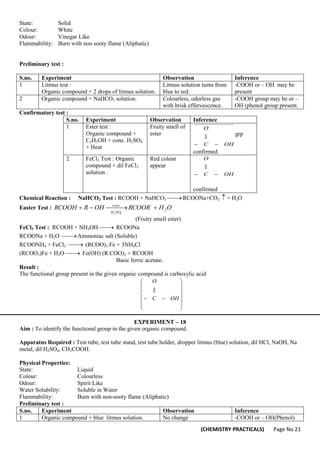
1.     O
H
CO
SO
NH
SO
H
CO
NH 2
2
4
2
4
4
2
3
2
4 ↑





2. O
H
CaCO
CO
OH
Ca 2
3
2
2 +
→
+
)
(
Confirmative Test
1. BaCl2 Test :
( ) Cl
NH
BaCO
BaCl
CO
NH 4
3
2
3
2
4 2
+
↓
→
+
2- MgSO4
  4
2
4
3
4
3
2
4 )
( SO
NH
MgCO
MgSO
CO
NH 




(CHEMISTRY PRACTICALS) Page No 3
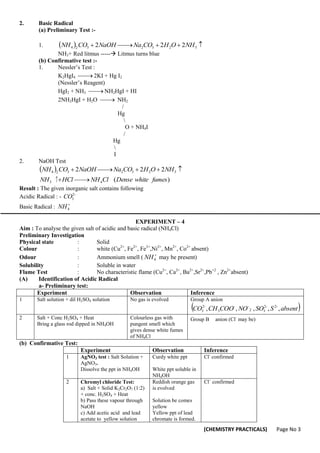
2. Basic Radical
(a) Preliminary Test :-
1.   




 3
2
3
2
3
2
4 2
2
2 NH
O
H
CO
Na
NaOH
CO
NH
NH3+ Red litmus ----- Litmus turns blue
(b) Confirmative test :-
1. Nessler’s Test :
K2HgI4 
 2KI + Hg I2
(Nessler’s Reagent)
HgI2 + NH3 
 NH2HgI + HI
2NH2HgI + H2O 
 NH2
/
Hg

O + NH4I
/
Hg

I
2. NaOH Test
  




 3
2
3
2
3
2
4 2
2
2 NH
O
H
CO
Na
NaOH
CO
NH
)
(
↑ 4
3 fumes
white
Dense
Cl
NH
HCl
NH 


Result : The given inorganic salt contains following
Acidic Radical : - -
2
3
CO
Basic Radical : 
4
NH
EXPERIMENT – 4
Aim : To analyse the given salt of acidic and basic radical (NH4Cl)
Preliminary Investigation
Physical state : Solid
Colour : white (Cu2+
, Fe2+
, Fe3+
,Ni2+
, Mn2+
, Co2+
absent)
Odour : Ammonium smell ( 
4
NH may be present)
Solubility : Soluble in water
Flame Test : No characteristic flame (Cu2+
, Ca2+
, Ba2+
,Sr2+
,Pb+2
, Zn2+
absent)
(A) Identification of Acidic Radical
a- Preliminary test:
Experiment Observation Inference
1 Salt solution + dil H2SO4 solution No gas is evolved Group A anion
( )
absent
S
SO
NO
COO
CH
CO ,
,
,
,
, -
2
-
2
3
2
-
-
3
-
2
3
2 Salt + Conc H2SO4 + Heat
Bring a glass rod dipped in NH4OH
Colourless gas with
pungent smell which
gives dense white fumes
of NH4Cl
Group B anion (Cl-
may be)
(b) Confirmative Test:
Experiment Observation Inference
1 AgNO3 test : Salt Solution +
AgNO3.
Dissolve the ppt in NH4OH
Curdy white ppt
White ppt soluble in
NH4OH
Cl-
confirmed
2 Chromyl chloride Test:
a) Salt + Solid K2Cr2O7 (1:2)
+ conc. H2SO4 + Heat
b) Pass these vapour through
NaOH
c) Add acetic acid and lead
acetate to yellow solution
Reddish orange gas
is evolved
Solution be comes
yellow
Yellow ppt of lead
chromate is formed.
Cl–
confirmed
(CHEMISTRY PRACTICALS) Page No 4
Identification of Basic Radical
Preliminary Test:
Experiment Observation Inference
1 Salt solution + NaOH +
Heat
Smell of Ammonia Zero group (NH4
+
)
May be
2 Place a red litmus on the
mouth of test tube
Red litmus turns
blue
Confirmative Test:
Experiment Observation Inference
1 Nessler Test: Salt solution + NaOH +
Nessler’s reagent
Reddish brown ppt is
formed
NH4
+
Confirmed
2 NaOH Test : Salt Solution + NaOH + Heat
Bring a glass rod dipped in dil HCl
Smell of NH3
white dense fumes of
NH4Cl are formed
NH4
+
Confirmed
Preliminary Test :
( ) HCl
SO
NH
SO
H
Cl
NH
Heat
2
+
→
+
2 4
2
4
4
2
4
O
H
Cl
NH
HCl
OH
NH 2
4
4 +
→
+
(White dense fumes)
Confirmative Test :
AgNO3 test 3
4
3
4 +
↓
2
→
2
+ NO
NH
AgCl
AgNO
Cl
NH
(Curdy white ppt)
O
H
Cl
NH
Ag
OH
NH
AgCl 2
2
3
4 2
]
)
(
[ 



(Diammine silver (I) Chloride)
Chromyl Chloride Test :
K2Cr2O7 + H2SO4 
 K2SO4+2Cr2O3 + H2O
2NH4 + H2SO4 
 (NH4)2SO4+ 2HCl
)
(
2 2
2
2
2
3
Vapour
O
H
Cl
O
Cr
HCl
CrO 




O
H
NaCl
CrO
Na
NaOH
Cl
CrO 2
4
2
2
2 2
4 




(Sodium Chromate (Yellow Solution)
COONa
CH
PbCrO
COO
CH
Pb
CrO
Na
dit
COOH
CH
3
4
.
2
3
4
2
3
)
( 


(Lead Chromate)
Chemical Reaction for Basic Radical
Preliminary Test :





 
3
2
4 NH
O
H
NaCl
NaOH
Cl
NH
NH3+ Red litmus ----- Litmus turns blue
Confirmative Test :
Nessler’s Test : K2HgI4 
 2KI+ HgI2
HgI2 + NH4 
 NH2 HgI + Hl
2NH2HgI + H2O 
 NH2 +NH4I
/
Hg

O
/
Hg

I (Iodide of millon base)
NaOH Test :
NH4Cl + NaOH 
 NaCl + H2O + NH3 (g)
(CHEMISTRY PRACTICALS) Page No 5
NH3 + HCl 
 NH4Cl
(Dense white fumes)
Result : The given inorganic salt contains
Acidic Radical Cl–
Basic Radical NH4
+
EXPERIMENT – 5
Aim : To analyze the given inorganic salt for acidic and basic radical. Pb(NO3)2
Preliminary Investigation
Physical state : Solid
Colour : Creamish white (Cu2+
, Co2+
,Ni2+
Fe2+
, Mn2+
Fe3+
absent)
Odour : No characteristic odour ( 
4
NH , S2-
,
CH3COO-
absent)
Solubility : Soluble in water
Flame Test : Dull Bluish white flame is obtained (Pb2+
may be)
(A) Identification of Acidic Radical
a- Preliminary test:
Experiment Observation Inference
1 Salt solution + dil H2SO4 solution No gas is evolved Group A
( )
absent
S
SO
NO
COO
CH
CO ,
,
,
,
, -
2
-
2
3
2
-
-
3
-
2
3
2 Salt + Concn
H2SO4 + Heat Brown Colourled gas
(NO2) is evolved
Group B (NO3
-
may be present)
(b) Confirmative test:
Experiment Observation Inference
1 Diphenyl amine test :
salt + Concn
H2SO4 + diphenyl amine
Deep blue coloured
solution
NO3
-
- confirmed
2 Ring Test :
Salt + Freshly prepared FeSO4 + Concn
H2SO4 along the side of the test tube
Brown ring is formed at
the junction of two liquids
NO3
-
- confirmed
Identification of Basic Radical
a- Preliminary test :
Experiment Observation Inference
1 Salt solution + NaOH No Smell of ammonia Zero group [NH4
+
] absent
2 Salt Solution + dil HCl
Filter the above ppt and boil it with water
and divide into parts.
White ppt of PbCl2 is
formed
I group [Pb2+
may be]
Identification of Basic Radical
a- Confirmative test :
Experiment Observation Inference
1 KI test : 1st
part + KI Pb I2 (Yellow Ppt) Pb2+
Confirmed
2 K2CrO4 Test : 2nd
part + K2CrO4 Yellow ppt of PbCrO4 is
formed
Pb2+
Confirmed
Chemical reaction for Acidic Radical
Preliminary Test : Pb (NO3)2 + H2SO4 
 PbSO4 + 2HNO3
Cu + HNO3 
 Cu(NO3)2 + 2 NO2 + H2O
Confirmative Test :
i) Ring Test Pb (NO3)2 + H2SO4 
 PbSO4 + 2HNO3
6FeSO4 + 3H2SO4 + 2HNO3 
 3Fe2 (SO4)3 + 4H2O + 2NO
(CHEMISTRY PRACTICALS) Page No 6
FeSO4 + NO 
 FeSO4 . NO
(Nitroso ferrous sulphate)
ii) Diphenyl amine Test
2(C6H5)2 NH + [O] 
 (C6H5)2 N – N (C6H5)2 + H2O
(Diphenyl amine hydrazine)
(B) Identification of Basic Radical
Preliminary Test : Pb (NO3)2 + 2HCl 
 PbCl2  + 2HNO3
(White)
Confirmative Test :
i) KI Test : PbCl2 + 2KI 
 PbI2  + 2KCI
ii) K2CrO4 Test : PbCl2 + K2CrO4 
 PbCrO4  + 2KCl
(Yellow ppt.)
Result : The given inorganic salt contains
Acidic Radical 
3
NO Basic Radical 2

Pb
EXPERIMENT – 6
Aim : To analyze the given inorganic salt for acidic and basic radical.[CuSO4]
Preliminary Investigation
Physical state : Solid
Colour : Blue (Cu2+
may be)
Qdour : No characteristic odour ( absence of 
4
NH , S2-
, CH3COO-
)
Solubility : Soluble in water.
Flame Test : Bluish green flame (Cu2+
may be)
(A) Identification of Acidic Radical
a- Preliminary test :
Experiment Observation Inference
1 Salt solution + dil H2SO4 solution No gas is evolved Group A
 
absent
COO
CH
NO
SO
S
CO -
3
2
2
3
2
2
3 ,
, 



2 Salt + Concn
H2SO4 + Heat No gas evolved Group B anions
 
areabsent
O
C
NO
I
Br
Cl 



 2
4
2
3 ,
,
,
,
(b) Confirmative test :
Experiment Observation Inference
1 BaCl2 test : Salt Solution + BaCl2 Solution
Add dil. HCl or dil HNO3
White Ppt formed
Ppt remains insoluble
SO4
2-
confirmed
2 Lead Acetate Test : -
Salt Solution + lead acetate solution
Add ammonium acetate Solution (CH3COO NH4 )
to above ppt.
White ppt. formed
Ppt becomes soluble
SO4
2-
confirmed
Identification of basic Radical
a- Preliminary test :
Experiment Observation Inference
1 Salt solution + NaOH + heat No smell of ammonia Zero Group,  
absent
NH 
4
2 Salt solution + dil . HCl No white Ppt Group I, (Pb2+
absent)
3 Above solution + H2S gas Black Ppt is formed Group II, (Cu2+
/ Pb2+
may be
present )
4 Dissolve above ppt in HNO3 Solution turms bluish
green
5 Divide the above solution in 2 parts .
(b) Confirmative test :
(CHEMISTRY PRACTICALS) Page No 7
Experiment Observation Inference
1 NH4OH test : 1st
part +
NH4 OH
Deep bule colour Cu2+
confirmed
2 Potassium ferrocynide test :
IInd part + K4[Fe(CN)6]
Chocolate brown
ppt of Copper
ferrocyanide is
formed
Cu2+
confirmed
Acidic Radical
1- BaCl2 Test:
CuSO4 + BaCl2  BaSO4  + CuCl2
(White Ppt)
2- (CH3COO)2 Pb Test :
CuSO4 + (CH3COO)2 Pb  PbSO4  +2(CH3COO)2 Cu
(White Ppt)
PbSO4  +2CH3COONH4  (CH3COO)2 Pb + (NH4)2SO4
(b) Basic radical
Cu2+
+ H2S  CuS + 2H+
Black ppt
S
O
H
NO
OH
Cu
HNO
CuS 3
4
2
)
(
8
3 2
2
3 





1. NH4OH test
ppt
blue
Deep
O
H
NO
NH
Cu
OH
NH
NO
Cu 2
4
3
4
3
4
2
3 4
)
](
)
(
[
4
)
( 



2. K4[Fe(CN)6 test
3
6
2
6
4
2
3 KNO
4
+
]
)
CN
(
Fe
[
Cu
→
]
)
CN
(
Fe
[
K
+
)
NO
(
Cu
2
Result : The given inorganic salt contains. Acidic Radical – 
2
4
SO
Basic Radical 
2
Cu
EXPERIMENT – 7
Aim : To analyze the given inorganic salt for acidic and basic radical.Al2(SO4)3
Preliminary Investigation
Physical state : Solid
Colour : White (Cu2+
, Fe2+
, Fe3+
,Ni2+
, Mn2+
, Co2+
absent)
Qdour : No characteristic odour ( absence of 
4
NH , S2-
, CH3COO-
)
Solubility : Soluble in water.
Flame Test : No characteristics flame (Pb+2
, Sr+2
, Cu2+
, Ca+2
, Ba+2
,Ni+2
, Zn2+
absent)
(A) Identification of Acidic Radical
a- Preliminary test:
Experiment Observation Inference
1 Salt solution + dil H2SO4 No gas is evolved Group A
 
-
3
2
2
3
2
2
3 ,
, COO
CH
NO
SO
S
CO 



Absent
2 Salt + Concn
H2SO4 + Heat No gas evolved Group B anions
 
absent
O
C
NO
I
Br
Cl 2
4
2
-
3
-
-
-
,
,
,
,
3. Salt + BaCl2 White ppt is formed Group C anion ( 
2
4
SO may be)
(b) Confirmative test :
(CHEMISTRY PRACTICALS) Page No 8
Experiment Observation Inference
1 BaCl2 test :Salt Solution + BaCl2
Add dil HCl to above ppt
White Ppt
Ppt remains insoluble

2
4
SO confirmed
2 Lead Acetate Test : -
Salt Solution + (CH3COO)2 Pb. solution
Add CH3COO NH4 to above ppt.
White ppt.
Ppt dissolves in
ammonium acetate.

2
4
SO confirmed
B- Identification of Basic Radical
(a) Preliminary test :
Experiment Observation Inference
1 Salt solution + NaOH +
heat
No smell of NH3 Zero
Group, 
absent
NH 
4
2 Salt solution + dil . HCl No Ppt Group I, (Pb2+
absent)
3 To the above solution
pass H2S gas
No ppt. Group II (Cd2+
, Pb2+
,
As2+
Cu2+
absent)
4 Boil H2S gas and add
NH4Cl + NH4OH &
divide the Solution in
two parts.
White gelatinous
ppt.
Group III (Al3+
may be)
(b) Confirmative test:
Experiment Observation Inference
1 Take test : 1st
part + dil + HCl + 2 drops of
blue litmus + NH4OH
Blue ppt.floats over
colourless solution
Al3+
confirmed
2 Ammonium chloride Test :
IInd part + NH4Cl + Boil the solution
Formation of white
gelatinous ppt.
Al3+
confirmed
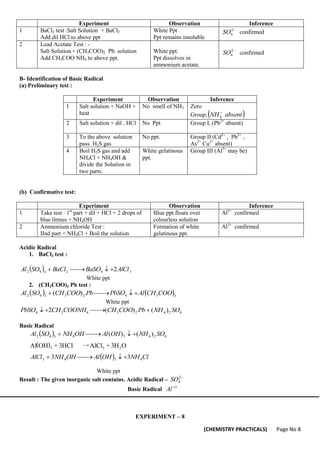
Acidic Radical
1. BaCl2 test :
  3
4
2
3
4
2 2AlCl
BaSO
BaCl
SO
Al 




White ppt
2. (CH3COO)2 Pb test :
   3
3
4
2
3
3
4
2 )
( COO
CH
Al
PbSO
Pb
COO
CH
SO
Al 




White ppt
4
2
4
2
3
4
3
4 )
(
)
(
2 SO
NH
Pb
COO
CH
COONH
CH
PbSO 




Basic Radical
  4
2
4
3
4
3
4
2 )
(
)
( SO
NH
OH
Al
OH
NH
SO
Al 




( ) O
H
3
+
AlCl
→
HCl
3
+
OH
Al 2
3
3
  Cl
NH
OH
Al
OH
NH
AlCl 4
3
4
3 3
3 




White ppt
Result : The given inorganic salt contains. Acidic Radical – 
2
4
SO
Basic Radical 3

Al
EXPERIMENT – 8
(CHEMISTRY PRACTICALS) Page No 9
Aim : To analyze the given inorganic salt for acidic and basic radical. (ZnCl2)
Preliminary Investigation
Physical state : Solid
Colour : White (Cu2+
, Fe+2
, Fe+3
,Ni+2
, Mn+2
, Co+2
are
absent)
Qdour : No characteristic above
absent
COO
CH
NH
S )
,
,
( 3
4
2 


Solubility : Soluble in water.
Flame Test : Green flashes ( Zn2+
may be )
(A) Identification of Acidic Radical
a- Preliminary test :
Experiment Observation Inference
1 Salt solution + dil H2SO4 No gas is evolved Group A
 
absent
COO
CH
NO
SO
S
CO 



3
-
2
2
3
2
2
3 ,
,
2 Salt + Concn
H2SO4 + Heat Colourless gas having
pungent smell which
gives white dense
fumes with glass rod
dipped in NH4OH
Group B anions
(Cl–
may be )
(b) Confirmative test :
Experiment Observation Inference
1 Chromyl chloride test : Salt + K2Cr2O7 (1 : 2) +
conc. H2SO4 + heat
Pass the vapour in a test tube containing
NaOH solution
Add (CH3COOH + (CH3COO)2 Pb into
above solution
Orangish red or reddish
orange vapour of chromyl
chloride are evolved
Yellow solution of
Na2CrO4 is obtained
Yellow ppt of lead
chromate is formed
Cl–
Confirmed
2 AgNO3 Test : Salt Solution + AgNO3
Dissolve ppt. in NH4OH
White ppt.
ppt becomes soluble.
Cl–
confirmed
B- Identification of Basic Radical
(a) Preliminary test :
Experiment Observation Inference
1 Salt solution + NaOH +
heat
No smell of NH3 Zero Group,
 
absent
NH 
4
2 Salt solution + dil . HCl No white Ppt Group I (Pb2+
absent)
3 To the above solution
pass H2S gas
No ppt. Group II, (Cu2+
, As+3
,
Cd+2
, Pb+2
absent)
4 Boil above solution to
remove H2S and add
NH4Cl (s) + NH4OH in
exess.
No ppt. Group III [Fe2+
,
Fe3+
,Al3+
absent ]
5 To above test tube pass
H2S gas
Dissolve the white ppt in
HCl and divide it into 2
parts.
White ppt is
obtained
Group IV [Zn2+
may
be]
(b) Confirmative test :
(CHEMISTRY PRACTICALS) Page No 10
Experiment Observation Inference
1 K4[Fe(CN)6] Test : 1st
part + K4[Fe(CN)6] White ppt of zinc
ferrocyanide
Zn+2
conformed
2 NaOH Test : 2nd
part + NaOH Bluish white ppt. Zn+2
confirmed
Chemical reaction for Acidic Radical
Preliminary Test :




 HCl
ZnSO
SO
H
ZnCl 3
4
4
2
2
O
H
Cl
NH
OH
NH
HCl 2
4
4 



(White dense fumes )
Confirmative Test :
i) Chromyl chloride test : O
H
O
Cr
SO
K
SO
H
O
Cr
K 2
3
2
4
2
4
2
7
2
2 2 



 
HCl
ZnSO
SO
H
ZnCl 2
4
4
2
2 


 
2
2
2
3 H
+
↑
Cl
CrO
→
HCl
2
+
CrO

(red vapours of chromyl chloride)
O
H
NaCl
CrO
Na
NaOH
Cl
CrO 2
4
2
2
2 2
4 




COONa
CH
PbCrO
COO
CH
Pb
CrO
Na
COOH
CH
Dil
3
4
.
2
3
4
2 +
→
)
(
+
3
ii) Silver Nitrate Test
2
3
3
2 )
(
2
2 NO
Zn
AgCl
AgNO
ZnCl 




(Curdy white ppt.)
O
H
Cl
NH
Ag
OH
NH
AgCl 2
2
3
4 2
]
)
(
[
2 



[Diammine silver (I) chloride ) {Soluble complex]
Chemical reaction for Basic Radical
(a) Preliminary Test :
↑
+
→
2
+
2
+
↓
→
+
2
2
2
2
S
H
ZnCl
HCl
ZnS
HCl
ZnS
S
H
ZnCl
(b) Confirmative Test :
KCl
CN
Fe
Zn
CN
Fe
K
ZnCl
Test
CN
Fe
K 4
+
↓
]
)
(
[
→
]
)
(
[
+
:
]
)
(
[
1 6
2
6
4
2
6
4
2. NaOH test :
NaCl
OH
Zn
NaOH
ZnCl 2
)
( 2
2 



O
H
ZnO
Na
NaOH
OH
Zn 2
2
2
2 2
+
→
2
+
)
(
Result : The given inorganic salt contains. Acidic Radical 
Cl
Basic Radical Zn+2
EXPERIMENT – 9
Aim : To analyze the given inorganic salt for acidic and basic radical. (BaBr2)
Preliminary Investigation
Physical state : Solid
Colour : White (Cu2+
, Fe+2
, Fe+3
,Ni+2
, Mn+2
, CO+2
are absent)
Qdour : No characteristic adour absent
S
COO
CH
NH )
,
,
( -
2
-
3
+
4
Solubility : Soluble in water.
Physical Test : Solid
(CHEMISTRY PRACTICALS) Page No 11
(A) Identification of Acidic Radical
a- Preliminary test:
Experiment Observation Inference
1 Salt solution + dil H2SO4 No gas is evolved Group A
( )
absent
COO
CH
NO
SO
S
CO -
3
-
2
-
2
3
-
2
2
3 ,
,
2 Salt + Conc H2SO4 + Heat Reddish orange
vapours which turns
starch paper yellow
Group B anion
(Br–
may be)
(b) Confirmative test:
Experiment Observation Inference
1 AgNO3 Test : Salt Solution +AgNO3
Dissolve ppt. in NH4OH
Yellow ppt.
Ppt. remains partially
soluble
Br–
confirmed
2 MnO2 Test :
Salt Solution + MnO2 + Conc. H2SO4+ Heat
Orange red vapour of Br2 Br–
confirmed
B- Identification of Basic Radical
(a) Preliminary test:
Experiment Observation Inference
1 Salt solution + NaOH + heat No smell of NH3 Zero Group,  
absent
NH 
4
2 Salt solution + dil . HCl No white Ppt Group I (Pb2+
absent)
3 To the above solution pass H2S gas No ppt. Group II (Cu2+
, As+3
, Cd+2
, Pb+2
absent )
4 Boil above solution to remove H2S and add
NH4Cl (s) + NH4OH in exess.
No ppt. Group III [Fe2+
, Fe3+
,Al3+
absent
]
5 To above test tube pass H2S gas No ppt Group IV [Zn2+
, Co+2
, Ni+2
,
Mn+2
absent]
6 Remove H2S gas by boiling.
Add [NH4]2 CO3 to it.
White ppt V group (Ca2+
, Ba2+
, Sr2+
may be)
(b) Confirmative test:
Experiment Observation Inference
1 Potassium chromate test :
1st
part + K2CrO4
Yellow ppt Ba2+
confirmed
2 Ammonium sulphate Test
:
IInd part + (NH4)2SO4
No ppt Sr2+
absent
3 Ammonium oxalate Test:
IIIrd part + ammonium
oxalate test (NH4)2C2O4
No ppt Ca2+
absent
4. Flame test : Perform flame
test with salt.
Apple green flame Ba2+
confirmed
Chemical reaction for Acidic Radical
Preliminary Test:
Colour
Yellow
Br
Starch
HCl
Br
SO
HBr
SO
H
HBr
BaSO
SO
H
BaBr












2
2
2
4
2
4
4
2
2
2
↑
2
2
Confirmative Test:
(CHEMISTRY PRACTICALS) Page No 12
i) Silver Nitrate test




 AgBr
NO
Ba
AgNO
BaBr 2
)
(
2 2
3
3
2
(Yellow ppt)
ii) MnO2 Test :- 






 2
2
4
4
4
2
2
2 2
2 Br
O
H
MnSO
BaSO
SO
H
MnO
BaBr
Chemical reaction for Basic Radical
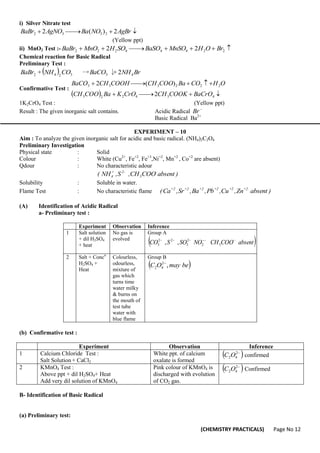
Preliminary Test :
( ) Br
NH
BaCO
CO
NH
BaBr 4
3
3
2
4
2 2
+
↓
→
+
Confirmative Test :
  










4
3
4
2
2
3
2
2
2
3
3
3
2
)
(
2
BaCrO
COOK
CH
CrO
K
Ba
COO
CH
O
H
CO
Ba
COO
CH
COOH
CH
BaCO
1K2CrO4 Test : (Yellow ppt)
Result : The given inorganic salt contains. Acidic Radical 
Br
Basic Radical Ba2+
EXPERIMENT – 10
Aim : To analyze the given inorganic salt for acidic and basic radical. (NH4)2C2O4
Preliminary Investigation
Physical state : Solid
Colour : White (Cu2+
, Fe+2
, Fe+3
,Ni+2
, Mn+2
, Co+2
are absent)
Qdour : No characteristic adour
)
absent
COO
CH
,
S
,
NH
( -
3
-
2
4
+
Solubility : Soluble in water.
Flame Test : No characteristic flame )
absent
Zn
,
Cu
,
Pb
,
Ba
,
Sr
,
Ca
( 2
2
2
2
2
2 +
+
+
+
+
+
(A) Identification of Acidic Radical
a- Preliminary test :
Experiment Observation Inference
1 Salt solution
+ dil H2SO4
+ heat
No gas is
evolved
Group A
 
absent
COO
CH
NO
SO
S
CO 3
—
2
2
3
2
2
3 ,
, 



2 Salt + Concn
H2SO4 +
Heat
Colourless,
odourless,
mixture of
gas which
turns time
water milky
& burns on
the mouth of
test tube
water with
blue flame
Group B
 
be
may
O
C ,
2
4
2

(b) Confirmative test :
Experiment Observation Inference
1 Calcium Chloride Test :
Salt Solution + CaCl2
White ppt. of calcium
oxalate is formed
 

2
4
2O
C confirmed
2 KMnO4 Test :
Above ppt + dil H2SO4+ Heat
Add very dil solution of KMnO4
Pink colour of KMnO4 is
discharged with evolution
of CO2 gas.
 

2
4
2O
C Confirmed
B- Identification of Basic Radical
(a) Preliminary test:
(CHEMISTRY PRACTICALS) Page No 13
Experiment Observation Inference
1 Salt solution + NaOH +
heat
Place red litmus paper on
mouth to test tube
Smell of NH3
Red litmus turns
blue
Zero Group,
 
present
NH 
4
(b) Confirmative test:
Experiment Observation Inference
1 To above solution, bring on glass rod dipped
in conc. HCl near mouth of test tube.
White dense of NH4Cl are
formed
 

4
NH confirmed
2 Nessler’s Test : Solution + NaOH +
Nessler’s reagent
Reddish brown ppt is
formed
 

4
NH confirmed
Chemical reaction for Acidic Radical
Preliminary Test :
O
H
CO
CO
O
C
H
SO
)
NH
(
O
C
H
SO
H
O
C
)
NH
(
2
2
4
2
2
4
2
4
4
2
2
4
2
4
2
2
4
+
+
↑
→
+
→
+
Confirmative Test :
i) CaCl2 test
Cl
NH
O
CaC
CaCl
O
C
NH 4
4
2
2
4
2
2
4 2
)
( 




Calcum oxalate (White ppt)
ii) KMnO4 Test :-
]
[
5
3
2
3
2 2
4
2
4
4
2
4
4
4
2
2
4
2
4
2
O
O
H
SO
H
MnSO
SO
H
KMnO
CaSO
O
C
H
SO
H
O
CaC










O
H
CO
O
O
C
H n
sol
hot
2
2
4
2
2 2
]
[ 



Basic Radical
a) Preliminary test
litmus
Blue
litmus
d
NH
O
H
NH
O
C
Na
NaOH
O
C
NH









Re
3
2
2
)
(
3
2
3
4
2
2
4
2
2
4
Confirmative Test :
Nessler’s Test : K2HgI4 
 2KI+ HgI2
HgI2 + NH3 
 NH2 HgI + Hl
2NH2HgI + H2O 
 NH2 +NH4I
/
Hg

O
/
Hg

I
(Iodide of millon base)
NaOH Test :
NH4Cl + NaOH 
 NaCl + H2O + NH3 (g)
NH3 + HCl 
 NH4Cl (Dense white fumes)
Result : The given inorganic salt contains.
Acidic Radical –

2
4
2O
C
Basic Radical  

4
NH
EXPERIMENT – 11
Aim : To analyze the given inorganic salt for acidic and basic radical.
Preliminary Investigation
(CHEMISTRY PRACTICALS) Page No 14
Physical state : Solid
Colour : Green (Ni2+-
may be)
Qdour : No characteristic odour
(absence of CH3COO-
, 
 2
4 S
NH )
Solubility : Soluble in water.
Flame Test : No Characteristic flame
[absence of Cu2+
, Pb+2
, Zn2+
,Cu2+
,Br+2
)
(a) Identification of Acidic Radical
a- Preliminary test :
Experiment Observation Inference
1 Salt solution +
dil HCl
No gas is
evolved
Group A
 
absent
COO
CH
NO
SO
S
CO 



3
2
2
3
2
2
3 ,
,
2 Salt + Concn
H2SO4 + Heat
Colourless
pungent
smelling gas
(HCl) is
evolved
which gives
white dense
fumes of
NH4Cl.
Group B anions
Cl–
may be present
(b) Confirmative test :
Experiment Observation Inference
1 AgNO3 Test :
Salt Solution + AgNO3
Dissolve ppt. in NH4OH
Curdy white ppt
Ppt become soluble
Cl-
confirmed
2 Chromyl chloride test : Salt + Kr2Cr2O7(s)
(1:2) + conc. H2SO4 + heat
Pass the vapour in a test tube containing
NH4OH
Add (CH3COOH + Pb(CH3COO)2
Reddish orange vapours
of chromyl chloride are
evolved
Solution becomes Yellow
Yellow ppt of lead
chromate is formed
Cl–
confirmed
B- Identification of Basic Radical
Preliminary test :
Experiment Observation Inference
1 Salt solution + NaOH +Heat No smell of NH3 Zero Group,  
absent
NH 
4
2 Salt solution + dil . HCl No white Ppt Group I, Pb2+
absent
3 Pass H2S gas through above NH4Cl No ppt. Group II,
(Cu2+
, As+3
, Cd+2
, Pb+2
) absent
4 Remove H2S gas by boiling & add NH4Cl (s)
+ NH4OH in excess.
No ppt. Group III [Fe2+
, Fe3+
,Al3+
absent
]
5 Pass H2S gas through above solution
Dissolve the ppt by boiling with aqua regia
[Conc HCl + Conc. HNO3] evaporate to
dryness & add water & divide in 2 parts .
Black ppt. Group IV [Ni+2
or Co+2
May be
present]
(b) Confirmative test :
Experiment Observation Inference
1 DMG test : I part + DMG Rose pink ppt. Ni+2
conformed
2 NaOH Test : 2nd
part + NaOH Apple green ppt Ni+ confirmed
Chemical reaction for Acidic Radical
Preliminary Test :
(CHEMISTRY PRACTICALS) Page No 15
O
H
Cl
NH
HCl
OH
NH
HCl
NiSO
heat
SO
H
NiCl
2
4
4
4
4
2
2 2










(White dense fumes)
Confirmative Test :
i) AgNO3 test 2
3
3
2 )
(
2
2 NO
Ni
AgCl
AgNO
NiCl 




Curdy white ppt
  O
H
Cl
NH
Ag
OH
NH
AgCl 2
2
3
4 )
(
2 



(Diammine Silver (I) Chloride)
2) Chromyl chloride test 4
2
2
2
4
4
2
7
2
2
2 2
3
2
2
7
4
)
( NiHSO
O
H
Cl
CrO
KHSO
SO
H
O
Cr
K
NiCl
i 





 
O
H
NaCl
CrO
Na
NaOH
Cl
O
Cr 2
4
2
2
2
2 2
4 



 
(Sodium Chromate)
COONa
CH
PbCrO
CrO
Na
COO
CH
Pb 3
4
4
2
2
3 2
)
( 



Yellow Ppt
Identification of Basic Radical
Preliminary Test : HCl
NiS
S
H
NiCl 2
2
2 




(black ppt.)
O
H
S
NO
NiCl
HCl
HNO
NiS 2
2
3 3
2
3
6
2
3 






Confirmative Test :
i) DMG test
OH
N
C
CH
Complex
Ni
DMG
O
H
Cl
NH
OH
NH
NiCl
OH
N
C
CH













3
2
4
4
2
3
2
2
|
(ii) NaOH Test :
NaCl
OH
Ni
NaOH
NiCl 2
)
(
2 2
2 



Result : The given inorganic salt contains. Acidic Radical 
Cl
Basic Radical Ni+2
EXPERIMENT – 12
Aim : To prepare 250 ml of 0.02 M (M/50) Mohr’s Salt solution.
Apparatus Required : Chemical balance, weight box, beaker (250 ml), watch glass, volumetric flask (250
ml) glass rod, funnel, test tube.
Chemical required :- Mohr’s salt, conc. H2SO4, Distilled water.
Theory : Molecular formula of Mohr’s salt – FeSO4[NH4]2SO4.6H2O
It is primary standard, hence is solution can be prepared by direct weighing.
Molecular weight of Mohr’s salt : 56+32+4×16+2(14+4)+32+4×16+6×18 = 392 g.
Thus to prepare 1000 ml of 1M Mohr’s salt solution, 392 g of Mohr’s salt is needed. To prepare
250ml of 1 M Mohr’s salt g
ie
4
392
250
1000
392
 of mohr’s salt is need.
To prepare 250 ml of 0.02 of Mohr’s salt solution g






 02
.
0
4
392
of salt is needed. Mohr’s salt
required = 1.9600 g of mohr’s salt.
Observation :
1- Weight of empty watch galss (W1) = 21.7200 g
(CHEMISTRY PRACTICALS) Page No 16
2- Weight of empty watch glass + mohrs salt (W2) = 21.7200 + 1.9600 = 23.6800 g
3- Weight of Mohr’s Salt [W2 – W1] = 23.6800 – 21.7200 = 1.9600 g
4- Volume of solution = 250 ml.
6. Morality of solution = M/50
Result : 250 ml of M/50 solution of Mohr’s salt is prepared.
Precautions :
1- Add 2-3 ml of conc. H2SO4 to prevent hydrolysis of FeSO4 before making solution of 250 ml.
2- Weighing should be done accurately.
3. Apparatus should be clean.
EXPERIMENT – 13
Aim : To prepare a standard solution of M/50 Mohr’s salt solution. With its help, determine molarity and strength of
KMnO4 Solution.
Apparatus Required : Burette, comical flask, pipette, burette stand, test tube, white tile, watch glass, volumetric flask
(250ml) beaker, funnel glass rod, weight box, wash bottle.
Chemical Required :
Mohr’s Salt, KMnO4 solution, dil H2SO4, conc. H2SO4 and water.
Theory :
(a) Preparation of standard or known solution of M/50 Mohr’s salt solution - Mohr’s salt is a primary standard
solution. Hence its can be prepared by direct weighting.
Molecular weight of mohr’s salt : 392 g/mol
Thus to prepare 1000 ml of 1M Mohr’s salt solution,
392 g of Mohr’s salt is needed.
To prepare 250ml of 1 M Mohr’s salt g
ie
4
392
250
100
392
 of mohr’s salt is need.
To prepare 250 ml of 0.02 of Mohr’s salt solution g






 02
.
0
4
392
of salt is needed. Mohr’s salt required = 1.9600 g
of mohr’s salt.
(b) Titration of Mohr’s salt Sol (standard solution ) with KMnO4 (unknown solution ) - KMnO4 is strong and
versatile oxidizing agent. When its treated with Mohr’s salt solution in sufficiently acidic medium Fe2+
ion are
oxidised to Fe3+
in cold according to reaction :
Ionic equation :
O
H
Fe
Mn
H
Fe
MnO 2
3
2
2
4 4
5
8
5 




 




Molecular equation
  )]
13
)
(
2
)
(
]
[
0
6
.
)
.(
2
[
5
]
[
5
3
2
3
2
2
4
2
4
3
4
2
4
2
2
4
2
4
4
2
4
4
2
4
2
4
O
H
SO
NH
SO
Fe
O
SO
H
H
SO
NH
FeSO
O
O
H
MnSO
SO
K
SO
H
KMnO












Adding both equation
O
H
SO
NH
SO
Fe
MnSO
SO
K
SO
NH
FeSO
SO
H
KMnO
2
4
2
4
3
4
2
4
4
2
4
2
4
4
4
2
4
68
)
(
10
)
(
5
2
2
)
.(
10
8
2








Indicator 
 KMnO4 is a self indicator
End point 
 colourless to pink
Observations:-
1. Preparation of standard solution :-
Weight of empty water glass (W1) 21.7200 g
Weight of watch glass + Mohr’s salt (W2) = 23.6800 g
Weight of Mohr’s salt = W2 – W1 = (23.6800 – 21.7200) g = 1.9600 g
Volume of mohr’s salt = 250 ml
Volume of mohr’s salt taken for each titration (V2) = 20 ml
2. Titration of standard solution with KMnO4 Solution :-
S.no. Volume of
Mohr’s salt used
(V1) ml
Burette initial Reading final Volume of
KMnO4 used
Concordant
Reading
1 20ml 0.0 14.8 14.8
2 20 ml 0.0 14.6 14.6 14.6
(CHEMISTRY PRACTICALS) Page No 17
3 20 ml 0.0 14.6 14.6
Calculation :
2
2
1
1
5
1
V
M
V
M 
20
50
5
1
6
.
14
1 



M
M
M1=0.0068 M
Strength = 158 × M = 158 × 0.0068 M = 1.0744 g/l
Result
1. Molarity of the given solution = 0.0068 M
2. Strength of the given solution = 1.0744 g/l
Precaution :
1. Weighting should be accurate.
2. Add 2 – 3 ml of conc H2SO4 to prevent hydrolysis of Mohr’s Salt solution.
3. While titrating, the funnel should not be placed at the top of the burette.
EXPERIMENT – 14
Aim : To prepare solution of M/30 (250 ml) Mohr’s salt solution. With its help, determine molarity and strength of
KMnO4 solution.
Apparatus Required : Burette, conical flask, pipette, burette stand, test tube, white tile, watch glass, volumetric flask
(250ml) beaker, funnel glass rod, weight box, wash bottle.
Chemical Required :
Mohr’s Salt, [FeSO4. (NH4)2 SO4.6H2O] ,KMnO4 , dil H2SO4, conc. H2SO4
Indicator : KMnO4 is a self indicator
End point : Colourless to pink
Theory :
(a) Preparation of standard solution of M/30 mohr’s salt
Molecular formula of mohr’s salt : FeSO4.(NH4)2 SO4.6H2O. mohr’s salt is a primary standard . Hence its solution can
be prepared by direct weighing.
Thus to prepare 1000 ml of 1M Mohr’s salt solution,
392 g of Mohr’s salt is needed.
To prepare 250ml of 1 M Mohr’s salt g
ie
4
392
250
1000
392
 of mohr’s salt is need.
Thus to prepare 250 ml of M/30 mohr’s salt solution, 392/4 × 1/30 i.e, 3.2670 g of mohr’s salt is needed.
(b) Titration of Mohr’s salt Sol (standard solution) with KMnO4 (unknown solution), KMnO4 is strong and
versatile oxidising agent . When its treated with mohr’s salt solution in sufficiently acidic medium, Fe2+
ion are
oxidise to Fe3+
according to reaction.
Ionic equation : O
H
Fe
Mn
H
Fe
MnO 2
3
2
2
4 4
5
8
5 




 




Molecular equation : )
(
5
3
2
3
2 2
4
4
2
4
2
4 O
O
H
MnSO
SO
K
SO
H
KMnO 






5
]
13
)
(
2
)
(
]
[
6
.
)
(
2
[ 2
4
2
4
3
4
2
4
2
2
4
2
4
4 





 O
H
SO
NH
SO
Fe
O
SO
H
O
H
SO
NH
FeSO Adding both the Eqn.
    O
H
SO
NH
SO
Fe
MnSO
SO
K
O
H
SO
NH
FeSO
SO
H
KMnO
2
4
2
4
3
4
2
4
4
2
2
4
2
4
4
4
2
4
68
10
5
2
6
.
)
.(
10
8
2








Observation Table:-
1. Preparation of standard solution:-
Weight of empty watch glass (W1) 21.7200 g
Weight of watch glass + Mohr’s salt (W2) = 21.7200+3.2670 = 24.9870g
Weight of Mohr’s salt = W2 – W1= 24.9870-217200 = 3.2670 g
Volume of mohr’s salt = 250 ml
Molarity of mohr’s salt = M/30
2. Titration of standard solution with KMnO4 Solution :-
M1 = Molarity of KMnO4 Soln
= ?
V1 = Volume of KMnO4 Soln
= 14.6 ml
M2 = Molarity of Mohr’s Salt Soln
= M/50
V2 = Volume of Mohr’s Salt Soln
= 20 ml
(CHEMISTRY PRACTICALS) Page No 18
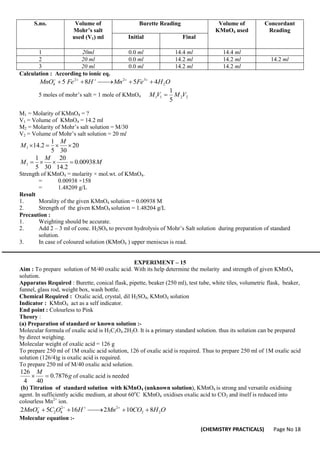
S.no. Volume of
Mohr’s salt
used (V1) ml
Burette Reading Volume of
KMnO4 used
Concordant
Reading
Initial Final
1 20ml 0.0 ml 14.4 ml 14.4 ml
2 20 ml 0.0 ml 14.2 ml 14.2 ml 14.2 ml
3 20 ml 0.0 ml 14.2 ml 14.2 ml
Calculation : According to ionic eq.
O
H
Fe
Mn
H
Fe
MnO 2
3
2
2
4 4
5
8
5 




 




5 moles of mohr’s salt = 1 mole of KMnO4 2
2
1
1
5
1
V
M
V
M 
M1 = Molarity of KMnO4 = ?
V1 = Volume of KMnO4 = 14.2 ml
M2 = Molarity of Mohr’s salt solution = M/30
V2 = Volume of Mohr’s salt solution = 20 ml
20
30
5
1
2
.
14
1 



M
M
M
M
M 00938
.
0
2
.
14
20
30
5
1
1 



Strength of KMnO4 = molarity × mol.wt. of KMnO4.
= 0.00938 ×158
= 1.48209 g/L
Result
1. Morality of the given KMnO4 solution = 0.00938 M
2. Strength of the given KMnO4 solution = 1.48204 g/L
Precaution :
1. Weighting should be accurate.
2. Add 2 – 3 ml of conc. H2SO4 to prevent hydrolysis of Mohr’s Salt solution during preparation of standard
solution.
3. In case of coloured solution (KMnO4 ) upper meniscus is read.
EXPERIMENT – 15
Aim : To prepare solution of M/40 oxalic acid. With its help determine the molarity and strength of given KMnO4
solution.
Apparatus Required : Burette, conical flask, pipette, beaker (250 ml), test tube, white tiles, volumetric flask, beaker,
funnel, glass rod, weight box, wash bottle.
Chemical Required : Oxalic acid, crystal, dil H2SO4, KMnO4 solution
Indicator : KMnO4 act as a self indicator.
End point : Colourless to Pink
Theory :
(a) Preparation of standard or known solution :-
Molecular formula of oxalic acid is H2C2O4.2H2O. It is a primary standard solution. thus its solution can be prepared
by direct weighing.
Molecular weight of oxalic acid = 126 g
To prepare 250 ml of 1M oxalic acid solution, 126 of oxalic acid is required. Thus to prepare 250 ml of 1M oxalic acid
solution (126/4)g is oxalic acid is required.
To prepare 250 ml of M/40 oxalic acid solution.
g
M
7876
.
0
40
4
126

 of oxalic acid is needed
(b) Titration of standard solution with KMnO4 (unknown solution), KMnO4 is strong and versatile oxidising
agent. In sufficiently acidic medium, at about 60o
C KMnO4 oxidises oxalic acid to CO2 and itself is reduced into
colourless Mn2+
ion.
O
H
CO
Mn
H
O
C
MnO 2
2
2
2
4
2
4 8
10
2
16
5
2 




 



Molecular equation :-
(CHEMISTRY PRACTICALS) Page No 19
]
[
5
3
2
3
2 2
4
4
2
4
2
4 O
O
H
MnSO
SO
K
SO
H
KMnO 





5
]
2
]
[ 2
2
4
2
2 



 O
H
CO
O
O
C
H
Adding both the eqn.
2
2
4
4
2
4
2
2
4
2
4 10
8
2
5
3
2 CO
O
H
MnSO
SO
K
O
C
H
SO
H
KMnO 






Observation Table :-
1. Preparation of M/40 standard solution :-
Weight of empty watch glass (W1) 21.7260 g
Weight of watch glass + Mohr’s salt (W2)
= 21.7200+ 0.7876 = 22.5076 g
Weight of oxalic acid = W2 – W1 = 0.7876 g
Volume of oxalic acid = 250 ml
Molarity of oxalic acid = M/40
2. Titration of standard solution with KMnO4 Solution :-
S.no. Volume of
Mohr’s salt
used (V1) ml
Burette Reading Volume of
KMnO4 used
Concordant
Reading
Initial final
1 20ml 0.0 ml 15.0 ml 15.0 ml
2 20 ml 0.0 ml 14.9 ml 14.9 ml 14.9 ml
3 20 ml 0.0 ml 14.9 ml 14.9 ml
Calculation : According to ionic equation .
O
H
CO
Mn
H
O
C
MnO 2
2
2
2
4
2
4 8
10
2
16
5
2 




 



1 mole of oxalic acid required 2/5 mole of KMnO4.
M1V1 = 2/5 M2V2
M1 = molarity of KMnO4 solution = ?
V1 = molarity of KMnO4 solution = 14.9 ml
M2 = molarity of oxalic acid solution = M/40
V2 = volume of oxalic acid solution. = 20 ml
M
M
M 0135
.
0
20
40
1
5
2
9
.
14 1
1 





Strength of KMnO4 = Molarity × Mol.wt.= 0.0135 M × 158 = 2.1345 g/L
Result
1. Molarity of the given KMnO4 solution = 0.0135 M
2. Strength of the given KMnO4 solution = 2.1345 g/L
Precaution:
1. Oxalic acid should not be heated about 60o
C.
2. weighing should be accurate.
EXPERIMENT – 16
Aim : To prepare solution of M/20 oxalic acid with its help determine the morality and strength of given
KMnO4 solution.
Apparatus Required : Burette, conical flask, pipette, beaker, test tube, weight box, white tiles, volumetric flask
beaker, funnel glass rod, weight box, wash bottle.
Chemical Required : Oxalic acid, crystal, dill H2SO4, KMnO4 solution
Indicator : KMnO4 act as a self indicator.
End point : Colourless to Pink
Theory :
(a) Preparation of standard or known solution :-
Molecular formula of oxalic acid is H2C2O4.2H2O. It is a primary standard solution. Thus its solution can be prepared
by direct weighting.
Molecular weight of oxalic acid = 126 g
 molar mass = 126 g/l
To prepare 1000 ml of 1M oxalic acid solution, 126 of oxalic acid is required
(CHEMISTRY PRACTICALS) Page No 20
To prepare 250 ml of 2M oxalic acid solution (126/4)g is oxalic acid is required.
 To prepare 250 ml of M/20 oxalic acid solution.
g
5750
.
1
20
1
4
126

 of oxalic acid is needed
(b) Titration of standard solution with KMnO4 (unknown solution): KMnO4 is strong and versatile
Oxidizing agent. When it is titrated against standard oxalic acid solution (reducing agent) in sufficiently acidic
medium at above 60o
C, KMnO4 oxidizes acid into CO2 and itself gets reduced to colourless Mn+2
ions.
Molecular Equation :
]
[
5
3
2
3
2 2
4
4
2
4
2
4 O
O
H
MnSO
SO
K
SO
H
KMnO 





5
]
2
]
[ 2
2
4
2
2 



 O
H
CO
O
O
C
H
Adding both equation : 2KMnO4 + 3H2SO4 + 5 COOH . 2H2O  K2SO4 + 2MnSO4 + 8 H2O+ 10CO2
Ionic equation : 2
]
4
[
5
8 2
2
)
(
4 




 



O
H
Mn
e
H
MnO
5
]
2
2 2
2
4
2 


 

e
CO
O
C
2
2
2
2
4
2
4 10
8
2
5
16
2 CO
O
H
Mn
O
C
H
KMnO 




 



Observation Table :
a) Preparation of M/20 oxalic acid solution :
Weight of water glass (W1) = 21.7200g
Weight of watch glass + weight of oxalic acid (W2) = 23.2950 g
 weight of oxalic acid (w2 – w1) = 1.5750g
Volume of oxalic acid used for each titration = 250 ml.
3. Titration of standard solution with unknown Solution :-
S.no. Volume of
Mohr’s
salt used
(V1) ml
Burette Reading Volume of
KMnO4
used
Concordant
Reading
1 2.0 ml 0.0 ml 15.1 ml 15.1 ml
2 2.0 ml 0.0 ml 14.8 ml 14.8 ml 14.8 ml
3 2.0 ml 0.0 ml 14.8 ml 14.8 ml
Calculation : According to the ionic eq.
O
H
CO
Mn
H
O
C
MnO 2
2
2
2
4
2
4 8
10
2
16
5
2 




 



1 mole of oxalic acid required 2/5 mole of KMnO4.
M1V1 = 2/5 M2V2
M
M
027
.
0
8
.
14
20
20
5
2



Strength of KMnO4 used = Molarity × molar mass = 0.027 × 158 = 4.2702 g/l
Result
1. Molarity = 0.0270 M
2. Strength = 4.2702 g/L
Precaution :
1. Weighting should be accurate .
2. Always remove funnel from burette while titrating the solution.
EXPERIMENT – 17
Aim : To identify the functional group in the given organic compound.
Apparatus Required : Test tube, test tube stand, test tube holder, dropper, litmus (blue), NaHCO3, conc. H2SO4 ,
NH4OH, FeCl3.
Physical Properties:
M1 = Molarity of KMnO4 Soln
= ?
V1 = Volume of KMnO4 Soln
= 14.8 ml
M2 = Molarity of Oxalic acid Soln
= M/20
V2 = Volume of Oxalic acid Soln
= 20 ml
(CHEMISTRY PRACTICALS) Page No 21
State: Solid
Colour: White
Odour: Vinegar Like
Flammability: Burn with non sooty flame (Aliphatic)
Preliminary test :
S.no. Experiment Observation Inference
1 Litmus test :
Organic compound + 2 drops of litmus solution.
Litmus solution turns from
blue to red.
-COOH or – OH may be
present
2 Organic compound + NaHCO3 solution. Colourless, odorless gas
with brisk effervescence.
-COOH group may be or –
OH (phenol group present.
Confirmatory test :
S.no. Experiment Observation Inference
1 Ester test :
Organic compound +
C2H5OH + conc. H2SO4
+ Heat
Fruity smell of
ester
OH
C
O


|| grp
confirmed.
2 FeCl3 Test : Organic
compound + dil FeCl3
solution .
Red colour
appear
OH
C
O


||
confirmed
Chemical Reaction : NaHCO3 Test : RCOOH + NaHCO3 
 RCOONa+CO2  + H2O
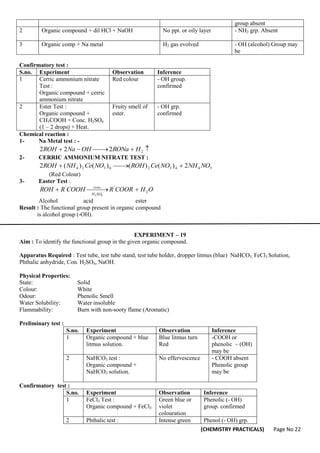
Easter Test : O
H
RCOOR
OH
R
RCOOH
SO
H
conc
2
'
.
4
2


 



(Fruity smell ester)
FeCl3 Test : RCOOH + NH4OH 
 RCOONa
RCOONa + H2O 
 Ammoniac salt (Soluble)
RCOONH4 + FeCl3 
 (RCOO)3 Fe + 3NH4Cl
(RCOO3)Fe + H2O 
 Fe(OH) (R COO)2 + RCOOH
Basic ferric acetate.
Result :
The functional group present in the given organic compound is carboxylic acid
.















 OH
C
O
||
EXPERIMENT – 18
Aim : To identify the functional group in the given organic compound.
Apparatus Required : Test tube, test tube stand, test tube holder, dropper litmus (blue) solution, dil HCl, NaOH, Na
metal, dil H2SO4, CH3COOH.
Physical Properties:
State: Liquid
Colour: Colourless
Odour: Spirit Like
Water Solubility: Soluble in Water
Flammability: Burn with non-sooty flame (Aliphatic)
Preliminary test :
S.no. Experiment Observation Inference
1 Organic compound + blue litmus solution. No change -COOH or – OH(Phenol)
(CHEMISTRY PRACTICALS) Page No 22
group absent
2 Organic compound + dil HCl + NaOH No ppt. or oily layer - NH2 grp. Absent
3 Organic comp + Na metal H2 gas evolved - OH (alcohol) Group may
be
Confirmatory test :
S.no. Experiment Observation Inference
1 Cerric ammonium nitrate
Test :
Organic compound + cerric
ammonium nitrate
Red colour - OH group.
confirmed
2 Ester Test :
Organic compound +
CH3COOH + Conc. H2SO4
(1 – 2 drops) + Heat.
Fruity smell of
ester.
- OH grp.
confirmed
Chemical reaction :
1- Na Metal test : -





 2
2
2
2 H
RONa
OH
Na
ROH
2- CERRIC AMMONIUM NITRATE TEST :
3
4
4
3
2
6
3
2
4 2
)
(
)
(
)
(
)
(
2 NO
NH
NO
Ce
ROH
NO
Ce
NH
ROH 



(Red Colour)
3- Easter Test :
O
H
COOR
R
COOH
R
ROH
SO
H
conc
2
'
.
'
4
2


 


Alcohol acid ester
Result : The functional group present in organic compound
is alcohol group (-OH).
EXPERIMENT – 19
Aim : To identify the functional group in the given organic compound.
Apparatus Required : Test tube, test tube stand, test tube holder, dropper litmus (blue) NaHCO3, FeCl3 Solution,
Phthalic anhydride, Con. H2SO4, NaOH.
Physical Properties:
State: Solid
Colour: White
Odour: Phenolic Smell
Water Solubility: Water insoluble
Flammability: Burn with non-sooty flame (Aromatic)
Preliminary test :
S.no. Experiment Observation Inference
1 Organic compound + blue
litmus solution.
Blue litmus turn
Red
-COOH or
phenolic – (OH)
may be
2 NaHCO3 test :
Organic compound +
NaHCO3 solution.
No effervescence - COOH absent
Phenolic group
may be
Confirmatory test :
S.no. Experiment Observation Inference
1 FeCl3 Test :
Organic compound + FeCl3
Green blue or
violet
colouration
Phenolic (- OH)
group. confirmed
2 Phthalic test : Intense green Phenol (- OH) grp.
(CHEMISTRY PRACTICALS) Page No 23
Organic compound +
pthalic acid + 2-3 drops
H2SO4 +  .then cool and
dil. NaOH
blue or red
colouration
Confirmed
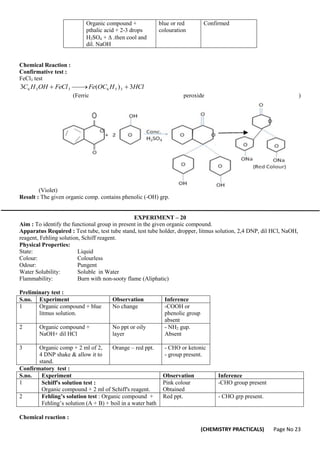
Chemical Reaction :
Confirmative test :
FeCl3 test
HCl
H
OC
Fe
FeCl
OH
H
C 3
)
(
3 3
5
6
3
5
6 



(Ferric peroxide )
(Violet)
Result : The given organic comp. contains phenolic (-OH) grp.
EXPERIMENT – 20
Aim : To identify the functional group in present in the given organic compound.
Apparatus Required : Test tube, test tube stand, test tube holder, dropper, litmus solution, 2,4 DNP, dil HCl, NaOH,
reagent, Fehling solution, Schiff reagent.
Physical Properties:
State: Liquid
Colour: Colourless
Odour: Pungent
Water Solubility: Soluble in Water
Flammability: Burn with non-sooty flame (Aliphatic)
Preliminary test :
S.no. Experiment Observation Inference
1 Organic compound + blue
litmus solution.
No change -COOH or
phenolic group
absent
2 Organic compound +
NaOH+ dil HCl
No ppt or oily
layer
- NH2 gup.
Absent
3 Organic comp + 2 ml of 2,
4 DNP shake & allow it to
stand.
Orange – red ppt. - CHO or ketonic
- group present.
Confirmatory test :
S.no. Experiment Observation Inference
1 Schiff's solution test :
Organic compound + 2 ml of Schiff's reagent.
Pink colour
Obtained
-CHO group present
2 Fehling’s solution test : Organic compound +
Fehling’s solution (A + B) + boil in a water bath
Red ppt. - CHO grp present.
Chemical reaction :
(CHEMISTRY PRACTICALS) Page No 24
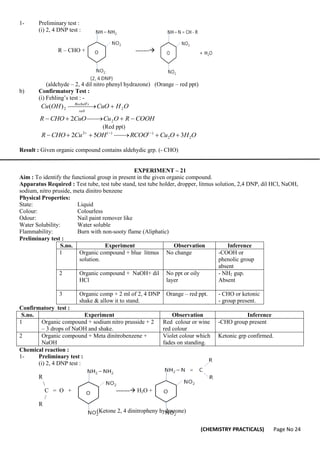
1- Preliminary test :
(i) 2, 4 DNP test :
R – CHO + -------
(aldchyde – 2, 4 dil nitro phenyl hydrazone) (Orange – red ppt)
b) Confirmatory Test :
(i) Fehling’s test : -
O
H
CuO
OH
Cu
salt
s
Rochell
2
'
2
)
( 


 

COOH
R
O
Cu
CuO
CHO
R 




 2
2
(Red ppt)
O
H
O
Cu
RCOO
OH
Cu
CHO
R 2
2
)
(
)
(
2
3
5
2 





 


Result : Given organic compound contains aldehydic grp. (- CHO)
EXPERIMENT – 21
Aim : To identify the functional group in present in the given organic compound.
Apparatus Required : Test tube, test tube stand, test tube holder, dropper, litmus solution, 2,4 DNP, dil HCl, NaOH,
sodium, nitro pruside, meta dinitro benzene
Physical Properties:
State: Liquid
Colour: Colourless
Odour: Nail paint remover like
Water Solubility: Water soluble
Flammability: Burn with non-sooty flame (Aliphatic)
Preliminary test :
S.no. Experiment Observation Inference
1 Organic compound + blue litmus
solution.
No change -COOH or
phenolic group
absent
2 Organic compound + NaOH+ dil
HCl
No ppt or oily
layer
- NH2 gup.
Absent
3 Organic comp + 2 ml of 2, 4 DNP
shake & allow it to stand.
Orange – red ppt. - CHO or ketonic
- group present.
Confirmatory test :
S.no. Experiment Observation Inference
1 Organic compound + sodium nitro prusside + 2
– 3 drops of NaOH and shake.
Red colour or wine
red colour
-CHO group present
2 Organic compound + Meta dinitrobenzene +
NaOH
Violet colour which
fades on standing.
Ketonic grp confirmed.
Chemical reaction :
1- Preliminary test :
(i) 2, 4 DNP test :
R

C = O + ------- H2O +
/
R
(Ketone 2, 4 dinitropheny hydrazone)
(CHEMISTRY PRACTICALS) Page No 25
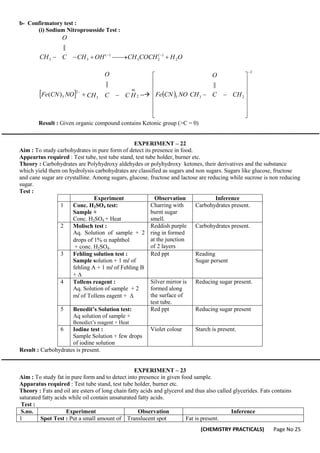
b- Confirmatory test :
(i) Sodium Nitroprousside Test :
O
H
COCH
CH
OH
CH
C
CH
O
2
)
(
2
3
)
(
3
3
||





 

  2
3
2
5
||
)
(



 H
C
C
CH
O
NO
CN
Fe --  
3
2
3
5
||


















 CH
C
O
CH
NO
CN
Fe
Result : Given organic compound contains Ketonic group (>C = 0)
EXPERIMENT – 22
Aim : To study carbohydrates in pure form of detect its presence in food.
Appeartus required : Test tube, test tube stand, test tube holder, burner etc.
Theory : Carbohydrates are Polyhydroxy aldehydes or polyhydroxy ketones, their derivatives and the substance
which yield them on hydrolysis carbohydrates are classified as sugars and non sugars. Sugars like glucose, fructose
and cane sugar are crystalline. Among sugars, glucose, fructose and lactose are reducing while sucrose is non reducing
sugar.
Test :
Experiment Observation Inference
1 Conc. H2SO4 test:
Sample +
Conc. H2SO4 + Heat
Charring with
burnt sugar
smell.
Carbohydrates present.
2 Molisch test :
Aq. Solution of sample + 2
drops of 1%  naphthol 
+ conc. H2SO4.
Reddish purple
ring in formed
at the junction
of 2 layers
Carbohydrates present.
3 Fehling solution test :
Sample solution + 1 ml of
fehling A + 1 ml of Fehling B
+ 
Red ppt Reading
Sugar persent
4 Tollens reagent :
Aq. Solution of sample + 2
ml of Tollens eagent + 
Silver mirror is
formed along
the surface of
test tube.
Reducing sugar present.
5 Benedit’s Solution test:
Aq solution of sample +
Benedict’s reagent + Heat
Red ppt Reducing sugar present
6 Iodine test :
Sample Solution + few drops
of iodine solution
Violet colour Starch is present.
Result : Carbohydrates is present.
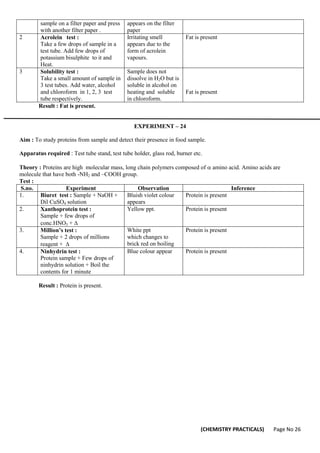
EXPERIMENT – 23
Aim : To study fat in pure form and to detect into presence in given food sample.
Apparatus required : Test tube stand, test tube holder, burner etc.
Theory : Fats and oil are esters of long chain fatty acids and glycerol and thus also called glycerides. Fats contains
saturated fatty acids while oil contain unsaturated fatty acids.
Test :
S.no. Experiment Observation Inference
1 Spot Test : Put a small amount of Translucent spot Fat is present.
(CHEMISTRY PRACTICALS) Page No 26
sample on a filter paper and press
with another filter paper .
appears on the filter
paper
2 Acrolein test :
Take a few drops of sample in a
test tube. Add few drops of
potassium bisulphite to it and
Heat.
Irritating smell
appears due to the
form of acrolein
vapours.
Fat is present
3 Solubility test :
Take a small amount of sample in
3 test tubes. Add water, alcohol
and chloroform in 1, 2, 3 test
tube respectively.
Sample does not
dissolve in H2O but is
soluble in alcohol on
heating and soluble
in chloroform.
Fat is present
Result : Fat is present.
EXPERIMENT – 24
Aim : To study proteins from sample and detect their presence in food sample.
Apparatus required : Test tube stand, test tube holder, glass rod, burner etc.
Theory : Proteins are high molecular mass, long chain polymers composed of amino acid. Amino acids are
molecule that have both -NH2 and –COOH group.
Test :
S.no. Experiment Observation Inference
1. Biuret test : Sample + NaOH +
Dil CuSO4 solution
Bluish violet colour
appears
Protein is present
2. Xanthoprotein test :
Sample + few drops of
conc.HNO3 + 
Yellow ppt. Protein is present
3. Million’s test :
Sample + 2 drops of millions
reagent + 
White ppt
which changes to
brick red on boiling
Protein is present
4. Ninhydrin test :
Protein sample + Few drops of
ninhydrin solution + Boil the
contents for 1 minute
Blue colour appear Protein is present
Result : Protein is present.

XII-CHEMISTRY-PRACTICAL.pdf for chemstry practicals

  • 1.
    (CHEMISTRY PRACTICALS) PageNo 1 [CLASS XII CHEMISTRY PRACTICALS] Evaluation Scheme for Examination Marks Volumetric Analysis 08 Salt Analysis 08 Content Based Experiment 06 Project Work 04 Class record and viva 04 Total 30 Note:- 1. Chemical Equations of Experiment 3 to 11 are to be written on blank pages. 2. Observation table of experiment 13 to 16 are to be drawn on blank pages. 3. Investigatory Project work (4 marks) is also included in the practical syllabus. For project work, contact the teacher for the topic. 4. Project report should be hand written. 5. Start each experiment from a new page. EXPERIMENT – 1 Classification of Anions Group Group Reagent Observation Inference A Dilute H2SO4 a) Colourless, odourless gas with brisk effervescence (CO2) which turn lime water milky. b) Colourless gas with rotten egg like smell (H2S) which turns lead acetate paper black. c) Colourless gas with smell of burning sulphur (SO2) which turns acidified dichromate paper green. d) Brown coloured gas (NO2) which turns ferrous sulphate solution black or brown. e) Colourless gas with vinegar like smell.  2 3 CO (Carbonate)  2 S (sulphide)  2 3 SO (Sulphite)  2 NO (Nitrite) CH3COO- (Acetate) B Conc. H2SO4 a) Colourless pungent smelling gas (HCl) which gives white dense fumes with glass rod dipped in NH4OH. b) Violet coloured vapours (I2) which turns starch paper blue. c) Reddish brown gas (NO2) having pungent smell (On adding copper turning, fumes becomes intense) d) Brown colour gas with pungent smell (Br2) which turns starch paper yellow. e) Colourless, odourless gas with brisk effervescence (CO + CO2) which turns lime water milky and burns on the mouth of test tube with blue flame.  Cl (Chloride) I– (Iodide)  3 NO (Nitrate)  Br (Bromide) - 2 4 2O C (Oxalate) C BaCl2 White ppt. of BaSO4 is formed.  2 4 SO (sulphate) D Ammonium molybdate 3 (NH3)4MoO4 Cannary yellow ppt. of phospho ammonium molybdate (NH4)3 PO4.12 MoO3 . 6H2O  3 4 PO (phosphate) EXPERIMENT – 2 Classification of Cations Group Group Reagent Radical PPt/Smell Colour Zero NaOH  4 NH Smell of NH3 - I Dil. HCl Pb+2 PbCl2 White II H2S gas in acidic Pb+2 PbS Black Medium As3+ As2S3 Yellow Cu+2 CuS Black Cd+2 CdS Yellow III NH4Cl (s) in presence of Fe2+ Fe(OH)2 Light green NH4OH Fe3+ Fe(OH)3 Reddish brown Al3+ Al(OH)3 Gelatinous white IV H2S gas in basic medium Ni2+ NiS Black
  • 2.
    (CHEMISTRY PRACTICALS) PageNo 2 Co2+ CoS Black Mn2+ MnS Flesh colour Zn2+ ZnS Dirty white V (NH4)2 CO3 in presence of NH4OH Ba2+ BaCO3 White Ca2+ CaCO3 White Sr2+ SrCO3 White VI Na2HPO4 in presence of NH4OH Mg2+ MgNH4PO4 White EXPERIMENT – 3 Aim :- To analyse the given inorganic salt for acidic and basic radicals [(NH4)2 CO3] Preliminary Investigation Physical State Colour Odour Solubility Flame Test Solid White (Cu2+ , Fe2+ , Fe3+ , Ni2+ , Mn2+ ,Co2+ absent) Ammonium smell (may be NH4 + ) Soluble in water No Characteristic flame (Pb2+ , Cu2+ , Ca2+ , Sr2+ , Ba2+ , Zn2+ absent) (A) Identification of Acidic Radical (a) Preliminary test : Experiment Observation Inference 1. Salt solution + dil H2SO4 Colourless, colourless gas with brisk effervescence which turn lime water milky Group A anion (CO3 2- may be present) Confirmative test : 1. BaCl2 Test : Salt solution + BaCl2 2. MgSO4 Test : Salt solution + MgSO4 White ppt of BaCO3 White ppt of MgCO3 CO3 2- Confirmed CO3 2- Confirmed (B) Identification of Basic Radical a) Preliminary Test Experiment Observation Inference 1. Salt Solution + NaOH+ Heat Smell of NH3 2. Place a red litmus on the mouth of test tube. Red litmus turns blue Zero group present   be may NH  4 Confirmative test Experiment Observation Inference 1. Nessler’s reagent test : Salt + Solution + NaOH + Nessler’s Reagent 2. NaOH test : Salt Solution + NaOH + Heat. Bring a glass rod dipped in conc. HCl Reddish brown ppt. is formed Smell of NH3 Dense white fumes of NH4Cl are formed.  4 NH confirmed.  4 NH Confirmed. Chemical Reactions : - Acidic Radical Preliminary Test :- 1.     O H CO SO NH SO H CO NH 2 2 4 2 4 4 2 3 2 4 ↑      2. O H CaCO CO OH Ca 2 3 2 2 + → + ) ( Confirmative Test 1. BaCl2 Test : ( ) Cl NH BaCO BaCl CO NH 4 3 2 3 2 4 2 + ↓ → + 2- MgSO4   4 2 4 3 4 3 2 4 ) ( SO NH MgCO MgSO CO NH     
  • 3.
    (CHEMISTRY PRACTICALS) PageNo 3 2. Basic Radical (a) Preliminary Test :- 1.         3 2 3 2 3 2 4 2 2 2 NH O H CO Na NaOH CO NH NH3+ Red litmus ----- Litmus turns blue (b) Confirmative test :- 1. Nessler’s Test : K2HgI4   2KI + Hg I2 (Nessler’s Reagent) HgI2 + NH3   NH2HgI + HI 2NH2HgI + H2O   NH2 / Hg O + NH4I / Hg I 2. NaOH Test         3 2 3 2 3 2 4 2 2 2 NH O H CO Na NaOH CO NH ) ( ↑ 4 3 fumes white Dense Cl NH HCl NH    Result : The given inorganic salt contains following Acidic Radical : - - 2 3 CO Basic Radical :  4 NH EXPERIMENT – 4 Aim : To analyse the given salt of acidic and basic radical (NH4Cl) Preliminary Investigation Physical state : Solid Colour : white (Cu2+ , Fe2+ , Fe3+ ,Ni2+ , Mn2+ , Co2+ absent) Odour : Ammonium smell (  4 NH may be present) Solubility : Soluble in water Flame Test : No characteristic flame (Cu2+ , Ca2+ , Ba2+ ,Sr2+ ,Pb+2 , Zn2+ absent) (A) Identification of Acidic Radical a- Preliminary test: Experiment Observation Inference 1 Salt solution + dil H2SO4 solution No gas is evolved Group A anion ( ) absent S SO NO COO CH CO , , , , , - 2 - 2 3 2 - - 3 - 2 3 2 Salt + Conc H2SO4 + Heat Bring a glass rod dipped in NH4OH Colourless gas with pungent smell which gives dense white fumes of NH4Cl Group B anion (Cl- may be) (b) Confirmative Test: Experiment Observation Inference 1 AgNO3 test : Salt Solution + AgNO3. Dissolve the ppt in NH4OH Curdy white ppt White ppt soluble in NH4OH Cl- confirmed 2 Chromyl chloride Test: a) Salt + Solid K2Cr2O7 (1:2) + conc. H2SO4 + Heat b) Pass these vapour through NaOH c) Add acetic acid and lead acetate to yellow solution Reddish orange gas is evolved Solution be comes yellow Yellow ppt of lead chromate is formed. Cl– confirmed
  • 4.
    (CHEMISTRY PRACTICALS) PageNo 4 Identification of Basic Radical Preliminary Test: Experiment Observation Inference 1 Salt solution + NaOH + Heat Smell of Ammonia Zero group (NH4 + ) May be 2 Place a red litmus on the mouth of test tube Red litmus turns blue Confirmative Test: Experiment Observation Inference 1 Nessler Test: Salt solution + NaOH + Nessler’s reagent Reddish brown ppt is formed NH4 + Confirmed 2 NaOH Test : Salt Solution + NaOH + Heat Bring a glass rod dipped in dil HCl Smell of NH3 white dense fumes of NH4Cl are formed NH4 + Confirmed Preliminary Test : ( ) HCl SO NH SO H Cl NH Heat 2 + → + 2 4 2 4 4 2 4 O H Cl NH HCl OH NH 2 4 4 + → + (White dense fumes) Confirmative Test : AgNO3 test 3 4 3 4 + ↓ 2 → 2 + NO NH AgCl AgNO Cl NH (Curdy white ppt) O H Cl NH Ag OH NH AgCl 2 2 3 4 2 ] ) ( [     (Diammine silver (I) Chloride) Chromyl Chloride Test : K2Cr2O7 + H2SO4   K2SO4+2Cr2O3 + H2O 2NH4 + H2SO4   (NH4)2SO4+ 2HCl ) ( 2 2 2 2 2 3 Vapour O H Cl O Cr HCl CrO      O H NaCl CrO Na NaOH Cl CrO 2 4 2 2 2 2 4      (Sodium Chromate (Yellow Solution) COONa CH PbCrO COO CH Pb CrO Na dit COOH CH 3 4 . 2 3 4 2 3 ) (    (Lead Chromate) Chemical Reaction for Basic Radical Preliminary Test :        3 2 4 NH O H NaCl NaOH Cl NH NH3+ Red litmus ----- Litmus turns blue Confirmative Test : Nessler’s Test : K2HgI4   2KI+ HgI2 HgI2 + NH4   NH2 HgI + Hl 2NH2HgI + H2O   NH2 +NH4I / Hg O / Hg I (Iodide of millon base) NaOH Test : NH4Cl + NaOH   NaCl + H2O + NH3 (g)
  • 5.
    (CHEMISTRY PRACTICALS) PageNo 5 NH3 + HCl   NH4Cl (Dense white fumes) Result : The given inorganic salt contains Acidic Radical Cl– Basic Radical NH4 + EXPERIMENT – 5 Aim : To analyze the given inorganic salt for acidic and basic radical. Pb(NO3)2 Preliminary Investigation Physical state : Solid Colour : Creamish white (Cu2+ , Co2+ ,Ni2+ Fe2+ , Mn2+ Fe3+ absent) Odour : No characteristic odour (  4 NH , S2- , CH3COO- absent) Solubility : Soluble in water Flame Test : Dull Bluish white flame is obtained (Pb2+ may be) (A) Identification of Acidic Radical a- Preliminary test: Experiment Observation Inference 1 Salt solution + dil H2SO4 solution No gas is evolved Group A ( ) absent S SO NO COO CH CO , , , , , - 2 - 2 3 2 - - 3 - 2 3 2 Salt + Concn H2SO4 + Heat Brown Colourled gas (NO2) is evolved Group B (NO3 - may be present) (b) Confirmative test: Experiment Observation Inference 1 Diphenyl amine test : salt + Concn H2SO4 + diphenyl amine Deep blue coloured solution NO3 - - confirmed 2 Ring Test : Salt + Freshly prepared FeSO4 + Concn H2SO4 along the side of the test tube Brown ring is formed at the junction of two liquids NO3 - - confirmed Identification of Basic Radical a- Preliminary test : Experiment Observation Inference 1 Salt solution + NaOH No Smell of ammonia Zero group [NH4 + ] absent 2 Salt Solution + dil HCl Filter the above ppt and boil it with water and divide into parts. White ppt of PbCl2 is formed I group [Pb2+ may be] Identification of Basic Radical a- Confirmative test : Experiment Observation Inference 1 KI test : 1st part + KI Pb I2 (Yellow Ppt) Pb2+ Confirmed 2 K2CrO4 Test : 2nd part + K2CrO4 Yellow ppt of PbCrO4 is formed Pb2+ Confirmed Chemical reaction for Acidic Radical Preliminary Test : Pb (NO3)2 + H2SO4   PbSO4 + 2HNO3 Cu + HNO3   Cu(NO3)2 + 2 NO2 + H2O Confirmative Test : i) Ring Test Pb (NO3)2 + H2SO4   PbSO4 + 2HNO3 6FeSO4 + 3H2SO4 + 2HNO3   3Fe2 (SO4)3 + 4H2O + 2NO
  • 6.
    (CHEMISTRY PRACTICALS) PageNo 6 FeSO4 + NO   FeSO4 . NO (Nitroso ferrous sulphate) ii) Diphenyl amine Test 2(C6H5)2 NH + [O]   (C6H5)2 N – N (C6H5)2 + H2O (Diphenyl amine hydrazine) (B) Identification of Basic Radical Preliminary Test : Pb (NO3)2 + 2HCl   PbCl2  + 2HNO3 (White) Confirmative Test : i) KI Test : PbCl2 + 2KI   PbI2  + 2KCI ii) K2CrO4 Test : PbCl2 + K2CrO4   PbCrO4  + 2KCl (Yellow ppt.) Result : The given inorganic salt contains Acidic Radical  3 NO Basic Radical 2  Pb EXPERIMENT – 6 Aim : To analyze the given inorganic salt for acidic and basic radical.[CuSO4] Preliminary Investigation Physical state : Solid Colour : Blue (Cu2+ may be) Qdour : No characteristic odour ( absence of  4 NH , S2- , CH3COO- ) Solubility : Soluble in water. Flame Test : Bluish green flame (Cu2+ may be) (A) Identification of Acidic Radical a- Preliminary test : Experiment Observation Inference 1 Salt solution + dil H2SO4 solution No gas is evolved Group A   absent COO CH NO SO S CO - 3 2 2 3 2 2 3 , ,     2 Salt + Concn H2SO4 + Heat No gas evolved Group B anions   areabsent O C NO I Br Cl      2 4 2 3 , , , , (b) Confirmative test : Experiment Observation Inference 1 BaCl2 test : Salt Solution + BaCl2 Solution Add dil. HCl or dil HNO3 White Ppt formed Ppt remains insoluble SO4 2- confirmed 2 Lead Acetate Test : - Salt Solution + lead acetate solution Add ammonium acetate Solution (CH3COO NH4 ) to above ppt. White ppt. formed Ppt becomes soluble SO4 2- confirmed Identification of basic Radical a- Preliminary test : Experiment Observation Inference 1 Salt solution + NaOH + heat No smell of ammonia Zero Group,   absent NH  4 2 Salt solution + dil . HCl No white Ppt Group I, (Pb2+ absent) 3 Above solution + H2S gas Black Ppt is formed Group II, (Cu2+ / Pb2+ may be present ) 4 Dissolve above ppt in HNO3 Solution turms bluish green 5 Divide the above solution in 2 parts . (b) Confirmative test :
  • 7.
    (CHEMISTRY PRACTICALS) PageNo 7 Experiment Observation Inference 1 NH4OH test : 1st part + NH4 OH Deep bule colour Cu2+ confirmed 2 Potassium ferrocynide test : IInd part + K4[Fe(CN)6] Chocolate brown ppt of Copper ferrocyanide is formed Cu2+ confirmed Acidic Radical 1- BaCl2 Test: CuSO4 + BaCl2  BaSO4  + CuCl2 (White Ppt) 2- (CH3COO)2 Pb Test : CuSO4 + (CH3COO)2 Pb  PbSO4  +2(CH3COO)2 Cu (White Ppt) PbSO4  +2CH3COONH4  (CH3COO)2 Pb + (NH4)2SO4 (b) Basic radical Cu2+ + H2S  CuS + 2H+ Black ppt S O H NO OH Cu HNO CuS 3 4 2 ) ( 8 3 2 2 3       1. NH4OH test ppt blue Deep O H NO NH Cu OH NH NO Cu 2 4 3 4 3 4 2 3 4 ) ]( ) ( [ 4 ) (     2. K4[Fe(CN)6 test 3 6 2 6 4 2 3 KNO 4 + ] ) CN ( Fe [ Cu → ] ) CN ( Fe [ K + ) NO ( Cu 2 Result : The given inorganic salt contains. Acidic Radical –  2 4 SO Basic Radical  2 Cu EXPERIMENT – 7 Aim : To analyze the given inorganic salt for acidic and basic radical.Al2(SO4)3 Preliminary Investigation Physical state : Solid Colour : White (Cu2+ , Fe2+ , Fe3+ ,Ni2+ , Mn2+ , Co2+ absent) Qdour : No characteristic odour ( absence of  4 NH , S2- , CH3COO- ) Solubility : Soluble in water. Flame Test : No characteristics flame (Pb+2 , Sr+2 , Cu2+ , Ca+2 , Ba+2 ,Ni+2 , Zn2+ absent) (A) Identification of Acidic Radical a- Preliminary test: Experiment Observation Inference 1 Salt solution + dil H2SO4 No gas is evolved Group A   - 3 2 2 3 2 2 3 , , COO CH NO SO S CO     Absent 2 Salt + Concn H2SO4 + Heat No gas evolved Group B anions   absent O C NO I Br Cl 2 4 2 - 3 - - - , , , , 3. Salt + BaCl2 White ppt is formed Group C anion (  2 4 SO may be) (b) Confirmative test :
  • 8.
    (CHEMISTRY PRACTICALS) PageNo 8 Experiment Observation Inference 1 BaCl2 test :Salt Solution + BaCl2 Add dil HCl to above ppt White Ppt Ppt remains insoluble  2 4 SO confirmed 2 Lead Acetate Test : - Salt Solution + (CH3COO)2 Pb. solution Add CH3COO NH4 to above ppt. White ppt. Ppt dissolves in ammonium acetate.  2 4 SO confirmed B- Identification of Basic Radical (a) Preliminary test : Experiment Observation Inference 1 Salt solution + NaOH + heat No smell of NH3 Zero Group,  absent NH  4 2 Salt solution + dil . HCl No Ppt Group I, (Pb2+ absent) 3 To the above solution pass H2S gas No ppt. Group II (Cd2+ , Pb2+ , As2+ Cu2+ absent) 4 Boil H2S gas and add NH4Cl + NH4OH & divide the Solution in two parts. White gelatinous ppt. Group III (Al3+ may be) (b) Confirmative test: Experiment Observation Inference 1 Take test : 1st part + dil + HCl + 2 drops of blue litmus + NH4OH Blue ppt.floats over colourless solution Al3+ confirmed 2 Ammonium chloride Test : IInd part + NH4Cl + Boil the solution Formation of white gelatinous ppt. Al3+ confirmed Acidic Radical 1. BaCl2 test :   3 4 2 3 4 2 2AlCl BaSO BaCl SO Al      White ppt 2. (CH3COO)2 Pb test :    3 3 4 2 3 3 4 2 ) ( COO CH Al PbSO Pb COO CH SO Al      White ppt 4 2 4 2 3 4 3 4 ) ( ) ( 2 SO NH Pb COO CH COONH CH PbSO      Basic Radical   4 2 4 3 4 3 4 2 ) ( ) ( SO NH OH Al OH NH SO Al      ( ) O H 3 + AlCl → HCl 3 + OH Al 2 3 3   Cl NH OH Al OH NH AlCl 4 3 4 3 3 3      White ppt Result : The given inorganic salt contains. Acidic Radical –  2 4 SO Basic Radical 3  Al EXPERIMENT – 8
  • 9.
    (CHEMISTRY PRACTICALS) PageNo 9 Aim : To analyze the given inorganic salt for acidic and basic radical. (ZnCl2) Preliminary Investigation Physical state : Solid Colour : White (Cu2+ , Fe+2 , Fe+3 ,Ni+2 , Mn+2 , Co+2 are absent) Qdour : No characteristic above absent COO CH NH S ) , , ( 3 4 2    Solubility : Soluble in water. Flame Test : Green flashes ( Zn2+ may be ) (A) Identification of Acidic Radical a- Preliminary test : Experiment Observation Inference 1 Salt solution + dil H2SO4 No gas is evolved Group A   absent COO CH NO SO S CO     3 - 2 2 3 2 2 3 , , 2 Salt + Concn H2SO4 + Heat Colourless gas having pungent smell which gives white dense fumes with glass rod dipped in NH4OH Group B anions (Cl– may be ) (b) Confirmative test : Experiment Observation Inference 1 Chromyl chloride test : Salt + K2Cr2O7 (1 : 2) + conc. H2SO4 + heat Pass the vapour in a test tube containing NaOH solution Add (CH3COOH + (CH3COO)2 Pb into above solution Orangish red or reddish orange vapour of chromyl chloride are evolved Yellow solution of Na2CrO4 is obtained Yellow ppt of lead chromate is formed Cl– Confirmed 2 AgNO3 Test : Salt Solution + AgNO3 Dissolve ppt. in NH4OH White ppt. ppt becomes soluble. Cl– confirmed B- Identification of Basic Radical (a) Preliminary test : Experiment Observation Inference 1 Salt solution + NaOH + heat No smell of NH3 Zero Group,   absent NH  4 2 Salt solution + dil . HCl No white Ppt Group I (Pb2+ absent) 3 To the above solution pass H2S gas No ppt. Group II, (Cu2+ , As+3 , Cd+2 , Pb+2 absent) 4 Boil above solution to remove H2S and add NH4Cl (s) + NH4OH in exess. No ppt. Group III [Fe2+ , Fe3+ ,Al3+ absent ] 5 To above test tube pass H2S gas Dissolve the white ppt in HCl and divide it into 2 parts. White ppt is obtained Group IV [Zn2+ may be] (b) Confirmative test :
  • 10.
    (CHEMISTRY PRACTICALS) PageNo 10 Experiment Observation Inference 1 K4[Fe(CN)6] Test : 1st part + K4[Fe(CN)6] White ppt of zinc ferrocyanide Zn+2 conformed 2 NaOH Test : 2nd part + NaOH Bluish white ppt. Zn+2 confirmed Chemical reaction for Acidic Radical Preliminary Test :      HCl ZnSO SO H ZnCl 3 4 4 2 2 O H Cl NH OH NH HCl 2 4 4     (White dense fumes ) Confirmative Test : i) Chromyl chloride test : O H O Cr SO K SO H O Cr K 2 3 2 4 2 4 2 7 2 2 2       HCl ZnSO SO H ZnCl 2 4 4 2 2      2 2 2 3 H + ↑ Cl CrO → HCl 2 + CrO  (red vapours of chromyl chloride) O H NaCl CrO Na NaOH Cl CrO 2 4 2 2 2 2 4      COONa CH PbCrO COO CH Pb CrO Na COOH CH Dil 3 4 . 2 3 4 2 + → ) ( + 3 ii) Silver Nitrate Test 2 3 3 2 ) ( 2 2 NO Zn AgCl AgNO ZnCl      (Curdy white ppt.) O H Cl NH Ag OH NH AgCl 2 2 3 4 2 ] ) ( [ 2     [Diammine silver (I) chloride ) {Soluble complex] Chemical reaction for Basic Radical (a) Preliminary Test : ↑ + → 2 + 2 + ↓ → + 2 2 2 2 S H ZnCl HCl ZnS HCl ZnS S H ZnCl (b) Confirmative Test : KCl CN Fe Zn CN Fe K ZnCl Test CN Fe K 4 + ↓ ] ) ( [ → ] ) ( [ + : ] ) ( [ 1 6 2 6 4 2 6 4 2. NaOH test : NaCl OH Zn NaOH ZnCl 2 ) ( 2 2     O H ZnO Na NaOH OH Zn 2 2 2 2 2 + → 2 + ) ( Result : The given inorganic salt contains. Acidic Radical  Cl Basic Radical Zn+2 EXPERIMENT – 9 Aim : To analyze the given inorganic salt for acidic and basic radical. (BaBr2) Preliminary Investigation Physical state : Solid Colour : White (Cu2+ , Fe+2 , Fe+3 ,Ni+2 , Mn+2 , CO+2 are absent) Qdour : No characteristic adour absent S COO CH NH ) , , ( - 2 - 3 + 4 Solubility : Soluble in water. Physical Test : Solid
  • 11.
    (CHEMISTRY PRACTICALS) PageNo 11 (A) Identification of Acidic Radical a- Preliminary test: Experiment Observation Inference 1 Salt solution + dil H2SO4 No gas is evolved Group A ( ) absent COO CH NO SO S CO - 3 - 2 - 2 3 - 2 2 3 , , 2 Salt + Conc H2SO4 + Heat Reddish orange vapours which turns starch paper yellow Group B anion (Br– may be) (b) Confirmative test: Experiment Observation Inference 1 AgNO3 Test : Salt Solution +AgNO3 Dissolve ppt. in NH4OH Yellow ppt. Ppt. remains partially soluble Br– confirmed 2 MnO2 Test : Salt Solution + MnO2 + Conc. H2SO4+ Heat Orange red vapour of Br2 Br– confirmed B- Identification of Basic Radical (a) Preliminary test: Experiment Observation Inference 1 Salt solution + NaOH + heat No smell of NH3 Zero Group,   absent NH  4 2 Salt solution + dil . HCl No white Ppt Group I (Pb2+ absent) 3 To the above solution pass H2S gas No ppt. Group II (Cu2+ , As+3 , Cd+2 , Pb+2 absent ) 4 Boil above solution to remove H2S and add NH4Cl (s) + NH4OH in exess. No ppt. Group III [Fe2+ , Fe3+ ,Al3+ absent ] 5 To above test tube pass H2S gas No ppt Group IV [Zn2+ , Co+2 , Ni+2 , Mn+2 absent] 6 Remove H2S gas by boiling. Add [NH4]2 CO3 to it. White ppt V group (Ca2+ , Ba2+ , Sr2+ may be) (b) Confirmative test: Experiment Observation Inference 1 Potassium chromate test : 1st part + K2CrO4 Yellow ppt Ba2+ confirmed 2 Ammonium sulphate Test : IInd part + (NH4)2SO4 No ppt Sr2+ absent 3 Ammonium oxalate Test: IIIrd part + ammonium oxalate test (NH4)2C2O4 No ppt Ca2+ absent 4. Flame test : Perform flame test with salt. Apple green flame Ba2+ confirmed Chemical reaction for Acidic Radical Preliminary Test: Colour Yellow Br Starch HCl Br SO HBr SO H HBr BaSO SO H BaBr             2 2 2 4 2 4 4 2 2 2 ↑ 2 2 Confirmative Test:
  • 12.
    (CHEMISTRY PRACTICALS) PageNo 12 i) Silver Nitrate test      AgBr NO Ba AgNO BaBr 2 ) ( 2 2 3 3 2 (Yellow ppt) ii) MnO2 Test :-         2 2 4 4 4 2 2 2 2 2 Br O H MnSO BaSO SO H MnO BaBr Chemical reaction for Basic Radical Preliminary Test : ( ) Br NH BaCO CO NH BaBr 4 3 3 2 4 2 2 + ↓ → + Confirmative Test :              4 3 4 2 2 3 2 2 2 3 3 3 2 ) ( 2 BaCrO COOK CH CrO K Ba COO CH O H CO Ba COO CH COOH CH BaCO 1K2CrO4 Test : (Yellow ppt) Result : The given inorganic salt contains. Acidic Radical  Br Basic Radical Ba2+ EXPERIMENT – 10 Aim : To analyze the given inorganic salt for acidic and basic radical. (NH4)2C2O4 Preliminary Investigation Physical state : Solid Colour : White (Cu2+ , Fe+2 , Fe+3 ,Ni+2 , Mn+2 , Co+2 are absent) Qdour : No characteristic adour ) absent COO CH , S , NH ( - 3 - 2 4 + Solubility : Soluble in water. Flame Test : No characteristic flame ) absent Zn , Cu , Pb , Ba , Sr , Ca ( 2 2 2 2 2 2 + + + + + + (A) Identification of Acidic Radical a- Preliminary test : Experiment Observation Inference 1 Salt solution + dil H2SO4 + heat No gas is evolved Group A   absent COO CH NO SO S CO 3 — 2 2 3 2 2 3 , ,     2 Salt + Concn H2SO4 + Heat Colourless, odourless, mixture of gas which turns time water milky & burns on the mouth of test tube water with blue flame Group B   be may O C , 2 4 2  (b) Confirmative test : Experiment Observation Inference 1 Calcium Chloride Test : Salt Solution + CaCl2 White ppt. of calcium oxalate is formed    2 4 2O C confirmed 2 KMnO4 Test : Above ppt + dil H2SO4+ Heat Add very dil solution of KMnO4 Pink colour of KMnO4 is discharged with evolution of CO2 gas.    2 4 2O C Confirmed B- Identification of Basic Radical (a) Preliminary test:
  • 13.
    (CHEMISTRY PRACTICALS) PageNo 13 Experiment Observation Inference 1 Salt solution + NaOH + heat Place red litmus paper on mouth to test tube Smell of NH3 Red litmus turns blue Zero Group,   present NH  4 (b) Confirmative test: Experiment Observation Inference 1 To above solution, bring on glass rod dipped in conc. HCl near mouth of test tube. White dense of NH4Cl are formed    4 NH confirmed 2 Nessler’s Test : Solution + NaOH + Nessler’s reagent Reddish brown ppt is formed    4 NH confirmed Chemical reaction for Acidic Radical Preliminary Test : O H CO CO O C H SO ) NH ( O C H SO H O C ) NH ( 2 2 4 2 2 4 2 4 4 2 2 4 2 4 2 2 4 + + ↑ → + → + Confirmative Test : i) CaCl2 test Cl NH O CaC CaCl O C NH 4 4 2 2 4 2 2 4 2 ) (      Calcum oxalate (White ppt) ii) KMnO4 Test :- ] [ 5 3 2 3 2 2 4 2 4 4 2 4 4 4 2 2 4 2 4 2 O O H SO H MnSO SO H KMnO CaSO O C H SO H O CaC           O H CO O O C H n sol hot 2 2 4 2 2 2 ] [     Basic Radical a) Preliminary test litmus Blue litmus d NH O H NH O C Na NaOH O C NH          Re 3 2 2 ) ( 3 2 3 4 2 2 4 2 2 4 Confirmative Test : Nessler’s Test : K2HgI4   2KI+ HgI2 HgI2 + NH3   NH2 HgI + Hl 2NH2HgI + H2O   NH2 +NH4I / Hg O / Hg I (Iodide of millon base) NaOH Test : NH4Cl + NaOH   NaCl + H2O + NH3 (g) NH3 + HCl   NH4Cl (Dense white fumes) Result : The given inorganic salt contains. Acidic Radical –  2 4 2O C Basic Radical    4 NH EXPERIMENT – 11 Aim : To analyze the given inorganic salt for acidic and basic radical. Preliminary Investigation
  • 14.
    (CHEMISTRY PRACTICALS) PageNo 14 Physical state : Solid Colour : Green (Ni2+- may be) Qdour : No characteristic odour (absence of CH3COO- ,   2 4 S NH ) Solubility : Soluble in water. Flame Test : No Characteristic flame [absence of Cu2+ , Pb+2 , Zn2+ ,Cu2+ ,Br+2 ) (a) Identification of Acidic Radical a- Preliminary test : Experiment Observation Inference 1 Salt solution + dil HCl No gas is evolved Group A   absent COO CH NO SO S CO     3 2 2 3 2 2 3 , , 2 Salt + Concn H2SO4 + Heat Colourless pungent smelling gas (HCl) is evolved which gives white dense fumes of NH4Cl. Group B anions Cl– may be present (b) Confirmative test : Experiment Observation Inference 1 AgNO3 Test : Salt Solution + AgNO3 Dissolve ppt. in NH4OH Curdy white ppt Ppt become soluble Cl- confirmed 2 Chromyl chloride test : Salt + Kr2Cr2O7(s) (1:2) + conc. H2SO4 + heat Pass the vapour in a test tube containing NH4OH Add (CH3COOH + Pb(CH3COO)2 Reddish orange vapours of chromyl chloride are evolved Solution becomes Yellow Yellow ppt of lead chromate is formed Cl– confirmed B- Identification of Basic Radical Preliminary test : Experiment Observation Inference 1 Salt solution + NaOH +Heat No smell of NH3 Zero Group,   absent NH  4 2 Salt solution + dil . HCl No white Ppt Group I, Pb2+ absent 3 Pass H2S gas through above NH4Cl No ppt. Group II, (Cu2+ , As+3 , Cd+2 , Pb+2 ) absent 4 Remove H2S gas by boiling & add NH4Cl (s) + NH4OH in excess. No ppt. Group III [Fe2+ , Fe3+ ,Al3+ absent ] 5 Pass H2S gas through above solution Dissolve the ppt by boiling with aqua regia [Conc HCl + Conc. HNO3] evaporate to dryness & add water & divide in 2 parts . Black ppt. Group IV [Ni+2 or Co+2 May be present] (b) Confirmative test : Experiment Observation Inference 1 DMG test : I part + DMG Rose pink ppt. Ni+2 conformed 2 NaOH Test : 2nd part + NaOH Apple green ppt Ni+ confirmed Chemical reaction for Acidic Radical Preliminary Test :
  • 15.
    (CHEMISTRY PRACTICALS) PageNo 15 O H Cl NH HCl OH NH HCl NiSO heat SO H NiCl 2 4 4 4 4 2 2 2           (White dense fumes) Confirmative Test : i) AgNO3 test 2 3 3 2 ) ( 2 2 NO Ni AgCl AgNO NiCl      Curdy white ppt   O H Cl NH Ag OH NH AgCl 2 2 3 4 ) ( 2     (Diammine Silver (I) Chloride) 2) Chromyl chloride test 4 2 2 2 4 4 2 7 2 2 2 2 3 2 2 7 4 ) ( NiHSO O H Cl CrO KHSO SO H O Cr K NiCl i         O H NaCl CrO Na NaOH Cl O Cr 2 4 2 2 2 2 2 4       (Sodium Chromate) COONa CH PbCrO CrO Na COO CH Pb 3 4 4 2 2 3 2 ) (     Yellow Ppt Identification of Basic Radical Preliminary Test : HCl NiS S H NiCl 2 2 2      (black ppt.) O H S NO NiCl HCl HNO NiS 2 2 3 3 2 3 6 2 3        Confirmative Test : i) DMG test OH N C CH Complex Ni DMG O H Cl NH OH NH NiCl OH N C CH              3 2 4 4 2 3 2 2 | (ii) NaOH Test : NaCl OH Ni NaOH NiCl 2 ) ( 2 2 2     Result : The given inorganic salt contains. Acidic Radical  Cl Basic Radical Ni+2 EXPERIMENT – 12 Aim : To prepare 250 ml of 0.02 M (M/50) Mohr’s Salt solution. Apparatus Required : Chemical balance, weight box, beaker (250 ml), watch glass, volumetric flask (250 ml) glass rod, funnel, test tube. Chemical required :- Mohr’s salt, conc. H2SO4, Distilled water. Theory : Molecular formula of Mohr’s salt – FeSO4[NH4]2SO4.6H2O It is primary standard, hence is solution can be prepared by direct weighing. Molecular weight of Mohr’s salt : 56+32+4×16+2(14+4)+32+4×16+6×18 = 392 g. Thus to prepare 1000 ml of 1M Mohr’s salt solution, 392 g of Mohr’s salt is needed. To prepare 250ml of 1 M Mohr’s salt g ie 4 392 250 1000 392  of mohr’s salt is need. To prepare 250 ml of 0.02 of Mohr’s salt solution g        02 . 0 4 392 of salt is needed. Mohr’s salt required = 1.9600 g of mohr’s salt. Observation : 1- Weight of empty watch galss (W1) = 21.7200 g
  • 16.
    (CHEMISTRY PRACTICALS) PageNo 16 2- Weight of empty watch glass + mohrs salt (W2) = 21.7200 + 1.9600 = 23.6800 g 3- Weight of Mohr’s Salt [W2 – W1] = 23.6800 – 21.7200 = 1.9600 g 4- Volume of solution = 250 ml. 6. Morality of solution = M/50 Result : 250 ml of M/50 solution of Mohr’s salt is prepared. Precautions : 1- Add 2-3 ml of conc. H2SO4 to prevent hydrolysis of FeSO4 before making solution of 250 ml. 2- Weighing should be done accurately. 3. Apparatus should be clean. EXPERIMENT – 13 Aim : To prepare a standard solution of M/50 Mohr’s salt solution. With its help, determine molarity and strength of KMnO4 Solution. Apparatus Required : Burette, comical flask, pipette, burette stand, test tube, white tile, watch glass, volumetric flask (250ml) beaker, funnel glass rod, weight box, wash bottle. Chemical Required : Mohr’s Salt, KMnO4 solution, dil H2SO4, conc. H2SO4 and water. Theory : (a) Preparation of standard or known solution of M/50 Mohr’s salt solution - Mohr’s salt is a primary standard solution. Hence its can be prepared by direct weighting. Molecular weight of mohr’s salt : 392 g/mol Thus to prepare 1000 ml of 1M Mohr’s salt solution, 392 g of Mohr’s salt is needed. To prepare 250ml of 1 M Mohr’s salt g ie 4 392 250 100 392  of mohr’s salt is need. To prepare 250 ml of 0.02 of Mohr’s salt solution g        02 . 0 4 392 of salt is needed. Mohr’s salt required = 1.9600 g of mohr’s salt. (b) Titration of Mohr’s salt Sol (standard solution ) with KMnO4 (unknown solution ) - KMnO4 is strong and versatile oxidizing agent. When its treated with Mohr’s salt solution in sufficiently acidic medium Fe2+ ion are oxidised to Fe3+ in cold according to reaction : Ionic equation : O H Fe Mn H Fe MnO 2 3 2 2 4 4 5 8 5            Molecular equation   )] 13 ) ( 2 ) ( ] [ 0 6 . ) .( 2 [ 5 ] [ 5 3 2 3 2 2 4 2 4 3 4 2 4 2 2 4 2 4 4 2 4 4 2 4 2 4 O H SO NH SO Fe O SO H H SO NH FeSO O O H MnSO SO K SO H KMnO             Adding both equation O H SO NH SO Fe MnSO SO K SO NH FeSO SO H KMnO 2 4 2 4 3 4 2 4 4 2 4 2 4 4 4 2 4 68 ) ( 10 ) ( 5 2 2 ) .( 10 8 2         Indicator   KMnO4 is a self indicator End point   colourless to pink Observations:- 1. Preparation of standard solution :- Weight of empty water glass (W1) 21.7200 g Weight of watch glass + Mohr’s salt (W2) = 23.6800 g Weight of Mohr’s salt = W2 – W1 = (23.6800 – 21.7200) g = 1.9600 g Volume of mohr’s salt = 250 ml Volume of mohr’s salt taken for each titration (V2) = 20 ml 2. Titration of standard solution with KMnO4 Solution :- S.no. Volume of Mohr’s salt used (V1) ml Burette initial Reading final Volume of KMnO4 used Concordant Reading 1 20ml 0.0 14.8 14.8 2 20 ml 0.0 14.6 14.6 14.6
  • 17.
    (CHEMISTRY PRACTICALS) PageNo 17 3 20 ml 0.0 14.6 14.6 Calculation : 2 2 1 1 5 1 V M V M  20 50 5 1 6 . 14 1     M M M1=0.0068 M Strength = 158 × M = 158 × 0.0068 M = 1.0744 g/l Result 1. Molarity of the given solution = 0.0068 M 2. Strength of the given solution = 1.0744 g/l Precaution : 1. Weighting should be accurate. 2. Add 2 – 3 ml of conc H2SO4 to prevent hydrolysis of Mohr’s Salt solution. 3. While titrating, the funnel should not be placed at the top of the burette. EXPERIMENT – 14 Aim : To prepare solution of M/30 (250 ml) Mohr’s salt solution. With its help, determine molarity and strength of KMnO4 solution. Apparatus Required : Burette, conical flask, pipette, burette stand, test tube, white tile, watch glass, volumetric flask (250ml) beaker, funnel glass rod, weight box, wash bottle. Chemical Required : Mohr’s Salt, [FeSO4. (NH4)2 SO4.6H2O] ,KMnO4 , dil H2SO4, conc. H2SO4 Indicator : KMnO4 is a self indicator End point : Colourless to pink Theory : (a) Preparation of standard solution of M/30 mohr’s salt Molecular formula of mohr’s salt : FeSO4.(NH4)2 SO4.6H2O. mohr’s salt is a primary standard . Hence its solution can be prepared by direct weighing. Thus to prepare 1000 ml of 1M Mohr’s salt solution, 392 g of Mohr’s salt is needed. To prepare 250ml of 1 M Mohr’s salt g ie 4 392 250 1000 392  of mohr’s salt is need. Thus to prepare 250 ml of M/30 mohr’s salt solution, 392/4 × 1/30 i.e, 3.2670 g of mohr’s salt is needed. (b) Titration of Mohr’s salt Sol (standard solution) with KMnO4 (unknown solution), KMnO4 is strong and versatile oxidising agent . When its treated with mohr’s salt solution in sufficiently acidic medium, Fe2+ ion are oxidise to Fe3+ according to reaction. Ionic equation : O H Fe Mn H Fe MnO 2 3 2 2 4 4 5 8 5            Molecular equation : ) ( 5 3 2 3 2 2 4 4 2 4 2 4 O O H MnSO SO K SO H KMnO        5 ] 13 ) ( 2 ) ( ] [ 6 . ) ( 2 [ 2 4 2 4 3 4 2 4 2 2 4 2 4 4        O H SO NH SO Fe O SO H O H SO NH FeSO Adding both the Eqn.     O H SO NH SO Fe MnSO SO K O H SO NH FeSO SO H KMnO 2 4 2 4 3 4 2 4 4 2 2 4 2 4 4 4 2 4 68 10 5 2 6 . ) .( 10 8 2         Observation Table:- 1. Preparation of standard solution:- Weight of empty watch glass (W1) 21.7200 g Weight of watch glass + Mohr’s salt (W2) = 21.7200+3.2670 = 24.9870g Weight of Mohr’s salt = W2 – W1= 24.9870-217200 = 3.2670 g Volume of mohr’s salt = 250 ml Molarity of mohr’s salt = M/30 2. Titration of standard solution with KMnO4 Solution :- M1 = Molarity of KMnO4 Soln = ? V1 = Volume of KMnO4 Soln = 14.6 ml M2 = Molarity of Mohr’s Salt Soln = M/50 V2 = Volume of Mohr’s Salt Soln = 20 ml
  • 18.
    (CHEMISTRY PRACTICALS) PageNo 18 S.no. Volume of Mohr’s salt used (V1) ml Burette Reading Volume of KMnO4 used Concordant Reading Initial Final 1 20ml 0.0 ml 14.4 ml 14.4 ml 2 20 ml 0.0 ml 14.2 ml 14.2 ml 14.2 ml 3 20 ml 0.0 ml 14.2 ml 14.2 ml Calculation : According to ionic eq. O H Fe Mn H Fe MnO 2 3 2 2 4 4 5 8 5            5 moles of mohr’s salt = 1 mole of KMnO4 2 2 1 1 5 1 V M V M  M1 = Molarity of KMnO4 = ? V1 = Volume of KMnO4 = 14.2 ml M2 = Molarity of Mohr’s salt solution = M/30 V2 = Volume of Mohr’s salt solution = 20 ml 20 30 5 1 2 . 14 1     M M M M M 00938 . 0 2 . 14 20 30 5 1 1     Strength of KMnO4 = molarity × mol.wt. of KMnO4. = 0.00938 ×158 = 1.48209 g/L Result 1. Morality of the given KMnO4 solution = 0.00938 M 2. Strength of the given KMnO4 solution = 1.48204 g/L Precaution : 1. Weighting should be accurate. 2. Add 2 – 3 ml of conc. H2SO4 to prevent hydrolysis of Mohr’s Salt solution during preparation of standard solution. 3. In case of coloured solution (KMnO4 ) upper meniscus is read. EXPERIMENT – 15 Aim : To prepare solution of M/40 oxalic acid. With its help determine the molarity and strength of given KMnO4 solution. Apparatus Required : Burette, conical flask, pipette, beaker (250 ml), test tube, white tiles, volumetric flask, beaker, funnel, glass rod, weight box, wash bottle. Chemical Required : Oxalic acid, crystal, dil H2SO4, KMnO4 solution Indicator : KMnO4 act as a self indicator. End point : Colourless to Pink Theory : (a) Preparation of standard or known solution :- Molecular formula of oxalic acid is H2C2O4.2H2O. It is a primary standard solution. thus its solution can be prepared by direct weighing. Molecular weight of oxalic acid = 126 g To prepare 250 ml of 1M oxalic acid solution, 126 of oxalic acid is required. Thus to prepare 250 ml of 1M oxalic acid solution (126/4)g is oxalic acid is required. To prepare 250 ml of M/40 oxalic acid solution. g M 7876 . 0 40 4 126   of oxalic acid is needed (b) Titration of standard solution with KMnO4 (unknown solution), KMnO4 is strong and versatile oxidising agent. In sufficiently acidic medium, at about 60o C KMnO4 oxidises oxalic acid to CO2 and itself is reduced into colourless Mn2+ ion. O H CO Mn H O C MnO 2 2 2 2 4 2 4 8 10 2 16 5 2           Molecular equation :-
  • 19.
    (CHEMISTRY PRACTICALS) PageNo 19 ] [ 5 3 2 3 2 2 4 4 2 4 2 4 O O H MnSO SO K SO H KMnO       5 ] 2 ] [ 2 2 4 2 2      O H CO O O C H Adding both the eqn. 2 2 4 4 2 4 2 2 4 2 4 10 8 2 5 3 2 CO O H MnSO SO K O C H SO H KMnO        Observation Table :- 1. Preparation of M/40 standard solution :- Weight of empty watch glass (W1) 21.7260 g Weight of watch glass + Mohr’s salt (W2) = 21.7200+ 0.7876 = 22.5076 g Weight of oxalic acid = W2 – W1 = 0.7876 g Volume of oxalic acid = 250 ml Molarity of oxalic acid = M/40 2. Titration of standard solution with KMnO4 Solution :- S.no. Volume of Mohr’s salt used (V1) ml Burette Reading Volume of KMnO4 used Concordant Reading Initial final 1 20ml 0.0 ml 15.0 ml 15.0 ml 2 20 ml 0.0 ml 14.9 ml 14.9 ml 14.9 ml 3 20 ml 0.0 ml 14.9 ml 14.9 ml Calculation : According to ionic equation . O H CO Mn H O C MnO 2 2 2 2 4 2 4 8 10 2 16 5 2           1 mole of oxalic acid required 2/5 mole of KMnO4. M1V1 = 2/5 M2V2 M1 = molarity of KMnO4 solution = ? V1 = molarity of KMnO4 solution = 14.9 ml M2 = molarity of oxalic acid solution = M/40 V2 = volume of oxalic acid solution. = 20 ml M M M 0135 . 0 20 40 1 5 2 9 . 14 1 1       Strength of KMnO4 = Molarity × Mol.wt.= 0.0135 M × 158 = 2.1345 g/L Result 1. Molarity of the given KMnO4 solution = 0.0135 M 2. Strength of the given KMnO4 solution = 2.1345 g/L Precaution: 1. Oxalic acid should not be heated about 60o C. 2. weighing should be accurate. EXPERIMENT – 16 Aim : To prepare solution of M/20 oxalic acid with its help determine the morality and strength of given KMnO4 solution. Apparatus Required : Burette, conical flask, pipette, beaker, test tube, weight box, white tiles, volumetric flask beaker, funnel glass rod, weight box, wash bottle. Chemical Required : Oxalic acid, crystal, dill H2SO4, KMnO4 solution Indicator : KMnO4 act as a self indicator. End point : Colourless to Pink Theory : (a) Preparation of standard or known solution :- Molecular formula of oxalic acid is H2C2O4.2H2O. It is a primary standard solution. Thus its solution can be prepared by direct weighting. Molecular weight of oxalic acid = 126 g  molar mass = 126 g/l To prepare 1000 ml of 1M oxalic acid solution, 126 of oxalic acid is required
  • 20.
    (CHEMISTRY PRACTICALS) PageNo 20 To prepare 250 ml of 2M oxalic acid solution (126/4)g is oxalic acid is required.  To prepare 250 ml of M/20 oxalic acid solution. g 5750 . 1 20 1 4 126   of oxalic acid is needed (b) Titration of standard solution with KMnO4 (unknown solution): KMnO4 is strong and versatile Oxidizing agent. When it is titrated against standard oxalic acid solution (reducing agent) in sufficiently acidic medium at above 60o C, KMnO4 oxidizes acid into CO2 and itself gets reduced to colourless Mn+2 ions. Molecular Equation : ] [ 5 3 2 3 2 2 4 4 2 4 2 4 O O H MnSO SO K SO H KMnO       5 ] 2 ] [ 2 2 4 2 2      O H CO O O C H Adding both equation : 2KMnO4 + 3H2SO4 + 5 COOH . 2H2O  K2SO4 + 2MnSO4 + 8 H2O+ 10CO2 Ionic equation : 2 ] 4 [ 5 8 2 2 ) ( 4           O H Mn e H MnO 5 ] 2 2 2 2 4 2       e CO O C 2 2 2 2 4 2 4 10 8 2 5 16 2 CO O H Mn O C H KMnO           Observation Table : a) Preparation of M/20 oxalic acid solution : Weight of water glass (W1) = 21.7200g Weight of watch glass + weight of oxalic acid (W2) = 23.2950 g  weight of oxalic acid (w2 – w1) = 1.5750g Volume of oxalic acid used for each titration = 250 ml. 3. Titration of standard solution with unknown Solution :- S.no. Volume of Mohr’s salt used (V1) ml Burette Reading Volume of KMnO4 used Concordant Reading 1 2.0 ml 0.0 ml 15.1 ml 15.1 ml 2 2.0 ml 0.0 ml 14.8 ml 14.8 ml 14.8 ml 3 2.0 ml 0.0 ml 14.8 ml 14.8 ml Calculation : According to the ionic eq. O H CO Mn H O C MnO 2 2 2 2 4 2 4 8 10 2 16 5 2           1 mole of oxalic acid required 2/5 mole of KMnO4. M1V1 = 2/5 M2V2 M M 027 . 0 8 . 14 20 20 5 2    Strength of KMnO4 used = Molarity × molar mass = 0.027 × 158 = 4.2702 g/l Result 1. Molarity = 0.0270 M 2. Strength = 4.2702 g/L Precaution : 1. Weighting should be accurate . 2. Always remove funnel from burette while titrating the solution. EXPERIMENT – 17 Aim : To identify the functional group in the given organic compound. Apparatus Required : Test tube, test tube stand, test tube holder, dropper, litmus (blue), NaHCO3, conc. H2SO4 , NH4OH, FeCl3. Physical Properties: M1 = Molarity of KMnO4 Soln = ? V1 = Volume of KMnO4 Soln = 14.8 ml M2 = Molarity of Oxalic acid Soln = M/20 V2 = Volume of Oxalic acid Soln = 20 ml
  • 21.
    (CHEMISTRY PRACTICALS) PageNo 21 State: Solid Colour: White Odour: Vinegar Like Flammability: Burn with non sooty flame (Aliphatic) Preliminary test : S.no. Experiment Observation Inference 1 Litmus test : Organic compound + 2 drops of litmus solution. Litmus solution turns from blue to red. -COOH or – OH may be present 2 Organic compound + NaHCO3 solution. Colourless, odorless gas with brisk effervescence. -COOH group may be or – OH (phenol group present. Confirmatory test : S.no. Experiment Observation Inference 1 Ester test : Organic compound + C2H5OH + conc. H2SO4 + Heat Fruity smell of ester OH C O   || grp confirmed. 2 FeCl3 Test : Organic compound + dil FeCl3 solution . Red colour appear OH C O   || confirmed Chemical Reaction : NaHCO3 Test : RCOOH + NaHCO3   RCOONa+CO2  + H2O Easter Test : O H RCOOR OH R RCOOH SO H conc 2 ' . 4 2        (Fruity smell ester) FeCl3 Test : RCOOH + NH4OH   RCOONa RCOONa + H2O   Ammoniac salt (Soluble) RCOONH4 + FeCl3   (RCOO)3 Fe + 3NH4Cl (RCOO3)Fe + H2O   Fe(OH) (R COO)2 + RCOOH Basic ferric acetate. Result : The functional group present in the given organic compound is carboxylic acid .                 OH C O || EXPERIMENT – 18 Aim : To identify the functional group in the given organic compound. Apparatus Required : Test tube, test tube stand, test tube holder, dropper litmus (blue) solution, dil HCl, NaOH, Na metal, dil H2SO4, CH3COOH. Physical Properties: State: Liquid Colour: Colourless Odour: Spirit Like Water Solubility: Soluble in Water Flammability: Burn with non-sooty flame (Aliphatic) Preliminary test : S.no. Experiment Observation Inference 1 Organic compound + blue litmus solution. No change -COOH or – OH(Phenol)
  • 22.
    (CHEMISTRY PRACTICALS) PageNo 22 group absent 2 Organic compound + dil HCl + NaOH No ppt. or oily layer - NH2 grp. Absent 3 Organic comp + Na metal H2 gas evolved - OH (alcohol) Group may be Confirmatory test : S.no. Experiment Observation Inference 1 Cerric ammonium nitrate Test : Organic compound + cerric ammonium nitrate Red colour - OH group. confirmed 2 Ester Test : Organic compound + CH3COOH + Conc. H2SO4 (1 – 2 drops) + Heat. Fruity smell of ester. - OH grp. confirmed Chemical reaction : 1- Na Metal test : -       2 2 2 2 H RONa OH Na ROH 2- CERRIC AMMONIUM NITRATE TEST : 3 4 4 3 2 6 3 2 4 2 ) ( ) ( ) ( ) ( 2 NO NH NO Ce ROH NO Ce NH ROH     (Red Colour) 3- Easter Test : O H COOR R COOH R ROH SO H conc 2 ' . ' 4 2       Alcohol acid ester Result : The functional group present in organic compound is alcohol group (-OH). EXPERIMENT – 19 Aim : To identify the functional group in the given organic compound. Apparatus Required : Test tube, test tube stand, test tube holder, dropper litmus (blue) NaHCO3, FeCl3 Solution, Phthalic anhydride, Con. H2SO4, NaOH. Physical Properties: State: Solid Colour: White Odour: Phenolic Smell Water Solubility: Water insoluble Flammability: Burn with non-sooty flame (Aromatic) Preliminary test : S.no. Experiment Observation Inference 1 Organic compound + blue litmus solution. Blue litmus turn Red -COOH or phenolic – (OH) may be 2 NaHCO3 test : Organic compound + NaHCO3 solution. No effervescence - COOH absent Phenolic group may be Confirmatory test : S.no. Experiment Observation Inference 1 FeCl3 Test : Organic compound + FeCl3 Green blue or violet colouration Phenolic (- OH) group. confirmed 2 Phthalic test : Intense green Phenol (- OH) grp.
  • 23.
    (CHEMISTRY PRACTICALS) PageNo 23 Organic compound + pthalic acid + 2-3 drops H2SO4 +  .then cool and dil. NaOH blue or red colouration Confirmed Chemical Reaction : Confirmative test : FeCl3 test HCl H OC Fe FeCl OH H C 3 ) ( 3 3 5 6 3 5 6     (Ferric peroxide ) (Violet) Result : The given organic comp. contains phenolic (-OH) grp. EXPERIMENT – 20 Aim : To identify the functional group in present in the given organic compound. Apparatus Required : Test tube, test tube stand, test tube holder, dropper, litmus solution, 2,4 DNP, dil HCl, NaOH, reagent, Fehling solution, Schiff reagent. Physical Properties: State: Liquid Colour: Colourless Odour: Pungent Water Solubility: Soluble in Water Flammability: Burn with non-sooty flame (Aliphatic) Preliminary test : S.no. Experiment Observation Inference 1 Organic compound + blue litmus solution. No change -COOH or phenolic group absent 2 Organic compound + NaOH+ dil HCl No ppt or oily layer - NH2 gup. Absent 3 Organic comp + 2 ml of 2, 4 DNP shake & allow it to stand. Orange – red ppt. - CHO or ketonic - group present. Confirmatory test : S.no. Experiment Observation Inference 1 Schiff's solution test : Organic compound + 2 ml of Schiff's reagent. Pink colour Obtained -CHO group present 2 Fehling’s solution test : Organic compound + Fehling’s solution (A + B) + boil in a water bath Red ppt. - CHO grp present. Chemical reaction :
  • 24.
    (CHEMISTRY PRACTICALS) PageNo 24 1- Preliminary test : (i) 2, 4 DNP test : R – CHO + ------- (aldchyde – 2, 4 dil nitro phenyl hydrazone) (Orange – red ppt) b) Confirmatory Test : (i) Fehling’s test : - O H CuO OH Cu salt s Rochell 2 ' 2 ) (       COOH R O Cu CuO CHO R       2 2 (Red ppt) O H O Cu RCOO OH Cu CHO R 2 2 ) ( ) ( 2 3 5 2           Result : Given organic compound contains aldehydic grp. (- CHO) EXPERIMENT – 21 Aim : To identify the functional group in present in the given organic compound. Apparatus Required : Test tube, test tube stand, test tube holder, dropper, litmus solution, 2,4 DNP, dil HCl, NaOH, sodium, nitro pruside, meta dinitro benzene Physical Properties: State: Liquid Colour: Colourless Odour: Nail paint remover like Water Solubility: Water soluble Flammability: Burn with non-sooty flame (Aliphatic) Preliminary test : S.no. Experiment Observation Inference 1 Organic compound + blue litmus solution. No change -COOH or phenolic group absent 2 Organic compound + NaOH+ dil HCl No ppt or oily layer - NH2 gup. Absent 3 Organic comp + 2 ml of 2, 4 DNP shake & allow it to stand. Orange – red ppt. - CHO or ketonic - group present. Confirmatory test : S.no. Experiment Observation Inference 1 Organic compound + sodium nitro prusside + 2 – 3 drops of NaOH and shake. Red colour or wine red colour -CHO group present 2 Organic compound + Meta dinitrobenzene + NaOH Violet colour which fades on standing. Ketonic grp confirmed. Chemical reaction : 1- Preliminary test : (i) 2, 4 DNP test : R C = O + ------- H2O + / R (Ketone 2, 4 dinitropheny hydrazone)
  • 25.
    (CHEMISTRY PRACTICALS) PageNo 25 b- Confirmatory test : (i) Sodium Nitroprousside Test : O H COCH CH OH CH C CH O 2 ) ( 2 3 ) ( 3 3 ||           2 3 2 5 || ) (     H C C CH O NO CN Fe --   3 2 3 5 ||                    CH C O CH NO CN Fe Result : Given organic compound contains Ketonic group (>C = 0) EXPERIMENT – 22 Aim : To study carbohydrates in pure form of detect its presence in food. Appeartus required : Test tube, test tube stand, test tube holder, burner etc. Theory : Carbohydrates are Polyhydroxy aldehydes or polyhydroxy ketones, their derivatives and the substance which yield them on hydrolysis carbohydrates are classified as sugars and non sugars. Sugars like glucose, fructose and cane sugar are crystalline. Among sugars, glucose, fructose and lactose are reducing while sucrose is non reducing sugar. Test : Experiment Observation Inference 1 Conc. H2SO4 test: Sample + Conc. H2SO4 + Heat Charring with burnt sugar smell. Carbohydrates present. 2 Molisch test : Aq. Solution of sample + 2 drops of 1%  naphthol  + conc. H2SO4. Reddish purple ring in formed at the junction of 2 layers Carbohydrates present. 3 Fehling solution test : Sample solution + 1 ml of fehling A + 1 ml of Fehling B +  Red ppt Reading Sugar persent 4 Tollens reagent : Aq. Solution of sample + 2 ml of Tollens eagent +  Silver mirror is formed along the surface of test tube. Reducing sugar present. 5 Benedit’s Solution test: Aq solution of sample + Benedict’s reagent + Heat Red ppt Reducing sugar present 6 Iodine test : Sample Solution + few drops of iodine solution Violet colour Starch is present. Result : Carbohydrates is present. EXPERIMENT – 23 Aim : To study fat in pure form and to detect into presence in given food sample. Apparatus required : Test tube stand, test tube holder, burner etc. Theory : Fats and oil are esters of long chain fatty acids and glycerol and thus also called glycerides. Fats contains saturated fatty acids while oil contain unsaturated fatty acids. Test : S.no. Experiment Observation Inference 1 Spot Test : Put a small amount of Translucent spot Fat is present.
  • 26.
    (CHEMISTRY PRACTICALS) PageNo 26 sample on a filter paper and press with another filter paper . appears on the filter paper 2 Acrolein test : Take a few drops of sample in a test tube. Add few drops of potassium bisulphite to it and Heat. Irritating smell appears due to the form of acrolein vapours. Fat is present 3 Solubility test : Take a small amount of sample in 3 test tubes. Add water, alcohol and chloroform in 1, 2, 3 test tube respectively. Sample does not dissolve in H2O but is soluble in alcohol on heating and soluble in chloroform. Fat is present Result : Fat is present. EXPERIMENT – 24 Aim : To study proteins from sample and detect their presence in food sample. Apparatus required : Test tube stand, test tube holder, glass rod, burner etc. Theory : Proteins are high molecular mass, long chain polymers composed of amino acid. Amino acids are molecule that have both -NH2 and –COOH group. Test : S.no. Experiment Observation Inference 1. Biuret test : Sample + NaOH + Dil CuSO4 solution Bluish violet colour appears Protein is present 2. Xanthoprotein test : Sample + few drops of conc.HNO3 +  Yellow ppt. Protein is present 3. Million’s test : Sample + 2 drops of millions reagent +  White ppt which changes to brick red on boiling Protein is present 4. Ninhydrin test : Protein sample + Few drops of ninhydrin solution + Boil the contents for 1 minute Blue colour appear Protein is present Result : Protein is present.