CHEMISTRY
INVESTIGATORY
PROJECT
ON
DETERMINATION OF
CONTENTS OF COLD
DRINKS
PROJECT PREPARED BY:
NIKHIL TYAGI
XII-A
Roll No:
Session: 2015-2016
Kendriya Vidyalaya I.N.A Colony
AIM
COMPARITIVE STUDY AND
QUALITATIVE
ANALYSIS OF DIFFERENT
BRANDS OF
COLD DRINKS AVAILABLE IN
MARKET.
CERTIFICATE
This is hereby to certify that, the original and
genuine investigation work has been carried out
to investigate about the subject matter and the
related data collection and investigation has
been completed solely, sincerely and
satisfactorily by
NIKHIL TYAGI of
CLASS XII A, KENDRIYA VIDYALAYA
I.N.A COLONY,
Regarding his project titled
“Determination of the Contents of Cold
Drinks”.
Teacher’s Signature
ACKNOWLEDGEMENT
It would be my utmost pleasure to express my
sincere thanks to My Chemistry Teachers Mrs.
Sudesh Yadav, in providing a helping hand in
this project. Their valuable guidance, support
and supervision all through this project titled
“Determination of the Contents of Cold
Drinks”, are responsible for attaining its
present form.
NIKHIL TYAGI
XII-A
PURPOSE
In recent days, soft drink brands were put into
various questions regarding their purity. News
flashed that they contain harmful pesticide,
which arouse many interest in knowing its
contents because I have been drinking them for
years. I wanted to confirm that whether the
charge imposed on these brands are true or not.
Another fact which inspired me to do this
project is that I am in touch with qualitative
analysis whose knowledge with other factors
helped me to do so.
CONTENTS
I. Introduction
II. Theory
III. Apparatus
IV. Chemicals Required
V. Detection of pH
VI. Test for Carbon Dioxide
VII. Test for Glucose
VIII. Test for Phosphate
IX. Test for Alcohol
X. Test for Sucrose
XI. Result
XII. Conclusion
INTRODUCTION
The era of cold drinks began in 1952 but the
Industrialization in India marked its beginning
with launching of Limca and Goldspot by
parley group of companies. Since, the
beginning of cold drinks was highly profitable
and luring, many multinational companies
launched their brands in India like Pepsi and
Coke. Now days, it is observed in general that
majority of people viewed Sprite, Miranda, and
Limca to give feeling of lightness, while Pepsi
and Thumps Up to activate pulse and brain.
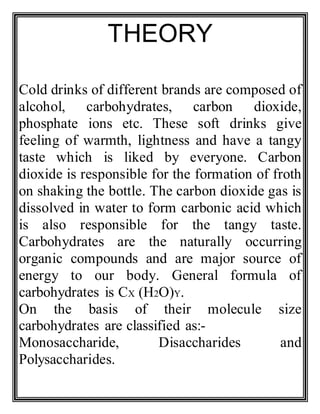
THEORY
Cold drinks of different brands are composed of
alcohol, carbohydrates, carbon dioxide,
phosphate ions etc. These soft drinks give
feeling of warmth, lightness and have a tangy
taste which is liked by everyone. Carbon
dioxide is responsible for the formation of froth
on shaking the bottle. The carbon dioxide gas is
dissolved in water to form carbonic acid which
is also responsible for the tangy taste.
Carbohydrates are the naturally occurring
organic compounds and are major source of
energy to our body. General formula of
carbohydrates is CX (H2O)Y.
On the basis of their molecule size
carbohydrates are classified as:-
Monosaccharide, Disaccharides and
Polysaccharides.
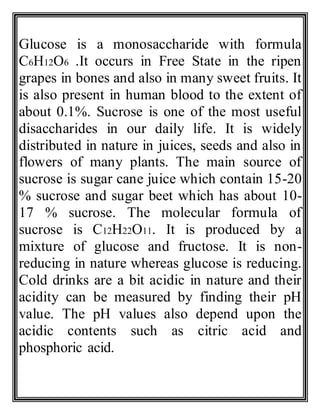
Glucose is a monosaccharide with formula
C6H12O6 .It occurs in Free State in the ripen
grapes in bones and also in many sweet fruits. It
is also present in human blood to the extent of
about 0.1%. Sucrose is one of the most useful
disaccharides in our daily life. It is widely
distributed in nature in juices, seeds and also in
flowers of many plants. The main source of
sucrose is sugar cane juice which contain 15-20
% sucrose and sugar beet which has about 10-
17 % sucrose. The molecular formula of
sucrose is C12H22O11. It is produced by a
mixture of glucose and fructose. It is non-
reducing in nature whereas glucose is reducing.
Cold drinks are a bit acidic in nature and their
acidity can be measured by finding their pH
value. The pH values also depend upon the
acidic contents such as citric acid and
phosphoric acid.
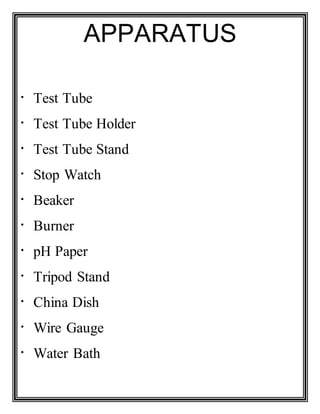
APPARATUS
Test Tube
Test Tube Holder
Test Tube Stand
Stop Watch
Beaker
Burner
pH Paper
Tripod Stand
China Dish
Wire Gauge
Water Bath
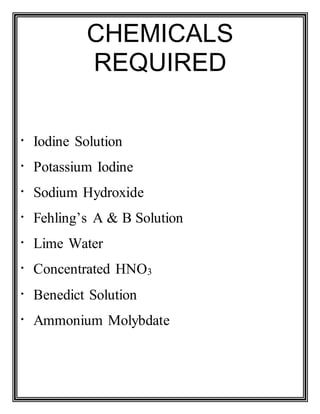
CHEMICALS
REQUIRED
Iodine Solution
Potassium Iodine
Sodium Hydroxide
Fehling’s A & B Solution
Lime Water
Concentrated HNO3
Benedict Solution
Ammonium Molybdate
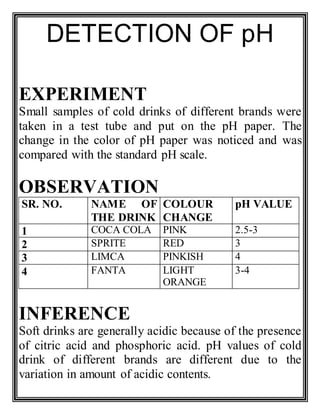
DETECTION OF pH
EXPERIMENT
Small samples of cold drinks of different brands were
taken in a test tube and put on the pH paper. The
change in the color of pH paper was noticed and was
compared with the standard pH scale.
OBSERVATION
SR. NO. NAME OF
THE DRINK
COLOUR
CHANGE
pH VALUE
1 COCA COLA PINK 2.5-3
2 SPRITE RED 3
3 LIMCA PINKISH 4
4 FANTA LIGHT
ORANGE
3-4
INFERENCE
Soft drinks are generally acidic because of the presence
of citric acid and phosphoric acid. pH values of cold
drink of different brands are different due to the
variation in amount of acidic contents.
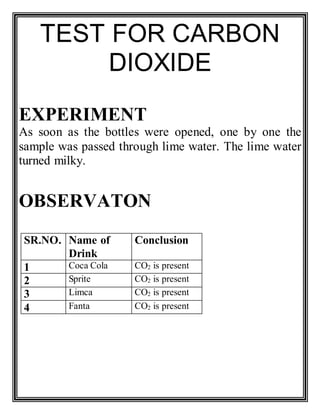
TEST FOR CARBON
DIOXIDE
EXPERIMENT
As soon as the bottles were opened, one by one the
sample was passed through lime water. The lime water
turned milky.
OBSERVATON
SR.NO. Name of
Drink
Conclusion
1 Coca Cola CO2 is present
2 Sprite CO2 is present
3 Limca CO2 is present
4 Fanta CO2 is present
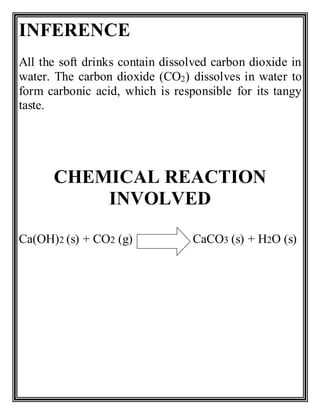
INFERENCE
All the soft drinks contain dissolved carbon dioxide in
water. The carbon dioxide (CO2) dissolves in water to
form carbonic acid, which is responsible for its tangy
taste.
CHEMICAL REACTION
INVOLVED
Ca(OH)2 (s) + CO2 (g) CaCO3 (s) + H2O (s)
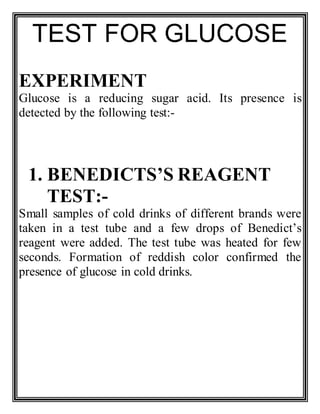
TEST FOR GLUCOSE
EXPERIMENT
Glucose is a reducing sugar acid. Its presence is
detected by the following test:-
1. BENEDICTS’S REAGENT
TEST:-
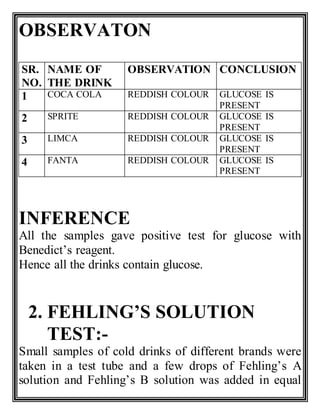
Small samples of cold drinks of different brands were
taken in a test tube and a few drops of Benedict’s
reagent were added. The test tube was heated for few
seconds. Formation of reddish color confirmed the
presence of glucose in cold drinks.
OBSERVATON
SR.
NO.
NAME OF
THE DRINK
OBSERVATION CONCLUSION
1 COCA COLA REDDISH COLOUR GLUCOSE IS
PRESENT
2 SPRITE REDDISH COLOUR GLUCOSE IS
PRESENT
3 LIMCA REDDISH COLOUR GLUCOSE IS
PRESENT
4 FANTA REDDISH COLOUR GLUCOSE IS
PRESENT
INFERENCE
All the samples gave positive test for glucose with
Benedict’s reagent.
Hence all the drinks contain glucose.
2. FEHLING’S SOLUTION
TEST:-
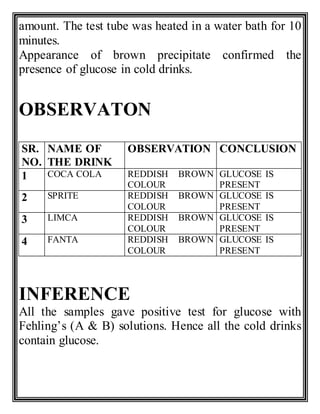
Small samples of cold drinks of different brands were
taken in a test tube and a few drops of Fehling’s A
solution and Fehling’s B solution was added in equal
amount. The test tube was heated in a water bath for 10
minutes.
Appearance of brown precipitate confirmed the
presence of glucose in cold drinks.
OBSERVATON
SR.
NO.
NAME OF
THE DRINK
OBSERVATION CONCLUSION
1 COCA COLA REDDISH BROWN
COLOUR
GLUCOSE IS
PRESENT
2 SPRITE REDDISH BROWN
COLOUR
GLUCOSE IS
PRESENT
3 LIMCA REDDISH BROWN
COLOUR
GLUCOSE IS
PRESENT
4 FANTA REDDISH BROWN
COLOUR
GLUCOSE IS
PRESENT
INFERENCE
All the samples gave positive test for glucose with
Fehling’s (A & B) solutions. Hence all the cold drinks
contain glucose.
TEST FOR
PHOSPHATE
EXPERIMENT
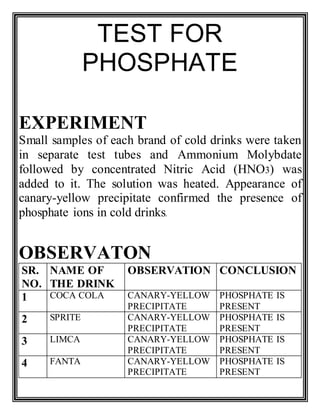
Small samples of each brand of cold drinks were taken
in separate test tubes and Ammonium Molybdate
followed by concentrated Nitric Acid (HNO3) was
added to it. The solution was heated. Appearance of
canary-yellow precipitate confirmed the presence of
phosphate ions in cold drinks.
OBSERVATON
SR.
NO.
NAME OF
THE DRINK
OBSERVATION CONCLUSION
1 COCA COLA CANARY-YELLOW
PRECIPITATE
PHOSPHATE IS
PRESENT
2 SPRITE CANARY-YELLOW
PRECIPITATE
PHOSPHATE IS
PRESENT
3 LIMCA CANARY-YELLOW
PRECIPITATE
PHOSPHATE IS
PRESENT
4 FANTA CANARY-YELLOW
PRECIPITATE
PHOSPHATE IS
PRESENT
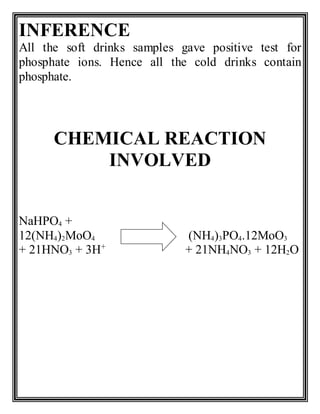
INFERENCE
All the soft drinks samples gave positive test for
phosphate ions. Hence all the cold drinks contain
phosphate.
CHEMICAL REACTION
INVOLVED
NaHPO4 +
12(NH4)2MoO4 (NH4)3PO4.12MoO3
+ 21HNO3 + 3H+
+ 21NH4NO3 + 12H2O
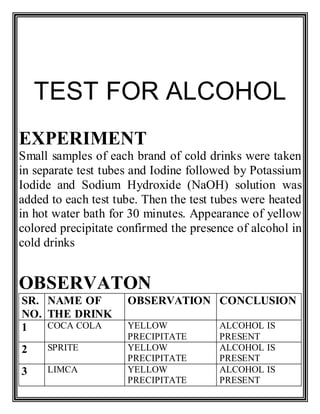
TEST FOR ALCOHOL
EXPERIMENT
Small samples of each brand of cold drinks were taken
in separate test tubes and Iodine followed by Potassium
Iodide and Sodium Hydroxide (NaOH) solution was
added to each test tube. Then the test tubes were heated
in hot water bath for 30 minutes. Appearance of yellow
colored precipitate confirmed the presence of alcohol in
cold drinks
OBSERVATON
SR.
NO.
NAME OF
THE DRINK
OBSERVATION CONCLUSION
1 COCA COLA YELLOW
PRECIPITATE
ALCOHOL IS
PRESENT
2 SPRITE YELLOW
PRECIPITATE
ALCOHOL IS
PRESENT
3 LIMCA YELLOW
PRECIPITATE
ALCOHOL IS
PRESENT
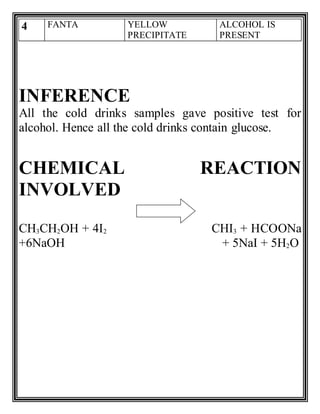
4 FANTA YELLOW
PRECIPITATE
ALCOHOL IS
PRESENT
INFERENCE
All the cold drinks samples gave positive test for
alcohol. Hence all the cold drinks contain glucose.
CHEMICAL REACTION
INVOLVED
CH3CH2OH + 4I2 CHI3 + HCOONa
+6NaOH + 5NaI + 5H2O
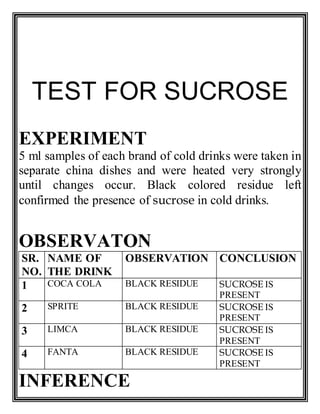
TEST FOR SUCROSE
EXPERIMENT
5 ml samples of each brand of cold drinks were taken in
separate china dishes and were heated very strongly
until changes occur. Black colored residue left
confirmed the presence of sucrose in cold drinks.
OBSERVATON
SR.
NO.
NAME OF
THE DRINK
OBSERVATION CONCLUSION
1 COCA COLA BLACK RESIDUE SUCROSE IS
PRESENT
2 SPRITE BLACK RESIDUE SUCROSE IS
PRESENT
3 LIMCA BLACK RESIDUE SUCROSE IS
PRESENT
4 FANTA BLACK RESIDUE SUCROSE IS
PRESENT
INFERENCE
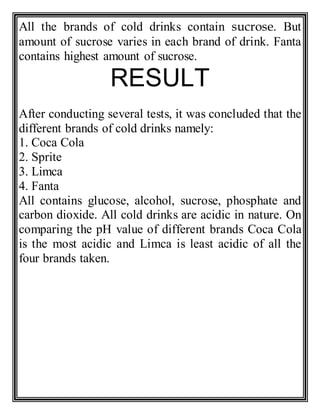
All the brands of cold drinks contain sucrose. But
amount of sucrose varies in each brand of drink. Fanta
contains highest amount of sucrose.
RESULT
After conducting several tests, it was concluded that the
different brands of cold drinks namely:
1. Coca Cola
2. Sprite
3. Limca
4. Fanta
All contains glucose, alcohol, sucrose, phosphate and
carbon dioxide. All cold drinks are acidic in nature. On
comparing the pH value of different brands Coca Cola
is the most acidic and Limca is least acidic of all the
four brands taken.
CONCLUSION
 DIS-ADVANTAGES OF COLD
DRINKS
1.Soft drinks are little more harmful than sugar
solution. As they contain sugar in large amount
which cause problems in diabetes patients.
2.Soft drinks can cause weight gain as they interfere
with the body’s natural ability to suppress hunger
feeling.
3.Soft drinks have ability to dissolve the calcium so
they are also harmful for our bones.
4.Soft drinks contain “phosphoric acid” which has a
pH of 2.8. So they can dissolve a nail in about 4
days.
5.For transportation of soft drinks syrup the
commercial truck must use the hazardous matter
place cards reserved for highly consive material.
6.Soft drinks have also ability to remove blood so
they are very harmful to our body.
 USES OF COLD DRINKS
1.Cold drinks can be used as toilet cleaners.
2.They can remove rust spots from chrome car
bumpers.
3.They clean corrosion from car battery terminals.
4.Soft drinks are used as an excellent ‘detergent’ to
remove grease from clothes.
5.They can loose a rusted bolt.
BIBLIOGRAPHY
Following books and websites were a source for my
project.
Comprehensive Chemistry Lab Manual
Mrs. Sudesh Yadav
www. Google.com
www.Wikipedia.com
TEACHER’S REMARKS

Investigatory project for chemistry

  • 1.
    CHEMISTRY INVESTIGATORY PROJECT ON DETERMINATION OF CONTENTS OFCOLD DRINKS PROJECT PREPARED BY: NIKHIL TYAGI XII-A Roll No: Session: 2015-2016 Kendriya Vidyalaya I.N.A Colony
  • 2.
    AIM COMPARITIVE STUDY AND QUALITATIVE ANALYSISOF DIFFERENT BRANDS OF COLD DRINKS AVAILABLE IN MARKET.
  • 3.
    CERTIFICATE This is herebyto certify that, the original and genuine investigation work has been carried out to investigate about the subject matter and the related data collection and investigation has been completed solely, sincerely and satisfactorily by NIKHIL TYAGI of CLASS XII A, KENDRIYA VIDYALAYA I.N.A COLONY, Regarding his project titled “Determination of the Contents of Cold Drinks”. Teacher’s Signature
  • 4.
    ACKNOWLEDGEMENT It would bemy utmost pleasure to express my sincere thanks to My Chemistry Teachers Mrs. Sudesh Yadav, in providing a helping hand in this project. Their valuable guidance, support and supervision all through this project titled “Determination of the Contents of Cold Drinks”, are responsible for attaining its present form. NIKHIL TYAGI XII-A
  • 5.
    PURPOSE In recent days,soft drink brands were put into various questions regarding their purity. News flashed that they contain harmful pesticide, which arouse many interest in knowing its contents because I have been drinking them for years. I wanted to confirm that whether the charge imposed on these brands are true or not. Another fact which inspired me to do this project is that I am in touch with qualitative analysis whose knowledge with other factors helped me to do so.
  • 6.
    CONTENTS I. Introduction II. Theory III.Apparatus IV. Chemicals Required V. Detection of pH VI. Test for Carbon Dioxide VII. Test for Glucose VIII. Test for Phosphate IX. Test for Alcohol X. Test for Sucrose XI. Result XII. Conclusion
  • 7.
    INTRODUCTION The era ofcold drinks began in 1952 but the Industrialization in India marked its beginning with launching of Limca and Goldspot by parley group of companies. Since, the beginning of cold drinks was highly profitable and luring, many multinational companies launched their brands in India like Pepsi and Coke. Now days, it is observed in general that majority of people viewed Sprite, Miranda, and Limca to give feeling of lightness, while Pepsi and Thumps Up to activate pulse and brain.
  • 8.
    THEORY Cold drinks ofdifferent brands are composed of alcohol, carbohydrates, carbon dioxide, phosphate ions etc. These soft drinks give feeling of warmth, lightness and have a tangy taste which is liked by everyone. Carbon dioxide is responsible for the formation of froth on shaking the bottle. The carbon dioxide gas is dissolved in water to form carbonic acid which is also responsible for the tangy taste. Carbohydrates are the naturally occurring organic compounds and are major source of energy to our body. General formula of carbohydrates is CX (H2O)Y. On the basis of their molecule size carbohydrates are classified as:- Monosaccharide, Disaccharides and Polysaccharides.
  • 9.
    Glucose is amonosaccharide with formula C6H12O6 .It occurs in Free State in the ripen grapes in bones and also in many sweet fruits. It is also present in human blood to the extent of about 0.1%. Sucrose is one of the most useful disaccharides in our daily life. It is widely distributed in nature in juices, seeds and also in flowers of many plants. The main source of sucrose is sugar cane juice which contain 15-20 % sucrose and sugar beet which has about 10- 17 % sucrose. The molecular formula of sucrose is C12H22O11. It is produced by a mixture of glucose and fructose. It is non- reducing in nature whereas glucose is reducing. Cold drinks are a bit acidic in nature and their acidity can be measured by finding their pH value. The pH values also depend upon the acidic contents such as citric acid and phosphoric acid.
  • 10.
    APPARATUS Test Tube Test TubeHolder Test Tube Stand Stop Watch Beaker Burner pH Paper Tripod Stand China Dish Wire Gauge Water Bath
  • 11.
    CHEMICALS REQUIRED Iodine Solution Potassium Iodine SodiumHydroxide Fehling’s A & B Solution Lime Water Concentrated HNO3 Benedict Solution Ammonium Molybdate
  • 12.
    DETECTION OF pH EXPERIMENT Smallsamples of cold drinks of different brands were taken in a test tube and put on the pH paper. The change in the color of pH paper was noticed and was compared with the standard pH scale. OBSERVATION SR. NO. NAME OF THE DRINK COLOUR CHANGE pH VALUE 1 COCA COLA PINK 2.5-3 2 SPRITE RED 3 3 LIMCA PINKISH 4 4 FANTA LIGHT ORANGE 3-4 INFERENCE Soft drinks are generally acidic because of the presence of citric acid and phosphoric acid. pH values of cold drink of different brands are different due to the variation in amount of acidic contents.
  • 13.
    TEST FOR CARBON DIOXIDE EXPERIMENT Assoon as the bottles were opened, one by one the sample was passed through lime water. The lime water turned milky. OBSERVATON SR.NO. Name of Drink Conclusion 1 Coca Cola CO2 is present 2 Sprite CO2 is present 3 Limca CO2 is present 4 Fanta CO2 is present
  • 14.
    INFERENCE All the softdrinks contain dissolved carbon dioxide in water. The carbon dioxide (CO2) dissolves in water to form carbonic acid, which is responsible for its tangy taste. CHEMICAL REACTION INVOLVED Ca(OH)2 (s) + CO2 (g) CaCO3 (s) + H2O (s)
  • 15.
    TEST FOR GLUCOSE EXPERIMENT Glucoseis a reducing sugar acid. Its presence is detected by the following test:- 1. BENEDICTS’S REAGENT TEST:- Small samples of cold drinks of different brands were taken in a test tube and a few drops of Benedict’s reagent were added. The test tube was heated for few seconds. Formation of reddish color confirmed the presence of glucose in cold drinks.
  • 16.
    OBSERVATON SR. NO. NAME OF THE DRINK OBSERVATIONCONCLUSION 1 COCA COLA REDDISH COLOUR GLUCOSE IS PRESENT 2 SPRITE REDDISH COLOUR GLUCOSE IS PRESENT 3 LIMCA REDDISH COLOUR GLUCOSE IS PRESENT 4 FANTA REDDISH COLOUR GLUCOSE IS PRESENT INFERENCE All the samples gave positive test for glucose with Benedict’s reagent. Hence all the drinks contain glucose. 2. FEHLING’S SOLUTION TEST:- Small samples of cold drinks of different brands were taken in a test tube and a few drops of Fehling’s A solution and Fehling’s B solution was added in equal
  • 17.
    amount. The testtube was heated in a water bath for 10 minutes. Appearance of brown precipitate confirmed the presence of glucose in cold drinks. OBSERVATON SR. NO. NAME OF THE DRINK OBSERVATION CONCLUSION 1 COCA COLA REDDISH BROWN COLOUR GLUCOSE IS PRESENT 2 SPRITE REDDISH BROWN COLOUR GLUCOSE IS PRESENT 3 LIMCA REDDISH BROWN COLOUR GLUCOSE IS PRESENT 4 FANTA REDDISH BROWN COLOUR GLUCOSE IS PRESENT INFERENCE All the samples gave positive test for glucose with Fehling’s (A & B) solutions. Hence all the cold drinks contain glucose.
  • 18.
    TEST FOR PHOSPHATE EXPERIMENT Small samplesof each brand of cold drinks were taken in separate test tubes and Ammonium Molybdate followed by concentrated Nitric Acid (HNO3) was added to it. The solution was heated. Appearance of canary-yellow precipitate confirmed the presence of phosphate ions in cold drinks. OBSERVATON SR. NO. NAME OF THE DRINK OBSERVATION CONCLUSION 1 COCA COLA CANARY-YELLOW PRECIPITATE PHOSPHATE IS PRESENT 2 SPRITE CANARY-YELLOW PRECIPITATE PHOSPHATE IS PRESENT 3 LIMCA CANARY-YELLOW PRECIPITATE PHOSPHATE IS PRESENT 4 FANTA CANARY-YELLOW PRECIPITATE PHOSPHATE IS PRESENT
  • 19.
    INFERENCE All the softdrinks samples gave positive test for phosphate ions. Hence all the cold drinks contain phosphate. CHEMICAL REACTION INVOLVED NaHPO4 + 12(NH4)2MoO4 (NH4)3PO4.12MoO3 + 21HNO3 + 3H+ + 21NH4NO3 + 12H2O
  • 20.
    TEST FOR ALCOHOL EXPERIMENT Smallsamples of each brand of cold drinks were taken in separate test tubes and Iodine followed by Potassium Iodide and Sodium Hydroxide (NaOH) solution was added to each test tube. Then the test tubes were heated in hot water bath for 30 minutes. Appearance of yellow colored precipitate confirmed the presence of alcohol in cold drinks OBSERVATON SR. NO. NAME OF THE DRINK OBSERVATION CONCLUSION 1 COCA COLA YELLOW PRECIPITATE ALCOHOL IS PRESENT 2 SPRITE YELLOW PRECIPITATE ALCOHOL IS PRESENT 3 LIMCA YELLOW PRECIPITATE ALCOHOL IS PRESENT
  • 21.
    4 FANTA YELLOW PRECIPITATE ALCOHOLIS PRESENT INFERENCE All the cold drinks samples gave positive test for alcohol. Hence all the cold drinks contain glucose. CHEMICAL REACTION INVOLVED CH3CH2OH + 4I2 CHI3 + HCOONa +6NaOH + 5NaI + 5H2O
  • 22.
    TEST FOR SUCROSE EXPERIMENT 5ml samples of each brand of cold drinks were taken in separate china dishes and were heated very strongly until changes occur. Black colored residue left confirmed the presence of sucrose in cold drinks. OBSERVATON SR. NO. NAME OF THE DRINK OBSERVATION CONCLUSION 1 COCA COLA BLACK RESIDUE SUCROSE IS PRESENT 2 SPRITE BLACK RESIDUE SUCROSE IS PRESENT 3 LIMCA BLACK RESIDUE SUCROSE IS PRESENT 4 FANTA BLACK RESIDUE SUCROSE IS PRESENT INFERENCE
  • 23.
    All the brandsof cold drinks contain sucrose. But amount of sucrose varies in each brand of drink. Fanta contains highest amount of sucrose. RESULT After conducting several tests, it was concluded that the different brands of cold drinks namely: 1. Coca Cola 2. Sprite 3. Limca 4. Fanta All contains glucose, alcohol, sucrose, phosphate and carbon dioxide. All cold drinks are acidic in nature. On comparing the pH value of different brands Coca Cola is the most acidic and Limca is least acidic of all the four brands taken.
  • 24.
    CONCLUSION  DIS-ADVANTAGES OFCOLD DRINKS 1.Soft drinks are little more harmful than sugar solution. As they contain sugar in large amount which cause problems in diabetes patients. 2.Soft drinks can cause weight gain as they interfere with the body’s natural ability to suppress hunger feeling. 3.Soft drinks have ability to dissolve the calcium so they are also harmful for our bones. 4.Soft drinks contain “phosphoric acid” which has a pH of 2.8. So they can dissolve a nail in about 4 days. 5.For transportation of soft drinks syrup the commercial truck must use the hazardous matter place cards reserved for highly consive material.
  • 25.
    6.Soft drinks havealso ability to remove blood so they are very harmful to our body.  USES OF COLD DRINKS 1.Cold drinks can be used as toilet cleaners. 2.They can remove rust spots from chrome car bumpers. 3.They clean corrosion from car battery terminals. 4.Soft drinks are used as an excellent ‘detergent’ to remove grease from clothes. 5.They can loose a rusted bolt.
  • 26.
    BIBLIOGRAPHY Following books andwebsites were a source for my project. Comprehensive Chemistry Lab Manual Mrs. Sudesh Yadav www. Google.com www.Wikipedia.com
  • 27.