By-
Srinjay Paray & Nobendu Mukerjee
Ramakrishna Mission Vivekananda Centenary College, Department of
Microbiology, 4th Semester
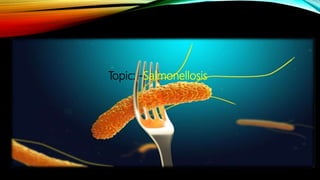
Topic: -Salmonellosis
ABOUT THE DISEASE
• Salmonellosis is a symptomatic infection caused by a bacteria of the Salmonella
type.
• It is a infectious type of disease where the live bacteria enters and causes the
disease.
• This disease is characterized by diarrhoea, fever, abdominal cramps and vomiting.
• This disease can also result in dehydration.
• The old, young and others with weaken immunity are more likely to develop
severe diseases.
MORPHOLOGY OF THE ORGANISM
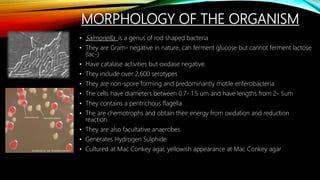
• Salmonella is a genus of rod shaped bacteria
• They are Gram- negative in nature, can ferment glucose but cannot ferment lactose
(lac-)
• Have catalase activities but oxidase negative.
• They include over 2,600 serotypes
• They are non-spore forming and predominantly motile enterobacteria
• The cells have diameters between 0.7- 1.5 um and have lengths from 2- 5um
• They contains a peritrichous flagella
• The are chemotrophs and obtain their energy from oxidation and reduction
reaction.
• They are also facultative anaerobes
• Generates Hydrogen Sulphide
• Cultured at Mac Conkey agar, yellowish appearance at Mac Conkey agar
CLASSIFICATION
Domain: Bacteria
Phylum: Proteobacteria
Class: Gammaproteobacteria
Order: Enterobacterales
Family: Enterobacteriaceae
Genus: Salmonella
Lignieres 1900
SYMPTOMS
• Pain Areas: in the abdomen or muscles
• Whole Body: chills, dehydration, fatigues, fever, or loss of appetite,
chills, myalgia
• Gastrointestinal: diarrhoea or blood in stool
• Also Common: headache
TRANSMISSION AND CAUSES
• Contaminated food, having no unusual look or smell
• Poor kitchen hygiene, especially problematic in institutional kitchens and
restaurants because this can lead to a significant outbreak
• Excretion from either sick or infected but apparently clinically healthy people and
animals
• Polluted surface water and standing water such as in shower hoses or unused
water dispensers.
• Unhygienically thawed poultry
• An association with reptiles is well described
• Amphibians such as frogs
DISEASE IN HUMANS
– Incubation period:
– Gastroenteritis: 12 hrs to 3 days
– Enteric fever: 10 to 14 days
– Asymptomatic to severe
– All serovars can produce all forms
– Reptile-associated is most severe
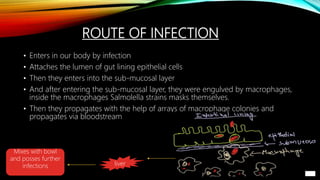
ROUTE OF INFECTION
• Enters in our body by infection
• Attaches the lumen of gut lining epithelial cells
• Then they enters into the sub-mucosal layer
• And after entering the sub-mucosal layer, they were engulved by macrophages,
inside the macrophages Salmolella strains masks themselves.
• Then they propagates with the help of arrays of macrophage colonies and
propagates via bloodstream
liver
Mixes with bowl
and posses further
infections
DIAGNOSIS
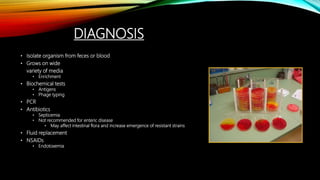
• Isolate organism from feces or blood
• Grows on wide
variety of media
• Enrichment
• Biochemical tests
• Antigens
• Phage typing
• PCR
• Antibiotics
• Septicemia
• Not recommended for enteric disease
• May affect intestinal flora and increase emergence of resistant strains
• Fluid replacement
• NSAIDs
• Endotoxemia
TREATMENTS
• Antibiotics
• Ampicillin, amoxicillin, gentamicin, TMS, fluoroquinolones,
chloramphenicol
• Treatment indications
• Septicemia, enteric fever
• Elderly, infants, immunosuppressed
• Healthy persons recover 2 to 7 days without antibiotics
REFERENCES
• “Salmonella". CDC. 9 March 2015. Archived from the original on 25 May 2017. Retrieved 7 May2017.
• Hald, T. (2013). Advances in microbial food safety: 2. Pathogen update: Salmonella. Elsevier Inc. Chapters.
p. 2.2. ISBN 9780128089606. Archived from the original on 2017-09-10.
• "Salmonella Infections". MedlinePlus. Archived from the original on 30 April 2017. Retrieved 7 May 2017.
• ^"Salmonella (non-typhoidal)". World Health Organization. December 2016. Archived from the original on 20 April 2017.
Retrieved 7 May 2017.
• GBD 2015 Mortality and Causes of Death, Collaborators. (8 October 2016). "Global, regional, and national life expectancy,
all-cause mortality, and cause-specific mortality for 249 causes of death, 1980-2015: a systematic analysis for the Global
Burden of Disease Study 2015". Lancet. 388 (10053): 1459–1544. doi:10.1016/s0140-6736(16)31012-
1. PMC 5388903. PMID 27733281.
• "Salmonella". World Health Organization. Archived from the original on 17 April 2017. Retrieved 7 May 2017.
• Santos, Renato L.; Shuping Zhang; Renee M. Tsolis; Robert A. Kingsley; L. Gary Adams; Andreas J. Baumler (2001).
"Animal models od Salmonella infections: enteritis versus typhoid fever". Microbes and Infection. 3 (14–15): 1335–
1344. doi:10.1016/s1286-4579(01)01495-2. PMID 11755423.
• "Nontyphoidal Salmonella Infections - Infectious Diseases - Merck Manuals Professional Edition". Merck Manuals
Professional Edition. Retrieved 2018-09-15.
THANK YOU ALL..

Salmonellosis

  • 1.
    By- Srinjay Paray &Nobendu Mukerjee Ramakrishna Mission Vivekananda Centenary College, Department of Microbiology, 4th Semester
  • 2.
  • 3.
    ABOUT THE DISEASE •Salmonellosis is a symptomatic infection caused by a bacteria of the Salmonella type. • It is a infectious type of disease where the live bacteria enters and causes the disease. • This disease is characterized by diarrhoea, fever, abdominal cramps and vomiting. • This disease can also result in dehydration. • The old, young and others with weaken immunity are more likely to develop severe diseases.
  • 4.
    MORPHOLOGY OF THEORGANISM • Salmonella is a genus of rod shaped bacteria • They are Gram- negative in nature, can ferment glucose but cannot ferment lactose (lac-) • Have catalase activities but oxidase negative. • They include over 2,600 serotypes • They are non-spore forming and predominantly motile enterobacteria • The cells have diameters between 0.7- 1.5 um and have lengths from 2- 5um • They contains a peritrichous flagella • The are chemotrophs and obtain their energy from oxidation and reduction reaction. • They are also facultative anaerobes • Generates Hydrogen Sulphide • Cultured at Mac Conkey agar, yellowish appearance at Mac Conkey agar
  • 5.
    CLASSIFICATION Domain: Bacteria Phylum: Proteobacteria Class:Gammaproteobacteria Order: Enterobacterales Family: Enterobacteriaceae Genus: Salmonella Lignieres 1900
  • 6.
    SYMPTOMS • Pain Areas:in the abdomen or muscles • Whole Body: chills, dehydration, fatigues, fever, or loss of appetite, chills, myalgia • Gastrointestinal: diarrhoea or blood in stool • Also Common: headache
  • 7.
    TRANSMISSION AND CAUSES •Contaminated food, having no unusual look or smell • Poor kitchen hygiene, especially problematic in institutional kitchens and restaurants because this can lead to a significant outbreak • Excretion from either sick or infected but apparently clinically healthy people and animals • Polluted surface water and standing water such as in shower hoses or unused water dispensers. • Unhygienically thawed poultry • An association with reptiles is well described • Amphibians such as frogs
  • 8.
    DISEASE IN HUMANS –Incubation period: – Gastroenteritis: 12 hrs to 3 days – Enteric fever: 10 to 14 days – Asymptomatic to severe – All serovars can produce all forms – Reptile-associated is most severe
  • 9.
    ROUTE OF INFECTION •Enters in our body by infection • Attaches the lumen of gut lining epithelial cells • Then they enters into the sub-mucosal layer • And after entering the sub-mucosal layer, they were engulved by macrophages, inside the macrophages Salmolella strains masks themselves. • Then they propagates with the help of arrays of macrophage colonies and propagates via bloodstream liver Mixes with bowl and posses further infections
  • 10.
    DIAGNOSIS • Isolate organismfrom feces or blood • Grows on wide variety of media • Enrichment • Biochemical tests • Antigens • Phage typing • PCR • Antibiotics • Septicemia • Not recommended for enteric disease • May affect intestinal flora and increase emergence of resistant strains • Fluid replacement • NSAIDs • Endotoxemia
  • 11.
    TREATMENTS • Antibiotics • Ampicillin,amoxicillin, gentamicin, TMS, fluoroquinolones, chloramphenicol • Treatment indications • Septicemia, enteric fever • Elderly, infants, immunosuppressed • Healthy persons recover 2 to 7 days without antibiotics
  • 12.
    REFERENCES • “Salmonella". CDC.9 March 2015. Archived from the original on 25 May 2017. Retrieved 7 May2017. • Hald, T. (2013). Advances in microbial food safety: 2. Pathogen update: Salmonella. Elsevier Inc. Chapters. p. 2.2. ISBN 9780128089606. Archived from the original on 2017-09-10. • "Salmonella Infections". MedlinePlus. Archived from the original on 30 April 2017. Retrieved 7 May 2017. • ^"Salmonella (non-typhoidal)". World Health Organization. December 2016. Archived from the original on 20 April 2017. Retrieved 7 May 2017. • GBD 2015 Mortality and Causes of Death, Collaborators. (8 October 2016). "Global, regional, and national life expectancy, all-cause mortality, and cause-specific mortality for 249 causes of death, 1980-2015: a systematic analysis for the Global Burden of Disease Study 2015". Lancet. 388 (10053): 1459–1544. doi:10.1016/s0140-6736(16)31012- 1. PMC 5388903. PMID 27733281. • "Salmonella". World Health Organization. Archived from the original on 17 April 2017. Retrieved 7 May 2017. • Santos, Renato L.; Shuping Zhang; Renee M. Tsolis; Robert A. Kingsley; L. Gary Adams; Andreas J. Baumler (2001). "Animal models od Salmonella infections: enteritis versus typhoid fever". Microbes and Infection. 3 (14–15): 1335– 1344. doi:10.1016/s1286-4579(01)01495-2. PMID 11755423. • "Nontyphoidal Salmonella Infections - Infectious Diseases - Merck Manuals Professional Edition". Merck Manuals Professional Edition. Retrieved 2018-09-15.
  • 13.