CONSULTATIVE
SELLING
Deepak Mehra
Agenda
 Selling
 Consultative Selling
 Traditional vs Consultative Selling
 Seven Steps Sales Process
 Practicing Consultative Selling
 Feedback
Selling
 Selling is to IDENTIFY – GENERATE –
INFLUENCE a need or a want for your
product/services for Mutual Benefits .
 If a customer has to buy our
product/service he has to
Forego/Forget/Share or Sacrifice.
 It is very important to have all good
reasons why customers should buy from
us.
Consultative Selling
• Consultative selling is a need-satisfaction presentation
format that focuses on problem identification, where the
salesperson serves as an expert on problem recognition
and resolution.
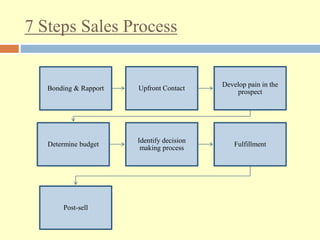
7 Steps Sales Process
Bonding & Rapport Upfront Contact
Develop pain in the
prospect
Determine budget
Identify decision
making process
Fulfillment
Post-sell
1. Bonding & Rapport
 75% of the outcome of any selling opportunity is directly correlated to
how trust and rapport are established by the salesperson in the
initial stages of the relationship.
 People buy from people who are like
themselves and who they feel comfortable
with
 Customer profiling with empathy maps
2. Upfront Contact
 “How much time do we have for this call (or meeting)?”
 “What do you expect to accomplish during this call?”
 Say (Assert) what you expect to accomplish.
 Decide together if there is enough time so both sides (parties) can be
relaxed.
 Set clear expectations.
 Be prepared to say “no” to the client.
 Be prepared to tell the prospect “you don’t qualify to be our client”
 Say this in a polite way, “I don’t think our company is the most
suited for your needs.” etc.
3. Develop pain in the prospect
 People buy for two reasons, and two reasons only
 Buy to gain pleasure
 Buy to remove pain
 Pain is money being lost
 Pain is quality of life being eroded
 Find 3 to 5 pains and what these pains are costing the
prospect
 People buy emotionally, then justify their reasons
intellectually
3. Develop pain in the prospect
Ask…
 “What is the pain costing your organization?”
 Find out what the pain is costing them personally
 Quality of life, personal bonus, career advancement, etc.
 “What has been done to remove this pain?”
 “What was the result?”
 Did it work? Why or why not?
 How committed are they to removing this pain?
 Is this pain in their top 10 priority? Top 5? Top 1?
4. Determine the budget
 Be comfortable talking about money
 Raise all money issues now, not later.
Ask:
 “What is your budget to remove this pain?”
 “Where is the budget coming from? Who pays?”
 “When will the budget be available?”
 Almost always…
 There is a gap between what they want to spend and what it will cost.
 Close the credibility gap between what they want to spend and what you
charge.
4. Determine the budget
If the prospect will not tell you their budget, say,
“In the past we have done X for Y budget for company Z to address similar situations to yours.”
 Give specific customer examples
 Give a range from small to large projects
 Ask, “Where does your organization fit in that range?”
 Use a “Monkey’s Paw”
 = smallest service offer you can make to reduce prospect’s pain
Assessment
 Pilot
 Small project
 Etc.
5. Identify Decision Making
Process
 Ask, “How do you buy?”
Has the prospect bought similar services in the past? Do they know
what to expect?
 “What is the purchasing process in your organization?”
 “Who other than yourself will be involved in making this
decision?”
 “When will this decision be made?”
 Find out if everyone in the decision making process has the
same pain
5. Identify Decision Making
Process
Talk high in the food chain
Know who you are talking to
Technical buyer – evaluates and screens out suppliers
User buyer – uses and benefits from your services
Economic buyer – signs off on the purchase
Coach – person who can inform and guide you
 Especially for large companies these functions can cause long delays is missed
 Ask about the need to involve purchasing, legal, finance people
 Suggest one-time Purchase Order (POs) if the amount is smaller
 Ask if they have a simple contract or “letter of engagement” that can be used for
proof to invoice
6. Fulfillment
 Stop and take a breath
 Repeat the pains back to the prospect
 Say that it is costing them W
 Say that we can address the pain by doing X
 Say that they have a budget of Y
 Say that the decision making process is Z
 Ask, “What do you want me to do next?”
 NEVER surprise the prospect with information in your proposal
 Scope, pricing, timeline, etc.
 The proposal is a simple restatement of the verbal agreement with the prospect from the consultative
selling process
6. Fulfillment
 When the salesperson truly believes in the product
or service and that (if) a fair price is being asked, it is
far easier to accomplish their goal.
 5 Good Outcomes of a Sales Visit
1. Yes
2. No
3. Clear future
 Not now, no money
 Next year we will have money
 Not "we will call you". This is not clear.
4. Referral. “You can’t help us, but call my friend.”
5. Lesson learned. How can we kaizen the selling process?
7. Post-sell
This is the most difficult step! After the prospect has accepted
your proposal, but before signing the contract:
 Ask if there are any new factors that require changes to
scope or timing
 Set agreements on how to manage changes to project scope,
changes in expectations, etc.
 Ask, “How will you communicate with us so that we will know
as soon as you move away from the “100% satisfied” line?”
 Offer to let them sleep on it (think it over) before signing the
contract
 Build trust, comfort and confidence by showing that we are
not in a big hurry to sign the contract, that quality is most
important
Sales Visit Debrief Template
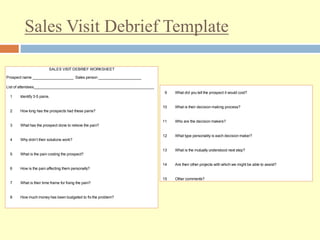
Prospect name ___________________ Sales person ____________________
List of attendees________________________________________________________
1 Identify 3-5 pains.
2 How long has the prospects had these pains?
3 What has the prospect done to relieve the pain?
4 Why didn’t their solutions work?
5 What is the pain costing the prospect?
6 How is the pain affecting them personally?
7 What is their time frame for fixing the pain?
8 How much money has been budgeted to fix the problem?
9 What did you tell the prospect it would cost?
10 What is their decision making process?
SALES VISIT DEBRIEF WORKSHEET
3 What has the prospect done to relieve the pain?
4 Why didn’t their solutions work?
5 What is the pain costing the prospect?
6 How is the pain affecting them personally?
7 What is their time frame for fixing the pain?
8 How much money has been budgeted to fix the problem?
9 What did you tell the prospect it would cost?
10 What is their decision making process?
11 Who are the decision makers?
12 What type personality is each decision maker?
13 What is the mutually understood next step?
14 Are their other projects with which we might be able to assist?
15 Other comments?
Practice Consultative Selling
 Review Consultative Selling process and reflect on past mistakes and
what it cost you (this is your pain)
 Review and prepare for your next sale visit
 Use the Sales Visit Debrief Template as a checklist for the process
 Take a 2nd person with you to sales visits to quietly observe your
interaction with the prospect
 The 2nd person takes notes, gives you feedback
Feedback & Questions

Consultative Selling Process

  • 1.
  • 2.
    Agenda  Selling  ConsultativeSelling  Traditional vs Consultative Selling  Seven Steps Sales Process  Practicing Consultative Selling  Feedback
  • 3.
    Selling  Selling isto IDENTIFY – GENERATE – INFLUENCE a need or a want for your product/services for Mutual Benefits .  If a customer has to buy our product/service he has to Forego/Forget/Share or Sacrifice.  It is very important to have all good reasons why customers should buy from us.
  • 4.
    Consultative Selling • Consultativeselling is a need-satisfaction presentation format that focuses on problem identification, where the salesperson serves as an expert on problem recognition and resolution.
  • 5.
    7 Steps SalesProcess Bonding & Rapport Upfront Contact Develop pain in the prospect Determine budget Identify decision making process Fulfillment Post-sell
  • 6.
    1. Bonding &Rapport  75% of the outcome of any selling opportunity is directly correlated to how trust and rapport are established by the salesperson in the initial stages of the relationship.  People buy from people who are like themselves and who they feel comfortable with  Customer profiling with empathy maps
  • 7.
    2. Upfront Contact “How much time do we have for this call (or meeting)?”  “What do you expect to accomplish during this call?”  Say (Assert) what you expect to accomplish.  Decide together if there is enough time so both sides (parties) can be relaxed.  Set clear expectations.  Be prepared to say “no” to the client.  Be prepared to tell the prospect “you don’t qualify to be our client”  Say this in a polite way, “I don’t think our company is the most suited for your needs.” etc.
  • 8.
    3. Develop painin the prospect  People buy for two reasons, and two reasons only  Buy to gain pleasure  Buy to remove pain  Pain is money being lost  Pain is quality of life being eroded  Find 3 to 5 pains and what these pains are costing the prospect  People buy emotionally, then justify their reasons intellectually
  • 9.
    3. Develop painin the prospect Ask…  “What is the pain costing your organization?”  Find out what the pain is costing them personally  Quality of life, personal bonus, career advancement, etc.  “What has been done to remove this pain?”  “What was the result?”  Did it work? Why or why not?  How committed are they to removing this pain?  Is this pain in their top 10 priority? Top 5? Top 1?
  • 10.
    4. Determine thebudget  Be comfortable talking about money  Raise all money issues now, not later. Ask:  “What is your budget to remove this pain?”  “Where is the budget coming from? Who pays?”  “When will the budget be available?”  Almost always…  There is a gap between what they want to spend and what it will cost.  Close the credibility gap between what they want to spend and what you charge.
  • 11.
    4. Determine thebudget If the prospect will not tell you their budget, say, “In the past we have done X for Y budget for company Z to address similar situations to yours.”  Give specific customer examples  Give a range from small to large projects  Ask, “Where does your organization fit in that range?”  Use a “Monkey’s Paw”  = smallest service offer you can make to reduce prospect’s pain Assessment  Pilot  Small project  Etc.
  • 12.
    5. Identify DecisionMaking Process  Ask, “How do you buy?” Has the prospect bought similar services in the past? Do they know what to expect?  “What is the purchasing process in your organization?”  “Who other than yourself will be involved in making this decision?”  “When will this decision be made?”  Find out if everyone in the decision making process has the same pain
  • 13.
    5. Identify DecisionMaking Process Talk high in the food chain Know who you are talking to Technical buyer – evaluates and screens out suppliers User buyer – uses and benefits from your services Economic buyer – signs off on the purchase Coach – person who can inform and guide you  Especially for large companies these functions can cause long delays is missed  Ask about the need to involve purchasing, legal, finance people  Suggest one-time Purchase Order (POs) if the amount is smaller  Ask if they have a simple contract or “letter of engagement” that can be used for proof to invoice
  • 14.
    6. Fulfillment  Stopand take a breath  Repeat the pains back to the prospect  Say that it is costing them W  Say that we can address the pain by doing X  Say that they have a budget of Y  Say that the decision making process is Z  Ask, “What do you want me to do next?”  NEVER surprise the prospect with information in your proposal  Scope, pricing, timeline, etc.  The proposal is a simple restatement of the verbal agreement with the prospect from the consultative selling process
  • 15.
    6. Fulfillment  Whenthe salesperson truly believes in the product or service and that (if) a fair price is being asked, it is far easier to accomplish their goal.  5 Good Outcomes of a Sales Visit 1. Yes 2. No 3. Clear future  Not now, no money  Next year we will have money  Not "we will call you". This is not clear. 4. Referral. “You can’t help us, but call my friend.” 5. Lesson learned. How can we kaizen the selling process?
  • 16.
    7. Post-sell This isthe most difficult step! After the prospect has accepted your proposal, but before signing the contract:  Ask if there are any new factors that require changes to scope or timing  Set agreements on how to manage changes to project scope, changes in expectations, etc.  Ask, “How will you communicate with us so that we will know as soon as you move away from the “100% satisfied” line?”  Offer to let them sleep on it (think it over) before signing the contract  Build trust, comfort and confidence by showing that we are not in a big hurry to sign the contract, that quality is most important
  • 17.
    Sales Visit DebriefTemplate Prospect name ___________________ Sales person ____________________ List of attendees________________________________________________________ 1 Identify 3-5 pains. 2 How long has the prospects had these pains? 3 What has the prospect done to relieve the pain? 4 Why didn’t their solutions work? 5 What is the pain costing the prospect? 6 How is the pain affecting them personally? 7 What is their time frame for fixing the pain? 8 How much money has been budgeted to fix the problem? 9 What did you tell the prospect it would cost? 10 What is their decision making process? SALES VISIT DEBRIEF WORKSHEET 3 What has the prospect done to relieve the pain? 4 Why didn’t their solutions work? 5 What is the pain costing the prospect? 6 How is the pain affecting them personally? 7 What is their time frame for fixing the pain? 8 How much money has been budgeted to fix the problem? 9 What did you tell the prospect it would cost? 10 What is their decision making process? 11 Who are the decision makers? 12 What type personality is each decision maker? 13 What is the mutually understood next step? 14 Are their other projects with which we might be able to assist? 15 Other comments?
  • 18.
    Practice Consultative Selling Review Consultative Selling process and reflect on past mistakes and what it cost you (this is your pain)  Review and prepare for your next sale visit  Use the Sales Visit Debrief Template as a checklist for the process  Take a 2nd person with you to sales visits to quietly observe your interaction with the prospect  The 2nd person takes notes, gives you feedback
  • 19.