5s system
. What is 5S?
5S is a system to reduce waste and optimize productivity through maintaining
an orderly workplace and using visual cues to achieve more consistent
operational results. The term refers to five steps – sort, set in order, shine,
standardize, and sustain – that are also sometimes known as the 5 pillars of a
visual workplace. 5S programs are implemented by teams working together to
get materials closer to operations, right at workers’ fingertips and organized
and labeled to facilitate operations with the smallest amount of wasted time
and materials.
The 5S system is a good starting point for all improvement efforts aiming to
drive out waste from the manufacturing process, and ultimately improve a
company’s bottom line by improving products and services, and lowering
costs.
“A place for everything, and everything in its place” is the mantra of the 5S
method and the result is an improved manufacturing process and the lowest
overall cost for goods produced.
What are the Five Ss?
5S was developed in Japan
and stands for the Japanese
words seiri (tidiness), seiton
(orderliness), seiso
(cleanliness), seiketsu
(standardization), and shitsuke
(discipline). These words have
been adopted to English to
maintain "5S."
Sort
The first step in a 5S program is to sort
through everything in each work area.
Keep only what is necessary. Materials,
tools, equipment and supplies should be
classified as to the type of object. Scrap
metal might go directly to a recycling bin.
A tool might go to a collection area for
further identification. Items that are not
frequently used should be moved to a
separate, common storage area. Items that
are not used should be discarded or
recycled. Some work areas can clean,
classify, determine ownership, and red tag
in just a few seconds. In other
circumstances the process may be more
involved and the steps more distinct. But
the objective of the 5S step of sorting is
the same, clean up and get rid of unused
items.
Set In Order
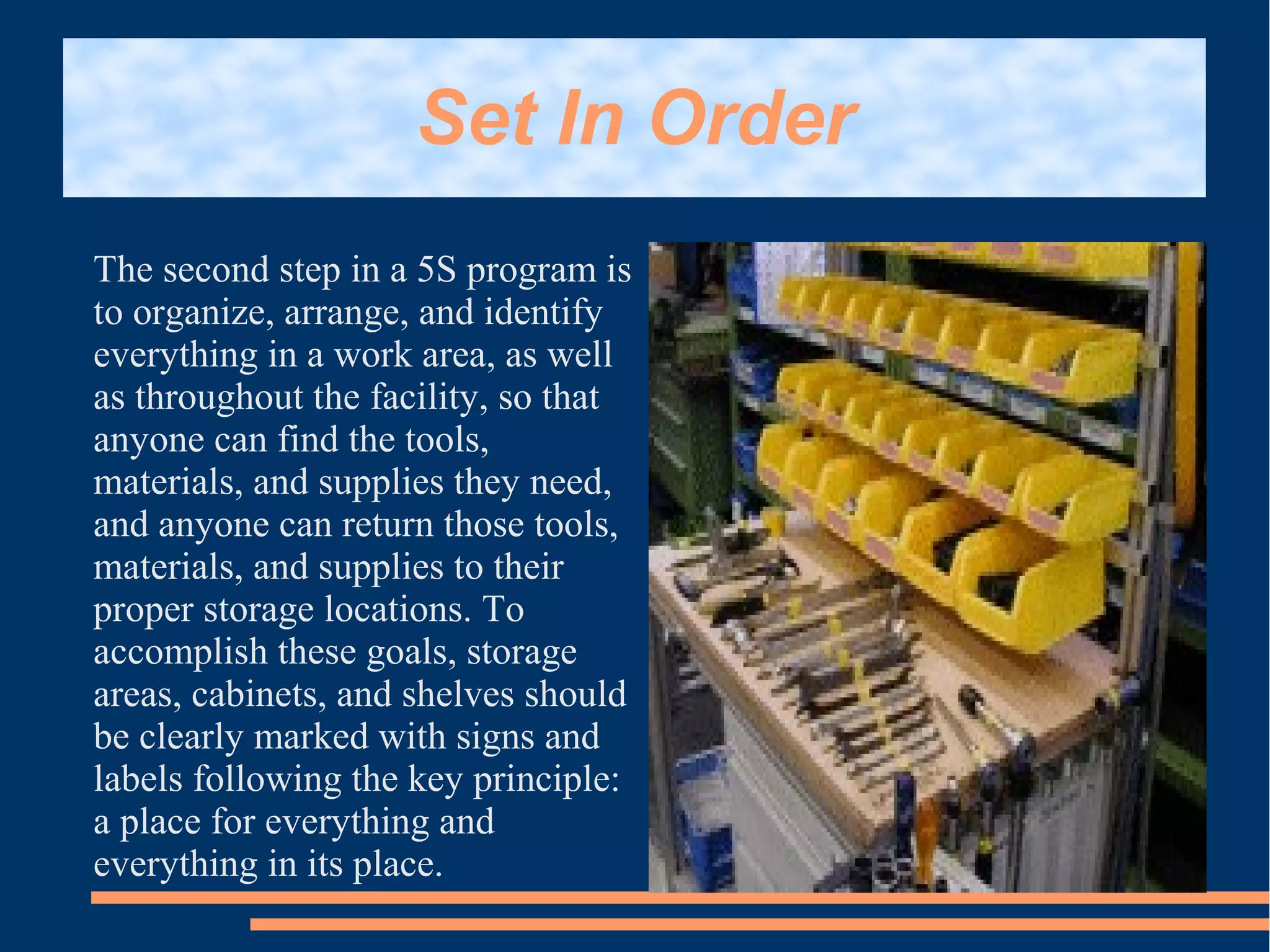
The second step in a 5S program is
to organize, arrange, and identify
everything in a work area, as well
as throughout the facility, so that
anyone can find the tools,
materials, and supplies they need,
and anyone can return those tools,
materials, and supplies to their
proper storage locations. To
accomplish these goals, storage
areas, cabinets, and shelves should
be clearly marked with signs and
labels following the key principle:
a place for everything and
everything in its place.
Shine
5S shine involves more than pushing a
broom around a work area once a week.
It involves regular, usually daily,
cleaning. The work area should be
returned to the condition it was in when
the day started - including putting away
all tools, materials and supplies used that
day. While cleaning it's easy to inspect
the machines, tools, equipment, and
supplies you work with. This emphasizes
that 5S shine is not just the job of a
janitor or a cleaning crew, it is everyone's
responsibility. When done on a regular,
frequent basis, cleaning and inspecting
generally will not take a lot of time, and
in the long run will most likely save time.
Standardize
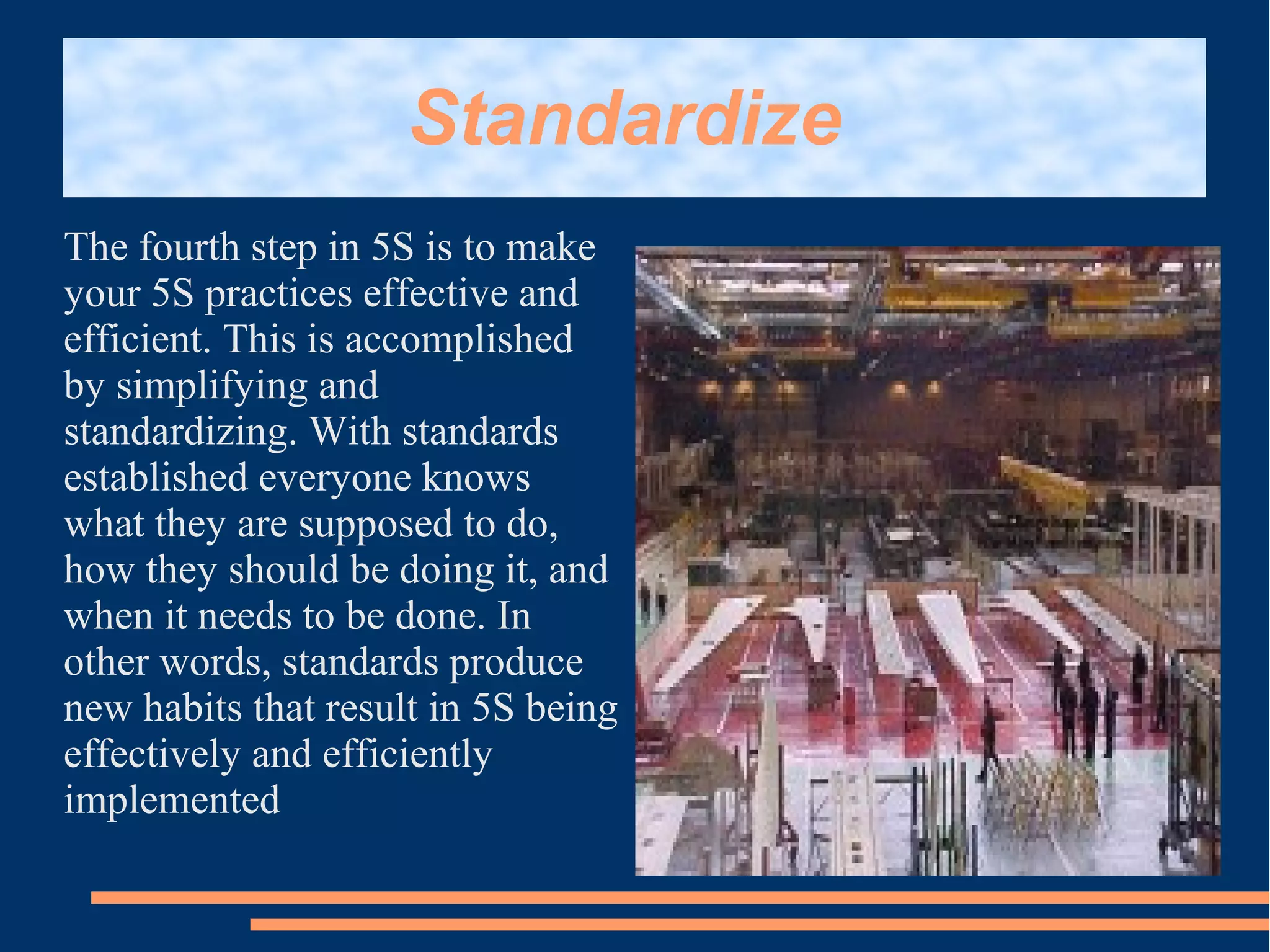
The fourth step in 5S is to make
your 5S practices effective and
efficient. This is accomplished
by simplifying and
standardizing. With standards
established everyone knows
what they are supposed to do,
how they should be doing it, and
when it needs to be done. In
other words, standards produce
new habits that result in 5S being
effectively and efficiently
implemented
Sustain
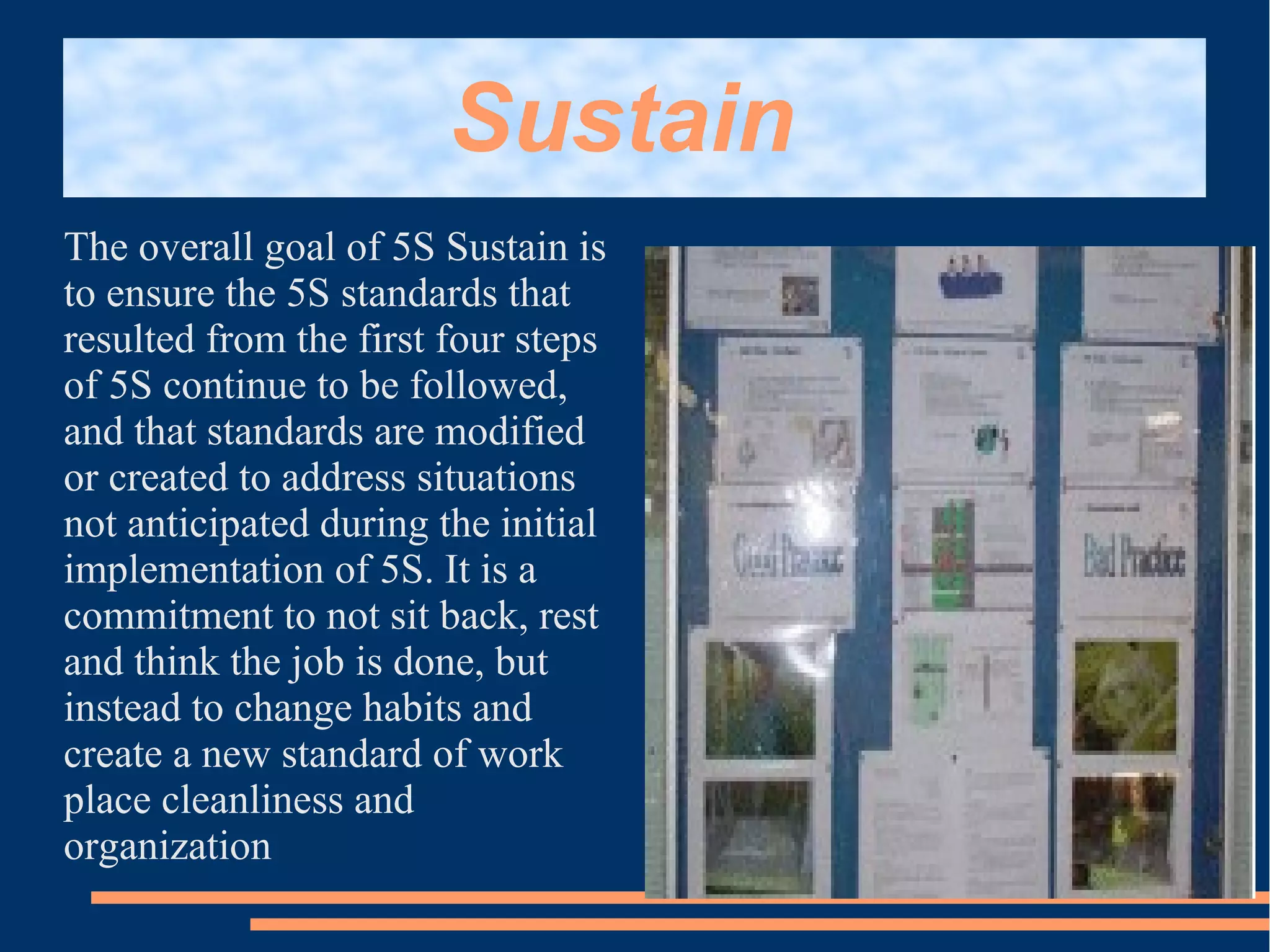
The overall goal of 5S Sustain is
to ensure the 5S standards that
resulted from the first four steps
of 5S continue to be followed,
and that standards are modified
or created to address situations
not anticipated during the initial
implementation of 5S. It is a
commitment to not sit back, rest
and think the job is done, but
instead to change habits and
create a new standard of work
place cleanliness and
organization
Sai krishna tirunagari

Sai krishna 5 s methodology

  • 1.
    5s system . Whatis 5S? 5S is a system to reduce waste and optimize productivity through maintaining an orderly workplace and using visual cues to achieve more consistent operational results. The term refers to five steps – sort, set in order, shine, standardize, and sustain – that are also sometimes known as the 5 pillars of a visual workplace. 5S programs are implemented by teams working together to get materials closer to operations, right at workers’ fingertips and organized and labeled to facilitate operations with the smallest amount of wasted time and materials. The 5S system is a good starting point for all improvement efforts aiming to drive out waste from the manufacturing process, and ultimately improve a company’s bottom line by improving products and services, and lowering costs. “A place for everything, and everything in its place” is the mantra of the 5S method and the result is an improved manufacturing process and the lowest overall cost for goods produced.
  • 2.
    What are theFive Ss? 5S was developed in Japan and stands for the Japanese words seiri (tidiness), seiton (orderliness), seiso (cleanliness), seiketsu (standardization), and shitsuke (discipline). These words have been adopted to English to maintain "5S."
  • 3.
    Sort The first stepin a 5S program is to sort through everything in each work area. Keep only what is necessary. Materials, tools, equipment and supplies should be classified as to the type of object. Scrap metal might go directly to a recycling bin. A tool might go to a collection area for further identification. Items that are not frequently used should be moved to a separate, common storage area. Items that are not used should be discarded or recycled. Some work areas can clean, classify, determine ownership, and red tag in just a few seconds. In other circumstances the process may be more involved and the steps more distinct. But the objective of the 5S step of sorting is the same, clean up and get rid of unused items.
  • 4.
    Set In Order Thesecond step in a 5S program is to organize, arrange, and identify everything in a work area, as well as throughout the facility, so that anyone can find the tools, materials, and supplies they need, and anyone can return those tools, materials, and supplies to their proper storage locations. To accomplish these goals, storage areas, cabinets, and shelves should be clearly marked with signs and labels following the key principle: a place for everything and everything in its place.
  • 5.
    Shine 5S shine involvesmore than pushing a broom around a work area once a week. It involves regular, usually daily, cleaning. The work area should be returned to the condition it was in when the day started - including putting away all tools, materials and supplies used that day. While cleaning it's easy to inspect the machines, tools, equipment, and supplies you work with. This emphasizes that 5S shine is not just the job of a janitor or a cleaning crew, it is everyone's responsibility. When done on a regular, frequent basis, cleaning and inspecting generally will not take a lot of time, and in the long run will most likely save time.
  • 6.
    Standardize The fourth stepin 5S is to make your 5S practices effective and efficient. This is accomplished by simplifying and standardizing. With standards established everyone knows what they are supposed to do, how they should be doing it, and when it needs to be done. In other words, standards produce new habits that result in 5S being effectively and efficiently implemented
  • 7.
    Sustain The overall goalof 5S Sustain is to ensure the 5S standards that resulted from the first four steps of 5S continue to be followed, and that standards are modified or created to address situations not anticipated during the initial implementation of 5S. It is a commitment to not sit back, rest and think the job is done, but instead to change habits and create a new standard of work place cleanliness and organization
  • 8.