5S
 5S is a system for organizing spaces, so work can
be performed efficiently, effectively, and safely.
 This system focuses on putting everything where it
belongs and keeping the workplace clean, which
makes it easier for people to do their jobs without
wasting time or risking injury.
 5S means Each thing has a place and each thing is
at its place.
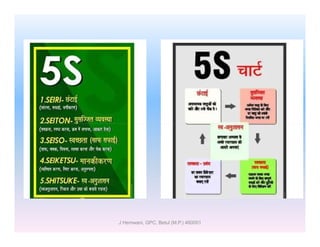
 The term 5S comes from five Japanese words. Seiri,
Seiton, Seiso, Seiketsu, Shitsuke.
 Each S represents one part of a five-step process that can
improve the overall function of a business.
J Hemwani, GPC, Betul (M.P.) 460001
5S
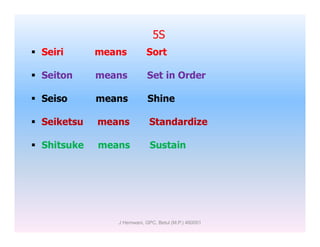
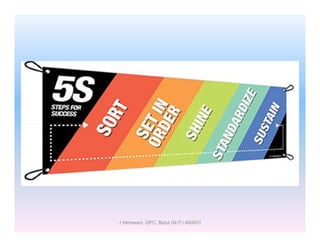
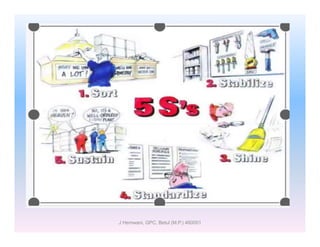
 Seiri means Sort
 Seiton means Set in Order
 Seiso means Shine
 Seiketsu means Standardize Seiketsu means Standardize
 Shitsuke means Sustain
J Hemwani, GPC, Betul (M.P.) 460001
5S Benefits
In long Run, The 5S methodology leads to many benefis
like
Reduced costs
Higher quality
Increased productivityIncreased productivity
Greater employee satisfaction
A safer work environment
J Hemwani, GPC, Betul (M.P.) 460001
5S Seiri
Seiri ( Sort ): The first step of 5S, Sort, involves going through all the
tools, furniture, materials, equipment, etc. in a work area to determine
what needs to be present and what can be removed. Some questions to
ask during this phase include:
What is the purpose of this item?
When was this item last used?
How frequently is it used?
Who uses it?Who uses it?
Does it really need to be here?
These questions help determine the value of each item. A
workspace might be better off without unnecessary items or items
used infrequently. These things can get in the way or take up
space.
Keep in mind the best people to assess the items in a space are
the people who work in that space. They are the ones who can
answer the above questions.
J Hemwani, GPC, Betul (M.P.) 460001
5S Seiton
Seiton (Set in Order): Once the extra clutter is gone, it's easier to
see what's what. Now work groups can come up with their own strategies
for sorting through the remaining items. Things to consider:
Which people (or workstations) use which items?
When are items used?
Which items are used most frequently?
Should items be grouped by type?
Where would it be most logical to place items?
 Are more storage containers necessary to keep things Are more storage containers necessary to keep things
organized?
 During this phase, everyone should determine what
arrangements are most logical. That will require thinking through
tasks, the frequency of those tasks, the paths people take through
the space, etc.
 Businesses may want to stop and think about the relationship
between organization and larger Lean efforts. What arrangement
will cause the least amount of waste?
J Hemwani, GPC, Betul (M.P.) 460001
5S Seiso
Seiso (Shine) : Everyone thinks they know what housekeeping is,
but it's one of the easiest things to overlook, especially when work gets
busy.
 The Shine stage of 5S focuses on cleaning up the work area,
which means sweeping, mopping, dusting, wiping down surfaces,
putting tools and materials away, etc.
 In addition to basic cleaning, Shine also involves performing
regular maintenance on equipment and machinery. Planning forregular maintenance on equipment and machinery. Planning for
maintenance ahead of time means businesses can catch problems
and prevent breakdowns. That means less wasted time and no
loss of profits related to work stoppages.
 Shining the workplace might not sound exciting, but it's important. And it
shouldn't just be left up to the janitorial staff. In 5S, everyone takes
responsibility for cleaning up their workspace, ideally on a daily basis.
Doing so makes people take ownership of the space, which in the long run
means people will be more invested in their work and in the company.
J Hemwani, GPC, Betul (M.P.) 460001
5S Seiketsu
Seiketsu (Standardize) : Once the first three steps of 5S are
completed, things should look pretty good. All the extra stuff is gone,
everything is organized, spaces are cleaned, and equipment is in good
working order.
 Standardize systematizes everything that just happened and
turns one-time efforts into habits. Standardize assigns regular
tasks, creates schedules, and posts instructions so these activities
become routines. It makes standard operating procedures for 5S
so that orderliness doesn't fall by the wayside.so that orderliness doesn't fall by the wayside.
Depending on the workspace, a daily 5S checklist or a chart might
be useful. A posted schedule indicating how frequently certain
cleaning tasks must occur and who is responsible for them is
another helpful tool.
Initially, people will probably need reminders about 5S. Small
amounts of time may need to be set aside daily for 5S tasks. But
over time, tasks will become routine and 5S organizing and
cleaning will become a part of regular work.
J Hemwani, GPC, Betul (M.P.) 460001
5S Shitsuke
Shitsuke (Sustain): Once standard procedures for 5S are in place,
businesses must perform the ongoing work of maintaining those procedures
and updating them as necessary.
 Sustain refers to the process of keeping 5S running smoothly,
but also of keeping everyone in the organization involved.
 Managers need to participate, as do employees out on the Managers need to participate, as do employees out on the
manufacturing floor, in the warehouse, or in the office.
 Sustain is about making 5S a long-term program, not just an
event or short-term project.
 5S should becomes a part of an organization's culture. And when
5S is sustained over time, that's when businesses will start to
notice continuous positive results.
J Hemwani, GPC, Betul (M.P.) 460001
The 6 th S Safety
Safety: Some companies like to include a sixth S in their 5S program thai
is Safety. When safety is included, the system is often called 6S. The Safety
step involves focusing on what can be done to eliminate risks in work
processes by arranging things in certain ways.
 This might involve setting up workstations so they're more
ergonomic, marking intersections—such as the places where
forklifts and pedestrians cross paths—with signs, and labeling the
storage cabinet for cleaning chemicals so people are aware of
potential hazards. If the layout of the workplace or the taskspotential hazards. If the layout of the workplace or the tasks
people perform are dangerous, those dangers should be reduced as
much as possible.
 Some people consider safety an outcome of performing the other
five S's appropriately, and as a result say a sixth S isn't necessary.
They think if the workspace is properly organized and cleaned and
uses helpful visual safety cues, a separate safety step is
unnecessary.
 Neither approach to safety is right or wrong. But however a business wants
to approach safety, it should be aware that paying attention to safety is
important. J Hemwani, GPC, Betul (M.P.) 460001
J Hemwani, GPC, Betul (M.P.) 460001
References:
1. Internet websites sources.
2. Slideshare.net
J Hemwani, GPC, Betul (M.P.) 460001

5 s

  • 1.
    5S  5S isa system for organizing spaces, so work can be performed efficiently, effectively, and safely.  This system focuses on putting everything where it belongs and keeping the workplace clean, which makes it easier for people to do their jobs without wasting time or risking injury.  5S means Each thing has a place and each thing is at its place.  The term 5S comes from five Japanese words. Seiri, Seiton, Seiso, Seiketsu, Shitsuke.  Each S represents one part of a five-step process that can improve the overall function of a business. J Hemwani, GPC, Betul (M.P.) 460001
  • 2.
    5S  Seiri meansSort  Seiton means Set in Order  Seiso means Shine  Seiketsu means Standardize Seiketsu means Standardize  Shitsuke means Sustain J Hemwani, GPC, Betul (M.P.) 460001
  • 3.
    J Hemwani, GPC,Betul (M.P.) 460001
  • 4.
    J Hemwani, GPC,Betul (M.P.) 460001
  • 5.
    J Hemwani, GPC,Betul (M.P.) 460001
  • 6.
    5S Benefits In longRun, The 5S methodology leads to many benefis like Reduced costs Higher quality Increased productivityIncreased productivity Greater employee satisfaction A safer work environment J Hemwani, GPC, Betul (M.P.) 460001
  • 7.
    5S Seiri Seiri (Sort ): The first step of 5S, Sort, involves going through all the tools, furniture, materials, equipment, etc. in a work area to determine what needs to be present and what can be removed. Some questions to ask during this phase include: What is the purpose of this item? When was this item last used? How frequently is it used? Who uses it?Who uses it? Does it really need to be here? These questions help determine the value of each item. A workspace might be better off without unnecessary items or items used infrequently. These things can get in the way or take up space. Keep in mind the best people to assess the items in a space are the people who work in that space. They are the ones who can answer the above questions. J Hemwani, GPC, Betul (M.P.) 460001
  • 8.
    5S Seiton Seiton (Setin Order): Once the extra clutter is gone, it's easier to see what's what. Now work groups can come up with their own strategies for sorting through the remaining items. Things to consider: Which people (or workstations) use which items? When are items used? Which items are used most frequently? Should items be grouped by type? Where would it be most logical to place items?  Are more storage containers necessary to keep things Are more storage containers necessary to keep things organized?  During this phase, everyone should determine what arrangements are most logical. That will require thinking through tasks, the frequency of those tasks, the paths people take through the space, etc.  Businesses may want to stop and think about the relationship between organization and larger Lean efforts. What arrangement will cause the least amount of waste? J Hemwani, GPC, Betul (M.P.) 460001
  • 9.
    5S Seiso Seiso (Shine): Everyone thinks they know what housekeeping is, but it's one of the easiest things to overlook, especially when work gets busy.  The Shine stage of 5S focuses on cleaning up the work area, which means sweeping, mopping, dusting, wiping down surfaces, putting tools and materials away, etc.  In addition to basic cleaning, Shine also involves performing regular maintenance on equipment and machinery. Planning forregular maintenance on equipment and machinery. Planning for maintenance ahead of time means businesses can catch problems and prevent breakdowns. That means less wasted time and no loss of profits related to work stoppages.  Shining the workplace might not sound exciting, but it's important. And it shouldn't just be left up to the janitorial staff. In 5S, everyone takes responsibility for cleaning up their workspace, ideally on a daily basis. Doing so makes people take ownership of the space, which in the long run means people will be more invested in their work and in the company. J Hemwani, GPC, Betul (M.P.) 460001
  • 10.
    5S Seiketsu Seiketsu (Standardize): Once the first three steps of 5S are completed, things should look pretty good. All the extra stuff is gone, everything is organized, spaces are cleaned, and equipment is in good working order.  Standardize systematizes everything that just happened and turns one-time efforts into habits. Standardize assigns regular tasks, creates schedules, and posts instructions so these activities become routines. It makes standard operating procedures for 5S so that orderliness doesn't fall by the wayside.so that orderliness doesn't fall by the wayside. Depending on the workspace, a daily 5S checklist or a chart might be useful. A posted schedule indicating how frequently certain cleaning tasks must occur and who is responsible for them is another helpful tool. Initially, people will probably need reminders about 5S. Small amounts of time may need to be set aside daily for 5S tasks. But over time, tasks will become routine and 5S organizing and cleaning will become a part of regular work. J Hemwani, GPC, Betul (M.P.) 460001
  • 11.
    5S Shitsuke Shitsuke (Sustain):Once standard procedures for 5S are in place, businesses must perform the ongoing work of maintaining those procedures and updating them as necessary.  Sustain refers to the process of keeping 5S running smoothly, but also of keeping everyone in the organization involved.  Managers need to participate, as do employees out on the Managers need to participate, as do employees out on the manufacturing floor, in the warehouse, or in the office.  Sustain is about making 5S a long-term program, not just an event or short-term project.  5S should becomes a part of an organization's culture. And when 5S is sustained over time, that's when businesses will start to notice continuous positive results. J Hemwani, GPC, Betul (M.P.) 460001
  • 12.
    The 6 thS Safety Safety: Some companies like to include a sixth S in their 5S program thai is Safety. When safety is included, the system is often called 6S. The Safety step involves focusing on what can be done to eliminate risks in work processes by arranging things in certain ways.  This might involve setting up workstations so they're more ergonomic, marking intersections—such as the places where forklifts and pedestrians cross paths—with signs, and labeling the storage cabinet for cleaning chemicals so people are aware of potential hazards. If the layout of the workplace or the taskspotential hazards. If the layout of the workplace or the tasks people perform are dangerous, those dangers should be reduced as much as possible.  Some people consider safety an outcome of performing the other five S's appropriately, and as a result say a sixth S isn't necessary. They think if the workspace is properly organized and cleaned and uses helpful visual safety cues, a separate safety step is unnecessary.  Neither approach to safety is right or wrong. But however a business wants to approach safety, it should be aware that paying attention to safety is important. J Hemwani, GPC, Betul (M.P.) 460001
  • 13.
    J Hemwani, GPC,Betul (M.P.) 460001
  • 14.
    References: 1. Internet websitessources. 2. Slideshare.net J Hemwani, GPC, Betul (M.P.) 460001
  • 15.
    J Hemwani, GPC,Betul (M.P.) 460001