Automated Inference of Access Control Policies
for Web Applications

Thanh H. Le, Cu D. Nguyen, and Lionel Briand
Interdisciplinary Centre for Security, Reliability and Trust (SnT Centre)
Benjamin Hourte 
HITEC Luxembourg


SACMAT 2015
20th ACM Symposium on Access Control Models and Technologies
1 - 3 June 2015, Vienna, Austria
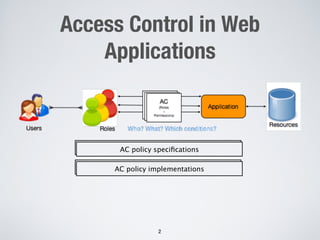
Access Control in Web
Applications
2
AC policy specifications
AC policy implementations
AC Vulnerabilities and Exploitation
Facts
3
OWASP Top 10 (2013)
A1 – Injection
A2 – Broken Authentication and
Session Management
A3 – Cross-Site Scripting (XSS)
A4 – Insecure Direct Object
References
A5 – Security Misconfiguration
A6 – Sensitive Data Exposure
A7 – Missing Function Level Access
Control
A8 – Cross-Site Request Forgery (CSRF)
A9 – Using Known Vulnerable
Components
A10 – Unvalidated Redirects and
Forwards
Research Problems and Goal
Problems:
• AC policies are not explicitly defined or modelled 
• Lacks of a systematic, scalable, and automated approach and
tools for testing AC
Research Goal:
• Bottom-up reverse engineering of AC policies using dynamic
analysis and machine learning
4
Contributions of This Work
1.  A novel approach for inferring AC policies
• Discover Web application’s AC artefacts
• Infer AC policies
2.  Experimental evaluation
• Effective in inferring AC policies of target applications
• Detect AC issues
5
Dynamic Analysis
Bottom-Up Strategy To 
Learn AC Policies
6
Machine Learning
AC Policies
(user1,role1,{c1,c2})
(user1,role2,{c1,c2})
(user2,role2,{c1})
…
•  Automatically discover resources and access permissions
•  Use machine-learning to learn AC policy specifications
The Steps of Our Approach
7
Exploratory
Access Testing
Resource Access
Analysis
Inferring Access
Rules
Rule Assessment
Targeted Incremental
Access Testing
Credential
Set
Credential
Set
Credential
Set
Access
Policies
Access
Policies
Access
Policies
Step 1. Exploratory Access Testing
•  Discovering SUT resources using semi-automated crawling
•  Access testing: all users vs all resources
8
Exploratory
Access Testing
Resource Access
Analysis
Inferring Access
Rules
Rule Assessment
Targeted Incremental
Access Testing
Credential
Set
Credential
Set
Credential
Set
Access
Policies
Access
Policies
Access
Policies
Step 1. Exploratory Access Testing
•  Provide more crawling entries to improve resources discovery
9
SUT
Spider
Credential Set
Credential Set
Credential Set
Access
Policies
Access
Policies
User Access
Space
Prox
y
JavaScript-support
browser
Request generator
(based on web directory
structure)
Step 1 Output: User Access Logs
• HTTP requests (resource URLs, parameters, etc.)
• HTTP responses for requests from every specific user 
10
Step 2. Resource Access Analysis
• Extract resources from access requests
• Determine access permissions based on response contents and HTTP codes
11
Exploratory
Access Testing
Resource Access
Analysis
Inferring Access
Rules
Rule Assessment
Targeted Incremental
Access Testing
Credential
Set
Credential
Set
Credential
Set
Access
Policies
Access
Policies
Access
Policies
Step 2 (continued)
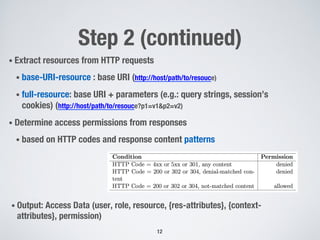
• Extract resources from HTTP requests
• base-URI-resource : base URI (http://host/path/to/resouce)
• full-resource: base URI + parameters (e.g.: query strings, session’s
cookies) (http://host/path/to/resouce?p1=v1&p2=v2)
• Determine access permissions from responses
• based on HTTP codes and response content patterns
12
• Output: Access Data (user, role, resource, {res-attributes}, {context-
attributes}, permission)
Example of the Access Data Obtained
at Step 2
13
User! Role! Resource! Method! Request Attribute! Permission!
admin" adminRole! /home/admin/createUser" GET" ALLOWED"
admin" adminRole! /home/admin/createUser" POST" username=‘john007’&fullname" ALLOWED"
admin" adminRole! /home/admin/createUser" POST" username=‘pte.lm’&fullname=" ALLOWED"
admin" adminRole! /home/admin/createUser" POST" username=‘bob’&fullname=‘B" ALLOWED"
junior" juniorManagerRole! /home/admin/createUser" GET" DENIED"
senior" seniorManagerRole! /home/admin/createUser" GET" DENIED"
junior" juniorManagerRole! /home/manager/manageDocument/ajax-create" GET" ALLOWED"
junior" juniorManagerRole! /home/manager/manageDocument/ajax-create" POST" title=‘a title’&docType=‘note’&" ALLOWED"
senior" seniorManagerRole! /home/manager/manageDocument/ajax-create" POST" title=‘new title’&docType=‘note" DENIED"
junior" juniorManagerRole! /home/manager/manageDocument/ajax-delete" GET" docId=1" ALLOWED"
senior" seniorManagerRole! /home/manager/manageDocument/ajax-delete" GET" docId=1" DENIED"
junior" juniorManagerRole! /home/manager/manageDocument/ajax-update" POST" docId=1" ALLOWED"
senior" seniorManagerRole! /home/manager/manageDocument/ajax-update" POST" docId=1" DENIED"
user1" userRole! /home/manager/manageDocument/ajax-update" GET" docId=1" DENIED"
user2" userRole! /home/user/viewDocument" GET" docId=1" DENIED"
junior" juniorManagerRole! /home/user/viewDocument" GET" docId=1" DENIED"
user1" userRole! /home/user/viewDocument" GET" docId=2" DENIED"
user1" userRole! /home/user/viewDocument" GET" docId=1" ALLOWED"
Step 3. Inferring Access Rules
Infer AC policies from access data using machine learning
14
Exploratory
Access Testing
Resource Access
Analysis
Inferring Access
Rules
Rule Assessment
Targeted Incremental
Access Testing
Credential
Set
Credential
Set
Credential
Set
Access
Policies
Access
Policies
Access
Policies
Step 3 Output:
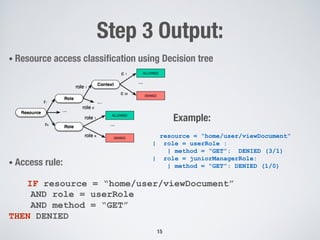
• Resource access classification using Decision tree
!
!
!
!
• Access rule: 
IF resource = “home/user/viewDocument”
AND role = userRole
AND method = “GET”
THEN DENIED
15
resource = “home/user/viewDocument”
| role = userRole :
| method = “GET”: DENIED (3/1)
| role = juniorManagerRole:
| method = “GET”: DENIED (1/0)
Example:
Step 4. Rule Assessment
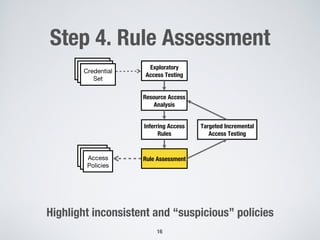
Highlight inconsistent and “suspicious” policies
16
Exploratory
Access Testing
Resource Access
Analysis
Inferring Access
Rules
Rule Assessment
Targeted Incremental
Access Testing
Credential
Set
Credential
Set
Credential
Set
Access
Policies
Access
Policies
Access
Policies
Step 4 (cont.)
• Inconsistent policies (inferred with less than 100% confidence)
resource = “home/user/viewDocument”
| role = userRole :
| method = “GET”: DENIED (3/1)
– transient server errors 
– resource extraction
– other factors like user’s profiles
• Suspicious policies
• Related to sensitive resources (e.g. database, configuration, password)
• Having permission as allowed to all users
17
Step 5. Incremental Access
Testing
18
Exploratory
Access Testing
Resource Access
Analysis
Inferring Access
Rules
Rule Assessment
Targeted Incremental
Access Testing
Credential
Set
Credential
Set
Credential
Set
Access
Policies
Access
Policies
Access
Policies
Resources related to
inconsistent policies
Analyse and Infer AC Policies
• To be validated by experts 
19
Exploratory
Access Testing
Resource Access
Analysis
Inferring Access
Rules
Rule Assessment
Targeted Incremental
Access Testing
Credential
Set
Credential
Set
Credential
Set
Access
Policies
Access
Policies
Access
Policies
Evaluation
20
Research Questions
RQ1. Does the proposed approach effectively discover
resources for inferring AC policies?


RQ2. What is the quality in terms of correctness and
consistency of the inferred AC policies?


RQ3. How useful are the inferred AC rules in detecting
AC issues?!
21
Web Applications
22
iTrust! ISP!
Licence! Open Source! Commercial!
AC
specification!
!
Hardcoded Role-based
AC policies - Gold
standard!
Specified by ISP’s super
users in administration
module !
!
RQ1. Resource Discovery
23
iTrust! ISP!
Discovery !
Method!
Baseline ! All-entry!
without
Javascript!
!
with
Javascript!
# of Resources
Found!
130!
248 (100% of
all resources)!
353! 680 (?)!
RQ2. Quality of Inferred AC Rules:
iTrust Result
204 resources (out of 248):
• ~95% AC rules are correct with the gold standard
• ~5% AC rules cannot be confirmed because they are not
covered by the gold standard
• 38 resources are not protected by AC design and implementation
24
RQ3. Detecting AC Issues
• We detected three vulnerabilities in the unprotected
resources
• ../util/resetPassword.jsp allows a user to change
passwords of other users 
• ../util/getUser.jsp is supposed to have access
enforced from other pages but can be directly
accessed without authorisation
• ../errors/reboot.jsp allows any user to reboot the
web server
• 44 resources (out of 248) return Java exception error
pages which are accessible by all users
• Disclose source codes and database information
25
iTrust
 ISP
•  15 CSV and JSON files that were not protected
from direct accesses from all users
•  Based on inconsistent rules, we found
•  Discrepancy between defined AC rules and
inferred AC rules
•  AC enforcement is not correctly implemented
•  Confirmed by ISP developers
Summary
• We proposed a bottom-up reverse engineering of AC policies
for Web applications
• Effectively discover Web application resources and
determine resource accesses
• Inferred AC policies are highly correct with AC specification
• The inconsistency of inferred AC policies can help finding AC
issues
26

Automated Inference of Access Control Policies for Web Applications

  • 1.
    Automated Inference ofAccess Control Policies for Web Applications Thanh H. Le, Cu D. Nguyen, and Lionel Briand Interdisciplinary Centre for Security, Reliability and Trust (SnT Centre) Benjamin Hourte HITEC Luxembourg SACMAT 2015 20th ACM Symposium on Access Control Models and Technologies 1 - 3 June 2015, Vienna, Austria
  • 2.
    Access Control inWeb Applications 2 AC policy specifications AC policy implementations
  • 3.
    AC Vulnerabilities andExploitation Facts 3 OWASP Top 10 (2013) A1 – Injection A2 – Broken Authentication and Session Management A3 – Cross-Site Scripting (XSS) A4 – Insecure Direct Object References A5 – Security Misconfiguration A6 – Sensitive Data Exposure A7 – Missing Function Level Access Control A8 – Cross-Site Request Forgery (CSRF) A9 – Using Known Vulnerable Components A10 – Unvalidated Redirects and Forwards
  • 4.
    Research Problems andGoal Problems: • AC policies are not explicitly defined or modelled • Lacks of a systematic, scalable, and automated approach and tools for testing AC Research Goal: • Bottom-up reverse engineering of AC policies using dynamic analysis and machine learning 4
  • 5.
    Contributions of ThisWork 1.  A novel approach for inferring AC policies • Discover Web application’s AC artefacts • Infer AC policies 2.  Experimental evaluation • Effective in inferring AC policies of target applications • Detect AC issues 5
  • 6.
    Dynamic Analysis Bottom-Up StrategyTo Learn AC Policies 6 Machine Learning AC Policies (user1,role1,{c1,c2}) (user1,role2,{c1,c2}) (user2,role2,{c1}) … •  Automatically discover resources and access permissions •  Use machine-learning to learn AC policy specifications
  • 7.
    The Steps ofOur Approach 7 Exploratory Access Testing Resource Access Analysis Inferring Access Rules Rule Assessment Targeted Incremental Access Testing Credential Set Credential Set Credential Set Access Policies Access Policies Access Policies
  • 8.
    Step 1. ExploratoryAccess Testing •  Discovering SUT resources using semi-automated crawling •  Access testing: all users vs all resources 8 Exploratory Access Testing Resource Access Analysis Inferring Access Rules Rule Assessment Targeted Incremental Access Testing Credential Set Credential Set Credential Set Access Policies Access Policies Access Policies
  • 9.
    Step 1. ExploratoryAccess Testing •  Provide more crawling entries to improve resources discovery 9 SUT Spider Credential Set Credential Set Credential Set Access Policies Access Policies User Access Space Prox y JavaScript-support browser Request generator (based on web directory structure)
  • 10.
    Step 1 Output:User Access Logs • HTTP requests (resource URLs, parameters, etc.) • HTTP responses for requests from every specific user 10
  • 11.
    Step 2. ResourceAccess Analysis • Extract resources from access requests • Determine access permissions based on response contents and HTTP codes 11 Exploratory Access Testing Resource Access Analysis Inferring Access Rules Rule Assessment Targeted Incremental Access Testing Credential Set Credential Set Credential Set Access Policies Access Policies Access Policies
  • 12.
    Step 2 (continued) • Extractresources from HTTP requests • base-URI-resource : base URI (http://host/path/to/resouce) • full-resource: base URI + parameters (e.g.: query strings, session’s cookies) (http://host/path/to/resouce?p1=v1&p2=v2) • Determine access permissions from responses • based on HTTP codes and response content patterns 12 • Output: Access Data (user, role, resource, {res-attributes}, {context- attributes}, permission)
  • 13.
    Example of theAccess Data Obtained at Step 2 13 User! Role! Resource! Method! Request Attribute! Permission! admin" adminRole! /home/admin/createUser" GET" ALLOWED" admin" adminRole! /home/admin/createUser" POST" username=‘john007’&fullname" ALLOWED" admin" adminRole! /home/admin/createUser" POST" username=‘pte.lm’&fullname=" ALLOWED" admin" adminRole! /home/admin/createUser" POST" username=‘bob’&fullname=‘B" ALLOWED" junior" juniorManagerRole! /home/admin/createUser" GET" DENIED" senior" seniorManagerRole! /home/admin/createUser" GET" DENIED" senior" seniorManagerRole! /home/admin/createUser" GET" DENIED" junior" juniorManagerRole! /home/manager/manageDocument/ajax-create" GET" ALLOWED" junior" juniorManagerRole! /home/manager/manageDocument/ajax-create" POST" title=‘a title’&docType=‘note’&" ALLOWED" senior" seniorManagerRole! /home/manager/manageDocument/ajax-create" POST" title=‘new title’&docType=‘note" DENIED" junior" juniorManagerRole! /home/manager/manageDocument/ajax-delete" GET" docId=1" ALLOWED" senior" seniorManagerRole! /home/manager/manageDocument/ajax-delete" GET" docId=1" DENIED" junior" juniorManagerRole! /home/manager/manageDocument/ajax-update" POST" docId=1" ALLOWED" senior" seniorManagerRole! /home/manager/manageDocument/ajax-update" POST" docId=1" DENIED" user1" userRole! /home/manager/manageDocument/ajax-update" GET" docId=1" DENIED" user2" userRole! /home/user/viewDocument" GET" docId=1" DENIED" junior" juniorManagerRole! /home/user/viewDocument" GET" docId=1" DENIED" user1" userRole! /home/user/viewDocument" GET" docId=2" DENIED" user1" userRole! /home/user/viewDocument" GET" docId=1" ALLOWED"
  • 14.
    Step 3. InferringAccess Rules Infer AC policies from access data using machine learning 14 Exploratory Access Testing Resource Access Analysis Inferring Access Rules Rule Assessment Targeted Incremental Access Testing Credential Set Credential Set Credential Set Access Policies Access Policies Access Policies
  • 15.
    Step 3 Output: • Resourceaccess classification using Decision tree ! ! ! ! • Access rule: IF resource = “home/user/viewDocument” AND role = userRole AND method = “GET” THEN DENIED 15 resource = “home/user/viewDocument” | role = userRole : | method = “GET”: DENIED (3/1) | role = juniorManagerRole: | method = “GET”: DENIED (1/0) Example:
  • 16.
    Step 4. RuleAssessment Highlight inconsistent and “suspicious” policies 16 Exploratory Access Testing Resource Access Analysis Inferring Access Rules Rule Assessment Targeted Incremental Access Testing Credential Set Credential Set Credential Set Access Policies Access Policies Access Policies
  • 17.
    Step 4 (cont.) • Inconsistentpolicies (inferred with less than 100% confidence) resource = “home/user/viewDocument” | role = userRole : | method = “GET”: DENIED (3/1) – transient server errors – resource extraction – other factors like user’s profiles • Suspicious policies • Related to sensitive resources (e.g. database, configuration, password) • Having permission as allowed to all users 17
  • 18.
    Step 5. IncrementalAccess Testing 18 Exploratory Access Testing Resource Access Analysis Inferring Access Rules Rule Assessment Targeted Incremental Access Testing Credential Set Credential Set Credential Set Access Policies Access Policies Access Policies Resources related to inconsistent policies
  • 19.
    Analyse and InferAC Policies • To be validated by experts 19 Exploratory Access Testing Resource Access Analysis Inferring Access Rules Rule Assessment Targeted Incremental Access Testing Credential Set Credential Set Credential Set Access Policies Access Policies Access Policies
  • 20.
  • 21.
    Research Questions RQ1. Doesthe proposed approach effectively discover resources for inferring AC policies?
 RQ2. What is the quality in terms of correctness and consistency of the inferred AC policies?
 RQ3. How useful are the inferred AC rules in detecting AC issues?! 21
  • 22.
    Web Applications 22 iTrust! ISP! Licence!Open Source! Commercial! AC specification! ! Hardcoded Role-based AC policies - Gold standard! Specified by ISP’s super users in administration module ! !
  • 23.
    RQ1. Resource Discovery 23 iTrust!ISP! Discovery ! Method! Baseline ! All-entry! without Javascript! ! with Javascript! # of Resources Found! 130! 248 (100% of all resources)! 353! 680 (?)!
  • 24.
    RQ2. Quality ofInferred AC Rules: iTrust Result 204 resources (out of 248): • ~95% AC rules are correct with the gold standard • ~5% AC rules cannot be confirmed because they are not covered by the gold standard • 38 resources are not protected by AC design and implementation 24
  • 25.
    RQ3. Detecting ACIssues • We detected three vulnerabilities in the unprotected resources • ../util/resetPassword.jsp allows a user to change passwords of other users • ../util/getUser.jsp is supposed to have access enforced from other pages but can be directly accessed without authorisation • ../errors/reboot.jsp allows any user to reboot the web server • 44 resources (out of 248) return Java exception error pages which are accessible by all users • Disclose source codes and database information 25 iTrust ISP •  15 CSV and JSON files that were not protected from direct accesses from all users •  Based on inconsistent rules, we found •  Discrepancy between defined AC rules and inferred AC rules •  AC enforcement is not correctly implemented •  Confirmed by ISP developers
  • 26.
    Summary • We proposed abottom-up reverse engineering of AC policies for Web applications • Effectively discover Web application resources and determine resource accesses • Inferred AC policies are highly correct with AC specification • The inconsistency of inferred AC policies can help finding AC issues 26