Recent Titles inthe Artech House
Information Security and Privacy Series
Rolf Oppliger, Series Editor
Privacy Protection and Computer Forensics, Second Edition,
Michael A. Caloyannides
Demystifying the IPsec Puzzle, Sheila Frankel
Developing Secure Distributed Systems with CORBA, Ulrich Lang and
Rudolf Schreiner
Implementing Electronic Card Payment Systems, Cristian Radu
Implementing Security for ATM Networks, Thomas Tarman and Edward Witzke
Information Hiding Techniques for Steganography and Digital Watermarking,
Stefan Katzenbeisser and Fabien A. P. Petitcolas, editors
Internet and Intranet Security, Second Edition, Rolf Oppliger
Non-repudiation in Electronic Commerce, Jianying Zhou
Role-Based Access Control, Second Edition, David F. Ferraiolo, D. Richard Kuhn,
and Ramaswamy Chandramouli
Secure Messaging with PGP and S/MIME, Rolf Oppliger
Security Fundamentals for E-Commerce, Vesna Hassler
Security Technologies for the World Wide Web, Second Edition, Rolf Oppliger
Software Verification and Validation for Practitioners and Managers,
Second Edition, Steven R. Rakitin
For quite a long time, computer security was a rather narrow field of study that was
populated mainly by theoretical computer scientists, electrical engineers, and
applied mathematicians. With the proliferation of open systems in general, and of
the Internet and the World Wide Web (WWW) in particular, this situation has
changed fundamentally. Today, computer and network practitioners are equally
interested in computer security, since they require technologies and solutions that
can be used to secure applications related to electronic commerce. Against this back-
ground, the field of computer security has become very broad and includes many
topics of interest. The aim of this series is to publish state-of-the-art, high standard
technical books on topics related to computer security. Further information about
the series can be found on the WWW at the following URL:
http://www.esecurity.ch/serieseditor.html
Also, if you’d like to contribute to the series by writing a book about a topic
related to computer security, feel free to contact either the Commissioning Editor or
the Series Editor at Artech House.
In memory ofmy late father,
and to my wife, Hildegard,
and my sons, Michael and Josef,
for the time I spent at my computer instead of with them
–DFF
To my parents, Richard and Jane Kuhn, and
my children, Gary, Christine, and Kevin, with love
–DRK
To my dear father, late mother, loving wife, Mira, and
dear daughters, Dipika and Divya
–RC
8.
Contents
Preface . .. . . . . . . . . . . xv
Acknowledgments . . . . . . . . . xix
1 Introduction . . . . . . . . . . . 1
1.1 The purpose and fundamentals of access control 2
1.1.1 Authorization versus authentication 3
1.1.2 Users, subjects, objects, operations, and permissions 4
1.1.3 Least privilege 5
1.2 A brief history of access control 6
1.2.1 Access control in the mainframe era 6
1.2.2 Department of Defense standards 8
1.2.3 Clark-Wilson model 9
1.2.4 Origins of RBAC 9
1.3 Comparing RBAC to DAC and MAC 17
1.4 RBAC and the enterprise 18
1.4.1 Economics of RBAC 19
1.4.2 Authorization management and resource provisioning 20
References 24
2 Access Control: Properties, Policies,
and Models . . . . . . . . . . . . 27
2.1 Access control: objectives and enforcement artifacts 27
2.2 Access control: core entities and principles 30
vii
9.
2.2.1 Subjects andobjects 30
2.2.2 Principles of secure design 31
2.3 Reference monitor and security kernel 33
2.3.1 Completeness 34
2.3.2 Isolation 35
2.3.3 Verifiability 36
2.3.4 The reference monitor—necessary, but not sufficient 37
2.4 Access control matrix 37
2.5 Access control data structures 42
2.5.1 Capability lists and access control lists (ACLs) 42
2.5.2 Protection bits 44
2.6 Discretionary access control (DAC) policies 44
2.7 MAC policies and models 45
2.7.1 Bell-LaPadula model 46
2.8 Biba’s integrity model 47
2.9 The Clark-Wilson model 48
2.10 The Chinese wall policy model 50
2.11 The Brewer-Nash model 51
2.12 Domain-type enforcement (DTE) model 52
References 54
3 Core RBAC Features . . . . . . . . 57
3.1 Roles versus ACL groups 59
3.2 Core RBAC 61
3.2.1 Administrative support 61
3.2.2 Permissions 62
3.2.3 Role activation 64
3.3 Mapping the enterprise view to the system view 65
3.3.1 Global users and roles and indirect role privileges 68
3.3.2 Mapping permissions into privileges 69
4 Role Hierarchies . . . . . . . . . 73
4.1 Building role hierarchies from flat roles 74
4.2 Inheritance schemes 75
4.2.1 Direct privilege inheritance 75
4.2.2 Permission and user membership inheritance 76
viii Contents
10.
4.2.3 User containmentand indirect privilege inheritance 78
4.3 Hierarchy structures and inheritance forms 81
4.3.1 Connector roles 82
4.3.2 Organization chart hierarchies 85
4.3.3 Geographical regions 87
4.4 Accounting for role types 89
4.5 General and limited role hierarchies 90
4.6 Accounting for the Stanford model 93
References 95
5 SoD and Constraints in RBAC Systems . . 97
5.1 Types of SoD 100
5.1.1 Static SoD 100
5.1.2 Dynamic SoD 104
5.1.3 Operational SoD 105
5.1.4 History and object-based SoD 106
5.2 Using SoD in real systems 107
5.2.1 SoD in role hierarchies 108
5.2.2 Static and dynamic constraints 109
5.2.3 Mutual exclusion 110
5.2.4 Effects of privilege assignment 111
5.2.5 Assigning privileges to roles 113
5.2.6 Assigning roles to users 114
5.3 Temporal constraints in RBAC 118
5.3.1 Need for temporal constraints 118
5.3.2 Taxonomy of temporal constraints 119
5.3.3 Associated requirements for supporting temporal constraints 122
References 123
6 RBAC, MAC, and DAC . . . . . . . 127
6.1 Enforcing DAC using RBAC 128
6.1.1 Configuring RBAC for DAC 129
6.1.2 DAC with grant-independent revocation 130
6.1.3 Additional considerations for grant-dependent revocation 131
6.2 Enforcing MAC on RBAC systems 131
6.2.1 Configuring RBAC for MAC using static constraints 132
Contents ix
11.
6.2.2 Configuring RBACfor MAC using dynamic constraints 133
6.3 Implementing RBAC on MLS systems 136
6.3.1 Roles and privilege sets 138
6.3.2 Assignment of categories to privilege sets 139
6.3.3 Assignment of categories to roles 140
6.3.4 Example of MLS to RBAC mapping 141
6.4 Running RBAC and MAC simultaneously 143
References 144
7 Privacy and Regulatory Issues . . . . 147
7.1 Privacy requirements and access control framework 148
7.1.1 Incorporating privacy policies into the policy specification module 148
7.1.2 Enhance RBAC model with privacy-related entities and relationships 151
7.1.3 Justifications for additional entities in the RBAC model 151
7.1.4 Business purpose entity 153
7.1.5 Data usage entity 154
7.1.6 Privacy-aware RBAC model 155
7.2 Integrate privacy policy support in the role engineering process 155
7.2.1 Identifying business purposes and role-business purpose
relationship instances 157
7.2.2 Identifying business purpose–task relationship instances 157
7.2.3 Identifying data usage entities and data usage–data object
relationship instances 158
7.3 Authorization using privacy-RBAC-ACF 160
7.4 RBAC and regulatory compliance 162
7.4.1 Sarbanes-Oxley Act compliance 164
7.4.2 Gramm-Leach-Bliley Act and HIPAA compliance 166
7.4.3 Compliance and the RBAC model 166
7.4.4 Considerations in using RBAC in regulatory compliance 167
References 168
8 RBAC Standards and Profiles . . . . . 171
8.1 The ANSI/INCITS RBAC standard 171
8.1.1 Overview 171
8.1.2 The RBAC reference model 172
8.1.3 Functional specification overview 173
8.1.4 Functional specification for core RBAC 174
x Contents
12.
8.1.5 Functional specificationfor hierarchical RBAC 176
8.1.6 Functional specification for static separation of duty (SSD) relation 179
8.1.7 Functional specification for a DSD relation 180
8.1.8 Options and packaging 181
8.1.9 Other RBAC standards 183
8.2 XACML profile for role-based access control 185
References 186
9 Role-Based Administration of RBAC . . . 189
9.1 Background and terminology 189
9.2 URA02 and PRA02 192
9.3 Crampton-Loizou administrative model 196
9.3.1 Flexibility of administrative scope 197
9.3.2 Decentralization and autonomy 198
9.3.3 A family of models for hierarchical administration 198
9.4 Role control center 203
9.4.1 Inheritance and the role graph 204
9.4.2 Constraints 206
9.4.3 Role views 206
9.4.4 Delegation of administrative permissions 207
9.4.5 Decentralization and autonomy 210
References 212
10 Role Engineering . . . . . . . . 213
10.1 Scenario-driven role-engineering approach 215
10.1.1 Scenarios and roles 216
10.1.2 Steps in the scenario-driven process 217
10.2 Goal driven/hybrid role engineering approach 220
10.3 Tools for role discovery and role management 224
10.3.1 Sage DNA 226
10.3.2 Role Miner 227
10.3.3 SmartRoles 228
10.3.4 Contouring Engine 229
10.4 Example RBAC installations 229
10.5 Role engineering: health care example 232
10.5.1 Identify and model usage scenarios 232
Contents xi
13.
10.5.2 Derive permissionsfrom scenarios 234
10.5.3 Identify permission constraints 236
10.5.4 Refine scenario model 236
10.5.5 Additional process activities 237
References 237
11 Enterprise Access Control Frameworks
Using RBAC and XML Technologies . . . . 239
11.1 Conceptual view of EAFs 239
11.2 Enterprise Access Central Model Requirements 242
11.2.1 EAM’s multiple-policy support requirement 243
11.2.2 EAM’s ease of administration requirement 243
11.3 EAM specification and XML schemas 244
11.4 Specification of the ERBAC model in the XML schema 246
11.4.1 XML schema specifications for ERBAC model elements 247
11.4.2 XML schema specifications for ERBAC model relations 250
11.5 Encoding of enterprise access control data in XML 253
11.6 Verification of the ERBAC model and data specifications 257
11.7 Limitations of XML schemas for ERBAC model
constraint representation 258
11.8 Using XML-encoded enterprise access control data for
enterprisewide access control implementation 262
11.9 Conclusions 268
References 268
12 Integrating RBAC with Enterprise IT
Infrastructures . . . . . . . . . . 271
12.1 RBAC for WFMSs 272
12.1.1 Workflow concepts and WFMSs 272
12.1.2 WFMS components and access control requirements 273
12.1.3 Access control design requirements 274
12.1.4 RBAC model design and implementation requirements for WFMSs 276
12.1.5 RBAC for workflows—research prototypes 279
12.2 RBAC integration in Web environments 280
12.2.1 Implementing RBAC entirely on the Web server 281
xii Contents
14.
12.2.2 Implementing RBACfor Web server access using cookies 282
12.2.3 RBAC on the Web using attribute certificates 284
12.3 RBAC for UNIX environments 291
12.3.1 RBAC for UNIX administration 291
12.3.2 RBAC implementation within the NFS 296
12.4 RBAC in Java 299
12.4.1 Evolution of Java security models 300
12.4.2 JDK 1.2 security model and enhancement 301
12.4.3 Incorporating RBAC into JDK 1.2 security model with JAAS 304
12.5 RBAC for FDBSs 306
12.5.1 IRO-DB architecture 307
12.5.2 RBAC model implementation in IRO-DB 308
12.6 RBAC in autonomous security service modules 309
12.7 Conclusions 311
References 311
13 Migrating to RBAC—Case Study:
Multiline Insurance Company . . . . . . 315
13.1 Background 316
13.2 Benefits of using RBAC to manage extranet users 316
13.2.1 Simplifying systems administration and maintenance 318
13.2.2 Enhancing organizational productivity 319
13.3 Benefits of using RBAC to manage employees (intranet users) 319
13.3.1 Reduction in new employee downtime 319
13.3.2 Simplified systems administration and maintenance 320
13.4 RBAC implementation costs 320
13.4.1 Software and hardware expenses 321
13.4.2 Systems administrators’ labor expenses 321
13.4.3 Role engineering expenses 321
13.5 Time series of benefits and costs 322
Reference 324
14 RBAC Features in Commercial Products . 325
14.1 RBAC in relational DBMS products 326
14.1.1 Informix Dynamic Server version 9.3 (IBM) 327
14.1.2 Oracle Database 10g Release (10.2) (Oracle Corporation) 329
Contents xiii
15.
14.1.3 Sybase AdaptiveServer Enterprise 15.0 (Sybase) 333
14.2 RBAC in enterprise security administration software 340
14.2.1 CONTROL-SA (BMC software) 342
14.2.2 DirX Identity V7.0 (Siemens) 346
14.2.3 SAM Jupiter (Beta Systems) 351
14.2.4 Tivoli Identity Manager version 1.1 (IBM) 356
14.3 Conclusions 359
References 360
Appendix A: XML Schema for the RBAC Model 361
Appendix B: XML-Encoded Data for
RBAC Model . . . . . . . . . . . 365
About the Authors . . . . . . . . . 369
Index . . . . . . . . . . . . . 371
xiv Contents
16.
Preface
Role-based access control(RBAC) is a technology that is attracting a great
deal of attention, particularly for commercial applications, because of its
potential for reducing the complexity and cost of security administration in
large networked applications. Under RBAC, security administration is greatly
simplified by using roles, hierarchies, and constraints to organize privileges.
RBAC reduces costs within an organization, because it takes into account that
employees change much more frequently than the duties within positions.
Under RBAC, if, for example, an employee moves within an organization,
only his or her role assignment is changed. Accordingly, it is unnecessary to
revoke his or her existing privileges and assign a completely new set of privi-
leges. RBAC can be configured to support a wide variety of access control poli-
cies, including traditional discretionary access control (DAC) and mandatory
access control (MAC), as well as organization-specific policies. Recently,
RBAC has also been found to be a natural access control facility for workflow
management systems. The concept and design of RBAC make it perfectly
suited to a wide variety of application and system software environments, for
both stand-alone and distributed deployments. It provides a safe and effective
way to manage access to an organization’s information, while reducing
administration costs and minimizing errors.
Over the past decade, interest in RBAC has increased dramatically, with
most major information technology (IT) vendors offering a product that
incorporates some form of role-based access. The profusion of new RBAC
products offers many advantages for security administrators and software
developers, but sorting out the capabilities of different products can be chal-
lenging. Until now, RBAC research has been documented in hundreds of
research papers, but not consolidated in book form. This book explains
RBAC and its administrative and cost advantages and implementation issues
and the migration from conventional access control methods to RBAC.
xv
17.
Specialized topics—including rolehierarchies, separation of duties, combin-
ing RBAC with military security models, and recent efforts toward standard-
ization—are detailed. To enable system integrators to integrate RBAC into
the various IT infrastructures found in an enterprise-like Web applications,
such as Java and Federated Database Systems, the book provides an analysis
of research ideas and prototypes built so far. The book also describes RBAC
implementations in various commercial products and includes a case study
documenting a large organization’s migration to a role-based security
architecture.
The second edition has added new materials and has revised some exist-
ing chapters to reflect developments in role engineering, standards, prod-
ucts, and regulatory issues.
The two new chapters added to the book are:
◗ Privacy and Regulatory Issues (Chapter 7)
◗ Role Engineering (Chapter 10)
The following chapters have undergone major revision:
◗ Access Control: Properties, Policies, and Models (Chapter 2, renamed)
◗ RBAC Standards and Profiles (Chapter 8)
◗ RBAC Features in Commercial Products (Chapter 14)
Privacy protection has become an important element of information
management due to regulatory requirements. Hence, we have added a new
chapter that presents some ideas on how to enhance RBAC models to
support privacy policies, and covers the impact of various privacy regula-
tions on RBAC modeling aspects. Role engineering, the process of defining
and structuring roles, is often regarded as the missing link in implementing
RBAC, but new methodoligies and tools make the job easier. RBAC’s impor-
tance in industry has led to standards that contribute to lower costs and
greater interoperability. RBAC models implemented in the latest versions
of Database Management products and Enterprise Security Administration
products (now relabeled as Identity Management products) are certainly
more sophisticated than those in earlier versions; descriptions of these
RBAC implementations have been added as well.
xvi Preface
18.
Intended audience
This bookis designed to be useful to three groups of readers: (1) security
professionals, technology managers, and users in industry, government,
and military organizations, including system administrators responsible for
security, policy officials, and technology officers; (2) software developers
for database systems, enterprise management, security, and cryptographic
products; and (3) computer science and IT students and instructors. The
treatment is not excessively formal; mathematical descriptions of RBAC
properties are included as sidebars, but the text is understandable without
reference to them. Because computer security is such a rapidly changing
field, we have included a discussion of research and commercial product
documentation through this year.
Intended audience xvii
20.
Acknowledgments
First of all,we want to thank Tim Grance of the National Institute of Stan-
dards and Technology (NIST). Much of NIST’s contribution to RBAC
research can be traced to Tim’s early persistent and continuing support, lead-
ership, and counsel. We would also like to thank Andrew Marshall of TD
Bank in Canada for his detailed review of material in Chapters 3 and 4 and his
great insight regarding the application of role hierarchies to commercial busi-
ness structures, and Leann Micheals for advice and counsel regarding medical
applications, functions, and roles that were applied throughout this book. The
authors also thank Dr. Martin Kuhlmann and Axel Kern of Beta Systems,
Wiley Vasquez and Gary Holland of BMC Software, and Harald Kopper and
Rudolf Wildgruber of Siemens AG, Thomas Raeuchle of Prodigen, Ed Zou of
Bridgestream, and Ron Rymon of Eurekify for providing technical documen-
tation pertaining to product offerings from their respective organizations. We
are grateful to Michael Gallaher, Alan O’Connor, and Brian Kropp of the
Research Triangle Institute and Greg Tassey of NIST for their excellent analy-
sis of the economic impact of RBAC.
We also thank the many contributors to the RBAC field from the public,
academic, and private sectors, such as Gail-Joon Ahn, Vijay Atluri, Elena
Ferrari, Arif Ghafoor, James Joshi, Trent Jaeger, Serban Gavrila, Virgil
Gligor, Bill Majurski, Tony Cincotta, Wayne Jansen, Janet Cugini, Elisa
Bertino, Konstantin Beznosov, Ed Coyne, Mike Davis, Anne Anderson,
Richard Fernandez, Ninghui Li, Jonathan Moffett, Jason Crampton,
Andreas Schaad, Luigi Giuri, and Pietro Iglio.
Finally, we give special thanks to Ravi Sandhu and Sylvia Osborn for
their early (through contemporary) efforts that have advanced the theory
and practice of role-based access control.
xix
22.
Introduction
Access control—or authorization,in its broadest sense—has
existed as a concept for as long as humans have had assets
worth protecting. Guards, gates, and locks have been used since
ancient times to limit individuals’ access to valuables. A need for
access control in fact prompted the invention of what can be
regarded as the world’s first secure computing system. In 1879, a
Dayton, Ohio, saloonkeeper named James Ritty invented the
“incorruptible cashier,” which later became known as the cash
register. Ritty’s invention reduced the common problem of
employee pilfering by permitting access to the cash drawer only
when a sale was rung up by entering the amount of the sale in
full view of the customer. By recording the amount of sales and
keeping a running total, the register made it possible for
storeowners to ensure that the cash drawer contents matched
the total sales made during the day.
In today’s information technology, authorization is con-
cerned with the ways in which users can access resources in
the computer system, or informally speaking, with “who can
do what.” Access control is arguably the most fundamental and
most pervasive security mechanism in use today. Access con-
trol shows up in virtually all systems and imposes great archi-
tectural and administrative challenges at all levels of enterprise
computing. From a business perspective, access control has the
potential to promote the optimal sharing and exchange of
resources, but it also has the potential to frustrate users, impose
large administrative costs, and cause the unauthorized disclo-
sure or corruption of valuable information.
1
1
Contents
1.1 The purpose and
fundamentals of access
control
1.2 A brief history of access
control
1.3 Comparing RBAC to DAC
and MAC
1.4 RBAC and the enterprise
C H A P T E R
23.
Access control cantake many forms. In addition to determining whether
a user has rights to use a resource, the access control system may constrain
when and how the resource may be used. For example, a user may have
access to a network only during working hours. Some organizations may
establish more complex controls, such as requiring that two staff members
conduct certain high-risk operations such as opening a vault or launching a
missile. The definition and modeling of access control stem from seminal
papers of the early 1970s, the early standardization efforts of the 1980s, and
the emergence of RBAC that began in the early 1990s, and it continues to
this day. This chapter introduces the origins, history, and central concepts of
access control, reviews popular forms of access controls in use today, and
introduces the basic concepts of RBAC and its advantages for system, appli-
cation, and network security.
1.1 The purpose and fundamentals of access control
Access control is only one aspect of a comprehensive computer security
solution, but it is one of the most visible. Every time a user logs on to a
multiuser computer system, access control is enforced. To gain a better
understanding of the purpose of access control, it is worth reviewing the
risks to information systems. Information security risks can be broadly cate-
gorized into the following three types, confidentiality, integrity, and availabil-
ity, which can be remembered with the convenient mnemonic “CIA.” These
categories are described as follows:
◗ Confidentiality refers to the need to keep information secure and pri-
vate. This category may include anything from state secrets to confi-
dential memoranda, financial information, and security information
such as passwords.
◗ Integrity refers to the concept of protecting information from being
improperly altered or modified by unauthorized users. For example,
most users want to ensure that bank account numbers used by financial
software cannot be changed by anyone else and that only the user or an
authorized security administrator can change passwords.
◗ Availability refers to the notion that information is available for
use when needed. Attacks that attempt to overload corporate
Web servers, widely reported in the popular press, are attacks on
availability.
2 Introduction
24.
Access control iscritical to preserving the confidentiality and integrity of
information. The condition of confidentiality requires that only authorized
users can read information, and the condition of integrity requires that only
authorized users can alter information in authorized ways. Access control is
less obviously central to preserving availability, but it clearly has an impor-
tant role: An attacker who gains unauthorized access to a system is likely to
have little trouble bringing it down.
1.1.1 Authorization versus authentication
Authorization and authentication are fundamental to access control. They
are distinct concepts but often confused. Part of the confusion stems from
the close relationship between the two; proper authorization in fact is
dependent on authentication.
Authentication is the process of determining that a user’s claimed iden-
tity is legitimate. Every computer user is familiar with passwords, the most
common form of authentication. If Alice logs in as alice46 and then provides
the correct password for user identification (ID) alice46, she has authenti-
cated herself to the system. Less common forms of authentication include
biometrics (e.g., fingerprint readers) and smart cards. Authentication is
based on one or more of the following factors:
◗ Something you know, such as the password, personal identification
number (PIN), or lock combination;
◗ Something you have, such as a smart card, automatic teller machine
(ATM) card, or key;
◗ Something you are, or a physical characteristic, such as a fingerprint
or retinal pattern, or a facial characteristic.
Clearly, authentication is normally stronger if two or more factors are
used. A password can be guessed; a key can be lost; and face-recognition
systems have a significant false positive rate, so using only one of these
authentication methods may not provide an acceptable level of security.
This is why banks require both cards and PINs to access ATMs rather than
only a password, or only a key or card. If the card were lost, a thief would
have to guess the PIN in only three tries to beat the authentication system.
While authentication is a process of determining who you are, authori-
zation determines what you are allowed to do. Authorization refers to a yes
or no decision as to whether a user is granted access to a system resource.
An information system must maintain some relationship between user IDs
1.1 The purpose and fundamentals of access control 3
25.
and system resources,possibly by attaching a list of authorized users to
resources, or by storing a list of accessible resources with each user ID. Note
that authorization necessarily depends on proper authentication. If the sys-
tem cannot be certain of a user’s identity, there is no valid way of determin-
ing if the user should be granted access.
1.1.2 Users, subjects, objects, operations, and permissions
A reasonably consistent terminology has developed over the past 3 decades
for describing access control models and systems. Almost any access control
model can be stated formally using the notions of users, subjects, objects, opera-
tions, and permissions, and the relationships between these entities. It is
important to understand these terms, because the reader will encounter
them not only in this book but also in most of the literature on access con-
trol and computer security.
The term user refers to people who interface with the computer system.
In many designs, it is possible for a single user to have multiple login
IDs, and these IDs may be simultaneously active. Authentication mecha-
nisms make it possible to match the multiple IDs to a single human user,
however.
An instance of a user’s dialog with a system is called a session.
A computer process acting on behalf of a user is referred to as a subject.
Note that in reality, all of a user’s actions on a computer system are per-
formed through some program running on the computer. A user may have
multiple subjects in operation, even if the user has only one login and one
session. For example, an e-mail system may be operating in the background,
fetching e-mail from a server periodically, while the user operates a Web
browser. Each of the user’s programs is a subject, and each program’s
accesses will be checked to ensure that they are permitted for the user who
invoked the program.
An object can be any resource accessible on a computer system, including
files, peripherals such as printers, databases, and fine-grained entities such
as individual fields in database records. Objects are traditionally viewed as
passive entities that contain or receive information, although even early
access control models included the possibility of treating programs, printers,
or other active entities as objects [1].
An operation is an active process invoked by a subject. Early access con-
trol models that were concerned strictly with information flow (i.e.,
read-and-write access) applied the term subject to all active processes, but
RBAC models require a distinction between subject and operation. For
example, when an ATM user enters a card and correct PIN, the control
4 Introduction
26.
program operating onthe user’s behalf is a subject, but the subject can
initiate more than one operation—deposit, withdrawal, balance inquiry, or
others.
Permissions (or privileges) are authorizations to perform some action on
the system. As used in this book, and in most computer security literature,
the term permission refers to some combination of object and operation. A
particular operation used on two different objects represents two distinct
permissions, and similarly, two different operations applied to a single
object represent two distinct permissions. For example, a bank teller may
have permissions to execute debit and credit operations on customer
records, through transactions, while an accountant may execute debit and
credit operations on the general ledger, which consolidates the bank’s
accounting data.
1.1.3 Least privilege
Least privilege is the time-honored administrative practice of selectively
assigning permission to users such that the user is given no more permission
than is necessary to perform his or her job function. The principle of least
privilege avoids the problem of an individual having the ability to perform
unnecessary and potentially harmful actions merely as a side effect of grant-
ing the ability to perform desired functions. The question then becomes
how to assign the set of system permissions to the aggregate of functions or
duties that correspond to a role of a user or subject acting on behalf of the
user. Least privilege provides a rationale for where to install the separation
boundaries that are to be provided by the access control mechanism. Ensur-
ing adherence to the principle of least privilege is largely an administrative
challenge that requires the identification of job functions, the specification
of the set of permissions required to perform each function, and the restric-
tion of the user to a domain with those privileges and nothing more.
Strict adherence to least privilege requires an individual to have different
levels of permission at different times, depending on the task or function
being performed. It must be recognized that in some environments and
with some permissions, restricting permission because it is nominally
unnecessary may inconvenience the user or place an additional burden on
administrators. However, granting of excess privilege that potentially can
be exploited to circumvent protection, whether for integrity or confidential-
ity, should be avoided whenever possible. It is also important that permis-
sions not persist beyond the time that they are required for performance of
duties.
1.1 The purpose and fundamentals of access control 5
27.
1.2 A briefhistory of access control
Although security issues had been addressed in some early time-sharing
computer systems from the 1960s, the discipline of computer security began
to progress rapidly in the early 1970s. At this time large resource-sharing
systems were becoming commonplace in government, military, and large
commercial organizations. The field developed both in government and mil-
itary systems, and in the commercial arena where applications such as
ATMs required strong security.
1.2.1 Access control in the mainframe era
The growth in multiuser computer systems and the increased dependence of
defense systems on computers led to efforts by the U.S. Defense Science
Board to investigate the vulnerability of government systems in the late
1960s. University researchers also considered the problem. The earliest
work in defining a formal, mathematical description of access control is that
of Lampson [2], who introduced the formal notions of subject and object and
an access matrix that mediated the access of subjects to objects. An access
matrix is a simple conceptual representation in which the (i,j) entry in the
matrix specifies the rights that subject i has to object j. An example is shown
in Figure 1.1. Subjects (processes invoked by users) are allowed to access
objects such as files or peripherals according to the rights specified in the
matrix. For example, user Bob is allowed read and write access to the pay-
roll file, and read access to the accounts receivable and accounts payable file.
A RAND Corporation report from 1970 [3] provided a comprehensive
analysis of security for DoD computer systems. Included in the report was
the definition of a method to implement multilevel—relating to documents
classified by a security level, such as confidential, secret, or top-secret—
access control on a resource-sharing system, with separate considerations
for local access and remote access where password-based authorization
would be required. This document also discussed the basic requirements for
6 Introduction
R
R
R
R
R
R
R
R,W
R,W
Charles
Bob
Alice
Accounts
payable
Accounts
receivable
Payroll
General
ledger
Figure 1.1 Access matrix.
28.
controlling access toinformation based on a user’s clearance level and the
classification level of files stored on the system. Proposals for a multi-
level secure system were extended in a U.S. Air Force report [4] that
included engineering development plans for such a system along with
communications.
Bell and LaPadula [5] formalized military access control rules into a
mathematical model suitable for defining and evaluating computer security
systems. As formulated in this model, multilevel secure systems implement
the familiar government document classification rule: Users are only
allowed to access information that is classified at or below their own clear-
ance level. Conceptually, this is a very simple policy, readily understood and
followed by humans. However, as with much in information technology,
implementing this seemingly simple policy on a computer system can be
tricky. Unexpected loopholes and nonobvious interactions between differ-
ent components of the system can leave a computer security system vulner-
able. The Bell-LaPadula model was significant because it provided a formal
(i.e., mathematical) model of the multilevel security policy, making it possi-
ble to analyze properties of the model in detail.
Two basic rules are required in the formal model: the simple security
rule and the *-property, commonly known as “no read up” and “no write
down.” The simple security rule is obvious: A user with a particular clear-
ance level cannot be allowed to read information above that level (e.g., a
user with secret clearance cannot read top-secret documents). The *-prop-
erty, which is essentially the reverse of the simple security rule, is required
to maintain system security: A user operating at a particular clearance level
can write information only at that level or above. For example, if a user is
logged in at secret level, programs or processes operated by that user are not
permitted to write information at the confidential level, although it could be
written to a higher level, such as top-secret. (Note that this rule makes sense
where we are concerned with processes operating on a computer. Obvi-
ously, a human being could log in at a high level, then print out or memo-
rize information and re-enter it after logging in at a lower level.) Also
included in the Bell-LaPadula model was the notion of categories, which
refers to a vertical breakdown of security compartments across levels. In
addition to having the proper clearance level, a user is required to be cleared
for all of the categories attached to a classified document. For example, a
document might be classified [Secret, nuclear, NATO]. To access the docu-
ment, a user would need a clearance of secret or above and must also be
cleared for the two categories—nuclear and NATO. (Chapter 2 provides a
more detailed discussion of these rules.) This policy ensures that
1.2 A brief history of access control 7
29.
information cannot bedowngraded either through unintentional or
malicious actions of a process.
A 1976 paper by Harrison, Ruzzo, and Ullman showed that safety is
inherently undecidable in a conventional access matrix view of security [6].
In other words, it is impossible to know whether a given configuration con-
sidered “safe” with respect to some security requirement would remain safe.
If the system is started with a set of access rights to objects, it is impossible to
know that the system will not eventually grant access rights that are not in
the original matrix. Although the proof of this result is somewhat technical,
the underlying reason for the undecidability is that users can give away
access rights. If the system has no control over what rights are passed from
one user to another, there is no way to be sure that an unauthorized user
will not eventually receive rights improperly, through some chain of rights
delegation.
1.2.2 Department of Defense standards
Codification of access control models in standards took a significant step for-
ward in 1983, when the U.S. Department of Defense (DoD) published its
Trusted Computer System Evaluation Criteria (TCSEC) [1], commonly known as
the “Orange Book,” for its orange cover. This standard defined in detail two
important access control modes for military systems: discretionary access
control (DAC) and mandatory access control (MAC). As the name suggests,
DAC is a mode in which the creators or owners of files assign access rights,
and a subject with discretionary access to information can pass that infor-
mation on to another subject.
By itself, DAC is insufficient for implementing the document classifica-
tion scheme used by the military. Since users in the DAC model of security
can give away rights to access objects, the Harrison, Ruzzo, Ullman
undecidability result applies to DAC. To provide a truly secure scheme in
which a system is guaranteed to remain secure, MAC is required.
As usually implemented, MAC controls provide the multilevel security
policy as formalized by the Bell-LaPadula model described in Section 1.2.1.
(Chapter 2 provides a more detailed treatment of DAC and MAC policies.)
The key feature of MAC is that, as its name implies, it is required for the
mediation of all accesses of objects on the system. Since the access control
system mediates all access to objects using rules imposed externally, users
cannot give away permissions for object access. Since users are limited in
the actions they can take, the access controls can ensure that the system will
remain in a secure state regardless of user actions.
8 Introduction
30.
1.2.3 Clark-Wilson model
Onegoal of the TCSEC was to encourage a market for secure operating sys-
tems and computer security products. Many writers argued that systems
meeting the lower levels of TCSEC requirements would be sufficient for
commercial use. The hope was that a uniform market for security products
would develop, with the TCSEC providing guidance for both commercial
and military security.
Despite efforts to promote TCSEC-compliant systems as commercial
security solutions, most commercial firms recognized that DAC and MAC
were not sufficient for their needs. TCSEC-oriented systems are focused on
the information flow and confidentiality of information. In a widely refer-
enced 1987 paper, Clark and Wilson [7] argued that while confidentiality
was important to commercial users, their primary concern pertains to integ-
rity (i.e., ensuring that information is modified only in appropriate ways by
authorized users).
When Clark and Wilson formalized business security practices into a
security model, the result was quite different from the military security
model formalized by Bell and LaPadula. The two central concepts in the
Clark-Wilson model are the well-formed transaction and separation of duty
(SoD). Well-formed transactions constrain the user to change data only in
authorized ways. For example, a bank teller cannot modify an arbitrary part
of a customer record, only those data fields that are incorporated into the
particular transaction being run, such as a savings deposit or withdrawal.
Complementing the well-formed transaction is the ancient principle of SoD,
which ensures the consistency of changes made to critical data. A division
manager, for example, can request an expenditure, but another person
must approve it, and a third audits the completed transaction to ensure that
fraud has not occurred. Implementing these rules in a computer system has
been found to be as challenging as implementing information flow policies.
One of the motivations of RBAC was to make commercial security policies
easier to manage.
1.2.4 Origins of RBAC
Like the multilevel security policy formalized by Bell and LaPadula, RBAC
has its roots in historical practices that predate the formal model, except that
RBAC’s features stem primarily from the commercial world. Also like multi-
level security, RBAC is conceptually simple: Access to computer system
objects is based on a user’s role in an organization. Roles with different priv-
ileges and responsibilities have long been recognized in business
1.2 A brief history of access control 9
31.
organizations, and commercialcomputer applications dating back to at least
the 1970s implemented limited forms of access constraints based on the
user’s role within the organization. For example, on-line banking applica-
tions in that period included both teller and teller supervisor roles that could
execute different sets of transactions, while simultaneously users at ATMs
were able to execute another set of transactions against the same databases.
In the late 1980s and early 1990s researchers began recognizing the vir-
tues of roles as an abstraction for managing privileges within applications
and database management systems. A role was seen as a job or position
within an organization. A role exists as a structure separate from that of the
users who were assigned to the roles. Dobson and McDermid [8] used the
term functional roles. Baldwin [9] called these structures named protection
domains (NPDs) and stated that they could be related and organized into
hierarchies based on NPD permission subsets. Also recognized was the use
of roles in support of the principle of least privilege in which a role is created
with minimum permissions in specification of duty requirements [10]. The
Brewer and Nash model [11] presented a basic theory for use in implement-
ing dynamically changing access permissions. The model is described in
terms of a particular commercial security policy, known as the Chinese wall.
The model is developed by first defining what a Chinese wall means and
then defining a set of rules (SoD requirements) such that no user can ever
access data from the wrong side of the wall. Nash and Poland [12] discussed
the application of role-based security to cryptographic authentication
devices commonly used in the banking industry.
These role-based systems were relatively simple and application-specific.
That is, there was no general-purpose model defining how access control
could be based on roles, and little formal analysis of the security of these
systems. The systems were developed by a variety of organizations, with no
commonly agreed upon definition or recognition in formal standards.
In 1992, NIST initiated a study [13] of both commercial and government
organizations, and found that access control needs were not being met by
products on the market at the time, many of which implemented only
TCSEC-style discretionary controls, considered by many organizations as
the “standard of due care.” In many enterprises within industry and civilian
government, end users do not “own” the information for which they are
allowed access as assumed by DAC. For these organizations, the corporation
or agency is the actual “owner” of system objects, and discretionary control
on the part of the users may not be appropriate. Conventional MAC,
focused on preserving confidentiality, is also inadequate for these organiza-
tions. Although enforcing a need-to-know policy is important where classi-
fied information is of concern, there existed a general need to support
10 Introduction
32.
subject-based security policies,such as access based on competency, the
enforcement of conflict-of-interest rules, or access based on a strict concept
of least privilege. Supporting such policies requires the ability to restrict
access based on a user function or role within the enterprise.
A solution to meet these needs was proposed in 1992 by Ferraiolo and
Kuhn [14], integrating features of existing application-specific approaches
into a generalized RBAC model. This paper described, in a simple formal
manner, the sets, relations, and mappings used in defining roles and role
hierarchies, subject-role activation, and subject-object mediation, as well as
the constraints on user-role membership and role-set activation. Three basic
rules were required:
1. Role assignment: A subject can execute a transaction only if the subject
has selected, or been assigned to, a role. The identification and
authentication process (e.g., login) is not considered a transaction.
All other user activities on the system are conducted through trans-
actions. Thus, all active users are required to have some active role.
2. Role authorization: A subject’s active role must be authorized for the
subject. With rule 1, this rule ensures that users can take on only
roles for which they are authorized.
3. Transaction authorization: A subject can execute a transaction only if
the transaction is authorized for the subject’s active role. In concert
with rules 1 and 2, this rule ensures that users can execute only
transactions for which they are authorized.
The formal description of the model is given in Figure 1.2. A key feature
of this model is that all access is through roles. A role is essentially a collec-
tion of permissions, and all users receive permissions only through the roles
to which they are assigned, as shown in Figure 1.3. Within an organization,
roles are relatively stable, while users and permissions are both numerous
and may change rapidly. Controlling all access through roles therefore sim-
plifies the management and review of access controls.
The most common method of implementing access control in a com-
puter system is through access control lists (ACLs). All system resources,
such as files, printers, and terminals, have a list of authorized users attached.
This makes it easy and quick to answer the per object review question:
“What users have access to object X?” Much more difficult is the per subject
review question: “What objects can user X access?” Answering this question
requires scanning all objects on the computer system, which may number in
the millions; recording their access control lists; and finally reporting on user
1.2 A brief history of access control 11
33.
X. Measurements ofreal systems have shown that this process can take
more than a day. A side effect of this scheme is that ACLs make it easy to
add permissions to an object but hard to revoke all of a particular user’s
12 Introduction
Original formal description of RBAC
For each subject, the active role is the one that the subject is currently using:
AR(s : subject) = {the active role for subject s}
Each subject may be authorized to perform one or more roles:
RA(s : subject) = {authorized roles for subject s}
Each role may be authorized to perform one or more transactions:
TA(r : role) = {transactions authorized for role r}
Subjects may execute transactions. The predicate exec(s,t) is true if and only if
subject s can execute transaction t at the current time; otherwise it is false:
exec(s:subject,t:tran) = {true iff subject s can execute transaction t}
1. Role assignment: A subject can execute a transaction only if the subject has
selected or been assigned a role:
∀s : subject, t : tran ⋅ exec(s,t) ⇒ AR(s) ≠ ∅
2. Role authorization: A subject’s active role must be authorized for the subject:
∀s : subject ⋅ AR(s) ⊆ RA(s)
3. Transaction authorization: A subject can execute a transaction only if the
transaction is authorized for the subject’s active role:
∀s : subject,t : tran ⋅ exec(s,t) ⇒ t ∈ TA(AR(s))
Note that because the conditional in rule 3 is “only if,” this rule allows for the
possibility that additional restrictions may be placed on transaction execution.
That is, the rule does not gurantee a transaction to be executable just because it is
in TA[AR(s)]. The set of transactions potentially executable by the subject’s active
role. For example, a trainee for a supervisory role may be assigned the role of
supervisor but may have restrictions applied to his or her role that limit accesible
transactions to a subset of those normally allowed for the supervisor role.
Figure 1.2 Formal description of RBAC from Ferraiolo and Kuhn [14].
Roles Permissions
Users
Figure 1.3 RBAC relationships.
34.
permissions. In manysystems, users are combined into groups, which are
then used as entries in ACLs.
Readers familiar with conventional group mechanisms will recognize a
superficial similarity between RBAC and groups. As normally implemented,
a group is a collection of users, rather than a collection of permissions, and
permissions can be associated with both users and the groups to which they
belong, as shown in Figure 1.4. Because users may access objects based on
either their user or group ID, it is possible for users to retain access permis-
sions that should be revoked when group permission is removed from the
object. The permission based on the individual user ID is in effect a loophole
in the enforcement of the security policy. The RBAC requirement that all
access be through roles helps to strengthen security significantly in real
applications by eliminating this loophole.
A second important feature of the Ferraiolo-Kuhn model is that roles are
hierarchical—roles can inherit permissions from other roles (Figure 1.5)
—while groups are normally treated as flat collections of users. Also
included in this model was a provision for constraints on role membership,
although specific types of constraints were not proposed.
1.2 A brief history of access control 13
Users Permissions
Groups
Figure 1.4 Group access control relationships.
Cardiologist Oncologist
Physician
Resident
Figure 1.5 Example of a functional role hierarchy.
35.
The 1992 papershowed that this model subsumes the Clark-Wilson
model (i.e., the Clark-Wilson model is included as a special case). A subse-
quent NIST publication [15] investigated RBAC in more detail, proposing
additional functions beyond those included in the 1992 model, and in-
cluded specific forms for constraints to implement separation-of-duty
requirements.
George Mason University Professor Ravi Sandhu, a well-known and
influential security expert, described the Ferraiolo-Kuhn RBAC model as
“an important innovation, which makes RBAC a service to be used by appli-
cation…. Instead of scattering security in application code, RBAC will con-
solidate security in a unified service which can be better managed while
providing the flexibility and customization required by individual applica-
tions” [16]. Dr. Sandhu went on to conduct extensive research and publish
numerous papers in the area of RBAC. Several of his students have joined
him in this research, and some have produced doctoral theses in areas
related to RBAC.
In 1994, Nyanchama and Osborn [17] proposed a very generalized form
of role organization called a role graph model. The authors showed that
roles could be organized based on three role relationships: partial, shared,
and augmented privileges. The role graph model is particularly useful in
analyzing privilege sharing, which is critical in detecting and preventing
conflict of interest relationships between roles. Gligor introduced the notion
of “role types,” which allow role administration to be simplified with
parameterized types that are instantiated to produce roles. This work
became the subject of the first U.S. patent in the area of RBAC [18].
In 1996, Sandhu and colleagues [19] introduced a framework of RBAC
models, RBAC96, breaking down RBAC into four conceptual models. Shown
in Figure 1.6, this framework specified a base model, RBAC0, that contains
the minimal features of a system implementing RBAC. Two advanced mod-
els, RBAC1 and RBAC2, include RBAC0, but add (respectively) support for
hierarchies and for constraints such as SoD. A fourth component, RBAC3,
includes all aspects of the lower-level models. The Sandhu et al. RBAC96
framework established a modular structure for RBAC systems, providing for
simplified commercial implementations that could offer basic RBAC0 func-
tionality, or more advanced features as required by customers.
Largely due to a series of conferences sponsored by the Association for
Computing Machinery (ACM), founded by Professor Sandhu and David
Ferraiolo of NIST, a robust RBAC research community had developed, and
today commercial implementations are providing ever more sophisticated
RBAC systems. RBAC began to see application in a wide variety of areas.
Early work by Barkley [20] showed that RBAC has a natural application in
14 Introduction
36.
health care. Workflowmanagement, an economically important field that
deals with the automation of business processes, is another area where
RBAC seems to be ideally suited to not only provide security, but serve as a
framework for workflows as well. Barkley and Cincotta [21] and Bertino,
Ferrari, and Atluri [22] introduced RBAC-based workflow systems.
In 2000, NIST initiated an effort to establish an international consensus
standard for RBAC, publishing a proposal [23] in the ACM RBAC workshop.
The proposed standard follows the RBAC96 structure and incorporates
features developed out of subsequent discussions and formal comments
received from the research and commercial vendor communities. In 2004,
the standard was approved as INCITS 359-2004 by the InterNational Com-
mittee for Information Technology standards, which is accredited by the
American National Standards Institute to develop industry consensus stan-
dards for IT. Following INCITS 359-2004, a variety of RBAC standards have
been completed or initiated, including the OASIS XACML Profile for RBAC,
which is helping to bring role-based access to Web services. See Chapter 8
for more on these and other standards.
What is most striking about RBAC’s history is its rapid evolution from a
concept to its commercial implementation and deployment. Although this
success can be attributed to a variety of factors, recognition of RBAC’s dual
policy and productivity advantages have undoubtedly contributed to its
present stature. In this respect, RBAC differs from many other security con-
cepts, in that its costs of deployment need not be justified based solely on
perceived threats and system vulnerabilities. Although RBAC allows for the
enforcement of a wide variety of important access control policies that are
either impractical or even impossible to enforce in its absence, RBAC’s
1.2 A brief history of access control 15
RBAC4
(union of 0,1,2)
RBAC2
(adds constraints)
RBAC1
(adds hierarchies)
RBAC0
(basic RBAC)
Figure 1.6 Sandhu et al. RBAC96 framework.
37.
productivity advantages aloneare often sufficient in justifying its deploy-
ment. When taken together, these dual motivators can lead to a strong busi-
ness justification. To improve the efficiency of heath care systems, the U.S.
Health Insurance Portability and Accountability Act of 1996 (HIPAA)
explicitly calls out RBAC requirements [24], and the U.S. Federal Aviation
Administration cites RBAC in its specifications for National Airspace System
security [25]. RBAC is now being prescribed as a generalized approach to
access control. For instance, RBAC was found to be “the most attractive
solution for providing security features in multidomain digital government
infrastructure” [26] and has shown its great relevance in meeting the
complex security needs of Web-based applications [27]. New regulations,
including Sarbanes-Oxley and Gramm-Leach-Bailey, are increasingly being
addressed using RBAC.
Although RBAC can be justified squarely on economics, something
else was going on over the last decade. During this period, hundreds of
papers were published on topics revolving on the theme of RBAC. As we
have discussed, RBAC is a packaging of closely related and dependent
access control and management features and ideas. Although the focus of
RBAC is clearly on access control, in many respects RBAC can be viewed
as a model for regulation and management of user actions and activities
within IT environments. Furthermore, these activities have been encapsu-
lated into highly intuitive role structures that appear naturally within
most business environments. As it turns out, role structures not only
apply to resource provisioning systems and access control and policy
management systems, they also fit naturally into workflow, process man-
agement, collaborative, and virtual enterprise environments. When
RBAC models first appeared, these enterprise applications were not
envisioned. However, once published, and thoroughly examined, other
researchers quickly began expanding and elaborating on RBAC concepts
and structures.
The pervasiveness of RBAC’s application within modern day IT infra-
structures is significant. Today, RBAC features are included at all levels of
enterprise computing, including operating system, database management
system, network, and enterprise management levels. RBAC is being incor-
porated and integrated within infrastructure technologies such as public key
infrastructure (PKI), workflow management systems, and directory and
Web services. In addition, RBAC is being proposed as an enabling technol-
ogy in formulating metapolicies within collaborative and virtual enterprise
systems.
16 Introduction
38.
1.3 Comparing RBACto DAC and MAC
The principle motivations behind RBAC are the ability to specify and
enforce enterprise-specific access control policies and to streamline the typi-
cally burdensome process of authorization management. RBAC represents a
major advancement in flexibility and detail of control from the existing
standards of DAC and MAC.
As defined in the TCSEC and commonly implemented, DAC is an access
control policy and mechanism that permits system users to allow or disallow
other users access to the objects under their control. The TCSEC DAC policy
is defined as follows [1]:
A means of restricting access to objects based on the identity of subjects or
groups, or both, to which they belong. The controls are discretionary in the
sense that a subject with a certain access permission is capable of passing that
permission (perhaps indirectly) on to any other subject (unless restricted by
MAC).
DAC, as the name implies, permits the granting and revocation of access
permissions to be left to the discretion of the individual users. A DAC mech-
anism allows users to grant or revoke access to any of the objects under
their control without the intercession of a system administrator.
For many enterprises within industry and civilian government, end
users do not “own” the information to which they are allowed access as
is assumed by DAC policies. For these organizations, the corporation or
agency is the actual “owner” of system objects, and it may not be appropri-
ate to allow users to give away access rights to the objects. With RBAC,
access decisions are based on the roles individual users have as part of an
organization. This includes the specification of duties, responsibilities, and
qualifications. For example, the roles an individual associated with a hospi-
tal can assume include doctor, nurse, clinician, and pharmacist. Roles in a
bank include teller, loan officer, and accountant. Roles can also apply to
military systems; for example, target analyst, situation analyst, and traffic
analyst are common roles in tactical systems. An RBAC policy is based on
the functions or the actions that a user is allowed to perform within the
context of an organization (referred to as either privileges or permissions).
The users cannot normally pass their permissions on to other users at
their discretion. For example, a doctor who may posses the permission to
prescribe medication should not be able to pass that permission onto a
clinician.
1.3 Comparing RBAC to DAC and MAC 17
39.
Security policy oftensupports higher level organizational objectives,
such as maintaining and enforcing ethics pertaining to a judge’s chambers,
or the laws and respect for privacy associated with the diagnosis of ailments,
treatment of disease, and the administering of medication within a hospital.
To support such policies, a capability to centrally control and maintain
access rights is required. The security administrator, not the users for which
the policies apply, must diligently represent the organization in specifying
the access policy over organizational resources.
As such, RBAC is sometimes described as a form of MAC in the sense
that users are unavoidably constrained by and have no influence over the
enforcement of the organization’s protection policies. However, RBAC is
different from TCSEC MAC. MAC is defined in the TCSEC as follows [1]:
A means of restricting access to objects based on the sensitivity (as represented
by a label) of the information contained in the objects and the formal authori-
zation (i.e., clearance) of subjects to information of such sensitivity.
As rationalized in the TCSEC, MAC supports DoD requirements and reg-
ulations pertaining to unauthorized access to classified information, and in
particular to the protection of the confidentiality (reading or observing) of
sensitive information. Systems that support MAC policies are concerned
with the unlawful flow of information from a high level to a low level. As
such, policy support is with respect to controlling reading and writing. How-
ever, control over write operations is only concerned with preventing the
indirect unlawful observation of sensitive information, and not with its
integrity (unauthorized modification or destruction).
With regard to RBAC controls, policies may pertain to issues of confiden-
tiality or integrity, or both: “Who can perform what actions?”
To distinguish RBAC from the policy specifics of MAC, RBAC is often
characterized as nondiscretionary access control. RBAC allows for the
nondiscretionary enforcement of a variety of protection policies that can be
tailored on an enterprise-by-enterprise basis. The policies enforced within a
stand-alone or distributed system are the net result of the administrative
configuration of various components of RBAC.
1.4 RBAC and the enterprise
RBAC has emerged as the primary alternative to MAC and DAC because it is
much better suited to the needs of commercial users than these earlier mod-
els. This section introduces a simple economic model that demonstrates
18 Introduction
40.
RBAC’s cost effectivenessand then discusses how RBAC fits into a large
organization.
1.4.1 Economics of RBAC
From a business perspective RBAC has the potential to offer several bene-
fits. This includes greater administrative productivity in performing com-
mon authorization management functions. These administrative functions
pertain to assigning permissions for new user access to resources (both new
users and new resources), reviewing and selectively removing accesses that
are no longer necessary (and potentially harmful) with respect to a user’s
change of job assignment, and the completeness and immediacy of the
removal of permissions in the event of a user’s separation from the enter-
prise. These same features have demonstrated their ability to increase user
productivity by reducing the downtime between administrative events,
where the enterprise would be deprived of productivity during the period
when the user is unable to access system resources. There is usually a direct
relationship between the cost of administration and the number of associa-
tions that must be managed in order to administer an access control policy:
The larger the number of associations, the costlier and more error-prone
access control administration. In most organizations, the use of RBAC
reduces the number of associations that must be managed.
A simple economic model can be used to approximate the savings that
results from using a role-based approach [28]. Job positions typically are
occupied by more than one individual, and most positions require more
than one permission in order for an individual in a job position to carry out
the responsibilities of that position. One can describe the associations autho-
rizing permissions to individuals who perform the responsibilities of a job
position as an ordered pair consisting of a set of individuals and a set of per-
missions (U, P) where:
U = the set of individuals in a job position;
P = the set of permissions required to perform that job position.
The number of associations required to directly relate the individuals to
those permissions is U P
⋅ , where
U = the number of individuals in the set U;
P = the number of permissions in the set P.
In other words, for each individual in U, there is an association for each
permission in P.
1.4 RBAC and the enterprise 19
41.
A role canbe described as a set of permissions. Thus, the set P can refer
to a role, or a job position whose user-role and role-permission associations
are represented by the ordered pair (U, P). The number of user-role and
role-permission associations required to authorize each user in the set U for
each of the permissions in the set P where P represents a role is U P
+ (i.e.,
an association with the role P for each individual in U and an association
with the role P for each permission in P).
For a job position, if U P U P
+ < ⋅ , then the administrative advantage of
RBAC over relating users directly with permissions is realized for that job
position. A sufficient condition for U P U P
+ < ⋅ is U P
, > 2, which is typi-
cally the case for most job positions in most organizations.
If n is the number of job positions within an organization, then the
administrative advantage of RBAC is realized organizationwide when
( ) ( )
U P U P
i i
i
n
i i
i
n
+ < ⋅
= =
∑ ∑
1 1
(Note that this is only an approximation, as users may frequently fill
more than one role in an organization, and roles may be hierarchically
related.)
In addition to cost savings due to greater administrative and user pro-
ductivity, RBAC has the advantage of avoiding future expenses incurred
through breaches of security or privacy policies. Because RBAC can map
naturally to organizational and business structures, is more configurable
then conventional identity-based access control mechanisms, and can be
managed at an abstraction above and across the systems and applications for
which it controls access, RBAC can enforce a greater number and type of
access control policies. Depending on the type of RBAC deployment these
policies can include the enforcement of least privilege (the time-honored
administrative practice of assigning privileges to users’ that are minimally
necessary for the performance of duty), and separation-of-duty policies
(thus avoiding situations that can lead to a conflict of interest). RBAC can
also increase user productivity by allowing users greater access to more
resources and the ability to better delegate administrative responsibility to
customers and partners where possible.
1.4.2 Authorization management and resource provisioning
At the lowest level, administrators control user access rights through the
creation and maintenance of ACLs on a system-by-system basis. ACLs spec-
ify, for each protected resource, a list of individual users, or groups com-
posed of individual users, with their respective modes of access (e.g., read or
20 Introduction
42.
write) to theresource. This use of ACLs has proved problematic for a variety
of reasons. ACLs are tied to particular resources. ACLs further complicate
matters because they are managed on a system-by-system basis. A large
number of users, each with many privileges, imply a very large number of
user-privilege associations that are spread over potentially large numbers of
independently managed platforms and applications. Thus, when a user
takes on different responsibilities within the enterprise, administering these
changes entails a thorough review, resulting in the selective addition or
deletion of the user’s privileges, typically within numerous systems. Autho-
rization management and resource provisioning tools, which typically
incorporate RBAC, have been developed to assist administrators in dealing
with these challenges.
Security administrators who manage users, resources, and privileges on
more than one platform must perform many similar tasks on different sys-
tems. Because each system has its own proprietary administrative interface,
even routine tasks require security administrators to have detailed knowl-
edge of each type of security system. They spend valuable time logging on
and off different security systems while performing each task locally.
As organizations grow, users typically require access to more and more
systems, including one or more applications that the user interacts with on a
daily basis, an e-mail server, systems used for occasional transactions such
as entering travel reimbursements or managing retirement accounts, and
possibly print servers, Web sites, and a host of other systems that require
authorization. All of these systems require some form of authentication and
access control, and they may be changed and updated independently of one
another, making it difficult for users to keep their passwords consistent
across all systems. Some organizations may explicitly require that users not
use the same passwords for different systems, particularly if the systems
vary in sensitivity. Managing authentication and access control across mul-
tiple systems is the key problem in authorization management.
Maintaining user IDs, role memberships, permissions, and the associa-
tions between roles and permissions are all tasks included in authorization
management. In most cases, system administrators must deal with these
problems on a daily basis, as organizations gain and lose employees, and
jobs and permissions change within the organization. Managing permis-
sions for a large number of applications is thus not only a problem for
users; it represents an enormous challenge for enterprise system
administrators.
Although there are many authorization management solutions to this
challenge, they all provide a means of centralizing authorization informa-
tion on a server. Broadly speaking, there are two common ways of dealing
1.4 RBAC and the enterprise 21
43.
with the problemof centralizing authorization, as shown in Figures 1.7
and 1.8.
In the first approach, which has been termed user pull [29], the user is
authenticated by the authorization server, obtains some sort of credential to
access applications, and then presents the credentials as authorization to the
applications. The second approach, termed server pull [29], requires applica-
tions to authenticate users, but centralizes information about user privileges
on an authorization server. When a user attempts to invoke an application,
the application queries the authorization server to determine the user’s per-
missions.
22 Introduction
Application 1
Application 2
Authorization
server
Application n
User
Figure 1.7 User-pull authorization architecture.
User Application 2
Application n
Application 1
Authorization
server
Figure 1.8 Server-pull authorization architecture.
44.
Before users canbegin accessing the applications they need to do their
jobs, the organization must set up access permissions for them throughout
the network. This is the problem of resource provisioning. In addition to thou-
sands of employees, the company may need to establish permissions for
contractors, business partners, and customers who access corporate data on
the Internet. Equally important is the task of decommissioning permissions
held by employees leaving the company. Surveys of corporations have
found that current and prior employees are the top two sources of security
breaches. Past employees are cited as a security problem nearly as often as
current employees, because of the problem of deleting permissions after
employees leave [30]. Creating and maintaining proper access permissions
in a fast-changing business environment is a complex problem, which
has led to the development of sophisticated tools typically costing from
$600,000 to $800,000 [31]. Resource provisioning typically requires coop-
eration among computer systems from the corporate human resources,
information systems, and a broad collection of other corporate departments
depending on the user’s job. If “Bob Smith” is hired, he must be given per-
missions for all the resources needed in his job. With conventional access
control systems, this would mean assigning his user ID to every resource he
will access. The direct linking of user with permission is not only time-con-
suming; it invariably leads to errors as user assignments change, resulting in
users having permissions they should not have.
RBAC does not permit users to be directly associated with permissions.
With RBAC, permissions are authorized for roles, and roles are authorized
for users. The permissions that are authorized for a role may span multiple
platforms and applications. Thus, when administering RBAC two different
types of associations must be managed (i.e., associations between users and
roles and associations between roles and permissions). When a user’s job
position changes, only the user-role associations change. If the job position
is represented by a single role, then when a user’s job position changes,
there are only two user-role associations to change: To implement these
changes, it is necessary to remove the association between the user and the
user’s current role and to add an association between the user and the user’s
new role. Complexities introduced by organizational hierarchies and con-
straints such as separation-of-duty requirements are hidden by the access
control software. This conceptually simple approach is what gives RBAC its
power and flexibility.
1.4 RBAC and the enterprise 23
45.
References
[1] DoD, TrustedComputer System Evaluation Criteria (TCSEC), DoD 5200.28-STD.
[2] Lampson, B. W., “Dynamic Protection Structures,” AFIPS Conference Proceedings,
35, 1969, pp. 27–38.
[3] Ware, W. H., Security Controls for Computer Systems (U): Report of Defense Science
Board Task Force on Computer Security, Santa Monica, CA: The RAND
Corporation, February 1970.
[4] Anderson, J. P., Computer Security Technology Planning Study Volume II,
ESD-TR-73-51, Electronic Systems Division, Air Force Systems Command,
Hanscom Field, Bedford, MA, October 1972.
[5] Bell, D. E., and L. J. LaPadula, Secure Computer Systems: Mathematical Foundations
and Model, Bedford, MA: The Mitre Corporation, 1973. See also D. E. Bell and
L. J. LaPadula, Secure Computer System: Unified Exposition and MULTICS
Interpretation, MTR-2997 Rev. 1, Bedford, MA: The MITRE Corporation,
March 1976, and ESD-TR-75-306, rev. 1, Electronic Systems Division, Air
Force Systems Command, Hanscom Field, Bedford, MA.
[6] Harrison, M., W. Ruzzo, and J. Ullman, Protection in Operating Systems, CACM
19, No. 8, August 1976, pp. 461–471.
[7] Clark, D. D., and D. R. Wilson, “A Comparison of Commercial and Military
Computer Security Policies,” IEEE Symposium of Security and Privacy, 1987,
pp. 184–194.
[8] Dobson, J. E., and J. A. McDermid, “Security Models and Enterprise Models,”
in Database Security, II: Status and Prospects, C. E. Landwehr, (ed.), New York:
North Holland, 1989, pp. 1–39.
[9] Baldwin, R. W., “Naming and Grouping Privileges to Simplify Security
Management in Large Database,” Proceedings IEEE Computer Society Symposium
on Research in Security and Privacy, April 1990, pp. 184–194.
[10] Thomsen, D. J., “Role-Based Application Design and Enforcement,” in
Database Security, IV: Status and Prospects, S. Jajodia and C. E. Landwehr, (eds.),
New York: North Holland, 1991, pp. 151–168.
[11] Brewer, D. F. C., and M. J. Nash, “The Chinese Wall Security Policy,”
Proceedings IEEE Computer Society Symposium on Research in Security and Privacy,
April 1989, pp. 215–228.
[12] Nash, M., and K. Poland, “Some Conundrums Concerning Separation of
Duty,” IEEE Symposium on Security and Privacy, Oakland, CA, 1990.
[13] Ferraiolo, D., D. Gilbert, and N. Lynch, “An Examination of Federal and
Commercial Access Control Policy Needs,” Proceedings of the NIST-NSA National
(USA) Computer Security Conference, 1993, pp. 107–116.
[14] Ferraiolo, D., and D. R. Kuhn, “Role-Based Access Control,” Proceedings of the
NIST-NSA National (USA) Computer Security Conference, 1992, pp. 554–563.
24 Introduction
46.
[15] Ferraiolo, D.F., J. Cugini, and D. R. Kuhn, “Role-Based Access Control
(RBAC): Features and Motivations,” Proceedings of the 11th Annual Computer
Security Application Conference, New Orleans, LA, December 11–15, 1995,
pp. 241–248.
[16] Sandhu, R. S., et al., “Role-Based Access Control: A Multidimensional View,”
Proceedings of the 10th Annual Computer Security Applications Conference, December
1994, pp. 54–62.
[17] Nyanchama, M., and S. L. Osborn, “Access Rights Administration in
Role-Based Security Systems,” Proceedings of the IFIP WG11.3 Working Conference
on Database Security, 1994. See also M. Nyanchama and S. L. Osborn, “The Role
Graph Model and Conflict of Interest,” ACM Transactions on Information and
System Security (TISSEC), Vol. 2, No. 1, February 1999, pp. 3–33.
[18] Deinhart, K., et al., “Method and System for Advanced Role-Based Access
Control in Distributed and Centralized Computer Systems,” U.S. Patent
5,911,143, June 8, 1999.
[19] Sandhu, R., et. al., “Role-Based Access Control Models,” IEEE Computer, Vol.
29, No. 2, February 1996.
[20] Barkley, J. F., “Application Engineering in Health Care,” Second Annual CHIN
Summit, June 9, 1995.
[21] Barkley, J. F., and A. V. Cincotta, “Implementation of Role/Group Permission
Association Using Object Access Type,” U.S. Patent 6,202,066, 2002.
[22] Bertino, E., E. Ferrari, and V. Atluri, “A Flexible Model for the Specification
and Enforcement of Authorizations in Workflow Management Systems,” 2nd
ACM Workshop on Role-Based Access Control, November 1997.
[23] Sandhu, R., D. Ferraiolo, and R. Kuhn, “The NIST Model for Role-Based
Access Control: Towards a Unified Standard,” Proc. 5th ACM Workshop on
Role-Based Access Control, July 26–27, 2000.
[24] U.S. Health Insurance Portability and Accountability Act of 1996 (HIPAA),
http://cms.hhs.gov/hipaa.
[25] Federal Aviation Administration, National Airspace System (NAS) Protection
Profile Template Supplement, Version 1.0, http://www.faa.gov/aio/common/
documents/NAS_PP_Supp_v1.pdf.
[26] Joshi, J., et al., “Digital Government Security Infrastructure Design
Challenges,” IEEE Computer, Vol. 33, No. 2, February 2001, pp. 66–72.
[27] Joshi, J. B. D., et al., “Security Models for Web-Based Applications,”
Communications of the ACM, Vol. 44, No. 2, February 2001, pp. 38–44.
[28] Ferraiolo, D. F., J. F. Barkley , and D. R. Kuhn, “A Role-Based Access Control
Model and Reference Implementation Within a Corporate Intranet,” ACM
Transactions on Information and System Security (TISSEC), Vol. 2, No. 1, February
1999, pp. 34–64.
1.4 RBAC and the enterprise 25
47.
[29] Park, J.S., and R. Sandhu, “RBAC on the Web by Smart Certificates,” Proc.
ACM Workshop on Role-Based Access Control 1999: 1–9, New York: ACM Press,
1999.
[30] Daniels, J., “This Is Not a Game: The Weakest Link,” SANS Institute, August 9,
2001.
[31] Messmer, E., “Role-Based Access Control on a Roll,” Network World, July 30,
2001, http://www.nwfusion.com/news/2001/0727burton.html.
26 Introduction
48.
Access Control: Properties,
Policies,and Models
Aknowledge of access control properties, policies, models,
and mechanisms is essential in understanding how RBAC
fits into the field of computer security. This chapter introduces
these important concepts [1–15].
2.1 Access control: objectives and
enforcement artifacts
While authentication mechanisms ensure that system users are
who they claim to be, these mechanisms say nothing about
what operations users should or should not perform within the
system. To afford protection to that effect, it is necessary to use
access control.
Access control is concerned with determining the allowed
activities of legitimate users, mediating every attempt by a user
to access a resource in the system. A given IT infrastructure can
implement access control systems in many places and at differ-
ent levels. Operating systems use access control to protect files
and directories. Database management systems (DBMSs) apply
access control to regulate access to tables and views. Most com-
mercially available application systems implement access con-
trol, often independent of the operating system or DBMS, or
both, on which they may be installed.
The objectives of an access control system are often
described in terms of protecting system resources against
27
2
Contents
2.1 Access control: objectives
and enforcement artifacts
2.2 Access control: core
entities and principles
2.3 Reference monitor and
security kernel
2.4 Access control matrix
2.5 Access control data
structures
2.6 Discretionary access
control (DAC) policies
2.7 MAC policies and models
2.8 Biba’s integrity model
2.9 The Clark-Wilson model
2.10 The Chinese wall policy
model
2.11 The Brewer-Nash model
2.12 Domain-type enforcement
(DTE) model
C H A P T E R
49.
inappropriate or undesireduser access. From a business perspective, this
objective could just as well be described in terms of the optimal sharing of
information. After all, the greater objective of IT is to make information
available to users and applications. A greater degree of sharing gives rise to
increased productivity. Although on the surface, access control appears to
gets in the way of this objective, in reality, a well-managed and effective
access control system actually facilitates sharing. A sufficiently fine-grained
access control mechanism can enable selective sharing of information where
in its absence, sharing may be considered too risky altogether.
When considering any access control system one considers three abstrac-
tions of control: access control policies, access control models, and access
control mechanisms. Policies are high-level requirements that specify how
access is managed and who, under what circumstances, may access what
information. While access control policies may be application-specific and
thus taken into consideration by the application vendor, policies are just as
likely to pertain to user actions within the context of an organizational unit
or across organizational boundaries. For instance, specific policies may per-
tain to the resources that can be accessed by consultancies or other business
partners. Such policies may span multiple computing platforms and applica-
tions. Policies may pertain to resource usage within or across organizational
units or may be based on need-to-know, competence, authority, obligation,
or conflict-of-interest factors. Although there are several well-known access
control policies, generating such a list is of limited value, since business
objectives, tolerance for risk, corporate culture, and the regulatory responsi-
bilities that influence policy differ from enterprise to enterprise, and even
from organizational unit to organizational unit. The access control policies
within a hospital may pertain to privacy and competency (e.g., only doctors
and nurse practitioners may prescribe medication), and hospital policies will
differ greatly from those of a military system or a financial institution. Even
within a specific business domain, policy will differ from institution to insti-
tution. Furthermore, access control policies are dynamic in nature, in that
they are likely to change over time in reflection of ever-evolving business
factors, government regulations, and environmental conditions. However,
because policy requirements can rarely be completely determined in
advance, access control systems are best designed to flexibly accommodate a
wide variety of changing policies.
At a high level, access control policies are enforced through a mecha-
nism that translates a user’s access request often in terms of a simple table
lookup—to grant or deny access. Access control mechanisms come in a wide
variety of forms, each with distinct policy advantages and disadvantages.
Although no well-accepted standard yet exists for determining their policy
28 Access Control: Properties, Policies, and Models
50.
support, access controlmechanisms can be characterized in a number of dif-
ferent ways, each bearing policy implications. In general, access control
mechanisms require that security attributes be kept about users and
resources. User security attributes consist of things like user identifiers,
groups, and roles to which users belong, or they can include security labels
reflecting the level of trust bestowed on the user. Resource attributes can
take on a wide variety of forms. For example, they can consist of sensitivity
labels, types, or access lists. In determining the user’s ability to perform
operations on resources, access control mechanisms compare the user’s
security attributes to those of the resource. Access control checks can be
determined (evaluated) based on a previously determined set of rules. For
example, the security label of the user must be greater than or equal to the
security label of the resource for the user to read the contents of the
resource. Access control checks can also be determined based on an attrib-
ute-matching algorithm. The user may perform a read operation on a
resource if the user’s identity, and read operation pair is included in the
access control list of the resource. Other characteristics of access control
mechanisms include attribute review and management capabilities. For
example, can the access control system determine the permissions that are
associated with a user or the users that can access a resource, or better
yet both? Who can specify permissions? Can permission specification be
delegated, and if so, does delegation allow further delegation?
From a consumer’s perspective, determining the policy implications of a
given access control mechanism is a formidable task. The fact that most
enterprises need to deal with a wide variety of access control mechanisms
only compounds this problem.
To provide greater policy support and control, a number of enterprise
management and resource-provisioning vendors offer administrative capa-
bilities over the native access control mechanisms of file management, data-
base management, applications, and host and network operating systems.
The result is an access control management system, on top of an access con-
trol management system, on top of potentially still another access control
system. What are the policy implications of this arrangement?
Rather than attempting to evaluate and analyze access control systems
exclusively at the mechanism level, security models are usually written to
describe the security properties of an access control system. Access control
models are written at a level of abstraction to accommodate a wide variety
of implementation choices and computing environments, while providing a
conceptual framework for reasoning about the policies they support. Access
control models are of general interest to both users and vendors. They
bridge the rather wide gap in abstraction between policy and mechanism.
2.1 Access control: objectives and enforcement artifacts 29
51.
Models can bepromoted for their support of policy, and mechanisms can be
designed for their adherence to the properties of the model. Users see an
access control model as an unambiguous and precise expression of require-
ments. Vendors and system developers see access control models as design
and implementation requirements.
Access control models and mechanisms are often characterized in terms
of their policy support. On one extreme an access control model may be
rigid in its implementation of a single policy. On the other extreme, a secu-
rity model will allow for the expression and enforcement of a wide variety
of policies and policy classes. From the 1990s to the present, security
researchers have sought to develop access control mechanisms and models
that are largely independent of the policy for which they can be used. This is
generally considered to be a desirable objective in that it allows the use of a
common mechanism for a wide variety of purposes.
2.2 Access control: core entities and principles
2.2.1 Subjects and objects
There are many access control models and mechanisms, most of which are
defined in terms of subjects and objects. A subject is a computer system
entity that can initiate requests to perform an operation or series of opera-
tions on objects. The subjects may be users, processes, or domains: A
domain is a protection environment in which a process executes. At some
level of discourse, a subject is considered to be a process or task that operates
on behalf of the user within a computing environment. An object is a sys-
tem entity on which an operation can be performed. Within the context of
an operating system, an object might represent a file, while within the con-
text of a DBMS, an object might represent a table or a view. An executable
image of a program residing in memory or stored on disk is considered to be
an object; however, during its execution it becomes part of a process and, as
such, is treated as part of the subject. Access to an object usually implies
access to the information it contains, but it may pertain to an exhaustible
system resource, such as a device, or to a physical container, such as a door
to a protected area or a lock on a cabinet containing physical evidence for a
trial. Other examples of objects include buffers, registers, blocks, pages, seg-
ments, file directories, programs, processes, and printers. The selection of
entities included in the set of objects is a matter of choice determined by the
protection requirements of the system or the security objectives of a model.
Processes are normally modeled as subjects because processes are active
30 Access Control: Properties, Policies, and Models
52.
computing entities. Howeverprocesses must be protected from unautho-
rized access and as such must be protected. For this reason, processes and
subjects in general are often viewed as objects.
An object is an abstract concept that is useful for purposes of generically
modeling access control approaches and describing access control mecha-
nisms. However, from an enterprise’s perspective, there are two types of
objects: resource objects and system objects. Resource objects are the objects of
general interest to the system’s users and as such justify the very existence
of the system. System objects are those objects that serve the system and
that are merely necessary for its correct operation. It is because of the sensi-
tivity of resource objects that system objects are sensitive and need to be
protected.
In many situations a subject can be thought of as a user, but within a
computer system, a subject is more precisely defined as a process or a collec-
tion of processes that act on a user’s behalf. Although users can typically be
considered human beings, users can also represent other requesting entities
such as machines or devices. It is imperative that all subjects have unique
identifiers. For instance, subjects acting on behalf of human users may
inherit the user’s ID obtained through the identification and authentication
process. However, a user may sign onto the system as different subjects
depending on which resources and applications the user wishes to access.
For instance, a user may have a need to invoke multiple applications. Under
these circumstances, two or more subjects would correspond to the same
user. Because a subject can invoke or create other subjects, subjects can be
represented as objects where the child subjects may be executed across
platforms or applications, or both.
Essential properties of subjects are that they have exclusive access to
their own memory and none to any others, they have potentially different
access to objects than other subjects, and that they are semiautonomous.
The first two properties are essential for subject isolation, and the latter
presents a vulnerability. In addition to issuing user requests, a subject may
maliciously (through a Trojan horse), or by system error, issue requests that
are independent of, and perhaps unknown to its user.
2.2.2 Principles of secure design
Salzer and Schroeder identified several design principles pertaining to pro-
tection mechanisms [15]. Although first proposed in 1975, before the rise of
networking and the Internet, these design principles continue to hold today.
(Some of the principles in fact can be traced to the rules for military ciphers
2.2 Access control: core entities and principles 31
53.
proposed by AugusteKerchoffs in the nineteenth century.) They promote
simplicity, isolation, confinement, and ease of use:
1. Least privilege: Every user and process should have the least set of per-
missions or privileges necessary in conducting the task at hand. The
implementation of this principle has the effect of limiting damage
that can result from system error or malicious events. When consid-
ering a user, permissions should be carefully assigned and
periodically reviewed to ensure they minimally fit the user’s func-
tional needs. When considering a process, a minimum subset of the
evoking user’s security attributes with associated permissions should
be activated during the course of a session.
2. Economy of mechanism: The design should be sufficiently small and
simple so that it can be evaluated and shown to be correct. Simple
means that less can go wrong and when errors do occur, they are eas-
ier to identify and fix. The application of this principle usually entails
implementing the protection mechanism at the lowest and most
protected levels of the system possible, where the higher levels (e.g.,
applications) are controlled by the lower levels.
3. Fail-safe defaults: Access decisions should be based on inclusion rather
than on exclusion. The default should be lack of access. If the protec-
tion mechanism should fail, then legitimate access is denied, but
illegitimate access is also denied. Note that there may be a trade-off
between this rule and the security goal of availability.
4. Complete mediation: Every request for access by a subject should be
checked for authorization. If permissions change, different results
are computed. Any caching of results should not be permitted.
5. Open design (Kerckhoffs’ law): The premise of security should not
depend on the design being secret. If the design is sound the system
should be secure. The more eyes the greater the likelihood of success.
This principle has traditionally been applied to cryptographic system
where the algorithms are subject to public scrutiny.
6. Separation of privilege: Where possible, a protection mechanism
should depend on multiple conditions being satisfied, such as requir-
ing cooperation from two independent entities, or requiring
cosigners.
32 Access Control: Properties, Policies, and Models
54.
7. Least commonmechanism: Minimize the sharing of mechanisms by
multiple users. The implementation of this principle includes isola-
tion through physically separate systems (sandboxes) or though
logically through virtual machines.
8. Psychological acceptability: The protection system interface should be
easy to use so that users accept the protection mechanism correctly.
The complexity of the protection system should be transparent to the
user. The user should not have to logoff and back on in performing
normal tasks.
2.3 Reference monitor and security kernel
Since its introduction in the Anderson report [1], the reference monitor
concept has served the security community in two ways. First, it provides an
abstract model of the necessary properties in achieving a high-assurance
access control mechanism. Second, it has been used as guidance in the
design, development, and implementation and subsequent analyses of
secure IT systems.
The reference monitor (see Figure 2.1) is an abstract concept, whereby
all accesses that subjects make to objects are authorized based on the infor-
mation contained in an access control database. Conceptually, the reference
monitor represents the hardware and software portion of an operating sys-
tem that is responsible for the enforcement of the security policy of the sys-
tem. The access control database is the embodiment of this policy in terms of
subject and object attributes and access rights. When a subject attempts to
perform an operation (e.g., read or write) on an object, the reference moni-
tor must perform a check, comparing the attributes of the subject with that
of the object. In addition, the reference monitor, with respect to some secu-
rity policy, must control the specific checks that are made and all
modifications to the access control database.
As an abstraction, the reference monitor does not dictate any specific
policy to be enforced by the system, nor does it address any particular
implementation. Rather, the reference monitor defines an assurance frame-
work that has been used for over three decades in the design, development,
and implementation of highly secure IT systems, and it has served as the
foundation in evaluation of the relative degrees of trust that can be assigned
to a multiuser computing system.
The abstract requirements of a reference monitor are comprised of three
fundamental implementation principles, described as follows:
2.3 Reference monitor and security kernel 33
55.
◗ Completeness: Itmust be always invoked and impossible to bypass.
◗ Isolation: It must be tamperproof.
◗ Verifiability: It must be shown to be properly implemented.
These principles provide architectural guidance pertaining to the design and
development process of an access control system. The degree to which a
system complies with these design principles has served as a metric for
measuring the level of confidence in the correctness of the system’s security
controls.
2.3.1 Completeness
The completeness principle requires that a subject can reference an object
only by invoking the reference monitor. Although this principle may seem
34 Access Control: Properties, Policies, and Models
Audit
file
Subjects Objects
Reference
monitor
Access
control
database
Figure 2.1 Reference monitor: All attempts by a subject to access an object are
controlled by the reference monitor in accordance with a security policy embodied
in the access control database. Security-relevant events are stored in the audit file.
56.
intuitive—and although itmight be expected that any reasonable operating
system would meet this requirement—few if any mainstream operating sys-
tems completely adhere to this principle. The difficulty in meeting the abso-
lute meaning of this principle stems from two issues. The first issue is what is
considered to be the objects in the system. In general, objects are interpreted
to be any system entity that can store information. Obvious places where
information may be stored include files, directories, memory, and buffers.
Most operating systems make reasonable attempts at controlling access to
these resources. However, there are a wide variety of not-so-obvious places
where information may be stored such as file names, segments, processors,
and status and error messages and registers. The completeness principle
requires that all objects must be protected—not just the obvious ones.
The second architectural challenge pertaining to the completeness prin-
ciple is the prevention of access to objects through methods (documented or
otherwise) other than through the invocation of the policy-preserving
access checker. For example, a subject could bypass a file system and issue a
read request directly to the physical location of a file on disk. Access control
is a basic function of not only operating systems; it is included within
DBMSs and other large application programs. How does the DBMS prevent
its objects (e.g., table and views) from being accessed through the underly-
ing operating system? How do operating systems prevent objects that are
under the control of the file management system from being accessed
through lower-level kernel functions?
2.3.2 Isolation
The isolation principle states that the access mediation function is
tamperproof. It must be impossible for a penetrator to attack the access
mediation mechanism in a manner that affects the proper performance of
access checks. Even though most resource management systems are
designed to protect themselves against accidental and overt break-in
attempts, meeting the absolute requirements of the isolation principle of the
reference monitor usually requires a security architecture consisting of both
hardware and software features.
The implementation of a security kernel (Figure 2.2) is one way to
achieve this isolation. The security kernel is a minimal implementation of
the security-relevant features of the system. The security kernel is imple-
mented as a primitive operating system function responsible for the
enforcement of security policy. It is implemented on top of the hardware
base and beneath nonsecurity-relevant operating system functions in a
domain of its own execution. System managers typically achieve this
2.3 Reference monitor and security kernel 35
57.
isolation using thesame hardware features that are commonly used to pre-
vent user programs from corrupting operating system code and data. The
security kernel runs in the most privileged domain and has access to all
memory and instructions, while the less privileged domains have access to
only a portion of memory and a subset of system instructions. The impor-
tant security feature is that the kernel executes in the most privileged
domain and is thus protected from the code that is executed in the outer
two rings. Although a process may run in any one of these domains at any
moment in time, when the process is running in a given domain, that
process is protected from corruption by other processes through process
isolation mechanisms.
Since human programmers create process isolation features as well as all
other security-relevant software, kernel code is subject to flaws and thus
must be verified to be correct. This brings us to the third principle of the ref-
erence monitor.
2.3.3 Verifiability
The principle of verifiability is met through software engineering practices
and design criteria. The idea is that the security kernel is made as small and
simple as possible, by excluding any functionality for which the security of
the system is not dependent, and by reducing the kernel to a small set of
clean kernel interfaces. This is made possible through the use of sound soft-
ware engineering practices. For instance, the security kernel should make
use of modularity, abstract specification, and information hiding. Since the
ultimate goal is to demonstrate the correctness of the kernel, thorough code
inspections and positive and negative testing are critical. In extreme cases,
formal mathematical modeling, formal specification, and verification
36 Access Control: Properties, Policies, and Models
Hardware
Security
kernel
Operating
system
Figure 2.2 Multidomain architecture: The security kernel is an interface layer on
top of hardware and controls operating system and user code and date.
58.
techniques are appliedin an attempt to prove the correctness of the kernel’s
implementation.
2.3.4 The reference monitor—necessary, but not sufficient
As an abstraction, the reference monitor concept does not charge a system
with enforcing any particular access control policy. It is the job of enter-
prises to articulate these requirements for their computer systems. From an
assurance perspective, the design principles of the reference monitor should
be viewed as a necessary prelude to assurance, but the reference monitor is
not sufficient. Even if all vendors were to rigorously adhere to the design
principles of the reference monitor, most enterprises have little control over
what policies are supported by the products they buy. Essentially, consum-
ers are forced to make do with the policy and access control management
decisions of their vendors. This book introduces three additional design
principles that are viewed by its authors as critical components of any access
control system. These principles are described as follows:
◗ Flexibility: The system should be able to enforce the access control pol-
icies of the host enterprise.
◗ Manageability: The system should be intuitive and easy to manage.
◗ Scalability: The system’s management and enforcement functions
should scale to the number of users and the number of resources that
are scattered across the computing platforms of the host enterprise.
By inserting these additional principles, we acknowledge that an access con-
trol system consists of more than a robust access mediation function, and
includes the properties of policy configuration, ease of use, and, to some
extent, interoperability.
2.4 Access control matrix
The access matrix has provided a framework for analyzing protection prop-
erties for over 30 years.
The state of an access control system is defined by a triple (S, O, A),
where S is the set of subjects, O is the set of objects, and A is an access
matrix, with rows corresponding to subjects and columns corresponding to
objects. An entry A[s, o] is a set of rights. Early models were developed by
researchers in support of operating system [2] and database management
system [3] protection requirements.
2.4 Access control matrix 37
59.
Harrison, Ruzzo, andUllman later [4] developed a more rigorous and
primitive version of an access matrix model to serve as a basis for specifying
and proving properties of protection systems in general. Under their model
subjects are processes and objects include both files and subjects. This access
matrix can be visualized by Figure 2.3 [4]. In general an access matrix is a
representation of permissions. An individual permission is a triple of the
form (s, r, o) where s and o are subjects and objects and r is a right belonging
to the protected system’s set of rights R. Typical rights may include read,
write, execute, and own.
Also included in the Harrison, Ruzzo, and Ullman model are both states
and state transitions where a state is defined by the current configuration of
the access matrix and state transitions are described by commands. Com-
mands are specified as a sequence of primitive operations that have the
effect of altering the access matrix. Harrison, Ruzzo, and Ullman defined six
primitive operations. The effects of these primitive operations are defined by
Table 2.1. Let op be a primitive operation, and let Q be a system state where
Q = (S, O, A). As such, by executing any op on A has the effect of changing
the state from Q = (S, O, A) to Q’ = (S’, O’, A’).
Associated with each primitive operation is a set of conditions. For
example, enter r into A[s, o], and enter r into the matrix at position A[s, o] if
s and o currently exist.
38 Access Control: Properties, Policies, and Models
o
s
Subjects
Subjects
Objects
Rights
Figure 2.3 An access matrix: Rows represent subjects and columns represent
objects, which include subjects. The A[s, o] entry are the rights subject s may
exercise on object o.
60.
Primitive operations alonehave limited power in expressing and manag-
ing access control policy as discrete, atomic “rights.” To apply primitive
operations in the creation and management of access control policies Harri-
son, Ruzzo, and Ullman defined the concept of a command. Commands
consisting of zero or more conditions and one or more primitive operations,
of the form:
c( 1
, , k
)
1
in [ s1
, o1
] and
2
in [ s2
, o2
] and
.
.
.
2.4 Access control matrix 39
Table 2.1 Primitive Operations
Operation Conditions New State
enter r into A[s, o] s∈S
o∈O
S’=S
O’=O
A’[s, o]=A[s, o] ∪{r}
A’[s1
, o1
]=A[s, o], where (s1
, o1
) ≠ (s, o)
delete r from A[s, o] s∈S
o∈O
S’=S
O’=O
A’[s, o]=A[s, o] −{r}
A’[s1
, o1
]=A[s, o], where (s1
, o1
)≠ (s, o)
create subject s’ s∉O S’=S∪{s’}
O’=O∪{s’}
A’[s, o]=A[s, o], where s∈S, o∈O
A’[s’, o]=∅, where o∈O’
A’[s, s’]=∅, where s∈O’
create object o’ o∉O S’=S
O’=O∪{o’}
A’[s, o]=A[s, o], where s∈S, o∈O
A’[s, o’]=∅, where s∈S’
destroy subject s’ s’∈S S’=S−{s’}
O’=O−{s’}
A’[s, o]=A[s, o], where s∈S’, o∈O’
destroy object o’ o’∈O
o’∉S
S’=S
O’=O−{o’}
A’[s, o]=A[s, o], where s∈S’, o∈O’
61.
m
in [ sm
,om
]
then
1
2
.
.
.
n
where r1
, …, rm
are rights, s1
, …, sm
and o1
, …, om
are integers representing
subjects and objects.
Regarding a command, if the conditions are met the sequence of primi-
tive operations is executed, resulting in changes to the matrix. The parame-
ters of the command indicate which aspects of the matrix are to be changed,
and how. Let c(a1
, …, ak
) be a command with k actual parameters, and let Q
= (S, O, A) be a state of the protection system. Then Q transitions to state Q’
under c, which can be written as:
Q + c(a1
, …, ak
) Q’
Example
We now present a simple example that is similar to that which was pre-
sented in [4]. We assume subjects to be processes and the objects other than
subjects are files, where each file is “owned” by a process. Under this exam-
ple, the ownership of a file indicates the ability of the subject to grant or
revoke access rights to that file to/from other subjects. This concept is com-
mon in modern-day operating systems and is modeled by specifying that the
owner of a file has the right own to that file. Ownership is established
through creation of an object. Other rights in our example include read and
write.
Create a new file. The subject that creates a file gains ownership of the file
and read and write access to the file by the following command:
create object ( , )
into [ , ]
into A[ , ]
into A[ , ]
Note that the parameters of a command are specified formally. At execu-
tion time these parameters are replaced by actual parameters that are object
40 Access Control: Properties, Policies, and Models
62.
names. The abovecommand has two parameters s and o, four primitive
operations, create object o, enter own into A[s, o], enter read into A[s, o],
and enter write into A[s, o], where s is the subject that created o and o is the
object being created. Note that this command has no conditions. However,
per Table 2.1, the conditions for the primitive operation enter r into A[s, o]
specifies that that both s and o must exist prior to entering own, read, or write
into the matrix at position A[s, o], and primitive operation create object o
specifies that object o must not exist prior to its creation. Note that the order
in the execution of primitive operations is sometimes important. If create
object o was not executed first the conditions for enter r into A[s, o] would
fail.
Grant rights. Once object o is created, subject s may grant other subjects
access to object o by executing the following two commands:
grant-read( , 1
, )
in [ , ]
into [ 1
, ]
grant-write( , 1
, )
in [ , ]
into [ 1
, ]
Both of these commands have one condition; that is, prior to s granting
read or write to s1
, the own right must be included in A[s, o]. To abide by the
principle of attenuation of privilege, which states that a subject can never
transfer rights to another subject that it does not posses, we modify the two
grant commands by inserting a new condition:
grant-read( , 1
, )
in [ , ],
in [ , ]
into [ 1
, ]
grant-write( , 1
, )
in [ , ]
in [ , ]
into [ 1
, ]
Revoke rights. Under certain circumstances a subject may wish to revoke
access rights. In modeling this concept we assume that the owner of an object
may revoke a subject’s access rights to that object. Commands for revoking
2.4 Access control matrix 41
63.
access rights aresimilar to commands for granting access rights; for example,
subject s may revoke read access from subject s1
with the following command:
revoke-read( , 1
, )
in [ , ]
from [ 1
, ]
2.5 Access control data structures
2.5.1 Capability lists and access control lists (ACLs)
Although an access control matrix is an interesting construct from a theoret-
ical perspective, for a system with a large number of users and objects, the
matrix will become very large and will be sparsely populated. As such, an
access control system is rarely implemented as a matrix but is almost always
implemented as a representation of the matrix. There are two primary rep-
resentations of the access control matrix as implemented in computer sys-
tems today: capability lists and ACLs.
Table 2.2 illustrates a simple access control matrix. The entries in the
matrix specify the operations of, or the type of access that each user has to,
each object. The basic function of an access control system is to ensure that
only the operations specified by the matrix can be executed.
In a capability system, access to an object is allowed if the subject that is
requesting access possesses a capability for the object. A capability is a pro-
tected identifier that both identifies the object and an operation to be
allowed to the subject that possesses the capability. This approach corre-
sponds to storing the matrix by rows. Table 2.3 presents the capability lists
corresponding to the access control matrix. Each subject is associated with a
capability list, which stores its approved operations to all concerned objects.
A subject possessing a capability is proof of the subject having the access
privileges. The principle advantage of capabilities is that it is easy to review
42 Access Control: Properties, Policies, and Models
Table 2.2 Example Access Control Matrix
Subject/
Object File_1 File_2 File_3 Process_1
Chris Read, write — Write —
Janet — Execute — Suspend
Barbara — Read Read —
Frank Read — — —
64.
all accesses thatare authorized for a given subject. On the other hand, it is
difficult to review the subjects that can access a particular object. To do so
would entail an examination of each and every capability list. It is also diffi-
cult to revoke access to an object given the need for a similar examination.
ACLs implement the access control matrix by representing the columns
as lists of users attached to a protected object. Each object is associated with
an ACL that stores the subjects and the subject’s approved operations for the
object. The list is checked by the access control system to determine if access
is granted or denied. Table 2.4 presents the ACLs corresponding to the
access control matrix in Table 2.2.
The principle advantage of ACLs is that they make it easy to review the
users that have access to an object as well as the operations that users can
apply to the object. In addition, it is easy to revoke access to an object by
simply deleting an ACL entry. These advantages make ACLs ideal for imple-
menting policies that are object-oriented, such as the policy of discretionary
access control (see Section 2.6 for a detailed description of the discretionary
access control policy). Another advantage is that the lists need not be exces-
sively long, if groups of users with common accesses to the object are
attached to the object instead of the group’s individual members. Although
the use of groups adds the need for additional administrative functions for
managing membership within groups, the availability of groups generally
makes the administration of ACLs more efficient. Generally speaking, the
creation and management of groups should be strictly controlled, since
becoming a member of a group can change the objects accessible to any
member.
2.5 Access control data structures 43
Table 2.4 ACL
Object
File_1 Chris: Read, write Frank: Read
File_2 Janet: Execute Barbara: Read
File_3 Chris: Write Barbara: Read
Process_1 Janet: Suspend
Table 2.3 Capability List
Subject
Chris File_1: Read, Write File_3: Write
Janet File_2: Execute Process_1: Suspend
Barbara File_2: Read File_3: Read
Frank File_1: Read
65.
2.5.2 Protection bits
Amechanism familiar to most users is the implementation of protection bits
that are commonly included in UNIX operating systems. Protection bit
mechanisms are similar to ACLs; however, instead of associating users and
operation entries, bits are associated with an object. Protection bits divide
users into three categories, described as follows:
◗ Self: The owner of a file;
◗ Group: A collection of users sharing common access to a file;
◗ Other: Everyone else besides the owner or the group members.
The access control system regulates access to a file by associating read (r),
write (w), or execute (x) operations with each of these categories of users.
For example, assume that a file has the following protection bits:
(r w x) (r – x) (– – x)
This string of bits indicates that self (the owner) has read, write, and execute
permission to the file; the members of the group that is associated with the
object have read and execute permission to the file; and all other system
users have execute permission to the file. Note that the “–” marking indi-
cates that the corresponding operation indicator is not present, thereby
effectively denying the associated categories of users that particular
operation on the file.
The user who created the file, by default, becomes the owner of the file.
The owner of the file is typically the only one besides the superuser who can
modify the protection bits.
Also note that there is only one group that is available for each file. The
system administrator controls group memberships, so that as membership
within these groups changes so will the capabilities of users to access files.
One problem with the protection bits method is that it is an access con-
trol mechanism that does not completely correspond to the access control
matrix—thus, the system cannot accurately grant access to an object on an
individual basis. For this reason many newer versions of UNIX and
UNIX-like operating systems include ACL mechanisms.
2.6 Discretionary access control (DAC) policies
DAC is a means of restricting access to objects based on the identity of users or
the groups to which they belong, or both. The controls are discretionary in
44 Access Control: Properties, Policies, and Models
66.
the sense thata user or subject given discretionary access to a resource is
capable of passing that information along to another subject. To provide this
discretionary control, DAC mechanisms usually include a concept of object
ownership, where the object’s “owner” has control permission to grant access
permission to the object for other subjects. This definition of DAC has its ori-
gins with the Trusted Computer Security Evaluation Criteria (TCSEC) [5] and
is rationalized based on the U.S. Department of Defense’s (DoD) regulatory
requirements for need-to-know access to classified or sensitive information:
“… no person may have access to classified information unless …access is
necessary for the performance of official duties.” By far the most common
mechanism for implementing DAC policies is through the use of ACLs.
DAC mechanisms tend to be very flexible and are widely used in com-
mercial and government sectors. Throughout the mid-1980s and 1990s,
many organizations considered DAC mechanisms to be the standard of due
care. During this period virtually every computer vendor demonstrated
DAC compliance by undergoing a C2 TCSEC (discretionary protection)
evaluation.
Even though DAC mechanisms are in wide commercial use today, they
are known to be inherently weak for two reasons: First, granting read access
is transitive. For example, when Chris grants Frank read access to a file,
nothing stops Frank from copying the contents of Chris’s file to an object
that Frank controls. Frank may now grant any other user access to the copy
of Chris’s file unbeknownst to Chris. Second, DAC mechanisms are vulnera-
ble to Trojan horse attacks. Because programs inherit the identity of the
invoking user, Frank may, for example, write a program for Chris that, on
the surface, performs some useful function, while at the same time reads the
contents of Chris’s files and writes the contents of the files to a location that
is accessible by both Chris and Frank. Frank may then move the contents of
the files to a location not accessible to Chris. Note that Frank’s Trojan horse
program could have destroyed the contents of Chris’s files. When investigat-
ing the problem, the audit files would indicate that Chris destroyed his own
files. What a dope!
2.7 MAC policies and models
In addition to DAC policies, the TCSEC defines MAC policies that are known
to prevent the Trojan horse problem. With regard to this policy, security lev-
els are assigned to users, with subjects acting on behalf of users and objects.
Security levels have a hierarchical and a nonhierarchical component. For
instance the hierarchical components might include “unclassified” (U),
2.7 MAC policies and models 45
67.
“confidential” (C), “secret”(S), and “top-secret” (TS) while the
nonhierarchical components may include “NATO” and “NUCLEAR”. The
security levels are partially ordered under a dominance relation, often writ-
ten as “≥”. For example, TS ≥ S ≥ C ≥ U and S (NATO, NUCLEAR) ≥ S
(NUCLEAR) ≥ S. The security level of the user, often referred to as the
user’s clearance level, reflects the level of trust bestowed to the user and
must always dominate the security levels that are assigned to the user’s sub-
jects. For example, Chris, who is cleared to the S (NUCLEAR) level may ini-
tiate sessions at the S (NUCLEAR), S, C, or U levels.
The security levels that are assigned to objects, often referred to as the
object’s classification level, reflect the sensitivity of the contents of the
objects.
2.7.1 Bell-LaPadula model
With respect to the security level of a subject and the security level of an
object, the Bell-LaPadula model [6] defines access control decisions in accor-
dance with two properties:
◗ Simple security property: A subject is permitted read access to an object if
the subject’s security level dominates the security level of the object.
◗ Star property: A subject is permitted write access to an object if the
object’s security level dominates the security level of the subject.
Satisfaction of these properties prevents users from being able to read
information that dominates (i.e., is above) their clearance level. The simple
security property directly supports this policy, never allowing a subject to
read information that dominates the invoking user’s clearance level. The
star property supports the MAC policy indirectly, by disallowing subjects
from writing information of level x into a container (contents of an object)
that could be subsequently read by a subject with a security level that is
dominated by x. Intuitively, the star property prevents high information
from ending up in a low container where a low user could read it.
With respect to the Bell-LaPadula model it is important to distinguish a
user from her or his subjects. To illustrate this point consider a user Ralph,
who is cleared to the top-secret level. Ralph’s range of capabilities includes the
ability to read and write all objects.that his clearance level dominates
Ralph’s subjects, on the other hand, do not enjoy this same freedom.
Although we can trust Ralph not to leak top-secret information, we are not
able to levy such trust on Ralph’s subjects because subjects are typically
computer programs, which may be compromised. Therefore, for Ralph to
46 Access Control: Properties, Policies, and Models
68.
successfully write toan object at, for example, the secret level, Ralph must
adjust his session to a level that is dominated by the secret security level of
the object (see Figure 2.4).
Now consider the case where Frank, who is cleared at the confidential
level, wishes to steal secret nuclear instructions using the same Trojan horse
program that he used to steal Chris’s files under the DAC policy. Frank once
again tricks Chris [who is cleared S, (NUCLEAR)], into invoking his mali-
cious software, this time while invoking a S, (NUCLEAR) session.
Although Frank’s Trojan horse will be able to successfully read the S,
(NUCLEAR) instructions, under the simple security property, the Trojan
horse will fail in its attempt to write the instructions to a location that is
accessible to Frank. Note, however, that Frank’s malicious program may still
destroy any of Chris’s files that are labeled at Chris’s session level or above.
If Chris invokes Frank’s software during an unclassified session, Frank, or
more accurately speaking, Frank’s program, is able to destroy all of Chris’s
files. The following model will deal with the problem of Frank’s program
being able to destroy Chris’s files.
2.8 Biba’s integrity model
Even though the Bell-LaPadula security model controls the writing of infor-
mation, its policy is to protect confidentiality (read protection). The multi-
level security policy does nothing to prevent unauthorized modification of
information. Soon after the Bell-LaPadula security model was introduced,
users quickly recognized that there was a need for a model with a property
similar to the star property to prevent a process at a higher security level
from reading lower-level objects without being negatively affected by
information at the lower security level.
The Biba integrity model [7] was introduced in 1977 not as an alterna-
tive but as an adjunct to the Bell-LaPadula model. As the Bell-LaPadula
2.8 Biba’s integrity model 47
UserTS
r,w
TS
S
C
U
r,w
r,w
r,w
SubjectT
r,w
r
r
r
Figure 2.4 User’s range of capabilities versus subject’s permitted accesses.
69.
model pertains exclusivelyto confidentiality issues while ignoring integrity
issues, the Biba model (a dual of the Bell-LaPadula model) addresses integ-
rity issues while sacrificing confidentiality. Under Biba, read-and-write
restrictions are based on integrity levels (consisting of a higher hierarchical
and categorical component) assigned to subjects and objects. The integrity
level associated with a user indicates the user’s level of trust regarding mod-
ification of information at that level, and the integrity level associated with
an object reflects the object’s sensitivity regarding its modification. For
example, these may include “critical” (C), “important” (I), and “ordinary.”
The properties of the Biba model are similar to the Bell-LaPadula model
except that the dominance relations controlling read-and-write are
reversed. These relations are described as follows:
◗ Simple integrity property: A subject is permitted read access to an object
if the object’s security level dominates the security level of the subject.
◗ Integrity star property: A subject is permitted write access to an object if
the subject’s security level dominates the security level of the object.
In compliance with the properties of this model, writes from lower levels are
prohibited, as are reads from higher levels to lower levels.
2.9 The Clark-Wilson model
While the TCSEC did a great deal to spur research and development of com-
puter security products, most of the commercial world recognized that it
was of limited benefit for their operations. Clark and Wilson documented
the differences between commercial and military security requirements in
detail in 1987 [8], arguing that the primary concern for most commercial
applications is integrity, rather than secrecy. For example, the 600-year-old
principle of double-entry bookkeeping helps to ensure the accuracy and
integrity of accounts by requiring that every credit entry be matched by a
debit entry to ensure a balance between the source and destination of funds.
Integrity in the computer security context refers to the accuracy and
authenticity of information, as well as the need to ensure that objects are
modified only in authorized ways by authorized personnel.
Clark and Wilson documented a generalized view of commercial security
policies, showing how they differed from the military-oriented policies that
are the focus of the TCSEC. They proposed two principles as most important
in ensuring information integrity: well-formed transactions and SoD.
Well-formed transactions constrain the ways in which users can modify
48 Access Control: Properties, Policies, and Models
70.
data, thus ensuringthat all data that starts in a valid state will remain so
after the execution of a transaction. The basic unit of access control in the
Clark-Wilson model is the “access control triple,” composed of user, transfor-
mation procedure, and constrained data item (see Figure 2.5).
A transformation procedure (TP) is a transaction, and a constrained data
item (CDI) is one for which integrity must be preserved. Unconstrained data
items (UDIs) are those that are not protected by the integrity model. Integ-
rity verification procedures (IVPs) ensure that a data item is in a valid state.
Clark and Wilson proposed nine rules to ensure the integrity of data. They
are described as follows:
1. For any CDI, there must also be an IVP that ensures that the data
item is in a valid state.
2. Every TP that modifies a CDI must be certified to modify CDIs only in
valid ways.
3. A CDI can only be modified by a certified TP.
4. Every TP must be certified to log its changes to CDIs.
5. Any TP that takes a UDI as input must be certified to perform only
valid transformations, or else no transformations, for any possible
value of the UDI. The transformation should take the input from a
UDI to a CDI, or the UDI is rejected.
6. Only certified TPs can modify CDIs.
7. A user can access CDIs only through TPs for which the user is
authorized.
8. Every user must be authenticated by the system before executing a
TP.
9. Only a security administrator can authorize users for TPs.
Unlike the Bell-LaPadula security model, which relies on access media-
tion in the operating system kernel, Clark and Wilson’s approach relies on
application-level controls. This difference in design results from the goals of
the two models. The military multilevel security model seeks to control
2.9 The Clark-Wilson model 49
User Operation Object
Figure 2.5 Clark-Wilson access control triple.
71.
information flow, whichcan be defined in terms of low-level
read-and-write operations. The commercial integrity model, as defined by
Clark and Wilson, must ensure that information is modified only in autho-
rized ways by authorized people, a requirement that is impossible to meet
using only control over kernel-level operations. The importance of control
over transactions, as opposed to simple read-and-write access, can be seen
by considering typical banking transactions. Tellers may execute a savings
deposit transaction, requiring read-and-write access to specific fields within
a savings file and a transaction log file. An accounting supervisor may be
able to execute correction transactions, requiring exactly the same
read-and-write access to the same files as the teller. The difference is the
process executed and the values written to the transaction log file.
SoD is another major component of the Clark and Wilson model that
contributes to integrity, preventing authorized users from making improper
modifications. This goal is achieved indirectly by separating all operations
into multiple subparts and requiring that a different person perform each
subpart. The process of purchasing and paying for some item, for example,
might involve authorizing a purchase order, recording the arrival of the
item, recording the arrival of the invoice, and authorizing payment. The last
step should not be performed unless the previous three have occurred. If a
different person performs each step, improper modification should be
detected and reported, unless some of these people conspire. If one person
can execute all of these steps, then fraud is possible—an order is placed and
payment made to a fictitious company without any actual delivery of an
item. In such a case, the books appear to balance; the error is in the
correspondence between real and recorded inventory.
2.10 The Chinese wall policy model
The Chinese wall policy is simple and easy to describe; however, as we will
see, its implementation and deployment are less straightforward. Brewer
and Nash [9] identified the policy to address conflict-of-interest issues
related to consulting activities within banking and other financial disci-
plines. Like Clark-Wilson, the Chinese wall policy is application-specific in
that it applies to a narrow set of activities that are tied to specific business
transactions. The stated objective of the Chinese wall policy is to prevent
illicit flows of information that can result in a conflict of interest. Consul-
tants naturally are given access to proprietary information to provide a
service for their clients. When a consultant gains access, for example,
to the competitive practices of two banks, the consultant gains
50 Access Control: Properties, Policies, and Models
72.
knowledge—amounting to insiderinformation—that can undermine the
completive advantage of one or both institutions or that can be used for per-
sonal profit. The objective of the Chinese wall policy is to identify and
prevent the flow of information that can give rise to such conflicts.
As an example, company-sensitive information is categorized into mutu-
ally disjoint conflict-of-interest categories (COIs). Each company belongs to
only one COI, and each COI has two or more member companies. The
membership within a COI includes like companies, whereby a consultant
obtaining sensitive information regarding one company would risk a con-
flict of interest if he or she were to obtain sensitive information in regard to
another. Several COIs may coexist. For example, COI1
may pertain to banks,
while COI2
may pertain to energy companies. The Chinese wall policy aims
to prevent a consultant from reading information for more than one com-
pany in any given COI.
There are several observations that we can make regarding this policy
with respect to read operations: First, as long as a consultant has not read
information belonging to any institution, the consultant is not yet bound by
the policy and is free to read any sensitive information of any institution.
Note that although a consultant may be free to read sensitive information
under the Chinese wall policy, she or he may be restricted from reading sen-
sitive information with respect to another policy—say a DAC policy. Sec-
ond, once a consultant has read sensitive information of say, bank A, the
consultant is prohibited from reading sensitive information belonging to any
other bank included in the COI of which bank A is a member. Third, all con-
sultants are free to read all the public information of all institutions.
As is evident, the Chinese wall policy is relatively straightforward
regarding read operations. We now consider the implications of write opera-
tions with respect to this policy as defined in the Brewer-Nash model.
2.11 The Brewer-Nash model
The Brewer-Nash model views data as objects, each belonging to a company
dataset. The company datasets are further categorized into COIs.
Similar to Bell-LaPadula, Brewer-Nash defines two rules, one for reading
and one for writing. Under the read rule, subject S can read object O only if
one of the following is true:
◗ O is in the same company dataset as some object previously read by S.
◗ O belongs to a COI class for which S has yet to read an object.
2.11 The Brewer-Nash model 51
73.
Under the writerule, subject S can write object O only if the following
are true:
◗ S can read O under the read rule.
◗ No object can be read within a different company dataset than the
one for which write access is requested.
Note that the Brewer-Nash rules do not make a distinction between
users and subjects, as does the Bell-LaPadula model, but instead recognizes
subjects to include both users and the processes that are acting on behalf of
the user. However, similar to Bell-LaPadula, the Brewer-Nash rule for writ-
ing takes into consideration the possibility of a Trojan horse.
In illustrating the need for the write rule, consider the case in which
Chris has read access to energy company A objects and read-and-write
access to bank B objects, and Frank has read access to energy company A
and bank B objects. A Trojan horse program running with Chris’s privileges
may read bank A objects and write to energy company B objects, giving
Frank read access to both bank A and bank B objects.
It is also interesting to note the temporal differences between these two
models. With respect to Bell-LaPadula, the policies regarding reading and
writing are applied within the life span of a subject-user session. With
respect to the Brewer-Nash model, the policy regarding reading applies for
the life of the user. Once a user reads an object from a company data set, the
user is forever precluded from reading an object from the data set of another
company belonging to the same COI.
2.12 Domain-type enforcement (DTE) model
The domain-type enforcement (DTE) model is an abstraction of the con-
cepts involved in the DTE mechanism. The DTE mechanism [10], in turn, is
an enhanced type enforcement (TE) mechanism, which is a table-oriented
access control mechanism developed by Boebert and Kain in the 1980s [11]
in support of the Bell-LaPadula MAC model. In particular the DTE mecha-
nism has been used in firewalls [12] and operating systems [13] and has
been shown to support a variety of security policies expressible through
RBAC models [14].
The DTE model, like many other access control models, divides the com-
puterized system into two logical entities: subjects and objects. Subjects are
active entities (usually processes). Objects are passive entities (e.g., files,
directories, devices, and memory segments). A domain is associated with a
52 Access Control: Properties, Policies, and Models
74.
subject. A typeis associated with an object. The assignment of a “domain”
label for a subject generally depends upon its function (e.g., a business pro-
cess transaction). An object is assigned a type based on its integrity require-
ments. Access control permissions are associated with both domains and
types. This gives rise to two groups of permissions: domain-domain permis-
sions and domain-type permissions. Each of these two groups of permis-
sions is represented using corresponding table types. The domain-domain
access control table (DDAT) is a two-dimensional table with an entry for
each ordered pair of domains. Similarly, the domain-type access control
table (DTAT) is a two-dimensional table with an entry for each (domain,
type) pair. Since there can be more than one permission associated with a
domain-domain pair or domain-type pair, each entry in these tables is a
subset of the permissions. All the entries in these two types of tables
together constitute the DTE database for an environment.
Examples of domain-domain permissions (in the context of a UNIX
operating system) are create (C) and kill (K). Examples of domain-type per-
missions are read (R), write (W), execute (E), and browse directory (T). The
semantics of domain-type permissions should be self-evident. The
domain-domain permissions are created to express allowed interactions
between subjects. For example, a subject A (process A) can create an
instance of another process (process B) only if there exists a create entry
between subject A’s domain and subject B’s domain.
The DDAT and DTAT tables in DTE are conceptually similar to the access
control matrix. However, DTE considerably reduces table entries by group-
ing subjects into domains and objects into types before specifying access
control permissions.
Several comparisons can be made between the concepts of the DTE
model and the RBAC model. RBAC ties users to roles and describes how a
role limits the operations available to a user. DTE ties subjects to domains
and describes how a domain limits the operations available to a subject. It is
these similarities in concepts that have been utilized by Hoffman [14] to
implement RBAC-expressible policies in the DTE-based secure operating
system LOCK. Specifically RBAC model entities have been mapped to DTE
model entities and the underlying DTE mechanism then facilitates imple-
mentation of the RBAC policy. Hoffman’s implementation takes a set of
roles, a set of users, and user-role assignments and links them to DTE model
entities like as subjects and domains. Each subject is assigned a role, and
users are associated with a subject. For every subject, the role of the subject
must be an authorized role for the subject’s user. Similarly, a set of domains
is associated with a role. Since a subject is already associated with a role, the
domain of a subject should be in the set of domains authorized for the role.
2.12 Domain-type enforcement (DTE) model 53
75.
Thus, by constrainingsubject-role association and user-subject association
using the user-role assignments of the RBAC model and by constraining the
subject-domain association using the role-domain assignment, a DTE model
can be made to implement the policies represented by a simple RBAC
model. Furthermore, the abstract set of permissions associated with a role
takes a concrete form when roles are assigned to domains, since the
domains in a DTE model encapsulate the processes relevant to a platform
(e.g., daemons, file systems, and system utilities in an operating system).
Since domains are associated with other domains and object types through
DDAT and DTAT table entries, the specification of permissions associated
with a role becomes complete.
References
[1] Anderson, J. P., Computer Security Technology Planning Study Volume II,
ESD-TR-73-51, Electronic Systems Division, Air Force Systems Command,
Hanscom Field, Bedford, MA, October 1972.
[2] Lampson, B., “Protection,” Proc. 5th Princeton Symp. of Info. Sci. and Syst., March
1971, pp. 437–443.
[3] Conway, R. W., W. L. Maxwell, and H. L. Morgan, “On the Implementation of
Security Measures in Information Systems,” Comm. ACM, Vol. 15, No. 4, April
1972, pp. 211–220.
[4] Harrison, M. A., W. L. Ruzzo, and J. D. Ullman, “Protection in Operating
Systems, “ Comm. ACM, Vol. 19, No. 8, August 1976, pp. 461–471.
[5] DoD National Computer Security Center, Department of Defense Trusted Computer
Systems Evaluation Criteria, December 1985, DoD 5200.28-STD.
[6] Bell, D. E., and L. J. LaPadula, Secure Computer Systems: Mathematical Foundations
and Model, Bedford, MA: The Mitre Corporation, 1973. See also D. E. Bell and
L. J. LaPadula, Secure Computer System: Unified Exposition and MULTICS
Interpretation, MTR-2997 Rev. 1, Bedford, MA: The MITRE Corporation, March
1976; also ESD-TR-75-306, rev. 1, Electronic Systems Division, Air Force
Systems Command, Hanscom Field, Bedford, MA.
[7] Biba, K. J., Integrity Considerations for Secure Computer Systems, Bedford, MA: The
MITRE Corporation, 1977.
[8] Clark, D. D., and D. R. Wilson, “A Comparison of Commercial and Military
Computer Security Policies,” IEEE Symposium of Security and Privacy, 1987, pp.
184–194.
[9] “The Chinese Wall Security Policy,” Proc. IEEE Computer Society Symposium on
Research in Security and Privacy, April 1989, pp. 215–228.
54 Access Control: Properties, Policies, and Models
76.
[10] Badger, L.,et al., “A Domain and Type Enforcement Prototype,” Usenix
Computing Systems Volume 9, Cambridge, MA, 1996.
[11] Boebert, W., and R. Kain, “A Practical Alternative to Hierarchical Integrity
Policies,” Proc. of 8th National Computer Security Conference, October 1985.
[12] Ostendorp, K. A., et al., “Domain and Type Enforcement Firewalls,” DARPA
Information Survivability Conference and Exposition, 2000, DISCEX ‘00, Vol. 1,
1999, pp. 351–361.
[13] Tidswell, J., and J. Potter, An Approach to Dynamic Domain and Type Enforcement,
Microsoft Research Institute, Department of Computing, Macquarie
University, NSW, Australia, 2000.
[14] Hoffman, J., “Implementing RBAC on a Type-Enforced System,” Proc. of 13th
Annual Computer Security Applications Conference, December 1997.
[15] Saltzer, J. H., and M. D. Schroeder, “The Protection of Information in
Computer Systems,” Proc. IEEE, Vol. 63, No. 9, September 1975, pp.
1278–1308.
2.12 Domain-type enforcement (DTE) model 55
78.
Core RBAC Features
TheRBAC security model is both abstract and general. It is
abstract, because properties that are not relevant to security
are not included, and it is general because many designs could be
considered valid interpretations of the model. Thus, the model is
usable as a basis for the design of a variety of IT systems.
The RBAC model described here and in the next two chap-
ters is sufficient to support a variety of security policies. In par-
ticular, an argument is made for least privilege and SoD. Least
privilege is the time-honored administrative practice of selec-
tively assigning privileges to users such that the user is given
no more privilege than is necessary to perform his or her job
function. The principle of least privilege avoids the problem of
an individual having the ability to perform unnecessary and
potentially harmful actions merely as a side effect of gaining
the ability to perform desired functions. Permissions (or privi-
leges) are rights granted to an individual, or subject acting on
behalf of a user, that enable the holder of those rights to act in
the system within the bounds of those rights. The question
then becomes how to assign the set of system privileges to the
aggregates of functions or duties that correspond to a role of a
user. Least privilege provides a rationale for installing the sepa-
ration boundaries that are to be provided by RBAC protection
and management mechanisms. Ensuring adherence to the
principle of least privilege is largely an administrative challenge
that requires the identification of job functions, the specifica-
tion of the set of privileges required to perform each function,
57
3
Contents
3.1 Roles versus ACL groups
3.2 Core RBAC
3.3 Mapping the enterprise
view to the system view
C H A P T E R
79.
and the restrictionof the user to a domain with those privileges and
nothing more.
SoD refers to the partitioning of tasks and associated privileges among
different roles associated with a single user to prevent users from colluding
with one another. These separation concepts include multiplexing shared
resources, naming distinctive sets of permissions to include functional
decomposition, categorically classifying users, and granting hierarchical
decomposition privileges.
The major purpose of RBAC is to facilitate authorization management
and review. Administration RBAC features range from the simple to the
complex. Because of the wide range of possible RBAC deployments, differ-
ent RBAC features apply to different environments based on their scope of
control and risk profile. Even identifying the bounds of RBAC is a point of
dispute. Research continues to this day to extend the RBAC model in
attempts to increase its functionality in support of new policies and to inte-
grate RBAC into a greater range of IT infrastructures and enterprise pro-
cesses. For instance, work is being conducted to include RBAC as a core
technology within workflow management systems (see Section 12.1) and to
extend RBAC policy to include temporal issues (see Section 5.3). However,
there are several basic RBAC features that are well accepted and that are
being widely implemented as a major component of government and com-
mercial IT infrastructures. To avoid diluting RBAC’s essential features and
motivations and distorting its basic properties, a taxonomy has been devel-
oped to distinguish the features incorporated in several RBAC models
proposed in the literature.
The RBAC model taxonomy consists of four models—core RBAC, hierar-
chical RBAC, static constrained RBAC, and dynamic constrained RBAC. This
chapter discusses the concepts of the core RBAC model as well as
approaches used for mapping the abstract concepts of core RBAC onto the
concrete structures of host operating systems and applications. Core RBAC
covers the basic set of features that are included in all RBAC systems. It is
the inclusion of this set of features that distinguishes RBAC from other
forms of authorization management systems. Chapter 4 details hierarchical
RBAC. Hierarchical RBAC adds the concept of a role hierarchy, defined as a
partial ordering on roles, using an inheritance relation. Chapter 5 covers
constrained RBAC in terms of the static and dynamic SoD properties. Stati-
cally constrained RBAC adds constraint relations imposed on role assign-
ment relations. Dynamic constrained RBAC imposes constraints on the
activation of sets of roles that may be included as an attribute of a user’s
subjects.
58 Core RBAC Features
80.
Before reviewing thecore RBAC model’s features, we first describe the
similarities and differences between roles and groups.
3.1 Roles versus ACL groups
An ACL is a lower-level mechanism that contains the names of subjects that
are authorized to access the object to which it refers, as well as specific per-
missions that are granted to each authorized subject. Thus, when a subject
wants to access an object, the system searches for an entry of the subject in
the appropriate ACL. If an entry exists, and if the requested operation is part
of that entry, then the system permits access. The privilege to create and
modify ACLs is restricted to the owners of the objects for which the ACLs
protect. To support discretionary policies, ownership or control typically
resides with the creators of the objects. In an attempt to support
nondiscretionary policies, which are typical of many organizations, owner-
ship is assumed by the enterprise, with security administrators centrally
controlling ACL entries on behalf of the enterprise. For administrative effi-
ciency reasons, a group is often used as an entry on the ACL as a shorthand
notation for describing a collection of individual subjects. For purposes of
access control calculations, the subject’s identity is compared to the identi-
ties maintained in the group. If a match is found, the subject is allowed to
perform the operation corresponding to the group entry.
At a basic level, roles can be considered to be equivalent to groups. A
role can represent a collection of users, and a user can be a member of mul-
tiple roles. Similarly, a single privilege can be associated with one or more
groups or roles and a single group or role with one or more privileges. As
such, assigning a user to a group or role provides the user with the ability to
execute those privileges that are associated with the group or role. At this
level of discourse a role is not unlike that of a group within the context of an
ACL. However, roles and groups have different semantics in access control
models and different usage in their implementation.
Groups are implementation-specific. Therefore, the characteristics of a
group may change from one implementation to another. For example,
within some UNIX environments, only one group can be associated with a
particular file; other operating system environments allow multiple groups
to coexist among the access control entries of a file, while still other access
control systems prevent a user from being a member of more than one
group at a time. Commensurate with restrictions on group membership, or
group usage, are restrictions on administrators or object owners’ specificity
and granularity of control.
3.1 Roles versus ACL groups 59
81.
As a centralelement of the RBAC model, a role is defined in terms of a
set of properties (with fixed characteristics). Regardless of its implementa-
tion, a role will always exhibit the properties defined by the RBAC model. A
group may or may not exhibit these properties. For example, the properties
of an RBAC role allow for the naming of many-to-many relations among
users and permissions. For a group to meet this same property, the group
structure as implemented must not place any practical restrictions on the
number of the following:
◗ Groups that could be created;
◗ Users that could become a member of any group;
◗ Groups to which a user can have simultaneous membership;
◗ Individual groups that can be included within access control entries of
a single access control list.
Many, but not all, application and operating system group or ACL mech-
anisms meet this requirement and thus may be considered equivalent to a
role according to the RBAC model. Because of their compliance to the
RBAC model they are known to provide the administrative benefits associ-
ated with a simple RBAC role within their scope of control.
Because RBAC is a model and not a mechanism, it may be implemented
within many types of systems to include network and enterprise manage-
ment systems with a scope of control that is far more expansive than a sin-
gle operating system or application. Regardless of its embodiment, users and
roles are treated as global entities under the RBAC model. By implementing
RBAC within an enterprise management system, the system administrator
treats and manages the users and roles as abstractions of system- and
application-specific permission. For instance, assigning a user to a role may
grant the user a set of permissions within and across multiple operat-
ing systems and applications. From the enterprise perspective, it may be
far more efficient to manage user permissions through global roles than
through the individual groups of potentially many operating systems and
applications.
Central to RBAC is the concept of role relations. By taking advantage of
the fixed properties of a role, RBAC serves as a semantic construct around
which an access control policy is formulated. In addition to user and permis-
sion assignment relations, the RBAC model includes user and permission
inheritance relations and a variety of static and dynamic constraint rela-
tions. Although it is plausible that a group structure could be extended to
provide a semantically equivalent set of relations, in general, groups are
60 Core RBAC Features
82.
product-specific with differingcharacteristics and therefore are better
viewed as serving rather then competing with the RBAC model roles.
3.2 Core RBAC
Core RBAC recognizes five administrative elements: (1) users, (2) roles, and
(3) permissions, where permissions are composed of (4) operations applied
to (5) objects. Central to RBAC is the concept of role, where a role is a
semantic construct around which access policy is formulated. The most basic
of these relations are user and permission assignments. In RBAC, permis-
sions are associated with roles, and users are made members of roles,
thereby acquiring the roles’ permissions. Figure 3.1 shows the relationship
between users, roles, and permissions. Figure 3.1’s use of double-headed
arrows indicates a many-to-many relationship. For example, a single user
can be associated with one or more roles, and a single role can have one or
more user members.
This arrangement provides great flexibility and granularity of assignment
of permissions to roles and users to roles. Any increase in flexibility in con-
trolling access to resources also strengthens the application of the principle
of least privilege.
3.2.1 Administrative support
One of RBAC’s greatest virtues is the administrative capability that it sup-
ports. The administration of authorization data is widely acknowledged as
an onerous process with a large and recurring expense. Under the core
RBAC model, users are assigned to roles based on their competencies,
authority, and responsibilities. User assignments can be easily revoked, and
new assignments established as job assignments dictate. With RBAC, users
are not granted permissions to perform operations on an individual basis;
instead, permissions are assigned to their roles. Role associations with new
permissions can be established, while old permissions can be deleted as
3.2 Core RBAC 61
Users Roles Permissions
Figure 3.1 User, role, and permission relationships.
83.
organizational functions changeand evolve. This basic concept has the
advantage of simplifying the understanding and management of permis-
sions: System administrators can update roles without updating the permis-
sions for every user on an individual basis.
As an alternative to providing these conveniences, it is often the practice
to establish user permissions based on a concept of “cloning.” Cloning is the
practice of assigning permissions to a user based on the duplication of per-
missions of a second user who performs a similar function to that of the first
user. Cloning is usually performed without regard to the details of the per-
missions that are assigned to users. Although cloning may be a quick and
efficient method for the establishment of permissions, due to the coarse
nature of permission assignment, cloning is generally considered to be a
dangerous practice.
Another advantage of RBAC is that system administrators specify access
requirements to resources at the same level of abstration as typical business
processes in an enterprise. Under the RBAC model, system managers
administratively create roles for various job positions in the organization.
For example, a role can include teller or loan officer in a bank, or doctor,
nurse, or clinician in a hospital. The permissions that are assigned to a role
constrain members of the role to a specific set of actions. For example,
within a hospital system, the role of a doctor can include permissions to per-
form diagnosis, prescribe medication, and order laboratory tests; the role of
researcher can be limited to gathering anonymous clinical information for
studies; the role of social worker may be reviewing patient profiles to flag
possible suicidal patients or to determine possible abuse cases.
3.2.2 Permissions
In modeling an access control system, system administrators may treat
permission as an abstract concept that refers to the arbitrary binding of com-
puter operations and resource objects, and, in the case of a transac-
tion-based system, the system administrator may take processes and values
into consideration. Because of this implied action, one can consider permis-
sions to represent an atomic unit of work exercised within a computing
environment. The collection of permissions assigned to a role confers the
potential to perform duties, tasks, functions, or any other abstraction of a
work-related activity. Assigning a user to a role gives the user the ability to
perform these activities.
Permissions that are assigned to roles reflect policy decisions on the part
of the host organization. These permission assignments can be detailed
in terms of both granularity of method and granularity of access. To
62 Core RBAC Features
84.
understand the importanceof granularity of method, consider the differ-
ences between the access needs of a teller and an accounting supervisor in a
bank. An enterprise defines a teller role as being able to perform a savings
deposit operation. This requires read and write access to specific fields
within a savings file. An enterprise may also define an accounting supervi-
sor role that is allowed to perform correction operations. These operations
require read and write access to the same fields of the savings file as the
teller needs. However, the accounting supervisor may not be allowed to ini-
tiate deposits or withdrawals but only perform corrections after the fact.
Likewise, the teller is not allowed to perform any corrections once the trans-
action has been completed. These two roles are distinguished by the opera-
tions that can be executed and the values that are written to the transaction
log file.
To understand the importance of the granularity of access, consider the
needs of a pharmacist to access a patient’s record to check for interactions
between medications and to add notes to the medication section of the
patient record. Although such operations may be necessary, the pharmacist
should not be able to read or alter other parts of the patient record.
The assignment of permissions to roles can comply with rules that are
self-imposed. For example, a health care provider may decide to constrain
the role of clinician to posting only the results of certain tests, rather than
distributing them where routing and human errors can result in a violation
of a patient’s right to privacy. Permission assignments may pertain to the
enforcement of laws or regulations. For example, a system could constrain a
nurse to adding a new entry to a patient’s history of treatments, rather than
being able to generally modify a patent record. A pharmacist can be pro-
vided with permissions to dispense, but not prescribe, medication.
The type of operations and the objects that RBAC controls are dependent
on the type of system in which it will be implemented. For example, within
an operating system, operations might include read, write, and execute;
within a DBMS, operations might include insert, delete, append, and
update; and within a transaction management system, operations would
take on the form of and exhibit all the properties of a transaction. The set of
objects covered by the RBAC system includes all of the objects accessible by
the RBAC operations. However, system objects need not be included in an
RBAC scheme. For instance, access to system-level objects such as synchro-
nization objects (e.g., semaphores, pipes, and message segments) and tem-
porary objects (e.g., temporary files and buffers) may not necessarily be
controlled within the RBAC protection set. It is the job of the resource man-
agement system of the underlying operating system to protect these objects
to support process isolation and to prevent security bypass attacks, as
3.2 Core RBAC 63
85.
pointed out inSection 2.3. RBAC objects need not be limited to information
containers. RBAC objects can represent exhaustible system resources, such
as printers, disk space, and CPU cycles.
As an illustration of the relations described earlier, Figure 3.2 shows a
pair of binary relations: one between operation and object, referred to as a
permission, and the other between role and permission.
3.2.3 Role activation
Consistent with many other types of models, RBAC includes the concepts of
subjects and objects. In general, the properties and mappings defined by the
RBAC model can be divided into two separate but dependent static and
dynamic components. The static component that has been discussed thus far
is defined in terms of RBAC relations that do not involve the notion of a
subject (in practical terms of ten equivalent to session). In applying a
dynamic security policy to a computing system, we speak of subjects, which
are active entities whose access to roles, operations, and objects must be
controlled. A subject acting on the user’s behalf carries out all the requests
of a user. Each subject is uniquely referenced by an identifier, which is used
to determine whether the subject is authorized for a role and can become
active in the role. A user may be associated with multiple subjects at any
moment in time. Each subject may have a different combination of active
roles. This feature supports the principle of least privilege in that a user that
is assigned to multiple roles may activate any subset of these roles to suit his
or her tasks. Limiting the roles that can be activated by a subject restricts the
subject to the space of accesses that are defined by the permissions that are
assigned to the roles in activation. Chapter 5 defines constraint relations
that can be applied to role activation in support of SoD policies and
enhanced least privilege features.
The dynamic component of core RBAC includes role activation and sub-
ject access. Properties of core RBAC ensure that the active roles of a subject
are a subset of the roles that are assigned to the subject’s user and that the
active roles of a subject are applied in the performance of object access
checks. In addition to these properties, the dynamic component of the core
64 Core RBAC Features
Users Roles
Operations
Operations
Permissions
Objects
Figure 3.2 Core RBAC static element.
86.
RBAC model definestwo mapping functions. The first maps a subject back
to a single user, and the second maps each subject to an active role set. Defi-
nition 3.1 formally defines core RBAC.
Figure 3.3 illustrates the set of dynamic mappings and static relations
that are necessary for a user to access an object. The dotted arrows depict
dynamic mappings, and the solid arrows depict static relations.
3.3 Mapping the enterprise view to the system view
In our terminology, privileges are system-specific, and permissions are
mapped into privileges. Each system supports its own class of operations and
has its own class of resources. The scope of a role pertains to the class of privi-
leges that can be expressed by the operations and resources of the systems
for which RBAC controls access. Although privileges are system-specific,
users and roles can take on a common meaning across multiple systems.
3.3 Mapping the enterprise view to the system view 65
u1
u2
s1
s2
r1 r2
Roles
Users Subjects
op1 o1
p1
op2 o2
p2
Permissions
subject-user
subject-roles
assigned-permissions
assigned-users
Figure 3.3 User u1
can perform operation op2
on object o2
because
p2
∈assigned_permissions(r2
) ∧ u1
assigned_users(r2
) ∧ u1
subject_user(s2
) ∧
r2
subject_roles(s2
).
87.
66 Core RBACFeatures
Definition 3.1 The Core RBAC model is defined as follows:
◗ USERS, ROLES, OPS, and OBS (users, roles, operations, and objects,
repectively).
◗ UA ⊆ USERS × ROLES, a many-to-many mapping between users and roles
(user-to-role assignment relation).
◗ assigned_users: (r:ROLES) → 2
USERS
, the mapping of role r onto a set of
users. Formally: assigned_users(r) = {u ∈ USERS | (u,r) ∈ UA}
◗ PRMS = 2
(OPS × OBS)
, the set of permissions.
◗ PA ⊆ PRMS × ROLES, a many-to-many mapping between permissions
and roles (role-permission assignment relation).
◗ assigned_permissions(r: ROLES) → 2
PRMS
, the mapping of role r onto a set of
permissions. Formally: assigned_permissions(r) = {p ∈ PRMS|(p,r) ∈ PA}.
◗ SUBJECTS, the set of subjects.
◗ subject_user(s: SUBJECTS) → USERS, the mapping of subject s onto the
subject’s associated user.
◗ subject_roles(s:SUBJECTS) → 2
ROLES
, the mapping of subject s onto a set of
roles. Formally: subject_roles(si
) ⊆ {r ∈ ROLES|(subject_user(si
),r) ∈ UA}
Property 3.1 Role authorization. A subject can never have an active role
that is not authorized for its user.
∀s:SUBJECTS, u : USERS, r :ROLES
r subject_roles(s) ^ u subject_user(s) u assigned_users(r)
◗ access: SUBJECTS × OPS × OBS → BOOLEAN;
◗ access(s, op, o) = 1 if subject s can access object o using operation op,
0 otherwise.
Property 3.2 Object access authorization. A subject s can perform an
operation op on object o only if there exists a role r that is included in the
subject’s active role set and there exists an permission that is assigned to r
such that the permission authorizes the performance of op on o.
s:SUBJECTS, op:OPS, o:OBS
access(s, op, o) ⇒
r: ROLES, p:PRMS r ∈ subject_role ^ p assigned_permissions(r)
^ (op, o) ∈ p
88.
User “John Smith”may possess a number of system accounts and may be
able to access resources within a variety of systems. Similarly, the role
“accounts receivable clerk” may be assigned privileges that span a number
of different systems and applications. In general, users, roles, and permis-
sions can be treated as global entities, while privileges that are ultimately
assigned to a role are specific to local computing environments.
In Figure 3.4, Tom and John are loan officers. They use their role per-
missions to read account data, write loan data, and execute transactions A,
B, and C. The role permissions authorize the users assigned to the role to
access the protected resources to perform their work. To put the role per-
missions into effect, access rights must be set up in the servers and applica-
tions affected—in other words, the permissions must be mapped into
system-specific privileges.
The question remains, how are these role permissions reflected in real
systems? This depends greatly on the type of environment and the scope of
control for which RBAC is implemented. For example, when system admin-
istrators implement RBAC within an operating system, DBMS, or applica-
tion environment, RBAC can be directly designed into the native resource
management and access control system. In these environments, the RBAC
system could directly manage the users, roles, operations, and resources
that are included within these environments. With respect to a distributed
heterogeneous computing environment, no single or overarching resource
management or access control system exists. To further complicate the
issue, the privilege names and semantics vary from system to system. For
example, the read operation to access a protected file is called “r” within
most UNIX systems or “READ” in RACF. A write operation could include a
3.3 Mapping the enterprise view to the system view 67
Users
Teller
Roles Permissions
A
B
C
Accounts
Loans
Read
Write
Execute
Loan officer
Transactions
Manager
John
Pam
Tom
Figure 3.4 User-roles and role-privilege associations.
89.
read operation insome systems but not in others. To deal with system-
dependent permissions, a number of different approaches have been
proposed and, in fact, are being implemented within enterprise manage-
ment and resource-provisioning systems.
Regardless of the approach, to deliver the prescribed benefits of RBAC,
core RBAC requires vendors to provide a method for mapping and main-
taining role-permission relations. It is important to emphasize that the
RBAC model does not dictate how these mappings are to be implemented
but rather specifies that user-role and role-permission relations must be in
place.
Because the RBAC model does not specify requirements for techniques
in mapping an enterprise view of RBAC to the system level view, IT con-
sumers must evaluate and compare competing products with respect to
their specific needs and applications. The following sections discuss two
generic approaches to providing this mapping. See Section 14.2 for RBAC
model concepts implemented in commercially available enterprise security
software.
3.3.1 Global users and roles and indirect role privileges
The first approach to mapping an enterprise-level RBAC view onto a sys-
tem-level view involves creating and maintaining direct associations
between RBAC users and local user IDs and between RBAC roles and local
groups. The local administrative interface can then be used to protect local
resources in terms of the RBAC system’s created user IDs and groups.
Under this approach, the RBAC system links the user IDs of user
accounts on various systems to one user at the enterprise level. This makes
it possible to manage all the user IDs of one user (person) from a single
point. User IDs on a particular system are often organized into user groups.
Accordingly, a security administrator can authorize a group to access a
resource instead of having to authorize each individual user. Groups and
user IDs are central to mapping RBAC entities on the enterprise level to
privileges at the system level.
At the enterprise level, users are organized into roles based on their role
assignments. A role is responsible for the execution of a portion of the over-
all work performed by the enterprise. The work is performed through the
invocation of permissions that are assigned to roles. To create a mapping of
an enterprise view onto a system-level group, the RBAC system populates
the group with the users who are assigned to its corresponding role. For the
RBAC system to grant a user membership into a local group, the user must
possess an account on the system. As a consequence, for each user who is
68 Core RBAC Features
90.
included within anygroup on the local system, the RBAC system must first
create a local user account. The RBAC system may perform this user and
role-to-user ID and group mapping over any number of local systems where
there exists a single user and single role that would be mapped onto multi-
ple systems. Thus, deleting a user’s role assignment at the enterprise level
would result in the deletion of the user’s membership within multiple
groups in multiple systems. Assigning a user to a role at the enterprise level
would result in the creation of user IDs and the granting of group member-
ships within any system for which the role has been previously mapped.
Using this scheme, the RBAC system can manage user IDs and groups across
its scope of control through manipulating user-role assignments at the
enterprise level. The mapping relations could be stored in any central data-
base or directory for convenient access and retrieval.
Once the RBAC system has created the user IDs, groups, and group
memberships at the system level, local administrators are free to protect
local resources by employing user IDs and groups in expressions of local
privileges. For example, a native ACL mechanism can be used in this
expression of privilege. Once these local privileges are established, the users
assigned to those roles mapped to those groups used as an expression of
privilege in protecting a resource on a local system can log on to that system
and access the resource.
In Figure 3.5, the users Tom and John are assigned to the role loan offi-
cer at the enterprise level. Tom and John’s role is mapped onto system 1 at
the system level by creating corresponding user IDs and a corresponding
group that includes Tom and John as group members. At the system level, a
local administrative interface is used to create an ACL that gives the group
loan officer read access to the files contained in the loan_data directory.
3.3.2 Mapping permissions into privileges
To allow for the definition of system-independent permissions, the RBAC
system provides abstract operations and abstract resources at the enterprise
level. Each abstract operation may map one-to-many onto the real opera-
tions of real systems at the system level. Through this mapping process, sys-
tem-specific interpretations of the generic operations are resolved by the
creation of equivalent but system-specific operations. Similarly, abstract
resources can be mapped one-to-many onto real resources on real systems.
The RBAC administrator may centrally grant role permissions in terms of
these abstract operations and abstract resources, resulting in the creation of
ACLs (i.e., privileges) on real resources across one or more systems. Once
mappings are established, any changes to permissions would result in
3.3 Mapping the enterprise view to the system view 69
91.
corresponding changes tothese ACLs (privileges). In Figure 3.6, because
loan officers are assigned the permission to perform write operations on
loans, wherever the abstract loans resource is instantiated (mapped), there
would result the automatic formulation of an ACL in terms of the local
system’s interpretation of the abstract operation “write.” In Figure 3.6, the
abstract resource “loans” is mapped to the real resource “loan_data” on
system 1 and to two other real resources on other systems at the system
level. The abstract operation “write” corresponds to the “w” operation on
system 1.
70 Core RBAC Features
John
Pam
Tom
Users
Teller
Roles
Loan officer
Manager
John’s user ID
Tom’s user ID
Pam’s user ID
User accounts
System 1
System 2
System n System n
System 1
System 2
Loan officer
Groups
System 1
System 2
System n
ACLs
(LoanOfficer,
read)
loan_data
…
(LoanOfficer,
write)
file_xyz
System level
Enterprise level
RBAC System Created Local Admin. Created
Figure 3.5 Mapping global users and roles to local user accounts, groups, and
privileges.
92.
3.3 Mapping theenterprise view to the system view 71
John
Pam
Tom
Users
Teller
Roles
Loan officer
Manager
John’s user ID
Tom’s user ID
Pam’s user ID
User accounts
System 1
System 2
System n System n
System 1
System 2
Loan officer
Groups
System 1
System 2
System n
ACLs
loan_data(LoanOfficer,w)
…
System level
Enterprise level
RBAC system created
Permissions
(abstract privileges)
B
C
Read
Write
Execute
Accounts
Loans
Figure 3.6 Mapping abstract permissions assigned to the role loan officer at the
enterprise level to real ACLs at the system level.
94.
Role Hierarchies
As amajor component of an RBAC system, role hierar-
chies go beyond the basic core RBAC structures described
in Chapter 3 in their ability to depict and manage user privileges.
These enhanced capabilities are a consequence of the inheri-
tance or containment relationships that are used to define role
hierarchies. Simply by virtue of a role’s relative position in a
role hierarchy, the permissions that are assigned to the role
are known to contain, or be contained by, other roles in the
hierarchy.
In addition to the user and permission role assignments that
are characteristic of flat role structures, the role inheritance
relation creates a third kind of authorization in addition to
user-role and role-permission authorizations. If a role A inher-
its role B, it means that all of B’s permissions are available via
role A. In other words, B’s permissions are a proper subset of
the permissions of A. System, organizational, and enterprise
role hierarchies are created through the strategic establishment
of role inheritance relationships that exist among roles.
Through the creation of relations, administrators are better
able to formulate access policies in terms of organization-spe-
cific functions and business structures. For instance the permis-
sions that are authorized for a role can be decomposed into
lower-level roles representing the functions, duties, and tasks
that comprise the role. Once these lower-level roles are cre-
ated, they may be reused in the creation of higher-level roles.
Although the required effort involved in the planning and
construction of a role hierarchy is no doubt significant, the
benefits of such an effort are immediate and long-lasting. These
73
4
Contents
4.1 Building role hierarchies
from flat roles
4.2 Inheritance schemes
4.3 Hierarchy structures and
inheritance forms
4.4 Accounting for role types
4.5 General and limited role
hierarchies
4.6 Accounting for the
Stanford model
C H A P T E R
95.
benefits include increasedadministrative productivity in the distribution,
review, and revocation of permissions as well as the ability to better specify
and analyze access control policies.
This chapter investigates the technical aspects of role hierarchies that
have been included within various RBAC models [1–3], permission man-
agement schemes [4, 5], and product offerings. In addition, we discuss the
practical uses of role inheritance relations in building organizational func-
tions and business structures [6] for the formulation and management of
privilege distribution policies.
4.1 Building role hierarchies from flat roles
The motivation for role hierarchies is the observation that individual roles
within an organization often have overlapping functions; that is, users
belonging to different roles may be authorized for common permissions. In
extreme circumstances, there are general functions performed by all or most
users within a department or enterprise. For example, general permissions
may relate to the ability to download e-mail, access an internal Web site, or
fill out and submit a travel voucher. In the absence of role hierarchies, it is
inefficient and administratively cumbersome to specify these general per-
missions repeatedly for a large number of roles, or to assign large numbers
of users to general roles. In the presence of a role hierarchy, the collection of
permissions that comprise a job function can be defined by multiple subor-
dinate roles, each of which may be reused in the sharing of common per-
missions and formulation of other roles.
To illustrate the potential for overlapping permissions and functions con-
sider five typical roles within a hospital—resident, physician, cardiologist,
oncologist, and accounts receivable clerk. Because the cardiologist and
oncologist are both physicians, it is reasonable to assume that all of the per-
missions that are assigned to the physician would also be assigned to the
cardiologist and oncologist roles. From an authorization management per-
spective, each permission assigned to the physician role would also have to
be assigned to the cardiologist and oncologist roles. In addition, because a
resident performs many of the duties of a physician, the permissions that are
assigned to the resident role would also need to be assigned to the physician
role, while the physician role may be assigned additional permissions that
are not assigned to the resident role. Although the cardiologist and
oncologist roles may be assigned a common set of permissions, each of these
roles would also include a unique and disjoint set of permissions for the
respective specialty. Finally, because the duties that pertain to the accounts
74 Role Hierarchies
96.
receivable clerk wouldbe completely disjointed from those of any of the
other roles, it is reasonable to expect that there would be no permission
overlap with respect to the permissions that are assigned to the accounts
receivable clerk role and the permissions that are assigned to any of the
other four roles of this example.
Now consider the role graph of Figure 4.1, which illustrates the five roles
and the overlapping permission relations described above. In this example,
the roles cardiologist and oncologist inherit the roles physician and resident.
Since the inheritance of permissions and role memberships is reflexive and
transitive, for the example in Figure 4.1, any user that is assigned to the car-
diologist role is authorized for the permissions that are assigned to the role
cardiologist and authorized for the permissions that are assigned to the roles
physician and resident. Not all roles have to be hierarchically related. The
roles cardiologist, oncologist, and accounts receivable clerk are not hierar-
chically related, but they can inherit some or all of the same roles, as is the
case of cardiologist and oncologist.
4.2 Inheritance schemes
Researchers have proposed several inheritance schemes. Although all role
hierarchy schemes are similar in their support of a basic inheritance relation
to characterize permission set inclusion among roles, the specific role defini-
tions and supporting authorization structures that define these schemes can
differ considerably.
4.2.1 Direct privilege inheritance
Some role inheritance schemes use the term role to refer simply to a named
collection of privileges. Under this approach, role inheritance refers to
4.2 Inheritance schemes 75
Cardiologist Oncologist
Physician
Resident
Accounts receivable clerk
Figure 4.1 Example of the functional role hierarchy.
97.
permission subsetting [3,4] (i.e., r1
“inherits” role r2
if all permissions of r2
are also permissions of r1
). Note that a role exists as an entity separate from
and independent of the role holder. As such, users and groups of users are
free to be administered separately. Assigning users or groups to roles grants
the users or members of the groups authorization to the permissions defined
by the role. For example, Baldwin’s approach [4] makes use of a permission
graph (Figure 4.2) that includes function, role, and user-group nodes. Any
path from a user-group node to a functional node implies that the user is
authorized to perform the privileges encapsulated by the functional node.
Because users must be assigned to groups, the user-group node in Figure 4.2
includes the subnodes user and group, where users may be assigned
to groups, or users may be assigned directly to roles. Although roles may
be globally defined within an enterprise or organization, permissions are
system-specific. For this reason, direct permission inheritance schemes are
often implemented as part of a closed management system such as that of a
DBMS. Within these systems, the resources and operations that are used in
the formulation of permissions and assigned to roles all belong to a single
class of operations and resources.
4.2.2 Permission and user membership inheritance
Another inheritance scheme uses the term role to refer to a structure that
includes both users and permissions [5]. Under this scheme, a role in the
role hierarchy serves both as a collection of permissions on one side and a
collection of users on the other side (Figure 4.3). The roles toward the top of
the hierarchy or role graph represent the more powerful roles (i.e., those
76 Role Hierarchies
Groups
Users
User/groups Roles Functions
Figure 4.2 Baldwin’s privilege graph.
98.
roles containing agreater number of authorized permissions and fewer
authorized users), and the roles toward the bottom of the graph represent
the more general roles (i.e., those roles containing fewer authorized permis-
sions and a greater number of authorized users). Assigning a user to a role
has the effect of authorizing the user for the permissions assigned to the role
and to all the permissions that are assigned to the roles inherited by that
role. For example, the authorized permissions for U3, U4, and U5 that are
assigned to R1 include P4 and P5 by permission assignment, and P8, P9, P10,
P1, P2, and P3 by inheritance. Similarly, assigning a permission to a role has
the effect of authorizing the permission to the users who are assigned to the
role and to all users who are assigned to the roles that inherit that role.
Notice that under Baldwin’s permission graph, greater opportunities for
the redundant authorization of permissions to a user exist, because a user
may be assigned directly to a role, or to one or more groups, or both.
Because these groups are administered separately from the role hierarchy,
the system has no way to determine the users that are actually being
assigned to its roles via the role hierarchy. This is an important distinction
between the permission graph approach and more recent role-based secu-
rity models. Determining the users who are assigned to a role and their
membership relation with respect to other roles for which the role has an
inheritance relation is a natural consequence of the scheme depicted in
Figure 4.3.
4.2 Inheritance schemes 77
P1
P2
P3
U1
U2
U6
P6
P7
P4
P5
P8
P9
P10
U3
U4
U5
U7
U8
R1 R2
R3
R4
User
membership
Privileges
Figure 4.3 Combined user and privilege inheritance.
99.
4.2.3 User containmentand indirect privilege inheritance
For some distributed RBAC implementations, role permission assignments
are not managed directly, while role hierarchies are. Under this scheme,
permissions are assigned to groups, and groups are mapped to roles that are
organized into a role hierarchy. For these systems, role hierarchies are man-
aged in terms of user containment relations: Role r1
“contains” role r2
if all
users authorized for r1
are also authorized for r2
. Assigning a user to a role r
in a user containment hierarchy assigns the user to the groups that are
mapped to r, and to the groups that are mapped to the roles that are con-
tained by r. Note, that user containment implies that a user assigned to r1
has (at least) all the permissions of a second role r2
that is contained by r1
,
while the permission inheritance for r1
and r2
does not imply anything about
user assignment.
Role hierarchies are intended to help administrators to set up access con-
trol information based on a user’s function in an enterprise. The permissions
that make up these functions may be scattered across numerous platforms
and applications. To manage access to these permissions, a role hierarchy
uses the notions of abstract users, roles, and permissions that are global to
the enterprise. However, many operating systems and applications do not
recognize roles; they perform access checks by using actual user accounts,
groups, and ACLs on target systems. User containment hierarchies can be
used to create and automatically maintain a mapping between roles, users,
and abstract privileges on one hand, and groups, user accounts and actual
privileges on the target systems it controls, on the other hand (Figure 4.4).
Because the permissions defined within a specific target system may not
apply to all roles within the hierarchy, mapping users, roles, and role mem-
berships to user accounts and groups on a target system must be based on
the concept of a subgraph within the RBAC model graph. For example, a
subgraph maybe defined by one or more base role(s) within the role hierar-
chy and all the roles and users that inherit or contain the base role(s). For
example, a subgraph may define all the users and roles within the payroll
department. The mapping process is straightforward, with the only rule
being that the entire subgraph has to be mapped onto the target system.
Each user in the subgraph is mapped to a user account on the target system.
For each role in the subgraph, a group of the same name is created on the
target system and is populated with user accounts according to the role
membership defined by the inheritance relations (user containment) of the
subgraph.
For example, the subgraph defined by R4 of Figure 4.4 is mapped onto
target system 1. Mapping the subgraph onto target system 1 creates corre-
sponding user accounts u1, u2, u3, and u4 for the abstract users U1, U2, U3,
78 Role Hierarchies
100.
and U4 ofthe subgraph. Groups gr1, gr2, gr3, and gr4 corresponding to roles
R1, R2, R3, and R4 are also created on target system 1 and are populated as
follows:
◗ gr1 has u1 and u2 as members;
◗ gr2 has u2 as a member;
◗ gr3 and gr4 has u1, u2, u3, and u4 as members.
By selecting an appropriate subgraph an administrator of a target system
may automatically create a mapping of users, roles, and role relations onto
local groups and user accounts. Subsequent changes to the portion of the
role hierarchy that corresponds to the mapped subgraph results in corre-
sponding changes to groups and user accounts. For example, deleting user
U1’s assignment to role R1 will automatically delete the user’s correspond-
ing assignment to user account u1 and delete the user’s membership within
groups g1, g3, and g4 on target system 1. Because user U1 is also included
within a subgraph (R1) that has been mapped onto target system n, the
4.2 Inheritance schemes 79
…
Target system 1, Subgraph R4 Target system n, Subgraph R1
Obj1:gr1:r,w, u3: r
Obj2:gr2:r,w; gr3:r
Obj3:u1:r,w; gr4:r
u1 u2 u3 u4
Target system 2, Subgraph R2
Obj3:gr2:r,w, u3:r
Obj4:gr2:r,w
…
Obj5:gr2:r,w
u3
Obj6:gr1:r,w,
Obj7:u2:r,w; gr1:r
Obj8:u1:r,w; gr1:r
u1 u2
R1
U1 U2 U3
U4
R2
R3
R4
gr1 gr2 gr3 gr4 gr2 gr1
Figure 4.4 User containment hierarchy.
101.
deletion of U1’sassignment to R1 will also result in the deletion of U1’s
account and U1’s membership within group gr1 on target system n.
Taking advantage of the intermediate mappings of users and roles onto
local user accounts and groups, role/permission management is provided
through the use of these user accounts and groups as expressions of permis-
sion within the local target system. As illustrated in Figure 4.4, these per-
missions may be in the form of ACL entries. Here it is the specification of a
role, or more accurately speaking, a group corresponding to a role in the
role hierarchy, in conjunction with an operation that comprises an indirect
role-permission relationship.
As illustrated in Tables 4.1 and 4.2, although a user containment
hierarchy does not directly support permission inheritance, effectively it is
equivalent to the permission and user membership inheritance of
Section 4.2.2.
80 Role Hierarchies
Table 4.1 Role Assignments and Authorizations
R1 R2 R3 R4
Assigned users U1, U2 U3 U4
Authorized
users
U1, U2 U3 U1, U2, U3, U4 U1, U2, U3, U4
Assigned
privileges
r,w, (obj1), r,w (obj6),
r(obj7), r(obj8)
r,w(obj2), r,w(obj3),
r,w(obj4), r,w(obj5)
r(obj2) r,w(obj3)
Authorized
privileges
r,w, (obj1), r,w (obj6),
r(obj7), r(obj8),
r(obj2), r,w(obj3)
r,w(obj2), r,w(obj3),
r,w(obj4), r,w(obj5),
r(obj2)
r(obj2), r,w(obj3) r,w(obj3)
Table 4.2 User Assignments and Authorizations
U1 U2 U3 U4
Role
assignments
R1 R1 R2 R3
Authorized
roles
R1, R3, R4 R1, R3, R4 R2, R3, R4 R3
Assigned
privileges
r,w(obj3), r,w(obj8) r,w(obj7) r(obj1), r(obj3)
Authorized
privileges
r,w(obj3), r,w(obj8),
r,w, (obj1), r,w (obj6),
r(obj7), r(obj8),
r(obj2)
r,w(obj7), r,w, (obj1),
r,w (obj6), r(obj7),
r(obj8), r(obj2),
r,w(obj3)
r(obj1), r(obj3),
r,w(obj2), r,w(obj3),
r,w(obj4), r,w(obj5),
r(obj2)
r,w(obj3), r(obj2)
102.
4.3 Hierarchy structuresand inheritance forms
Regardless of the scheme, role hierarchies can be used to support several
organizational structures such as line of authority, functional delinea-
tion, and geographic responsibilities. Before discussing role hierarchical
representations of these business structures, we first describe inheritance
properties.
A binary relation between roles, called immediate inheritance, defines a
role hierarchy. The reflexive-transitive closure (i.e., both immediate and
indirect inheritance) of the immediate inheritance is called simply inheri-
tance. Intuitively, a first role inherits a second role if all permissions of the
second role are also permissions of the first role and all users of the first role
are also users of the second role. Accordingly, the role hierarchy helps
define new roles in terms of existing roles, providing the advantage of being
able to visualize and reason about the distribution of permissions while
avoiding role permission and membership redundancy.
The inheritance relation, shown as →, defines both permission inheri-
tance and user membership inheritance. Because we represent the graph
with the arcs corresponding to the inheritance relation oriented top-down,
we say that role membership is inherited top-down and that role permissions
are inherited bottom-up. Under this scheme, the roles toward the top of the
hierarchy represent more powerful roles while roles toward the bottom rep-
resent the more general roles.
Given that user and role permissions can be highly diverse and
fine-grained, role hierarchies offer a means of visualizing and managing the
distribution of permissions. User access rights can be managed as a result of
creating or revoking a user-role assignment, creating or revoking a role-per-
mission assignment or by creating or deleting a role inheritance relation.
Since inheritance properties dictate that higher-order roles can execute the
permissions of lower-order roles within a role hierarchy, we can minimize
the role-permission assignments required to facilitate a desirable distribu-
tion by assigning permission at the lowest point in a role hierarchy where it
is appropriate. Similarly, we assign users to one or more roles in the hierar-
chy to allow authorization to the greatest set of permissions that is mini-
mally necessary for the performance of duties. Role hierarchies also offer
increased administrative efficiency. Assigning a user to the cardiologist role
of Figure 4.1 has the effect of authorizing the user to the permissions that
are assigned to the cardiologist role and—by virtue of inheritance—to the
permissions that are assigned to the physician and resident roles.
4.3 Hierarchy structures and inheritance forms 81
103.
4.3.1 Connector roles
Althoughorganizing flat roles into a role hierarchy offers increased visual-
ization and administrative efficiency, by including connector roles within the
hierarchy we can further enhance these advantages. Intuitively, connector
roles exist within a role hierarchy for the convenience of defining collec-
tions of permissions to be inherited by higher-order roles within the hierar-
chy. Generally speaking it would not be meaningful for users to be directly
assigned to a connector role, so connector roles would not exist in the
absence of a role hierarchy. In Figure 4.5, specialist and general hospital are
connector roles: Specialist captures the commonality between cardiologist
and oncologist as well as any other specialist role that may be created; while
general hospital captures the commonality among all roles within the hospi-
tal. Regarding specialist, permissions can be assigned that are not appropri-
ate for a physician but that are shared by all roles that inherit specialist.
Regarding general hospital, permissions can be assigned to include access to
a hospital-wide calendar application or an internal Web site. Although the
use of connector roles will obviously lead to an increased number of roles
that need to be managed, the number of role-permission assignments will
be further minimized. For most applications this is a positive trade-off.
In general, connector roles can encapsulate arbitrary collections of per-
missions as an abstraction of, for example, functions, duties, tasks, or
82 Role Hierarchies
Cardiologist Oncologist
Physician
Physician resident Accounts receivable clerk
Specialist
General Hospital
Figure 4.5 Example functional role hierarchy with connector roles.
104.
4.3 Hierarchy structuresand inheritance forms 83
Formal definitions: Formally we define the set of all roles by ROLE, the immedi-
ate inheritance relation by →. The pair (Role, →) is a directed acyclic graph, whose
nodes represent the roles, and whose arcs represent the relationships q r. Usually
we draw the graph with the arcs oriented in the general direction top-to-bottom.
In this way we say that q is an immediate ascendant of r and that r is an immediate
descendant of q, if and only if q r.
The inheritance relation → defines both the permission inheritance and user
membership inheritance (i.e., r1
→ r2
) if and only if all permissions of r2
are also
permissions of r1
, and all users of r1
are also users of r2
. We denote by →
*
the
reflexive-transitive closure of the inheritance relation (i.e., r1
→
*
r2
iff r1
= q1
…qn
= r2
) where n ≥ 1. Note that this definition allows for r1
and r2
to coincide. Also,
the same relation can be used to denote the user assignment to roles, as well as
permission inheritance from a role to its assigned users. Regarding the terminol-
ogy, a user u is said to be assigned to role r if u → r, while u is said to be autho-
rized for role r if u →+
r, where →
+
is the transitive closure of the → relation.
Other properties of the inheritance relation include reflexivity and
antisymmetry. Given roles r1
and r2
, we have r1
→ r1
(reflexivity) since
assigned_permissions(r1
) ⊆ assigned_permissions(r1
) and assigned_users(r1
)
⊆ assigned_u sers(r1
). Also, r1
→ r2
∧ r2
→ r1
⇒ r1
= r2
.
From the ordering, we define a chain of authorizations that are linear orders
of roles according to increased authority, connected by the inheritance relation
→. In the graph thus defined, rx f
_ ry
if and only if there is a directed path
(sequence of arrows) from rx
to ry
. Also, there are no (directed) cycles in the
graph since the order relation is antisymmetric and transitive.
We can now formally define general hierarchies.
Definition 4.1 General role hierarchies:
◗ RH ⊆ ROLES × ROLES is a partial order on ROLES called the inheritance rela-
tion, written as _
f, where r1 f
_ r2
only if all permissions of r2
are also permis-
sions of r1
, and all users of r1
are also users of r2
. Formally: r1 f
_ r2
⇒ authorized_permissions(r2
) ⊆ authorized_permissions(r1
) ^ authorized_users(r1
) ⊆
authorized_users(r2
).
◗ authorized_users(r: ROLES)→2
USERS
, the mapping of role r onto a set of users in the
presence of a role hierarchy. Formally, authorized_users(r) = {u USERS | r‘ f
_ r, ^
(u, r‘) ∈ UA}.
◗ authorized_permissions(r: ROLES)→2PRMS
, the mapping of role r onto a set of per-
missions in the presence of a role hierarchy. Formally, authorized_permissions(r)
= {p PRMS | r‘ f
_ r, (p, r‘) ∈ PA}.
105.
activities. In doingso, system administrators are free to use and reuse these
abstractions in the formulation of any other higher-order role, to include
other connector roles.
It is important to note that in the absence of a role hierarchy, each role
would be forced to completely encapsulate, as a single collection of permis-
sions, all lower-level permission abstractions. Also, note that although
higher-order permission abstractions are composed from lower-level
abstractions, there are no hard and fast rules that dictate any sequence of
composition with respect to these levels of abstraction. For example, a role
that is assigned to a user may be composed of a collection of duties, and
these duties may bypass tasks and activities and be defined directly as collec-
tions of permissions. In this same respect, although users are typically not
directly assigned to connector roles, there are no hard rules that would pre-
vent such an assignment if it were deemed appropriate.
In addition to adding structure and providing convenience in grouping
permissions, a connector role can be used for limiting permission inheritance
within a role hierarchy. It is often the case that a role may merely share a
large subset of permissions with a second role, where the total inheritance
of permission by the first role would be inappropriate. For example,
although a cardiologist may be trained and well-qualified to perform the
functions of a general physician, there are still certain functions that are
performed on a routine basis by the general physician that the specialist
could not appropriately perform. In situations such as these, the cardiologist
may retain the permissions of the general physician but not participate in
situations where these functions would be performed. In other situations,
there might be a large portion of permissions common between roles, but
nevertheless, regulatory or institutional requirements would forbid a com-
plete inheritance of permission. Such a relationship may exist between a
teller in a bank, and the teller supervisor. In situations such as these, con-
nector roles may be used to limit some portion of permission inheritance
within the hierarchy while retaining the convenience of inheriting the com-
plement of permissions, as illustrated in Figure 4.6. While both the teller
and teller supervisor inherit select common permissions from the teller
functions role, both the teller and teller supervisor roles retain permissions
that are unique to their specific functions. As is the case of using connector
roles for other structural situations, the added burden of role proliferation
84 Role Hierarchies
Teller
Teller functions
Teller supervisor
Figure 4.6 Connector role used as a means of blocking permission inheritance.
106.
may be justifiedby the reduction in the number of redundant role
permission assignments.
For example, if there is an 80% or greater permission overlap between
roles, an organization may choose to create a connector role as a means of
expressing and managing the permissions that correspond to the overlap-
ping functions. Keeping in mind that roles can be thought of as an abstract
collection of functions and permissions, the addition of connector roles
within a role hierarchy may help make it easier to visualize the distribution
of permissions among roles.
So far this chapter has discussed functional roles and their inheritance
relations. However, role hierarchies can be used to capture other organiza-
tion structure characteristics. Sections 4.3.2 and 4.3.3 explore organiza-
tional units and geographic locations as a means of contributing to the
structure of role hierarchies.
4.3.2 Organization chart hierarchies
Most enterprises are structured and managed along organizational bound-
aries such as departments, divisions, groups, and teams. Although the nam-
ing convention used to describe these OUs may differ from enterprise to
enterprise, the concept of OUs in one form or another exists across almost
all enterprises as a means of delineating lines of authority, resource owner-
ship, and areas of responsibility.
With respect to authority and responsibility, OUs are often used to
describe an enterprise hierarchy where one OU is managed or subsumed by
another. Hierarchical relations are often depicted in the form of an organi-
zational chart, where each named OU includes an individual responsible for
4.3 Hierarchy structures and inheritance forms 85
Formal definitions: Connector roles define a form of relationship between two
roles where there is a form of permission sharing in which the roles have a
nonempty intersection of their permission sets but where neither of the permis-
sion sets are a subset nor superset of the other. If there exists a role whose autho-
rized permission set is some or all of this intersection, then we say such a role is a
connector role.
Definition 4.2 Connector roles: ∀r, r1
, r2
: ROLES, r is a connector role of r1
and r2
if r r r r
1 2
f f
_ _
∧ ∧ authorized_permissions(r) ⊆ (authorized_permissions(r1
) ∩ autho-
rized_permissions(r2
))
where r1
≠r and r2
≠r.
107.
its management. Figure4.7 depicts a portion of a sample organizational
chart detailing the organizational structure of a hospital that includes a chief
operations officer, four divisions, and the financial, administrative, legal,
medicine, and admissions departments. Each organizational unit (OU) per-
tains to a set of functions that are performed within the enterprise. The
managing authority of each OU may be given a budget for maintaining a
professional staff, performing IT functions, and purchasing equipment and
other supplies by a higher authority. In each case, the OU is responsible for
running the organization in an efficient manner while providing a core set
of functions and services. During periods of reduced revenue the managing
authority may be asked to provide the same functions and services with a
reduced budget. To be accountable for these budgetary and functional
responsibilities, a managing authority must assume ownership and manag-
ing authority over the OU. To meet regulatory requirements, share the bur-
den of managing the OU, or introduce base competencies, an OU is
organized into subfunctional disciplines. For example, Figure 4.7 shows the
finance department broken into accounting and forecasting departments.
The specialties department is organized using professional
activities—neurology, cardiology, and anesthesiology.
Clearly, organizational charts alone are not intended to define complete
sets of job positions or roles within an OU, nor do they prescribe privilege
inheritance relations within or among the OUs. The chief operations officer
position within the organizational chart of Figure 4.7, for example, is not
86 Role Hierarchies
General Hospital
COO, Dr. Callahan
Cardiology dept.
Dr. Buholzer
Neurology dept.
Dr. McCarthy
Anesthesiology dept.
Dr. Michaels
Finance div.
Mr. Hu
Forecasting dept.
Mr. Gavrila
Accounting dept.
Mr. Mell
Specialties div.
Dr. Frank
Legal div.
Dr. Michael
Informatics div.
Mr. Grants
Accounts receivable
Ms. Zimmie
Accounts payable
Mr.Thomas
. . .
Figure 4.7 Example organizational chart.
108.
meant to inferthe ability to perform all enterprise functions and access to all
enterprise resources [6]. However, OUs can assist in defining roles and rep-
resent collections of functions and users; as such, they are valuable struc-
tures in contributing to the overall strategy of distributing and managing of
privileges within the enterprise. For instance, OUs often assume ownership
of resources to include servers, databases, and devices. Most users within an
enterprise belong to or are guests within a specific OU and as such are selec-
tively given access to the resources that are owned by the unit. It is the local
administrators—closer to the day-to-day operations of an OU—who are best
suited for making these access control decisions.
Furthermore, OUs help in defining the business processes and work
flows that RBAC helps in creating. For instance, travel orders that are
requested within an OU may need to be approved by the managing author-
ity within the business unit. A purchase request under $2,500 may be
approved by a department manager, while requests for purchases at or over
$2,500 may need approval at the division level.
OUs can be viewed as containers of users, roles, and resources. Thus,
they can be used for defining specific roles or role types within the context
of the OU. The cardiology department may include a number of cardiology
specialists including physicians, cardiologists, and various types of nurses.
When these functional roles are placed within the cardiology department
they gain access to the resources that are owned and managed by the
department. Their specific accesses are governed and are often regulated by
the competencies and duties that are inferred from the roles. For example, a
nurse practitioner (NP) may have the capability to perform a diagnosis and
prescribe medicine as a consequence of being an NP; an NP within the cardi-
ology department may be provided the additional capability to access
patient records and add entries to the treatment history of patents that are
being treated within the department.
Systems administrators can also create specific types of security adminis-
trative roles. For example, a security administrative role may be created and
given permission to assign users to the collection of roles that are contained
within the cardiology department. Application or system administrators
may assign privileges to the cardiology department roles by selectively speci-
fying access rights to the resources that they are responsible for managing.
4.3.3 Geographical regions
Many enterprises are organized and locally managed with respect to geo-
graphical regions. While they are usually required to adhere to specific stan-
dards, in many cases, a regional operation can be independently responsible
4.3 Hierarchy structures and inheritance forms 87
109.
for such functionsas manufacturing, help desk operation, quality assurance,
marketing, sales, and profit. However, in almost all cases, regional opera-
tions must report to a central authority and in many cases benefit from glob-
alized activities such as research and development or product marketing.
From a resource access perspective, regional operations will have a signifi-
cant impact on the structure of a role hierarchy.
Let us return to our hospital example, where the hospital offers pediatric
and chemotherapy services at two regional clinics, along with core health
care operations at its downtown hospital. Each clinic requires access to the
hospital patient records while maintaining local records pertaining to
patient treatment, accounts receivable, and cashier functions. Figure 4.8
illustrates the roles pertaining to clinics respectively offering pediatric and
chemotherapy services.
88 Role Hierarchies
Oncologist
Oncology nurse practitioner
Register nurse
New City Clinic
(a)
Accounting
Accounts receivable clerk
Cashier clerk
(b)
Pediatrician
Pediatric nurse practitioner
Register nurse
Melborn Clinic
Accounting
Accounts receivable clerk
Cashier clerk
Figure 4.8 (a) New City Clinic roles, and (b) Melborn Clinic roles.
110.
4.4 Accounting forrole types
For many distributed enterprises each location or OU may have employees
whose roles are identical, but the resources that each employee accesses
pertain at least in part to the location. Examples include tellers, supervisors,
and financial advisors across branches of a bank, or secretaries across
departments. For these roles, there may be hardware resources like file serv-
ers or printers, or customer records tied to a specific office location for which
employees in the office should have access. When a generic role (common
across locations) is incorporated within a specific location, the result is what
is often referred to as a role type.
To avoid having many separate and unrelated role permissions for tell-
ers, for example, roles can include qualifiers. Common qualifiers are the
location, the name of a branch, the OU, or the region where the particular
functions of the role are fulfilled. This mechanism provides a way of cus-
tomizing the permissions assigned to a role so that they are specific to some
characteristic of the user. It should be noted that this mechanism need only
apply to some permissions assigned to the roles, since there may also be
enterprisewide permissions that apply to all roles of a specific type.
Figure 4.9 shows three types of loan officer roles—northeast, southeast,
and west. For each role type, permissions are uniquely assigned depending
on the region qualifier. Tom and John are assigned to the role loan officer
east, have the permissions to read northeast accounts and execute northeast
transactions A, B, and C. All users that are assigned to a loan officer role,
regardless of its type, have the permission to write to national loans. When
assigning permissions to role types only those permissions that are unique
to the role type (defined by the qualifier) need to be assigned. Permissions
that are generic to all role types can be assigned directly to the generic role.
Although the concept of a role type can be implemented using role qual-
ifiers as illustrated in Figure 4.9, in reality, a role type is a simple form of role
4.4 Accounting for role types 89
Privileges
A
NE accounts
National
loans
Read
Write
Execute
NE
transactions
John
Pam
Tom
Users
Loan officer
southeast
Loan officer
northeast
Loan officer
west
Roles
Loan officer
<region>
Northeast
Southeast
West
C
B
Figure 4.9 Roles and role qualifiers.
111.
hierarchy. Figure 4.10is a role hierarchy equivalent to that of Figure 4.9.
The generic permission to write to national loans could be assigned to the
national loan officers’ role, and the specialized (local) permission to read
northeast accounts and execute northeast transactions A, B, and C could be
assigned to the northeast loan officer functions role. Assigning Tom and
John to loan officer northeast achieves the same access control policy as that
depicted in Figure 4.9.
4.5 General and limited role hierarchies
In practice, role hierarchies are of two types—general role hierarchies and
limited role hierarchies. General role hierarchies provide support for an
arbitrary partial order to serve as the role hierarchy to include the concept
of multiple inheritances of permissions and user membership among roles.
General role hierarchies allow a role to have more than one immediate
ascendant (potentially inheriting user membership from multiple sources)
and at the same time one or more immediate descendents (potentially
inheriting permissions from multiple sources). Limited role hierarchies
90 Role Hierarchies
Formal Definitions: We represent r1
as an immediate descendent of r2
by r1
r2
, if
r r
1 2
f
_ , but no role in the role hierarchy lies between r1
and r2
. That is, there exists no
role r3
in the role hierarchy such that r r r
1 3 2
f f
_ _ , where r1
≠ r2
and r2
≠ r3
.
We now define limited role hierarchies as a restriction on the immediate
descendents of the general role hierarchy.
Definition 4.3 Limited role hierarchies:
Definition 4.1 with the following limitation:
∀ ∈ → ∧ → ⇒ =
r r r ROLES r r r r r r
, , ,
1 2 1 2 1 2
Loan officer
Northeast
loan officer functions
Southeast
loan officer functions
Western region
loan officer functions
Figure 4.10 A role hierarchy that is equivalent to a role type using location as a
qualifier.
112.
impose restrictions resultingin a simpler tree structure (e.g., a role may
have one or more immediate ascendants but is restricted to a single immedi-
ate descendent, or vice versa).
Roles in a limited role hierarchy are restricted to a single immediate
descendent. Although limited role hierarchies do not support multiple inheri-
tances, they nonetheless provide clear administrative advantages over flat
role structures.
Thus far in this chapter our examples and role graphs have been
restricted to simple tree structures. The functional, organizational, and geo-
graphical graphs described above are characterized as limited inheritance
role hierarchies. Each graph includes a common root node with two or
more subnodes accurately depicting the union of user membership. In the
case of OUs, illustrated as an organization chart, permission containment
with respect to the definition of role inheritance could not be justified,
although it is accurate with respect to resource ownership and lines of
authority.
To date, the implementation of limited role hierarchies remains the
norm within most popular commercial authorization management prod-
ucts, although general role hierarchies offer greater flexibility in defining
the complex role structures that are common to many user enterprises. This
state of commercial implementation is due to a variety of circumstances.
Traditionally, commercially available products lag behind the research
community. It is always easier to create a new security model or write a
paper than to implement and market a new feature. This situation has been
especially true with respect to new security features because security fea-
tures are typically considered by vendors to diminish performance and
detract from other high value services. Also, as suggested earlier, the current
state of authorization management is so dismal that any technological
advancement has the potential to be successfully marketed and would be
welcomed by the user community. Finally, tree structures have become the
industry norm for visualizing and managing system resources. Vast numbers
of users have become accustomed to the use of trees to perform mundane
tasks such as managing directories, files, and domains, and even the more
recently available directory storage structures are organized according to
tree structures. General hierarchies, therefore, represent a departure from
the past and thus will require some adjustment on the part of users. How-
ever, any fear that users will reject general hierarchies is probably
unfounded. This is because general hierarchies are, in reality, just as intu-
itive, more natural, and more powerful in articulating enterprise structures
than the simple tree structures to which we have all become accustomed.
Figure 4.11 shows an example of a general role hierarchy.
4.5 General and limited role hierarchies 91
113.
Figure 4.11 combinesorganizational and functional roles into one role
inheritance graph. General role hierarchies support the concept of multiple
inheritance, which provides the ability to inherit permissions from two or
more role sources and to inherit user membership from two or more role
sources. Multiple inheritances provide the ability to compose a role from
multiple subordinate roles (with fewer permissions) in defining roles and
relations that are characteristic of the organizational and business struc-
tures, which these roles are intended to represent. Because general hierar-
chies place no restrictions on the number of immediate role inheritance
relations, the cardiologist role is able to inherit permissions from the func-
tional role specialist and the organizational role cardiology department.
Head cardiologist Dr. McCarthy is assigned to the cardiologist role and
accordingly is authorized for the privileges that are assigned to the cardiolo-
gist role. Definition 4.1 also authorizes Dr. McCarthy for the permissions
that are assigned to any role that is inherited by the cardiologist role.
Because the graph that is depicted in Figure 4.11 represents a general role
hierarchy, any node in the graph may inherit permissions from multiple
role sources. Thus, the cardiologist role is able to inherit permissions from
92 Role Hierarchies
Cardiologist
Specialist Cardiology department
Cardiology nurse practitioner
Physician Medicine
Dr. McCarthy (head cardiologist)
Administration
Cardiologist nurse specialist
Nurse practitioner
Ms. Michaels
Figure 4.11 General hierarchy with functional and organizational roles.
Formal definitions: Combiner roles define a form of relationship in which a role
inherits permissions from disjointed immediate descendent roles, combining their
authorized permissions into a single, higher-level role. Notice that the definition of
combiner roles is the dual of that for connector roles.
Definition 4.4 Combiner roles: ∀r, r1
, r2
: ROLES, r is a combiner of roles r1
and r2
if
r r r r
1 2
p p
_ _
∧ ^ authorized_permissions(r’) ⊇ (authorized_permissions(r1
) ∪ autho-
rized_permissions(r2
)), where r1
≠ r and r2
≠ r
114.
both the specialistrole and the cardiology department role, and by virtue of
transitivity, the permissions that are assigned to the physician and medicine
roles. As such, the cardiologist role is neither a functional nor an organiza-
tional role, but rather a hybrid. Similarly, cardiologist NP is also a hybrid
role, and by virtue of role inheritance, so is cardiologist nurse specialist. The
cardiologist role is referred to as a combiner role, since it combines the
authorized permissions of the roles that it inherits.
Another interesting characteristic of multiple inheritance is the ability to
accurately represent users and their role assignments within the role hierar-
chy through the uniform treatment of user/role assignments and the imme-
diate role inheritance relations. By virtue of role assignment, the user is
authorized for the permissions that are assigned to the user or inherited by
the role, and the user’s membership is inherited by the role and any other
role that is inherited by the role.
Although within a limited role hierarchy, a single user assignment may
also be represented through the immediate role inheritance relation, a user
can be assigned to multiple roles. Therefore, representing all of a user’s role
assignments would require multiple user instances.
Within a general hierarchy, all user role assignments can be represented
as a single user instance. Dr. McCarthy’s role assignments in Figure 4.11 are
represented as two immediate inheritance relations. Deleting Dr. McCarthy
from the role graph has the effect of deleting all of Dr. McCarthy’s permis-
sions that are managed by RBAC. This is the behavior that would be
expected intuitively.
4.6 Accounting for the Stanford model
General hierarchies also allow for an object-oriented approach to managing
an enterprise’s distribution of permissions, consistent with that prescribed
by the Stanford model [7]. The Stanford model (see Figure 4.12) recognizes
several layers of abstractions at the enterprise level. Under this model,
permissions are recorded as nonsystem-specific entitlements, which can be
grouped together into tasks, and then further managed as groups of tasks
that describe job functions. Finally, job functions can be assigned to organiza-
tional roles rather than to individuals to facilitate the assignment of author-
ity as people move in and out of a specific role. Although the Stanford
model does not directly recognize permissions, entitlements are mapped
one-to-many onto permissions that may exist across systems. Also, the
Stanford model allows a user to be assigned to more than one role.
4.6 Accounting for the Stanford model 93
115.
Although RBAC doesnot specifically call out the various abstractions
defined in the Stanford model, these same abstractions could be constructed
using general hierarchies. Under the RBAC model, a user can be assigned to
one or more roles, and one or more permissions can be assigned to a role.
However, in the context of a role hierarchy, neither users nor permissions
need to be directly assigned to a role (see Figure 4.13). Therefore, roles are
free to be created to represent functions and tasks where the functions are
exclusively inherited by roles, and tasks are exclusively inherited by func-
tions. Also, under the RBAC model, roles can be created to represent
entitlements so that each of the roles is exclusively inherited by roles that
represent tasks and is composed of a collection of permissions that spans one
or more systems.
Although the Stanford model does not stipulate multiple inheritance
relations between adjacent abstractions, Figure 4.12 clearly illustrates such a
relationship. As such in order for a system to meet these requirements
would require the use of a general role hierarchy.
94 Role Hierarchies
Directory:
-Proxy updates
-Dept updates
Calender:
-Reserve
Entitlements
Enroll
students
Order
books
Schedule
classes
Directory
upd
Purchasing
Schedule
meetings
Tasks
Instruction
support
Office
admin
Functions
Faculty
support
Senior
admin
Roles
Internal / system view
Business view
Student:
-Class update
-Time schedule
-Waitlist
Financial:
-Purchase orders.
-Receiving
-Vendors
Facilities:
-Reserve
NSI
Axess2k
ReptMart
Registry
CoreFin
Resource25
MfgMaker
Systems
Departments Authority
Figure 4.12 Stanford model enterprise and system abstractions.
116.
References
[1] Ferraiolo, D.,and R. Kuhn, “Role-Based Access Control,” Proc. of the NIST-NSA
Nat. (USA) Comp. Security Conf., 1992, pp. 554–563.
[2] Ferraiolo, D., J. Cugini, and R. Kuhn, “Role-Based Access Control: Features
and Motivations,” Proc. of the Annual Computer Security Applications Conf., New
Orleans, LA, 1995.
[3] Sandhu, R., et al., “Role-Based Access Control Models,” IEEE Computer, Vol.
29, No. 2, February 1996.
[4] Baldwin, R. W., “Naming and Grouping Privileges to Simplify Security
Management in Large Databases,” Proc. of IEEE Computer Society Symposium on
Research in Security and Privacy, April 1990, pp. 184–194.
[5] Nyanchama, M., and S. L. Osborn, “Access Rights Administration in
Role-Based Security Systems,” Proceedings of the IFIP WG11.3 Working Conference
on Database Security, 1994. See also Nyanchama, M., and S. L. Osborn, “The
4.6 Accounting for the Stanford model 95
R1 R2 Rr
...
Stanford roles
F1 F2 Ff
...
Functions
T1 T2 Tt
Tasks
...
Entitlements
E1 E2
Ee
...
System 1 System 2 … System n Privileges
User 1 User 2 User n
… Users
Enterprise view
System view
Figure 4.13 Representing the Stanford model’s abstractions using roles and
inheritance relations.
117.
Role Graph Modeland Conflict of Interest,” ACM Transactions on Information
and System Security (TISSEC), Vol. 2, No. 1, February 1999, pp. 3–33.
[6] Moffett, J. D., and E. C. Lupu, “The Uses of Role Hierarchies in Access
Control,” Proc. of 4th ACM Workshop on Role-Based Access Control, 1999,
pp. 153–160.
[7] McRae, R., The Stanford Model for Access Control Administration, Stanford
University, 2000 (unpublished).
96 Role Hierarchies
118.
SoD and Constraintsin RBAC
Systems
SoD is a fundamental principle in security systems, both auto-
mated and manual. Although there are many variations,
SoD is fundamentally a requirement that critical operations are
divided among two or more people, so that no single individual can com-
promise security. Banks require that two employees be present
when opening and processing deposits from an ATM or night
deposit box. In the military, SoD is known as the “two-man rule”
and is required for operations involving nuclear weapons. In
both cases, the goal is the same: to ensure that no one person has
the ability to control all the steps involved in a high-risk opera-
tion. When SoD rules are properly implemented, collusion of
two or more employees is required to commit a damaging
action; the risk of damage to the organization is therefore
reduced. In addition to reducing the risk of fraud, SoD increases
the opportunity for detecting errors, since two or more parties
are involved in completing a transaction.
Accounting and financial management offices often have
particularly elaborate SoD requirements to deter fraud. Figure
5.1 shows a section of an accounting manual detailing the
requirements for disbursement and deposit of funds. When
humans perform the tasks involved, complex requirements
like those in Figure 5.1 are not difficult to implement. How-
ever, most computer security mechanisms do not easily accom-
modate SoD rules. One banking industry analyst notes that
“the use of technology has eroded many traditional SoD con-
trols and has provided individual employees access to greater
97
5
Contents
5.1 Types of SoD
5.2 Using SoD in real systems
5.3 Temporal constraints in
RBAC
C H A P T E R
119.
amounts of moneyin a single transaction” [1]. Part of the problem today is
that traditional computer security software makes it difficult to build SoD
constraints into computerized operations.
98 SoD and Constraints in RBAC Systems
SoD definitions:
American National Standards Institute: “Dividing responsibility for sensitive
information so that no individual acting alone can compromise the security of the
data processing system.” (Telecom Glossary 2000, American National Standard for
Telecommunications, American National Standards Institute)
The U.S. Office of Management and Budget’s Circular A-123 (revised June
21, 1995): “Key duties and responsibilities in authorizing, processing, recording,
and reviewing official agency transactions should be separated among
individuals.”
Separation of Duties
I. Disbursement of Funds
The following minimum separation of duties applies to individuals in
departments and accounting offices who are responsible for the
disbursement of funds.
The following duties shall be performed by different individuals:
1. Check request reviewer—evaluates requests with respect to business purpose,
applicable policy, backup documentation, and authorized signature.
2. Check preparer—prepares checks and ledger entries.
3. Check issuer— has checks signed and approves ledger entry.
4. Check deliverer—distributes checks or sends to payees.
5. Ledger reviewer—reconciles bank statement with general ledger cash account.
II. Depository Funds
The following minimum separation of duties applies to individuals in
departments and accounting offices who are responsible for depository
funds.
The following duties shall be performed by different individuals:
1. Mail handler—opens mail, reviews, and endorses checks.
2. Cashier—processes cash, determines account coding, and deposits in bank
account or delivers to another cashier.
3. Auditor—ensures that all checks received are deposited and accounts coded
correctly; also receives checks returned to the office.
4. Ledger reviewer—reconciles department accounting records with accounting
office records.
Figure 5.1 Example accounting system SoDs.
120.
When controls arenot implemented properly, automated systems make
it easy for large amounts of money to be lost in a short time. A spectacular
example of this occurred in 1995 when one of Britain’s oldest merchant
banks collapsed as a result of high-risk trading. The bank’s Singapore office
chief, Nicholas Leeson, was allowed to run both the financial derivatives
trading operation in Singapore as well as back-office functions where trades
were settled. This is a mix of roles that can be—and in this case was—disas-
trous. An SoD between making and settling trades would have prevented
this disaster.
Two 1999 cases described by the inspector general of the U.S. Depart-
ment of Veterans Affairs (VA) illustrate how vulnerable automated systems
can be with inadequate SoD controls. In one case, a supervisor at a VA
regional office stole $615,451 in less than 2 years by establishing a fraudu-
lent disability award for her fiancé, a Gulf War veteran. A second embezzle-
ment scheme had been going on for 12 years when it was discovered in
1999. In this case, a former VA employee had created a fraudulent disability
award for himself using another person’s social security number, which
made it possible to avoid detection by computer-matching DoD and Social
Security Administration records. The VA inspector general testified that
“SoD controls intended to prevent fraud had been abandoned or circum-
vented” [2]. Management officials had abandoned SoD requirements in
order to speed up processing [2]:
At some VBA
1
regions, employees were authorized for duplicative computer
command authorities, in violation of VA policy, apparently to increase over-
all production capability. This gave the employees the ability to circumvent
SoD controls and computer edits to create a benefit account and approve
payment, without the need to refer the case to another employee for autho-
rization. Employees with these extraordinary authorities could also create a
fictitious benefit payment account and generate payments, or fraudulently
upgrade the benefit payments of otherwise entitled beneficiaries, without
the knowledge of other VBA employees. We also found other significant
computer access vulnerabilities that could be exploited to perpetrate a fraud,
such as by acquiring and using the computer access authorities of others to
conceal the perpetrator’s involvement.
The VA experience illustrates both the difficulty of implementing SoD
controls in computer systems and the potential for loss when they are not
present. Inevitably, when computer security controls are cumbersome and
99
1. Veterans Benefits Administration.
121.
inefficient, users circumventor disable them. One of RBAC’s great advan-
tages is that SoD rules can be implemented in a natural and efficient way. In
fact, SoD has been studied more in the context of RBAC than in any other
field of computer security.
5.1 Types of SoD
Researchers have proposed a great variety of SoD models, only some of
which are implemented in real products. This section focuses on the most
significant categories of SoD that are likely to be important in practice. A
comprehensive survey by Simon and Zurko [3] found two broad categories
of SoD methods: static and dynamic. A simple way to distinguish between
these two forms is to consider the time at which the role constraints are
applied. Static SoD places constraints on roles at the time users are autho-
rized for roles. For example, a policy may require that if a user is authorized
for role A, then the same user cannot be authorized for role B. In dynamic
SoD (DSD), constraints are invoked when users are actively using the sys-
tem. This is a weaker form of SoD, since, for example, it may allow a user to
be authorized for both roles A and B, but not allow the user to hold these
roles simultaneously in a single session. Depending on an organization’s
security needs and resources, either static or dynamic rules may be appro-
priate.
5.1.1 Static SoD
SoD relations are often used to enforce conflict-of-interest policies, which
should be analyzed organizationwide, across distributed systems [4]. Con-
flict of interest in a role-based system may arise as a result of a user gaining
authorization for permissions associated with conflicting roles. One means
of preventing this form of conflict of interest is though static SoD—that is, to
enforce constraints on the assignment of users to roles. This means that if a
user is assigned to one role, the user is prohibited from being a member of a
second role. For example, Figure 5.2 shows a role hierarchy with SoD con-
straints.
A user who is assigned to the role billing clerk may not be assigned to the
role accounts receivable clerk. That is, the role billing clerk and accounts
receivable clerk are mutually exclusive. A static SoD policy can be centrally
specified and then uniformly imposed on specific roles. From a policy per-
spective, static constraint relations provide a powerful means of enforcing
conflict-of-interest and other separation rules over sets of RBAC elements.
100 SoD and Constraints in RBAC Systems
122.
The static SoDpolicy can be centrally specified and then uniformly
imposed on specific roles. Because of the potential for inconsistencies
between static SoD relations and inheritance relations of a role hierarchy,
we define static SoD requirements both in the presence and absence of role
hierarchies:
◗ Static SoD: Static SoD relations place constraints on the assignments of
users to roles. Membership in one role may prevent the user from
being a member of one or more other roles, depending on the static
SoD rules enforced.
◗ Static SoD in the presence of a hierarchy: This type of static SoD relation
works in the same way as basic static SoD except that both inherited
roles as well as directly assigned roles are considered when enforcing
the constraints.
Figure 5.3 illustrates how static SoD fits into the RBAC framework. With
respect to the constraints placed on the user-role assignments for defined
sets of roles, we can define static SoD as a pair (role set, n) where no user is
5.1 Types of SoD 101
Accounts
receivable
supervisor
Billing
supervisor
Cashier
supervisor
Accounts
receivable
clerk
Billing
clerk
Cashier
Accounts
receivable
Accounting
Contains
Static
separation
of duty
Figure 5.2 Static SoD in a hierarchy.
123.
assigned to nor more roles from the role set (in most real applications, n =
2). Thus, we recognize a variety of static SoD policies. For example, a user
may not be assignable to every role in a specified role set, while a strong
deployment of the same feature may restrict a user from being assigned to
any combination of two or more roles in the role set.
Static constraints can take on a wide variety of forms. A common exam-
ple is mutually disjoint user assignments with respect to sets of roles [5, 6].
However, static constraints have been shown to be a powerful means of
implementing a number of other important SoD policies. For example,
Simon and Zurko [3], Gligor et al. [7], and Ahn and Sandhu [8] have identi-
fied static SoD relations to include constraints on users, operations, and
objects as well as combinations thereof. Some authors [8–12] have studied
other forms of constraints recently, but so far consensus has not been
developed.
Although static SoD appears to be overly restrictive and may not work
for smaller organizations, it is often used in practice because it is easy to
implement and simple to verify. Unless an organization is very small, the job
titles involved in requesting or approving an expenditure (e.g., a manager),
recording the expenditure (e.g., account clerk), and releasing funds (e.g.,
cashier) are likely to be mutually exclusive. This form of SoD policy arises
naturally in organizations and is highly effective.
Static SoD is also particularly easy to implement with RBAC. Consider
this discussion of SoD rules in a case study used by the American Institute of
102 SoD and Constraints in RBAC Systems
Role hierarchy
Users Roles
Subjects
OPS OBS
PRMS
Permission
assignment
User
assignment
SSD
subject_user
subject_roles
Figure 5.3 Static SoD.
124.
Certified Public Accountantsdescribing a database application that processes
payroll [13]:
For example, a payroll clerk who has been granted “update” and “add” privi-
leges to the payroll register table should not be able to generate paychecks. If
this were to happen, the payroll clerk could then produce erroneous pay-
checks (e.g., by modifying his or her hours worked, adding a new timecard
for a friend, or adding a fictitious employee with a post office box address to
which the payroll clerk possesses the key). This type of security represents a
logical SoD. Manual SoD is also important; it includes restricting the payroll
clerk from possessing blank payroll checks.
A conventional ACL approach is described in this case study. The clerk’s
user ID is attached to the ACL for the payroll register table, with “add” and
“update” privileges. An audit program must then be used to ensure that the
clerk’s user ID is not also attached to the paycheck-generating application.
Additional reviews must be made to ensure that this particular clerk does
not have another user ID that violates these constraints. When an enterprise
employs thousands of people, privilege audits such as these become extraor-
dinarily complex and time-consuming.
In an RBAC system, the SoD requirements for this example can be han-
dled by assigning the ability to update the payroll register to one role and
the ability to generate payroll checks to another role. These roles are then
made mutually exclusive; from this point on, the RBAC system will ensure
that no individual can be assigned to both roles.
5.1 Types of SoD 103
Formal definition: Static SoD If static separation is required for any pair of roles r1
and r2
, then r1
and r2
can have no common assigned users.
SSD ⊆ (2
ROLES
× N ) is collection of pairs (rs, n) in static SoD, where each rs is a
role set and n is a natural number ≥2, with the property that no user is assigned
to n or more roles from the set rs in each
(rs, n)∈SSD
Formally:
∀ ∈ ∀ ⊆ ≥ ⇒ = ∅
∈
( , ) , : _ ( )
rs n SSD s rs s n assigned users r
r s
I
Static SoD in the presence of a hierarchy: In the presence of a role hierarchy
static SoD is redefined based on authorized users rather than assigned users as
follows:
∀ ∈ ∀ ⊆ ≥ ⇒ = ∅
∈
( , ) , : _ ( )
rs n SSD s rs s n authorized users r
r s
I
125.
5.1.2 Dynamic SoD
DynamicSoD (DSD) (Figure 5.4) is the second broad category of SoD. With
dynamic separation, users may be authorized for roles that may conflict, but
limitations are imposed while the user is actively logged onto the system.
For example, consider the problem of processing expenditures in a small
business. With limited personnel, it is not possible to have each of the tasks
shown in Figure 5.1 performed by separate individuals. An alternative is to
require that no person can be active in both roles at the same time. All
employees in the firm may have privileges to request expenditures or
approve them, but a DSD rule prevents them from applying both privileges
to expenditures in the same session. Note the hidden assumption that a user
does not terminate a session and log in with the other role. Auditing or
some other mechanism is required to ensure that this loophole is not
exploited when DSD is used.
Dynamic SoD relations, like static SoD relations, limit the permissions
that are available to a user. However DSD relations differ from static SoD
relations by the context in which these limitations are imposed. DSD
requirements limit the availability of the permissions by placing constraints
on the roles that can be activated within or across a user’s sessions.
Similar to static SoD relations, DSD relations define constraints as a pair
(role set, n) where n is a natural number ≥ 2, with the property that no user
session may simultaneously activate n or more roles from the role set.
DSD properties provide extended support for the principle of least privi-
lege in that each user has different levels of permission at different times,
depending on the task being performed. This ensures that permissions do
104 SoD and Constraints in RBAC Systems
Role hierarchy
USERS ROLES
SUBJECTS
OPS OBS
PRMS
Permission
assignment
User
assignment
subject_user
subject_roles
DSD
Figure 5.4 DSD.
126.
not persist beyondthe time that they are required for performance of duty.
This aspect of least privilege is often referred to as timely revocation of trust.
Dynamic revocation of permissions can be a complex issue without the facil-
ities of dynamic SoD and thus has been generally ignored in the past for rea-
sons of expediency.
Static SoD relations provide the capability to address potential conflict-
of-interest issues at the time a user is assigned to a role. DSD allows a user to
be authorized for two or more roles that do not create a conflict of interest
when acted in independently but produce policy concerns when activated
simultaneously. For example, a user may be authorized for both the roles of
cashier and cashier supervisor, where the supervisor is allowed to acknowl-
edge corrections to a cashier’s open cash drawer. If the individual acting in
the role cashier attempted to switch to the role cashier supervisor, RBAC
would require the user to drop the cashier role, and thereby force the
closure of the cash drawer before assuming the role cashier supervisor. As
long as the same user is not allowed to assume both of these roles at the
same time, a conflict of interest situation will not arise. Although this effect
could be achieved through the establishment of a static SoD relationship,
DSD relations generally provide the enterprise with greater operational
flexibility.
5.1.3 Operational SoD
RBAC can be used to enforce a policy of operational SoD [14], defined as
follows: No single user can be allowed to perform all operations required to
perform a critical function. Implicit in this definition is a requirement that at
least two roles are required for any critical function. Therefore, the failure of
one role to perform as expected can be detected by the organization. In
RBAC terms, the operational SoD policy can be enforced when roles are
authorized for individual users and when operations are assigned to roles.
5.1 Types of SoD 105
Formal definition: DSD If dynamic separation is required for any pair of roles r1
and r2
, then r1
and r2
can have no common authorized users.
DSD ⊆ (2
ROLES
× N) is collection of pairs (rs, n) in DSD, where each rs is a role
set and n is a natural number ≥ 2, with the property that no subject may activate
n or more roles from the set rs in each dsd ∈DSD. Formally:
∀rs 2
ROLES
, n N, (rs, n)∈DSD ⇒ n ≥ 2 ^ |rs| ≥ n, and
s SUBJECTS, rs 2
ROLES
, role_subset ∈ 2
ROLES
, ∀n N, (rs, n) ∈ DSD,
role_subset ⊆ rs, role_subset ⊆ subject_roles(s) ⇒ |role_subset| < n.
127.
Note that thismeans that operational SoD can be implemented either as a
static or dynamic form of separation.
5.1.4 History and object-based SoD
One form of SoD discussed in research literature, although not widely
implemented, takes into account the history of access to system objects. For
example, it may be acceptable for one person to do both request and
approval of expenditures, provided no one individual can both request and
approve the same item. Small firms in particular may need this arrange-
ment. It may be too expensive to have a single person dedicated full-time to
order processing, or temporary absence may require one person to fill sev-
eral roles that would be mutually exclusive in a large organization.
An early model for a flexible form of SoD was offered by Sandhu [15],
who proposed the use of “transaction control expressions” that represent
the potential history of access to an object. SoD rules could be enforced by
maintaining a complete history on transient system objects, such as an
expenditure transaction, and an abbreviated history on persistent objects,
such as a general ledger. A commercial security product using
“object-based” separation was described by Nash and Poland [16], who also
showed that transaction control expressions could be used to define this
policy. This approach allowed a user to simultaneously be authorized for
mutually exclusive roles but not to act upon an object that she or he has
previously acted upon. For example, a user might both prepare checks and
cash them but could not cash a check that he or she had prepared. This
approach is simple, but it limits users to handling only one part of a business
process. If multiple steps are involved in a process, SoD could be maintained
when users handle more than one step, provided that no single individual
handles all steps.
A variety of recent proposals have highlighted history- and context-sen-
sitive controls, in which a user’s current task is included in the access con-
trol decision [17–19]. A recent example of such a policy, designated as
“history-based,” was proposed by Papenfus and Botha [20]. History-based
SoD can be thought of as a dynamic form of operational SoD policy. A user
can have all the privileges required for a critical task, but cannot perform all
the parts of a task on the same object.
Including history in SoD controls provides the most flexible approach,
but at the cost of greater complexity in the access control system. The sys-
tem must keep track of the ID of each user who processes objects in a busi-
ness process. This may be relatively efficient when all parts of a process are
managed by a single application. For example, a database system may
106 SoD and Constraints in RBAC Systems
128.
contain all therecords required in a payroll application and provide the
transactions needed to process payroll records. The DBMS transactions can
pass user ID information between transactions related to a particular payroll
record to provide the information needed to ensure that a single individual
does not handle all parts of the business process.
With larger, more complex processes, however, this may be more diffi-
cult. Records must be passed securely between multiple computer applica-
tions, with mechanisms to ensure that the records have not been tampered
with and that all records were properly originated. These requirements can
generally be handled in two ways: (1) by having the access control system
keep track of all objects and their current state, the users interacting with
them, and their progress through applications, and (2) by attaching infor-
mation to objects and records showing who has handled the object and
what applications have been used. Both approaches have their own sets of
advantages and problems.
History-based SoD mechanisms introduce considerable additional com-
plexity, because they require systems to keep records of all user actions on
system objects. This added complexity is one reason why general-purpose
commercial access control systems (such as for DBMSs) so far have not
implemented history-based approaches. Although a number of researchers
have proposed sophisticated history-based mechanisms, it will likely be
several years before this work makes its way from the laboratory to the
marketplace. This situation results in an ironic conundrum: History-based
approaches will most likely require special application development, but the
small businesses that require the flexibility of history-based mechanisms are
not likely to be able to afford customized software. Users, therefore, need
ways to obtain the flexibility of history-based mechanisms using only the
basic features that are common to most RBAC systems. Today, the most
practical approach is to use a conventional static SoD mechanism but to
allow overrides that can be audited to ensure compliance with SoD rules.
5.2 Using SoD in real systems
RBAC systems available on the market provide many sophisticated features,
including the ability to create complex role hierarchies, but very few have
strong support for SoD. Some provide mechanisms that can be used to
implement SoD constraints to a limited degree. Developers and system inte-
grators need to look closely at features provided by operating systems and
DBMSs that support RBAC, because SoD is the area in which features are
most often limited. This section discusses the current state of SoD features in
5.2 Using SoD in real systems 107
129.
commercial systems, howthese features affect the design of systems enforc-
ing SoD rules, and trade-offs that can be made in system design. In general,
automated role engineering tools will be needed to create and check SoD
rules in an RBAC system. This section aims to provide an understanding of
the important concepts that are implemented in role engineering tools.
5.2.1 SoD in role hierarchies
Most RBAC systems available today support role hierarchies in some form,
and SoD constraints have important implications for role hierarchies that
can affect the administration of SoD rules. When roles inherit other roles,
the system must ensure that the inheritance structure cannot result in a vio-
lation of separation constraints. The properties given below by Kuhn [5] are
important in understanding the interaction between SoD rules and role
inheritance. The first three properties are obvious from definitions:
◗ Property 1: Two roles Ri
and Rj
can be mutually exclusive only if neither
one inherits the other, either directly or indirectly. Clearly, if a user
inherits one of the roles, SoD is not maintained if he or she can also
invoke the other role. Role administration is affected by this rule. To
be useful, role management tools must alert the administrator to SoD
violations created by inheritance.
◗ Property 2: If there are two roles Ri
and Rj
that are mutually exclusive,
then there can be no third role that inherits both of them. As with prop-
erty 1, this property must be handled properly by role management
tools to allow administrators to set up role hierarchies that do not vio-
late SoD constraints.
◗ Property 3: If static SoD holds, then DSD is maintained. Clearly, if a user
is only authorized for one of two roles, then he or she can never be
active in both. The practical importance of this rule is that SoD policies
can be simplified if the organization has sufficient resources to perma-
nently limit the roles that a user may activate. In Figure 5.2, for exam-
ple, if a user in the role “accounts receivable clerk” will never need to
have access to the role “billing clerk,” static separation can be estab-
lished for these roles. Since the SoD constraint is established when roles
are authorized, the system never needs to check these constraints dur-
ing a user session, which will improve performance and reduce the risk
of vulnerabilities introduced by bugs in the software.
◗ Property 4: If there are any two roles R
i
and R
j
that are mutually exclu-
sive, then there can be no “root” or “superuser” (a role that has all
108 SoD and Constraints in RBAC Systems
130.
system privileges) roleactive on the system. This occurs because no
role can inherit two others that are mutually exclusive, and a “root”
role would inherit all other roles. Note that this holds even if DSD is
used. Under DSD, a single user could be authorized for all roles, but
the roles could not be active simultaneously. However, because the
“root” role inherits all other roles, “root” could never be activated
with all its inherited roles.
Constraints, including SoD, are inherited in the opposite direction from
role membership. If the role hierarchy is represented as a tree with the most
general role at the root, then role membership is inherited “down.” For
example, consider the accounting department hierarchy in Figure 5.2,
which includes the membership chain Accts Receivable Supervisor > Accts
Receivable Clerk > Accounts Receivable > Accounting. An employee desig-
nated as “Accts Receivable Clerk” inherits membership down the tree, to
include accounts receivable and accounting.
Constraints are inherited in the opposite direction. In Figure 5.2, since
the roles accounts receivable clerk and billing clerk have a static SoD rela-
tionship, then accounts receivable supervisor also has a static SoD relation-
ship with billing clerk. Another way of thinking of this is that any instance
of accounts receivable supervisor can be treated as an instance of accounts
receivable clerk. Therefore, the static SoD constraint billing clerk has with
accounts receivable clerk must also apply to accounts receivable supervisor.
In other words, constraints are inherited in an “up” direction in the hierar-
chy, toward the more specialized roles.
5.2.2 Static and dynamic constraints
The simplest way to provide SoD is to give administrators the ability to spec-
ify two roles as mutually exclusive: A user authorized for one role may not
be authorized for the other role. This provides static SoD. DSD requires that
users not be active in two mutually exclusive roles at the same time,
although they may be authorized for both. Surprisingly, some commercial
systems provide support (in a sense) for DSD without providing static SoD.
Some systems allow a user to be active in only a single role at a time or give
the ability to restrict the number of roles that a user can activate simulta-
neously. An example of this functionality is the Informix DBMS system
[21], which allows the creation of roles and role hierarchies. Only one role
can be activated at a time. It is not possible to specify mutual exclusion or
other constraints on roles. Since only one role can be activated at a time,
Informix does provide a basic form of DSD. A byproduct of preventing a
5.2 Using SoD in real systems 109
131.
user from activatingmore than one role at a time is thus a form of DSD.
Without the ability to establish constraints on role authorization, though,
these systems cannot ensure static SoD. In addition, DSD can only be
ensured through the careful administration of roles. An additional tool will
be needed to audit complex role sets to ensure that user-role assignments
meet policy constraints.
Full support for both static SoD and DSD is available in few products.
Sybase’s DBMS is one example of a product that features both static SoD
and DSD. Static SoD is provided by allowing administrators to specify two
roles as mutually exclusive. Mutual exclusion is a simple and effective way
to establish basic static and dynamic SoD. SoD policies that require keeping
track of an object’s history require more than the ability to set up roles as
mutually exclusive, but the Sybase feature provides the necessary basis to
build more sophisticated policies into applications.
5.2.3 Mutual exclusion
Existing systems, and those likely to be available in the near future, typically
rely on mutual exclusion of roles to enforce SoD policies. However, mutual
exclusion rules may be provided in more than one way, and the design of
this feature can affect ease of use significantly. Consider again the account-
ing rules shown in Figure 5.1. As indicated, different individuals must fill
the five different roles. How should this SoD policy be implemented? There
are a number of possibilities, depending on the features of the RBAC system
and on how strictly the policy is interpreted. The policy in Figure 5.1
requires that if an individual has one of the roles, she or he must be
excluded from all others. If the system provides the capability, this policy
might be implemented using mutual exclusion rules in one of two ways:
◗ Exclusion specified by sets: It may be possible to declare a set of roles that
are mutually exclusive (i.e., membership in any one role of the set
precludes membership in another). This feature is particularly desir-
able if the application requires elaborate SoD requirements such as in
Figure 5.1. A related design by Crampton and Loizou uses lattices to
provide greater flexibility in policy representation [22].
◗ Exclusion specified by role pairs: If the system provides only the capability
to specify pairs of roles that are mutually exclusive, the problem
becomes more complex. For n roles, the number of pairs is
n n
( )
−1
2
. For
five roles, then, there are 10 mutual exclusion pairs that must be spec-
ified (see Figure 5.5). For the example application, this feature is
110 SoD and Constraints in RBAC Systems
132.
clearly much lessdesirable than a system that provides the ability to
specify a set of roles as mutually exclusive.
If the system offers only the option of specifying pairs of mutually exclu-
sive roles, implementation of this policy will be cumbersome, since the
number of pairs increases quadratically with the number of mutually exclu-
sive roles. An alternative to specifying 10 pairs of mutually exclusive roles
would be to adopt a less strict policy that still meets the objectives of SoD. If
the objective is to ensure that no individual has access to all five roles, it is
sufficient to specify only one mutual-exclusion pair. For example, if “check
request reviewer” and “check preparer” are mutually exclusive, then any
user who is authorized for one will be excluded from the other, and thus
cannot have access to all five roles.
5.2.4 Effects of privilege assignment
The discussion so far has introduced concepts that seem natural and intu-
itive. In systems that are fully or partially manual, SoD is relatively easy to
implement. Even in elaborate accounting SoD systems, such as depicted in
Figure 5.1, it is easy to see that multiple individuals will be involved with
any transactions. However, fully automated systems make it much more
difficult to determine whether SoD is adequate. It is not enough to ensure
that people in different roles are involved with all transactions, because
5.2 Using SoD in real systems 111
R1
R2
R3
R4
R5
Figure 5.5 Mutual exclusion possibilities for five roles.
133.
what are criticalare the privileges available to a single individual. If all inter-
actions are through a computerized system, there may be little human over-
sight of activities. If a single individual has access to all privileges needed to
accomplish some critical function, then the system can be compromised
regardless of the role structure. In a manual, or even semiautomated sys-
tem, SoD mechanisms are easy to implement. However, there is a serious
potential for violation of SoD rules when roles and privileges are assigned in
a paperless office system. The assignment of privileges to roles is as critical as
the establishment of SoD relationships between roles.
Complications arise if privileges are made available to other roles that
may not be designated as mutually exclusive. Care must be taken to avoid a
situation in which some combination of roles would allow a user to have
access to privileges that should be mutually exclusive. For example, suppose
there are two roles, P and Q, that are mutually exclusive, and that role Q has
access to privileges b and c. Assume that role R has privilege b and that role S
has privilege c. Then, a user in role P could gain access to the same capability
provided by role Q through roles R and S.
For a more concrete example, consider the payroll example described in
Section 5.1.1, in which a payroll clerk who has been granted “update” and
“add” privileges to the payroll register table should not be able to generate
paychecks. A static SoD relationship is established between the role “payroll
clerk” and another role “payroll processor,” which has privileges to execute
the payroll program. If there is a third role, say “computer operator,” whose
privileges include executing the payroll program, then clearly anyone
authorized for “payroll clerk” must not also be authorized for “computer
operator.” This example illustrates a critical point: SoD policies must be ana-
lyzed by first considering what privileges are required by particular tasks
and then evaluating the distribution of privileges among roles.
As discussed in the introduction, the purpose of SoD rules is to prevent
one person from doing all parts of a task to reduce the risk of malicious
activity. The examples discussed above can accomplish this, but depending
on how privileges are assigned, the breakdown of roles between individuals
may be more restrictive than necessary, or errors may be made that allow
one person all privileges required for a task. The payroll clerk example
described above is an example of the latter problem. As an example of the
first problem, consider the distribution of roles in Figure 5.1. Clearly this
five-way separation of roles will accomplish SoD requirements, but it may
be more restrictive than necessary.
In automated systems, with large numbers of privileges spread among
many employees, relationships between privileges become difficult to
review and manage. To help in analyzing the assignment of privileges in
112 SoD and Constraints in RBAC Systems
134.
automated systems, wecan define a safety condition as the condition that
must be met to ensure that SoD requirements are not violated [5]. The
safety condition is simply a formal restatement of the goal of SoD: No single
individual will have the ability to execute a critical task.
If there are only two privileges needed for a task, then each privilege can
be assigned to separate roles, and the roles can be made mutually exclusive.
If more than two privileges are involved, then they can be split among two
or more roles. While intuitively simple, the assignment of privileges to roles
in a safe manner may be more difficult than it at first appears. Section 5.2.5
discusses some considerations regarding safe privilege assignments.
5.2.5 Assigning privileges to roles
Assignment of privileges to roles in a SoD environment can become com-
plex. To accomplish this task safely, an administrator must first ensure that
no single role has all privileges needed to accomplish a critical task and then
ensure that roles are assigned to individuals in such a way that no individual
will have all of these privileges through some combination of roles. Note
that inheritance of privileges and roles through hierarchies must be consid-
ered as well.
The first problem is the following: Given a set of tasks where each task Ti
requires a set of privileges P, assign privileges to roles such that no single
role has access to all privileges required by any task. This appears simple,
and in most cases it will be. However, in some cases it may not be possible.
Consider the following case: There are three critical tasks, T1, T2, and T3,
requiring combinations of privileges P1, P2, and P3, as shown in Table 5.1.
Suppose we want to allocate privileges to two roles R1 and R2, in such a
way that no task is compromised with respect to SoD requirements (i.e.,
neither role has all the privileges needed to perform one of the critical
tasks). Unfortunately, this is not possible for this example. To see this, note
5.2 Using SoD in real systems 113
Formal definition: Static SoD safety condition:
Given T = {critical tasks requiring SoD}
TPi
= {privileges required for task i}
∀ ∈ ⊄
u USERS TPi
, U
r user role u
authorized permissions r
∈ _ *( )
_ ( )
Alternatively,
∀ ∈ ∃ ∈ ∈ ∧ ∉
∈
u USERS p PRMS p TP p authorize
i
r user role u
, ,
_ *( )
U d permissions r
_ ( )
(An analogous definition for dynamic separation would use session privileges.)
135.
that all privilegesmust be assigned to some role. If there are two roles, then
two or more privileges must be assigned to at least one of the roles. There
are
3
2
3
= possible ways to choose two privileges out of three: {P1,P2},
{P1,P3}, and {P2,P3}. Because there are three tasks, each requiring a differ-
ent combination of two privileges, at least one task will be compromised.
The only way to ensure safe SoD in this example is to establish a third role
and to ensure that no individual has access to a combination of roles that
would compromise a task. In most applications this problem will not occur,
because tasks normally require several privileges, and privileges are allo-
cated among several roles. However, this example illustrates the important
point that it is sometimes necessary to create an additional role that was not
in the original organizational structure to ensure SoD.
5.2.6 Assigning roles to users
To maintain SoD, roles must be assigned to users in such a way that no user
can violate SoD rules through a combination of roles. This requires that no
single user possess all the privileges needed to accomplish a task that is con-
trolled under SoD. In the payroll clerk example of Section 5.1.1, we noted
that SoD requirements could be met by assigning the ability to update the
payroll register to one role and the ability to generate payroll checks to
another role (e.g., payroll clerk and payroll department computer operator).
These roles could be made mutually exclusive so that the RBAC system
could ensure that no individual could be assigned to both roles. There is, of
course, a hidden assumption in this example that if a user is assigned to
“payroll clerk,” the same user could not acquire the privileges needed to
generate payroll checks through a third role, even though “payroll clerk”
and “payroll department computer operator” are mutually exclusive.
Given a set of roles and mutual exclusion relationships, how many sepa-
rate users are required to ensure that roles can be assigned without violating
SoD requirements? Consider the example in Table 5.2, which depicts the
114 SoD and Constraints in RBAC Systems
Table 5.1 Mapping of Privileges
to Tasks
P1 P2 P3
T1 X X —
T2 — X X
T3 X — X
136.
mutual exclusion relationshipbetween five roles, R1 through R5. [An X in
cell i,j indicates that role Ri
is mutually exclusive to Rj
(e.g., that R1 and R2
are mutually exclusive).] It is not immediately obvious how to assign roles
to users to ensure that this mutual exclusion relationship is maintained. We
could, of course, assign one role to each of five users, but is it essential to
have five, or could fewer users suffice?
Using graph theory, there is an easy way to determine this number,
within at most one greater than the minimum [23]. The chromatic number,
χ( )
G , of a graph is the minimum number of colors that are required to color
vertices so that no two adjacent vertices are the same color. We can model
the mutual exclusion relationship with a graph, shown in Figure 5.6. The
graph is constructed directly from Table 5.2, so that two roles are connected
in the graph whenever they are designated as mutually exclusive.
Only three colors are needed to ensure that no edge in this graph con-
nects two vertices of the same color; therefore, SoD requirements can be
5.2 Using SoD in real systems 115
Table 5.2 Example of a Mutual Exclusion Relationship
R1 R2 R3 R4 R5
R1 — X X — —
R2 X — X — X
R3 X X — X —
R4 — — X — X
R5 — X X —
R1
R2
R3
R4
R5
Figure 5.6 Mutual exclusion relationships.
137.
maintained by assigningroles R1 through R5 to three different users, corre-
sponding to the three colors. For example, if R1 = red, R2 = green, R3 = blue,
R4 = green, and R5 = red, χ( )
G = 3 for this graph. It is a theorem of graph the-
ory that the chromatic number of any graph G is equal to the largest com-
plete graph that is a subgraph of G. A complete graph is one in which every
node is connected to every other node. (See Figure 5.7.)
The graph in Figure 5.6 is not complete, but the five-node graph in
Figure 5.7 is. It is easy to recognize a complete subgraph using an adjacency
matrix like that above—a complete graph appears as a filled triangle of Xs,
as highlighted in Table 5.3.
To quickly determine the size of the largest complete subgraph, we can
use another theorem, which states that for any graph G, χ( ) ( )
G G
≤ +
∆ 1,
where ∆( )
G is the degree of the graph. The degree is simply the largest num-
ber of edges connected to any vertex, which can be determined by counting
the Xs in rows of the matrix (Table 5.3). In Table 5.3, no row has more than
three Xs, so we know that no more than four users are needed to maintain
the SoD relationship. If the graph is not completely connected, we can do
better using a result known as Brooks’ theorem, which states that
χ( ) ( )
G G
≤ ∆ if G is not complete. Since our example graph is not complete, we
116 SoD and Constraints in RBAC Systems
Figure 5.7 The first fourz complete graphs.
Table 5.3 Complete Subgraph in Example from Table 5.2
R1 R2 R3 R4 R5
R1 — X X — —
R2 X — X — X
R3 X X — X —
R4 — — X — X
R5 — X — X —
138.
can tell thatno more than three users are needed simply by looking at the
number of Xs in each row of the mutual exclusion table.
To better understand the complexities involved in assigning privileges,
roles, and users in a SoD environment, we can consider the necessary
and sufficient conditions for safe privilege assignment. A necessary con-
dition, as the name implies, is a condition that is essential; without it, all
bets are off. A sufficient condition, on the other hand, is one that guarantees
the relationship we seek. It may be overkill, though, in that it may be
more than needed to ensure the relationship. In most cases, some condition
in between necessary and sufficient conditions will be established in real
systems. For SoD, necessary and sufficient conditions are described as
follows by Kuhn [5]:
◗ Necessary: For any pair of roles that are mutually exclusive, each role
must contain one privilege of a critical task not available to the other
role in the mutual exclusion relationship. To see why this is a neces-
sary condition, note that if it did not hold, then the privileges of one
role, R1, could be a subset of another, R2. Then mutual exclusion
between R1 and R2 would be irrelevant for a user with access to role
R2. Note that this condition is necessary, but not sufficient [i.e., main-
taining this condition does not ensure the safety of role assignments,
but if it is not maintained, then we cannot use mutual exclusion
(alone) to ensure that a role assignment is safe].
◗ Sufficient: For any role R1 in a mutual exclusion relationship, no privi-
leges in R1 are available to any other role R2. This condition is
fairly obvious; if two roles R1 and R2 each have a privilege that is
needed to accomplish a particular task, then making them mutually
exclusive guarantees that two individuals will be needed to accom-
plish the task, thus ensuring SoD. This condition, though sufficient, is
not necessary. In most cases it will be a stronger condition than needed
to ensure SoD.
These conditions underscore a fundamental point about SoD: If privi-
leges are accessible by more than one role, then we need to pay attention to
privilege assignment when setting up mutual exclusion rules for roles. Oth-
erwise, establishing mutual exclusion between roles may only appear to
ensure SoD, while leaving a loophole that makes a system vulnerable to
fraud.
5.2 Using SoD in real systems 117
139.
5.3 Temporal constraintsin RBAC
Sections 5.1 and 5.2 deal with the definition and specification of various
types of SoD constraints for the RBAC model and the issues involved
in their enforcement. This section examines another important class of con-
straints—the temporal constraints. The temporal (time-based) constraints
incorporate the notion of time in specifying access control requirements.
Unlike the SoD constraints, the issues relating to the support of temporal
constraints in RBAC have not been studied extensively.
The incorporation of time-dependent access control requirements into
the RBAC model (through specification of temporal constraints) was first
proposed by Bertino et al. [24]. The resultant RBAC model was called the
temporal RBAC (TRBAC) model. The TRBAC model was later extended by
Joshi et al. [25] into what they called the generalized TRBAC (GTRBAC)
model.
Our discussion of temporal constraints in RBAC is organized as follows:
First, we briefly look at the need for supporting temporal constraints in an
access control model. Next, we look at the taxonomy of the temporal con-
straints that it may be necessary to support in the RBAC model and illustrate
how they can be specified using the specification language of the GTRBAC
model. Finally, we discuss other constraint-related and implementation-
related features that are required in the RBAC model for supporting tempo-
ral constraints.
5.3.1 Need for temporal constraints
Temporal constraints are formal statements of access policies that involve
time-based restrictions on access to resources; they are required in several
application scenarios. In some applications, temporal constraints may be
required to limit resource use. In other types of applications, they may be
required for controlling time-sensitive activities such as those found in
workflow management systems (WFMSs). It is these time-based constraints
(in addition to other constraints like workflow precedence relationships)
that must be evaluated for generating dynamic authorizations during
workflow execution time (refer to Section 12.1.5). Temporal constraints are
also required in nonworkflow environments as well. For example, in a com-
mercial banking enterprise, a user should be able to assume the role of a
teller (to perform transactions on customer accounts) only during desig-
nated banking hours (say, 9 a.m. to 2 p.m., Monday through Friday, and 9
a.m. to 12 p.m. on Saturday). To meet this requirement, it is necessary to
118 SoD and Constraints in RBAC Systems
140.
specify temporal constraintsthat limit role availability and activation capa-
bility only to those designated banking hours.
5.3.2 Taxonomy of temporal constraints
Depending upon the application needs, an RBAC model should be able to
support one or more of the following categories of temporal constraints:
◗ Temporal constraints on roles;
◗ Temporal constraints on user-role assignments;
◗ Temporal constraints on role-permission assignments.
Out of these three categories, the temporal constraints on user-role
assignments and role-permission assignments may need to be enforced
considerably less frequently than the temporal constraints on roles. What-
ever the category of temporal constraint, symbols are required for the repre-
sentation of time-related concepts, and a generic form is required for
representation of temporal constraints. Here, we discuss the symbols devel-
oped for representing time-related concepts and the generic constraint
form in the GTRBAC model. We then proceed to discuss the above three
categories of temporal constraints. We also provide examples of each these
categories of constraints as applicable to a specification of access control
requirements for a hospital database application.
Representation of time-related concepts The two time-related concepts
considered in the GTRBAC model are periodicity and duration. These two
concepts are used to represent periodicity-type temporal constraints and
duration-type temporal constraints, respectively. The symbols for representa-
tion of the periodicity and duration concepts are discussed as follows:
◗ Periodicity: A periodic time is represented by the pairs ([Begin,End],P),
where P is the periodic expression denoting a set (possibly infinite) of
periodic time instants, and [Begin,End] is a time interval denoting the
lower and upper bounds that are imposed on instants in P. For exam-
ple, the periodic time representation ([1/1/2002, 12/31/2002], Mon-
days) denotes all the Mondays of 2002.
◗ Duration: A duration is simply represented by a symbol D, which
stands for either an expression or a numeral.
5.3 Temporal constraints in RBAC 119
141.
Generic form oftemporal constraint Temporal constraints in GTRBAC
have the generic form (X, E) where X is either a periodic time or duration, and
E is an event expression. An example of an event expression is activate r (the
event that activates role r).
Temporal constraints on roles Temporal constraints on roles are specified in
GTRBAC by making a clear distinction between the concepts—role enabling
and role activation. A role is enabled if a user can acquire the permission
assigned to it. An enabled role is said to be activated when a user acquires the
permissions assigned to the role in a session. The distinction between role
enabling and role activation in turn leads to the notion of role states. A disabled
state of a role indicates that the role cannot be used in any user session (i.e., a
user cannot acquire the permissions associated with the role). A role in the
disabled state can be enabled. The enabled state indicates that users who are
authorized to use the role (because they have been assigned that role) at the
time of request may activate the role, but no one has yet done so. If a user
now activates that role, the state of the role becomes active. When a role is in
active state, it indicates that there is at least one user who has activated that
role. Once in the active state, upon subsequent activation by the same or
other users, the role remains in the active state. A role in the active state
can go back to the enabled state if all users deactivate that role. A role in either
the enabled or active state can transition to the disabled state if a disabling
event occurs.
The above discussion should give the reader an idea of the type of tem-
poral constraints that can be specified on roles: role-enabling and role-dis-
abling constraints and role-activation and role-deactivation constraints. A
brief discussion of these constraints follows.
Role-enabling and -disabling constraints These constraints allow one to
specify the time interval (periodicity) during which a role is enabled or dis-
abled. It is also possible to denote the length of time (duration) for which a
role can remain enabled or disabled. Thus, the role-enabling and role-dis-
abling constraints can be of either the periodicity type or the duration type.
For a duration-type constraint to become applicable, a role-enabling or -dis-
abling event should have taken place.
A representation of a periodicity-type constraint that states that the doc-
tor-on-call role can be enabled only between 10 P.M. and 6 A.M. during the
period November 1, 2002, to March 31, 2003, follows:
120 SoD and Constraints in RBAC Systems
142.
The duration-type constraintthat states that a NurseInTraining role can
remain enabled only for 3 hours follows:
This constraint can become applicable only when an event had already
enabled the NurseInTraining role.
Role-activation and role-deactivation constraints These constraints specify
how a user should be restricted in activating a role. There is no periodic-
ity-type restriction for a role-activation or role-deactivation constraint since a
role can be activated or deactivated at the discretion of the user. However a
duration-type restriction can be specified for a role-activation or role-deacti-
vation constraint.
Suppose a hospital periodically puts up special health reports (SHRs) on
some high-incidence diseases and that it allows public health workers to
download those reports by assuming the download-SHR role. To limit the
duration time for which a public health worker remains active in that role
(so as not to increase the load on the FTP server), a duration-type constraint
for role activation can be specified as follows:
Temporal constraints on user-role assignments These are constructs to
express either a specific interval or duration in which a user is assigned to a
role. Very often hospitals hire and make use of the services of outside doctors.
These doctors are given the consulting-physician role to enable them to access
certain patient-related information like clinical tests. A periodicity-type con-
straint that states that a specialist Dr. Ken is assigned the consulting-physician
role from November 1, 2002, to December 31, 2002, can be expressed as fol-
lows:
Temporal constraints on role-permission assignments These are constructs
to express either a specific interval or duration in which a permission is
assigned to a role. Suppose a hospital offers several health insurance plans for
its employees and that it provides a window of time at the close of the year for
employees to change their subscribed health insurance plan. The periodic-
ity-type constraint that states that the permission to change the health insur-
ance plan for an employee (accessing the system with an employee role) is only
5.3 Temporal constraints in RBAC 121
143.
available between December1, 2002, and December 31, 2002, is expressed as
follows:
5.3.3 Associated requirements for supporting temporal
constraints
In RBAC models, the constraint enforcement results in an event. Examples
of events include the enabling of a role and the activation of a role. In many
application domains, there is a requirement for some related events to occur
when an event occurs. For example, in the hospital environment, when an
attending-physician role is enabled, there is the requirement to enable a
nurse-on-duty role as well. In the GTRBAC model, the notion of a role trig-
ger is defined to support such event dependencies. An example of a role
trigger to support the dependencies we stated earlier follows:
In addition to the automatically enforced temporal constraints (which
cause events), there may be practical situations where a security administra-
tor may have to intervene and dynamically initiate certain events. For
example, a security administrator may need to enable or disable certain
roles and assign or de-assign users or permissions to roles at run time. The
GTRBAC model provides constructs to express these run-time requests. In
our hospital setting, an intern may be required to take care of some
post-surgical patient care tasks. The request to activate an intern role for a
specific intern by name Susan is expressed as:
In addition to supporting some related event requests (like role triggers
and run-time requests), a complete implementation of an RBAC model that
supports temporal constraints requires several supporting data stores and
functional modules. For example, data stores are required for storing role
triggers, occurred events, active roles, and pending actions. Functional mod-
ules (called action handlers) are required for executing various types of
actions that are a consequence of periodicity and duration constraints, role
triggers, and run-time requests. A detailed description of the architecture of
the GTRBAC model is given in [25].
122 SoD and Constraints in RBAC Systems
144.
Supporting temporal constraintson the RBAC model affects the seman-
tics of the role hierarchies specified in the model. The default semantics of
the role hierarchy in the absence of temporal constraints (or for that matter
in the hierarchical RBAC model) is that since a senior role inherits the per-
missions of all its junior roles, activation of a senior role by a user allows that
user to acquire all the permissions of all of its junior roles. The presence of
various timing constraints relating to role-enabling or role-activation and
role-permission assignments results in dynamic hierarchies called temporal
hierarchies. These temporal hierarchies do not possess the complete permis-
sion inheritance properties found in the role hierarchies of RBAC models
without the associated temporal constraints. Readers interested in the anal-
ysis of the implication of temporal constraints on role hierarchies may refer
to [25].
References
[1] Proctor, K., “Why All Banks Should Practice Risk Management,” Hoosier
Banker, April 2001.
[2] Griffin, R. J., Statement of the Honorable Richard J. Griffin, Inspector General,
Department of Veterans Affairs, Before the United States House of Representatives
Committee on Veterans Affairs, Subcommittee on Oversight and Investigations Hearing
on Fraud and Mismanagement in VA, September 23, 1999.
[3] Simon, R. T., and M. E. Zurko, “Separation of Duty in Role Based
Environments,” Proc. Computer Security Foundations Workshop X, Rockport, MA,
June 1997.
[4] Moffett, J., and M. Sloman, “Policy Conflict Analysis in Distributed Systems
Management,” Journal of Organizational Computing, Vol. 4, No. 1, 1994,
pp. 1–22.
[5] Kuhn, D. R., “Mutual Exclusion of Roles as a Means of Implementing
Separation of Duty in Role-Based Access Control Systems,” Proc. 2nd ACM
Workshop on Role-Based Access Control, Fairfax, VA, 1997, pp. 23–30.
[6] Giuri, L., and P. Iglio, “A Formal Model for Role-Based Access Control with
Constraints,” Proc. of the Computer Security Foundations Workshop, Piscataway, NJ:
IEEE Press, 1996, pp. 136–145.
[7] Gligor, V., S. I. Gavrilla, and D. F. Ferraiolo, “On the Formal Definition of
Separation of Duty Policies and Their Composition,” Proc. IEEE Symposium on
Security and Privacy, May 1998, pp. 172–183.
[8] Ahn, G. J., and R. Sandhu, “The RSL99 Language for Role-Based Separation
of Duty Constraints,” Proc. of 4th ACM Workshop on Role-Based Access Control,
October 28–29, 1999, Fairfax, VA, pp. 43–54.
5.3 Temporal constraints in RBAC 123
145.
[9] Ahn, G.J., and R. Sandhu, “Role-Based Authorization Constraints
Specification,” ACM Transactions on Information and System Security (TISSEC),
Vol. 3, No. 4, November 2000.
[10] Tidswell, J. E., and T. Jaeger, “Integrated Constraints and Inheritance in
DTAC,” Proc. of 5th ACM Workshop on Role-Based Access Control, Berlin, Germany,
July 26–28, 2000, pp. 93–102.
[11] Schaad, A., and J. D. Moffett, “The Incorporation of Control Policies into
Access Control Policies,” Policy 2001: Workshop on Policies for Distributed Systems
and Networks, Bristol, U.K., 2001.
[12] Botha, R. A., and J. H. P. Eloff, “Separation of Duties for Access Control
Enforcement in Workflow Environments,” IBM Systems Journal, Vol. 40, No. 3,
2001.
[13] Hunton, J. E., and T. L. Jones, “Recreation, Inc., An Information Technology
Risk Assessment Case Study of Enterprise Resource Planning (ERP) Systems,”
AICPA Case Development Program, Case No. 2000-02, American Institute of
Certified Public Accountants, 2000.
[14] Ferraiolo, D., J. Cugini, and R. Kuhn, “Role-Based Access Control: Features
and Motivations,” Proc. of the Annual Computer Security Applications Conf.,
Piscataway, NJ: IEEE Press, 1995.
[15] Sandhu, R., “Transaction Control Expressions for Separation of Duties,” Proc.
4th Aerospace Computer Security Applications Conference, Orlando, FL, December
1988, pp. 282–286.
[16] Nash, M. J., and K. R. Poland, “Some Conundrums Concerning Separation of
Duty,” Proc. 1990 IEEE Symposium on Security and Privacy, May 1990,
pp. 201–207.
[17] Cholewka, D. G., R. H. Botha, and J. H. P. Eloff, “A Context-Sensitive Access
Control Model and Prototype Implementation,” Proc. of IFIP TC11 15th
International Conference on Information Security, Beijing, China, 2000,
pp. 341–350.
[18] Georgiadis, C. K., et al., “Flexible Team-Based Access Control Using Contexts,”
Proceedings of ACM RBAC97, 1997.
[19] Kumar, A., N. Karnik, and G. Chafle, “Context Sensitivity in Role-Based
Access,” ACM SIGOPS Operating Systems Review, Vol. 36, Issue 3, July 2002,
pp. 53–66, http://portal.acm.org/citation.cfm?id=567331.567336&coll=portal&
dl=ACM&idx=J597&part=newsletter&WantType=Newsletters&title=Operating
%20Systems&CFID=5328156&CFTOKEN=18503687-FullText.
[20] Papenfus, C., and R. Botha, “An XML-Based Approach to Enforcing History
Based Separation of Duty Policies in Heterogeneous Workflow
Environments,” SACJ/SART, No. 26, 2000, pp. 60–68.
[21] Chandramouli, R., and R. Sandhu, “Role-Based Access Control Features in
Commercial Database Management Systems,” 21st National Information Systems
Security Conference, Crystal City, VA, October 6–9, 1998.
124 SoD and Constraints in RBAC Systems
146.
[22] Crampton, J.,and G. Loizou, “Authorization and Antichains,” Operating
Systems Review, Vol. 35, No. 3, 2001, pp. 6–15.
[23] Kuhn, D. R., “Role and Permission Assignment with Separation of Duty
Constraints,” unpublished memorandum, 2001.
[24] Bertino, E., A. Bonatti, and E. Ferrari, “TRBAC: A Temporal Role-Based
Access Control Model,” ACM Transactions on Information and System Security, Vol.
4, No. 4, September 2001, pp. 65–104.
[25] Joshi, J. B. D., A. Bertino, and A. Ghafoor, “Temporal Hierarchies and
Inheritance Semantics for GTRBAC,” 7th ACM Symposium on Access Control
Models and Technologies, Monterey, CA, 2002.
5.3 Temporal constraints in RBAC 125
148.
RBAC, MAC, andDAC
Before RBAC, the most widely implemented forms of access
control were conventional DAC and MAC. The availability
of RBAC does not obviate the need for MAC and DAC policies,
however. Whenever secrecy and information flow are primary
concerns, these conventional access control systems may be
needed, particularly for military and government systems that
require multilevel secure (MLS) MAC controls for classified
information. Thus, it is important to understand the relationship
between RBAC, MAC, and DAC approaches to access control.
RBAC is more general than either MAC or DAC. Unlike
MAC, which was designed to prevent unauthorized informa-
tion flow, RBAC is policy-independent, meaning that it can
support a variety of policies. Accordingly, we would expect
RBAC to be able to implement an information flow policy in
addition to integrity-oriented constraints such as SoD. As it
turns out, this is indeed the case. Nyanchama and Osborn [1];
Sandhu [2]; Osborn, Sandhu, and Munawer [3]; and Ferraiolo
and Hu [4] presented methods for simulating lattice-based
MLS systems in RBAC. A simple construction allows RBAC to
be configured for MAC information flow policies. Similarly,
Sandhu and Munawer [5] have shown that DAC can be imple-
mented by the appropriate configuration of RBAC systems,
although it is much more complex to implement than MAC.
Surprisingly, given RBAC’s greater generality, it is also possible
to configure a MAC-based system to support most of the RBAC
model. A construction due to Kuhn [6] makes it possible to
implement RBAC by configuring security categories on an MLS
system, with the restriction that the RBAC system supports
127
6
Contents
6.1 Enforcing DAC using RBAC
6.2 Enforcing MAC on RBAC
systems
6.3 Implementing RBAC on
MLS systems
6.4 Running RBAC and MAC
simultaneously
C H A P T E R
149.
only a treehierarchy, rather than a fully general partial order structure for
roles. Since nearly all RBAC systems implement only simple tree hierar-
chies, this may not be a serious restriction in practice. This chapter reviews
these methods for implementing traditional MAC and DAC policies on
RBAC, or RBAC policies on MAC, and then discusses considerations for
operating RBAC and multilevel secure MAC systems simultaneously.
6.1 Enforcing DAC using RBAC
Although RBAC is nondiscretionary in nature, Sandhu and Munawer [5]
have shown that it is possible to implement DAC in RBAC by using roles
associated with each object. Several variations of DAC can be supported in
RBAC using this method. The approach is more of a theoretical than a prac-
tical interest, because it consumes an enormous number of resources. How-
ever, it could be used to provide DAC within RBAC on small collections of
objects rather than across the RBAC system. This result also confirms that
RBAC is policy neutral and more general than DAC because, while RBAC
can simulate DAC, the reverse is not true.
DAC provides for owner-controlled administration of access rights to
objects (i.e., access is granted at the owner’s discretion). Researchers have
proposed an extensive variety of DAC models, including the following:
1. Strict DAC, in which only the owner has the authority to grant access
to an object. Ownership cannot be transferred to another user.
2. Liberal DAC, which allows the owner to delegate authority to grant
access to other users. Subcategories of liberal DAC are defined by the
extent to which access authority can be delegated:
◗ One-level grant: The owner can give access granting authority to
another user, but the authority cannot be passed on.
◗ Two-level grant: A user who has received access granting authority
from the object owner can give access granting authority to a third
user, but the authority cannot be passed on by that third user.
◗ Multilevel grant: As its name implies, any user who has received
access-granting authority can pass it on with no restrictions on
further grants.
3. DAC with change of ownership, which allows the object owner to pass
on ownership to another user.
128 RBAC, MAC, and DAC
150.
In addition toaccess-granting authority, we must consider the revoca-
tion of access rights in any definition of DAC. Two types of revocation are
important:
1. Grant-dependent revocation, which is the more intuitive form, allows
only the party who originally granted access to revoke the access
rights of another user.
2. Grant-independent revocation, which allows a third party, rather than
the original granter, to revoke access rights.
6.1.1 Configuring RBAC for DAC
The Sandhu-Munawer construction can be used to simulate the variations
of DAC described above and has enough flexibility to implement more spe-
cialized forms of DAC. The method requires, for each object in the system,
the creation of four roles and eight permissions. The roles required are listed
as follows:
◗ Three administrative roles: OWN_O, PARENT_O, and
PARENTwithGRANT_O;
◗ One ordinary role: READ_O.
Table 6.1 lists the permissions and the roles to which they are assigned.
Table 6.1 Permission Assignments
Permission Role Assigned to Function
CanRead_O READ_O Authorizes read operation on
object O
DestroyObject_O OWN_O Authorizes deletion of the
object
AddReadUser_O PARENT_O Adds users to role READ_O
DeleteReadUser_O PARENT_O Removes users from role
READ_O
AddParent_O PARENTwithGRANT_O Adds users to role PARENT_O
DeleteParent_O PARENTwithGRANT_O Deletes users from role
PARENT_O
AddParentWithGrant_O OWN_O Adds users to role PARENT_O
DeleteParentWithGrant_O OWN_O Deletes users from role
PARENT_O
6.1 Enforcing DAC using RBAC 129
151.
Object deletion ishandled by removing the roles OWN_O, PARENT_O,
PARENTwithGRANT_O, and READ_O, along with the eight permissions in
Table 6.1. As shown in Table 6.1, only the owner can delete objects, through
the DestroyObject_O permission.
6.1.2 DAC with grant-independent revocation
With this set of roles and permissions, it is possible to simulate the varieties
of DAC described earlier by changing cardinality constraints on the special-
ized roles OWN_O, PARENT_O, and PARENTwithGRANT_O and then
allowing authorized users to assign other users to READ_O as appropriate.
The configurations described in the following sections support grant-inde-
pendent revocation. Grant-dependent revocation is more complex, as will be
explained in Section 6.1.3.
Strict DAC Because OWN_O has a cardinality constraint of 1, only the
owner can grant or revoke read access to objects:
Role Constraint
OWN_O cardinality = 1
PARENT_O cardinality = 0
PARENTwithGRANT_O cardinality = 0
Liberal DAC—one-level grant In this variety of DAC, the owner can assign
any number of users to PARENT_O, who can in turn assign other users
to READ_O, enabling others to have read access to the object, but the
constraint on PARENTwithGRANT_O prevents this authority from being
passed on:
Role Constraint
OWN_O cardinality = 1
PARENT_O none
PARENTwithGRANT_O cardinality = 0
Liberal DAC—two-level grant For two-level grant, the constraint on
PARENTwithGRANT_O is removed, allowing authorized users to assign other
users to PARENT_O:
130 RBAC, MAC, and DAC
152.
Role Constraint
OWN_O cardinality= 1
PARENT_O none
PARENTwithGRANT_O none
Liberal DAC—multilevel grant To support multilevel grants, we add per-
mission to the role PARENTwithGRANT_O to assign others to the
PARENTwithGRANT_O role. The additional permission,
AddParentWithGrant_O, is added when the object is created, along with the
DeleteParentWithGrant_O permission. An alternative for this configuration
is to keep DeleteParentWithGrant_O only in the OWN_O role:
Role Constraint Additional Permissions
OWN_O cardinality = 1 —
PARENT_O none —
PARENTwithGRANT_O none AddParentWithGrant_O,
DeleteParentWithGrant_O
6.1.3 Additional considerations for grant-dependent
revocation
To simulate grant-dependent revocation, it is necessary to follow the proce-
dures for grant-independent revocation, with the added complication that
additional roles must be established for every user authorized to do a grant
by the object owner. Specifically, the roles OWN_O, PARENT_O, and
PARENTwithGRANT_O are replaced by roles Ui
OWN_O, Ui
PARENT_O, and
Ui
PARENTwithGRANT_O for every user Ui
authorized to do a grant. These
roles must be created by the system whenever an object owner authorizes
user Ui.
In addition to new per-user roles, user-specific administrative per-
missions must also be created at the same time. For example, in simulating
one-level grant, permissions addUi
_ReadUser_O and deleteUi
_ReadUser_O
are assigned to Ui
PARENT_O, to permit adding users to Ui
_ReadUser_O and
deleting users from Ui
_ReadUser_O. Other roles must be similarly estab-
lished for each user.
6.2 Enforcing MAC on RBAC systems
Simulating DAC on RBAC is not a straightforward process, despite DAC’s
apparent simplicity. Part of the difficulty is that RBAC is by nature a
6.2 Enforcing MAC on RBAC systems 131
153.
nondiscretionary approach toaccess control. Perhaps because of its
nondiscretionary nature, RBAC can be configured to implement MAC much
more easily than DAC. This problem has been studied by a number of
authors, including Nyanchama and Osborn [1], Sandhu [2], and Osborn [7].
A compilation of results by Osborn, Sandhu, and Munawer [3] shows how
to configure RBAC to support lattice-based access control policies, including
several varieties of MAC.
As with DAC, a number of different rules have been proposed for MAC.
These rules have been introduced in Chapters 1 and 3, but are reviewed
here. Recall that a security label combines both a level (e.g., secret,
top-secret) and a set of security categories. One rule common to all multi-
level secure MAC systems is the simple security property, for subjects and
objects with security levels given by L(s) and L(o), respectively.
Simple security property A subject s can read an object o only if L(s) ≥ L(o).
The simple security property is the familiar “no read up” property introduced
in Chapter 1. It prevents users from reading information for which they are
not cleared. Rules for writing information can vary, depending on the organi-
zation’s requirements. The most important forms of write rules are the liberal
and strict *-property rules, which enforce a “no write down” policy.
Liberal *-property A subject s can write object o only if L(s)≤ L(o). Because
this rule could allow malicious users (or, more likely, a compromised user ses-
sion) to overwrite and destroy information above their clearance level, a sec-
ond form of *-property is defined in the following.
Strict *-property A subject s can write object o only if L(s) = L(o). The strict
*-property enforces a “write equal” policy, which, of course, implies “no write
down” as well.
6.2.1 Configuring RBAC for MAC using static constraints
Unlike DAC, MAC rules are relatively easy to enforce on an RBAC system. A
construction developed by Sandhu [2] shows that by appropriately combin-
ing role hierarchies and constraints, a variety of policies can be imple-
mented. This section explains MAC for liberal and strict *-properties. This
discussion presumes a set of security labels {L1
, L2
, … Ln
} that combine clear-
ance level and categories.
Liberal *-property For each security label, read (Li
R) and write (Li
W) roles
are defined:
132 RBAC, MAC, and DAC
154.
1. Two disjointrole hierarchies are used, one for read and the other for
write. The basic idea is to place high security levels on the top of
the read hierarchy and at the bottom of the write hierarchy (see
Figure 6.1). This allows users to read objects at or below their level
and write objects at or above their level, exactly as required by the
liberal *-property.
2. Permissions (o, r) and (o, w) are established for each object o in the
system.
3. Each user is assigned roles xR and LW, where x is the user’s security
label and LW is the write role for the lowermost security level.
4. Each user session has two roles, yR and yW.
5. Permissions are assigned to roles as follows:
◗ (o, r) is assigned to xR if and only if (o, w) is assigned to xW.
◗ (o, r) is assigned to exactly one role xR, where x is the label of o.
Strict *-property This construction uses the same rules as those for liberal
*-property, with the exception that no hierarchical relationship is established
for the write roles (see Figure 6.2). In this way, users are prevented from writ-
ing above their levels.
6.2.2 Configuring RBAC for MAC using dynamic constraints
It is also possible to use dynamic constraints, in particular dynamic SoD (see
Chapter 5), to implement multilevel security on an RBAC system [4]. To
implement the multilevel secure MLS policy in RBAC, assume that we have
users cleared to the levels of high (H), medium (M), and low (L) and objects
6.2 Enforcing MAC on RBAC systems 133
HR
M1R
LR
M2R M1W M2W
HW
LW
Figure 6.1 Configuration of RBAC for liberal *-property.
155.
that are classifiedat the high, medium, and low levels. We are able to define
the range of capabilities for H, M, and L users using a role hierarchy, an
object hierarchy where object sets (OS) are organized by a containment rela-
tion, and where roles are assigned to operation sets and operation sets are
assigned to object sets as depicted in Figure 6.3. Regarding the object hierar-
chy, if an object is assigned to an object set than the object is contained in
that object set and all junior object sets. For example, if an object were to be
assigned to the object set L in Figure 6.3, than the object would be contained
in L, LM, and LMH. Under this scheme users are either assigned to L, M, or H
depending on their clearance level and objects are assigned to L, M, or H
134 RBAC, MAC, and DAC
HR
M2R
LR
M1R M2W
M1W
LW
HW
Figure 6.2 Configuration of RBAC for strict *-property.
MH
L
M
LMH
M
L
H
{r}
{r}
{r}
{w}
{w}
H
LM
{w}
Figure 6.3 H, M, L user’s range of capabilities. On the left side of the graph are
roles organized as a role hierarchy, and on the right side of the graph are object
sets (OS) organized under a containment relation.
156.
depending on theobject’s classification level. Note that by considering the
permission inheritance properties of the role hierarchy, the access control
policy defined thus far preserves the simple security property but is in viola-
tion of the *-property (e.g., the subject of a user that is assigned to H could
active H, M, and L roles). Table 6.2 is an access matrix presentation of the
range of accesses that are depicted in Figure 6.3.
To accommodate the *-property, we impose the following dynamic con-
straints on the active user sets of all subjects: dsd(H, HC
) , dsd(M, M
C
), dsd(L,
L
C
)∈DSD, where H
C
, M
C
, and L
C
, are the complements of H, M, and L, respec-
tively. As such the subjects of H users will be constrained to activation, H, M,
or L role sets, and M users will be constrained to the activation of M or L role
sets. Because L users are only authorized for L role sets, their subjects are by
default restricted to the activation of only the L role set. All subjects are
restricted to the activation of H, M, or L role sets.
As a consequence of the permission relations depicted in Figure 6.3 and
the dynamic separation of duty relation relations defined above, results in
the access policy depicted by the access matrix of Table 6.2. The access
matrix of Table 6.2 defines the set of subject and object set accesses with
respect to the H, M, and L active role set (ARS) subject attributes. Note that
the policy depicted in Table 6.2 preserves both the simple security and
*-property of the multilevel security model.
The constructions shown in Table 6.2 offer new opportunities to devel-
opers of RBAC systems, because they allow the same trusted computing sys-
tem to address the needs of both commercial (primarily RBAC) and MLS
users with the same product. One of the primary reasons for RBAC’s success
is its ability to address the needs of the commercial marketplace. Developers
of MLS systems had long hoped that MLS systems providing MAC and DAC
would be sufficient for commercial users. An early view of computer secu-
rity was that commercial users needed the same type of security as military
users, only less of it. Had this vision been correct, MLS systems would have
found a much broader market, making it possible to reduce their cost. How-
ever, the inability of MLS systems to meet the needs of most commercial
6.2 Enforcing MAC on RBAC systems 135
Table 6.2 The Effective Access Matrix for Subjects (ARS) Constrained Under
DSD Relations
subject(ARS)os H M L LMH LM MH
subject(H) r, w r r r r —
subject(M) w r, w r — r w
subject(L) w w r, w w w w
157.
users led tothe recognition of a need for a different approach to security,
embodied by RBAC and related designs. Yet there is still a need for MLS sys-
tems within some organizations. The methods described in this section
allow these organizations to take advantage of RBAC’s flexibility while pro-
viding traditional MAC rules. However, government policies may require
that the system provide MLS controls at the kernel level, rather than lay-
ered on top of an RBAC system. Section 6.3 shows that it is possible to take
the opposite approach to combining RBAC and MLS controls by layering
RBAC on a traditional MLS platform.
6.3 Implementing RBAC on MLS systems
Sections 6.1 and 6.2 demonstrate that RBAC can be used to implement the
traditional DAC and MAC rules. This section does the reverse, configuring a
system that supports MAC to implement RBAC. A construction defined by
Kuhn [6] allows RBAC to be implemented directly on MLS systems that
support the traditional lattice-based controls. This is significant because it
means that the enormous investment in MLS systems can be applied to
implementing RBAC systems. In addition, this method allows simultaneous
support of RBAC and MLS access rules, with MLS controls remaining at the
kernel level.
A role can be thought of as a set of permissions or privileges. RBAC can
then be implemented on an MLS system by establishing a relationship
between privilege sets within the RBAC system and category sets within the
MLS system. To implement RBAC, a trusted interface function is developed
to ensure that the assignment of levels and categories to users is controlled
according to the RBAC rules. No modifications to the MLS system are neces-
sary. Roles and their associated privilege sets must be mapped by the inter-
face function to sets of categories. Each time a user establishes a session, the
interface presents the user’s role options and then checks to ensure that
the user is authorized for the requested role. The trusted interface then sets
the subject’s categories according to a mapping function that determines a
unique combination of categories based on the privileges associated with
requsted role (see Figure 6.4).
A problem arises in the choice of the mapping function. One possibility is
the one-to-one assignment of MLS categories to RBAC privileges. This
approach is used in the Data General DG/UX B2 secure system [8], for
example. For small numbers of privileges, this is an efficient solution.
DG/UX supports up to 128 separate roles. Users can be assigned a set of
136 RBAC, MAC, and DAC
158.
categories that correspondto the privileges of their roles; then, access is
handled by the MLS system.
Unfortunately, most MLS systems support a relatively small number of
categories and levels, typically 64 to 128 of each. Obviously, if the MLS sys-
tem were testing that L(s) ≥ L(o) and C(o) = C(s), rather than L(s) ≥ L(o) and
C(o) ⊆ C(s), then we could simply use subsets of categories to map to privi-
leges, giving a total of 2c
mappings. However, since we want to be able to
control access to RBAC privileges simultaneously with MLS access control
without changing the MLS system, we need a method that can uniquely
represent a large number of privileges using MLS categories and levels.
One alternative is to establish a mapping between RBAC privileges and
pairs of MLS categories. This approach would support a total of ( )
n n
2
2
−
privilege mappings. If 64 categories are available on the MLS system, then
2,016 privileges could be mapped to MLS categories. This is a more reason-
able number, but large organizations may require many more individual
privileges to be controlled. Also, in some applications only a very small
number of categories may be available (for example, if there is a need to
6.3 Implementing RBAC on MLS systems 137
Subject
RBAC
trusted
interface
MLS
system
O1 O2 On
…
RBAC to MLS
mapping function
Role request
{Categories}
Figure 6.4 RBAC/MLS interface.
159.
reserve a largenumber of categories for MAC use). If only 10 categories
were available, then only 45 privileges could be controlled in this manner. A
more generalized approach is to use combinations of categories.
This section describes a method of implementing RBAC by mapping
from roles to categories at system initialization time. Only category sets are
used; security levels are not needed to control access to RBAC-protected
objects. This makes it possible to use RBAC simultaneously with the MAC
policies supported on MLS systems. One possible limitation of this construc-
tion is that the role to category mapping must be regenerated if changes are
made in the role structure. In practice, however, role structures change rela-
tively slowly, and the mapping can be regenerated automatically without
impacting users. Another potential problem is that the hierarchy created
by the algorithm must be a tree, rather than a lattice or partial order. Fortu-
nately, this should not be a serious limitation, because existing role-based
systems use tree hierarchies.
Note that the data objects controlled by MAC rules can still be organized
into a lattice. The MAC system will use both levels and categories, while the
RBAC system uses only a set of categories with all processes labeled at sys-
tem-low (if appropriate). This architecture may be particularly advanta-
geous in a military system that must support both roles and MAC security.
For example, a system for satellite photo analysts could provide a role struc-
ture to control access to photos that are classified into different clearance
levels and categories. Because the Kuhn construction is limited to tree hier-
archies, it does not invalidate the claim that RBAC is more general than
MLS MAC, since this method does not allow simulation of the full RBAC
model on an MLS system. (Please note that the construction described
in this section is the subject of a patent owned by the U.S. government.
Licensing requirements, if any, are established by the U.S. Department of
Commerce.)
6.3.1 Roles and privilege sets
Let R be a tree of roles and associated privileges, where the root R0
repre-
sents one or more privileges that are available to all roles in the system.
Child nodes represent more specialized privilege sets. A child node Rj
can
access all privileges associated with role Rj
and any associated with roles Ri
,
where Ri
are any ancestor nodes of Rj
. The privilege sets are assumed to be
disjoint. If roles exist with overlapping privilege sets, then new roles can be
created with the common privileges, and existing roles can inherit from
them. For example, if Ri
and Rj
have privilege sets P(Ri
) and P(Rj
) that over-
lap, then the following steps are necessary:
138 RBAC, MAC, and DAC
160.
1. Create anew role Rk
with privilege set P R P R
i j
( ) ( )
I ;
2. Remove privileges in P R P R
i j
( ) ( )
I from Ri
and Rj
;
3. Modify the role hierarchy so that role Ri
and Rj
inherit from Rk
, and Rk
inherits from the role that Ri
and Rj
previously inherited from.
Let
C = total number of categories on the MLS system to be used to imple-
ment RBAC;
d = maximum depth of child nodes from the root, where the root is
level 0. This is equivalent to the maximum level of the leaf nodes.
The categories from C will be assigned to roles and privilege sets. If the
tree is relatively balanced, then C/d categories are available at each level for
representing privilege sets. To distinguish between privilege sets, combina-
tions of categories are used. At each level in the tree, where n is the number
of categories available for representing roles at that level, the number of
privilege sets that can be distinguished is
n
n 2
. Using C/d categories at each
of d levels, the total number of privilege sets in the tree is therefore
(depending on how well balanced the tree is) approximately
C d
C d
d
2
6.3.2 Assignment of categories to privilege sets
Privilege sets are associated with categories as follows:
1. A role at the root of the tree, with privileges available to all users, is
associated with a randomly selected category. This category is
removed from the set of categories available to designate roles.
2. Roles at level l of the tree, where Nl
indicates the number of nodes at
level l, are associated with unique sets of categories drawn from the
set of remaining categories.
The number of categories needed for level l is the smallest number c
such that N
c
c
l ≤
2
. Choose c categories from the remaining set of
categories. Remove these c categories from the set of categories avail-
able to designate roles.
6.3 Implementing RBAC on MLS systems 139
161.
3. From theset of c categories chosen in step 2, assign a unique set of
categories to each privilege set at level l. Step 2 ensures that there are
enough categories to make all the sets different.
One way of implementing this step is to generate a list L1
of num-
bers from 1 to 2c
– 1, then extract from this list a second list L2
containing all numbers whose binary representation contains c/2
bits. Each bit is associated with a category. Assign to each privilege
set at level l a different number from L2
. Then label each privilege in a
privilege set with category i if and only if bit i in the binary represen-
tation is a 1. For example, the mapping from bits to categories in
Table 6.3 shows how the procedure works for c = 3 categories. Ex-
tracting all sets of two categories from the list gives {c2
, c1
}, {c3
, c1
}, {c3
,
c2
}. (These are highlighted with brackets in Table 6.3. It would also be
possible to have three distinct sets of one category each; two are used
simply to demonstrate the procedure.) Because all of the numbers
associated with privilege sets have c/2 bits, each privilege set will be
labeled with a different set of categories.
4. Repeat steps 2 and 3 until all privilege sets have been assigned a set of
categories.
6.3.3 Assignment of categories to roles
Each role must be able to access all privileges associated with its privilege set
and all privilege sets associated with roles that it inherits (i.e., roles that are
represented by ancestor nodes in the role hierarchy). Categories are
assigned to roles as follows:
140 RBAC, MAC, and DAC
Table 6.3 Mapping of Privileges
to Categories
L1
L2
:binary
x3
x2
x1
Categories
Cp = =
Uj xj j
c
1
1
2
3
4
5
6
7
001
010
{011}
100
{101}
{110}
111
c1
c2
{c2
, c1
}
c3
{c3
, c1
}
{c3
, c2
}
c3
, c2,
c1
162.
1. Assign torole Ri
the set of categories assigned to its privilege set.
2. For each ancestor role Rj
from which role Ri
inherits privileges, add to
the labels for role Ri
the categories associated with the privilege set
for Rj
.
6.3.4 Example of MLS to RBAC mapping
Figure 6.5 shows an example of category labeling for a hierarchical privilege
set defining 36 roles. The tree has a depth of 2 and a maximum branching
factor of 6. A total of nine categories is needed. The privilege sets assigned to
a role are those labeling the role’s node in the tree, plus the labels of any
ancestor nodes. For example, role R33
has categories a, b, d, g, and i. Consider
roles R0
, R1
, and R20
. Privileges authorized for role R0
are assigned category a.
Privileges authorized for role R1
are assigned categories a, b, and c (a from
role R0
and b and c from role R1
). Privileges authorized for role R20
are
assigned categories a, b, c, g, and h (a from role R0
; b and c from role R1
and g
and h from role R20
). A user who establishes a session at role R1
will be
assigned categories a, b, and c. Note that this user can access the privileges
assigned to role R0
, because the user has category a. A user who establishes a
session at role R20
will be assigned categories a, b, c, g, and h. This user can
access all inherited privileges, but not any other privilege sets because all
others have at least one category not assigned to role R20
. Figure 6.6 shows a
6.3 Implementing RBAC on MLS systems 141
R0 a
R1 bc R2 bd R3 cd R4 be R6 de
R5 ce
R15 fh
R32 gi
R7 fg
R20 gh
R26 fi
R33 gi
R8 fg
R16 fh
R21 gh
R27fi
R34 gi
R9 fg
R17 fh
R22 gh
R28 fi
R35 gi
R10 fg
R18 fh
R23 gh
R29 fi
R36 gi
R11 fg
R19 fh
R24 gh
R30 fi
R25 fg
R31 fh
R13 gh
R14 fi
R12 hi
Figure 6.5 Example of hierarchical privilege mapping.
163.
portion of Figure6.5 with privilege sets associated with various roles. Each
of the privileges, P1
and P2
, associated with role R0
is labeled with category a.
Therefore, any user authorized for role R0
, or any role that inherits privileges
from R0
(e.g., R1
and R7
) can access privileges P1
or P2
. Note that a user autho-
rized only for R0
cannot access privileges such as P5
; P6
; P7
, because these are
labeled with categories a, b, and c, but R0
has only category a. A user autho-
rized for role R1
, or any role that inherits from R1
can access P5
; P6
; P7
,
because R1
has categories a, b, and c.
The construction described in this section provides an alternative
approach to implementing RBAC jointly with MLS. It presents a number of
advantages. Many firms have spent millions of dollars building, testing, and
maintaining MLS systems. By implementing RBAC using a single trusted
process, this investment can be leveraged to produce new systems that have
great commercial value without requiring a similarly large investment to
build entirely new RBAC systems. In addition to the initial design cost, the
assurance process for trusted systems is lengthy and expensive. By confining
RBAC to a single trusted process that sits above the MLS kernel, the assur-
ance process should be much less expensive than that required for an
entirely new system. Since RBAC is implemented through configuration
142 RBAC, MAC, and DAC
R0 a
R1 abc R2 abd
P5, P6, P7
abc
P11, P12, P15
abcgh
R15 abcfh
R20 abcgh
Privilege sets
R7 abcfg
R26 abcfi
R26 abcfi
a
P1, P2
Figure 6.6 Roles and privilege sets with category labels.
164.
options, a systemcan provide RBAC while retaining the same high
assurance level.
6.4 Running RBAC and MAC simultaneously
Sections 6.1 to 6.3 have shown ways to use conventional systems and RBAC
to implement each other, but there are important considerations when
operating RBAC simultaneously with a MLS system. RBAC’s utility has
made it attractive not only for commercial systems, but for a wide variety of
systems that process classified information (see, for example, [9, 10]). The
U.S. DoD’s Global Command and Control System incorporates RBAC [11],
as do some cryptographic key management systems. These systems, and
many others, may have requirements to incorporate MAC rules in a
role-based security environment.
Researchers have investigated the interrelationship between multilevel
security and RBAC. Osborn [7] showed that significant constraints exist on
the ability to assign roles to subjects without violating MAC rules. To ana-
lyze the assignment of roles, it is necessary to consider all objects that can be
read or written by users with a role. The collection of read-and-write privi-
leges for a particular role, termed the modified privilege set, is the set of pairs
(object, operation) that are accessible to the role either directly or indirectly,
where operation is either read or write. Then the r-level is defined as the maxi-
mum security level of any object for which (o, read) is in the modified privi-
lege set of the role. Similarly, the w-level is the minimum security level of any
object for which (o, write) is in the modified privilege set of the role.
Once r-level(R) and w-level(R) for a role R have been determined, it is
possible to analyze the assignment of users to the role. Clearly, users
must not be allowed to read objects above their clearance levels. This
requirement leads us to the first constraint, which ensures the “no read up”
property:
◗ Constraint 1: Any subject s assigned to a role R must have L(s) ≥
r-level(R). The “no write down” property must also be maintained, so
for the liberal *-property we also have the following.
◗ Constraint 2: Any subject s assigned to a role R must have L(s) ≤
w−
level(R). Combining these two constraints, we can see that the third
property, termed the “role lemma” [7], must hold for any role.
◗ Constraint 3: w−
level(R) ≥ r−
level(R). For the strict *-property, the con-
straints become even tighter. This version of the *-property requires
6.4 Running RBAC and MAC simultaneously 143
165.
that L(s) =w−
level(R), so every object that can be written to by a user
in role R must be at the same security level.
Since a role might require read and write access to objects at a broad
range of security levels, these constraints could theoretically present a prob-
lem in implementing RBAC with MAC. However, practical applications pro-
vide a way around this limitation. In practice, the traditional *-property may
be relaxed to allow write access if the data written does not depend on the
data read, reducing constraints on role assignment depending on the degree
to which there is independence between read-and-write data in “typical’’
applications. Of course, the constraints above must hold for any data where
there are dependencies between read-and-write operations.
To date, systems supporting both MAC and RBAC have not been pro-
duced, but the approaches discussed in this chapter show that such a system
is possible. Deciding whether to use a MAC on RBAC (Section 6.2) or RBAC
on MAC approach (Section 6.3), or some hybrid design, will depend on
organizational requirements and available resources. In either case, the con-
straints described above must be observed.
References
[1] Nyanchama, M., and S. L. Osborn, “Information Flow Analysis in Role-Based
Systems,” Journal of Computing and Information, Vol. 1, No. 1, May 1994,
Special Issue: Proc. of the 6th International Conference on Computing and
Information (ICCI), Peterborough, Ontario, Canada.
[2] Sandhu, R., “Role Hierarchies and Constraints for Lattice-Based Access
Controls,” Proc. of 4th European Symposium on Research in Computer Security,
Rome, Italy, September 25–27, 1996.
[3] Osborn, S., R. Sandhu, and Q. Munawer, “Configuring Role-Based Access
Control to Enforce Mandatory and Discretionary Access Control Policies,”
ACM Transactions on Information and System Security, Vol. 3, No. 2, May 2002,
pp. 85–106.
[4] Ferraiolo, D. F., and V. Hu, The Policy Machine: A Policy Engine and Language for
Generalized Attribute-Based Access Control, (unpublished) 2002.
[5] Sandhu, R., and Q. Munawer, “How to Do Discretionary Access Control Using
Roles,” Proc. of 3rd ACM Workshop on Role-Based Access Control (RBAC-98), Fairfax,
VA, October 1998.
[6] Kuhn, D. R., “Role-Based Access Control on MLS Systems Without Kernel
Changes,” Proc. ACM Workshop on Role-Based Access Control, 1998, pp. 25–32.
144 RBAC, MAC, and DAC
166.
[7] Osborn, S.L., “Mandatory Access Control and Role-Based Access Control
Revisited,” Proc. of 2nd ACM Workshop on Role-Based Access Control, November
1997.
[8] Meyers, W. J., “RBAC Emulation on Trusted DG/UX,” Proc. 2nd ACM Workshop
on Role-Based Access Control, 1997.
[9] Phillips, Jr., C. E., S. A. Demurjian, and T. C. Ting, “Towards Information
Assurance for Dynamic Coalitions,” Proc. 2002 IEEE Workshop in Information
Assurance, United States Military Academy, West Point, New York, June 2002.
[10] Khair M., I. Mavridis, and G. Pangalos, “Design of Secure Distributed Medical
Database System,” Database and Expert Systems Applications (DEXA ’98), August
1998.
[11] Phillips, Jr., C. E., T. C. Ting, and S. A. Demurjian, “Mobile and Cooperative
Systems: Information Sharing and Security in Dynamic Coalitions,” 7th ACM
Symposium on Access Control Models and Technologies, June 2002. Also Information
Sharing and Security in Dynamic Coalitions, University of Connecticut, Technical
Report CSE-TR-02-1, 2002.
6.4 Running RBAC and MAC simultaneously 145
168.
Privacy and RegulatoryIssues
Privacy requirements impact several data flow and data
accessibility issues. These issues are anonymity,
Pseudoanonymity, unlinkability, unobservability, and protec-
tion of personally identifiable information (PII). Since the focus
of any access control framework is information and resource
protection, incorporating protection requirements driven by
privacy principles for this particular class of information (i.e.,
PII) becomes a natural fit into this framework. Hence among all
privacy requirements, the discussion in this book is limited to
privacy requirements relating to protection of PII.
The information content in PII relates to an identifiable
individual, for whom unrestricted disclosure and inappropriate
use of that content might be detrimental to the privacy and
safety of that individual. Thus there are public regulations at
the local, state, and national levels that prescribe the set of pro-
cedures and restrictions governing all life-cycle activities asso-
ciated with that class of information (collection, storage, usage
and destruction). Examples of such regulations in the United
States are the Health Insurance Portability and Accountability
Act (HIPAA) governing healthcare information, the Gramm
Leach Bliley Act (GLBA) for financial information, and a vari-
ety of state laws and regulations.
Incorporating privacy requirements for protection of PII has
an impact on every stage of the access control framework
development life cycle. These stages include policy specifica-
tion, model definition, requirements engineering, and authori-
zation engine design.
147
7
Contents
7.1 Privacy requirements
and access control
framework
7.2 Integrate privacy
policy support in the role
engineering process
7.3 Authorization using
privacy-RBAC-ACF
7.4 RBAC and regulatory
compliance
C H A P T E R
169.
7.1 Privacy requirementsand access control
framework
Although in some cases privacy and access control goals may conflict, shar-
ing the common goal of information protection (in the context of PII) can
help privacy requirements enforcement processes integrate into an access
control framework. Hence this is the most common approach adopted by
the research community and industry for privacy requirements enforce-
ment. Developing an access control framework for an enterprise or applica-
tion typically consists of the following generic tasks (the specific tasks in the
context of RBAC are given in parenthesis):
◗ Development of access control policy specification module;
◗ Choosing an access control model (RBAC with all required entities and
relationships);
◗ Analyzing business processes and access control policies to create the
deployment data for the access control model (role engineer-
ing—defining entity and relationship instances);
◗ Designing access decision module or authorization engine.
To incorporate privacy requirements into the access control framework
development process, the following steps are adopted in literature:
◗ Incorporate privacy policies into access control policy specification
module;
◗ Enhance RBAC model with privacy-related entities and relationships;
◗ Integrate privacy policy support in the role engineering process;
◗ Integrate privacy rules evaluation logic into access decision module
(authorization engine).
Let us now see in detail each of the above steps whose final output is a
privacy-supporting RBAC-based access control framework. We will call this
privacy-RBAC-ACF.
7.1.1 Incorporating privacy policies into the policy
specification module
Access control policies are often expressed through policy specification lan-
guages, each of which may have different syntaxes. However, the funda-
mental building blocks of any access control policy (also called policy
elements) are subject, object, operation, and condition (please refer to
148 Privacy and Regulatory Issues
170.
Chapter 2 fora detailed discussion of the first three policy elements) These
elements form the core elements in a privacy policy specification as well.
However, the characteristics of these policy elements (granularity, relation-
ship to other elements, and so forth.) in privacy policies differ from those in
access control policies as described next.
Subject: In privacy policy specifications, there are multiple subjects and a
privacy policy assertion may involve reference to the relationship between
the subjects. In most access control policy specifications, there is only one sub-
ject—the user requesting access to data—although in certain contexts such as
DBMS, there is the concept of data owner. In privacy policies, in addition to
data access requestor and data owner, there are additional subject types such
as the data subject and the data custodian. The data subject is the individual
who the data is about (e.g., John Smith’s electronic patient record) and the
data custodian is the entity that collects and maintains the data and is trusted
to protect the privacy of the data (e.g., Holy Cross Hospital). Depending upon
the local privacy laws, either the data subject or the data custodian is also des-
ignated as the data owner. Access restriction to a particular data object may
therefore be dictated by the relationships between these subject entities
involved. (In certain situations, there might secondary recipients of
data—subjects with whom the data requestor may legitimately share infor-
mation. This makes the relationship even more complex.) Further, these rela-
tionships may be dynamic (e.g., a hospital’s patient and the attending
physician).
Object: Privacy policies refer to data objects at a coarser level of granularity
than access control policies. They often refer to a class of information (e.g.,
patient personal information) rather than individual record types such as
patient demographic information, or patient insurance information.Hence a
mapping taxonomy needs to be developed and maintained to translate the
higher-level information referred to in the policies to lower-level objects on
which access protection in IT systems are enforced.
Operation: Very often, privacy policies specify the set of allowed opera-
tions on classes of information guided by a policy element called “purpose”
(the different types of purposes are discussed below) and generally these
operations are encapsulated within an atomic task (called a transaction) that
involves accessing several objects. Contrast this with a typical access control
policy specification where operations are specified in term of rudimentary
access modes such as “write” or “read” on elemental data items or records. For
example, for the “purpose” of prescribing a medication or treatment regimen
7.1 Privacy requirements and access control framework 149
171.
for a patient,the attending physician performs a task or transaction that
involves (1) reading several medical history records of the patient such as pre-
vious instances of medication and reactions, (2) reading about reported aller-
gies, and (3) prescribing drugs that did not produce adverse reactions or
allergies in the past.
Condition: This describes the qualifications or additional restrictions that
must be evaluated to grant access to a particular subject for a particular data
object. These conditions or access control rules (also called permission con-
straints) could theoretically involve any piece of context/content information
and hence the usage of this policy element in a privacy policy is no different
than in an access control policy.
In addition to the above four common policy elements, privacy policies
may require two additional elements as described next.
Purpose: Privacy requirements refer to two types of purposes—business
purpose and data purpose. Business purpose captures the intention for per-
forming a business task that involves some type of access to privacy-protected
information. Data purpose captures the data usage parameters consented to
by the data subject or data owner (called privacy preferences) and recorded by
the data collector. Examples of privacy preferences are opt-in, opt-out
choices, retention periods, and so forth. The purpose-binding principle of pri-
vacy stipulates that the business task using a data object is allowed to be per-
formed only if there is logical binding of the business purpose associated with
task with the data purpose for the data object involved in the task. For exam-
ple, a business task that generates e-mail promotions using customer contact
information can only be performed if the data purpose “direct marketing” or
“e-mail promotion” is associated with customer contact information (or a
higher-level data object).
Obligation: This policy element specifies additional protection measures
for PII. For example, hospitals should archive patient data medical records
securely and filter those medical records of individually identifiable informa-
tion prior to sending it to clinical researchers.
The generic syntax for a privacy rule involving the policy elements dis-
cussed above is given here [1]:
ALLOW [Data User/Role/Subject]
to perform [Operation] on [Data Type/Object]
for [Business Purpose] provided [Condition].
Carry out [Obligation].
150 Privacy and Regulatory Issues
172.
7.1.2 Enhance RBACmodel with privacy-related entities and
relationships
When an RBAC-based access control system is designed for an application
system that carries privacy-impacting information, privacy policies will nat-
urally form an integral part of the policy specification framework. Based on
the discussion in the previous section, the reader can see that the incorpora-
tion of privacy policies is a nontrivial exercise given the presence of two
additional policy elements (i.e., purpose and obligation), the granularity of
operations, and various subject relationships. In spite of this, the incorpora-
tion of privacy rules into a policy specification module is relatively easier
compared to the analysis required to determine the artifacts needed to sup-
port these privacy rules within the overall access control framework. The
second or both of the following two types of artifacts are needed.
◗ Additional entities to the access control model such that these entity
instances could serve as value bindings of a privacy rule evaluation
instance during an access decision. Examples of these additional enti-
ties are: “business purpose” and “data usage” entities that are used in
purpose-binding evaluation.
◗ Additional context-based and content-based constraints that are
mappings from privacy rules. An example of context-based mapping
is: A doctor can review the electronic patient record of only patients
currently assigned to his or her duty ward.
The rationale for creating the above artifacts for processing the privacy
rules is explained in the following sections.
7.1.3 Justifications for additional entities in the RBAC model
Let us now examine closely the two additional policy elements needed for
supporting privacy policies—purpose and obligation. Out of the two types of
purposes in the “purpose” policy element, the business purpose is associated
with task instances while data purpose is associated with data object
instances. Although the “task” entity is not usually part of the standard
RBAC model, RBAC-based authorization frameworks proposed for many
application domains have always included task as one of the RBAC entities.
The same observation applies to the data object entity also, since in the stan-
dard RBAC model, the data object entity is one of the components of the
“permission” entity represented as <Object, Operation> tuple. However, in
our discussion in this chapter, the RBAC model we are going to consider is
7.1 Privacy requirements and access control framework 151
173.
one proposed inthe DAFMAT framework [2] together with additional enti-
ties proposed in [3] to make it privacy-aware. The schematic diagram of a
privacy-aware RBAC model is shown in Figure 7.1.
Continuing our discussion of the “purpose” policy element, since each
business purpose instance is associated with one or more task instances, it
needs to be captured through a new RBAC model entity called “business
purpose” and its relationship with the task entity established through
task-business purpose relationship instances. Similarly, since a data purpose
is associated with an instance of data object or a particular class of data
objects, it needs to be captured through a data usage entity and its relation-
ship with data object entity established through data object-data usage
relationship instances.
In regard to the “obligation” policy element, obligation refers to a set of
mandated tasks that need to be carried out on a data object or a class of data
objects that are subject to privacy protection. The mandated task may be a
function that needs to be performed as soon as any access takes place on the
data object or it may be a periodical or event triggered function. Whatever
the nature of the task, since an obligation always relates to a data object or a
152 Privacy and Regulatory Issues
Access
modes D-T pair
Users Roles
Domain
Object-type
Business
purpose
Task
Subject
Data
object
Data usage
M:N N:1
M: N
M:N
N: 1
1: 1
1: 1
M:N
M: N
N: 1
N: 1
Figure 7.1 Privacy-aware RBAC model.
174.
data class, itcan also be captured in the data usage entity that is already
associated with data object instances.
Summarizing the above discussions, the following two entities and asso-
ciated relationships need to be added to the RBAC model to support privacy
rules:
◗ An entity called “business purpose” to carry information about the
business purpose. This entity needs to be associated with role and task
entities through the role-business purpose relationship and the busi-
ness purpose–task relationship.
◗ An entity called “data usage” to carry information about the purpose
associated with a data object or a class of data objects. This entity
needs to be associated with data object entity through the data
object–data usage relationship.
A detailed discussion of the nature of the privacy-specific entities and rela-
tionships with some examples is given in the next two sections.
7.1.4 Business purpose entity
Business purpose entity carries the purpose information associated with a
task or business process. For example the “accounts receivable clerk” role in
an enterprise may have the task “access customer contact information”
assigned to it. Since many roles may have this task assigned to it, the pur-
pose for which this task is invoked is different for different roles. The
role-task relationship instances do not capture this purpose. Hence we need
a new construct to record this information that needs to be carried to the
authorization engine when purpose-binding needs to be performed for pri-
vacy rule evaluation. Coming back to our example, an accounts receivable
clerk may be accessing customer contact information for the purpose of
sending an invoice to that customer and hence the purpose is “invoicing.”
The same task could also be used for the purpose of “payment confirma-
tion.” Since these two purposes can be generalized as “billing,” it is possible
to build a purpose hierarchy similar to a role hierarchy for the “purpose”
entity.
An example of the purpose hierarchy related to task “access customer
contract information” is given in Figure 7.2.
7.1 Privacy requirements and access control framework 153
175.
7.1.5 Data usageentity
This modeling entity carries the data purpose information as well as cus-
tomer’s preferences (e.g., opt-in/opt-out choices). Generally, at the policy
level, both the data purpose and the data object may be specified at a coarser
level of granularity compared to the business purpose and the data objects
found in the access control model. If the data purpose is at a coarser level of
granularity, its binding with a business purpose can be easily established
using the purpose hierarchy described above. However, a higher-level data
object stated in the privacy policy may have to be broken into its constituent
subobjects found in the access control model and the data purpose has to be
stated for each of those subobjects in order to create data usage entity and
data object—data usage relationship instances at the correct level of granu-
larity in the access control model. An example instance of data usage entity
is “Customer John Smith wants his contact information to be used only for
invoicing and for direct marketing through postal promotions but not
through e-mail promotions.” The data purposes carried in this example are
invoicing and direct marketing, the opt-in choice is “postal promotion” and
opt-out choice is “e-mail promotion.”
As discussed in Section 7.1.3, the data usage entity also carries informa-
tion on the two types of obligation tasks. An example of a function that
needs to be performed as soon as any access takes place on the customer
contact information data object is “it must be logged.” An example of a peri-
odical or event-triggered function is “Customer’s banking information (such
154 Privacy and Regulatory Issues
Customer contact
Direct marketing Billing
E-mail
promotions
Postal
promotions
Invoicing Payment
confirmation
Figure 7.2 Purpose hierarchy related to task “access customer contact
information.”
176.
as the accountnumber and routing number) should be deleted if no
invoices have been sent in the last 12 months.”
7.1.6 Privacy-aware RBAC model
The RBAC model can be extended with additional entities and relationships
to become a privacy-aware RBAC model. This model can has the capability
to support evaluation of privacy policies for practical application domains.
7.2 Integrate privacy policy support in the role
engineering process
To deploy an RBAC-based access control framework for an enterprise or
application, the various entity instances and relationship instances of the
chosen RBAC model must be established. This process is called role engi-
neering. Role engineering generally involves defining roles, permissions,
role hierarchies, and conditions/constraints associated with exercise of those
permissions by the various roles. However, privacy requirements are not
generally addressed in role engineering due to the following reasons:
◗ Privacy rule processing is not a design requirement for the access deci-
sion module since the policy specification module does not include
privacy policies;
◗ The RBAC model does not have constructs/entities that capture pri-
vacy policy elements.
Let us therefore assume that the prerequisites for addressing privacy
requirements within role engineering exist. In particular, we will assume
that the privacy-aware RBAC model like the one proposed in [3] and shown
in Figure 7.1 exists and that our access decision module has to process pri-
vacy rules. Hence in addition to the list cited above (role instances, role-per-
mission instances, and so forth), our role engineering process should
determine the following entity and relationship instances:
◗ Business purpose entity instances;
◗ Role-business purpose relationship instances;
◗ Business purpose-task relationship instances;
◗ Data usage entity instances;
◗ Data usage-data object relationship instances.
7.2 Integrate privacy policy support in the role engineering process 155
177.
There are severalrole engineering approaches proposed by the research
community. Some examples are: scenario-driven approach [4], analytical
role modeling [5], UML-based approach [6] and goal-driven approach [7].
A hybrid role engineering approach that uses a combination of goals and
scenarios has been proposed by Qingfeng He and Annie Anton [8] that
incorporates support for capturing privacy requirements. Specifically, this
approach outlines the steps required to determine the instances of addi-
tional entities and relationships listed above, required by a privacy-aware
RBAC model, in addition to those of core entities and relationships (roles,
role-task relationship, and so forth) found in the basic RBAC model. Here
we briefly outline these ideas. Interested readers can refer to the paper for a
comprehensive understanding of the complete role engineering
methodology.
To determine the additional entity and relationship instances, He and
Anton’s methodology [8] uses a data model consisting of three entities: role,
permissions, and objects. Please note that these entities are part of the role
engineering data model and have nothing to do with our privacy-aware
RBAC model, which is our end goal. A schematic diagram of this role engi-
neering data model is given in Figure 7.3.
156 Privacy and Regulatory Issues
Role.ID
Role.Name
Role.Context.Purpose
Permission.ID
Permission.Operation
Permission.Object
Permission.Context
Permission.Constraints
Permission.Obligations
Object.ID
Object.Type
Object.Context.Purpose
Object.Context.Recipient
Object.Context.Retention
Object.Context.Service.Opt-in
Object.Context.Service.Opt-out
Figure 7.3 Role engineering data model.
178.
7.2.1 Identifying businesspurposes and role-business
purpose relationship instances
In Figure 7.3, the role entity has an attribute called “Role.Context.Purpose.”
The value for this attribute for any role instance is determined by identifying
the business purpose in the role definition process of role engineering. For
example, the role of an accounts receivable clerk could have the business
purpose “billing” associated. Note that business purpose is at a fairly high
level (it is not technology or system-specific) and there will not be any gran-
ularity mismatch in associating it with a role since the latter is also the direct
result of business process analysis. A purpose could also have subpurposes
associated with it. In our example, the “billing” purpose could have “invoic-
ing” and “payment confirmation” as subpurposes, thus creating a purpose
hierarchy. The semantic of a parent purpose is that it includes all tasks asso-
ciated with subpurposes. Hence if a role is associated with a business (par-
ent) purpose, it is automatically associated with all its subpurposes. Thus in
our example, the accounts receivable clerk role by virtue of being associated
with billing purpose is also associated with invoicing and payment confir-
mation since the latter two are subpurposes of the billing purpose. Hence
the following role-business purpose relationship instances hold in our
scenario:
1. Accounts receivable clerk—billing;
2. Accounts receivable clerk—invoicing;
3. Accounts receivable clerk—payment confirmation.
7.2.2 Identifying business purpose–task relationship
instances
To fulfill a purpose, multiple business tasks may have to be performed. For
example, the invoicing purpose could typically require the following tasks
(let us call this list ARC-Tasks):
◗ Access shipping notices;
◗ Access customer contact information (since a customer’s billing address
could be different from a shipping address);
◗ Access pricing information for the products shipped;
◗ Generate an invoice record for the shipping instance.
7.2 Integrate privacy policy support in the role engineering process 157
179.
The entity andrelationship instances determined so far are shown here.
(the role engineering data model entity attributes from which they are
mapped are shown in parenthesis in italics).
Entities:
1. Role(s)—accounts receivable clerk;
2. Business purpose(s)—billing, invoicing, payment confirmation.
Relationships:
1. Role-business purpose relationship instances = {Accounts Receiv-
able Clerk – Billing} (from Role.Context.Purpose = Billing for Role.Name =
Accounts Receivable Clerk)
2. Business-purpose-task relationship instances = {Invoicing—tasks
in the list “ARC-Tasks” with one of them being Access Customer
Contact Information} (from Permission.Operation = Read for Permis-
sion.Object = Customer Contact Information and Permission.Obligation
=Real Time Logging)
7.2.3 Identifying data usage entities and data usage–data
object relationship instances
Now the only instances to be determined are for data usage entity and data
usage–data object relationship. Data usage entity is to be used as a place-
holder for data purposes and privacy preferences (such as opt-in and
opt-out) and hence it is naturally an attribute of the objects. This is the
design driver behind the creation of object attributes such as Object.Con-
text.Purpose, Object.Context.Service.Opt-in, and so on in the role engineer-
ing data model (Figure 7.3).
Coming back to our example, when we start following the task-subject,
subject-domain, domain-dt pair, dt-pair–object type and object-type–data
object relationship instance threads in the privacy-aware RBAC model (Fig-
ure 7.1), we arrive at the following data object instances:
◗ Customer contact information;
◗ Shipment information;
◗ Product pricing information.
Now out of these three data objects identified, the customer contact
information is the only one that comes under the classification of personally
158 Privacy and Regulatory Issues
180.
identifiable information (PII)subject to privacy protection, and hence comes
under the scope of a privacy policy. Hence data usage entity instances would
only be associated with customer contact information instances. As already
stated, the privacy policy that carries the data purpose/privacy preference
designations may refer to data objects at a coarser level of granularity than
the data objects found in the access control model. In our case the privacy
policy could refer to the customer information data type. This data type is an
aggregate type consisting of subtypes such as customer contact information,
customer banking information, and so on. Based on the semantics that a
privacy policy applicable for an aggregate data type is applicable to each of
the subtypes, we could capture this data purpose information specified for
customer information under the data usage entity instances associated with
customer contact information, as well as customer banking information. In
our example, one customer would have specified that his or her information
be used only for billing and direct marketing through postal promotions
while another customer would have specified that the information be used
for billing and direct marketing through both postal and e-mail promotions.
As an outcome of the above discussion, examples of the remaining
instances of privacy-related entity and relationship instances arrived at
using the role engineering process are given here. As before, the role engi-
neering data model entity attributes from which they are mapped are
shown in parenthesis in italics):
◗ Data usage entity instance = {Customer Contact Information
(CCI-DU; this should not be confused with a “data object” entity
instance with the same name (i.e., Customer Contact Information);
we call this “Customer Contact Information–Data Usage” with the
abbreviation CCI-DU};
◗ Data object—data usage relationship instances = {customer contact
information – CCI-DU with (data purpose = billing and direct market-
ing), (preferences = opt-in = postal promotion, opt-out = e-mail pro-
motion) (from Object.Purpose = Billing and Direct Marketing,
Object.Context.Service.Opt-in = Postal Promotion, Object.Context.Service.
Opt-out= E-mail Promotion for Object.Type = Customer Contact Information).
We have provided an overview of the role engineering process that will
help derive entity and relationship instances for the additional entities and
relationships incorporated into a privacy-aware RBAC model. Now the only
step remaining to complete the development of a privacy-supporting
RBAC-based access control framework is the integration of privacy rules
evaluation logic into the access decision module. This process is
7.2 Integrate privacy policy support in the role engineering process 159
181.
conceptually no differentthan integrating an access control rule into the
access decision engine and hence requires no further elaboration.
In the next section, we illustrate a complete authorization process using
an RBAC-based access control framework that provides support for privacy
policies.
7.3 Authorization using privacy-RBAC-ACF
Let us now see the authorization process in a privacy-supporting
RBAC-based access control framework (privacy-RBAC-ACF) that uses a pri-
vacy-aware RBAC model, when an access request involves a privacy-pro-
tected data. The authorization process in this type of access request context
has two subprocesses. They are:
◗ Access control rules evaluation process;
◗ Privacy rules evaluation process.
Since the access control rule evaluation process is covered extensively in the
literature, we will just illustrate the privacy rule evaluation process. Let us
now restate the generic format of our privacy rule for the purpose of starting
the discussion thread:
ALLOW [Data User/Role]
to perform [Operation] on [Data Type]
for [Business Purpose] provided [Data Purpose
and/or Condition].
Carry out [Obligation].
The data access request context is as follows. A user assigned the role of
“accounts receivable clerk” uses the “invoice application” (subject) to
invoke the task “access customer contact information.” Using the task-pur-
pose relationship instances, the purposes for which this task is invoked can
be determined. At this stage the privacy rules evaluation process has the fol-
lowing partial bindings generated for the privacy rule (the binding data val-
ues are shown in bold) evaluation:
ALLOW [ ]
To perform [ ] on [ ]
For [ ] provided [Data Purpose
and/or Condition].
Carry out [Obligation].
160 Privacy and Regulatory Issues
182.
Note that inthe above policy rule-binding instance, the business purpose
binding “Invoicing” is obtained directly from role-task and business pur-
pose-task relationship instances. The binding “Billing” is obtained from the
fact that Billing is the parent purpose (i.e., Invoicing is a child purpose) of
the Invoicing purpose in the purpose hierarchy (Figure 7.2). The parent
purpose needs to be used in privacy rule binding due to the fact that the
data purpose is typically either at the same level of granularity as a business
purpose or at a coarser level (because of the common-sense driven design
decision to associate a task that is part of an application program with a pur-
pose that is at the lowest possible level in the purpose hierarchy due to the
granularity of a task within most practical business application systems).
Let us now see the rest of the steps involved in the privacy rule-binding
process. Using the subject-domain, domain-D-T Pair, D-T Pair–Object-Type
and Object-Type–Data Object relationship instances in the privacy-aware
RBAC model (Figure 7.1), we can now determine the set of data objects to
be accessed. However, since our goal is privacy rule evaluation, we are only
interested in the subset of data objects whose access have privacy impact
and in our scenario the only such data object is the customer contact infor-
mation. The access decision module then does a lookup in the data usage
entity instances associated with customer contact information. If an entity
instance with a data purpose equal to “Invoicing” is found, then we have
found a data purpose that matches with the business purpose and the pur-
pose-binding process is then complete. However, if an entity instance whose
data purpose value does not exactly match the business purpose is found,
we have to traverse the purpose hierarchy tree to see whether any of the
subprocesses under the retrieved data purpose match with the business pro-
cess. If such a match is found, then the purpose-binding process is also
deemed complete. Such a purpose-binding will occur in our example if we
find a data usage entity associated with customer contact information that
has the value “Billing” for data purpose. Since accessing customer contact
information task has associated with it invoicing as the business purpose
and billing is the parent of this invoicing purpose in the purpose hierarchy,
the purpose-binding principle holds.
The obligation function specified in a data usage entity instance is not
really involved in value binding for the purpose of policy rule evaluation.
Once a binding data usage entity is found, its obligation value is simply
extracted for the system or transaction to carry out that function. As we
already stated, let the obligation associated with customer contact informa-
tion be immediate logging and deletion of banking information for inactive
customers.
A complete binding for our example privacy rule is given here:
7.3 Authorization using privacy-RBAC-ACF 161
183.
ALLOW [ ]
Toperform [ ] on [ ]
For [ ] provided [Billing or Invoicing is
the Data Purpose for Customer Contact Information].
Carry out [immediate logging of access and deleting
of banking information from customer information
for customers with no billing activity for the
last 12 months].
Since the above represents a consistent set of binding, the privacy rule eval-
uates to TRUE and hence access is granted.
7.4 RBAC and regulatory compliance
Can privacy and regulatory requirements be addressed entirely through
administrative means? This is a critical question for many organizations.
Some commentators have suggested that administrative changes are suffi-
cient for compliance, and while this is technically correct, it fails to take
advantage of the built-in capacity of access control systems, particularly
RBAC, to make regulatory compliance easier and ultimately less expensive.
Even in the best-managed organizations, employees eventually make mis-
takes that may violate administrative guidelines for compliance, or worse,
malicious employees may take advantage of the lack of automated controls
to commit fraud. RBAC features provide tight controls over all actions, espe-
cially complex requirements such as separation of duty. Most important, an
RBAC system can document all controlled actions, providing strong evi-
dence that management has implemented “due diligence” for regulatory
compliance.
While at one time most audits required some input from a firm’s data
processing department, and in some cases audits covered IT operations as
well, today information security is central to nearly all compliance issues.
Many of the new requirements can be traced to three extensive regulatory
statutes passed by the U.S. Congress in the 1990s: the Gramm-Leach-Bliley
act, for financial services, the Health Information Portability and Account-
ability Act, for health care, and the Sarbanes Oxley Act, which covers pub-
licly traded firms to give investors confidence that business operations are
legitimate.
Together, these statutes imply:
◗ A much greater need for IT involvement in regulatory compliance;
162 Privacy and Regulatory Issues
184.
◗ Need foran ongoing program encompassing all parts of the organiza-
tion, not just a project effort;
◗ A single individual may be responsible for regulatory compliance: the
SEC requires a chief compliance officer for SOX, HIPAA requires a chief
privacy officer and a chief security officer:
◗ Most critical, a need for more preventive controls and ways to avoid
excess access privileges. For example, SOX requires separation of duty
to reduce the risk that a single individual can put the enterprise in
jeopardy.
Many similarities and overlaps exist among regulations. Although the stat-
utes are enforced by a variety of agencies, the U.S. government makes it
clear in the Federal Register [9] that “the Agencies will expect an institution
to coordinate all the elements of its information security program.” In addi-
tion to meeting the regulatory need for a coordinated approach to informa-
tion security, a unified approach can reduce costs. Many argue that
compliance with SOX alone costs many firms more than they spend on
product development, and average compliance cost is estimated at $4.36
million per large company. The total cost to the U.S. economy, including
opportunity costs, is estimated at $1.4 trillion [10]. Although regulatory
compliance can be expensive, careful planning can not only reduce costs of
initial implementation, but allow audits to go more efficiently in the future
by automating much of the compliance process. The key to cost reduction is
establishment of the proper controls.
IT controls can be divided into three categories:
1. Preventive: reduce the risk of fraud or other violations; access control
and authorization. Preventive controls are especially important
since they may be the only controls that will catch fraud or other vio-
lations before damage is done. Separation of duty for financial
reporting purposes may only ensure that violations are eventually
caught.
2. Analytical: monitoring activity to ensure that preventive controls are
functioning correctly: auditing accesses, reviewing permissions and
changes to role/permission assignments. Analytical controls are
especially important when role/permission assignments are
changed because careless changes can result in a role structure that
allows users to violate separation of duty requirements. See Chapter
5 for detailed consideration of SoD rules.
7.4 RBAC and regulatory compliance 163
185.
3. Corrective: torestore systems to compliance with policy. Corrective
controls are implemented administratively, and may involve re-
structuring the role hierarchy, changing permission assignments,
and new user/role assignments.
This section focuses on preventive and analytical controls, which can be
built in to most RBAC systems. In particular, we show how the RBAC con-
figuration and access reports can be used to document compliance.
7.4.1 Sarbanes-Oxley Act compliance
The Sarbanes-Oxley Act establishes a set of requirements for financial sys-
tems, to deter fraud and increase corporate accountability with the objective
of ensuring that investors and regulators have an accurate and complete
picture of the firm’s financial position. For information technology systems,
regulators may need to know who used a system, when they logged in and
out, what accesses or modifications were made to what files, and what
authorizations were in effect. IT vendors responding to Sarbanes-Oxley
requirements have adopted RBAC as central to compliance solutions
because RBAC was originally designed to ensure that “data and processes
[can] be modified only in authorized was by authorized users” [11]. SOX
rules can be very costly to implement, but they also present an opportunity
for firms to achieve better control over internal processes.
A review of SOX requirements helps in understanding where RBAC fits
in a comprehensive approach for compliance. SOX requires that manage-
ment certify the effectiveness of internal controls and procedures that are
used in producing financial reports. In IT terms, this means rigorous security
controls over the software systems that the firm depends on for all financial
data. This includes not only accounting software, but order information,
personnel records, inventory, physical assets, and all other data that will be
eventually reflected in financial statements. Controls must be in place to
ensure that changes can only be made in appropriate ways by authorized
personnel, which is precisely what RBAC was designed to accomplish. More
and more access is being automated through Web sites and touch-tone
phones, so controls need to cover both employees and automated processes
to prevent unauthorized release of customer information.
Sarbanes-Oxley is a large, complex statute, but three sections in particu-
lar are relevant for information technology:
◗ Section 302 requires that corporate executives certify the complete-
ness and accuracy of the firm’s financial reporting.
164 Privacy and Regulatory Issues
186.
◗ Section 404says that firms must maintain “adequate internal control
structure and procedures for financial reporting,” and file reports on
their internal controls with the Securities and Exchange Commission.
Criminal penalties are established for executives who certify nonexis-
tent or ineffective controls. External auditors must review internal con-
trols, with tests to ensure their effectiveness, documentation of the
controls in place, and reports on insufficient controls.
◗ Section 409 requires timely reporting to investors and regulators of
any information regarding material changes in the firm’s financial
condition or operations.
Most of the effort and expense of SOX compliance for IT systems goes
into meeting Section 404 requirements. Although the statute does not spec-
ify what are considered “adequate” internal controls, a number of best prac-
tices cite capabilities, including the following:
◗ Strong control over user IDs and permissions linked to IDs;
◗ Rigorous monitoring of user privilege assignments, updates, or revoca-
tion of privileges, including complete audit trails;
◗ Separation of duties for access to, or modifications of, financial
information;
◗ Control of updates and strong audit trails showing who made updates,
when, and through what means;
◗ Tracking and strong controls over software updates and changes;
◗ Comprehensive documentation of software configurations and
maintenance;
◗ Timely implementation of security patches and updates for software,
with audit trails;
◗ Full documentation of internal control deficiencies that reduce the
firm’s ability to meet the above objectives.
RBAC has advantages in meeting all of these requirements, and is partic-
ularly effective for more complex and expensive controls such as separation
of duty. As important as implementing controls, though, is the ability to
document their existence and effectiveness. The Section 404 report on
internal controls is a product of a full audit by external auditors, but care-
fully designed access control structures can make compliance quicker and
much less expensive.
7.4 RBAC and regulatory compliance 165
187.
7.4.2 Gramm-Leach-Bliley Actand HIPAA compliance
In 1999, the U.S. Congress passed the Gramm-Leach-Bliley Financial Ser-
vices Modernization Act (GLB), which substantially expanded the range of
businesses that can be operated by banks, investment firms, and insurance
companies. Part of the act specifies mandatory privacy rules designed to
ensure the confidentiality and integrity of customer information, and pro-
tect against unauthorized disclosure. Compliance is required from all finan-
cial services firms that offer financial services or products to consumers. The
scope of the act is broad—in addition to banks, brokerages, and insurance
companies, GLB regulations also affect real estate settlement firms, tax pre-
parers, financial advisors, and debt collectors. A survey of Internet privacy
policies for financial institutions found the fundamental concept of
role-based access to be central in policies; despite different wording, most
contained some form of the requirement “provide access to CI (Customer
Information) to authorized personnel with authorized roles” [12].
The Health Insurance Portability and Accountability Act of 1996
(HIPAA, Title II) established comprehensive requirements for safeguarding
the privacy of medical records and health care information. In addition to
consumer privacy, HIPAA includes provisions for electronic patient infor-
mation, and complex standards for communicating information between
organizations. Fortunately, RBAC is well suited to meeting HIPAA require-
ments, so much so that HIPAA regulations specifically include RBAC as an
approved means of HIPAA compliance. The impact of GLB and HIPAA in an
RBAC environment is primarily in configuration of privacy rules, discussed
in Section 7.3.
7.4.3 Compliance and the RBAC model
Drawing on the discussion from the previous section and the RBAC model
specified in Chapters 2 through 5, we can develop an approach to defining
and documenting the access control aspects of internal controls. As will be
seen below, a properly configured RBAC system will naturally provide the
controls and reporting that are needed for most regulatory compliance. Doc-
umenting compliance can be addressed by tracing from regulatory rules to
RBAC structures and audit reports.
Basic factors for control and audit trail. These represent the who, what,
when, and where questions of data modification:
◗ User ID, roles selected, and IP address of workstation;
◗ Applications and transactions executed;
166 Privacy and Regulatory Issues
188.
◗ Date andtime of transactions;
◗ Multiple role uses per user;
◗ Separation of duty violations or exceptions.
7.4.4 Considerations in using RBAC in regulatory compliance
The basic strategy in demonstrating regulatory compliance with an RBAC
system is to map information called out in regulations to data items in the
enterprise information system. This structure is depicted in Figure 7.4.
1. Determine all data that must be covered under all regulations and
map the specified data to data record types and fields in the organiza-
tion’s database. Items such as customer SSN will be obvious. Others
may have multiple names across applications, but must be mapped
to a common term for control and reporting. For example, customer
limits on sharing information with other firms may be represented in
a variety of ways in different e-commerce applications.
2. A subset of the data from step 1 will require separation of duty for
some operations. Establish separation of duty rules (Chapter 5)
based on the employee roles that have access to the data (e.g., pur-
chase request in excess of some amount may not be written and
approved by the same role). Flexibility may require a modified rule
in which the order may be written and approved by the same role
but must be flagged as an exception for later review, and more
importantly, for regulatory reports. For example, in a small firm the
7.4 RBAC and regulatory compliance 167
Name, address,
and so forth
Personal data (financial,
medical, and so forth)
Protected
data specification
Identifying
information
2 Mapping 3 Mapping
1 Controlled by
privacy/regulatory
policy rules
4 Controlled by
access control
policy rules
Figure 7.4 Mapping of regulatory information to IT system data items.
189.
same individual maysometimes need to activate roles that the RBAC
system treats as mutually exclusive, because the firm does not have
enough personnel to have one person devoted to reviewing pur-
chase requests. In this case, configuring the system to flag the SoD
violations as exceptions, rather than denying access, may provide
full documentation that can be used in demonstrating compliance.
3. Evaluate the applications that collect the data items identified in step
1. In many organizations, this can be more than one of those listed
above, or additional regulations unique to a particular industry.
Determine the set of transactions that read, write, or modify any of
the relevant data records determined above.
4. Evaluate privacy notices to determine what data items are controlled
under privacy rules; for example, customer name, social security
number, or account balance. Privacy notices explain the ways that
customer data will be used, and customers must agree to such use.
Data can be used only in ways that are explained in the privacy no-
tice and agreed to by the customer. Customers may agree to only a
subset of the conditions laid out in the privacy notice. For example,
many Web sites provide one or more checkboxes to allow users to in-
dicate if their information may be shared with advertisers or other
third parties. Determine the set of transactions that read, write, or
modify any of these data records.
With the mappings documented as discussed above, determine the roles
that have access to the sets of transactions collected in previous steps. If
RBAC is being enforced, then only the users with authorization for these
roles will have access to the regulated data. An audit of users who have
authorization for roles in this set provides a bound on the number and job
assignment of users who can access privacy or regulatory sensitive informa-
tion. A complete picture of who does what in the organization is provided
by reporting role activations, transactions executed in each role, exceptions
or access denials, and changes in user-role or role-permission assignments.
References
[1] Powers, C., P. Ashley, and M. Schunter, “Privacy Promises, Access Control
and Privacy Management,” Proc. of the 3rd International Symposium on Electronic
Commerce (ISEC’02), 2002.
168 Privacy and Regulatory Issues
190.
[2] Chandramouli, R.,“A Framework for Multiple Authorization Types in a
Healthcare Application System,” Proc. of the 17th Annual Computer Security
Applications Conference (ACSAC 2001), 2001, pp. 137–148.
[3] He, Q., Privacy Enforcement with an Extended Role-Based Access Control Model,
NCSU Computer Science Technical Report, TR-2003-09, 2003.
[4] Neumann, G., and M. Strembeck, “A Scenario-Driven Role Engineering
Process for Functional RBAC Roles,” Proc. of 7th ACM Symposium on Access
Control Models and Technologies (SACMAT’02), 2002, pp. 33–42.
[5] Crooke, R., D. Ince, and B. Nuseibeh, “Towards an Analytical Role Modeling
Framework for Security Requirements,” Proc. of the 8th International Workshop
on Requirements Engineering: Foundation for Software Quality (REFSQ’02), Essen,
Germany, 2002.
[6] Epstein, P., and R. Sandhu, “Towards a UML Based Approach to Role
Engineering,” Proc. of 4th ACM Workshop on Role-Based Access Control (RBAC’99),
1999, pp. 135–143.
[7] Anton, A. I., “Goal-Based Requirements Analysis,” Proc. of 2nd International
Workshop on Requirements Engineering (RE’96), April 1996, pp. 136–144.
[8] He, Q., and A. I. Anton, “A Framework for Modeling Privacy Requirements in
Role Engineering,” Proc. of the 9th International Workshop on Requirements
Engineering: Foundation for Software Quality (REFSQ’03), Klagenfurt/Velden,
Austria, June 16–17, 2003.
[9] “Rules and Regulations,” Federal Register, Vol. 66, No. 22, Thursday, February
1, 2001.
[10] Zhang, I. X., “Economic Consequences of the Sarbanes-Oxley Act of 2002,”
University of Rochester, February 2005.
[11] Ferraiolo, D., and D. R. Kuhn, “Role-Based Access Control,” Proceedings of the
NIST-NSA National (USA) Computer Security Conference, 1992, pp. 554–563.
[12] Anton, A. I., et al., “The Lack of Clarity in Financial Privacy Policies and the
Need for Standardization,” IEEE Security & Privacy, Vol. 2, No. 2, 2004, pp.
36–45 (also available as NCSU CSC Technical Report #Tr-2003-14).
Selected Bibliography
D’Aquila, J. M., “Tallying the Cost of the Sarbanes-Oxley Act,” The CPA Journal,
http://www.nysscpa.org/cpajournal/2004/1104/perspectives/p6.htm.
Federal Trade Commission, Facts for Business, “In Brief: The Financial Privacy
Requirements of the Gramm-Leach-Bliley Act,”
http://www.ftc.gov/bcp/conline/pubs/buspubs/glbshort.htm.
Gallegos, F., “Sarbanes-Oxley Act of 2002 and Impact on the IT Auditor,” IS Control
Journal, Vol. 4, 2002, p. 17.
Ramos, M., “Section 404 Compliance in the Annual Report,” American Institute of
Certified Public Accountants, http://www.aicpa.org/pubs/jofa/oct2004/ramos.htm.
7.4 RBAC and regulatory compliance 169
192.
RBAC Standards andProfiles
8.1 The ANSI/INCITS RBAC standard
In 2000, NIST called for a unified standard for RBAC [1], com-
bining the Ferraiolo-Kuhn 1992 model with the RBAC frame-
work introduced by Sandhu et al. in 1996 (see Chapter 1).
Following debate and comment within the RBAC and security
communities, NIST made revisions and proposed a U.S.
national standard for RBAC [2] through the International
Committee for Information Technology Standards (INCITS),
the primary U.S. body for developing standards in information
and communications technology. INCITS is also the American
National Standards Institute’s (ANSI) Technical Advisory
Group for ISO/IEC Joint Technical Committee 1, which is
responsible for IT standardization at the international level. In
2004, the standard received ballot approval and was adopted as
INCITS 359-2004 [3].
This chapter provides an overview of the structure and con-
tents of the standard. All the terms and features of the standard
will be familiar to those who have read the body of this book,
but it is important to understand which RBAC features have
been included in the standard. The chapter also summarizes
the major components of application program interfaces (APIs)
for RBAC systems that implement the standard.
8.1.1 Overview
Standardization over a stable set of RBAC features provides a
number of benefits. These benefits include a common set of
171
8
Contents
8.1 The ANSI/INCITS RBAC
standard
8.2 XACML profile for
role-based access control
C H A P T E R
193.
benchmarks for vendors,which are already developing RBAC mechanisms,
to use in their product specifications. In addition, it gives IT consumers, who
constitute the principle beneficiary of RBAC technology, a basis for the cre-
ation of uniform acquisition specifications. Moreover, an RBAC standard
allows for the subsequent development of a standard RBAC API that would
in turn promote the development of innovative authorization management
tools by guaranteeing interoperability and portability.
Large organizations are beginning to expect RBAC, and the number of
vendors that offer RBAC features is growing rapidly. Prior to the standard,
this development occurred without general agreement on RBAC features.
The standard is designed to provide an authoritative definition of
well-accepted RBAC features for use in authorization management systems,
and software providers have begun to offer RBAC products that conform to
various model components in INCITS 359-2004. RBAC features included in
the standard represent a stable and well-accepted set of features and are
known to be included within a wide range of commercial products and ref-
erence implementations, so many products met RBAC core requirements
very quickly. More recently, some vendors have offered products that meet
the more advanced requirements in INCITS 359 components 2 through 4
(see Chapter 11 for some examples).
INCITS 359 RBAC standard structure
The INCITS 359 standard is in two parts, described as follows:
◗ A reference model, defined as a collection of four model components:
core RBAC, hierarchical RBAC, static SoD relations, and DSD rela-
tions. The model components exist to provide a standard vocabulary
of relevant terms for defining a broad range of RBAC features. To pro-
vide a rigorous definition, the reference model is formally specified as
mathematical functions, relations, and sets, making it possible to
implement the model from this specification.
◗ A functional specification that casts the reference model into a congru-
ent set of functional components, where each component defines spe-
cific requirements for administrative operations to create and
maintain RBAC sets and relations, review functions, and system fea-
tures pertaining to the corresponding model component.
8.1.2 The RBAC reference model
The INCITS 359 RBAC model is defined in terms of four model components:
core RBAC, hierarchical RBAC, static SoD relations, and dynamic SoD
172 RBAC Standards and Profiles
194.
relations. Core RBACdefines a minimum collection of RBAC elements, ele-
ment sets, and relations to completely achieve a RBAC system. This includes
user-role assignment and permission-role assignment relations, considered
fundamental in any RBAC system. In addition, core RBAC introduces the
concept of role activation as part of a user’s session within a computer sys-
tem. Core RBAC is required in any RBAC system, but the other components
are independent of each other and may be implemented separately.
The hierarchical RBAC component adds relations for supporting role
hierarchies. Hierarchical RBAC goes beyond simple user and permission role
assignment by introducing the concept of inheriting a role’s set of autho-
rized users and authorized permissions from other roles. A third model com-
ponent, static SoD relations, adds exclusivity relations among roles with
respect to user assignments. Because of the potential for inconsistencies due
to the interaction of static SoD relations and the inheritance relations of a
role hierarchy, the SSD relations model component defines relations in both
the presence and absence of role hierarchies. The fourth model component,
dynamic SoD relations, defines exclusivity relations with respect to roles
that are activated as part of a user’s session.
Each model component is defined by the following subcomponents:
◗ A set of basic element sets;
◗ A set of RBAC relations involving those element sets (containing sub-
sets of Cartesian products denoting valid combinations);
◗ A set of mapping functions that yield instances of members from one
element set for a given instance from another element set.
It is important to note that the RBAC reference model defines a taxon-
omy of RBAC features that can be composed into a number of feature pack-
ages. Rather then attempting to define a complete set of RBAC features, this
model focuses on providing a standard set of terms for defining the most
salient features as represented in existing models and implemented in
commercial products.
8.1.3 Functional specification overview
This section provides an overview of the functionality involved in meeting
the requirements for each of the components defined in Section 8.1.2. Sec-
tion 8.1.2 defined RBAC as four model components in terms of an abstract
set of element sets, relations, and administrative queries. This section casts
the abstract model concepts into functional requirements for administrative
operations, session management, and administrative review. The RBAC
8.1 The ANSI/INCITS RBAC standard 173
195.
functional specification outlinesthe semantics of the various functions that
are required for the creation and maintenance of the RBAC model compo-
nents (element sets and relations), as well as supporting system functions.
The three categories of functions in the RBAC functional specification
and their purpose are described as follows:
◗ Administrative functions: Creation and maintenance of element sets and
relations for building the various RBAC model components;
◗ Supporting system functions: Functions that are required by the RBAC
implementation to support the RBAC model constructs (e.g., RBAC
session attributes and access decision logic) during user interaction
with an IT system;
◗ Review functions: Functions that review the results of the actions cre-
ated by the administrative functions.
Appendix A of the standard provides a complete specification of these
functions using the Z notation. The functional descriptions in Appendix A
are intended to provide a level of detail sufficient for evaluating RBAC
implementations for conformance with the RBAC reference model.
8.1.4 Functional specification for core RBAC
Administrative functions
The administrative functions are described as follows:
◗ Creation and maintenance of element sets: The basic element sets in core
RBAC are USERS, ROLES, OPS, and OBS. Of these element sets, OPS
and OBS are considered predefined by the underlying information
system for which RBAC is deployed. For example, a banking system
may have predefined transactions (OPS) for savings deposits, for
example, and predefined data sets (OBS) such as savings files and
address files. Administrators create and delete USERS and ROLES and
establish relationships between roles and existing operations and
objects. Required administrative functions for USERS are AddUser
and DeleteUser and for ROLES, AddRole and DeleteRole.
◗ Creation and maintenance of relations: The two main relations of core
RBAC are (1) user-to-role assignment (UA) relation and (2) permis-
sion-to-role assignment (PA) relation. Functions to create and delete
instances of UA relations are AssignUser and DeassignUser. For PA,
the required functions are GrantPermission and RevokePermission.
174 RBAC Standards and Profiles
196.
Supporting system functions
Supportingsystem functions are required for session management and for
making access control decisions. An active role is necessary for regulating
access control for a user in a session. The function that creates a session
establishes a default set of active roles for the user at the start of the session.
The user can then alter the composition of this default set during the session
by adding or deleting roles. Functions relating to the addition and dropping
of active roles and other auxiliary functions are listed as follows:
◗ CreateSession: Creates a user session and provides the user with a
default set of active roles;
◗ AddActiveRole: Adds a role as an active role for the current session;
◗ DropActiveRole: Deletes a role from the active role set for the current
session;
◗ CheckAccess: Determines if the session subject has permission to per-
form the requested operation on an object.
Review functions
When UA and PA relation instances have been created, it should be possible
to view the contents of those relations from both the user and role perspec-
tives. For example, from the UA relation, the administrator should have the
facility to view all the users assigned to a given role as well as to view all the
roles assigned to a given user. In addition, it should be possible to view the
results of the supporting system functions to determine some session attrib-
utes—like the active roles in a given session and the total permission
domain for a given session. Since not all RBAC implementations provide
facilities for viewing role, user, and session permissions or active roles for a
session, these functions have been designated as optional or advance func-
tions in the requirement specification. Mandatory (M) and optional (O)
review functions are described as follows:
◗ AssignedUsers (M): Returns the set of users assigned to a given role;
◗ AssignedRoles (M): Returns the set of roles assigned to a given user;
◗ RolePermissions (O): Returns the set of permissions granted to a given
role;
◗ UserPermissions (O): Returns the set of permissions a given user gets
through his or her assigned roles;
◗ SessionRoles(O): Returns the set of active roles associated with a session;
8.1 The ANSI/INCITS RBAC standard 175
197.
◗ SessionPermissions (O):Returns the set of permissions available in the
session (i.e., the union of all the permissions assigned to a session’s
active roles);
◗ RoleOperationsOnObject (O): Returns the set of operations a given role
may perform on a given object;
◗ UserOperationsOnObject (O): Returns the set of operations a given user
may perform on a given object (obtained either directly or through his
or her assigned roles).
8.1.5 Functional specification for hierarchical RBAC
Hierarchical administrative functions
The administrative functions required for hierarchical RBAC include all the
administrative functions that were required for core RBAC. However, the
semantics for DeassignUser must be redefined because the presence of role
hierarchies gives rise to the concept of authorized roles for a user. In other
words, a user may inherit authorization for a role even if he or she is not
directly assigned to the role. The hierarchy allows users to inherit permis-
sions from roles that are junior to their assigned roles. An important issue is
whether a user can only be deassigned from a role that was directly assigned
to the user or can be deassigned from one of the (indirectly) authorized
roles. The appropriate course of action is left as an implementation issue and
is not prescribed in this specification.
The additional administrative functions required for the hierarchical
RBAC model pertain to the creation and maintenance of the partial order
relation (RH) among roles. The operations for a partial order involve either
(1) creating (or deleting) an inheritance relationship among two existing
roles in a role set, or (2) adding a newly created role at an appropriate posi-
tion in the hierarchy by making it the ascendant or descendant role of an
another role in the existing hierarchy. The name and purpose of these
functions are summarized as follows:
◗ AddInheritance: Establishes a new immediate inheritance relationship
between two existing roles, creating a junior/senior role relationship;
◗ DeleteInheritance: Deletes an existing immediate inheritance relation-
ship between two roles;
◗ AddAscendant: Creates a new role and adds it as an immediate ascendant
of an existing role;
176 RBAC Standards and Profiles
198.
◗ AddDescendant: Createsa new role and adds it as an immediate descen-
dant of an existing role.
The model provides for both general and limited hierarchies. A general
hierarchy allows multiple inheritances, while a limited hierarchy is essen-
tially a tree structure (in some cases represented as an inverted tree). For a
limited hierarchy, the AddInheritance function is constrained to a single
ascendant role.
The outcome of the DeleteInheritance function may result in multiple
scenarios. When DeleteInheritance is invoked with two given roles—for
example, role A and role B—the implementation system is required to do
one of two things:
1. The system may preserve the implicit inheritance relationships that
roles A and B have with other roles in the hierarchy. That is, if role A
inherits other roles—say C and D—through role B, role A will main-
tain permissions for C and D after the relationship with role B is
deleted.
2. A second option is to break those relationships because an inheri-
tance relationship no longer exists between role A and role B. The
question of which semantics the DeleteInheritance should carry is
left as an implementation issue and is not prescribed in the specifica-
tion.
Supporting system functions
The supporting system functions for hierarchical RBAC are the same as
those for core RBAC and provide the same functionality. However because
of the presence of a role hierarchy, the functions CreateSession and
AddActiveRole have to be redefined. In a role hierarchy, a given role may
inherit one or more of the other roles. When a user activates that given role,
the question of whether the inherited roles are automatically activated or
must be explicitly activated is left as an implementation issue, and no one
course of action is prescribed as part of this specification. However, when
the latter scenario is implemented (i.e., explicit activation), the correspond-
ing supporting functionality will be provided in the supporting system func-
tions. For example, in the case of CreateSession function, the active role set
created as a result of the new session will include not only roles directly
assigned to a user but also some or all of the roles inherited by those
“directly assigned roles” (that were previously included in the default active
role set) as well. Similarly, in the AddActiveRole function, a user can
8.1 The ANSI/INCITS RBAC standard 177
199.
activate a directlyassigned role or one or more of the roles inherited by the
“directly assigned role.”
Review functions
All the review functions specified for core RBAC remain valid for hierarchi-
cal RBAC as well. In addition, the user membership set for a given role
includes not only users directly assigned to that given role, but also those
users assigned to roles that inherit the given role. Analogously, the role mem-
bership set for a given user includes not only roles directly assigned to the given
user but also those roles inherited by the directly assigned roles. To capture this
expanded “User Memberships for Roles” and “Role Memberships for a User”
the following functions are defined:
◗ AuthorizedUsers: Returns the set of users directly assigned to a given
role as well as those who were members of those “roles that inherited
the given role”;
◗ AuthorizedRoles: Returns the set of roles directly assigned to a given
user as well as those “roles that were inherited by the directly
assigned roles.”
Because of the presence of partial order among the roles, the permission
set for a given role includes not only the permissions directly assigned to a
given role but also permissions obtained from the roles that the given role
inherited. Consequently, the permission set for a user who is assigned that
given role becomes expanded as well. These “permissions review” functions
are listed below. As already alluded to, since not all RBAC implementations
provide this facility, these are treated as advanced/optional functions:
◗ RolePermissions: Returns the set of all permissions either directly
granted to or inherited by a given role;
◗ UserPermissions: Returns the set of permissions of a given user through
his or her authorized roles (sum of directly assigned roles and roles
inherited by those roles);
◗ RoleOperationsOnObject: Returns the set of operations a given role may
perform on a given object (obtained either directly or by inheritance);
◗ UserOperationsOnObject: Returns the set of operations a given user may
perform on a given object (obtained directly or through his or her
assigned roles or through roles inherited by those roles).
178 RBAC Standards and Profiles
200.
8.1.6 Functional specificationfor static separation of duty
(SSD) relation
Administrative functions
The administrative functions for an SSD RBAC model without hierarchies
will include all the administrative functions for core RBAC. However since
the SSD property relates to the membership of users in conflicting roles, the
AssignUser function will incorporate functionality to verify and ensure that
a given user assignment does not violate the constraints associated with any
instance of an SSD relation.
As already described under the SSD RBAC reference model, an SSD rela-
tion consists of a triplet—(SSD_Set_Name, role_set,SSD_Card). The
SSD_Set_Name indicates the transaction or business process in which com-
mon user membership must be restricted to enforce a COI policy. The
role_set is a set containing the constituent roles for the named SSD relation
(and is referred to as the named SSD role set). The SSD_Card designates the
cardinality of the subset within the role_set to which common user mem-
berships must be restricted. Hence, administrative functions relating to the
creation and maintenance of an SSD relation are operations that create and
delete an instance of an SSD relation, add and delete role members to the
role-set parameter of the SSD relation, and change or set the SSD_Card
parameter for the SSD relation. These functions are summarized as follows:
◗ CreateSSDSet: Creates a named instance of an SSD relation;
◗ DeleteSSDSet: Deletes an existing SSD relation;
◗ AddSSDRoleMember: Adds a role to a named SSD role set;
◗ DeleteSSDRoleMember: Deletes a role from a named SSD role set;
◗ SetSSDCardinality: Sets the cardinality of the subset of roles from a
named SSD role set for which common user membership restriction
applies.
For the case of SSD RBAC models with role hierarchies (both general
role hierarchies and limited role hierarchies), the above functions produce
the same end result with one exception: Constraints governing the combi-
nation of role hierarchies and SSD relations will be enforced when these
functions are invoked. For example, roles within a hierarchical chain cannot
be made members of a role set in an SSD relation.
Supporting system functions
The supporting system functions for an SSD RBAC model are the same as
those for the core RBAC Model.
8.1 The ANSI/INCITS RBAC standard 179
201.
Review functions
All thereview functions for the core RBAC model are needed for the imple-
mentation of the SSD RBAC model. These include (1) a function to reveal
the set of named SSD relations created, (2) a function that returns the set of
roles associated with a named SSD role set, and (3) a function that gives the
cardinality of the subset within the named SSD role set for which common
user membership restriction applies. These functions are summarized as
follows:
◗ SSDRoleSets: Returns the set of named SSD relations created for the
SSD RBAC model;
◗ SSDRoleSetRoles: Returns the set of roles associated with a named SSD
role set;
◗ SSDRoleSetCardinality: Returns the cardinality of the subset within the
named SSD role set for which common user membership restriction
applies.
8.1.7 Functional specification for a DSD relation
Administrative functions
The semantics of creating an instance of DSD relation are identical to that of
an SSD relation. While constraints associated with an SSD relation are
enforced during user assignments (as well as while creating role hierar-
chies), the constraints associated with DSD are enforced only at the time of
role activation within a user session. The list of administrative functions that
will be provided for a DSD RBAC model and their purposes are listed as
follows:
◗ CreateDSDSet: Creates a named instance of a DSD relation;
◗ DeleteDSDSet: Deletes an existing DSD relation;
◗ AddDSDRoleMember: Adds a role to a named DSD role set;
◗ DeleteDSDRoleMember: Deletes a role from a named DSD role set;
◗ SetDSDCardinality: Sets the cardinality of the subset of roles from a
named DSD role set for which user activation restriction within the
same session applies.
Supporting system functions
Recall that the supporting system functions for core RBAC are (1)
CreateSession, (2) AddActiveRole, and (3) DeleteActiveRole. These system
functions will be available for a DSD RBAC model implementation without
180 RBAC Standards and Profiles
202.
role hierarchies aswell. However, the additional functionality required of
these functions in the DSD RBAC model context is that they should enforce
the DSD constraints. For example, during the invocation of the
CreateSession function, the default active role set that is made available to
the user should not violate any of the DSD constraints. Similarly, the
AddActiveRole function will check and prevent the addition of any active
role to the session’s active role set that violates any of the DSD constraints.
The semantics of the supporting system functions for a DSD RBAC
model with role hierarchies (both general role hierarchy and limited role
hierarchy) are the same as those for corresponding functions for hierarchi-
cal RBAC:
◗ CreateSession: Creates a user session and provides the user with a
default set of active roles;
◗ AddActiveRole: Adds a role as an active role for the current session;
◗ DropActiveRole: Deletes a role from the active role set for the current
session.
Review functions
All the review functions for the core RBAC model are needed for the imple-
mentation of the DSD RBAC model. Additional functions required include
(1) a function to reveal the set of named DSD relations created, (2) a func-
tion that returns the set of roles associated with a named DSD role set, and
(3) a function that gives the cardinality of the subset within the named DSD
role set for which common user membership restriction applies. They are
described as follows:
◗ DSDRoleSets: Returns the set of named SSD relations created for the
DSD RBAC model;
◗ DSDRoleSetRoles: Returns the set of roles associated with a named DSD
role set;
◗ DSDRoleSetCardinality: Returns the cardinality of the subset within the
named DSD role set for which user activation restriction within the
same session applies.
8.1.8 Options and packaging
Not all RBAC features are appropriate for all environments, nor do vendors
necessarily implement all RBAC features. Accordingly, the standard pro-
vides a method of packaging features through the selection of model and
associated functional components and feature options within a component,
8.1 The ANSI/INCITS RBAC standard 181
203.
beginning with acore set of RBAC features that must be included in all
packages. Other components that may be selected in arriving at a relevant
package of features pertain to role hierarchies, static constraints (static SoD),
and dynamic constraints (DSD). A RBAC system conforms to this technical
specification if it complies with all the requirements for a specified compo-
nent and feature option.
Standards conformance
A conformity assessment would be done through a supplier’s declaration,
with the cost of assessing conformity borne by suppliers. The Common Cri-
teria protection profile for RBAC [4] provides means for assessing confor-
mance with some parts of the standard and could be expanded to
encompass other parts of the standard.
Functional specification packages
The standard defines a family of four functional components to include core
RBAC, hierarchical RBAC, static SoD relations, and dynamic SoD relations.
Each functional component includes three sections—administrative opera-
tions for the creation and maintenance of RBAC sets and relations, adminis-
trative review functions, and system-level functions for the binding of roles
to a user’s session and making access control decisions.
This section describes a logical approach for defining packages of func-
tional components, where each package may pertain to a different threat
environment or market segment. The basic concept is that each component
can optionally be selected for inclusion into a package with one excep-
tion—core RBAC must be included as a part of all packages. See Figure 8.1
for an overview of the methodology for composing functional packages.
In defining functional packages, core RBAC is unique in that it is funda-
mental and must be included in all packages. Thus, any package must begin
with the selection of core RBAC. Core RBAC includes an advanced review
feature that may be optionally selected. For some environments, the selec-
tion of the single core RBAC component may be sufficient.
Hierarchical RBAC includes two subcomponents—general role hierar-
chies (in which permissions can be inherited from roles above and below in
the hierarchy) and limited role hierarchies (a strict tree structure). System
managers who select hierarchical RBAC for inclusion in a package must
choose which of these subcomponents to include. Like core RBAC, hierar-
chical RBAC includes an advanced review feature that may be optionally
selected.
The static SoD relations component also includes two subcomponents—
static SoD relations and Static SoD relations in the presence of a hierarchy. If
this component is selected for inclusion in a package then a dependency
182 RBAC Standards and Profiles
204.
relation must berecognized. That is, if the package includes a hierarchical
RBAC component then static SoD relations in the presence of a hierarchy
must be included in the package; otherwise it is necessary to select the static
SoD relations subcomponent.
The final component is dynamic SoD relations. This component does not
include any options or dependency relations other than core RBAC.
8.1.9 Other RBAC standards
Following the development of INCITS 359, industry consortia and standards
bodies have initiated additional RBAC standardization efforts. RBAC stan-
dards are now being established by a variety of organizations, both for broad
usage and for specific industries.
INCITS CS1.1 Role-based access control implementation standard
The INCITS CS1 Cyber Security Working Group initiated a standards devel-
opment activity in 2005 to define implementation requirements for RBAC
systems. The INCITS 359 standard specifies RBAC requirements in three
categories: administrative operations, administrative reviews, and
8.1 The ANSI/INCITS RBAC standard 183
Core RBAC
Hier. RBAC
a. Limited
b. General
SSD Relations
a. w/hierarchies
b.wo/hierarchies
DSD
relations
Select core RBAC
Option: Advanced review
Choose a or b
Option: Advanced review
Adhere to
dependency
Requirements
package
Figure 8.1 Methodology for creating functional packages.
205.
system-level functionality. TheCS1.1 standard is intended to specify how
these features are to be implemented in order to “provide a basis for the
interchange of data and functional interoperability among services and
applications” [5]. The CS1.1 standard is intended to include specifications
for core and hierarchical RBAC, plus static separation of duty and dynamic
separation of duty relations.
A more recent project proposal within INCITS CS1, Enterprise Dynamic
Access Control (EDAC) [6], would extend the capabilities of INCITS 359 to
address the needs of organizations with rapidly changing role assignments.
In many large organizations, personnel assignments may change frequently
in response to external events, particularly in military or government orga-
nizations that have rapid response requirements. External conditions—such
as threat level or a natural disaster—may also change. Managing access con-
trol in such an enterprise could be cumbersome if system administrators
were needed to make temporary adjustments in user permissions. EDAC
addresses this problem by incorporating real-time evaluation of resource
characteristics and environmental characteristics (e.g., threat level) in role
assignments.
ASTM E31.20: Privilege management infrastructure
This draft standard [7] is defining a standardized role based privilege man-
agement infrastructure for the health care industry. According to the draft,
the “privilege mechanisms in this standard support the contexts of
role-based access control, privileges of a user who wishes to (digitally) sign a
document, privileges required to connect to a resource, access a file, or
access the data and functions of a protected application (or other resource).”
Designed to provide interoperability across the industry, the ASTM stan-
dard will specify privilege management not only for a single enterprise, but
also for external suppliers and healthcare providers. Because of the rapid
improvements in information technology within healthcare, organizations
need to support a wide variety of distributed applications, in addition to
integrating information that may reside on external systems. E31.20 estab-
lishes a foundation for industry standard permissions for users, categorizing
roles as either structural or functional [8]. Structural roles are based on the
ASTM E1986-98 Standard Guide for Information Access Privileges to Health
Information, which defines 107 healthcare role names. In addition, the
E31.20 standard provides a framework for establishing functional roles (e.g.,
Admitting Physician). The U.S. Department of Veterans Affairs, Veterans
Health Administration (VHA) has adopted the set of ASTM role names as
structural role names for interoperability among healthcare organizations,
proposing additional role names to extend E1986-98 coverage [9].
184 RBAC Standards and Profiles
206.
The VHA workand its successor activities within the HL7 organization
(see below) can be expected to influence the future course of healthcare
RBAC standards. ASTM E31.20 is interesting because it is perhaps the most
comprehensive effort to establish an industry-wide role structure and role
based privilege management infrastructure. The VHA role engineering work
continues under the auspices of HL7, within its Security Technical Commit-
tee. VHA and the Health Level Seven (HL7) Security Technical Committee
have been working to identify a standard set of healthcare permissions
(operations on objects) rather than roles. The rationale is that role defini-
tions will vary among organizations, but the permissions attached to the
roles can be standardized [10]. As of January 2006, HL7 had voted affirma-
tively for the following as a Draft Standard for Trial Use:
◗ HL7 RBAC Healthcare Permission Catalog v2.2;
◗ HL7 Healthcare Scenario Roadmap v2.19;
◗ HL7 RBAC Healthcare Scenarios v2.0;
◗ HL7 RBAC Role Engineering Process v1.1;
◗ HL7 RBAC Role Engineering Process Applied Example v1.1.
It is anticipated that adjustments and additions will be made to these
standards after the trial use period.
8.2 XACML profile for role-based access control
This document [11] provides a basis for implementing the INCITS 359
RBAC standard using the OASIS eXtensible Access Control Markup Lan-
guage (XACML). That is, the XACML profile does not specify a complete
implementation of INCITS 359, but can be used as a foundation. The profile
can be used without changes or extensions to XACML Versions 1.0 or 1.1.
The 2004 XACML RBAC profile is also consistent with XACML Version 2.0,
although minor changes to the syntax specified in the RBAC profile are
needed for conversion to XACML 2.0; these changes are described in the 2.0
version of the RBAC profile. The XACML RBAC profile describes a set of
building blocks based on XACML that can be used in implementing the vari-
ous sections of INCITS 359, and includes a detailed example to illustrate the
process. It specifies three types of policies: “Role PolicySet,” “Permission
PolicySet,” and “Separation of Duty PolicySet,” and describes an additional
nonnormative type: “Role Assignment <PolicySet>.”
A subsequent version of the XACML profile for RBAC issued in 2005
[12] updated the RBAC profile for XACML 2.0 and extended the original
8.2 XACML profile for role-based access control 185
207.
version to includea recommended AttributeId for roles, but reduces the
scope to cover only core and hierarchical RBAC (i.e., SSD is not included).
The normative portion of the document prescribes a specific set of XACML
Attributes and Attribute IDs that are to be used in constructing an RBAC
implementation using XACML.
This profile does not deal with separation of duty functions (in the nor-
mative text), although OASIS indicates that a future profile may address
advanced requirements such as SoD. A Role Assignment PolicySet can be
used to prevent assigning conflicting roles during role setup in both the 1.0
and 2.0 versions of the profile, thus enforcing SSD, but this type of policy is
not normative. Version 1.0 allows a subject to have conflicting roles
enabled, but the subject will be denied access in this case. Either static or
dynamic separation of duty is possible, depending on which types of roles
are included in the decision context. If the access decision is made in an
environment in which all statically assigned roles are included, then SSD is
enforced. If the access decision is made in an environment in which only the
dynamically assigned roles are included in the decision context, then DSD is
enforced. The policy enforcement point and the context handler determine
which assigned roles are used in making the decision. This approach does
not work well for DSD, because the role required for a given request may
not be known until the request is evaluated. For SSD, it does not prevent
the user from being assigned to conflicting roles, but does prevent using
them when requesting access.
The XACML RBAC profile is significant because it brings practical RBAC
solutions to the Web services environment. Web services are critical in most
e-commerce and other advanced online applications today. Managing priv-
ileges in a distributed environment is far from a fully solved problem, but
RBAC solutions can provide greater control with reduced complexity. The
XACML RBAC profile makes it possible to handle security policies in a dis-
tributed environment because it supports retrieval of both attributes
(including roles) and policies from distributed sites that may be independ-
ently managed. It is also integrated with the OASIS SAML Profile that pro-
vides secure transport and authentication for distributed environments.
References
[1] Sandhu, R., D. F. Ferraiolo, and D. R. Kuhn, “The NIST Model for Role-Based
Access Control: Towards a Unified Standard,” Proc. of 5th ACM Workshop on
Role Based Access Control, July 26–27, 2000.
186 RBAC Standards and Profiles
208.
[2] National Instituteof Standards and Technology, Proposed Standard for
Role-Based Access Control, http://csrc.nist.gov/rbac/rbacSTD-ACM.pdf, 1995.
[3] ANSI/INCITS 359-2004, Information Technology—Role Based Access Control,
InterNational Committee for Information Technology Standards, February 3,
2004.
[4] Reynolds, J., and R. Chandramouli, Role Based Access Control Protection Profile,
Version 1.0,
http://www.commoncriteriaportal.org/public/files/ppfiles/RBAC_987.pdf, July
1998.
[5] Coyne, E. J., Role Based Access Control Implementation Standard, Version 0.1,
January 2006, INCITS CS1.1 Working Group.
[6] Fernandez, R., “Enterprise Dynamic Access, Version 2 Overview,” January 1,
2006, U.S. Navy COMPACFLT, http://csrc.nist.gov/rbac/EDACv2overview.pdf.
[7] ASTM E31.20 Working Group, Privilege Management Infrastructure, January 4,
2006, http://www.va.gov/rbac/docs/ASTMEPMV0_9.doc.
[8] Blobel, B., “Analysis, Design and Implementation of Secure and Interoperable
Distributed Health Information Systems,” Studies in Health Technology and
Informatics, Vol. 89, IOS Press, September 2002.
[9] VARBAC, http://www.va.gov/rbac/.
[10] VHA RBAC Newsletter, Vol. 27, May 2006.
[11] OASIS, XACML Profile for Role Based Access Control (RBAC), February 13, 2004,
oasis-open.org, http://www.oasis-open.org/committees/xacml.
[12] OASIS, Core and Hierarchical Role Based Access Control (RBAC) Profile of XACML
v2.0, oasis-open.org, http://www.oasis-open.org/committees/xacml, February
1, 2005.
8.2 XACML profile for role-based access control 187
210.
Role-Based Administration of
RBAC
Oneof the principal purposes of RBAC is to provide a
cost-effective and more accurate approach to the manage-
ment of access control data. However, the deployment of RBAC
can potentially result in the creation of a large number of user
roles, which in turn need to be administered. In a large enter-
prise the number of roles can be in the hundreds or thousands;
the number of users can be in the tens, hundreds of thousands,
or in extreme circumstances over a million; and the number of
objects can easily exceed a million. In other words, the deploy-
ment of RBAC replaces the very difficult and intractable problem
of managing authorization data, scattered over numerous plat-
forms and administrative domains, with a less difficult but signif-
icant problem of managing roles. An appealing concept is to
administer RBAC relations through the use of RBAC. One can
consider role administration to be just another application of
RBAC.
9.1 Background and terminology
In administering RBAC with RBAC we need to make a distinc-
tion between administrative roles and user roles, between
administrative objects and user objects, and between adminis-
trative operations and user operations. This distinction is
clearly defined by Sandhu et al. in their popular RBAC model
commonly referred to as RBAC96 [1]. Figure 9.1 illustrates
189
9
Contents
9.1 Background and
terminology
9.2 URA02 and PRA02
9.3 Crampton-Loizou
administrative model
9.4 Role control center
C H A P T E R
The use ofRBAC principles for managing RBAC systems have not been
studied to the extent of that of RBAC models in general. Nonetheless, signif-
icant advances have been made. The NIST model and Web implementation
of RBAC incorporates an administrative tool that provides rudimentary sup-
port for an RBAC database that stores information about user and permis-
sion role assignments and role hierarchies [2]. Nyanchama and Osborn [3]
defined a role graph model that rigorously specified operational semantics
for manipulating role relations in the contexts of a role hierarchy. ARBAC97
built on these previous attempts to construct administrative models [4] over
all aspects of the RBAC model. ARBAC97 has three components: URA97
(user-role assignment ’97), PRA97 (permission-role assignment ’97), and
RRA97 (role-role assignment ’97), incorporating the functionality provided
by the NIST implementation and the administrative operations defined by
the role graph model. Fundamental to ARBAC97 and to all subsequent
efforts to develop role-based models for RBAC administration are the princi-
ples of decentralization of administrative authority, administrative autonomy, and
control over anomalous side effects. Although ARBAC97 can be credited with
identifying these essential administrative principles, each of its components
has been systematically updated and improved upon in attempts to alleviate
identified erroneous conditions and to provide greater administrative
flexibility and control.
Central to RRA97 is the notion of an encapsulated range for defining the
administrative scope of control. An encapsulated range is a self-contained
subhierarchy defining a set of roles and relations over which an administra-
tive role may perform administrative operations. The idea is that adminis-
trative operations cannot cause side effects to occur outside of the range.
The Crampton-Loizou model [5] provides a simpler yet more flexible means
of defining the administrative scope of control than that of RRA97 while
preserving many of its intended properties (e.g., support for decentralization
and autonomy and prevention of anomalous changes to the hierarchy).
Both ARBAC97 and the Crampton-Loizou models are defined in the con-
text of RBAC96.
URA97 and PRA97 authorize administrative roles by means of role ranges
and prerequisite conditions in terms of an existing role hierarchy. For example,
before a user may be assigned to a role, the user must exist as a member of
some other role lower (<) in the hierarchy, or before a permission can be
assigned to a role, the permission must be currently assigned to a role higher
(>) in the hierarchy. Acknowledging this dependency’s unacceptable impact
on role hierarchies, Oh and Sandhu [6] have redefined prerequisite condi-
tions in terms of external organizational structures and thereby alleviated
their dependence and erroneous impact on a role hierarchy. In keeping
9.1 Background and terminology 191
213.
with a consistentnomenclature to that of ARBAC97, Oh and Sandhu called
their new administrative components URA02 and PRA02.
On a completely different research track than that of ARBAC97 is the
role control center [7, 8], an RBAC administrative tool for managing (creat-
ing and deleting) and mapping abstract users, roles, and permissions rela-
tions onto concrete system-level user accounts, groups, and ACLs. The role
control center supports still a third approach to supporting administrative
authority and autonomy through its ability to define administrative views,
encompassing roles, inheritance relations, and user and permission role
assignments in terms of a connected role graph and a fine-grained delega-
tion feature.
The remainder of this chapter examines the Sejong and Sandhu admin-
istrative components (ARA02 and PRA02), the Crampton-Loizou alterna-
tive model component to that of RRA97, and the role control center
implementation.
9.2 URA02 and PRA02
URA02 and PRA02 are two of three components in ARBAC02 that are
required in administering RBAC relations through the use of administrative
roles. The development of these model components was driven by support
of decentralized administration, autonomy of control, and the prevention of
anomalous changes with regard to user-role and role-permission assign-
ments in the presence of a role hierarchy.
We explain these components with an example, using the end-user role
hierarchy and administrative role hierarchy of Figure 9.2. Sejong and
Sandhu and others have traditionally used these examples, which first
appeared in an earlier paper by Sandhu, to illustrate administrative con-
cepts. Figure 9.2(a) models the roles within an engineering department
(ED). PE1 and PE2 are production engineers; QE1 and QE2 are quality engi-
neers; PL1 and PL2 are project leader roles for engineers E1 and E2, respec-
tively. E represents the employee role, and DIR is the director of the
engineering department.
User-role assignment is managed under a can-assign relation that
includes three parameters: can-assign(x, y, z), where a is an administrative
role, y is a prerequisite condition, and z is a role range consisting of a set of
roles.
The administrative roles belong to any role included in the role hierar-
chy. The prerequisite condition is a Boolean expression that indicates the
user’s positive membership within an organizational unit (indicated by the
192 Role-Based Administration of RBAC
214.
@ symbol todistinguish organizational units from roles) or a condition
regarding the user’s nonmembership within an existing role of the end-user
hierarchy, or both. For example, can-assign (PSO1, @ED ^ ¬ E2, [E1, PL1])
indicates that any user who is authorized for the administrative role PSO1
can assign any user who is currently a member of the @ED organizational
unit and is not assigned to the E2 role to any of the roles included in the
range between and including E1 and PL1 (i.e., {E1, PE1, QE1, PL1}). Mem-
bership within an organization is treated outside the scope of the URA02
model and, thus, is not regulated by the model. Intuitively, prerequisite
conditions can afford a level of safety. For example, before a user can be
assigned to the role PE1, the user must be known to possess a competency,
officially recognized by the enterprise. This competency may be implied, for
example, by the human resource department granting the user membership
within the organizational unit engineering department. The use of the @
symbol signifies reference to an organizational unit.
9.2 URA02 and PRA02 193
DIR
PE1
PL1
QE1
E1
ED
E
PE2 QE2
PL2
E2
Senior security officer (SSO)
Project security officer 1 (PSO1) Project security officer 2 (PSO2)
Department security officer (DSO)
(a)
(b)
Figure 9.2 (a) Example end-user role hierarchy, and (b) administrative role
hierarchy.
215.
Organizational units aretypically organized as a simple tree structure as
depicted by Figure 9.3. A user—or for that matter any employee not
intended to be a system user—is given membership into an organizational
unit, which may imply implicit membership in higher-order organizational
units. By virtue of the human resource department granting an employee
membership within the quality control organizational unit, for example, the
user also becomes a member of the manufacturing department and the pro-
duction department.
Regarding the role range, left or right brackets or parentheses may be
used in defining a range. A bracket indicates the inclusion of an end point,
and a parenthesis indicates the exclusion of an end point. For example, [E2,
PL2) defines the roles included in the set {E2, PE2, QE2}.
User revocation is managed under a can-revoke relation that includes two
parameters: can-revoke(x, z), where x is an administrative role, and z is a role
range. Note that under the URA02 model component, the revoke relation
does not include a prerequisite condition and thus is much simpler.
Although not explicitly included in URA02, a practical implementation of
ARBAC02 might require the revocation of user-role assignments in the
event that a user’s membership within an organizational unit is revoked.
Tables 9.1 and 9.2 show example can-assign and can-revoke administrative
policies under URA02.
PRA02 is similar to URA02. PRA02 has two subcomponents, one for
assigning permissions to roles and one for revoking permissions from roles.
Permission assignment is managed under a can-assignp relation that includes
three parameters: can-assignp(x, y, z), where x is an administrative role, y is a
prerequisite condition, and z is a role range. Similar to the can-assign rela-
tion of the URA02, for the can-assignp relation the administrative roles may
belong to any role included within the role hierarchy. The prerequisite con-
dition is a Boolean expression that indicates the permission’s positive mem-
bership within a unit of an organizational structure (indicated by the @
194 Role-Based Administration of RBAC
Production division (PRD)
Engineering dept. (ED) Manufacturing dept. (MD)
Project 1 (PJ1) Project 2 (PJ2) Quality Control (QC)
Inventory control (IC)
Figure 9.3 Example organization units.
216.
symbol to distinguishthe organizational unit from that of a role) or a condi-
tion regarding the permission’s exclusivity among the existing permissions
that are currently assigned to a role within the end-user hierarchy.
Opposite that of the organizational user structure, the organizational
unit permission structure is organized as an inverted tree. For example, con-
sider the permission structure depicted in Figure 9.4. Common permissions
are included in the lower units of the organizational structure, and the more
specialized permissions are included in the higher units of the organization
structure. Thus, permission containment is inherited up the tree. For exam-
ple, all units would contain the permissions that are assigned to the produc-
tion division unit, while the project 1 unit would contain the permissions
assigned to the project 1 unit as well as the permissions that would be
assigned to the engineering department and production division units.
Unlike organizational user structures that are likely to be managed by the
human resource department, permission assignments within permission
9.2 URA02 and PRA02 195
Table 9.2 Example can-revoke in URA02
Administrative Role Role Range
PSO1 [PE1, PL1)
PSO2 [PE2, PL2)
DSO (ED, DIR)
Table 9.1 Example can-assign in URA02
Administrative Role Prerequisite Condition Role Range
PSO1 @PJ1 ∧ ¬QE1 [PE1, PE1]
PSO2 @PJ2 ∧ ¬PE2 [PE2, PE2]
DSO @ED (ED, DIR)
Project 1 (PJ1) Project 2 (PJ2) Quality control (QC) Inventory
control (IC)
Production division (PRD)
Engineering dept. (ED) Manufacturing dept. (MD)
Figure 9.4 A sample permission organization.
217.
units are likelyto be managed by the IT department, affording safety poli-
cies. For example, before a transaction may be assigned to the engineering
department role, the IT department may need to test and certify its correct
operation. Once testing and certification is completed, the IT department
may only then publish the transaction by assigning it to the engineering
department organizational unit. This has the effect of preventing the arbi-
trary assignment of permissions to sensitive roles. Table 9.3 includes sample
can-assignp relations.
Similar to the can-revoke relation of the of the URA02 subcomponent, the
can-revokep relation of the PRA02 subcomponent consists of two parameters
of the form can-revokep(x, z) where x is an administrative role, and z is a role
range. Although not explicitly included in PRA02, a practical implementa-
tion of ARBAC02 might require the revocation of permission-role assign-
ments in the event that a permission entry is deleted from an associated
organizational permission unit.
9.3 Crampton-Loizou administrative model
Central to the Crampton-Loizou model is the concept of administrative
scope and its use in controlling hierarchical operations.
Crampton-Loizou recognizes the following operations: AddRole(r, ▲r,
▼r), DeleteRole(r), AddEdge(c, p), and DeleteEdge(c, p), where ▲r is the set of
immediate children of r, ▼r is the set of immediate parents of r, c the child
role, and p the parent role.
Administrative scope is defined in terms of what we refer to as up-roles
and down-roles respectively written as ↑r and ↓r.
As an example, consider the role hierarchy depicted in Figure 9.2(a):
↑E1 = {E1, PE1, QE1, PL1, DIR} and ↓QE1 = {QE1, E1, ED, E}.
196 Role-Based Administration of RBAC
Table 9.3 Example can-assignp in PRA02
Administrative Role Prerequisite Condition Role Range
PSO1 @PJ ∧¬ QE1 [PE1, PE1]
PSO2 @PJ2 ∧¬ QE2 [PE2, PE2]
DSO @ED [ED, DIR)
Let S ⊆ R; define S = {r R: r ≥ s for some s S} and ↓S = {r R: r s for some
s S}
Definition of up-role and down-role
218.
Informally speaking roles is an element of A(r), the administrative scope
of r, if and only if s is a down-role of r such that each up-role of s is either an
up-role of r or a down role of r.
Consider the following examples depicted in Figure 9.5. The down-roles
of PL1 = {PL1, PE1, QE1, E1, ED, E}. The up-roles that subsume the
down-roles of PL1 = A(PL1) = {PL1, PE1, QE1, E1}. Note that ED and E are
not included in A(PL1) because their up-roles include {E2, PE2, QE2, PL2,
DIR}, which are not included in the down-roles of PL1.
Crampton and Loizou formally define administrative scope as follows:
9.3.1 Flexibility of administrative scope
The administrative scope of a role is dependent on the current inheritance
relations of the role hierarchy and therefore changes dynamically as the
hierarchy changes. For example, as Figure 9.6 shows, the operation
AddRole(X, {QE1}, DIR}), removes {E1, QE1} from A(PL1) because their
up-roles now include X, which is not included in the down-roles of PL1.
9.3 Crampton-Loizou administrative model 197
A(r) = {s R: s ≤ r, ↑s ↑r ≤ ↓r}
Crampton-Loizou formal definition of administrative scope
DIR
PE1
PL1
QE1
E1
ED
E
PE2 QE2
PL2
E2
Figure 9.5 Calculating A(PL1).
219.
9.3.2 Decentralization andautonomy
As noted earlier, RBAC96 makes a distinction between administrative and
end-user roles. The Crampton-Loizou RBAC administrative model does not
assume the existence of disjoint administrative roles. In other words, admin-
istrative roles may exist within the same role graph as end-user roles.
According to the definition of administrative scope, for all roles r in the role
hierarchy, r is included in A(r). Under many circumstances, an administrator
role should not be in its own administrative scope. Accordingly, Crampton
and Loizou define the concept of strict administrative scope. The strict
administrative scope of r is A(r) minus {r}, denoted as AS
(r). If s is included as
an element of AS
(r), r is said to be the administrator of s. Although s may be
an element of both AS
(x) and AS
(y), where x ≠ y, either x > y or y > x. From a
practical perspective, any two administrative roles of s are always compara-
ble, and thus, s will always have a minimum administrative role, which is
referred to by Crampton and Loizou as the line manager of s.
9.3.3 A family of models for hierarchical administration
This section describes the four subcomponents of Crampton-Loizou—RHA1
thru RHA4
, where RHA1
is considered the base model, and each sequential
model subcomponent adds increased rigor.
198 Role-Based Administration of RBAC
DIR
PE1
PL1
QE1
E1
ED
E
PE2 QE2
PL2
E2
X
Figure 9.6 Recalculating A(PL1) after adding role X.
220.
9.3.3.1 RHA1
RHA1
is themost basic subcomponent of the Crampton-Loizou model. It is
defined in terms of administrative scope and the circumstances under which
a hierarchical operation may be permitted.
A role a is permitted to perform a hierarchical operation as follows:
◗ AddRole(r, ▲r, ▼r) provided r has at least one parent or child, ▲r
AS
(a), ▼r A(a);
◗ DeleteRole(r) provided r AS
(a);
◗ AddEdge(c, p) provided c, p A(a);
◗ DeleteEdge(c, p) provided c, p A(a).
RHA1
allows an existing role within the role hierarchy to assume admin-
istrative authority over a designated portion of the hierarchy defined by
administrative scope. For example, the project leader PL2 may perform the
administrative operations defined earlier on the set of roles and relations
included in project 1.
9.3.3.2 RHA2
RHA2
extends RHA1
by requiring that in addition to satisfying the adminis-
trative scope condition that the administrative role a must be assigned the
appropriate administrative privileges. As such RHA2
adds a finer granularity
of specificity regarding administrative operations that may be applied over
the roles and relations defined by administrative scope.
9.3.3.3 RHA3
RHA3
extends RHA2
by introducing an administrative authority binary rela-
tion. If (a, r) ∈ admin-authority then role a is said to be the administrative
role and is the controller of r. The set of roles that are controlled by role a is
denoted by C(a).
Imposing the admin-authority relation effectively extends the hierarchy.
Consider the effect of the following admin-authority relations on the example
role hierarchy depicted in Figure 9.7 where the elements are represented by
broken lines:
◗ Admin-authority (PSO1, PL1);
◗ Admin-authority (DSO, DIR);
◗ Admin-authority (DSO, PSO1).
9.3 Crampton-Loizou administrative model 199
221.
Note that C(PSO1)= {PL1} and C(DSO) = {DIR, PSO1}.
In addition, RHA3
requires that the second field of the admin-authority
relation must be unique. This ensures that each role r is controlled by, at
most, one administrative role. This constraint is introduced to underscore
the concept of a line manager.
Crampton and Loizou extend the definition of administrative scope, by
including administrative control (see Figure 9.7):.
For example, A(PSO1) = {PL1, PE1, QE1, ED1}. Note also that A(DSO)
includes PSO1 and A(PSO1).
9.3.3.4 RHA4
RHA4
extends RHA3
to allow the administration of the admin-authority rela-
tion. This type of administration can be conducted in one of two ways. The
first is through adding or deleting admin-authority relations to the extended
200 Role-Based Administration of RBAC
PE1
PL1
QE1
E1
ED
E
PE2
QE2
PL2
E2
DIR
PSO1
DSO
Figure 9.7 Extended hierarchy that includes administrative roles.
A(a) = {r R: ↑r ↑C(a) ⊆ ↓C(a)}
AS
(a) = A(a) C(a)
Extended definition of administrative scope
222.
hierarchy. The secondis by performing hierarchy administrative operations
on the nodes and relations of the extended hierarchy.
Adding or deleting an admin-authority relation is equivalent to adding or
deleting a corresponding edge to or from the extended hierarchy. The
ordered pair (a, r) can only be removed from the set of admin-authority rela-
tions by an administrative role a’ provided that a A(a’) and r AS
(a’). In
the event that r was removed from A(a’) as a result of the deletion of an
edge then it would follow that a new edge (a’ r) would be added to preserve
the administrative scope of a’. The rule for adding a relation is similar to
deleting a relation. The relation (a, r) can only be added by a’ provided that
a ∈ A(a’) and r ∈ AS
(a’).
As a consequence of performing an administrative operation on the
hierarchy, it may be necessary to update the set of admin-authority relations
to preserve the administrative scope or to remove any redundancies that
result from the application of the operation.
In the event of performing an AddRole operation to the extended hierar-
chy where there is no parent role, the new role would have no administra-
tors and thus would require that (a, r) be added to the existing set of
admin-authority relations. For example, assume the need to create a new role
QE2’ for the establishment of an independent quality engineering function
as indicated in Figure 9.8. The new role QE2’ is added as a parent of QE2,
were QE2’ has no parent of its own. As a consequence of this operation,
QE2’ has no administrators. To elevate this situation (DSO, QE2’) is added
to the admin-authority relation.
In the event that a role r is deleted from the hierarchy, where (a, r) ∈
admin-authority, there is the possibility that administrator a may lose ad-
ministrative control. However this is not necessarily always the case. In
Figure 9.8, if QE2’ were deleted, DSO would not lose any administrative
control over any of the remaining roles included in A(DSO). On the other
hand, if PL1 were deleted, as indicated in Figure 9.9, PSO1 would lose
administrative control over PE1, QE1, and E1. Accordingly, we add (PSO1,
PE1) and (PSO, QE1) in order to reestablish PSO1’s appropriate administra-
tive control. Note that PE1 and QE1 were child roles of PE1 that were
included in the original A(PSO1).
Adding an edge to the role hierarchy makes it possible to introduce
redundancies in administrative control. Although such redundancies do not
undermine administrative control, they add clutter and, therefore, the
opportunity for confusion and error. As an example, consider the invoca-
tion of the operation AddEdge(QE2’, DIR), as indicated in Figure 9.10. As a
consequence of the AddEdge operation, QE2’ is redundantly included in
A(DSO). Therefore, we remove (DSO, QE2’).
9.3 Crampton-Loizou administrative model 201
223.
202 Role-Based Administrationof RBAC
PL1 PL2
PE1 QE1
E1
ED
E
PE2 QE2
E2
DIR
PSO1
DSO
QE2´
Figure 9.8 AddRole(QE2´, {QE2}).
PL2
PE1 QE1
E1
ED
E
PE2 QE2
E2
DIR
PSO1
QE2´
DSO
Figure 9.9 DeleteRole(PL1).
224.
Deleting an edge(c, p) from the role hierarchy presents the possibility for
the loss of administrative control. For example, deleting (PL2, DIR) results
in DSO’s loss of control over PL2 and PE2. Accordingly, we add (PL2, DSO)
as indicated in Figure 9.11.
9.4 Role control center
Role control center (RCC) is a role graph–centric implementation of the
RBAC model, providing support for the management of user-role assign-
ments, role-privilege assignments, and role-role inheritance relations to
include exclusivity relations of user membership among roles [7, 8]. RCC—
like the models for the administration of RBAC relations described above
—provides support for the principles of decentralization of administrative
authority, administrative autonomy, and control over anomalous side
effects. To support these principles, RCC provides support for authority
through use of an RCC structure referred to as a view. Each view is defined
as a subset of the nodes that are included within the overall role graph. The
concept of a view supports a coordinated and logical approach to carving up
9.4 Role control center 203
PL2
PE1 QE1
E1
ED
E
PE2 QE2
E2
DIR
PSO1
QE2´
DSO
Figure 9.10 AddEdge(QE2´, DIR).
225.
the overall administrativeresponsibility of managing the role relations
defined by the role graph into local administrative interests, while support-
ing the administration of global policies over collections of administrative
interests (i.e., a view may contain a view). Consistent with Crampton-
Loizou, RCC does not assume the existence of disjoint administrative roles.
The administrative roles exist within the same role graph as end-user roles.
Unlike the administrative models and model components described previ-
ously in this chapter, RCC provides support for the delegation of administra-
tive operations over defined views from a more powerful administrator (one
with more permissions) to a less powerful administrator. Through RCC’s
delegation feature, virtually any number and type of role administrator can
be conveniently created, down to the granularity of a single RCC
administrative operation on a single node of the role graph.
9.4.1 Inheritance and the role graph
RCC assumes that the inheritance relation ≥ defines both the privilege
inheritance and user membership containment (i.e., r1
≥ r2
if and only if all
privileges of r2
are also privileges of r1
, and all users of r1
are also users of r2
).
204 Role-Based Administration of RBAC
PL2
PE1 QE1
E1
ED
E
PE2 QE2
E2
DIR
PSO1
QE2´
DSO
Figure 9.11 DeleteEdge(PL2, DIR).
226.
In the rolegraph, nodes represent both users and roles, and the arcs drawn
as “→” represent the edges of the graph. We denote by →* the reflex-
ive-transitive closure of the inheritance relation (i.e., r1
→* r2
iff r1
= q1
→ …
→ qn
= r2
, where n 1). (Note that the definition allows for roles r1
and r2
to
coincide.) RCC requires the inheritance relation →* to be a partial order on
the set of RBAC users and roles. Consequently, the role graph is a directed
acyclic graph. We represent the graph with the arcs corresponding to the
inheritance relation → oriented top-down. Thus, we can say that the role
membership is inherited top-down, and the role privileges are inherited
bottom-up.
RCC includes the users in the role graph, using the same relation → to
denote the user assignment to roles, as well as the privilege inheritance
from a role to its assigned users. Regarding the terminology, a user u is said
to be assigned to role r if u → r, while u is said to be authorized for role r if u
→+
r, where →
+
is the transitive closure of the → relation.
For example, in the role graph of Figure 9.12, where the users are repre-
sented by double ellipses and the roles by single ellipses, user David is
assigned to role PayrollSuper and is authorized to roles PayrollSuper,
PayrollClerk, Taxes, and Payroll. Also, the privileges of PayrollSuper are the
union of the privilege sets of Payroll, Taxes, PayrollClerk, and the privileges
directly granted to PayrollSuper.
9.4 Role control center 205
Super
Ross
Vicky
Mike
Jim
Gray
Laura
David
Sheila
rbac
SuperAdmins
Payroll
Auditing
Taxes
PayrollClerk
PayrollSuper
Figure 9.12 A role graph.
227.
In Figure 9.12,the role rbac is the base role defined as the least common
node within the role graph. The remainder of this section will use the name
rbac to designate the base role. The base role serves several purposes. It
guarantees that the graph is always connected. Implementing the base role
as the smallest element of the role set requires the following actions: When
a user or role is created without specifying whose ascendant it is, the new
user or role is made a direct ascendant of rbac. When a role r is set to inherit
another role r‘, the direct inheritance r→rbac is deleted if it exists. When an
inheritance r→r‘ is deleted and consequently role r has no direct descen-
dants, then the direct inheritance r→rbac is established.
9.4.2 Constraints
RCC can enforce a rule of SSD. This means that a user may be authorized as
a member of a role only if that role is not designated as mutually exclusive
with any of the other roles for which the user already is authorized. For
example, in the graph of Figure 9.12, the role Auditing should be mutually
exclusive with Taxes and PayrollClerk. This means that no user may be
authorized for Auditing and PayrollClerk, or Auditing and Taxes, or Audit-
ing and PayrollSuper.
9.4.3 Role views
RCC introduces the concept of a role view, as a means of defining users,
roles, and role inheritance relationships within the role graph. Views can be
defined to represent organizational units, divisions, projects, or any other ad
hoc collection of relations down to the granularity of a single user.
A role view defined by a set of roles {r1
,…,rn
} is defined as a subgraph of
the overall role graph with the following properties:
◗ The view contains r1
,…,rn
as nodes.
◗ If the view contains a role r, then it contains any user or role q such that
q r.
◗ The view contains no other nodes except those included by rules 1, 2.
◗ The view contains an arc q r if q and r are included in the view, and
q→r is an arc in the original graph.
As a consequence, to define a view it suffices to indicate the “most gen-
eral” roles contained in that view, which are called the principal nodes of the
view. If the view obtained from those principals applying the above
206 Role-Based Administration of RBAC
228.
properties is nota connected graph, then a base role is added when display-
ing the view. For example (see Figure 9.13), roles PayrollClerk and Auditing
define the view shown in Figure 9.14. Note that the subgraph is built from
the principals, their direct and indirect ascendants, and their inheritance
relationships and is augmented with the base role rbac as a direct descendant
of the principals PayrollClerk and Auditing. Views may overlap; for example,
PayrollSuper, Sheila, and David are common to the views defined by the prin-
cipals {PayrollClerk, Auditing} and {Taxes}.
RCC uses role views to define sets of relevant users and roles to delegate
administrative privileges for certain portions of the role graph to administra-
tive roles.
9.4.4 Delegation of administrative permissions
The number of roles and role relationships within a large enterprise can
become overwhelming for a single administrator to maintain. In addition,
administrators who are closer to the day-to-day operations of a specific
organization are typically better suited to administer the roles and role rela-
tionships for that organization. To deal with this issue, RCC supports the
delegation of administrative permissions (i.e., the assignment of access
9.4 Role control center 207
Super
Ross
Vicky
Mike
Jim
Gray
Laura
David
Sheila
rbac
SuperAdmins
Payroll
Auditing
Taxes
PayrollClerk
PayrollSuper
Figure 9.13 Defining a role view.
229.
rights necessary tomanage the roles and role relationships from one role
administrator to a second role administrator).
In the context of RCC, delegation refers to the administrative operation
of transferring administrative permissions for the management of roles and
role relations from one administrative role to another. Furthermore, it is
often desirable to impose policy constraints across administrative bound-
aries. Administrative permissions are just ordinary permissions defined on
(abstract) resources, which happen to be roles and role relations. An RBAC
application is a good example of a role-aware application, which uses roles,
their assigned users, and their permissions to control access to its data: roles,
users, relationships, and permissions.
In order for one role administrator to transfer permissions to another
role administrator, the first role administrator must possess (be assigned)
the set of permissions that are being transferred and the permission to dele-
gate permission. Because delegation refers to a collection of roles and rela-
tions over which delegated administrative operations are applied, role
hierarchies are considered a valuable supporting feature.
The delegation process is best described by an example. Assume that the
enterprise role graph is much more complex than that of Figure 9.12 but
still contains the view with the principal Payroll. The super user, which may
208 Role-Based Administration of RBAC
Ross Jim
Gray
Laura
David
Sheila
rbac
Auditing
PayrollClerk
PayrollSuper
Figure 9.14 A view displayed by RCC.
230.
perform all RCCoperations on all users and roles, may want to delegate the
administration of the Payroll view to user Ronald. To that purpose, super may
create a new, administrative role, called PayrollAdmins, grant it all permis-
sions on the roles included in the Payroll view (see Figure 9.15), and assign
the user Ronald to PayrollAdmins. Ronald will be able to perform all RCC
operations, but only on roles included in the Payroll view. Note that the RCC
user interface allows for defining permissions on all roles in a view by
checking the “Apply to Entire View” box. Figure 9.16 shows the per-user
review of permissions for Ronald. The small arrow in front of permissions
indicates that the permission is inherited from an assigned role, and not
directly granted to Ronald.
9.4 Role control center 209
Figure 9.15 Granting permissions to PayrollAdmins.
231.
Administrative operations, suchas change permissions and create ascendant,
are just ordinary operations defined on (abstract) objects that happen to be
roles (RccRole in Figure 9.13 denotes the class of role objects).
In turn, Ronald may want to delegate the administration (or at least some
administrative duties) of the Taxes view to a third administrator, Michael. To
this purpose, Ronald may create a new administrative role TaxAdmins (but
as an ascendant of Payroll—remember that Ronald has no access to roles out-
side the Payroll view), grant TaxAdmins some administrative permissions to
the Taxes view, and assign Michael to TaxAdmins. Ronald is allowed to grant
TaxAdmins permissions on roles in the Taxes view if and only if super has
granted him (through the PayrollTaxes role) the permission to change per-
missions on those roles.
9.4.5 Decentralization and autonomy
In contrast to the Crampton-Loizou model, RCC does not include an
extended hierarchy to define administrative scope, but rather administra-
tive roles are included in a separate role class as to the user roles for which
210 Role-Based Administration of RBAC
Figure 9.16 Ronald’s permissions.
232.
they manage. Underthis management scheme, each role may (but is not
required to) have single a line manager. For example, in Figure 9.17, the
Chief Admin has management authority over the entire role graph, includ-
ing administrative roles. The Payroll Admin has administrative authority
over the entire payroll department, including the Adjustments roles and
relation. Furthermore, the Adjustment Admin only has administrative
authority over the Adjustments branch. Therefore, the Adjustment Admin
is considered the line manager of the adjustment branch; the Payroll Admin
is the line manager of the Taxes branch. Also, if the Chief Admin granted
the Payroll Admin permission to grant administrative permissions to other
administrators, the Payroll Admin may have, in turn, granted this permis-
sion to the Adjustment Admin. Note that because of the Payroll Admin’s
position in the Administrative hierarchy, the Payroll Admin inherits the
Adjustment Admin’s permissions to any roles or relations that may be
created by the Adjustment Admin.
The autonomy of control is less precise. Because administrative author-
ity is based on the concept of a view, nothing prevents an administrator of
view 1 from creating a parent relation to some role that is included within a
second view for which the administrator has no administrative authority.
Although RCC permits the creation of such a relation, RCC effectively does
not extend the administrator’s authority into the second view. Thus, there is
no local administrative action that can be used to undermine administrative
authority. However, if a more powerful administrator wishes to grant
administrative permission into overlapping views that is the administrator’s
prerogative.
9.4 Role control center 211
Payroll dept.
…
Adjustments Taxes
Payroll admin
Chief admin
Adjustment admin
Figure 9.17 Administrative authority by view.
233.
References
[1] Sandhu, R.,et al., “Role-Based Access Control Models,” IEEE Computer, Vol.
29, No. 2, February 1996.
[2] Ferraiolo, D., and J. Barkley, “Specifying and Managing Role-Based Access
Control Within a Corporate Intranet,” Proc. of 2nd ACM Workshop on Role-Based
Access Control, 1997, pp 77–82.
[3] Nyanchama, M., and S. Osborn, “The Role Graph Model and Conflict of
Interest,” ACM Transactions on Information and System Security, Vol. 2, No. 1,
1999, pp. 3–33.
[4] Sandhu, R., V. Bhamidipati, and Q. Munawer, “The ARBAC97 Model for
Role-Based Administration of Roles,” ACM Transactions on Information and
System Security, Vol. 1, No. 2, 1999, pp. 105–135.
[5] Crampton, J., and G. Loizou, “Administrative Scope and Role Hierarchy
Operations,” Proc. of 7th ACM Symposium on Access Control Models and Technologies,
2002, pp. 145–154.
[6] Oh, S., and R. Sandhu, “A Model for Role Administration Using Organization
Structure,” Proc. of 7th ACM Symposium on Access Control Models and Technologies,
2002, pp. 155–162.
[7] Ferraiolo, D., and S. Gavrila, “A Method for Visualizing and Managing
Role-Based Policies on Identity-Based Systems,” Proc. of 1999 ACM
INFOSECU99, October 1999.
[8] Ferraiolo, D., G. Ahn, and S. Gavrila, “The Role Control Center: Features and
Case Studies,” Proc. of 8th ACM Symposium on Access Control Models and
Technologies, June 2003.
212 Role-Based Administration of RBAC
234.
Role Engineering
In recentyears, RBAC has become the authorization scheme of
choice for medium and large enterprises as organizations
begin deploying identity management and provisioning sys-
tems, broaden their scope of access, and meet their regulatory
and reporting requirements. Arguably, the biggest obstacle to
RBAC is the initial complexity involved in setting it up, a process
that has come to be known as role engineering. Role engineering
for RBAC is the process of defining roles, user-role assignments,
permission-role assignments, role hierarchies and constraints
within an RBAC deployment [1]. As with most complex pro-
jects, RBAC is best implemented by applying a detailed and
structured framework that breaks down each task into its com-
ponent parts.
Unlike early role engineering efforts that were primarily
based on an interview process, which more often than not
resulted in a poor or failed outcome, the industry as a whole
has become more educated on the topic. Chief among the les-
sons learned is that role engineering is a technical, social, and
business process. As researchers and practitioners have sug-
gested, a formal and structured role engineering process is
helpful in achieving a desired outcome [2, 3]. In many
respects, role engineering draws from the same or similar sets
of techniques as requirements engineering [4, 5]. Since the pri-
mary tasks in role engineering involve aggregation of access
rights for supporting a business process or transaction to deter-
mine roles and role hierarchies, any technique used in role
213
10
Contents
10.1 Scenario-driven
role-engineering approach
10.2 Goal driven/hybrid role
engineering approach
10.3 Tools for role discovery
and role management
10.4 Example RBAC
installations
10.5 Role engineering: health
care example
C H A P T E R
235.
engineering should adopta business perspective rather than merely an IT
system perspective.
Later in this chapter we discuss a number of strategies in performing role
engineering. Regardless of the strategy, a role engineering effort must begin
with a well-thought-out plan. In development of this plan, it should be
recognized that role engineering is a kind of requirements analysis that
addresses both functional and quality requirements. Functional require-
ments define a system purpose or how the system is to be used, while qual-
ity requirements consider system characteristics such as manageability and
interoperability. Included in the plan is a clearly defined project scope,
required resources, a strong commitment by upper management, lines of
communication and a commitment of cooperation among business units,
and a strategy for ongoing life-cycle management. Both business and tech-
nical representatives should be involved in the project and both a bottom-
up and a top-down approach should be taken into consideration.
A bottom-up approach is an attempt to define existing roles by examina-
tion of user permission assignments as currently reflected by system and
application access control data sets. Deriving such roles is often performed
with the aid of a role discovery tool. A bottom-up analysis can be hampered
if the existing authorization database is inaccurate—user-permission assign-
ments do not accurately reflect the functions that users legitimately perform
within their organizations. This inaccuracy (which is usually an over specifi-
cation of permissions) may be the result of poor authorization practices of
the past. For example, the practice of cloning has and probably continues to
be a common method for the assignment of user permissions. Through clon-
ing, a user obtains permissions based on the duplication of permissions of
another user that performs a similar function. Also, over time as new func-
tions are created and updated, existing user permissions are augmented, but
rarely are obsolete permissions ever deleted. Experience has shown that
nearly all organizations have some degree of excessive user permissions.
A top-down approach consists of an analysis of the functions and goals
of the enterprise. Although a first pass may reveal a number of obvious
roles, the challenges of a top-down analysis are that of completeness and
granularity. Overlooking any function or task may result in a set of users
that cannot effectively perform their jobs. Defining roles that are too large
or small will respectively detract from the enterprise’s goal of adhering to
the property of least privilege or will create an undue administrative
burden.
In the hybrid approach, roles are initially determined according to the
bottom-up approach and later modified based on information gained during
the top-down approach. It is important to recognize that although a
214 Role Engineering
236.
bottom-up approach maybe relatively quick and easy, this method may not
consider regulatory requirements that as presented below are addressed as a
goals-driven top-down approach.
In spite of evolving best practices and tool support, role engineering
remains a technically challenging and expensive process. However, the
long-term benefits of an RBAC deployment should far outweigh these near
term costs.
10.1 Scenario-driven role-engineering approach
Neumann and Strembeck have developed an adaptation of the software
requirements engineering process for use in the role-engineering approach
[4]. Their scenario-driven role-engineering approach or some derivation
thereof is perhaps the most cited role-engineering approach and is the
approach that is currently being followed by the U.S. Department of Veter-
ans Affairs RBAC Task Force, which will be used as an example of the pro-
cess later in this chapter. It is based on requirements engineering techniques
for discovery of functional RBAC roles and can be applied to build an enter-
prise-specific RBAC implementation.
In general, scenarios identify actions and step sequences, commonly
specified with text descriptions and diagrams. As an example of such a spec-
ification, Figure 10.1 is a message sequence chart as modified from
10.1 Scenario-driven role-engineering approach 215
Insert bank card
Enter PIN code
Enter amount to withdraw
Check PIN
Check
availability
of funds
Return card
Emit notes
Take card
Take notes
Debit account
Customer ATM
Figure 10.1 Example scenario for the withdrawal of funds from an ATM.
237.
Neumann and Strembeck[4], depicting a simple scenario for the with-
drawal of money from an automated teller machine (ATM).
An arrow with an accompanying text description represents each step in
the scenario. Each associated action and event of a scenario step can be used
to identify a particular permission or set of permissions. Any user that is
expected to perform the actions of a scenario must ultimately posses the
permissions that are associated with the entire scenario (via one or more
roles). Figure 10.1 depicts a scenario from the perspective of a customer. It
should be noted that a different scenario might be defined from the perspec-
tive of the ATM.
In addition to specifying basic functionality for a role, a given scenario
may additionally assist in deriving system functionality. For example, the
check PIN, check availability of funds, and debit account events may each be
represented by a message sequence chart where the ATM may interact with
a server.
10.1.1 Scenarios and roles
An obvious question is how are roles associated with scenarios? To provide
structures and a method for identifying scenarios, Neumann and Strembeck
[4] identified a top-down approach where work profiles are identified and
composed of a set of one or more tasks. A task may be thought of as a
sequence or collection of actions in performing a unit of work (e.g., process-
ing a damage claim in an insurance company or registering a patient in a
hospital.) Once identified, tasks can be combined in defining a work profile.
A work profile comprises the tasks that a certain type of user may perform
within the context of an organization. In addition each task is associated
with one or more scenarios. Since scenarios are created to define required
permissions, the identified permissions can eventually be mapped back to
work profiles, which are considered to be logically equivalent to functional
roles. Figure 10.2 depicts this delineation from work profile to permission.
It is important to note that while work profiles, tasks, steps, and permis-
sions are the prescribed abstractions of work or activities per the Neumann
and Strembeck scenario-driven role engineering process, other abstractions
could be considered as well. For example, one might consider the use of
roles, functions, tasks, entitlements, and privileges as proposed by the Stan-
ford model, as an alternative delineation of units of work (see Section 4.6
for a description of the Stanford model). Another alternative in deriving
permissions for roles might be that roles could be associated directly with
individual scenarios or tasks, as well as work profiles.
216 Role Engineering
238.
10.1.2 Steps inthe scenario-driven process
As defined by Neumann and Strembeck, the scenario-driven role engineer-
ing process is composed of seven subprocesses:
1. Identify and model usage scenarios: System usages are identified and
specified in terms of scenarios. To identify scenarios and their corre-
sponding step sequences, role engineers rely on the cooperation of
domain experts (e.g.,, a doctor, nurse, and clinician in a hospital, or a
teller, loan officer, and manager in a bank). As a first step, each sce-
nario could be characterized by a simple sentence, such as “open
new account” in a banking system, or “register a new patient” in a
hospital system.
2. Derive permissions from scenarios: For each scenario, identify, name,
and catalog permissions. Permissions are identified by the actions
that are associated with each step of the scenario. The result of this
10.1 Scenario-driven role-engineering approach 217
Task 2
Task 1 Task n
……
Work profile
Task 2
Task 1 Task n
Scenario 2
Scenario 1 Scenario 1
……
Step 2
Step 1 Step n
Perm 2
Perm 1 Perm n
……
……
Figure 10.2 The delineation of abstractions of work per Neumann and Strembeck [4].
239.
subprocess is thepermission catalog that contains the set of permis-
sions that were generated as a consequence of the scenario. Each
permission should be uniquely identified as a pair <operation,
object>. Because some of the steps (e.g., “check account balance”)
may be associated with multiple scenarios, so will their derived per-
missions. (see Section 3.2.2 for a more detailed description of
permissions).
3. Identify constraints: Constraints to be enforced over permissions are
identified. Typical constraints may pertain to separation of duty or
temporal constraints (see Chapter 5 for a detailed description of con-
straints). Selection of the types of constraints to be specified and
ultimately enforced is dependent on the RBAC product or services
that will be deployed.
4. Refine scenarios: The scenarios that have been identified in subprocess
1 are reviewed and for similar scenarios a common generalization is
defined.
Subprocesses 1–4 are repeated until the scenario model is completed.
5. Define tasks and work profiles: Scenarios are logically combined to form
tasks, while taking any identified constraints into consideration.
Constraints may, for example, pertain to specific separation of duty
requirements. Once tasks are identified and cataloged, tasks are logi-
cally combined to form work profiles. A scenario may be associated
with one or more tasks and a task may be associated with one or
more work profiles. As indicated above, permissions are not explic-
itly associated with work profiles, but an association can be indirectly
derived through a work profile’s mapping to scenarios that are
explicitly associated with permissions.
6. Derive preliminary role-hierarchy: The work profiles and the permis-
sion catalog are analyzed for overlapping permissions and as such
senior and junior work profiles (proposed roles) are organized into a
hierarchy. Any redundant work profiles are marked for deletion.
Similar work profiles are considered for combining.
7. Define RBAC model: The preliminary roles (work profiles), role hierar-
chy, permission catalog, and constraint catalog are applied in
definition of a concrete RBAC model (RBAC deployment). The spe-
cifics of the concrete RBAC model to be deployed are of course
dependent on the RBAC relations that are supported by the RBAC
218 Role Engineering
240.
product(s) at hand.For example, not all products offer support for
role hierarchies or support for constraints.
The scenario-driven role-engineering process is meant to be iterative.
Subprocesses 1–4 are repeated until scenarios are completely defined to
include detailed entries in the permissions catalog. With the assistance of
subject experts, scenarios may first be identified and annotated by a short
sentence description. Prior to development of a detailed message sequence
chart for any one scenario, a collection of scenario descriptions should be
developed for a domain area such as processing a damage claim within an
insurance company. This initial pass may be thought of as a brainstorming
session. Upon further reflection, analysis opportunities for generalization
(two or more scenarios may be combined) or further refinement may be
presented, in a second iteration. Permissions that are associated with a step
of a scenario may be first stated abstractly, like “transfer money,” and later
refined to include specific permissions like “read account” or “write
account.” Starting at an abstract level, a set of permissions may be high-
lighted for consideration in their association with a number of scenarios,
tasks, and work profiles. On the other hand, as permissions become more
refined, a need to disassociate permissions may arise. For example, consider
the following permission refinement: <write, patient record>, → <write,
treatment field of patient record>, → <append only, treatment field of
patient record>. Although at first blush, a number of tasks and work profiles
may in general be able to write in some form to a patient record, a far fewer
number should be able to write to the treatment field of a patient record,
and upon further reflection only a primary caregiver and the associated
tasks should be to appending information to the treatment field of a patient
record in ensuring the integrity and pedigree of information for past patient
treatments.
As user profiles and permission associations are identified, a role hierar-
chy can begin to be constructed. As with profiles, the construction of a role
hierarchy is an iterative process. Roles with the same permissions are ini-
tially noted, but not yet consolidated. In a later iteration such roles may be
associated with additional permissions, or permissions may be deleted. In
either case one role may be identified as a junior to the other. In general,
the process of constructing a role hierarchy consists of a comparison of roles
for the identification of subsets of permissions. If the permissions of roles r1
and r2
have the relation r1
⊆ r2
, then we note r2
→ r1
, where r1
is the junior of
r2
. This process continues for each identified role.
10.1 Scenario-driven role-engineering approach 219
241.
10.2 Goal driven/hybridrole engineering approach
As proposed by Qingfeng He of North Carolina State University [5], a
goals-driven requirements analysis [6] can be used to derive RBAC entities
and relationships. As a component of requirements engineering, a goal is
treated as an objective of a task, a business process, or a system. As an illus-
tration, let us take up the example of privacy requirements that form an
integral part of overall functional requirements for IT systems carrying per-
sonally identifiable information for applications in healthcare and e-govern-
ment systems. Starting from these privacy requirements, one could derive
privacy goals that serve as an intermediary between high-level privacy poli-
cies and low-level privacy enforcement rules. Analyzing the use cases or
scenarios taking into account the privacy goals helps to derive an RBAC
model that meets both security and privacy requirements. Thus goals and
scenarios could play a complimentary role in the overall role engineering
process because of the following:
◗ Goals are abstract and declarative statements of requirements, while
scenarios are concrete, narrative, and procedural statements.
◗ Goals can be considered when defining scenarios and scenarios can be
analyzed to help identify goals.
There are some situations where a goal-driven role engineering
approach or a combination of goal-driven and scenario-driven approaches
(as opposed to just a scenario-driven approach) is needed. One such situa-
tion is where the access rights requirements (permissions) must conform to
privacy policies. “Purpose” is one of the important elements in a privacy pol-
icy. As already stated, from a requirements analysis standpoint, we consider
role engineering to be conceptually a specialization of requirements engi-
neering where the requirements are restricted to resource access rights.
Hence the methodologies adopted in requirements engineering can provide
a road map for role engineering in an environment that includes privacy
requirements in addition to security (access control) requirements.
In that vein, we examined two goal-driven requirements engineering
approaches [7, 8] and two goal-scenario-driven (hybrid) approaches [9, 10].
We found that the goal-driven approach is suitable for purpose identifica-
tion and hence is a good candidate for modeling privacy requirements (poli-
cies). In the case of goal-scenario-driven (hybrid) approaches, we found that
either goal hierarchies are used to organize requirements as scenarios, goal
obstacles, and constraints as in [9], or a goal-scenario bidirectional coupling
technique is used between goal discovery and scenario authoring as [10]. A
common theme emerging from the hybrid approaches is that scenarios can
220 Role Engineering
242.
be used todiscover goals and goals can be operationalized through scenarios
and refined into requirements.
From the above discussion of the goal-scenario-driven approach for
requirements engineering, we can draw parallels for the role engineering
process. Potentially scenarios can be used to elicit new goals and derive
requirements such as permissions and roles. Going the other way, the goal
hierarchies can be used to organize scenarios and purpose hierarchies. It is
these principles that have been utilized in a goal-scenario (hybrid) driven
approach to perform a role engineering approach in [5], which we will dis-
cuss here in detail. Although the discussion may refer to privacy require-
ments in some places, it is equally applicable for any general functional
requirements.
In [5], the objective is to develop a structured role engineering process
for privacy-aware RBAC systems (see Chapter 7 for a detailed discussion).
The process as described consists of the following three major phases:
◗ Role-permission analysis (RPA);
◗ Role-permission refinement (RPR);
◗ Role-permission maintenance (RPM).
The phases have been formulated based on the hypothesis that role engi-
neering is a life-cycle process. The artifacts generated by the role engineer-
ing process—roles, role hierarchies, permissions, role-permission
assignments, and constraints may not remain constant throughout the life
of the enterprise and hence a maintenance phase should be an integral
phase of the whole process.
Let us see in detail the major activities taking place in each of the three
phases. In the RPA phase the business processes and business tasks are ana-
lyzed using goal- and scenario-driven requirements analysis techniques.
The artifacts generated by this phase include role and permission candi-
dates, permission context, and permission constraints. If privacy require-
ments are involved, the purposes for each of the roles are identified as well.
Possible inputs to the RPA phase are the following:
◗ Business process description;
◗ Policy statements (including regulatory requirements);
◗ Functional requirements specification.
The main activities in RPA are the following:
10.2 Goal driven/hybrid role engineering approach 221
243.
◗ Identify atask (and its associate goals) for supporting a business
process;
◗ Identify the task domain;
◗ Author scenarios (sequences of events) to model task details;
◗ Translate events into permissions (or permission candidates);
◗ Identify permission contexts, attributes of permissions, permission con-
straints, and conditions to be satisfied to exercise the permissions;
◗ Identify role candidates from the actors of events;
◗ Associate permission candidates with role candidates;
◗ Associate purposes with each role candidate (if privacy requirements
exist).
To see an example of each of the above activities, let us consider the
business process “purchase or procurement.” A task to support this business
process is “approve payment.” This task is done through a “procurement
application system” that defines the domain. The goal for performing the
task is to pay the supplier of a particular goods or service. Two possible sce-
narios can be associated with this task.
Scenario 1:
◗ Receive a payment request from service beneficiary, accompanied by
a service completion approval report;
◗ Approve service fees for payment.
Scenario 2:
◗ Receive a payment request from a purchase officer, accompanied by a
goods inspection report;
◗ Approve invoice for payment.
From the above two scenarios, let us take the second one and look at all
possible permissions. Based upon the events associated with the scenario
this could be:
◗ Read payment request record;
◗ Read goods inspection record;
◗ Read goods delivery record;
◗ Read invoice;
◗ Write (create) a payment authorization record.
222 Role Engineering
244.
After identifying thepermissions, the next steps are to determine per-
mission context(s), permission attribute(s), and permission constraint(s),
conditions that must be satisfied to exercise the permissions and the actors
involved. An example for each of these entities with reference to the sce-
nario under discussion is given below:
◗ Permission context: The date of the goods inspection report is not less
than 15 days.
◗ Permission attributes: The invoice amount is not greater than $1M.
◗ Permission constraint: The approver should not be the same person who
made the purchase request (to satisfy conflict of interest policy if one
exists).
◗ Conditions that must be satisfied to exercise the permission: The quantity of
goods in the delivery record, inspection record, and invoice should all
match.
◗ Actors involved: The actors involved in the payment authorization may
be the manager of the purchase department if the items purchased
come under the category of noncapital goods or the financial control-
ler if the goods and service are capital in nature.
The actors of events become role candidates. In our situation, purchase
manager and financial controller are candidate roles. The permissions iden-
tified above are associated with these candidate roles. Since no pri-
vacy-impacting information is associated with this task, no “purpose” is
associated with these roles. The RPA phase can be said to be complete only
when all tasks have been identified and a set of candidate roles and permis-
sions and permission contexts emerges.
In the next phase (i.e., role-permission refinement or RPR phase), the
roles, permissions, and role-permissions assignments identified in the RPA
phase may be refined taking into account business process efficiency consid-
erations, organizational structures, and safeguards, and so on. The activities
performed during this phase are:
◗ Refine permissions, roles, and role-permission assignments;
◗ Define role hierarchies;
◗ Identify role constraints;
◗ Identify purposes and associated hierarchies (if required).
For example, in our situation the organization would like to provide the
financial controller an overriding power over a payment authorization made
10.2 Goal driven/hybrid role engineering approach 223
245.
by a purchasemanager. Hence a new permission “Void payment authoriza-
tion record” must be given to the financial controller role. As another exam-
ple, if it is found that the goods inspection report includes the goods delivery
details, it is not necessary for the payment authorization task to include the
permission “Read goods delivery record” and hence this redundant permis-
sion can be removed from the list of permissions for both purchase manager
and financial controller roles. Role hierarchies could be defined based on
identification of permission containment sets. For example, if the purchase
officer has permissions to request a purchase and issue a purchase request
amendment while the purchase manager has permissions to request a pur-
chase, issue an amendment, and also cancel a purchase request, then by the
permission containment principle, a hierarchy can be created with the pur-
chase manager being the senior role and the purchase officer being the
junior role. Similarly a purpose hierarchy can also be built, if a purpose con-
tainment relationship is identified among the identified purposes.
The final artifact emerging from all the above tasks is a deployable RBAC
model. The activities in the role-permission maintenance phase (RPM) have
the potential to alter the contents and in some instance the structure of the
RBAC model itself. These activities are:
◗ Merge or split roles;
◗ Add new roles;
◗ Change role-permission assignments;
◗ Change contexts, constraints, purpose, and hierarchies.
In the RPM phase, it is necessary to define some heuristics to control the
extent of changes to the deployed RBAC model. One such heuristic may be
that the total number of role mergers, role splits, and changes to role hierar-
chies cannot exceed more than 10% of the roles in the RBAC model. If that
threshold is exceeded, the role engineering process has to be initiated afresh
starting from the RPA phase. It is also crucial to keep an audit trail of all
changes made to the deployed RBAC model, since if the business process
modifications that triggered the changes are rolled back, the corresponding
changes to the RBAC model can be rolled back easily, making the overall
RBAC administration more efficient.
10.3 Tools for role discovery and role management
The definition of a concrete RBAC deployment (role engineering) is a diffi-
cult process that can be performed in a top-down, bottom-up, or hybrid
224 Role Engineering
246.
approach. Top-down approachessuch as those discussed above are time
consuming, resource intensive, and in some sense are considered idealistic.
An alternative perspective is that existing users already have the necessary
permissions to do their work, and roles can be derived from these permis-
sion assignments using data mining techniques. Although the state of per-
mission assignments may not be perfect, the application of data or role
mining can at least provide a place to start, or can complement, validate, or
replace role discovery through a top-down role engineering process.
Although role discovery is an important component of role engineering,
once roles are initially created these roles and their relationship also need to
be managed. This latter aspect of role engineering is sometimes referred to
as change management. Existing role discovery and change management
tools include SmartRoles by Bridgestream, Sage Discovery and Audit (DNA)
by Eurekify, the Contouring Engine by Prodigen, and Role Miner by Beta
Systems. In this section we discuss interactive role-mining tools that predict
roles based on such techniques as clusters of existing permission assign-
ments, organizational hierarchies, and analysis of user actions through
examination of audit records. The interactive nature of these tools allows
the user to apply domain knowledge to guide the clustering of permissions
and ultimate specification of roles and role hierarchies.
The role-mining process is much different from the top-down
approaches described above:
◗ Discover: The first phase in role mining is an analysis of existing per-
missions, organizational structures, and past activities producing a
suite of proposed roles. Sources of permissions include directories,
workflow processes, and applications.
◗ Cleanup: The second phase addresses the inevitability of noise in the
data, for example existing permissions that have been granted errone-
ously or due to poor authorization management practices of the past.
As with any data mining process, either prior to and/or immediately
following initial role discovery role, data cleansing must occur to deal
with anomalies and obvious mistakes. During the cleanup phase dor-
mant accounts may be identified and deleted, and permissions to obso-
lete applications and workflows may be discovered and deleted.
◗ Reconcile: Role mining necessitates an interactive process often requir-
ing the assistance of domain experts. With reporting tools that produce
reconciliation reports, roles can be reviewed for permissions that fall
outside of the intention of the role.
10.3 Tools for role discovery and role management 225
247.
◗ Approve: Oncestrong role candidates have been identified, and prior to
deployment, these roles are often required to be approved by a security
or privacy board.
◗ Maintain: Finally, roles like any system object have a life cycle—they
are created, may be periodically reviewed and modified, and may
eventually be declared obsolete and deleted.
10.3.1 Sage DNA
Eurekify Sage Enterprise Role Manager (ERM) provides the functionality to
define a role-based privileges model, manage it over time to reflect business
changes, and utilize it in a variety of provisioning, compliance, and security
tasks.
Eurekify uses pattern recognition technology to assist in role engineering
and role management tasks. The pattern recognition technology is used to
identify role candidates from existing individual privileges, and to refine
them as needed. It is also used to identify out-of-pattern privileges that need
to be cleansed, or otherwise explicitly justified and authorized. The software
is divided into two parts: (1) an analytical workstation called Sage Discovery
& Audit (DNA), which is used to identify and refine role definitions, and to
audit role definitions and individual privileges; and (2) a Web-based server
that is used for reporting and for business collaboration processes that
involve business managers.
A variety of processes can be used in the role engineering process:
◗ Simple top-down attaches privileges to users based on a business
analysis, then fills up common privileges based on the current actual
assignment;
◗ Augmented top-down creates roles that are “modeled-after” an identi-
fied set of users and/or privileges, where the software fills the gaps for
the role modeler;
◗ Automated discovery of provisioning rules along hierarchies such as
organizational, functional, and location-based;
◗ Automated discovery of provisioning rules (rule-based roles) that are
characteristic of any set of users that share a subset of their HR
attributes;
◗ Automated discovery of membership-style roles that may or may not
be related to their HR attributes.
226 Role Engineering
248.
Sage DNA alsoprovides role refinement to deal with potentially clut-
tered data and to optimize the role model. The tools are also used to identify
exceptions and clean up privileges on individual platforms and applications
(e.g., in preparation to role engineering and/or deployment of identity man-
agement (IdM) systems). Eurekify provides separate functionality for defin-
ing rule-based organizational policies such as segregation of duty and other
business process constraints and verifying compliance with such policies. A
Web-based reporting server provides reports for a variety of administrative
functions, role critiquing and approval functions, and auditing and
compliance reports.
10.3.2 Role Miner
Beta Systems provides a tool called Role Miner to aid in the implementation
of a concrete RBAC model. The deployment concept of Role Miner includes
seven stages:
1. Select the relevant information sources;
2. Prepare and select the data;
3. Describe a role trend and initial cross check;
4. Mine for roles;
5. Role definition;
6. Compare the defined roles with the preexisting infrastructure;
7. Role distribution.
The role-mining process begins with collection and cleansing of relevant
authorization data. With the assistance of domain experts, this is followed
by the creation of an initial working hypothesis regarding the role structures
and role distribution into organization units. Statistical data mining of the
input data provides suggestions regarding the composition and distribution
of the roles, based on methods such as clustering analysis or association, in
the identification of similarities in the authorization data. Role mining, like
data mining in general, is an iterative process, where evaluation of prelimi-
nary results can lead to correction of the hypotheses or the statistical
threshold values and render additional iteration steps necessary.
The ultimate goal of Role Miner is to distribute the largest possible share
of access rights across the smallest possible number of roles. The candidate
roles are next imported into the Role Miner structure, where a further
10.3 Tools for role discovery and role management 227
249.
comparison is madewith the preexisting infrastructure in order to ensure
that the roles which are created are consistent with the requirements of
business processes and organizational structures. Prior to the assignment of
users to roles, existing role definitions can be “test driven” with business
unit representatives to verify proper functionality. After verification of role
functionality, perhaps through random sampling, the roles are actually
assigned to users. An important component of Role Miner is a facility for
any portion of the process to be repeated. This allows the selective definition
of role to be updated and improved over time and with experience. Role
Miner can also be used if existing role concepts have to be verified, or if a
system-specific point solution is to be extended to an enterprise role
concept.
10.3.3 SmartRoles
Bridgestream’s SmartRoles applies a multidimensional process in defining
and managing roles. The process starts with definition of a business frame-
work that exists within departments, across divisions, and throughout the
extended enterprise of stakeholders such as contractors, vendors, and part-
ners. A central concept behind SmartRoles is that a person can have direct,
indirect, and auxiliary relationships with multiple teams, and as such can
play different roles in each relationship. Enterprise role repositories and
associated tools capture the policies and rules that are translated into IT
terms, to enable an RBAC model that can be used by identity management
and provisioning systems. To build these relations and policies, SmartRoles
includes three components: a data model representing multiple and inter-
secting hierarchies across the extended enterprise, a set of tools for creating,
managing, visualizing, and analyzing hierarchical information to define
roles and their relationships, and a temporal model that enables role
definitions to evolve as organizational context changes over time.
The SmartRoles repository captures multiple enterprise-wide hierarchies
that are considered in automating role creation and management. Typical
hierarchies include reporting, cost center, and location. However, hierarchies
can vary significantly among organizations. Other hierarchies may define
organizations, positions, and teams. Also, hierarchies can be interdepen-
dent—a change in one hierarchy can cause a change in another. Through
the SmartRoles repository, the role engine reduces or in many cases elimi-
nates the need to manually define role relations. This is made possible
because the system can consider the underlying organizational model.
For example, a cost center manager is a person who is in a manager rela-
tionship with an organization in a cost center hierarchy; or a European
228 Role Engineering
250.
account executive isa person with a specific job code or team membership
who is in the sales branch of a reporting hierarchy and who is also located in
the European branch of the location hierarchy. As aspects of any of these
hierarchies change, so will the characteristics of the associated roles.
In order for the role information to be useful to the enterprise, it must be
made available to its applications. To accomplish this, the SmartRoles inte-
gration bus manages the transfer of information into the SmartRoles reposi-
tory as well as to the applications. The SmartRoles integration bus includes
interfaces for importing user and position data from human resource man-
agement systems (HRMS), such as PeopleSoft, into the organizational
model of the repository, and exporting roles into IBM Tivoli, Oracle, and
Sun Identity Manager systems.
10.3.4 Contouring Engine
Prodigen’s Contouring Engine captures and establishes activity profiles
(contours) that reflect the normal activities of users. The engine can consoli-
date activities across platforms and applications, providing a point of refer-
ence to all exercised entitlements and utilizations to corporate resources.
One of the greatest problems in the bottom-up role engineering pro-
cesses has to do with contending with inaccurate authorization data. The
legitimate set of permissions for a user can be defined as (the user’s current
set of permissions) ∩ (the set of permissions that are exercised in perform-
ing legitimate activities). By identifying contours over time (assuming that
the user is only performing legitimate accesses) and identifying all of the
permissions of the user makes it possible to isolate and subsequently delete
inappropriate permissions for the user.
Depending on the type of resource being accessed, adaptors collect and
deliver the “what do users access” data by searching for and extracting the
“what can users access” data from platforms, applications, servers, directo-
ries, and databases.
10.4 Example RBAC installations
Organizations planning a move to RBAC are often unsure of what to expect,
in both the transition process and the end result. While RBAC is not univer-
sal, it has become widely used in many industries, and a substantial experi-
ence base has developed. Enterprise software vendor Beta Systems suggests
that in most cases, relatively few roles are assigned to each user—typically
one to five—but the number of roles in an organization can vary
10.4 Example RBAC installations 229
251.
significantly. Organizations sometimesinclude location information in roles;
for example, Branch Manager/Atlanta and Branch Manager/Los Angeles,
which can lead to an explosion of roles. But by designing a role hierarchy
properly, such a large number of roles can be managed with the same effi-
ciency as a more compact structure. Table 10.1 summarizes some example
RBAC installations across a variety of organizations.
A more detailed look at some of these organizations is useful in illustrat-
ing real-world applications of RBAC in environments with diverse applica-
tions and enterprise software. RBAC is rarely, if ever, the sole access control
system in use. Most organizations have an installed base of application soft-
ware, database management systems, end-user platforms, and existing
security layers. Introducing RBAC in such an environment can be challeng-
ing, but very large firms have managed it successfully. Here we review two
of these conversion efforts, then derive lessons learned that can be helpful
to others planning a migration to RBAC.
Case 1 A large European bank has an environment that is typical of many
organizations in a variety of industries: 90,000 users, extensive installation of
SAP enterprise software, RACF access control, with a number of applications
relying on DB2 and LDAP. Employees use Windows 2000 platforms to inter-
act with the application base. This firm spent about 1 year in their transition to
RBAC, including concept definition, planning, review, and implementation.
The project initially involved six FTEs, but later reduced the effort to three
FTEs. Roles were established iteratively, one department at a time, with the
completed role hierarchy reflecting organizational units. A structure of
approximately 1,500 roles was developed, with one to two roles per user. The
RBAC software (SAM Jupiter) manages access to roughly 75 resources per
230 Role Engineering
Table 10.1 Role-Based Access in Various Organizations
Industry Users Roles Roles Per User
Insurance 167,000 1,890 3 to 5
Insurance 17,000 120 Few
Banking 31,000 450 Approximately 1
Banking 15,000 3,800 Approximately 4
Banking 14,500 474 1 to 2
Airline 160,000 100 Approximately 3
Banking 90,000 1,500 1 to 2
Banking 186,000 3,700 Approximately 5
Banking 45,000 1,000 5 to 10
Source: Beta Systems.
252.
role, with extensiveconnections to RACF-, DB2-, and LDAP-based applica-
tions. RACF limitations on group size required parameterized roles to be cre-
ated in some cases. Role management is centralized in a single department,
with business managers requesting changes in role structure and permissions.
Most access permission modifications and assignments are automated, with
occasional manual intervention.
Case 2 A large international bank provides an example of RBAC installa-
tion in a very complex application environment that includes 30 RACF sys-
tems, large IMS/CICS transaction processing applications, OS/2 (currently
being migrated to Windows), plus Unix systems. Roles are applied to both
general purpose (3,700 roles) and department-specific (4,900 roles) applica-
tions. Despite the large number of roles, employees average only about five
roles per user. As with the example above, parameterized roles are used with
RACF. For branch operations, approximately four target systems are con-
nected per role. Maintaining the role structure requires less than one FTE.
Business departments request role additions or changes, and updates are
implemented by an application security team. Access rights are audited on a
daily basis to ensure consistency.
Based on their experience with roles in these and other firms, Beta Sys-
tems has developed a mixed approach to role engineering that combines
top-down analysis of business processes with bottom-up extraction of exist-
ing permissions. An automated tool, Role Miner (see Section 10.3.2) is used
to survey existing group and individual authorizations to resources. These
permissions are then consolidated into a proposed role structure. The Role
Miner tool also performs data cleansing of redundant or missing permission
assignments. Analysis of workflow, organization structure, and job descrip-
tions can be used at the business process layer to develop roles as well. Role
engineering is a continuous process that must be conducted as business
operations and organization structure change. Beta Systems uses the follow-
ing role engineering approach to implementing RBAC:
◗ Start without role structure fully defined. Changes are inevitable as
more is learned about the enterprise’s permission structure and busi-
ness processes.
◗ Determine the correct parameters.
◗ Introduce a few roles. These can be general-purpose roles, followed by
clearly recognizable sets of permissions required for particular job func-
tions (e.g., teller).
◗ Start small—do the easy parts of the enterprise first (e.g., branches).
Roles may be applied to a limited number of target systems at first.
10.4 Example RBAC installations 231
253.
◗ Gradually extendthe role model. Most organizations operate a mixed
combination of systems in which some applications are controlled via
roles, while others retain conventional access control. As experience
is gained, some organizations choose to extend RBAC across the
enterprise.
10.5 Role engineering: health care example
This section describes the role engineering process followed by the U.S.
Department of Veterans Affairs [11], using an example scenario from the
HL7 Orders/Observations Technical Committee. Steps in this process are
based on the Neumann/Strembeck methodology. This case study illustrates
how permissions, tasks, and work profiles can be derived using typical sce-
narios from the application domain. In this case, an emergency room physi-
cian deals with an incoming patient who complains of chest pains. The
process is detailed using sequence diagrams and textual descriptions of the
steps followed by the emergency room personnel.
10.5.1 Identify and model usage scenarios
Step 1: Develop scenarios using storyboards and access patterns derived from system
application logs and other resources.
The VA scenario begins with the arrival at the emergency room of Mr. A,
complaining of chest pains. He is seen by Dr. Emergency, who orders imme-
diate tests, followed by an order for blood samples to be taken every 8 hours
for the next two days. The order is entered into the ordering system, and
then transmitted to the laboratory. A phlebotomist, Nurse N, is dispatched
by the lab to collect the initial sample after the order is received. Nurse N
takes the sample, labels it, and carries the sample back to the lab. Upon
arrival, a lab technician processes the sample and sends an extract of the
serum to a laboratory workstation. The workstation transmits a notification
back to the ordering system indicating that the sample is being processed.
Notify laboratory results
An initial lab test is conducted and the result sent from the laboratory to the
results reporting system. A second test, which takes longer to complete, has to
await additional processing, so the first test is reported as preliminary. When
the second test is completed, the results are added to the earlier results,
marked as final, and sent to the results reporting system. The “notify labora-
tory results” step will be repeated as samples are taken at 8-hour intervals.
232 Role Engineering
254.
Intent to performoccurrence
Following up on the order to obtain samples every 8 hours, a nurse takes the
sample, then the lab collects it for processing (see Figure 10.3). When arrival
processing is completed at the lab, the sample is sent to the workstation,
which sends a notice to the ordering system that the sample is being tested.
Notify laboratory results
This process is repeated using the same steps as described above under
“notify laboratory results.”
Processes “notify laboratory results” and “intent to perform occurrence”
are repeated according to the emergency room physician’s orders.
Step 2: Assign names to the scenario.
Develop text descriptions and sequence diagrams for each scenario.
Scenarios developed in discussions with users are diagrammed and
described. Examples from the “intent to perform order” workflow are
shown below. Users are set off in boxes at the top of the diagrams (note that
not all users are human), with the interactions between them detailed
below. Operations shown in the user interactions will be used to determine
permissions needed.
Step 3: Validate scenarios
Domain experts validate scenarios and update/revise as needed.
Step 4: Compile scenarios
Each workflow, developed in storyboard construction, may contain one or
more scenarios. In this step, scenarios are consolidated and assigned to the
appropriate workflows.
10.5 Role engineering: health care example 233
Labels specimen
Prints STAT label
Collects specimen
<<Receives STAT order>>
ER physician Phlebotomist Laboratory
system
Figure 10.3 Intent to perform order—collect sample scenario.
255.
10.5.2 Derive permissionsfrom scenarios
Scenarios developed above are used to derive permissions by identifying
each user and the [operation, object] pairs that users execute in the scenario
steps.
Step 1: Review scenarios and identify actors and steps they perform
In this part of the process, each scenario is reviewed and the actors and steps
are identified (see Table 10.2). Table 10.3 contains the actor-to-step mapping.
Figure 10.4 illustrates how the scenarios, actors, and steps are consoli-
dated and tied to specific workflows.
Step 2: Identify operations and objects from the scenarios
In this example, an established set of operations, create, read, update,
delete, and execute (C, R, U, D, E) have been used, tied to objects defined in
an industry standard. In other application areas, entirely different opera-
tions may apply, with different objects (see Table 10.4).
Step 3: Combine the associated {operation, object} pairs and consolidate into the per-
mission catalog
Permissions are the [operation, object] pairs, produced by simply merging
the information in the last two columns of the previous table. Some
234 Role Engineering
Table 10.2 Identification of Actors and Steps
Workflow Scenario Actor Step
Frequency lab
order with results
Intent to perform
order—collect
specimen
Phlebotomist Receives STAT
order
Frequency lab
order with results
Intent to perform
order—collect
specimen
Phlebotomist Collects specimen
Frequency lab
order with results
Intent to perform
order—collect
specimen
Phlebotomist Printes STAT label
Frequency lab
order with results
Intent to perform
order—collect
specimen
Lab tech Process specimen
Frequency lab
order with results
Intent to perform
order—collect
specimen
Lab tech Logs specimen
Frequency lab
order with results
Intent to perform
order—collect
specimen
Laboratory system
(lab tech,
phlebotomoist,
and/or pathologist?)
Notifies order
256.
basic steps appearin many different scenarios, but each permission is listed
only once in the permission catalog. These will be normalized in the next
step.
10.5 Role engineering: health care example 235
Table 10.3 Actor-to-Step Mapping
Workflow Scenario Actor Step {Operation, Object}
Frequency lab
order with results
Intent to perform
order—collect
specimen
Phlebotomist Receives STAT
order
{R, Order}
{C, Observation}
Frequency lab
order with results
Intent to perform
order—collect
specimen
Phlebotomist Collects
specimen
{C, Observation}
{U, Order}
{R, WorkList}
Frequency lab
order with results
Intent to perform
order—collect
specimen
Phlebotomist Prints STAT
label
{C, Device}
Frequency lab
order with results
Intent to perform
order—collect
specimen
Lab tech Process STAT
specimen
{U, Observation}
Frequency lab
order with results
Intent to perform
order—collect
specimen
Lab tech Logs specimen {U, Observation}
Frequency lab
order with results
Intent to perform
order—collect
specimen
Laboratory
system (lab tech,
phlebotomoist,
and/or
pathologist?)
Notify order {U, Order}
Phlebotomist Lab tech Laboratory
system
Order entry
system
Processing
specimen
Logs specimen
Notifies order
<<Arrives specimen>>
Figure 10.4 Intent to perform order—process sample scenario.
257.
10.5.3 Identify permissionconstraints
Constraints may be attached to some permissions. For example, some
operations may only be conducted during specific times, or at specific loca-
tions. Constraints are identified from the information collected in step 1 in
Section 10.5.1.
10.5.4 Refine scenario model
Complex processes may require additional refinement, breaking down sce-
narios identified in previous stages into multiple scenarios.
Concretion
Step 1 For each complex storyboard, define multiple scenarios as necessary
Step 2 Update the scenario model
Generalization
The scenario definition process normally results in a significant degree of
duplication. Duplicate scenarios must be identified and consolidated into
canonical scenario definitions.
236 Role Engineering
Table 10.4 Identification of Objects
Workflow Scenario Actor Step Operation
HL7 DIMM
Object
Frequency lab
order with
results
Intent to perform
order—collect
specimen
Phlebotomist Receives
STAT
order
R,
C
Order,
Observation
Frequency lab
order with
results
Intent to perform
order—collect
specimen
Phlebotomist Collects
specimen
U
U
R
Observation,
Order,
WorkList
Frequency lab
order with
results
Intent to perform
order—collect
specimen
Phlebotomist Prints STAT
label
C Device
Frequency lab
order with
results
Intent to perform
order—collect
specimen
Lab tech Process
specimen
U Observastion
Frequency lab
order with
results
Intent to perform
order—collect
specimen
Lab tech Logs
specimen
U Observation
Frequency lab
order with
results
Intent to perform
order—collect
specimen
Laboratory system (lab
tech, phlebotomoist,
and/or pathologist?)
Notifies
order
U Order
258.
Step 1 Identifyduplicate scenarios
Scenarios can be combined if they have the same actor and same [operation,
object] permission sets.
Step 2 Consolidate the list of similar steps and {Operation, Object}, eliminating
duplicates
Step 3 Define an abstract type for the scenario (if necessary)
Step 4 Group the similar scenarios and derive a common abstract type
Permissions identified earlier as [operation, object] pairs are given unique
names within the permission catalog.
10.5.5 Additional process activities
Construction of the role hierarchy depends on completion of all scenarios.
After these are completed and names are normalized, a role hierarchy can
be defined based on subset relations between role permissions.
References
[1] Coyne, E. J., “Role Engineering,” Proc. of 1st ACM Workshop on Role-Based Access
Control, 1996.
[2] Schaad, A., J. Moffett, and J. Jacob, “The Role-Based Access Control System of
a European Bank: A Case Study and Discussion,” Proc. of 6th ACM Symposium
on Access Control Models and Technologies, 2001, pp. 3–9.
[3] Schimpf, G., “Role-Engineering Critical Success Factors for Enterprise Security
Administration,” Proc. of 16th Annual Computer Security Applications Conference,
2000.
[4] Neumann, G., and M. Strembeck, “A Scenario-Driven Role Engineering
Process for Functional RBAC Roles,” Proc. of 7th ACM Symposium on Access
Control Models and Technologies, 2002, pp. 33–42.
[5] He, Q., “A Goal-Driven Role Engineering Process for Privacy-Aware RBAC
Systems,” 11th IEEE International Requirements Engineering Conference, Doctoral
Symposium, 2003.
[6] van Lamsweerde, A., “Goal-Oriented Requirements Engineering: A Guided
Tour,” Proc. of IEEE 5th International Symposium on Requirements Engineering,
2001, pp. 249–262.
[7] Kavakli, E., “Goal-Oriented Requirements Engineering: A Unifying
Framework,” Requirement Engineering Journal, Vol. 6, No. 4, 2002, pp. 237–251.
10.5 Role engineering: health care example 237
259.
[8] Van Lamsweerde,A., “Goal-Oriented Requirements Engineering: A Guided
Tour,” Proc of IEEE 5th International Symposium on Requirements Engineering,
2001, pp. 249–262.
[9] Anton, A. I., “Goal-Based Requirements Analysis,” Proc. of 2nd International
IEEE Conference on Requirements Engineering, 1996, pp. 136–144.
[10] Rolland, C., C. Souveyet, and C. Ben Achour, “Guiding Goal Modeling Using
Scenarios,” IEEE Transactions on Software Engineering, Vol. 24, No. 12, 1998, pp.
1055–1071.
[11] Coyne, E., “Role-Based Access Control Role Engineering Process, Version 3.0,”
Healthcare RBAC Task Force, May 2004.
238 Role Engineering
260.
Enterprise Access Control
FrameworksUsing RBAC and
XML Technologies
An enterprise access control framework (EAF) refers to the
infrastructure needed to administer access control on the
various IT resources of the enterprise. These IT resources encom-
pass a combination of hardware, operating systems, general-
purpose software (e.g., DBMS and Web server software) and
business application systems. Before we proceed to build
an infrastructure for an EAF, it is first necessary to obtain a
clear conceptual understanding of what constitutes such a
framework.
11.1 Conceptual view of EAFs
Any access control system or module can be looked upon con-
ceptually as having the following building blocks:
1. A policy specification component with its associated access
control model;
2. An access enforcement mechanism.
The policy specification component is used to specify the
access control policy. An access control policy defines autho-
rized modes of access (e.g., read and write) for all IT resources
in the enterprise for the various business processes and, by
implication, for the various users who use the IT system to
239
11
Contents
11.1 Conceptual view of EAFs
11.2 Enterprise Access Central
Model Requirements
11.3 EAM specification and
XML schemas
11.4 Specification of the
ERBAC model in the XML
schema
11.5 Encoding of enterprise
access control data in
XML
11.6 Verification of the ERBAC
model and data
specifications
11.7 Limitations of XML
schemas for ERBAC model
constraint representation
11.8 Using XML-encoded
enterprise access control
data for enterprisewide
access control
implementation
11.9 Conclusions
C H A P T E R
261.
carry out thosebusiness processes. The access enforcement mechanism
implements the policy by mediating all user accesses and ensuring that
those accesses comply with the policy requirements. The policy require-
ments themselves are not arbitrary free-form stipulations but are specified
using a formal framework called an access control model.
An access control model contains mathematical formalisms and abstrac-
tions for describing the entities involved (and their attributes) in any IT
resource access. For example in the lattice-based access control model (a
variant of the MAC model), the entities involved are subjects (users or their
invoked programs, or both) and objects (such as files and databases). The
attributes that govern the accesses of subjects on objects are the clearance
levels of subjects and the classification levels of objects (also called labels).
These clearance levels (or classification levels) are organized in the form of
a mathematical structure called the lattice. Thus, the lattice-based access
control model provides the formalism for an access control policy based on
labels.
A desirable feature in an access control module would be a logical sepa-
ration between its constituent entities—policy specification component (and
associated access control model) and enforcement mechanism. This separa-
tion would enable different enforcement mechanisms to enforce the same
policy or to have mechanisms enforce multiple policies. However, in practi-
cally all platforms (e.g., operating systems, DBMSs, and Web servers) where
an access control module is present, the supported access control models
and their corresponding enforcement mechanisms are geared to meet the
requirements of a specify policy. This tight coupling between the policy and
the enforcement mechanism forces the security administrator to state or
cast the protection requirements for objects in a given application system in
terms of the artifacts of the policy that is supported on the platform that is
hosting the application system. Those protection requirements that cannot
be cast into the supported policy framework are implemented as part of the
application code itself.
In spite of living with the reality of an integrated access control policy
specification and enforcement modules on all its platforms in its IT infra-
structure, an enterprise would still be required to specify, represent, and
maintain a business process view of access control requirements for all its IT
resources. This requirement may be due to a combination of reasons: inter-
nal audit and control requirements as well as external statutory require-
ments like HIPAA [1]. Apart from control and legal requirements, there
may be situations where an enterprise is expected to maintain separation of
policy specification and enforcement components even for technical rea-
sons. For example, let us say that an enterprise has to develop access control
240 Enterprise Access Control Frameworks Using RBAC and XML Technologies
262.
specifications for adistributed system. A typical distributed system consists
of many application components, each hosted on different platforms with
their own native access control modules. In this situation, the enterprise
should definitely have a means for specifying access control policies for all
the IT resources that will be under the control of the distributed system
regardless of the exact platform in which the individual IT resources will be
hosted.
The above discussion underscores the need for an enterprise to create
and maintain a platform-independent specification of access control policies
and requirements. In a platform-dependent specification, the access control
requirements are stated in terms of the data structures provided by the
access control modules in the various platforms. Examples of plat-
form-dependent specifications are ACLs in Windows NT and protection bits
in UNIX platforms. However, in a platform-independent specification,
access control policies and requirements are stated at a higher level of
abstraction than platform-dependent artifacts. In other words, the concep-
tual framework for a platform-independent policy specification (i.e., the
access control model) should also be at a higher level of abstraction. This
abstract higher-level access control model is what we call an enterprise
access control model to distinguish it from an access control model, which
refers to the access control policy specification framework supported in a
given platform and which is dependent on the access enforcement
mechanism on that platform.
A mere specification of access control requirements for all IT resources in
an enterprise (which we shall refer to as enterprise access control data) in a
platform-independent manner using an enterprise access control model
(EAM) alone will not be practically useful. There should be a means to map
the data in these specifications into the format of the native access control
models in the various heterogeneous platforms in the enterprise. Such map-
ping is only possible if the EAM as well as its associated enterprise access
control data is in machine-readable form. Hence we need tools and pro-
grams to create and maintain the EAM and its associated data as well as to
map the data to artifacts of access control module in the various applica-
tion-hosting platforms in the enterprise. Thus we see that a supporting
infrastructure is needed for a centralized enterprise level specification and
implementation of access control. This supporting structure is the EAF. The
exact components required to support this EAF framework very much
depend on the characteristics of the enterprise—its size and the diversity
and distribution of IT resources. However, based on our discussion, we can
identify a minimal set of required components for supporting an EAF. They
are listed as follows:
11.1 Conceptual view of EAFs 241
263.
◗ EAF-COMP1 (MODEL):An enterprise access control model (EAM);
◗ EAF-COMP2 (ACCESS CONTROL DATA): Enterprise access control
data that corresponds to the model;
◗ EAF-COMP3 (TOOL SETS): A set of administrative tools and programs
to create, maintain, and validate the EAM and its data as well as to
map that data to the various heterogeneous systems within the enter-
prise (called Target Systems).
This chapter illustrates an approach to develop an EAF using RBAC and
XML technologies. In terms of the minimal components identified above,
the candidate for the enterprise access control model is RBAC and the sup-
porting tool and programming infrastructure is provided by XML technolo-
gies. This chapter is organized as follows: Section 11.2 outlines the general
requirements for the EAM and describes how RBAC meets those require-
ments. We call the resultant RBAC model used in an enterprise context the
enterprise RBAC (ERBAC) model. Section 11.3 discusses EAM specification
issues and how XML-based schemas are good candidates for representing an
EAM. Section 11.4 details the development of an model for a commercial
bank using one of the XML schema languages called the XML schema.
Section 11.5 provides the encoding of the enterprise access control data that
is associated with the XML schema representation of the model for a bank-
ing enterprise in XML. Sections 11.6 to 11.8 deal with the following:
1. The verification of enterprise access control data in XML documents
for conformance to the XML schema representation of the model
using XML APIs and tool sets (Section 11.6);
2. The limitations of XML schemas for RBAC model constraint repre-
sentation (Section 11.7);
3. The use of XML-encoded access control data for enterprisewide ac-
cess control implementation (Section 11.8).
11.2 Enterprise Access Central Model Requirements
The EAM is the structure used to represent the various elements (as well as
the relationships among them) involved in specifying access restrictions on
the various IT resources within the enterprise. The two basic requirements
for the EAM are multiple-policy support and administrative ease.
242 Enterprise Access Control Frameworks Using RBAC and XML Technologies
264.
11.2.1 EAM’s multiple-policysupport requirement
The diverse nature of IT resources in the enterprise calls for different sets of
access control policies for different resources. Hence the EAM should have
the requisite structural flexibility to represent many different types of poli-
cies. In other words, the EAM should be policy-neutral.
Chapter 6 shows that RBAC is policy-neutral by illustrating that RBAC
components can be used to specify traditional access policies like DAC and
MAC. On examining the approach adopted in Chapter 6, we find that the
RBAC modeling features that enabled support for the previously discussed
access control policies are role relationships (e.g., hierarchies), user-role
assignments, and role-privilege assignments. It has been shown in [2–4]
that these same features can be used to support arbitrary, organization-spe-
cific policies in the form of authorization constraints. Several authorization
constraints may need to be enforced in an organization to prevent fraud and
information misuse. An important class of authorization constraints is SoD.
This class of constraints seeks to reduce the risk of fraud by not allowing any
individual to possess sufficient privileges within the system to single-
handedly commit fraud. The RBAC features that can be used to enforce an
SoD constraint are (1) role-privilege assignment—by not allowing the two
privileges that together enable fraud commitment to be on the privilege set
of the same role—and (2) user-role assignment—by disallowing the assign-
ment of roles that together grant the fraud-enabling privileges to the same
user.
11.2.2 EAM’s ease of administration requirement
The second requirement for an EAM is that it should be easy to administer.
Since the EAM is a structured representation of enterprise access control
policies, which may be continuously evolving in light of changes in the busi-
ness environment and IT infrastructure, it is imperative that the EAM
should undergo changes as well. To manage these changes efficiently, the
EAM should facilitate ease of administration.
Security administration on any access control model has two facets: user
management and privilege management. Both these facets of administra-
tion are greatly simplified in RBAC by the use of roles to organize the privi-
leges. Users are granted membership into roles based on their competencies,
credentials, and responsibilities in the enterprise. If a user moves to a new
area of responsibility, the system administrator can simply remove the user
from existing roles and assign a new set of roles commensurate with the
new functions. In many access control models this user migration will
11.2 Enterprise Access Central Model Requirements 243
265.
involve revocation ofthe user’s old privileges individually and the granting
of new privileges.
The privilege set associated with a job function may have to be updated
either due to redefinition of the job function or changes in IT application
system technologies. The privilege management tasks that this entails are
again simplified in RBAC since the privilege set in the roles that represent
that job function can be easily updated without updating the permissions
for every user (who performs that job function) on an individual basis. The
determination of the initial privilege set for a job function is also facilitated
through the use of role hierarchies or role graphs that allow roles to implic-
itly include the privileges of the descendant roles in the role hierarchy or the
role graph.
Furthermore, RBAC provides for the modular security administration of
EAMs of very large enterprises. This is done in RBAC through the definition
of special administration roles that are designated to manage other roles.
These administrative roles can also be hierarchically organized to provide a
well-organized security management structure, especially for enterprises
with diverse IT application systems (such as legacy systems and multitier
Web-based systems).
11.3 EAM specification and XML schemas
Having chosen RBAC as the EAM (which we shall henceforth refer to as the
ERBAC model), the next step in our development of EAF is the specification
of this model and the associated enterprise access control data in a form that
can be easily manipulated and evolved. The approach commonly adopted
for the specification of many access control models is the use of a policy
specification language [5, 6], since every access control model has been tai-
lored to explicitly meet the requirements of a specific policy. However, these
specification languages cannot be used for the specification of our ERBAC
model since our model potentially can represent any access control policy
(or policies), and since each specification language by itself has limitations in
the types of policies it can express. Even if a particular policy specification
language is powerful enough to express an EAM for a given enterprise
context, it may be lacking the capability to analyze the policy for conflicts
and inconsistencies and may not be extensible enough to cater to a new
type of policy. Furthermore, the access control model specification and
its associated data represented in a proprietary policy specification lan-
guage may not be accessible from all the different types of heterogeneous
244 Enterprise Access Control Frameworks Using RBAC and XML Technologies
266.
systems in anenterprise that needs to translate the enterprise access con-
trol data into a format suitable for enforcement by its native access control
mechanisms.
Many of the challenges and limitations in representing structured infor-
mation (such as models and their associated data) using policy specification
languages have been overcome in the language specifications provided by
XML technologies [7]. Apart from the core mark-up language XML [which
is a simplified version of the generalized markup language (SGML)], the
XML specifications provide several meta or schema languages like DTD and
XML Schema [8, 9]. A schema language is used for metadata specifica-
tion—description of the structure and the data content of an XML docu-
ment. For example, the XML schema language will specify the various
elements found in an XML document (also called the XML tags), its struc-
ture (e.g., nesting), its occurrence constraints (number of times it can occur
in a document), and its data types (both standard and user-defined).
The XML schema and XML are now being increasingly used for repre-
sentation and exchange of metadata and associated data content, respec-
tively, in a platform-independent fashion. Because of its support for
structural, occurrence and data-typing constraints, the XML schema lan-
guage has the necessary constructs for describing the role structures,
user-role assignments, and role-privilege assignments that are the key struc-
tural relationships in an RBAC model. There have been some research
approaches to specify RBAC models in terms of the other schema languages
such as DTD [10] but these fall short in terms of modeling capabilities.
Hence, we choose to employ the XML schema language to define a gram-
mar (or schema) for our ERBAC model. We shall call the specification of
the ERBAC model in the XML schema syntax an “ERBAC XML schema.”
The enterprise access control data based on the model will be encoded
in XML.
Let us now take stock of where we are with respect to our goal of build-
ing the components EAF-COMP1, EAF-COMP2, and EAF-COMP3 (refer to
Section 11.1) needed for the EAF. Based on our discussion in Section 11.2,
we have chosen RBAC as the candidate for the EAM (EAF-COMP1) and
have called the resulting model the ERBAC model. Our survey on the avail-
ability of specification languages for access control models has led us to
choose the XML schema language for the specification of the ERBAC model,
and we call the resulting specification the ERBAC XML schema. The choice
of XML schema for the EAM automatically chooses for us the representation
framework for the enterprise access control data (EAF-COMP2) [i.e., the
extensible markup language (XML)].
11.3 EAM specification and XML schemas 245
267.
11.4 Specification ofthe ERBAC model in the XML
schema
Before representing the ERBAC model using the XML schema we have to
choose the exact RBAC model itself from the many RBAC models proposed
in the literature. We have chosen the NIST RBAC reference model [11] here
because of its comprehensiveness and formal definition. In the NIST RBAC
reference model, the main components are users, roles, permissions, and
sessions. If we are simply to specify the NIST RBAC reference model without
a specific enterprise context (e.g., a healthcare enterprise or bank enter-
prise), we would be specifying only the structural aspects of the various
RBAC components (like users, roles, permissions, and sessions) and the var-
ious associations between the components, such as user-role assignment
and role-privilege assignment. We would not be able to specify some enter-
prise context–related constraints like the valid names of roles and the maxi-
mum (or minimum) number of users who can be assigned to any role. An
RBAC model without these types of constraints cannot be called an ERBAC
model since any EAM should contain constraints related to the enterprise
context. We generally refer to these types of constraints as the domain con-
straints to distinguish them from the category of structural constraints that
are more related to the model structure than to any aspect of the enterprise.
Since our objective is to provide a specification of an ERBAC model, we
have to choose a reference enterprise context and then specify the RBAC
model for that enterprise context. For the purpose of our EAF framework
here we will choose a commercial banking enterprise. Hence, the RBAC
model we will be specifying here will be an ERBAC model for a banking
enterprise and will therefore contain constraints related to the banking
enterprise context. Therefore, the XML schema specification of our ERBAC
model for banking enterprise context should attempt to represent con-
straints not only related to our ERBAC model structure but also some
domain constraints related to the banking enterprise environment. There-
fore, during our XML schema development process, we will be pointing out
the distinction between the structural and domain constraints.
Before developing the XML schema for the ERBAC model, we view our
ERBAC model as consisting of two sets of entities: model elements and model
relations. The model elements are user, role, privilege, and session. The
model relations are role hierarchies, user-role assignment, role-privilege
assignment, user-session assignment, and privilege-session assignment. In
the XML schema specification we will only be modeling user, role, and priv-
ilege components and not the session component. This is because a session
is a platform-dependent artifact. For example, the definition of a session
246 Enterprise Access Control Frameworks Using RBAC and XML Technologies
268.
varies from, forexample, an operating system (OS) and a DBMS and even
varies within different OSs and DBMSs. Hence in the specification of an
enterprise-level RBAC model, the specification of a session is not relevant.
The concept of privilege is also dependent on the type of resource or appli-
cation objects within a platform (e.g., files in an OS and tables within a
DBMS), but since a specification of an EAM does not make sense without
the specification of privileges, we will use generalized resources in our XML
schema specification.
Hence our overall strategy for developing the XML schema specifications
for our ERBAC model for a banking enterprise will be as follows: We will
first develop specifications for the RBAC model elements user, role, and
privilege and then proceed to develop specifications for the RBAC model
relations—role hierarchies, user-role assignments, and role-privilege
assignments.
11.4.1 XML schema specifications for ERBAC model
elements
An RBAC model element is represented by the concept element in the XML
schema. A user-defined data type for that XML schema element is used to
capture the internal structure of the RBAC model element. For example, the
XML schema element and an associated type for representing the RBAC
model element User are as follows:
<xs:element name= user type= userType/>
After having designated the data type for the user element as
“userType,” the definition of that type in the XML schema provides the
structural representation of the RBAC element User. If our structural repre-
sentation of the element User consists of two attributes: userID and fullname,
then the definition for the data type “userType” will be as follows:
<xs:complexType name= userType>
<xs:attribute name= userID type= xs:ID
use= required/>
<xs:attribute name= fullname type= xs:string
use= optional/>
</xs:complexype>
The above XML schema syntax defines that the user-defined data type
called the “userType” has two attributes userID and fullname. The type for
userID is “xs:ID,” which means that the value for this attribute must be
11.4 Specification of the ERBAC model in the XML schema 247
269.
unique. The typefor the attribute fullname is simply a string and this attrib-
ute is optional when representing any user.
Let us now proceed to define the XML schema specification for our next
RBAC model element—role. Here we must remember that what we are
developing is not a generic ERBAC model but a model that is relevant in the
context of a particular enterprise environment. The difference between a
generic ERBAC model and an ERBAC model for a particular domain is that
some domain-specific constraints must be incorporated into the RBAC
model representation. The XML schema language has limitations with
respect to representation of an arbitrary domain constraint. However, con-
straints relating to cardinality, enumeration, and nature of existence
(optional and mandatory) can be expressed because of XML schema’s sup-
port for complex data types. Some of these constraints are used to define the
data type called the “roleType” for the element “role,” which stands for the
RBAC model element role.
<xs:element name= role type= roleType/>
<xs:complexType name= roleType/>
<xs:attribute name= roleID type= xs:ID
use= required/>
<xs:attribute name= rolename type= validRole
use= required/>
<xs:attribute name= cardinality type= role-
Limit use= optional/>
</xs:complexType>
The above syntax means that the structured representation of a role con-
sists of attributes roleID, rolename, and cardinality of types xs:ID, validRole,
and roleLimit, respectively. For our ERBAC model, we need the rolename to
be one of the valid roles for the banking enterprise. Supposing this valid set
consists of the following roles: BranchManager, Customer_Service_Rep,
Loan_Officer, Accounting_Manager, Internal_Auditor, Teller, and Accoun-
tant. To represent the fact that the attribute role name can take on values
only from this set of valid strings, its corresponding type (i.e., valid Role)
should be an enumerated type:
<xs:simpleType name= validRole>
<xs:restriction base= xs:string>
<xs:enumeration value= BranchManager/>
<xs:enumeration value= Customer_Service_Rep/>
<xs:enumeration value= Loan_Officer/>
<xs:enumeration value= Accounting_Manager/>
248 Enterprise Access Control Frameworks Using RBAC and XML Technologies
270.
<xs:enumeration value= Internal_Auditor/>
<xs:enumerationvalue= Teller/>
<xs:enumeration value= Accountant/>
</xs:restriction>
</xs:simpleType>
Similarly a domain-specific constraint that states that the value for the
cardinality attribute of a role (which stands for the maximum number of
users who can take on that role) can only take on values between 0 and 10
can be represented using the range data type definition of the XML schema
as follows:
<xs:simpleType name= roleLimit>
<xs:restriction base= xs:integer>
<xs:minInclusive value= 0/>
<xs:maxInclusive value= 10/>
</xs:restriction>
</xs:simpleType>
Now the only RBAC model element we need to specify is the Privilege. A
privilege or permission (as it is often referred to) is represented as a tuple
<data_resource, operation>. It stands for a particular operation on a given
data resource. There are valid sets of operations associated with a given data
resource. For example, the valid set of operations on a text file is read,
delete, modify, and append. The valid operations on a relational database
table include read (select), update (modify), delete, and insert. However,
specifying privileges relevant to a specific type of resource requires making
assumptions about the platform in which that resource will be hosted.
Hence, in the ERBAC model, we use the concept of a generalized data
resource. A generalized data resource stands for assets in an enterprise that
are designated from a business perspective. For example, in our banking
enterprise these generalized data resources include deposit accounts (e.g.,
savings and checking), loan accounts, line-of-credit accounts, term deposits,
and investment accounts. To specify privileges on these generalized data
resources, we have to use generalized operations. These generalized opera-
tions should be consistent with the business process designations in the
enterprise domain. For example, the generalized operations associated with
deposit accounts are Open (create a new account for a customer), Close
(close the account), Credit (withdraw money from the account), and Debit
(deposit money into the account). The generalized privilege definition then
becomes the tuple <generalized_data_resource, generalized_operation>.
11.4 Specification of the ERBAC model in the XML schema 249
271.
Using the generalizedprivileges discussed above, the XML schema speci-
fication for the RBAC element Privilege is given as
<xs:element name= privilege type= privilegeType/>
<xs:complexType name= privilegeType>
<xs:attribute name= privilegeID type= xs:ID
use= required />
<xs:attribute name= gen_resource
type= xs:String use= required/>
<xs:attribute name= gen_oper type= operType
use= required/>
</xs:complexType>
The data type “operType” should be used to enumerate the valid set of
operations and hence is declared as an enumerated type as follows:
<xs:simpleType name= operType >
<xs:restriction base= xs:string >
<xs:enumeration value= Open/>
<xs:enumeration value= Close/>
<xs:enumeration value= Debit/>
</xs:enumeration value= Credit/>
</xs:restriction>
</xs:simpleType>
11.4.2 XML schema specifications for ERBAC model relations
Now that we have completed the XML schema specifications for the ERBAC
model elements—user, role, and privilege—we are ready to develop similar
specifications for the ERBAC model relations.
First, we will discuss the role inheritance structures. Although the orga-
nization of roles can theoretically take on any structures, the structure that
very often results based on the composition of privilege sets in the roles is
the hierarchy. This is not really surprising since roles represent organiza-
tional functions or domains of responsibilities, and these domains are gener-
ally organized in a hierarchical fashion. Hence our specification of the role
inheritance structure is as follows:
<xs:element name= role_inherit type= InheritType/>
<xs:complexType name= InheritType>
<xs:sequence>
<xs:element name= FromRole type= validRole
minOccurs= 1 maxOccurs= 1/>
250 Enterprise Access Control Frameworks Using RBAC and XML Technologies
272.
<xs:element
name= ToRole type=validRole
minOccurs= 1 maxOccurs= 1/>
</xs:sequence>
</xs:complexType>
Please note that in each specification of the role inheritance relation,
we can have only one instance of a parent role and child role (as the num-
ber of allowed occurrences for both “FromRole” and “ToRole” should be
exactly 1).
Next we take up the specification of user-role assignment relations. In
modeling the user-role assignment relations we have two choices. In each
instance of a user-role assignment specification we can either specify all the
roles that are associated with a single user (user-centric) or specify all the
users that are associated with a single role (role-centric). In any enterprise,
since the number of roles is much fewer than the number of users, choosing
a role-centric representation results in economy of specification:
<xs:element name= UserRoleAssignment type= URAType/>
<xs:complexType name= URAType>
<xs:sequence>
<xs:element name= role type= xs:IDREF/>
<xs:element
name= user type= xs:IDREF maxOccurs= 10/>
</xs:sequence>
</xs:complexType>
Please note that in our above specification of the user-role assignment
relationship, the data type for both the elements “role” and “user” is
“xs:IDREF,” meaning that any instance of the UserRoleAssignment in the
associated XML document should refer to a valid role and valid user, respec-
tively. More specifically, the valid value for a string under the element tag
“role” (or user) should be one of the “roleID” (or “userID”) values used
under the specification of RBAC model component “role” (or user).
Now the only RBAC model relation we have to model and specify is the
role-privilege assignment relation. Similar to the user-role assignment rela-
tionship, we have theoretically two choices here. We can model the
role-privilege assignment in either a role-centric (associating the privileges
for a single role) or privilege-centric (providing the list of roles where a priv-
ilege can be found) fashion. From a practical viewpoint, we never ask the
question, “What are the roles in which a privilege is found?” Rather we
always ask the question, “What are the privileges associated with or
11.4 Specification of the ERBAC model in the XML schema 251
273.
assigned to agiven role?” since our main objective is to ensure that a role
has been assigned the most appropriate set of privileges (no more and no
less) to perform the requisite enterprise functions without compromising
the security of the operations of the enterprise.
Based on the above discussion, we provide here a role-centric XML
schema specification of the role-privilege assignment relationship:
<xs:element name= RolePrivilegeAssignment
type= RPAType/>
<xs:complexType name= RPAType>
<xs:sequence>
<xs:element name= role type= xs:IDREF/>
<xs:element name= privilege type= xs:IDREF/>
</xs:sequence>
</xs:complexType>
Again to ensure referential integrity (that an instance of
RolePrivilegeAssignment refers to a valid instance of a role and privilege)
we have used the data type “xs:IDREF” for both these elements.
After representing the individual elements and relations of the ERBAC
model for the banking enterprise, the entire model itself is represented
using an element called “BANK_RBAC_Model” with elements representing
all the model elements and relations as subelements.
<xs:element name= Bank_RBAC_Model type=
BankRBACModelType/>
<xs:complexType name= BankRBACModelType>
<xs:sequence>
<xs:element ref= user maxOccurs= unbounded/>
<xs:element ref= role maxOccurs= unbounded/>
<xs:element ref= privilege maxOccurs= unbounded/>
<xs:element
ref= role_inherit maxOccurs= unbounded/>
<xs:element
ref= UserRoleAssignment maxOccurs= unbounded/>
<xs:element ref= RolePrivilegeAssignment
maxOccurs= unbounded/>
</xs:sequence>
</xs:complexType>
252 Enterprise Access Control Frameworks Using RBAC and XML Technologies
274.
11.5 Encoding ofenterprise access control data
in XML
Now that we have completed the XML schema specification of the ERBAC
model, we are ready to encode the enterprise access control data in XML.
The structure of the resulting XML document should conform to the XML
schema specification of the ERBAC model (which we will refer to as the
ERBAC XML schema).
We encode a sample set of users as follows:
<userid= DrayJ fullname= Jim Dray/>
<userid= GranceT fullname= Tim Grance/>
<userid= VincentH fullname= Vincent Hu/>
<userid= MiraM fullname= Mira Mouli/>
<userid= JansenW/>
<userid= TomK fullname= Tom Karygiannis/>
<userid= MellP fullname= Peter Mell/>
<userid= MorganK fullname= Kim Morgan/>
We see that our above encoding does not violate our XML schema defi-
nition of the “user” element. Since the “fullname” attribute is optional, it
need not be present in every user instance. Also, there can be no repeating
value for the userid attribute since it is of type “xs:ID.”
We encode a sample set of roles in the banking enterprise as follows:
<roleID= BRM rolename= BranchManager
cardinality= 1/>
<roleID= CSR rolename= Customer_Service_Rep
cardinality= 3/>
<roleID= LNO rolename= Loan_Officer cardinality= 2/>
<roleID= ACM rolename= Accounting_Manager
cardinality= 1/>
<roleID= AUD rolename= Internal_Auditor
cardinality= 1/>
<roleID= TEL rolename= Teller cardinality= 6/>
<roleID= ACC cardinality= 2/>
Our XML representation of the set of privileges in the banking enterprise
is as follows:
<privilege privilegeID= PV111 gen_resource=
DepAcct gen_oper= Open />
<privilege privilegeID= PV112 gen_resource=
DepAcct gen_oper= Debit />
11.5 Encoding of enterprise access control data in XML 253
275.
<privilege privilegeID= PV113gen_resource=
DepAcct gen_oper= Credit />
<privilege privilegeID= PV114 gen_resource=
DepAcct gen_oper = Close />
<privilege privilegeID= PV211 gen_resource=
LoanAcct gen_oper= Open />
<privilege privilegeID= PV212 gen_resource=
LoanAcct gen_oper= Debit />
<privilege privilegeID= PV213 gen_resource=
LoanAcct gen_oper= Credit />
<privilege privilegeID= PV214 gen_resource=
LoanAcct gen_oper = Close />
We have provided an XML-encoded set of data corresponding the
ERBAC model elements. We now provide data corresponding to the ERBAC
model relations. Again these encodings should conform to the correspond-
ing XML schema specifications. Recall that we have three types of ERBAC
model relations for which to provide data—role inheritance, user-role
assignment, and role-privilege assignment.
Our sample set of data for role inheritance relations corresponds to the
role structure for a hypothetical banking enterprise given in Figure 11.1.
The XML encoding of the role inheritance data for our banking enter-
prise (corresponding to Figure 11.1) is given next:
254 Enterprise Access Control Frameworks Using RBAC and XML Technologies
Branch_Manager
Customer_
Service_Rep
Loan_Officer
Accounting_
Manager
Internal_
Auditor
Teller Accountant
Figure 11.1 Role hierarchies in a banking enterprise.
276.
/* Customer ServiceRepresentative Role inherits
its privileges from Teller Role */
<role_inherit>
<FromRole>Teller</FromRole>
<ToRole>Customer_Service_Rep</ToRole>
</role_inherit>
/* Accounting Manager Role inherits its privileges
from Accountant Role */
<role_inherit>
<FromRole>Accountant</FromRole>
<ToRole>Accounting_Manager</ToRole>
</role_inherit>
The following XML encodings represent the various inheritance rela-
tions involving the branch manager role. It represents the fact that the
branch manager role inherits its privileges from the customer service repre-
sentative, loan officer, accounting manager, and internal auditor roles.
<role_inherit>
<FromRole>Customer_Service_Rep</FromRole>
<ToRole>BranchManager</ToRole>
</role_inherit>
<role_inherit>
<FromRole>Loan_Officer</FromRole>
<ToRole>BranchManager</ToRole>
</role_inherit>
<role_inherit>
<FromRole>Accounting_Manager</FromRole>
<ToRole>BranchManager</ToRole>
</role_inherit>
<role_inherit>
<FromRole>Internal_Auditor</FromRole>
<ToRole>BranchManager</ToRole>
</role_inherit>
The sample set of XML-encoded data for the user-role assignment rela-
tions follows:
<UserRoleAssignment>
<role>BRM</role>
<user>GranceT</user>
<user>JansenW</user>
</UserRoleAssignment>
<UserRole Assignment>
11.5 Encoding of enterprise access control data in XML 255
11.6 Verification ofthe ERBAC model and data
specifications
We have now completed the encoding in XML of all enterprise access con-
trol data. So far we have talked about the XML specification of the ERBAC
model and the XML encoding of the enterprise access control data without
really mentioning the tools we have used to create these specifications.
Merely using a text editor to create these two documents is not sufficient for
the following reasons:
1. The metadata descriptions (or rather element descriptions) in the
ERBAC XML schema document should conform to the syntax of the
XML schema language. This verification process is called checking
for well-formedness of the XML schema specification.
2. The XML encoding of the enterprise access control data should
conform to the XML language specification. Again, verifying this
property is called checking for well-formedness of the XML document.
Stated more formally, an XML document is said to be well-formed if
the physical structure of the document obeys the XML tag rules (i.e.,
every opening tag should have an ending tag).
3. Since the encoding syntax in the XML document containing enter-
prise access control data should conform to the specification rules
(structural, cardinality, and data typing) in the ERBAC XML schema
document, we should have a means for checking this property. This
verification process is called checking for the validity of the XML doc-
ument. More formally, an XML document is said to be valid if it
conforms to the specifications in the XML schema it references.
Fortunately there are many commercial tools under the category of XML
parsers or processors [12, 13] that help in the creation of well-formed XML
schema and XML documents as well as valid XML documents (ones that
conform to associated XML schema specifications). We have used one such
tool, XML Spy [12], to create the ERBAC XML schema and the XML docu-
ment containing the enterprise access control data.
In fact we have deliberately introduced some errors in our XML encod-
ing to test the validation capabilities of our tool. For example in our encod-
ing of the following role (refer to Section 11.5), we left out the mandatory
rolename attribute:
<role roleID>= ACC cardinality= 2 />
11.6 Verification of the ERBAC model and data specifications 257
279.
Our XML parsertool produced the following error message:
Validation Error:
Reason: Required Attribute rolename is missing
Similarly in our user-role assignment data, we used an invalid user (a
user we did not specify in our list of users) in the following specification.
<UserRoleAssignment>
<role>LNO</role>
<user>MarksD</user>
</UserRoleAssignment>
Since this is in violation of the following referential constraint in the
XML schema specification,
<xs:element name= UserRoleAssignment type=
URAType />
<xs:complexType name= URAType >
<xs:sequence>
<xs:element name= role type= xs:IDREF />
<xs:element name= user type= xs:IDREF
maxOccurs= 10 />
</xs:sequence>
</xs:complexType>
Our XML parser tool produced the following error message:
Validation Error:
Reason: The ID MarksD is referenced but not
defined in the document
11.7 Limitations of XML schemas for ERBAC model
constraint representation
We can see from our XML schema specification of the ERBAC model that
the XML schema language has provided us with flexibility in the syntac-
tic representation of enterprise access control data. An example of syntactic
flexibility follows:
◗ The attributes “roleID” and “userID” are mandatory attributes in the
specification of a particular role or user, respectively. However, the
258 Enterprise Access Control Frameworks Using RBAC and XML Technologies
280.
attributes “fullname” and“cardinality” for the user and role specifica-
tions, respectively, are optional.
A critical reader would have noticed by this time that the XML schema is
able to provide a good syntactic representation of the ERBAC model but not
much semantic information pertaining to the enterprise context. Semantic
information pertaining to an enterprise context can only be specified in a
metadata representation using constraints that are based on the content or
value of the data. These constraints are generally called the domain con-
straints. For example, in the ERBAC model for a banking enterprise, we
would like the following domain constraints to exist:
◗ No more than one user can be assigned to the role of “branch man-
ager” (role cardinality constraint).
◗ The roles “auditor” and “accountant” cannot be assigned to the same
user (SoD constraint).
The above domain constraints will translate to following respective
requirements on the XML encoding of the enterprise access control data (we
will refer to the string under a particular tag as the value of the tag).
◗ When the value of the “role” tag under a roleAssignment tag is
“BRM” (which is the roleID for branch manager), there cannot be
more than one instance of a “user” tag under that roleAssignment tag.
◗ None of the user tag values under a roleAssignment tag (with
role tag value “AUD”) should match with user tag values under a
roleAssignment tag (with role tag value “ACC”).
From the above examples it should be clear that any practical domain
constraint is content-based. However, we should point out at this juncture,
that the XML schema language can be used to specify a limited class of
domain constraints through its data typing and occurrence features. An
example of a domain constraint that can be specified using data typing and
occurrence features is described as follows:
◗ Constraint using data typing feature: The role name (or identifier for
a role) should occur from a valid list. We have already placed this
constraint in our XML schema by specifying the data type associated
with a “rolename” attribute of the role element as an enumerated
type.
11.7 Limitations of XML schemas for ERBAC model constraint representation 259
281.
◗ Constraint usingoccurrence feature: The total number of roles in the
enterprise cannot exceed 10. We already have inserted this constraint
into our XML schema by specifying the value associated with the
maxOccurs attribute of the role element as 10.
The reason for the limitation of the XML schema in the specification of
domain constraints is the fact that the XML schema is a grammar-based lan-
guage, and a grammar-based language cannot deal with content-based con-
straints. Hence an XML schema is not sufficient for a complete specification
of the ERBAC model for an enterprise since the latter contains con-
tent-based domain constraints.
One of the common approaches proposed in the literature to overcome
the limitations of the XML schema in representing semantic information
pertaining to the domain is to augment the XML schema specification with
semantic information using domain modeling languages such as RDF [14]
or pattern-based languages like Schematron [15]. In the following para-
graphs we provide a few examples of how content-based constraints using the
Schematron language can be included in an XML schema specification of the
ERBAC model. The reader is certainly encouraged to look at approaches
involving the annotation of XML schemas with RDF schemas for incorpo-
rating domain constraints in the research journals and conference proceed-
ings.
Augmenting the XML schema specifications with Schematron
constraints The Schematron language was developed for the validation of
the contents of XML documents through features for expressing rules. These
rules are expressed using the syntax of Xpath, which, in turn, provides
expressions for locating information within an XML document. For example,
to refer to a role whose text content is “TEL” within a UserRoleAssignment
(i.e., locating user role assignments for the teller role), the Xpath syntax is:
UserRoleAssignment[role[text ( )= TEL ]]
Using the above content-addressing syntax provided by Xpath, a
Schematron rule expression that expresses the fact that there should exists
an instance of UserRoleAssignment where the role has the text “TEL”
(meaning that there should be at least one user assignment for the teller
role) has the form:
UserRoleAssignment[count(role[text ( )= TEL ])
>= 1]
260 Enterprise Access Control Frameworks Using RBAC and XML Technologies
282.
In Schematron, constraintexpressions can be used for generating alerts
(or diagnostic messages) both for the situation where a constraint is violated
as well as for a situation where it is found to be true within the XML docu-
ment contents. The Schematron specification of the constraint expression in
the case where a violation should trigger an alert (or diagnostic message) is
specified under an <assert> tag as follows:
<sch:assert
test= UserRoleAssignment[count(role[text (
)= TEL ])>= 1] >
There should be an assignment for Teller Role
</sch:assert>
However, a constraint or rule expression alone does not constitute the
complete Schematron specification. The context in which the rule expres-
sion must be evaluated should also be provided. For the above constraint,
the context is the topmost element in the XML schema specification of the
ERBAC model (i.e., ERBAC XML schema) since the “UserRoleAssignment”
element is a subelement under this topmost element.
<sch:rule context= Bank_RBAC_Model >
We have so far provided an example of how a domain constraint can be
expressed using a Schematron specification. The next issue that arises is
where this Schematron specification is located. A Schematron specification
is never provided as a standalone specification for an XML document con-
tent but is always embedded within the associated XML schema specifica-
tion. In fact, the exact location for a Schematron specification is within the
“annotation” tag of the XML schema specification. This feature is intended
to help the software tool (called the Schematron validator [16]) to not only
locate the Schematron constraints but also to establish the proper context
for validating a given XML document for conformance to those constraints.
Based on the above discussion, the complete Schematron specification
(including its location within the XML schema specification) of the banking
domain constraint that states there should exist at least one user assignment
for the teller role is as follows:
<xs:complexType name= BankRBACModelType >
-(Start of Schematron constraint)
<xs:appinfo>
<sch:pattern name= Role Assignment Rules >
<sch:rule context= Bank_RBAC_Model >
11.7 Limitations of XML schemas for ERBAC model constraint representation 261
283.
<sch:assert test= UserRoleAssignment[count
(role[text( )= TEL ])>= 1] >
There should be an assignment for Teller
Role
</sch:assert>
</sch:rule>
</sch:pattern>
</xs:appinfo>
</xs:annotation> -(End of Schematron constraint)
<xs:sequence>
<xs:element ref= user maxOccurs= unbounded />
As already alluded to, the validation of our enterprise access control data
in the XML document for conformance to the above domain constraints
expressed through the Schematron specifications is done through a class of
tool called Schematron Validator [16]. The reader could see that the
Schematron Validator performs, in the context of Schematron specifica-
tions, a function identical to what the XML Parser does in the context of the
XML schema specification.
The error generated by the Schematron Validator on our XML document
containing enterprise access control data is illustrated here (since we delib-
erately did not provide an assignment for the teller role).
From pattern Role Assignment Rules :
Assertion fails: There should be an assignment
for Teller Role at
/Bank_RBAC_Model[1]
<Bank_RBAC_Model
xsi:noNamespaceSchemaLocation= A:Bank_RBAC_model.
xsd >...</>
11.8 Using XML-encoded enterprise access control
data for enterprisewide access control implementation
At this stage in our EAF development effort, we have accomplished the
following:
◗ An XML schema specification of the ERBAC model augmented with
Schematron specifications (for representation of some domain con-
straints). Let us call this document Bank_RBAC_model.xsd.
262 Enterprise Access Control Frameworks Using RBAC and XML Technologies
284.
◗ The XMLencoding of the enterprise access control data (in a docu-
ment we will call the Bank_RBAC_data.xml). We also validated the
contents of the Bank_RBAC_data.xml document for the satisfaction
of structural and some rudimentary domain constraints through an
XML schema validator. In addition, we validated the access control
data in that document for the satisfaction of some domain constraints
expressed through the Schematron specification using a Schematron
validator.
(The complete listing of the XML document Bank_RBAC_data.xml and
the XML schema specification augmented with Schematron constraints in
the document Bank_RBAC_model.xsd are given in appendixes at the end of
the book.)
Now, the practical value of the enterprise access control data in
Bank_RBAC_data.xml can only be realized if it can be programmatically
interpreted, extracted, and mapped to define the access control information
in the native format of the several application platforms in the enterprise.
Consistent interpretation of the data in an XML document across all pro-
grams is only possible if a standardized API is defined for processing the con-
tents of XML documents. Fortunately, there are two prominent APIs that
have been standardized and utilized in the industry. They are (1) the DOM
API [17] that was issued as a W3C recommendation in October 1998 and
(2) the SAX API [18]. These APIs have been implemented in a class of tools
called XML processor or parsers. In other words, an XML parser provides a
library of routines or methods that have implemented either a DOM or SAX
API and those in turn are then callable from a procedural language. For
example, the library of methods in an XML parser for Java can be utilized by
Java programs to access (and even modify) the structure and content of
XML documents.
We will now illustrate the process of interpreting and extracting the
enterprise access control data in Bank_RBAC_data.xml using a Java pro-
gram that makes use of IBM’s XML parser for Java [13] (which has imple-
mented the DOM API). In the same Java program we will also show how
the extracted data can be utilized to define access control information for a
SQL relational database application platform. Before we proceed to describe
our Java program (let us call it Bank_RBAC_to_SQL.java), we have to
understand the basic logic involved in the extraction of contents from XML
documents using the DOM API. In DOM, an XML document is represented
as a tree-structured object (an object of a type called document) whose
nodes are such items as elements and texts. An XML parser parsing an XML
document generates an instance of this tree (also called a DOM object) and a
11.8 Using XML-encoded enterprise access control data 263
285.
processing program (thatis utilizing the same XML parser) is able to manip-
ulate the nodes of the tree through the set of DOM-provided APIs.
To programmatically parse the document Bank_RBAC_data.xml for the
purpose of extraction of its contents, the first task our Java program
(Bank_RBAC_to_SQL.java) has to do is create a DOM object from the
Bank_RBAC_data.xml document by specifying the URL of this XML docu-
ment [19]. Our Java code for this task (including all the other house-keep-
ing activities) is as follows:
import com.ibm.xml.parser.*;
import org.w3c.dom.*;
Try {
URL u = new URL(http://RBAC_BOOK.org/xml/
Bank_RBAC_data.xml);
InputStream i = u.openStream ( );
Parser ps = new Parser ( Extracting enterprise
access control data for SQL DBMS application );
Document doc = ps.readStream(i);
} catch (Exception e) { }
By creating the DOM object (called the document object) of our
Bank_RBAC_data.xml file using the XML parser, we have prepared our-
selves to extract the information contained in that XML file. The document
object (created from our BANK_RBAC_Data.xml file) now contains a tree of
nodes (this is the DOM’s view of the XML file). There are methods available
in the node interface to check the following information about each node:
◗ The type of the node (there are two important node
types—ELEMENT_NODE and TEXT_NODE);
◗ The value (or string) contained in the node (this is true for nodes of type
TEXT_NODE);
◗ Whether a node has children (this is true for nodes of type
ELEMENT_NODE).
Now our enterprise access control data in Bank_RBAC_data.xml has
become the document object that, in turn, is nothing but a container of
nodes. We also know that there are two types of nodes—TEXT_NODE and
ELEMENT_NODE. To meaningfully process the contents of the nodes in our
document object, we need to know the association between these nodes
and the elements in our XML schema specification. This is because of the
fact that our understanding of the structure and semantics of the ERBAC
264 Enterprise Access Control Frameworks Using RBAC and XML Technologies
286.
model is interms of the elements in the XML schema specification
document Bank_RBAC_model.xsd. Fortunately there exists an association
between the nodes generated by the XML parser and the elements in the
XML schema specification. It so happens that there is an interface called ele-
ment in the DOM API that extends the node. More specifically, a node of
type ELEMENT_NODE is also an element.
Now that we know that there is a node of type ELEMENT_NODE (or ele-
ments), information under the various tag names like role and user (that we
encounter in our Bank_RBAC_data.xml file) can be accessed since these tag
names correspond to elements in the XML schema file. However, then we
find that in our XML file there is no single instance of tag names like role or
user. These tag names occur several times, denoting the number of roles and
number of users in the enterprise, respectively. Hence we need an interface
(and a corresponding object) that can refer to a list of nodes (instead of a
single node) based on common property (e.g., tag name). Fortunately, the
DOM specification provides for such an interface by name NodeList inter-
face. The NodeList objects are generated by node objects of type
ELEMENT_NODE (or element objects). Since our document object (called
doc in our case) is also an element object, it has a method called
getElementsByTagName (string tagname) that returns a NodeList of all ele-
ments with that tag name.
To solidify the above discussion, Table 11.1 provides the association
between various entities in the XML document, the XML schema specifica-
tion, and the DOM API nodes.
We now have a fair idea of how to interpret the tags in an XML docu-
ment and extract the values under the various tags as well as speci-
fied attributes. To illustrate how we interpret the contents of the
11.8 Using XML-encoded enterprise access control data 265
Table 11.1 Mapping from XML Document Tags to DOM API Interfaces
XML Document
XML Schema
Spec
DOM API
Interface/Method
Tag Element Node of type ELEMENT_NODE or
Element
Text string under
a tag (or tag value)
Node of type TEXT_NODE
Group of tags with
the same tag name
NodeList
Value associated
with a tag
Node.getNodeValue ( )
Value of a named
attribute under a
given tag
Node.getAttribute(named attribute)
287.
Bank_RBAC_data.xml document, letus assume that we are interested in
extracting the names of all the roles in the document for the purpose of
defining these roles in the SQL DBMS application environment. To do this
we have to obtain a reference to an object that contains a list of nodes
whose tag name is “role.” In other words, we have to create a NodeList
object that contains element objects with the tag name “role” from our doc-
ument object . The Java code to create this NodeList object containing a list
of “role” elements is as follows:
NodeList listofRoles = doc.getElementsByTagName
( role );
Now that we have the NodeList object containing all the “role” elements
(which are also nodes), we can iterate over the set of nodes to extract infor-
mation about each individual “role” element (node). There are two methods
in the NodeList interface that help us to carry out this process. They are
listed as follows:
◗ NodeList.getLength( ): gives the total number of nodes that the NodeList
object is pointing to;
◗ NodeList.item(int index): returns the specific node located by the index.
Specifically, within each “role” element we are interested in getting the
value of the attribute “rolename.” We can obtain the value associated with a
named attribute on a given “role” Element (i.e., specific node) using the
method: getAttribute(string name) where name is the name of the attribute.
Making use of the methods referred above, here is the code to iterate
over the set of “role” elements (or nodes) and obtain the names of the roles
(value associated with the attribute “rolename”):
int numberOfRoles = listOfRoles.getLength ( );
for (int i=0 ; i < numberOfRoles ; i ++) {
String rolename = ((Node) listOfRoles.item(i)).
getAttribute( rolename );
}
Recall that our interest in extracting the role names is to define those
roles in the SQL DBMS application environment. Java programs generally
connect to SQL database servers using a piece of software called a database
driver (which provides the necessary communication pipe) as well as a set
of libraries called a Java Database Connectivity (JDBC). In fact, the JDBC
266 Enterprise Access Control Frameworks Using RBAC and XML Technologies
288.
libraries provide aclass called the DriverManager into which the loaded
driver must be registered. The java command to load a driver is:
String mydriver = weblogic.jdbc.oci.driver ;
Class.forName(myDriver);
Once a driver is loaded, it creates an instance of itself and automatically
registers itself with the DriverManager. Once the driver has been loaded, we
are in a position to open a database connection and obtain a connection
object by simply calling the driver manager’s static getConnection( )
method. The getConnection method requires as its parameters the follow-
ing: (1) the database location specified using a URL syntax (consisting of
protocol:subprotocol:server address:database name), (2) a user name, and
(3) a password. The code snippet to create an instance of a connection object
consists of:
String DB_URL= jdbc:weblogic:oracle:bankdb ;
String user= dba ;
String password= manager ;
Connection dbcon = DriverManager.getConnection
(DB_URL, user, password);
Before using any SQL statement to create the required roles, a statement
object needs to be obtained using the connection object. This is accom-
plished using:
Statement stmt = dbcon.createStatement ( );
Now the statement interface of the JDBC specification provides methods
to send both queries and updates/creates to the database. Since our inten-
tion here is to send in a SQL statement to create a new role, it is an example
of a create statement, and the appropriate statement interface method is
executeUpdate, since this executeUpdate method returns an integer whose
value should be zero if the SQL create statement is successful. Constructing
a java string of the SQL create statement for the creating a role with name
“rolename” and passing that string as a parameter to executeUpdate method
we get:
SqlString = create role + rolename;
int count = stmt.executeUpdate(sqlString);
11.8 Using XML-encoded enterprise access control data 267
289.
In summary, wehave now illustrated the case of using the DOM API and
JDBC libraries within a Java program to parse our Bank_RBAC_data.xml
and extract the role names and create those roles in a target application
hosted on a relational DBMS platform. In fact the above logic can be used to
parse all DOM nodes (and hence all the tags and their values in the XML
document that contains our enterprise access control data) and define the
necessary access control information for the various target application plat-
forms. It is needless to state that the appropriate SQL statement for creating
an instance of each type of access control information should be used. The
SQL command strings for creating these instances of access control informa-
tion (which in the target application platform are also considered to be
RBAC-based access control data) are:
SqlString = Create user + username;
(for creating a user)
SqlString = grant role + fromRole + to +
toRole; (for creating a role hierarchy with the
toRole as the parent and fromRole as the child).
11.9 Conclusions
This chapter has illustrated an approach for developing an EAF. This frame-
work provides the infrastructure to specify the access control requirements
(using the formalism of an access control model) for all the IT resources in
an enterprise that embodies multiple policies in a platform-independent for-
mat and to map those specifications to the various access control modules
found in the diverse application environments of the enterprise. We have
shown that RBAC (more specifically ERBAC)—because of its support for
multiple policies and ease of administration—is the candidate of choice for
an EAM. We have described in detail how the XML language vocabularies,
APIs, and tool sets can be used to specify an ERBAC model, encode the cor-
responding enterprise access control data, and map that data into the format
required by access control modules in the heterogeneous application plat-
forms within the enterprise.
References
[1] Department of Health and Human Services, “Security and Electronic
Signature Standards; Proposed Rule,” Federal Register, Vol. 63, No. 155, August
12, 1998.
268 Enterprise Access Control Frameworks Using RBAC and XML Technologies
290.
[2] Ferraiolo, D.,J. Cugini, and D. J. Kuhn, “Role-Based Access Control (RBAC):
Features and Motivations,” Proc. of 11th Annual Computer Security Applications
Conference, New Orleans, LA, December 1995.
[3] Ferraiolo, D. F., J. F. Barkley, and D. R. Kuhn, “A Role-Based Access Control
Model and Reference Implementation Within a Corporate Intranet,” ACM
Transactions on Information and Systems Security, Vol. 2, No. 1, February 1999,
pp. 34–64.
[4] Sandhu, R. S., et al., “Role-Based Access Control Models,” IEEE Computer, Vol.
29, No. 2, February 1996, pp. 38–47.
[5] Bai, Y., and V. Varadharajan, “A Logic for State Transformations in
Authorization Policies,” Proc. of IEEE Computer Security Foundations Workshop,
June 1997.
[6] Jajodia, S., P. Samarati, and V. S. Subhramanian, “A Logical Language for
Expressing Authorizations,” Proc. of IEEE Symposium on Security and Privacy,
May 1997.
[7] The Extensible Markup Language, Version 1.0, http://www.w3.org/TR/
REC-xml, February 1998.
[8] Guide to the W3C XML Specification (“XMLspec”) DTD, Version 2.1,
http://www.w3.org/XML/1998/06/xmlspec-report-v21.html.
[9] XML Schema Part 0: Primer W3C Recommendation, May 2, 2001,
http://www.w3.org/TR/xmlschema-0.
[10] Vuong, N. N., G. S. Smith, and D. Yi, “Managing Security Policies in a
Distributed Environment Using Extensible Markup Language (XML),” Proc. of
16th ACM SAC2001 Symposium on Applied Computing, Las Vegas, NV, March
2001.
[11] Ferraiolo, D. F., et al., “Proposed NIST Standard for Role-Based Access
Control,” ACM Transactions on Information and Systems Security, Vol. 4, No. 3,
August 2001.
[12] http://www.xmlspy.com/download.html.
[13] XML Parser for Java, http://www.ibm.com/xml.
[14] Resource Description Framework (RDF), http://www.w3.org/RDF.
[15] Schematron—Pattern-Based Schema Language, http://www.ascc.net/xml/
resource/schematron/schematron.html.
[16] Schematron Schema Validator, http://www.topologi.com.
[17] Document Object Model—Level—1 Recommendations, http://www.w3.org/
TR/REC-DOM-Level-1, October 1998.
[18] SAX—Event-Driven API for XML, http://www.megginson.com/SAX.
[19] Maruyama, H., K. Tamura, and N. Uramoto, XML and Java—Developing Web
Applications, Reading, MA: Addison-Wesley, 1999.
11.9 Conclusions 269
292.
Integrating RBAC with
EnterpriseIT Infrastructures
This chapter discusses the research concepts and associated
prototypes that have been developed to integrate RBAC
model concepts into existing enterprise IT infrastructures. Our
choice of technologies under the umbrella of enterprise IT infra-
structures is motivated by the success achieved so far in integrat-
ing RBAC into the building blocks of these technologies. The
technologies we have considered include WFMSs, Web applica-
tions, the UNIX OS, distributed file systems or network file sys-
tems (NFSs), Java, and federated database system (FDBS). The
reader is reminded that this chapter deals only with research
frameworks and prototypes. Chapter 14 focuses on the imple-
mentation of RBAC into commercial products.
Our discussion of the integration of RBAC with each of the
above mentioned technologies is organized as follows: We first
provide brief background information on each of these tech-
nologies and then refer to the research ideas that have been
proposed for incorporation of role-based access enforcement
(i.e., integrating a RBAC model) in the deployment of these
technologies. We also discuss the salient features of the proto-
type tools (if any) that have been developed based on these
research ideas. In the course of the discussions of each particu-
lar RBAC integration aspect, we refer readers to conference
and journal articles providing more details on that topic.
Section 12.1 discusses the integration of RBAC model con-
cepts into WFMSs. Section 12.2 deals with the integration of
the RBAC model into the Web applications’ access control
271
12
Contents
12.1 RBAC for WFMSs
12.2 RBAC integration in Web
environments
12.3 RBAC for UNIX
environments
12.4 RBAC in Java
12.5 RBAC for FDBSs
12.6 RBAC in autonomous
security service modules
12.7 Conclusions
C H A P T E R
293.
framework through cookiesand X.509 digital certificates. Section 12.2 also
discusses a prototype that has integrated RBAC into an e-commerce-type
Web application where the user base is not known in advance. Section 12.3
describes a prototype that has integrated RBAC into the access control
framework of a commercial UNIX operating System (i.e., Solaris) and illus-
trates how it facilitates decentralized administration. In addition, Section
12.3 discusses a prototype describing the incorporation of RBAC into a
well-established distributed file system NFS (from Sun Microsystems).
Section 12.4 illustrates research ideas that have been proposed to incorpo-
rate role-based access enforcement in the Java 2 Security Model (JDK 1.2)
enhanced with the Java Authentication and Authorization Service (JAAS).
Section 12.5 describes the architecture of a role-based authorization and
access control subsystem that has been developed as part of the security sys-
tem of a FDBS. Section 12.6 describes an implementation of RBAC model in
an autonomous security services module.
12.1 RBAC for WFMSs
WFMSs are computerized systems used for supporting (coordinating and
streamlining) business processes in various application domains like finance
and banking, health care, telecommunications, and manufacturing. Exam-
ples of business processes in a manufacturing organization are order pro-
cessing, goods procurement, and production scheduling.
WFMSs, as they support the definition of business processes and the
enforcement of control over those processes, are called upon to support var-
ious policies including access control policies. RBAC, with its policy-support
capabilities and ease of access management, becomes a natural candidate for
incorporation into WFMSs.
To appreciate the usefulness of the RBAC framework for the enforce-
ment of access control policies in WFMSs, we need a good overview of
workflow concepts and the distinct access control requirements of WFMSs.
These are the topics of Sections 12.1.1 and 12.1.2. Subsequently, we discuss
some of the research concepts and prototypes that have used RBAC to spec-
ify and enforce access control policies within WFMSs.
12.1.1 Workflow concepts and WFMSs
Based on the definition provided by the Workflow Management Coalition
(WFMC) [1], an international organization of workflow vendors, users, and
research groups, a workflow is a representation of an organizational or
272 Integrating RBAC with Enterprise IT Infrastructures
294.
business process inwhich “… documents, information, or tasks are passed
from one participant to another in a way that is governed by rules or proce-
dures.” A workflow separates the various activities of a given organizational
process into a set of well-defined tasks. Hence, typically, a workflow (often
synonymous with a process) is specified as a set of tasks and a set of depend-
encies among the tasks. The various tasks in a workflow are usually carried
out by several users in accordance with organizational rules relevant to the
process represented by the workflow.
A WFMS is a computerized information system that is responsible for
scheduling and synchronizing the various tasks within the workflow, in
accordance with specified task dependencies, and for sending each task to
the respective processing entity (e.g., Web server or database server). The
data resources that a task uses are called work items.
As already stated, the representation of a business process using a
workflow involves a number of organizational rules or policies. An impor-
tant class of organizational policies is security policies. Within the realm of
security policies, access control policies play a key role, and hence defining
and enforcing access control requirements becomes a key function of a
WFMS.
It has been found, from the point of view of ease of security administra-
tion, that specifying access control requirements for workflows in terms of
roles is preferable to specifying them in terms of individuals (e.g., only the
department manager can approve a purchase order for the department).
Furthermore, role-based authorization is particularly beneficial in workflow
environments in facilitating dynamic load balancing when several individu-
als can perform a task. This is the reason that commercial WFMSs, such as
Lotus Notes and Action Workflow, support role-based authorizations [2, 3].
12.1.2 WFMS components and access control requirements
WFMSs consist of two main components—design time and run time. The
design-time component consists of a set of tools (called the process defini-
tion tools) that are used for defining and modeling the business processes
and their constituent tasks. A process definition consists of process name
(e.g., purchase order process), the definition of various tasks within the pro-
cess (e.g., purchase order approval task), and a set of business rules associ-
ated with the process (e.g., task sequence or data flow among tasks). The
run-time component of a WFMS (also called a workflow engine) consists of
a set of servers that interpret the process definition and create and maintain
process instances. Task instances associated with each process instance are
also created (based on process definition). The list of instantiated tasks
12.1 RBAC for WFMSs 273
295.
pending to beexecuted is presented to the user (for his or her action)
through a worklist server. The tasks themselves are executed in task servers.
Data servers act as repositories of data that is needed by tasks (referred to
earlier as work items). In addition, there are monitor servers that maintain
the execution history for various processes or tasks instances to facilitate
run-time access control decisions. Figure 12.1 presents a schematic diagram
of the overall architecture of a WFMS.
12.1.3 Access control design requirements
The overall business rules that have gone into the definition of various pro-
cesses in a workflow are also the determinants for the access control design
requirements for WFMSs. A characteristic feature of these access control
design requirements is the incorporation of execution-context information.
To appreciate the importance of context information for access control
specification in workflow environments, let us consider the workflow repre-
sentation for a purchase order business process. This process involves four
tasks: initiate a purchase order, approve a purchase order, authorize pay-
ment, and sign checks. Figure 12.2 provides a representation of the pur-
chase order workflow along with role-task assignment.
From Figure 12.2, it should be clear that a role can be assigned to per-
form more than one task (e.g., manager role can perform tasks T1 and T2)
and that a task can be performed by more than one role (e.g., T1 can be
performed by the roles employee and manager). Furthermore, we see
from Figure 12.2 that a certain task may have to be executed more than
once (e.g., task T4) in a workflow. Each invocation of a task is called task
274 Integrating RBAC with Enterprise IT Infrastructures
D
W M
T1
T2 T3
Data servers
Task servers
Worklist servers Monitor servers
Design-time component
(process definition tools)
Run-time component
(workflow engine)
Figure 12.1 Components of the WFMS.
296.
activation. In otherwords, certain tasks in a workflow may have more than
one activation. A particular purchase order—for example, “purchase order
#1003 initiated by Jack for purchasing 100 Zip disks on 8/23/02”—is called a
workflow instance.
At first glance it might appear for the above workflow specification, that
the designated role-task assignments, along with a suitable role hierarchy
and user-role assignments would complete the access control specification
(and in our case an RBAC model specification) for the “purchase order”
workflow environment. However, close examination reveals that our access
control specification in its present form does not have answers to the follow-
ing questions:
◗ Question 1 (Q1): Can a manager who is authorized to both initiate and
approve purchase orders approve an order instance that he or she has
initiated himself or herself?
◗ Question 2 (Q2): Can a manager approve a purchase order that does not
carry price quotes?
◗ Question 3 (Q3): Can both activations of task T4 (sign checks) be done
by the same user?
It should be clear from the nature of the above questions that they can
only be answered if we carry information pertaining to execution history
(e.g., who performed the order initiation task for the workflow instance
identified by purchase order #1003) and the contents of the data resource
12.1 RBAC for WFMSs 275
Initiate_Order
Approve_Order
Authorize_Payment
Sign_Checks
Task T1: Roles: Employee, Manager
Task T2: Roles: Manager
Task T3: Roles: Finance_Controller
Task T4: Roles: Accountant
No. of invocations required: 2
Figure 12.2 Purchase order workflow with role-task assignment.
297.
affected by atask (e.g., purchase order table in a relational database). More
specifically, execution history is required for answering queries Q1 and Q3,
and the content information on a data resource is required for answering
query Q2.
Having seen the necessity for context information in the access control
specification for a WFMS, let us now take a look at the various access con-
trol design requirements that have been identified by researchers [4]. These
requirements—strict least privilege, order of events, and SoD—are collec-
tively called context-sensitive access control requirements:
1. Strict least privilege: The concept of least privilege requires that a user
receive no more access permissions than those required to carry out
his or her job responsibilities. Strict least privilege reinforces that
concept by taking into account that some of these permissions in
some specific instances may be inappropriate. For example, a man-
ager may be authorized to both initiate and approve purchase orders.
As part of the purchase order initiation activity, the manager may
have permission to edit the details of an order. However, when the
manager is approving a purchase order initiated by some other
employee, he or she should not be allowed to make changes to (or
edit) the contents of that particular order.
2. Order of events: This requires that certain privileges can only be
granted or exercised once others have been exercised. For example,
a manager cannot approve a purchase order until the initiating
employee has submitted it; similarly, a purchase order cannot be
submitted until quotes have been obtained and filled up against the
requested items.
3. SoD: The primary objective of this concept is the prevention of fraud
and errors, thus maintaining the semantic integrity of business infor-
mation. This requirement is formulated as a set of business rules such
as “a person may not approve his or her own purchase order” or “a
check requires two different signatures.”
12.1.4 RBAC model design and implementation requirements
for WFMSs
Let us now take a look at the RBAC model design and implementation
requirements based on the access control design requirements we saw in
the previous section. The RBAC model design requirements for WFMSs
have an impact on the following activities:
276 Integrating RBAC with Enterprise IT Infrastructures
298.
◗ User-role assignment:Certain SoD requirements (those that deal with
preventing situations that should never occur) must be enforced dur-
ing design or administration time. These requirements are referred to
in the RBAC literature as static SoD. For example, in the purchase
order process, the roles Accountant and Finance_Controller should
not be assigned to the same person. This may result in a Finance_Con-
troller approving and releasing a company check based on a phony
order approved by a manager friend.
◗ Role hierarchy definition: The design of roles and role structures should
be based on task responsibilities within the various workflow processes
and not on the reporting structure of an organization. For example, an
Accountant may report to a Finance_Controller, but the Finance_Con-
troller role should not be made the parent role for the Accountant,
making the former inherit all the latter’s permissions. This would defeat
the basic motive behind the process definition for the purchase order
process where the Finance_Controller and Accountant are expected to
have distinct nonoverlapping responsibilities.
◗ Role-permission assignment: The definition of permissions directly
assigned to the roles must be abstract and tied to the semantics of the
workflow processes. For example with respect to the purchase order
process the following should be role-permission assignments (since
tasks are the semantic entities representing the user operations):
<employee, initiate_order (T1)>
<manager, approve_order (T2)>
<finance_controller, authorize_payment (T3)>
<accountant, sign_check (T4)>
The permissions required on the underlying data sources (object-level
permissions) for the successful execution of each of the tasks (stated in the
role-permission assignments) should also be mapped as part of the RBAC
model definition. Thus, the overall role-permission assignment is complete
only when we have role-task assignments and task-permission assign-
ments [5]. This is depicted through tables in Figure 12.3.
Having seen the RBAC model design-time requirements, let us take a
look at the RBAC model implementation requirements for workflow envi-
ronments. These implementation requirements are also called run-time
requirements since they are to be enforced when a business process instance
has been defined and its constituent tasks are being executed in a WFMS.
The run-time requirements are described as follows:
12.1 RBAC for WFMSs 277
299.
◗ Role-activation constraints:These types of constraints must be defined
and enforced during run time to ensure that certain permissions are
not misused. These requirements are referred to in the RBAC litera-
ture as dynamic SoD constraints. An example of such a constraint
would be “a manager may not approve his own purchase order.” The
enforcement of these types of constraints is possible in WFMSs due to
the information provided by the worklist and monitor servers. The
monitor server keeps a log of execution history (i.e., who performed
task T1—say an initiation of a purchase order—in workflow (process)
instance #35). The worklist presents a list of pending tasks associated
with process instance #35. Suppose that a manager who has initiated
the purchase order in the instance #35 wants to approve that same
order by executing task T2. To execute the pending task T2 (approv-
ing the purchase order with instance #35), a manger has to activate
the “manager” role but he or she will be prevented from doing so, if a
suitable role activation constraint is defined.
278 Integrating RBAC with Enterprise IT Infrastructures
Tasks
Roles
x
R4
x
R3
x
x
R2
x
R1
T4
T3
T2
T1
Role task assignments
-
O3
M33
M32
M31
R W W
T4
W
R
T3
W
W
R
T2
W
R
T1
O2
M22
M21
O1
M12
M11
Objects
Tasks
Task–object permissions assignment
Figure 12.3 Complete role-permission assignments in WFMS.
300.
12.1.5 RBAC forworkflows—research prototypes
Research in the area of applying RBAC concepts for access control in
workflow systems covers the gamut of formal models [6] and research pro-
totypes [7, 8]. Since one of the research prototypes [7] makes use of the
model referenced in [6], we will confine our discussion to the research pro-
totypes. A common feature of the two research prototypes is that the RBAC
specification and enforcement modules (let us call them collectively the
workflow authorization server) are layered on top of existing WFMSs. Spe-
cifically the workflow engine component of WFMSs (refer to Figure 12.1)
interacts with the workflow authorization server to obtain and revoke
authorizations during workflow execution time.
In the prototype by Payne et al. [7] (referred to as the Napoleon proto-
type), the workflow authorization server is the Napoleon tool, a multilay-
ered role definition and enforcement tool. Each of the levels in Napoleon is
used to define roles at various policy levels or levels of abstraction. The bot-
tom-most layer is used to define application-specific roles (i.e., roles in terms
of application resources and the access control mechanism of the hosting
platform). Each of the higher layers contains progressively more abstract
roles, while the roles at the top-most layer are assigned to the users. Figure
12.4 shows these multiple layers.
Each of the semantic layers is defined based on the particular enterprise
requirements. In the Napoleon prototype, a new layer called the workflow
layer, which is structurally similar to other semantic layers, is built. This
layer contains roles and role constraints directly associated with workflow
tasks in the various processes. The workflow engine managing a workflow
(process) instance requests Napoleon to grant access to an active task. The
12.1 RBAC for WFMSs 279
Application
roles
Layer of
semantic roles
Users assigned
Layer of
semantic roles
Auditor
Accountant
Consultant
Caregiver
Reviewer
Admin
Provider
auditor
Application
Developer
Local
sysadmin
Workflow
administrator
Task 1 Task 2 Task 3 Task 4
Doctor
Support staff
Insurance
App. suite
integrator
Figure 12.4 Layers of roles in the Napoleon tool.
301.
Napoleon receives arequest along with a host of other information, such as
user identities. Napoleon then makes use of information such as user-role
assignments, role constraints, execution history of the process instance, and
role-task assignments to associate roles for the current active task. Since
the subsequent lower layers in Napoleon contain more application-specific
roles, eventually resource-specific permissions are generated to enable the
current active task to be carried out if the dynamic role-task association is
successful. Similarly, the WFMS can request Napoleon to revoke access to
all inactive tasks.
Like the Napoleon prototype, the prototype by Huang et al. [7] (the
SecureFlow prototype) is also designed to work with existing WFMSs. In the
SecureFlow prototype, a workflow authorization server (WAS) interacts
with the workflow engine (called the workflow execution server) to provide
authorization support during workflow execution. The WAS consists of an
authorization specification module (ASM), an authorization generation
module (AGM), and an authorization repository. The ASM allows security
administrators to state workflow-related access control policy specifications
that, in turn, are written to the authorization repository to be enforced dur-
ing the workflow execution. The various specifications are user specifica-
tion, role specification, user-role assignments, authorization template (AT)
specification (static role-task assignments and role-to-object permissions),
object type specification, and constraint specification. The AGM generates
authorizations during workflow execution time. It makes use of a constraint
manager submodule to assemble all constraints relevant to the current task,
executes the constraints, and generates what is called the eligible subject set
(ESS). The ESS contains a subset of the original subjects assigned to the role,
since some of the subjects might have been eliminated due to the imposition
of the constraints. If the current subject(s) requesting authorization is in the
ESS, the AGM makes use of the AT specifications to generate the required
authorization. Figure 12.5 is a schematic diagram showing the contents of
the WAS and its interactions with the components of the WFMS in the
SecureFlow architecture.
12.2 RBAC integration in Web environments
A survey of the suitability of various access control models for Web-based
applications reveals that RBAC models have the most desirable features [9].
The heterogeneous platform-based, distributed nature of Web-based appli-
cations requires an access control model that is flexible, multipolicy-
supportable, and scalable, thereby providing good support for security
280 Integrating RBAC with Enterprise IT Infrastructures
302.
management and administration.RBAC models do possess these character-
istics. Consequently, several architectures have been proposed and demon-
strated for providing access control services for Web-based applications
using RBAC. A common thread through these several research ideas and
prototypes is that most of them, if not all, rely on public key infrastructure
(PKI) facilities with a major portion of RBAC model information residing on
Web servers.
12.2.1 Implementing RBAC entirely on the Web server
One of the earliest implementations of RBAC on the Web server was the
project initiated at NIST by Ferraiolo et al. [10]. The first step in their archi-
tecture was the definition of signatures of various function calls needed to
define an RBAC model and to query the model for enforcing access control
by designing what they called the RBAC/Web API. Implementing the
RBAC/Web API for a given Web server environment will result in support
for role-based access enforcement for all the applications on a Web server.
They came up with two prototype RBAC implementations on the Web
server. One type implemented the RBAC model as a CGI program on a
Microsoft IIS server and did not involve any change to the Web server
source code. The second type implemented the RBAC model by modifying
the Apache Web server source code to implement access enforcement on its
12.2 RBAC integration in Web environments 281
User-role
assignments
User
specification
Object type
specification
Constraint
specification
Role
specification
Authorization
template
specification
Constraint
manager
Authorization
generator
Workflow repository Authorization repository
Workflow
specification
module
Workflow
execution
server
Workflow
management system
Workflow authorization server
Figure 12.5 Modules in SecureFlow WAS.
303.
resources based onthe user roles and role permissions instead of user iden-
tity. Neither implementation required any change to the client or the Web
browser.
12.2.2 Implementing RBAC for Web server access using
cookies
Park, Sandhu, and Ahn [11] have developed a prototype implementation of
RBAC for access control on a Web server using the concept of secure cook-
ies. Cookies were invented to maintain continuity and state information as
the HTTP protocol that enables communication between a browser and Web
server is stateless. When a user visits a cookie-using Web server through his
or her browser, the Web server creates a string of text characters called a
cookie, encoding relevant information about the user and sends them to
user’s machine via the browser. When the user revisits the same Web
server, the Web server can obtain information about the user from the
cookie instead of asking for the information all over again. (In some
instances, a different Web server can recognize the cookie generated by
another Web server.) However, cookies are generally transmitted in clear
text and therefore cannot be used for sending sensitive information.
Park et al.’s motivation in making cookies secure is to use them as a
medium for transmitting sensitive authorization information. Specifically
they use cookies as the medium for clients (browsers) to present their
authorized role(s) to the Web servers. The rest of the RBAC model informa-
tion—role hierarchies, permission role assignment, and constraints—are all
stored in the Web server and are used by the Web server to enforce access
control on resources accessed by the user. In fact, the user obtains his or her
authorized role(s) from a central role server that stores the user role assign-
ment information. The set of assigned roles (let us call it the role credentials)
is presented to the Web server through the medium of cookies along with
the requested URL. In Park et al.’s “RBAC-using secure cookie” prototype,
the role server generates a set of secure cookies (the secure cookie set) after
the user logs into the role server with a user identification and password.
Table 12.1 lists the names of the various cookies generated and the main
information that they contain.
The role server uses the following information to generate each of the
cookies in the above set. The user identification and password (needed for
Name_Cookie and Pswd_Cookie, respectively) are provided by the user dur-
ing login to the role server. The encryption of the password is done using
the Web server’s public key by making use of encryption software like the
PGP. The IP address of the user’s machine (needed in IP_Cookie) is directly
282 Integrating RBAC with Enterprise IT Infrastructures
304.
retrieved by therole server. The role(s) assigned to the user (and set in the
Role_Cookie) are obtained from a user-role assignment database in the role
server. Finally, the role server creates a hash of the information in all the
cookies and digitally signs it using its private key and sends it as the
Seal_Cookie.
The above set of secure cookies generated by the role server is sent to the
user’s (client) machine and stored securely in the user’s hard drive so that
the user does not need to go back to the role server to get his or her assigned
roles until the cookies expire. When the user requests access to a Web
server—by typing the server URL in his browser as well as by typing a user
id and password through a HTML form—the browser sends the correspond-
ing set of secure cookies to the Web server. The Web server is provided with
a special program to process the cookies. The Web server cookie program
checks the authenticity of the owner of the cookie by using the relevant
cookies, such as the IP_Cookie and Pswd_Cookie, by comparing the values
in the cookies with the values from the user (the encrypted password is
decrypted using the Web server’s private key). The Web server cookie pro-
gram then verifies the integrity of the cookie set by verifying the digital sig-
nature in the Seal_Cookie with the role server’s public key. If all the cookies
are valid and successfully verified, the Web server is in a position to trust the
role information in the cookie set, and hence the Web server cookie pro-
gram retrieves the user’s role information from the Role_Cookie to be used
by the Web server to determine the user’s permissions. Figure 12.6 is a sche-
matic diagram of the cookie set presentation and verification process.
An efficiency-related limitation of Park et al.’s secure cookie RBAC pro-
totype is that every Web server has to go through the entire verification pro-
cess for a user. Within a corporate domain, there may be many Web servers
with hyperlinked Web documents, and it is clearly very inefficient if the
same user has to go through the verification process for each Web server
accessed within a given user browser session. Recognizing the fact that the
12.2 RBAC integration in Web environments 283
Table 12.1 Cookies in the Secure Cookie Set
Cookie Name Main Information
Name_Cookie User identification
Role_Cookie Role(s) Assigned to the user
Life_Cookie Expiry date for the presented cookie set
Pswd_Cookie User Password encrypted using Web server’s public key
IP_Cookie IP address of the user’s machine
Seal_Cookie Role server’s digital signature of cookie contents
305.
role authorization fora user is different in different Web servers, Shim and
Park [10, 12] have proposed a slightly modified architecture using secure
cookies. In Shim’s et al.’s architecture, the user presents only authentication
cookies to a Web server (say WS_A). If the authentication is successful
WS_A then generates what is called a “Valid_Cookie” containing the user
name and password and sends it to the user to be stored in the user’s
memory space (and not in the user’s hard disk). In the meantime, WS_A
retrieves the authorized roles for the user directly from a role server
and based upon the permissions associated with retrieved roles, grants or
denies the user’s URL request. When the same user visits another Web
server in the same domain (say WS_B), the WS_B does not go through the
verification process for the user. Based on the information from the
“Valid_Cookie,” the WS_B lets the user access the Web server resources
based on the roles and role permissions applicable for WS_B (which
is obtained by WS_B from role server). In this architecture, the
“Valid_Cookie” is valid only as long as the user’s browser is open.
12.2.3 RBAC on the Web using attribute certificates
The concept that is gaining widespread acceptance for providing access con-
trol for Web-based applications is the use of attribute certificates (ACs). Edi-
tion 4 of X.509 [13] published by ITU-T in 2001 was the first edition to fully
standardize the X.509 AC. Hence, there are now two major types of X.509
284 Integrating RBAC with Enterprise IT Infrastructures
Authentication
User-role
assignment
Set secure
cookies
Get cookies
Authentication
Check integrity
Retrieve roles
RBAC
Role server
(Cookie issuer)
Web Server
Client
(browser)
Get cookies
(Name,Life, IP,
Role,Password,Seal) Response
Access
Send cookies
(Name,Life, IP,
Role,Password,Seal)
and URL Request
Assigning roles and
creating secure cookies Verifying secure cookies and RBAC
Figure 12.6 RBAC on the Web using secure cookies.
306.
certificates: the X.509identity certificate and the X.509 AC. While X.509
identity certificates (also called public key certificates) are used to maintain
a strong binding between a user’s name and his or her public key, an AC
maintains a strong binding between a user’s name and one or more privi-
lege attributes. Each privilege attribute is defined using a combination of
attribute type and attribute value. Just like a X.509 public key certificate
forms the basis for a PKI, X.509 AC forms the basis for a privilege manage-
ment infrastructure (PMI). While public key certificates are issued by a cer-
tification authority (CA), the ACs are issued by an attribute authority (AA).
The root of trust in a PKI is called the root CA. Similarly, the root of trust in
a PMI is called the source of authority (SOA). In short, X.509 PMI is to
authorization what X.509 PKI is to authentication.
The European Commission (EC)–funded Privilege and Role Manage-
ment Infrastructure Standards Validation (PERMIS) Project [14] was the
first project to build an RBAC-based X.509 PMI that could be used by differ-
ent Web-based applications. The PERMIS project defines several ACs to
store RBAC-model information. Table 12.2 lists the names of the various
ACs and the RBAC model information they contain.
Table 12.2 shows that the PERMIS project used two types of ACs. The
role-assignment AC and the role-specification AC (the first two ACs) are
collectively called the role ACs. The ACs numbered 3 through 9 are called
policy ACs. The encoding of policy information in the policy ACs has been
done using XML syntax. It is interesting to note that the role-specification
AC has two attribute types: role and permission. Those ACs containing roles
as attribute types associate one or more roles with the holder (which is also
a role) and are thus used to carry role hierarchy information. Both the role
12.2 RBAC integration in Web environments 285
Table 12.2 ACs and Contents in PERMIS Project
AC Name
Certificate
Holder Privilege Attributes
1. Role-Assignment AC User Roles assigned to user
2. Role-Specification AC Role Roles and permissions
3. Subject-Policy AC SOA or AA Subject domains within the policy scope
4. RoleHierarchyPolicy AC SOA or AA Allowable role hierarchies
5. SOA-Policy AC SOA or AA Identifiers for trusted SOAs or AAs
6. RoleAssignmentPolicy AC SOA or AA Allowable role assignments
7. TargetPolicy AC SOA or AA Target (resource) domain within the policy scope
8. ActionPolicy AC SOA or AA Actions or methods supported by the targets
9. TargetAccessPolicy AC SOA or AA Which roles have permission to perform actions
on which targets
307.
ACs and policyACs are issued by a SOA or AA and stored in a publicly
accessible LDAP directory. Since ACs are digitally signed by the SOA or AA,
they are tamper-resistant, and hence there is no modification risk.
The PERMIS project implemented a Java-based API to enable various
Web applications to obtain access control decisions. It is a modification of
the Open Group’s AZN API [15] that, in turn, is based on ISO 10181-3
access control framework that specifies the interface between the access
enforcement function (AEF) and the access decision function (ADF). The
PERMIS API architecture (shown in Figure 12.7) enables a user to access
resources (targets) via an application gateway. The AEF authenticates the
user and then asks the ADF if the user is allowed to perform the required
action on the particular target resource. The ADF accesses one or more
LDAP directories to retrieve the set of policy and role ACs relevant to the
user and bases its decision on these.
The AEF authenticates the user using his or her client certificates and
thus obtains the user’s distinguished name (DN)—the unique identifier for a
user in the X.500 directory structure used in the LDAP directory. Further-
more, since the AEF is application-platform resident, it also contains the
trusted SOA for the application as well as the list of the LDAP uniform
resource identifiers (URIs). The AEF passes all this information to the ADF,
which then retrieves the policy ACs and role ACs relevant for the user. The
ADF parses the XML encodings in the policy ACs and uses the information
there to validate the information in the role ACs. Invalid Role ACs are
discarded, and the valid role ACs then constitute the credential information
for the user. At each user access attempt, the AEF passes the target name
and attempted action to the ADF that now contains the credential informa-
tion. The ADF also associates a time-out period with the credential informa-
tion thus preventing the user from keeping a connection open for a long
time.
286 Integrating RBAC with Enterprise IT Infrastructures
LDAP
DIRECTORY
Retrieve policy
and role attribute
certificates
Submit user
access request
AEF
ADF
(The PERMIS API)
Decision
request
Decision
Application
gateway
Present
access
request
Target
Authentication service
Figure 12.7 Privilege verification subsystem in PERMIS project.
308.
There is anearlier prototype implementation of RBAC using X.509 cer-
tificates by Park, Sandhu, and Ahn [11]. In Park et al.’s prototype, the user’s
role information was carried in the “extensions” field of a regular X.509
identity certificate. When a user presents this certificate to a Web server, the
Web server verifies the certificate, and then uses the role information there
to enforce role-based access enforcement. The rest of the RBAC model
information, like the role hierarchies and role-permission assignments are
already defined and stored in the Web server. The user obtains the bundled
X.509 identity certificate (as it contains both identity and authorization
information) from a role server that contains the user-role assignment data-
base after proper authentication.
All the RBAC implementations for the Web-based applications we have
seen so far are based on the assumption that we have a pre-established and
known set of users and that what is required by the Web server (or any
program based on the Web server) is to authenticate them and verify the
integrity of their role credentials. However in the case of sensitive
(trust-requiring) Web transactions originating from users whose identity is
not known in advance (which is the case in many e-commerce applica-
tions), the Web server must first establish the trust in the requesting user
before finding the mapping from the user to his or her authorized roles.
Herzberg, Mass, and Mihaeli [16] have presented an implementation that
will enable an unknown user to establish this trust with a Web server by
presenting certain attribute information (not roles) through a specially
designed TE certificate and then be mapped to a set of predefined business
roles. The TE and role mapping tasks are accomplished by a TE module. The
rest of the RBAC model information—role hierarchies, role permission
assignments, and associated constraints—are resident on the Web server
itself and collectively provide the role-based access control. The TE module
has been implemented in two different ways by Herzberg et al. in their two
prototypes. It was implemented as a CGI program in an Apache Web server
and as a servlet under the IBM WebSphere Application Server.
Let us now take a look at the specially designed TE certificate. The TE
certificate has been designed by adding some attributes (or fields) to a
X.509v3 certificate making use of its extension field. Since as many exten-
sions as needed can be defined, Herzberg et al.’s TE certificate contains the
mandatory attribute fields shown in Table 12.3.
The TE module maps the subject that is presenting these TE certificates
to a role (or roles) based on the attribute values in these certificates using a
policy set by the owner of the resource for which the subject is requesting
access. (Please note that the issuer of the certificate has nothing to do with
this policy.) The policy can therefore be said to perform the dual task of trust
12.2 RBAC integration in Web environments 287
309.
establishment as wellas access authorization. The policies in the TE module
are defined using an XML-based language called trust policy language
(TPL). A typical policy may involve requirements based on a combination of
the affiliation of the TE certificate issuer as well as attribute values in the TE
certificate. An example policy statement may run as:
A subject (identified by its public key) can be added to the hospital role pro-
vided it presents at least two certificates issued by “Partner_Hospital_Group”
and the “Level” field in each of these certificates contains the value “1.”
Some policies may demand multiple TE certificates, and due to the limi-
tation of the client machine, a subject (client) may be able to provide only
one certificate. In such situations, the client may indicate through the
IssuerCertRepository and SubjectCertRepository attributes in the TE certifi-
cate pointers to URL locations for extracting more certificates. A submodule
of the TE module called the “certificate collector” collects certificates from
certificate repositories referred to by the subject. Thus we see that the TE
module is made up of a certificate collector and the policy engine along with
associated databases (for storing TE certificates and policy definitions).
The sequence of steps involved in processing a user’s request (through a
browser) in Herzberg et al.’s RBAC-based TE architecture is as follows:
1. The user (client) requests a resource (or transaction) from the Web
server through his or her browser. The resource is requested through
288 Integrating RBAC with Enterprise IT Infrastructures
Table 12.3 Mandatory Attributes in TE Certificate
Mandatory Component Purpose
Issuer’s public key Serves as identifier of the issuer
Subject’s public key Serves as identifier of the subject
Certificate type Intended for supporting multiple certificate types (e.g., X.509v3, SPKI,
PGP, and KeyNote); only X.509v3 implementation has been presented.
Certificate version Self-explanatory
ProfileURL URL that describes the certificate type, namely its structure and
semantics
IssuerCertRepository Addresses to look for more certificates for the issuer—to establish the
trust in issuer as well as most recent CRL’s to verify certificate validity
SubjectCertRepository Addresses to look for more certificates for the subject—in situations
the subject can only present one certificate due to client device or
protocol limitations
310.
an SSL session,and the Web server is configured to use SSL client
authentication. The Web server asks the browser for a certificate and
the browser in turn displays on the user screen a list of TE certificates
to choose from. The user selects a certificate and sends it to the Web
server.
2. The Web server runs a CGI/servlet program and passes the client cer-
tificate to it.
3. Based on the type of resource requested, the CGI/servlet retrieves
the associated policy and along with the certificate sends it to the TE
module for deciding on the role(s) for the user.
4. The TE module verifies compliance to policy requirements
(described using TPL) in light of the information retrieved from the
certificates and, if successful, returns to the CGI/servlet program the
set of role(s) for that user.
5. The CGI/servlet determines the permissions associated with the re-
turned roles and allows or denies the user request. (Figure 12.8
shows the information exchange between CGI/servlet and the TE
module.)
Herzberg et al.’s RBAC-based TE architecture based on the TE certificates
described above is useful in situations where an unknown user accessing
an enterprise’s resources through the Web server has to be dynamically
assigned to one of the enterprise-defined roles so as to regulate his or her
access to resources within the enterprise. However there are other types of
12.2 RBAC integration in Web environments 289
Web server Trust establishment module (TE)
Policy
evaluator
Certificate
collector
Policy database Certificate repository
CGI/
Servlet
TE certificates
from client
Assigned
roles
Figure 12.8 Information exchange between the CGI/servlet and TE module.
311.
e-commerce transactions whereinit is not only required to authenticate an
unknown user from another enterprise (hereafter referred to as interacting
enterprise) who has initiated a transaction (e.g., sent a purchase order docu-
ment) but also to ensure that the unknown user (hereafter referred to as
agent) is authorized to act on behalf of the interacting enterprise and is act-
ing in a legally binding way (i.e., the interacting enterprise can be made lia-
ble for the digital signatures its authorized agents provide). To address these
issues, Oppliger, Pernul, and Strauss [17] have proposed a scheme where
ACs can be used to carry the role credentials of an interacting enterprise’s
agent. In this scheme it is assumed that there exists a set of certificate
authorities TCA = { CA1, CA2…. } for a state or country (established using a
general accreditation or certification scheme) and a set of attribute authori-
ties TAA = {AA1, AA2… } registered with an appropriate national body,
such as a chamber of commerce. It is further assumed that each organiza-
tion or enterprise Y has at least one attribute authority AA(Y). Each AA(Y)
holds a public key and private key pair of which the public key is certified
(and digitally signed) by an accredited CA (a member of TCA). The AA(Y)
issues and revokes ACs (ACs) for the authorized agents of the enterprise Y.
The ACs contain the bindings between a name (that is unique within the
enterprise Y) and a specific role within the corresponding enterprise. For
example if John is an authorized agent for enterprise Y, he will have a certif-
icate for his public key and an AC for the role he plays within the enterprise
Y. The public key certificate is issued by a CA that is a member of the
TCA, whereas the AC is issued by an attribute authority [which, in our
example, is AA(Y)]. Whenever John has to sign a document that must be
legally binding in one way or another, such as a contract (e.g., a commit-
ment a buy an expensive custom-made piece of equipment), he uses his
private key to digitally sign the document and provides his public key certifi-
cate together with the AC that certifies his role within the company Y to the
intended recipients (e.g., the company that manufactures the expensive
equipment). The recipient(s) in turn, use(s) the public key certificate to
verify the following:
◗ The digital signature provided by John;
◗ The corresponding public key certificate presented by John (to see
whether it has been issued by an accredited CA);
◗ The AC presented by John [issued by AA(Y)]—for appropriate authori-
zation for John within enterprise Y;
◗ The nomination of AA(Y) by an established commerce/trade entity
(e.g., chamber of commerce).
290 Integrating RBAC with Enterprise IT Infrastructures
312.
12.3 RBAC forUNIX environments
We have seen that general-purpose application software like a Web server
has its own implementation of RBAC regardless of the platform on which it
is hosted (e.g., Windows NT, Windows 2000, or any flavor of UNIX). Hence,
our study of RBAC integration in the UNIX environment will be restricted to
the implementation of RBAC for access control to resources that are directly
under the control of the operating system. Our first case study deals with
the details of the RBAC model prototypes1
for administration of Solaris and
Trusted Solaris, both of which are UNIX OS offerings by Sun Microsystems.
Let us call this the RBAC-Solaris prototype. Our second case study deals
with implementation of RBAC in the UNIX-based distributed file system
NFS.
12.3.1 RBAC for UNIX administration
The primary motivation for the development of the RBAC-Solaris prototype
is to use roles as an alternative to the traditional UNIX superuser or root. Tra-
ditionally, in all UNIX flavors, root access is required to perform all aspects
of administration. For example, setting the system date requires root access,
which in turn, provides full access to the system. This lack of granularity
with respect to the assignment of privileged operations to administrators
not only makes the root user powerful but also makes other users weak,
thereby hampering proper distribution of administrative functions. In effect,
this results in no hierarchy of privileged operations, no separation of pow-
ers, and no ability to delegate any of the powers to others—effectively pre-
venting enforcement of all access administration policies that are required
for effective decentralized administration. The RBAC model prototype for
Solaris and Trusted Solaris operating systems from Sun Microsystems as
described in [18] addresses these deficiencies while at the same retaining
many of the core UNIX administrative concepts. The retention of the core
UNIX administrative concepts resulted in a system that allowed existing
applications and interfaces to work with RBAC without requiring that they
be rewritten to work with new interfaces and databases.
12.3.1.1 Role semantics in the prototype
In the RBAC-Solaris prototype, RBAC has been used to partition some of
the superuser’s (root’s) powers into a set of discrete roles. This has been
done to parcel out certain capabilities to others and is not meant to restrict
12.3 RBAC for UNIX environments 291
1. These prototypes have since evolved into commercial-grade products.
313.
the root’s powers.In this prototype both roles and users are types of UNIX
accounts. In this sense, a role becomes an authenticated principal. However,
roles cannot be used as primary logins or be assumed without prior authori-
zation (without being assigned to a user including the root user), and they
must be formally assumed by authorized users to exercise its underlying
permission set. For example, if a “root” role has been created encapsulating
all superuser permissions, only an authorized user who has been assigned
the “root” role and assumes that role after logging in, can exercise the root
permissions. Merely logging in as root using the root password will not pro-
vide the necessary permissions. The above discussed features that enable
roles to be used as special shared accounts have been implemented in the
RBAC-Solaris prototype using existing mechanisms of UNIX without mak-
ing changes to the kernel. Specifically, the system’s pluggable authentica-
tion module (PAM) has been extended to recognize role accounts.
However, it must be mentioned that a few privileged operations may still
have to be directly assigned to the user instead of a role since the context
here is an OS, and bootstrapping an OS has to be performed along with a
login process before assuming any role.
The roles used in the prototype are not organized into any hierarchies.
Hence, roles can only be assigned to users, not to other roles. The main set
of attributes associated with a role is the permission sets (Section 12.3.1.2
discusses the structuring of these permission sets). In addition, roles are
defined to carry other attributes. Cardinality is an attribute that specifies
how many times a role can either be assigned or assumed. Mutual exclusion
(denoted by mutex) specifies that a SoD relationship exists between this role
and another specified role.
Assuming a role is the discrete action of activating a role that has been
assigned to a user. Since roles are limited to authorized users, the identity of
the user must be authenticated before the role assumption takes place.
Therefore, roles cannot be used as primary login accounts. The user must
first log in to the system and then use an appropriate interface to assume a
role. The process of assuming a role itself involves authentication and
authorization checks. An authentication check is required for assuming a
role since there is a password associated with a role. Authorization checks
associated with role assumption include verification that the role has been
assigned to the user who is assuming it and that any dynamic restrictions,
such as cardinality and mutual exclusion, are not violated.
12.3.1.2 Structuring of permissions
The last section discussed the semantics of the role in the RBAC-Solaris pro-
totype as well as the dynamics involved in the user assuming a role. Let us
292 Integrating RBAC with Enterprise IT Infrastructures
314.
now see howthe permissions are structured and assigned to the various
defined roles. In most of the literature on access control, the terms permis-
sion, privilege and authorization are frequently used interchangeably. However
in the context of the RBAC-Solaris prototype (or for that matter within the
general UNIX environment itself in some cases), each of these terms carries
different semantics. A permission is a generic term that is used to describe a
transaction that a user is permitted to do through the execution of one or
more programs. Since the term permission is used in an abstract sense in the
UNIX content, what is of practical relevance with respect to access control
on the resources of a UNIX system are the terms privileges and authoriza-
tions. The term file is frequently encountered in the UNIX literature. This is
due to the fact that the files are used as an abstraction for most of the system
resources in UNIX. Hence files may just contain data (data files), or they
may be executable. Executable files are also called programs.
Associated with an executable file or program is a set of attributes called
privileges (also called process attributes). The most important of these pro-
cess attributes or privileges are described as follows:
◗ The read, write, and execute attributes associated with levels user,
group, and other, totally giving rise to nine attributes or privileges.
◗ The effective user id (euid) and effective group id (egid) attributes that
allow a program to run with the same privileges as the owner’s userid
and group, respectively. Usually these attributes are set only in
trusted programs. One category of trusted programs are the
set-userid-to-root programs that are owned by the root and are
assigned these attributes. This will enable any user to run these pro-
grams with root privileges.
Having discussed the concept of privileges (which are process attributes),
we turn our attention to the concept of authorizations. An authorization is a
right assigned to a user or a role that is used to grant access to an otherwise
restricted function. Authorizations, like privileges, are also fine-grained but
not directly associated with programs (or processes). Instead they are associ-
ated with a user or a role and stored in a database indexed using roles or
users. Authorization checks are done by applications as opposed to privilege
checks, which are done in the UNIX kernel. Authorizations are expressed
using a hierarchical naming convention as in Java. The first component
refers to the organization or enterprise name, the second to the class of
authorizations, and the third component refers to the specific function
within a class or organization. For example, the authorization to create new
roles, modify their attributes, and delete them is
12.3 RBAC for UNIX environments 293
315.
Solaris.role.write
where Solaris refersto the enterprise name; role refers to the authorization
class; and write refers to the write function [create, delete, edit (modify
attributes)]. Table 12.4 lists authorizations pertaining to the “role” authori-
zation class and the rights associated with each of them.
In addition to associating authorizations with a user or role directly, it
would be good if the ability to run certain trusted programs with root privi-
leges (by suitably setting the process attributes discussed earlier) were
restricted to only certain users or roles (since setuid-to-root programs can be
run by any user). It would be still better from the point of view of distribut-
ing administrative responsibilities, if these sets of trusted programs could be
run with different privileges by different users. To enable this, different sets
of process attributes must be defined and dynamically associated with these
trusted or privileged programs during execution time. To facilitate the
implementation of these concepts, the concept of execution profile has been
defined in RBAC-Solaris prototype. An execution profile is a collection of
permissions that has the following components:
◗ A list of authorizations;
◗ A list of trusted executables and associated process attributes.
A user or role is assigned one or more execution profiles. The set of per-
missions available to a user or role is the cumulative set of authorizations
and executables found in all the assigned execution profiles.
Now it is not sufficient if execution profiles are merely associated with a
user or roles. When the trusted executables in the execution profile are
294 Integrating RBAC with Enterprise IT Infrastructures
Table 12.4 Authorizations and Rights in the RBAC-Solaris Prototype
Authorization Name Associated Rights
Solaris.role.write Create new roles; modify their rights and delete
them
Solaris.usermgr.passwd Create role’s password (here the authorization class
used is usermgr since roles share some semantics
with the “user”—both are UNIX accounts)
Solaris.role.assign The right to assign (revoke) any role to (from) a user
Solaris.role.delegate The right to delegate one’s own assigned roles to
other users
Solaris.role.* Wild card authorization—covers all authorizations
under the class “role”
316.
executed, the interpreterfor each executable type should be able to associ-
ate the set of attributes specified in the profile and then execute those pro-
grams. To achieve this, the RBAC-Solaris prototype made use of a profile
execution program called pfexec. The standard UNIX shells, sh, csh, and ksh
were modified to invoke pfexec for profile-based execution. Examples of
executables are UNIX commands and executable objects in the common
desktop environment (CDE) (called CDE actions).
Based on the implementation details we have discussed so far, we are
now ready to summarize the layout of the RBAC database and the
role-based access enforcement process in the RBAC-Solaris prototype. Table
12.5 presents the layout of the RBAC database.
Examples are listed as follows:
◗ User_Name= Fred Roles=SysAdmin, Profiles= All;
◗ Role_Name=SysAdmin, mutex=SecAdmin,cardinality =2, Profiles=
Audit_Review,File_Mgmt;
◗ Profile_Name=Audit_Review, Authorizations=solaris.audit.read;
◗ Profile_Name=File_Mgmt, [Executable_ID=/usr/sbin/tunefs; Pro-
cess_Attributes=(euid =0,egid=3)].
The access enforcement process in the RBAC-Solaris prototype is sum-
marized as follows:
1. A valid user logging into the Solaris UNIX system is authenticated.
12.3 RBAC for UNIX environments 295
Table 12.5 Layout of RBAC Database in the RBAC-Solaris Prototype
Database
Component
DB Name in the
Prototype Associated Attributes
User User_attr User name, list of assigned roles, list of execution
profiles
Role User_attr Role name, list of execution profiles, cardinality limit,
list of mutually excluded profiles
Profiles
(permission sets)
Profile_attr List of authorizations (refer Auth_attr), list of
executable objects and associated process attributes
(refer Exec_attr)
Authorizations Auth_attr Authorization name and its help description file
Executable objects
and associated process
attrbutes
Exec_attr Fully qualified executable name, associated profile, type
of executable (UNIX command or CDE), value of
process attributes
317.
2. The authenticateduser can then assume a role by using the tradi-
tional su command (after supplying the password associated with
the role provided that he or she has been assigned that role).
3. The information in the execution profiles assigned to the role is set
up. This information consists of a list of authorizations and a list of
executables with their associated process attributes. When an exe-
cutable file is invoked, the binding of process attributes in the profile
with the executable is enabled by the profile execution program
pfexec.
12.3.2 RBAC implementation within the NFS
A prototype implementation of RBAC within the NFS (a file system that
provides distributed file service in networked UNIX systems) was developed
by a group of researchers at Linkoping University [19] (we shall refer to it as
the Linkoping-RBAC prototype) in Sweden. Their implementation platform
was the Linux User Space NFS server running on a Linux 2.0 system. The
implementation was based on a design that modified the NFS server to use
the access control information from a role-based security information data-
base to set the access attributes for a file. To understand how RBAC was
incorporated into the NFS access control process, we have to take a brief
look at some background information with respect to the overall architec-
ture of NFS and how it normally enforces access control.
The NFS is a distributed file system that was introduced by Sun Micro-
systems to provide transparent access to remote file systems on UNIX plat-
forms. NFS provides file service based on a client-server protocol. The
system that requests a remote file system is called an NFS client. A system
that makes its file systems available for remote access (exports) is called an
NFS server. Hence a single machine can be both an NFS client and an NFS
server. Since the file systems on remote machines can be different from the
one on client machine, clients use an abstract file system called the virtual
file system (VFS). The VFS enables clients to obtain a common view (or
interface) of both their local and remote files. Access to files in remote sys-
tems is enabled through a network transport mechanism called the remote
procedure call (RPC) that uses a platform-neutral representation of data
called the external data representation (XDR). Before a client can access the
contents (files and directories) of a remote file system, it needs to incorpo-
rate the remote file system into its own VFS. This operation is called mount,
and the client uses a command of the same name. Through this mount com-
mand the NFS client specifies the host name, the name of the file system,
and the file type. The NFS server on the remote host on receiving this
296 Integrating RBAC with Enterprise IT Infrastructures
318.
request checks whetherthe file system is available for export and then
returns a file handle to the requesting NFS client. The NFS client creates a
node of its virtual file system (called VNODE) with a pointer to another
node called RNODE where the returned file handle from the remote host is
stored. The NFS client through the newly created VNODE then accesses the
contents of the remote file system.
With the above background information on NFS, let us now take a look
at how NFS normally enforces access control on the resources under its con-
trol—directories, directory trees, and files. When an NSF server receives a
resource (say a file) access request from a NFS client, it also receives with
each request, the effective user and group identities (UID and GID, respec-
tively) of the caller as well as the file handle. The NFS server uses these
identities to authenticate the file handle, the calling machine, and the call-
ing user. It then accesses the file and makes the file available to the client
along with file access attributes (generally called the permission bits). The
main responsibility for access control still rests with the kernel of the client
that allows or disallows access based on the file access attributes, as reported
by the NFS server.
The central design idea in the Linkoping-RBAC prototype is to mount
the remote file system as usual but then to sidestep the default permis-
sion-checking behavior. The sequence of steps involved in role-based access
enforcement in the Linkoping-RBAC prototype using the modified NFS
server (marked as RBAC NFS server in Figure 12.9) is as follows:
(a) Activate roles: The user (through an NFS client) starts out an NFS
access request by using a special application (resident in a server
called the role state server that is located in the same network
domain as the NFS server to which it is making the NFS access
request) to activate one or more roles. The list of roles assigned to the
user is stored in a user/role database attached to the role state server.
Since a user can only activate roles to which he or she has been
assigned, the role state module checks with this user/role database to
verify whether the user has been assigned that role. The role state
module then stores the activated roles indexed by the UID of the
user.
(b) Request NFS: The user application accesses the contents of a mounted
file system. This results in an NFS service request from the NFS client
to the RBAC-NFS server.
(c) Get activated role list: The RBAC-NFS server contains two modules.
The first one is what we call the role retriever (RR) (though not
12.3 RBAC for UNIX environments 297
319.
explicitly mentioned bythis name in the prototype), and the second
module is called the access control and filtering (ACF) module. The
RR retrieves the set of activated roles from the role state server (refer
to step a) using the UID of the user.
(d) Retrieve role permissions: The active roles retrieved by RR are passed
along with the NFS service request to the ACF. The ACF retrieves
permissions associated with the active roles from a role/permission
database. The permissions are in the form of access modes from a
predefined set. These access modes pertain to files, directories or di-
rectory trees. Tables 12.6 and 12.7 list the access modes specified for
the RBAC-NFS server and sample contents of the role/permission
database.
(e) Obtain file system access: The RBAC-NFS server maps the access modes
obtained from the role/permission database to the format in which
the file access attributes are usually specified in UNIX. (Note that the
access modes in the role/permissions database are specified in terms
of mnemonics, whereas the file access attributes in UNIX are speci-
fied in terms of privileges read, write, and execute at owner, group,
298 Integrating RBAC with Enterprise IT Infrastructures
Client
Role state
server
RBAC-NFS
server
Access
control and
filtering
a
b
f
c
d
e
User/role
database
Role/permission
database
Target file
system
Role
retriever
Figure 12.9 Access enforcement in Linkoping-RBAC prototype: (a) activate roles,
(b) NFS request, (c) get activated role list, (d) retrieve role permissions, (e) file
system access (NFS request and file access attributes, and (f) reply (retrieved file
and access attributes).
320.
and other levels.)Based on the access attributes, the RBAC-NFS
server performs the corresponding operation on the target file sys-
tem (e.g., retrieve a file). (Note that the access attributes stored for a
file on the target file system are ignored.)
(f) Reply: The retrieved file along with the mapped file access attributes
are sent in the reply to the NFS client. As already stated the kernel in
the client machine enforces access control on the retrieved file using
the file access attributes supplied by the RBAC-NFS server.
12.4 RBAC in Java
Java is both a modern object-oriented programming language and a com-
plex software architecture. Java, developed by Sun Microsystems, offers
12.4 RBAC in Java 299
Table 12.6 Defined Access Modes
for RBAC-NFS Server
Access Mode Mnemonic
Read file FR
Create file FC
Write file FW
Append to file FA
Delete file FD
Execute file FX
Create directory DC
List directory DL
Remove Directory DR
Toggle execute bit XT
Create symbolic link LC
Table 12.7 Layout of Role/Permission Database
Path Role Permissions
/usr/apps/dbms/audit.log DBA FR:FC:FA:FD
/usr/apps/dbms/audit.log Db_User FR
/usr/apps/dbms DBA FC:FD:FR:FX
/usr/apps/dbms Db_User FR:FX
321.
sophisticated solutions forthe design of distributed and mobile applications,
where the software can be partitioned on distinct network nodes and down-
loaded from one node to be executed on another. The biggest security
problem in such an architecture is to protect the local system from the
downloaded executable code (called the applets), especially those from
untrustworthy hosts. Hence, successive evolutions of the access control
model for Java (also called the Java Security Model) provided through JDK
has been code-centric (i.e., associates permissions with pieces of Java code).
Before we take a look at some of the research concepts and prototypes
that have incorporated the RBAC model concepts into the Java security
model, we need to understand the principles behind the evolution of the
successive versions of Java security models. This is the focus of Section
12.4.1. Section 12.4.2 describes the current version of the Java security
model (i.e., the Java 2 security model) to provide the proper context for the
introduction of roles into the Java 2 security model (also referred to as the
JDK 1.2 security model). Section 12.4.2 also briefly describes the salient fea-
tures of JAAS, a set of Java packages that extend the Java 2 security model
to offer services for user authentication and management of access control
rights. The following sections describe the two research concepts/prototypes
proposed for incorporating the RBAC model paradigms into the Java 2 secu-
rity model.
12.4.1 Evolution of Java security models
The first security model of Java, the one associated with JDK version 1.0
(JDK 1.0) is based on partitioning the set of Java programs into trusted and
untrusted programs. The JDK 1.0 security model considered every local pro-
gram as trusted and every remote program downloaded (i.e., Applet) as
untrusted. This untrusted downloaded code was made to execute in a
restricted run-time environment called the sandbox. A program running in
a sandbox has rigid restrictions on the set of local resources that could be
used (e.g., cannot access files on the local file system) and limits on network
access (e.g., can open network connections only if the target host is the host
from where the code was downloaded). The concept of trusted downloaded
code (also called dynamically loaded code) was introduced in JDK 1.1,
where downloaded code that was digitally signed by a trusted code provider
(e.g., signed applet) was allowed to execute with the same permissions as
local code.
The Java 2 Security Model supported by JDK 1.2 has provided an exten-
sible access control scheme that applies to both local code and dynamically
300 Integrating RBAC with Enterprise IT Infrastructures
322.
loaded code (infact, it does not make a distinction between the two). In the
JDK 1.2 security model, the sandbox concept has been replaced by the con-
cept of the protection domain. A protection domain refers to a group of pro-
grams that come from a specific location or origin (called a code base),
signed with a specific set of public keys (signers), that have the same set of
permissions. The origin of a program is specified through a URL location,
and the association between the origin and the set of public keys is called
the code source. In other words, a protection domain can be looked upon
as a customized sandbox associated with every Java program that belongs to
a particular code source. Figure 12.10 shows a schematic diagram that
explains the concept of the protection domain.
12.4.2 JDK 1.2 security model and enhancement
The JDK 1.2 security model requires the definition of a policy file. A policy is
a set of rules that permit one to derive the set of permissions associated with
a code source (origin and signers). A policy file therefore consists of a set of
entries, each of which grants a set of permissions to a specified code source
using the following syntax:
Grant CodeBase URL ,
SignedBy { signer_name1 , signer_name2 , .}
{
permission1;
.
Permission2;
};
12.4 RBAC in Java 301
a.class
b.class
c.class
d.class
e.class
Protection
domain A
Permissions
Permissions
Classes in the run time
Protection
domain B
Figure 12.10 The concept of protection domains in the JDK 1.2 security model.
323.
The URL notation(based on a predefined relation) can be used to denote
either class files or JAR files (or both) in a single directory or in all subdirec-
tories. Since an origin (code base) plus a set of signers with the same set of
permissions defines a protection domain, in effect, each policy entry is a
mapping from a protection domain to its associated permissions. It is this
mapping relation P that defines the policy:
( ) { }
P d P
→ r (12.1)
where d stands for a protection domain and {Pr} stands for sets of
permissions.
A policy is implemented by subclassing the java.security.Policy abstract
class. Permissions are defined using subclasses of the abstract class java.secu-
rity.Permission. An example of such a subclass is the FilePermission class
used to represent access rights on files and directories (permissions of a
particular type). There is also a PermissionCollection abstract class that rep-
resents a homogeneous collection of permission objects (i.e., it holds per-
missions of the same type). For example, the FilePermissionCollection class
is used to hold FilePermission objects.
The JDK 1.2 security model enforces access controls based on where
code came from and who signed it. To enforce similar access controls based
on who runs the code, the JDK 1.2 requires additional support for user
authentication and requires extension to existing authorization compo-
nents to enforce new access controls based on who was authenticated.
The JAAS framework was designed to augment the JDK 1.2 with such
support.
First of all, the JAAS framework defines the concept of subject to repre-
sent the source of the request. A subject in Java represents a single entity
such as a person or service. Associated with each subject is a set of identities
and a set of security-related attributes. Each identity is represented as a prin-
cipal within the subject. Hence, a subject could have many principals. Exam-
ples of principals include names such as e-mail addresses, employee
numbers, group identification headings such as departments, and driver’s
license numbers.
JAAS facilitates authentication of a subject by providing a LoginModule
interface that can implemented by the Java application depending upon the
type of authentication the application requires (e.g., passwords, smart cards,
or biometrics). Once a subject is authenticated, permissions have to be asso-
ciated with the subject (indirectly though), through the principals associated
with that subject.
302 Integrating RBAC with Enterprise IT Infrastructures
324.
Recall that apolicy entry in the JDK 1.2 policy file only associated code
source (origins and signers) with permissions. Now, principals also must be
included in these entries. In other words, the concept of a protection
domain in JDK1.2 enhanced with JAAS (we will refer to this as
JDK1.2-JAAS) now comprises code source (practically a URL+ set of sign-
ers) or principals. To define permissions for the JDK1.2-JAAS protection
domain, JAAS provides the JAAS policy class. An example of a grant entry
then in JDK1.2-JAAS is as follows:
Grant CodeBase http://foo.com,
SignedBy "Jim",
Principal UnixPrincipal "Joe" {
Permission java.io.FilePermission "/user/Joe",
read, write ;
};
Hence semantically a protection domain can now be defined from either
a code-centric or principal-centric (by implication user or subject-centric)
point of view. In the principal-centric point of view, principals with similar
security properties are grouped into protection domains and permissions are
granted to protection domains, thus establishing an indirect relationship
between principals and access rights.
We have already stated that many principals might be associated with a
single subject or user. However, not all principals may be activated in any
login session. Usually the activation of principals associated with a subject
takes place at the time of login (soon after authentication of the subject),
and the logic for activating which subset of associated principals is an appli-
cation-specific feature.
When a subject logins in and starts a session, a number of principals
associated with a subject might be also activated. Then the subject may
make a series of method calls. Each of the invoked methods may be from
different code sources and hence may be from different protection domains.
Hence the execution environment (access control context) for a subject
after a sequence of method calls consists of a sequence of protection
domains and a set of active principals. When a subject makes a new access
request p (permission), the subject is granted access only if permission p can
be derived from the intersection of permission sets from all the domains
crossed under the set of currently active principals. In other words, the
access control context is automatically set up by the sequence of protection
domains associated with the subject’s method call chain. The verification of
the permission is done by the checkPermission method of SecurityManager
class.
12.4 RBAC in Java 303
325.
12.4.3 Incorporating RBACinto JDK 1.2 security model
with JAAS
A survey of existing research projects or prototypes that have incorporated
RBAC concepts into JDK1.2-JAAS reveals that the RBAC model has been
incorporated using the following approaches:
◗ Defining appropriate policy entries;
◗ A new implementation of the security manager class that contains
methods for the enforcement of RBAC constraints.
12.4.3.1 IBM research project
In the research project by Gunter Karjoth of IBM Research [20] (hereafter
referred to as the Gunter project), a formal specification of the
JDK1.2-JAAS access control model has been developed. The expressiveness
of the JDK1.2-JAAS model has been illustrated by using the building blocks
of the specification to express role-based authorizations. In the Gunter pro-
ject a role is treated as a named principal. A user group is also treated as a
named principal. A distinction made between groups and roles is that roles
can be “activated” and “deactivated” by users (subjects) at their discretion,
whereas a group membership always applies. The incorporation of various
aspects of RBAC model concepts in the JDK1.2-JAAS model based on speci-
fication in the Gunter project is given as follows:
◗ Role-permission assignment: The assignment of permissions to roles that,
in effect, is equivalent to the assignment of permissions to named
principals is implemented through grant entries in the Java policy file.
An entry in a policy file that states that “only somebody who is a man-
ager and a member of project X is allowed to change project X’s time
schedule” will be:
Grant Principal Role manager ,
Principal Group project-X {
Permission SchedulePermission change ;
}
Stated in terms of the policy mapping relation (12.1), the above pol-
icy entry is:
P(<E,$,{manager,project-X}>) = {<schedule,
change>}
304 Integrating RBAC with Enterprise IT Infrastructures
326.
where (<E,$,{manager,project-X}>) denotesa domain with an empty
code base (E), a null set of signers ($) and the set of principals denoted
by {manager,project-X}. The expression {schedule,change} represents
the permission where schedule is the target object and the change is the
action.
◗ User-role assignment: The user role assignment (which in our case is
association of subjects with principals) is handled by administrators
outside of the JDK1.2-JAAS model implementation.
◗ Activation of user roles in a session: The activation of a role in a user (sub-
ject) session (which in our case is the dynamic association of princi-
pals with the current access-control context) is accomplished using
the java.security.auth.subject.doAs method, which adds additional
principals to the current access control context. It is thus equivalent to
defining a session during which a subset of user roles is simulta-
neously activated. The permissions available to the user are thus the
union of the permissions of all roles activated in that session (i.e., the
role principals given to the subject.doAs method).
12.4.3.2 RBAC for a Java-Web application
Luigi Giuri has defined an extension to the JDK1.2-JAAS model [21] to
incorporate RBAC model concepts for Web-based server-side Java applica-
tions (i.e., Java Servlet). Just like in the Gunter Project, the concept of a
role is treated as a named principal. Giuri created a new class called
“RolePrincipal” for this purpose. In addition, Guiri has implemented a class
called “UserPrincipal.” The UserPrincipal class has no semantic significance.
It is merely a place holder for assigning RolePrincipal instances (in effect,
assigning roles to a user or subject). There is, at most, one UserPrincipal
object associated with a subject. The association between a subject and a
UserPrincipal object is established soon after the subject is authenticated
using the LoginModule by making use of an implementation of a newly cre-
ated RoleLoginModule:
◗ Role-permission assignment: Just like in Gunter’s project, the assignment
of permissions to roles that in our case is equivalent to the assignment
of permissions to RolePrincipal principals is implemented through
grant entries in the JDK1.2-JAAS policy file. An entry for a policy
that states, “Only Departmental heads can modify task assignments,”
will be:
12.4 RBAC in Java 305
327.
Grant Principal RolePrincipal"depthead" {
Permission TaskAssignmentPermission
modify ;
◗ User-role assignment (also role-hierarchy creation): The user role assign-
ment (which in our case is the assignment of RolePrincipal objects to a
UserPrincipal object) is accomplished through a new RolePolicy
abstract class. An implementation of the RolePolicy class uses a file
called RolePolicy file (similar to JDK1.2-JAAS policy file) to store grant
entries pertaining to assignment of RolePrincipal objects to a
UserPrincipal (in effect assigning roles to users). The same file can also
be used to grant RolePrincipal objects to other RolePrincipal objects in
effect creating a role hierarchy.
Grant principal [RolePrincipal "role-name" |
UserPrincipal "user-name" ]
{
RolePrincipal "role-name1" ,
RolePrincipal "role-name2"
};
◗ Activation of user roles in a session: The activation or deactivation of a
role in a user (subject) session (which in our case is dynamic associa-
tion/disassociation of RolePrincipal with the UserPrincipal) is accom-
plished in Guiri’s project through a separate RoleController class. Two
methods of RoleController class that are useful for this are described
as follows:
1. ResetDefaults( ): Enable or activate only a predefined set of default
roles associated with the subject;
2. EnableRole(String rolename): Add the role identified by the rolename
to the set of activated roles.
12.5 RBAC for FDBSs
A FDBS consists of an interoperable layer providing access to data stored in
several heterogeneous databases. The individual databases for which the
FDBS provides access are called component database systems (CDBSs). The
FDBS gives the users the illusion of a homogeneous central database system.
306 Integrating RBAC with Enterprise IT Infrastructures
328.
The process ofspecifying the individual CDBSs and configuring the software
at the interoperable layer to enable access to data residing in the CDBSs is
called “creating the federation.” Depending upon who is responsible for cre-
ating and maintaining the federation, FDBSs can be classified as loosely cou-
pled and tightly coupled. In a loosely coupled FDBS, the user is responsible
for creating and maintaining the federation, and the FDBS and its adminis-
trators exercise no control. In a tightly coupled FDBS, the administrators are
responsible for creating and maintaining the federation and actively control
the CDBSs.
Although sophisticated RBAC models have been implemented in indi-
vidual commercial DBMSs (refer to Chapter 14), there are not very many
research frameworks and prototypes that have been developed to support
authorization and access control in the context of a FDBS. This section dis-
cusses the architecture of a role-based authorization and access control sys-
tem that has been developed as part of the security subsystem for a FDBS
called the interoperable relational and object-oriented database (IRO-DB).
The IRO-DB is a FDBS that is designed to provide access to several heteroge-
neous relational and object-oriented CDBSs. The IRO-DB FDBS as well as its
authorization and access control subsystem is currently under implementa-
tion as part of the IRO-DB ESPRIT-III project [22], a joint project that
involves several European union countries. Before we discuss the features
of the role-based authorization and access control subsystem of IRO-DB, we
need to take a look at the overall architecture of the IRO-DB itself and the
services provided by its security system (in which the authorization and
access control system is a subsystem).
12.5.1 IRO-DB architecture
The goal of IRO-DB is to provide homogeneous access to heterogeneous and
distributed databases. To fulfill this requirement, IDO-DB has be designed
with a three-layer architecture—a local layer, a communication layer, and
an interoperable layer.
The local layer supports a uniform data model and provides access to
heterogeneous component databases through the use of local database
adapters. The communication layer provides services for remote databases
and object access. The interoperable layer integrates the various local sche-
mata (structure of the database) into an interoperable schema that is able to
combine related data from local databases and to overcome inconsistencies
in such areas as structure, naming, and semantics.
The IRO-DB security system (ISS) is located at the interoperable layer
and performs the following functions:
12.5 RBAC for FDBSs 307
329.
◗ Communicates withthe user application in providing identification
and authentication mechanisms;
◗ Communicates with the interoperable layer’s query processor and
object manager in providing access control features;
◗ Communicates with the interoperable layer’s data dictionary from
which information about authorization subjects (explained below),
objects and rules is retrieved.
12.5.2 RBAC model implementation in IRO-DB
The role-based authorization and access control model in the ISS consists of
the following: authorization subjects (ASs), authorization objects (AOs),
authorization types (ATs), and authorization rules. Figure 12.11 shows
the security metaclasses that implement the model, together with their
interrelationships.
Roles are ASs of IRO-DB and represent jobs. Hence authorizations asso-
ciated with roles should be limited to those required to perform the func-
tions associated with the job. Consequently, it is possible to define a role
hierarchy that reflects the organizational and functional structure of the
enterprise that deploys IRO-DB. Users are assigned several roles, but they
can play only one role at a time. The AOs of IRO-DB are classes that can
have one or more of the following structures:
◗ Relationships (related class);
◗ Hierarchy (subclasses and superclasses);
◗ Class composition (comp-class).
308 Integrating RBAC with Enterprise IT Infrastructures
User
name
Role Class
name name
type
access
Has-a
Plays-a
Authorized-to
Subrole Subclass
Comp-
class
Related-class
Figure 12.11 Security metaclasses of the IRO-DB security system.
330.
The AT withwhich a role may access a class can be either read (R),
write (W), create (C), and delete (D) for covering relational CDBSs, or
method-access for covering object-oriented CDBSs. There is also the owner-
ship (T), which is the most powerful authorization type that implies all
other authorization types. Finally, an IRO-DB authorization rule is defined
as a triple (s,t,o) where
s belongs to the set of authorization subjects (roles);
t belongs to the authorization types (e.g., R, W, C, T);
o belongs to the set of authorization objects (e.g., class, database).
Both positive and negative authorizations can be specified using the
above formalism. The RBAC model in IRO-DB employs a combination of
administration and ownership paradigm. In this paradigm, when a role “r1”
that creates an authorization object “O1” becomes its owner with authoriza-
tion type ‘T’, a corresponding authorization rule (r1, T, O1) is added auto-
matically to the authorization database. Automatically such a rule is also
added for an administrator role making the administrator a joint owner of
the object “O1.” The ownership authorization on object “O1” for role “r1”
does not imply the ability to change authorization rules (i.e., to delegate
authorizations to other authorization subjects).
The RBAC model implemented in IRO-DB through security metaclasses
is stored in the IRO-DB authorization database. This database can only be
edited by one or more designated administrator roles. The administrative
features provided in IRO-DB for maintaining the RBAC model consists of
the following:
◗ Adding, removing, and modifying users;
◗ Associating users to roles;
◗ Adding, removing, and modifying roles in the role hierarchy;
◗ Adding, removing, and modifying authorization rules in the authori-
zation database.
12.6 RBAC in autonomous security service modules
In the previous sections, we have seen the research frameworks and proto-
types that have incorporated RBAC model concepts into various enterprise
IT infrastructures to achieve role-based access enforcement. Dridi, Fischer,
and Pernul [23] describe an implementation where an RBAC model has
been incorporated into an autonomous security services module called
12.6 RBAC in autonomous security service modules 309
331.
“communication, security, authentication,and privacy” (CSAP) module to
provide an access control service called the “RBAC service.” The CSAP is a
generic and adaptable security module that offers programming interfaces
to core security services such as user identification, authentication, access
control, auditing, and security management. The CSAP security services
module was originally developed to work with Web application system
WEBOCRAT, which supports the concept of e-government, although it has
been designed in a generic way to work with any Web-based application.
The layered design of CSAP enables an application designer to integrate
new security services or to enhance existing security services depending
upon the changing security needs of the application system. This is possible
since CSAP facilitates the exchange or enhancement of security mechanisms
via a plug-in concept based on abstract classes. Before we discuss how the
CSAP provides the RBAC service, we need to understand the functionality
of the three layers—the API layer, the service layer, and the data layer in
the CSAP. The API layer provides a unified access to the security services
implemented by CSAP by providing common interface that separates the
usage of a security service from its implementation. Applications request
services only through the CSAP API. The service layer is built upon the ker-
nel of CSAP and provides the infrastructure for changing an existing secu-
rity service or plugging in new services. All the security services discussed
above are integrated in this layer. The clients (which in our case are applica-
tions) use a security service via the API layer. The data needed by the service
is provided by the third layer of CSAP called the data layer. The data layer
provides the flexibility to access and manage user security information (e.g.,
permissions and passwords).
The service layer in CSAP contains two kinds of classes—service classes
and product classes. A product class is an instance of modeling low-level
objects within CSAP, such as user, object, operation, permission, session,
and role. The service classes are responsible for creating product classes and
implementing security services. For example, CSAP contains a service class
called “RBACService.” The “RBACService” service class contains all the
methods necessary to implement the core RBAC model of the NIST stan-
dard. By implementing these methods, an access control service based on
roles (called as the “RBAC service” within CSAP) can be implemented. This
is what has been exactly done in the European Union–funded Webocracy
project.
The functionality of the RBAC service in the CSAP implementation is as
follows: On the API layer, the authenticated user requests a certain role
from the RBAC service at the service layer. Based on the role data stored at
the data layer, the RBAC service presents the set of available roles. After the
310 Integrating RBAC with Enterprise IT Infrastructures
332.
user has chosena certain role, the RBAC service verifies, based on the secu-
rity information gathered from the data layer, whether the user is allowed
to activate that role. After the user activates the role, a session object (with a
designated session ID) containing the user object and the activated role is
created by CSAP. When a user invokes an operation on an object within
that session, a method called checkAccess containing three arguments (session
ID, operation name, and object name) is invoked. The RBAC service then
retrieves the user’s active role by accessing the corresponding session object
based on session ID and then determines the permissions associated with
the active role. If there exists a permission tuple <object, operation> that
matches the object name and the operation name in the checkAccess invo-
cation, access is granted; otherwise it is denied.
12.7 Conclusions
The motivations behind the development of prototypes integrating the
RBAC model into the various enterprise technologies are quite varied in
nature. A common thread running through these motivations is better pol-
icy support and ease of access administration. Hence it is not surprising that
authorization management through RBAC is being explored for some
emerging enterprise infrastructures like XML repositories.
A research proposal to this effect can be found in [24].
References
[1] Workflow Management Coalition, http://www.wfmc.org/about.htm.
[2] Lotus Notes Administrator’s Reference Manual, Release 4, Lotus Corporation, 1996.
[3] Georgakopoulos, D., M. Hornick, and A. Sheth, “Overview of Workflow
Management: From Process Modeling to Workflow Automation
Infrastructure,” Distributed and Parallel Databases, 1995, pp. 119–153.
[4] Botha, R. A., and J. H. P. Eloff, “A Framework for Access Control in Workflow
Systems,” Information Management and Computer Security, Vol. 9, No. 3, 2001,
pp. 126–133.
[5] Kang, M. H., J. S. Park, and J. N. Froscher, “Access Control Mechanisms for
Interorganizational Workflow,” 6th ACM Symposium on Access Control Models and
Technologies, 2001, pp. 66–74.
[6] Bertino, E., E. Ferrari, and V. Atluri, “Specification and Enforcement of
Authorization Constraints in Workflow Management Systems,” ACM
Transactions on Information and System Security, Vol. 2, No. 1, 1999, pp. 65–104.
12.7 Conclusions 311
333.
[7] Huang, W.K., and V. Atluri, “SecureFlow: A Secure Web-Enabled Workflow
Management System,” 4th ACM Workshop on Role-Based Access Control, 1999,
pp. 83–94.
[8] Payne, C., et al., “Napoleon: A Recipe for Workflow,” 15th Annual Computer
Security Applications Conference, 1999, pp. 134–142.
[9] Joshi, J. B. D., et al., “Security Models for Web-Based Applications,”
Communications of the ACM, Vol. 44, Issue 2, 2001, pp. 38–44.
[10] Ferraiolo, D. F., J. F. Barkley, and D. R. Kuhn, “A Role-Based Access Control
Model and Reference Implementation Within a Corporate Intranet,” ACM
Transactions on Information and System Security, Vol. 2, No. 1, 1999, pp. 34–64.
[11] Park, J. S., R. Sandhu, and G. J. Ahn, “Role-Based Access Control on the
Web,” ACM Transactions on Information and System Security, Vol. 4, No. 1, 2001,
pp. 37–71.
[12] Shim, W. B., and S. Park, “Implementing Web Access Control System for
Multiple Web Servers in the Same Domain Using RBAC Concept,” 8th
International Conference on Parallel and Distributed Systems (ICAPDS), 2001,
pp. 768–773.
[13] ISO/ITU-T Recommendation X.509, “The Directory: Authentication
Framework,” 2001.
[14] Chadwick, D. W., and A. Otenko, “The PERMIS X.509 Role-Based Privilege
Management Infrastructure,” 7th ACM Symposium on Access Control Models and
Technologies, 2002, pp. 135–140.
[15] The Open Group (2000), “Authorization (AZN) API, Generic Application
Interface for Authorization Frameworks,” http://www.opengroup.org/
publications/c908.htm.
[16] Herzberg, A., et al., “Access Control Meets Public Key Infrastructure, Or:
Assigning Roles to Strangers,” IEEE Symposium on Security and Privacy, Oakland,
CA, 2000, pp. 2–14.
[17] Oppliger, R., G. Pernul, and C. Strauss, “Using ACs to Implement Role-Based
Authorization and Access Control,” Swiss Federal Office of Information
Technology and Systems, 2001.
[18] Faden, G., “RBAC in UNIX Administration,” 4th ACM Workshop on Role-Based
Access Control, Fairfax, VA, 1999, pp. 95–101.
[19] Gustafsson, G., B. Deligny, and N. Shahmehri, “Using NFS to Implement
Role-Based Access Control,” 6th IEEE Workshop on Enabling Technologies:
Infrastructure for Collaborative Enterprises, 1997, pp. 299–304.
[20] Karjoth, G., “An Operational Semantics of Java 2 Access Control,” 13th
Computer Security Foundations Workshop, 2000, pp. 224–232.
[21] Giuri, L., “Role-Based Access Control on the Web Using Java,” 4th ACM
Workshop on Role-Based Access Control, 1999, pp. 11–18.
312 Integrating RBAC with Enterprise IT Infrastructures
334.
[22] Elmayr, W.,et al., “Authorization and Access Control in IRO-DB,”
International Conference on Data Engineering, 1996.
[23] Dridi, F., M. Fischer, and G. Pernul, CSAP—An Adaptable Security Module for the
E-Government System WEBOCRAT, A Report on the Webocracy Project Funded
by European Commission, 2002.
[24] He, H., and R. K. Wong, “A Role-Based Access Control Model for XML
Repositories,” 1st International Conference on Web Information Systems Engineering,
2000, pp. 138–145.
12.7 Conclusions 313
336.
Migrating to RBAC—CaseStudy:
Multiline Insurance Company
This chapter documents the experience of a real company in
its transition from conventional access control methods to
RBAC. This case study was conducted by the Research Triangle
Institute (RTI) as part of an evaluation of the economic impact of
RBAC on U.S. industry, and this section was excerpted with per-
mission from the RTI report, The Economic Impact of Role-Based
Access Control [1] distributed by NIST. The case study provides an
opportunity to more fully explore the benefits and costs of RBAC
from the vantage point of a software end user.
RTI conducted the case study with a multiline insurance
company (referred to here as “the company”). RTI selected the
company for the case study for two principal reasons. First, the
company is implementing RBAC to manage both its employ-
ees’ access permissions and its extranet users’ permissions. The
case study was able to capture, with one software end user,
insights from implementing RBAC in these two environments.
Second, because the company’s extranet users are contracting
agencies, the case study could also capture insights related to
delegated administration and other functionalities afforded
RBAC users.
This section discusses the company’s line of business and
how the company intends to leverage RBAC to enrich its busi-
ness model and improve employee productivity. The installa-
tion and implementation will cost the company an estimated
$783,636 over the course of 12 to 18 months. Once fully imple-
mented, however, RTI estimates that the annual administrative
315
13
Contents
13.1 Background
13.2 Benefits of using RBAC
to manage extranet users
13.3 Benefits of using RBAC
to manage employees
(intranet users)
13.4 RBAC implementation
costs
13.5 Time series of benefits
and costs
C H A P T E R
337.
and productivity estimateswill total nearly $661,330. In addition, the com-
pany estimates that its RBAC-enabled e-business strategy will increase its
annual amount of new business by 10% to 20%.
13.1 Background
The company’s primary line of business is the provision of an array of insur-
ance products, including home, auto, business, and life insurance. Like
many multiline insurers, the company does not sell directly to policy-
holders, but it instead teams with locally operated independent insurance
agents. These local insurance agents market and sell products within their
area, contracting with the company upon selling a policy. The company’s
annual revenues are measured in the billions; it has several thousand
employees; and it works with hundreds of agencies located across the
United States.
The company is in the middle of rolling out RBAC to its internal and
external user population; the rollout is occurring in two stages. First, the
company is providing electronic services to its customer base, the local
insurance agencies, via the Internet. The system will use RBAC to provide
systems security and to relieve maintenance and administrative pressures by
delegating administration. As this process nears completion, the company
will devote more resources to its internal migration from identity-based
ACLs to RBAC.
The company expects that using RBAC will increase productivity and
increase its amount of new business annually. RBAC will also provide the
level of security required by an institution with a large number of users and
a wide variety of user types, including potentially competing insurance
agents. The company was not able to provide any quantitative information
concerning security benefits; however, it openly discussed the other benefits
it expected to accrue and costs it expected to incur. These costs and benefits,
quantified by RTI, are presented in Table 13.1. The company’s strategy
should save it at least $661,330 annually, but to reap these benefits it must
first outlay $783,636 in labor, software, and hardware expenses.
13.2 Benefits of using RBAC to manage extranet users
The company’s client base consists of hundreds of independent insurance
agencies located across the United States, each employing approximately
three agents and their support personnel. Traditionally, insurance agents
316 Migrating to RBAC—Case Study: Multiline Insurance Company
338.
have interacted withthe company through telephone calls and written
communication. Agents contact the company directly to determine rates,
receive quotes, and obtain other information. After receiving information
from the company, agents then recontact prospective policyholders to
inform them of the results. The process of contacting the company directly
to determine rates and to gather other information translated into a signifi-
cant amount of time between a customer’s inquiry and the sale of the pol-
icy. If the customer should choose to purchase the policy, the agent must
then initiate a process whereby the policy is enacted and the appropriate
forms filed at the agency and mailed to the company. The company would
supplement its records with information obtained from agents in the
13.2 Benefits of using RBAC to manage extranet users 317
Table 13.1 Summary of the Company’s Costs and Estimated Benefits
Variable
Dollar
Value
Economic
Metric
Enhanced organizational
productivity
$471,040 Reduced paper- and telephone-based
workload for insurance claims and
policy-processing professionals
Delegated administration of
extranet user accounts
$161,086 Avoided cost of corporate systems
administrators;
maintaining extranet users’ accounts
Reduction in new employee
downtime
Undisclosed Reduction in the amount of time an
employee is without access
permissions
Improved management of
employees’ permissions
$29,204 The cost difference between RBAC and
non-RBAC policies to manager
employees’ user accounts
Total annual benefits $661,330
Software expenses $120,000 Software purchases, including
maintenance and support agreements
Hardware expenses $20,000 Hardware purchases to support
systems migration and e-business
strategy
Consulting fees $24,000 Fees paid to consultants to assist in
the implementation process
Labor expenses $608,088 Labor expenses of employees tasked
with implementing RBAC systems and
e-business strategy
Role engineering expenses $14,548 Labor expenses related to determining
the characteristics of roles to be used
Total one-time costs $783,636
339.
additional mailings andother communications. The process of completely
selling a policy, including mailing and final data entry, could take as long as
4 to 6 weeks.
RBAC is the technology enabling the company’s strategic e-business ini-
tiative. The RBAC software will grant or deny access to users to data and
applications as users’ roles dictate. In essence, the software is the platform to
which data and applications will be linked. Agents will interact with the
company over the Internet. Agents will be assigned roles that allow them to
enter policyholder information, examine rates, and sell products instantly to
customers. The goal is to allow agents to maintain, access, determine, and
interact with policy information and details electronically. The company
also estimates that the ability to instantly register and sell products to pro-
spective policyholders will increase its amount of new business by 10% to
20% annually.
The company could have selected an alternative access control model,
but it would have been more costly, although the extent of the additional
cost is unknown. What is known, however, is that a non-RBAC solution
would have entailed a larger programming component, which would have
increased installation and customization costs. The system would also have
been far more costly to operate and less secure for several reasons related to
systems administration and maintenance, such as user directory mainte-
nance and user account maintenance (i.e., no delegated administration).
13.2.1 Simplifying systems administration and maintenance
The company will use RBAC’s delegated administration capability to estab-
lish an administrator at each agency who will be tasked with performing the
basic systems administration and role maintenance for its agency. It will
take the company less than 1 hour per agency to establish administrators
and set up the basic structure, a cost that is included in the labor cost esti-
mates presented in Section 13.4. Delegated administration of the company’s
agents is expected to decrease the systems administrator’s workload by
approximately 1.5 full-time employees annually, compared to using an
alternative access control model. Based on data from 2000 National Occupa-
tional Employment and Wage Estimates published by the Bureau of Labor
Statistics, the average, fully loaded wage of the systems administrators per-
forming these functions is estimated at $51.62 per hour. At this wage, the
company would save $161,086 annually.
Delegated administration does not push costs further down the supply
chain, rather there may be benefits to those organizations to which account
administration has been delegated. For example, the cost of having the
318 Migrating to RBAC—Case Study: Multiline Insurance Company
340.
office manager ata local insurance agency assign a role to a new agent may
be outweighed by the benefit of that agent having his or her permissions
quickly. If the office manager does not have to arrange account setup and
administration with the company, he or she avoids the labor and lag time
expenses. The agent is also able to assume his or her regular duties.
13.2.2 Enhancing organizational productivity
Policy and policyholder information is transmitted to the company securely
over the Internet, reducing the company’s administrative and data entry
burden as well as the amount of paper circulating among its departments.
The company currently employs 40 people tasked solely to maintain the
communication and data entry associated with managing relationships with
agents in the mailroom, call center, support, and data entry departments. It
estimated that the new initiative would make available about 20% of their
time. Based on information gathered from the Bureau of Labor Statistics,
the mean national loaded wage for insurance claims and policy processing
clerks is estimated to be $29.44 per hour. The e-business strategy should
free up 16,000 person hours annually, given its current level of employ-
ment. The value of those hours is therefore at least $471,040.
13.3 Benefits of using RBAC to manage employees
(intranet users)
The company is replacing its current, identity-based access control system
with a role-based one. The company employs a few thousand people at sev-
eral offices. IT systems administrators at the headquarters facility currently
maintain each employee’s access permissions using ACLs. The company
estimates that once it implements RBAC, its principal benefits will fall into
two categories: reduced new employee downtime and simplified systems
administration and maintenance.
13.3.1 Reduction in new employee downtime
The administrative benefits of allowing a new employee to quickly assume
his or her duties by having access permissions more quickly are potentially
substantial. Being a large insurer, the company has scores of employees in
similar job functions. With RBAC, it can create and define a role once and
then assign that role to new employees as opposed to adding the employee’s
user ID to each ACL. The company indicated that the time until a new
13.3 Benefits of using RBAC to manage employees (intranet users) 319
341.
employee is fullyenabled is currently 2 to 3 days, including the routing of
paperwork. The role-based system and accompanying administrative poli-
cies are expected to reduce the amount of time significantly; therefore, the
employee is able to access data and applications more quickly.
Because information on employee turnover and employment at the
company is confidential, we do not present the impact estimates. However,
if we assume that the amount of downtime is reduced by one-half, and that
during that time the employee is 85% productive, we can estimate the
approximate benefits. For a new policy-processing clerk, the reduction in
new employee downtime would be worth $44.16. [The reduction in down-
time (50% of 2.5 days = 1.25 days = 10 hour) is multiplied by the loaded
wage rate for policy-processing clerks ($29.44 per hour) and the productiv-
ity loss (15%).] This number is excluded from the total benefits calculation
for the company case study because it is meant solely to illustrate the
benefit.
13.3.2 Simplified systems administration and maintenance
As explained in the previous section, the company expects that the ability to
more quickly assign access privileges will reduce its systems administration
and maintenance costs. The time that otherwise would have been spent
determining and assigning privileges will be free for other tasks. Alterna-
tively adjusting or terminating privileges for employees that are either
leaving the company or moving to new positions internally will be
equally facilitated. The aggregate effect is an improvement in administra-
tors’ productivity. It is estimated that using RBAC rather than identity-based
ACLs to manage user permissions will save the company $29,204 annually.
(Results from a survey of firms using RBAC allowed RTI to calculate the
number of minutes administrators save by using RBAC rather than other
access control models, and estimate the average number of times adminis-
trative tasks such as assigning and terminating permissions were performed
annually.)
13.4 RBAC implementation costs
The migration to RBAC and the implementation of the e-business strategy
will cost the company approximately $784,000. The labor costs associated
with installation as well as the software and hardware costs are one-time
costs. The company will intermittently incur role engineering costs as its
business activities warrant redefining roles over the life of the system. The
320 Migrating to RBAC—Case Study: Multiline Insurance Company
342.
company’s total userpopulation is expected to be 10,000; thus, the imple-
mentation cost per user will be approximately $78.36.
13.4.1 Software and hardware expenses
The company’s costs included software and hardware purchases, consulting
fees, and labor expenses. The access control software, which complements
the e-business platform and other software, cost the company $120,000,
including a one-year maintenance and support agreement. The company
also hired consultants to assist in the implementation at a cost of $24,000. It
purchased two additional servers to facilitate the migration and to support
the e-business initiative at a total cost of $20,000. Thus, the company’s total
software and hardware outlay totaled $164,000.
13.4.2 Systems administrators’ labor expenses
Three computer systems managers are tasked full time to accomplish both
the e-business and RBAC rollout to independent agencies and the internal
RBAC rollout. These systems managers anticipate that the entire process
will take between 12 and 18 months. Included in these costs are several
tasks such as the following:
◗ Software customization;
◗ Programming related to Web-enabling applications;
◗ Software and hardware installation;
◗ Training and education;
◗ Defining roles within the software package;
◗ All other labor activities related to the software rollout.
Using data provided by the Bureau of Labor Statistics, the loaded wage
rate of computer and information systems managers was estimated to be
$77.96 per hour. The midpoint of the company’s time horizon and the
number of administrators tasked yield an estimated labor expense of
$608,088.
13.4.3 Role engineering expenses
The final labor activity to be included is role engineering. The company has
yet to complete the role engineering process and is unsure of the amount of
time, and therefore the expense, it will take to complete the task. The
13.4 RBAC implementation costs 321
343.
company anticipates thatseveral more meetings in the coming months will
be required to determine and establish administrative policies and roles and
to work out organizational issues. Role engineering is an iterative process
and the company will most likely revisit role definitions established during
initial rollout.
The role engineering cost is also a recurring cost as the company grows
and its organizational structure shifts. New tools and experience with role
engineering should make the process less costly in the future. However, it is
impossible to hypothesize how the company’s future business environment
may affect the need to redefine the roles established during the rollout. For
this case study we assumed that role engineering is a one-time cost and that
the organizational structure of the company is fixed.
At the time the interviews were conducted, the company had held 40
hours of meetings, each with an average of five individuals consisting
equally of general managers and computer and information systems manag-
ers. The loaded wage rate of computer and information systems managers
was estimated to be $72.74, using the 2000 National Occupational Employ-
ment and Wage Estimates published by the Bureau of Labor Statistics. Using
the wage rates for these two groups of employees, we calculate the cost of
these meetings to be $14,548.
13.5 Time series of benefits and costs
The RBAC software and model will be in place indefinitely. Because of the
significant capital and labor expense of implementing access control policies
and products, it is unlikely that the company will migrate to an alternative
model in the foreseeable future. It may deepen or adjust the model it has
chosen, which may include further labor and capital investment for soft-
ware revisions or the creation of new roles or redefinition of existing ones.
At present the company has no plans to deepen or adjust its model once
RBAC has been fully deployed.
Table 13.2 presents a time series of the company’s estimated costs and
benefits, based on its current expenditure plans. The time series assumes
that real wage rates are constant and that the company’s organizational
structure remains fixed. All dollars are 2001 dollars. The company’s costs
are spread over six quarters encompassing 3 calendar years. Because some
employees will be managed using RBAC while others are being migrated to
the new system, costs and benefits overlap. The total estimated annual ben-
efit to the company is not first accrued until 2003.
322 Migrating to RBAC—Case Study: Multiline Insurance Company
344.
Expenses are distributedover a six-quarter period. The company pur-
chased the hardware and RBAC software during the final quarter of 2000.
The time series assumes the company began implementation at the start of
the first quarter of 2001 and completed it 15 months later at the end of the
first quarter of 2002. Hence, there was a one-quarter lag between software
and hardware purchases and the beginning of implementation. The role
engineering process was completed before users were migrated to the new
system; therefore, the implementation labor expense is distributed evenly
over the five-quarter period, but the role engineering expense was limited
to the first two quarters.
The company plans to first bring its extranet users into the system and
then its employees. The entire process will take nine months; during three
months both extranet users and employees will be migrated. The process
began in the third quarter of 2001 and will be completed at the end of the
first quarter of 2002. Although some benefits will be accrued in 2001, the
total estimated annual benefit does not begin to accrue until 2003.
Figure 13.1 illustrates the net benefits to the company on a quarterly
basis. Although the software and hardware costs were incurred solely dur-
ing the fourth quarter of 2000, Figure 13.1 conceptualizes these particular
costs over the entire 2000 calendar year. This adjustment was made because
the labor costs were distributed evenly over time, when in reality some
months may have seen more labor activity than others. If the software and
hardware costs had been depicted as a spike in net cash flows, the resulting
data point would have made the curve’s cost area difficult to illustrate and
understand.
Figure 13.1 illustrates the flow of the company’s net benefits on a quar-
terly basis from implementation to full operation.
13.5 Time series of benefits and costs 323
Table 13.2 Time Series of the Company’s
Costs and Benefits
Year Costs Benefits
2000 $164,000 —
2001 $501,018 $159,857
2002 $121,618 $659,505
2003 — $661,330
2004 — $661,330
2005 — $661,330
2006 — $661,330
345.
Reference
[1] Gallaher, M.P., A. C. O’Connor, and B. Kropp, The Economic Impact of
Role-Based Access Control, Planning Report 01-2, National Institute of Standards
and Technology, 2002.
324 Migrating to RBAC—Case Study: Multiline Insurance Company
-$80,000
-$60,000
-$40,000
-$20,000
$0
$20,000
$40,000
$60,000
$80,000
$100,000
$120,000
$140,000
2002 2002 2002 2002
2001 2001 20012001
2000 2000 2000 2000
Q4 Q4
Time
Net
cash
flow
Q4
Q3 Q3 Q3
Q2 Q2 Q2
Q1 Q1 Q1
$116,196
Figure 13.1 Quarterly flow of net benefits.
346.
RBAC Features inCommercial
Products
This chapter discusses the RBAC features found in two impor-
tant classes of commercial software: relational DBMS products
and enterprise security administration (ESA) products (also
called system management software). The motivations for
using RBAC in these two classes of software are different. In
DBMS products, the RBAC model forms an integral compo-
nent of the access control mechanism, and hence the RBAC
model data is used for enforcing access control on the various
resources (database objects) under the control of the DBMS
product. In ESA products, the RBAC model is used as an
abstract higher-level model for capturing authorizations to
enterprise-wide resources resident in various heterogeneous
systems (OSs and application systems). We call this the enter-
prise authorization model (or simply the authorization model
based on roles). The authorization model data in ESA products
is then mapped to the access control entities (components) in
the various systems (called target systems) distributed through-
out the enterprise. The actual access enforcement is performed
by the native access control mechanisms in the target systems,
many of which may not support RBAC. Thus, while the RBAC
model is used for access enforcement in DBMS products, it is
used for authorization modeling and management in ESA
products.
325
14
Contents
14.1 RBAC in relational DBMS
products
14.2 RBAC in enterprise
security administration
software
14.3 Conclusions
C H A P T E R
347.
14.1 RBAC inrelational DBMS products
More than any other class of commercial application software, DBMSs pro-
vide access control at several levels of granularity including provision for
content-based controls. An application system developed using a DBMS can
contain a large amount of data with highly differentiated access permissions
for different users depending upon their job function(s) or role(s) within the
organization. Hence it was no surprise that DBMS products were one of the
earliest classes of commercial products to support RBAC. Also the set of
RBAC features supported in DBMS products far outnumber the features
supported in other classes of commercial products.
Our analysis and discussion of RBAC in the context of DBMS products
will go beyond the RBAC model features (e.g., the ability to build role hier-
archies) to also cover the implementation features relating to certain admin-
istrative tasks such as role propagation, role maintenance, and the control of
permission sets for roles. Hence, our RBAC model description in various
commercial DBMS products is organized in terms of various broad catego-
ries of RBAC administrative functions. These broad categories are listed as
follows:
◗ Role creation;
◗ User role assignments and role propagation;
◗ Role activation;
◗ Creation of role hierarchies and constraints;
◗ Assignable privileges.
We have chosen the following three commercial DBMS products for our
discussion. Our choice was not motivated by any commercial factors such as
market share but to present to the reader the total set of all RBAC model
capabilities (which is in fact a combination of RBAC model features and sup-
ported administrative functions) in this class of commercial products. All the
information needed for our analysis was obtained from DBMS product
manuals or textbooks.
◗ Informix Dynamic Server version 9.3 [1–3];
◗ Oracle Database 10g Release 2 (10.2) [4];
◗ Sybase Adaptive Server version 15.0 [5].
326 RBAC Features in Commercial Products
348.
14.1.1 Informix DynamicServer version 9.3 (IBM)
◗ Role creation: In Informix only the database administrator (DBA) can
create a role. An example of the CREATE ROLE command to create a
teller role is
CREATE ROLE teller
The role name cannot be a user name that is known to the DBMS
server or to the operating system of the DBMS server. No authentica-
tion information can be attached to a role.
◗ User role assignments and role propagation: The DBA has the authority to
grant an existing role to a single user, a specified list of users or—by
using the keyword PUBLIC to all users. Examples for each of these vari-
ations are
GRANT teller TO Mary
GRANT teller TO Mary, John, Joe
GRANT teller TO PUBLIC
A user can be granted more than role. A role can be granted to a user
with the GRANT OPTION. A user who receives a role with GRANT
OPTION can grant that role to other users or to another role. In addi-
tion the receiving user can also drop that role. For example, if Mary
receives the teller role with GRANT OPTION through the command
GRANT teller TO Mary WITH GRANT OPTION;
Mary can grant that teller role to any other user or even drop the role
using the command
DROP ROLE teller
◗ Role activation: The privileges in the various roles received by a user
(through a DBA or another user) are not available to the user automati-
cally by opening up a session through successful login. The user has to
activate a role in the session to exercise the privileges in the role’s privi-
lege set. At login time all users are, by default, assigned the dummy role
NULL or NONE. The roles NULL and NONE have no privileges. The user
can enable a role assigned to him or her by means of the SET ROLE
14.1 RBAC in relational DBMS products 327
349.
command. If Susanhas been assigned the role Customer_Rep she can
activate that role by the command
SET ROLE Customer_Rep;
The SET ROLE allows for the specification of only one role, so the
command can be used for enabling or activating only one role at a
time. Moreover, if a user executes the SET ROLE command after a
role is already set, the new role replaces the old role. This implies that
a user can be active in one and only one role at any point in time dur-
ing the user session. Informix provides no feature to specify a default
active role, other than NULL or NONE, for a user.
◗ Creation of role hierarchies and constraints: As already stated, users who
have been granted a role with GRANT OPTION as well as the DBAs can
grant a role to another role. This feature enables building nested roles,
so it is possible to build a role hierarchy. Informix has no features to des-
ignate a set of roles as mutually exclusive roles, meaning that all roles in
that designated set cannot be granted to the same user. Hence it does
not support static SoD. There is also no support for a cardinality con-
straint to restrict the maximum and minimum number of users that can
be assigned to a role. Informix does in a sense support the dynamic SoD,
which is preventing a set of designated roles from being activated
simultaneously (within the same user session). However, this is more a
side effect of the fact that only one role can be activated at a time rather
than an independent feature in its own right.
◗ Assignable privileges: There are seven categories of privileges in
Informix. The most important of these are: database-level privileges,
table-level privileges, and routine-level privileges. Database-level
privileges enable a user to create new objects (such as tables and
views) in the database as well perform some administrative functions
like granting privileges on objects to other users and allocating disk
spaces. Table-level privileges enable a user to perform operations on a
named application table (e.g., ledger table). These operations include
SELECT (which retrieves rows from the table), INSERT, DELETE, and
UPDATE (which update the contents of the table), INDEX (which cre-
ates new indexes), ALTER (which changes the table definition—add-
ing or deleting columns), and REFERENCES (which specifies
referential constraints on the table). Routine-level privileges allow a
user to execute stored procedures. Out of the three privilege catego-
ries discussed above, Informix allows only table-level and
328 RBAC Features in Commercial Products
350.
routine-level privileges tobe granted to roles. The object owners, the
DBA, as well as users who have been granted these privileges with
GRANT OPTION can grant these privileges to roles.
14.1.2 Oracle Database 10g Release 2 (10.2) (Oracle
Corporation)
Role creation: Oracle 10g provides a set of predefined roles to facilitate
database administration. These roles listed in Table 11-1 of [4] are automati-
cally defined when a database is created. Three of these roles—CONNECT,
RESOURCE, and DBA—are likely to be deprecated in future versions of Ora-
cle to enable enterprises to create their own roles, assigning only those privi-
leges that are needed so as to maintain finer granularity of control over
administrative privileges and roles.
In contrast with predefined roles, user-defined roles are created by a
DBA or other administrators or users. The CREATE ROLE system privi-
lege is needed for creating roles. The command to create a role (i.e.,
CREATE ROLE command) has an option to specify an activation condition
that should be satisfied by the role assignee (the specific user to whom the
role has been granted) to activate or enable a role. This activation condition
(called authorization method for a role by Oracle) can be specified as part of
the role creation statement as follows:
CREATE ROLE <role name> [ NOT IDENTIFIED |
IDENTIFIED]
[ BY <password> | USING <package> |
EXTERNALLY | GLOBALLY ];
An example of creating a role that does not require an activation condition
is:
CREATE ROLE employee NOT IDENTIFIED;
Four activation conditions can be specified:
◗ By the database using a password;
◗ By the application using a specified package;
◗ By the operating system, network, or other external sources
(externally);
◗ By an enterprise directory service (globally).
14.1 RBAC in relational DBMS products 329
351.
The following statementsare examples for creating roles that can be acti-
vated by a password, a package, externally and globally, respectively:
CREATE ROLE teller IDENTIFIED BY mysecret;
CREATE ROLE auditor IDENTIFIED USING banking.admin;
CREATE ROLE accountant IDENTIFIED EXTERNALLY;
CREATE ROLE manager IDENTIFIED GLOBALLY;
In the above examples, a user assigned the teller role has to provide a
password to enable that role in a user session. The auditor role is an exam-
ple of an application role that can be enabled only by applications using an
authorized PL/SQL package (in our case the package name is bank-
ing.admin). Because the package is activating the role, it can perform any
desired validation to ensure that certain conditions are met before issuing
the SET ROLE command (e.g., the user session was created by a proxy, the
request comes from a specific IP address, or that the user was authenticated
using an X.509 certificate).
Continuing with our discussion of the above examples, a role can be
specified (in our case accountant role) to be activated through an external
source such as the operating system or network authorization server. The
manager role is an example of a global role that can only be assigned to a
global user (a user created at the enterprise level as opposed to a data-
base-specific user) and can only be activated using the enterprise directory
service. The global role can be defined locally in the database and be
assigned privileges and/or other roles. However it cannot be assigned
directly to a user or another role in the database. The assignment of a global
user to a global role or a set of global roles is made through an artifact called
enterprise role, which acts as a container or directory for multiple global
roles in the enterprise directory. This assignment is queried when a global
user connects to a database and the associated set of global roles are acti-
vated. A global role always applies to only one database.
The activation mechanism associated with a role can be changed using the
ALTER ROLE statement.
ALTER ROLE <role name> [ NOT IDENTIFIED |
IDENTIFIED]
[ BY <password> | USING <package> |
EXTERNALLY | GLOBALLY ];
User role assignments and role propagation: Oracle 10g allows a role to be
granted to multiple users and a user to be granted multiple roles. A role can
also be granted to all users in a single statement using the usergroup PUBLIC.
330 RBAC Features in Commercial Products
352.
This feature isvery useful when a generic role such as “employee role” that
contains permissions common to all employees of the company needs to be
assigned to all users. In addition a role granted to a user with ADMIN OPTION
provides the following expanded capabilities—the grantee can grant or
revoke that role to or from any user or other role in the database, further grant
the role with ADMIN OPTION, and also can alter (changing the activation
mechanism) or drop the role. The general syntax for the GRANT statement is
given below:
GRANT <role1> [,<role2>, <role3>, .] TO <user1>
[,<user2>, <user3>, <user4> ] [WITH ADMIN OPTION];
The following are examples for each of the options provided by the
GRANT statement.
GRANT auditor TO john, susan;
GRANT accountant, budget_analyst TO jack;
GRANT employee TO PUBLIC;
GRANT loan_officer TO smith WITH ADMIN OPTION;
The last statement grants smith the capability to grant, revoke, alter, or
drop the loan_officer role.
Role activation: In Oracle, a user who has been granted one or more roles
can invoke the SET ROLE command to enable or disable those roles for the
current user session. Roles that are defined to be activated externally or glob-
ally cannot be enabled using SET ROLE command. The SET ROLE in Oracle
has the following three options:
1. Specify a list of roles to be enabled, providing the password for each if
it has one. (Please note that for those roles that are to be activated
using a password, this command is invoked at the command line or
in a login script while for those roles that are to be activated through
an application package, it is always found inside a PL/SQL
procedure.)
◗ Example 1
SET ROLE teller IDENTIFIED BY mysecret, intern
IDENTIFIED by guest;
14.1 RBAC in relational DBMS products 331
353.
2. Activate allroles assigned to the user except those specifically identi-
fied. (Please note that this statement option cannot be used if roles
have any activation mechanism associated with them.)
◗ Example 2
SET ROLE ALL EXCEPT AUDITOR;
3. Disable all roles for the current session
◗ Example 3
SET ROLE NONE;
The SET ROLE command described above can be used to dynamically
alter the set of active roles during a user session. In addition, Oracle provides
the ALTER USER command to specify the initial set of roles that should be
enabled at the start of a session (called the default role set). Similar to SET
ROLE usage, the ALTER USER command cannot include any role that has
been specified to be activated externally or globally as a default role. This
means that only those roles that have either a password, PL/SQL package or
no activation mechanism can be included in the default role set.
The ALTER USER statement provides three sets of options identical to
those in the SET ROLE command as the examples below demonstrate:
1. Specify the list of roles that should be part of the set of enabled roles
at the start of the session (default role set).
◗ Example 1
ALTER USER john DEFAULT ROLE accountant,
loan_officer;
2. Make all assigned roles as default roles except the specified ones.
◗ Example 2
ALTER USER scott DEFAULT ROLE ALL EXCEPT
auditor;
3. Make the default role set null.
◗ Example 3
332 RBAC Features in Commercial Products
354.
ALTER USER maryDEFAULT ROLE NONE;
Creation of role hierarchies and constraints: As already stated, Oracle’s
GRANT command can be used to assign a role (or a list of roles) to another role
(or list). This enables building a hierarchy of roles. An interesting feature in
Oracle is that the GRANT command with ADMIN OPTION can be used when
assigning a role to another role just as in assigning a role to a user. Thus when
a junior role is assigned to a senior role with ADMIN OPTION, a member of
the senior role becomes a local role administrator since he or she can grant or
revoke the junior role or the system privileges (see discussion on Assignable
privileges) contained in the junior role to or from any user or role in the data-
base. Oracle does not have features to specify and enforce static and dynamic
SoD constraints. It is also not possible to specify the maximum number or
minimum number of users that can be assigned to a role.
Assignable privileges: Privileges that can be assigned to a role in Oracle fall
into two categories: system privileges and object privileges. System privileges
are either: (a) commands for managing various RBAC model enti-
ties—CREATE USER, DROP USER, CREATE ROLE, DROP ANY ROLE, and so
on, or (b) commands to perform appropriate operations on different database
objects—CREATE TABLE, CREATE VIEW, CREATE PROCEDURE, and so on.
Object privileges on the other hand deal with different types of permissions
on specific application objects (e.g., SELECT on Customer_Deposit_Accounts,
UPDATE on Loan_Accounts, and so forth). A system privilege can be granted
to a role by a security administrator or by a user who has been granted that
specific system privilege with ADMIN OPTION. An object privilege can be
granted to a role by the object owner or by a user who has been granted that
object privilege with GRANT OPTION.
14.1.3 Sybase Adaptive Server Enterprise 15.0 (Sybase)
Role creation: The Sybase Adaptive Server provides support for two types
of roles—system roles and user-defined roles. The system roles are roles that
are predefined in the adaptive server. The roles created for the purpose of
access control on different objects (tables, views, procedures, and so forth) in
various application databases are called user-defined roles. There are a total of
12 system roles. However, from a security perspective, the following two sys-
tem roles are important:
14.1 RBAC in relational DBMS products 333
355.
1. sa_role (systemadministrator role): The user who has been assigned this
role is called a system administrator. A system administrator has per-
missions to perform certain server-level (as opposed to
database-level) tasks such as allocating and managing physical
resources (e.g., allocation of disk spaceor disk mirroring), creating
databases, shutting down the server, and so on. The system adminis-
trator can also grant permission to any object on any database to
users since it is treated as the object owner as far as this privilege is
concerned. In addition, the system administrator has some
user(login) management privileges such as dropping logins (remov-
ing user IDs) as well as lock and unlock logins.
2. sso_role (system security officer): The user who has been assigned this
role is called system security officer. The system security officer has
permissions to create user-defined roles and grant those roles to
users or other roles. As far as login management is concerned, the
system security officer can create new logins, change login pass-
words, and lock and unlock login accounts. In addition, the system
security officer can grant permission to users/roles to use the set proxy
or set session authorization commands that enable the user/role
assignee (recipient of the permission) to assume the identity of
another user.
User-defined roles can be created in the adaptive server using the create
role statement. This statement provides the following options:
◗ Specifying a password the user must enter to activate the role;
◗ Specifying a password expiration interval in days;
◗ Specifying a minimum length for password;
◗ Specifying the number of “failed password attempts” while activating
a role before the login account will get automatically locked.
The general syntax of create role statement in the adaptive server is:
CREATE ROLE <role_name> [ WITH PASSWD password
[, {PASSWD EXPIRATION | MIN PASSWD LENGTH |
MAX FAILED LOGINS } <option_value> ] ]
Examples of create role statements are given next:
CREATE ROLE teller WITH PASSWD tell123, PASSWD
EXPIRATION 30
334 RBAC Features in Commercial Products
356.
CREATE ROLE accountantWITH PASSWD accounting123,
MIN PASSWD LENGTH 8
CREATE ROLE auditor WITH PASSWD check123, MAX
FAILED LOGINS 10
The role names must be unique to the entire Sybase adaptive server and
cannot be the same name as a database userID (login).
The passwords can be added, dropped (removed as an activation require-
ment), or changed for a role after creation using the alter role command.
The same command also has options to lock/unlock roles and to spec-
ify/change password expiration interval, minimum password length, and
maximum number of failed (wrong) password attempts allowed by the
database server.
ALTER ROLE < role_name> [ADD PASSWD password |
DROP PASSWD] [LOCK | UNLOCK]
ALTER ROLE {<role_name> | all overrides }
SET { PASSWD EXPIRATION | MIN PASSWD LENGTH |
MAX FAILED LOGINS } <option_value>
To change the password for a role, the existing password must be
dropped and the new password must be added. Hence it requires two invo-
cations of the “alter role” statement. The alter role statement also comes
with an option called “all overrides” and is invoked to override the
server-wide values set for the following parameters: password expiration,
max failed_logins, and min passwd length.A user-defined role can be
removed by using the DROP ROLE command with the following syntax:
DROP ROLE <role_name> [WITH OVERRIDE]
If the role has any access privileges already granted, all those privileges
granted to that role in all databases must be revoked before role can be
dropped, otherwise the drop role command will fail. However, when the
WITH OVERRIDE option is used, all access privileges in all databases
(server-wide) for that role are automatically dropped and hence the drop
role command succeeds. However, as far as role membership is concerned,
dropping a role automatically removes any user’s membership in that role,
regardless of whether you use the OVERRIDE option.
User role assignments and role propagation: Once roles have been created,
any role or a list of roles can be granted to a user or role (to a list of users or
14.1 RBAC in relational DBMS products 335
357.
roles) using thegrant role command. To assign roles financial_analyst and
accountant to Susan and John, the following command is to be used:
GRANT ROLE financial_analyst, accountant TO Susan,
John
Thus we see that in Sybase a role can be granted to one or more users
and that any user can be granted more than one role. However, there is no
feature in Sybase for granting a user-defined role to a user with the grantee
being able to propagate that role to other users.
Roles granted to a user or a role can be revoked using the REVOKE
ROLE as illustrated below:
REVOKE ROLE financial_analyst FROM John
Role activation: Sybase allows users to activate multiple roles in a user ses-
sion. Although the SET ROLE statement (the one that activates a user’s
assigned role during a session) allows for specifying only one role, by repeated
invocation of this statement, the user can activate multiple roles from the set
of his/her assigned roles. Roles that have a password can be activated only
using this statement. Roles that do not have a password can be activated auto-
matically at login time by including them in the default activation list (see
next section). These activation options are needed only for user-defined roles.
System roles are automatically activated, if they do not have passwords asso-
ciated with them. Roles that are already active during a session can also be
deactivated using this statement. The general syntax for SET ROLE is as
follows:
SET ROLE {<role_name> [WITH PASSWD password ]} {ON
| OFF}
Some examples of SET ROLE statements are:
SET ROLE sa_role OFF (deactivates the sa_role)
SET ROLE auditor WITH PASSWD check123 ON (acti-
vates the auditor role by providing the associated
password)
As referred to in the previous section, automatic activation of roles at
login time can be enabled for those roles that do not have attached pass-
words. This is done using the SP_MODIFYLOGIN statement in Sybase.
336 RBAC Features in Commercial Products
358.
Similar to theSET ROLE statement, the SP_MODIFYLOGIN statement also
allows for specifying only one role at a time, but by repeated invocation of
this command, a default list of roles to be automatically activated at login
time can be created, as the following examples illustrate.
SP_MODIFYLOGIN jack ADD DEFAULT ROLE chief_accoun-
tant
SP_MODIFYLOGIN jack ADD DEFAULT ROLE budget_analyst
The default list of roles that will be activated for Jack at login time con-
sists of chief_accountant and budget_analyst roles.The default list can also
be modified since this statement has the feature to drop roles as well.
SP_MODIFYLOGIN jack DROP DEFAULT ROLE
budget_analyst
The maximum number of roles that a user can activate per user session
can be specified in Sybase through the configuration parameter “max roles
enabled per user.” The allowable range for the value of this parameter is
from 10 to 127 with 20 being the default value. The system limit for the
maximum number of roles that can be activated in the entire adaptive
server is 992.
Creation of role hierarchies and constraints: As already stated, the GRANT
ROLE command in Sybase can be used to assign a role (roles) to one or more
other roles thus providing a means for creating a role hierarchy. To create a
hierarchy with the chief_accountant role containing the accountant and
financial_analyst roles, we need to specify:
GRANT ROLE accountant, financial_analyst TO
chief_accountant
In addition to the role hierarchy creation feature, Sybase provides sup-
port for specification and enforcement of both static and dynamic separation
of duty constraints through the following two “mutual exclusivity” features:
◗ If any two roles are defined as “mutually exclusive for membership,”
the system will prevent any one user from being assigned both roles;
◗ If any two roles are defined as “mutually exclusive for activation,” the
system will prevent a user from activating or enabling both these two
roles at the same time.
14.1 RBAC in relational DBMS products 337
359.
Example specifications foreach of the above two features are given
below:
ALTER ROLE accountant ADD EXCLUSIVE MEMBERSHIP audi-
tor (defines roles accountant and auditor as mutually exclusive for mem-
bership and hence cannot be assigned to the same user).
ALTER ROLE accountant ADD EXCLUSIVE ACTIVATION finan-
cial_analyst (defines roles accountant and financial_analyst as mutu-
ally exclusive for activation and hence these pair of roles cannot be
activated or enabled at the same time by a user even though both of them
are in the list of his/her assigned roles).
Just as in Oracle, it is also not possible in Sybase to specify the maximum
number or minimum number of users that can be assigned to a role.
Assignable privileges: In Sybase, the following categories of privileges
(permissions) can be granted to roles:
◗ Object access permissions;
◗ Permission to use built-in functions;
◗ Object creation permissions;
◗ Permission to execute “set proxy”;
◗ Permission to execute dbcc commands;
◗ Default permissions on system tables.
Object access permissions on a database object can be granted to
(revoked from) a role by the object owner (or system administrators). It can
also be granted by the database owner who has successfully used the setuser
command to assume the identity of the owner of the database object. The
applicable access permissions for each type of object is given in Table 14.1.
The following examples illustrate as to how object access permissions
can be granted to roles:
GRANT SELECT, INSERT, DELETE ON acct_tran TO
accountant
338 RBAC Features in Commercial Products
Table 14.1 Object Access Permissions in Sybase
Object Permission List
Table Select, insert, delete, update,
references, update statistics,
delete statistics, truncate table
View Select, insert, delete, update
Column Select, update, references
Stored procedure Execute
360.
GRANT TRUNCATE TABLE,UPDATE STATISTICS, DELETE
STATISTICS ON audit_tran TO auditor
Sybase provides certain built-in functions to retrieve (or set) attribute
values relating to an application context. For example, Sybase provides an
application context called SYS_SESSION and in order to retrieve ses-
sion-specific information from this context, a function called
“get_appcontext” is provided. The statement that grants permission to exe-
cute this built-in function for the auditor role is:
GRANT SELECT ON BUILTIN get_appcontext TO auditor
Object creation permissions granted to a role enables the user of the role to
create objects. These permissions can be granted only by a system adminis-
trator or a database owner. Object creation commands include create data-
base, create procedure, create rule, create table, and create view. The
following command grants permissions to the user of chief_financial_officer
role to create tables and stored procedures:
GRANT CREATE TABLE, CREATE PROCEDURE TO
chief_financial_officer
Note that a user who has created a stored procedure by virtue of possess-
ing the CREATE PROCEDURE privilege becomes the owner of that stored
procedure object and hence automatically acquires permissions to delete
and modify (combination of delete and create) that object. Proxy authoriza-
tion permission enables the user of the role to impersonate another user in
the Sybase adaptive server. This permission can only be granted by system
security officer. The command to grant this permission is shown below:
GRANT SET PROXY TO chief_account (OR)
GRANT SET SESSION AUTHORIZATION TO chief_accountant
The user who uses the chief_account role can exercise this permission
using SET ROLE or SET SESSION AUTHORIZATION command.
The DBCC commands are commands that enable a user to check the val-
ues of configuration parameters either at the database level or at the server
level. For example, the command to check the storage space in any database
is “checkstorage.” To grant permission to execute this dbcc command to a
role by name “storage_admin_role” on a database by name “fin_DB,” the
following statement has to be used:
14.1 RBAC in relational DBMS products 339
361.
GRANT DBCC checkstorageON fin_DB to stor-
age_admin_role
In Sybase adaptive server, permissions for the use of system tables can be
controlled by the database owner, just like permissions on any other tables.
However, from an operational viewpoint, it would be good if users have
minimal privileges (say Select) on subset of system tables (say sysindexes
table to view the list of indexes available for an application table). These
minimal privileges are encapsulated under “default permissions” and made
a parameter for GRANT and REVOKE statements. The syntax for a GRANT
statement that uses this parameter is:
GRANT DEFAULT PERMISSIONS ON SYSTEM TABLES
The list of system tables for which the default permissions apply in any
database is given in [2].
14.2 RBAC in enterprise security administration
software
This section analyzes and discusses the RBAC model concepts that have
been implemented in another class of commercial software called the ESA
products. ESA products enable centralized management of access control for
a wide variety of security systems (called target systems) resident in several
heterogeneous platforms throughout the enterprise. The various types of
target system platforms include the following:
◗ Server operating systems (e.g., UNIX and Windows NT);
◗ Web servers (e.g., Apache, WebSphere, and BEA);
◗ DBMSs (e.g., Oracle and Sybase);
◗ Mainframes.
Although the term target system refers to the native access control
mechanism, since many platforms have only one native access control
mechanism (with the exception of mainframes that support many mecha-
nisms like RACF and ACF2), we refer to a target system by its platform
name (e.g., UNIX). In general the ESA software does not replace the native
access control mechanism in the target systems. In a few cases, it might
extend the access control capabilities of the native access control mecha-
nisms by providing add-on modules.
340 RBAC Features in Commercial Products
362.
ESA products canbe used to perform several enterprise security func-
tions like single sign-on, password synchronization, and delegated adminis-
tration. For our purposes, we are only interested in the following two
general functions:
◗ Defining an enterprise authorization model and storing authorization
data pertaining to all the IT resources in the enterprise in the model;
◗ Mapping authorization data under the enterprise authorization model
to access control entities in the various native access control mecha-
nisms (target systems).
Our interest is mainly in the set of ESA products whose enterprise
authorization model uses the concept of roles. Since the design motivation
in ESA products is to reduce the administrative complexity involved in
managing authorizations for hundreds of users and a still larger number of
IT resources throughout the enterprise, it is necessary that the enterprise
authorization model based on roles supported in these products should not
be complex. Hence the RBAC model features found in the enterprise autho-
rization model of ESA products is not as extensive as those supported in the
DBMS products. Many of them support the definition of role hierarchies but
do not provide support for constraints like static SoD and dynamic SoD. An
important distinction to note is that while the authorization data based on
roles is used for enforcing access control on resources in DBMS products,
the authorization data stored under the enterprise authorization model in
ESA products is only used for mapping to the relevant access control entities
in the various target systems. In fact many of these target systems may not
have the concept of roles as part of their access control mechanism. Based
on the above observations, our analysis and description of RBAC features
found in the various ESA products is organized under the following
headings:
◗ Enterprise authorization model and target system access control
entities;
◗ Connecting users to enterprisewide resources (provisioning).
In addition, we also provide a brief overview of the architecture of each
of the ESA products highlighting the functions performed by the product’s
components.
We have analyzed the RBAC model features found in the following
commercial ESA products. Just as in the case of DBMS products, our choice
of these products was not based on market positions or other considerations
14.2 RBAC in enterprise security administration software 341
363.
but with aview to present to the readers the total landscape of RBAC fea-
tures available in the ESA product category. All the information needed for
our analysis was obtained from product manuals or published technical
reports:
◗ Control-SA [6];
◗ DirX Identity V7.0 [7];
◗ SAM Jupiter [8];
◗ Tivoli Identity Manager [9, 10].
14.2.1 CONTROL-SA (BMC software)
CONTROL-SA, the ESA product from BMC Software provides centralized
security administration through the following main components (refer to
Figure 14.1):
◗ Enterprise security station (ESS);
◗ Several SA-agents.
The ESS, the management component of CONTROL-SA, communicates
through gateways to several SA-agents each running on top of a target
342 RBAC Features in Commercial Products
SA-Agent SA-Agent SA-Agent
Security
Administration
database
Resident security systems (RSSs)(Target Systems)
RACF Unix Windows NT
Enterprise
security
station
Figure 14.1 BMC’S CONTROL-SA components.
364.
system. The ESSuses a central security administration database to store
authorization data for the entire enterprise (contents of enterprise authori-
zation model). SA-agents (an instance of which runs on each of the target
platform) receive commands (as well as pass messages to) from the ESS and
pass them to the native access control system on the target platform. Each
native access control system is referred to as a resident security system (RSS)
in CONTROL-SA. The RSS may be the native security kernel of the operat-
ing system (e.g., Solaris, HP-UX, or Novell Netware) or any other product
implementing access control (e.g., RACF and ACF2).
Enterprise authorization model and target system access control
entities
From an administration standpoint, CONTROL-SA does not make a distinc-
tion between the enterprise authorization model entities and the RSS (tar-
get system) access control entities. This is due to the fact that the
management component of CONTROL-SA—the ESS handles the tasks of
configuration of even RSS entities (e.g., creating RSS groups and assigning
resources to those groups) through its own interface instead of those tasks
being handled by an RSS administrator through RSS native interfaces. Fur-
thermore, the ESS itself needs a number of additional entities for the
administration of CONTROL-SA. However, for our goal of understanding
the structure of enterprise authorization model and the use of the model for
access enforcement on various RSS (target systems), consideration of the
following entities is sufficient:
◗ Enterprise user;
◗ Job code (role);
◗ RSS user;
◗ RSS user groups;
◗ Resources.
Figure 14.2 shows the relationships among the above entities. A brief
discussion on the semantics of the above entities is as follows:
◗ Enterprise user represents a person in the enterprise who may need
access to a number of resources resident in several different platforms.
◗ A job code (role) represents a job function. The definition of the job
code itself includes the set of user groups in various RSSs in which the
user requires membership to perform the job function represented by
the job code. Thus we see that the authorization model in
CONTROL-SA does not make a distinction between the concept of a
14.2 RBAC in enterprise security administration software 343
365.
role and theconcept of permission since the definition of role (job code)
includes the concept of permission (RSS user group memberships). An
enterprise user can be assigned to any number of job codes depending
upon the job functions associated with his or her organizational
position in the enterprise.
◗ An RSS user represents a single user login ID in a specific RSS (target
system). A single enterprise user may be connected to many RSS users
in one or more RSSs.
◗ RSS user group represents a named collection of one or more RSS users
in a specific RSS.
◗ A resource represents a logical or physical IT asset (e.g., files, directo-
ries, and printers) in a specific RSS. An RSS user group may be con-
nected to any number of resources in a specific RSS.
Out of the entities described above, information pertaining to enterprise
user and job code (role) is carried in the central security administration
database that is an integral component of CONTROL-SA. The entities RSS
user, RSS user groups, and resources are resident in various RSSs, and infor-
mation regarding these entities is carried in the local RSS databases like the
344 RBAC Features in Commercial Products
Enterprise user
RSS user Job code (role)
User group
Resource
Figure 14.2 Authorization model and access control entities in CONTROL-SA.
366.
ACL (a tablelisting the RSS users and user groups with access rights for a
specific resource and the type of access for which each is authorized). In
addition, one or more template entities can be defined for each of the above
entity types. These template entities carry a set of absolute values or rules
used to assign default values for fields when a new entity record is created.
Please note that the job code definition only contains references to RSS user
groups in various RSSs. The actual RSS user groups are resident in the vari-
ous RSSs.
In CONTROL-SA, two or more job codes can be connected to form a
hierarchical structure called as multilevel job code. Also the hierarchical
structure can have any number of levels. Thus CONTROL-SA supports role
hierarchies. A multilevel job code can be used to either represent a complex
job function (with the junior roles representing the simple or basic job func-
tions) or a complete job description (with the junior roles representing the
job functions related to the job title).
Connecting users to enterprisewide resources
In established enterprises, a set of job codes (roles) would be already
defined. Since a job code contains the references to RSS user groups in vari-
ous RSSs, we can also assume that the RSS user groups in various RSSs
would have been defined as well and resources connected to those RSS user
groups. Hence the association between job codes, RSS user groups, and
resources is relatively static in established enterprises. Hence the major
administrative tasks are adding users and assigning them the appropriate job
codes.
Let us see the process involved in connecting a new IBM mainframe sys-
tems developer John Smith to the IT resources using CONTROL-SA. To start
performing his job activities John needs access to e-mail and connection to
systems program development utilities. The ESS administrator uses the
ESS’s GUI interface to perform the following tasks:
◗ Create the enterprise user John Smith;
◗ Connect John Smith to CORP_NETMAIL and SYS_DEV job codes to
enable John to use the corporate e-mail and invoke systems program-
ming utilities.
The ESS automatically performs the following tasks:
◗ The CORP_NETMAIL contains references to “Domain_User” group on
a NT server and “General” group on Corporate Exchange Server. The
CORP_NETMAIL job code has also associated with it
“NT_DOMAINUSERS” template and “EX_GENERAL” template. These
14.2 RBAC in enterprise security administration software 345
367.
templates provide theattributes for creating an account for John
Smith in the NT server and corporate exchange server, respectively.
Using these templates, the ESS automatically creates those accounts
(RSS users) and connects those RSS user Ids to the relevant RSS user
groups (in our case Domain_User group on the NT server and “Gen-
eral” group on the corporate exchange server).
◗ The SYS_DEV job codes contain reference to SYS_DEV user group on
two different MVS/RACF systems. A template “RACF_DEV” is also
attached to this job code. Using this template the ESS creates new
RACF accounts and connects those accounts to SYS_DEV groups.
14.2.2 DirX Identity V7.0 (Siemens)
DirectX Identity V7.0 (HiPath SIcurity DirectX Identity) is the main compo-
nent of the product suite from Siemens [7] that can be used to perform
enterprise-wide identity and authorization (access control) management in
an environment that consists of many different types of IT systems (target
systems). DirX Identity’s support of target systems include database drivers
such as ODBC and JDBC, mainframe security systems such as IBM’s RACF,
application systems such as SAP R/3, e-mail systems such as Microsoft
Exchange and Lotus/Domino, O/S such as Windows NT, and directory
systems such as Active Directory.
The main components in DirX Identity are the following (see Figure
14.3):
◗ Identity Manager;
◗ Identity Server;
◗ Identity Store;
◗ Agents and Connectors.
The Identity Manager is the client for DirX Identity that provides access
through a Java-based GUI. It communicates with DirX Identity’s data repos-
itory (i.e., identity store) through SSL. The Identity Server is the primary
module of DirX Identity that implements the business logic through its vari-
ous identity services. The services include the policy execution service, which
runs rules for such tasks as automated role assignment, and role resolution
service, which maps abstract permissions associated with roles to detailed
access rights in various target systems as well as two types of provisioning
workflow services—event-triggered provisioning and scheduled provisioning. The
identity store is the repository for all DirX Identity data, including user data,
346 RBAC Features in Commercial Products
368.
privileges, policies, targetsystem account, group and account-group mem-
berships, as well as configuration and operational data. The technology for
the identity store’s data repository is an LDAPv3 directory. DirX Identity
agents and connectors enable data exchange between identity store and dif-
ferent target systems during provisioning as well as synchronization. An
agent supports the interfaces to a specific target system whereas connector is
a thread that runs in the identity server and enables data exchange between
identity store and a target system (which may have a proprietary API) via
Service Provisioning Markup Language (SPML) request/response messages.
Enterprise authorization model and target system access control entities: The
enterprise authorization model in DirX Identity (called in vendor documenta-
tion the “DirX Identity role model” and shown in Figure 14.4) consists of two
entities: User and Privileges. The target system entities include account,
group, resource, and native access control structure that assign various per-
missions on resources to groups. A brief description of the entities in DirX
Identity role model and target systems is given below:
◗ The user represents a person inside or outside of the enterprise for the
purpose of privilege assignment. Privilege is the generic name for vari-
ous access rights modeled in the DirX Identity role model. There are
three types of privileges: groups, permissions, and roles, that are orga-
nized in a hierarchical fashion to form a privilege structure (see below
for discussion).
14.2 RBAC in enterprise security administration software 347
Identity
manager
Identity
store
Agents and
connectors
Identity server with its
identity services
Target
system
Target
system
Target
system
Figure 14.3 DirX Identity architecture.
369.
◗ A targetsystem represents an IT system, examples being operating sys-
tems, directories, databases, and application systems such as Enterprise
Resource Planning (ERP).
◗ An account represents a user in a target system. A single user can have
accounts in many different target systems.
◗ Resources represent IT assets in target systems such as databases,
files,and so on..
◗ Access control structures are native schemes for representing authori-
zation data in various target systems.
The components of the privilege structure referred to above are
described here as follows:
◗ The group is the lowest element of the privilege structure. It is target-
system specific and represents a set of access rights (it does not con-
tain the actual access rights) in that target system. Thus it represents
the link between DirX Identity role model and the target system
access control model. A group in the DirX Identity role model can be
assigned directly to a user or indirectly through permissions and roles
that include the group.
348 RBAC Features in Commercial Products
Policies
Users
Policy-based
and
manual
assignments
Account
Role
Permission
Group
Target
system
artifacts
Privileges
Figure 14.4 DirX Identity model.
370.
◗ A permissionrepresents an aggregation of groups. It is target-sys-
tem-neutral as the aggregation could involve groups from one or more
target systems. A permission can be directly assigned to a user or indi-
rectly through roles that include the respective permissions.
◗ The role is the topmost (abstract) element of the privilege structure
and aggregates a collection of permissions, collection of roles, or both
and is directly assigned to a user. The reason that a role can contain a
collection of roles is that the DirX Identity role model supports role
hierarchies. The DirX role model also supports static separation of
duty (by providing the feature to designate a set of roles or permis-
sions or groups that cannot be assigned to the same user) and hence
functionally conforms to Level 3 (RBAC with SSD) of the ANSI/
INCITS 359-2004 standard.
The privileges (roles, permissions, groups) can be assigned to users man-
ually (through administrative action or workflow requests) or automatically
via provisioning policies. An example of a provisioning policy is a rule that
specifies privilege assignments for a specific user based on his/her attributes.
In addition to provisioning policies DirX Identity provides two other means
of controlling the assignment of privileges—they are role parameters and
permission parameters associated with roles and permissions, respectively,
in the privilege structure. An example for each method of controlling privi-
lege assignments is discussed below:
Using a provisioning rule: A provisioning rule can stipulate role assign-
ments for a user based on the value of the “user type” attribute. For example,
if the user type value is “Staff,” the user will be assigned the “Employee” role,
otherwise not. Provisioning rules can also be defined for making user-permis-
sion assignments and could also use more than one user attribute. For exam-
ple, a provisioning rule can be defined that specifies that users with user type
attribute value “Staff” and department attribute “Sales” obtain “Sales Track-
ing Application” permission.
Using role parameters: Each role can be associated with one or more role
parameters. Defining such generic roles helps to reduce the number of roles in
the enterprise. For example, in an enterprise that has several projects, a
generic ProjectManager role with role parameter project is defined instead of
defining ProjectManager roles for each of the different projects. When a user
is assigned to this generic role, a value for the role parameter project (also
called role-assignment attribute) is provided. Corresponding to a role param-
eter, an attribute has to be associated with a group or groups as well. Then
14.2 RBAC in enterprise security administration software 349
371.
using a matchingrule that matches the role parameter values with corre-
sponding group attribute values, a user assigned to the ProjectManager role
with a specific value for the role parameter project is automatically assigned to
groups whose project attribute value matches the corresponding role param-
eter value (in this case project) for the user. In the DirX Identity role model, a
group attribute should also be defined as a permission parameter.
Using permission parameters: A permission can also be indexed by a
parameter just as a role. Such a permission is a generic or parameterized per-
mission. The permission parameter must be a group/user attribute. A match-
ing rule for the permission can then be defined that determines group
assignment for a user based on the matching of values for a specific user attrib-
ute and a specific group attribute. For example, a teller in a large bank may be
assigned the generic permission “Customer Accounts Access” which carries
the locality attribute of the user as its parameter. When a specific user is
assigned this permission, the locality attribute of the user is matched with
locality attributes of the group(s) and the user is assigned to only those match-
ing groups. The net result of this matching rule is that the user can only access
customer accounts for all customers in his/her own locality and not any other
customers in the bank database.
Connecting users to enterprise-wide resources: The user-privilege assign-
ments (more specifically user-role assignments) made in the DirX Identity
role model must ultimately be mapped to access rights in various target sys-
tems to enable users to connect to appropriate enterprise wide resources to
carry out their assigned business processes. The access rights can only be
established using a combination of authentication data (e.g., the accounts)
and the authorization data (e.g., the account-group memberships, or account
attribute assignments in systems such as LDAP, which do not have the con-
cept of groups). The process of establishing these access rights (called
provisioning) is done through a two-step process in DirX Identity.
In the first step of the process (called role resolution or sometimes more
generically, privilege resolution), the accounts, groups, target systems to
which accounts and groups belong, and account-group memberships that
result from role assignment to users are calculated. The calculated data is
then stored in the identity store. The calculation process may involve the
instantiation of provisioning policies (that contain user attributes), role
parameters or permission parameters as appropriate.
In the second step, the connectivity infrastructures (such as agents and
connectors) provided by DirX Identity are used to physically transfer the
350 RBAC Features in Commercial Products
372.
access rights tothe target systems either immediately or through a sched-
uled batch run.
14.2.3 SAM Jupiter (Beta Systems)
SAM Jupiter is an identity management solution from Beta Systems Soft-
ware AG [8]. It provides a central point of administration for several secu-
rity systems (target systems) deployed across the enterprise. SAM’s support
of target systems include those on mainframe platforms such as RACF,
ACF2 and TopSecret, on UNIX platforms (AIX, Solaris, and HP-UX), on
Windows Domain (Windows NT, Win2003), on DBMS products (Oracle
and DB2), on directory systems (Active Directory, LDAP and Netware), as
well as on standard applications (SAP).
SAM Jupiter has a three-tier architecture consisting of presentation,
application, and communication layers with the following components (see
Figure 14.5):
◗ SAM client;
◗ SAM server;
◗ SAM provisioning engine;
◗ Bulk processing interface;
◗ SAM repository;
14.2 RBAC in enterprise security administration software 351
SAM client
SAM server
SAM repository
Presentation
layer
Application layer
Communication
layer
Agentless
connector
SAM
provisioning
engine
Bulk
processing
Master courier
Target
system
Target
system
Target
system
Agent Agent
Figure 14.5 Sam Jupiter architecture.
373.
◗ Master courier.
TheSAM client forms part of the presentation layer, the SAM server
together with SAM provisioning engine, bulk processing interface, and SAM
repository constitutes the application layer, while the master courier
belongs to the communication layer.
The SAM client has a Web-based graphical user interface developed
according to ISO 13407. The SAM server implements the business logic of
SAM Jupiter. It contains mechanisms for managing the presentation layer
for the user and for gathering administrative input, including definition and
maintenance of roles and policies (security and administration) within SAM
Jupiter. It also has functions for importing data and queue processing from
external data sources through the bulk-processing interface. The SAM
provisioning engine connects with identity repositories such as HR systems
or corporate directories and helps to automate the definition of enterprise
authorization model entities through processes such as policy-based account
creation, resource authorization, and role connections. The SAM repository
is the identity store (the database for an identity management system) that
holds all the data created by SAM server. This repository is built using SQL
databases such as DB2 or Oracle. The master courier communicates with
target systems through SAM connectors, which either reside as agents in the
target systems or act from a central server. The agents propagate the enter-
prise authorization data generated in the SAM server (and stored in SAM
repository) to their associated target system and also performs the function
of synchronizing data in the SAM repository with that in target systems in
situations where authorization data changes in target systems.
Enterprise authorization model and target system access control entities:
The enterprise authorization model used in SAM Jupiter is called ERBAC
(which stands for enterprise role-based access control (see Figure 14.6). The
entities in the ERBAC model are users, enterprise roles, and permissions. The
target system entities are accounts, groups (and/or roles in some cases), and
resources. The semantics of both ERBAC and target system entities are
described below:
◗ A user in SAM Jupiter is an employee in the enterprise. Some com-
mon information associated with an employee like organizational
unit, location, and job description are stored as attributes of a user.
◗ An enterprise role represents a business task in the enterprise. Since
performing a business task may involve using functions or transaction
features in multiple IT systems, enterprise roles may span multiple
352 RBAC Features in Commercial Products
374.
target systems intheir scope and hence may consist of permissions per-
taining to several application systems or platforms.
◗ A permission in ERBAC is a reference to a group (see two bullets down
for definition) in a target system. If the target system supports the con-
cept of a role, a permission may also refer to a role. Hence the assign-
ment of one or more permissions to an enterprise role is nothing but a
set of enterprise-role-to-group connections.
◗ An account is a user ID in a specific target system.
◗ A group is a target system entity that bundles permissions. An account
that is made a member of a group obtains the group’s underlying
permissions.
◗ A resource (represented as TS Object in Figure 14.6) is an entity
whose definition depends upon the target system platform on which
it is resident. A resource may refer to a file (in an O/S platform) or a
database or database table (in a DBMS platform).
The ERBAC model in SAM Jupiter supports the assignment of one role
to another (when we say role in the context of SAM Jupiter we only refer to
the enterprise role since the underlying model is ERBAC), thus supporting
the definition of a role hierarchy. The role hierarchy can be of any length.
ERBAC implements static SoD by making use of rules defining constraints
14.2 RBAC in enterprise security administration software 353
Account
in TS
User
User
assignment
Permission
assignment
Enterprise
role
Permission
Static SoD Role hierarchy
Enterprise level
Operation Object
Permission in TS
TS
operation
TS
object
Target systems
Figure 14.6 SAM Jupiter’s ERBAC model.
375.
between roles. Theserules are evaluated when assigning users to roles (to
ensure that the receiver does not receive two roles that are defined to be in
static SoD) and roles to roles (to prevent the static SoD requirement from
being circumvented by a role hierarchy). Because of the above features, the
ERBAC model in SAM Jupiter is functionally equivalent to the “constrained
RBAC” model (Level 3) of the ANSI RBAC standard 359-2004.
To support rule-based provisioning, SAM Jupiter provides a rule engine
as part of the SAM provisioning module. Rules can be created using the
SAM client to define accounts, policy, and role assignments for users. These
rules use either user attributes, user-role assignment attributes, or role
attributes and facilitates automation of the following functions in the cre-
ation of enterprise authorization model.
User-role assignment: Rules can be formulated to map the user attributes
to roles, enabling the automation of the user-to-role assignment process. An
example of a rule is:
IF Department of User = Loans
AND Type of User = Processor
THEN connect to role Loan Officer {codeend}
User-permission(group) assignment using user attributes: To reduce the
number of roles, SAM Jupiter supports the concept of a dynamic or generic
role. The permission for a generic role is a joker (or wild card) group. For
example, a large commercial bank could have a generic role called “Teller”
and assign the joker group “Customer Accounts Access” to it. The wild card
parameter for this joker group is “User Location.” When a user whose location
attribute has the value “Boston” is assigned the teller role, the associated joker
group (i.e., Customer Accounts Access group) gets instantiated to “Boston
Customer Accounts Access” group by a rule that associates the value of the
user location attribute with the specific group.
User-permission assignment using role-assignment attributes: Instead of
using user attributes, SAM Jupiter supports a second way of doing role
parameterization by allowing the administrator at the time of assigning a role
to a user to specify certain attribute values. For example if the same employee
(Susan) is a project leader in project A and project engineer in another project
(say project B), the administrator can specify value “project A” while assign-
ing Susan to the “Project Leader” role and the value “project B” while assign-
ing Susan to the “Project Engineer” role so that Susan is assigned appropriate
groups (permissions) in the corresponding project-related target systems.
354 RBAC Features in Commercial Products
376.
User-permission assignment usingrole attributes: Dynamic group assign-
ments can also be created using role attribute values. For example, when a
junior loan processor in a bank is assigned the “Loan Officer” role, the maxi-
mum value of the loan he or she can approve can be set using the “maximum
amount” attribute of the “Loan Officer” role. Depending upon the value of
this attribute, the user may be assigned different groups in the loan processing
system. For example, if the maximum amount value is $500,000, then the
user may be assigned the group “moderate value loans” but if the same attrib-
ute is set to $5 million for another user assigned to that role, that user may be
assigned to the group “high value loans” in the same system.
Fine-grained permissions for applications: Application security involves
defining fine-grained access rules as compared to system security. For exam-
ple, a bank may stipulate that loan officers on probation can only process and
approve auto (for vehicle purchase) loans for local residents and that too up to
a limit of $50,000. In order to deal with these types of access rules, mere group
assignments as permissions in the ERBAC model will not suffice. Permissions
in this type of environment have to involve a combination of process and
object attributes. More specifically, in this instance, the permission may
involve the process by name “Approve Loans” with Loan Type attribute =
“Auto” and object by name “Loan Applicant” with Residence attribute =
“Local Branch Area” in addition to the maximum amount attribute in the
Loan Officer role set to $50,000. While SAM provides infrastructure objects to
define such fine-grained application specific permissions, it is left to the enter-
prise deploying SAM Jupiter to define such permissions.
Connecting users to enterprisewide resources: Let us assume that a new
teller John Smith joins a bank that has branches nationwide. The set of cus-
tomer accounts that John Smith can access depends upon his location. The set
of all customer accounts is carried in an IBM mainframe (with a RACF secu-
rity system) with separate database views defined for retrieving customer
records from a particular region. All the access permissions for a particular
view are defined in a separate RACF group. For example the BOSTON_VIEW
enables retrieval of customer records from the BOSTON region. The access
permissions for the records under the BOSTON_VIEW are included in the
RACF group named BOSTON. The teller also needs access to a Windows NT
account to enter the total cash receipts for the day. All permissions needed for
a teller are included in the role teller in SAM Jupiter. The role teller is con-
nected to two permissions. One permission is a joker permission that can be
resolved using the user attribute “location.” The other permission is a normal
permission that has the group connection CASH_RECEIPTS in the NT server.
14.2 RBAC in enterprise security administration software 355
377.
The SAM administratorfirst defines John Smith as a user in SAM Jupiter
with the user ID Smith01. This user ID is then assigned to the teller role. If
John Smith’s work location is the BOSTON region, this attribute of John
Smith is passed on to the joker permissions associated with the teller role.
The joker permission is resolved and John’s group connection is determined
(i.e., BOSTON group in RACF). John Smith’s other group connection
CASH_RECEIPTS is directly obtained from the second permission assigned
to the teller role. A user account is created for John Smith (for Smith01
userID) in RACF and is assigned the BOSTON group. A user account is cre-
ated in NT server and the group CASH_RECEIPTS is assigned to that
account.
SAM Jupiter eliminates the need for separate administrators for each of
the target systems it manages. When these systems are connected to SAM
Jupiter and their data loaded into SAM repository, the security administra-
tors need to work only with SAM interfaces. All administrative work is done
in SAM Jupiter and automatically propagated to the underlying systems in
the format required.
14.2.4 Tivoli Identity Manager version 1.1 (IBM)
The Tivoli Identity Manager version 1.1 from IBM provides centralized
access control administration for the various systems and applications (tar-
get systems) throughout the enterprise using the following components (see
Figure 14.7):
◗ Identity manager server;
◗ Tivoli user administration version 3.8;
◗ Tivoli security manager version 3.8;
◗ Tivoli management framework version 3.7.1.
The identity manager server is the management module of the Tivoli
Identity Manager that coordinates with other components. It has a
Web-accessible interface. The Tivoli user administration component man-
ages user accounts on various target systems. The Tivoli security manager
provides centralized security policy enforcement for multiple target systems
by managing access control. In addition to enforcement of access control
rules, the security manager manipulates other security policy aspects like
platform password policy, login policy, and audit configuration. An impor-
tant module of the Tivoli management framework component is the Tivoli
management server (TMR). The TMR communicates with agent software
(called end points in Tivoli) used to manage each of the native access control
356 RBAC Features in Commercial Products
378.
systems on targetsystem platforms and thus is able to monitor events in the
various target systems. The target platforms for which Tivoli identity man-
ager provides end points include the following: Solaris, HP-UX, AIX, Linux,
Windows NT/2000, OS/390, AS/400, OS/2, and Novell NetWare.
Enterprise authorization model and target system access control entities: The
entities in the enterprise-level authorization model in the Tivoli identity man-
ager are users, groups, roles, and resource definitions (actual resources exist
in various target platforms). User IDs, groups, and actual resources reside on
target systems. Figure 14.8 shows a schematic diagram showing the relation-
ship among these entities. The semantics for these entities are described as
follows:
◗ A user represents an employee of an enterprise who needs access to IT
resources.
◗ A group (at the enterprise level) represents a set of users within an
enterprise. Example groups include divisions, departments, project
teams, and job titles. A user can be a member of only one group.
◗ A role defines a set of capabilities required to carry out a given job. Roles
in Tivoli identity manager are system-independent, and the resources
associated with them may reside in many different target system plat-
forms. The combination of target systems and roles is called a subscrip-
tion within the Tivoli management framework. In Tivoli identity
14.2 RBAC in enterprise security administration software 357
Unix Win-NT Novell S/390
Tivoli user administration/Tivoli
Security manager/Tivoli management
framework
Identity manager
management server
End points
(agents in target
system platforms)
User registry
User profiles/
security profiles
Figure 14.7 Tivoli Identity Manager and its associated components.
379.
manager, it ispossible to derive a child role from a parent role object.
However, a permanent role hierarchy is not created or maintained in
the authorization model. A child role is often used to add new capabili-
ties, override parent capabilities, or subtract capabilities to define a new
role. In other words, the role object inheritance is used only for
facilitating easy creation of new roles.
◗ The entity resource at the enterprise level actually stands for resource
definitions rather than actual resources since the latter physically exist
at the target system. A resource definition can be a member of more
than one role.
◗ An account is a user ID in a specific managed target (target system). A
user can have many accounts.
◗ A resource at the target system level stands for programs, files, and
databases that need some form of access protection.
◗ A group at the target system level represents a set of resource access
permissions. An account assigned to a group obtains the permissions
defined for the group.
Connecting users to enterprisewide resources: All security management
information in the Tivoli security manager component is stored in security
profiles. They contain records using target system–independent formats so
that they can be used within an enterprise on many different target system
types. The following types of records exist:
358 RBAC Features in Commercial Products
Tivoli security
manager
Tivoli user
administration
Tivoli identity manager (enterprise level)
Native access control system (target system level)
User IDs Groups Resources
User Groups
Roles
Resource
definitions
Figure 14.8 Authorization model entities in Tivoli.
380.
◗ A grouprecord contains user, group, and role membership lists. At
the target system level they are mapped to UserID-to-groups (target
system level groups) associations.
◗ A role record defines the set of capabilities required to carry out a job
function within the organization. Groups are given the necessary capa-
bilities by assigning one or more roles to the group.
◗ A resource record defines a homogeneous collection of resource objects
in the enterprise that can be accessed by users and groups via their role
assignments.
◗ A system policy record provides the ability to define user
and resource-related security policy rules that will be applied on a
enterprise-wide basis to all subscribed (please refer to the definition of
subscription in the previous section) endpoints.
The administrator can choose how many and what combination of secu-
rity profile record types a given security profile will contain. One security
profile may contain group, role, and resource records, while another may
contain only system policy records. The exact combination of record types in
a given security profile is influenced by the security requirements of the tar-
get systems that subscribe to the profile manager that contains the security
profiles. Security profile management consists of two main functions: popu-
lation and distribution. Population of security profiles enables discovery of
security information from subscribed end points (target systems). Distribu-
tion of security profiles enables security information (e.g., user ID-to-group
associations) in target systems to be updated. Distribution of security pro-
files to target systems is enabled through endpoints (agent software) on var-
ious target system platforms and is performed by the Tivoli management
server.
14.3 Conclusions
We have seen that RBAC model implementation in DBMS products has a
rich set of RBAC model features and is actually used for access enforcement.
Thus, it supports a rich set of administrative functions defined in the RBAC
standard. In the case of ESA products, the concept of roles is merely used in
the enterprise authorization model to simplify the management of authori-
zations. Hence the RBAC model implementation found in ESA products has
only a limited set of RBAC model features (e.g., role hierarchy). The main
administrative functions in ESA products include defining roles, assigning
14.3 Conclusions 359
381.
the relevant targetsystem groups to roles, and assigning users to roles. The
functions relating to propagating the enterprise-level authorization infor-
mation to various target systems is done automatically using middleware
products.
References
[1] Informix Guide to SQL: Reference, Version 8.3/9.3.
[2] Administrator’s Guide for Informix Dynamic Server, Version 9.3.
[3] Informix Guide to Database Design and Implementation, Version 8.3/9.3.
[4] Oracle Database (10g Release 2) Security Guide.
[5] Adaptive Server® Enterprise 15.0—System Administration Guide: Volumes 1
& II.
[6] Enterprise Security Station—User Guide (Windows GUI)—BMC Software Inc.
[7] DirX Identity 7.0, http://solutions.fujitsu-siemens.com/software, catalog/
product.php?id=200006280&lang=en&platform=all.
[8] http://www.betasystems.com/e_beta.nsf/(Docs)/0240070501.
[9] Enterprise Security Architecture Using IBM Tivoli Security Solutions, IBM
Corporation, 2002.
[10] Tivoli Security Management Design Guide (2002)—IBM Corporation.
360 RBAC Features in Commercial Products
382.
Appendix A
XML Schemafor the RBAC Model
<?xml version="1.0" encoding="UTF-8"?>
<! edited with XML Spy v4.2 (http://www.xmlspy.com) by Ramaswamy
Chandramouli (NIST) >
<xs:schema xmlns:xs="http://www.w3.org/2001/XMLSchema"
xmlns:sch="http://www.ascc.net/xml/schematron" elementFormDefault="qualified"
attributeFormDefault="unqualified">
<xs:element name="Bank_RBAC_Model" type="BankRBACModelType"/>
<xs:element name="user" type="userType"/>
<xs:element name="role" type="roleType"/>
<xs:element name="privilege" type="privilegeType"/>
<xs:element name="role_inherit" type="InheritType"/>
<xs:element name="UserRoleAssignment" type="URAType"/>
<xs:element name="RolePrivilegeAssignment" type="RPAType"/>
<xs:complexType name="BankRBACModelType">
<xs:annotation>
<xs:appinfo>
<sch:pattern name="Role Assignment Rules">
<sch:rule context="Bank_RBAC_Model">
sch:assert test="UserRoleAssignment[count(role[text ( )= TEL ])= 1]"
>There should be an assignment for Teller Role
</sch:assert>
</sch:rule>
</sch:pattern>
</xs:appinfo>
</xs:annotation>
361
About the Authors
DavidF. Ferraiolo is a supervisory computer scientist in the Computer
Security Division of the National Institute of Standards and Technology
(NIST). He has over 23 years of experience in computer and communica-
tions security, serving both the government and private industry. During his
last 14 years of employment at NIST, he has conducted extensive research
in various areas of access control, including formal model development, ref-
erence and prototype implementation, and product demonstration develop-
ment and evaluation. He is the author or coauthor of more than 20 papers
in the area of access control. He received a U.S. Department of Commerce
gold medal in 2002 and a 1998 Excellence in Technology Transfer award
from the Federal Laboratory Consortium for research in RBAC, and has
served on the editorial boards of the U.S. Federal Criteria and the interna-
tional Common Criteria (ISO 15408). He received a combined B.S. in com-
puter science and mathematics from the State University of New York at
Albany in 1982.
D. Richard Kuhn is a computer scientist in the Computer Security Division
of NIST. His primary technical interests are in information security and soft-
ware assurance, and he is the author or coauthor of more than 40 papers in
these areas. Mr. Kuhn, a senior member of the Institute of Electrical and
Electronics Engineers (IEEE), received a U.S. Department of Commerce gold
medal in 2002, a 1998 Excellence in Technology Transfer award from the
Federal Laboratory Consortium for research in RBAC, and a U.S. Depart-
ment of Commerce bronze medal in 1990 for his contributions to open sys-
tem standards. In addition, he is a member of Beta Gamma Sigma. He
served as program manager for the Committee on Applications and Tech-
nology of the President’s Information Infrastructure Task Force from 1994
to 1995, and from 1996 to 1999, he was a manager of the Software Quality
369
391.
Group at NIST.He received an M.S. in computer science from the University
of Maryland at College Park and an M.B.A. from the College of William and
Mary in Virginia.
Ramaswamy Chandramouli is a computer scientist with the Computer
Security Division of the Information Technology Laboratory at NIST. Mouli
(as he has been known to his colleagues over the years) has more than
21 years of experience in the design, development, and implementation of
information systems both in the commercial and government sector in
diverse areas such as international banking, healthcare, energy, and trans-
portation. He joined NIST in 1997. Dr. Mouli’s recent research focus has
been in the area of RBAC models, security architectures, security functional
testing, healthcare IT security, and criteria-based security specifications. He
has written more than 12 conference and journal publications in the area of
computer security and is the coauthor of the “RBAC Protection Profile,”
which was the first security protection profile to be formally evaluated and
certified by CESG, United Kingdom, under the IT Security Evaluation &
Certification (ITSEC) service. He is also the coauthor of the proposed NIST
RBAC standard. Dr. Mouli holds an M.S. in operations research from the
University of Texas at Dallas and a Ph.D. in information technology from
George Mason University in Fairfax, Virginia.
370 About the Authors
392.
Index
A
Access control
as securitymechanism, 1
Clark-Wilson model, 9
defined, 1
DoD standards, 8
enforcement, 28–30
forms, 2
history of, 6–16
in mainframe era, 6–8
mechanisms, 28–29
military rules, 7
models, 4–5, 28, 29–30
objectives, 27–28
privacy requirements, 148–55
purpose and fundamentals, 2–5
secure design principles, 31–33
subjects and objects, 30–31
WFMSs, 273–76
XML-encoded data, 262–68
See also DAC; MAC; RBAC
Access control and filtering (ACF), 298
Access control checks, 29
Access control lists (ACLs)
advantages, 43
creating, 69–71
features, 11–13
groups vs. roles, 59–61
problems in using, 21
Access control matrix, 6
example of, 42
Harrison, Ruzzo, Ullman model, 38–40
protection bits method, 44
state definition, 37
Access control mechanisms
forms, 28–29
policy implications, 29
policy support, 30
Access control models
abstraction level, 29–30
policy support, 30
Access control policies
defined, 28
enforcement, 28–30
Access control triple, 49
Access decision function (ADF), 286
Access enforcement function (AEF), 286
Access matrix, 6. See also Access control matrix
Access matrix for subjects (ARS), 135
ACL. See Access control lists
Administrative authority, 199, 200–3
Administrative functions
core RBAC, 174
defined, 174
dynamic SoD, 180
hierarchical RBAC, 176–77
static SoD (SSD), 179
Administrative permissions, role control center,
207–10
Administrative roles
Crampton-Loizou model, 198
defined, 190
See also Role-based administration
Administrative support, core RBAC, 61–62
Airspace security, 16
371
393.
American National StandardsInstitute (ANSI)
ANSI/INCITS RBAC, 171–81
SoD definition, 98
Analytical controls, 163
ANSI/INCITS RBAC standard
core RBAC, 174–76
dynamic SoD (DSD) relation, 180–81
functional specification, 173–79
hierarchical RBAC, 176–79
options and packaging, 181–83
overview, 171–72
RBAC reference model, 172–73
static SoD (SSD) relation, 179–80
API layer, 310
Application-level controls, 49–50
Approve phase, 225
ARBAC97, 191, 192
Assignment. See Role assignment
Association for Computing Machinery (ACM),
14–15
ASTM E31.20, 184–85
Attenuation of privilege, 41
Attribute certificates (ACs), 284–90
Attribute-matching algorithm, 29
Authentication
defined, 3
vs. authorization, 3–4
Authorization
authentication vs., 3–4
defined, 1, 3–4
RBAC features, 58
rules, 307–9
UNIX environment, 293–96
using privacy-RBAC-ACF, 160–62
See also Access control; Authorization
management
Authorization generation module (AGM), 280
Authorization management
RBAC overview, 19–23
RBAC advantages, 20–23
server pull, 22
user pull, 22
Authorization object (AO), 307–9
Authorization specification module (ASM), 280
Authorization subject (AS), 307–9
Authorization type (AT), 307–9
Autonomous security service modules, 309–11
Autonomy
Crampton-Loizou model, 198
role control center, 211
Availability, 2, 3
B
Baldwin’s permission graph, 77
Bell-LaPadula model, 7–8, 46–47
vs. Brewer-Nash model, 52
Biba’s integrity model, 47–48
Bottom-up analysis, 214
Brewer-Nash model, 51–52
Business purpose entity
identifying purposes, 157
overview, 152, 153–54
role relationship, 157
task relationship, 157–58
C
Can-assignp relation, 194, 196
Can-assign relation, 192–93
Can-revokep relation, 196
Can-revoke relation, 194, 195
Capability lists
access principles, 42
advantages, 42–43
Case study, RTI, 315–24
Categories
Bell-LaPadula model, 7–8
MLS, 139–41
Certification authority (CA), 285
checkAccess, 311
Chinese wall, 10, 50–51
Chromatic number, 115
CIA (confidentiality, integrity, and availability),
2–3
Clark-Wilson model, 9, 14
application–level controls, 49–50
integrity principles, 48–49
Cleanup phase, 225
Cloning, 62
Combiner role, 93
Common desktop environment (CDE), 295
Communication, security, authentication, and
privacy (CSAP), 310–11
Complete mediation, 32
Completeness, reference monitor, 34–35
Component database system (CDBS), 306–8
Condition
defined, 150
372 Index
394.
privacy policy, 150
Confidentiality
Bell-LaPadulamodel, 47–48
Biba model, 48
defined, 2, 3
importance to users, 9
Conflict-of-interest (COI), 51, 105
Connector roles, 82–85. See also Role
hierarchies; Roles
Constrained data item (CDI), 49
Constraints
content-based, 259–62
dynamic, 109–10
MAC, 133–36
Content-based constraints, 259–62
Contouring Engine, 229
CONTROL-SA, 342–46
Cookies, 282–84
Core RBAC
administrative elements, 61
administrative support, 61–62
defined, 66
dynamic component, 64–65
functional specification, 174–76, 182
local/global users, 68–69
mapping, 65–71
permissions, 62–64
reference model, 173
role activation, 64–65
role concept, 61
Corrective controls, 164
Crampton-Loizou administrative model,
196–203
D
DAC
appropriateness of, 10–11
compared to RBAC, 17–18
defined, 8, 17, 44–45
enforcing using RBAC, 128–31
model types, 128–29
policies overview, 44–45
RBAC comparison, 127–28
weakness of, 45
with change of ownership, 128
DAFMAT, 152
Database management system (DBMS), 27
relational, 325–40
Data layer, 310
Data object entity, 151
Data object relationship, 158–60
Data typing feature, 259
Data usage entity
data object relationship, 158–60
identifying, 158–60
overview, 154–55
DDAT, 53
Decentralization
Crampton-Loizou model, 198
role control center, 210–11
Department of Defense (DoD)
Global Command and Control System, 143
Trusted Computer System Evaluation Criteria,
8–9
Direct privilege inheritance, 75–76
DirectX Identity V7.0, 346–51
Discover phase, 225
Discretionary access control. See DAC
Distinguished name (DN), 286
Domain-domain access control table (DDAT),
53
Domain-domain permissions, 53
Domain-type access control table (DTAT), 53
Domain-type enforcement (DTE) model, 52–54
Domain-type permissions, 53
DOM API, 263, 264, 265
DSD. See Dynamic separation of duty
DTAT, 53
DTE model, 52–54
Duration, 119
Dynamic constraints
in MAC, 133–36
overview, 109–10
Dynamic hierarchies, 123
Dynamic separation of duty (DSD)
functional specification, 180–81
overview, 104–5
reference model, 173
XACML profile, 186
E
EAF. See Enterprise access control framework
Economic Impact of Role-Based Access Control, The,
315
Economic model, RBAC advantages, 19–20
Economy of mechanism, 32
Index 373
395.
Element sets, coreRBAC, 174–80
Eligible subject set (ESS), 280
Employee downtime, 319–20
Employee management, 319–20
Encapsulated range, 191
Enterprise access control framework (EAF)
administration, 243–44
concepts, 239–42
multiple-policy support, 243
specification, 244–52
XML schema, 246–56
Enterprise Dynamic Access Control (EDAC),
184
Enterprise security administration (ESA)
CONTROL-SA, 342–46
DirX Identity V7.0, 346–51
motivations for using, 325
overview, 340–42
RBAC in, 340–59
SAM Jupiter, 351–56
Tivoli Identity Manager, 356–59
Enterprise view
mapping to system view, 65–71
SmartRoles application, 228–29
Entitlements, 93
ERBAC
encoding access control data, 252–56
enterprisewide implementation, 262–68
model elements, 246, 247–50
model relations, 246, 250–52
SAM Jupiter, 352–54
specifications verification, 257–58
XML schemas, limitation of, 258–62
XML specification, 246–56
ESA. See Enterprise security administration
Ethics, regulation and, 16, 18
European Commission, 285
Execution profile, 294
Extranet users, 316–18
F
Fail-safe defaults, 32
Federated database system (FDBS), 306–8
Ferraiolo-Kuhn model, 11–13, 14
File, UNIX environment, 293
Flat roles, 74–75
Flexibility
Crampton-Loizou model, 197–98
DAT, 45
description, 37
Functional roles, 10
Functional specification
core RBAC, 174–76
defined, 172
defining packages, 182–83
dynamic SoD (DSD), 180–81
function categories, 174
hierarchical RBAC, 176–78
overview, 173–74
static SoD (SSD), 179–80
Functions, job, 93
G
Generalized data resource, 249–50
Generalized TRBAC (GTRBAC) model, 118,
119–23
General role hierarchies, 90–93, 182
Geographical regions, 87–88
Global Command and Control System, 143
Goal driven/hybrid role engineering, 220–24
Gramm Leach Bailey Act (GLBA), 16, 147, 166
Grant-dependent revocation, 129
Grant-independent revocation, 129, 130–31
Granularity of access, 62–63
Granularity of method, 62–63
Graph degree, 116
Groups
ACL advantages, 43
GTRBAC model, 118, 119–23
protection bits, 44
similarity to RBAC, 13
vs. roles in core RBAC, 59–61
H
Harrison, Ruzzo, Ullman model, 38–40
Harrison, Ruzzo, Ullman undecidability result, 8
Health care systems
privilege management, 184–85
regulation, 16, 18, 166
role engineering examples, 232–37
Health Insurance Portability and
Accountability Act (HIPAA), 16, 147,
166
Hierarchical RBAC
administration, 198–203
functional specification, 176–78
374 Index
396.
functional specification packages,182
reference model, 173
roles, 13
security levels, MAC, 45–46
History-based SoD, 106–7
Hoffman’s implementation, 53
Human resource management systems (HRMS),
229
Hybrid role engineering
goal-driven approach, 220–24
overview, 214–15
I
IBM research project, 304–5
Immediate descendent, 91
Immediate inheritance, 81
INCITS 359–2004, 15, 172
INCITS CS1.1, 183–84
Indirect privilege inheritance, 78–80
Information security risks, 2–3
Information sharing, 28
Informix Dynamic Server, 327–29
Inheritance. See Role inheritance
Insurance company case study, 315–24
Integrity
Biba’s model, 47–48
Clark-Wilson model, 48–49
defined, 2, 3
importance to users, 9
Integrity star property, 48
Integrity verification procedure (IVP), 49
Interoperable relational and object-oriented
database (IRO-DB), 307–8
Intranet users, 319–20
IRO-DB, 307–9
IRO-DB ESPRIT-III, 307
ISO 10181-3, 286
Isolation, 35–36
J
Java, 263–68
JDK 1.2 security model
overview, 299–300
security model evolution, 300–303
Web application, 305–306
Java Database Connectivity (JDBC), 266–68
JDK 1.0 security model, 300–5
K
Kerckhoffs’ law, 32
Kuhn’s construction, MLS, 136, 138
Kuhn’s necessary and sufficient conditions, 117
Kuhn’s properties, 108–9
L
Layered design, 310
LDAP directory, 286
Least common mechanism, 33
Least privilege
and roles, 10
defined, 5, 32
in dynamic SoD, 104–5
in economic model, 20
rationale of, 57–58
strict, 276
Leeson, Nicholas, 99
Liberal DAC, 128, 130–31
Liberal *-property, 132–33
Limited role hierarchies, 90–93, 182
LOCK system, 53
M
MAC
appropriateness of, 10–11
compared to RBAC, 17–18, 127–28
defined, 8
enforcing using RBAC, 131–36
key feature, 8
policies, 45–47
running RBAC, 143–44
Mainframe era, 6–8
Maintain phase, 225
Manageability, 37
Mandatory access control. See MAC
Mapping
core RBAC, 65–71
enterprise to system view, 65–71
RBAC on MLS, 136–43
role relations, 68
Maximum security level, 143
Military access control rules, 7
Minimum security level, 143
MLS. See Multilevel secure
Model elements, ERBAC, 246, 247–50
Model relations, ERBAC, 246, 250–52
Modified privilege set, 143
Index 375
397.
Most privileged domain,36
Multilevel grant, 128, 131
Multilevel secure (MLS)
Bell-LaPadula model, 6–8
for classified information, 127
implementing in MAC, 133–36
information flow control, 49–50
RBAC implementation, 136–43
RBAC interrelationship, 143–44
unauthorized modification of information,
47
Multiline Insurance Company, 315–24
Multiple inheritance, 92–93, 94–95
Mutual exclusion, 110–11
N
Named protection domain (NPD), 10
Napoleon prototype, 279–80
Necessary conditions, 117
NFS, 296–99
NIST
ERBAC model, 246
RBAC international standards, 15, 191
study, 10–11
Nodelist interface, 265, 266
Nonhierarchical security levels, 46
O
Object-based SoD, 106–7
Object ownership, DAT, 45
Objects
defined, 4, 31
history of, 6
in access control, 31
in ACL groups, 59
in DTE model, 52–53
privacy policy, 149
resource, 31
resource vs. system, 31
Obligation, 150, 152–53
Occurrence feature, 260
One-level grant, 128, 130
Open design (Kerckhoffs’ law), 32
Operations
defined, 4–5
privacy policy, 149–50
Operational SoD, 105–6
Oracle Database 10g, 329–33
Orange Book, 8
Order of events, 276
Organizational productivity, 319
Organizational unit (OU), 85–87
Organization chart hierarchies, 85–87
P
Periodicity, 119
PERMIS Project, 285–86
Permission inheritance, 76–77
Permissions
core RBAC, 62–64
decommissioning, 23
defined, 5
domain-domain, 53
domain-type, 53
Java security model, 304–6
mapping in core RBAC, 69–71
NFS, 298
revocation of, 41–42
role control center, 207–10
UNIX environment, 292–96
User’s inability to pass on, 17
WFMSs, 277
See also Least privilege; Privileges
Personally identifiable information (PII), 147,
158–59
Pluggable authentication module (PAM), 292
Policy attribute certificate (AC), 285–86
Policy elements, 148–49
Policy execution service, 346
Policy specification module, 148–50
PRA02, 192, 194–96
PRA97, 191
Prerequisite conditions, 191, 192–93
Preventive controls, 163
Primitive operations, 38–40
Privacy
access control framework, 148
adding entities to RBAC, 151–55
authorization, 160–62
business purpose entity, 153–54
compliance, IT control, 163–64
data usage entity, 154–55
identifying business purposes, 157–58
identifying data usage entities, 158–60
integrating privacy support, 155–60
overview, 147
376 Index
398.
policy specification module,148–50
privacy-aware model, 155
regulatory compliance, 162–68
requirements, 148
rule binding, 160–62
Privacy-aware RBAC, 155, 160–62, 221
Privacy-RBAC-ACF, 160–62
Privileges
DirX Identity model, 348–51
Informix Dynamic Server, 328–29
Oracle Database 10g, 333
SoD assignment, 111–17
Sybase, 338–40
UNIX environment, 293
user’s inability to pass on, 17
XML specification, 249–50
See also Least privilege; Permissions; Privilege
sets
Privilege sets
MLS, 139–40
modified, 143
Product classes, 310
Protection bits, 44
Provisioning rule, 349
Psychological acceptability, 33
Public key infrastructure (PKI), 16, 285
Purpose
defined, 150
privacy policy, 151–52
Q
Qualifiers, role, 89–90
R
RAND Corporation report, 6–7
Range of capabilities, 46–47
RBAC
administration features, 58
authorization management, 19–23
case study, 315–24
core features, 57–71
DAC/MAC comparison, 17–18, 127–28
defined, xv
DTE model comparison, 53–54
economics of, 19–20
implementation costs, 320–22
in enterprise security administration, 340–59
for FDBSs, 306–9
in Java, 299–306
installation examples, 229–32
integrating with enterprise infrastructures,
271–72
international standards, 15
on MLS systems, 136–43
model taxonomy, 58
NIST standard, 15, 191
origins of, 9–16
privacy-aware model, 155, 160–62
productivity advantages, 15–16
regulatory compliance, 162–68
in relational DBMS products, 326–40
resource provisioning, 23
running MAC simultaneously, 143–44
in security service modules, 309–11
temporal constraints, 118–23
temporal issue policies, 58
for UNIX environments, 291–99
user functions policies, 17
in Web environments, 280–91
for WFMSs, 272–80
workflow systems, 15
XACML profile, 185–86
XML schemas, 361–67
See also Core RBAC; Dynamic constrained
RBAC; Hierarchical RBAC; Static constrained
RBAC
RBAC1 model, 14–15
RBAC2 model, 14–15
RBAC96
administrative roles, 190
features, 14–15
RBAC-Solaris, 291–96
Reconcile phase, 225
Reference model, INCITS 359, 172–73
Reference monitor
as abstraction, 33–34
completeness principle, 34–35
defined, 33
isolation principle, 35–36
sufficiency of, 37
verifiability principle, 36–37
Regulatory compliance
Gramm Leach Bailey Act, 16, 147, 166
HIPAA, 16, 166
overview, 162–64
RBAC model, 166–68
Sarbanes-Oxley Act, 16, 164–65
Index 377
399.
Relational DBMS
motivations forusing, 325
RBAC in, 326–40
Relations, core RBAC, 174–75
Remote procedure call (RPC), 296
Resource objects, 31
Resource provisioning
RBAC advantages, 20–23
RBAC overview, 19–23
Review functions
core RBAC, 175–76
defined, 174
dynamic SoD, 181
hierarchical RBAC, 178
static SoD (SSD), 180
Revocation of rights
commands, 41–42
core RBAC, 61
in DAC, 129, 130–31
static SoD, 105
RHA1
model, 199
RHA2
model, 199
RHA3
model, 199
RHA4
model, 200–3
RNODE, 297
Role ACs, 285–86
Role activation
constraints, 120–23
core RBAC, 64–65
defined, 120
Informix Dynamic Server, 327–28
Java security models, 306
NFS, 297
Oracle Database 10g, 329–30, 331–32
Sybase, 336–37
UNIX environment, 292
WFMSs, 278
Role administrator, 190
Role assignment
defined, 11
DirX Identity model, 349–50
Informix Dynamic Server, 327–29
Java security model, 305
Java security models, 306
Oracle Database 10g, 330–31
SAM Jupiter, 354, 354–55
SoD, 111–17
Sybase, 335–36
UNIX environment, 292
WFMSs, 277
XML schemas, 251–52, 256
Role authorization, 11. See also Role assignment
Role-based access control. See RBAC;
Role-based administration
Role-based administration
background and terminology, 189–92
Crampton-Loizou model, 196–203
PRA02, 192–96
role control center, 203–11
URA02, 192–96
Role control center (RCC), 203–11
Role-deactivation constraints, 121
Role discovery
overview, 224–26
Role Miner, 227–28
Sage DNA, 226–27
Role enabling
constraints, 120–23
defined, 120
Role engineering
approaches, 156
costs, 321–22
defined, 155, 213
goal-driven/hybrid approach, 220–24
health care example, 232–37
integrating privacy policy support, 155–60
overview, 213–15
RBAC installation, 229–32
role discovery, 224–28
role management, 228–29
scenario-driven approach, 215–19
Role graphs, 14, 204–6
Role hierarchies
administrative role authorization, 191–92
connector roles, 82–85
from flat roles, 74–75
general and limited, 90–93
geographical regions, 87–88
Informix Dynamic Server, 328
inheritance schemes, 75–80
Oracle Database 10g, 333
organizational structures, 81–88
organization charts, 85–87
overview, 73–74
role types, 89–90
SoD in, 108–9
Standord model, 93–95
Sybase, 337–38
378 Index
400.
temporal, 123
WFMSs, 277
Roleinheritance
as authorization, 73
direct privilege, 75–76
hierarchy structures, 81–88
immediate, 81
limiting, 84
multiple, 92–93, 94–95
permission and user membership, 76–77
role control center, 204–6
static SoD, 101
user containment, 78–80
XML schemas, 250–52, 254–56
Role management
Contouring Engine, 229
SmartRoles, 228–29
Role membership inheritance, 81
Role Miner, 227–28
Role mining. See Role discovery
Role-permission analysis (RPA), 221–23
Role-permission maintenance (RPM), 221, 224
Role-permission refinement (RPR), 221, 223–24
Role permissions. See Permissions
Role ranges, 191, 194
Role relations
concepts, 60–62
mapping, 68
Role resolution service, 346
Roles
access decisions, 17
ACL groups comparison, 59–61
administrative, 190
and scenarios, 216–17
application of, 16
assigning categories to, 140–41
assigning privileges to, 113–14
assigning to users, 114–17
authorized for users, 23
business-purpose relationship, 157–58
combiner, 93
connector, 82–85
core RBAC, 61
functional, 10
hierarchy of, 13
MLS, 138–39
permissions authorized for, 23
qualifiers, 89–90
RBAC origins, 9–10
scope of, 65, 67
Role semantics, 291–92
Role types
introduction, 14
qualifiers, 89–90
Role views, 206–7
RRA97, 191, 192
S
Safety, access matrix view, 8
Safety condition, 113
Sage Discovery & Audit (DNA), 226–27
SAM Jupiter, 351–56
Sandhu-Munawer construction, 129–30
Sarbanes-Oxley Act, 16, 164–65
SAX API, 263
Scalability, 37
Scenario-driven role engineering
overview, 215–16
scenarios and roles, 216–17
subprocesses, 217–19
Scope of a role, 65, 67
Secure design, 31–33
SecureFlow prototype, 280
Security kernel
in isolation principle, 35–36
verifiability, 6–37
Security service modules, autonomous, 309–11
Separation of duty (SoD)
ANSI definition, 98
assigning privileges, 113–14
assigning roles, 114–17
and Chinese wall, 10
in Clark-Wilson model, 50
defined, 9, 58
dynamic, 104–5
and integrity, 48–49
history- and object-based, 106–7
mutual exclusion, 110–11
operational, 105–6
overview, 97–100
privilege assignment, 111–13
in role hierarchies, 108–9
static, 100–3, 105
static and dynamic constraints, 109–10
types, 100–7
using in real systems, 107–117
WFMSs, 276
Index 379
401.
Separation of duty(continued)
See also Dynamic separation of duty; Static
separation of duty
Separation of privilege, 32
Server pull, 22
Service classes, 310
Service layer, 310
Session, 4
Simple integrity property, 48
Simple security property, 46, 132
Simple security rule, 7
SmartRoles, 228–29
SQL DBMS environment, 266–68
Standardization
ANSI/INCITS RBAC, 171–85
ASTM E31.20, 184–85
core RBAC, 174–76
dynamic SoD relation, 180–81
functional specification, 173–78
hierarchical RBAC, 176–78
INCITS CS1.1, 183–84
INCITS 359–2004, 15
industry consensus, 15
options and packaging, 181–83
overview, 171–72
RBAC reference model, 172–73
static separation of duty relation, 179–80
XACML profile, 185–86
Stanford model, 93–95
Star property, 46
Static *-property, 133
Static constraints
in MAC, 132–33
overview, 109–10
Static separation of duty (SoD)
functional specification, 179–80
functional specification packages, 182–83
overview, 100–3, 105
reference model, 173
role control center, 206
XACML profile, 186
Strict *-property, 132, 134
Strict DAC, 128, 130
Strict least privilege, 276
Subgraph, 78–79
Subjects
defined, 4, 30
history of, 6
in access control, 30–31
in ACL groups, 59
in core RBAC, 64
in DTE model, 52
overview, 30–31
privacy policy, 149
properties of, 31
vs. users, 31
Sufficient conditions, 117
Supporting system functions
core RBAC, 175
defined, 174
dynamic SoD, 180–81
hierarchical RBAC, 177–78
static SoD (SSD), 179
Sybase Adaptive Server Enterprise, 333–40
System objects, 31
Systems administration, 318–319, 320
System view, mapping, 65–71
T
Target system access control, 347–48
Task entity, 151
Task relationship
business purpose, 157–58
TCSEC standard, 8, 9, 10, 17
DAC definition, 45
DAC policy, 17
MAC definition, 18
TCSEC standard, 8, 9, 10, 17
TE certificate, 287–90
Temporal constraints
need for, 118–19
overview, 118
support requirements, 122–23
taxonomy, 119–22
Temporal hierarchies, 123
Temporal RBAC (TRBAC), 118–23
Timely revocation of trust, 105
Tivoli Identity Manager, 356–59
Tools
role discovery, 224–28
role management, 228–29
Top-down analysis, 214, 225
Transaction authorization, 11
Transaction control expressions, 106
Transformation procedure (TP), 49
TRBAC model, 118–23
Tree hierarchy, 138
380 Index
402.
Trojan horse attack,45
Trusted Computer System Evaluation Criteria
(TCSEC), 8, 9, 10, 17
Trust policy language (TPL), 288
Two-level grant, 128, 130
Types, associated with objects, 53
U
Uniform resource identifier (URI), 286
UNIX environments
administration, 291–96
permissions, 282–96
RBAC implementation, 296–99
role semantics, 291–92
URA02, 192–96
URA97, 191
User containment inheritance, 78–80
User membership inheritance, 76–77
User productivity, 19
User pull, 22
User-role associations, 23
Users
assigning roles to, 114–17
defined, 4
global/local associations, 68–69
protection bit categories, 44
revoking rights, 41–42, 61, 105
vs. subjects, 31
V
Verifiability, reference monitor, 36–37
Verification, ERBAC model, 257–58
Veteran Affairs (VA) Department
privilege management, 184–85
role engineering examples, 232–37
SoD controls, 99–100
Virtual file system (VFS), 296
VNODE, 297
W
Web environments
implementing RBAC, 281–90
RBAC models suitability, 280–81
security policies, 186
Well-formed transaction
defined, 9
and integrity, 48–49
verification of, 257–58
WFMS. See Workflow management system
Workflow authorization server (WAS), 280
Workflow Management Coalition (WFMC),
272–73
Workflow management system (WFMS)
access control design, 274–76
components, 273–74
overview, 15, 16, 272
RBAC model design, 276–78
research prototypes, 279–80
temporal constraints, 118
workflow concepts, 272–73
X
X.509 certificates, 284–85, 287
XACML profile, 185–86
XML schemas
access control data encoding, 253–56
choice of, 246
enterprisewide data control, 262–68
limitations, 258–62
model entities, 246, 247–50
model relations, 246, 250–52
RBAC encoded data, 365–67
RBAC model, 361–64
specification, 246–47
verification, 257–58
Index 381
404.
Recent Titles inthe Artech House
Computing Library
Advanced ANSI SQL Data Modeling and Structure Processing, Michael M. David
Advanced Database Technology and Design, Mario Piattini and Oscar Díaz, editors
Action Focused Assessment for Software Process Improvement, Tim Kasse
Building Reliable Component-Based Software Systems, Ivica Crnkovic and
Magnus Larsson, editors
Business Process Implementation for IT Professionals and Managers,
Robert B. Walford
Configuration Management: The Missing Link in Web Engineering, Susan Dart
Data Modeling and Design for Today’s Architectures, Angelo Bobak
Developing Secure Distributed Systems with CORBA, Ulrich Lang and
Rudolf Schreiner
Future Codes: Essays in Advanced Computer Technology and the Law,
Curtis E. A. Karnow
Global Distributed Applications with Windows® DNA, Enrique Madrona
A Guide to Software Configuration Management, Alexis Leon
Guide to Standards and Specifications for Designing Web Software, Stan Magee
and Leonard L. Tripp
Implementing Electronic Payment Systems, Cristian Radu
Internet Commerce Development, Craig Standing
Knowledge Management Strategy and Technology, Richard F. Bellaver and
John M. Lusa, editors
Managing Computer Networks: A Case-Based Reasoning Approach, Lundy Lewis
Metadata Management for Information Control and Business Success, Guy Tozer
Multimedia Database Management Systems, Guojun Lu
Practical Guide to Software Quality Management, John W. Horch
Practical Process Simulation Using Object-Oriented Techniques and C++,
José Garrido
Risk-Based E-Business Testing, Paul Gerrard and Neil Thompson
405.
Secure Messaging withPGP and S/MIME, Rolf Oppliger
Software Fault Tolerance Techniques and Implementation, Laura L. Pullum
Software Verification and Validation for Practitioners and Managers,
Second Edition, Steven R. Rakitin
Strategic Software Production with Domain-Oriented Reuse, Paolo Predonzani,
Giancarlo Succi, and Tullio Vernazza
Successful Evolution of Software Systems, Hongji Yang and Martin Ward
Systems Modeling for Business Process Improvement,
David Bustard, Peter Kawalek, and Mark Norris, editors
User-Centered Information Design for Improved Software Usability,
Pradeep Henry
Workflow Modeling: Tools for Process Improvement and Application
Development, Alec Sharp and Patrick McDermott
For further information on these and other Artech House titles,
including previously considered out-of-print books now available through our
In-Print-Forever®
(IPF®
) program, contact:
Artech House Artech House
685 Canton Street 46 Gillingham Street
Norwood, MA 02062 London SW1V 1AH UK
Phone: 781-769-9750 Phone: +44 (0)20 7596-8750
Fax: 781-769-6334 Fax: +44 (0)20 7630-0166
e-mail: artech@artechhouse.com e-mail: artech-uk@artechhouse.com
Find us on the World Wide Web at:
www.artechhouse.com
384



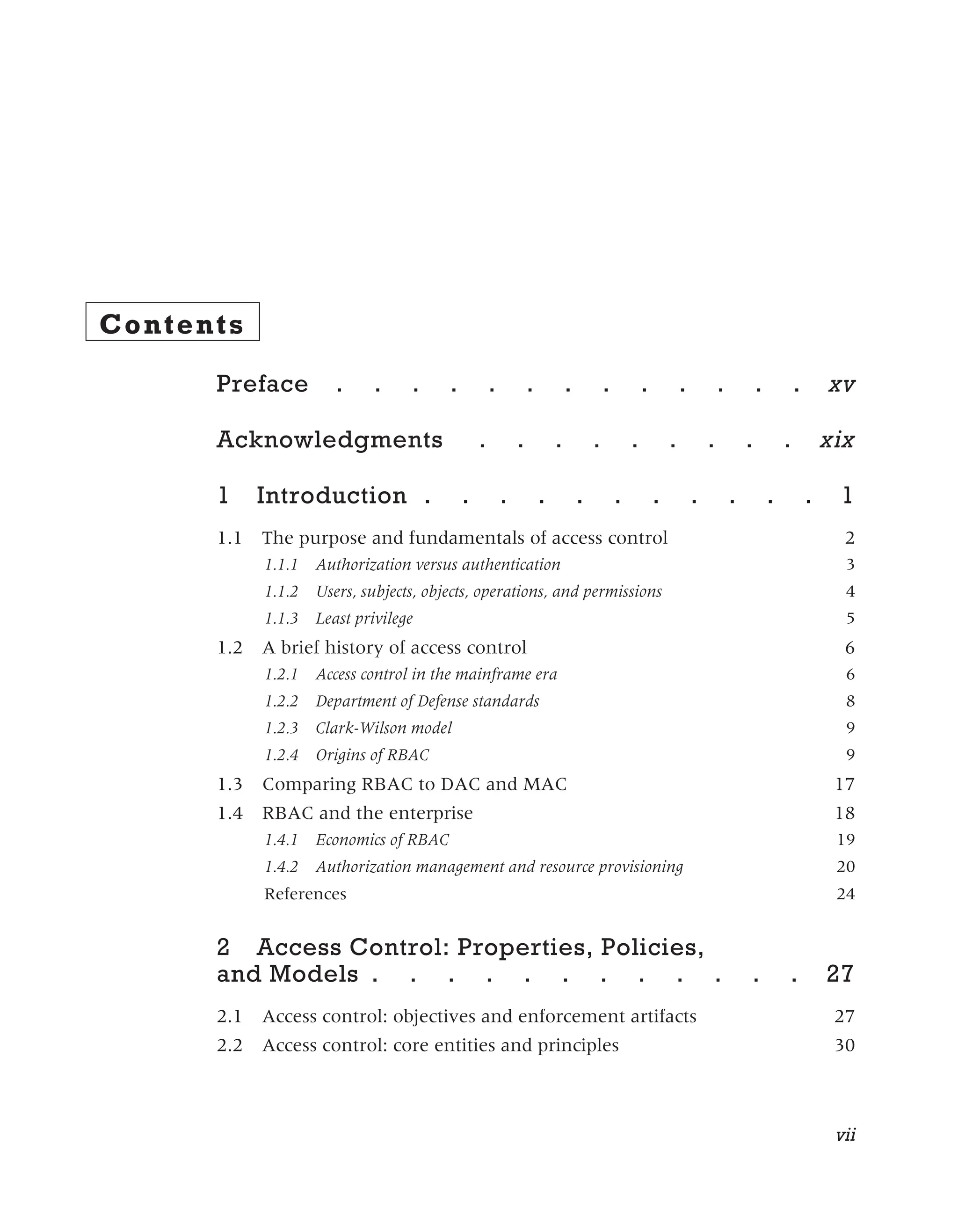
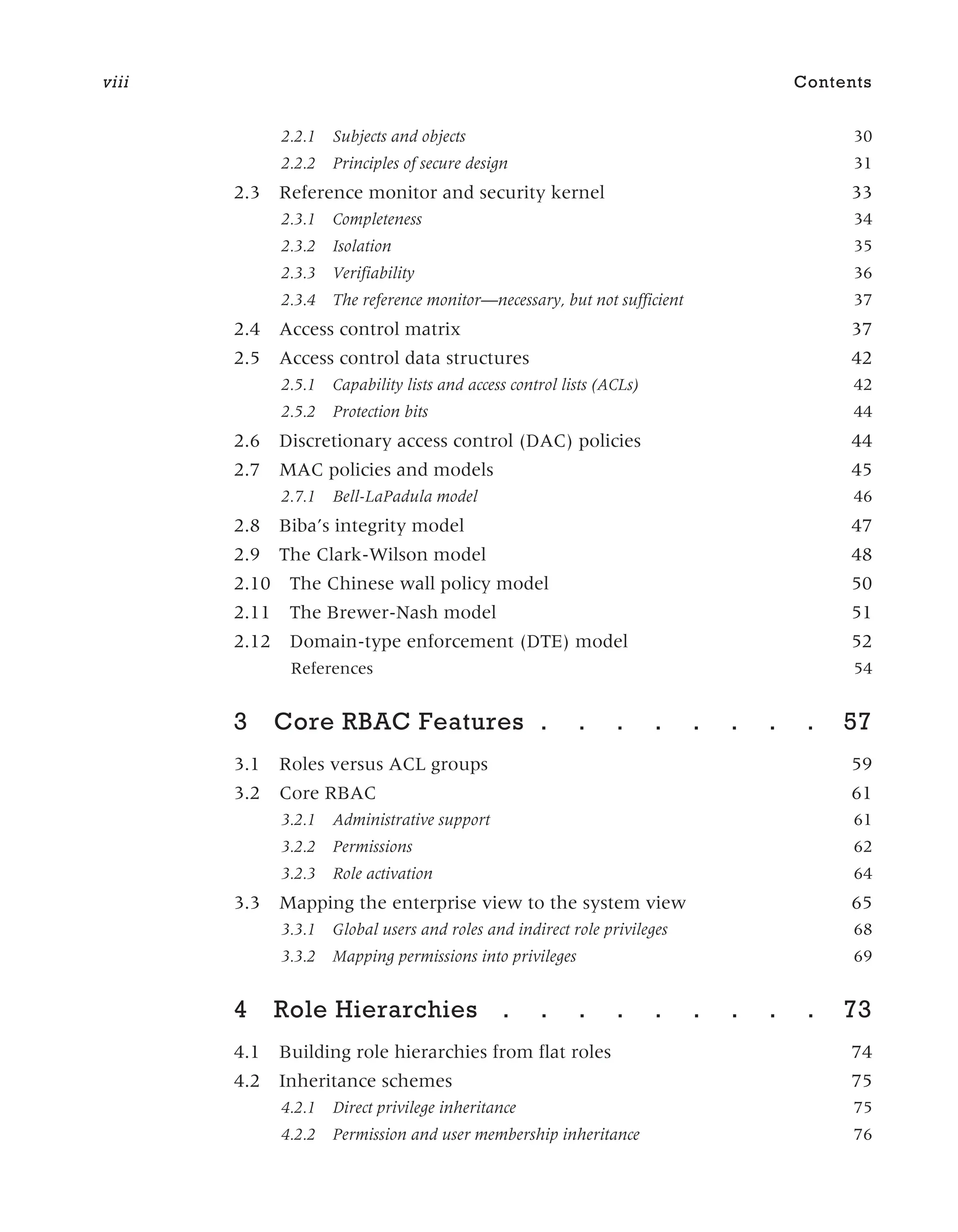
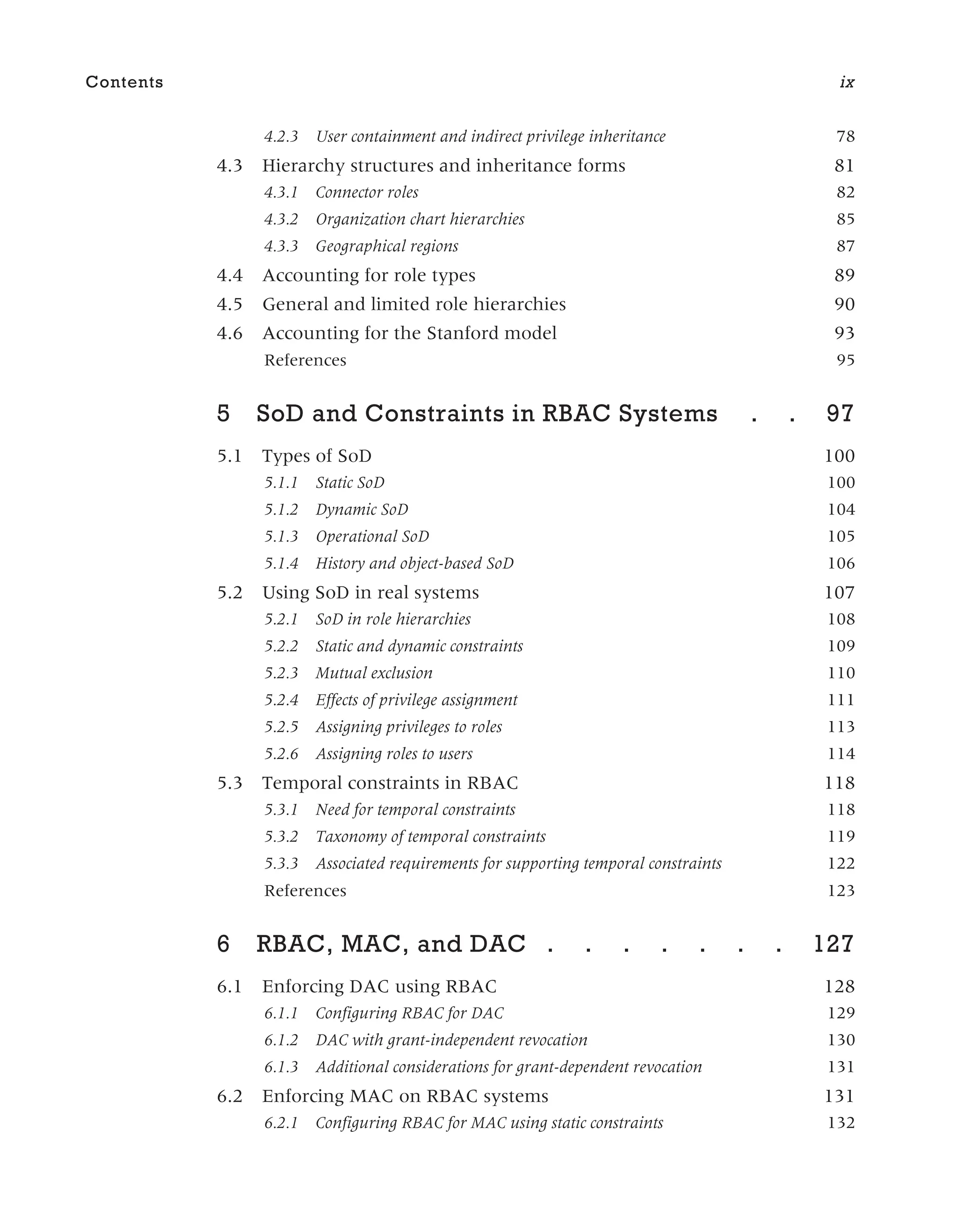
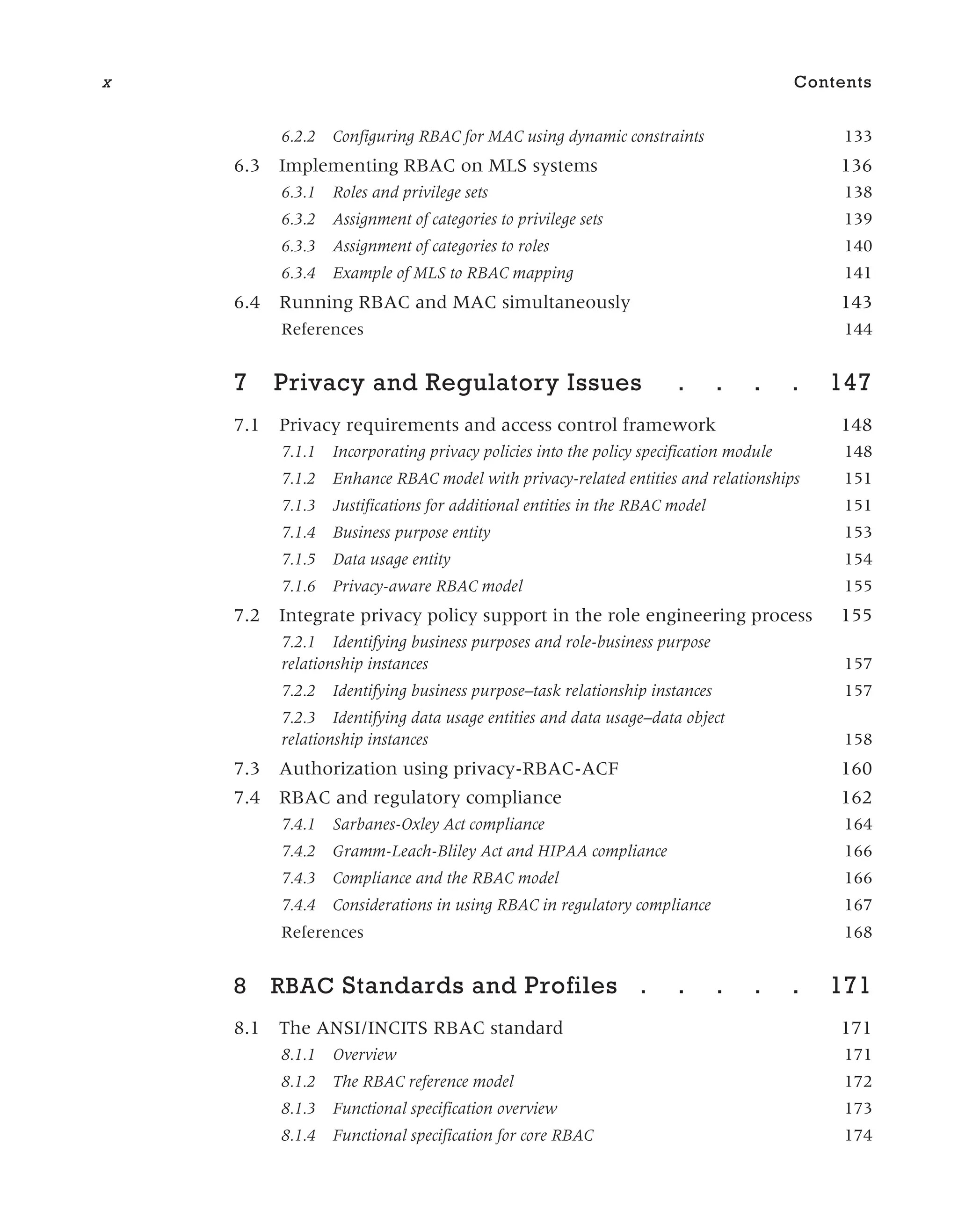
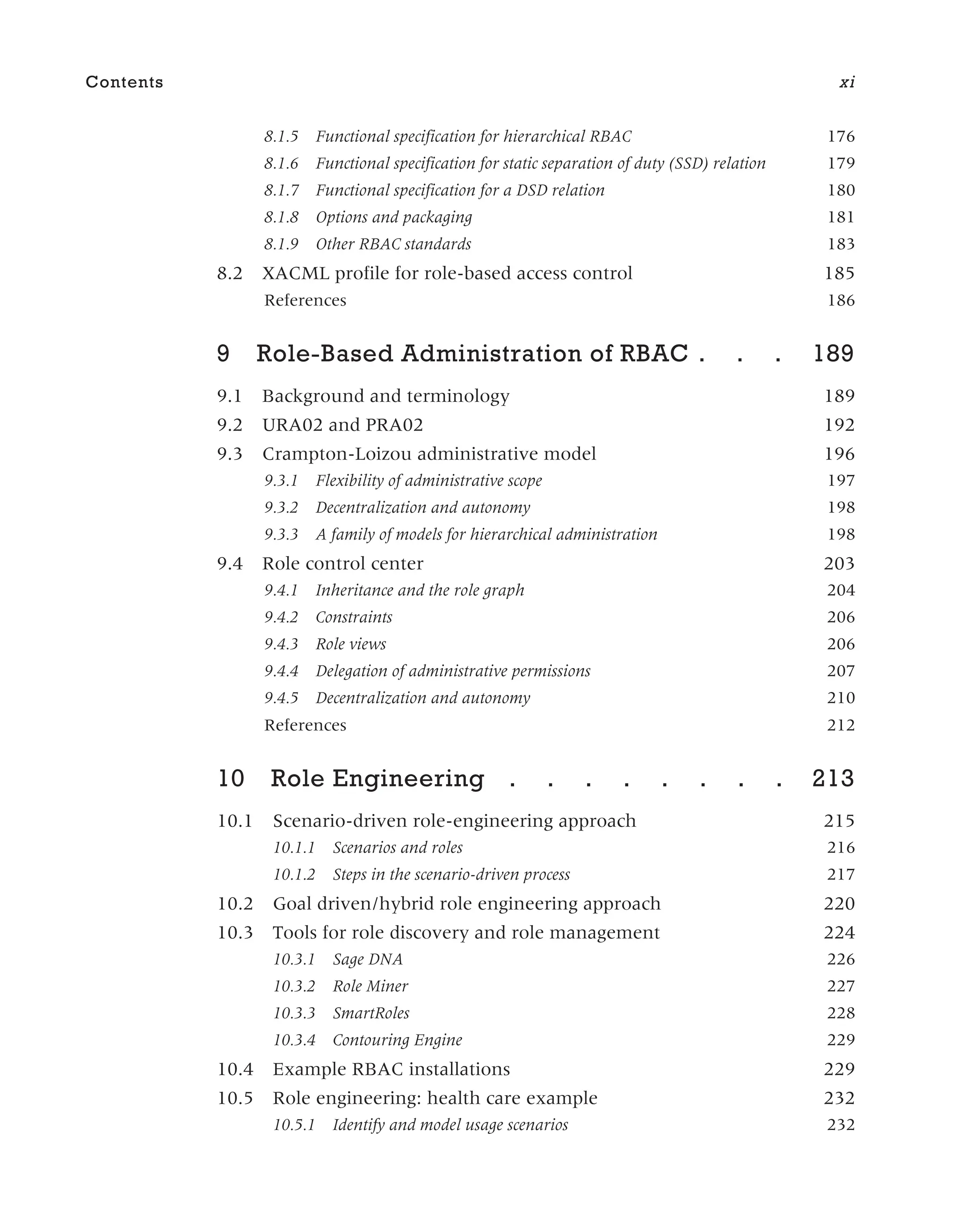
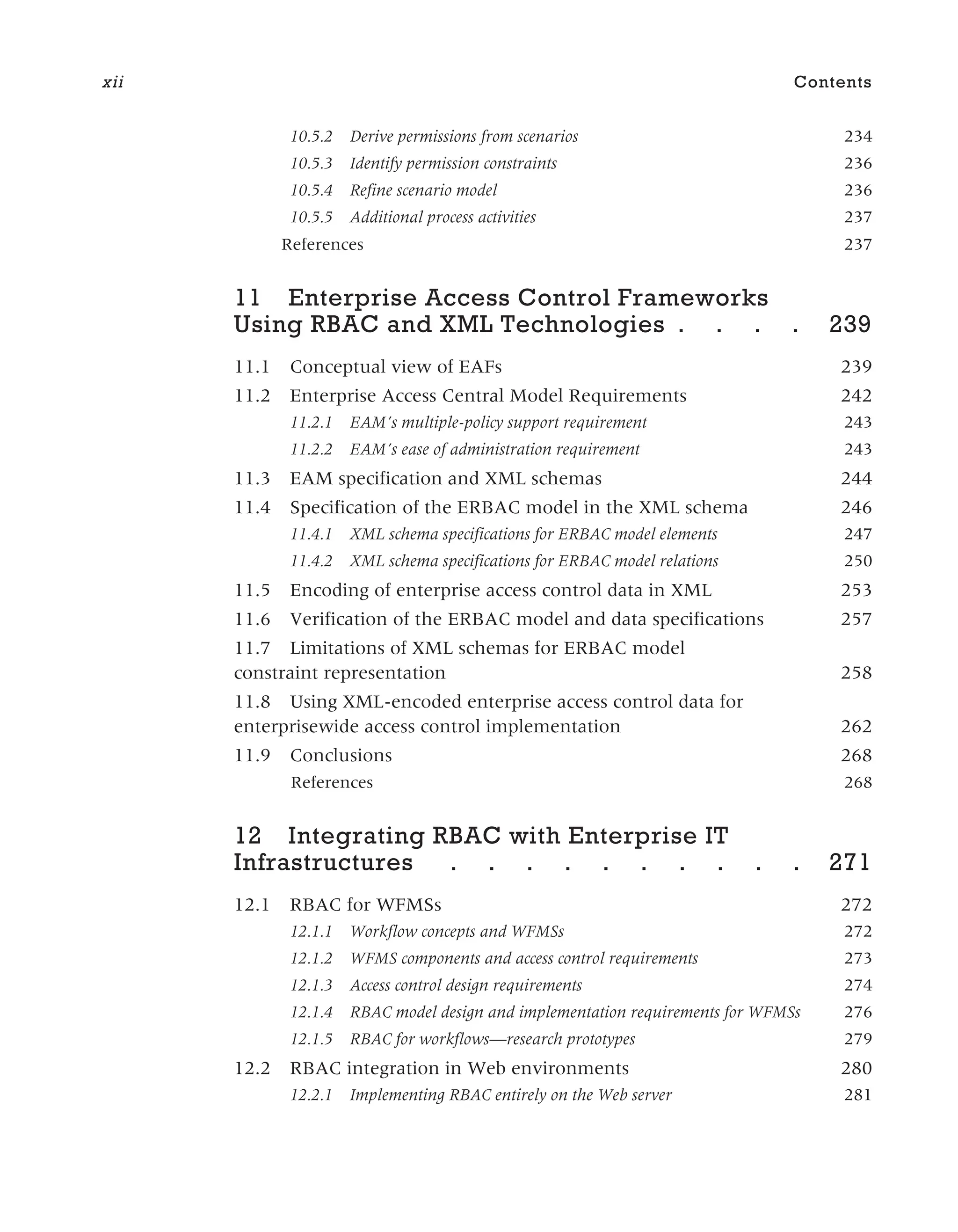
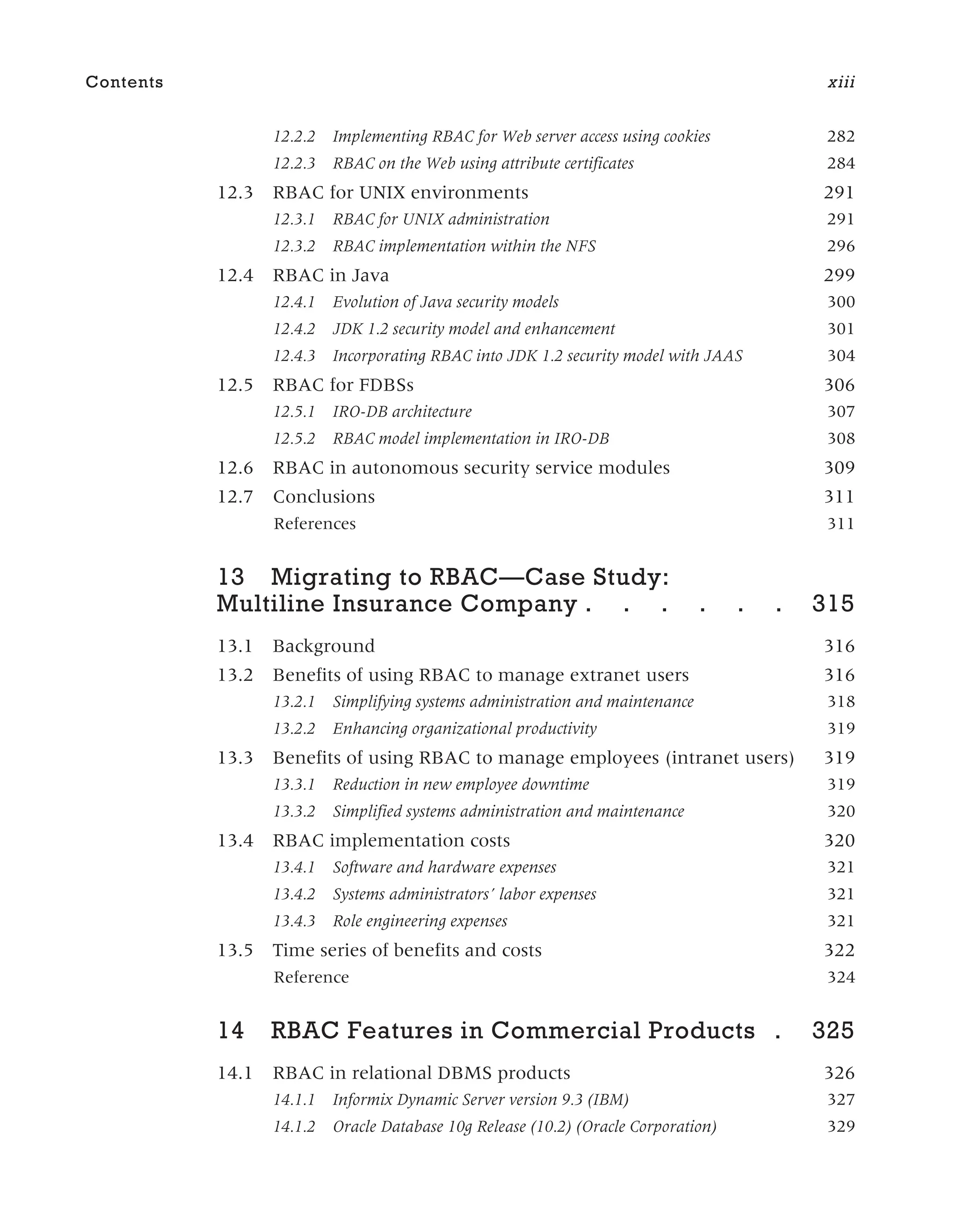
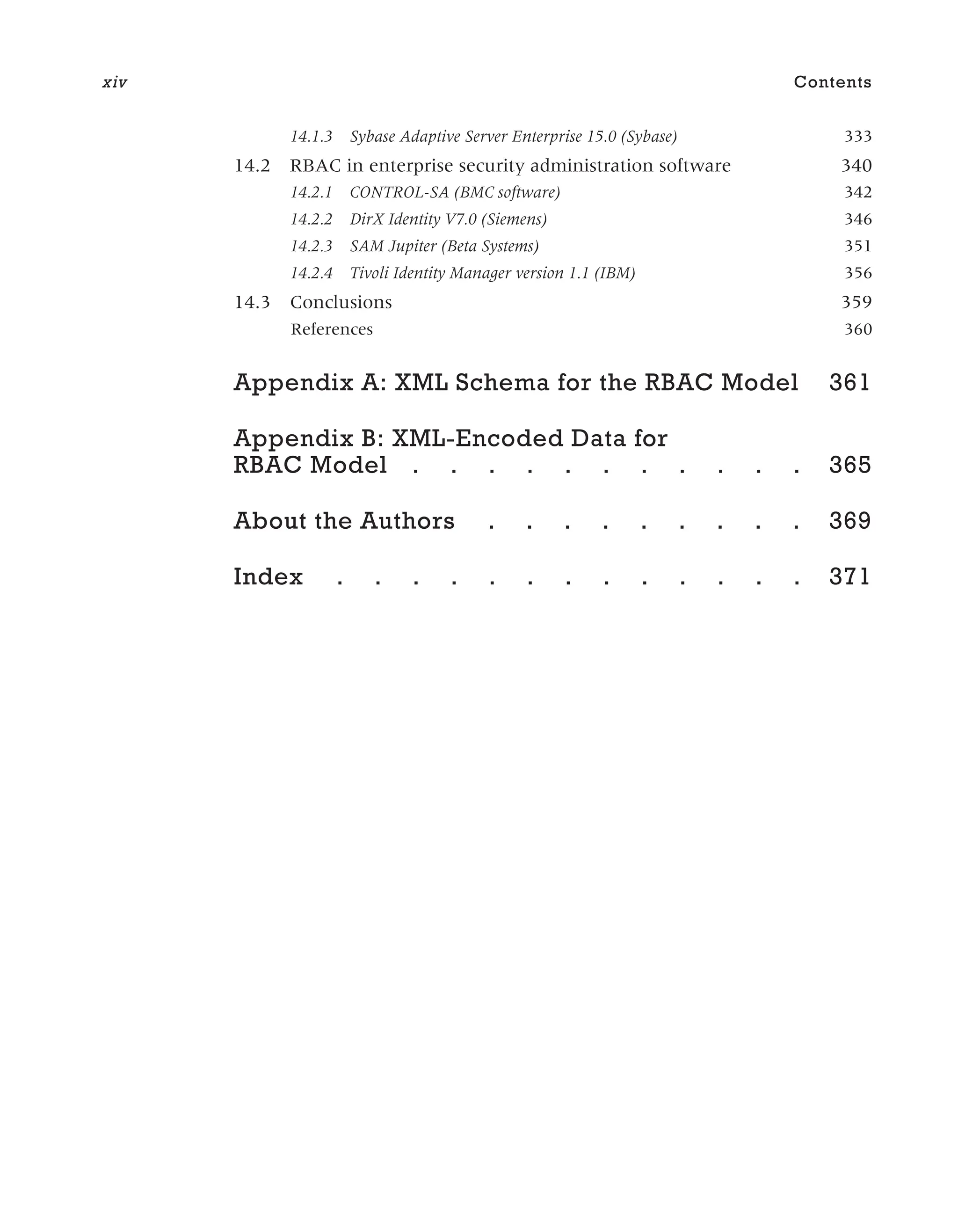


![and system resources, possibly by attaching a list of authorized users to
resources, or by storing a list of accessible resources with each user ID. Note
that authorization necessarily depends on proper authentication. If the sys-
tem cannot be certain of a user’s identity, there is no valid way of determin-
ing if the user should be granted access.
1.1.2 Users, subjects, objects, operations, and permissions
A reasonably consistent terminology has developed over the past 3 decades
for describing access control models and systems. Almost any access control
model can be stated formally using the notions of users, subjects, objects, opera-
tions, and permissions, and the relationships between these entities. It is
important to understand these terms, because the reader will encounter
them not only in this book but also in most of the literature on access con-
trol and computer security.
The term user refers to people who interface with the computer system.
In many designs, it is possible for a single user to have multiple login
IDs, and these IDs may be simultaneously active. Authentication mecha-
nisms make it possible to match the multiple IDs to a single human user,
however.
An instance of a user’s dialog with a system is called a session.
A computer process acting on behalf of a user is referred to as a subject.
Note that in reality, all of a user’s actions on a computer system are per-
formed through some program running on the computer. A user may have
multiple subjects in operation, even if the user has only one login and one
session. For example, an e-mail system may be operating in the background,
fetching e-mail from a server periodically, while the user operates a Web
browser. Each of the user’s programs is a subject, and each program’s
accesses will be checked to ensure that they are permitted for the user who
invoked the program.
An object can be any resource accessible on a computer system, including
files, peripherals such as printers, databases, and fine-grained entities such
as individual fields in database records. Objects are traditionally viewed as
passive entities that contain or receive information, although even early
access control models included the possibility of treating programs, printers,
or other active entities as objects [1].
An operation is an active process invoked by a subject. Early access con-
trol models that were concerned strictly with information flow (i.e.,
read-and-write access) applied the term subject to all active processes, but
RBAC models require a distinction between subject and operation. For
example, when an ATM user enters a card and correct PIN, the control
4 Introduction](https://image.slidesharecdn.com/role-basedaccesscontrolsecondeditionpdfdrive-250311062434-2e3fc82e/75/Role-Based-Access-Control-Second-Edition-PDFDrive-pdf-25-2048.jpg)
![1.2 A brief history of access control
Although security issues had been addressed in some early time-sharing
computer systems from the 1960s, the discipline of computer security began
to progress rapidly in the early 1970s. At this time large resource-sharing
systems were becoming commonplace in government, military, and large
commercial organizations. The field developed both in government and mil-
itary systems, and in the commercial arena where applications such as
ATMs required strong security.
1.2.1 Access control in the mainframe era
The growth in multiuser computer systems and the increased dependence of
defense systems on computers led to efforts by the U.S. Defense Science
Board to investigate the vulnerability of government systems in the late
1960s. University researchers also considered the problem. The earliest
work in defining a formal, mathematical description of access control is that
of Lampson [2], who introduced the formal notions of subject and object and
an access matrix that mediated the access of subjects to objects. An access
matrix is a simple conceptual representation in which the (i,j) entry in the
matrix specifies the rights that subject i has to object j. An example is shown
in Figure 1.1. Subjects (processes invoked by users) are allowed to access
objects such as files or peripherals according to the rights specified in the
matrix. For example, user Bob is allowed read and write access to the pay-
roll file, and read access to the accounts receivable and accounts payable file.
A RAND Corporation report from 1970 [3] provided a comprehensive
analysis of security for DoD computer systems. Included in the report was
the definition of a method to implement multilevel—relating to documents
classified by a security level, such as confidential, secret, or top-secret—
access control on a resource-sharing system, with separate considerations
for local access and remote access where password-based authorization
would be required. This document also discussed the basic requirements for
6 Introduction
R
R
R
R
R
R
R
R,W
R,W
Charles
Bob
Alice
Accounts
payable
Accounts
receivable
Payroll
General
ledger
Figure 1.1 Access matrix.](https://image.slidesharecdn.com/role-basedaccesscontrolsecondeditionpdfdrive-250311062434-2e3fc82e/75/Role-Based-Access-Control-Second-Edition-PDFDrive-pdf-27-2048.jpg)
![controlling access to information based on a user’s clearance level and the
classification level of files stored on the system. Proposals for a multi-
level secure system were extended in a U.S. Air Force report [4] that
included engineering development plans for such a system along with
communications.
Bell and LaPadula [5] formalized military access control rules into a
mathematical model suitable for defining and evaluating computer security
systems. As formulated in this model, multilevel secure systems implement
the familiar government document classification rule: Users are only
allowed to access information that is classified at or below their own clear-
ance level. Conceptually, this is a very simple policy, readily understood and
followed by humans. However, as with much in information technology,
implementing this seemingly simple policy on a computer system can be
tricky. Unexpected loopholes and nonobvious interactions between differ-
ent components of the system can leave a computer security system vulner-
able. The Bell-LaPadula model was significant because it provided a formal
(i.e., mathematical) model of the multilevel security policy, making it possi-
ble to analyze properties of the model in detail.
Two basic rules are required in the formal model: the simple security
rule and the *-property, commonly known as “no read up” and “no write
down.” The simple security rule is obvious: A user with a particular clear-
ance level cannot be allowed to read information above that level (e.g., a
user with secret clearance cannot read top-secret documents). The *-prop-
erty, which is essentially the reverse of the simple security rule, is required
to maintain system security: A user operating at a particular clearance level
can write information only at that level or above. For example, if a user is
logged in at secret level, programs or processes operated by that user are not
permitted to write information at the confidential level, although it could be
written to a higher level, such as top-secret. (Note that this rule makes sense
where we are concerned with processes operating on a computer. Obvi-
ously, a human being could log in at a high level, then print out or memo-
rize information and re-enter it after logging in at a lower level.) Also
included in the Bell-LaPadula model was the notion of categories, which
refers to a vertical breakdown of security compartments across levels. In
addition to having the proper clearance level, a user is required to be cleared
for all of the categories attached to a classified document. For example, a
document might be classified [Secret, nuclear, NATO]. To access the docu-
ment, a user would need a clearance of secret or above and must also be
cleared for the two categories—nuclear and NATO. (Chapter 2 provides a
more detailed discussion of these rules.) This policy ensures that
1.2 A brief history of access control 7](https://image.slidesharecdn.com/role-basedaccesscontrolsecondeditionpdfdrive-250311062434-2e3fc82e/75/Role-Based-Access-Control-Second-Edition-PDFDrive-pdf-28-2048.jpg)
![information cannot be downgraded either through unintentional or
malicious actions of a process.
A 1976 paper by Harrison, Ruzzo, and Ullman showed that safety is
inherently undecidable in a conventional access matrix view of security [6].
In other words, it is impossible to know whether a given configuration con-
sidered “safe” with respect to some security requirement would remain safe.
If the system is started with a set of access rights to objects, it is impossible to
know that the system will not eventually grant access rights that are not in
the original matrix. Although the proof of this result is somewhat technical,
the underlying reason for the undecidability is that users can give away
access rights. If the system has no control over what rights are passed from
one user to another, there is no way to be sure that an unauthorized user
will not eventually receive rights improperly, through some chain of rights
delegation.
1.2.2 Department of Defense standards
Codification of access control models in standards took a significant step for-
ward in 1983, when the U.S. Department of Defense (DoD) published its
Trusted Computer System Evaluation Criteria (TCSEC) [1], commonly known as
the “Orange Book,” for its orange cover. This standard defined in detail two
important access control modes for military systems: discretionary access
control (DAC) and mandatory access control (MAC). As the name suggests,
DAC is a mode in which the creators or owners of files assign access rights,
and a subject with discretionary access to information can pass that infor-
mation on to another subject.
By itself, DAC is insufficient for implementing the document classifica-
tion scheme used by the military. Since users in the DAC model of security
can give away rights to access objects, the Harrison, Ruzzo, Ullman
undecidability result applies to DAC. To provide a truly secure scheme in
which a system is guaranteed to remain secure, MAC is required.
As usually implemented, MAC controls provide the multilevel security
policy as formalized by the Bell-LaPadula model described in Section 1.2.1.
(Chapter 2 provides a more detailed treatment of DAC and MAC policies.)
The key feature of MAC is that, as its name implies, it is required for the
mediation of all accesses of objects on the system. Since the access control
system mediates all access to objects using rules imposed externally, users
cannot give away permissions for object access. Since users are limited in
the actions they can take, the access controls can ensure that the system will
remain in a secure state regardless of user actions.
8 Introduction](https://image.slidesharecdn.com/role-basedaccesscontrolsecondeditionpdfdrive-250311062434-2e3fc82e/75/Role-Based-Access-Control-Second-Edition-PDFDrive-pdf-29-2048.jpg)
![1.2.3 Clark-Wilson model
One goal of the TCSEC was to encourage a market for secure operating sys-
tems and computer security products. Many writers argued that systems
meeting the lower levels of TCSEC requirements would be sufficient for
commercial use. The hope was that a uniform market for security products
would develop, with the TCSEC providing guidance for both commercial
and military security.
Despite efforts to promote TCSEC-compliant systems as commercial
security solutions, most commercial firms recognized that DAC and MAC
were not sufficient for their needs. TCSEC-oriented systems are focused on
the information flow and confidentiality of information. In a widely refer-
enced 1987 paper, Clark and Wilson [7] argued that while confidentiality
was important to commercial users, their primary concern pertains to integ-
rity (i.e., ensuring that information is modified only in appropriate ways by
authorized users).
When Clark and Wilson formalized business security practices into a
security model, the result was quite different from the military security
model formalized by Bell and LaPadula. The two central concepts in the
Clark-Wilson model are the well-formed transaction and separation of duty
(SoD). Well-formed transactions constrain the user to change data only in
authorized ways. For example, a bank teller cannot modify an arbitrary part
of a customer record, only those data fields that are incorporated into the
particular transaction being run, such as a savings deposit or withdrawal.
Complementing the well-formed transaction is the ancient principle of SoD,
which ensures the consistency of changes made to critical data. A division
manager, for example, can request an expenditure, but another person
must approve it, and a third audits the completed transaction to ensure that
fraud has not occurred. Implementing these rules in a computer system has
been found to be as challenging as implementing information flow policies.
One of the motivations of RBAC was to make commercial security policies
easier to manage.
1.2.4 Origins of RBAC
Like the multilevel security policy formalized by Bell and LaPadula, RBAC
has its roots in historical practices that predate the formal model, except that
RBAC’s features stem primarily from the commercial world. Also like multi-
level security, RBAC is conceptually simple: Access to computer system
objects is based on a user’s role in an organization. Roles with different priv-
ileges and responsibilities have long been recognized in business
1.2 A brief history of access control 9](https://image.slidesharecdn.com/role-basedaccesscontrolsecondeditionpdfdrive-250311062434-2e3fc82e/75/Role-Based-Access-Control-Second-Edition-PDFDrive-pdf-30-2048.jpg)
![organizations, and commercial computer applications dating back to at least
the 1970s implemented limited forms of access constraints based on the
user’s role within the organization. For example, on-line banking applica-
tions in that period included both teller and teller supervisor roles that could
execute different sets of transactions, while simultaneously users at ATMs
were able to execute another set of transactions against the same databases.
In the late 1980s and early 1990s researchers began recognizing the vir-
tues of roles as an abstraction for managing privileges within applications
and database management systems. A role was seen as a job or position
within an organization. A role exists as a structure separate from that of the
users who were assigned to the roles. Dobson and McDermid [8] used the
term functional roles. Baldwin [9] called these structures named protection
domains (NPDs) and stated that they could be related and organized into
hierarchies based on NPD permission subsets. Also recognized was the use
of roles in support of the principle of least privilege in which a role is created
with minimum permissions in specification of duty requirements [10]. The
Brewer and Nash model [11] presented a basic theory for use in implement-
ing dynamically changing access permissions. The model is described in
terms of a particular commercial security policy, known as the Chinese wall.
The model is developed by first defining what a Chinese wall means and
then defining a set of rules (SoD requirements) such that no user can ever
access data from the wrong side of the wall. Nash and Poland [12] discussed
the application of role-based security to cryptographic authentication
devices commonly used in the banking industry.
These role-based systems were relatively simple and application-specific.
That is, there was no general-purpose model defining how access control
could be based on roles, and little formal analysis of the security of these
systems. The systems were developed by a variety of organizations, with no
commonly agreed upon definition or recognition in formal standards.
In 1992, NIST initiated a study [13] of both commercial and government
organizations, and found that access control needs were not being met by
products on the market at the time, many of which implemented only
TCSEC-style discretionary controls, considered by many organizations as
the “standard of due care.” In many enterprises within industry and civilian
government, end users do not “own” the information for which they are
allowed access as assumed by DAC. For these organizations, the corporation
or agency is the actual “owner” of system objects, and discretionary control
on the part of the users may not be appropriate. Conventional MAC,
focused on preserving confidentiality, is also inadequate for these organiza-
tions. Although enforcing a need-to-know policy is important where classi-
fied information is of concern, there existed a general need to support
10 Introduction](https://image.slidesharecdn.com/role-basedaccesscontrolsecondeditionpdfdrive-250311062434-2e3fc82e/75/Role-Based-Access-Control-Second-Edition-PDFDrive-pdf-31-2048.jpg)
![subject-based security policies, such as access based on competency, the
enforcement of conflict-of-interest rules, or access based on a strict concept
of least privilege. Supporting such policies requires the ability to restrict
access based on a user function or role within the enterprise.
A solution to meet these needs was proposed in 1992 by Ferraiolo and
Kuhn [14], integrating features of existing application-specific approaches
into a generalized RBAC model. This paper described, in a simple formal
manner, the sets, relations, and mappings used in defining roles and role
hierarchies, subject-role activation, and subject-object mediation, as well as
the constraints on user-role membership and role-set activation. Three basic
rules were required:
1. Role assignment: A subject can execute a transaction only if the subject
has selected, or been assigned to, a role. The identification and
authentication process (e.g., login) is not considered a transaction.
All other user activities on the system are conducted through trans-
actions. Thus, all active users are required to have some active role.
2. Role authorization: A subject’s active role must be authorized for the
subject. With rule 1, this rule ensures that users can take on only
roles for which they are authorized.
3. Transaction authorization: A subject can execute a transaction only if
the transaction is authorized for the subject’s active role. In concert
with rules 1 and 2, this rule ensures that users can execute only
transactions for which they are authorized.
The formal description of the model is given in Figure 1.2. A key feature
of this model is that all access is through roles. A role is essentially a collec-
tion of permissions, and all users receive permissions only through the roles
to which they are assigned, as shown in Figure 1.3. Within an organization,
roles are relatively stable, while users and permissions are both numerous
and may change rapidly. Controlling all access through roles therefore sim-
plifies the management and review of access controls.
The most common method of implementing access control in a com-
puter system is through access control lists (ACLs). All system resources,
such as files, printers, and terminals, have a list of authorized users attached.
This makes it easy and quick to answer the per object review question:
“What users have access to object X?” Much more difficult is the per subject
review question: “What objects can user X access?” Answering this question
requires scanning all objects on the computer system, which may number in
the millions; recording their access control lists; and finally reporting on user
1.2 A brief history of access control 11](https://image.slidesharecdn.com/role-basedaccesscontrolsecondeditionpdfdrive-250311062434-2e3fc82e/75/Role-Based-Access-Control-Second-Edition-PDFDrive-pdf-32-2048.jpg)
![X. Measurements of real systems have shown that this process can take
more than a day. A side effect of this scheme is that ACLs make it easy to
add permissions to an object but hard to revoke all of a particular user’s
12 Introduction
Original formal description of RBAC
For each subject, the active role is the one that the subject is currently using:
AR(s : subject) = {the active role for subject s}
Each subject may be authorized to perform one or more roles:
RA(s : subject) = {authorized roles for subject s}
Each role may be authorized to perform one or more transactions:
TA(r : role) = {transactions authorized for role r}
Subjects may execute transactions. The predicate exec(s,t) is true if and only if
subject s can execute transaction t at the current time; otherwise it is false:
exec(s:subject,t:tran) = {true iff subject s can execute transaction t}
1. Role assignment: A subject can execute a transaction only if the subject has
selected or been assigned a role:
∀s : subject, t : tran ⋅ exec(s,t) ⇒ AR(s) ≠ ∅
2. Role authorization: A subject’s active role must be authorized for the subject:
∀s : subject ⋅ AR(s) ⊆ RA(s)
3. Transaction authorization: A subject can execute a transaction only if the
transaction is authorized for the subject’s active role:
∀s : subject,t : tran ⋅ exec(s,t) ⇒ t ∈ TA(AR(s))
Note that because the conditional in rule 3 is “only if,” this rule allows for the
possibility that additional restrictions may be placed on transaction execution.
That is, the rule does not gurantee a transaction to be executable just because it is
in TA[AR(s)]. The set of transactions potentially executable by the subject’s active
role. For example, a trainee for a supervisory role may be assigned the role of
supervisor but may have restrictions applied to his or her role that limit accesible
transactions to a subset of those normally allowed for the supervisor role.
Figure 1.2 Formal description of RBAC from Ferraiolo and Kuhn [14].
Roles Permissions
Users
Figure 1.3 RBAC relationships.](https://image.slidesharecdn.com/role-basedaccesscontrolsecondeditionpdfdrive-250311062434-2e3fc82e/75/Role-Based-Access-Control-Second-Edition-PDFDrive-pdf-33-2048.jpg)
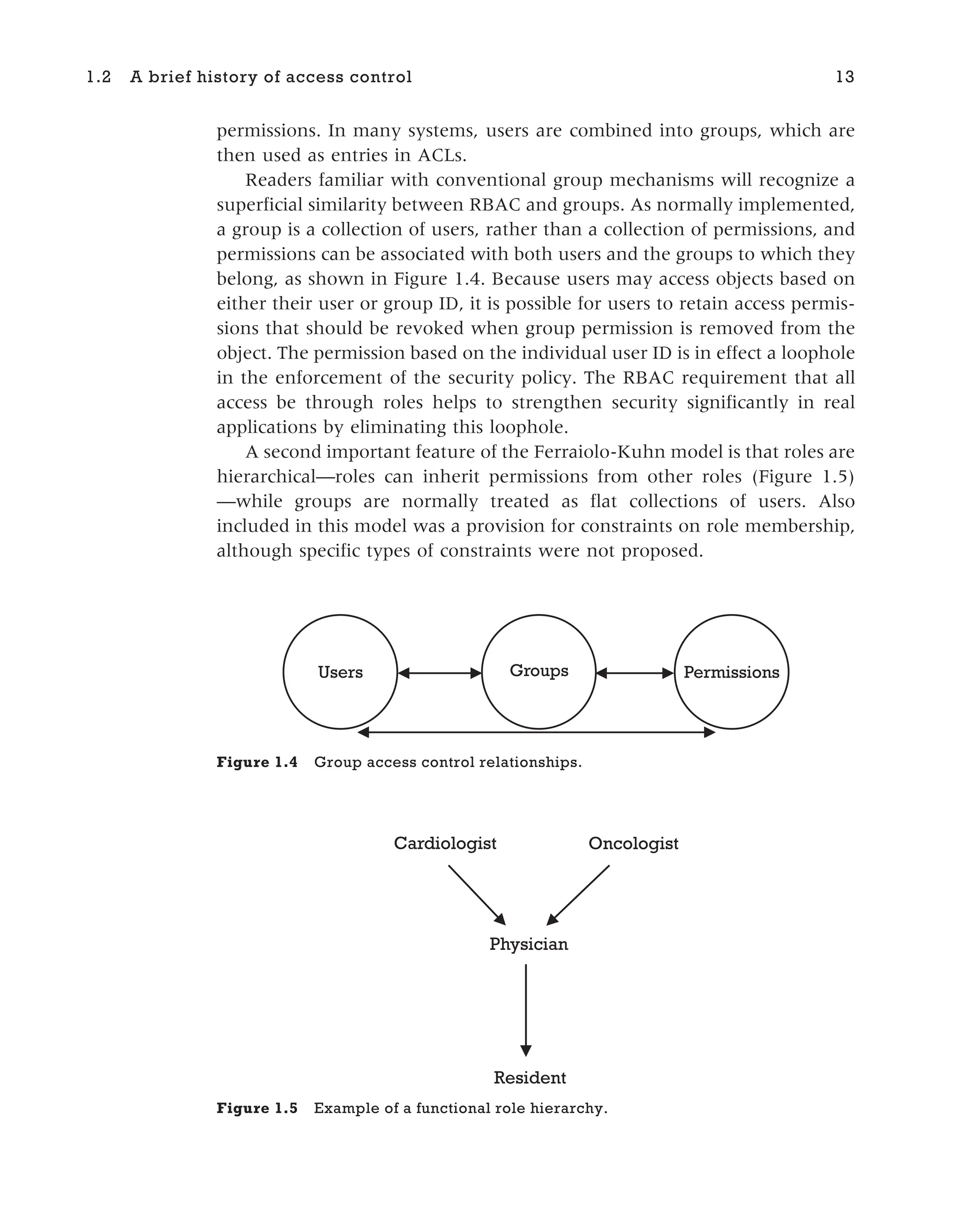
![The 1992 paper showed that this model subsumes the Clark-Wilson
model (i.e., the Clark-Wilson model is included as a special case). A subse-
quent NIST publication [15] investigated RBAC in more detail, proposing
additional functions beyond those included in the 1992 model, and in-
cluded specific forms for constraints to implement separation-of-duty
requirements.
George Mason University Professor Ravi Sandhu, a well-known and
influential security expert, described the Ferraiolo-Kuhn RBAC model as
“an important innovation, which makes RBAC a service to be used by appli-
cation…. Instead of scattering security in application code, RBAC will con-
solidate security in a unified service which can be better managed while
providing the flexibility and customization required by individual applica-
tions” [16]. Dr. Sandhu went on to conduct extensive research and publish
numerous papers in the area of RBAC. Several of his students have joined
him in this research, and some have produced doctoral theses in areas
related to RBAC.
In 1994, Nyanchama and Osborn [17] proposed a very generalized form
of role organization called a role graph model. The authors showed that
roles could be organized based on three role relationships: partial, shared,
and augmented privileges. The role graph model is particularly useful in
analyzing privilege sharing, which is critical in detecting and preventing
conflict of interest relationships between roles. Gligor introduced the notion
of “role types,” which allow role administration to be simplified with
parameterized types that are instantiated to produce roles. This work
became the subject of the first U.S. patent in the area of RBAC [18].
In 1996, Sandhu and colleagues [19] introduced a framework of RBAC
models, RBAC96, breaking down RBAC into four conceptual models. Shown
in Figure 1.6, this framework specified a base model, RBAC0, that contains
the minimal features of a system implementing RBAC. Two advanced mod-
els, RBAC1 and RBAC2, include RBAC0, but add (respectively) support for
hierarchies and for constraints such as SoD. A fourth component, RBAC3,
includes all aspects of the lower-level models. The Sandhu et al. RBAC96
framework established a modular structure for RBAC systems, providing for
simplified commercial implementations that could offer basic RBAC0 func-
tionality, or more advanced features as required by customers.
Largely due to a series of conferences sponsored by the Association for
Computing Machinery (ACM), founded by Professor Sandhu and David
Ferraiolo of NIST, a robust RBAC research community had developed, and
today commercial implementations are providing ever more sophisticated
RBAC systems. RBAC began to see application in a wide variety of areas.
Early work by Barkley [20] showed that RBAC has a natural application in
14 Introduction](https://image.slidesharecdn.com/role-basedaccesscontrolsecondeditionpdfdrive-250311062434-2e3fc82e/75/Role-Based-Access-Control-Second-Edition-PDFDrive-pdf-35-2048.jpg)
![health care. Workflow management, an economically important field that
deals with the automation of business processes, is another area where
RBAC seems to be ideally suited to not only provide security, but serve as a
framework for workflows as well. Barkley and Cincotta [21] and Bertino,
Ferrari, and Atluri [22] introduced RBAC-based workflow systems.
In 2000, NIST initiated an effort to establish an international consensus
standard for RBAC, publishing a proposal [23] in the ACM RBAC workshop.
The proposed standard follows the RBAC96 structure and incorporates
features developed out of subsequent discussions and formal comments
received from the research and commercial vendor communities. In 2004,
the standard was approved as INCITS 359-2004 by the InterNational Com-
mittee for Information Technology standards, which is accredited by the
American National Standards Institute to develop industry consensus stan-
dards for IT. Following INCITS 359-2004, a variety of RBAC standards have
been completed or initiated, including the OASIS XACML Profile for RBAC,
which is helping to bring role-based access to Web services. See Chapter 8
for more on these and other standards.
What is most striking about RBAC’s history is its rapid evolution from a
concept to its commercial implementation and deployment. Although this
success can be attributed to a variety of factors, recognition of RBAC’s dual
policy and productivity advantages have undoubtedly contributed to its
present stature. In this respect, RBAC differs from many other security con-
cepts, in that its costs of deployment need not be justified based solely on
perceived threats and system vulnerabilities. Although RBAC allows for the
enforcement of a wide variety of important access control policies that are
either impractical or even impossible to enforce in its absence, RBAC’s
1.2 A brief history of access control 15
RBAC4
(union of 0,1,2)
RBAC2
(adds constraints)
RBAC1
(adds hierarchies)
RBAC0
(basic RBAC)
Figure 1.6 Sandhu et al. RBAC96 framework.](https://image.slidesharecdn.com/role-basedaccesscontrolsecondeditionpdfdrive-250311062434-2e3fc82e/75/Role-Based-Access-Control-Second-Edition-PDFDrive-pdf-36-2048.jpg)
![productivity advantages alone are often sufficient in justifying its deploy-
ment. When taken together, these dual motivators can lead to a strong busi-
ness justification. To improve the efficiency of heath care systems, the U.S.
Health Insurance Portability and Accountability Act of 1996 (HIPAA)
explicitly calls out RBAC requirements [24], and the U.S. Federal Aviation
Administration cites RBAC in its specifications for National Airspace System
security [25]. RBAC is now being prescribed as a generalized approach to
access control. For instance, RBAC was found to be “the most attractive
solution for providing security features in multidomain digital government
infrastructure” [26] and has shown its great relevance in meeting the
complex security needs of Web-based applications [27]. New regulations,
including Sarbanes-Oxley and Gramm-Leach-Bailey, are increasingly being
addressed using RBAC.
Although RBAC can be justified squarely on economics, something
else was going on over the last decade. During this period, hundreds of
papers were published on topics revolving on the theme of RBAC. As we
have discussed, RBAC is a packaging of closely related and dependent
access control and management features and ideas. Although the focus of
RBAC is clearly on access control, in many respects RBAC can be viewed
as a model for regulation and management of user actions and activities
within IT environments. Furthermore, these activities have been encapsu-
lated into highly intuitive role structures that appear naturally within
most business environments. As it turns out, role structures not only
apply to resource provisioning systems and access control and policy
management systems, they also fit naturally into workflow, process man-
agement, collaborative, and virtual enterprise environments. When
RBAC models first appeared, these enterprise applications were not
envisioned. However, once published, and thoroughly examined, other
researchers quickly began expanding and elaborating on RBAC concepts
and structures.
The pervasiveness of RBAC’s application within modern day IT infra-
structures is significant. Today, RBAC features are included at all levels of
enterprise computing, including operating system, database management
system, network, and enterprise management levels. RBAC is being incor-
porated and integrated within infrastructure technologies such as public key
infrastructure (PKI), workflow management systems, and directory and
Web services. In addition, RBAC is being proposed as an enabling technol-
ogy in formulating metapolicies within collaborative and virtual enterprise
systems.
16 Introduction](https://image.slidesharecdn.com/role-basedaccesscontrolsecondeditionpdfdrive-250311062434-2e3fc82e/75/Role-Based-Access-Control-Second-Edition-PDFDrive-pdf-37-2048.jpg)
![1.3 Comparing RBAC to DAC and MAC
The principle motivations behind RBAC are the ability to specify and
enforce enterprise-specific access control policies and to streamline the typi-
cally burdensome process of authorization management. RBAC represents a
major advancement in flexibility and detail of control from the existing
standards of DAC and MAC.
As defined in the TCSEC and commonly implemented, DAC is an access
control policy and mechanism that permits system users to allow or disallow
other users access to the objects under their control. The TCSEC DAC policy
is defined as follows [1]:
A means of restricting access to objects based on the identity of subjects or
groups, or both, to which they belong. The controls are discretionary in the
sense that a subject with a certain access permission is capable of passing that
permission (perhaps indirectly) on to any other subject (unless restricted by
MAC).
DAC, as the name implies, permits the granting and revocation of access
permissions to be left to the discretion of the individual users. A DAC mech-
anism allows users to grant or revoke access to any of the objects under
their control without the intercession of a system administrator.
For many enterprises within industry and civilian government, end
users do not “own” the information to which they are allowed access as
is assumed by DAC policies. For these organizations, the corporation or
agency is the actual “owner” of system objects, and it may not be appropri-
ate to allow users to give away access rights to the objects. With RBAC,
access decisions are based on the roles individual users have as part of an
organization. This includes the specification of duties, responsibilities, and
qualifications. For example, the roles an individual associated with a hospi-
tal can assume include doctor, nurse, clinician, and pharmacist. Roles in a
bank include teller, loan officer, and accountant. Roles can also apply to
military systems; for example, target analyst, situation analyst, and traffic
analyst are common roles in tactical systems. An RBAC policy is based on
the functions or the actions that a user is allowed to perform within the
context of an organization (referred to as either privileges or permissions).
The users cannot normally pass their permissions on to other users at
their discretion. For example, a doctor who may posses the permission to
prescribe medication should not be able to pass that permission onto a
clinician.
1.3 Comparing RBAC to DAC and MAC 17](https://image.slidesharecdn.com/role-basedaccesscontrolsecondeditionpdfdrive-250311062434-2e3fc82e/75/Role-Based-Access-Control-Second-Edition-PDFDrive-pdf-38-2048.jpg)
![Security policy often supports higher level organizational objectives,
such as maintaining and enforcing ethics pertaining to a judge’s chambers,
or the laws and respect for privacy associated with the diagnosis of ailments,
treatment of disease, and the administering of medication within a hospital.
To support such policies, a capability to centrally control and maintain
access rights is required. The security administrator, not the users for which
the policies apply, must diligently represent the organization in specifying
the access policy over organizational resources.
As such, RBAC is sometimes described as a form of MAC in the sense
that users are unavoidably constrained by and have no influence over the
enforcement of the organization’s protection policies. However, RBAC is
different from TCSEC MAC. MAC is defined in the TCSEC as follows [1]:
A means of restricting access to objects based on the sensitivity (as represented
by a label) of the information contained in the objects and the formal authori-
zation (i.e., clearance) of subjects to information of such sensitivity.
As rationalized in the TCSEC, MAC supports DoD requirements and reg-
ulations pertaining to unauthorized access to classified information, and in
particular to the protection of the confidentiality (reading or observing) of
sensitive information. Systems that support MAC policies are concerned
with the unlawful flow of information from a high level to a low level. As
such, policy support is with respect to controlling reading and writing. How-
ever, control over write operations is only concerned with preventing the
indirect unlawful observation of sensitive information, and not with its
integrity (unauthorized modification or destruction).
With regard to RBAC controls, policies may pertain to issues of confiden-
tiality or integrity, or both: “Who can perform what actions?”
To distinguish RBAC from the policy specifics of MAC, RBAC is often
characterized as nondiscretionary access control. RBAC allows for the
nondiscretionary enforcement of a variety of protection policies that can be
tailored on an enterprise-by-enterprise basis. The policies enforced within a
stand-alone or distributed system are the net result of the administrative
configuration of various components of RBAC.
1.4 RBAC and the enterprise
RBAC has emerged as the primary alternative to MAC and DAC because it is
much better suited to the needs of commercial users than these earlier mod-
els. This section introduces a simple economic model that demonstrates
18 Introduction](https://image.slidesharecdn.com/role-basedaccesscontrolsecondeditionpdfdrive-250311062434-2e3fc82e/75/Role-Based-Access-Control-Second-Edition-PDFDrive-pdf-39-2048.jpg)
![RBAC’s cost effectiveness and then discusses how RBAC fits into a large
organization.
1.4.1 Economics of RBAC
From a business perspective RBAC has the potential to offer several bene-
fits. This includes greater administrative productivity in performing com-
mon authorization management functions. These administrative functions
pertain to assigning permissions for new user access to resources (both new
users and new resources), reviewing and selectively removing accesses that
are no longer necessary (and potentially harmful) with respect to a user’s
change of job assignment, and the completeness and immediacy of the
removal of permissions in the event of a user’s separation from the enter-
prise. These same features have demonstrated their ability to increase user
productivity by reducing the downtime between administrative events,
where the enterprise would be deprived of productivity during the period
when the user is unable to access system resources. There is usually a direct
relationship between the cost of administration and the number of associa-
tions that must be managed in order to administer an access control policy:
The larger the number of associations, the costlier and more error-prone
access control administration. In most organizations, the use of RBAC
reduces the number of associations that must be managed.
A simple economic model can be used to approximate the savings that
results from using a role-based approach [28]. Job positions typically are
occupied by more than one individual, and most positions require more
than one permission in order for an individual in a job position to carry out
the responsibilities of that position. One can describe the associations autho-
rizing permissions to individuals who perform the responsibilities of a job
position as an ordered pair consisting of a set of individuals and a set of per-
missions (U, P) where:
U = the set of individuals in a job position;
P = the set of permissions required to perform that job position.
The number of associations required to directly relate the individuals to
those permissions is U P
⋅ , where
U = the number of individuals in the set U;
P = the number of permissions in the set P.
In other words, for each individual in U, there is an association for each
permission in P.
1.4 RBAC and the enterprise 19](https://image.slidesharecdn.com/role-basedaccesscontrolsecondeditionpdfdrive-250311062434-2e3fc82e/75/Role-Based-Access-Control-Second-Edition-PDFDrive-pdf-40-2048.jpg)
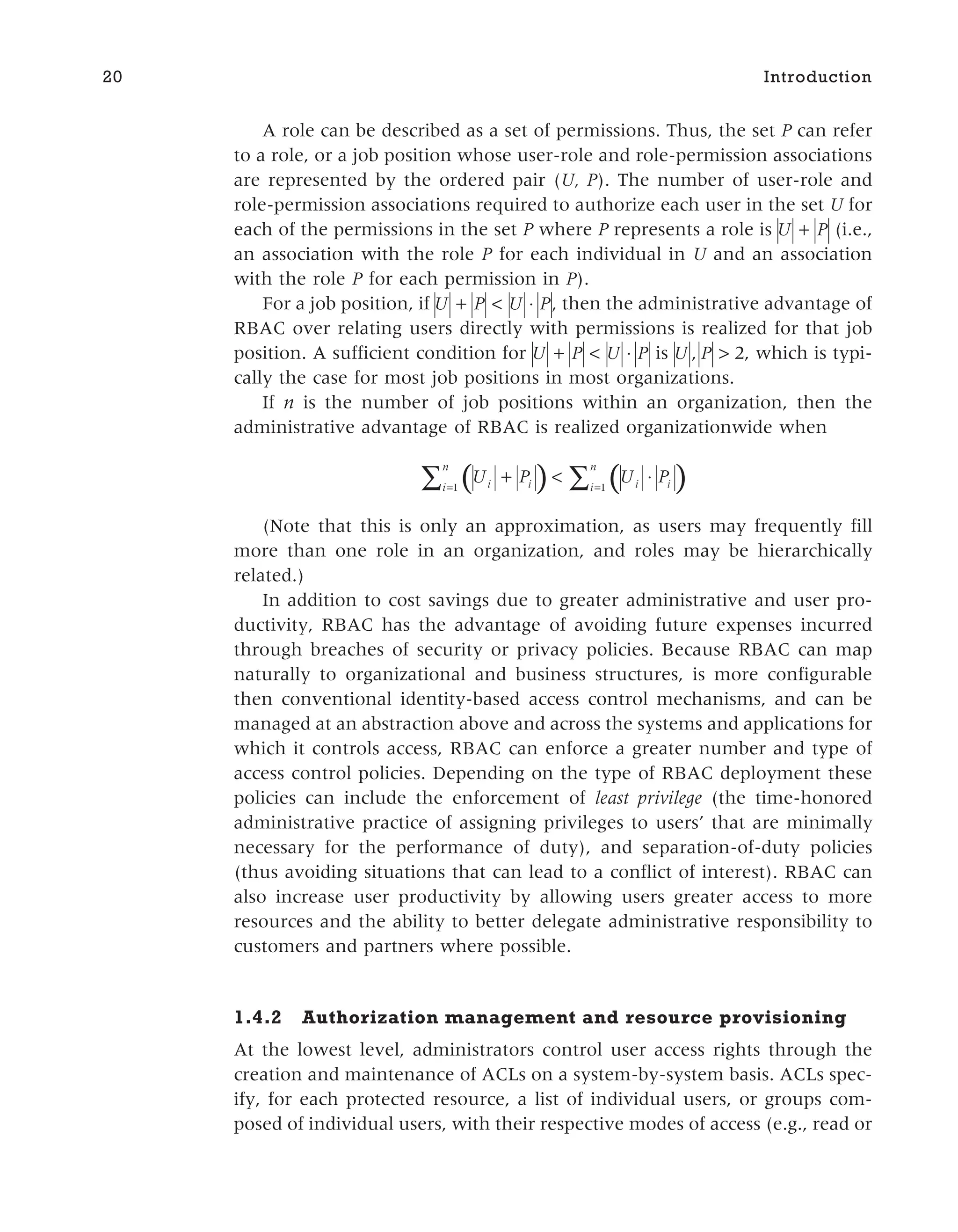
![with the problem of centralizing authorization, as shown in Figures 1.7
and 1.8.
In the first approach, which has been termed user pull [29], the user is
authenticated by the authorization server, obtains some sort of credential to
access applications, and then presents the credentials as authorization to the
applications. The second approach, termed server pull [29], requires applica-
tions to authenticate users, but centralizes information about user privileges
on an authorization server. When a user attempts to invoke an application,
the application queries the authorization server to determine the user’s per-
missions.
22 Introduction
Application 1
Application 2
Authorization
server
Application n
User
Figure 1.7 User-pull authorization architecture.
User Application 2
Application n
Application 1
Authorization
server
Figure 1.8 Server-pull authorization architecture.](https://image.slidesharecdn.com/role-basedaccesscontrolsecondeditionpdfdrive-250311062434-2e3fc82e/75/Role-Based-Access-Control-Second-Edition-PDFDrive-pdf-43-2048.jpg)
![Before users can begin accessing the applications they need to do their
jobs, the organization must set up access permissions for them throughout
the network. This is the problem of resource provisioning. In addition to thou-
sands of employees, the company may need to establish permissions for
contractors, business partners, and customers who access corporate data on
the Internet. Equally important is the task of decommissioning permissions
held by employees leaving the company. Surveys of corporations have
found that current and prior employees are the top two sources of security
breaches. Past employees are cited as a security problem nearly as often as
current employees, because of the problem of deleting permissions after
employees leave [30]. Creating and maintaining proper access permissions
in a fast-changing business environment is a complex problem, which
has led to the development of sophisticated tools typically costing from
$600,000 to $800,000 [31]. Resource provisioning typically requires coop-
eration among computer systems from the corporate human resources,
information systems, and a broad collection of other corporate departments
depending on the user’s job. If “Bob Smith” is hired, he must be given per-
missions for all the resources needed in his job. With conventional access
control systems, this would mean assigning his user ID to every resource he
will access. The direct linking of user with permission is not only time-con-
suming; it invariably leads to errors as user assignments change, resulting in
users having permissions they should not have.
RBAC does not permit users to be directly associated with permissions.
With RBAC, permissions are authorized for roles, and roles are authorized
for users. The permissions that are authorized for a role may span multiple
platforms and applications. Thus, when administering RBAC two different
types of associations must be managed (i.e., associations between users and
roles and associations between roles and permissions). When a user’s job
position changes, only the user-role associations change. If the job position
is represented by a single role, then when a user’s job position changes,
there are only two user-role associations to change: To implement these
changes, it is necessary to remove the association between the user and the
user’s current role and to add an association between the user and the user’s
new role. Complexities introduced by organizational hierarchies and con-
straints such as separation-of-duty requirements are hidden by the access
control software. This conceptually simple approach is what gives RBAC its
power and flexibility.
1.4 RBAC and the enterprise 23](https://image.slidesharecdn.com/role-basedaccesscontrolsecondeditionpdfdrive-250311062434-2e3fc82e/75/Role-Based-Access-Control-Second-Edition-PDFDrive-pdf-44-2048.jpg)
![References
[1] DoD, Trusted Computer System Evaluation Criteria (TCSEC), DoD 5200.28-STD.
[2] Lampson, B. W., “Dynamic Protection Structures,” AFIPS Conference Proceedings,
35, 1969, pp. 27–38.
[3] Ware, W. H., Security Controls for Computer Systems (U): Report of Defense Science
Board Task Force on Computer Security, Santa Monica, CA: The RAND
Corporation, February 1970.
[4] Anderson, J. P., Computer Security Technology Planning Study Volume II,
ESD-TR-73-51, Electronic Systems Division, Air Force Systems Command,
Hanscom Field, Bedford, MA, October 1972.
[5] Bell, D. E., and L. J. LaPadula, Secure Computer Systems: Mathematical Foundations
and Model, Bedford, MA: The Mitre Corporation, 1973. See also D. E. Bell and
L. J. LaPadula, Secure Computer System: Unified Exposition and MULTICS
Interpretation, MTR-2997 Rev. 1, Bedford, MA: The MITRE Corporation,
March 1976, and ESD-TR-75-306, rev. 1, Electronic Systems Division, Air
Force Systems Command, Hanscom Field, Bedford, MA.
[6] Harrison, M., W. Ruzzo, and J. Ullman, Protection in Operating Systems, CACM
19, No. 8, August 1976, pp. 461–471.
[7] Clark, D. D., and D. R. Wilson, “A Comparison of Commercial and Military
Computer Security Policies,” IEEE Symposium of Security and Privacy, 1987,
pp. 184–194.
[8] Dobson, J. E., and J. A. McDermid, “Security Models and Enterprise Models,”
in Database Security, II: Status and Prospects, C. E. Landwehr, (ed.), New York:
North Holland, 1989, pp. 1–39.
[9] Baldwin, R. W., “Naming and Grouping Privileges to Simplify Security
Management in Large Database,” Proceedings IEEE Computer Society Symposium
on Research in Security and Privacy, April 1990, pp. 184–194.
[10] Thomsen, D. J., “Role-Based Application Design and Enforcement,” in
Database Security, IV: Status and Prospects, S. Jajodia and C. E. Landwehr, (eds.),
New York: North Holland, 1991, pp. 151–168.
[11] Brewer, D. F. C., and M. J. Nash, “The Chinese Wall Security Policy,”
Proceedings IEEE Computer Society Symposium on Research in Security and Privacy,
April 1989, pp. 215–228.
[12] Nash, M., and K. Poland, “Some Conundrums Concerning Separation of
Duty,” IEEE Symposium on Security and Privacy, Oakland, CA, 1990.
[13] Ferraiolo, D., D. Gilbert, and N. Lynch, “An Examination of Federal and
Commercial Access Control Policy Needs,” Proceedings of the NIST-NSA National
(USA) Computer Security Conference, 1993, pp. 107–116.
[14] Ferraiolo, D., and D. R. Kuhn, “Role-Based Access Control,” Proceedings of the
NIST-NSA National (USA) Computer Security Conference, 1992, pp. 554–563.
24 Introduction](https://image.slidesharecdn.com/role-basedaccesscontrolsecondeditionpdfdrive-250311062434-2e3fc82e/75/Role-Based-Access-Control-Second-Edition-PDFDrive-pdf-45-2048.jpg)
![[15] Ferraiolo, D. F., J. Cugini, and D. R. Kuhn, “Role-Based Access Control
(RBAC): Features and Motivations,” Proceedings of the 11th Annual Computer
Security Application Conference, New Orleans, LA, December 11–15, 1995,
pp. 241–248.
[16] Sandhu, R. S., et al., “Role-Based Access Control: A Multidimensional View,”
Proceedings of the 10th Annual Computer Security Applications Conference, December
1994, pp. 54–62.
[17] Nyanchama, M., and S. L. Osborn, “Access Rights Administration in
Role-Based Security Systems,” Proceedings of the IFIP WG11.3 Working Conference
on Database Security, 1994. See also M. Nyanchama and S. L. Osborn, “The Role
Graph Model and Conflict of Interest,” ACM Transactions on Information and
System Security (TISSEC), Vol. 2, No. 1, February 1999, pp. 3–33.
[18] Deinhart, K., et al., “Method and System for Advanced Role-Based Access
Control in Distributed and Centralized Computer Systems,” U.S. Patent
5,911,143, June 8, 1999.
[19] Sandhu, R., et. al., “Role-Based Access Control Models,” IEEE Computer, Vol.
29, No. 2, February 1996.
[20] Barkley, J. F., “Application Engineering in Health Care,” Second Annual CHIN
Summit, June 9, 1995.
[21] Barkley, J. F., and A. V. Cincotta, “Implementation of Role/Group Permission
Association Using Object Access Type,” U.S. Patent 6,202,066, 2002.
[22] Bertino, E., E. Ferrari, and V. Atluri, “A Flexible Model for the Specification
and Enforcement of Authorizations in Workflow Management Systems,” 2nd
ACM Workshop on Role-Based Access Control, November 1997.
[23] Sandhu, R., D. Ferraiolo, and R. Kuhn, “The NIST Model for Role-Based
Access Control: Towards a Unified Standard,” Proc. 5th ACM Workshop on
Role-Based Access Control, July 26–27, 2000.
[24] U.S. Health Insurance Portability and Accountability Act of 1996 (HIPAA),
http://cms.hhs.gov/hipaa.
[25] Federal Aviation Administration, National Airspace System (NAS) Protection
Profile Template Supplement, Version 1.0, http://www.faa.gov/aio/common/
documents/NAS_PP_Supp_v1.pdf.
[26] Joshi, J., et al., “Digital Government Security Infrastructure Design
Challenges,” IEEE Computer, Vol. 33, No. 2, February 2001, pp. 66–72.
[27] Joshi, J. B. D., et al., “Security Models for Web-Based Applications,”
Communications of the ACM, Vol. 44, No. 2, February 2001, pp. 38–44.
[28] Ferraiolo, D. F., J. F. Barkley , and D. R. Kuhn, “A Role-Based Access Control
Model and Reference Implementation Within a Corporate Intranet,” ACM
Transactions on Information and System Security (TISSEC), Vol. 2, No. 1, February
1999, pp. 34–64.
1.4 RBAC and the enterprise 25](https://image.slidesharecdn.com/role-basedaccesscontrolsecondeditionpdfdrive-250311062434-2e3fc82e/75/Role-Based-Access-Control-Second-Edition-PDFDrive-pdf-46-2048.jpg)
![[29] Park, J. S., and R. Sandhu, “RBAC on the Web by Smart Certificates,” Proc.
ACM Workshop on Role-Based Access Control 1999: 1–9, New York: ACM Press,
1999.
[30] Daniels, J., “This Is Not a Game: The Weakest Link,” SANS Institute, August 9,
2001.
[31] Messmer, E., “Role-Based Access Control on a Roll,” Network World, July 30,
2001, http://www.nwfusion.com/news/2001/0727burton.html.
26 Introduction](https://image.slidesharecdn.com/role-basedaccesscontrolsecondeditionpdfdrive-250311062434-2e3fc82e/75/Role-Based-Access-Control-Second-Edition-PDFDrive-pdf-47-2048.jpg)
![Access Control: Properties,
Policies, and Models
Aknowledge of access control properties, policies, models,
and mechanisms is essential in understanding how RBAC
fits into the field of computer security. This chapter introduces
these important concepts [1–15].
2.1 Access control: objectives and
enforcement artifacts
While authentication mechanisms ensure that system users are
who they claim to be, these mechanisms say nothing about
what operations users should or should not perform within the
system. To afford protection to that effect, it is necessary to use
access control.
Access control is concerned with determining the allowed
activities of legitimate users, mediating every attempt by a user
to access a resource in the system. A given IT infrastructure can
implement access control systems in many places and at differ-
ent levels. Operating systems use access control to protect files
and directories. Database management systems (DBMSs) apply
access control to regulate access to tables and views. Most com-
mercially available application systems implement access con-
trol, often independent of the operating system or DBMS, or
both, on which they may be installed.
The objectives of an access control system are often
described in terms of protecting system resources against
27
2
Contents
2.1 Access control: objectives
and enforcement artifacts
2.2 Access control: core
entities and principles
2.3 Reference monitor and
security kernel
2.4 Access control matrix
2.5 Access control data
structures
2.6 Discretionary access
control (DAC) policies
2.7 MAC policies and models
2.8 Biba’s integrity model
2.9 The Clark-Wilson model
2.10 The Chinese wall policy
model
2.11 The Brewer-Nash model
2.12 Domain-type enforcement
(DTE) model
C H A P T E R](https://image.slidesharecdn.com/role-basedaccesscontrolsecondeditionpdfdrive-250311062434-2e3fc82e/75/Role-Based-Access-Control-Second-Edition-PDFDrive-pdf-48-2048.jpg)
![computing entities. However processes must be protected from unautho-
rized access and as such must be protected. For this reason, processes and
subjects in general are often viewed as objects.
An object is an abstract concept that is useful for purposes of generically
modeling access control approaches and describing access control mecha-
nisms. However, from an enterprise’s perspective, there are two types of
objects: resource objects and system objects. Resource objects are the objects of
general interest to the system’s users and as such justify the very existence
of the system. System objects are those objects that serve the system and
that are merely necessary for its correct operation. It is because of the sensi-
tivity of resource objects that system objects are sensitive and need to be
protected.
In many situations a subject can be thought of as a user, but within a
computer system, a subject is more precisely defined as a process or a collec-
tion of processes that act on a user’s behalf. Although users can typically be
considered human beings, users can also represent other requesting entities
such as machines or devices. It is imperative that all subjects have unique
identifiers. For instance, subjects acting on behalf of human users may
inherit the user’s ID obtained through the identification and authentication
process. However, a user may sign onto the system as different subjects
depending on which resources and applications the user wishes to access.
For instance, a user may have a need to invoke multiple applications. Under
these circumstances, two or more subjects would correspond to the same
user. Because a subject can invoke or create other subjects, subjects can be
represented as objects where the child subjects may be executed across
platforms or applications, or both.
Essential properties of subjects are that they have exclusive access to
their own memory and none to any others, they have potentially different
access to objects than other subjects, and that they are semiautonomous.
The first two properties are essential for subject isolation, and the latter
presents a vulnerability. In addition to issuing user requests, a subject may
maliciously (through a Trojan horse), or by system error, issue requests that
are independent of, and perhaps unknown to its user.
2.2.2 Principles of secure design
Salzer and Schroeder identified several design principles pertaining to pro-
tection mechanisms [15]. Although first proposed in 1975, before the rise of
networking and the Internet, these design principles continue to hold today.
(Some of the principles in fact can be traced to the rules for military ciphers
2.2 Access control: core entities and principles 31](https://image.slidesharecdn.com/role-basedaccesscontrolsecondeditionpdfdrive-250311062434-2e3fc82e/75/Role-Based-Access-Control-Second-Edition-PDFDrive-pdf-52-2048.jpg)
![7. Least common mechanism: Minimize the sharing of mechanisms by
multiple users. The implementation of this principle includes isola-
tion through physically separate systems (sandboxes) or though
logically through virtual machines.
8. Psychological acceptability: The protection system interface should be
easy to use so that users accept the protection mechanism correctly.
The complexity of the protection system should be transparent to the
user. The user should not have to logoff and back on in performing
normal tasks.
2.3 Reference monitor and security kernel
Since its introduction in the Anderson report [1], the reference monitor
concept has served the security community in two ways. First, it provides an
abstract model of the necessary properties in achieving a high-assurance
access control mechanism. Second, it has been used as guidance in the
design, development, and implementation and subsequent analyses of
secure IT systems.
The reference monitor (see Figure 2.1) is an abstract concept, whereby
all accesses that subjects make to objects are authorized based on the infor-
mation contained in an access control database. Conceptually, the reference
monitor represents the hardware and software portion of an operating sys-
tem that is responsible for the enforcement of the security policy of the sys-
tem. The access control database is the embodiment of this policy in terms of
subject and object attributes and access rights. When a subject attempts to
perform an operation (e.g., read or write) on an object, the reference moni-
tor must perform a check, comparing the attributes of the subject with that
of the object. In addition, the reference monitor, with respect to some secu-
rity policy, must control the specific checks that are made and all
modifications to the access control database.
As an abstraction, the reference monitor does not dictate any specific
policy to be enforced by the system, nor does it address any particular
implementation. Rather, the reference monitor defines an assurance frame-
work that has been used for over three decades in the design, development,
and implementation of highly secure IT systems, and it has served as the
foundation in evaluation of the relative degrees of trust that can be assigned
to a multiuser computing system.
The abstract requirements of a reference monitor are comprised of three
fundamental implementation principles, described as follows:
2.3 Reference monitor and security kernel 33](https://image.slidesharecdn.com/role-basedaccesscontrolsecondeditionpdfdrive-250311062434-2e3fc82e/75/Role-Based-Access-Control-Second-Edition-PDFDrive-pdf-54-2048.jpg)
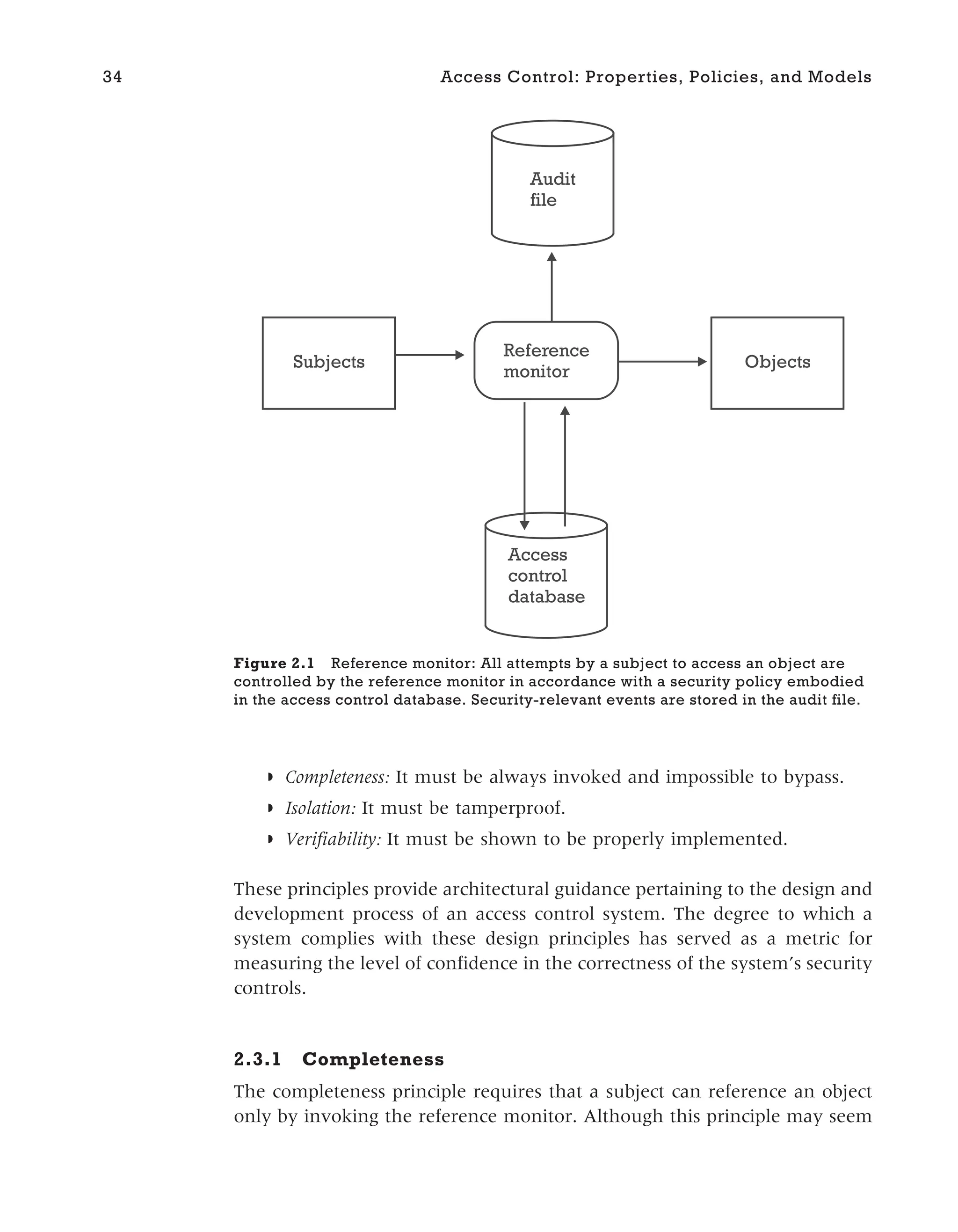
![techniques are applied in an attempt to prove the correctness of the kernel’s
implementation.
2.3.4 The reference monitor—necessary, but not sufficient
As an abstraction, the reference monitor concept does not charge a system
with enforcing any particular access control policy. It is the job of enter-
prises to articulate these requirements for their computer systems. From an
assurance perspective, the design principles of the reference monitor should
be viewed as a necessary prelude to assurance, but the reference monitor is
not sufficient. Even if all vendors were to rigorously adhere to the design
principles of the reference monitor, most enterprises have little control over
what policies are supported by the products they buy. Essentially, consum-
ers are forced to make do with the policy and access control management
decisions of their vendors. This book introduces three additional design
principles that are viewed by its authors as critical components of any access
control system. These principles are described as follows:
◗ Flexibility: The system should be able to enforce the access control pol-
icies of the host enterprise.
◗ Manageability: The system should be intuitive and easy to manage.
◗ Scalability: The system’s management and enforcement functions
should scale to the number of users and the number of resources that
are scattered across the computing platforms of the host enterprise.
By inserting these additional principles, we acknowledge that an access con-
trol system consists of more than a robust access mediation function, and
includes the properties of policy configuration, ease of use, and, to some
extent, interoperability.
2.4 Access control matrix
The access matrix has provided a framework for analyzing protection prop-
erties for over 30 years.
The state of an access control system is defined by a triple (S, O, A),
where S is the set of subjects, O is the set of objects, and A is an access
matrix, with rows corresponding to subjects and columns corresponding to
objects. An entry A[s, o] is a set of rights. Early models were developed by
researchers in support of operating system [2] and database management
system [3] protection requirements.
2.4 Access control matrix 37](https://image.slidesharecdn.com/role-basedaccesscontrolsecondeditionpdfdrive-250311062434-2e3fc82e/75/Role-Based-Access-Control-Second-Edition-PDFDrive-pdf-58-2048.jpg)
![Harrison, Ruzzo, and Ullman later [4] developed a more rigorous and
primitive version of an access matrix model to serve as a basis for specifying
and proving properties of protection systems in general. Under their model
subjects are processes and objects include both files and subjects. This access
matrix can be visualized by Figure 2.3 [4]. In general an access matrix is a
representation of permissions. An individual permission is a triple of the
form (s, r, o) where s and o are subjects and objects and r is a right belonging
to the protected system’s set of rights R. Typical rights may include read,
write, execute, and own.
Also included in the Harrison, Ruzzo, and Ullman model are both states
and state transitions where a state is defined by the current configuration of
the access matrix and state transitions are described by commands. Com-
mands are specified as a sequence of primitive operations that have the
effect of altering the access matrix. Harrison, Ruzzo, and Ullman defined six
primitive operations. The effects of these primitive operations are defined by
Table 2.1. Let op be a primitive operation, and let Q be a system state where
Q = (S, O, A). As such, by executing any op on A has the effect of changing
the state from Q = (S, O, A) to Q’ = (S’, O’, A’).
Associated with each primitive operation is a set of conditions. For
example, enter r into A[s, o], and enter r into the matrix at position A[s, o] if
s and o currently exist.
38 Access Control: Properties, Policies, and Models
o
s
Subjects
Subjects
Objects
Rights
Figure 2.3 An access matrix: Rows represent subjects and columns represent
objects, which include subjects. The A[s, o] entry are the rights subject s may
exercise on object o.](https://image.slidesharecdn.com/role-basedaccesscontrolsecondeditionpdfdrive-250311062434-2e3fc82e/75/Role-Based-Access-Control-Second-Edition-PDFDrive-pdf-59-2048.jpg)
![Primitive operations alone have limited power in expressing and manag-
ing access control policy as discrete, atomic “rights.” To apply primitive
operations in the creation and management of access control policies Harri-
son, Ruzzo, and Ullman defined the concept of a command. Commands
consisting of zero or more conditions and one or more primitive operations,
of the form:
c( 1
, , k
)
1
in [ s1
, o1
] and
2
in [ s2
, o2
] and
.
.
.
2.4 Access control matrix 39
Table 2.1 Primitive Operations
Operation Conditions New State
enter r into A[s, o] s∈S
o∈O
S’=S
O’=O
A’[s, o]=A[s, o] ∪{r}
A’[s1
, o1
]=A[s, o], where (s1
, o1
) ≠ (s, o)
delete r from A[s, o] s∈S
o∈O
S’=S
O’=O
A’[s, o]=A[s, o] −{r}
A’[s1
, o1
]=A[s, o], where (s1
, o1
)≠ (s, o)
create subject s’ s∉O S’=S∪{s’}
O’=O∪{s’}
A’[s, o]=A[s, o], where s∈S, o∈O
A’[s’, o]=∅, where o∈O’
A’[s, s’]=∅, where s∈O’
create object o’ o∉O S’=S
O’=O∪{o’}
A’[s, o]=A[s, o], where s∈S, o∈O
A’[s, o’]=∅, where s∈S’
destroy subject s’ s’∈S S’=S−{s’}
O’=O−{s’}
A’[s, o]=A[s, o], where s∈S’, o∈O’
destroy object o’ o’∈O
o’∉S
S’=S
O’=O−{o’}
A’[s, o]=A[s, o], where s∈S’, o∈O’](https://image.slidesharecdn.com/role-basedaccesscontrolsecondeditionpdfdrive-250311062434-2e3fc82e/75/Role-Based-Access-Control-Second-Edition-PDFDrive-pdf-60-2048.jpg)
![m
in [ sm
, om
]
then
1
2
.
.
.
n
where r1
, …, rm
are rights, s1
, …, sm
and o1
, …, om
are integers representing
subjects and objects.
Regarding a command, if the conditions are met the sequence of primi-
tive operations is executed, resulting in changes to the matrix. The parame-
ters of the command indicate which aspects of the matrix are to be changed,
and how. Let c(a1
, …, ak
) be a command with k actual parameters, and let Q
= (S, O, A) be a state of the protection system. Then Q transitions to state Q’
under c, which can be written as:
Q + c(a1
, …, ak
) Q’
Example
We now present a simple example that is similar to that which was pre-
sented in [4]. We assume subjects to be processes and the objects other than
subjects are files, where each file is “owned” by a process. Under this exam-
ple, the ownership of a file indicates the ability of the subject to grant or
revoke access rights to that file to/from other subjects. This concept is com-
mon in modern-day operating systems and is modeled by specifying that the
owner of a file has the right own to that file. Ownership is established
through creation of an object. Other rights in our example include read and
write.
Create a new file. The subject that creates a file gains ownership of the file
and read and write access to the file by the following command:
create object ( , )
into [ , ]
into A[ , ]
into A[ , ]
Note that the parameters of a command are specified formally. At execu-
tion time these parameters are replaced by actual parameters that are object
40 Access Control: Properties, Policies, and Models](https://image.slidesharecdn.com/role-basedaccesscontrolsecondeditionpdfdrive-250311062434-2e3fc82e/75/Role-Based-Access-Control-Second-Edition-PDFDrive-pdf-61-2048.jpg)
![names. The above command has two parameters s and o, four primitive
operations, create object o, enter own into A[s, o], enter read into A[s, o],
and enter write into A[s, o], where s is the subject that created o and o is the
object being created. Note that this command has no conditions. However,
per Table 2.1, the conditions for the primitive operation enter r into A[s, o]
specifies that that both s and o must exist prior to entering own, read, or write
into the matrix at position A[s, o], and primitive operation create object o
specifies that object o must not exist prior to its creation. Note that the order
in the execution of primitive operations is sometimes important. If create
object o was not executed first the conditions for enter r into A[s, o] would
fail.
Grant rights. Once object o is created, subject s may grant other subjects
access to object o by executing the following two commands:
grant-read( , 1
, )
in [ , ]
into [ 1
, ]
grant-write( , 1
, )
in [ , ]
into [ 1
, ]
Both of these commands have one condition; that is, prior to s granting
read or write to s1
, the own right must be included in A[s, o]. To abide by the
principle of attenuation of privilege, which states that a subject can never
transfer rights to another subject that it does not posses, we modify the two
grant commands by inserting a new condition:
grant-read( , 1
, )
in [ , ],
in [ , ]
into [ 1
, ]
grant-write( , 1
, )
in [ , ]
in [ , ]
into [ 1
, ]
Revoke rights. Under certain circumstances a subject may wish to revoke
access rights. In modeling this concept we assume that the owner of an object
may revoke a subject’s access rights to that object. Commands for revoking
2.4 Access control matrix 41](https://image.slidesharecdn.com/role-basedaccesscontrolsecondeditionpdfdrive-250311062434-2e3fc82e/75/Role-Based-Access-Control-Second-Edition-PDFDrive-pdf-62-2048.jpg)
![access rights are similar to commands for granting access rights; for example,
subject s may revoke read access from subject s1
with the following command:
revoke-read( , 1
, )
in [ , ]
from [ 1
, ]
2.5 Access control data structures
2.5.1 Capability lists and access control lists (ACLs)
Although an access control matrix is an interesting construct from a theoret-
ical perspective, for a system with a large number of users and objects, the
matrix will become very large and will be sparsely populated. As such, an
access control system is rarely implemented as a matrix but is almost always
implemented as a representation of the matrix. There are two primary rep-
resentations of the access control matrix as implemented in computer sys-
tems today: capability lists and ACLs.
Table 2.2 illustrates a simple access control matrix. The entries in the
matrix specify the operations of, or the type of access that each user has to,
each object. The basic function of an access control system is to ensure that
only the operations specified by the matrix can be executed.
In a capability system, access to an object is allowed if the subject that is
requesting access possesses a capability for the object. A capability is a pro-
tected identifier that both identifies the object and an operation to be
allowed to the subject that possesses the capability. This approach corre-
sponds to storing the matrix by rows. Table 2.3 presents the capability lists
corresponding to the access control matrix. Each subject is associated with a
capability list, which stores its approved operations to all concerned objects.
A subject possessing a capability is proof of the subject having the access
privileges. The principle advantage of capabilities is that it is easy to review
42 Access Control: Properties, Policies, and Models
Table 2.2 Example Access Control Matrix
Subject/
Object File_1 File_2 File_3 Process_1
Chris Read, write — Write —
Janet — Execute — Suspend
Barbara — Read Read —
Frank Read — — —](https://image.slidesharecdn.com/role-basedaccesscontrolsecondeditionpdfdrive-250311062434-2e3fc82e/75/Role-Based-Access-Control-Second-Edition-PDFDrive-pdf-63-2048.jpg)
![the sense that a user or subject given discretionary access to a resource is
capable of passing that information along to another subject. To provide this
discretionary control, DAC mechanisms usually include a concept of object
ownership, where the object’s “owner” has control permission to grant access
permission to the object for other subjects. This definition of DAC has its ori-
gins with the Trusted Computer Security Evaluation Criteria (TCSEC) [5] and
is rationalized based on the U.S. Department of Defense’s (DoD) regulatory
requirements for need-to-know access to classified or sensitive information:
“… no person may have access to classified information unless …access is
necessary for the performance of official duties.” By far the most common
mechanism for implementing DAC policies is through the use of ACLs.
DAC mechanisms tend to be very flexible and are widely used in com-
mercial and government sectors. Throughout the mid-1980s and 1990s,
many organizations considered DAC mechanisms to be the standard of due
care. During this period virtually every computer vendor demonstrated
DAC compliance by undergoing a C2 TCSEC (discretionary protection)
evaluation.
Even though DAC mechanisms are in wide commercial use today, they
are known to be inherently weak for two reasons: First, granting read access
is transitive. For example, when Chris grants Frank read access to a file,
nothing stops Frank from copying the contents of Chris’s file to an object
that Frank controls. Frank may now grant any other user access to the copy
of Chris’s file unbeknownst to Chris. Second, DAC mechanisms are vulnera-
ble to Trojan horse attacks. Because programs inherit the identity of the
invoking user, Frank may, for example, write a program for Chris that, on
the surface, performs some useful function, while at the same time reads the
contents of Chris’s files and writes the contents of the files to a location that
is accessible by both Chris and Frank. Frank may then move the contents of
the files to a location not accessible to Chris. Note that Frank’s Trojan horse
program could have destroyed the contents of Chris’s files. When investigat-
ing the problem, the audit files would indicate that Chris destroyed his own
files. What a dope!
2.7 MAC policies and models
In addition to DAC policies, the TCSEC defines MAC policies that are known
to prevent the Trojan horse problem. With regard to this policy, security lev-
els are assigned to users, with subjects acting on behalf of users and objects.
Security levels have a hierarchical and a nonhierarchical component. For
instance the hierarchical components might include “unclassified” (U),
2.7 MAC policies and models 45](https://image.slidesharecdn.com/role-basedaccesscontrolsecondeditionpdfdrive-250311062434-2e3fc82e/75/Role-Based-Access-Control-Second-Edition-PDFDrive-pdf-66-2048.jpg)
![“confidential” (C), “secret” (S), and “top-secret” (TS) while the
nonhierarchical components may include “NATO” and “NUCLEAR”. The
security levels are partially ordered under a dominance relation, often writ-
ten as “≥”. For example, TS ≥ S ≥ C ≥ U and S (NATO, NUCLEAR) ≥ S
(NUCLEAR) ≥ S. The security level of the user, often referred to as the
user’s clearance level, reflects the level of trust bestowed to the user and
must always dominate the security levels that are assigned to the user’s sub-
jects. For example, Chris, who is cleared to the S (NUCLEAR) level may ini-
tiate sessions at the S (NUCLEAR), S, C, or U levels.
The security levels that are assigned to objects, often referred to as the
object’s classification level, reflect the sensitivity of the contents of the
objects.
2.7.1 Bell-LaPadula model
With respect to the security level of a subject and the security level of an
object, the Bell-LaPadula model [6] defines access control decisions in accor-
dance with two properties:
◗ Simple security property: A subject is permitted read access to an object if
the subject’s security level dominates the security level of the object.
◗ Star property: A subject is permitted write access to an object if the
object’s security level dominates the security level of the subject.
Satisfaction of these properties prevents users from being able to read
information that dominates (i.e., is above) their clearance level. The simple
security property directly supports this policy, never allowing a subject to
read information that dominates the invoking user’s clearance level. The
star property supports the MAC policy indirectly, by disallowing subjects
from writing information of level x into a container (contents of an object)
that could be subsequently read by a subject with a security level that is
dominated by x. Intuitively, the star property prevents high information
from ending up in a low container where a low user could read it.
With respect to the Bell-LaPadula model it is important to distinguish a
user from her or his subjects. To illustrate this point consider a user Ralph,
who is cleared to the top-secret level. Ralph’s range of capabilities includes the
ability to read and write all objects.that his clearance level dominates
Ralph’s subjects, on the other hand, do not enjoy this same freedom.
Although we can trust Ralph not to leak top-secret information, we are not
able to levy such trust on Ralph’s subjects because subjects are typically
computer programs, which may be compromised. Therefore, for Ralph to
46 Access Control: Properties, Policies, and Models](https://image.slidesharecdn.com/role-basedaccesscontrolsecondeditionpdfdrive-250311062434-2e3fc82e/75/Role-Based-Access-Control-Second-Edition-PDFDrive-pdf-67-2048.jpg)
![successfully write to an object at, for example, the secret level, Ralph must
adjust his session to a level that is dominated by the secret security level of
the object (see Figure 2.4).
Now consider the case where Frank, who is cleared at the confidential
level, wishes to steal secret nuclear instructions using the same Trojan horse
program that he used to steal Chris’s files under the DAC policy. Frank once
again tricks Chris [who is cleared S, (NUCLEAR)], into invoking his mali-
cious software, this time while invoking a S, (NUCLEAR) session.
Although Frank’s Trojan horse will be able to successfully read the S,
(NUCLEAR) instructions, under the simple security property, the Trojan
horse will fail in its attempt to write the instructions to a location that is
accessible to Frank. Note, however, that Frank’s malicious program may still
destroy any of Chris’s files that are labeled at Chris’s session level or above.
If Chris invokes Frank’s software during an unclassified session, Frank, or
more accurately speaking, Frank’s program, is able to destroy all of Chris’s
files. The following model will deal with the problem of Frank’s program
being able to destroy Chris’s files.
2.8 Biba’s integrity model
Even though the Bell-LaPadula security model controls the writing of infor-
mation, its policy is to protect confidentiality (read protection). The multi-
level security policy does nothing to prevent unauthorized modification of
information. Soon after the Bell-LaPadula security model was introduced,
users quickly recognized that there was a need for a model with a property
similar to the star property to prevent a process at a higher security level
from reading lower-level objects without being negatively affected by
information at the lower security level.
The Biba integrity model [7] was introduced in 1977 not as an alterna-
tive but as an adjunct to the Bell-LaPadula model. As the Bell-LaPadula
2.8 Biba’s integrity model 47
UserTS
r,w
TS
S
C
U
r,w
r,w
r,w
SubjectT
r,w
r
r
r
Figure 2.4 User’s range of capabilities versus subject’s permitted accesses.](https://image.slidesharecdn.com/role-basedaccesscontrolsecondeditionpdfdrive-250311062434-2e3fc82e/75/Role-Based-Access-Control-Second-Edition-PDFDrive-pdf-68-2048.jpg)
![model pertains exclusively to confidentiality issues while ignoring integrity
issues, the Biba model (a dual of the Bell-LaPadula model) addresses integ-
rity issues while sacrificing confidentiality. Under Biba, read-and-write
restrictions are based on integrity levels (consisting of a higher hierarchical
and categorical component) assigned to subjects and objects. The integrity
level associated with a user indicates the user’s level of trust regarding mod-
ification of information at that level, and the integrity level associated with
an object reflects the object’s sensitivity regarding its modification. For
example, these may include “critical” (C), “important” (I), and “ordinary.”
The properties of the Biba model are similar to the Bell-LaPadula model
except that the dominance relations controlling read-and-write are
reversed. These relations are described as follows:
◗ Simple integrity property: A subject is permitted read access to an object
if the object’s security level dominates the security level of the subject.
◗ Integrity star property: A subject is permitted write access to an object if
the subject’s security level dominates the security level of the object.
In compliance with the properties of this model, writes from lower levels are
prohibited, as are reads from higher levels to lower levels.
2.9 The Clark-Wilson model
While the TCSEC did a great deal to spur research and development of com-
puter security products, most of the commercial world recognized that it
was of limited benefit for their operations. Clark and Wilson documented
the differences between commercial and military security requirements in
detail in 1987 [8], arguing that the primary concern for most commercial
applications is integrity, rather than secrecy. For example, the 600-year-old
principle of double-entry bookkeeping helps to ensure the accuracy and
integrity of accounts by requiring that every credit entry be matched by a
debit entry to ensure a balance between the source and destination of funds.
Integrity in the computer security context refers to the accuracy and
authenticity of information, as well as the need to ensure that objects are
modified only in authorized ways by authorized personnel.
Clark and Wilson documented a generalized view of commercial security
policies, showing how they differed from the military-oriented policies that
are the focus of the TCSEC. They proposed two principles as most important
in ensuring information integrity: well-formed transactions and SoD.
Well-formed transactions constrain the ways in which users can modify
48 Access Control: Properties, Policies, and Models](https://image.slidesharecdn.com/role-basedaccesscontrolsecondeditionpdfdrive-250311062434-2e3fc82e/75/Role-Based-Access-Control-Second-Edition-PDFDrive-pdf-69-2048.jpg)
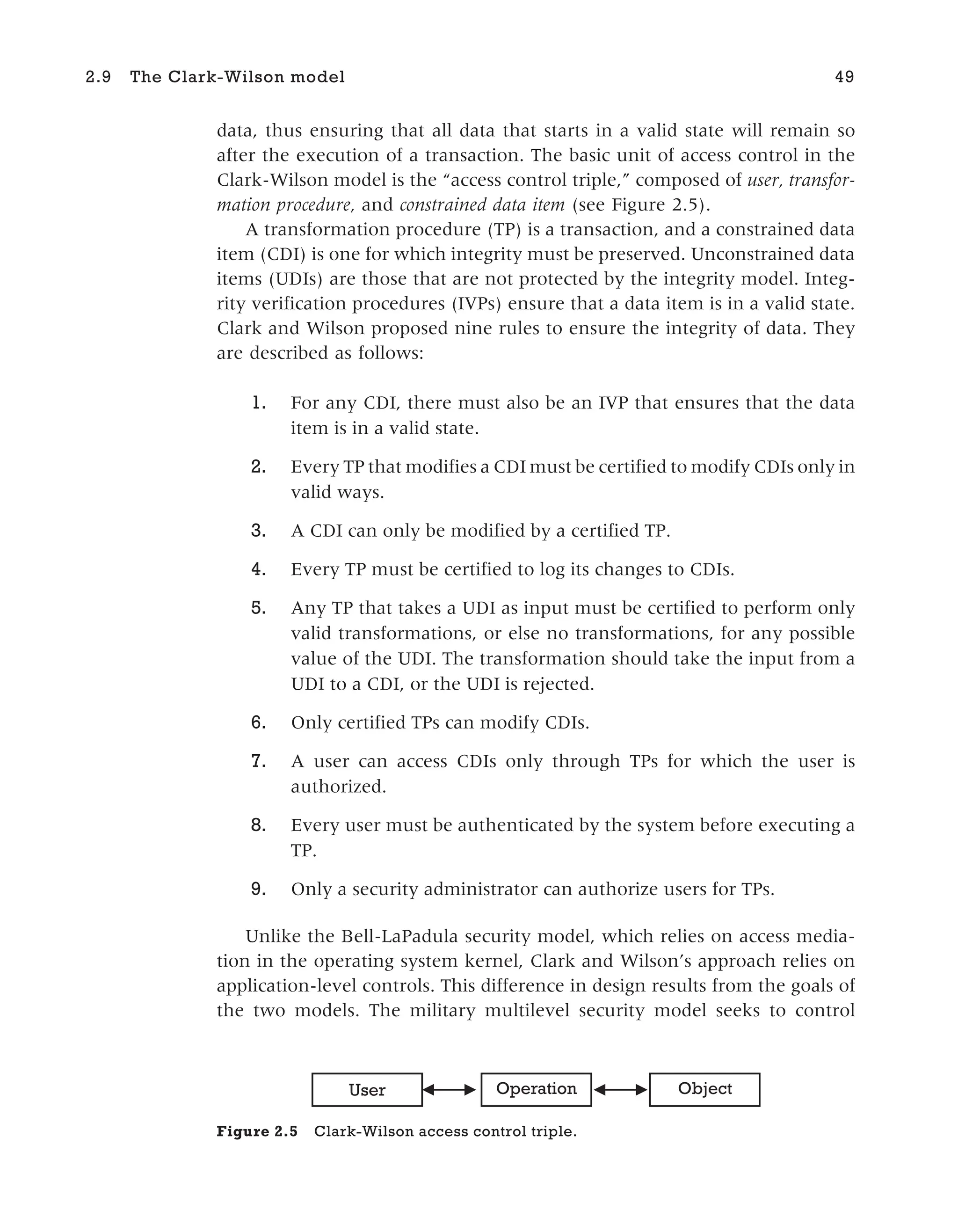
![information flow, which can be defined in terms of low-level
read-and-write operations. The commercial integrity model, as defined by
Clark and Wilson, must ensure that information is modified only in autho-
rized ways by authorized people, a requirement that is impossible to meet
using only control over kernel-level operations. The importance of control
over transactions, as opposed to simple read-and-write access, can be seen
by considering typical banking transactions. Tellers may execute a savings
deposit transaction, requiring read-and-write access to specific fields within
a savings file and a transaction log file. An accounting supervisor may be
able to execute correction transactions, requiring exactly the same
read-and-write access to the same files as the teller. The difference is the
process executed and the values written to the transaction log file.
SoD is another major component of the Clark and Wilson model that
contributes to integrity, preventing authorized users from making improper
modifications. This goal is achieved indirectly by separating all operations
into multiple subparts and requiring that a different person perform each
subpart. The process of purchasing and paying for some item, for example,
might involve authorizing a purchase order, recording the arrival of the
item, recording the arrival of the invoice, and authorizing payment. The last
step should not be performed unless the previous three have occurred. If a
different person performs each step, improper modification should be
detected and reported, unless some of these people conspire. If one person
can execute all of these steps, then fraud is possible—an order is placed and
payment made to a fictitious company without any actual delivery of an
item. In such a case, the books appear to balance; the error is in the
correspondence between real and recorded inventory.
2.10 The Chinese wall policy model
The Chinese wall policy is simple and easy to describe; however, as we will
see, its implementation and deployment are less straightforward. Brewer
and Nash [9] identified the policy to address conflict-of-interest issues
related to consulting activities within banking and other financial disci-
plines. Like Clark-Wilson, the Chinese wall policy is application-specific in
that it applies to a narrow set of activities that are tied to specific business
transactions. The stated objective of the Chinese wall policy is to prevent
illicit flows of information that can result in a conflict of interest. Consul-
tants naturally are given access to proprietary information to provide a
service for their clients. When a consultant gains access, for example,
to the competitive practices of two banks, the consultant gains
50 Access Control: Properties, Policies, and Models](https://image.slidesharecdn.com/role-basedaccesscontrolsecondeditionpdfdrive-250311062434-2e3fc82e/75/Role-Based-Access-Control-Second-Edition-PDFDrive-pdf-71-2048.jpg)
![Under the write rule, subject S can write object O only if the following
are true:
◗ S can read O under the read rule.
◗ No object can be read within a different company dataset than the
one for which write access is requested.
Note that the Brewer-Nash rules do not make a distinction between
users and subjects, as does the Bell-LaPadula model, but instead recognizes
subjects to include both users and the processes that are acting on behalf of
the user. However, similar to Bell-LaPadula, the Brewer-Nash rule for writ-
ing takes into consideration the possibility of a Trojan horse.
In illustrating the need for the write rule, consider the case in which
Chris has read access to energy company A objects and read-and-write
access to bank B objects, and Frank has read access to energy company A
and bank B objects. A Trojan horse program running with Chris’s privileges
may read bank A objects and write to energy company B objects, giving
Frank read access to both bank A and bank B objects.
It is also interesting to note the temporal differences between these two
models. With respect to Bell-LaPadula, the policies regarding reading and
writing are applied within the life span of a subject-user session. With
respect to the Brewer-Nash model, the policy regarding reading applies for
the life of the user. Once a user reads an object from a company data set, the
user is forever precluded from reading an object from the data set of another
company belonging to the same COI.
2.12 Domain-type enforcement (DTE) model
The domain-type enforcement (DTE) model is an abstraction of the con-
cepts involved in the DTE mechanism. The DTE mechanism [10], in turn, is
an enhanced type enforcement (TE) mechanism, which is a table-oriented
access control mechanism developed by Boebert and Kain in the 1980s [11]
in support of the Bell-LaPadula MAC model. In particular the DTE mecha-
nism has been used in firewalls [12] and operating systems [13] and has
been shown to support a variety of security policies expressible through
RBAC models [14].
The DTE model, like many other access control models, divides the com-
puterized system into two logical entities: subjects and objects. Subjects are
active entities (usually processes). Objects are passive entities (e.g., files,
directories, devices, and memory segments). A domain is associated with a
52 Access Control: Properties, Policies, and Models](https://image.slidesharecdn.com/role-basedaccesscontrolsecondeditionpdfdrive-250311062434-2e3fc82e/75/Role-Based-Access-Control-Second-Edition-PDFDrive-pdf-73-2048.jpg)
![subject. A type is associated with an object. The assignment of a “domain”
label for a subject generally depends upon its function (e.g., a business pro-
cess transaction). An object is assigned a type based on its integrity require-
ments. Access control permissions are associated with both domains and
types. This gives rise to two groups of permissions: domain-domain permis-
sions and domain-type permissions. Each of these two groups of permis-
sions is represented using corresponding table types. The domain-domain
access control table (DDAT) is a two-dimensional table with an entry for
each ordered pair of domains. Similarly, the domain-type access control
table (DTAT) is a two-dimensional table with an entry for each (domain,
type) pair. Since there can be more than one permission associated with a
domain-domain pair or domain-type pair, each entry in these tables is a
subset of the permissions. All the entries in these two types of tables
together constitute the DTE database for an environment.
Examples of domain-domain permissions (in the context of a UNIX
operating system) are create (C) and kill (K). Examples of domain-type per-
missions are read (R), write (W), execute (E), and browse directory (T). The
semantics of domain-type permissions should be self-evident. The
domain-domain permissions are created to express allowed interactions
between subjects. For example, a subject A (process A) can create an
instance of another process (process B) only if there exists a create entry
between subject A’s domain and subject B’s domain.
The DDAT and DTAT tables in DTE are conceptually similar to the access
control matrix. However, DTE considerably reduces table entries by group-
ing subjects into domains and objects into types before specifying access
control permissions.
Several comparisons can be made between the concepts of the DTE
model and the RBAC model. RBAC ties users to roles and describes how a
role limits the operations available to a user. DTE ties subjects to domains
and describes how a domain limits the operations available to a subject. It is
these similarities in concepts that have been utilized by Hoffman [14] to
implement RBAC-expressible policies in the DTE-based secure operating
system LOCK. Specifically RBAC model entities have been mapped to DTE
model entities and the underlying DTE mechanism then facilitates imple-
mentation of the RBAC policy. Hoffman’s implementation takes a set of
roles, a set of users, and user-role assignments and links them to DTE model
entities like as subjects and domains. Each subject is assigned a role, and
users are associated with a subject. For every subject, the role of the subject
must be an authorized role for the subject’s user. Similarly, a set of domains
is associated with a role. Since a subject is already associated with a role, the
domain of a subject should be in the set of domains authorized for the role.
2.12 Domain-type enforcement (DTE) model 53](https://image.slidesharecdn.com/role-basedaccesscontrolsecondeditionpdfdrive-250311062434-2e3fc82e/75/Role-Based-Access-Control-Second-Edition-PDFDrive-pdf-74-2048.jpg)
![Thus, by constraining subject-role association and user-subject association
using the user-role assignments of the RBAC model and by constraining the
subject-domain association using the role-domain assignment, a DTE model
can be made to implement the policies represented by a simple RBAC
model. Furthermore, the abstract set of permissions associated with a role
takes a concrete form when roles are assigned to domains, since the
domains in a DTE model encapsulate the processes relevant to a platform
(e.g., daemons, file systems, and system utilities in an operating system).
Since domains are associated with other domains and object types through
DDAT and DTAT table entries, the specification of permissions associated
with a role becomes complete.
References
[1] Anderson, J. P., Computer Security Technology Planning Study Volume II,
ESD-TR-73-51, Electronic Systems Division, Air Force Systems Command,
Hanscom Field, Bedford, MA, October 1972.
[2] Lampson, B., “Protection,” Proc. 5th Princeton Symp. of Info. Sci. and Syst., March
1971, pp. 437–443.
[3] Conway, R. W., W. L. Maxwell, and H. L. Morgan, “On the Implementation of
Security Measures in Information Systems,” Comm. ACM, Vol. 15, No. 4, April
1972, pp. 211–220.
[4] Harrison, M. A., W. L. Ruzzo, and J. D. Ullman, “Protection in Operating
Systems, “ Comm. ACM, Vol. 19, No. 8, August 1976, pp. 461–471.
[5] DoD National Computer Security Center, Department of Defense Trusted Computer
Systems Evaluation Criteria, December 1985, DoD 5200.28-STD.
[6] Bell, D. E., and L. J. LaPadula, Secure Computer Systems: Mathematical Foundations
and Model, Bedford, MA: The Mitre Corporation, 1973. See also D. E. Bell and
L. J. LaPadula, Secure Computer System: Unified Exposition and MULTICS
Interpretation, MTR-2997 Rev. 1, Bedford, MA: The MITRE Corporation, March
1976; also ESD-TR-75-306, rev. 1, Electronic Systems Division, Air Force
Systems Command, Hanscom Field, Bedford, MA.
[7] Biba, K. J., Integrity Considerations for Secure Computer Systems, Bedford, MA: The
MITRE Corporation, 1977.
[8] Clark, D. D., and D. R. Wilson, “A Comparison of Commercial and Military
Computer Security Policies,” IEEE Symposium of Security and Privacy, 1987, pp.
184–194.
[9] “The Chinese Wall Security Policy,” Proc. IEEE Computer Society Symposium on
Research in Security and Privacy, April 1989, pp. 215–228.
54 Access Control: Properties, Policies, and Models](https://image.slidesharecdn.com/role-basedaccesscontrolsecondeditionpdfdrive-250311062434-2e3fc82e/75/Role-Based-Access-Control-Second-Edition-PDFDrive-pdf-75-2048.jpg)
![[10] Badger, L., et al., “A Domain and Type Enforcement Prototype,” Usenix
Computing Systems Volume 9, Cambridge, MA, 1996.
[11] Boebert, W., and R. Kain, “A Practical Alternative to Hierarchical Integrity
Policies,” Proc. of 8th National Computer Security Conference, October 1985.
[12] Ostendorp, K. A., et al., “Domain and Type Enforcement Firewalls,” DARPA
Information Survivability Conference and Exposition, 2000, DISCEX ‘00, Vol. 1,
1999, pp. 351–361.
[13] Tidswell, J., and J. Potter, An Approach to Dynamic Domain and Type Enforcement,
Microsoft Research Institute, Department of Computing, Macquarie
University, NSW, Australia, 2000.
[14] Hoffman, J., “Implementing RBAC on a Type-Enforced System,” Proc. of 13th
Annual Computer Security Applications Conference, December 1997.
[15] Saltzer, J. H., and M. D. Schroeder, “The Protection of Information in
Computer Systems,” Proc. IEEE, Vol. 63, No. 9, September 1975, pp.
1278–1308.
2.12 Domain-type enforcement (DTE) model 55](https://image.slidesharecdn.com/role-basedaccesscontrolsecondeditionpdfdrive-250311062434-2e3fc82e/75/Role-Based-Access-Control-Second-Edition-PDFDrive-pdf-76-2048.jpg)

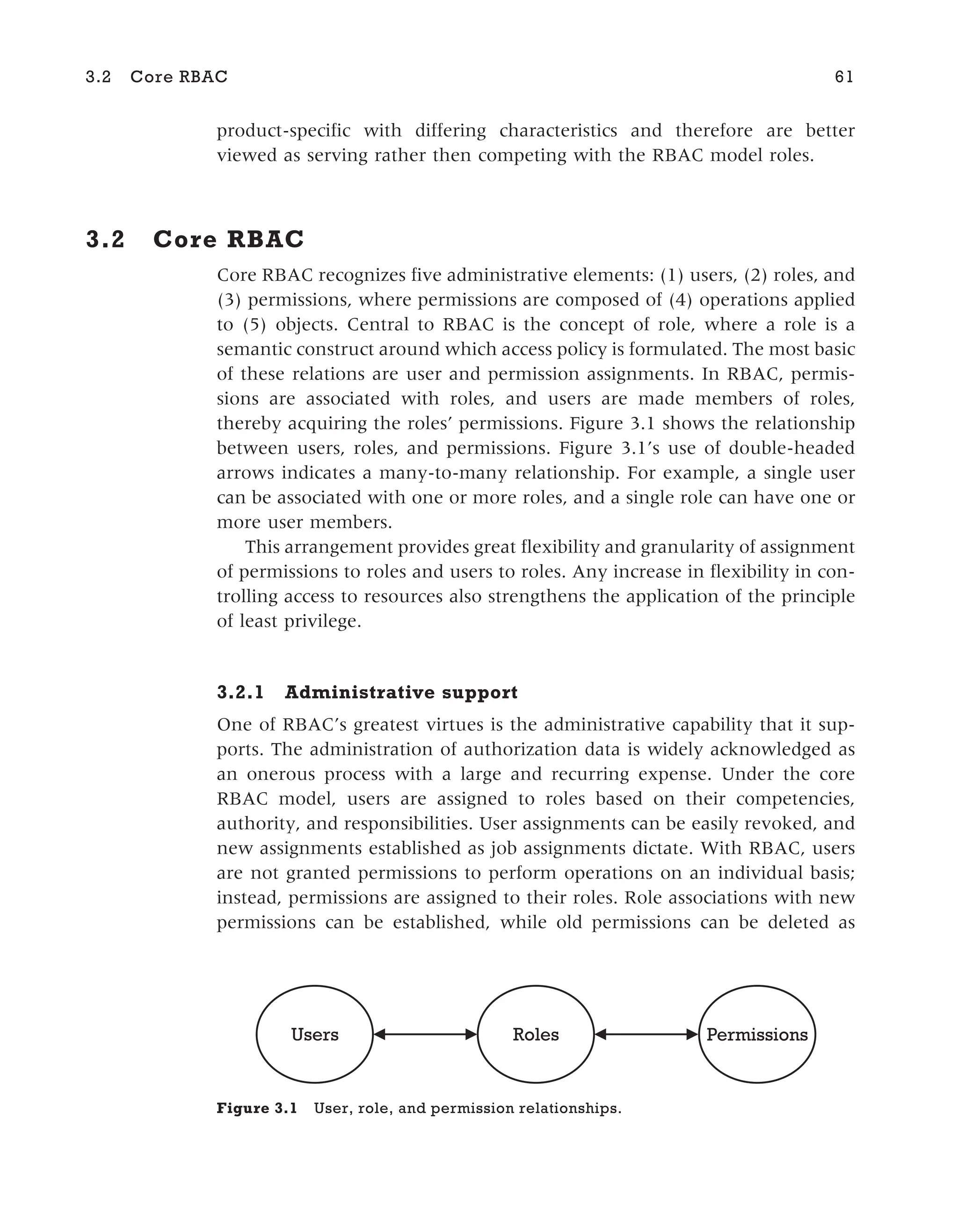
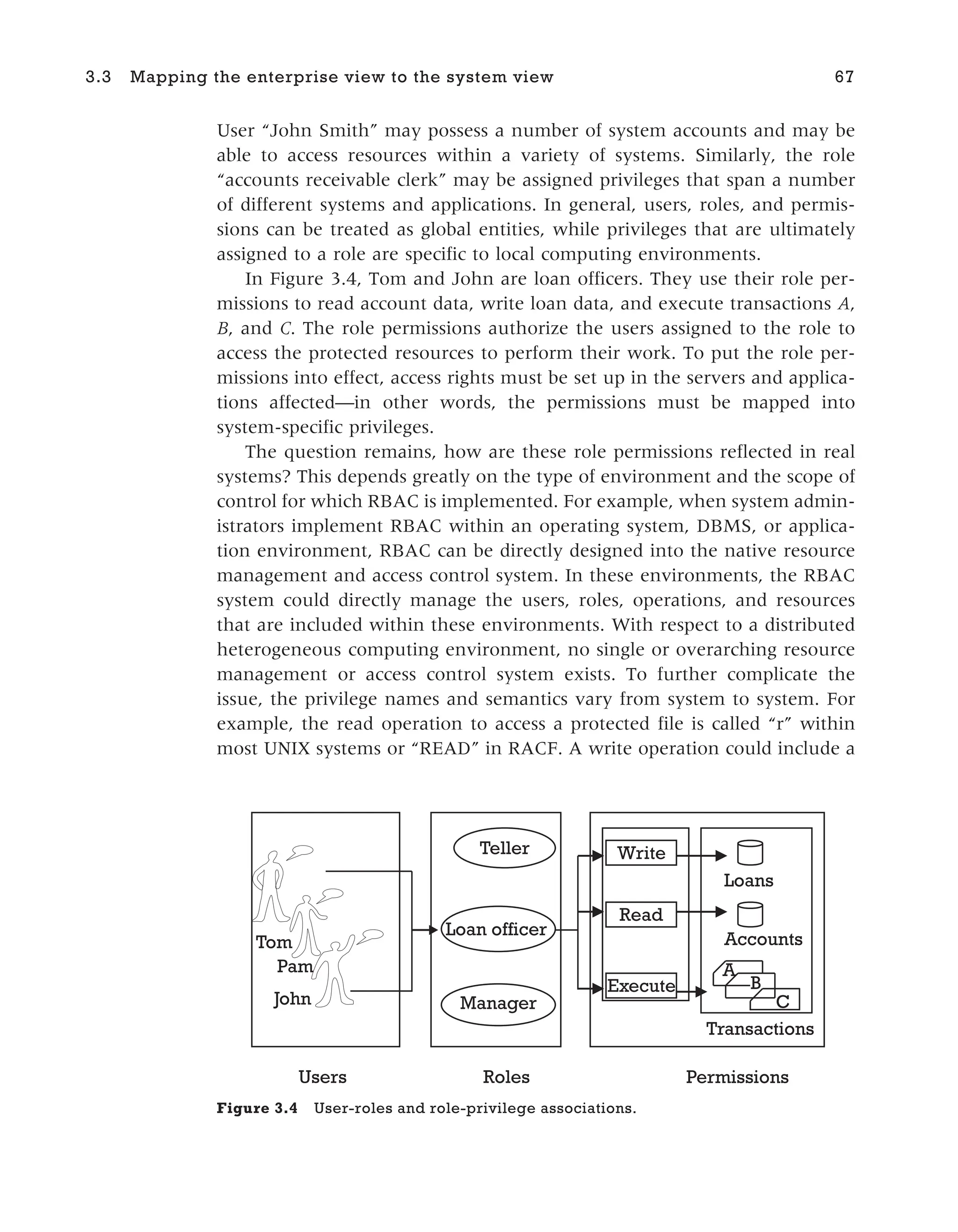
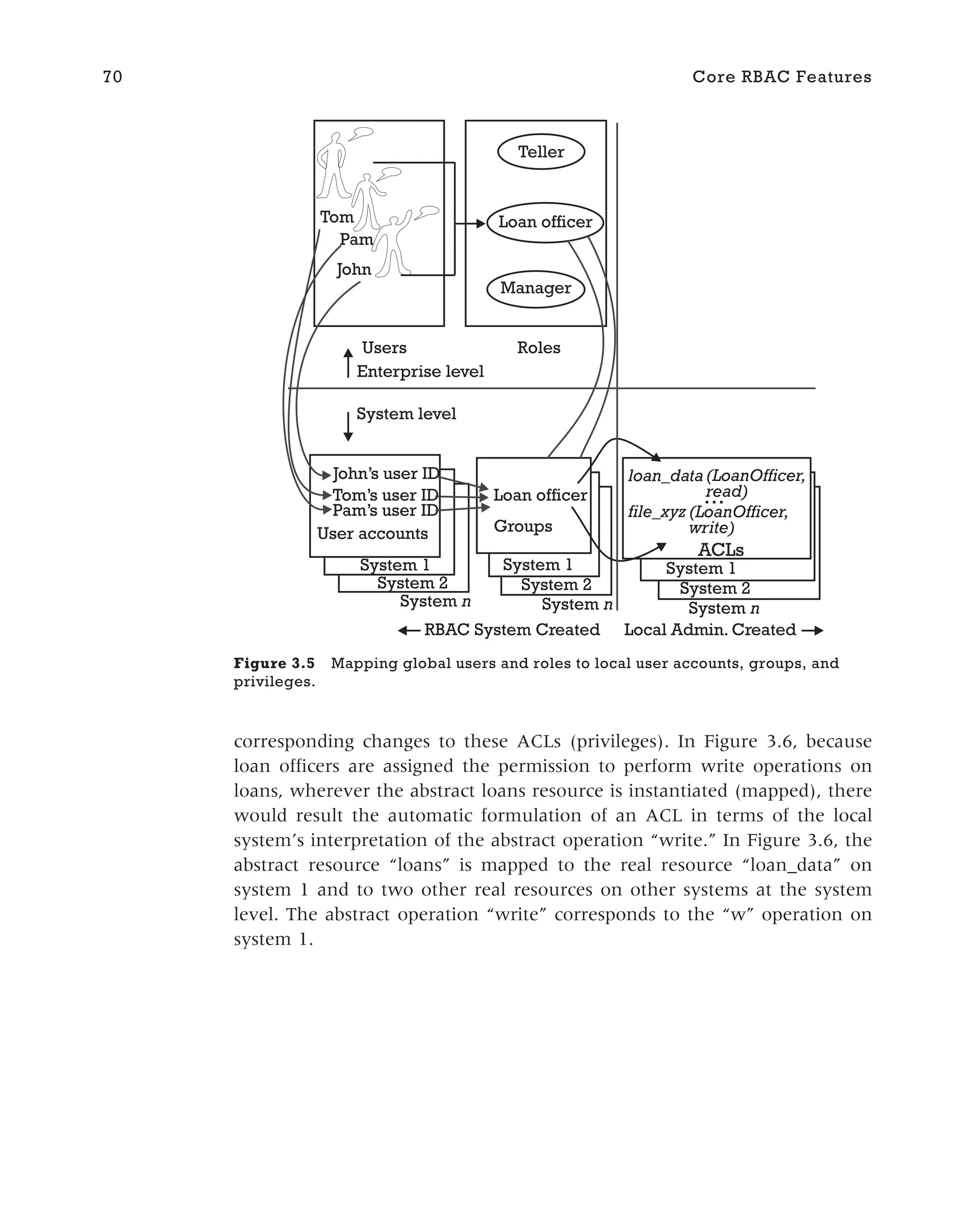
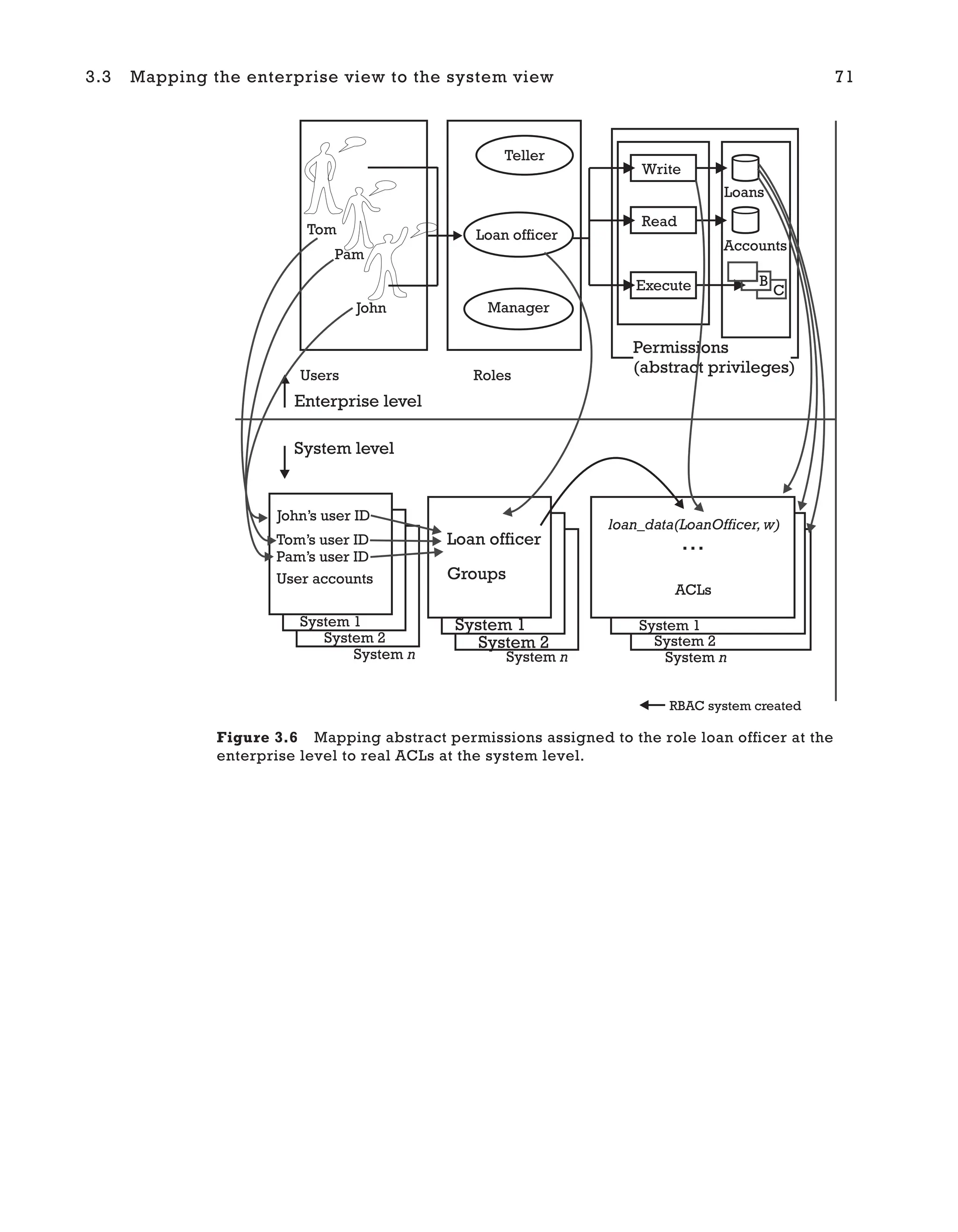

![benefits include increased administrative productivity in the distribution,
review, and revocation of permissions as well as the ability to better specify
and analyze access control policies.
This chapter investigates the technical aspects of role hierarchies that
have been included within various RBAC models [1–3], permission man-
agement schemes [4, 5], and product offerings. In addition, we discuss the
practical uses of role inheritance relations in building organizational func-
tions and business structures [6] for the formulation and management of
privilege distribution policies.
4.1 Building role hierarchies from flat roles
The motivation for role hierarchies is the observation that individual roles
within an organization often have overlapping functions; that is, users
belonging to different roles may be authorized for common permissions. In
extreme circumstances, there are general functions performed by all or most
users within a department or enterprise. For example, general permissions
may relate to the ability to download e-mail, access an internal Web site, or
fill out and submit a travel voucher. In the absence of role hierarchies, it is
inefficient and administratively cumbersome to specify these general per-
missions repeatedly for a large number of roles, or to assign large numbers
of users to general roles. In the presence of a role hierarchy, the collection of
permissions that comprise a job function can be defined by multiple subor-
dinate roles, each of which may be reused in the sharing of common per-
missions and formulation of other roles.
To illustrate the potential for overlapping permissions and functions con-
sider five typical roles within a hospital—resident, physician, cardiologist,
oncologist, and accounts receivable clerk. Because the cardiologist and
oncologist are both physicians, it is reasonable to assume that all of the per-
missions that are assigned to the physician would also be assigned to the
cardiologist and oncologist roles. From an authorization management per-
spective, each permission assigned to the physician role would also have to
be assigned to the cardiologist and oncologist roles. In addition, because a
resident performs many of the duties of a physician, the permissions that are
assigned to the resident role would also need to be assigned to the physician
role, while the physician role may be assigned additional permissions that
are not assigned to the resident role. Although the cardiologist and
oncologist roles may be assigned a common set of permissions, each of these
roles would also include a unique and disjoint set of permissions for the
respective specialty. Finally, because the duties that pertain to the accounts
74 Role Hierarchies](https://image.slidesharecdn.com/role-basedaccesscontrolsecondeditionpdfdrive-250311062434-2e3fc82e/75/Role-Based-Access-Control-Second-Edition-PDFDrive-pdf-95-2048.jpg)
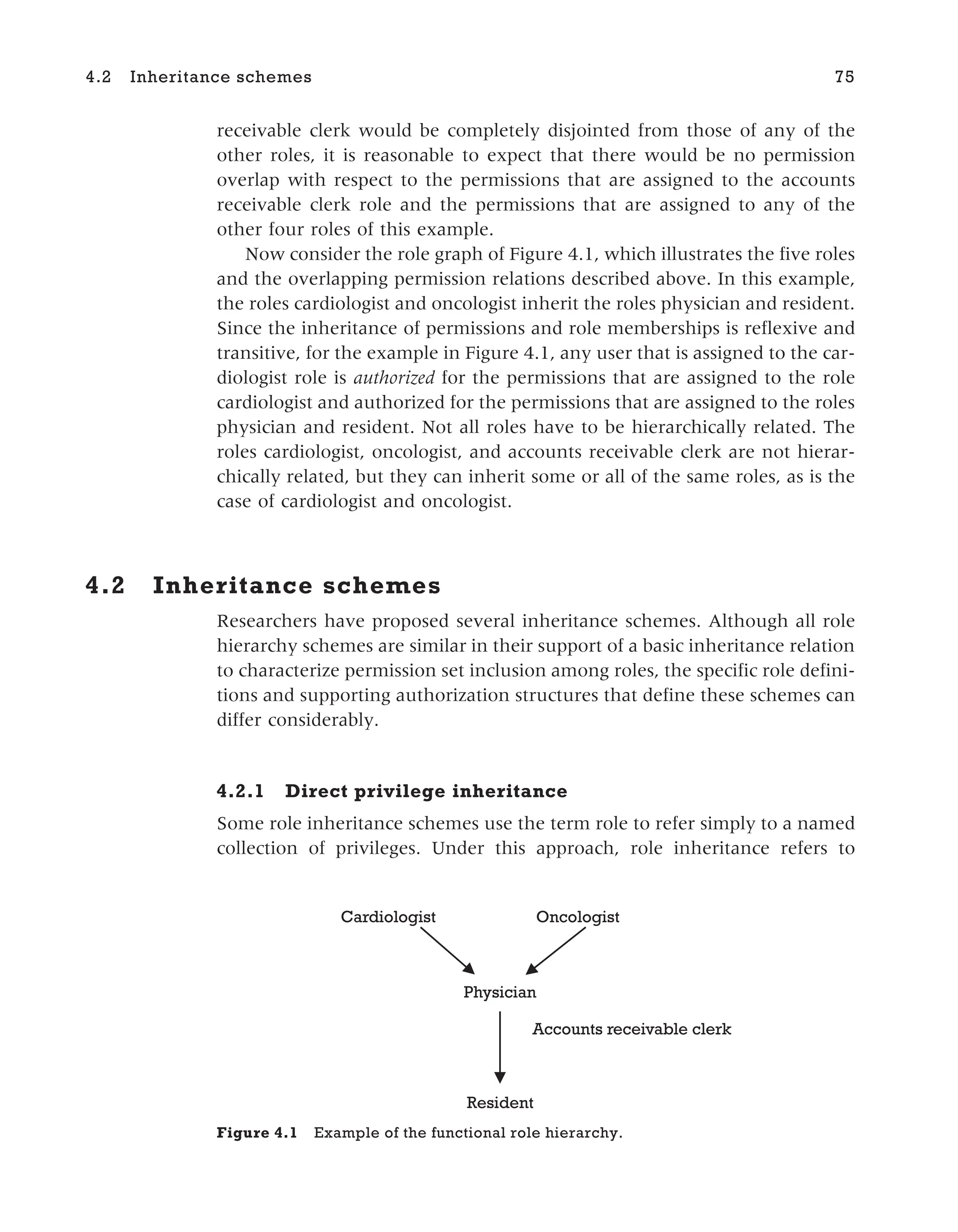
![permission subsetting [3, 4] (i.e., r1
“inherits” role r2
if all permissions of r2
are also permissions of r1
). Note that a role exists as an entity separate from
and independent of the role holder. As such, users and groups of users are
free to be administered separately. Assigning users or groups to roles grants
the users or members of the groups authorization to the permissions defined
by the role. For example, Baldwin’s approach [4] makes use of a permission
graph (Figure 4.2) that includes function, role, and user-group nodes. Any
path from a user-group node to a functional node implies that the user is
authorized to perform the privileges encapsulated by the functional node.
Because users must be assigned to groups, the user-group node in Figure 4.2
includes the subnodes user and group, where users may be assigned
to groups, or users may be assigned directly to roles. Although roles may
be globally defined within an enterprise or organization, permissions are
system-specific. For this reason, direct permission inheritance schemes are
often implemented as part of a closed management system such as that of a
DBMS. Within these systems, the resources and operations that are used in
the formulation of permissions and assigned to roles all belong to a single
class of operations and resources.
4.2.2 Permission and user membership inheritance
Another inheritance scheme uses the term role to refer to a structure that
includes both users and permissions [5]. Under this scheme, a role in the
role hierarchy serves both as a collection of permissions on one side and a
collection of users on the other side (Figure 4.3). The roles toward the top of
the hierarchy or role graph represent the more powerful roles (i.e., those
76 Role Hierarchies
Groups
Users
User/groups Roles Functions
Figure 4.2 Baldwin’s privilege graph.](https://image.slidesharecdn.com/role-basedaccesscontrolsecondeditionpdfdrive-250311062434-2e3fc82e/75/Role-Based-Access-Control-Second-Edition-PDFDrive-pdf-97-2048.jpg)
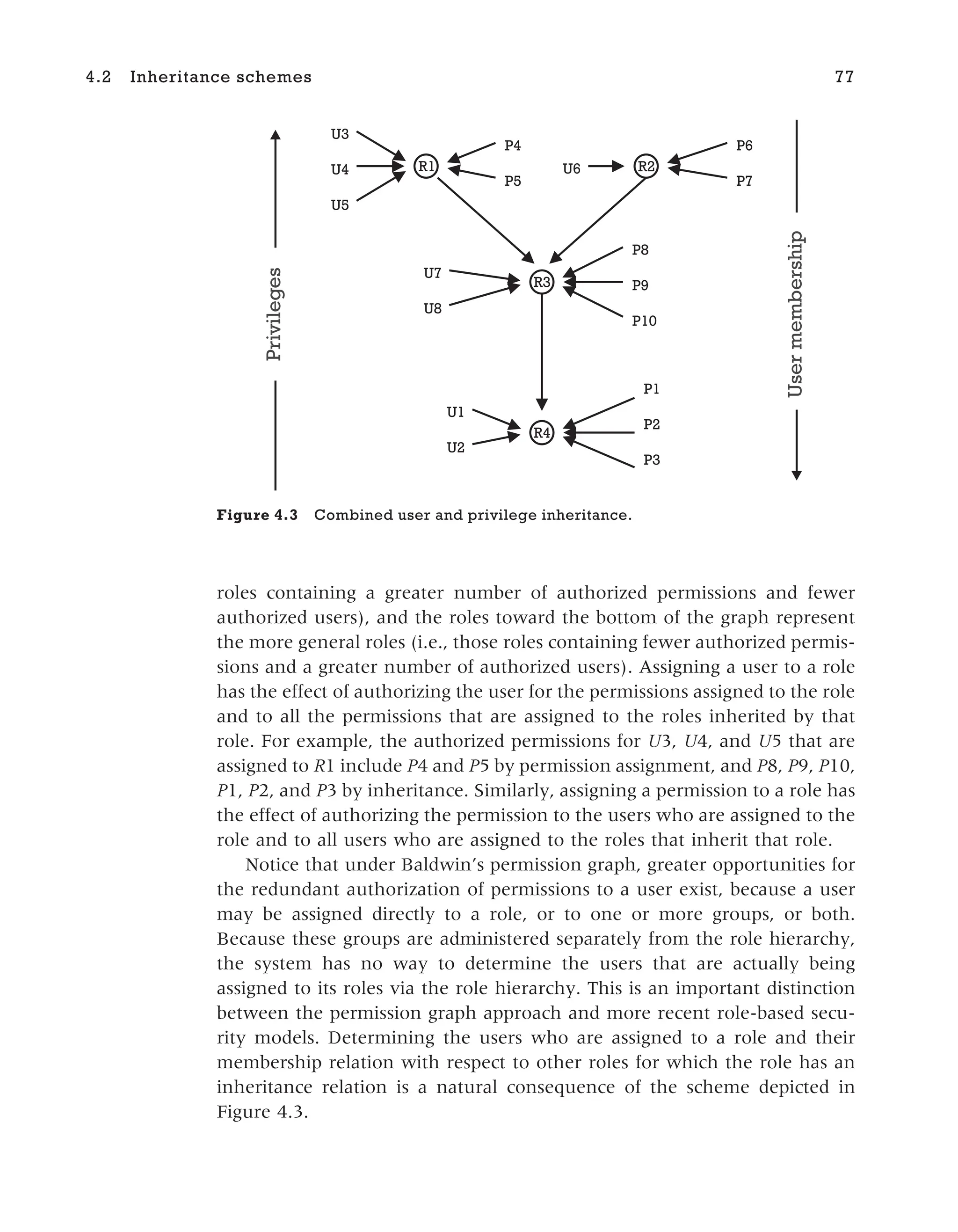
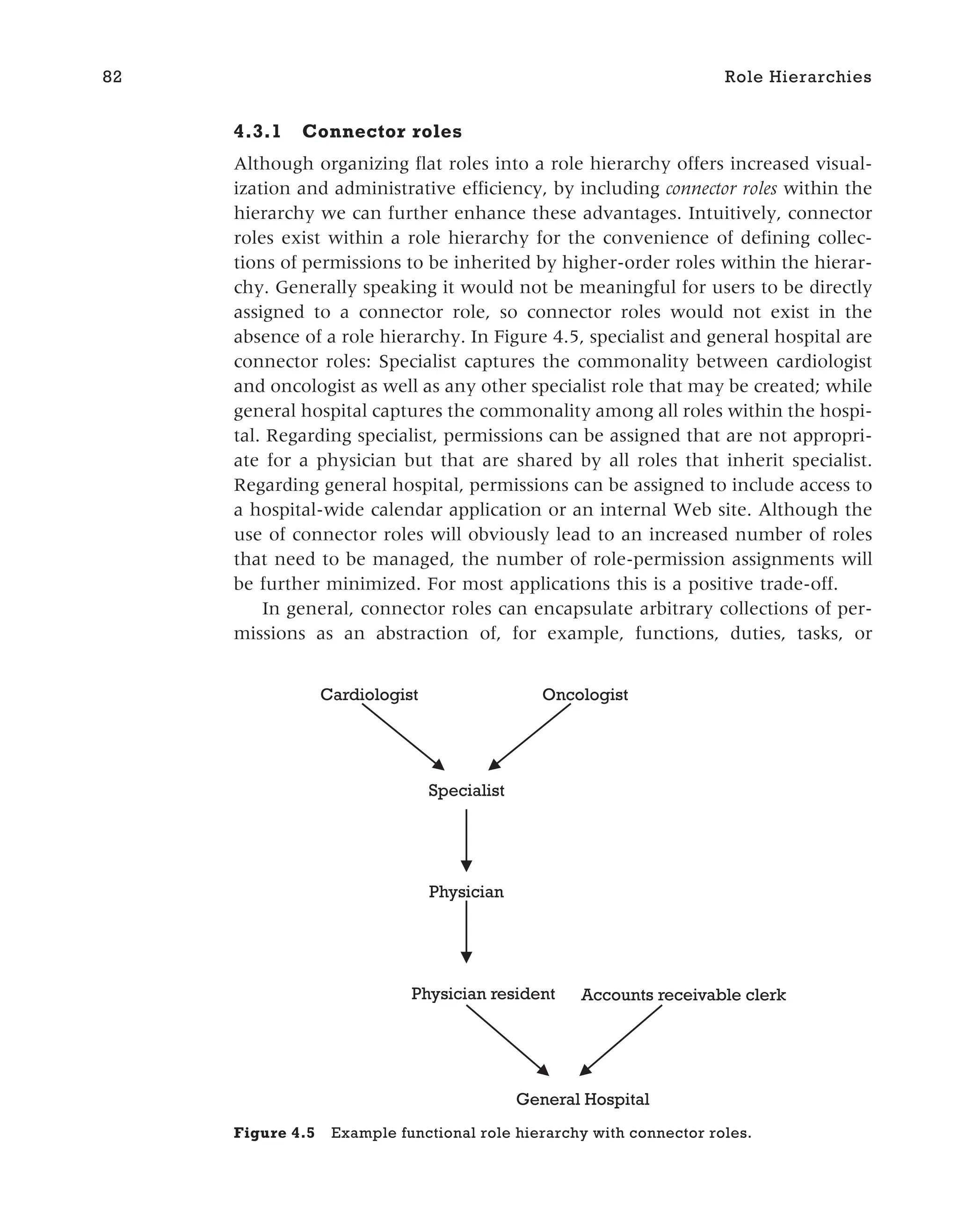
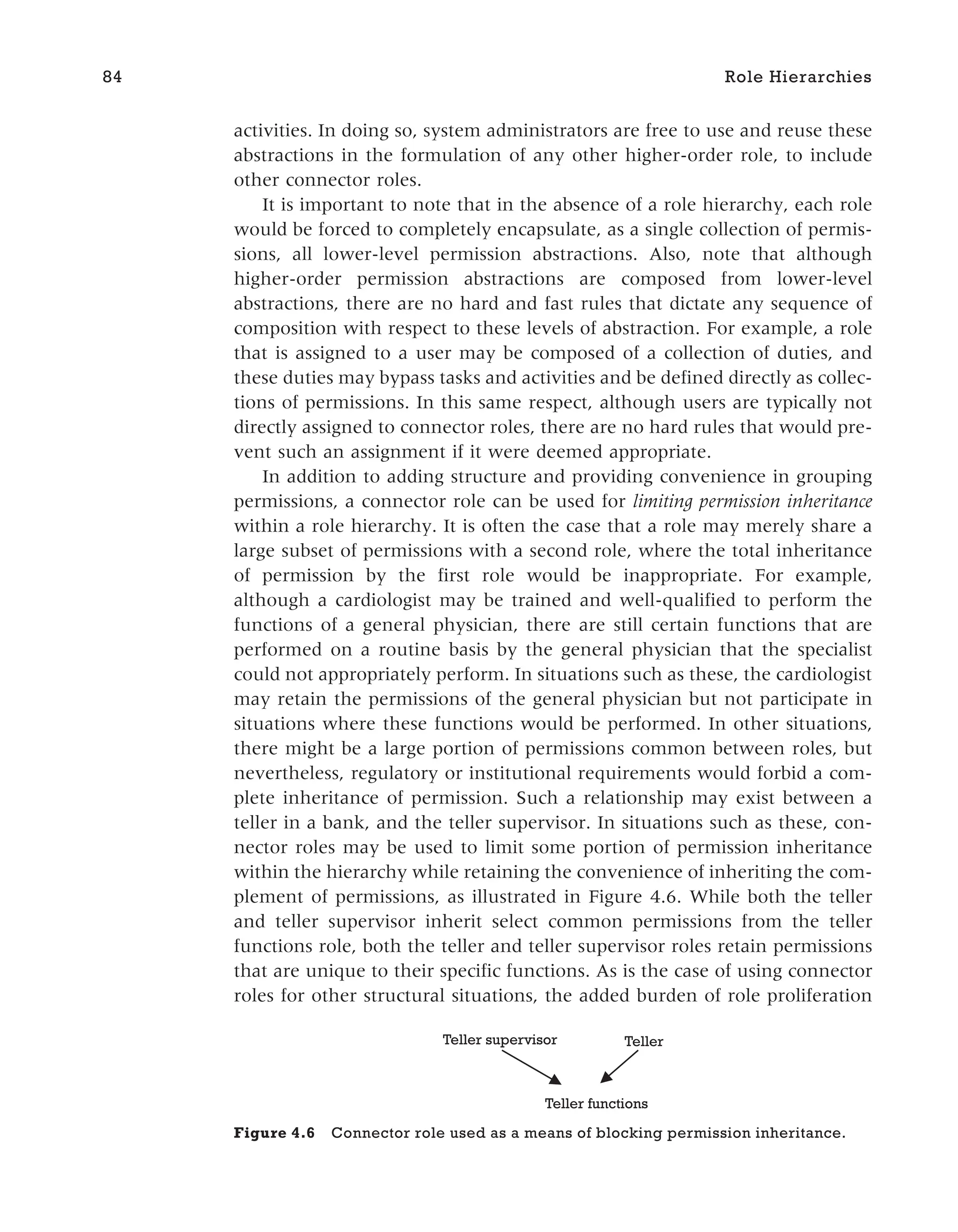
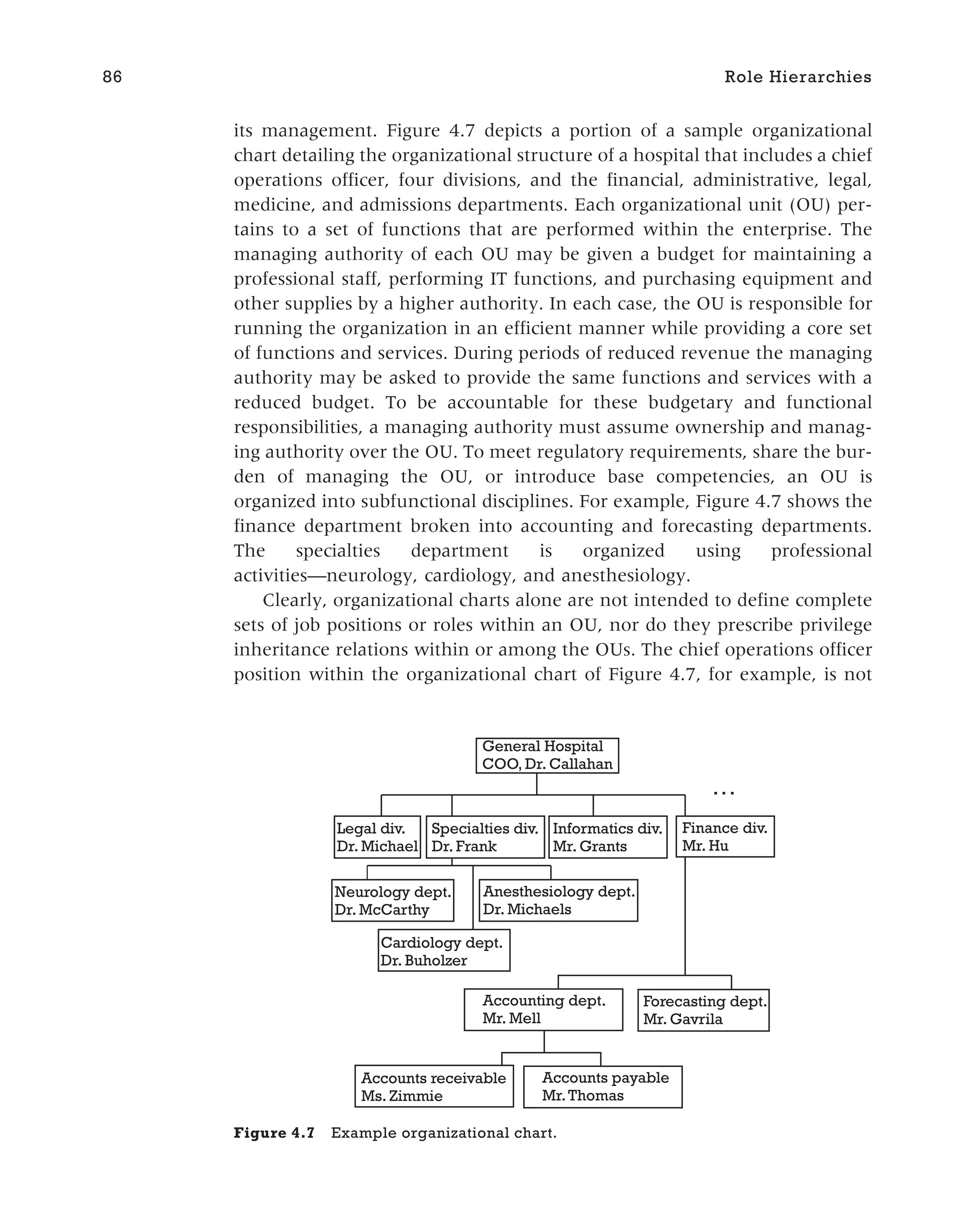
![meant to infer the ability to perform all enterprise functions and access to all
enterprise resources [6]. However, OUs can assist in defining roles and rep-
resent collections of functions and users; as such, they are valuable struc-
tures in contributing to the overall strategy of distributing and managing of
privileges within the enterprise. For instance, OUs often assume ownership
of resources to include servers, databases, and devices. Most users within an
enterprise belong to or are guests within a specific OU and as such are selec-
tively given access to the resources that are owned by the unit. It is the local
administrators—closer to the day-to-day operations of an OU—who are best
suited for making these access control decisions.
Furthermore, OUs help in defining the business processes and work
flows that RBAC helps in creating. For instance, travel orders that are
requested within an OU may need to be approved by the managing author-
ity within the business unit. A purchase request under $2,500 may be
approved by a department manager, while requests for purchases at or over
$2,500 may need approval at the division level.
OUs can be viewed as containers of users, roles, and resources. Thus,
they can be used for defining specific roles or role types within the context
of the OU. The cardiology department may include a number of cardiology
specialists including physicians, cardiologists, and various types of nurses.
When these functional roles are placed within the cardiology department
they gain access to the resources that are owned and managed by the
department. Their specific accesses are governed and are often regulated by
the competencies and duties that are inferred from the roles. For example, a
nurse practitioner (NP) may have the capability to perform a diagnosis and
prescribe medicine as a consequence of being an NP; an NP within the cardi-
ology department may be provided the additional capability to access
patient records and add entries to the treatment history of patents that are
being treated within the department.
Systems administrators can also create specific types of security adminis-
trative roles. For example, a security administrative role may be created and
given permission to assign users to the collection of roles that are contained
within the cardiology department. Application or system administrators
may assign privileges to the cardiology department roles by selectively speci-
fying access rights to the resources that they are responsible for managing.
4.3.3 Geographical regions
Many enterprises are organized and locally managed with respect to geo-
graphical regions. While they are usually required to adhere to specific stan-
dards, in many cases, a regional operation can be independently responsible
4.3 Hierarchy structures and inheritance forms 87](https://image.slidesharecdn.com/role-basedaccesscontrolsecondeditionpdfdrive-250311062434-2e3fc82e/75/Role-Based-Access-Control-Second-Edition-PDFDrive-pdf-108-2048.jpg)
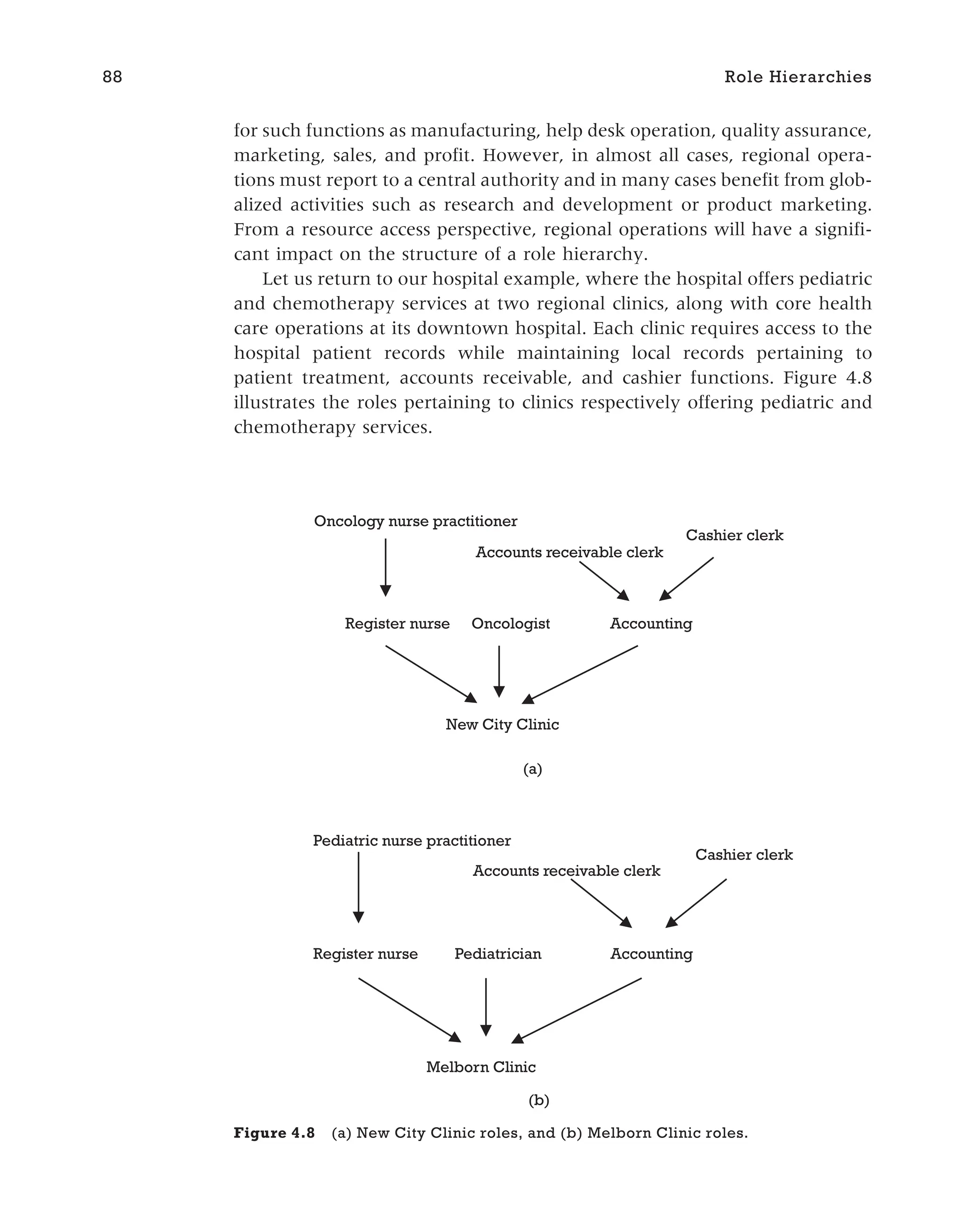
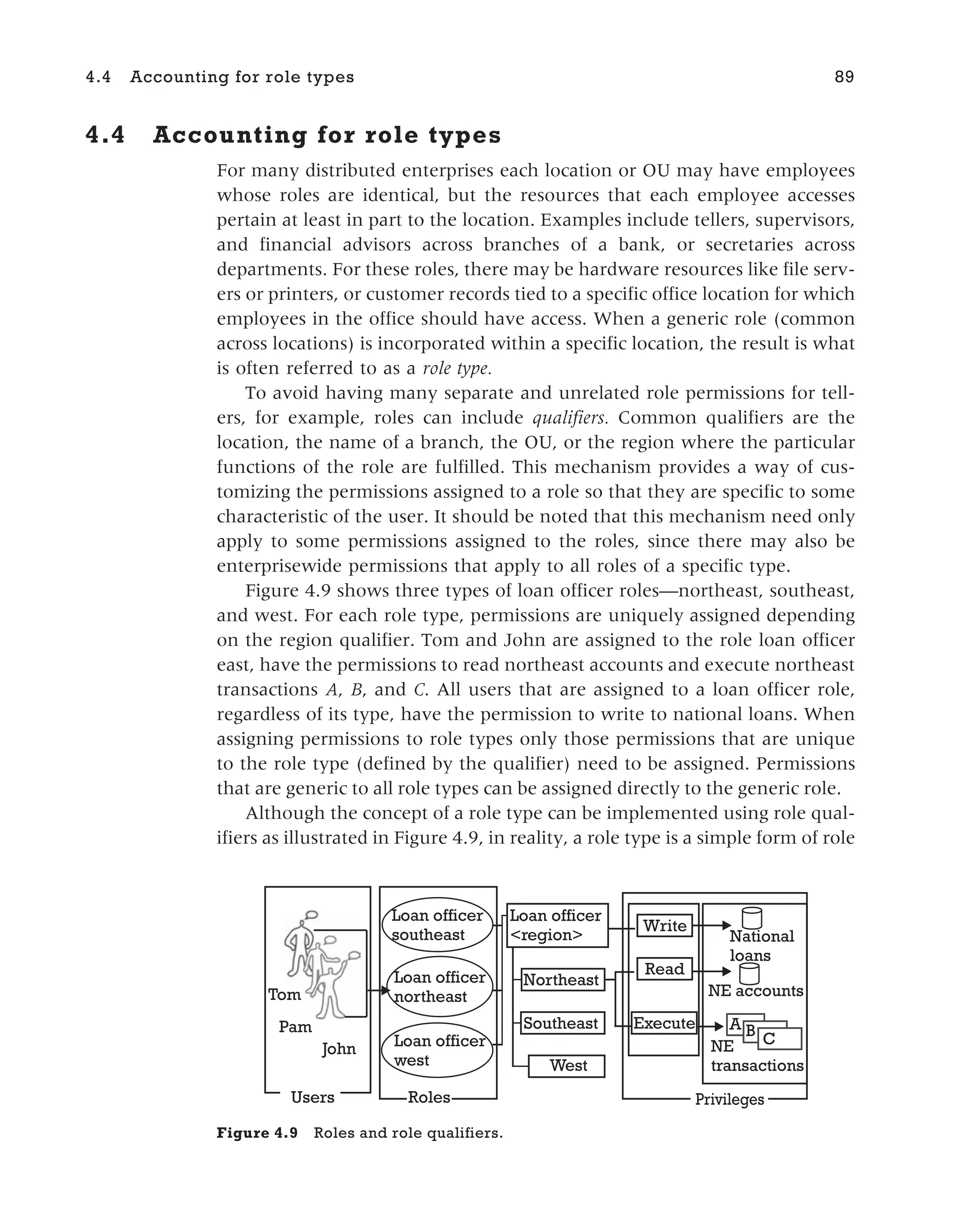
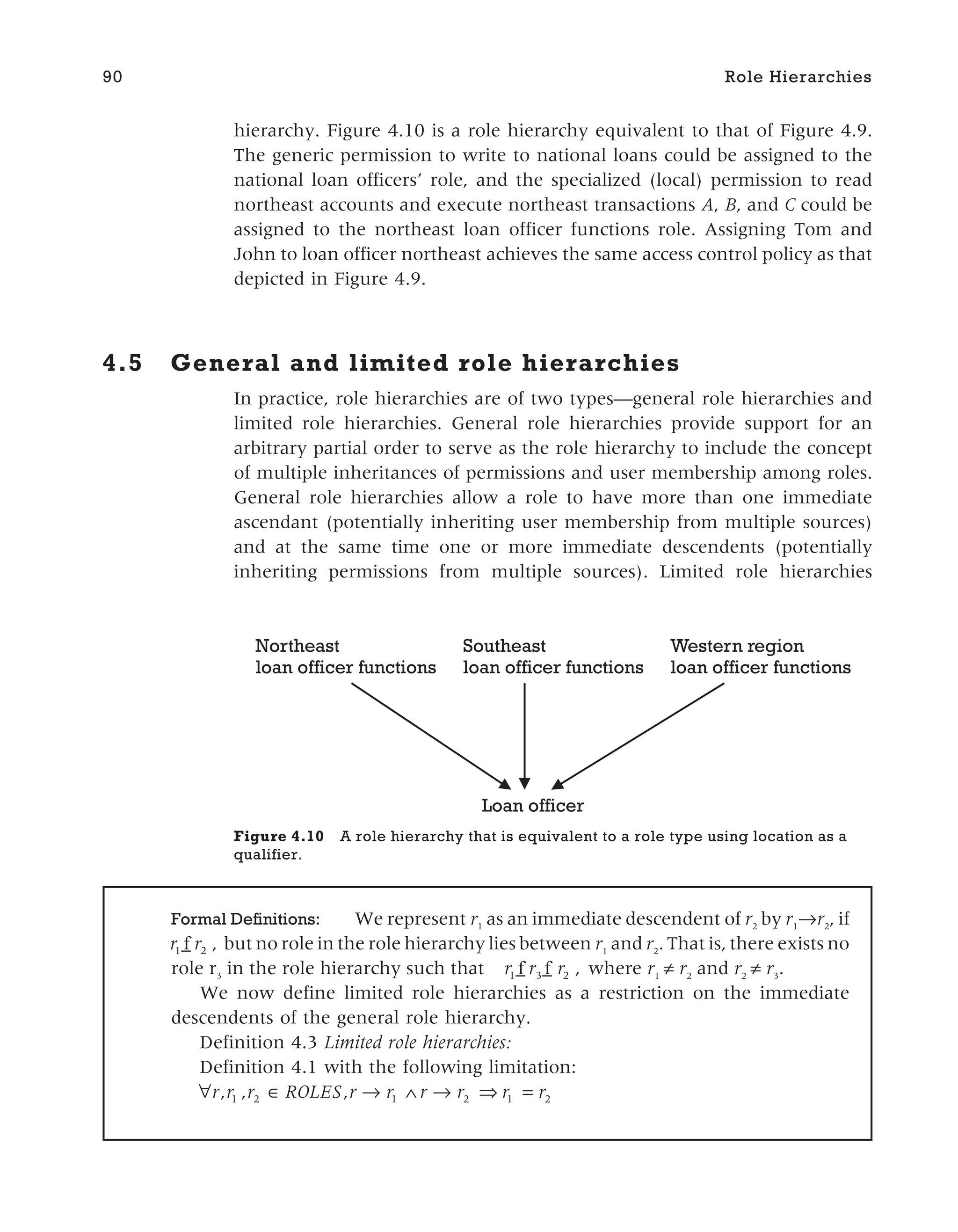
![both the specialist role and the cardiology department role, and by virtue of
transitivity, the permissions that are assigned to the physician and medicine
roles. As such, the cardiologist role is neither a functional nor an organiza-
tional role, but rather a hybrid. Similarly, cardiologist NP is also a hybrid
role, and by virtue of role inheritance, so is cardiologist nurse specialist. The
cardiologist role is referred to as a combiner role, since it combines the
authorized permissions of the roles that it inherits.
Another interesting characteristic of multiple inheritance is the ability to
accurately represent users and their role assignments within the role hierar-
chy through the uniform treatment of user/role assignments and the imme-
diate role inheritance relations. By virtue of role assignment, the user is
authorized for the permissions that are assigned to the user or inherited by
the role, and the user’s membership is inherited by the role and any other
role that is inherited by the role.
Although within a limited role hierarchy, a single user assignment may
also be represented through the immediate role inheritance relation, a user
can be assigned to multiple roles. Therefore, representing all of a user’s role
assignments would require multiple user instances.
Within a general hierarchy, all user role assignments can be represented
as a single user instance. Dr. McCarthy’s role assignments in Figure 4.11 are
represented as two immediate inheritance relations. Deleting Dr. McCarthy
from the role graph has the effect of deleting all of Dr. McCarthy’s permis-
sions that are managed by RBAC. This is the behavior that would be
expected intuitively.
4.6 Accounting for the Stanford model
General hierarchies also allow for an object-oriented approach to managing
an enterprise’s distribution of permissions, consistent with that prescribed
by the Stanford model [7]. The Stanford model (see Figure 4.12) recognizes
several layers of abstractions at the enterprise level. Under this model,
permissions are recorded as nonsystem-specific entitlements, which can be
grouped together into tasks, and then further managed as groups of tasks
that describe job functions. Finally, job functions can be assigned to organiza-
tional roles rather than to individuals to facilitate the assignment of author-
ity as people move in and out of a specific role. Although the Stanford
model does not directly recognize permissions, entitlements are mapped
one-to-many onto permissions that may exist across systems. Also, the
Stanford model allows a user to be assigned to more than one role.
4.6 Accounting for the Stanford model 93](https://image.slidesharecdn.com/role-basedaccesscontrolsecondeditionpdfdrive-250311062434-2e3fc82e/75/Role-Based-Access-Control-Second-Edition-PDFDrive-pdf-114-2048.jpg)
![References
[1] Ferraiolo, D., and R. Kuhn, “Role-Based Access Control,” Proc. of the NIST-NSA
Nat. (USA) Comp. Security Conf., 1992, pp. 554–563.
[2] Ferraiolo, D., J. Cugini, and R. Kuhn, “Role-Based Access Control: Features
and Motivations,” Proc. of the Annual Computer Security Applications Conf., New
Orleans, LA, 1995.
[3] Sandhu, R., et al., “Role-Based Access Control Models,” IEEE Computer, Vol.
29, No. 2, February 1996.
[4] Baldwin, R. W., “Naming and Grouping Privileges to Simplify Security
Management in Large Databases,” Proc. of IEEE Computer Society Symposium on
Research in Security and Privacy, April 1990, pp. 184–194.
[5] Nyanchama, M., and S. L. Osborn, “Access Rights Administration in
Role-Based Security Systems,” Proceedings of the IFIP WG11.3 Working Conference
on Database Security, 1994. See also Nyanchama, M., and S. L. Osborn, “The
4.6 Accounting for the Stanford model 95
R1 R2 Rr
...
Stanford roles
F1 F2 Ff
...
Functions
T1 T2 Tt
Tasks
...
Entitlements
E1 E2
Ee
...
System 1 System 2 … System n Privileges
User 1 User 2 User n
… Users
Enterprise view
System view
Figure 4.13 Representing the Stanford model’s abstractions using roles and
inheritance relations.](https://image.slidesharecdn.com/role-basedaccesscontrolsecondeditionpdfdrive-250311062434-2e3fc82e/75/Role-Based-Access-Control-Second-Edition-PDFDrive-pdf-116-2048.jpg)
![Role Graph Model and Conflict of Interest,” ACM Transactions on Information
and System Security (TISSEC), Vol. 2, No. 1, February 1999, pp. 3–33.
[6] Moffett, J. D., and E. C. Lupu, “The Uses of Role Hierarchies in Access
Control,” Proc. of 4th ACM Workshop on Role-Based Access Control, 1999,
pp. 153–160.
[7] McRae, R., The Stanford Model for Access Control Administration, Stanford
University, 2000 (unpublished).
96 Role Hierarchies](https://image.slidesharecdn.com/role-basedaccesscontrolsecondeditionpdfdrive-250311062434-2e3fc82e/75/Role-Based-Access-Control-Second-Edition-PDFDrive-pdf-117-2048.jpg)
![amounts of money in a single transaction” [1]. Part of the problem today is
that traditional computer security software makes it difficult to build SoD
constraints into computerized operations.
98 SoD and Constraints in RBAC Systems
SoD definitions:
American National Standards Institute: “Dividing responsibility for sensitive
information so that no individual acting alone can compromise the security of the
data processing system.” (Telecom Glossary 2000, American National Standard for
Telecommunications, American National Standards Institute)
The U.S. Office of Management and Budget’s Circular A-123 (revised June
21, 1995): “Key duties and responsibilities in authorizing, processing, recording,
and reviewing official agency transactions should be separated among
individuals.”
Separation of Duties
I. Disbursement of Funds
The following minimum separation of duties applies to individuals in
departments and accounting offices who are responsible for the
disbursement of funds.
The following duties shall be performed by different individuals:
1. Check request reviewer—evaluates requests with respect to business purpose,
applicable policy, backup documentation, and authorized signature.
2. Check preparer—prepares checks and ledger entries.
3. Check issuer— has checks signed and approves ledger entry.
4. Check deliverer—distributes checks or sends to payees.
5. Ledger reviewer—reconciles bank statement with general ledger cash account.
II. Depository Funds
The following minimum separation of duties applies to individuals in
departments and accounting offices who are responsible for depository
funds.
The following duties shall be performed by different individuals:
1. Mail handler—opens mail, reviews, and endorses checks.
2. Cashier—processes cash, determines account coding, and deposits in bank
account or delivers to another cashier.
3. Auditor—ensures that all checks received are deposited and accounts coded
correctly; also receives checks returned to the office.
4. Ledger reviewer—reconciles department accounting records with accounting
office records.
Figure 5.1 Example accounting system SoDs.](https://image.slidesharecdn.com/role-basedaccesscontrolsecondeditionpdfdrive-250311062434-2e3fc82e/75/Role-Based-Access-Control-Second-Edition-PDFDrive-pdf-119-2048.jpg)
![When controls are not implemented properly, automated systems make
it easy for large amounts of money to be lost in a short time. A spectacular
example of this occurred in 1995 when one of Britain’s oldest merchant
banks collapsed as a result of high-risk trading. The bank’s Singapore office
chief, Nicholas Leeson, was allowed to run both the financial derivatives
trading operation in Singapore as well as back-office functions where trades
were settled. This is a mix of roles that can be—and in this case was—disas-
trous. An SoD between making and settling trades would have prevented
this disaster.
Two 1999 cases described by the inspector general of the U.S. Depart-
ment of Veterans Affairs (VA) illustrate how vulnerable automated systems
can be with inadequate SoD controls. In one case, a supervisor at a VA
regional office stole $615,451 in less than 2 years by establishing a fraudu-
lent disability award for her fiancé, a Gulf War veteran. A second embezzle-
ment scheme had been going on for 12 years when it was discovered in
1999. In this case, a former VA employee had created a fraudulent disability
award for himself using another person’s social security number, which
made it possible to avoid detection by computer-matching DoD and Social
Security Administration records. The VA inspector general testified that
“SoD controls intended to prevent fraud had been abandoned or circum-
vented” [2]. Management officials had abandoned SoD requirements in
order to speed up processing [2]:
At some VBA
1
regions, employees were authorized for duplicative computer
command authorities, in violation of VA policy, apparently to increase over-
all production capability. This gave the employees the ability to circumvent
SoD controls and computer edits to create a benefit account and approve
payment, without the need to refer the case to another employee for autho-
rization. Employees with these extraordinary authorities could also create a
fictitious benefit payment account and generate payments, or fraudulently
upgrade the benefit payments of otherwise entitled beneficiaries, without
the knowledge of other VBA employees. We also found other significant
computer access vulnerabilities that could be exploited to perpetrate a fraud,
such as by acquiring and using the computer access authorities of others to
conceal the perpetrator’s involvement.
The VA experience illustrates both the difficulty of implementing SoD
controls in computer systems and the potential for loss when they are not
present. Inevitably, when computer security controls are cumbersome and
99
1. Veterans Benefits Administration.](https://image.slidesharecdn.com/role-basedaccesscontrolsecondeditionpdfdrive-250311062434-2e3fc82e/75/Role-Based-Access-Control-Second-Edition-PDFDrive-pdf-120-2048.jpg)
![inefficient, users circumvent or disable them. One of RBAC’s great advan-
tages is that SoD rules can be implemented in a natural and efficient way. In
fact, SoD has been studied more in the context of RBAC than in any other
field of computer security.
5.1 Types of SoD
Researchers have proposed a great variety of SoD models, only some of
which are implemented in real products. This section focuses on the most
significant categories of SoD that are likely to be important in practice. A
comprehensive survey by Simon and Zurko [3] found two broad categories
of SoD methods: static and dynamic. A simple way to distinguish between
these two forms is to consider the time at which the role constraints are
applied. Static SoD places constraints on roles at the time users are autho-
rized for roles. For example, a policy may require that if a user is authorized
for role A, then the same user cannot be authorized for role B. In dynamic
SoD (DSD), constraints are invoked when users are actively using the sys-
tem. This is a weaker form of SoD, since, for example, it may allow a user to
be authorized for both roles A and B, but not allow the user to hold these
roles simultaneously in a single session. Depending on an organization’s
security needs and resources, either static or dynamic rules may be appro-
priate.
5.1.1 Static SoD
SoD relations are often used to enforce conflict-of-interest policies, which
should be analyzed organizationwide, across distributed systems [4]. Con-
flict of interest in a role-based system may arise as a result of a user gaining
authorization for permissions associated with conflicting roles. One means
of preventing this form of conflict of interest is though static SoD—that is, to
enforce constraints on the assignment of users to roles. This means that if a
user is assigned to one role, the user is prohibited from being a member of a
second role. For example, Figure 5.2 shows a role hierarchy with SoD con-
straints.
A user who is assigned to the role billing clerk may not be assigned to the
role accounts receivable clerk. That is, the role billing clerk and accounts
receivable clerk are mutually exclusive. A static SoD policy can be centrally
specified and then uniformly imposed on specific roles. From a policy per-
spective, static constraint relations provide a powerful means of enforcing
conflict-of-interest and other separation rules over sets of RBAC elements.
100 SoD and Constraints in RBAC Systems](https://image.slidesharecdn.com/role-basedaccesscontrolsecondeditionpdfdrive-250311062434-2e3fc82e/75/Role-Based-Access-Control-Second-Edition-PDFDrive-pdf-121-2048.jpg)
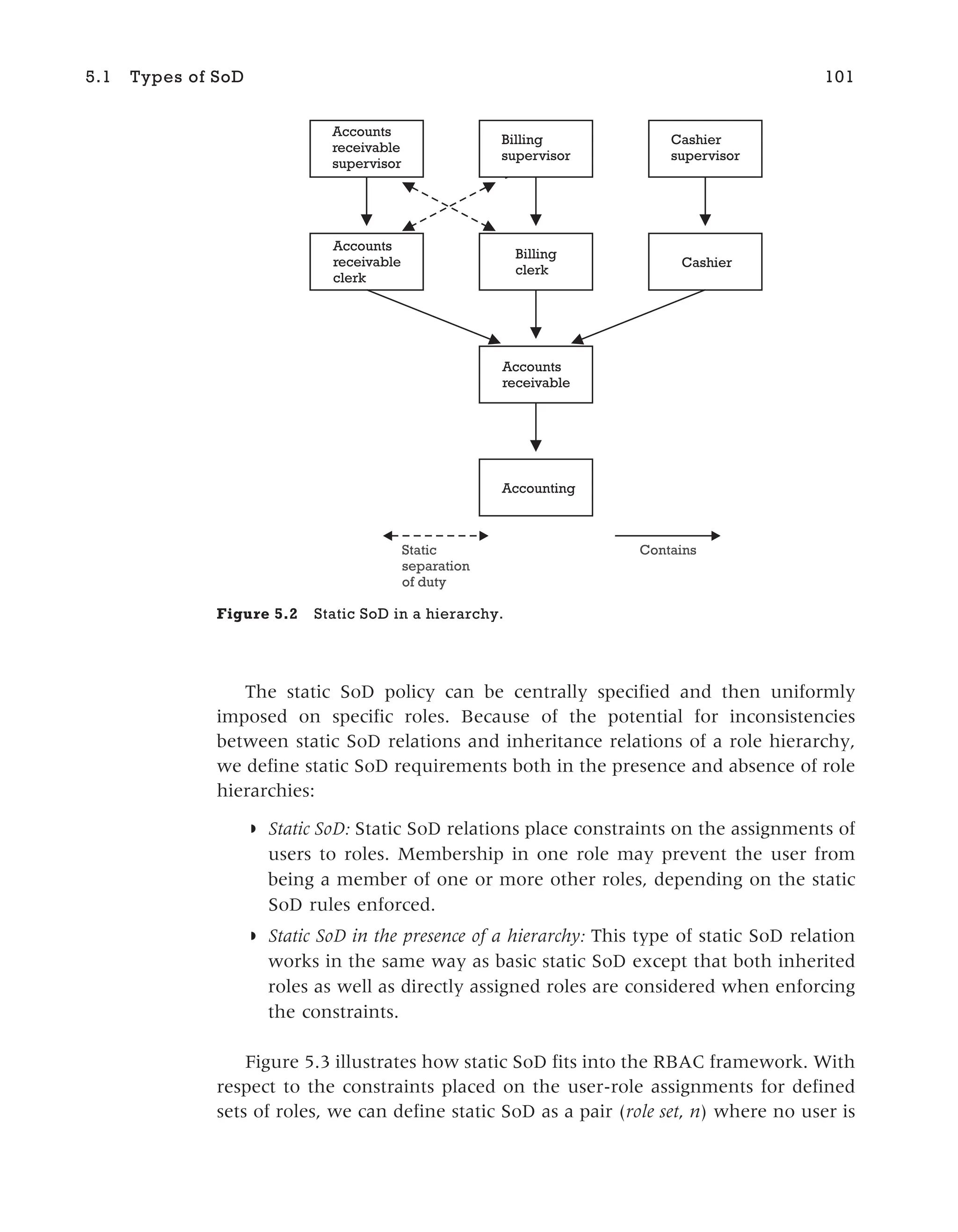
![assigned to n or more roles from the role set (in most real applications, n =
2). Thus, we recognize a variety of static SoD policies. For example, a user
may not be assignable to every role in a specified role set, while a strong
deployment of the same feature may restrict a user from being assigned to
any combination of two or more roles in the role set.
Static constraints can take on a wide variety of forms. A common exam-
ple is mutually disjoint user assignments with respect to sets of roles [5, 6].
However, static constraints have been shown to be a powerful means of
implementing a number of other important SoD policies. For example,
Simon and Zurko [3], Gligor et al. [7], and Ahn and Sandhu [8] have identi-
fied static SoD relations to include constraints on users, operations, and
objects as well as combinations thereof. Some authors [8–12] have studied
other forms of constraints recently, but so far consensus has not been
developed.
Although static SoD appears to be overly restrictive and may not work
for smaller organizations, it is often used in practice because it is easy to
implement and simple to verify. Unless an organization is very small, the job
titles involved in requesting or approving an expenditure (e.g., a manager),
recording the expenditure (e.g., account clerk), and releasing funds (e.g.,
cashier) are likely to be mutually exclusive. This form of SoD policy arises
naturally in organizations and is highly effective.
Static SoD is also particularly easy to implement with RBAC. Consider
this discussion of SoD rules in a case study used by the American Institute of
102 SoD and Constraints in RBAC Systems
Role hierarchy
Users Roles
Subjects
OPS OBS
PRMS
Permission
assignment
User
assignment
SSD
subject_user
subject_roles
Figure 5.3 Static SoD.](https://image.slidesharecdn.com/role-basedaccesscontrolsecondeditionpdfdrive-250311062434-2e3fc82e/75/Role-Based-Access-Control-Second-Edition-PDFDrive-pdf-123-2048.jpg)
![Certified Public Accountants describing a database application that processes
payroll [13]:
For example, a payroll clerk who has been granted “update” and “add” privi-
leges to the payroll register table should not be able to generate paychecks. If
this were to happen, the payroll clerk could then produce erroneous pay-
checks (e.g., by modifying his or her hours worked, adding a new timecard
for a friend, or adding a fictitious employee with a post office box address to
which the payroll clerk possesses the key). This type of security represents a
logical SoD. Manual SoD is also important; it includes restricting the payroll
clerk from possessing blank payroll checks.
A conventional ACL approach is described in this case study. The clerk’s
user ID is attached to the ACL for the payroll register table, with “add” and
“update” privileges. An audit program must then be used to ensure that the
clerk’s user ID is not also attached to the paycheck-generating application.
Additional reviews must be made to ensure that this particular clerk does
not have another user ID that violates these constraints. When an enterprise
employs thousands of people, privilege audits such as these become extraor-
dinarily complex and time-consuming.
In an RBAC system, the SoD requirements for this example can be han-
dled by assigning the ability to update the payroll register to one role and
the ability to generate payroll checks to another role. These roles are then
made mutually exclusive; from this point on, the RBAC system will ensure
that no individual can be assigned to both roles.
5.1 Types of SoD 103
Formal definition: Static SoD If static separation is required for any pair of roles r1
and r2
, then r1
and r2
can have no common assigned users.
SSD ⊆ (2
ROLES
× N ) is collection of pairs (rs, n) in static SoD, where each rs is a
role set and n is a natural number ≥2, with the property that no user is assigned
to n or more roles from the set rs in each
(rs, n)∈SSD
Formally:
∀ ∈ ∀ ⊆ ≥ ⇒ = ∅
∈
( , ) , : _ ( )
rs n SSD s rs s n assigned users r
r s
I
Static SoD in the presence of a hierarchy: In the presence of a role hierarchy
static SoD is redefined based on authorized users rather than assigned users as
follows:
∀ ∈ ∀ ⊆ ≥ ⇒ = ∅
∈
( , ) , : _ ( )
rs n SSD s rs s n authorized users r
r s
I](https://image.slidesharecdn.com/role-basedaccesscontrolsecondeditionpdfdrive-250311062434-2e3fc82e/75/Role-Based-Access-Control-Second-Edition-PDFDrive-pdf-124-2048.jpg)
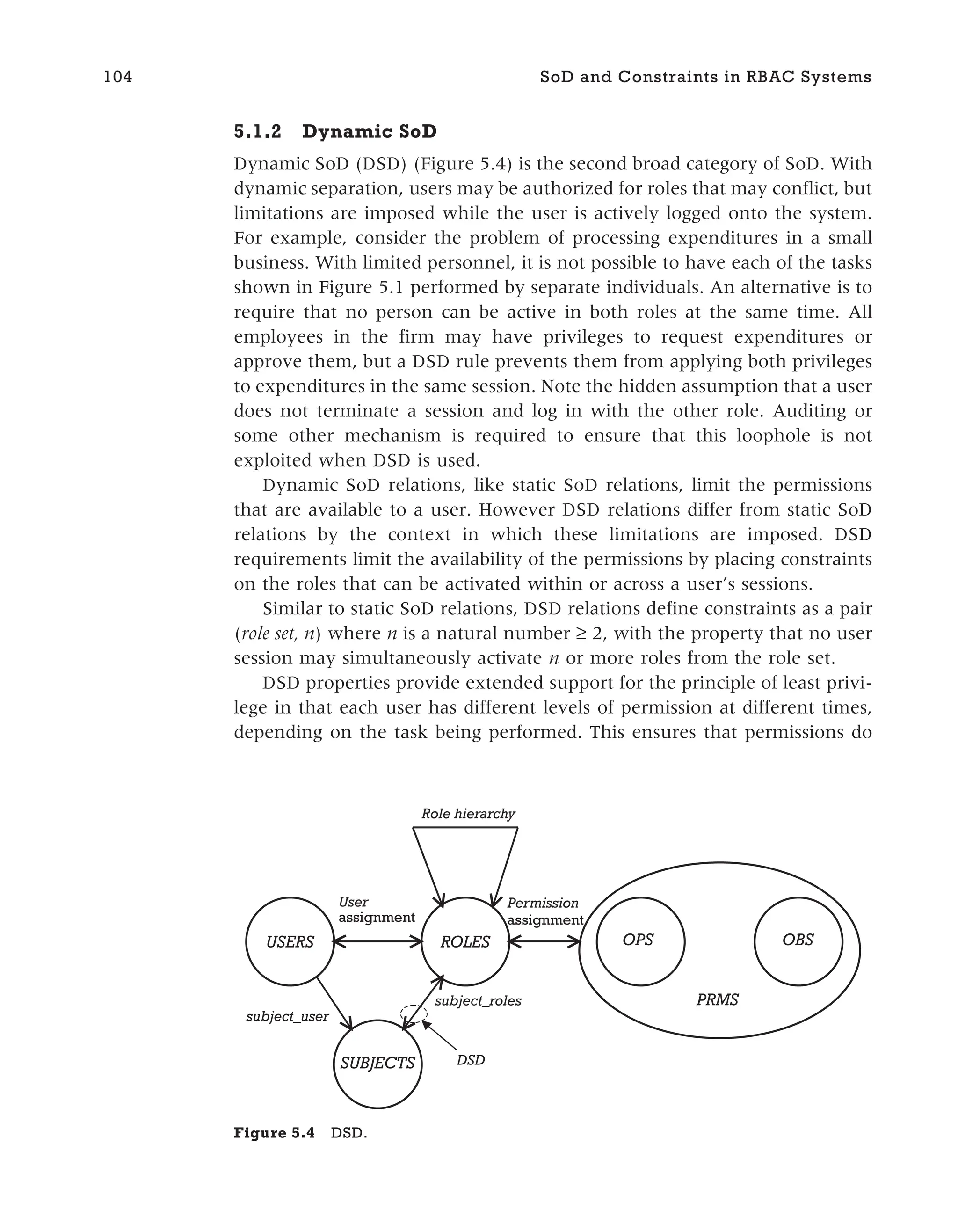
![not persist beyond the time that they are required for performance of duty.
This aspect of least privilege is often referred to as timely revocation of trust.
Dynamic revocation of permissions can be a complex issue without the facil-
ities of dynamic SoD and thus has been generally ignored in the past for rea-
sons of expediency.
Static SoD relations provide the capability to address potential conflict-
of-interest issues at the time a user is assigned to a role. DSD allows a user to
be authorized for two or more roles that do not create a conflict of interest
when acted in independently but produce policy concerns when activated
simultaneously. For example, a user may be authorized for both the roles of
cashier and cashier supervisor, where the supervisor is allowed to acknowl-
edge corrections to a cashier’s open cash drawer. If the individual acting in
the role cashier attempted to switch to the role cashier supervisor, RBAC
would require the user to drop the cashier role, and thereby force the
closure of the cash drawer before assuming the role cashier supervisor. As
long as the same user is not allowed to assume both of these roles at the
same time, a conflict of interest situation will not arise. Although this effect
could be achieved through the establishment of a static SoD relationship,
DSD relations generally provide the enterprise with greater operational
flexibility.
5.1.3 Operational SoD
RBAC can be used to enforce a policy of operational SoD [14], defined as
follows: No single user can be allowed to perform all operations required to
perform a critical function. Implicit in this definition is a requirement that at
least two roles are required for any critical function. Therefore, the failure of
one role to perform as expected can be detected by the organization. In
RBAC terms, the operational SoD policy can be enforced when roles are
authorized for individual users and when operations are assigned to roles.
5.1 Types of SoD 105
Formal definition: DSD If dynamic separation is required for any pair of roles r1
and r2
, then r1
and r2
can have no common authorized users.
DSD ⊆ (2
ROLES
× N) is collection of pairs (rs, n) in DSD, where each rs is a role
set and n is a natural number ≥ 2, with the property that no subject may activate
n or more roles from the set rs in each dsd ∈DSD. Formally:
∀rs 2
ROLES
, n N, (rs, n)∈DSD ⇒ n ≥ 2 ^ |rs| ≥ n, and
s SUBJECTS, rs 2
ROLES
, role_subset ∈ 2
ROLES
, ∀n N, (rs, n) ∈ DSD,
role_subset ⊆ rs, role_subset ⊆ subject_roles(s) ⇒ |role_subset| < n.](https://image.slidesharecdn.com/role-basedaccesscontrolsecondeditionpdfdrive-250311062434-2e3fc82e/75/Role-Based-Access-Control-Second-Edition-PDFDrive-pdf-126-2048.jpg)
![Note that this means that operational SoD can be implemented either as a
static or dynamic form of separation.
5.1.4 History and object-based SoD
One form of SoD discussed in research literature, although not widely
implemented, takes into account the history of access to system objects. For
example, it may be acceptable for one person to do both request and
approval of expenditures, provided no one individual can both request and
approve the same item. Small firms in particular may need this arrange-
ment. It may be too expensive to have a single person dedicated full-time to
order processing, or temporary absence may require one person to fill sev-
eral roles that would be mutually exclusive in a large organization.
An early model for a flexible form of SoD was offered by Sandhu [15],
who proposed the use of “transaction control expressions” that represent
the potential history of access to an object. SoD rules could be enforced by
maintaining a complete history on transient system objects, such as an
expenditure transaction, and an abbreviated history on persistent objects,
such as a general ledger. A commercial security product using
“object-based” separation was described by Nash and Poland [16], who also
showed that transaction control expressions could be used to define this
policy. This approach allowed a user to simultaneously be authorized for
mutually exclusive roles but not to act upon an object that she or he has
previously acted upon. For example, a user might both prepare checks and
cash them but could not cash a check that he or she had prepared. This
approach is simple, but it limits users to handling only one part of a business
process. If multiple steps are involved in a process, SoD could be maintained
when users handle more than one step, provided that no single individual
handles all steps.
A variety of recent proposals have highlighted history- and context-sen-
sitive controls, in which a user’s current task is included in the access con-
trol decision [17–19]. A recent example of such a policy, designated as
“history-based,” was proposed by Papenfus and Botha [20]. History-based
SoD can be thought of as a dynamic form of operational SoD policy. A user
can have all the privileges required for a critical task, but cannot perform all
the parts of a task on the same object.
Including history in SoD controls provides the most flexible approach,
but at the cost of greater complexity in the access control system. The sys-
tem must keep track of the ID of each user who processes objects in a busi-
ness process. This may be relatively efficient when all parts of a process are
managed by a single application. For example, a database system may
106 SoD and Constraints in RBAC Systems](https://image.slidesharecdn.com/role-basedaccesscontrolsecondeditionpdfdrive-250311062434-2e3fc82e/75/Role-Based-Access-Control-Second-Edition-PDFDrive-pdf-127-2048.jpg)
![commercial systems, how these features affect the design of systems enforc-
ing SoD rules, and trade-offs that can be made in system design. In general,
automated role engineering tools will be needed to create and check SoD
rules in an RBAC system. This section aims to provide an understanding of
the important concepts that are implemented in role engineering tools.
5.2.1 SoD in role hierarchies
Most RBAC systems available today support role hierarchies in some form,
and SoD constraints have important implications for role hierarchies that
can affect the administration of SoD rules. When roles inherit other roles,
the system must ensure that the inheritance structure cannot result in a vio-
lation of separation constraints. The properties given below by Kuhn [5] are
important in understanding the interaction between SoD rules and role
inheritance. The first three properties are obvious from definitions:
◗ Property 1: Two roles Ri
and Rj
can be mutually exclusive only if neither
one inherits the other, either directly or indirectly. Clearly, if a user
inherits one of the roles, SoD is not maintained if he or she can also
invoke the other role. Role administration is affected by this rule. To
be useful, role management tools must alert the administrator to SoD
violations created by inheritance.
◗ Property 2: If there are two roles Ri
and Rj
that are mutually exclusive,
then there can be no third role that inherits both of them. As with prop-
erty 1, this property must be handled properly by role management
tools to allow administrators to set up role hierarchies that do not vio-
late SoD constraints.
◗ Property 3: If static SoD holds, then DSD is maintained. Clearly, if a user
is only authorized for one of two roles, then he or she can never be
active in both. The practical importance of this rule is that SoD policies
can be simplified if the organization has sufficient resources to perma-
nently limit the roles that a user may activate. In Figure 5.2, for exam-
ple, if a user in the role “accounts receivable clerk” will never need to
have access to the role “billing clerk,” static separation can be estab-
lished for these roles. Since the SoD constraint is established when roles
are authorized, the system never needs to check these constraints dur-
ing a user session, which will improve performance and reduce the risk
of vulnerabilities introduced by bugs in the software.
◗ Property 4: If there are any two roles R
i
and R
j
that are mutually exclu-
sive, then there can be no “root” or “superuser” (a role that has all
108 SoD and Constraints in RBAC Systems](https://image.slidesharecdn.com/role-basedaccesscontrolsecondeditionpdfdrive-250311062434-2e3fc82e/75/Role-Based-Access-Control-Second-Edition-PDFDrive-pdf-129-2048.jpg)
![system privileges) role active on the system. This occurs because no
role can inherit two others that are mutually exclusive, and a “root”
role would inherit all other roles. Note that this holds even if DSD is
used. Under DSD, a single user could be authorized for all roles, but
the roles could not be active simultaneously. However, because the
“root” role inherits all other roles, “root” could never be activated
with all its inherited roles.
Constraints, including SoD, are inherited in the opposite direction from
role membership. If the role hierarchy is represented as a tree with the most
general role at the root, then role membership is inherited “down.” For
example, consider the accounting department hierarchy in Figure 5.2,
which includes the membership chain Accts Receivable Supervisor > Accts
Receivable Clerk > Accounts Receivable > Accounting. An employee desig-
nated as “Accts Receivable Clerk” inherits membership down the tree, to
include accounts receivable and accounting.
Constraints are inherited in the opposite direction. In Figure 5.2, since
the roles accounts receivable clerk and billing clerk have a static SoD rela-
tionship, then accounts receivable supervisor also has a static SoD relation-
ship with billing clerk. Another way of thinking of this is that any instance
of accounts receivable supervisor can be treated as an instance of accounts
receivable clerk. Therefore, the static SoD constraint billing clerk has with
accounts receivable clerk must also apply to accounts receivable supervisor.
In other words, constraints are inherited in an “up” direction in the hierar-
chy, toward the more specialized roles.
5.2.2 Static and dynamic constraints
The simplest way to provide SoD is to give administrators the ability to spec-
ify two roles as mutually exclusive: A user authorized for one role may not
be authorized for the other role. This provides static SoD. DSD requires that
users not be active in two mutually exclusive roles at the same time,
although they may be authorized for both. Surprisingly, some commercial
systems provide support (in a sense) for DSD without providing static SoD.
Some systems allow a user to be active in only a single role at a time or give
the ability to restrict the number of roles that a user can activate simulta-
neously. An example of this functionality is the Informix DBMS system
[21], which allows the creation of roles and role hierarchies. Only one role
can be activated at a time. It is not possible to specify mutual exclusion or
other constraints on roles. Since only one role can be activated at a time,
Informix does provide a basic form of DSD. A byproduct of preventing a
5.2 Using SoD in real systems 109](https://image.slidesharecdn.com/role-basedaccesscontrolsecondeditionpdfdrive-250311062434-2e3fc82e/75/Role-Based-Access-Control-Second-Edition-PDFDrive-pdf-130-2048.jpg)
![user from activating more than one role at a time is thus a form of DSD.
Without the ability to establish constraints on role authorization, though,
these systems cannot ensure static SoD. In addition, DSD can only be
ensured through the careful administration of roles. An additional tool will
be needed to audit complex role sets to ensure that user-role assignments
meet policy constraints.
Full support for both static SoD and DSD is available in few products.
Sybase’s DBMS is one example of a product that features both static SoD
and DSD. Static SoD is provided by allowing administrators to specify two
roles as mutually exclusive. Mutual exclusion is a simple and effective way
to establish basic static and dynamic SoD. SoD policies that require keeping
track of an object’s history require more than the ability to set up roles as
mutually exclusive, but the Sybase feature provides the necessary basis to
build more sophisticated policies into applications.
5.2.3 Mutual exclusion
Existing systems, and those likely to be available in the near future, typically
rely on mutual exclusion of roles to enforce SoD policies. However, mutual
exclusion rules may be provided in more than one way, and the design of
this feature can affect ease of use significantly. Consider again the account-
ing rules shown in Figure 5.1. As indicated, different individuals must fill
the five different roles. How should this SoD policy be implemented? There
are a number of possibilities, depending on the features of the RBAC system
and on how strictly the policy is interpreted. The policy in Figure 5.1
requires that if an individual has one of the roles, she or he must be
excluded from all others. If the system provides the capability, this policy
might be implemented using mutual exclusion rules in one of two ways:
◗ Exclusion specified by sets: It may be possible to declare a set of roles that
are mutually exclusive (i.e., membership in any one role of the set
precludes membership in another). This feature is particularly desir-
able if the application requires elaborate SoD requirements such as in
Figure 5.1. A related design by Crampton and Loizou uses lattices to
provide greater flexibility in policy representation [22].
◗ Exclusion specified by role pairs: If the system provides only the capability
to specify pairs of roles that are mutually exclusive, the problem
becomes more complex. For n roles, the number of pairs is
n n
( )
−1
2
. For
five roles, then, there are 10 mutual exclusion pairs that must be spec-
ified (see Figure 5.5). For the example application, this feature is
110 SoD and Constraints in RBAC Systems](https://image.slidesharecdn.com/role-basedaccesscontrolsecondeditionpdfdrive-250311062434-2e3fc82e/75/Role-Based-Access-Control-Second-Edition-PDFDrive-pdf-131-2048.jpg)
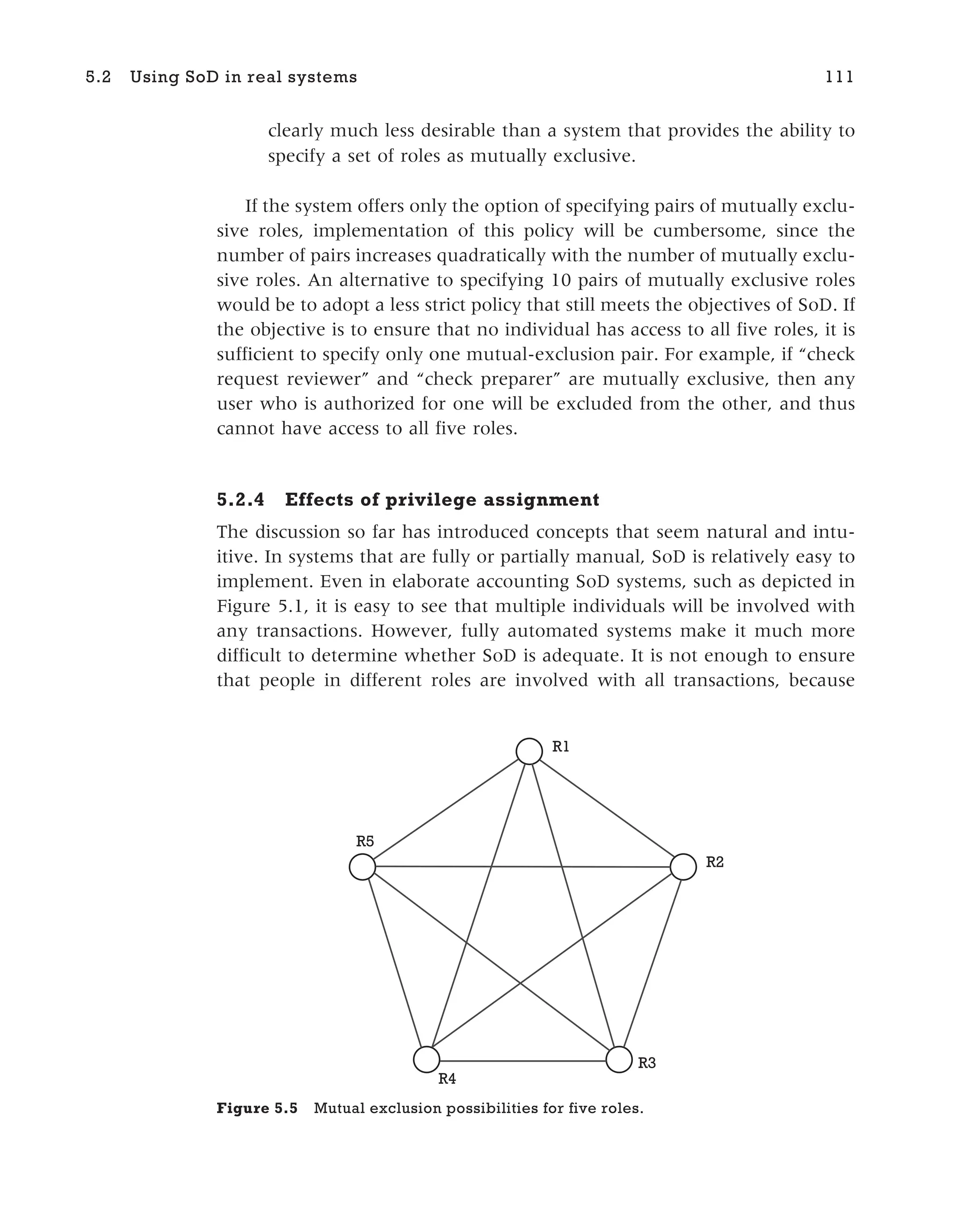
![automated systems, we can define a safety condition as the condition that
must be met to ensure that SoD requirements are not violated [5]. The
safety condition is simply a formal restatement of the goal of SoD: No single
individual will have the ability to execute a critical task.
If there are only two privileges needed for a task, then each privilege can
be assigned to separate roles, and the roles can be made mutually exclusive.
If more than two privileges are involved, then they can be split among two
or more roles. While intuitively simple, the assignment of privileges to roles
in a safe manner may be more difficult than it at first appears. Section 5.2.5
discusses some considerations regarding safe privilege assignments.
5.2.5 Assigning privileges to roles
Assignment of privileges to roles in a SoD environment can become com-
plex. To accomplish this task safely, an administrator must first ensure that
no single role has all privileges needed to accomplish a critical task and then
ensure that roles are assigned to individuals in such a way that no individual
will have all of these privileges through some combination of roles. Note
that inheritance of privileges and roles through hierarchies must be consid-
ered as well.
The first problem is the following: Given a set of tasks where each task Ti
requires a set of privileges P, assign privileges to roles such that no single
role has access to all privileges required by any task. This appears simple,
and in most cases it will be. However, in some cases it may not be possible.
Consider the following case: There are three critical tasks, T1, T2, and T3,
requiring combinations of privileges P1, P2, and P3, as shown in Table 5.1.
Suppose we want to allocate privileges to two roles R1 and R2, in such a
way that no task is compromised with respect to SoD requirements (i.e.,
neither role has all the privileges needed to perform one of the critical
tasks). Unfortunately, this is not possible for this example. To see this, note
5.2 Using SoD in real systems 113
Formal definition: Static SoD safety condition:
Given T = {critical tasks requiring SoD}
TPi
= {privileges required for task i}
∀ ∈ ⊄
u USERS TPi
, U
r user role u
authorized permissions r
∈ _ *( )
_ ( )
Alternatively,
∀ ∈ ∃ ∈ ∈ ∧ ∉
∈
u USERS p PRMS p TP p authorize
i
r user role u
, ,
_ *( )
U d permissions r
_ ( )
(An analogous definition for dynamic separation would use session privileges.)](https://image.slidesharecdn.com/role-basedaccesscontrolsecondeditionpdfdrive-250311062434-2e3fc82e/75/Role-Based-Access-Control-Second-Edition-PDFDrive-pdf-134-2048.jpg)
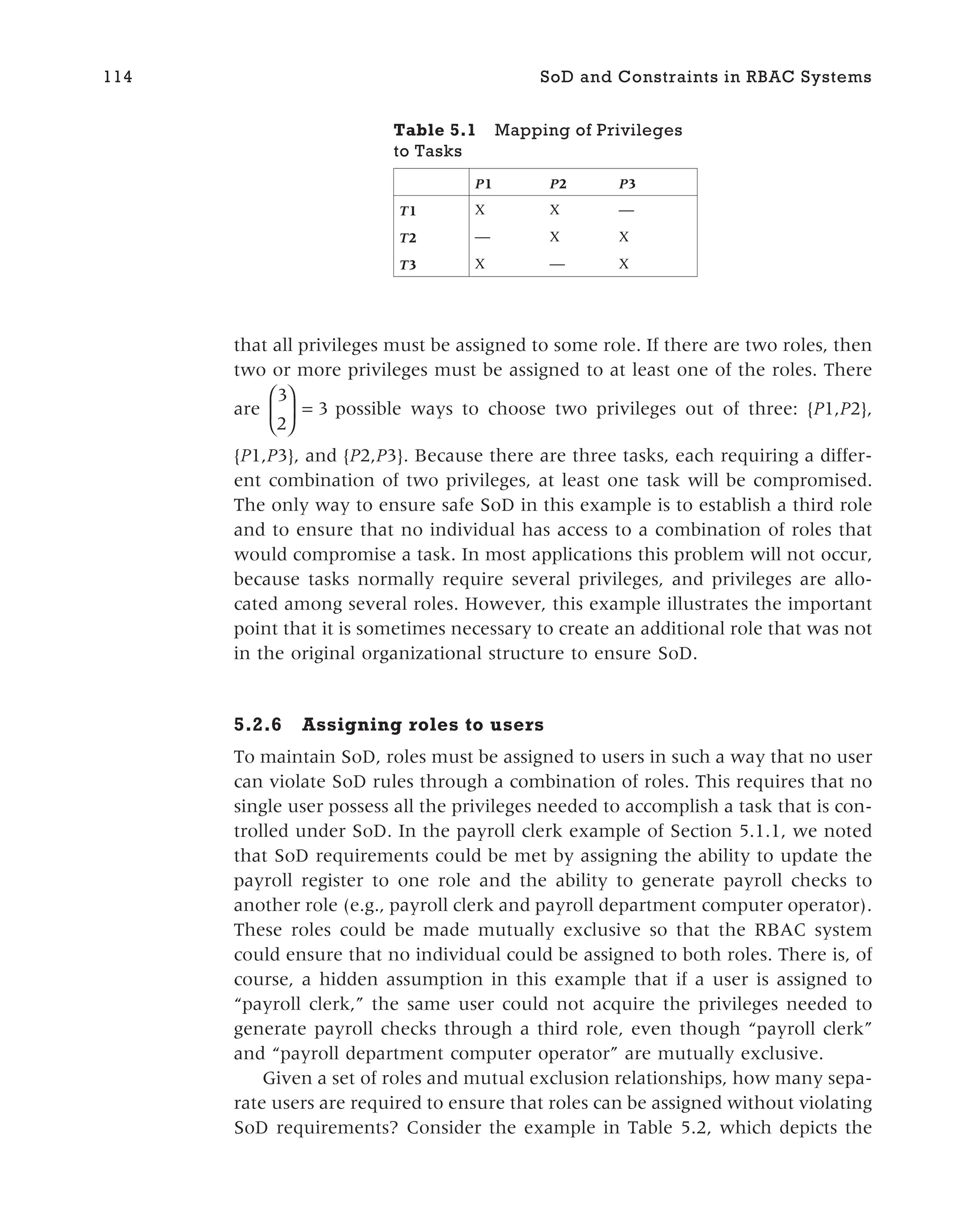
![mutual exclusion relationship between five roles, R1 through R5. [An X in
cell i,j indicates that role Ri
is mutually exclusive to Rj
(e.g., that R1 and R2
are mutually exclusive).] It is not immediately obvious how to assign roles
to users to ensure that this mutual exclusion relationship is maintained. We
could, of course, assign one role to each of five users, but is it essential to
have five, or could fewer users suffice?
Using graph theory, there is an easy way to determine this number,
within at most one greater than the minimum [23]. The chromatic number,
χ( )
G , of a graph is the minimum number of colors that are required to color
vertices so that no two adjacent vertices are the same color. We can model
the mutual exclusion relationship with a graph, shown in Figure 5.6. The
graph is constructed directly from Table 5.2, so that two roles are connected
in the graph whenever they are designated as mutually exclusive.
Only three colors are needed to ensure that no edge in this graph con-
nects two vertices of the same color; therefore, SoD requirements can be
5.2 Using SoD in real systems 115
Table 5.2 Example of a Mutual Exclusion Relationship
R1 R2 R3 R4 R5
R1 — X X — —
R2 X — X — X
R3 X X — X —
R4 — — X — X
R5 — X X —
R1
R2
R3
R4
R5
Figure 5.6 Mutual exclusion relationships.](https://image.slidesharecdn.com/role-basedaccesscontrolsecondeditionpdfdrive-250311062434-2e3fc82e/75/Role-Based-Access-Control-Second-Edition-PDFDrive-pdf-136-2048.jpg)
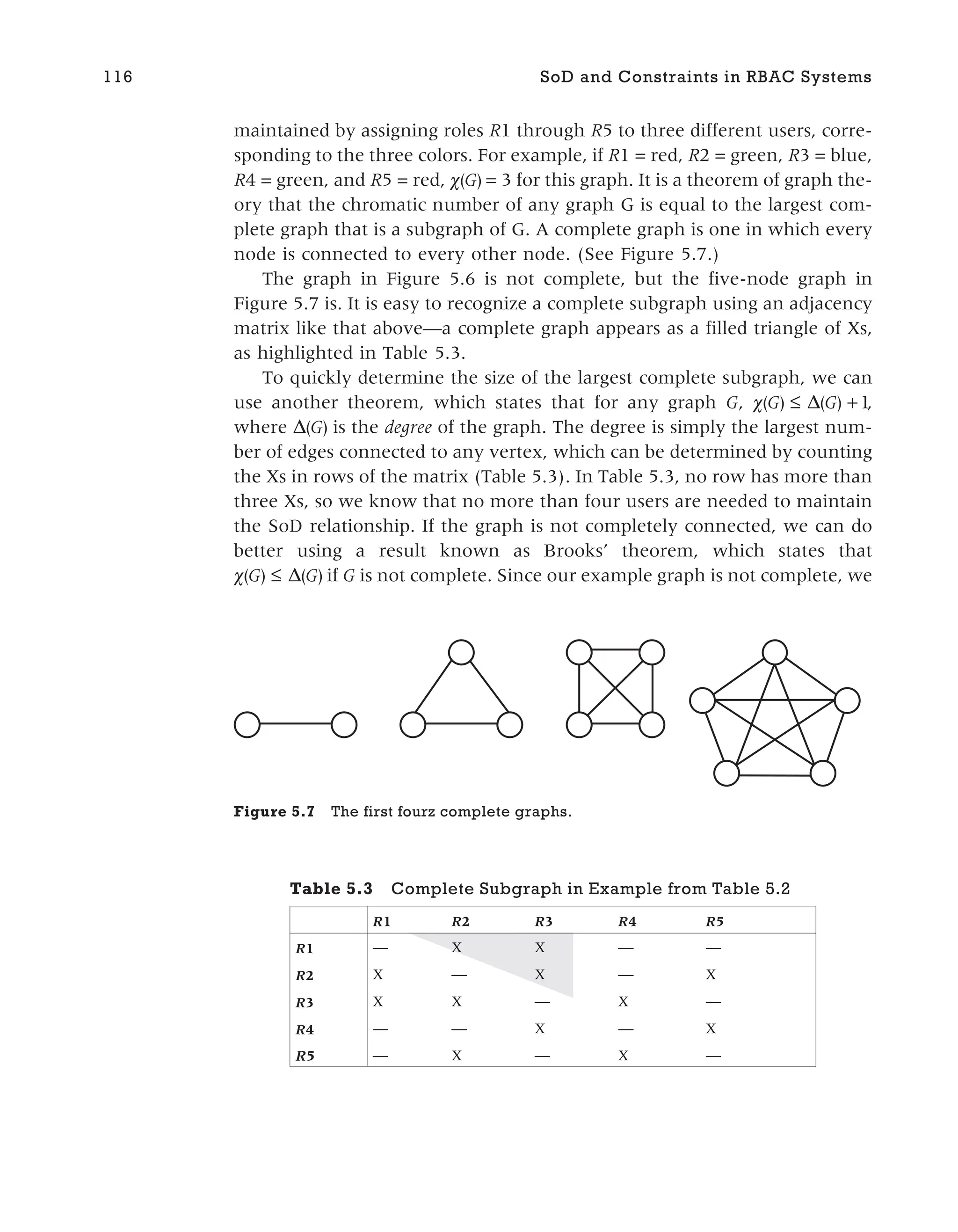
![can tell that no more than three users are needed simply by looking at the
number of Xs in each row of the mutual exclusion table.
To better understand the complexities involved in assigning privileges,
roles, and users in a SoD environment, we can consider the necessary
and sufficient conditions for safe privilege assignment. A necessary con-
dition, as the name implies, is a condition that is essential; without it, all
bets are off. A sufficient condition, on the other hand, is one that guarantees
the relationship we seek. It may be overkill, though, in that it may be
more than needed to ensure the relationship. In most cases, some condition
in between necessary and sufficient conditions will be established in real
systems. For SoD, necessary and sufficient conditions are described as
follows by Kuhn [5]:
◗ Necessary: For any pair of roles that are mutually exclusive, each role
must contain one privilege of a critical task not available to the other
role in the mutual exclusion relationship. To see why this is a neces-
sary condition, note that if it did not hold, then the privileges of one
role, R1, could be a subset of another, R2. Then mutual exclusion
between R1 and R2 would be irrelevant for a user with access to role
R2. Note that this condition is necessary, but not sufficient [i.e., main-
taining this condition does not ensure the safety of role assignments,
but if it is not maintained, then we cannot use mutual exclusion
(alone) to ensure that a role assignment is safe].
◗ Sufficient: For any role R1 in a mutual exclusion relationship, no privi-
leges in R1 are available to any other role R2. This condition is
fairly obvious; if two roles R1 and R2 each have a privilege that is
needed to accomplish a particular task, then making them mutually
exclusive guarantees that two individuals will be needed to accom-
plish the task, thus ensuring SoD. This condition, though sufficient, is
not necessary. In most cases it will be a stronger condition than needed
to ensure SoD.
These conditions underscore a fundamental point about SoD: If privi-
leges are accessible by more than one role, then we need to pay attention to
privilege assignment when setting up mutual exclusion rules for roles. Oth-
erwise, establishing mutual exclusion between roles may only appear to
ensure SoD, while leaving a loophole that makes a system vulnerable to
fraud.
5.2 Using SoD in real systems 117](https://image.slidesharecdn.com/role-basedaccesscontrolsecondeditionpdfdrive-250311062434-2e3fc82e/75/Role-Based-Access-Control-Second-Edition-PDFDrive-pdf-138-2048.jpg)
![5.3 Temporal constraints in RBAC
Sections 5.1 and 5.2 deal with the definition and specification of various
types of SoD constraints for the RBAC model and the issues involved
in their enforcement. This section examines another important class of con-
straints—the temporal constraints. The temporal (time-based) constraints
incorporate the notion of time in specifying access control requirements.
Unlike the SoD constraints, the issues relating to the support of temporal
constraints in RBAC have not been studied extensively.
The incorporation of time-dependent access control requirements into
the RBAC model (through specification of temporal constraints) was first
proposed by Bertino et al. [24]. The resultant RBAC model was called the
temporal RBAC (TRBAC) model. The TRBAC model was later extended by
Joshi et al. [25] into what they called the generalized TRBAC (GTRBAC)
model.
Our discussion of temporal constraints in RBAC is organized as follows:
First, we briefly look at the need for supporting temporal constraints in an
access control model. Next, we look at the taxonomy of the temporal con-
straints that it may be necessary to support in the RBAC model and illustrate
how they can be specified using the specification language of the GTRBAC
model. Finally, we discuss other constraint-related and implementation-
related features that are required in the RBAC model for supporting tempo-
ral constraints.
5.3.1 Need for temporal constraints
Temporal constraints are formal statements of access policies that involve
time-based restrictions on access to resources; they are required in several
application scenarios. In some applications, temporal constraints may be
required to limit resource use. In other types of applications, they may be
required for controlling time-sensitive activities such as those found in
workflow management systems (WFMSs). It is these time-based constraints
(in addition to other constraints like workflow precedence relationships)
that must be evaluated for generating dynamic authorizations during
workflow execution time (refer to Section 12.1.5). Temporal constraints are
also required in nonworkflow environments as well. For example, in a com-
mercial banking enterprise, a user should be able to assume the role of a
teller (to perform transactions on customer accounts) only during desig-
nated banking hours (say, 9 a.m. to 2 p.m., Monday through Friday, and 9
a.m. to 12 p.m. on Saturday). To meet this requirement, it is necessary to
118 SoD and Constraints in RBAC Systems](https://image.slidesharecdn.com/role-basedaccesscontrolsecondeditionpdfdrive-250311062434-2e3fc82e/75/Role-Based-Access-Control-Second-Edition-PDFDrive-pdf-139-2048.jpg)
![specify temporal constraints that limit role availability and activation capa-
bility only to those designated banking hours.
5.3.2 Taxonomy of temporal constraints
Depending upon the application needs, an RBAC model should be able to
support one or more of the following categories of temporal constraints:
◗ Temporal constraints on roles;
◗ Temporal constraints on user-role assignments;
◗ Temporal constraints on role-permission assignments.
Out of these three categories, the temporal constraints on user-role
assignments and role-permission assignments may need to be enforced
considerably less frequently than the temporal constraints on roles. What-
ever the category of temporal constraint, symbols are required for the repre-
sentation of time-related concepts, and a generic form is required for
representation of temporal constraints. Here, we discuss the symbols devel-
oped for representing time-related concepts and the generic constraint
form in the GTRBAC model. We then proceed to discuss the above three
categories of temporal constraints. We also provide examples of each these
categories of constraints as applicable to a specification of access control
requirements for a hospital database application.
Representation of time-related concepts The two time-related concepts
considered in the GTRBAC model are periodicity and duration. These two
concepts are used to represent periodicity-type temporal constraints and
duration-type temporal constraints, respectively. The symbols for representa-
tion of the periodicity and duration concepts are discussed as follows:
◗ Periodicity: A periodic time is represented by the pairs ([Begin,End],P),
where P is the periodic expression denoting a set (possibly infinite) of
periodic time instants, and [Begin,End] is a time interval denoting the
lower and upper bounds that are imposed on instants in P. For exam-
ple, the periodic time representation ([1/1/2002, 12/31/2002], Mon-
days) denotes all the Mondays of 2002.
◗ Duration: A duration is simply represented by a symbol D, which
stands for either an expression or a numeral.
5.3 Temporal constraints in RBAC 119](https://image.slidesharecdn.com/role-basedaccesscontrolsecondeditionpdfdrive-250311062434-2e3fc82e/75/Role-Based-Access-Control-Second-Edition-PDFDrive-pdf-140-2048.jpg)
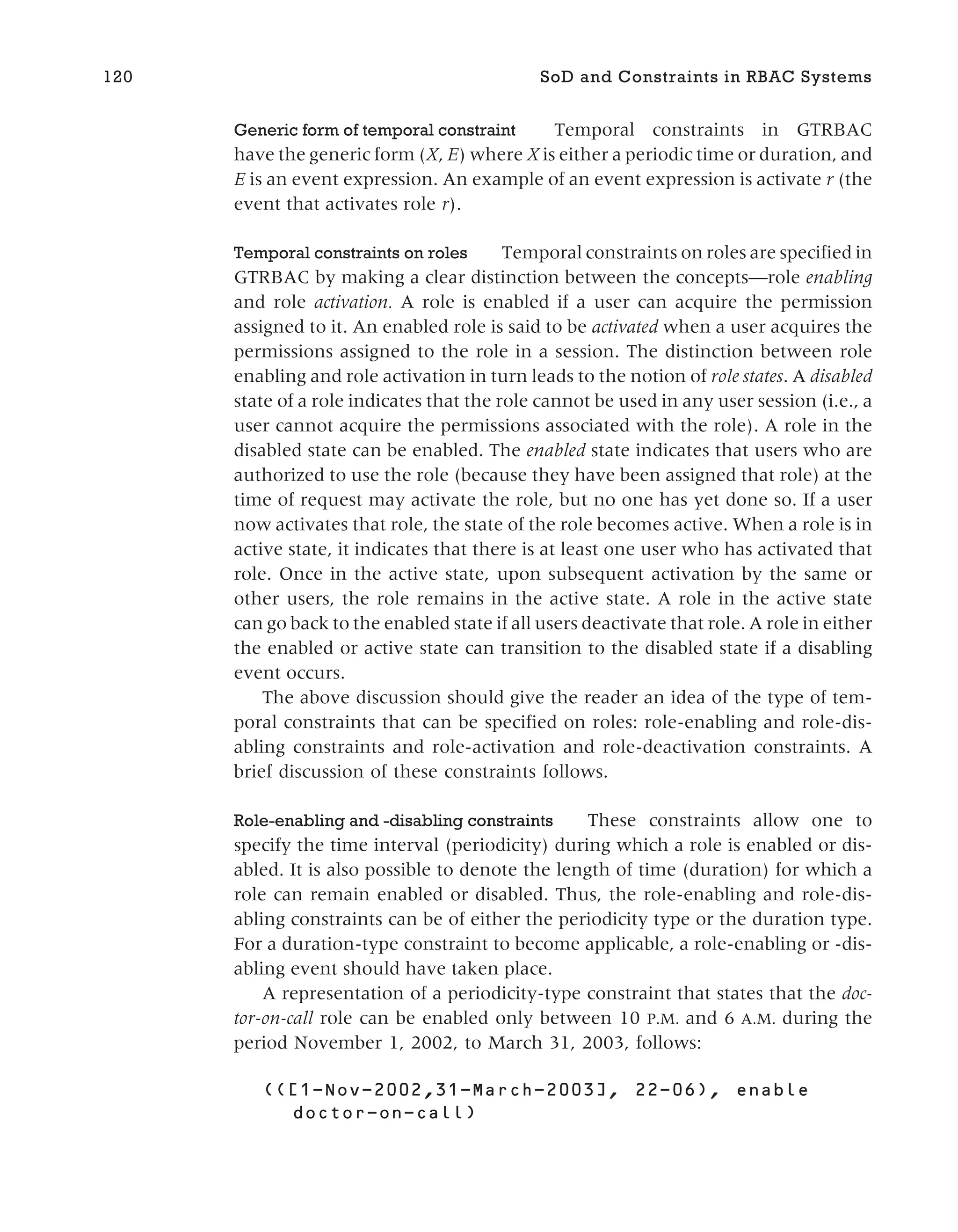
![available between December 1, 2002, and December 31, 2002, is expressed as
follows:
5.3.3 Associated requirements for supporting temporal
constraints
In RBAC models, the constraint enforcement results in an event. Examples
of events include the enabling of a role and the activation of a role. In many
application domains, there is a requirement for some related events to occur
when an event occurs. For example, in the hospital environment, when an
attending-physician role is enabled, there is the requirement to enable a
nurse-on-duty role as well. In the GTRBAC model, the notion of a role trig-
ger is defined to support such event dependencies. An example of a role
trigger to support the dependencies we stated earlier follows:
In addition to the automatically enforced temporal constraints (which
cause events), there may be practical situations where a security administra-
tor may have to intervene and dynamically initiate certain events. For
example, a security administrator may need to enable or disable certain
roles and assign or de-assign users or permissions to roles at run time. The
GTRBAC model provides constructs to express these run-time requests. In
our hospital setting, an intern may be required to take care of some
post-surgical patient care tasks. The request to activate an intern role for a
specific intern by name Susan is expressed as:
In addition to supporting some related event requests (like role triggers
and run-time requests), a complete implementation of an RBAC model that
supports temporal constraints requires several supporting data stores and
functional modules. For example, data stores are required for storing role
triggers, occurred events, active roles, and pending actions. Functional mod-
ules (called action handlers) are required for executing various types of
actions that are a consequence of periodicity and duration constraints, role
triggers, and run-time requests. A detailed description of the architecture of
the GTRBAC model is given in [25].
122 SoD and Constraints in RBAC Systems](https://image.slidesharecdn.com/role-basedaccesscontrolsecondeditionpdfdrive-250311062434-2e3fc82e/75/Role-Based-Access-Control-Second-Edition-PDFDrive-pdf-143-2048.jpg)
![Supporting temporal constraints on the RBAC model affects the seman-
tics of the role hierarchies specified in the model. The default semantics of
the role hierarchy in the absence of temporal constraints (or for that matter
in the hierarchical RBAC model) is that since a senior role inherits the per-
missions of all its junior roles, activation of a senior role by a user allows that
user to acquire all the permissions of all of its junior roles. The presence of
various timing constraints relating to role-enabling or role-activation and
role-permission assignments results in dynamic hierarchies called temporal
hierarchies. These temporal hierarchies do not possess the complete permis-
sion inheritance properties found in the role hierarchies of RBAC models
without the associated temporal constraints. Readers interested in the anal-
ysis of the implication of temporal constraints on role hierarchies may refer
to [25].
References
[1] Proctor, K., “Why All Banks Should Practice Risk Management,” Hoosier
Banker, April 2001.
[2] Griffin, R. J., Statement of the Honorable Richard J. Griffin, Inspector General,
Department of Veterans Affairs, Before the United States House of Representatives
Committee on Veterans Affairs, Subcommittee on Oversight and Investigations Hearing
on Fraud and Mismanagement in VA, September 23, 1999.
[3] Simon, R. T., and M. E. Zurko, “Separation of Duty in Role Based
Environments,” Proc. Computer Security Foundations Workshop X, Rockport, MA,
June 1997.
[4] Moffett, J., and M. Sloman, “Policy Conflict Analysis in Distributed Systems
Management,” Journal of Organizational Computing, Vol. 4, No. 1, 1994,
pp. 1–22.
[5] Kuhn, D. R., “Mutual Exclusion of Roles as a Means of Implementing
Separation of Duty in Role-Based Access Control Systems,” Proc. 2nd ACM
Workshop on Role-Based Access Control, Fairfax, VA, 1997, pp. 23–30.
[6] Giuri, L., and P. Iglio, “A Formal Model for Role-Based Access Control with
Constraints,” Proc. of the Computer Security Foundations Workshop, Piscataway, NJ:
IEEE Press, 1996, pp. 136–145.
[7] Gligor, V., S. I. Gavrilla, and D. F. Ferraiolo, “On the Formal Definition of
Separation of Duty Policies and Their Composition,” Proc. IEEE Symposium on
Security and Privacy, May 1998, pp. 172–183.
[8] Ahn, G. J., and R. Sandhu, “The RSL99 Language for Role-Based Separation
of Duty Constraints,” Proc. of 4th ACM Workshop on Role-Based Access Control,
October 28–29, 1999, Fairfax, VA, pp. 43–54.
5.3 Temporal constraints in RBAC 123](https://image.slidesharecdn.com/role-basedaccesscontrolsecondeditionpdfdrive-250311062434-2e3fc82e/75/Role-Based-Access-Control-Second-Edition-PDFDrive-pdf-144-2048.jpg)
![[9] Ahn, G. J., and R. Sandhu, “Role-Based Authorization Constraints
Specification,” ACM Transactions on Information and System Security (TISSEC),
Vol. 3, No. 4, November 2000.
[10] Tidswell, J. E., and T. Jaeger, “Integrated Constraints and Inheritance in
DTAC,” Proc. of 5th ACM Workshop on Role-Based Access Control, Berlin, Germany,
July 26–28, 2000, pp. 93–102.
[11] Schaad, A., and J. D. Moffett, “The Incorporation of Control Policies into
Access Control Policies,” Policy 2001: Workshop on Policies for Distributed Systems
and Networks, Bristol, U.K., 2001.
[12] Botha, R. A., and J. H. P. Eloff, “Separation of Duties for Access Control
Enforcement in Workflow Environments,” IBM Systems Journal, Vol. 40, No. 3,
2001.
[13] Hunton, J. E., and T. L. Jones, “Recreation, Inc., An Information Technology
Risk Assessment Case Study of Enterprise Resource Planning (ERP) Systems,”
AICPA Case Development Program, Case No. 2000-02, American Institute of
Certified Public Accountants, 2000.
[14] Ferraiolo, D., J. Cugini, and R. Kuhn, “Role-Based Access Control: Features
and Motivations,” Proc. of the Annual Computer Security Applications Conf.,
Piscataway, NJ: IEEE Press, 1995.
[15] Sandhu, R., “Transaction Control Expressions for Separation of Duties,” Proc.
4th Aerospace Computer Security Applications Conference, Orlando, FL, December
1988, pp. 282–286.
[16] Nash, M. J., and K. R. Poland, “Some Conundrums Concerning Separation of
Duty,” Proc. 1990 IEEE Symposium on Security and Privacy, May 1990,
pp. 201–207.
[17] Cholewka, D. G., R. H. Botha, and J. H. P. Eloff, “A Context-Sensitive Access
Control Model and Prototype Implementation,” Proc. of IFIP TC11 15th
International Conference on Information Security, Beijing, China, 2000,
pp. 341–350.
[18] Georgiadis, C. K., et al., “Flexible Team-Based Access Control Using Contexts,”
Proceedings of ACM RBAC97, 1997.
[19] Kumar, A., N. Karnik, and G. Chafle, “Context Sensitivity in Role-Based
Access,” ACM SIGOPS Operating Systems Review, Vol. 36, Issue 3, July 2002,
pp. 53–66, http://portal.acm.org/citation.cfm?id=567331.567336&coll=portal&
dl=ACM&idx=J597&part=newsletter&WantType=Newsletters&title=Operating
%20Systems&CFID=5328156&CFTOKEN=18503687-FullText.
[20] Papenfus, C., and R. Botha, “An XML-Based Approach to Enforcing History
Based Separation of Duty Policies in Heterogeneous Workflow
Environments,” SACJ/SART, No. 26, 2000, pp. 60–68.
[21] Chandramouli, R., and R. Sandhu, “Role-Based Access Control Features in
Commercial Database Management Systems,” 21st National Information Systems
Security Conference, Crystal City, VA, October 6–9, 1998.
124 SoD and Constraints in RBAC Systems](https://image.slidesharecdn.com/role-basedaccesscontrolsecondeditionpdfdrive-250311062434-2e3fc82e/75/Role-Based-Access-Control-Second-Edition-PDFDrive-pdf-145-2048.jpg)
![[22] Crampton, J., and G. Loizou, “Authorization and Antichains,” Operating
Systems Review, Vol. 35, No. 3, 2001, pp. 6–15.
[23] Kuhn, D. R., “Role and Permission Assignment with Separation of Duty
Constraints,” unpublished memorandum, 2001.
[24] Bertino, E., A. Bonatti, and E. Ferrari, “TRBAC: A Temporal Role-Based
Access Control Model,” ACM Transactions on Information and System Security, Vol.
4, No. 4, September 2001, pp. 65–104.
[25] Joshi, J. B. D., A. Bertino, and A. Ghafoor, “Temporal Hierarchies and
Inheritance Semantics for GTRBAC,” 7th ACM Symposium on Access Control
Models and Technologies, Monterey, CA, 2002.
5.3 Temporal constraints in RBAC 125](https://image.slidesharecdn.com/role-basedaccesscontrolsecondeditionpdfdrive-250311062434-2e3fc82e/75/Role-Based-Access-Control-Second-Edition-PDFDrive-pdf-146-2048.jpg)

![RBAC, MAC, and DAC
Before RBAC, the most widely implemented forms of access
control were conventional DAC and MAC. The availability
of RBAC does not obviate the need for MAC and DAC policies,
however. Whenever secrecy and information flow are primary
concerns, these conventional access control systems may be
needed, particularly for military and government systems that
require multilevel secure (MLS) MAC controls for classified
information. Thus, it is important to understand the relationship
between RBAC, MAC, and DAC approaches to access control.
RBAC is more general than either MAC or DAC. Unlike
MAC, which was designed to prevent unauthorized informa-
tion flow, RBAC is policy-independent, meaning that it can
support a variety of policies. Accordingly, we would expect
RBAC to be able to implement an information flow policy in
addition to integrity-oriented constraints such as SoD. As it
turns out, this is indeed the case. Nyanchama and Osborn [1];
Sandhu [2]; Osborn, Sandhu, and Munawer [3]; and Ferraiolo
and Hu [4] presented methods for simulating lattice-based
MLS systems in RBAC. A simple construction allows RBAC to
be configured for MAC information flow policies. Similarly,
Sandhu and Munawer [5] have shown that DAC can be imple-
mented by the appropriate configuration of RBAC systems,
although it is much more complex to implement than MAC.
Surprisingly, given RBAC’s greater generality, it is also possible
to configure a MAC-based system to support most of the RBAC
model. A construction due to Kuhn [6] makes it possible to
implement RBAC by configuring security categories on an MLS
system, with the restriction that the RBAC system supports
127
6
Contents
6.1 Enforcing DAC using RBAC
6.2 Enforcing MAC on RBAC
systems
6.3 Implementing RBAC on
MLS systems
6.4 Running RBAC and MAC
simultaneously
C H A P T E R](https://image.slidesharecdn.com/role-basedaccesscontrolsecondeditionpdfdrive-250311062434-2e3fc82e/75/Role-Based-Access-Control-Second-Edition-PDFDrive-pdf-148-2048.jpg)
![only a tree hierarchy, rather than a fully general partial order structure for
roles. Since nearly all RBAC systems implement only simple tree hierar-
chies, this may not be a serious restriction in practice. This chapter reviews
these methods for implementing traditional MAC and DAC policies on
RBAC, or RBAC policies on MAC, and then discusses considerations for
operating RBAC and multilevel secure MAC systems simultaneously.
6.1 Enforcing DAC using RBAC
Although RBAC is nondiscretionary in nature, Sandhu and Munawer [5]
have shown that it is possible to implement DAC in RBAC by using roles
associated with each object. Several variations of DAC can be supported in
RBAC using this method. The approach is more of a theoretical than a prac-
tical interest, because it consumes an enormous number of resources. How-
ever, it could be used to provide DAC within RBAC on small collections of
objects rather than across the RBAC system. This result also confirms that
RBAC is policy neutral and more general than DAC because, while RBAC
can simulate DAC, the reverse is not true.
DAC provides for owner-controlled administration of access rights to
objects (i.e., access is granted at the owner’s discretion). Researchers have
proposed an extensive variety of DAC models, including the following:
1. Strict DAC, in which only the owner has the authority to grant access
to an object. Ownership cannot be transferred to another user.
2. Liberal DAC, which allows the owner to delegate authority to grant
access to other users. Subcategories of liberal DAC are defined by the
extent to which access authority can be delegated:
◗ One-level grant: The owner can give access granting authority to
another user, but the authority cannot be passed on.
◗ Two-level grant: A user who has received access granting authority
from the object owner can give access granting authority to a third
user, but the authority cannot be passed on by that third user.
◗ Multilevel grant: As its name implies, any user who has received
access-granting authority can pass it on with no restrictions on
further grants.
3. DAC with change of ownership, which allows the object owner to pass
on ownership to another user.
128 RBAC, MAC, and DAC](https://image.slidesharecdn.com/role-basedaccesscontrolsecondeditionpdfdrive-250311062434-2e3fc82e/75/Role-Based-Access-Control-Second-Edition-PDFDrive-pdf-149-2048.jpg)
![nondiscretionary approach to access control. Perhaps because of its
nondiscretionary nature, RBAC can be configured to implement MAC much
more easily than DAC. This problem has been studied by a number of
authors, including Nyanchama and Osborn [1], Sandhu [2], and Osborn [7].
A compilation of results by Osborn, Sandhu, and Munawer [3] shows how
to configure RBAC to support lattice-based access control policies, including
several varieties of MAC.
As with DAC, a number of different rules have been proposed for MAC.
These rules have been introduced in Chapters 1 and 3, but are reviewed
here. Recall that a security label combines both a level (e.g., secret,
top-secret) and a set of security categories. One rule common to all multi-
level secure MAC systems is the simple security property, for subjects and
objects with security levels given by L(s) and L(o), respectively.
Simple security property A subject s can read an object o only if L(s) ≥ L(o).
The simple security property is the familiar “no read up” property introduced
in Chapter 1. It prevents users from reading information for which they are
not cleared. Rules for writing information can vary, depending on the organi-
zation’s requirements. The most important forms of write rules are the liberal
and strict *-property rules, which enforce a “no write down” policy.
Liberal *-property A subject s can write object o only if L(s)≤ L(o). Because
this rule could allow malicious users (or, more likely, a compromised user ses-
sion) to overwrite and destroy information above their clearance level, a sec-
ond form of *-property is defined in the following.
Strict *-property A subject s can write object o only if L(s) = L(o). The strict
*-property enforces a “write equal” policy, which, of course, implies “no write
down” as well.
6.2.1 Configuring RBAC for MAC using static constraints
Unlike DAC, MAC rules are relatively easy to enforce on an RBAC system. A
construction developed by Sandhu [2] shows that by appropriately combin-
ing role hierarchies and constraints, a variety of policies can be imple-
mented. This section explains MAC for liberal and strict *-properties. This
discussion presumes a set of security labels {L1
, L2
, … Ln
} that combine clear-
ance level and categories.
Liberal *-property For each security label, read (Li
R) and write (Li
W) roles
are defined:
132 RBAC, MAC, and DAC](https://image.slidesharecdn.com/role-basedaccesscontrolsecondeditionpdfdrive-250311062434-2e3fc82e/75/Role-Based-Access-Control-Second-Edition-PDFDrive-pdf-153-2048.jpg)
![1. Two disjoint role hierarchies are used, one for read and the other for
write. The basic idea is to place high security levels on the top of
the read hierarchy and at the bottom of the write hierarchy (see
Figure 6.1). This allows users to read objects at or below their level
and write objects at or above their level, exactly as required by the
liberal *-property.
2. Permissions (o, r) and (o, w) are established for each object o in the
system.
3. Each user is assigned roles xR and LW, where x is the user’s security
label and LW is the write role for the lowermost security level.
4. Each user session has two roles, yR and yW.
5. Permissions are assigned to roles as follows:
◗ (o, r) is assigned to xR if and only if (o, w) is assigned to xW.
◗ (o, r) is assigned to exactly one role xR, where x is the label of o.
Strict *-property This construction uses the same rules as those for liberal
*-property, with the exception that no hierarchical relationship is established
for the write roles (see Figure 6.2). In this way, users are prevented from writ-
ing above their levels.
6.2.2 Configuring RBAC for MAC using dynamic constraints
It is also possible to use dynamic constraints, in particular dynamic SoD (see
Chapter 5), to implement multilevel security on an RBAC system [4]. To
implement the multilevel secure MLS policy in RBAC, assume that we have
users cleared to the levels of high (H), medium (M), and low (L) and objects
6.2 Enforcing MAC on RBAC systems 133
HR
M1R
LR
M2R M1W M2W
HW
LW
Figure 6.1 Configuration of RBAC for liberal *-property.](https://image.slidesharecdn.com/role-basedaccesscontrolsecondeditionpdfdrive-250311062434-2e3fc82e/75/Role-Based-Access-Control-Second-Edition-PDFDrive-pdf-154-2048.jpg)
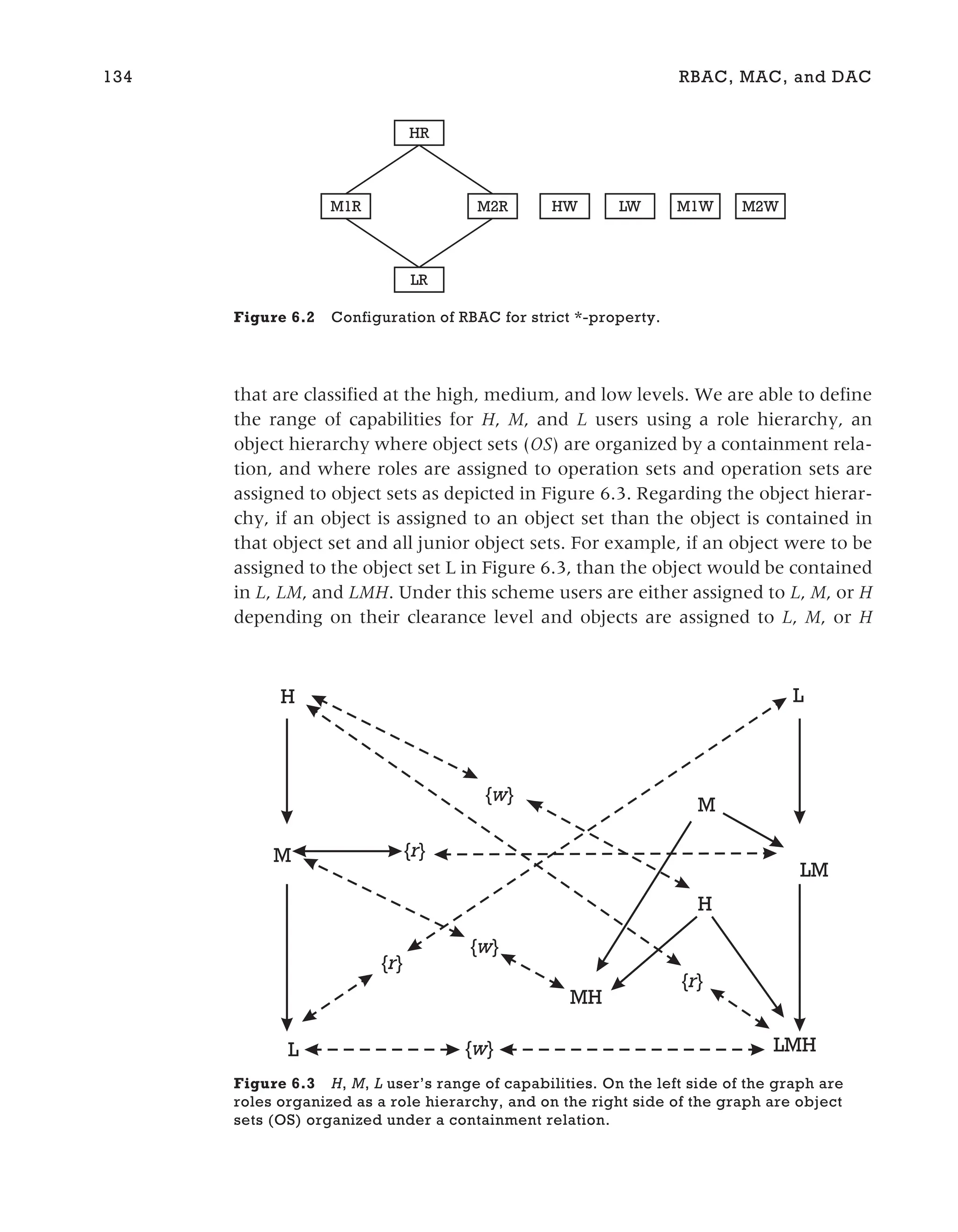
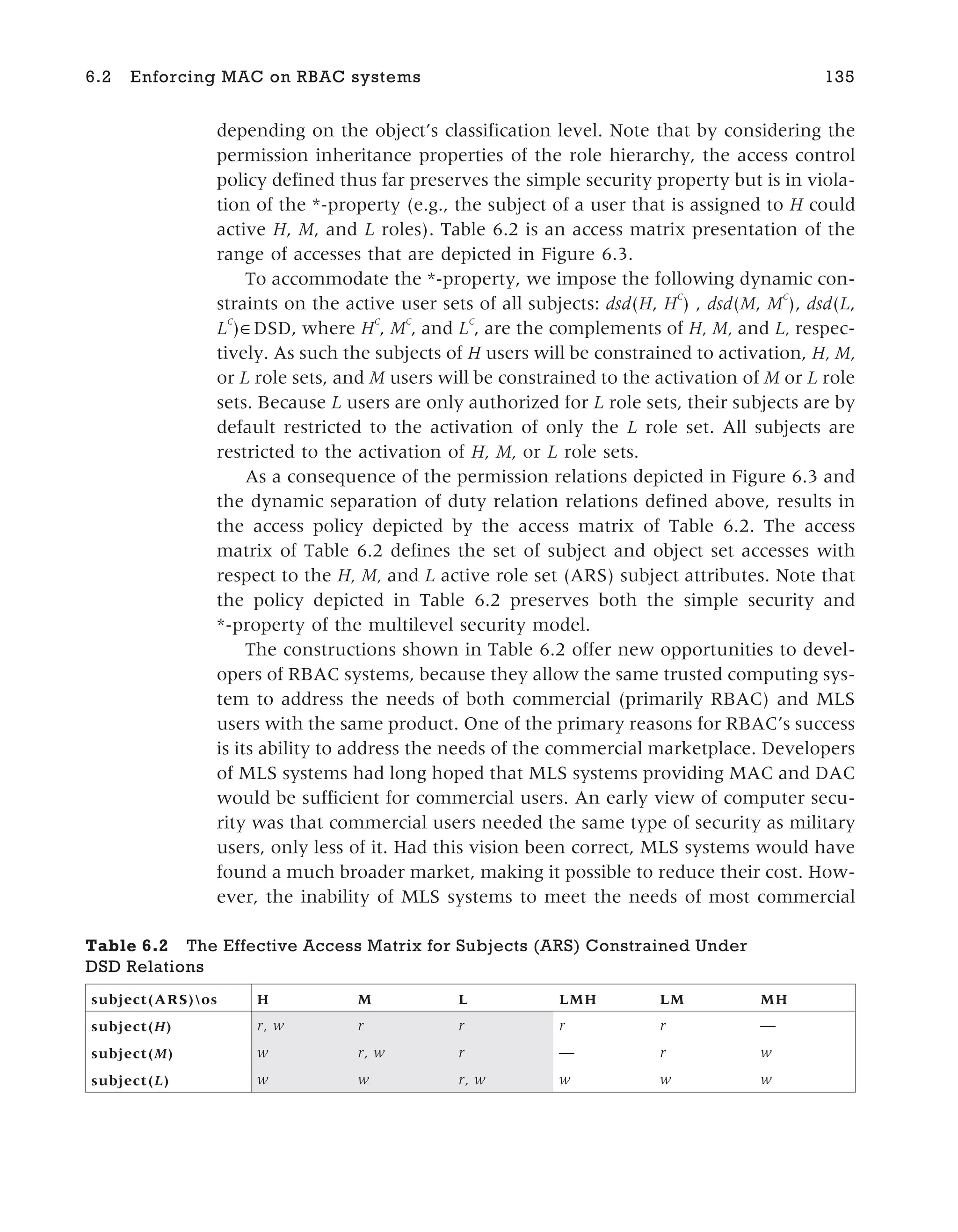
![users led to the recognition of a need for a different approach to security,
embodied by RBAC and related designs. Yet there is still a need for MLS sys-
tems within some organizations. The methods described in this section
allow these organizations to take advantage of RBAC’s flexibility while pro-
viding traditional MAC rules. However, government policies may require
that the system provide MLS controls at the kernel level, rather than lay-
ered on top of an RBAC system. Section 6.3 shows that it is possible to take
the opposite approach to combining RBAC and MLS controls by layering
RBAC on a traditional MLS platform.
6.3 Implementing RBAC on MLS systems
Sections 6.1 and 6.2 demonstrate that RBAC can be used to implement the
traditional DAC and MAC rules. This section does the reverse, configuring a
system that supports MAC to implement RBAC. A construction defined by
Kuhn [6] allows RBAC to be implemented directly on MLS systems that
support the traditional lattice-based controls. This is significant because it
means that the enormous investment in MLS systems can be applied to
implementing RBAC systems. In addition, this method allows simultaneous
support of RBAC and MLS access rules, with MLS controls remaining at the
kernel level.
A role can be thought of as a set of permissions or privileges. RBAC can
then be implemented on an MLS system by establishing a relationship
between privilege sets within the RBAC system and category sets within the
MLS system. To implement RBAC, a trusted interface function is developed
to ensure that the assignment of levels and categories to users is controlled
according to the RBAC rules. No modifications to the MLS system are neces-
sary. Roles and their associated privilege sets must be mapped by the inter-
face function to sets of categories. Each time a user establishes a session, the
interface presents the user’s role options and then checks to ensure that
the user is authorized for the requested role. The trusted interface then sets
the subject’s categories according to a mapping function that determines a
unique combination of categories based on the privileges associated with
requsted role (see Figure 6.4).
A problem arises in the choice of the mapping function. One possibility is
the one-to-one assignment of MLS categories to RBAC privileges. This
approach is used in the Data General DG/UX B2 secure system [8], for
example. For small numbers of privileges, this is an efficient solution.
DG/UX supports up to 128 separate roles. Users can be assigned a set of
136 RBAC, MAC, and DAC](https://image.slidesharecdn.com/role-basedaccesscontrolsecondeditionpdfdrive-250311062434-2e3fc82e/75/Role-Based-Access-Control-Second-Edition-PDFDrive-pdf-157-2048.jpg)
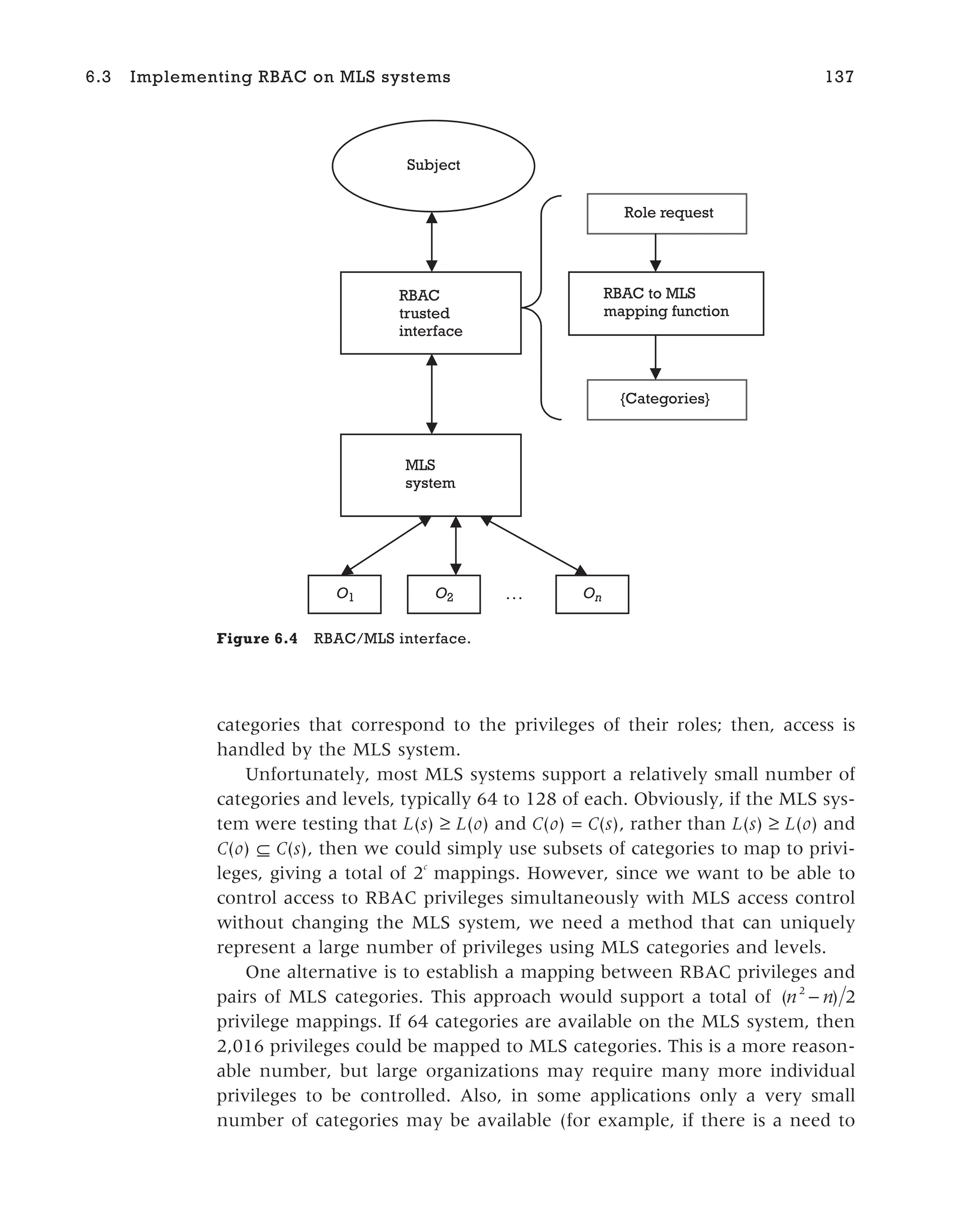
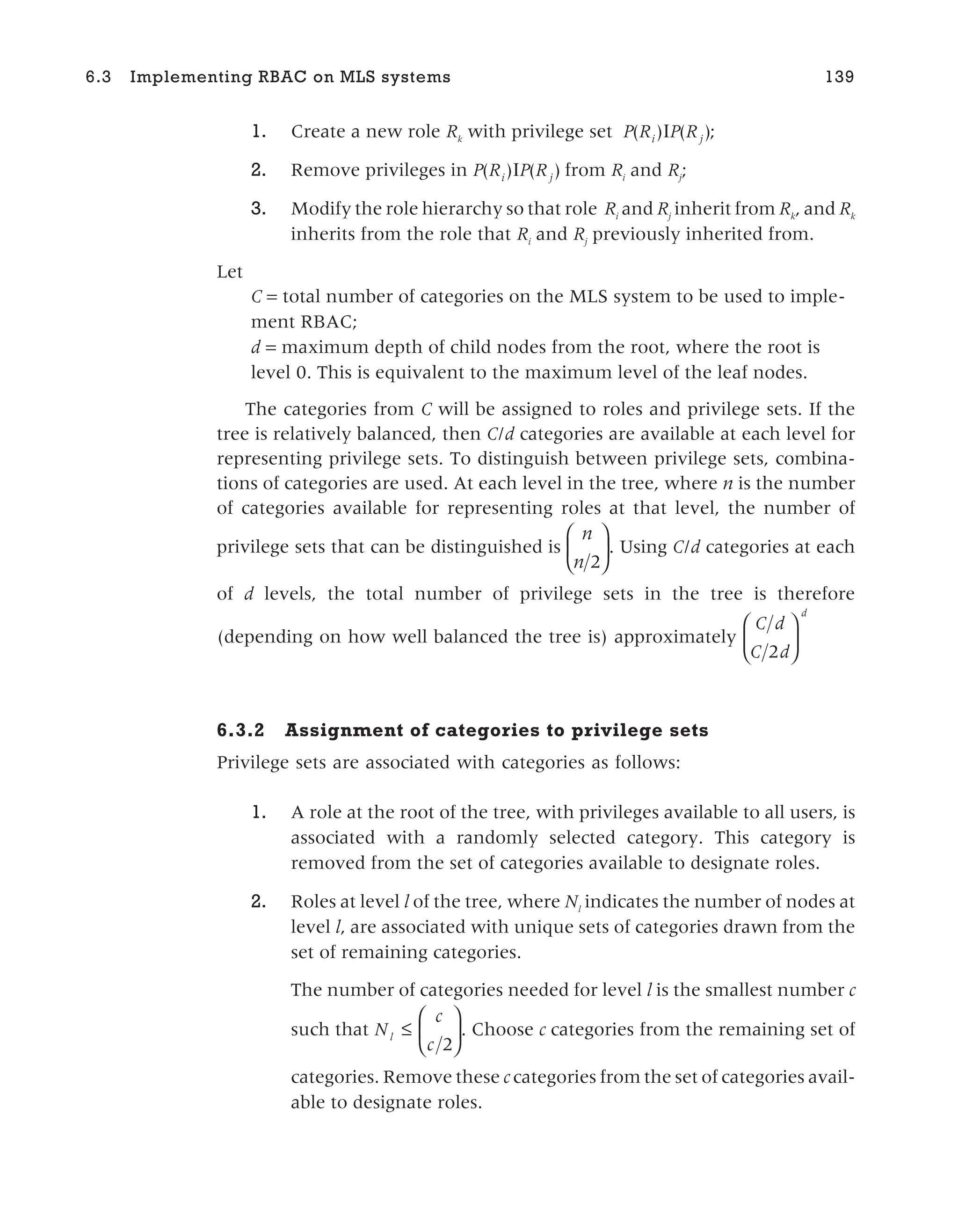
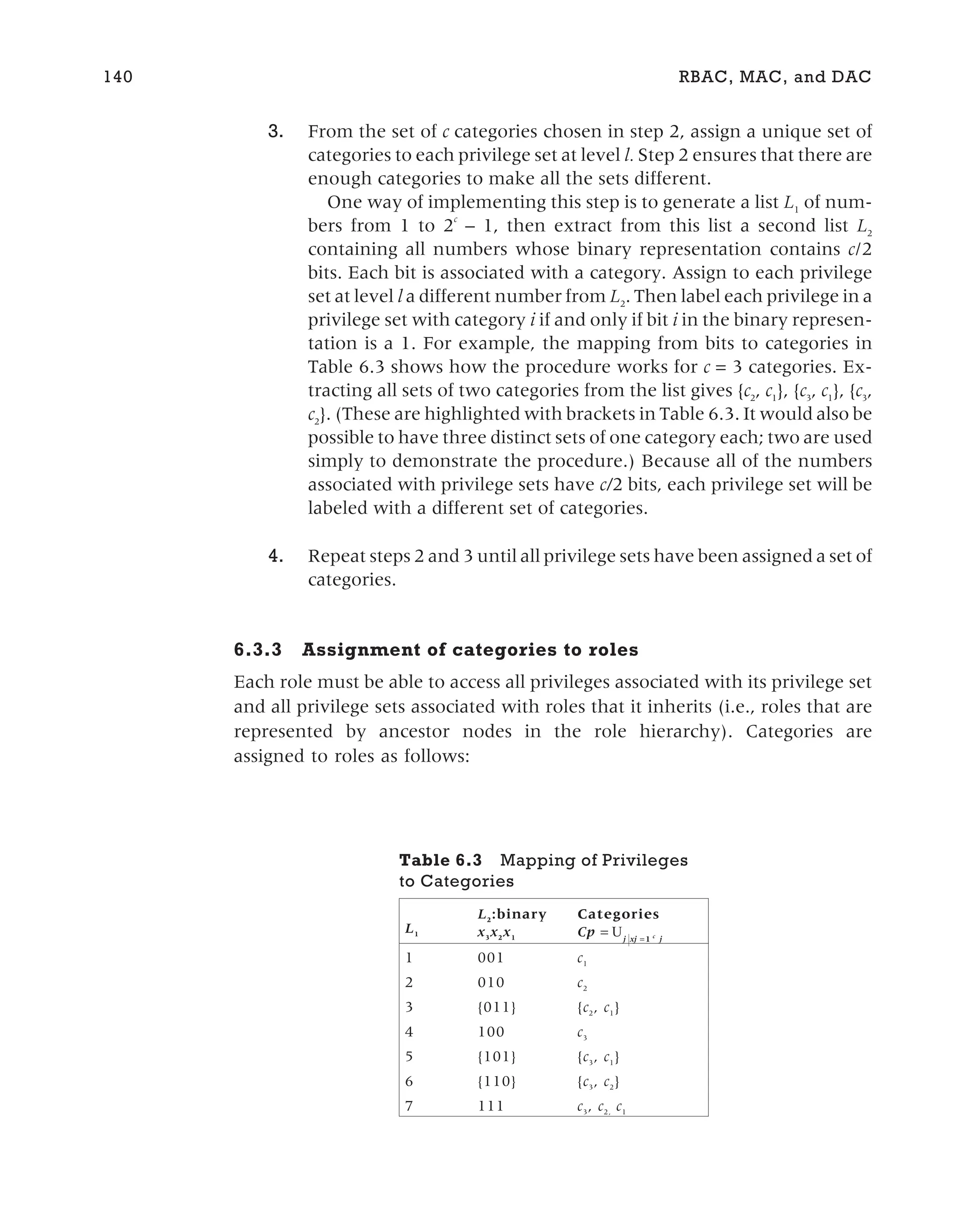
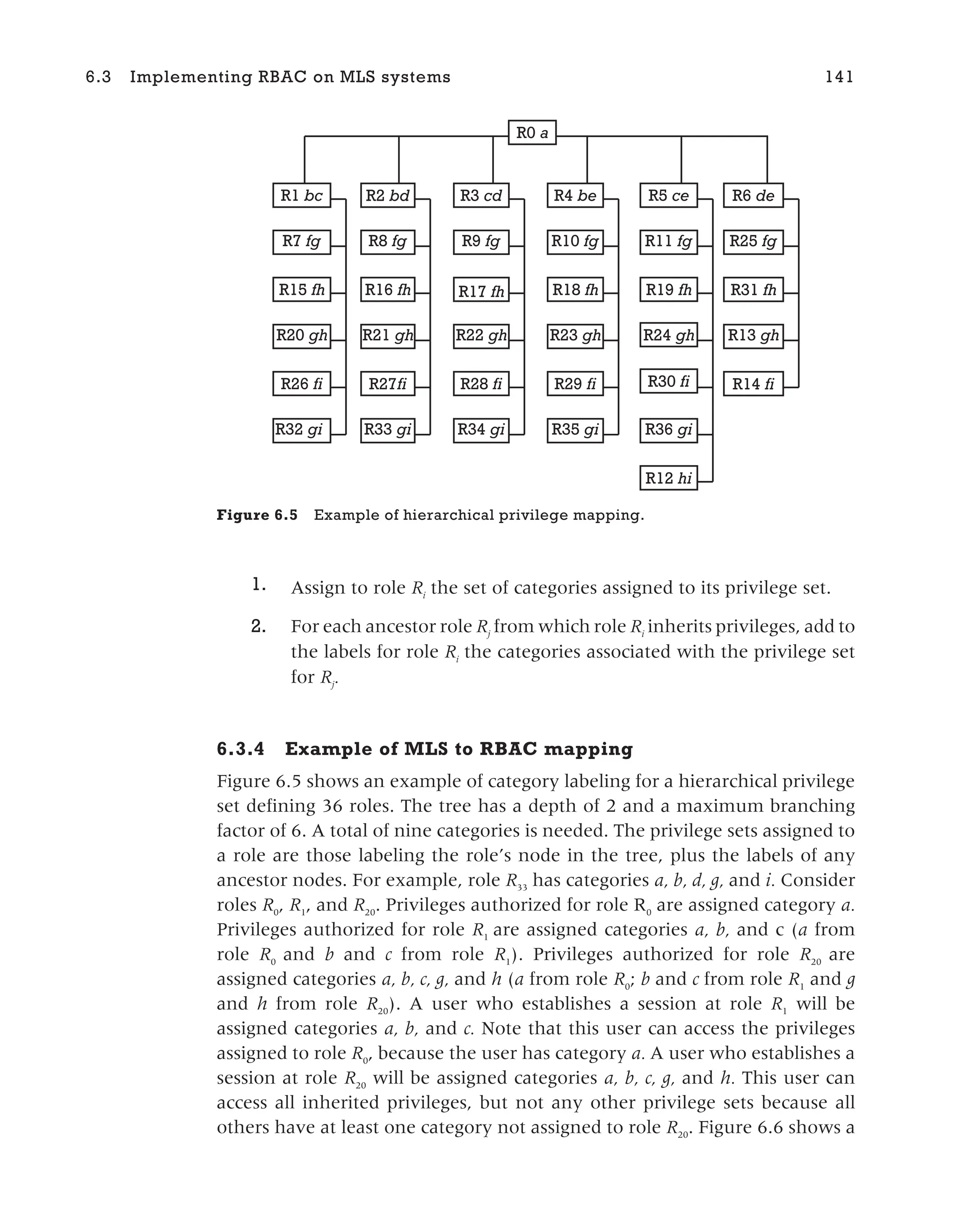
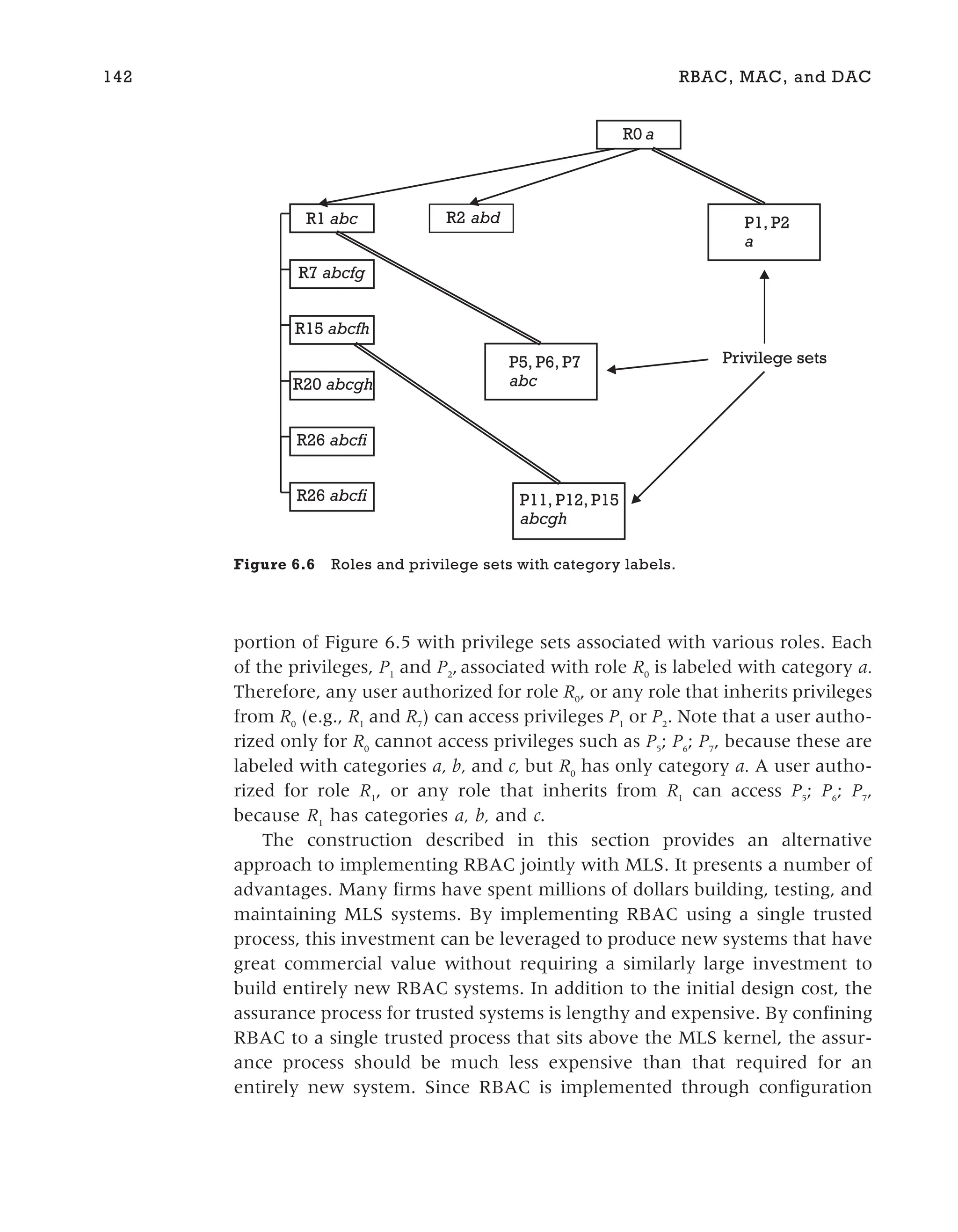
![options, a system can provide RBAC while retaining the same high
assurance level.
6.4 Running RBAC and MAC simultaneously
Sections 6.1 to 6.3 have shown ways to use conventional systems and RBAC
to implement each other, but there are important considerations when
operating RBAC simultaneously with a MLS system. RBAC’s utility has
made it attractive not only for commercial systems, but for a wide variety of
systems that process classified information (see, for example, [9, 10]). The
U.S. DoD’s Global Command and Control System incorporates RBAC [11],
as do some cryptographic key management systems. These systems, and
many others, may have requirements to incorporate MAC rules in a
role-based security environment.
Researchers have investigated the interrelationship between multilevel
security and RBAC. Osborn [7] showed that significant constraints exist on
the ability to assign roles to subjects without violating MAC rules. To ana-
lyze the assignment of roles, it is necessary to consider all objects that can be
read or written by users with a role. The collection of read-and-write privi-
leges for a particular role, termed the modified privilege set, is the set of pairs
(object, operation) that are accessible to the role either directly or indirectly,
where operation is either read or write. Then the r-level is defined as the maxi-
mum security level of any object for which (o, read) is in the modified privi-
lege set of the role. Similarly, the w-level is the minimum security level of any
object for which (o, write) is in the modified privilege set of the role.
Once r-level(R) and w-level(R) for a role R have been determined, it is
possible to analyze the assignment of users to the role. Clearly, users
must not be allowed to read objects above their clearance levels. This
requirement leads us to the first constraint, which ensures the “no read up”
property:
◗ Constraint 1: Any subject s assigned to a role R must have L(s) ≥
r-level(R). The “no write down” property must also be maintained, so
for the liberal *-property we also have the following.
◗ Constraint 2: Any subject s assigned to a role R must have L(s) ≤
w−
level(R). Combining these two constraints, we can see that the third
property, termed the “role lemma” [7], must hold for any role.
◗ Constraint 3: w−
level(R) ≥ r−
level(R). For the strict *-property, the con-
straints become even tighter. This version of the *-property requires
6.4 Running RBAC and MAC simultaneously 143](https://image.slidesharecdn.com/role-basedaccesscontrolsecondeditionpdfdrive-250311062434-2e3fc82e/75/Role-Based-Access-Control-Second-Edition-PDFDrive-pdf-164-2048.jpg)
![that L(s) = w−
level(R), so every object that can be written to by a user
in role R must be at the same security level.
Since a role might require read and write access to objects at a broad
range of security levels, these constraints could theoretically present a prob-
lem in implementing RBAC with MAC. However, practical applications pro-
vide a way around this limitation. In practice, the traditional *-property may
be relaxed to allow write access if the data written does not depend on the
data read, reducing constraints on role assignment depending on the degree
to which there is independence between read-and-write data in “typical’’
applications. Of course, the constraints above must hold for any data where
there are dependencies between read-and-write operations.
To date, systems supporting both MAC and RBAC have not been pro-
duced, but the approaches discussed in this chapter show that such a system
is possible. Deciding whether to use a MAC on RBAC (Section 6.2) or RBAC
on MAC approach (Section 6.3), or some hybrid design, will depend on
organizational requirements and available resources. In either case, the con-
straints described above must be observed.
References
[1] Nyanchama, M., and S. L. Osborn, “Information Flow Analysis in Role-Based
Systems,” Journal of Computing and Information, Vol. 1, No. 1, May 1994,
Special Issue: Proc. of the 6th International Conference on Computing and
Information (ICCI), Peterborough, Ontario, Canada.
[2] Sandhu, R., “Role Hierarchies and Constraints for Lattice-Based Access
Controls,” Proc. of 4th European Symposium on Research in Computer Security,
Rome, Italy, September 25–27, 1996.
[3] Osborn, S., R. Sandhu, and Q. Munawer, “Configuring Role-Based Access
Control to Enforce Mandatory and Discretionary Access Control Policies,”
ACM Transactions on Information and System Security, Vol. 3, No. 2, May 2002,
pp. 85–106.
[4] Ferraiolo, D. F., and V. Hu, The Policy Machine: A Policy Engine and Language for
Generalized Attribute-Based Access Control, (unpublished) 2002.
[5] Sandhu, R., and Q. Munawer, “How to Do Discretionary Access Control Using
Roles,” Proc. of 3rd ACM Workshop on Role-Based Access Control (RBAC-98), Fairfax,
VA, October 1998.
[6] Kuhn, D. R., “Role-Based Access Control on MLS Systems Without Kernel
Changes,” Proc. ACM Workshop on Role-Based Access Control, 1998, pp. 25–32.
144 RBAC, MAC, and DAC](https://image.slidesharecdn.com/role-basedaccesscontrolsecondeditionpdfdrive-250311062434-2e3fc82e/75/Role-Based-Access-Control-Second-Edition-PDFDrive-pdf-165-2048.jpg)
![[7] Osborn, S. L., “Mandatory Access Control and Role-Based Access Control
Revisited,” Proc. of 2nd ACM Workshop on Role-Based Access Control, November
1997.
[8] Meyers, W. J., “RBAC Emulation on Trusted DG/UX,” Proc. 2nd ACM Workshop
on Role-Based Access Control, 1997.
[9] Phillips, Jr., C. E., S. A. Demurjian, and T. C. Ting, “Towards Information
Assurance for Dynamic Coalitions,” Proc. 2002 IEEE Workshop in Information
Assurance, United States Military Academy, West Point, New York, June 2002.
[10] Khair M., I. Mavridis, and G. Pangalos, “Design of Secure Distributed Medical
Database System,” Database and Expert Systems Applications (DEXA ’98), August
1998.
[11] Phillips, Jr., C. E., T. C. Ting, and S. A. Demurjian, “Mobile and Cooperative
Systems: Information Sharing and Security in Dynamic Coalitions,” 7th ACM
Symposium on Access Control Models and Technologies, June 2002. Also Information
Sharing and Security in Dynamic Coalitions, University of Connecticut, Technical
Report CSE-TR-02-1, 2002.
6.4 Running RBAC and MAC simultaneously 145](https://image.slidesharecdn.com/role-basedaccesscontrolsecondeditionpdfdrive-250311062434-2e3fc82e/75/Role-Based-Access-Control-Second-Edition-PDFDrive-pdf-166-2048.jpg)

![for a patient, the attending physician performs a task or transaction that
involves (1) reading several medical history records of the patient such as pre-
vious instances of medication and reactions, (2) reading about reported aller-
gies, and (3) prescribing drugs that did not produce adverse reactions or
allergies in the past.
Condition: This describes the qualifications or additional restrictions that
must be evaluated to grant access to a particular subject for a particular data
object. These conditions or access control rules (also called permission con-
straints) could theoretically involve any piece of context/content information
and hence the usage of this policy element in a privacy policy is no different
than in an access control policy.
In addition to the above four common policy elements, privacy policies
may require two additional elements as described next.
Purpose: Privacy requirements refer to two types of purposes—business
purpose and data purpose. Business purpose captures the intention for per-
forming a business task that involves some type of access to privacy-protected
information. Data purpose captures the data usage parameters consented to
by the data subject or data owner (called privacy preferences) and recorded by
the data collector. Examples of privacy preferences are opt-in, opt-out
choices, retention periods, and so forth. The purpose-binding principle of pri-
vacy stipulates that the business task using a data object is allowed to be per-
formed only if there is logical binding of the business purpose associated with
task with the data purpose for the data object involved in the task. For exam-
ple, a business task that generates e-mail promotions using customer contact
information can only be performed if the data purpose “direct marketing” or
“e-mail promotion” is associated with customer contact information (or a
higher-level data object).
Obligation: This policy element specifies additional protection measures
for PII. For example, hospitals should archive patient data medical records
securely and filter those medical records of individually identifiable informa-
tion prior to sending it to clinical researchers.
The generic syntax for a privacy rule involving the policy elements dis-
cussed above is given here [1]:
ALLOW [Data User/Role/Subject]
to perform [Operation] on [Data Type/Object]
for [Business Purpose] provided [Condition].
Carry out [Obligation].
150 Privacy and Regulatory Issues](https://image.slidesharecdn.com/role-basedaccesscontrolsecondeditionpdfdrive-250311062434-2e3fc82e/75/Role-Based-Access-Control-Second-Edition-PDFDrive-pdf-171-2048.jpg)
![one proposed in the DAFMAT framework [2] together with additional enti-
ties proposed in [3] to make it privacy-aware. The schematic diagram of a
privacy-aware RBAC model is shown in Figure 7.1.
Continuing our discussion of the “purpose” policy element, since each
business purpose instance is associated with one or more task instances, it
needs to be captured through a new RBAC model entity called “business
purpose” and its relationship with the task entity established through
task-business purpose relationship instances. Similarly, since a data purpose
is associated with an instance of data object or a particular class of data
objects, it needs to be captured through a data usage entity and its relation-
ship with data object entity established through data object-data usage
relationship instances.
In regard to the “obligation” policy element, obligation refers to a set of
mandated tasks that need to be carried out on a data object or a class of data
objects that are subject to privacy protection. The mandated task may be a
function that needs to be performed as soon as any access takes place on the
data object or it may be a periodical or event triggered function. Whatever
the nature of the task, since an obligation always relates to a data object or a
152 Privacy and Regulatory Issues
Access
modes D-T pair
Users Roles
Domain
Object-type
Business
purpose
Task
Subject
Data
object
Data usage
M:N N:1
M: N
M:N
N: 1
1: 1
1: 1
M:N
M: N
N: 1
N: 1
Figure 7.1 Privacy-aware RBAC model.](https://image.slidesharecdn.com/role-basedaccesscontrolsecondeditionpdfdrive-250311062434-2e3fc82e/75/Role-Based-Access-Control-Second-Edition-PDFDrive-pdf-173-2048.jpg)
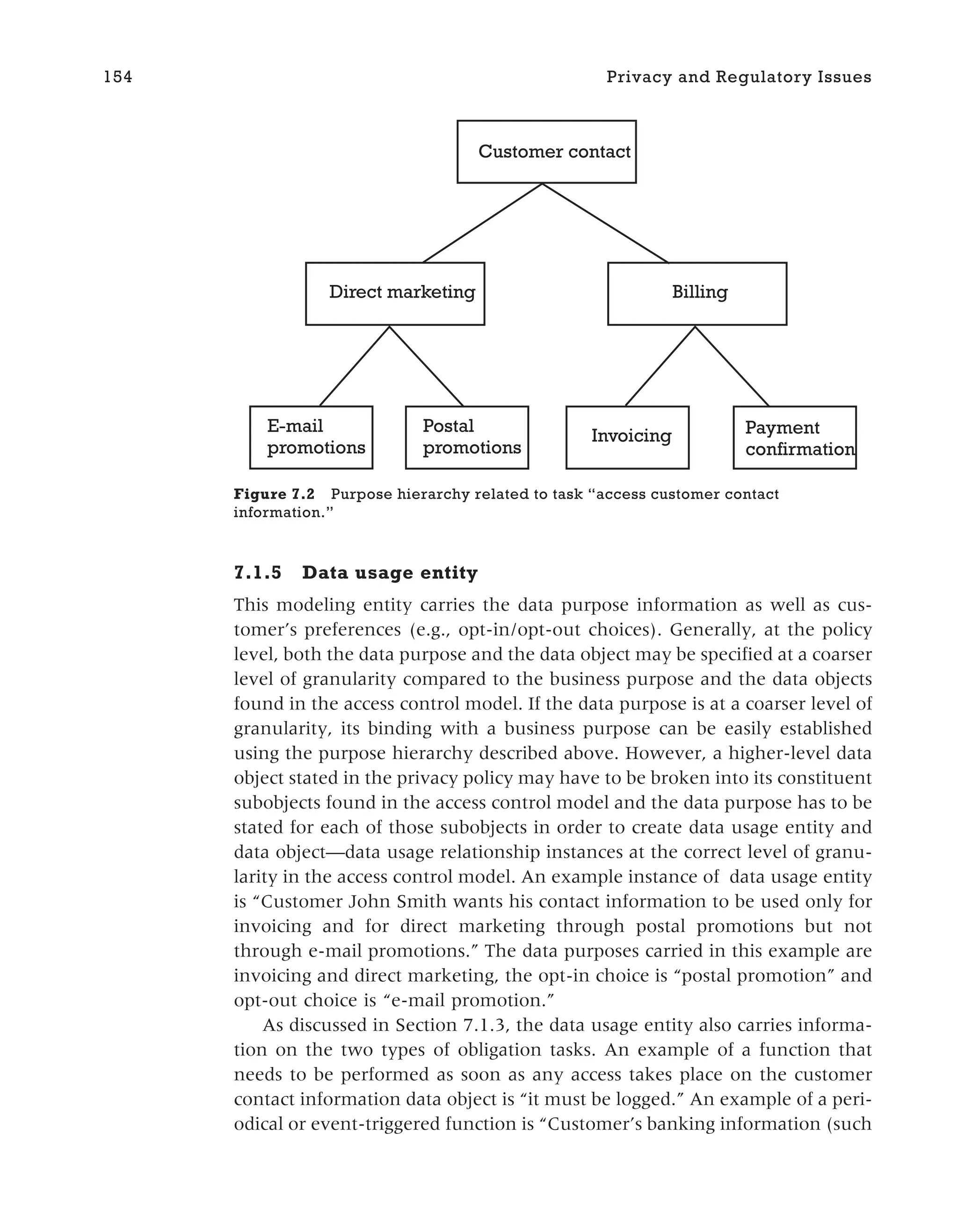
![as the account number and routing number) should be deleted if no
invoices have been sent in the last 12 months.”
7.1.6 Privacy-aware RBAC model
The RBAC model can be extended with additional entities and relationships
to become a privacy-aware RBAC model. This model can has the capability
to support evaluation of privacy policies for practical application domains.
7.2 Integrate privacy policy support in the role
engineering process
To deploy an RBAC-based access control framework for an enterprise or
application, the various entity instances and relationship instances of the
chosen RBAC model must be established. This process is called role engi-
neering. Role engineering generally involves defining roles, permissions,
role hierarchies, and conditions/constraints associated with exercise of those
permissions by the various roles. However, privacy requirements are not
generally addressed in role engineering due to the following reasons:
◗ Privacy rule processing is not a design requirement for the access deci-
sion module since the policy specification module does not include
privacy policies;
◗ The RBAC model does not have constructs/entities that capture pri-
vacy policy elements.
Let us therefore assume that the prerequisites for addressing privacy
requirements within role engineering exist. In particular, we will assume
that the privacy-aware RBAC model like the one proposed in [3] and shown
in Figure 7.1 exists and that our access decision module has to process pri-
vacy rules. Hence in addition to the list cited above (role instances, role-per-
mission instances, and so forth), our role engineering process should
determine the following entity and relationship instances:
◗ Business purpose entity instances;
◗ Role-business purpose relationship instances;
◗ Business purpose-task relationship instances;
◗ Data usage entity instances;
◗ Data usage-data object relationship instances.
7.2 Integrate privacy policy support in the role engineering process 155](https://image.slidesharecdn.com/role-basedaccesscontrolsecondeditionpdfdrive-250311062434-2e3fc82e/75/Role-Based-Access-Control-Second-Edition-PDFDrive-pdf-176-2048.jpg)
![There are several role engineering approaches proposed by the research
community. Some examples are: scenario-driven approach [4], analytical
role modeling [5], UML-based approach [6] and goal-driven approach [7].
A hybrid role engineering approach that uses a combination of goals and
scenarios has been proposed by Qingfeng He and Annie Anton [8] that
incorporates support for capturing privacy requirements. Specifically, this
approach outlines the steps required to determine the instances of addi-
tional entities and relationships listed above, required by a privacy-aware
RBAC model, in addition to those of core entities and relationships (roles,
role-task relationship, and so forth) found in the basic RBAC model. Here
we briefly outline these ideas. Interested readers can refer to the paper for a
comprehensive understanding of the complete role engineering
methodology.
To determine the additional entity and relationship instances, He and
Anton’s methodology [8] uses a data model consisting of three entities: role,
permissions, and objects. Please note that these entities are part of the role
engineering data model and have nothing to do with our privacy-aware
RBAC model, which is our end goal. A schematic diagram of this role engi-
neering data model is given in Figure 7.3.
156 Privacy and Regulatory Issues
Role.ID
Role.Name
Role.Context.Purpose
Permission.ID
Permission.Operation
Permission.Object
Permission.Context
Permission.Constraints
Permission.Obligations
Object.ID
Object.Type
Object.Context.Purpose
Object.Context.Recipient
Object.Context.Retention
Object.Context.Service.Opt-in
Object.Context.Service.Opt-out
Figure 7.3 Role engineering data model.](https://image.slidesharecdn.com/role-basedaccesscontrolsecondeditionpdfdrive-250311062434-2e3fc82e/75/Role-Based-Access-Control-Second-Edition-PDFDrive-pdf-177-2048.jpg)
![conceptually no different than integrating an access control rule into the
access decision engine and hence requires no further elaboration.
In the next section, we illustrate a complete authorization process using
an RBAC-based access control framework that provides support for privacy
policies.
7.3 Authorization using privacy-RBAC-ACF
Let us now see the authorization process in a privacy-supporting
RBAC-based access control framework (privacy-RBAC-ACF) that uses a pri-
vacy-aware RBAC model, when an access request involves a privacy-pro-
tected data. The authorization process in this type of access request context
has two subprocesses. They are:
◗ Access control rules evaluation process;
◗ Privacy rules evaluation process.
Since the access control rule evaluation process is covered extensively in the
literature, we will just illustrate the privacy rule evaluation process. Let us
now restate the generic format of our privacy rule for the purpose of starting
the discussion thread:
ALLOW [Data User/Role]
to perform [Operation] on [Data Type]
for [Business Purpose] provided [Data Purpose
and/or Condition].
Carry out [Obligation].
The data access request context is as follows. A user assigned the role of
“accounts receivable clerk” uses the “invoice application” (subject) to
invoke the task “access customer contact information.” Using the task-pur-
pose relationship instances, the purposes for which this task is invoked can
be determined. At this stage the privacy rules evaluation process has the fol-
lowing partial bindings generated for the privacy rule (the binding data val-
ues are shown in bold) evaluation:
ALLOW [ ]
To perform [ ] on [ ]
For [ ] provided [Data Purpose
and/or Condition].
Carry out [Obligation].
160 Privacy and Regulatory Issues](https://image.slidesharecdn.com/role-basedaccesscontrolsecondeditionpdfdrive-250311062434-2e3fc82e/75/Role-Based-Access-Control-Second-Edition-PDFDrive-pdf-181-2048.jpg)
![ALLOW [ ]
To perform [ ] on [ ]
For [ ] provided [Billing or Invoicing is
the Data Purpose for Customer Contact Information].
Carry out [immediate logging of access and deleting
of banking information from customer information
for customers with no billing activity for the
last 12 months].
Since the above represents a consistent set of binding, the privacy rule eval-
uates to TRUE and hence access is granted.
7.4 RBAC and regulatory compliance
Can privacy and regulatory requirements be addressed entirely through
administrative means? This is a critical question for many organizations.
Some commentators have suggested that administrative changes are suffi-
cient for compliance, and while this is technically correct, it fails to take
advantage of the built-in capacity of access control systems, particularly
RBAC, to make regulatory compliance easier and ultimately less expensive.
Even in the best-managed organizations, employees eventually make mis-
takes that may violate administrative guidelines for compliance, or worse,
malicious employees may take advantage of the lack of automated controls
to commit fraud. RBAC features provide tight controls over all actions, espe-
cially complex requirements such as separation of duty. Most important, an
RBAC system can document all controlled actions, providing strong evi-
dence that management has implemented “due diligence” for regulatory
compliance.
While at one time most audits required some input from a firm’s data
processing department, and in some cases audits covered IT operations as
well, today information security is central to nearly all compliance issues.
Many of the new requirements can be traced to three extensive regulatory
statutes passed by the U.S. Congress in the 1990s: the Gramm-Leach-Bliley
act, for financial services, the Health Information Portability and Account-
ability Act, for health care, and the Sarbanes Oxley Act, which covers pub-
licly traded firms to give investors confidence that business operations are
legitimate.
Together, these statutes imply:
◗ A much greater need for IT involvement in regulatory compliance;
162 Privacy and Regulatory Issues](https://image.slidesharecdn.com/role-basedaccesscontrolsecondeditionpdfdrive-250311062434-2e3fc82e/75/Role-Based-Access-Control-Second-Edition-PDFDrive-pdf-183-2048.jpg)
![◗ Need for an ongoing program encompassing all parts of the organiza-
tion, not just a project effort;
◗ A single individual may be responsible for regulatory compliance: the
SEC requires a chief compliance officer for SOX, HIPAA requires a chief
privacy officer and a chief security officer:
◗ Most critical, a need for more preventive controls and ways to avoid
excess access privileges. For example, SOX requires separation of duty
to reduce the risk that a single individual can put the enterprise in
jeopardy.
Many similarities and overlaps exist among regulations. Although the stat-
utes are enforced by a variety of agencies, the U.S. government makes it
clear in the Federal Register [9] that “the Agencies will expect an institution
to coordinate all the elements of its information security program.” In addi-
tion to meeting the regulatory need for a coordinated approach to informa-
tion security, a unified approach can reduce costs. Many argue that
compliance with SOX alone costs many firms more than they spend on
product development, and average compliance cost is estimated at $4.36
million per large company. The total cost to the U.S. economy, including
opportunity costs, is estimated at $1.4 trillion [10]. Although regulatory
compliance can be expensive, careful planning can not only reduce costs of
initial implementation, but allow audits to go more efficiently in the future
by automating much of the compliance process. The key to cost reduction is
establishment of the proper controls.
IT controls can be divided into three categories:
1. Preventive: reduce the risk of fraud or other violations; access control
and authorization. Preventive controls are especially important
since they may be the only controls that will catch fraud or other vio-
lations before damage is done. Separation of duty for financial
reporting purposes may only ensure that violations are eventually
caught.
2. Analytical: monitoring activity to ensure that preventive controls are
functioning correctly: auditing accesses, reviewing permissions and
changes to role/permission assignments. Analytical controls are
especially important when role/permission assignments are
changed because careless changes can result in a role structure that
allows users to violate separation of duty requirements. See Chapter
5 for detailed consideration of SoD rules.
7.4 RBAC and regulatory compliance 163](https://image.slidesharecdn.com/role-basedaccesscontrolsecondeditionpdfdrive-250311062434-2e3fc82e/75/Role-Based-Access-Control-Second-Edition-PDFDrive-pdf-184-2048.jpg)
![3. Corrective: to restore systems to compliance with policy. Corrective
controls are implemented administratively, and may involve re-
structuring the role hierarchy, changing permission assignments,
and new user/role assignments.
This section focuses on preventive and analytical controls, which can be
built in to most RBAC systems. In particular, we show how the RBAC con-
figuration and access reports can be used to document compliance.
7.4.1 Sarbanes-Oxley Act compliance
The Sarbanes-Oxley Act establishes a set of requirements for financial sys-
tems, to deter fraud and increase corporate accountability with the objective
of ensuring that investors and regulators have an accurate and complete
picture of the firm’s financial position. For information technology systems,
regulators may need to know who used a system, when they logged in and
out, what accesses or modifications were made to what files, and what
authorizations were in effect. IT vendors responding to Sarbanes-Oxley
requirements have adopted RBAC as central to compliance solutions
because RBAC was originally designed to ensure that “data and processes
[can] be modified only in authorized was by authorized users” [11]. SOX
rules can be very costly to implement, but they also present an opportunity
for firms to achieve better control over internal processes.
A review of SOX requirements helps in understanding where RBAC fits
in a comprehensive approach for compliance. SOX requires that manage-
ment certify the effectiveness of internal controls and procedures that are
used in producing financial reports. In IT terms, this means rigorous security
controls over the software systems that the firm depends on for all financial
data. This includes not only accounting software, but order information,
personnel records, inventory, physical assets, and all other data that will be
eventually reflected in financial statements. Controls must be in place to
ensure that changes can only be made in appropriate ways by authorized
personnel, which is precisely what RBAC was designed to accomplish. More
and more access is being automated through Web sites and touch-tone
phones, so controls need to cover both employees and automated processes
to prevent unauthorized release of customer information.
Sarbanes-Oxley is a large, complex statute, but three sections in particu-
lar are relevant for information technology:
◗ Section 302 requires that corporate executives certify the complete-
ness and accuracy of the firm’s financial reporting.
164 Privacy and Regulatory Issues](https://image.slidesharecdn.com/role-basedaccesscontrolsecondeditionpdfdrive-250311062434-2e3fc82e/75/Role-Based-Access-Control-Second-Edition-PDFDrive-pdf-185-2048.jpg)
![7.4.2 Gramm-Leach-Bliley Act and HIPAA compliance
In 1999, the U.S. Congress passed the Gramm-Leach-Bliley Financial Ser-
vices Modernization Act (GLB), which substantially expanded the range of
businesses that can be operated by banks, investment firms, and insurance
companies. Part of the act specifies mandatory privacy rules designed to
ensure the confidentiality and integrity of customer information, and pro-
tect against unauthorized disclosure. Compliance is required from all finan-
cial services firms that offer financial services or products to consumers. The
scope of the act is broad—in addition to banks, brokerages, and insurance
companies, GLB regulations also affect real estate settlement firms, tax pre-
parers, financial advisors, and debt collectors. A survey of Internet privacy
policies for financial institutions found the fundamental concept of
role-based access to be central in policies; despite different wording, most
contained some form of the requirement “provide access to CI (Customer
Information) to authorized personnel with authorized roles” [12].
The Health Insurance Portability and Accountability Act of 1996
(HIPAA, Title II) established comprehensive requirements for safeguarding
the privacy of medical records and health care information. In addition to
consumer privacy, HIPAA includes provisions for electronic patient infor-
mation, and complex standards for communicating information between
organizations. Fortunately, RBAC is well suited to meeting HIPAA require-
ments, so much so that HIPAA regulations specifically include RBAC as an
approved means of HIPAA compliance. The impact of GLB and HIPAA in an
RBAC environment is primarily in configuration of privacy rules, discussed
in Section 7.3.
7.4.3 Compliance and the RBAC model
Drawing on the discussion from the previous section and the RBAC model
specified in Chapters 2 through 5, we can develop an approach to defining
and documenting the access control aspects of internal controls. As will be
seen below, a properly configured RBAC system will naturally provide the
controls and reporting that are needed for most regulatory compliance. Doc-
umenting compliance can be addressed by tracing from regulatory rules to
RBAC structures and audit reports.
Basic factors for control and audit trail. These represent the who, what,
when, and where questions of data modification:
◗ User ID, roles selected, and IP address of workstation;
◗ Applications and transactions executed;
166 Privacy and Regulatory Issues](https://image.slidesharecdn.com/role-basedaccesscontrolsecondeditionpdfdrive-250311062434-2e3fc82e/75/Role-Based-Access-Control-Second-Edition-PDFDrive-pdf-187-2048.jpg)
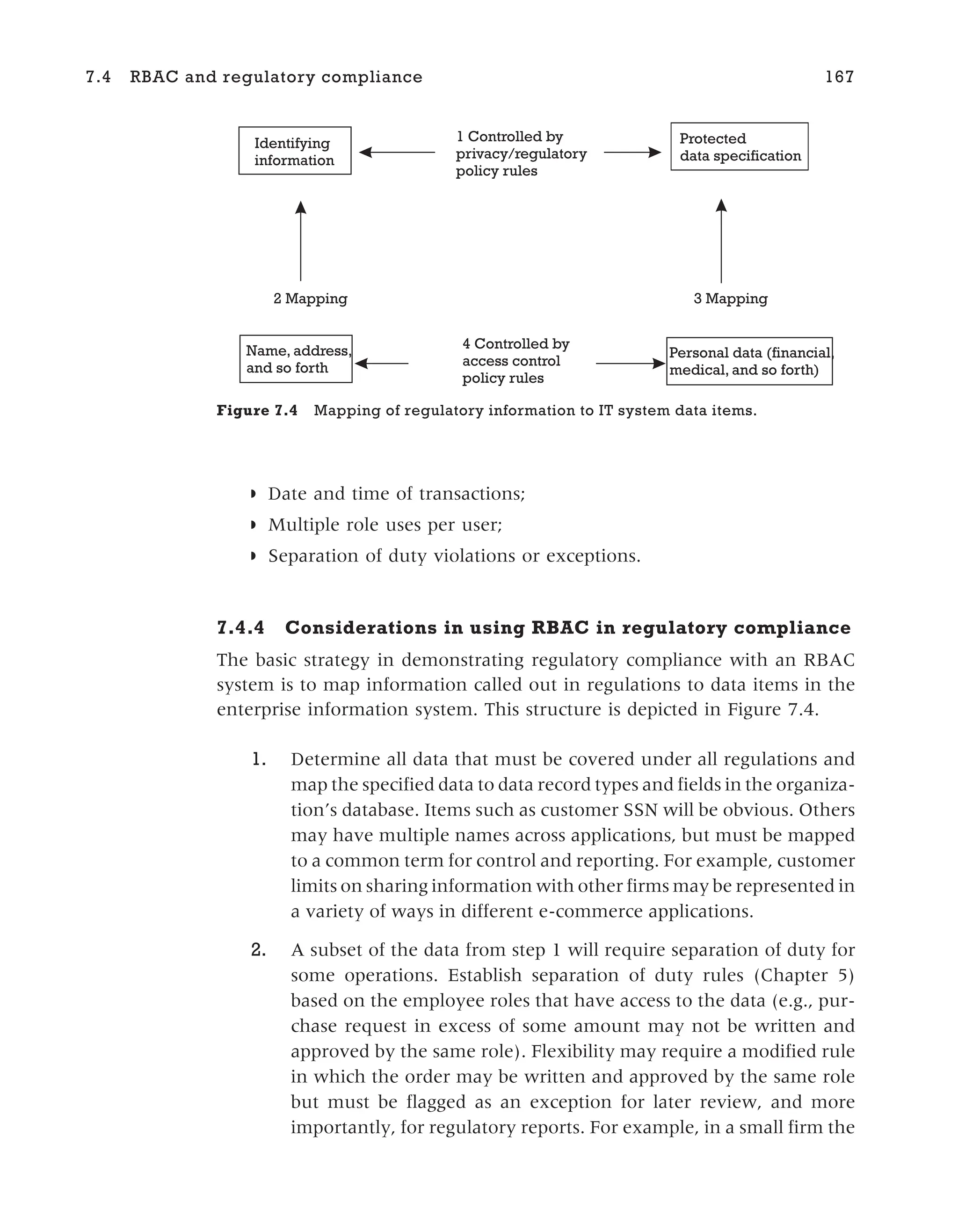
![same individual may sometimes need to activate roles that the RBAC
system treats as mutually exclusive, because the firm does not have
enough personnel to have one person devoted to reviewing pur-
chase requests. In this case, configuring the system to flag the SoD
violations as exceptions, rather than denying access, may provide
full documentation that can be used in demonstrating compliance.
3. Evaluate the applications that collect the data items identified in step
1. In many organizations, this can be more than one of those listed
above, or additional regulations unique to a particular industry.
Determine the set of transactions that read, write, or modify any of
the relevant data records determined above.
4. Evaluate privacy notices to determine what data items are controlled
under privacy rules; for example, customer name, social security
number, or account balance. Privacy notices explain the ways that
customer data will be used, and customers must agree to such use.
Data can be used only in ways that are explained in the privacy no-
tice and agreed to by the customer. Customers may agree to only a
subset of the conditions laid out in the privacy notice. For example,
many Web sites provide one or more checkboxes to allow users to in-
dicate if their information may be shared with advertisers or other
third parties. Determine the set of transactions that read, write, or
modify any of these data records.
With the mappings documented as discussed above, determine the roles
that have access to the sets of transactions collected in previous steps. If
RBAC is being enforced, then only the users with authorization for these
roles will have access to the regulated data. An audit of users who have
authorization for roles in this set provides a bound on the number and job
assignment of users who can access privacy or regulatory sensitive informa-
tion. A complete picture of who does what in the organization is provided
by reporting role activations, transactions executed in each role, exceptions
or access denials, and changes in user-role or role-permission assignments.
References
[1] Powers, C., P. Ashley, and M. Schunter, “Privacy Promises, Access Control
and Privacy Management,” Proc. of the 3rd International Symposium on Electronic
Commerce (ISEC’02), 2002.
168 Privacy and Regulatory Issues](https://image.slidesharecdn.com/role-basedaccesscontrolsecondeditionpdfdrive-250311062434-2e3fc82e/75/Role-Based-Access-Control-Second-Edition-PDFDrive-pdf-189-2048.jpg)
![[2] Chandramouli, R., “A Framework for Multiple Authorization Types in a
Healthcare Application System,” Proc. of the 17th Annual Computer Security
Applications Conference (ACSAC 2001), 2001, pp. 137–148.
[3] He, Q., Privacy Enforcement with an Extended Role-Based Access Control Model,
NCSU Computer Science Technical Report, TR-2003-09, 2003.
[4] Neumann, G., and M. Strembeck, “A Scenario-Driven Role Engineering
Process for Functional RBAC Roles,” Proc. of 7th ACM Symposium on Access
Control Models and Technologies (SACMAT’02), 2002, pp. 33–42.
[5] Crooke, R., D. Ince, and B. Nuseibeh, “Towards an Analytical Role Modeling
Framework for Security Requirements,” Proc. of the 8th International Workshop
on Requirements Engineering: Foundation for Software Quality (REFSQ’02), Essen,
Germany, 2002.
[6] Epstein, P., and R. Sandhu, “Towards a UML Based Approach to Role
Engineering,” Proc. of 4th ACM Workshop on Role-Based Access Control (RBAC’99),
1999, pp. 135–143.
[7] Anton, A. I., “Goal-Based Requirements Analysis,” Proc. of 2nd International
Workshop on Requirements Engineering (RE’96), April 1996, pp. 136–144.
[8] He, Q., and A. I. Anton, “A Framework for Modeling Privacy Requirements in
Role Engineering,” Proc. of the 9th International Workshop on Requirements
Engineering: Foundation for Software Quality (REFSQ’03), Klagenfurt/Velden,
Austria, June 16–17, 2003.
[9] “Rules and Regulations,” Federal Register, Vol. 66, No. 22, Thursday, February
1, 2001.
[10] Zhang, I. X., “Economic Consequences of the Sarbanes-Oxley Act of 2002,”
University of Rochester, February 2005.
[11] Ferraiolo, D., and D. R. Kuhn, “Role-Based Access Control,” Proceedings of the
NIST-NSA National (USA) Computer Security Conference, 1992, pp. 554–563.
[12] Anton, A. I., et al., “The Lack of Clarity in Financial Privacy Policies and the
Need for Standardization,” IEEE Security & Privacy, Vol. 2, No. 2, 2004, pp.
36–45 (also available as NCSU CSC Technical Report #Tr-2003-14).
Selected Bibliography
D’Aquila, J. M., “Tallying the Cost of the Sarbanes-Oxley Act,” The CPA Journal,
http://www.nysscpa.org/cpajournal/2004/1104/perspectives/p6.htm.
Federal Trade Commission, Facts for Business, “In Brief: The Financial Privacy
Requirements of the Gramm-Leach-Bliley Act,”
http://www.ftc.gov/bcp/conline/pubs/buspubs/glbshort.htm.
Gallegos, F., “Sarbanes-Oxley Act of 2002 and Impact on the IT Auditor,” IS Control
Journal, Vol. 4, 2002, p. 17.
Ramos, M., “Section 404 Compliance in the Annual Report,” American Institute of
Certified Public Accountants, http://www.aicpa.org/pubs/jofa/oct2004/ramos.htm.
7.4 RBAC and regulatory compliance 169](https://image.slidesharecdn.com/role-basedaccesscontrolsecondeditionpdfdrive-250311062434-2e3fc82e/75/Role-Based-Access-Control-Second-Edition-PDFDrive-pdf-190-2048.jpg)

![RBAC Standards and Profiles
8.1 The ANSI/INCITS RBAC standard
In 2000, NIST called for a unified standard for RBAC [1], com-
bining the Ferraiolo-Kuhn 1992 model with the RBAC frame-
work introduced by Sandhu et al. in 1996 (see Chapter 1).
Following debate and comment within the RBAC and security
communities, NIST made revisions and proposed a U.S.
national standard for RBAC [2] through the International
Committee for Information Technology Standards (INCITS),
the primary U.S. body for developing standards in information
and communications technology. INCITS is also the American
National Standards Institute’s (ANSI) Technical Advisory
Group for ISO/IEC Joint Technical Committee 1, which is
responsible for IT standardization at the international level. In
2004, the standard received ballot approval and was adopted as
INCITS 359-2004 [3].
This chapter provides an overview of the structure and con-
tents of the standard. All the terms and features of the standard
will be familiar to those who have read the body of this book,
but it is important to understand which RBAC features have
been included in the standard. The chapter also summarizes
the major components of application program interfaces (APIs)
for RBAC systems that implement the standard.
8.1.1 Overview
Standardization over a stable set of RBAC features provides a
number of benefits. These benefits include a common set of
171
8
Contents
8.1 The ANSI/INCITS RBAC
standard
8.2 XACML profile for
role-based access control
C H A P T E R](https://image.slidesharecdn.com/role-basedaccesscontrolsecondeditionpdfdrive-250311062434-2e3fc82e/75/Role-Based-Access-Control-Second-Edition-PDFDrive-pdf-192-2048.jpg)
![beginning with a core set of RBAC features that must be included in all
packages. Other components that may be selected in arriving at a relevant
package of features pertain to role hierarchies, static constraints (static SoD),
and dynamic constraints (DSD). A RBAC system conforms to this technical
specification if it complies with all the requirements for a specified compo-
nent and feature option.
Standards conformance
A conformity assessment would be done through a supplier’s declaration,
with the cost of assessing conformity borne by suppliers. The Common Cri-
teria protection profile for RBAC [4] provides means for assessing confor-
mance with some parts of the standard and could be expanded to
encompass other parts of the standard.
Functional specification packages
The standard defines a family of four functional components to include core
RBAC, hierarchical RBAC, static SoD relations, and dynamic SoD relations.
Each functional component includes three sections—administrative opera-
tions for the creation and maintenance of RBAC sets and relations, adminis-
trative review functions, and system-level functions for the binding of roles
to a user’s session and making access control decisions.
This section describes a logical approach for defining packages of func-
tional components, where each package may pertain to a different threat
environment or market segment. The basic concept is that each component
can optionally be selected for inclusion into a package with one excep-
tion—core RBAC must be included as a part of all packages. See Figure 8.1
for an overview of the methodology for composing functional packages.
In defining functional packages, core RBAC is unique in that it is funda-
mental and must be included in all packages. Thus, any package must begin
with the selection of core RBAC. Core RBAC includes an advanced review
feature that may be optionally selected. For some environments, the selec-
tion of the single core RBAC component may be sufficient.
Hierarchical RBAC includes two subcomponents—general role hierar-
chies (in which permissions can be inherited from roles above and below in
the hierarchy) and limited role hierarchies (a strict tree structure). System
managers who select hierarchical RBAC for inclusion in a package must
choose which of these subcomponents to include. Like core RBAC, hierar-
chical RBAC includes an advanced review feature that may be optionally
selected.
The static SoD relations component also includes two subcomponents—
static SoD relations and Static SoD relations in the presence of a hierarchy. If
this component is selected for inclusion in a package then a dependency
182 RBAC Standards and Profiles](https://image.slidesharecdn.com/role-basedaccesscontrolsecondeditionpdfdrive-250311062434-2e3fc82e/75/Role-Based-Access-Control-Second-Edition-PDFDrive-pdf-203-2048.jpg)
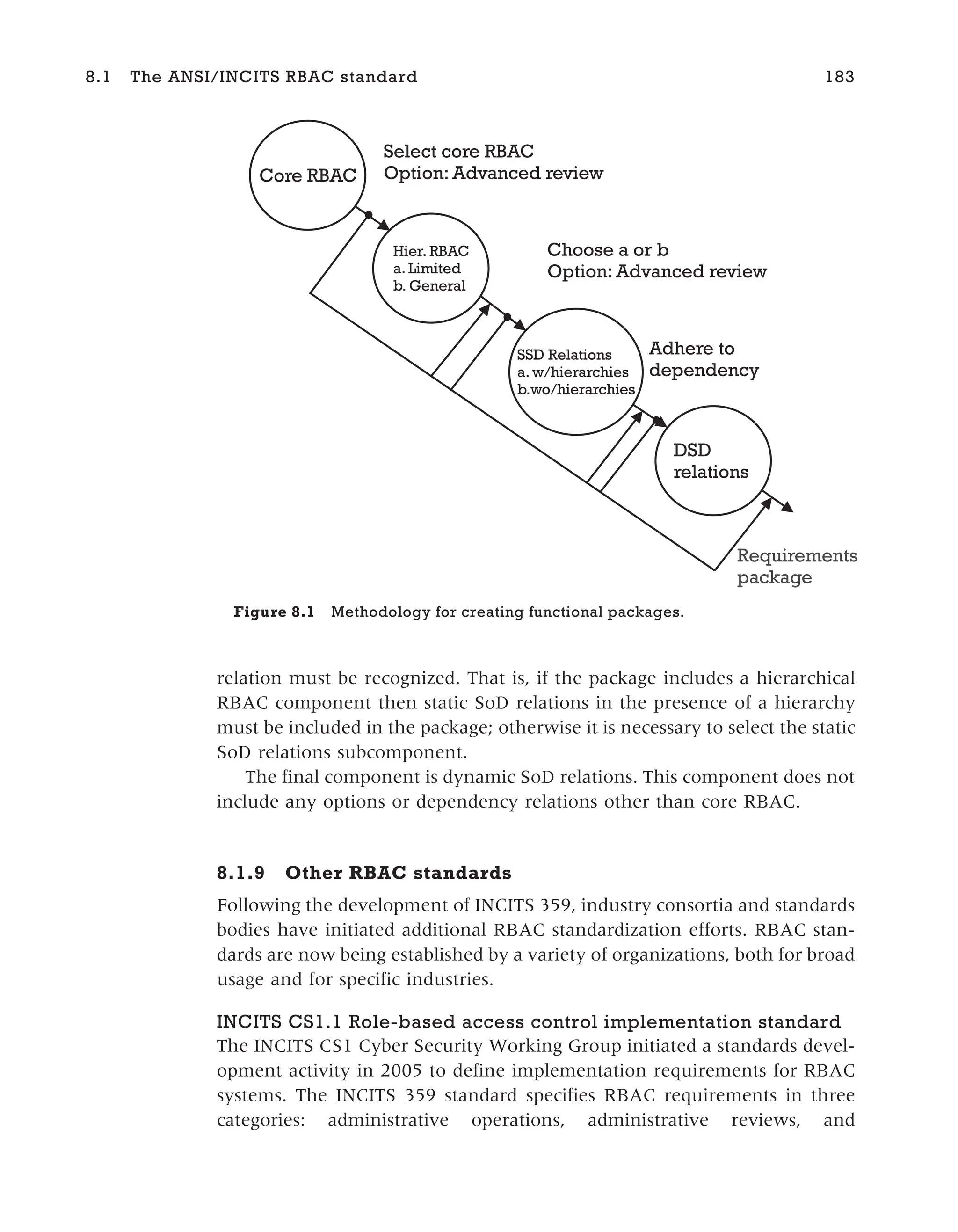
![system-level functionality. The CS1.1 standard is intended to specify how
these features are to be implemented in order to “provide a basis for the
interchange of data and functional interoperability among services and
applications” [5]. The CS1.1 standard is intended to include specifications
for core and hierarchical RBAC, plus static separation of duty and dynamic
separation of duty relations.
A more recent project proposal within INCITS CS1, Enterprise Dynamic
Access Control (EDAC) [6], would extend the capabilities of INCITS 359 to
address the needs of organizations with rapidly changing role assignments.
In many large organizations, personnel assignments may change frequently
in response to external events, particularly in military or government orga-
nizations that have rapid response requirements. External conditions—such
as threat level or a natural disaster—may also change. Managing access con-
trol in such an enterprise could be cumbersome if system administrators
were needed to make temporary adjustments in user permissions. EDAC
addresses this problem by incorporating real-time evaluation of resource
characteristics and environmental characteristics (e.g., threat level) in role
assignments.
ASTM E31.20: Privilege management infrastructure
This draft standard [7] is defining a standardized role based privilege man-
agement infrastructure for the health care industry. According to the draft,
the “privilege mechanisms in this standard support the contexts of
role-based access control, privileges of a user who wishes to (digitally) sign a
document, privileges required to connect to a resource, access a file, or
access the data and functions of a protected application (or other resource).”
Designed to provide interoperability across the industry, the ASTM stan-
dard will specify privilege management not only for a single enterprise, but
also for external suppliers and healthcare providers. Because of the rapid
improvements in information technology within healthcare, organizations
need to support a wide variety of distributed applications, in addition to
integrating information that may reside on external systems. E31.20 estab-
lishes a foundation for industry standard permissions for users, categorizing
roles as either structural or functional [8]. Structural roles are based on the
ASTM E1986-98 Standard Guide for Information Access Privileges to Health
Information, which defines 107 healthcare role names. In addition, the
E31.20 standard provides a framework for establishing functional roles (e.g.,
Admitting Physician). The U.S. Department of Veterans Affairs, Veterans
Health Administration (VHA) has adopted the set of ASTM role names as
structural role names for interoperability among healthcare organizations,
proposing additional role names to extend E1986-98 coverage [9].
184 RBAC Standards and Profiles](https://image.slidesharecdn.com/role-basedaccesscontrolsecondeditionpdfdrive-250311062434-2e3fc82e/75/Role-Based-Access-Control-Second-Edition-PDFDrive-pdf-205-2048.jpg)
![The VHA work and its successor activities within the HL7 organization
(see below) can be expected to influence the future course of healthcare
RBAC standards. ASTM E31.20 is interesting because it is perhaps the most
comprehensive effort to establish an industry-wide role structure and role
based privilege management infrastructure. The VHA role engineering work
continues under the auspices of HL7, within its Security Technical Commit-
tee. VHA and the Health Level Seven (HL7) Security Technical Committee
have been working to identify a standard set of healthcare permissions
(operations on objects) rather than roles. The rationale is that role defini-
tions will vary among organizations, but the permissions attached to the
roles can be standardized [10]. As of January 2006, HL7 had voted affirma-
tively for the following as a Draft Standard for Trial Use:
◗ HL7 RBAC Healthcare Permission Catalog v2.2;
◗ HL7 Healthcare Scenario Roadmap v2.19;
◗ HL7 RBAC Healthcare Scenarios v2.0;
◗ HL7 RBAC Role Engineering Process v1.1;
◗ HL7 RBAC Role Engineering Process Applied Example v1.1.
It is anticipated that adjustments and additions will be made to these
standards after the trial use period.
8.2 XACML profile for role-based access control
This document [11] provides a basis for implementing the INCITS 359
RBAC standard using the OASIS eXtensible Access Control Markup Lan-
guage (XACML). That is, the XACML profile does not specify a complete
implementation of INCITS 359, but can be used as a foundation. The profile
can be used without changes or extensions to XACML Versions 1.0 or 1.1.
The 2004 XACML RBAC profile is also consistent with XACML Version 2.0,
although minor changes to the syntax specified in the RBAC profile are
needed for conversion to XACML 2.0; these changes are described in the 2.0
version of the RBAC profile. The XACML RBAC profile describes a set of
building blocks based on XACML that can be used in implementing the vari-
ous sections of INCITS 359, and includes a detailed example to illustrate the
process. It specifies three types of policies: “Role PolicySet,” “Permission
PolicySet,” and “Separation of Duty PolicySet,” and describes an additional
nonnormative type: “Role Assignment <PolicySet>.”
A subsequent version of the XACML profile for RBAC issued in 2005
[12] updated the RBAC profile for XACML 2.0 and extended the original
8.2 XACML profile for role-based access control 185](https://image.slidesharecdn.com/role-basedaccesscontrolsecondeditionpdfdrive-250311062434-2e3fc82e/75/Role-Based-Access-Control-Second-Edition-PDFDrive-pdf-206-2048.jpg)
![version to include a recommended AttributeId for roles, but reduces the
scope to cover only core and hierarchical RBAC (i.e., SSD is not included).
The normative portion of the document prescribes a specific set of XACML
Attributes and Attribute IDs that are to be used in constructing an RBAC
implementation using XACML.
This profile does not deal with separation of duty functions (in the nor-
mative text), although OASIS indicates that a future profile may address
advanced requirements such as SoD. A Role Assignment PolicySet can be
used to prevent assigning conflicting roles during role setup in both the 1.0
and 2.0 versions of the profile, thus enforcing SSD, but this type of policy is
not normative. Version 1.0 allows a subject to have conflicting roles
enabled, but the subject will be denied access in this case. Either static or
dynamic separation of duty is possible, depending on which types of roles
are included in the decision context. If the access decision is made in an
environment in which all statically assigned roles are included, then SSD is
enforced. If the access decision is made in an environment in which only the
dynamically assigned roles are included in the decision context, then DSD is
enforced. The policy enforcement point and the context handler determine
which assigned roles are used in making the decision. This approach does
not work well for DSD, because the role required for a given request may
not be known until the request is evaluated. For SSD, it does not prevent
the user from being assigned to conflicting roles, but does prevent using
them when requesting access.
The XACML RBAC profile is significant because it brings practical RBAC
solutions to the Web services environment. Web services are critical in most
e-commerce and other advanced online applications today. Managing priv-
ileges in a distributed environment is far from a fully solved problem, but
RBAC solutions can provide greater control with reduced complexity. The
XACML RBAC profile makes it possible to handle security policies in a dis-
tributed environment because it supports retrieval of both attributes
(including roles) and policies from distributed sites that may be independ-
ently managed. It is also integrated with the OASIS SAML Profile that pro-
vides secure transport and authentication for distributed environments.
References
[1] Sandhu, R., D. F. Ferraiolo, and D. R. Kuhn, “The NIST Model for Role-Based
Access Control: Towards a Unified Standard,” Proc. of 5th ACM Workshop on
Role Based Access Control, July 26–27, 2000.
186 RBAC Standards and Profiles](https://image.slidesharecdn.com/role-basedaccesscontrolsecondeditionpdfdrive-250311062434-2e3fc82e/75/Role-Based-Access-Control-Second-Edition-PDFDrive-pdf-207-2048.jpg)
![[2] National Institute of Standards and Technology, Proposed Standard for
Role-Based Access Control, http://csrc.nist.gov/rbac/rbacSTD-ACM.pdf, 1995.
[3] ANSI/INCITS 359-2004, Information Technology—Role Based Access Control,
InterNational Committee for Information Technology Standards, February 3,
2004.
[4] Reynolds, J., and R. Chandramouli, Role Based Access Control Protection Profile,
Version 1.0,
http://www.commoncriteriaportal.org/public/files/ppfiles/RBAC_987.pdf, July
1998.
[5] Coyne, E. J., Role Based Access Control Implementation Standard, Version 0.1,
January 2006, INCITS CS1.1 Working Group.
[6] Fernandez, R., “Enterprise Dynamic Access, Version 2 Overview,” January 1,
2006, U.S. Navy COMPACFLT, http://csrc.nist.gov/rbac/EDACv2overview.pdf.
[7] ASTM E31.20 Working Group, Privilege Management Infrastructure, January 4,
2006, http://www.va.gov/rbac/docs/ASTMEPMV0_9.doc.
[8] Blobel, B., “Analysis, Design and Implementation of Secure and Interoperable
Distributed Health Information Systems,” Studies in Health Technology and
Informatics, Vol. 89, IOS Press, September 2002.
[9] VARBAC, http://www.va.gov/rbac/.
[10] VHA RBAC Newsletter, Vol. 27, May 2006.
[11] OASIS, XACML Profile for Role Based Access Control (RBAC), February 13, 2004,
oasis-open.org, http://www.oasis-open.org/committees/xacml.
[12] OASIS, Core and Hierarchical Role Based Access Control (RBAC) Profile of XACML
v2.0, oasis-open.org, http://www.oasis-open.org/committees/xacml, February
1, 2005.
8.2 XACML profile for role-based access control 187](https://image.slidesharecdn.com/role-basedaccesscontrolsecondeditionpdfdrive-250311062434-2e3fc82e/75/Role-Based-Access-Control-Second-Edition-PDFDrive-pdf-208-2048.jpg)

![Role-Based Administration of
RBAC
One of the principal purposes of RBAC is to provide a
cost-effective and more accurate approach to the manage-
ment of access control data. However, the deployment of RBAC
can potentially result in the creation of a large number of user
roles, which in turn need to be administered. In a large enter-
prise the number of roles can be in the hundreds or thousands;
the number of users can be in the tens, hundreds of thousands,
or in extreme circumstances over a million; and the number of
objects can easily exceed a million. In other words, the deploy-
ment of RBAC replaces the very difficult and intractable problem
of managing authorization data, scattered over numerous plat-
forms and administrative domains, with a less difficult but signif-
icant problem of managing roles. An appealing concept is to
administer RBAC relations through the use of RBAC. One can
consider role administration to be just another application of
RBAC.
9.1 Background and terminology
In administering RBAC with RBAC we need to make a distinc-
tion between administrative roles and user roles, between
administrative objects and user objects, and between adminis-
trative operations and user operations. This distinction is
clearly defined by Sandhu et al. in their popular RBAC model
commonly referred to as RBAC96 [1]. Figure 9.1 illustrates
189
9
Contents
9.1 Background and
terminology
9.2 URA02 and PRA02
9.3 Crampton-Loizou
administrative model
9.4 Role control center
C H A P T E R](https://image.slidesharecdn.com/role-basedaccesscontrolsecondeditionpdfdrive-250311062434-2e3fc82e/75/Role-Based-Access-Control-Second-Edition-PDFDrive-pdf-210-2048.jpg)
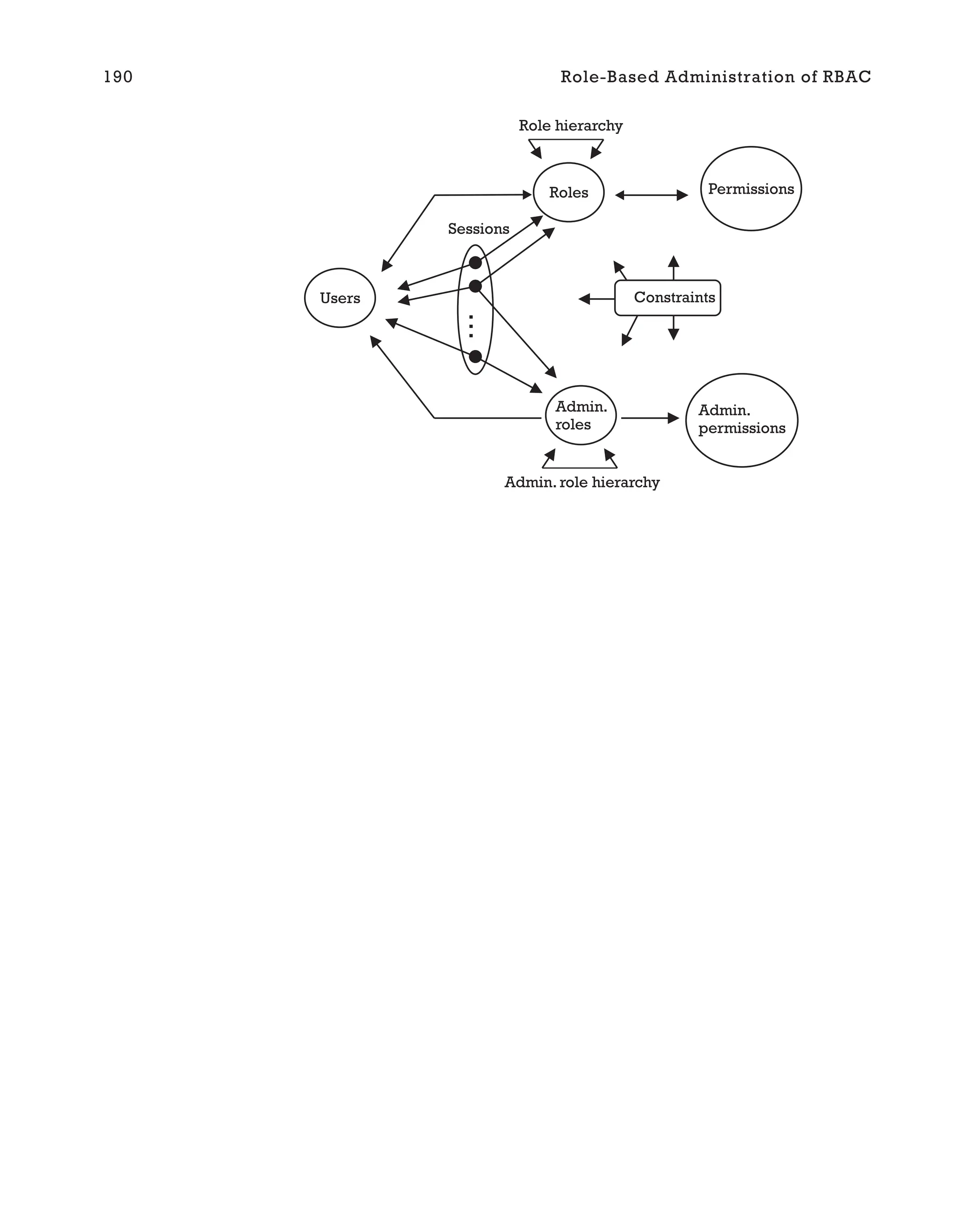
![The use of RBAC principles for managing RBAC systems have not been
studied to the extent of that of RBAC models in general. Nonetheless, signif-
icant advances have been made. The NIST model and Web implementation
of RBAC incorporates an administrative tool that provides rudimentary sup-
port for an RBAC database that stores information about user and permis-
sion role assignments and role hierarchies [2]. Nyanchama and Osborn [3]
defined a role graph model that rigorously specified operational semantics
for manipulating role relations in the contexts of a role hierarchy. ARBAC97
built on these previous attempts to construct administrative models [4] over
all aspects of the RBAC model. ARBAC97 has three components: URA97
(user-role assignment ’97), PRA97 (permission-role assignment ’97), and
RRA97 (role-role assignment ’97), incorporating the functionality provided
by the NIST implementation and the administrative operations defined by
the role graph model. Fundamental to ARBAC97 and to all subsequent
efforts to develop role-based models for RBAC administration are the princi-
ples of decentralization of administrative authority, administrative autonomy, and
control over anomalous side effects. Although ARBAC97 can be credited with
identifying these essential administrative principles, each of its components
has been systematically updated and improved upon in attempts to alleviate
identified erroneous conditions and to provide greater administrative
flexibility and control.
Central to RRA97 is the notion of an encapsulated range for defining the
administrative scope of control. An encapsulated range is a self-contained
subhierarchy defining a set of roles and relations over which an administra-
tive role may perform administrative operations. The idea is that adminis-
trative operations cannot cause side effects to occur outside of the range.
The Crampton-Loizou model [5] provides a simpler yet more flexible means
of defining the administrative scope of control than that of RRA97 while
preserving many of its intended properties (e.g., support for decentralization
and autonomy and prevention of anomalous changes to the hierarchy).
Both ARBAC97 and the Crampton-Loizou models are defined in the con-
text of RBAC96.
URA97 and PRA97 authorize administrative roles by means of role ranges
and prerequisite conditions in terms of an existing role hierarchy. For example,
before a user may be assigned to a role, the user must exist as a member of
some other role lower (<) in the hierarchy, or before a permission can be
assigned to a role, the permission must be currently assigned to a role higher
(>) in the hierarchy. Acknowledging this dependency’s unacceptable impact
on role hierarchies, Oh and Sandhu [6] have redefined prerequisite condi-
tions in terms of external organizational structures and thereby alleviated
their dependence and erroneous impact on a role hierarchy. In keeping
9.1 Background and terminology 191](https://image.slidesharecdn.com/role-basedaccesscontrolsecondeditionpdfdrive-250311062434-2e3fc82e/75/Role-Based-Access-Control-Second-Edition-PDFDrive-pdf-212-2048.jpg)
![with a consistent nomenclature to that of ARBAC97, Oh and Sandhu called
their new administrative components URA02 and PRA02.
On a completely different research track than that of ARBAC97 is the
role control center [7, 8], an RBAC administrative tool for managing (creat-
ing and deleting) and mapping abstract users, roles, and permissions rela-
tions onto concrete system-level user accounts, groups, and ACLs. The role
control center supports still a third approach to supporting administrative
authority and autonomy through its ability to define administrative views,
encompassing roles, inheritance relations, and user and permission role
assignments in terms of a connected role graph and a fine-grained delega-
tion feature.
The remainder of this chapter examines the Sejong and Sandhu admin-
istrative components (ARA02 and PRA02), the Crampton-Loizou alterna-
tive model component to that of RRA97, and the role control center
implementation.
9.2 URA02 and PRA02
URA02 and PRA02 are two of three components in ARBAC02 that are
required in administering RBAC relations through the use of administrative
roles. The development of these model components was driven by support
of decentralized administration, autonomy of control, and the prevention of
anomalous changes with regard to user-role and role-permission assign-
ments in the presence of a role hierarchy.
We explain these components with an example, using the end-user role
hierarchy and administrative role hierarchy of Figure 9.2. Sejong and
Sandhu and others have traditionally used these examples, which first
appeared in an earlier paper by Sandhu, to illustrate administrative con-
cepts. Figure 9.2(a) models the roles within an engineering department
(ED). PE1 and PE2 are production engineers; QE1 and QE2 are quality engi-
neers; PL1 and PL2 are project leader roles for engineers E1 and E2, respec-
tively. E represents the employee role, and DIR is the director of the
engineering department.
User-role assignment is managed under a can-assign relation that
includes three parameters: can-assign(x, y, z), where a is an administrative
role, y is a prerequisite condition, and z is a role range consisting of a set of
roles.
The administrative roles belong to any role included in the role hierar-
chy. The prerequisite condition is a Boolean expression that indicates the
user’s positive membership within an organizational unit (indicated by the
192 Role-Based Administration of RBAC](https://image.slidesharecdn.com/role-basedaccesscontrolsecondeditionpdfdrive-250311062434-2e3fc82e/75/Role-Based-Access-Control-Second-Edition-PDFDrive-pdf-213-2048.jpg)
![@ symbol to distinguish organizational units from roles) or a condition
regarding the user’s nonmembership within an existing role of the end-user
hierarchy, or both. For example, can-assign (PSO1, @ED ^ ¬ E2, [E1, PL1])
indicates that any user who is authorized for the administrative role PSO1
can assign any user who is currently a member of the @ED organizational
unit and is not assigned to the E2 role to any of the roles included in the
range between and including E1 and PL1 (i.e., {E1, PE1, QE1, PL1}). Mem-
bership within an organization is treated outside the scope of the URA02
model and, thus, is not regulated by the model. Intuitively, prerequisite
conditions can afford a level of safety. For example, before a user can be
assigned to the role PE1, the user must be known to possess a competency,
officially recognized by the enterprise. This competency may be implied, for
example, by the human resource department granting the user membership
within the organizational unit engineering department. The use of the @
symbol signifies reference to an organizational unit.
9.2 URA02 and PRA02 193
DIR
PE1
PL1
QE1
E1
ED
E
PE2 QE2
PL2
E2
Senior security officer (SSO)
Project security officer 1 (PSO1) Project security officer 2 (PSO2)
Department security officer (DSO)
(a)
(b)
Figure 9.2 (a) Example end-user role hierarchy, and (b) administrative role
hierarchy.](https://image.slidesharecdn.com/role-basedaccesscontrolsecondeditionpdfdrive-250311062434-2e3fc82e/75/Role-Based-Access-Control-Second-Edition-PDFDrive-pdf-214-2048.jpg)
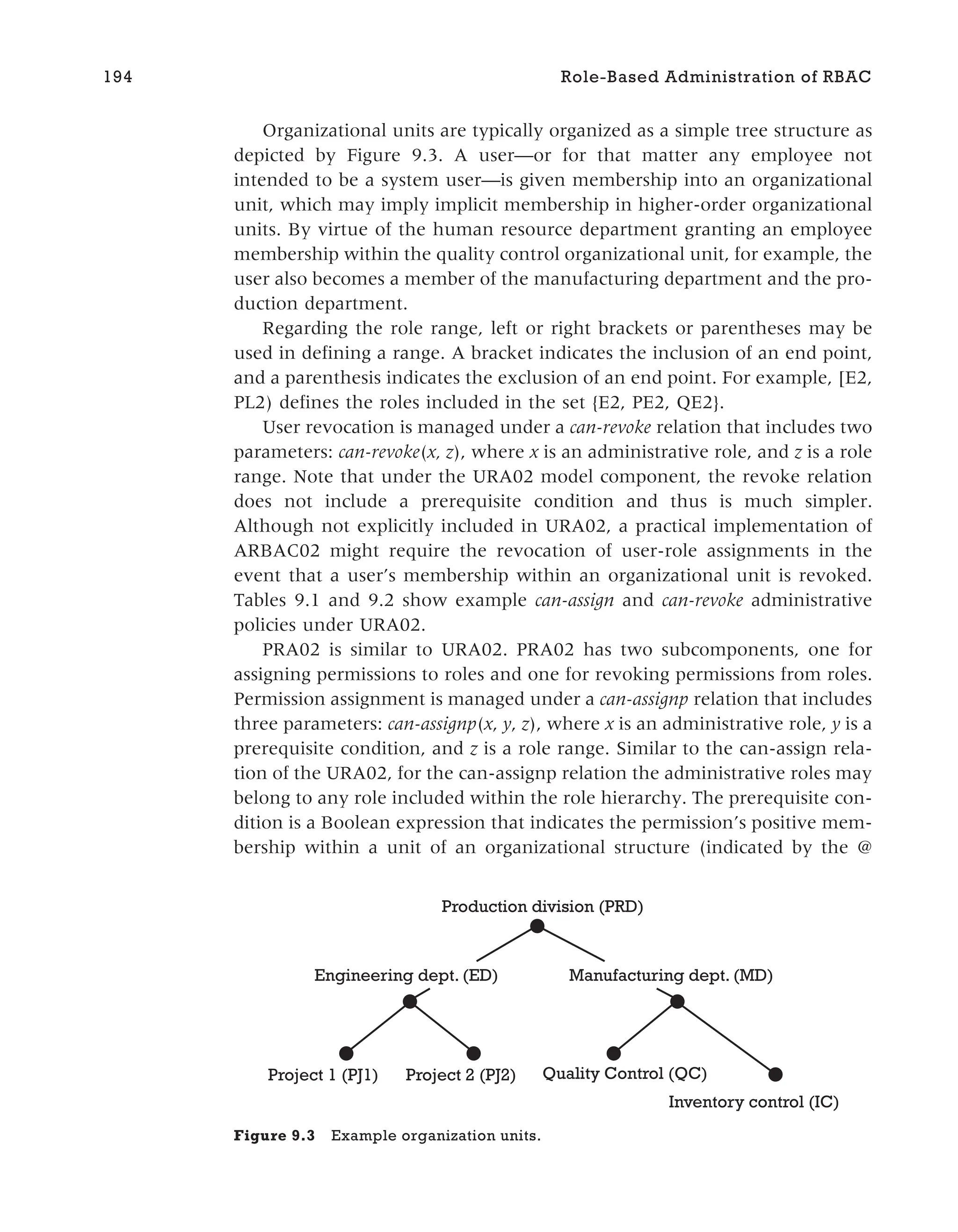
![symbol to distinguish the organizational unit from that of a role) or a condi-
tion regarding the permission’s exclusivity among the existing permissions
that are currently assigned to a role within the end-user hierarchy.
Opposite that of the organizational user structure, the organizational
unit permission structure is organized as an inverted tree. For example, con-
sider the permission structure depicted in Figure 9.4. Common permissions
are included in the lower units of the organizational structure, and the more
specialized permissions are included in the higher units of the organization
structure. Thus, permission containment is inherited up the tree. For exam-
ple, all units would contain the permissions that are assigned to the produc-
tion division unit, while the project 1 unit would contain the permissions
assigned to the project 1 unit as well as the permissions that would be
assigned to the engineering department and production division units.
Unlike organizational user structures that are likely to be managed by the
human resource department, permission assignments within permission
9.2 URA02 and PRA02 195
Table 9.2 Example can-revoke in URA02
Administrative Role Role Range
PSO1 [PE1, PL1)
PSO2 [PE2, PL2)
DSO (ED, DIR)
Table 9.1 Example can-assign in URA02
Administrative Role Prerequisite Condition Role Range
PSO1 @PJ1 ∧ ¬QE1 [PE1, PE1]
PSO2 @PJ2 ∧ ¬PE2 [PE2, PE2]
DSO @ED (ED, DIR)
Project 1 (PJ1) Project 2 (PJ2) Quality control (QC) Inventory
control (IC)
Production division (PRD)
Engineering dept. (ED) Manufacturing dept. (MD)
Figure 9.4 A sample permission organization.](https://image.slidesharecdn.com/role-basedaccesscontrolsecondeditionpdfdrive-250311062434-2e3fc82e/75/Role-Based-Access-Control-Second-Edition-PDFDrive-pdf-216-2048.jpg)
![units are likely to be managed by the IT department, affording safety poli-
cies. For example, before a transaction may be assigned to the engineering
department role, the IT department may need to test and certify its correct
operation. Once testing and certification is completed, the IT department
may only then publish the transaction by assigning it to the engineering
department organizational unit. This has the effect of preventing the arbi-
trary assignment of permissions to sensitive roles. Table 9.3 includes sample
can-assignp relations.
Similar to the can-revoke relation of the of the URA02 subcomponent, the
can-revokep relation of the PRA02 subcomponent consists of two parameters
of the form can-revokep(x, z) where x is an administrative role, and z is a role
range. Although not explicitly included in PRA02, a practical implementa-
tion of ARBAC02 might require the revocation of permission-role assign-
ments in the event that a permission entry is deleted from an associated
organizational permission unit.
9.3 Crampton-Loizou administrative model
Central to the Crampton-Loizou model is the concept of administrative
scope and its use in controlling hierarchical operations.
Crampton-Loizou recognizes the following operations: AddRole(r, ▲r,
▼r), DeleteRole(r), AddEdge(c, p), and DeleteEdge(c, p), where ▲r is the set of
immediate children of r, ▼r is the set of immediate parents of r, c the child
role, and p the parent role.
Administrative scope is defined in terms of what we refer to as up-roles
and down-roles respectively written as ↑r and ↓r.
As an example, consider the role hierarchy depicted in Figure 9.2(a):
↑E1 = {E1, PE1, QE1, PL1, DIR} and ↓QE1 = {QE1, E1, ED, E}.
196 Role-Based Administration of RBAC
Table 9.3 Example can-assignp in PRA02
Administrative Role Prerequisite Condition Role Range
PSO1 @PJ ∧¬ QE1 [PE1, PE1]
PSO2 @PJ2 ∧¬ QE2 [PE2, PE2]
DSO @ED [ED, DIR)
Let S ⊆ R; define S = {r R: r ≥ s for some s S} and ↓S = {r R: r s for some
s S}
Definition of up-role and down-role](https://image.slidesharecdn.com/role-basedaccesscontrolsecondeditionpdfdrive-250311062434-2e3fc82e/75/Role-Based-Access-Control-Second-Edition-PDFDrive-pdf-217-2048.jpg)
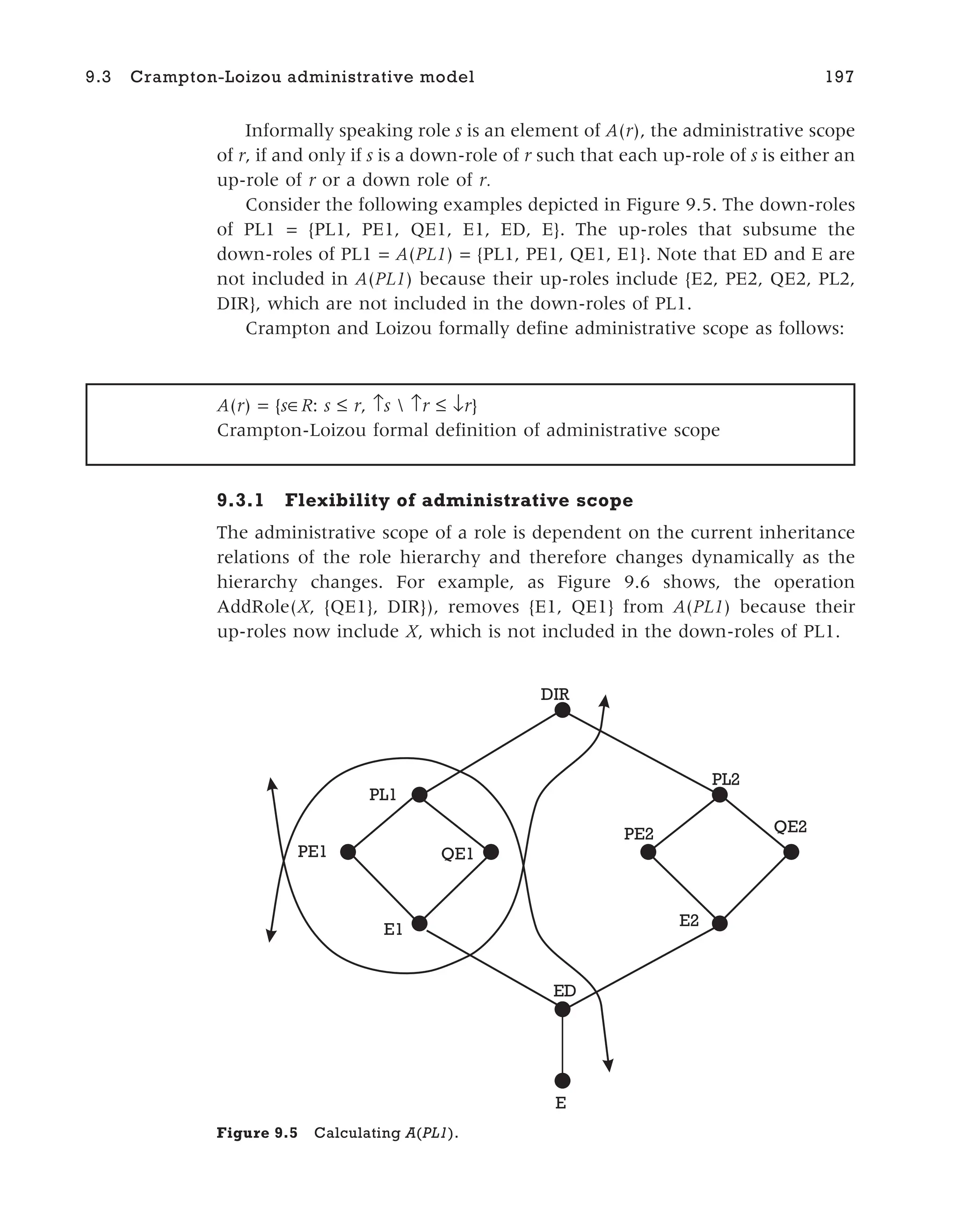
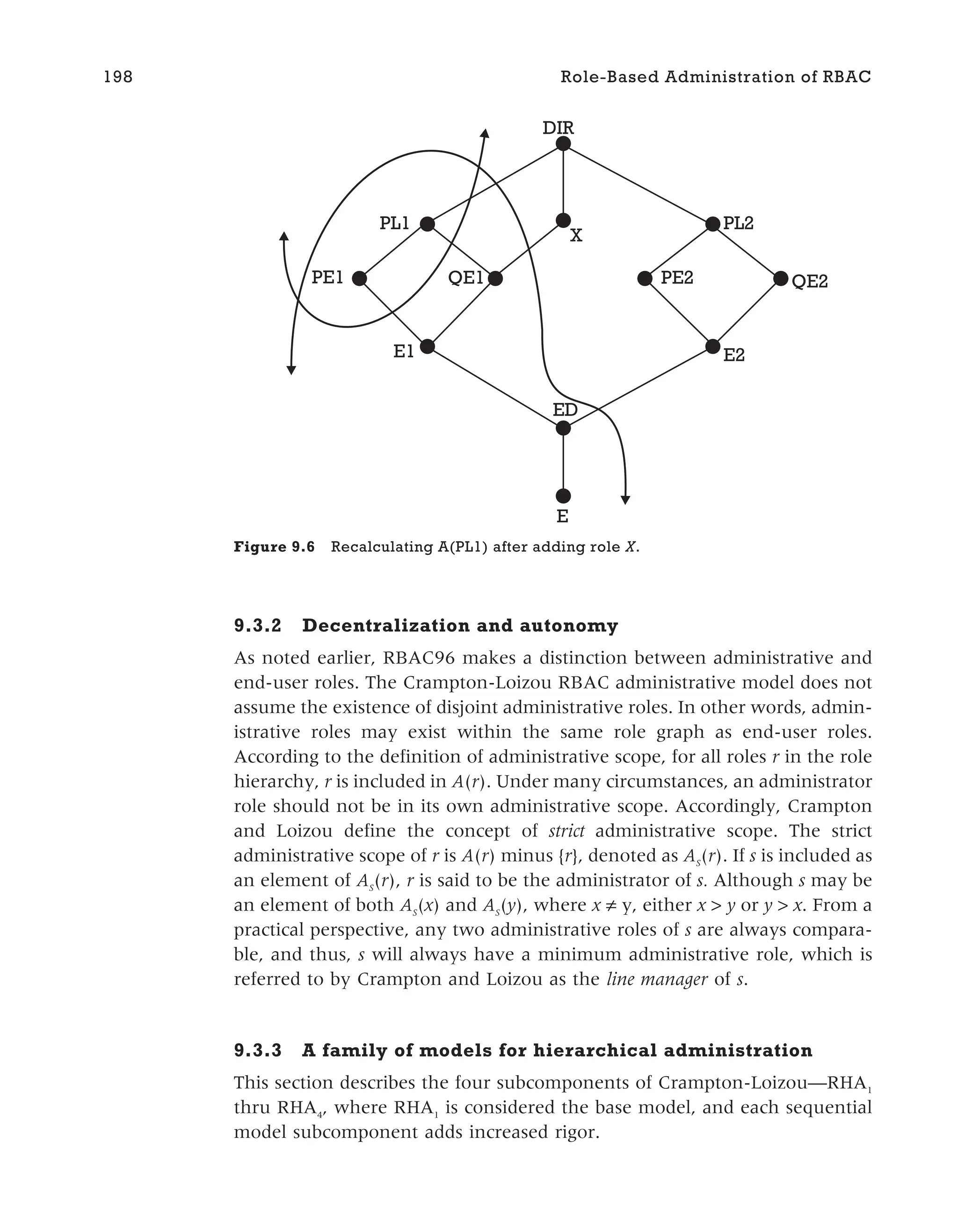
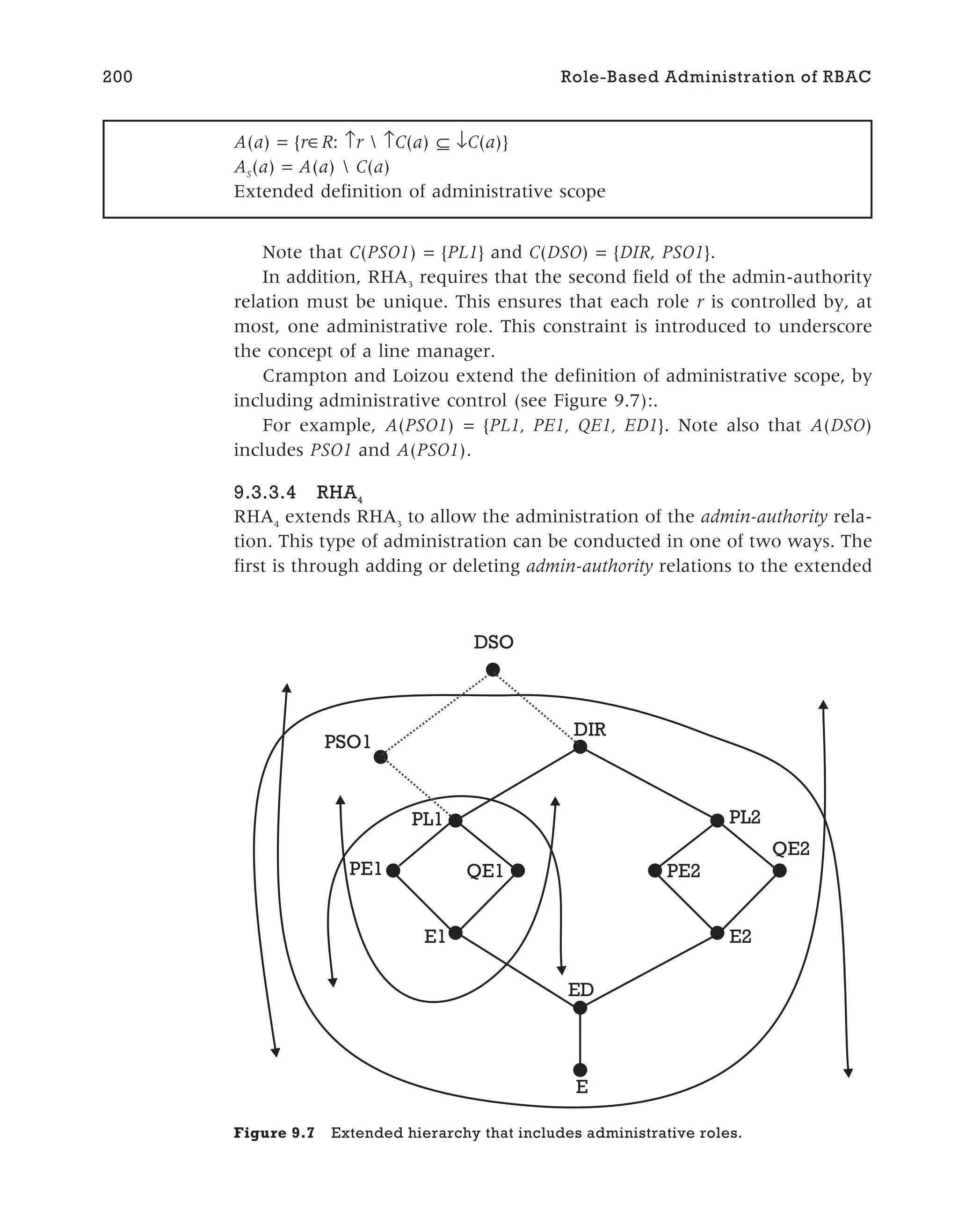
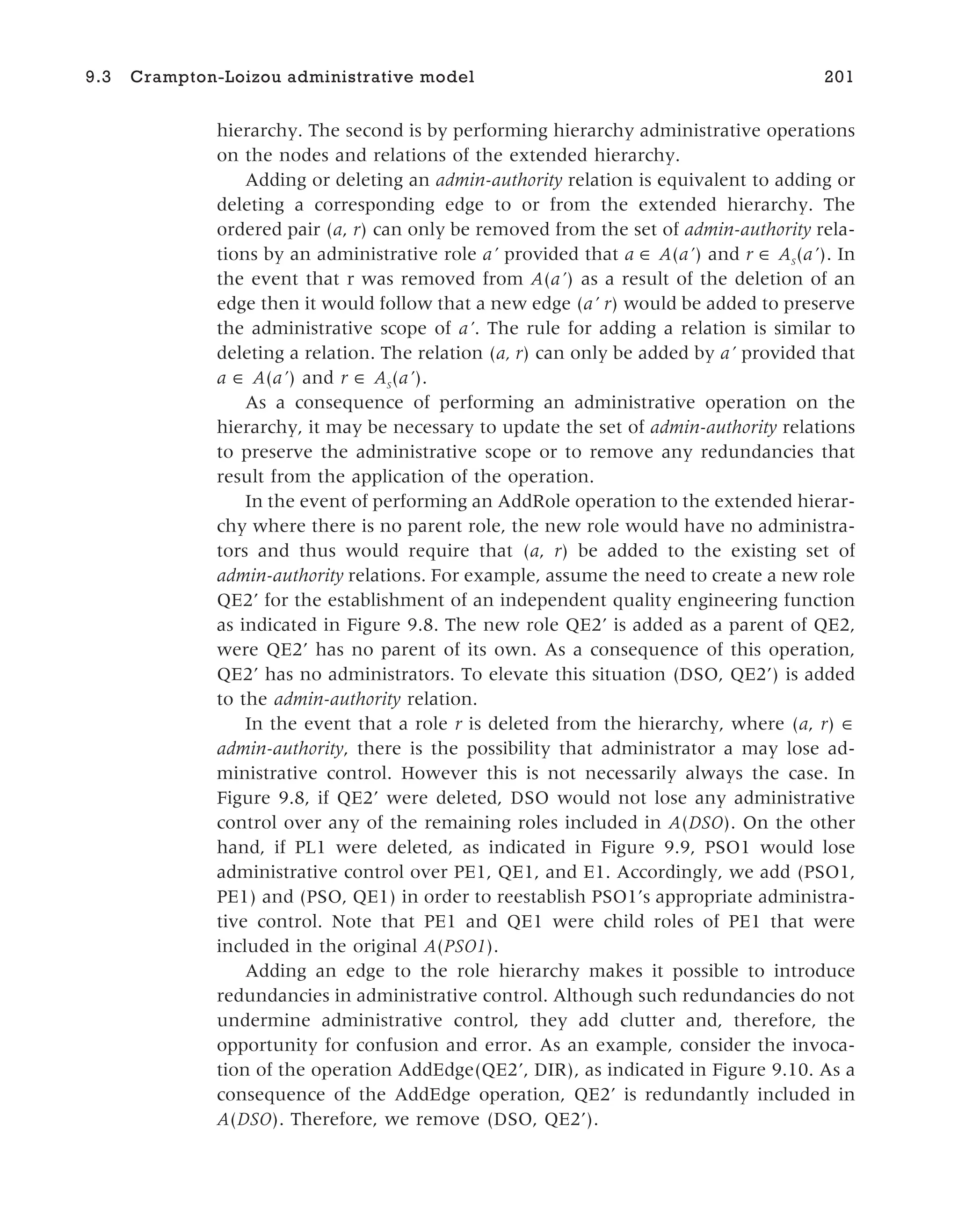
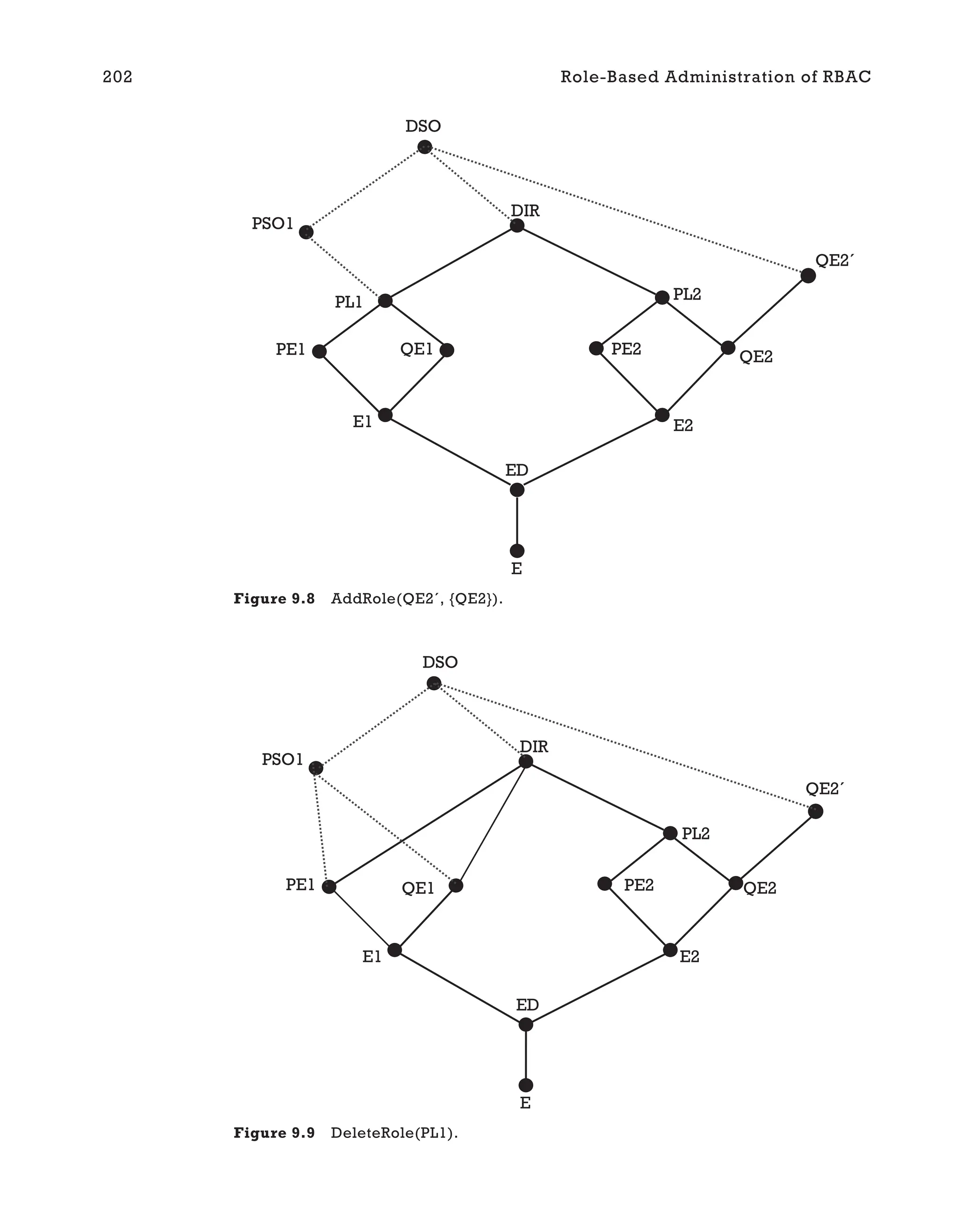
![Deleting an edge (c, p) from the role hierarchy presents the possibility for
the loss of administrative control. For example, deleting (PL2, DIR) results
in DSO’s loss of control over PL2 and PE2. Accordingly, we add (PL2, DSO)
as indicated in Figure 9.11.
9.4 Role control center
Role control center (RCC) is a role graph–centric implementation of the
RBAC model, providing support for the management of user-role assign-
ments, role-privilege assignments, and role-role inheritance relations to
include exclusivity relations of user membership among roles [7, 8]. RCC—
like the models for the administration of RBAC relations described above
—provides support for the principles of decentralization of administrative
authority, administrative autonomy, and control over anomalous side
effects. To support these principles, RCC provides support for authority
through use of an RCC structure referred to as a view. Each view is defined
as a subset of the nodes that are included within the overall role graph. The
concept of a view supports a coordinated and logical approach to carving up
9.4 Role control center 203
PL2
PE1 QE1
E1
ED
E
PE2 QE2
E2
DIR
PSO1
QE2´
DSO
Figure 9.10 AddEdge(QE2´, DIR).](https://image.slidesharecdn.com/role-basedaccesscontrolsecondeditionpdfdrive-250311062434-2e3fc82e/75/Role-Based-Access-Control-Second-Edition-PDFDrive-pdf-224-2048.jpg)
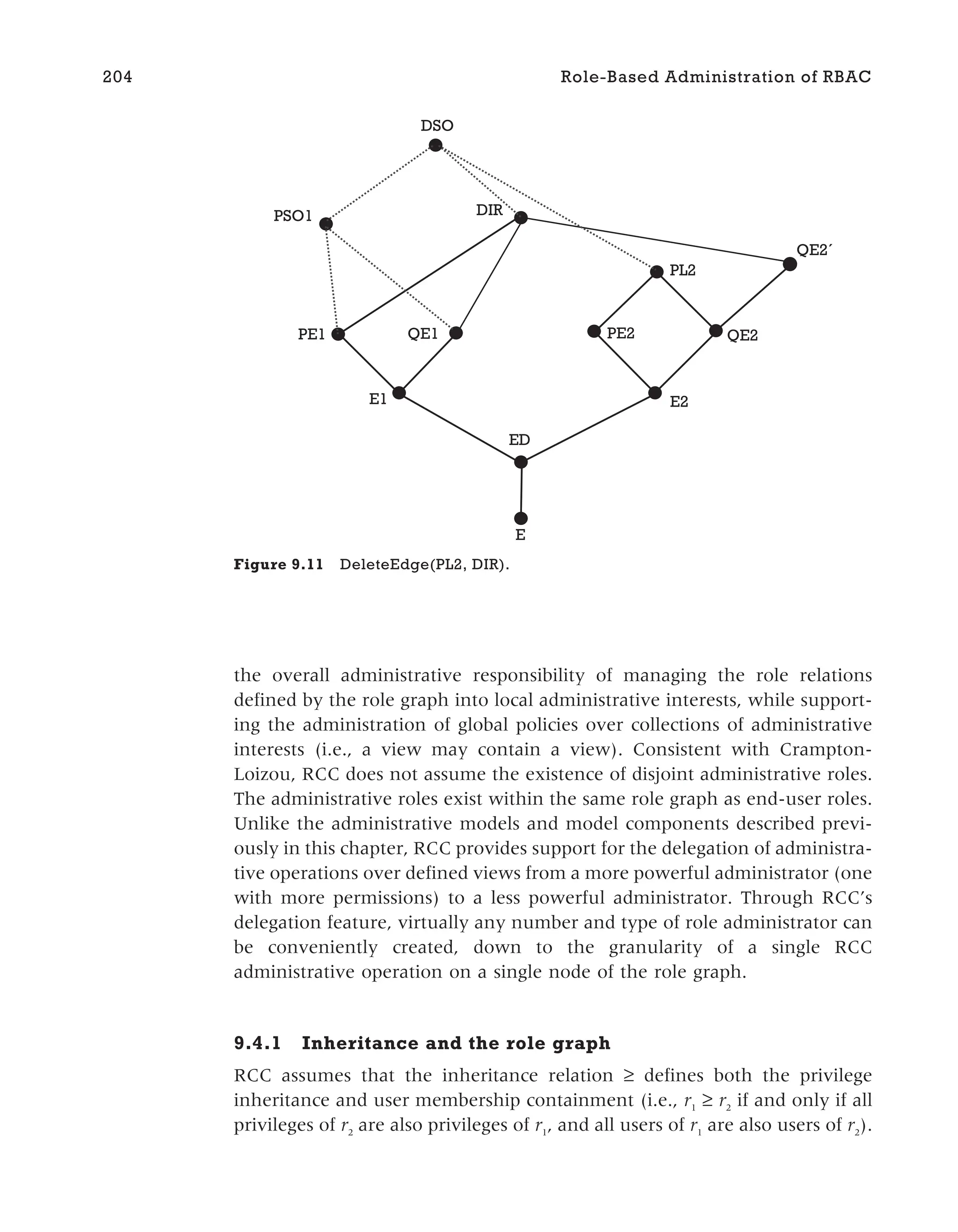
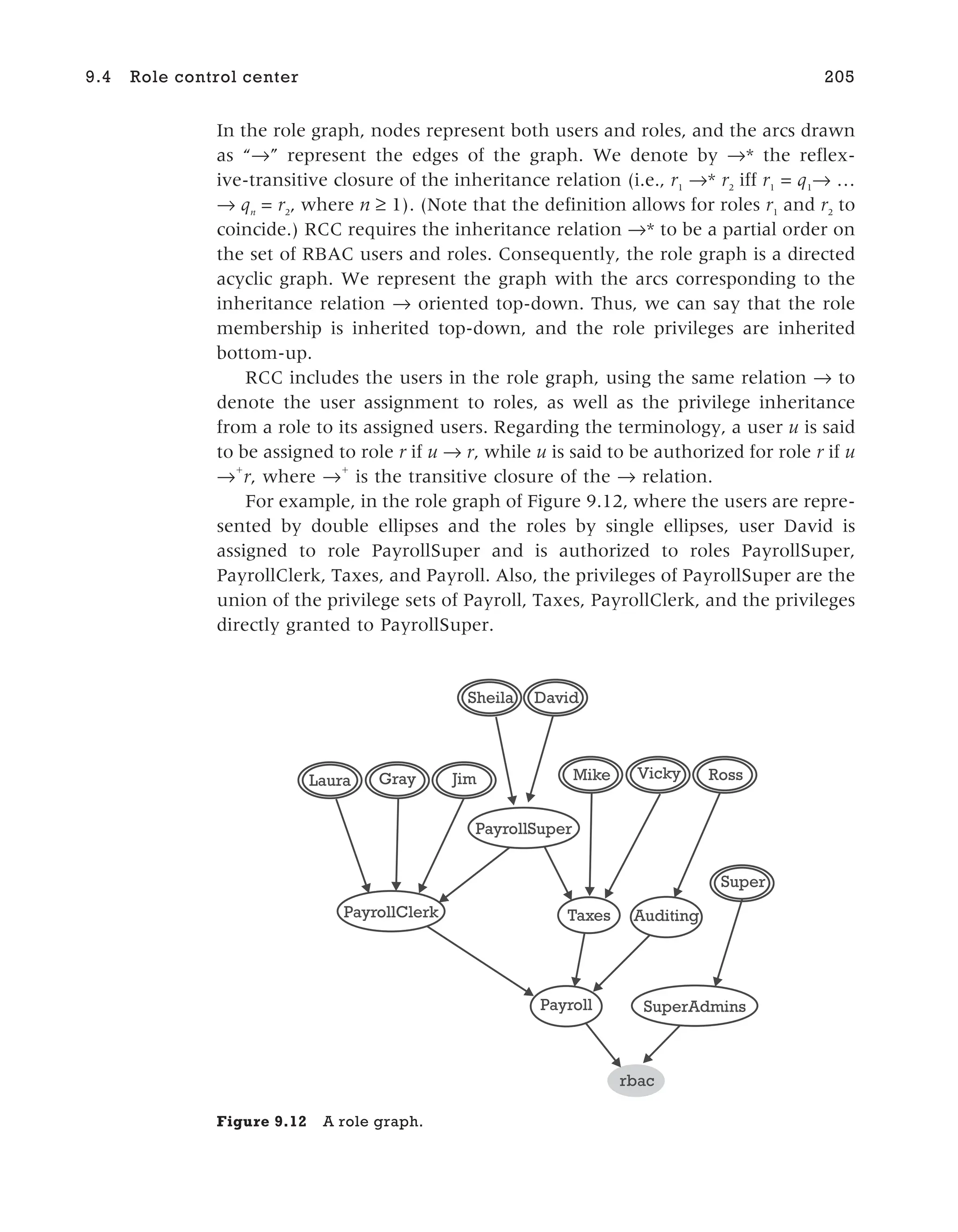
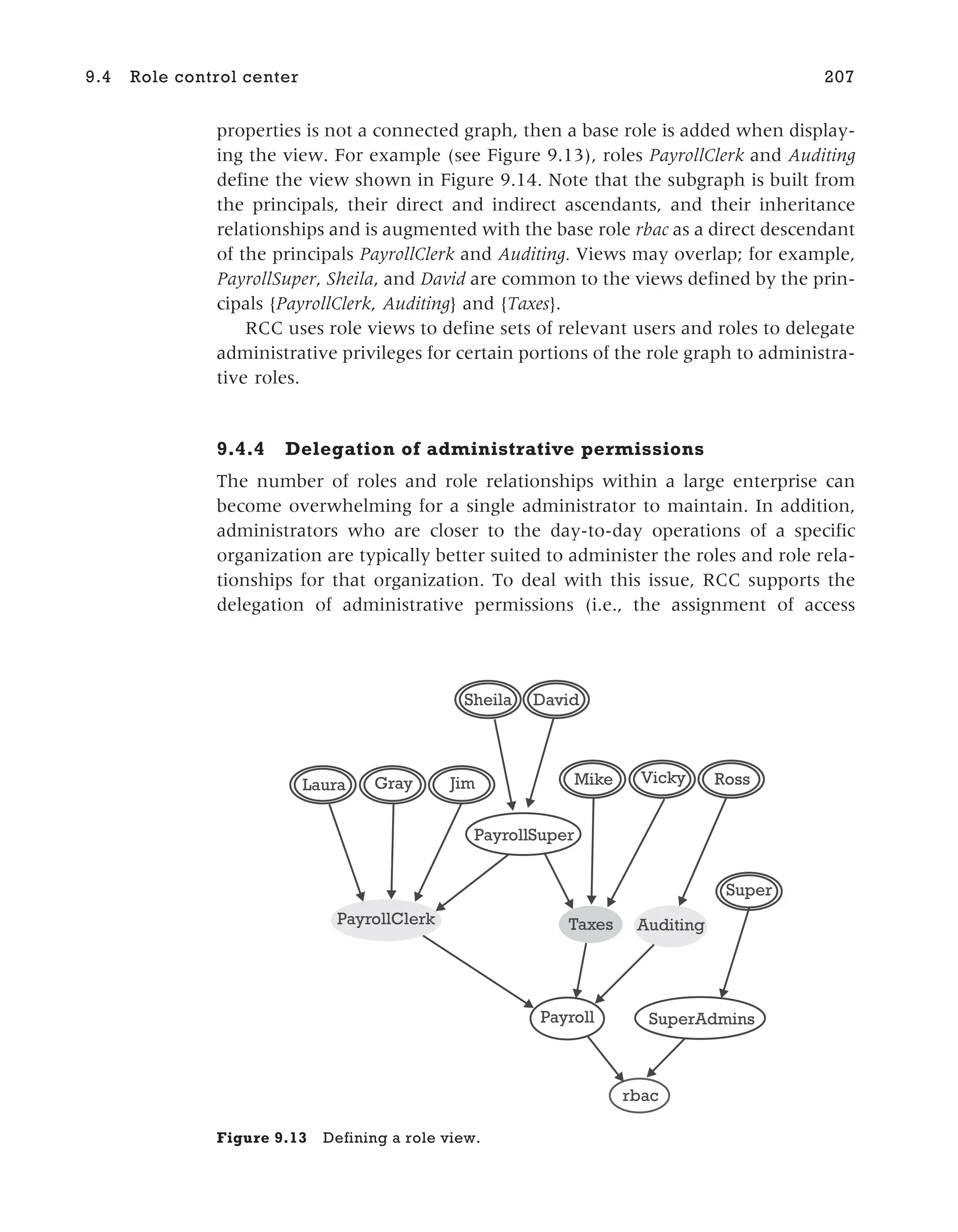
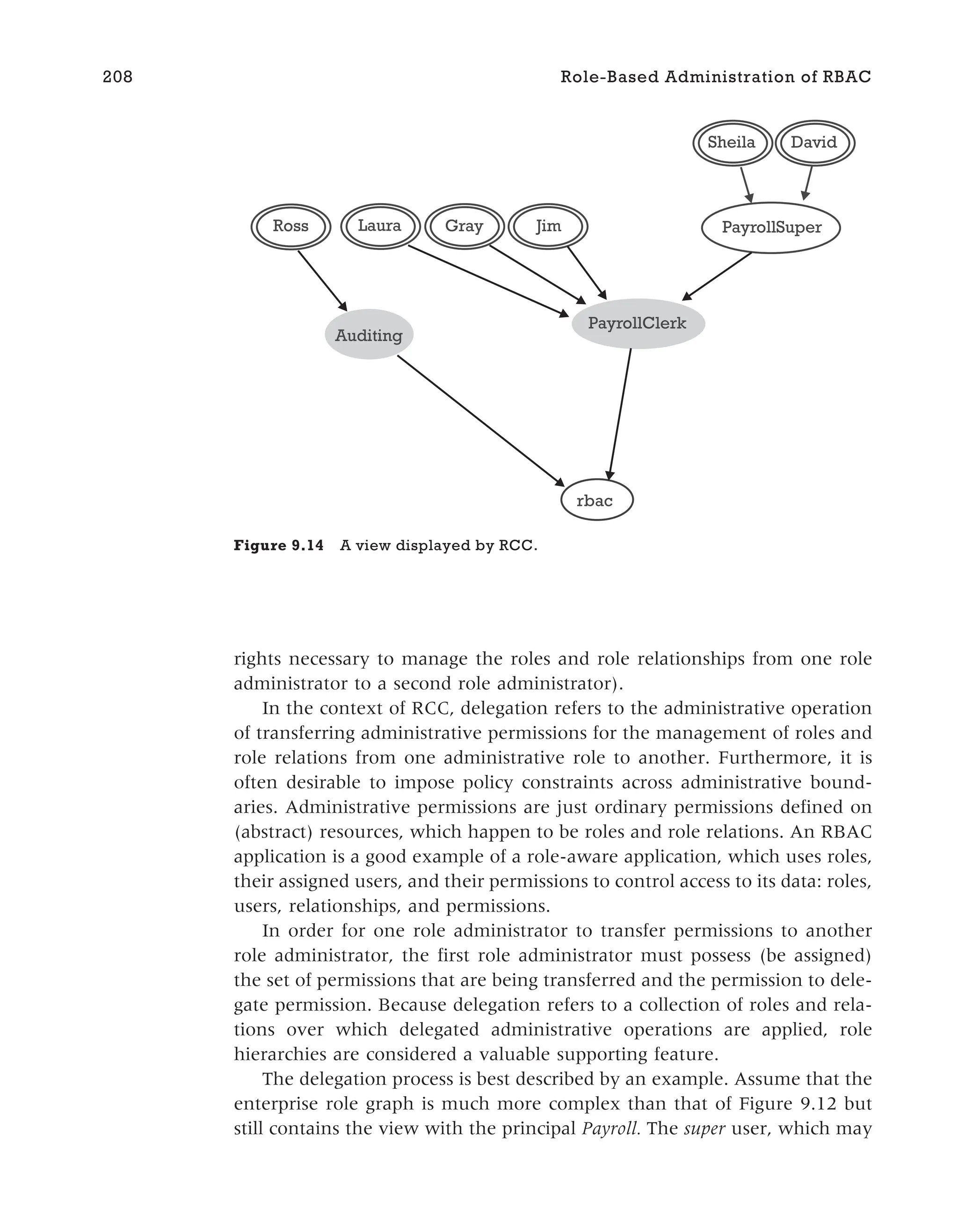
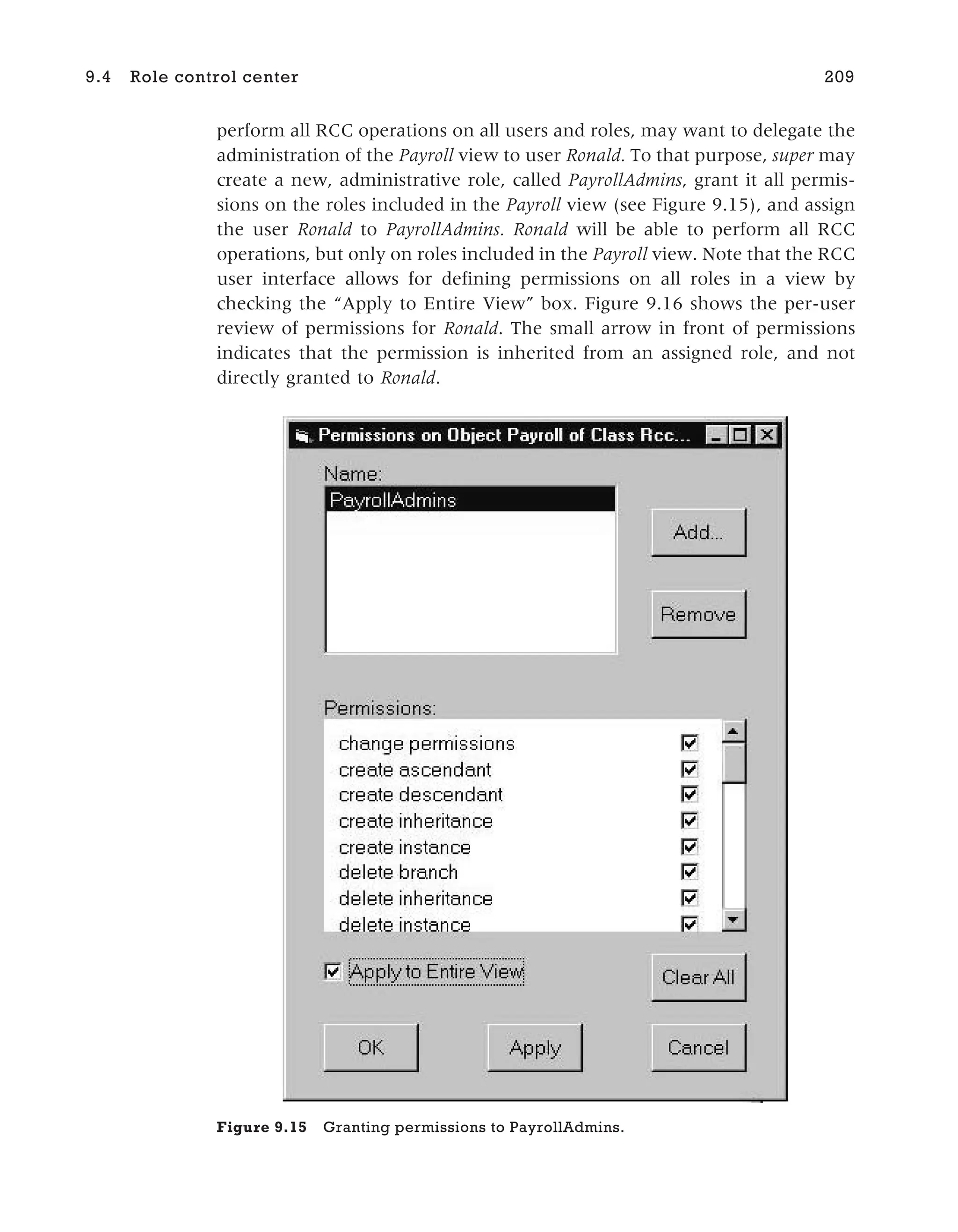
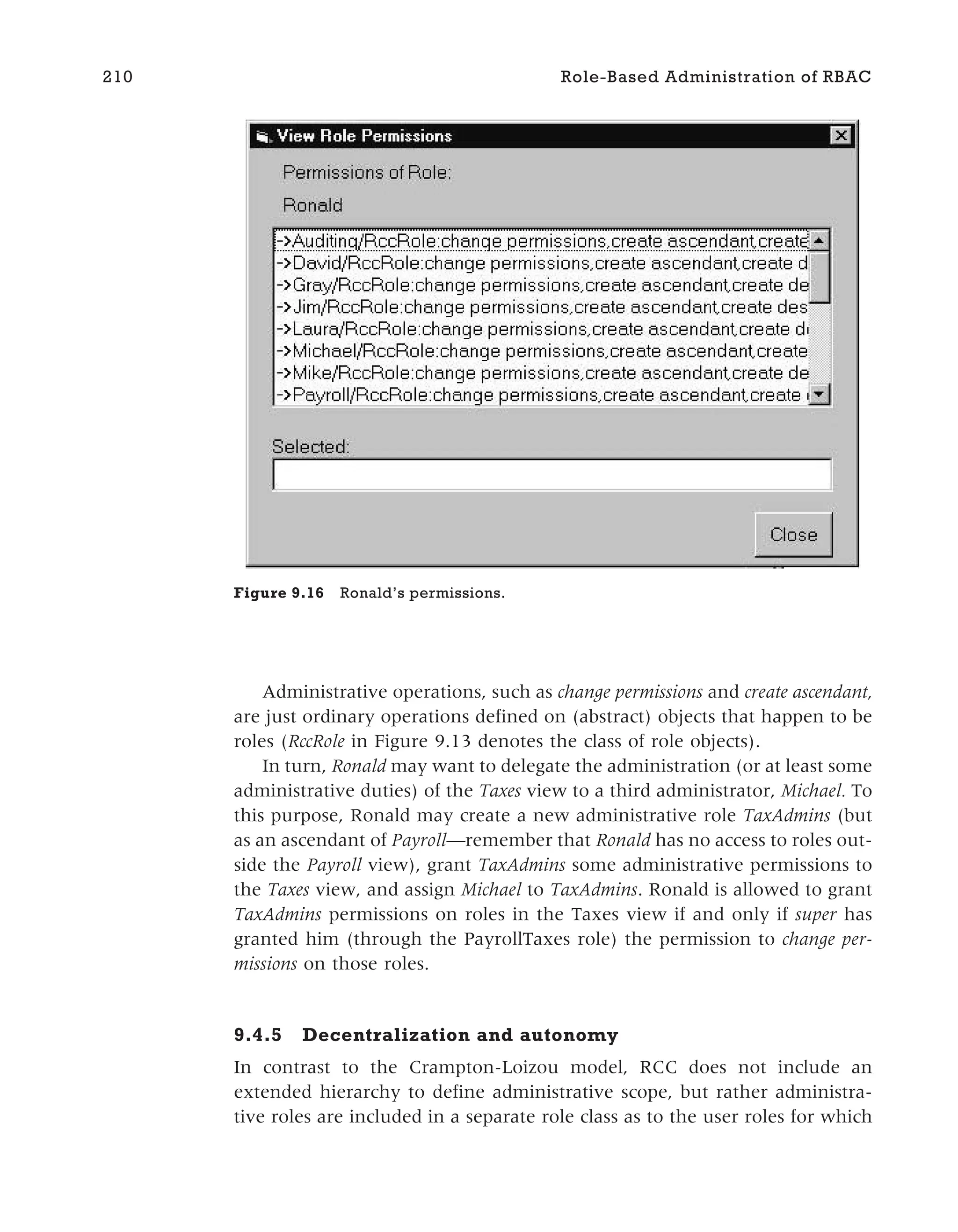
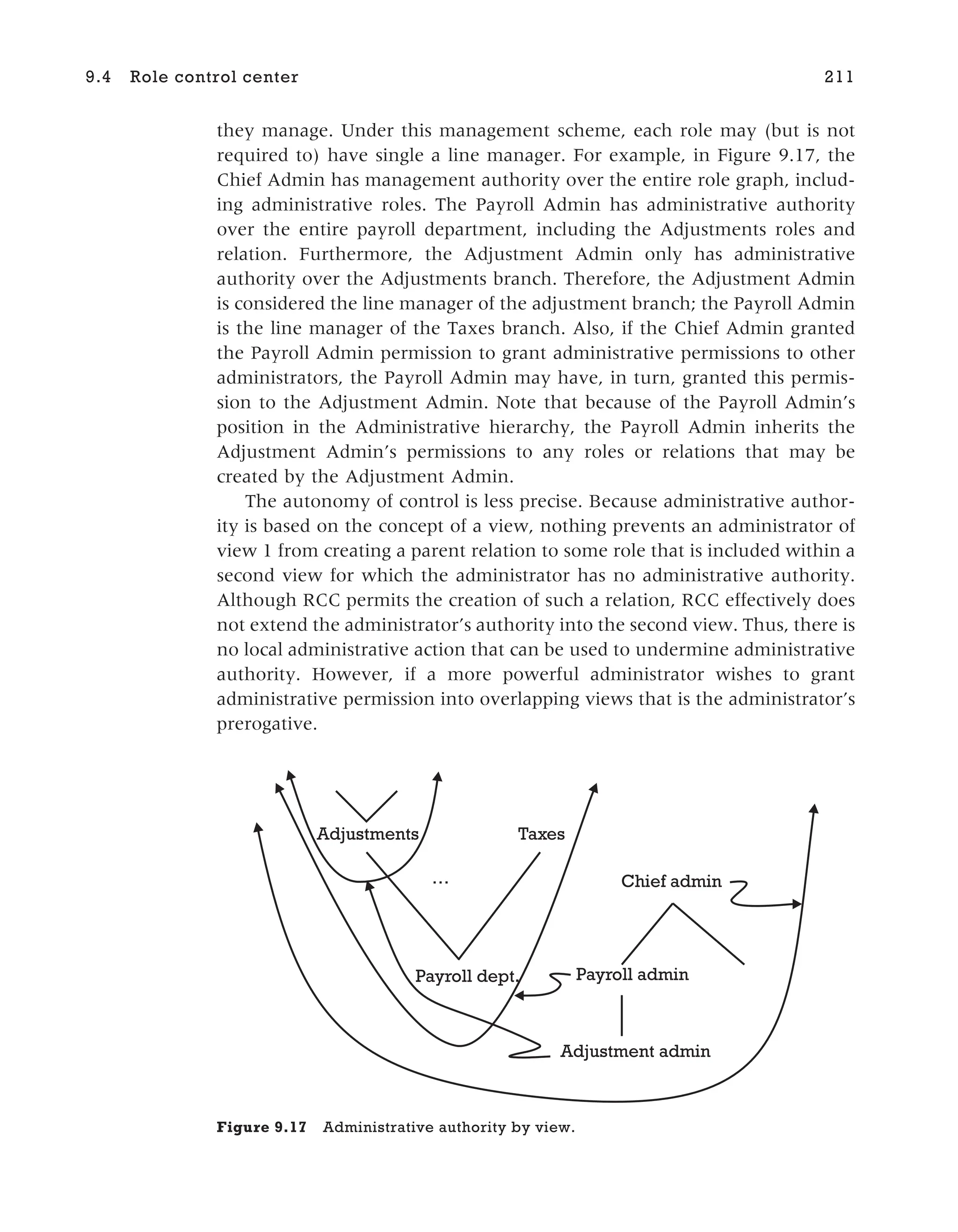
![References
[1] Sandhu, R., et al., “Role-Based Access Control Models,” IEEE Computer, Vol.
29, No. 2, February 1996.
[2] Ferraiolo, D., and J. Barkley, “Specifying and Managing Role-Based Access
Control Within a Corporate Intranet,” Proc. of 2nd ACM Workshop on Role-Based
Access Control, 1997, pp 77–82.
[3] Nyanchama, M., and S. Osborn, “The Role Graph Model and Conflict of
Interest,” ACM Transactions on Information and System Security, Vol. 2, No. 1,
1999, pp. 3–33.
[4] Sandhu, R., V. Bhamidipati, and Q. Munawer, “The ARBAC97 Model for
Role-Based Administration of Roles,” ACM Transactions on Information and
System Security, Vol. 1, No. 2, 1999, pp. 105–135.
[5] Crampton, J., and G. Loizou, “Administrative Scope and Role Hierarchy
Operations,” Proc. of 7th ACM Symposium on Access Control Models and Technologies,
2002, pp. 145–154.
[6] Oh, S., and R. Sandhu, “A Model for Role Administration Using Organization
Structure,” Proc. of 7th ACM Symposium on Access Control Models and Technologies,
2002, pp. 155–162.
[7] Ferraiolo, D., and S. Gavrila, “A Method for Visualizing and Managing
Role-Based Policies on Identity-Based Systems,” Proc. of 1999 ACM
INFOSECU99, October 1999.
[8] Ferraiolo, D., G. Ahn, and S. Gavrila, “The Role Control Center: Features and
Case Studies,” Proc. of 8th ACM Symposium on Access Control Models and
Technologies, June 2003.
212 Role-Based Administration of RBAC](https://image.slidesharecdn.com/role-basedaccesscontrolsecondeditionpdfdrive-250311062434-2e3fc82e/75/Role-Based-Access-Control-Second-Edition-PDFDrive-pdf-233-2048.jpg)
![Role Engineering
In recent years, RBAC has become the authorization scheme of
choice for medium and large enterprises as organizations
begin deploying identity management and provisioning sys-
tems, broaden their scope of access, and meet their regulatory
and reporting requirements. Arguably, the biggest obstacle to
RBAC is the initial complexity involved in setting it up, a process
that has come to be known as role engineering. Role engineering
for RBAC is the process of defining roles, user-role assignments,
permission-role assignments, role hierarchies and constraints
within an RBAC deployment [1]. As with most complex pro-
jects, RBAC is best implemented by applying a detailed and
structured framework that breaks down each task into its com-
ponent parts.
Unlike early role engineering efforts that were primarily
based on an interview process, which more often than not
resulted in a poor or failed outcome, the industry as a whole
has become more educated on the topic. Chief among the les-
sons learned is that role engineering is a technical, social, and
business process. As researchers and practitioners have sug-
gested, a formal and structured role engineering process is
helpful in achieving a desired outcome [2, 3]. In many
respects, role engineering draws from the same or similar sets
of techniques as requirements engineering [4, 5]. Since the pri-
mary tasks in role engineering involve aggregation of access
rights for supporting a business process or transaction to deter-
mine roles and role hierarchies, any technique used in role
213
10
Contents
10.1 Scenario-driven
role-engineering approach
10.2 Goal driven/hybrid role
engineering approach
10.3 Tools for role discovery
and role management
10.4 Example RBAC
installations
10.5 Role engineering: health
care example
C H A P T E R](https://image.slidesharecdn.com/role-basedaccesscontrolsecondeditionpdfdrive-250311062434-2e3fc82e/75/Role-Based-Access-Control-Second-Edition-PDFDrive-pdf-234-2048.jpg)
![bottom-up approach may be relatively quick and easy, this method may not
consider regulatory requirements that as presented below are addressed as a
goals-driven top-down approach.
In spite of evolving best practices and tool support, role engineering
remains a technically challenging and expensive process. However, the
long-term benefits of an RBAC deployment should far outweigh these near
term costs.
10.1 Scenario-driven role-engineering approach
Neumann and Strembeck have developed an adaptation of the software
requirements engineering process for use in the role-engineering approach
[4]. Their scenario-driven role-engineering approach or some derivation
thereof is perhaps the most cited role-engineering approach and is the
approach that is currently being followed by the U.S. Department of Veter-
ans Affairs RBAC Task Force, which will be used as an example of the pro-
cess later in this chapter. It is based on requirements engineering techniques
for discovery of functional RBAC roles and can be applied to build an enter-
prise-specific RBAC implementation.
In general, scenarios identify actions and step sequences, commonly
specified with text descriptions and diagrams. As an example of such a spec-
ification, Figure 10.1 is a message sequence chart as modified from
10.1 Scenario-driven role-engineering approach 215
Insert bank card
Enter PIN code
Enter amount to withdraw
Check PIN
Check
availability
of funds
Return card
Emit notes
Take card
Take notes
Debit account
Customer ATM
Figure 10.1 Example scenario for the withdrawal of funds from an ATM.](https://image.slidesharecdn.com/role-basedaccesscontrolsecondeditionpdfdrive-250311062434-2e3fc82e/75/Role-Based-Access-Control-Second-Edition-PDFDrive-pdf-236-2048.jpg)
![Neumann and Strembeck [4], depicting a simple scenario for the with-
drawal of money from an automated teller machine (ATM).
An arrow with an accompanying text description represents each step in
the scenario. Each associated action and event of a scenario step can be used
to identify a particular permission or set of permissions. Any user that is
expected to perform the actions of a scenario must ultimately posses the
permissions that are associated with the entire scenario (via one or more
roles). Figure 10.1 depicts a scenario from the perspective of a customer. It
should be noted that a different scenario might be defined from the perspec-
tive of the ATM.
In addition to specifying basic functionality for a role, a given scenario
may additionally assist in deriving system functionality. For example, the
check PIN, check availability of funds, and debit account events may each be
represented by a message sequence chart where the ATM may interact with
a server.
10.1.1 Scenarios and roles
An obvious question is how are roles associated with scenarios? To provide
structures and a method for identifying scenarios, Neumann and Strembeck
[4] identified a top-down approach where work profiles are identified and
composed of a set of one or more tasks. A task may be thought of as a
sequence or collection of actions in performing a unit of work (e.g., process-
ing a damage claim in an insurance company or registering a patient in a
hospital.) Once identified, tasks can be combined in defining a work profile.
A work profile comprises the tasks that a certain type of user may perform
within the context of an organization. In addition each task is associated
with one or more scenarios. Since scenarios are created to define required
permissions, the identified permissions can eventually be mapped back to
work profiles, which are considered to be logically equivalent to functional
roles. Figure 10.2 depicts this delineation from work profile to permission.
It is important to note that while work profiles, tasks, steps, and permis-
sions are the prescribed abstractions of work or activities per the Neumann
and Strembeck scenario-driven role engineering process, other abstractions
could be considered as well. For example, one might consider the use of
roles, functions, tasks, entitlements, and privileges as proposed by the Stan-
ford model, as an alternative delineation of units of work (see Section 4.6
for a description of the Stanford model). Another alternative in deriving
permissions for roles might be that roles could be associated directly with
individual scenarios or tasks, as well as work profiles.
216 Role Engineering](https://image.slidesharecdn.com/role-basedaccesscontrolsecondeditionpdfdrive-250311062434-2e3fc82e/75/Role-Based-Access-Control-Second-Edition-PDFDrive-pdf-237-2048.jpg)
![10.1.2 Steps in the scenario-driven process
As defined by Neumann and Strembeck, the scenario-driven role engineer-
ing process is composed of seven subprocesses:
1. Identify and model usage scenarios: System usages are identified and
specified in terms of scenarios. To identify scenarios and their corre-
sponding step sequences, role engineers rely on the cooperation of
domain experts (e.g.,, a doctor, nurse, and clinician in a hospital, or a
teller, loan officer, and manager in a bank). As a first step, each sce-
nario could be characterized by a simple sentence, such as “open
new account” in a banking system, or “register a new patient” in a
hospital system.
2. Derive permissions from scenarios: For each scenario, identify, name,
and catalog permissions. Permissions are identified by the actions
that are associated with each step of the scenario. The result of this
10.1 Scenario-driven role-engineering approach 217
Task 2
Task 1 Task n
……
Work profile
Task 2
Task 1 Task n
Scenario 2
Scenario 1 Scenario 1
……
Step 2
Step 1 Step n
Perm 2
Perm 1 Perm n
……
……
Figure 10.2 The delineation of abstractions of work per Neumann and Strembeck [4].](https://image.slidesharecdn.com/role-basedaccesscontrolsecondeditionpdfdrive-250311062434-2e3fc82e/75/Role-Based-Access-Control-Second-Edition-PDFDrive-pdf-238-2048.jpg)
![10.2 Goal driven/hybrid role engineering approach
As proposed by Qingfeng He of North Carolina State University [5], a
goals-driven requirements analysis [6] can be used to derive RBAC entities
and relationships. As a component of requirements engineering, a goal is
treated as an objective of a task, a business process, or a system. As an illus-
tration, let us take up the example of privacy requirements that form an
integral part of overall functional requirements for IT systems carrying per-
sonally identifiable information for applications in healthcare and e-govern-
ment systems. Starting from these privacy requirements, one could derive
privacy goals that serve as an intermediary between high-level privacy poli-
cies and low-level privacy enforcement rules. Analyzing the use cases or
scenarios taking into account the privacy goals helps to derive an RBAC
model that meets both security and privacy requirements. Thus goals and
scenarios could play a complimentary role in the overall role engineering
process because of the following:
◗ Goals are abstract and declarative statements of requirements, while
scenarios are concrete, narrative, and procedural statements.
◗ Goals can be considered when defining scenarios and scenarios can be
analyzed to help identify goals.
There are some situations where a goal-driven role engineering
approach or a combination of goal-driven and scenario-driven approaches
(as opposed to just a scenario-driven approach) is needed. One such situa-
tion is where the access rights requirements (permissions) must conform to
privacy policies. “Purpose” is one of the important elements in a privacy pol-
icy. As already stated, from a requirements analysis standpoint, we consider
role engineering to be conceptually a specialization of requirements engi-
neering where the requirements are restricted to resource access rights.
Hence the methodologies adopted in requirements engineering can provide
a road map for role engineering in an environment that includes privacy
requirements in addition to security (access control) requirements.
In that vein, we examined two goal-driven requirements engineering
approaches [7, 8] and two goal-scenario-driven (hybrid) approaches [9, 10].
We found that the goal-driven approach is suitable for purpose identifica-
tion and hence is a good candidate for modeling privacy requirements (poli-
cies). In the case of goal-scenario-driven (hybrid) approaches, we found that
either goal hierarchies are used to organize requirements as scenarios, goal
obstacles, and constraints as in [9], or a goal-scenario bidirectional coupling
technique is used between goal discovery and scenario authoring as [10]. A
common theme emerging from the hybrid approaches is that scenarios can
220 Role Engineering](https://image.slidesharecdn.com/role-basedaccesscontrolsecondeditionpdfdrive-250311062434-2e3fc82e/75/Role-Based-Access-Control-Second-Edition-PDFDrive-pdf-241-2048.jpg)
![be used to discover goals and goals can be operationalized through scenarios
and refined into requirements.
From the above discussion of the goal-scenario-driven approach for
requirements engineering, we can draw parallels for the role engineering
process. Potentially scenarios can be used to elicit new goals and derive
requirements such as permissions and roles. Going the other way, the goal
hierarchies can be used to organize scenarios and purpose hierarchies. It is
these principles that have been utilized in a goal-scenario (hybrid) driven
approach to perform a role engineering approach in [5], which we will dis-
cuss here in detail. Although the discussion may refer to privacy require-
ments in some places, it is equally applicable for any general functional
requirements.
In [5], the objective is to develop a structured role engineering process
for privacy-aware RBAC systems (see Chapter 7 for a detailed discussion).
The process as described consists of the following three major phases:
◗ Role-permission analysis (RPA);
◗ Role-permission refinement (RPR);
◗ Role-permission maintenance (RPM).
The phases have been formulated based on the hypothesis that role engi-
neering is a life-cycle process. The artifacts generated by the role engineer-
ing process—roles, role hierarchies, permissions, role-permission
assignments, and constraints may not remain constant throughout the life
of the enterprise and hence a maintenance phase should be an integral
phase of the whole process.
Let us see in detail the major activities taking place in each of the three
phases. In the RPA phase the business processes and business tasks are ana-
lyzed using goal- and scenario-driven requirements analysis techniques.
The artifacts generated by this phase include role and permission candi-
dates, permission context, and permission constraints. If privacy require-
ments are involved, the purposes for each of the roles are identified as well.
Possible inputs to the RPA phase are the following:
◗ Business process description;
◗ Policy statements (including regulatory requirements);
◗ Functional requirements specification.
The main activities in RPA are the following:
10.2 Goal driven/hybrid role engineering approach 221](https://image.slidesharecdn.com/role-basedaccesscontrolsecondeditionpdfdrive-250311062434-2e3fc82e/75/Role-Based-Access-Control-Second-Edition-PDFDrive-pdf-242-2048.jpg)
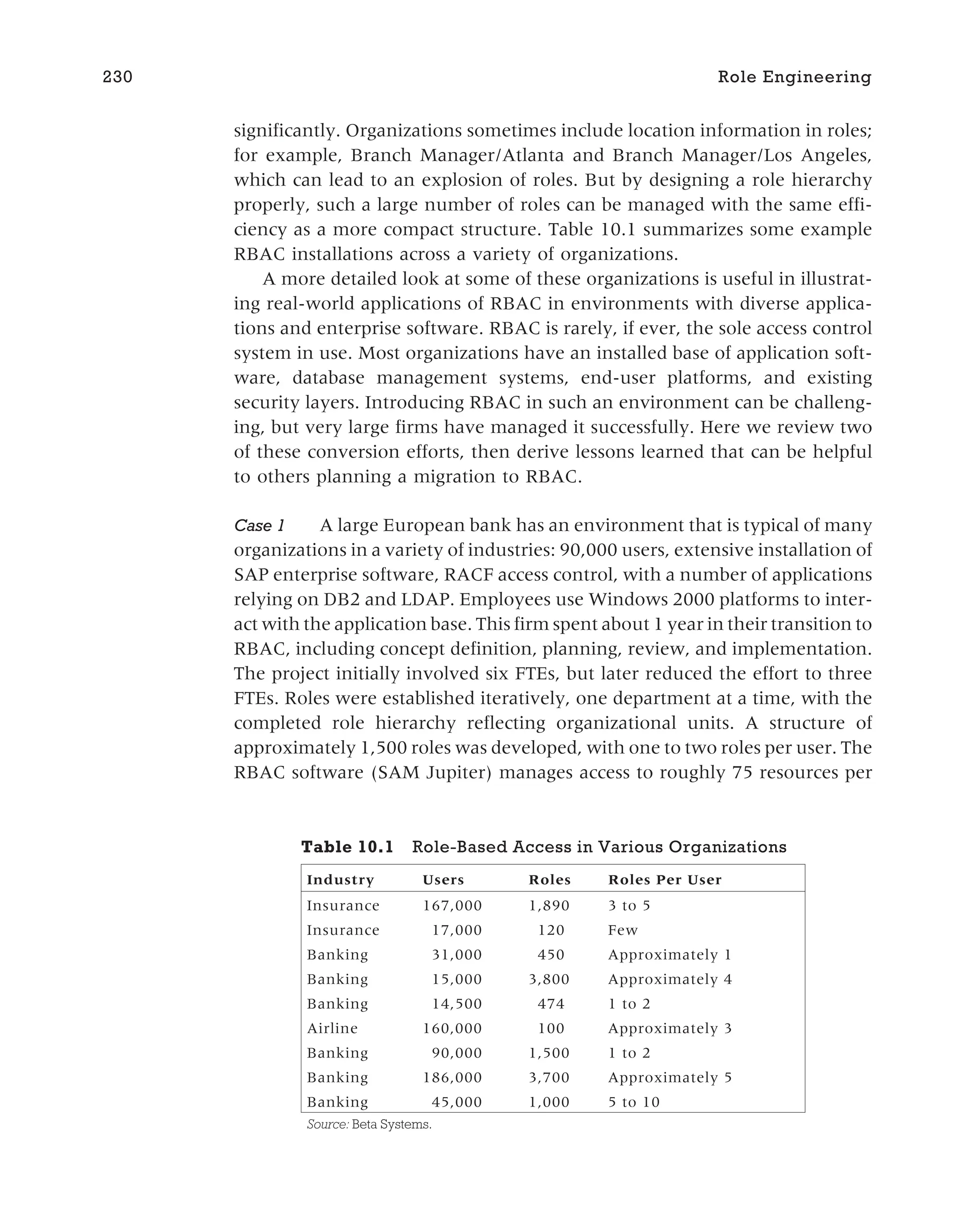
![◗ Gradually extend the role model. Most organizations operate a mixed
combination of systems in which some applications are controlled via
roles, while others retain conventional access control. As experience
is gained, some organizations choose to extend RBAC across the
enterprise.
10.5 Role engineering: health care example
This section describes the role engineering process followed by the U.S.
Department of Veterans Affairs [11], using an example scenario from the
HL7 Orders/Observations Technical Committee. Steps in this process are
based on the Neumann/Strembeck methodology. This case study illustrates
how permissions, tasks, and work profiles can be derived using typical sce-
narios from the application domain. In this case, an emergency room physi-
cian deals with an incoming patient who complains of chest pains. The
process is detailed using sequence diagrams and textual descriptions of the
steps followed by the emergency room personnel.
10.5.1 Identify and model usage scenarios
Step 1: Develop scenarios using storyboards and access patterns derived from system
application logs and other resources.
The VA scenario begins with the arrival at the emergency room of Mr. A,
complaining of chest pains. He is seen by Dr. Emergency, who orders imme-
diate tests, followed by an order for blood samples to be taken every 8 hours
for the next two days. The order is entered into the ordering system, and
then transmitted to the laboratory. A phlebotomist, Nurse N, is dispatched
by the lab to collect the initial sample after the order is received. Nurse N
takes the sample, labels it, and carries the sample back to the lab. Upon
arrival, a lab technician processes the sample and sends an extract of the
serum to a laboratory workstation. The workstation transmits a notification
back to the ordering system indicating that the sample is being processed.
Notify laboratory results
An initial lab test is conducted and the result sent from the laboratory to the
results reporting system. A second test, which takes longer to complete, has to
await additional processing, so the first test is reported as preliminary. When
the second test is completed, the results are added to the earlier results,
marked as final, and sent to the results reporting system. The “notify labora-
tory results” step will be repeated as samples are taken at 8-hour intervals.
232 Role Engineering](https://image.slidesharecdn.com/role-basedaccesscontrolsecondeditionpdfdrive-250311062434-2e3fc82e/75/Role-Based-Access-Control-Second-Edition-PDFDrive-pdf-253-2048.jpg)
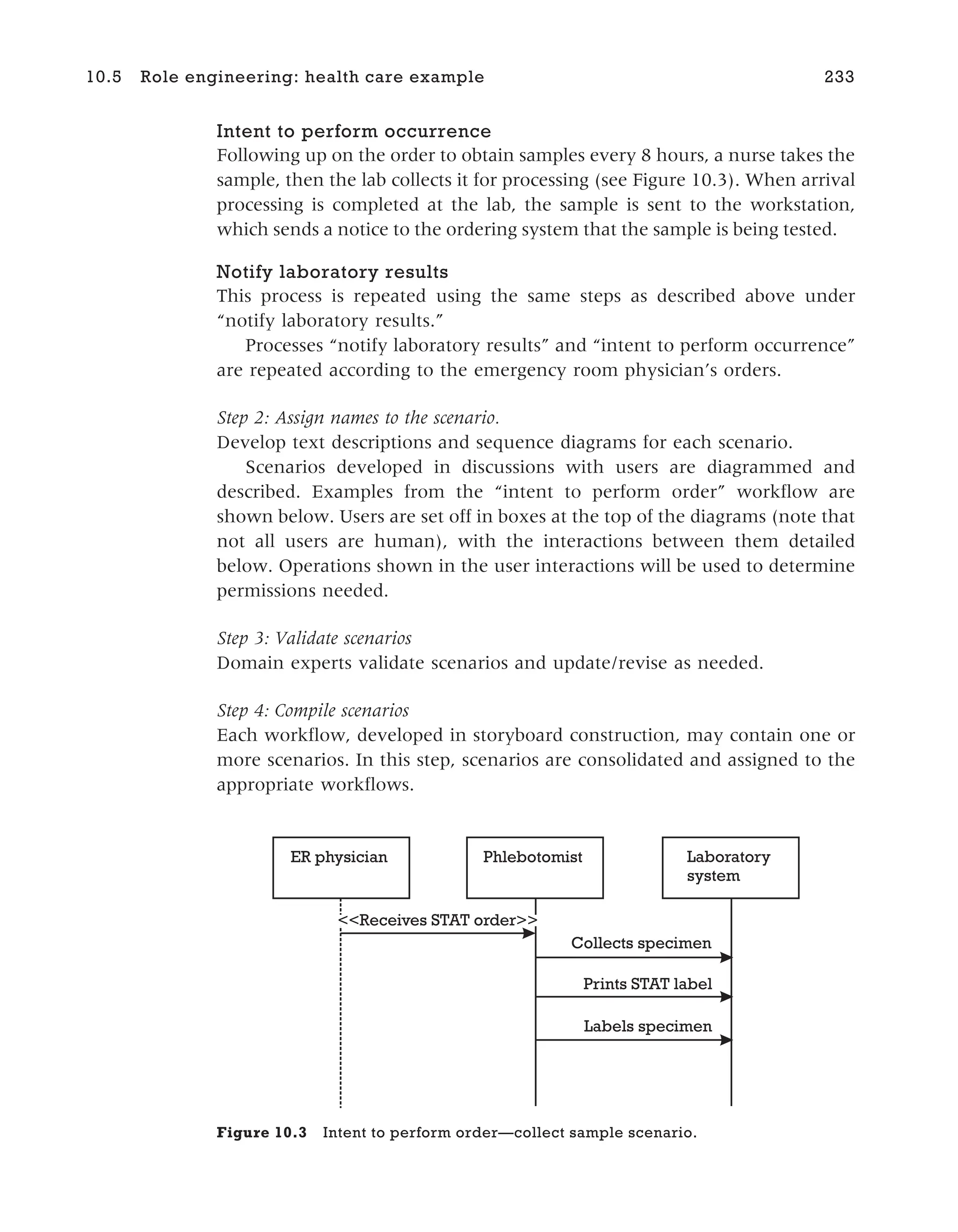
![10.5.2 Derive permissions from scenarios
Scenarios developed above are used to derive permissions by identifying
each user and the [operation, object] pairs that users execute in the scenario
steps.
Step 1: Review scenarios and identify actors and steps they perform
In this part of the process, each scenario is reviewed and the actors and steps
are identified (see Table 10.2). Table 10.3 contains the actor-to-step mapping.
Figure 10.4 illustrates how the scenarios, actors, and steps are consoli-
dated and tied to specific workflows.
Step 2: Identify operations and objects from the scenarios
In this example, an established set of operations, create, read, update,
delete, and execute (C, R, U, D, E) have been used, tied to objects defined in
an industry standard. In other application areas, entirely different opera-
tions may apply, with different objects (see Table 10.4).
Step 3: Combine the associated {operation, object} pairs and consolidate into the per-
mission catalog
Permissions are the [operation, object] pairs, produced by simply merging
the information in the last two columns of the previous table. Some
234 Role Engineering
Table 10.2 Identification of Actors and Steps
Workflow Scenario Actor Step
Frequency lab
order with results
Intent to perform
order—collect
specimen
Phlebotomist Receives STAT
order
Frequency lab
order with results
Intent to perform
order—collect
specimen
Phlebotomist Collects specimen
Frequency lab
order with results
Intent to perform
order—collect
specimen
Phlebotomist Printes STAT label
Frequency lab
order with results
Intent to perform
order—collect
specimen
Lab tech Process specimen
Frequency lab
order with results
Intent to perform
order—collect
specimen
Lab tech Logs specimen
Frequency lab
order with results
Intent to perform
order—collect
specimen
Laboratory system
(lab tech,
phlebotomoist,
and/or pathologist?)
Notifies order](https://image.slidesharecdn.com/role-basedaccesscontrolsecondeditionpdfdrive-250311062434-2e3fc82e/75/Role-Based-Access-Control-Second-Edition-PDFDrive-pdf-255-2048.jpg)
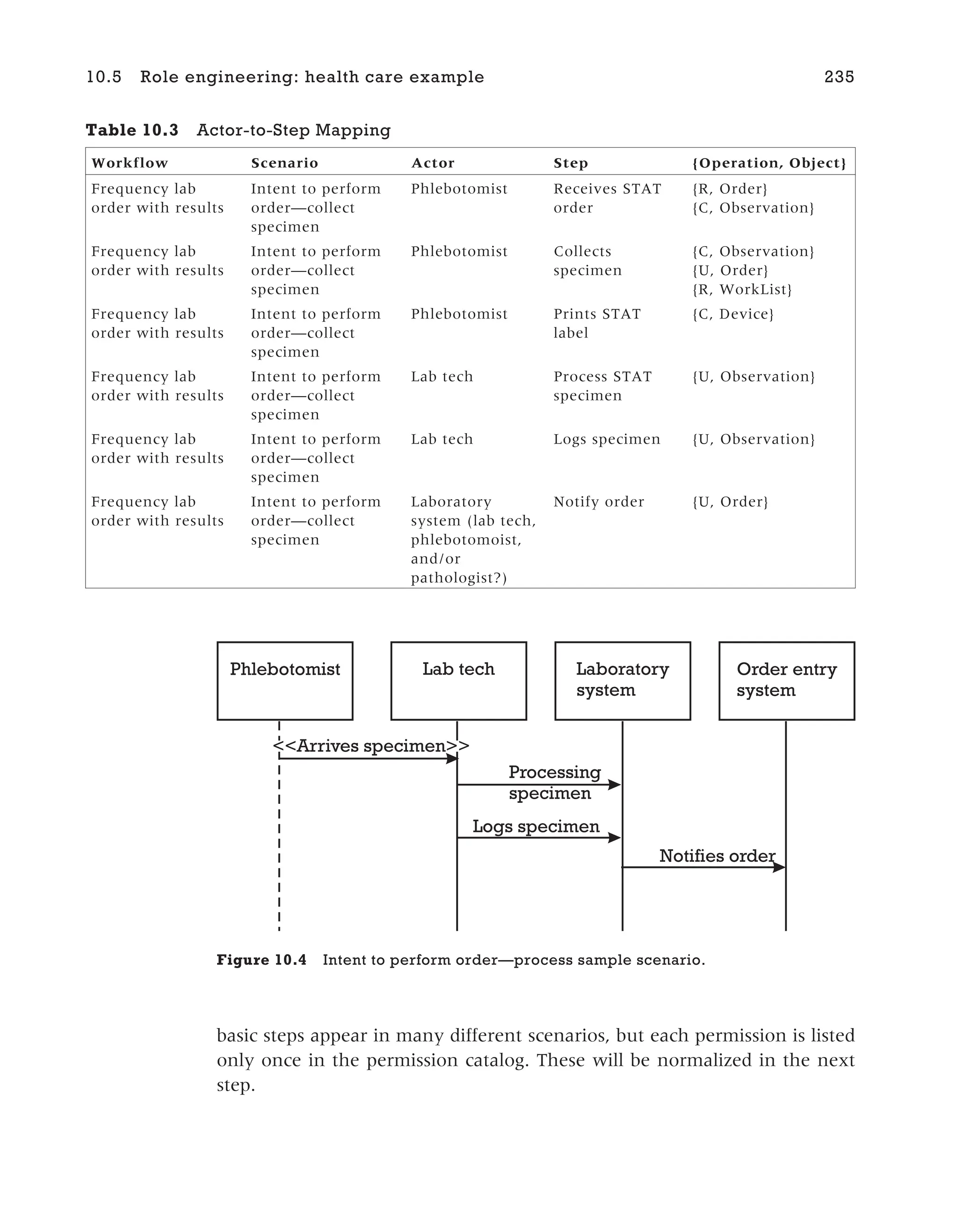
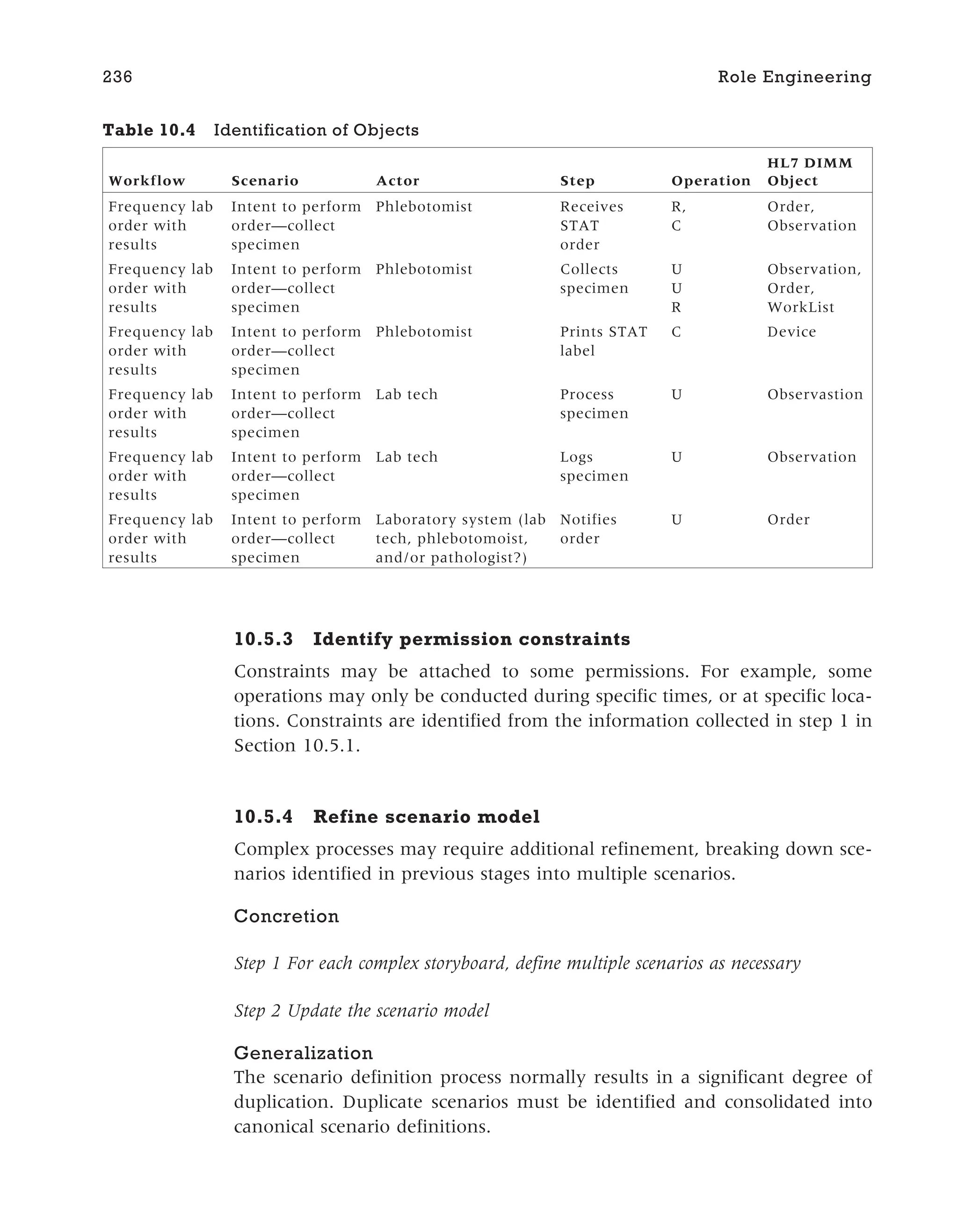
![Step 1 Identify duplicate scenarios
Scenarios can be combined if they have the same actor and same [operation,
object] permission sets.
Step 2 Consolidate the list of similar steps and {Operation, Object}, eliminating
duplicates
Step 3 Define an abstract type for the scenario (if necessary)
Step 4 Group the similar scenarios and derive a common abstract type
Permissions identified earlier as [operation, object] pairs are given unique
names within the permission catalog.
10.5.5 Additional process activities
Construction of the role hierarchy depends on completion of all scenarios.
After these are completed and names are normalized, a role hierarchy can
be defined based on subset relations between role permissions.
References
[1] Coyne, E. J., “Role Engineering,” Proc. of 1st ACM Workshop on Role-Based Access
Control, 1996.
[2] Schaad, A., J. Moffett, and J. Jacob, “The Role-Based Access Control System of
a European Bank: A Case Study and Discussion,” Proc. of 6th ACM Symposium
on Access Control Models and Technologies, 2001, pp. 3–9.
[3] Schimpf, G., “Role-Engineering Critical Success Factors for Enterprise Security
Administration,” Proc. of 16th Annual Computer Security Applications Conference,
2000.
[4] Neumann, G., and M. Strembeck, “A Scenario-Driven Role Engineering
Process for Functional RBAC Roles,” Proc. of 7th ACM Symposium on Access
Control Models and Technologies, 2002, pp. 33–42.
[5] He, Q., “A Goal-Driven Role Engineering Process for Privacy-Aware RBAC
Systems,” 11th IEEE International Requirements Engineering Conference, Doctoral
Symposium, 2003.
[6] van Lamsweerde, A., “Goal-Oriented Requirements Engineering: A Guided
Tour,” Proc. of IEEE 5th International Symposium on Requirements Engineering,
2001, pp. 249–262.
[7] Kavakli, E., “Goal-Oriented Requirements Engineering: A Unifying
Framework,” Requirement Engineering Journal, Vol. 6, No. 4, 2002, pp. 237–251.
10.5 Role engineering: health care example 237](https://image.slidesharecdn.com/role-basedaccesscontrolsecondeditionpdfdrive-250311062434-2e3fc82e/75/Role-Based-Access-Control-Second-Edition-PDFDrive-pdf-258-2048.jpg)
![[8] Van Lamsweerde, A., “Goal-Oriented Requirements Engineering: A Guided
Tour,” Proc of IEEE 5th International Symposium on Requirements Engineering,
2001, pp. 249–262.
[9] Anton, A. I., “Goal-Based Requirements Analysis,” Proc. of 2nd International
IEEE Conference on Requirements Engineering, 1996, pp. 136–144.
[10] Rolland, C., C. Souveyet, and C. Ben Achour, “Guiding Goal Modeling Using
Scenarios,” IEEE Transactions on Software Engineering, Vol. 24, No. 12, 1998, pp.
1055–1071.
[11] Coyne, E., “Role-Based Access Control Role Engineering Process, Version 3.0,”
Healthcare RBAC Task Force, May 2004.
238 Role Engineering](https://image.slidesharecdn.com/role-basedaccesscontrolsecondeditionpdfdrive-250311062434-2e3fc82e/75/Role-Based-Access-Control-Second-Edition-PDFDrive-pdf-259-2048.jpg)
![carry out those business processes. The access enforcement mechanism
implements the policy by mediating all user accesses and ensuring that
those accesses comply with the policy requirements. The policy require-
ments themselves are not arbitrary free-form stipulations but are specified
using a formal framework called an access control model.
An access control model contains mathematical formalisms and abstrac-
tions for describing the entities involved (and their attributes) in any IT
resource access. For example in the lattice-based access control model (a
variant of the MAC model), the entities involved are subjects (users or their
invoked programs, or both) and objects (such as files and databases). The
attributes that govern the accesses of subjects on objects are the clearance
levels of subjects and the classification levels of objects (also called labels).
These clearance levels (or classification levels) are organized in the form of
a mathematical structure called the lattice. Thus, the lattice-based access
control model provides the formalism for an access control policy based on
labels.
A desirable feature in an access control module would be a logical sepa-
ration between its constituent entities—policy specification component (and
associated access control model) and enforcement mechanism. This separa-
tion would enable different enforcement mechanisms to enforce the same
policy or to have mechanisms enforce multiple policies. However, in practi-
cally all platforms (e.g., operating systems, DBMSs, and Web servers) where
an access control module is present, the supported access control models
and their corresponding enforcement mechanisms are geared to meet the
requirements of a specify policy. This tight coupling between the policy and
the enforcement mechanism forces the security administrator to state or
cast the protection requirements for objects in a given application system in
terms of the artifacts of the policy that is supported on the platform that is
hosting the application system. Those protection requirements that cannot
be cast into the supported policy framework are implemented as part of the
application code itself.
In spite of living with the reality of an integrated access control policy
specification and enforcement modules on all its platforms in its IT infra-
structure, an enterprise would still be required to specify, represent, and
maintain a business process view of access control requirements for all its IT
resources. This requirement may be due to a combination of reasons: inter-
nal audit and control requirements as well as external statutory require-
ments like HIPAA [1]. Apart from control and legal requirements, there
may be situations where an enterprise is expected to maintain separation of
policy specification and enforcement components even for technical rea-
sons. For example, let us say that an enterprise has to develop access control
240 Enterprise Access Control Frameworks Using RBAC and XML Technologies](https://image.slidesharecdn.com/role-basedaccesscontrolsecondeditionpdfdrive-250311062434-2e3fc82e/75/Role-Based-Access-Control-Second-Edition-PDFDrive-pdf-261-2048.jpg)
![11.2.1 EAM’s multiple-policy support requirement
The diverse nature of IT resources in the enterprise calls for different sets of
access control policies for different resources. Hence the EAM should have
the requisite structural flexibility to represent many different types of poli-
cies. In other words, the EAM should be policy-neutral.
Chapter 6 shows that RBAC is policy-neutral by illustrating that RBAC
components can be used to specify traditional access policies like DAC and
MAC. On examining the approach adopted in Chapter 6, we find that the
RBAC modeling features that enabled support for the previously discussed
access control policies are role relationships (e.g., hierarchies), user-role
assignments, and role-privilege assignments. It has been shown in [2–4]
that these same features can be used to support arbitrary, organization-spe-
cific policies in the form of authorization constraints. Several authorization
constraints may need to be enforced in an organization to prevent fraud and
information misuse. An important class of authorization constraints is SoD.
This class of constraints seeks to reduce the risk of fraud by not allowing any
individual to possess sufficient privileges within the system to single-
handedly commit fraud. The RBAC features that can be used to enforce an
SoD constraint are (1) role-privilege assignment—by not allowing the two
privileges that together enable fraud commitment to be on the privilege set
of the same role—and (2) user-role assignment—by disallowing the assign-
ment of roles that together grant the fraud-enabling privileges to the same
user.
11.2.2 EAM’s ease of administration requirement
The second requirement for an EAM is that it should be easy to administer.
Since the EAM is a structured representation of enterprise access control
policies, which may be continuously evolving in light of changes in the busi-
ness environment and IT infrastructure, it is imperative that the EAM
should undergo changes as well. To manage these changes efficiently, the
EAM should facilitate ease of administration.
Security administration on any access control model has two facets: user
management and privilege management. Both these facets of administra-
tion are greatly simplified in RBAC by the use of roles to organize the privi-
leges. Users are granted membership into roles based on their competencies,
credentials, and responsibilities in the enterprise. If a user moves to a new
area of responsibility, the system administrator can simply remove the user
from existing roles and assign a new set of roles commensurate with the
new functions. In many access control models this user migration will
11.2 Enterprise Access Central Model Requirements 243](https://image.slidesharecdn.com/role-basedaccesscontrolsecondeditionpdfdrive-250311062434-2e3fc82e/75/Role-Based-Access-Control-Second-Edition-PDFDrive-pdf-264-2048.jpg)
![involve revocation of the user’s old privileges individually and the granting
of new privileges.
The privilege set associated with a job function may have to be updated
either due to redefinition of the job function or changes in IT application
system technologies. The privilege management tasks that this entails are
again simplified in RBAC since the privilege set in the roles that represent
that job function can be easily updated without updating the permissions
for every user (who performs that job function) on an individual basis. The
determination of the initial privilege set for a job function is also facilitated
through the use of role hierarchies or role graphs that allow roles to implic-
itly include the privileges of the descendant roles in the role hierarchy or the
role graph.
Furthermore, RBAC provides for the modular security administration of
EAMs of very large enterprises. This is done in RBAC through the definition
of special administration roles that are designated to manage other roles.
These administrative roles can also be hierarchically organized to provide a
well-organized security management structure, especially for enterprises
with diverse IT application systems (such as legacy systems and multitier
Web-based systems).
11.3 EAM specification and XML schemas
Having chosen RBAC as the EAM (which we shall henceforth refer to as the
ERBAC model), the next step in our development of EAF is the specification
of this model and the associated enterprise access control data in a form that
can be easily manipulated and evolved. The approach commonly adopted
for the specification of many access control models is the use of a policy
specification language [5, 6], since every access control model has been tai-
lored to explicitly meet the requirements of a specific policy. However, these
specification languages cannot be used for the specification of our ERBAC
model since our model potentially can represent any access control policy
(or policies), and since each specification language by itself has limitations in
the types of policies it can express. Even if a particular policy specification
language is powerful enough to express an EAM for a given enterprise
context, it may be lacking the capability to analyze the policy for conflicts
and inconsistencies and may not be extensible enough to cater to a new
type of policy. Furthermore, the access control model specification and
its associated data represented in a proprietary policy specification lan-
guage may not be accessible from all the different types of heterogeneous
244 Enterprise Access Control Frameworks Using RBAC and XML Technologies](https://image.slidesharecdn.com/role-basedaccesscontrolsecondeditionpdfdrive-250311062434-2e3fc82e/75/Role-Based-Access-Control-Second-Edition-PDFDrive-pdf-265-2048.jpg)
![systems in an enterprise that needs to translate the enterprise access con-
trol data into a format suitable for enforcement by its native access control
mechanisms.
Many of the challenges and limitations in representing structured infor-
mation (such as models and their associated data) using policy specification
languages have been overcome in the language specifications provided by
XML technologies [7]. Apart from the core mark-up language XML [which
is a simplified version of the generalized markup language (SGML)], the
XML specifications provide several meta or schema languages like DTD and
XML Schema [8, 9]. A schema language is used for metadata specifica-
tion—description of the structure and the data content of an XML docu-
ment. For example, the XML schema language will specify the various
elements found in an XML document (also called the XML tags), its struc-
ture (e.g., nesting), its occurrence constraints (number of times it can occur
in a document), and its data types (both standard and user-defined).
The XML schema and XML are now being increasingly used for repre-
sentation and exchange of metadata and associated data content, respec-
tively, in a platform-independent fashion. Because of its support for
structural, occurrence and data-typing constraints, the XML schema lan-
guage has the necessary constructs for describing the role structures,
user-role assignments, and role-privilege assignments that are the key struc-
tural relationships in an RBAC model. There have been some research
approaches to specify RBAC models in terms of the other schema languages
such as DTD [10] but these fall short in terms of modeling capabilities.
Hence, we choose to employ the XML schema language to define a gram-
mar (or schema) for our ERBAC model. We shall call the specification of
the ERBAC model in the XML schema syntax an “ERBAC XML schema.”
The enterprise access control data based on the model will be encoded
in XML.
Let us now take stock of where we are with respect to our goal of build-
ing the components EAF-COMP1, EAF-COMP2, and EAF-COMP3 (refer to
Section 11.1) needed for the EAF. Based on our discussion in Section 11.2,
we have chosen RBAC as the candidate for the EAM (EAF-COMP1) and
have called the resulting model the ERBAC model. Our survey on the avail-
ability of specification languages for access control models has led us to
choose the XML schema language for the specification of the ERBAC model,
and we call the resulting specification the ERBAC XML schema. The choice
of XML schema for the EAM automatically chooses for us the representation
framework for the enterprise access control data (EAF-COMP2) [i.e., the
extensible markup language (XML)].
11.3 EAM specification and XML schemas 245](https://image.slidesharecdn.com/role-basedaccesscontrolsecondeditionpdfdrive-250311062434-2e3fc82e/75/Role-Based-Access-Control-Second-Edition-PDFDrive-pdf-266-2048.jpg)
![11.4 Specification of the ERBAC model in the XML
schema
Before representing the ERBAC model using the XML schema we have to
choose the exact RBAC model itself from the many RBAC models proposed
in the literature. We have chosen the NIST RBAC reference model [11] here
because of its comprehensiveness and formal definition. In the NIST RBAC
reference model, the main components are users, roles, permissions, and
sessions. If we are simply to specify the NIST RBAC reference model without
a specific enterprise context (e.g., a healthcare enterprise or bank enter-
prise), we would be specifying only the structural aspects of the various
RBAC components (like users, roles, permissions, and sessions) and the var-
ious associations between the components, such as user-role assignment
and role-privilege assignment. We would not be able to specify some enter-
prise context–related constraints like the valid names of roles and the maxi-
mum (or minimum) number of users who can be assigned to any role. An
RBAC model without these types of constraints cannot be called an ERBAC
model since any EAM should contain constraints related to the enterprise
context. We generally refer to these types of constraints as the domain con-
straints to distinguish them from the category of structural constraints that
are more related to the model structure than to any aspect of the enterprise.
Since our objective is to provide a specification of an ERBAC model, we
have to choose a reference enterprise context and then specify the RBAC
model for that enterprise context. For the purpose of our EAF framework
here we will choose a commercial banking enterprise. Hence, the RBAC
model we will be specifying here will be an ERBAC model for a banking
enterprise and will therefore contain constraints related to the banking
enterprise context. Therefore, the XML schema specification of our ERBAC
model for banking enterprise context should attempt to represent con-
straints not only related to our ERBAC model structure but also some
domain constraints related to the banking enterprise environment. There-
fore, during our XML schema development process, we will be pointing out
the distinction between the structural and domain constraints.
Before developing the XML schema for the ERBAC model, we view our
ERBAC model as consisting of two sets of entities: model elements and model
relations. The model elements are user, role, privilege, and session. The
model relations are role hierarchies, user-role assignment, role-privilege
assignment, user-session assignment, and privilege-session assignment. In
the XML schema specification we will only be modeling user, role, and priv-
ilege components and not the session component. This is because a session
is a platform-dependent artifact. For example, the definition of a session
246 Enterprise Access Control Frameworks Using RBAC and XML Technologies](https://image.slidesharecdn.com/role-basedaccesscontrolsecondeditionpdfdrive-250311062434-2e3fc82e/75/Role-Based-Access-Control-Second-Edition-PDFDrive-pdf-267-2048.jpg)
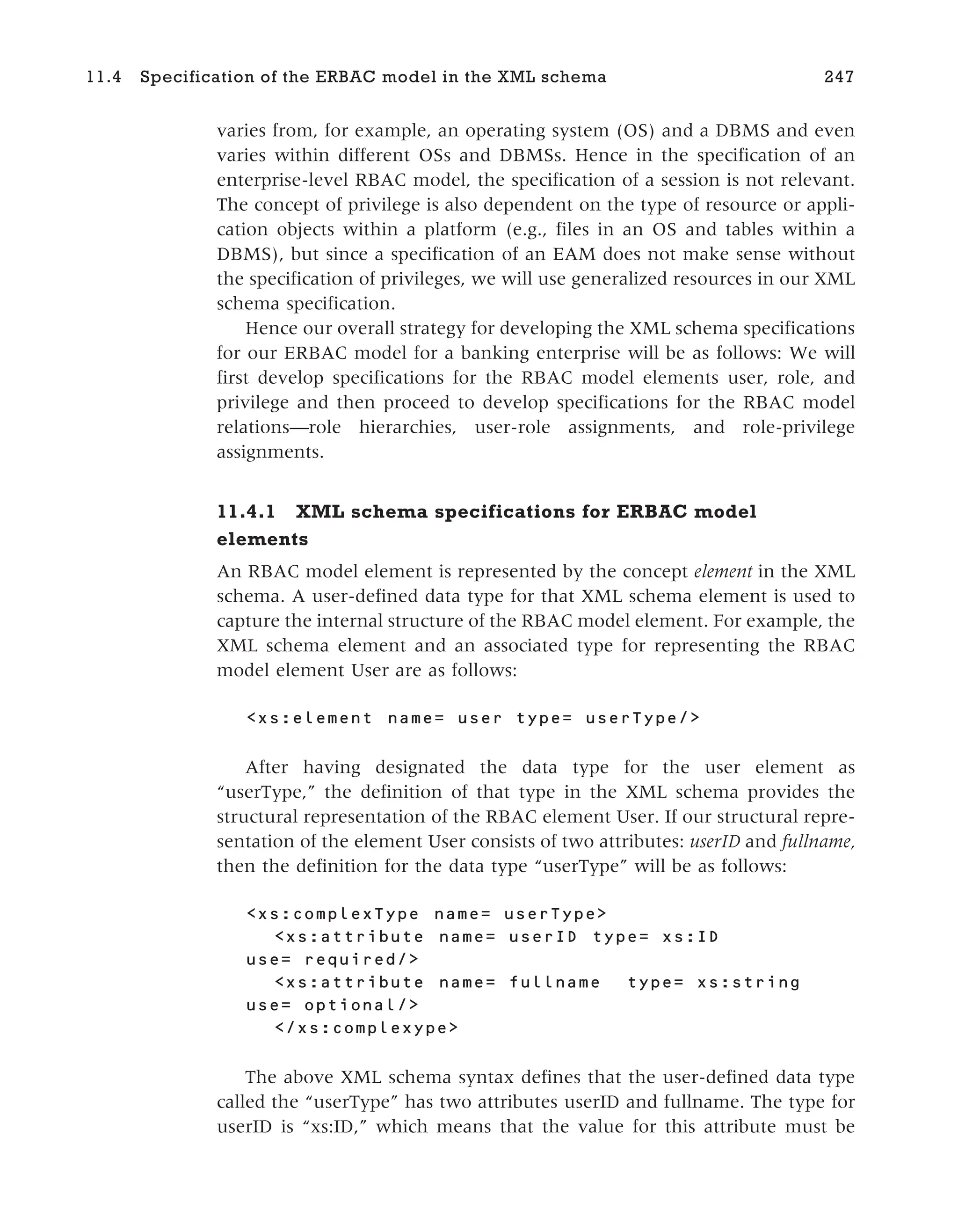
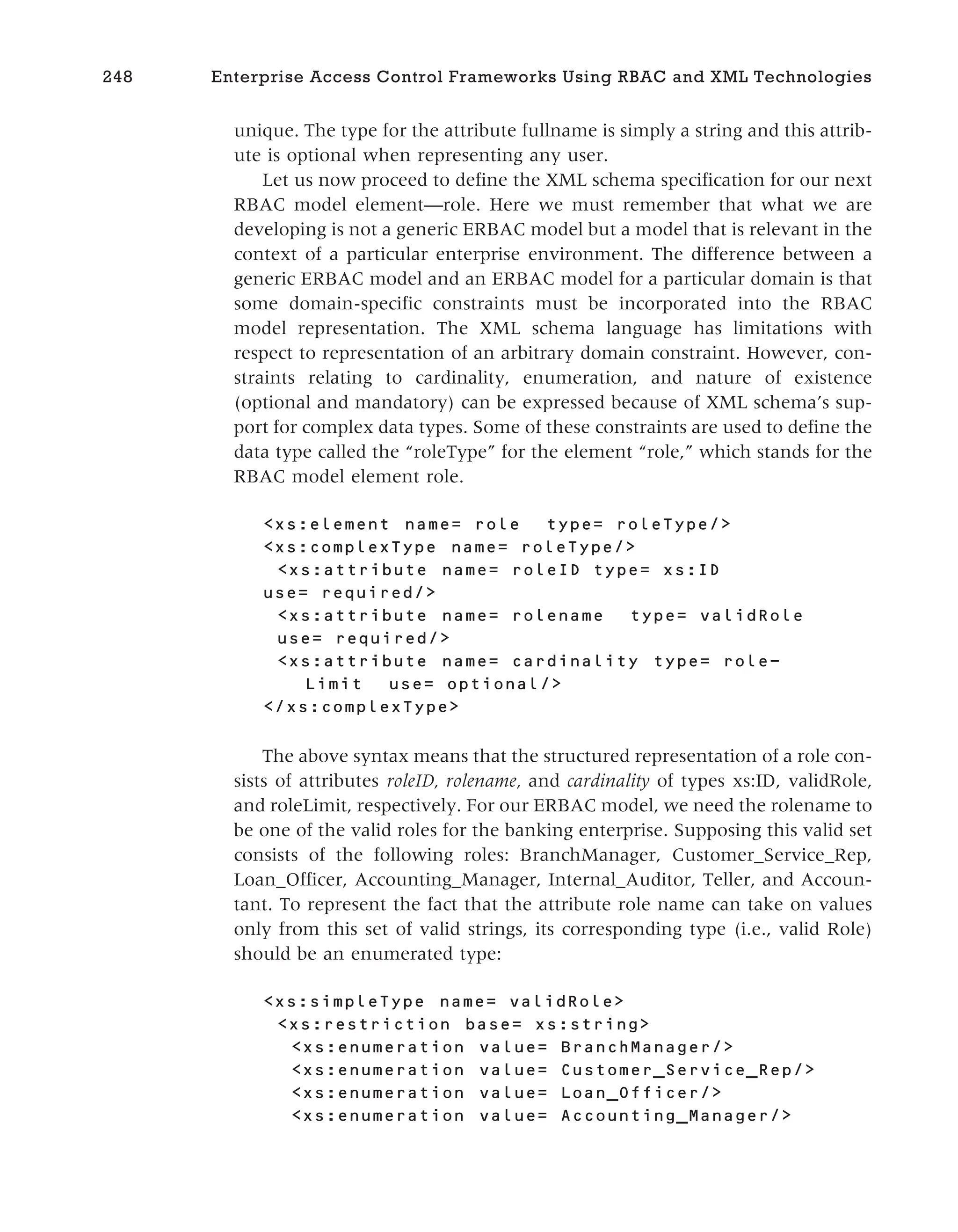
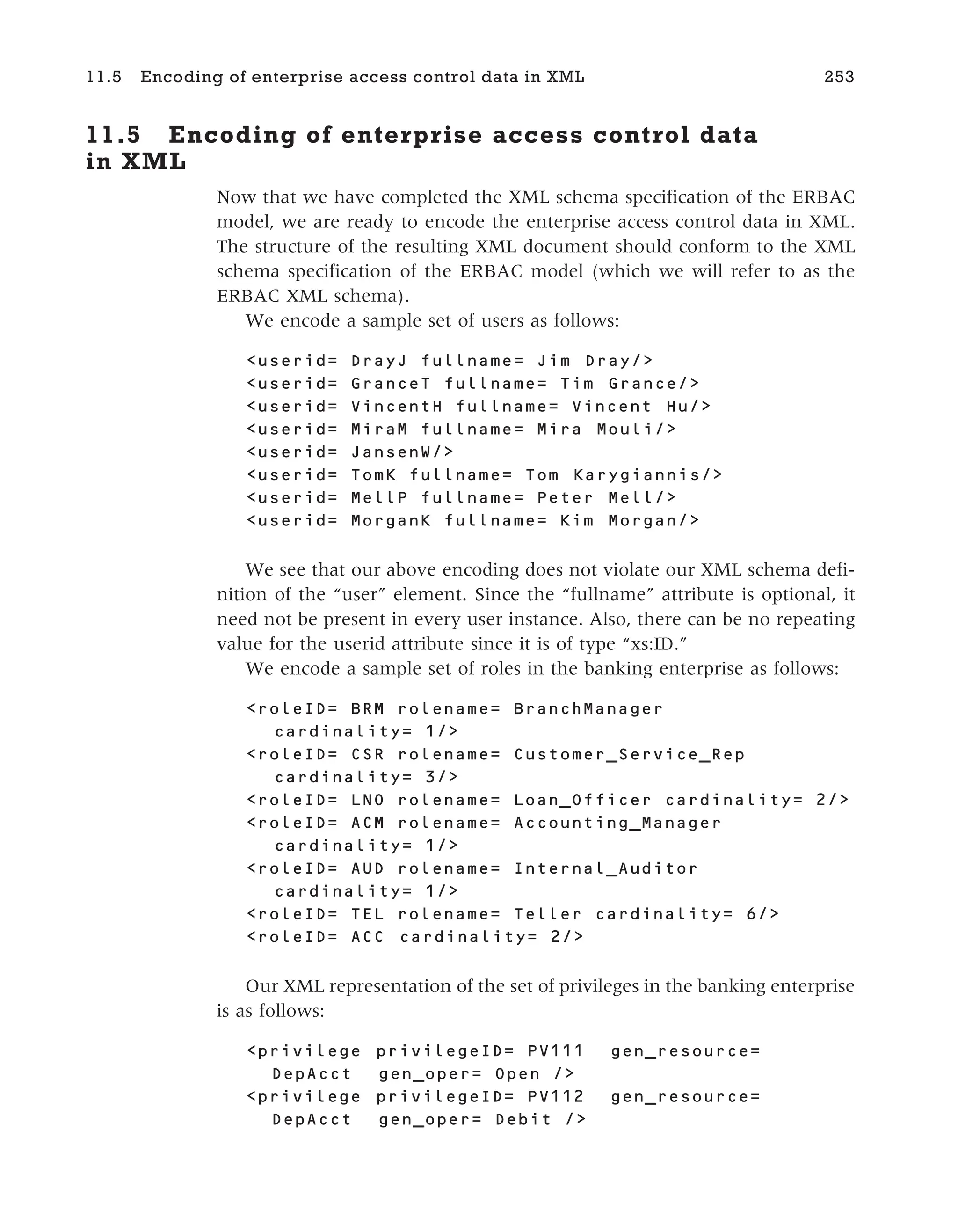
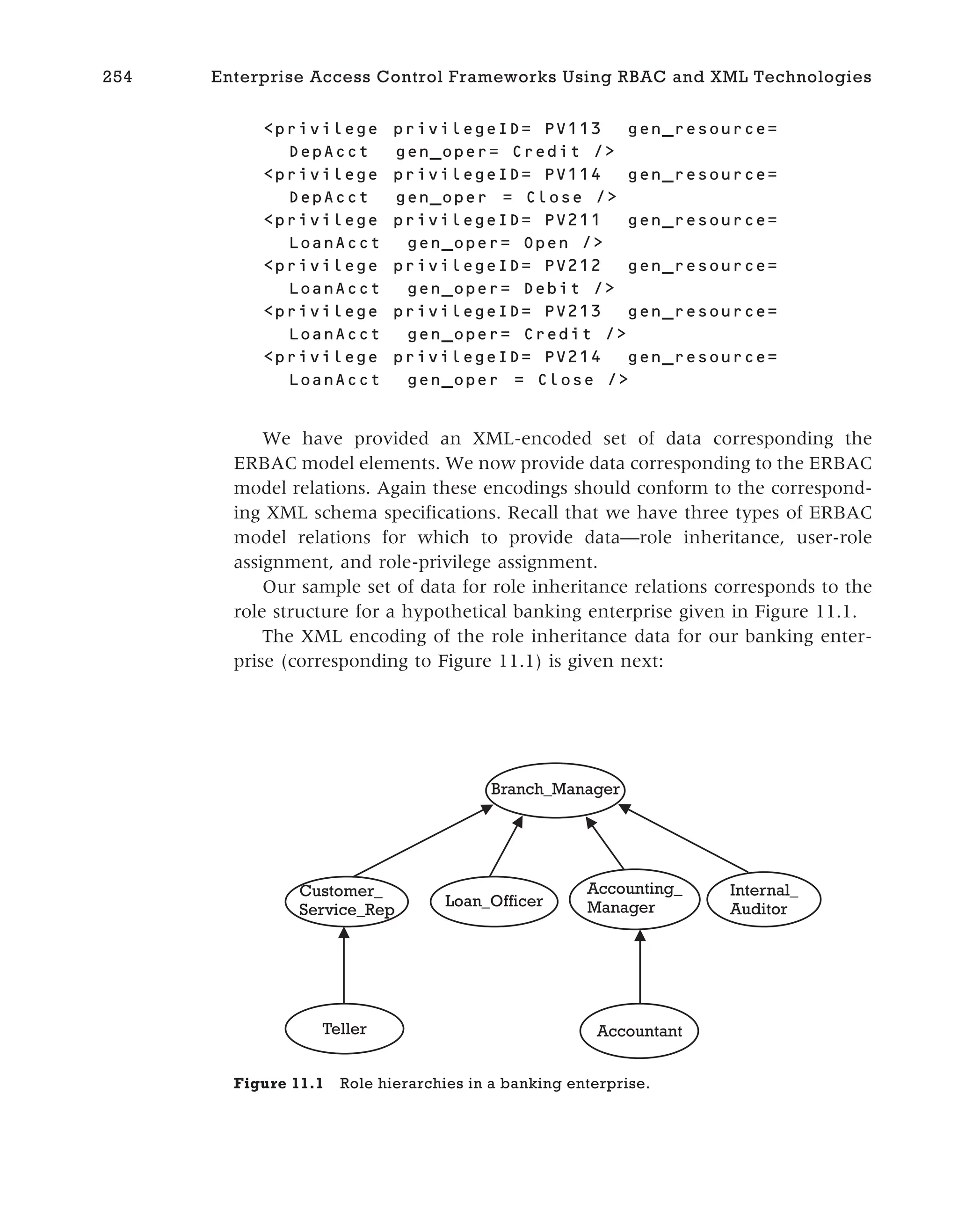
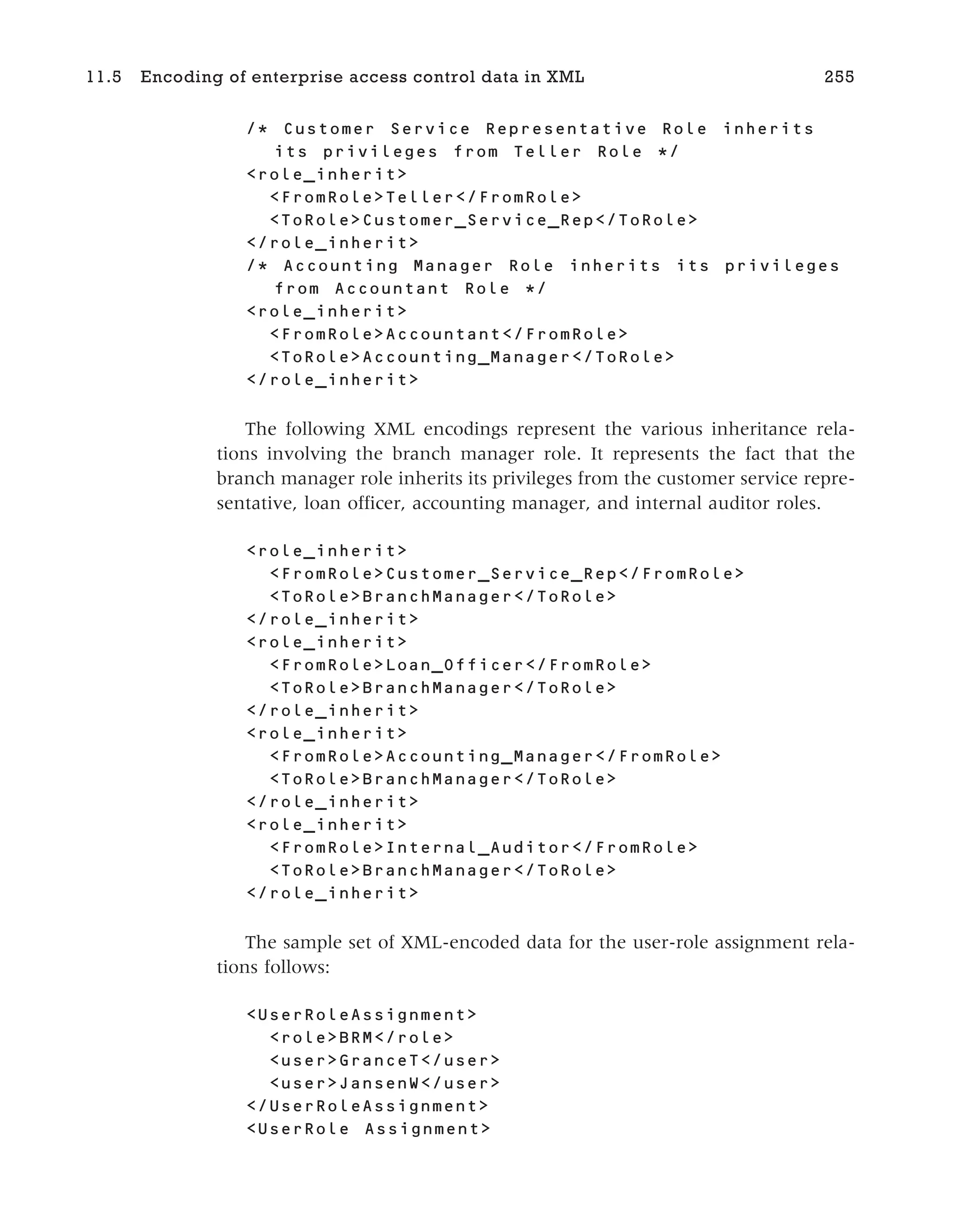
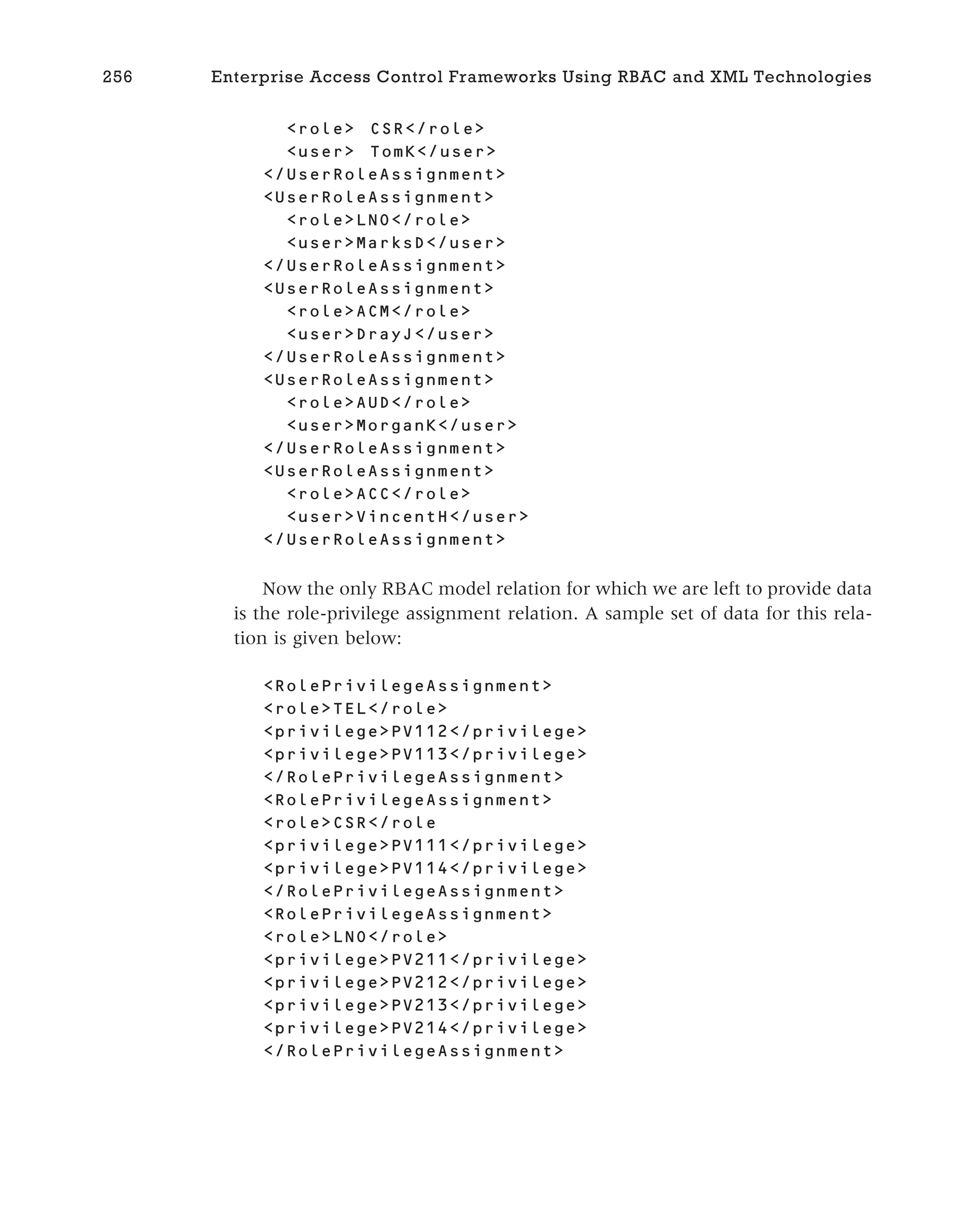
![11.6 Verification of the ERBAC model and data
specifications
We have now completed the encoding in XML of all enterprise access con-
trol data. So far we have talked about the XML specification of the ERBAC
model and the XML encoding of the enterprise access control data without
really mentioning the tools we have used to create these specifications.
Merely using a text editor to create these two documents is not sufficient for
the following reasons:
1. The metadata descriptions (or rather element descriptions) in the
ERBAC XML schema document should conform to the syntax of the
XML schema language. This verification process is called checking
for well-formedness of the XML schema specification.
2. The XML encoding of the enterprise access control data should
conform to the XML language specification. Again, verifying this
property is called checking for well-formedness of the XML document.
Stated more formally, an XML document is said to be well-formed if
the physical structure of the document obeys the XML tag rules (i.e.,
every opening tag should have an ending tag).
3. Since the encoding syntax in the XML document containing enter-
prise access control data should conform to the specification rules
(structural, cardinality, and data typing) in the ERBAC XML schema
document, we should have a means for checking this property. This
verification process is called checking for the validity of the XML doc-
ument. More formally, an XML document is said to be valid if it
conforms to the specifications in the XML schema it references.
Fortunately there are many commercial tools under the category of XML
parsers or processors [12, 13] that help in the creation of well-formed XML
schema and XML documents as well as valid XML documents (ones that
conform to associated XML schema specifications). We have used one such
tool, XML Spy [12], to create the ERBAC XML schema and the XML docu-
ment containing the enterprise access control data.
In fact we have deliberately introduced some errors in our XML encod-
ing to test the validation capabilities of our tool. For example in our encod-
ing of the following role (refer to Section 11.5), we left out the mandatory
rolename attribute:
<role roleID>= ACC cardinality= 2 />
11.6 Verification of the ERBAC model and data specifications 257](https://image.slidesharecdn.com/role-basedaccesscontrolsecondeditionpdfdrive-250311062434-2e3fc82e/75/Role-Based-Access-Control-Second-Edition-PDFDrive-pdf-278-2048.jpg)
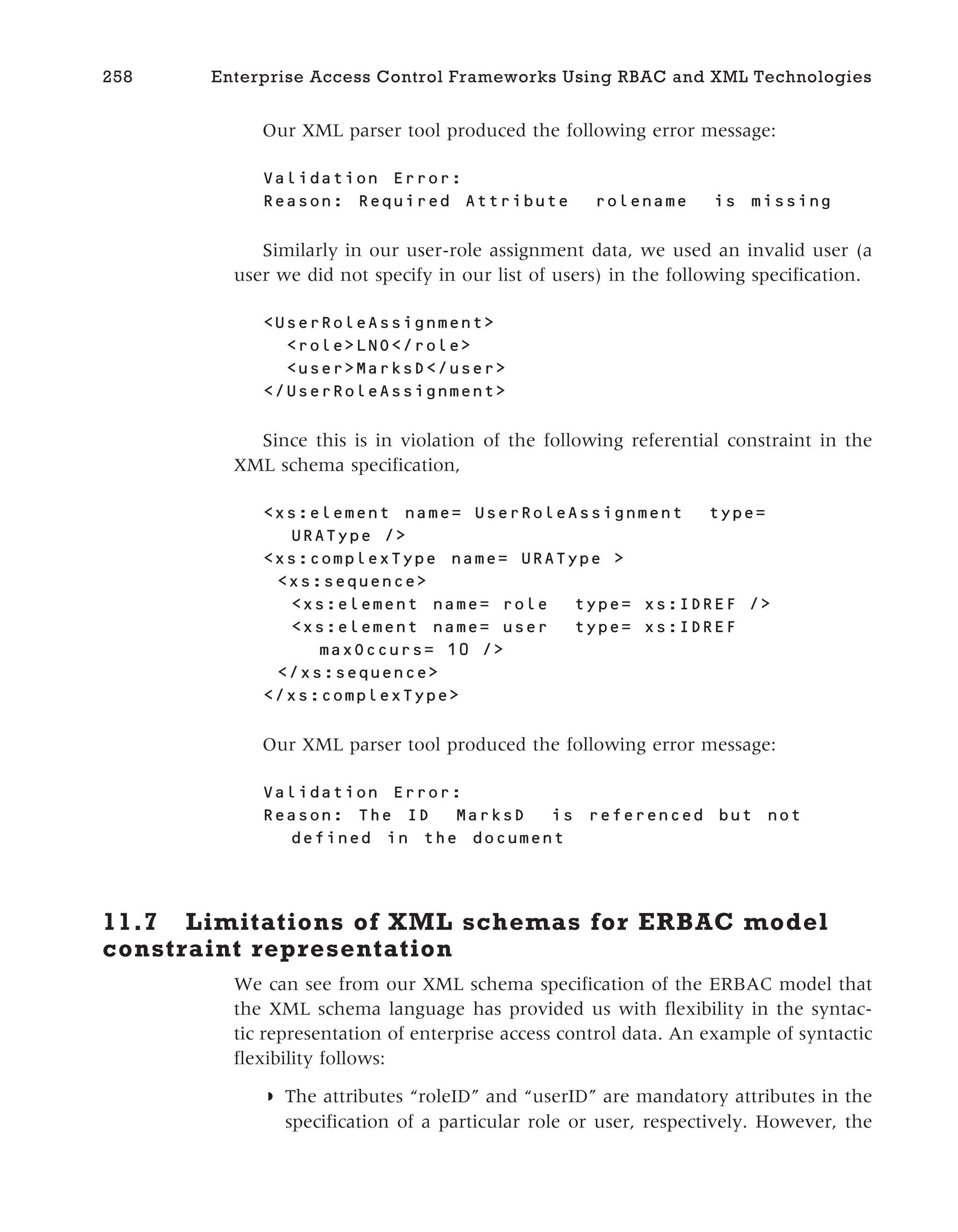
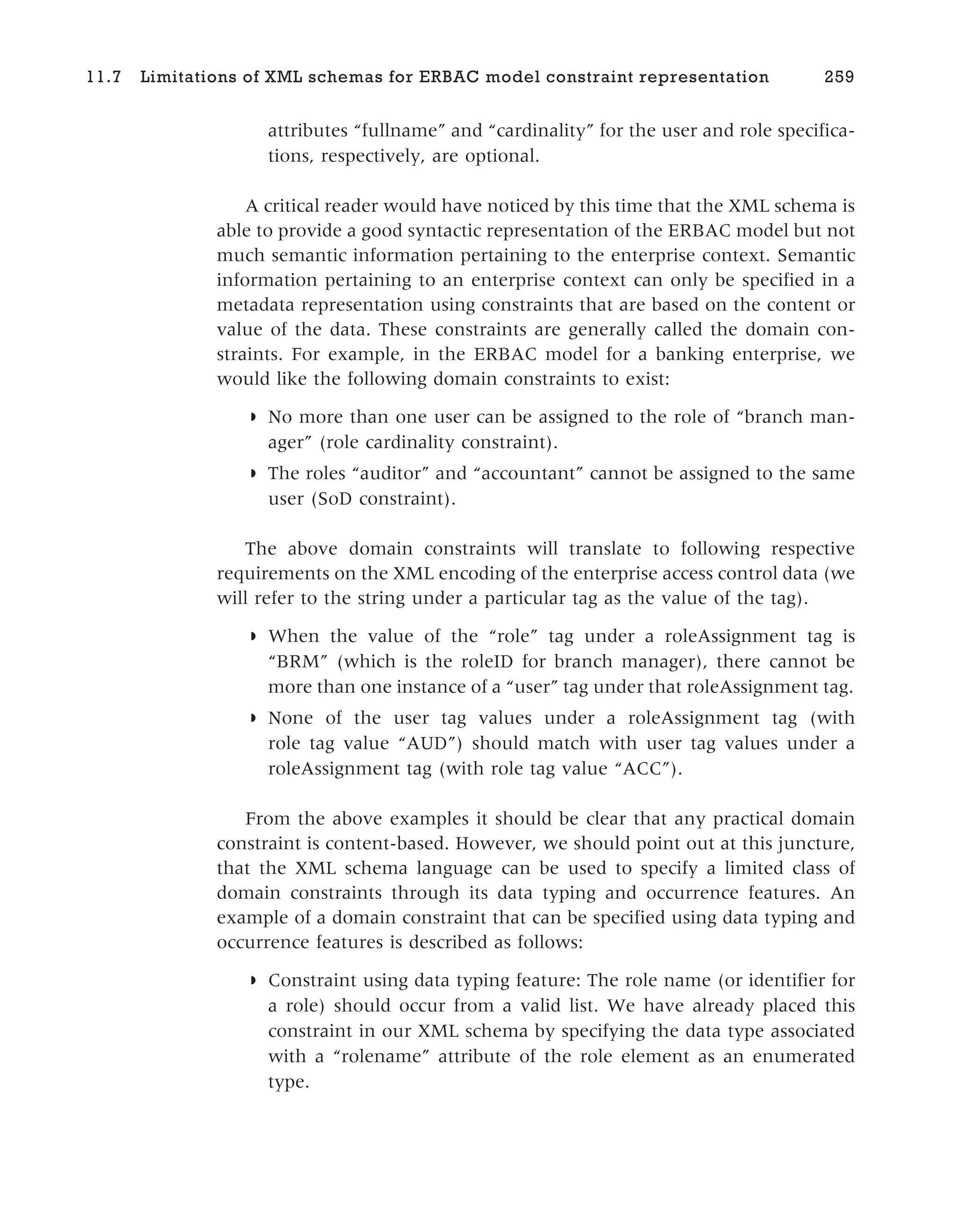
![◗ Constraint using occurrence feature: The total number of roles in the
enterprise cannot exceed 10. We already have inserted this constraint
into our XML schema by specifying the value associated with the
maxOccurs attribute of the role element as 10.
The reason for the limitation of the XML schema in the specification of
domain constraints is the fact that the XML schema is a grammar-based lan-
guage, and a grammar-based language cannot deal with content-based con-
straints. Hence an XML schema is not sufficient for a complete specification
of the ERBAC model for an enterprise since the latter contains con-
tent-based domain constraints.
One of the common approaches proposed in the literature to overcome
the limitations of the XML schema in representing semantic information
pertaining to the domain is to augment the XML schema specification with
semantic information using domain modeling languages such as RDF [14]
or pattern-based languages like Schematron [15]. In the following para-
graphs we provide a few examples of how content-based constraints using the
Schematron language can be included in an XML schema specification of the
ERBAC model. The reader is certainly encouraged to look at approaches
involving the annotation of XML schemas with RDF schemas for incorpo-
rating domain constraints in the research journals and conference proceed-
ings.
Augmenting the XML schema specifications with Schematron
constraints The Schematron language was developed for the validation of
the contents of XML documents through features for expressing rules. These
rules are expressed using the syntax of Xpath, which, in turn, provides
expressions for locating information within an XML document. For example,
to refer to a role whose text content is “TEL” within a UserRoleAssignment
(i.e., locating user role assignments for the teller role), the Xpath syntax is:
UserRoleAssignment[role[text ( )= TEL ]]
Using the above content-addressing syntax provided by Xpath, a
Schematron rule expression that expresses the fact that there should exists
an instance of UserRoleAssignment where the role has the text “TEL”
(meaning that there should be at least one user assignment for the teller
role) has the form:
UserRoleAssignment[count(role[text ( )= TEL ])
>= 1]
260 Enterprise Access Control Frameworks Using RBAC and XML Technologies](https://image.slidesharecdn.com/role-basedaccesscontrolsecondeditionpdfdrive-250311062434-2e3fc82e/75/Role-Based-Access-Control-Second-Edition-PDFDrive-pdf-281-2048.jpg)
![In Schematron, constraint expressions can be used for generating alerts
(or diagnostic messages) both for the situation where a constraint is violated
as well as for a situation where it is found to be true within the XML docu-
ment contents. The Schematron specification of the constraint expression in
the case where a violation should trigger an alert (or diagnostic message) is
specified under an <assert> tag as follows:
<sch:assert
test= UserRoleAssignment[count(role[text (
)= TEL ])>= 1] >
There should be an assignment for Teller Role
</sch:assert>
However, a constraint or rule expression alone does not constitute the
complete Schematron specification. The context in which the rule expres-
sion must be evaluated should also be provided. For the above constraint,
the context is the topmost element in the XML schema specification of the
ERBAC model (i.e., ERBAC XML schema) since the “UserRoleAssignment”
element is a subelement under this topmost element.
<sch:rule context= Bank_RBAC_Model >
We have so far provided an example of how a domain constraint can be
expressed using a Schematron specification. The next issue that arises is
where this Schematron specification is located. A Schematron specification
is never provided as a standalone specification for an XML document con-
tent but is always embedded within the associated XML schema specifica-
tion. In fact, the exact location for a Schematron specification is within the
“annotation” tag of the XML schema specification. This feature is intended
to help the software tool (called the Schematron validator [16]) to not only
locate the Schematron constraints but also to establish the proper context
for validating a given XML document for conformance to those constraints.
Based on the above discussion, the complete Schematron specification
(including its location within the XML schema specification) of the banking
domain constraint that states there should exist at least one user assignment
for the teller role is as follows:
<xs:complexType name= BankRBACModelType >
-(Start of Schematron constraint)
<xs:appinfo>
<sch:pattern name= Role Assignment Rules >
<sch:rule context= Bank_RBAC_Model >
11.7 Limitations of XML schemas for ERBAC model constraint representation 261](https://image.slidesharecdn.com/role-basedaccesscontrolsecondeditionpdfdrive-250311062434-2e3fc82e/75/Role-Based-Access-Control-Second-Edition-PDFDrive-pdf-282-2048.jpg)
![<sch:assert test= UserRoleAssignment[count
(role[text ( )= TEL ])>= 1] >
There should be an assignment for Teller
Role
</sch:assert>
</sch:rule>
</sch:pattern>
</xs:appinfo>
</xs:annotation> -(End of Schematron constraint)
<xs:sequence>
<xs:element ref= user maxOccurs= unbounded />
As already alluded to, the validation of our enterprise access control data
in the XML document for conformance to the above domain constraints
expressed through the Schematron specifications is done through a class of
tool called Schematron Validator [16]. The reader could see that the
Schematron Validator performs, in the context of Schematron specifica-
tions, a function identical to what the XML Parser does in the context of the
XML schema specification.
The error generated by the Schematron Validator on our XML document
containing enterprise access control data is illustrated here (since we delib-
erately did not provide an assignment for the teller role).
From pattern Role Assignment Rules :
Assertion fails: There should be an assignment
for Teller Role at
/Bank_RBAC_Model[1]
<Bank_RBAC_Model
xsi:noNamespaceSchemaLocation= A:Bank_RBAC_model.
xsd >...</>
11.8 Using XML-encoded enterprise access control
data for enterprisewide access control implementation
At this stage in our EAF development effort, we have accomplished the
following:
◗ An XML schema specification of the ERBAC model augmented with
Schematron specifications (for representation of some domain con-
straints). Let us call this document Bank_RBAC_model.xsd.
262 Enterprise Access Control Frameworks Using RBAC and XML Technologies](https://image.slidesharecdn.com/role-basedaccesscontrolsecondeditionpdfdrive-250311062434-2e3fc82e/75/Role-Based-Access-Control-Second-Edition-PDFDrive-pdf-283-2048.jpg)
![◗ The XML encoding of the enterprise access control data (in a docu-
ment we will call the Bank_RBAC_data.xml). We also validated the
contents of the Bank_RBAC_data.xml document for the satisfaction
of structural and some rudimentary domain constraints through an
XML schema validator. In addition, we validated the access control
data in that document for the satisfaction of some domain constraints
expressed through the Schematron specification using a Schematron
validator.
(The complete listing of the XML document Bank_RBAC_data.xml and
the XML schema specification augmented with Schematron constraints in
the document Bank_RBAC_model.xsd are given in appendixes at the end of
the book.)
Now, the practical value of the enterprise access control data in
Bank_RBAC_data.xml can only be realized if it can be programmatically
interpreted, extracted, and mapped to define the access control information
in the native format of the several application platforms in the enterprise.
Consistent interpretation of the data in an XML document across all pro-
grams is only possible if a standardized API is defined for processing the con-
tents of XML documents. Fortunately, there are two prominent APIs that
have been standardized and utilized in the industry. They are (1) the DOM
API [17] that was issued as a W3C recommendation in October 1998 and
(2) the SAX API [18]. These APIs have been implemented in a class of tools
called XML processor or parsers. In other words, an XML parser provides a
library of routines or methods that have implemented either a DOM or SAX
API and those in turn are then callable from a procedural language. For
example, the library of methods in an XML parser for Java can be utilized by
Java programs to access (and even modify) the structure and content of
XML documents.
We will now illustrate the process of interpreting and extracting the
enterprise access control data in Bank_RBAC_data.xml using a Java pro-
gram that makes use of IBM’s XML parser for Java [13] (which has imple-
mented the DOM API). In the same Java program we will also show how
the extracted data can be utilized to define access control information for a
SQL relational database application platform. Before we proceed to describe
our Java program (let us call it Bank_RBAC_to_SQL.java), we have to
understand the basic logic involved in the extraction of contents from XML
documents using the DOM API. In DOM, an XML document is represented
as a tree-structured object (an object of a type called document) whose
nodes are such items as elements and texts. An XML parser parsing an XML
document generates an instance of this tree (also called a DOM object) and a
11.8 Using XML-encoded enterprise access control data 263](https://image.slidesharecdn.com/role-basedaccesscontrolsecondeditionpdfdrive-250311062434-2e3fc82e/75/Role-Based-Access-Control-Second-Edition-PDFDrive-pdf-284-2048.jpg)
![processing program (that is utilizing the same XML parser) is able to manip-
ulate the nodes of the tree through the set of DOM-provided APIs.
To programmatically parse the document Bank_RBAC_data.xml for the
purpose of extraction of its contents, the first task our Java program
(Bank_RBAC_to_SQL.java) has to do is create a DOM object from the
Bank_RBAC_data.xml document by specifying the URL of this XML docu-
ment [19]. Our Java code for this task (including all the other house-keep-
ing activities) is as follows:
import com.ibm.xml.parser.*;
import org.w3c.dom.*;
Try {
URL u = new URL(http://RBAC_BOOK.org/xml/
Bank_RBAC_data.xml);
InputStream i = u.openStream ( );
Parser ps = new Parser ( Extracting enterprise
access control data for SQL DBMS application );
Document doc = ps.readStream(i);
} catch (Exception e) { }
By creating the DOM object (called the document object) of our
Bank_RBAC_data.xml file using the XML parser, we have prepared our-
selves to extract the information contained in that XML file. The document
object (created from our BANK_RBAC_Data.xml file) now contains a tree of
nodes (this is the DOM’s view of the XML file). There are methods available
in the node interface to check the following information about each node:
◗ The type of the node (there are two important node
types—ELEMENT_NODE and TEXT_NODE);
◗ The value (or string) contained in the node (this is true for nodes of type
TEXT_NODE);
◗ Whether a node has children (this is true for nodes of type
ELEMENT_NODE).
Now our enterprise access control data in Bank_RBAC_data.xml has
become the document object that, in turn, is nothing but a container of
nodes. We also know that there are two types of nodes—TEXT_NODE and
ELEMENT_NODE. To meaningfully process the contents of the nodes in our
document object, we need to know the association between these nodes
and the elements in our XML schema specification. This is because of the
fact that our understanding of the structure and semantics of the ERBAC
264 Enterprise Access Control Frameworks Using RBAC and XML Technologies](https://image.slidesharecdn.com/role-basedaccesscontrolsecondeditionpdfdrive-250311062434-2e3fc82e/75/Role-Based-Access-Control-Second-Edition-PDFDrive-pdf-285-2048.jpg)
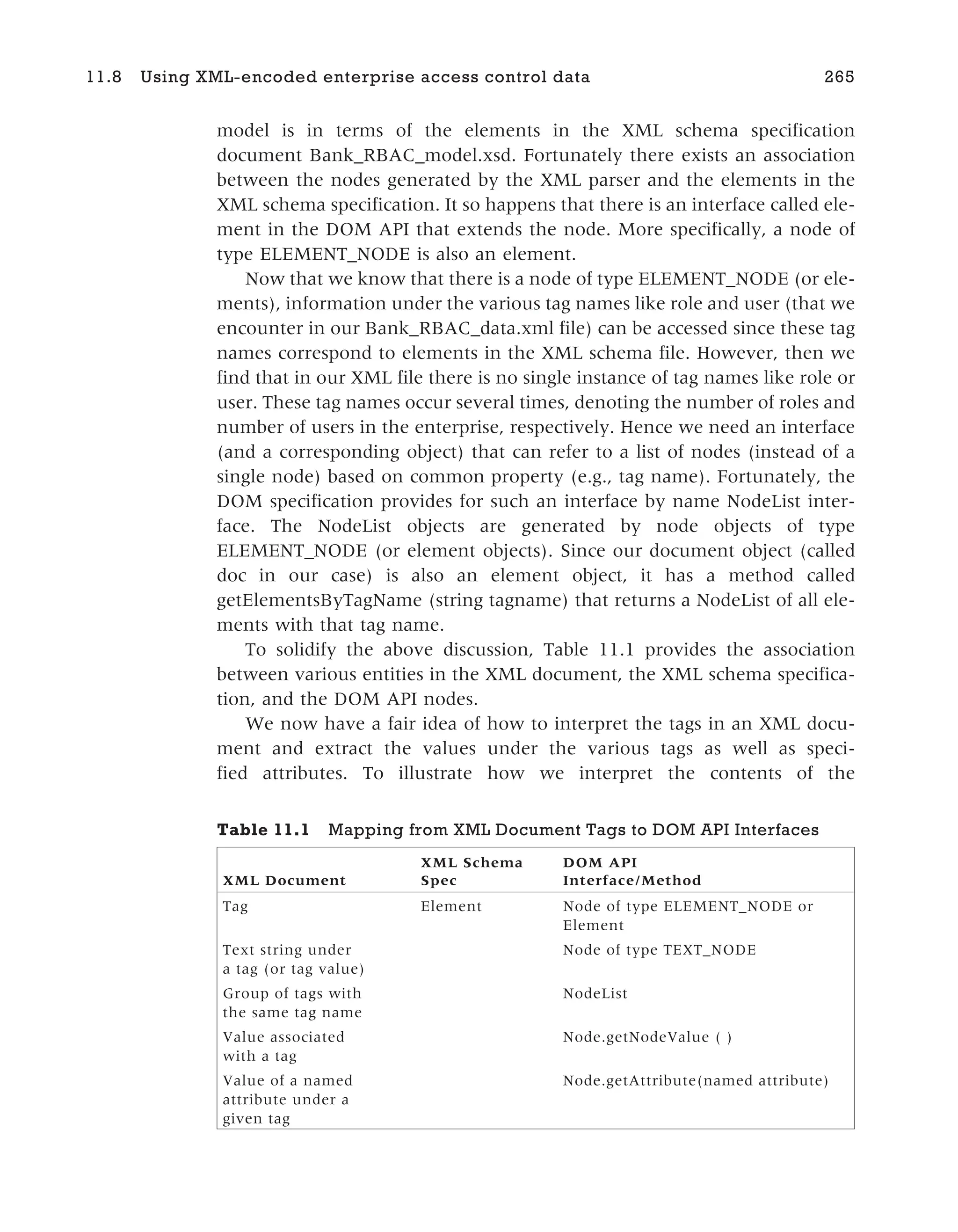
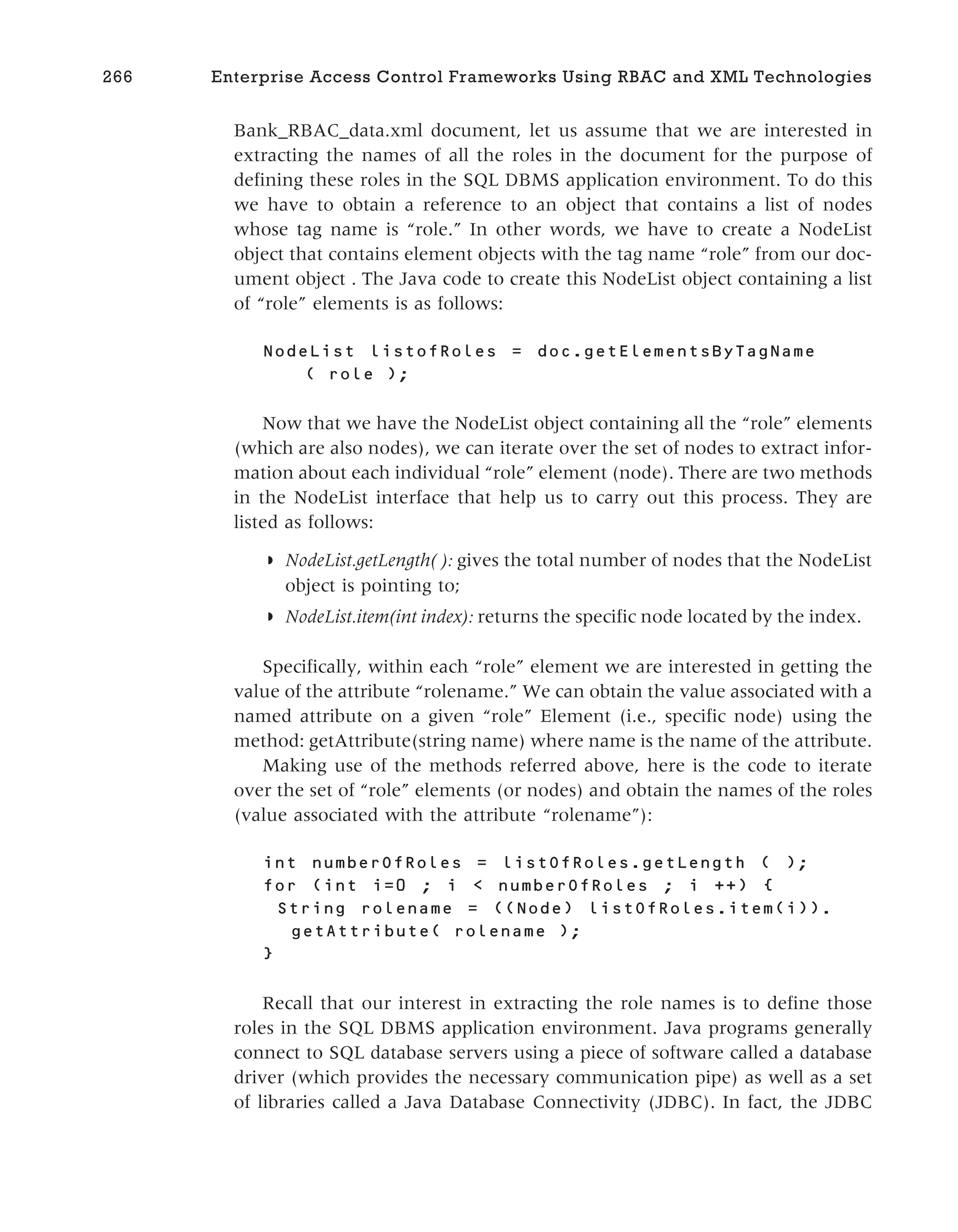
![In summary, we have now illustrated the case of using the DOM API and
JDBC libraries within a Java program to parse our Bank_RBAC_data.xml
and extract the role names and create those roles in a target application
hosted on a relational DBMS platform. In fact the above logic can be used to
parse all DOM nodes (and hence all the tags and their values in the XML
document that contains our enterprise access control data) and define the
necessary access control information for the various target application plat-
forms. It is needless to state that the appropriate SQL statement for creating
an instance of each type of access control information should be used. The
SQL command strings for creating these instances of access control informa-
tion (which in the target application platform are also considered to be
RBAC-based access control data) are:
SqlString = Create user + username;
(for creating a user)
SqlString = grant role + fromRole + to +
toRole; (for creating a role hierarchy with the
toRole as the parent and fromRole as the child).
11.9 Conclusions
This chapter has illustrated an approach for developing an EAF. This frame-
work provides the infrastructure to specify the access control requirements
(using the formalism of an access control model) for all the IT resources in
an enterprise that embodies multiple policies in a platform-independent for-
mat and to map those specifications to the various access control modules
found in the diverse application environments of the enterprise. We have
shown that RBAC (more specifically ERBAC)—because of its support for
multiple policies and ease of administration—is the candidate of choice for
an EAM. We have described in detail how the XML language vocabularies,
APIs, and tool sets can be used to specify an ERBAC model, encode the cor-
responding enterprise access control data, and map that data into the format
required by access control modules in the heterogeneous application plat-
forms within the enterprise.
References
[1] Department of Health and Human Services, “Security and Electronic
Signature Standards; Proposed Rule,” Federal Register, Vol. 63, No. 155, August
12, 1998.
268 Enterprise Access Control Frameworks Using RBAC and XML Technologies](https://image.slidesharecdn.com/role-basedaccesscontrolsecondeditionpdfdrive-250311062434-2e3fc82e/75/Role-Based-Access-Control-Second-Edition-PDFDrive-pdf-289-2048.jpg)
![[2] Ferraiolo, D., J. Cugini, and D. J. Kuhn, “Role-Based Access Control (RBAC):
Features and Motivations,” Proc. of 11th Annual Computer Security Applications
Conference, New Orleans, LA, December 1995.
[3] Ferraiolo, D. F., J. F. Barkley, and D. R. Kuhn, “A Role-Based Access Control
Model and Reference Implementation Within a Corporate Intranet,” ACM
Transactions on Information and Systems Security, Vol. 2, No. 1, February 1999,
pp. 34–64.
[4] Sandhu, R. S., et al., “Role-Based Access Control Models,” IEEE Computer, Vol.
29, No. 2, February 1996, pp. 38–47.
[5] Bai, Y., and V. Varadharajan, “A Logic for State Transformations in
Authorization Policies,” Proc. of IEEE Computer Security Foundations Workshop,
June 1997.
[6] Jajodia, S., P. Samarati, and V. S. Subhramanian, “A Logical Language for
Expressing Authorizations,” Proc. of IEEE Symposium on Security and Privacy,
May 1997.
[7] The Extensible Markup Language, Version 1.0, http://www.w3.org/TR/
REC-xml, February 1998.
[8] Guide to the W3C XML Specification (“XMLspec”) DTD, Version 2.1,
http://www.w3.org/XML/1998/06/xmlspec-report-v21.html.
[9] XML Schema Part 0: Primer W3C Recommendation, May 2, 2001,
http://www.w3.org/TR/xmlschema-0.
[10] Vuong, N. N., G. S. Smith, and D. Yi, “Managing Security Policies in a
Distributed Environment Using Extensible Markup Language (XML),” Proc. of
16th ACM SAC2001 Symposium on Applied Computing, Las Vegas, NV, March
2001.
[11] Ferraiolo, D. F., et al., “Proposed NIST Standard for Role-Based Access
Control,” ACM Transactions on Information and Systems Security, Vol. 4, No. 3,
August 2001.
[12] http://www.xmlspy.com/download.html.
[13] XML Parser for Java, http://www.ibm.com/xml.
[14] Resource Description Framework (RDF), http://www.w3.org/RDF.
[15] Schematron—Pattern-Based Schema Language, http://www.ascc.net/xml/
resource/schematron/schematron.html.
[16] Schematron Schema Validator, http://www.topologi.com.
[17] Document Object Model—Level—1 Recommendations, http://www.w3.org/
TR/REC-DOM-Level-1, October 1998.
[18] SAX—Event-Driven API for XML, http://www.megginson.com/SAX.
[19] Maruyama, H., K. Tamura, and N. Uramoto, XML and Java—Developing Web
Applications, Reading, MA: Addison-Wesley, 1999.
11.9 Conclusions 269](https://image.slidesharecdn.com/role-basedaccesscontrolsecondeditionpdfdrive-250311062434-2e3fc82e/75/Role-Based-Access-Control-Second-Edition-PDFDrive-pdf-290-2048.jpg)

![framework through cookies and X.509 digital certificates. Section 12.2 also
discusses a prototype that has integrated RBAC into an e-commerce-type
Web application where the user base is not known in advance. Section 12.3
describes a prototype that has integrated RBAC into the access control
framework of a commercial UNIX operating System (i.e., Solaris) and illus-
trates how it facilitates decentralized administration. In addition, Section
12.3 discusses a prototype describing the incorporation of RBAC into a
well-established distributed file system NFS (from Sun Microsystems).
Section 12.4 illustrates research ideas that have been proposed to incorpo-
rate role-based access enforcement in the Java 2 Security Model (JDK 1.2)
enhanced with the Java Authentication and Authorization Service (JAAS).
Section 12.5 describes the architecture of a role-based authorization and
access control subsystem that has been developed as part of the security sys-
tem of a FDBS. Section 12.6 describes an implementation of RBAC model in
an autonomous security services module.
12.1 RBAC for WFMSs
WFMSs are computerized systems used for supporting (coordinating and
streamlining) business processes in various application domains like finance
and banking, health care, telecommunications, and manufacturing. Exam-
ples of business processes in a manufacturing organization are order pro-
cessing, goods procurement, and production scheduling.
WFMSs, as they support the definition of business processes and the
enforcement of control over those processes, are called upon to support var-
ious policies including access control policies. RBAC, with its policy-support
capabilities and ease of access management, becomes a natural candidate for
incorporation into WFMSs.
To appreciate the usefulness of the RBAC framework for the enforce-
ment of access control policies in WFMSs, we need a good overview of
workflow concepts and the distinct access control requirements of WFMSs.
These are the topics of Sections 12.1.1 and 12.1.2. Subsequently, we discuss
some of the research concepts and prototypes that have used RBAC to spec-
ify and enforce access control policies within WFMSs.
12.1.1 Workflow concepts and WFMSs
Based on the definition provided by the Workflow Management Coalition
(WFMC) [1], an international organization of workflow vendors, users, and
research groups, a workflow is a representation of an organizational or
272 Integrating RBAC with Enterprise IT Infrastructures](https://image.slidesharecdn.com/role-basedaccesscontrolsecondeditionpdfdrive-250311062434-2e3fc82e/75/Role-Based-Access-Control-Second-Edition-PDFDrive-pdf-293-2048.jpg)
![business process in which “… documents, information, or tasks are passed
from one participant to another in a way that is governed by rules or proce-
dures.” A workflow separates the various activities of a given organizational
process into a set of well-defined tasks. Hence, typically, a workflow (often
synonymous with a process) is specified as a set of tasks and a set of depend-
encies among the tasks. The various tasks in a workflow are usually carried
out by several users in accordance with organizational rules relevant to the
process represented by the workflow.
A WFMS is a computerized information system that is responsible for
scheduling and synchronizing the various tasks within the workflow, in
accordance with specified task dependencies, and for sending each task to
the respective processing entity (e.g., Web server or database server). The
data resources that a task uses are called work items.
As already stated, the representation of a business process using a
workflow involves a number of organizational rules or policies. An impor-
tant class of organizational policies is security policies. Within the realm of
security policies, access control policies play a key role, and hence defining
and enforcing access control requirements becomes a key function of a
WFMS.
It has been found, from the point of view of ease of security administra-
tion, that specifying access control requirements for workflows in terms of
roles is preferable to specifying them in terms of individuals (e.g., only the
department manager can approve a purchase order for the department).
Furthermore, role-based authorization is particularly beneficial in workflow
environments in facilitating dynamic load balancing when several individu-
als can perform a task. This is the reason that commercial WFMSs, such as
Lotus Notes and Action Workflow, support role-based authorizations [2, 3].
12.1.2 WFMS components and access control requirements
WFMSs consist of two main components—design time and run time. The
design-time component consists of a set of tools (called the process defini-
tion tools) that are used for defining and modeling the business processes
and their constituent tasks. A process definition consists of process name
(e.g., purchase order process), the definition of various tasks within the pro-
cess (e.g., purchase order approval task), and a set of business rules associ-
ated with the process (e.g., task sequence or data flow among tasks). The
run-time component of a WFMS (also called a workflow engine) consists of
a set of servers that interpret the process definition and create and maintain
process instances. Task instances associated with each process instance are
also created (based on process definition). The list of instantiated tasks
12.1 RBAC for WFMSs 273](https://image.slidesharecdn.com/role-basedaccesscontrolsecondeditionpdfdrive-250311062434-2e3fc82e/75/Role-Based-Access-Control-Second-Edition-PDFDrive-pdf-294-2048.jpg)
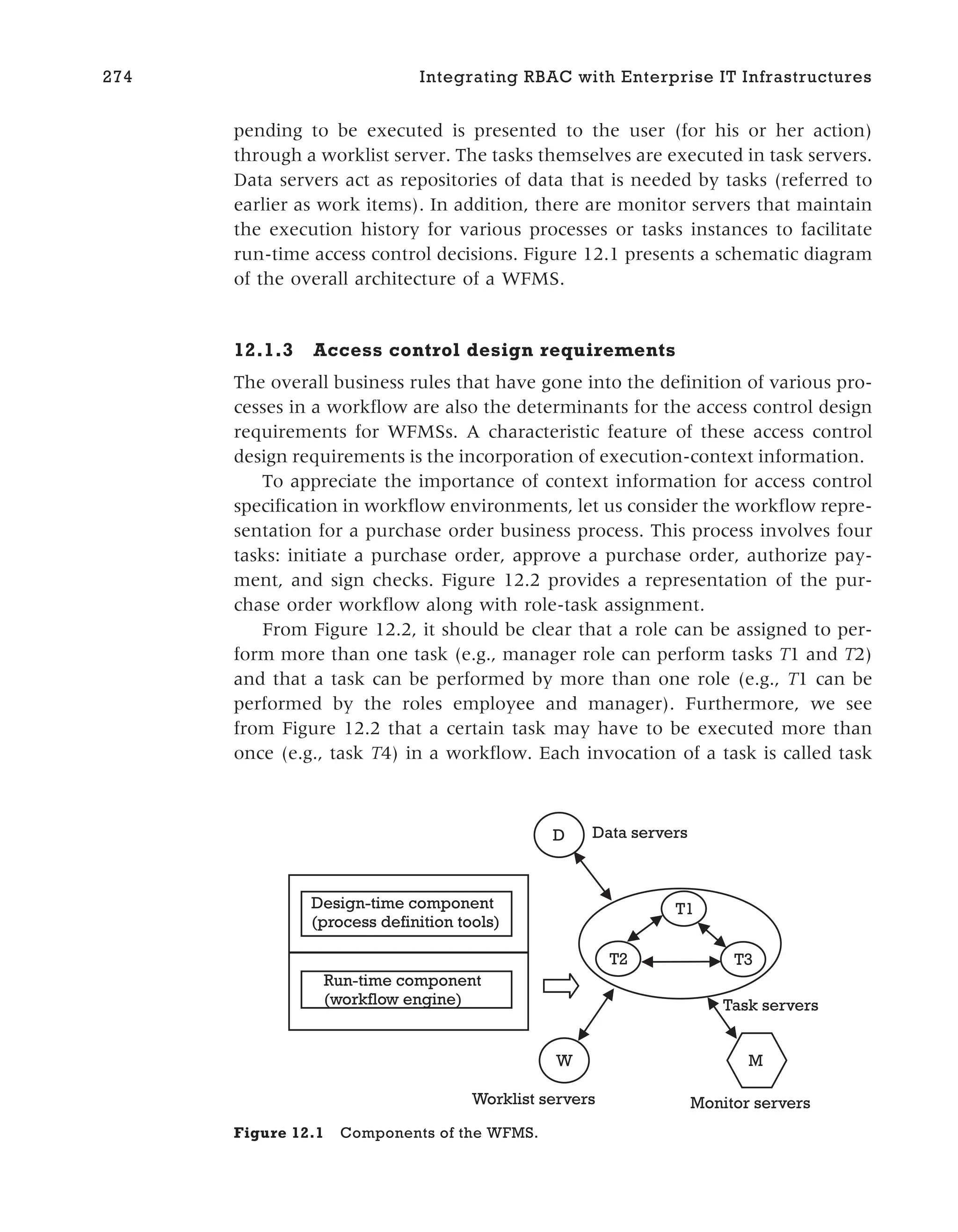
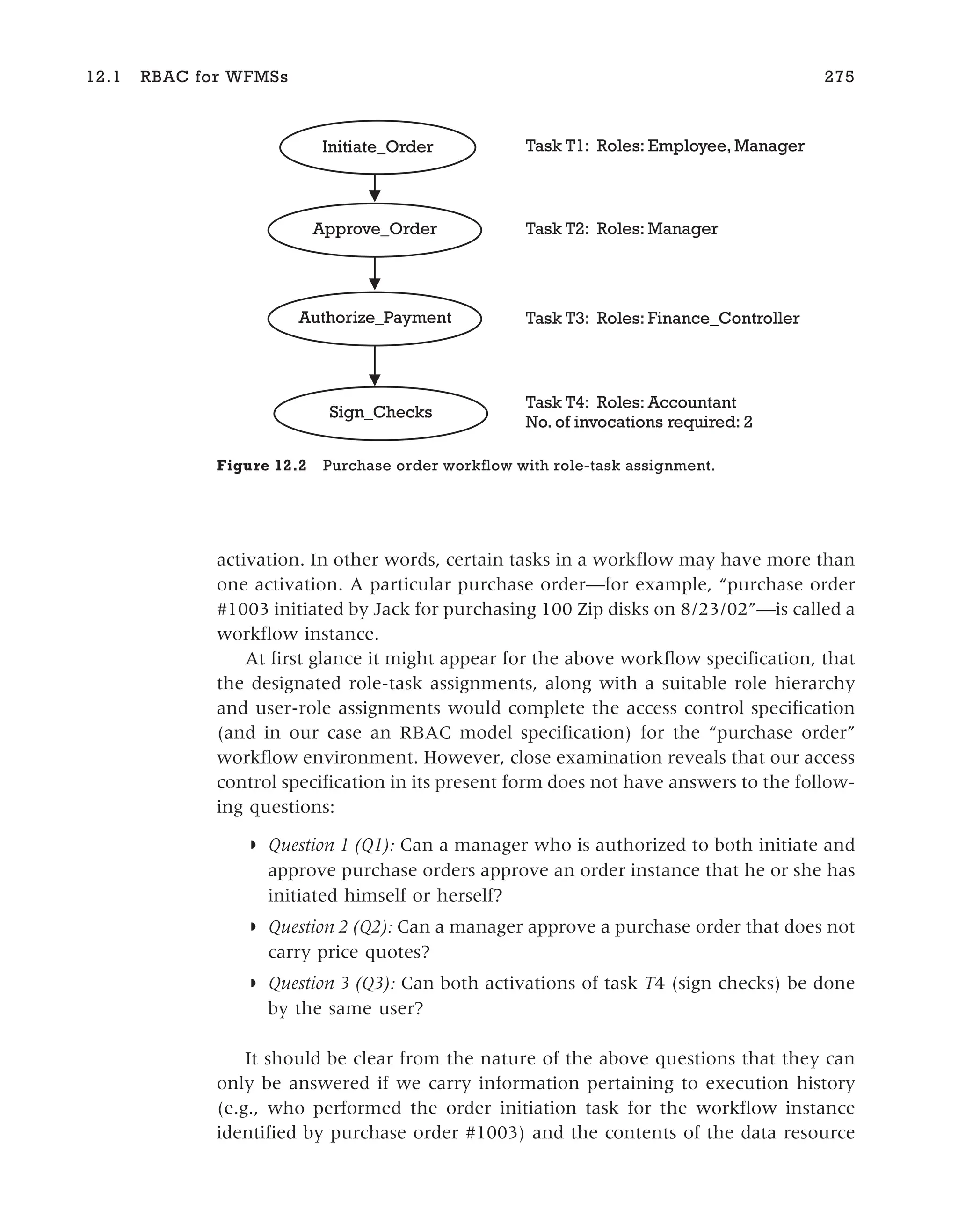
![affected by a task (e.g., purchase order table in a relational database). More
specifically, execution history is required for answering queries Q1 and Q3,
and the content information on a data resource is required for answering
query Q2.
Having seen the necessity for context information in the access control
specification for a WFMS, let us now take a look at the various access con-
trol design requirements that have been identified by researchers [4]. These
requirements—strict least privilege, order of events, and SoD—are collec-
tively called context-sensitive access control requirements:
1. Strict least privilege: The concept of least privilege requires that a user
receive no more access permissions than those required to carry out
his or her job responsibilities. Strict least privilege reinforces that
concept by taking into account that some of these permissions in
some specific instances may be inappropriate. For example, a man-
ager may be authorized to both initiate and approve purchase orders.
As part of the purchase order initiation activity, the manager may
have permission to edit the details of an order. However, when the
manager is approving a purchase order initiated by some other
employee, he or she should not be allowed to make changes to (or
edit) the contents of that particular order.
2. Order of events: This requires that certain privileges can only be
granted or exercised once others have been exercised. For example,
a manager cannot approve a purchase order until the initiating
employee has submitted it; similarly, a purchase order cannot be
submitted until quotes have been obtained and filled up against the
requested items.
3. SoD: The primary objective of this concept is the prevention of fraud
and errors, thus maintaining the semantic integrity of business infor-
mation. This requirement is formulated as a set of business rules such
as “a person may not approve his or her own purchase order” or “a
check requires two different signatures.”
12.1.4 RBAC model design and implementation requirements
for WFMSs
Let us now take a look at the RBAC model design and implementation
requirements based on the access control design requirements we saw in
the previous section. The RBAC model design requirements for WFMSs
have an impact on the following activities:
276 Integrating RBAC with Enterprise IT Infrastructures](https://image.slidesharecdn.com/role-basedaccesscontrolsecondeditionpdfdrive-250311062434-2e3fc82e/75/Role-Based-Access-Control-Second-Edition-PDFDrive-pdf-297-2048.jpg)
![◗ User-role assignment: Certain SoD requirements (those that deal with
preventing situations that should never occur) must be enforced dur-
ing design or administration time. These requirements are referred to
in the RBAC literature as static SoD. For example, in the purchase
order process, the roles Accountant and Finance_Controller should
not be assigned to the same person. This may result in a Finance_Con-
troller approving and releasing a company check based on a phony
order approved by a manager friend.
◗ Role hierarchy definition: The design of roles and role structures should
be based on task responsibilities within the various workflow processes
and not on the reporting structure of an organization. For example, an
Accountant may report to a Finance_Controller, but the Finance_Con-
troller role should not be made the parent role for the Accountant,
making the former inherit all the latter’s permissions. This would defeat
the basic motive behind the process definition for the purchase order
process where the Finance_Controller and Accountant are expected to
have distinct nonoverlapping responsibilities.
◗ Role-permission assignment: The definition of permissions directly
assigned to the roles must be abstract and tied to the semantics of the
workflow processes. For example with respect to the purchase order
process the following should be role-permission assignments (since
tasks are the semantic entities representing the user operations):
<employee, initiate_order (T1)>
<manager, approve_order (T2)>
<finance_controller, authorize_payment (T3)>
<accountant, sign_check (T4)>
The permissions required on the underlying data sources (object-level
permissions) for the successful execution of each of the tasks (stated in the
role-permission assignments) should also be mapped as part of the RBAC
model definition. Thus, the overall role-permission assignment is complete
only when we have role-task assignments and task-permission assign-
ments [5]. This is depicted through tables in Figure 12.3.
Having seen the RBAC model design-time requirements, let us take a
look at the RBAC model implementation requirements for workflow envi-
ronments. These implementation requirements are also called run-time
requirements since they are to be enforced when a business process instance
has been defined and its constituent tasks are being executed in a WFMS.
The run-time requirements are described as follows:
12.1 RBAC for WFMSs 277](https://image.slidesharecdn.com/role-basedaccesscontrolsecondeditionpdfdrive-250311062434-2e3fc82e/75/Role-Based-Access-Control-Second-Edition-PDFDrive-pdf-298-2048.jpg)
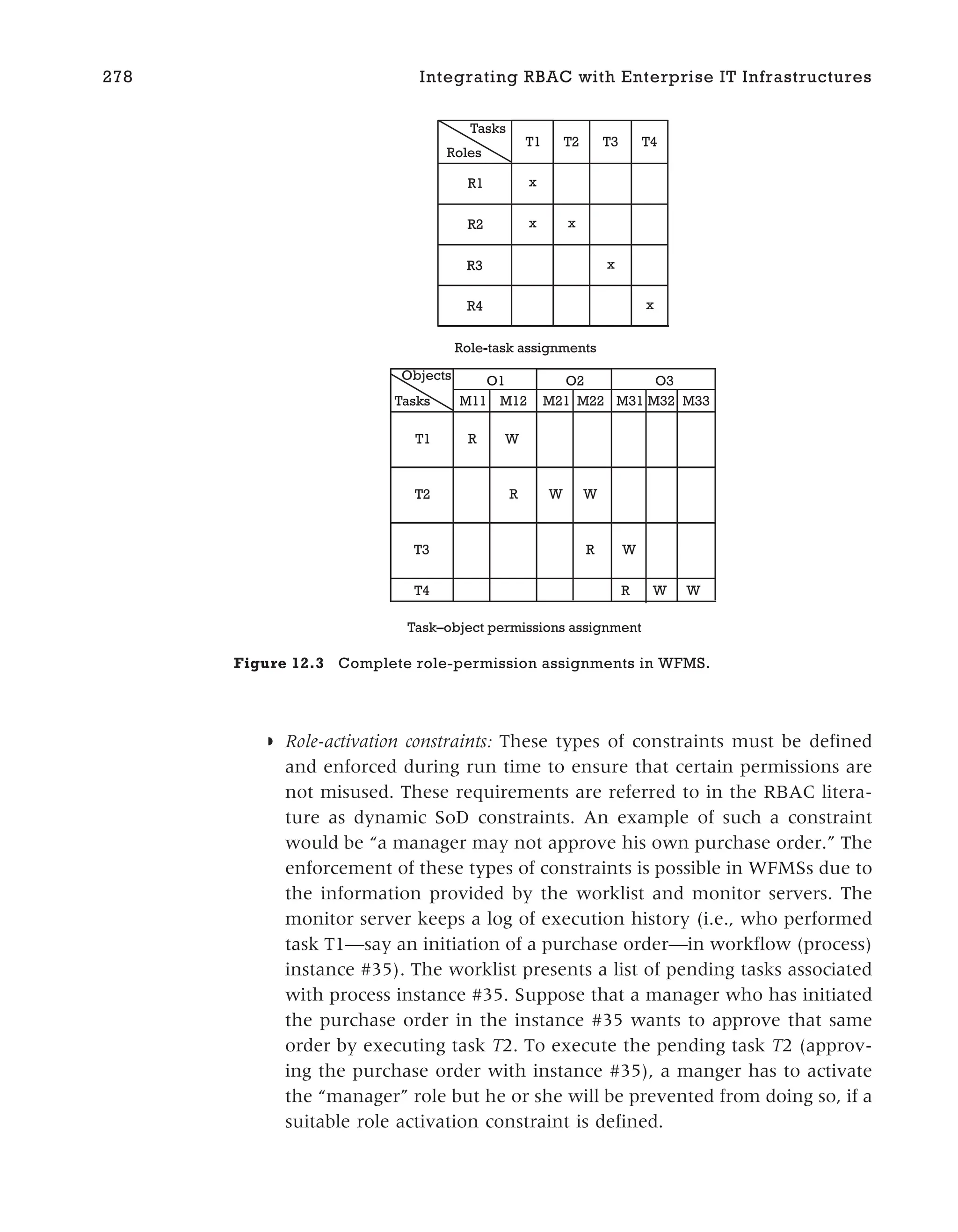
![12.1.5 RBAC for workflows—research prototypes
Research in the area of applying RBAC concepts for access control in
workflow systems covers the gamut of formal models [6] and research pro-
totypes [7, 8]. Since one of the research prototypes [7] makes use of the
model referenced in [6], we will confine our discussion to the research pro-
totypes. A common feature of the two research prototypes is that the RBAC
specification and enforcement modules (let us call them collectively the
workflow authorization server) are layered on top of existing WFMSs. Spe-
cifically the workflow engine component of WFMSs (refer to Figure 12.1)
interacts with the workflow authorization server to obtain and revoke
authorizations during workflow execution time.
In the prototype by Payne et al. [7] (referred to as the Napoleon proto-
type), the workflow authorization server is the Napoleon tool, a multilay-
ered role definition and enforcement tool. Each of the levels in Napoleon is
used to define roles at various policy levels or levels of abstraction. The bot-
tom-most layer is used to define application-specific roles (i.e., roles in terms
of application resources and the access control mechanism of the hosting
platform). Each of the higher layers contains progressively more abstract
roles, while the roles at the top-most layer are assigned to the users. Figure
12.4 shows these multiple layers.
Each of the semantic layers is defined based on the particular enterprise
requirements. In the Napoleon prototype, a new layer called the workflow
layer, which is structurally similar to other semantic layers, is built. This
layer contains roles and role constraints directly associated with workflow
tasks in the various processes. The workflow engine managing a workflow
(process) instance requests Napoleon to grant access to an active task. The
12.1 RBAC for WFMSs 279
Application
roles
Layer of
semantic roles
Users assigned
Layer of
semantic roles
Auditor
Accountant
Consultant
Caregiver
Reviewer
Admin
Provider
auditor
Application
Developer
Local
sysadmin
Workflow
administrator
Task 1 Task 2 Task 3 Task 4
Doctor
Support staff
Insurance
App. suite
integrator
Figure 12.4 Layers of roles in the Napoleon tool.](https://image.slidesharecdn.com/role-basedaccesscontrolsecondeditionpdfdrive-250311062434-2e3fc82e/75/Role-Based-Access-Control-Second-Edition-PDFDrive-pdf-300-2048.jpg)
![Napoleon receives a request along with a host of other information, such as
user identities. Napoleon then makes use of information such as user-role
assignments, role constraints, execution history of the process instance, and
role-task assignments to associate roles for the current active task. Since
the subsequent lower layers in Napoleon contain more application-specific
roles, eventually resource-specific permissions are generated to enable the
current active task to be carried out if the dynamic role-task association is
successful. Similarly, the WFMS can request Napoleon to revoke access to
all inactive tasks.
Like the Napoleon prototype, the prototype by Huang et al. [7] (the
SecureFlow prototype) is also designed to work with existing WFMSs. In the
SecureFlow prototype, a workflow authorization server (WAS) interacts
with the workflow engine (called the workflow execution server) to provide
authorization support during workflow execution. The WAS consists of an
authorization specification module (ASM), an authorization generation
module (AGM), and an authorization repository. The ASM allows security
administrators to state workflow-related access control policy specifications
that, in turn, are written to the authorization repository to be enforced dur-
ing the workflow execution. The various specifications are user specifica-
tion, role specification, user-role assignments, authorization template (AT)
specification (static role-task assignments and role-to-object permissions),
object type specification, and constraint specification. The AGM generates
authorizations during workflow execution time. It makes use of a constraint
manager submodule to assemble all constraints relevant to the current task,
executes the constraints, and generates what is called the eligible subject set
(ESS). The ESS contains a subset of the original subjects assigned to the role,
since some of the subjects might have been eliminated due to the imposition
of the constraints. If the current subject(s) requesting authorization is in the
ESS, the AGM makes use of the AT specifications to generate the required
authorization. Figure 12.5 is a schematic diagram showing the contents of
the WAS and its interactions with the components of the WFMS in the
SecureFlow architecture.
12.2 RBAC integration in Web environments
A survey of the suitability of various access control models for Web-based
applications reveals that RBAC models have the most desirable features [9].
The heterogeneous platform-based, distributed nature of Web-based appli-
cations requires an access control model that is flexible, multipolicy-
supportable, and scalable, thereby providing good support for security
280 Integrating RBAC with Enterprise IT Infrastructures](https://image.slidesharecdn.com/role-basedaccesscontrolsecondeditionpdfdrive-250311062434-2e3fc82e/75/Role-Based-Access-Control-Second-Edition-PDFDrive-pdf-301-2048.jpg)
![management and administration. RBAC models do possess these character-
istics. Consequently, several architectures have been proposed and demon-
strated for providing access control services for Web-based applications
using RBAC. A common thread through these several research ideas and
prototypes is that most of them, if not all, rely on public key infrastructure
(PKI) facilities with a major portion of RBAC model information residing on
Web servers.
12.2.1 Implementing RBAC entirely on the Web server
One of the earliest implementations of RBAC on the Web server was the
project initiated at NIST by Ferraiolo et al. [10]. The first step in their archi-
tecture was the definition of signatures of various function calls needed to
define an RBAC model and to query the model for enforcing access control
by designing what they called the RBAC/Web API. Implementing the
RBAC/Web API for a given Web server environment will result in support
for role-based access enforcement for all the applications on a Web server.
They came up with two prototype RBAC implementations on the Web
server. One type implemented the RBAC model as a CGI program on a
Microsoft IIS server and did not involve any change to the Web server
source code. The second type implemented the RBAC model by modifying
the Apache Web server source code to implement access enforcement on its
12.2 RBAC integration in Web environments 281
User-role
assignments
User
specification
Object type
specification
Constraint
specification
Role
specification
Authorization
template
specification
Constraint
manager
Authorization
generator
Workflow repository Authorization repository
Workflow
specification
module
Workflow
execution
server
Workflow
management system
Workflow authorization server
Figure 12.5 Modules in SecureFlow WAS.](https://image.slidesharecdn.com/role-basedaccesscontrolsecondeditionpdfdrive-250311062434-2e3fc82e/75/Role-Based-Access-Control-Second-Edition-PDFDrive-pdf-302-2048.jpg)
![resources based on the user roles and role permissions instead of user iden-
tity. Neither implementation required any change to the client or the Web
browser.
12.2.2 Implementing RBAC for Web server access using
cookies
Park, Sandhu, and Ahn [11] have developed a prototype implementation of
RBAC for access control on a Web server using the concept of secure cook-
ies. Cookies were invented to maintain continuity and state information as
the HTTP protocol that enables communication between a browser and Web
server is stateless. When a user visits a cookie-using Web server through his
or her browser, the Web server creates a string of text characters called a
cookie, encoding relevant information about the user and sends them to
user’s machine via the browser. When the user revisits the same Web
server, the Web server can obtain information about the user from the
cookie instead of asking for the information all over again. (In some
instances, a different Web server can recognize the cookie generated by
another Web server.) However, cookies are generally transmitted in clear
text and therefore cannot be used for sending sensitive information.
Park et al.’s motivation in making cookies secure is to use them as a
medium for transmitting sensitive authorization information. Specifically
they use cookies as the medium for clients (browsers) to present their
authorized role(s) to the Web servers. The rest of the RBAC model informa-
tion—role hierarchies, permission role assignment, and constraints—are all
stored in the Web server and are used by the Web server to enforce access
control on resources accessed by the user. In fact, the user obtains his or her
authorized role(s) from a central role server that stores the user role assign-
ment information. The set of assigned roles (let us call it the role credentials)
is presented to the Web server through the medium of cookies along with
the requested URL. In Park et al.’s “RBAC-using secure cookie” prototype,
the role server generates a set of secure cookies (the secure cookie set) after
the user logs into the role server with a user identification and password.
Table 12.1 lists the names of the various cookies generated and the main
information that they contain.
The role server uses the following information to generate each of the
cookies in the above set. The user identification and password (needed for
Name_Cookie and Pswd_Cookie, respectively) are provided by the user dur-
ing login to the role server. The encryption of the password is done using
the Web server’s public key by making use of encryption software like the
PGP. The IP address of the user’s machine (needed in IP_Cookie) is directly
282 Integrating RBAC with Enterprise IT Infrastructures](https://image.slidesharecdn.com/role-basedaccesscontrolsecondeditionpdfdrive-250311062434-2e3fc82e/75/Role-Based-Access-Control-Second-Edition-PDFDrive-pdf-303-2048.jpg)
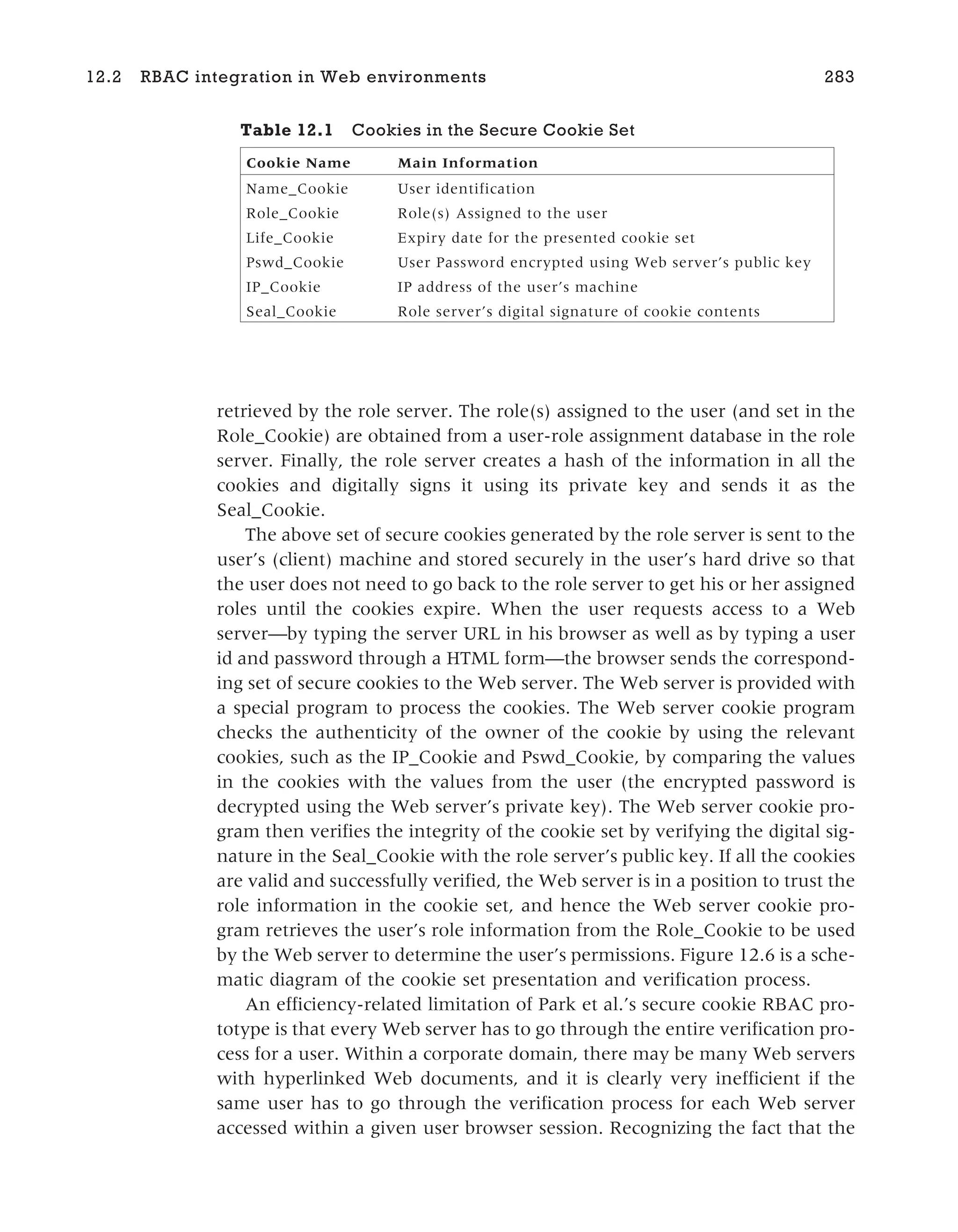
![role authorization for a user is different in different Web servers, Shim and
Park [10, 12] have proposed a slightly modified architecture using secure
cookies. In Shim’s et al.’s architecture, the user presents only authentication
cookies to a Web server (say WS_A). If the authentication is successful
WS_A then generates what is called a “Valid_Cookie” containing the user
name and password and sends it to the user to be stored in the user’s
memory space (and not in the user’s hard disk). In the meantime, WS_A
retrieves the authorized roles for the user directly from a role server
and based upon the permissions associated with retrieved roles, grants or
denies the user’s URL request. When the same user visits another Web
server in the same domain (say WS_B), the WS_B does not go through the
verification process for the user. Based on the information from the
“Valid_Cookie,” the WS_B lets the user access the Web server resources
based on the roles and role permissions applicable for WS_B (which
is obtained by WS_B from role server). In this architecture, the
“Valid_Cookie” is valid only as long as the user’s browser is open.
12.2.3 RBAC on the Web using attribute certificates
The concept that is gaining widespread acceptance for providing access con-
trol for Web-based applications is the use of attribute certificates (ACs). Edi-
tion 4 of X.509 [13] published by ITU-T in 2001 was the first edition to fully
standardize the X.509 AC. Hence, there are now two major types of X.509
284 Integrating RBAC with Enterprise IT Infrastructures
Authentication
User-role
assignment
Set secure
cookies
Get cookies
Authentication
Check integrity
Retrieve roles
RBAC
Role server
(Cookie issuer)
Web Server
Client
(browser)
Get cookies
(Name,Life, IP,
Role,Password,Seal) Response
Access
Send cookies
(Name,Life, IP,
Role,Password,Seal)
and URL Request
Assigning roles and
creating secure cookies Verifying secure cookies and RBAC
Figure 12.6 RBAC on the Web using secure cookies.](https://image.slidesharecdn.com/role-basedaccesscontrolsecondeditionpdfdrive-250311062434-2e3fc82e/75/Role-Based-Access-Control-Second-Edition-PDFDrive-pdf-305-2048.jpg)
![certificates: the X.509 identity certificate and the X.509 AC. While X.509
identity certificates (also called public key certificates) are used to maintain
a strong binding between a user’s name and his or her public key, an AC
maintains a strong binding between a user’s name and one or more privi-
lege attributes. Each privilege attribute is defined using a combination of
attribute type and attribute value. Just like a X.509 public key certificate
forms the basis for a PKI, X.509 AC forms the basis for a privilege manage-
ment infrastructure (PMI). While public key certificates are issued by a cer-
tification authority (CA), the ACs are issued by an attribute authority (AA).
The root of trust in a PKI is called the root CA. Similarly, the root of trust in
a PMI is called the source of authority (SOA). In short, X.509 PMI is to
authorization what X.509 PKI is to authentication.
The European Commission (EC)–funded Privilege and Role Manage-
ment Infrastructure Standards Validation (PERMIS) Project [14] was the
first project to build an RBAC-based X.509 PMI that could be used by differ-
ent Web-based applications. The PERMIS project defines several ACs to
store RBAC-model information. Table 12.2 lists the names of the various
ACs and the RBAC model information they contain.
Table 12.2 shows that the PERMIS project used two types of ACs. The
role-assignment AC and the role-specification AC (the first two ACs) are
collectively called the role ACs. The ACs numbered 3 through 9 are called
policy ACs. The encoding of policy information in the policy ACs has been
done using XML syntax. It is interesting to note that the role-specification
AC has two attribute types: role and permission. Those ACs containing roles
as attribute types associate one or more roles with the holder (which is also
a role) and are thus used to carry role hierarchy information. Both the role
12.2 RBAC integration in Web environments 285
Table 12.2 ACs and Contents in PERMIS Project
AC Name
Certificate
Holder Privilege Attributes
1. Role-Assignment AC User Roles assigned to user
2. Role-Specification AC Role Roles and permissions
3. Subject-Policy AC SOA or AA Subject domains within the policy scope
4. RoleHierarchyPolicy AC SOA or AA Allowable role hierarchies
5. SOA-Policy AC SOA or AA Identifiers for trusted SOAs or AAs
6. RoleAssignmentPolicy AC SOA or AA Allowable role assignments
7. TargetPolicy AC SOA or AA Target (resource) domain within the policy scope
8. ActionPolicy AC SOA or AA Actions or methods supported by the targets
9. TargetAccessPolicy AC SOA or AA Which roles have permission to perform actions
on which targets](https://image.slidesharecdn.com/role-basedaccesscontrolsecondeditionpdfdrive-250311062434-2e3fc82e/75/Role-Based-Access-Control-Second-Edition-PDFDrive-pdf-306-2048.jpg)
![ACs and policy ACs are issued by a SOA or AA and stored in a publicly
accessible LDAP directory. Since ACs are digitally signed by the SOA or AA,
they are tamper-resistant, and hence there is no modification risk.
The PERMIS project implemented a Java-based API to enable various
Web applications to obtain access control decisions. It is a modification of
the Open Group’s AZN API [15] that, in turn, is based on ISO 10181-3
access control framework that specifies the interface between the access
enforcement function (AEF) and the access decision function (ADF). The
PERMIS API architecture (shown in Figure 12.7) enables a user to access
resources (targets) via an application gateway. The AEF authenticates the
user and then asks the ADF if the user is allowed to perform the required
action on the particular target resource. The ADF accesses one or more
LDAP directories to retrieve the set of policy and role ACs relevant to the
user and bases its decision on these.
The AEF authenticates the user using his or her client certificates and
thus obtains the user’s distinguished name (DN)—the unique identifier for a
user in the X.500 directory structure used in the LDAP directory. Further-
more, since the AEF is application-platform resident, it also contains the
trusted SOA for the application as well as the list of the LDAP uniform
resource identifiers (URIs). The AEF passes all this information to the ADF,
which then retrieves the policy ACs and role ACs relevant for the user. The
ADF parses the XML encodings in the policy ACs and uses the information
there to validate the information in the role ACs. Invalid Role ACs are
discarded, and the valid role ACs then constitute the credential information
for the user. At each user access attempt, the AEF passes the target name
and attempted action to the ADF that now contains the credential informa-
tion. The ADF also associates a time-out period with the credential informa-
tion thus preventing the user from keeping a connection open for a long
time.
286 Integrating RBAC with Enterprise IT Infrastructures
LDAP
DIRECTORY
Retrieve policy
and role attribute
certificates
Submit user
access request
AEF
ADF
(The PERMIS API)
Decision
request
Decision
Application
gateway
Present
access
request
Target
Authentication service
Figure 12.7 Privilege verification subsystem in PERMIS project.](https://image.slidesharecdn.com/role-basedaccesscontrolsecondeditionpdfdrive-250311062434-2e3fc82e/75/Role-Based-Access-Control-Second-Edition-PDFDrive-pdf-307-2048.jpg)
![There is an earlier prototype implementation of RBAC using X.509 cer-
tificates by Park, Sandhu, and Ahn [11]. In Park et al.’s prototype, the user’s
role information was carried in the “extensions” field of a regular X.509
identity certificate. When a user presents this certificate to a Web server, the
Web server verifies the certificate, and then uses the role information there
to enforce role-based access enforcement. The rest of the RBAC model
information, like the role hierarchies and role-permission assignments are
already defined and stored in the Web server. The user obtains the bundled
X.509 identity certificate (as it contains both identity and authorization
information) from a role server that contains the user-role assignment data-
base after proper authentication.
All the RBAC implementations for the Web-based applications we have
seen so far are based on the assumption that we have a pre-established and
known set of users and that what is required by the Web server (or any
program based on the Web server) is to authenticate them and verify the
integrity of their role credentials. However in the case of sensitive
(trust-requiring) Web transactions originating from users whose identity is
not known in advance (which is the case in many e-commerce applica-
tions), the Web server must first establish the trust in the requesting user
before finding the mapping from the user to his or her authorized roles.
Herzberg, Mass, and Mihaeli [16] have presented an implementation that
will enable an unknown user to establish this trust with a Web server by
presenting certain attribute information (not roles) through a specially
designed TE certificate and then be mapped to a set of predefined business
roles. The TE and role mapping tasks are accomplished by a TE module. The
rest of the RBAC model information—role hierarchies, role permission
assignments, and associated constraints—are resident on the Web server
itself and collectively provide the role-based access control. The TE module
has been implemented in two different ways by Herzberg et al. in their two
prototypes. It was implemented as a CGI program in an Apache Web server
and as a servlet under the IBM WebSphere Application Server.
Let us now take a look at the specially designed TE certificate. The TE
certificate has been designed by adding some attributes (or fields) to a
X.509v3 certificate making use of its extension field. Since as many exten-
sions as needed can be defined, Herzberg et al.’s TE certificate contains the
mandatory attribute fields shown in Table 12.3.
The TE module maps the subject that is presenting these TE certificates
to a role (or roles) based on the attribute values in these certificates using a
policy set by the owner of the resource for which the subject is requesting
access. (Please note that the issuer of the certificate has nothing to do with
this policy.) The policy can therefore be said to perform the dual task of trust
12.2 RBAC integration in Web environments 287](https://image.slidesharecdn.com/role-basedaccesscontrolsecondeditionpdfdrive-250311062434-2e3fc82e/75/Role-Based-Access-Control-Second-Edition-PDFDrive-pdf-308-2048.jpg)
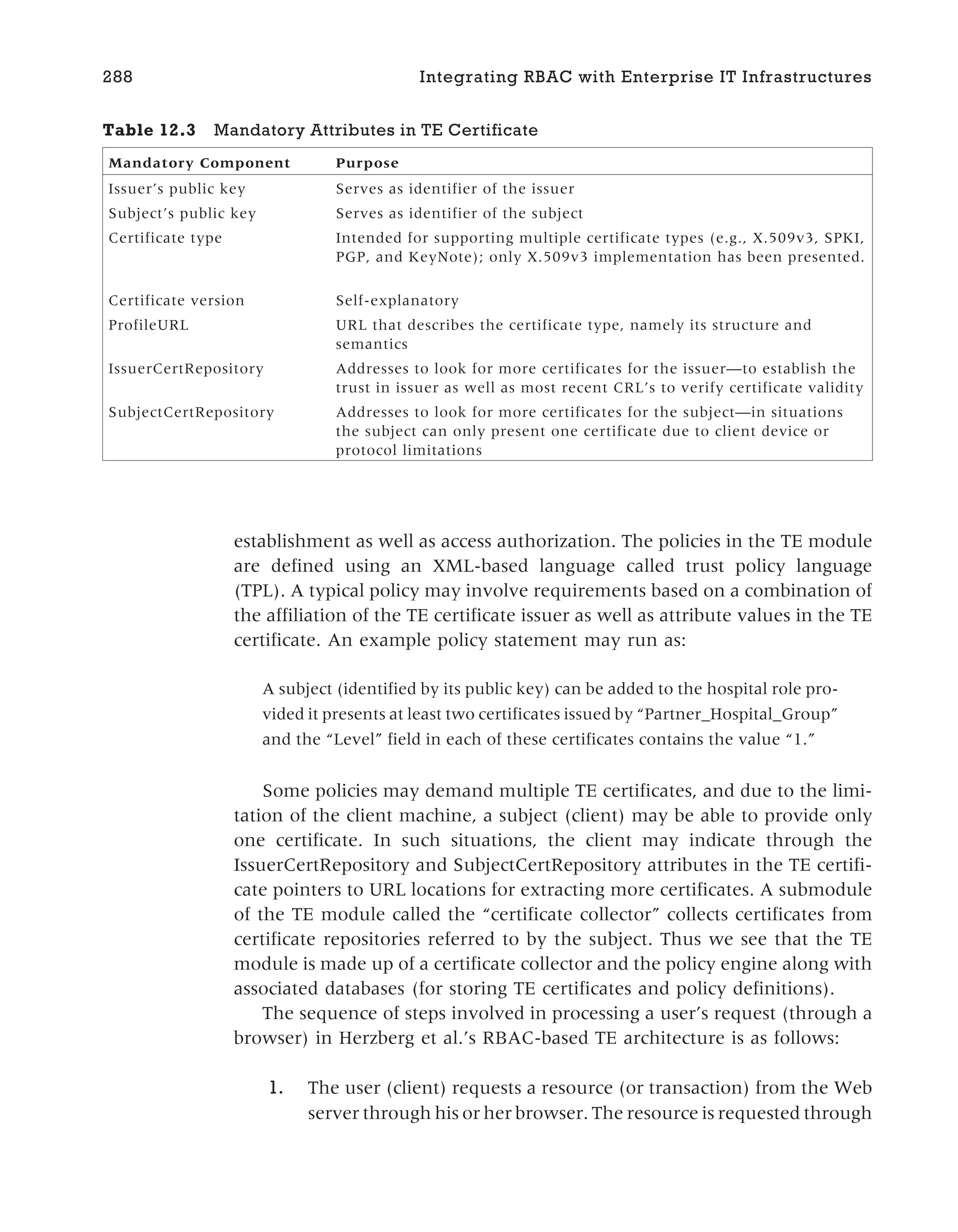
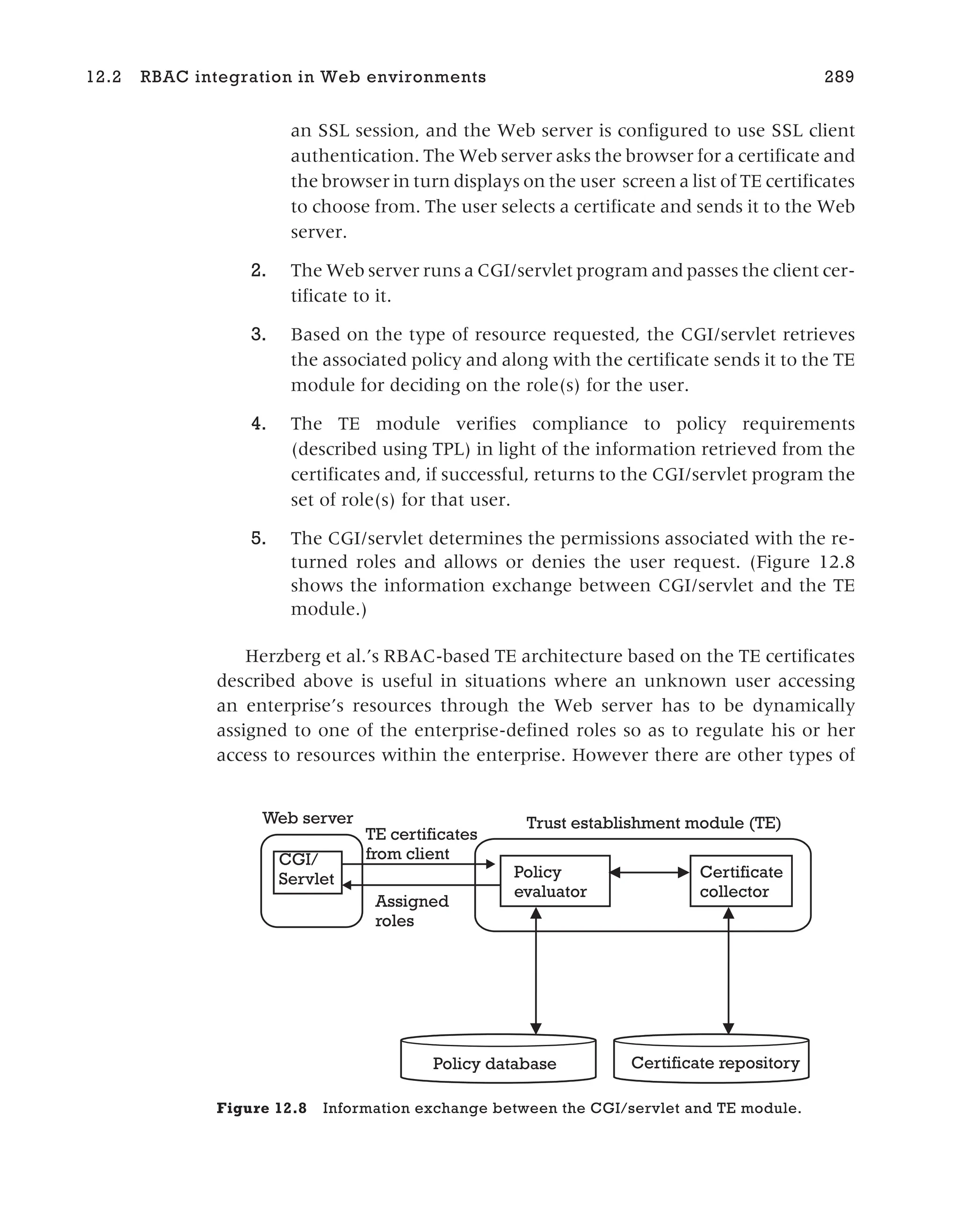
![e-commerce transactions wherein it is not only required to authenticate an
unknown user from another enterprise (hereafter referred to as interacting
enterprise) who has initiated a transaction (e.g., sent a purchase order docu-
ment) but also to ensure that the unknown user (hereafter referred to as
agent) is authorized to act on behalf of the interacting enterprise and is act-
ing in a legally binding way (i.e., the interacting enterprise can be made lia-
ble for the digital signatures its authorized agents provide). To address these
issues, Oppliger, Pernul, and Strauss [17] have proposed a scheme where
ACs can be used to carry the role credentials of an interacting enterprise’s
agent. In this scheme it is assumed that there exists a set of certificate
authorities TCA = { CA1, CA2…. } for a state or country (established using a
general accreditation or certification scheme) and a set of attribute authori-
ties TAA = {AA1, AA2… } registered with an appropriate national body,
such as a chamber of commerce. It is further assumed that each organiza-
tion or enterprise Y has at least one attribute authority AA(Y). Each AA(Y)
holds a public key and private key pair of which the public key is certified
(and digitally signed) by an accredited CA (a member of TCA). The AA(Y)
issues and revokes ACs (ACs) for the authorized agents of the enterprise Y.
The ACs contain the bindings between a name (that is unique within the
enterprise Y) and a specific role within the corresponding enterprise. For
example if John is an authorized agent for enterprise Y, he will have a certif-
icate for his public key and an AC for the role he plays within the enterprise
Y. The public key certificate is issued by a CA that is a member of the
TCA, whereas the AC is issued by an attribute authority [which, in our
example, is AA(Y)]. Whenever John has to sign a document that must be
legally binding in one way or another, such as a contract (e.g., a commit-
ment a buy an expensive custom-made piece of equipment), he uses his
private key to digitally sign the document and provides his public key certifi-
cate together with the AC that certifies his role within the company Y to the
intended recipients (e.g., the company that manufactures the expensive
equipment). The recipient(s) in turn, use(s) the public key certificate to
verify the following:
◗ The digital signature provided by John;
◗ The corresponding public key certificate presented by John (to see
whether it has been issued by an accredited CA);
◗ The AC presented by John [issued by AA(Y)]—for appropriate authori-
zation for John within enterprise Y;
◗ The nomination of AA(Y) by an established commerce/trade entity
(e.g., chamber of commerce).
290 Integrating RBAC with Enterprise IT Infrastructures](https://image.slidesharecdn.com/role-basedaccesscontrolsecondeditionpdfdrive-250311062434-2e3fc82e/75/Role-Based-Access-Control-Second-Edition-PDFDrive-pdf-311-2048.jpg)
![12.3 RBAC for UNIX environments
We have seen that general-purpose application software like a Web server
has its own implementation of RBAC regardless of the platform on which it
is hosted (e.g., Windows NT, Windows 2000, or any flavor of UNIX). Hence,
our study of RBAC integration in the UNIX environment will be restricted to
the implementation of RBAC for access control to resources that are directly
under the control of the operating system. Our first case study deals with
the details of the RBAC model prototypes1
for administration of Solaris and
Trusted Solaris, both of which are UNIX OS offerings by Sun Microsystems.
Let us call this the RBAC-Solaris prototype. Our second case study deals
with implementation of RBAC in the UNIX-based distributed file system
NFS.
12.3.1 RBAC for UNIX administration
The primary motivation for the development of the RBAC-Solaris prototype
is to use roles as an alternative to the traditional UNIX superuser or root. Tra-
ditionally, in all UNIX flavors, root access is required to perform all aspects
of administration. For example, setting the system date requires root access,
which in turn, provides full access to the system. This lack of granularity
with respect to the assignment of privileged operations to administrators
not only makes the root user powerful but also makes other users weak,
thereby hampering proper distribution of administrative functions. In effect,
this results in no hierarchy of privileged operations, no separation of pow-
ers, and no ability to delegate any of the powers to others—effectively pre-
venting enforcement of all access administration policies that are required
for effective decentralized administration. The RBAC model prototype for
Solaris and Trusted Solaris operating systems from Sun Microsystems as
described in [18] addresses these deficiencies while at the same retaining
many of the core UNIX administrative concepts. The retention of the core
UNIX administrative concepts resulted in a system that allowed existing
applications and interfaces to work with RBAC without requiring that they
be rewritten to work with new interfaces and databases.
12.3.1.1 Role semantics in the prototype
In the RBAC-Solaris prototype, RBAC has been used to partition some of
the superuser’s (root’s) powers into a set of discrete roles. This has been
done to parcel out certain capabilities to others and is not meant to restrict
12.3 RBAC for UNIX environments 291
1. These prototypes have since evolved into commercial-grade products.](https://image.slidesharecdn.com/role-basedaccesscontrolsecondeditionpdfdrive-250311062434-2e3fc82e/75/Role-Based-Access-Control-Second-Edition-PDFDrive-pdf-312-2048.jpg)
![Solaris.role.write
where Solaris refers to the enterprise name; role refers to the authorization
class; and write refers to the write function [create, delete, edit (modify
attributes)]. Table 12.4 lists authorizations pertaining to the “role” authori-
zation class and the rights associated with each of them.
In addition to associating authorizations with a user or role directly, it
would be good if the ability to run certain trusted programs with root privi-
leges (by suitably setting the process attributes discussed earlier) were
restricted to only certain users or roles (since setuid-to-root programs can be
run by any user). It would be still better from the point of view of distribut-
ing administrative responsibilities, if these sets of trusted programs could be
run with different privileges by different users. To enable this, different sets
of process attributes must be defined and dynamically associated with these
trusted or privileged programs during execution time. To facilitate the
implementation of these concepts, the concept of execution profile has been
defined in RBAC-Solaris prototype. An execution profile is a collection of
permissions that has the following components:
◗ A list of authorizations;
◗ A list of trusted executables and associated process attributes.
A user or role is assigned one or more execution profiles. The set of per-
missions available to a user or role is the cumulative set of authorizations
and executables found in all the assigned execution profiles.
Now it is not sufficient if execution profiles are merely associated with a
user or roles. When the trusted executables in the execution profile are
294 Integrating RBAC with Enterprise IT Infrastructures
Table 12.4 Authorizations and Rights in the RBAC-Solaris Prototype
Authorization Name Associated Rights
Solaris.role.write Create new roles; modify their rights and delete
them
Solaris.usermgr.passwd Create role’s password (here the authorization class
used is usermgr since roles share some semantics
with the “user”—both are UNIX accounts)
Solaris.role.assign The right to assign (revoke) any role to (from) a user
Solaris.role.delegate The right to delegate one’s own assigned roles to
other users
Solaris.role.* Wild card authorization—covers all authorizations
under the class “role”](https://image.slidesharecdn.com/role-basedaccesscontrolsecondeditionpdfdrive-250311062434-2e3fc82e/75/Role-Based-Access-Control-Second-Edition-PDFDrive-pdf-315-2048.jpg)
![executed, the interpreter for each executable type should be able to associ-
ate the set of attributes specified in the profile and then execute those pro-
grams. To achieve this, the RBAC-Solaris prototype made use of a profile
execution program called pfexec. The standard UNIX shells, sh, csh, and ksh
were modified to invoke pfexec for profile-based execution. Examples of
executables are UNIX commands and executable objects in the common
desktop environment (CDE) (called CDE actions).
Based on the implementation details we have discussed so far, we are
now ready to summarize the layout of the RBAC database and the
role-based access enforcement process in the RBAC-Solaris prototype. Table
12.5 presents the layout of the RBAC database.
Examples are listed as follows:
◗ User_Name= Fred Roles=SysAdmin, Profiles= All;
◗ Role_Name=SysAdmin, mutex=SecAdmin,cardinality =2, Profiles=
Audit_Review,File_Mgmt;
◗ Profile_Name=Audit_Review, Authorizations=solaris.audit.read;
◗ Profile_Name=File_Mgmt, [Executable_ID=/usr/sbin/tunefs; Pro-
cess_Attributes=(euid =0,egid=3)].
The access enforcement process in the RBAC-Solaris prototype is sum-
marized as follows:
1. A valid user logging into the Solaris UNIX system is authenticated.
12.3 RBAC for UNIX environments 295
Table 12.5 Layout of RBAC Database in the RBAC-Solaris Prototype
Database
Component
DB Name in the
Prototype Associated Attributes
User User_attr User name, list of assigned roles, list of execution
profiles
Role User_attr Role name, list of execution profiles, cardinality limit,
list of mutually excluded profiles
Profiles
(permission sets)
Profile_attr List of authorizations (refer Auth_attr), list of
executable objects and associated process attributes
(refer Exec_attr)
Authorizations Auth_attr Authorization name and its help description file
Executable objects
and associated process
attrbutes
Exec_attr Fully qualified executable name, associated profile, type
of executable (UNIX command or CDE), value of
process attributes](https://image.slidesharecdn.com/role-basedaccesscontrolsecondeditionpdfdrive-250311062434-2e3fc82e/75/Role-Based-Access-Control-Second-Edition-PDFDrive-pdf-316-2048.jpg)
![2. The authenticated user can then assume a role by using the tradi-
tional su command (after supplying the password associated with
the role provided that he or she has been assigned that role).
3. The information in the execution profiles assigned to the role is set
up. This information consists of a list of authorizations and a list of
executables with their associated process attributes. When an exe-
cutable file is invoked, the binding of process attributes in the profile
with the executable is enabled by the profile execution program
pfexec.
12.3.2 RBAC implementation within the NFS
A prototype implementation of RBAC within the NFS (a file system that
provides distributed file service in networked UNIX systems) was developed
by a group of researchers at Linkoping University [19] (we shall refer to it as
the Linkoping-RBAC prototype) in Sweden. Their implementation platform
was the Linux User Space NFS server running on a Linux 2.0 system. The
implementation was based on a design that modified the NFS server to use
the access control information from a role-based security information data-
base to set the access attributes for a file. To understand how RBAC was
incorporated into the NFS access control process, we have to take a brief
look at some background information with respect to the overall architec-
ture of NFS and how it normally enforces access control.
The NFS is a distributed file system that was introduced by Sun Micro-
systems to provide transparent access to remote file systems on UNIX plat-
forms. NFS provides file service based on a client-server protocol. The
system that requests a remote file system is called an NFS client. A system
that makes its file systems available for remote access (exports) is called an
NFS server. Hence a single machine can be both an NFS client and an NFS
server. Since the file systems on remote machines can be different from the
one on client machine, clients use an abstract file system called the virtual
file system (VFS). The VFS enables clients to obtain a common view (or
interface) of both their local and remote files. Access to files in remote sys-
tems is enabled through a network transport mechanism called the remote
procedure call (RPC) that uses a platform-neutral representation of data
called the external data representation (XDR). Before a client can access the
contents (files and directories) of a remote file system, it needs to incorpo-
rate the remote file system into its own VFS. This operation is called mount,
and the client uses a command of the same name. Through this mount com-
mand the NFS client specifies the host name, the name of the file system,
and the file type. The NFS server on the remote host on receiving this
296 Integrating RBAC with Enterprise IT Infrastructures](https://image.slidesharecdn.com/role-basedaccesscontrolsecondeditionpdfdrive-250311062434-2e3fc82e/75/Role-Based-Access-Control-Second-Edition-PDFDrive-pdf-317-2048.jpg)
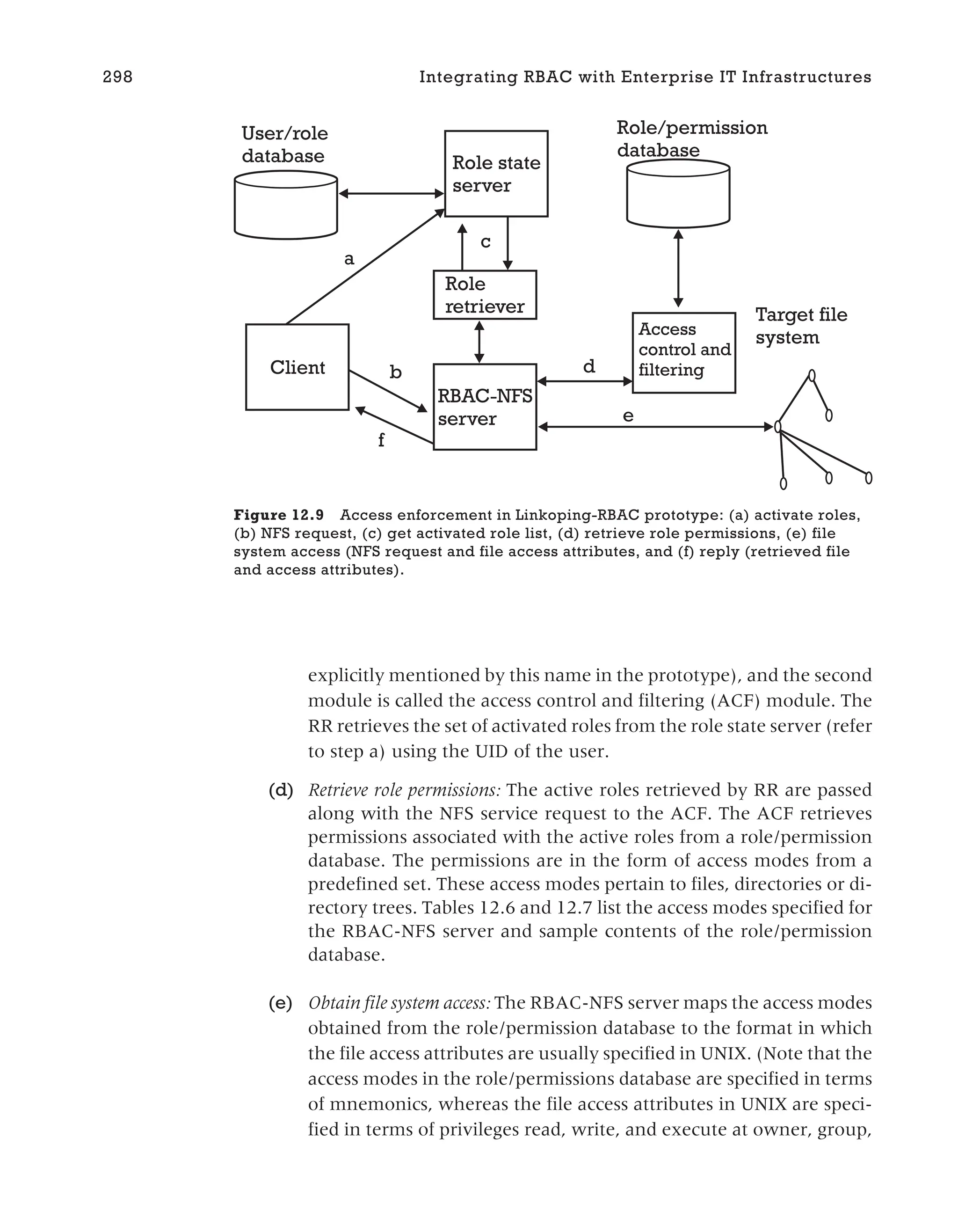
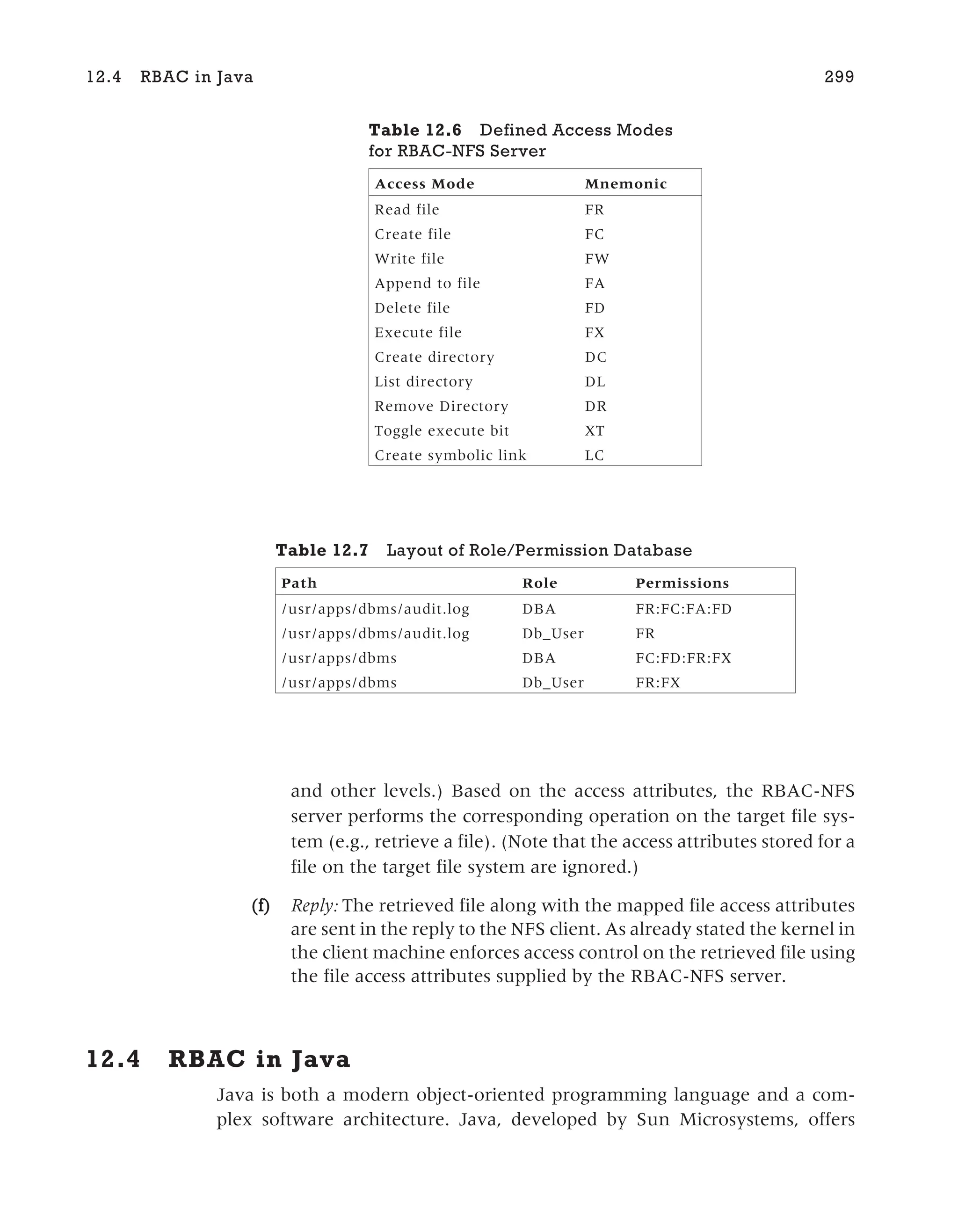
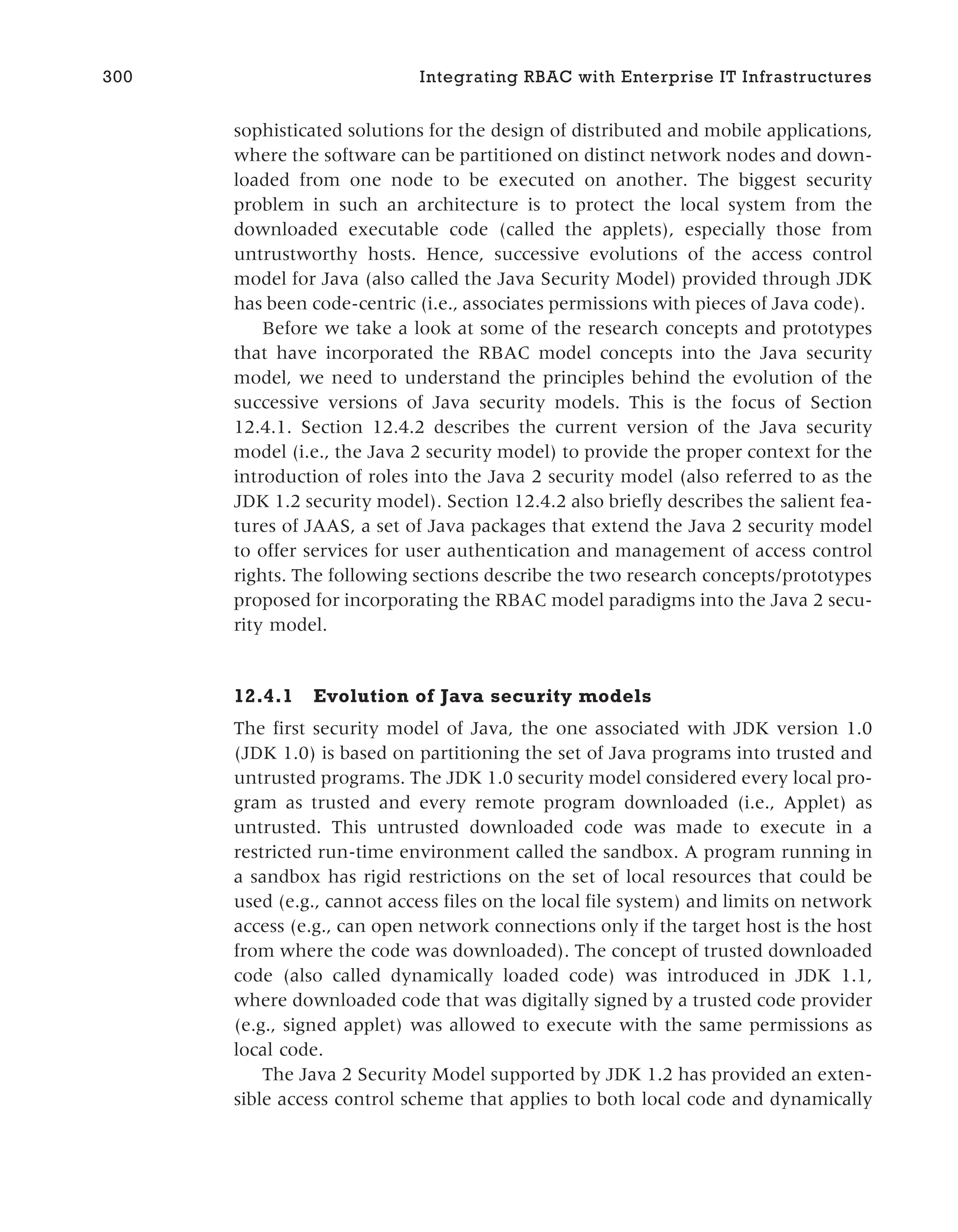
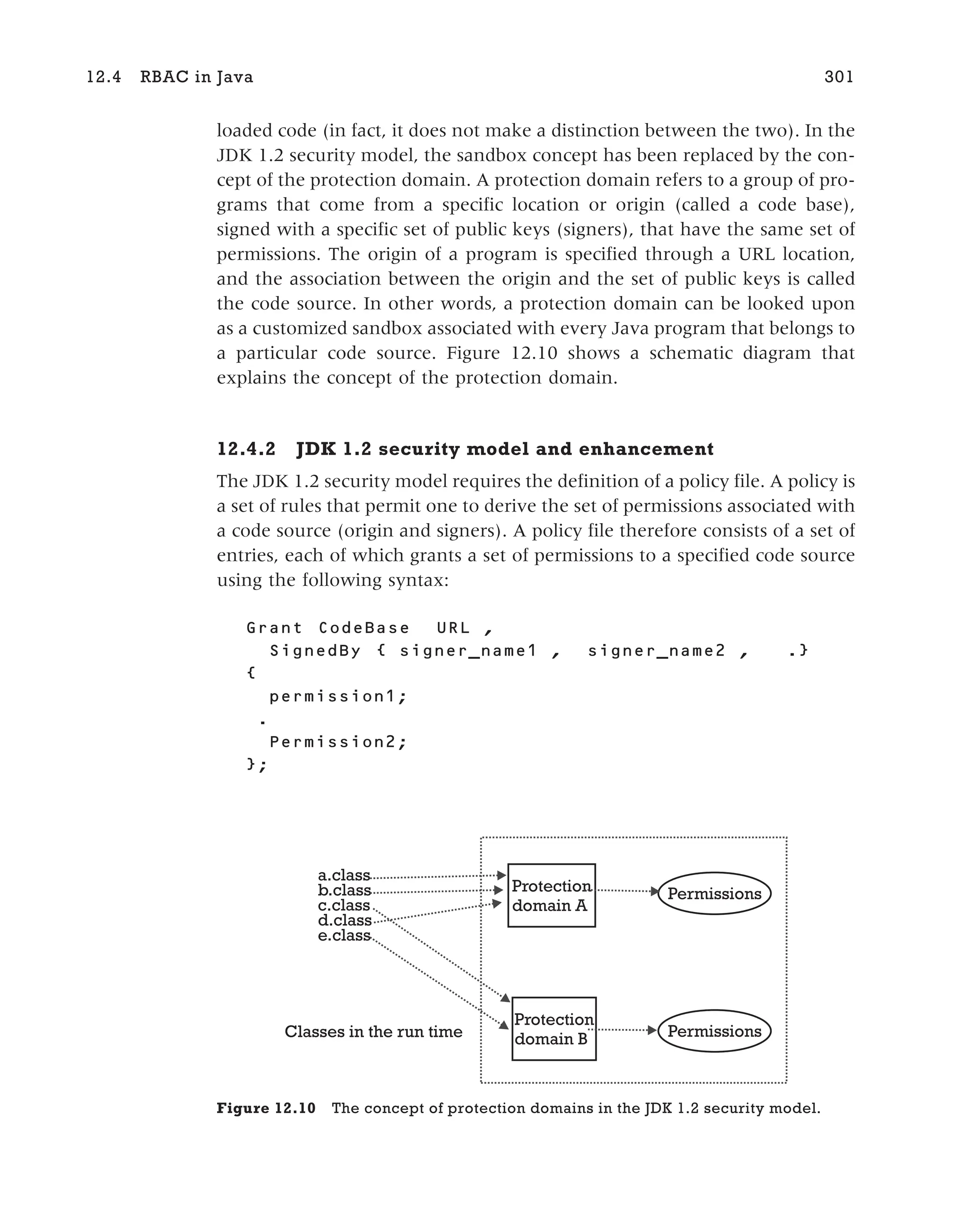
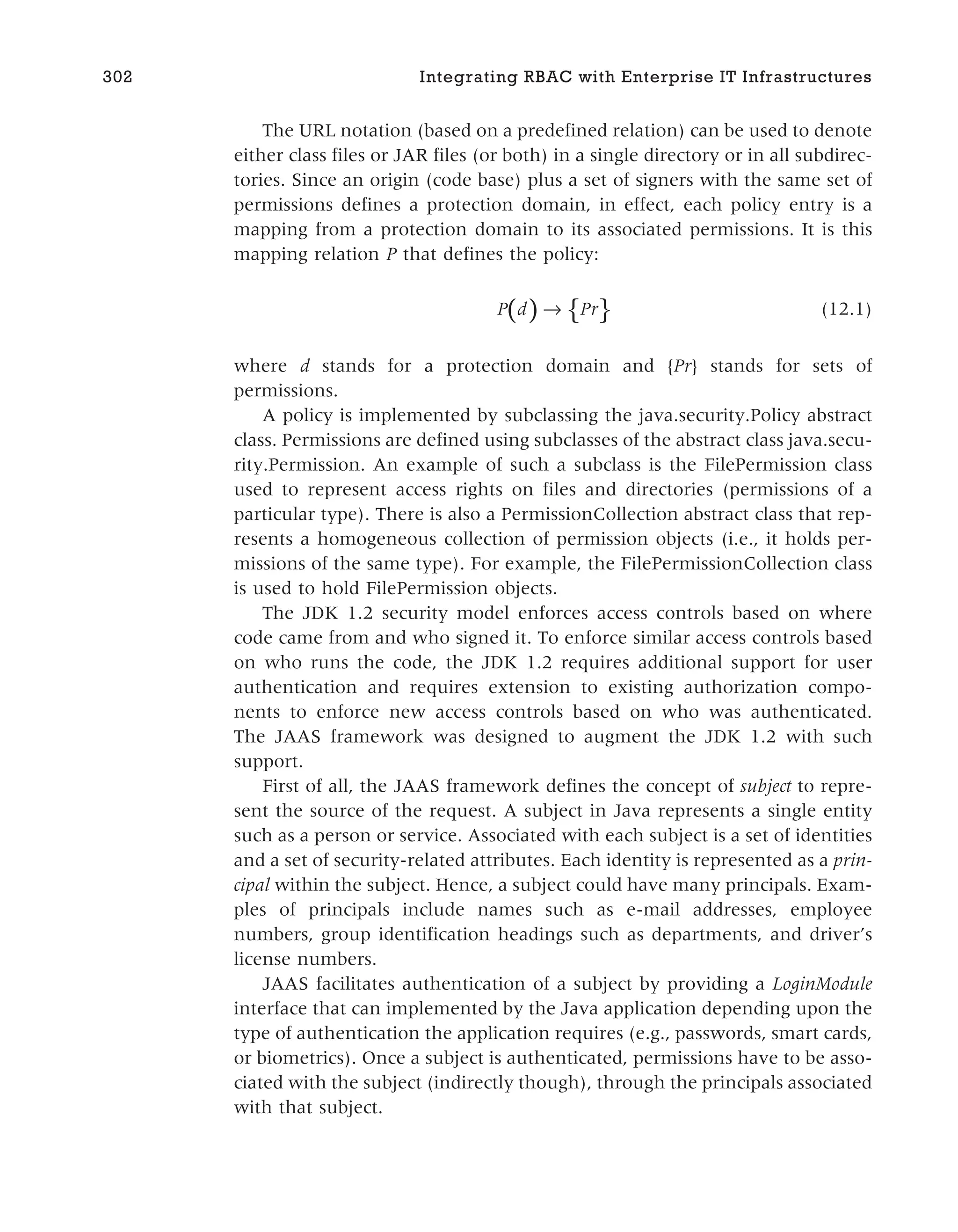
![12.4.3 Incorporating RBAC into JDK 1.2 security model
with JAAS
A survey of existing research projects or prototypes that have incorporated
RBAC concepts into JDK1.2-JAAS reveals that the RBAC model has been
incorporated using the following approaches:
◗ Defining appropriate policy entries;
◗ A new implementation of the security manager class that contains
methods for the enforcement of RBAC constraints.
12.4.3.1 IBM research project
In the research project by Gunter Karjoth of IBM Research [20] (hereafter
referred to as the Gunter project), a formal specification of the
JDK1.2-JAAS access control model has been developed. The expressiveness
of the JDK1.2-JAAS model has been illustrated by using the building blocks
of the specification to express role-based authorizations. In the Gunter pro-
ject a role is treated as a named principal. A user group is also treated as a
named principal. A distinction made between groups and roles is that roles
can be “activated” and “deactivated” by users (subjects) at their discretion,
whereas a group membership always applies. The incorporation of various
aspects of RBAC model concepts in the JDK1.2-JAAS model based on speci-
fication in the Gunter project is given as follows:
◗ Role-permission assignment: The assignment of permissions to roles that,
in effect, is equivalent to the assignment of permissions to named
principals is implemented through grant entries in the Java policy file.
An entry in a policy file that states that “only somebody who is a man-
ager and a member of project X is allowed to change project X’s time
schedule” will be:
Grant Principal Role manager ,
Principal Group project-X {
Permission SchedulePermission change ;
}
Stated in terms of the policy mapping relation (12.1), the above pol-
icy entry is:
P(<E,$,{manager,project-X}>) = {<schedule,
change>}
304 Integrating RBAC with Enterprise IT Infrastructures](https://image.slidesharecdn.com/role-basedaccesscontrolsecondeditionpdfdrive-250311062434-2e3fc82e/75/Role-Based-Access-Control-Second-Edition-PDFDrive-pdf-325-2048.jpg)
![where (<E,$,{manager,project-X}>) denotes a domain with an empty
code base (E), a null set of signers ($) and the set of principals denoted
by {manager,project-X}. The expression {schedule,change} represents
the permission where schedule is the target object and the change is the
action.
◗ User-role assignment: The user role assignment (which in our case is
association of subjects with principals) is handled by administrators
outside of the JDK1.2-JAAS model implementation.
◗ Activation of user roles in a session: The activation of a role in a user (sub-
ject) session (which in our case is the dynamic association of princi-
pals with the current access-control context) is accomplished using
the java.security.auth.subject.doAs method, which adds additional
principals to the current access control context. It is thus equivalent to
defining a session during which a subset of user roles is simulta-
neously activated. The permissions available to the user are thus the
union of the permissions of all roles activated in that session (i.e., the
role principals given to the subject.doAs method).
12.4.3.2 RBAC for a Java-Web application
Luigi Giuri has defined an extension to the JDK1.2-JAAS model [21] to
incorporate RBAC model concepts for Web-based server-side Java applica-
tions (i.e., Java Servlet). Just like in the Gunter Project, the concept of a
role is treated as a named principal. Giuri created a new class called
“RolePrincipal” for this purpose. In addition, Guiri has implemented a class
called “UserPrincipal.” The UserPrincipal class has no semantic significance.
It is merely a place holder for assigning RolePrincipal instances (in effect,
assigning roles to a user or subject). There is, at most, one UserPrincipal
object associated with a subject. The association between a subject and a
UserPrincipal object is established soon after the subject is authenticated
using the LoginModule by making use of an implementation of a newly cre-
ated RoleLoginModule:
◗ Role-permission assignment: Just like in Gunter’s project, the assignment
of permissions to roles that in our case is equivalent to the assignment
of permissions to RolePrincipal principals is implemented through
grant entries in the JDK1.2-JAAS policy file. An entry for a policy
that states, “Only Departmental heads can modify task assignments,”
will be:
12.4 RBAC in Java 305](https://image.slidesharecdn.com/role-basedaccesscontrolsecondeditionpdfdrive-250311062434-2e3fc82e/75/Role-Based-Access-Control-Second-Edition-PDFDrive-pdf-326-2048.jpg)
![Grant Principal RolePrincipal "depthead" {
Permission TaskAssignmentPermission
modify ;
◗ User-role assignment (also role-hierarchy creation): The user role assign-
ment (which in our case is the assignment of RolePrincipal objects to a
UserPrincipal object) is accomplished through a new RolePolicy
abstract class. An implementation of the RolePolicy class uses a file
called RolePolicy file (similar to JDK1.2-JAAS policy file) to store grant
entries pertaining to assignment of RolePrincipal objects to a
UserPrincipal (in effect assigning roles to users). The same file can also
be used to grant RolePrincipal objects to other RolePrincipal objects in
effect creating a role hierarchy.
Grant principal [RolePrincipal "role-name" |
UserPrincipal "user-name" ]
{
RolePrincipal "role-name1" ,
RolePrincipal "role-name2"
};
◗ Activation of user roles in a session: The activation or deactivation of a
role in a user (subject) session (which in our case is dynamic associa-
tion/disassociation of RolePrincipal with the UserPrincipal) is accom-
plished in Guiri’s project through a separate RoleController class. Two
methods of RoleController class that are useful for this are described
as follows:
1. ResetDefaults( ): Enable or activate only a predefined set of default
roles associated with the subject;
2. EnableRole(String rolename): Add the role identified by the rolename
to the set of activated roles.
12.5 RBAC for FDBSs
A FDBS consists of an interoperable layer providing access to data stored in
several heterogeneous databases. The individual databases for which the
FDBS provides access are called component database systems (CDBSs). The
FDBS gives the users the illusion of a homogeneous central database system.
306 Integrating RBAC with Enterprise IT Infrastructures](https://image.slidesharecdn.com/role-basedaccesscontrolsecondeditionpdfdrive-250311062434-2e3fc82e/75/Role-Based-Access-Control-Second-Edition-PDFDrive-pdf-327-2048.jpg)
![The process of specifying the individual CDBSs and configuring the software
at the interoperable layer to enable access to data residing in the CDBSs is
called “creating the federation.” Depending upon who is responsible for cre-
ating and maintaining the federation, FDBSs can be classified as loosely cou-
pled and tightly coupled. In a loosely coupled FDBS, the user is responsible
for creating and maintaining the federation, and the FDBS and its adminis-
trators exercise no control. In a tightly coupled FDBS, the administrators are
responsible for creating and maintaining the federation and actively control
the CDBSs.
Although sophisticated RBAC models have been implemented in indi-
vidual commercial DBMSs (refer to Chapter 14), there are not very many
research frameworks and prototypes that have been developed to support
authorization and access control in the context of a FDBS. This section dis-
cusses the architecture of a role-based authorization and access control sys-
tem that has been developed as part of the security subsystem for a FDBS
called the interoperable relational and object-oriented database (IRO-DB).
The IRO-DB is a FDBS that is designed to provide access to several heteroge-
neous relational and object-oriented CDBSs. The IRO-DB FDBS as well as its
authorization and access control subsystem is currently under implementa-
tion as part of the IRO-DB ESPRIT-III project [22], a joint project that
involves several European union countries. Before we discuss the features
of the role-based authorization and access control subsystem of IRO-DB, we
need to take a look at the overall architecture of the IRO-DB itself and the
services provided by its security system (in which the authorization and
access control system is a subsystem).
12.5.1 IRO-DB architecture
The goal of IRO-DB is to provide homogeneous access to heterogeneous and
distributed databases. To fulfill this requirement, IDO-DB has be designed
with a three-layer architecture—a local layer, a communication layer, and
an interoperable layer.
The local layer supports a uniform data model and provides access to
heterogeneous component databases through the use of local database
adapters. The communication layer provides services for remote databases
and object access. The interoperable layer integrates the various local sche-
mata (structure of the database) into an interoperable schema that is able to
combine related data from local databases and to overcome inconsistencies
in such areas as structure, naming, and semantics.
The IRO-DB security system (ISS) is located at the interoperable layer
and performs the following functions:
12.5 RBAC for FDBSs 307](https://image.slidesharecdn.com/role-basedaccesscontrolsecondeditionpdfdrive-250311062434-2e3fc82e/75/Role-Based-Access-Control-Second-Edition-PDFDrive-pdf-328-2048.jpg)
![The AT with which a role may access a class can be either read (R),
write (W), create (C), and delete (D) for covering relational CDBSs, or
method-access for covering object-oriented CDBSs. There is also the owner-
ship (T), which is the most powerful authorization type that implies all
other authorization types. Finally, an IRO-DB authorization rule is defined
as a triple (s,t,o) where
s belongs to the set of authorization subjects (roles);
t belongs to the authorization types (e.g., R, W, C, T);
o belongs to the set of authorization objects (e.g., class, database).
Both positive and negative authorizations can be specified using the
above formalism. The RBAC model in IRO-DB employs a combination of
administration and ownership paradigm. In this paradigm, when a role “r1”
that creates an authorization object “O1” becomes its owner with authoriza-
tion type ‘T’, a corresponding authorization rule (r1, T, O1) is added auto-
matically to the authorization database. Automatically such a rule is also
added for an administrator role making the administrator a joint owner of
the object “O1.” The ownership authorization on object “O1” for role “r1”
does not imply the ability to change authorization rules (i.e., to delegate
authorizations to other authorization subjects).
The RBAC model implemented in IRO-DB through security metaclasses
is stored in the IRO-DB authorization database. This database can only be
edited by one or more designated administrator roles. The administrative
features provided in IRO-DB for maintaining the RBAC model consists of
the following:
◗ Adding, removing, and modifying users;
◗ Associating users to roles;
◗ Adding, removing, and modifying roles in the role hierarchy;
◗ Adding, removing, and modifying authorization rules in the authori-
zation database.
12.6 RBAC in autonomous security service modules
In the previous sections, we have seen the research frameworks and proto-
types that have incorporated RBAC model concepts into various enterprise
IT infrastructures to achieve role-based access enforcement. Dridi, Fischer,
and Pernul [23] describe an implementation where an RBAC model has
been incorporated into an autonomous security services module called
12.6 RBAC in autonomous security service modules 309](https://image.slidesharecdn.com/role-basedaccesscontrolsecondeditionpdfdrive-250311062434-2e3fc82e/75/Role-Based-Access-Control-Second-Edition-PDFDrive-pdf-330-2048.jpg)
![user has chosen a certain role, the RBAC service verifies, based on the secu-
rity information gathered from the data layer, whether the user is allowed
to activate that role. After the user activates the role, a session object (with a
designated session ID) containing the user object and the activated role is
created by CSAP. When a user invokes an operation on an object within
that session, a method called checkAccess containing three arguments (session
ID, operation name, and object name) is invoked. The RBAC service then
retrieves the user’s active role by accessing the corresponding session object
based on session ID and then determines the permissions associated with
the active role. If there exists a permission tuple <object, operation> that
matches the object name and the operation name in the checkAccess invo-
cation, access is granted; otherwise it is denied.
12.7 Conclusions
The motivations behind the development of prototypes integrating the
RBAC model into the various enterprise technologies are quite varied in
nature. A common thread running through these motivations is better pol-
icy support and ease of access administration. Hence it is not surprising that
authorization management through RBAC is being explored for some
emerging enterprise infrastructures like XML repositories.
A research proposal to this effect can be found in [24].
References
[1] Workflow Management Coalition, http://www.wfmc.org/about.htm.
[2] Lotus Notes Administrator’s Reference Manual, Release 4, Lotus Corporation, 1996.
[3] Georgakopoulos, D., M. Hornick, and A. Sheth, “Overview of Workflow
Management: From Process Modeling to Workflow Automation
Infrastructure,” Distributed and Parallel Databases, 1995, pp. 119–153.
[4] Botha, R. A., and J. H. P. Eloff, “A Framework for Access Control in Workflow
Systems,” Information Management and Computer Security, Vol. 9, No. 3, 2001,
pp. 126–133.
[5] Kang, M. H., J. S. Park, and J. N. Froscher, “Access Control Mechanisms for
Interorganizational Workflow,” 6th ACM Symposium on Access Control Models and
Technologies, 2001, pp. 66–74.
[6] Bertino, E., E. Ferrari, and V. Atluri, “Specification and Enforcement of
Authorization Constraints in Workflow Management Systems,” ACM
Transactions on Information and System Security, Vol. 2, No. 1, 1999, pp. 65–104.
12.7 Conclusions 311](https://image.slidesharecdn.com/role-basedaccesscontrolsecondeditionpdfdrive-250311062434-2e3fc82e/75/Role-Based-Access-Control-Second-Edition-PDFDrive-pdf-332-2048.jpg)
![[7] Huang, W. K., and V. Atluri, “SecureFlow: A Secure Web-Enabled Workflow
Management System,” 4th ACM Workshop on Role-Based Access Control, 1999,
pp. 83–94.
[8] Payne, C., et al., “Napoleon: A Recipe for Workflow,” 15th Annual Computer
Security Applications Conference, 1999, pp. 134–142.
[9] Joshi, J. B. D., et al., “Security Models for Web-Based Applications,”
Communications of the ACM, Vol. 44, Issue 2, 2001, pp. 38–44.
[10] Ferraiolo, D. F., J. F. Barkley, and D. R. Kuhn, “A Role-Based Access Control
Model and Reference Implementation Within a Corporate Intranet,” ACM
Transactions on Information and System Security, Vol. 2, No. 1, 1999, pp. 34–64.
[11] Park, J. S., R. Sandhu, and G. J. Ahn, “Role-Based Access Control on the
Web,” ACM Transactions on Information and System Security, Vol. 4, No. 1, 2001,
pp. 37–71.
[12] Shim, W. B., and S. Park, “Implementing Web Access Control System for
Multiple Web Servers in the Same Domain Using RBAC Concept,” 8th
International Conference on Parallel and Distributed Systems (ICAPDS), 2001,
pp. 768–773.
[13] ISO/ITU-T Recommendation X.509, “The Directory: Authentication
Framework,” 2001.
[14] Chadwick, D. W., and A. Otenko, “The PERMIS X.509 Role-Based Privilege
Management Infrastructure,” 7th ACM Symposium on Access Control Models and
Technologies, 2002, pp. 135–140.
[15] The Open Group (2000), “Authorization (AZN) API, Generic Application
Interface for Authorization Frameworks,” http://www.opengroup.org/
publications/c908.htm.
[16] Herzberg, A., et al., “Access Control Meets Public Key Infrastructure, Or:
Assigning Roles to Strangers,” IEEE Symposium on Security and Privacy, Oakland,
CA, 2000, pp. 2–14.
[17] Oppliger, R., G. Pernul, and C. Strauss, “Using ACs to Implement Role-Based
Authorization and Access Control,” Swiss Federal Office of Information
Technology and Systems, 2001.
[18] Faden, G., “RBAC in UNIX Administration,” 4th ACM Workshop on Role-Based
Access Control, Fairfax, VA, 1999, pp. 95–101.
[19] Gustafsson, G., B. Deligny, and N. Shahmehri, “Using NFS to Implement
Role-Based Access Control,” 6th IEEE Workshop on Enabling Technologies:
Infrastructure for Collaborative Enterprises, 1997, pp. 299–304.
[20] Karjoth, G., “An Operational Semantics of Java 2 Access Control,” 13th
Computer Security Foundations Workshop, 2000, pp. 224–232.
[21] Giuri, L., “Role-Based Access Control on the Web Using Java,” 4th ACM
Workshop on Role-Based Access Control, 1999, pp. 11–18.
312 Integrating RBAC with Enterprise IT Infrastructures](https://image.slidesharecdn.com/role-basedaccesscontrolsecondeditionpdfdrive-250311062434-2e3fc82e/75/Role-Based-Access-Control-Second-Edition-PDFDrive-pdf-333-2048.jpg)
![[22] Elmayr, W., et al., “Authorization and Access Control in IRO-DB,”
International Conference on Data Engineering, 1996.
[23] Dridi, F., M. Fischer, and G. Pernul, CSAP—An Adaptable Security Module for the
E-Government System WEBOCRAT, A Report on the Webocracy Project Funded
by European Commission, 2002.
[24] He, H., and R. K. Wong, “A Role-Based Access Control Model for XML
Repositories,” 1st International Conference on Web Information Systems Engineering,
2000, pp. 138–145.
12.7 Conclusions 313](https://image.slidesharecdn.com/role-basedaccesscontrolsecondeditionpdfdrive-250311062434-2e3fc82e/75/Role-Based-Access-Control-Second-Edition-PDFDrive-pdf-334-2048.jpg)

![Migrating to RBAC—Case Study:
Multiline Insurance Company
This chapter documents the experience of a real company in
its transition from conventional access control methods to
RBAC. This case study was conducted by the Research Triangle
Institute (RTI) as part of an evaluation of the economic impact of
RBAC on U.S. industry, and this section was excerpted with per-
mission from the RTI report, The Economic Impact of Role-Based
Access Control [1] distributed by NIST. The case study provides an
opportunity to more fully explore the benefits and costs of RBAC
from the vantage point of a software end user.
RTI conducted the case study with a multiline insurance
company (referred to here as “the company”). RTI selected the
company for the case study for two principal reasons. First, the
company is implementing RBAC to manage both its employ-
ees’ access permissions and its extranet users’ permissions. The
case study was able to capture, with one software end user,
insights from implementing RBAC in these two environments.
Second, because the company’s extranet users are contracting
agencies, the case study could also capture insights related to
delegated administration and other functionalities afforded
RBAC users.
This section discusses the company’s line of business and
how the company intends to leverage RBAC to enrich its busi-
ness model and improve employee productivity. The installa-
tion and implementation will cost the company an estimated
$783,636 over the course of 12 to 18 months. Once fully imple-
mented, however, RTI estimates that the annual administrative
315
13
Contents
13.1 Background
13.2 Benefits of using RBAC
to manage extranet users
13.3 Benefits of using RBAC
to manage employees
(intranet users)
13.4 RBAC implementation
costs
13.5 Time series of benefits
and costs
C H A P T E R](https://image.slidesharecdn.com/role-basedaccesscontrolsecondeditionpdfdrive-250311062434-2e3fc82e/75/Role-Based-Access-Control-Second-Edition-PDFDrive-pdf-336-2048.jpg)
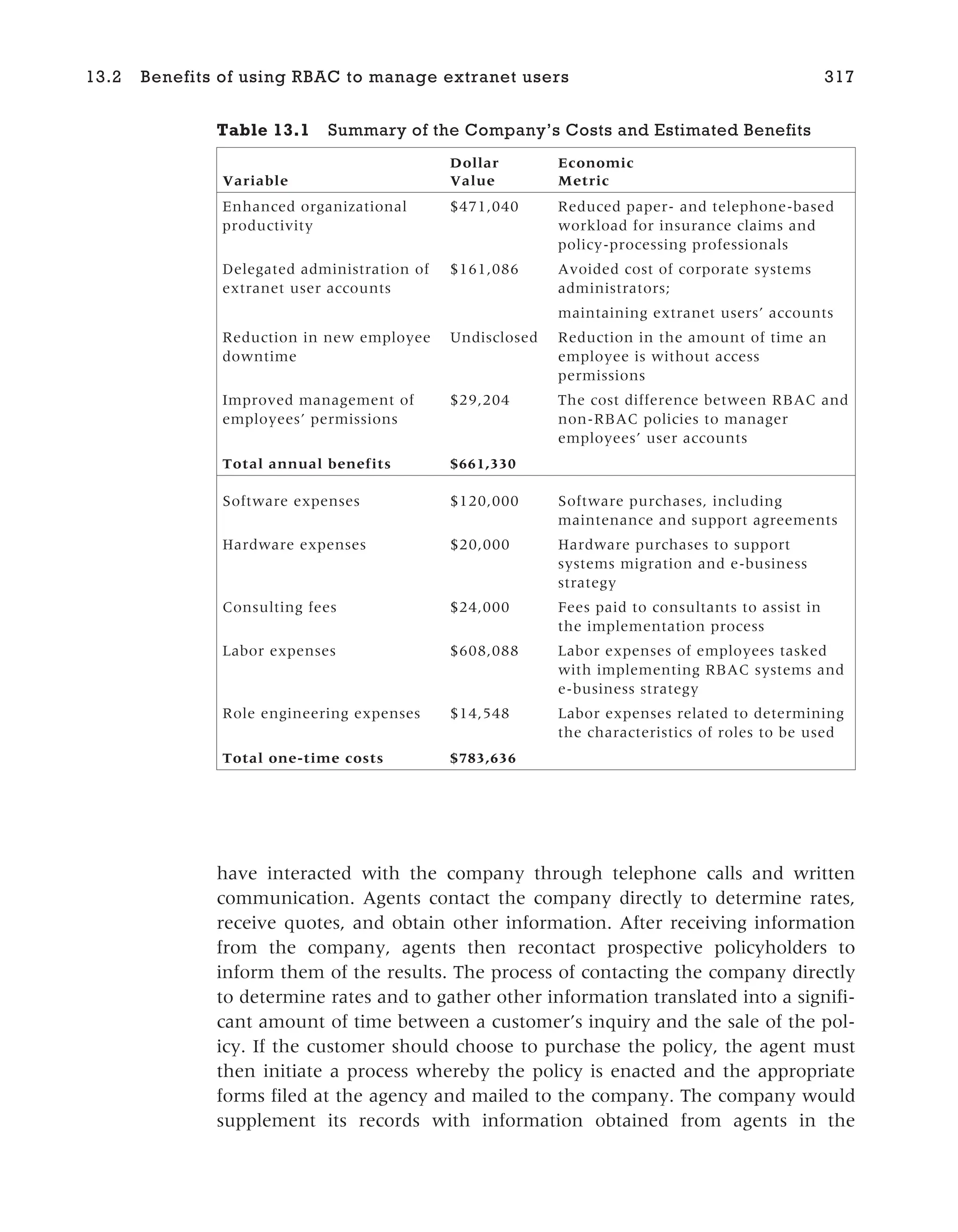
![employee is fully enabled is currently 2 to 3 days, including the routing of
paperwork. The role-based system and accompanying administrative poli-
cies are expected to reduce the amount of time significantly; therefore, the
employee is able to access data and applications more quickly.
Because information on employee turnover and employment at the
company is confidential, we do not present the impact estimates. However,
if we assume that the amount of downtime is reduced by one-half, and that
during that time the employee is 85% productive, we can estimate the
approximate benefits. For a new policy-processing clerk, the reduction in
new employee downtime would be worth $44.16. [The reduction in down-
time (50% of 2.5 days = 1.25 days = 10 hour) is multiplied by the loaded
wage rate for policy-processing clerks ($29.44 per hour) and the productiv-
ity loss (15%).] This number is excluded from the total benefits calculation
for the company case study because it is meant solely to illustrate the
benefit.
13.3.2 Simplified systems administration and maintenance
As explained in the previous section, the company expects that the ability to
more quickly assign access privileges will reduce its systems administration
and maintenance costs. The time that otherwise would have been spent
determining and assigning privileges will be free for other tasks. Alterna-
tively adjusting or terminating privileges for employees that are either
leaving the company or moving to new positions internally will be
equally facilitated. The aggregate effect is an improvement in administra-
tors’ productivity. It is estimated that using RBAC rather than identity-based
ACLs to manage user permissions will save the company $29,204 annually.
(Results from a survey of firms using RBAC allowed RTI to calculate the
number of minutes administrators save by using RBAC rather than other
access control models, and estimate the average number of times adminis-
trative tasks such as assigning and terminating permissions were performed
annually.)
13.4 RBAC implementation costs
The migration to RBAC and the implementation of the e-business strategy
will cost the company approximately $784,000. The labor costs associated
with installation as well as the software and hardware costs are one-time
costs. The company will intermittently incur role engineering costs as its
business activities warrant redefining roles over the life of the system. The
320 Migrating to RBAC—Case Study: Multiline Insurance Company](https://image.slidesharecdn.com/role-basedaccesscontrolsecondeditionpdfdrive-250311062434-2e3fc82e/75/Role-Based-Access-Control-Second-Edition-PDFDrive-pdf-341-2048.jpg)
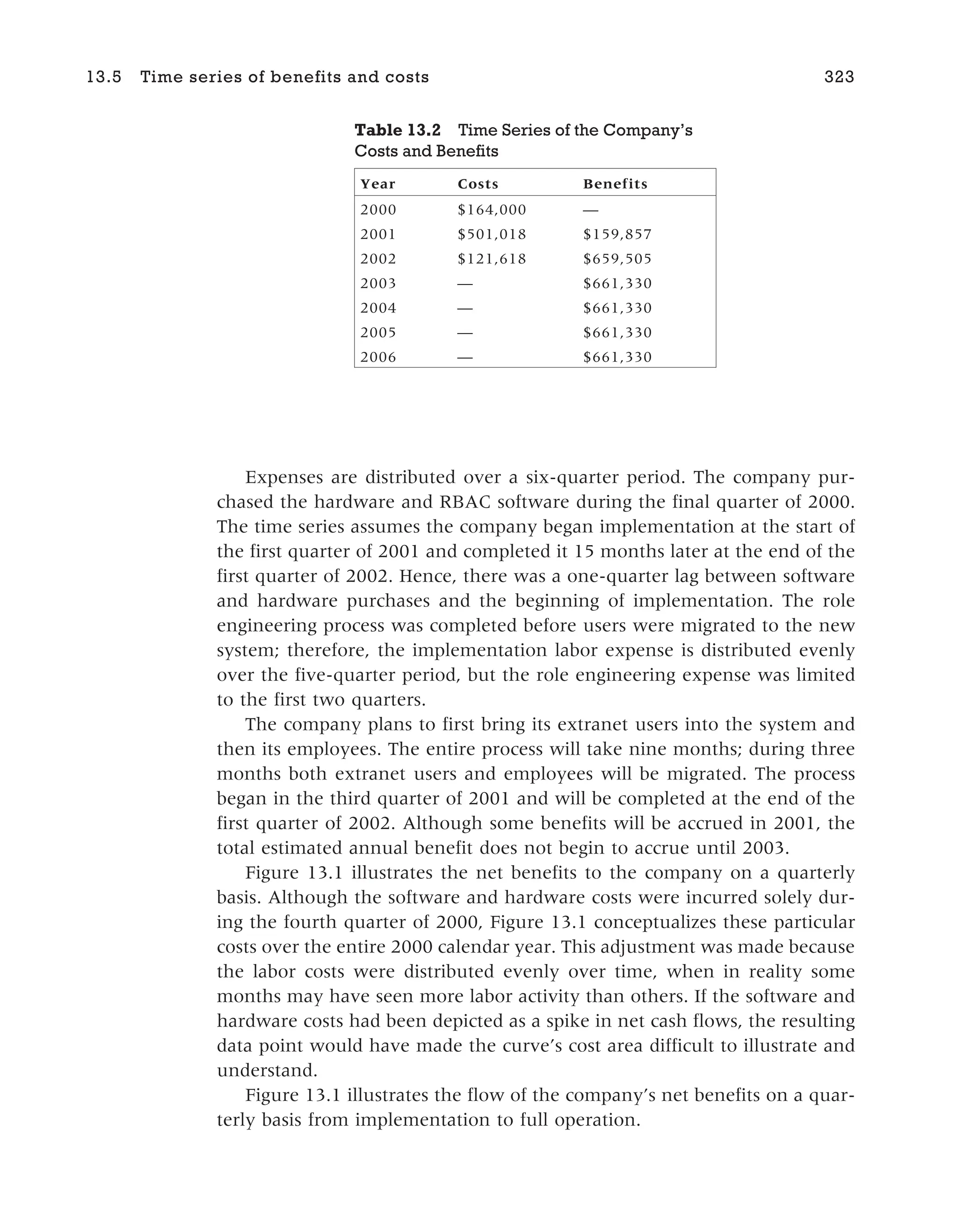
![Reference
[1] Gallaher, M. P., A. C. O’Connor, and B. Kropp, The Economic Impact of
Role-Based Access Control, Planning Report 01-2, National Institute of Standards
and Technology, 2002.
324 Migrating to RBAC—Case Study: Multiline Insurance Company
-$80,000
-$60,000
-$40,000
-$20,000
$0
$20,000
$40,000
$60,000
$80,000
$100,000
$120,000
$140,000
2002 2002 2002 2002
2001 2001 20012001
2000 2000 2000 2000
Q4 Q4
Time
Net
cash
flow
Q4
Q3 Q3 Q3
Q2 Q2 Q2
Q1 Q1 Q1
$116,196
Figure 13.1 Quarterly flow of net benefits.](https://image.slidesharecdn.com/role-basedaccesscontrolsecondeditionpdfdrive-250311062434-2e3fc82e/75/Role-Based-Access-Control-Second-Edition-PDFDrive-pdf-345-2048.jpg)
![14.1 RBAC in relational DBMS products
More than any other class of commercial application software, DBMSs pro-
vide access control at several levels of granularity including provision for
content-based controls. An application system developed using a DBMS can
contain a large amount of data with highly differentiated access permissions
for different users depending upon their job function(s) or role(s) within the
organization. Hence it was no surprise that DBMS products were one of the
earliest classes of commercial products to support RBAC. Also the set of
RBAC features supported in DBMS products far outnumber the features
supported in other classes of commercial products.
Our analysis and discussion of RBAC in the context of DBMS products
will go beyond the RBAC model features (e.g., the ability to build role hier-
archies) to also cover the implementation features relating to certain admin-
istrative tasks such as role propagation, role maintenance, and the control of
permission sets for roles. Hence, our RBAC model description in various
commercial DBMS products is organized in terms of various broad catego-
ries of RBAC administrative functions. These broad categories are listed as
follows:
◗ Role creation;
◗ User role assignments and role propagation;
◗ Role activation;
◗ Creation of role hierarchies and constraints;
◗ Assignable privileges.
We have chosen the following three commercial DBMS products for our
discussion. Our choice was not motivated by any commercial factors such as
market share but to present to the reader the total set of all RBAC model
capabilities (which is in fact a combination of RBAC model features and sup-
ported administrative functions) in this class of commercial products. All the
information needed for our analysis was obtained from DBMS product
manuals or textbooks.
◗ Informix Dynamic Server version 9.3 [1–3];
◗ Oracle Database 10g Release 2 (10.2) [4];
◗ Sybase Adaptive Server version 15.0 [5].
326 RBAC Features in Commercial Products](https://image.slidesharecdn.com/role-basedaccesscontrolsecondeditionpdfdrive-250311062434-2e3fc82e/75/Role-Based-Access-Control-Second-Edition-PDFDrive-pdf-347-2048.jpg)
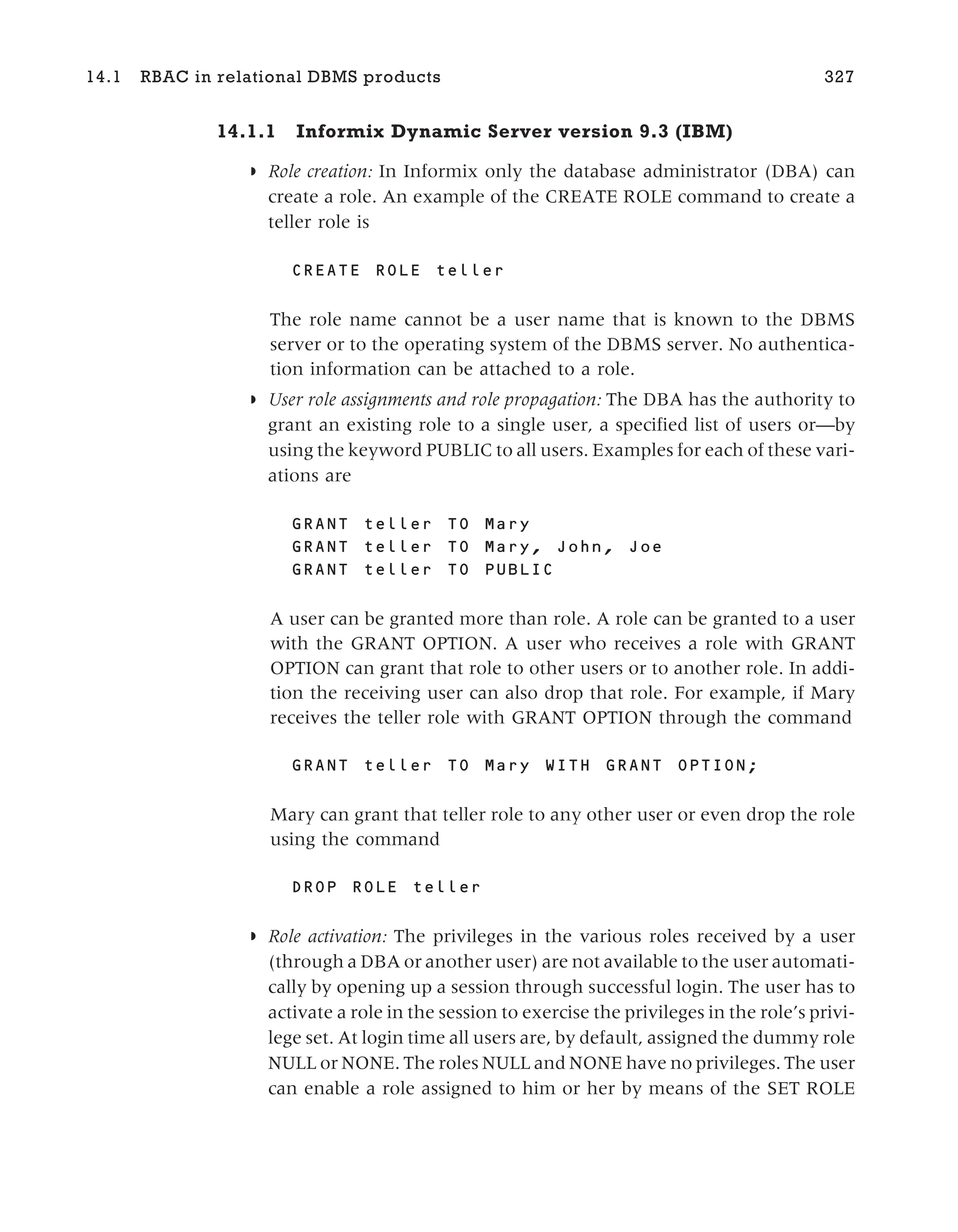
![routine-level privileges to be granted to roles. The object owners, the
DBA, as well as users who have been granted these privileges with
GRANT OPTION can grant these privileges to roles.
14.1.2 Oracle Database 10g Release 2 (10.2) (Oracle
Corporation)
Role creation: Oracle 10g provides a set of predefined roles to facilitate
database administration. These roles listed in Table 11-1 of [4] are automati-
cally defined when a database is created. Three of these roles—CONNECT,
RESOURCE, and DBA—are likely to be deprecated in future versions of Ora-
cle to enable enterprises to create their own roles, assigning only those privi-
leges that are needed so as to maintain finer granularity of control over
administrative privileges and roles.
In contrast with predefined roles, user-defined roles are created by a
DBA or other administrators or users. The CREATE ROLE system privi-
lege is needed for creating roles. The command to create a role (i.e.,
CREATE ROLE command) has an option to specify an activation condition
that should be satisfied by the role assignee (the specific user to whom the
role has been granted) to activate or enable a role. This activation condition
(called authorization method for a role by Oracle) can be specified as part of
the role creation statement as follows:
CREATE ROLE <role name> [ NOT IDENTIFIED |
IDENTIFIED]
[ BY <password> | USING <package> |
EXTERNALLY | GLOBALLY ];
An example of creating a role that does not require an activation condition
is:
CREATE ROLE employee NOT IDENTIFIED;
Four activation conditions can be specified:
◗ By the database using a password;
◗ By the application using a specified package;
◗ By the operating system, network, or other external sources
(externally);
◗ By an enterprise directory service (globally).
14.1 RBAC in relational DBMS products 329](https://image.slidesharecdn.com/role-basedaccesscontrolsecondeditionpdfdrive-250311062434-2e3fc82e/75/Role-Based-Access-Control-Second-Edition-PDFDrive-pdf-350-2048.jpg)
![The following statements are examples for creating roles that can be acti-
vated by a password, a package, externally and globally, respectively:
CREATE ROLE teller IDENTIFIED BY mysecret;
CREATE ROLE auditor IDENTIFIED USING banking.admin;
CREATE ROLE accountant IDENTIFIED EXTERNALLY;
CREATE ROLE manager IDENTIFIED GLOBALLY;
In the above examples, a user assigned the teller role has to provide a
password to enable that role in a user session. The auditor role is an exam-
ple of an application role that can be enabled only by applications using an
authorized PL/SQL package (in our case the package name is bank-
ing.admin). Because the package is activating the role, it can perform any
desired validation to ensure that certain conditions are met before issuing
the SET ROLE command (e.g., the user session was created by a proxy, the
request comes from a specific IP address, or that the user was authenticated
using an X.509 certificate).
Continuing with our discussion of the above examples, a role can be
specified (in our case accountant role) to be activated through an external
source such as the operating system or network authorization server. The
manager role is an example of a global role that can only be assigned to a
global user (a user created at the enterprise level as opposed to a data-
base-specific user) and can only be activated using the enterprise directory
service. The global role can be defined locally in the database and be
assigned privileges and/or other roles. However it cannot be assigned
directly to a user or another role in the database. The assignment of a global
user to a global role or a set of global roles is made through an artifact called
enterprise role, which acts as a container or directory for multiple global
roles in the enterprise directory. This assignment is queried when a global
user connects to a database and the associated set of global roles are acti-
vated. A global role always applies to only one database.
The activation mechanism associated with a role can be changed using the
ALTER ROLE statement.
ALTER ROLE <role name> [ NOT IDENTIFIED |
IDENTIFIED]
[ BY <password> | USING <package> |
EXTERNALLY | GLOBALLY ];
User role assignments and role propagation: Oracle 10g allows a role to be
granted to multiple users and a user to be granted multiple roles. A role can
also be granted to all users in a single statement using the usergroup PUBLIC.
330 RBAC Features in Commercial Products](https://image.slidesharecdn.com/role-basedaccesscontrolsecondeditionpdfdrive-250311062434-2e3fc82e/75/Role-Based-Access-Control-Second-Edition-PDFDrive-pdf-351-2048.jpg)
![This feature is very useful when a generic role such as “employee role” that
contains permissions common to all employees of the company needs to be
assigned to all users. In addition a role granted to a user with ADMIN OPTION
provides the following expanded capabilities—the grantee can grant or
revoke that role to or from any user or other role in the database, further grant
the role with ADMIN OPTION, and also can alter (changing the activation
mechanism) or drop the role. The general syntax for the GRANT statement is
given below:
GRANT <role1> [,<role2>, <role3>, .] TO <user1>
[,<user2>, <user3>, <user4> ] [WITH ADMIN OPTION];
The following are examples for each of the options provided by the
GRANT statement.
GRANT auditor TO john, susan;
GRANT accountant, budget_analyst TO jack;
GRANT employee TO PUBLIC;
GRANT loan_officer TO smith WITH ADMIN OPTION;
The last statement grants smith the capability to grant, revoke, alter, or
drop the loan_officer role.
Role activation: In Oracle, a user who has been granted one or more roles
can invoke the SET ROLE command to enable or disable those roles for the
current user session. Roles that are defined to be activated externally or glob-
ally cannot be enabled using SET ROLE command. The SET ROLE in Oracle
has the following three options:
1. Specify a list of roles to be enabled, providing the password for each if
it has one. (Please note that for those roles that are to be activated
using a password, this command is invoked at the command line or
in a login script while for those roles that are to be activated through
an application package, it is always found inside a PL/SQL
procedure.)
◗ Example 1
SET ROLE teller IDENTIFIED BY mysecret, intern
IDENTIFIED by guest;
14.1 RBAC in relational DBMS products 331](https://image.slidesharecdn.com/role-basedaccesscontrolsecondeditionpdfdrive-250311062434-2e3fc82e/75/Role-Based-Access-Control-Second-Edition-PDFDrive-pdf-352-2048.jpg)
![1. sa_role (system administrator role): The user who has been assigned this
role is called a system administrator. A system administrator has per-
missions to perform certain server-level (as opposed to
database-level) tasks such as allocating and managing physical
resources (e.g., allocation of disk spaceor disk mirroring), creating
databases, shutting down the server, and so on. The system adminis-
trator can also grant permission to any object on any database to
users since it is treated as the object owner as far as this privilege is
concerned. In addition, the system administrator has some
user(login) management privileges such as dropping logins (remov-
ing user IDs) as well as lock and unlock logins.
2. sso_role (system security officer): The user who has been assigned this
role is called system security officer. The system security officer has
permissions to create user-defined roles and grant those roles to
users or other roles. As far as login management is concerned, the
system security officer can create new logins, change login pass-
words, and lock and unlock login accounts. In addition, the system
security officer can grant permission to users/roles to use the set proxy
or set session authorization commands that enable the user/role
assignee (recipient of the permission) to assume the identity of
another user.
User-defined roles can be created in the adaptive server using the create
role statement. This statement provides the following options:
◗ Specifying a password the user must enter to activate the role;
◗ Specifying a password expiration interval in days;
◗ Specifying a minimum length for password;
◗ Specifying the number of “failed password attempts” while activating
a role before the login account will get automatically locked.
The general syntax of create role statement in the adaptive server is:
CREATE ROLE <role_name> [ WITH PASSWD password
[, {PASSWD EXPIRATION | MIN PASSWD LENGTH |
MAX FAILED LOGINS } <option_value> ] ]
Examples of create role statements are given next:
CREATE ROLE teller WITH PASSWD tell123, PASSWD
EXPIRATION 30
334 RBAC Features in Commercial Products](https://image.slidesharecdn.com/role-basedaccesscontrolsecondeditionpdfdrive-250311062434-2e3fc82e/75/Role-Based-Access-Control-Second-Edition-PDFDrive-pdf-355-2048.jpg)
![CREATE ROLE accountant WITH PASSWD accounting123,
MIN PASSWD LENGTH 8
CREATE ROLE auditor WITH PASSWD check123, MAX
FAILED LOGINS 10
The role names must be unique to the entire Sybase adaptive server and
cannot be the same name as a database userID (login).
The passwords can be added, dropped (removed as an activation require-
ment), or changed for a role after creation using the alter role command.
The same command also has options to lock/unlock roles and to spec-
ify/change password expiration interval, minimum password length, and
maximum number of failed (wrong) password attempts allowed by the
database server.
ALTER ROLE < role_name> [ADD PASSWD password |
DROP PASSWD] [LOCK | UNLOCK]
ALTER ROLE {<role_name> | all overrides }
SET { PASSWD EXPIRATION | MIN PASSWD LENGTH |
MAX FAILED LOGINS } <option_value>
To change the password for a role, the existing password must be
dropped and the new password must be added. Hence it requires two invo-
cations of the “alter role” statement. The alter role statement also comes
with an option called “all overrides” and is invoked to override the
server-wide values set for the following parameters: password expiration,
max failed_logins, and min passwd length.A user-defined role can be
removed by using the DROP ROLE command with the following syntax:
DROP ROLE <role_name> [WITH OVERRIDE]
If the role has any access privileges already granted, all those privileges
granted to that role in all databases must be revoked before role can be
dropped, otherwise the drop role command will fail. However, when the
WITH OVERRIDE option is used, all access privileges in all databases
(server-wide) for that role are automatically dropped and hence the drop
role command succeeds. However, as far as role membership is concerned,
dropping a role automatically removes any user’s membership in that role,
regardless of whether you use the OVERRIDE option.
User role assignments and role propagation: Once roles have been created,
any role or a list of roles can be granted to a user or role (to a list of users or
14.1 RBAC in relational DBMS products 335](https://image.slidesharecdn.com/role-basedaccesscontrolsecondeditionpdfdrive-250311062434-2e3fc82e/75/Role-Based-Access-Control-Second-Edition-PDFDrive-pdf-356-2048.jpg)
![roles) using the grant role command. To assign roles financial_analyst and
accountant to Susan and John, the following command is to be used:
GRANT ROLE financial_analyst, accountant TO Susan,
John
Thus we see that in Sybase a role can be granted to one or more users
and that any user can be granted more than one role. However, there is no
feature in Sybase for granting a user-defined role to a user with the grantee
being able to propagate that role to other users.
Roles granted to a user or a role can be revoked using the REVOKE
ROLE as illustrated below:
REVOKE ROLE financial_analyst FROM John
Role activation: Sybase allows users to activate multiple roles in a user ses-
sion. Although the SET ROLE statement (the one that activates a user’s
assigned role during a session) allows for specifying only one role, by repeated
invocation of this statement, the user can activate multiple roles from the set
of his/her assigned roles. Roles that have a password can be activated only
using this statement. Roles that do not have a password can be activated auto-
matically at login time by including them in the default activation list (see
next section). These activation options are needed only for user-defined roles.
System roles are automatically activated, if they do not have passwords asso-
ciated with them. Roles that are already active during a session can also be
deactivated using this statement. The general syntax for SET ROLE is as
follows:
SET ROLE {<role_name> [WITH PASSWD password ]} {ON
| OFF}
Some examples of SET ROLE statements are:
SET ROLE sa_role OFF (deactivates the sa_role)
SET ROLE auditor WITH PASSWD check123 ON (acti-
vates the auditor role by providing the associated
password)
As referred to in the previous section, automatic activation of roles at
login time can be enabled for those roles that do not have attached pass-
words. This is done using the SP_MODIFYLOGIN statement in Sybase.
336 RBAC Features in Commercial Products](https://image.slidesharecdn.com/role-basedaccesscontrolsecondeditionpdfdrive-250311062434-2e3fc82e/75/Role-Based-Access-Control-Second-Edition-PDFDrive-pdf-357-2048.jpg)
![GRANT DBCC checkstorage ON fin_DB to stor-
age_admin_role
In Sybase adaptive server, permissions for the use of system tables can be
controlled by the database owner, just like permissions on any other tables.
However, from an operational viewpoint, it would be good if users have
minimal privileges (say Select) on subset of system tables (say sysindexes
table to view the list of indexes available for an application table). These
minimal privileges are encapsulated under “default permissions” and made
a parameter for GRANT and REVOKE statements. The syntax for a GRANT
statement that uses this parameter is:
GRANT DEFAULT PERMISSIONS ON SYSTEM TABLES
The list of system tables for which the default permissions apply in any
database is given in [2].
14.2 RBAC in enterprise security administration
software
This section analyzes and discusses the RBAC model concepts that have
been implemented in another class of commercial software called the ESA
products. ESA products enable centralized management of access control for
a wide variety of security systems (called target systems) resident in several
heterogeneous platforms throughout the enterprise. The various types of
target system platforms include the following:
◗ Server operating systems (e.g., UNIX and Windows NT);
◗ Web servers (e.g., Apache, WebSphere, and BEA);
◗ DBMSs (e.g., Oracle and Sybase);
◗ Mainframes.
Although the term target system refers to the native access control
mechanism, since many platforms have only one native access control
mechanism (with the exception of mainframes that support many mecha-
nisms like RACF and ACF2), we refer to a target system by its platform
name (e.g., UNIX). In general the ESA software does not replace the native
access control mechanism in the target systems. In a few cases, it might
extend the access control capabilities of the native access control mecha-
nisms by providing add-on modules.
340 RBAC Features in Commercial Products](https://image.slidesharecdn.com/role-basedaccesscontrolsecondeditionpdfdrive-250311062434-2e3fc82e/75/Role-Based-Access-Control-Second-Edition-PDFDrive-pdf-361-2048.jpg)
![but with a view to present to the readers the total landscape of RBAC fea-
tures available in the ESA product category. All the information needed for
our analysis was obtained from product manuals or published technical
reports:
◗ Control-SA [6];
◗ DirX Identity V7.0 [7];
◗ SAM Jupiter [8];
◗ Tivoli Identity Manager [9, 10].
14.2.1 CONTROL-SA (BMC software)
CONTROL-SA, the ESA product from BMC Software provides centralized
security administration through the following main components (refer to
Figure 14.1):
◗ Enterprise security station (ESS);
◗ Several SA-agents.
The ESS, the management component of CONTROL-SA, communicates
through gateways to several SA-agents each running on top of a target
342 RBAC Features in Commercial Products
SA-Agent SA-Agent SA-Agent
Security
Administration
database
Resident security systems (RSSs)(Target Systems)
RACF Unix Windows NT
Enterprise
security
station
Figure 14.1 BMC’S CONTROL-SA components.](https://image.slidesharecdn.com/role-basedaccesscontrolsecondeditionpdfdrive-250311062434-2e3fc82e/75/Role-Based-Access-Control-Second-Edition-PDFDrive-pdf-363-2048.jpg)
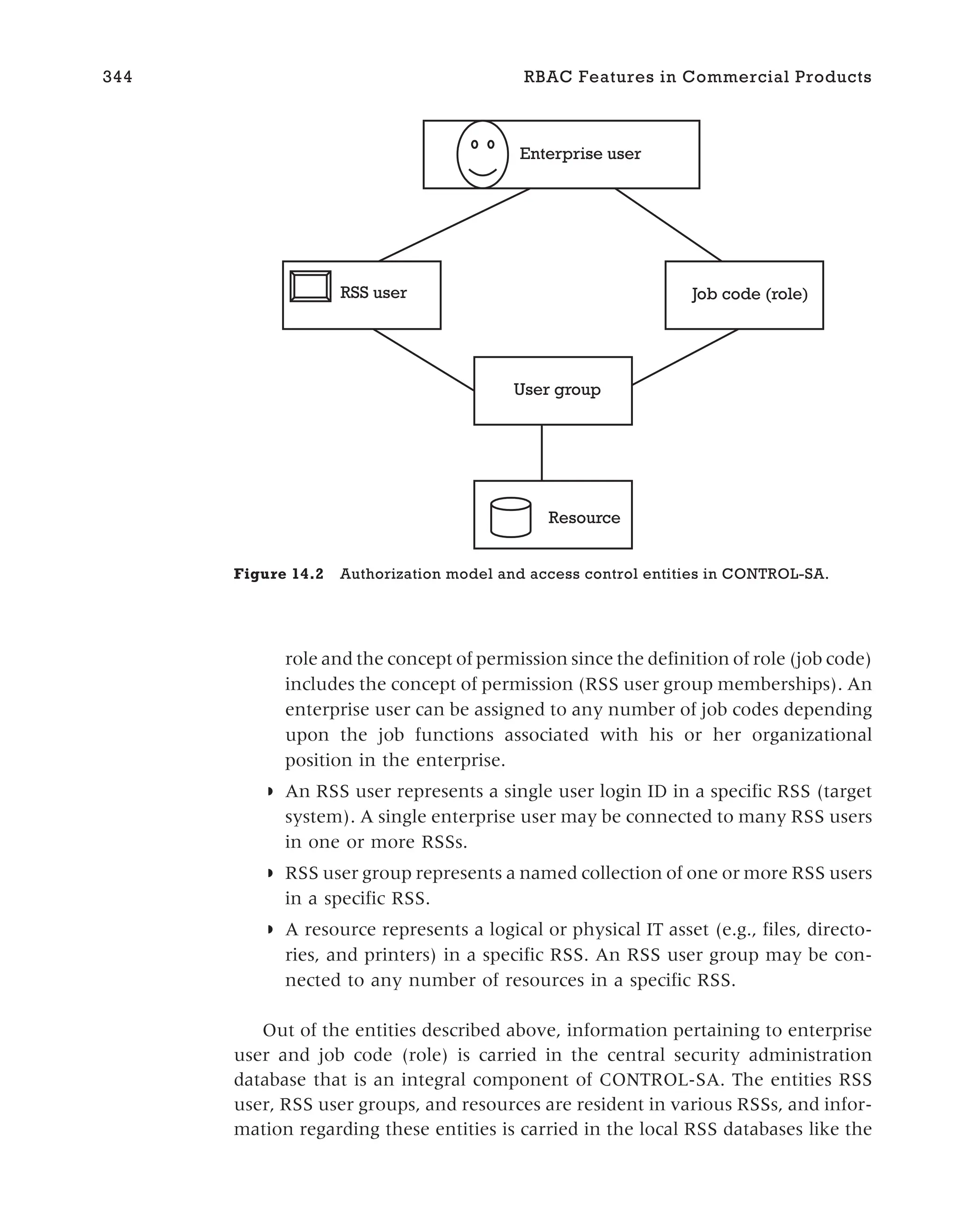
![templates provide the attributes for creating an account for John
Smith in the NT server and corporate exchange server, respectively.
Using these templates, the ESS automatically creates those accounts
(RSS users) and connects those RSS user Ids to the relevant RSS user
groups (in our case Domain_User group on the NT server and “Gen-
eral” group on the corporate exchange server).
◗ The SYS_DEV job codes contain reference to SYS_DEV user group on
two different MVS/RACF systems. A template “RACF_DEV” is also
attached to this job code. Using this template the ESS creates new
RACF accounts and connects those accounts to SYS_DEV groups.
14.2.2 DirX Identity V7.0 (Siemens)
DirectX Identity V7.0 (HiPath SIcurity DirectX Identity) is the main compo-
nent of the product suite from Siemens [7] that can be used to perform
enterprise-wide identity and authorization (access control) management in
an environment that consists of many different types of IT systems (target
systems). DirX Identity’s support of target systems include database drivers
such as ODBC and JDBC, mainframe security systems such as IBM’s RACF,
application systems such as SAP R/3, e-mail systems such as Microsoft
Exchange and Lotus/Domino, O/S such as Windows NT, and directory
systems such as Active Directory.
The main components in DirX Identity are the following (see Figure
14.3):
◗ Identity Manager;
◗ Identity Server;
◗ Identity Store;
◗ Agents and Connectors.
The Identity Manager is the client for DirX Identity that provides access
through a Java-based GUI. It communicates with DirX Identity’s data repos-
itory (i.e., identity store) through SSL. The Identity Server is the primary
module of DirX Identity that implements the business logic through its vari-
ous identity services. The services include the policy execution service, which
runs rules for such tasks as automated role assignment, and role resolution
service, which maps abstract permissions associated with roles to detailed
access rights in various target systems as well as two types of provisioning
workflow services—event-triggered provisioning and scheduled provisioning. The
identity store is the repository for all DirX Identity data, including user data,
346 RBAC Features in Commercial Products](https://image.slidesharecdn.com/role-basedaccesscontrolsecondeditionpdfdrive-250311062434-2e3fc82e/75/Role-Based-Access-Control-Second-Edition-PDFDrive-pdf-367-2048.jpg)
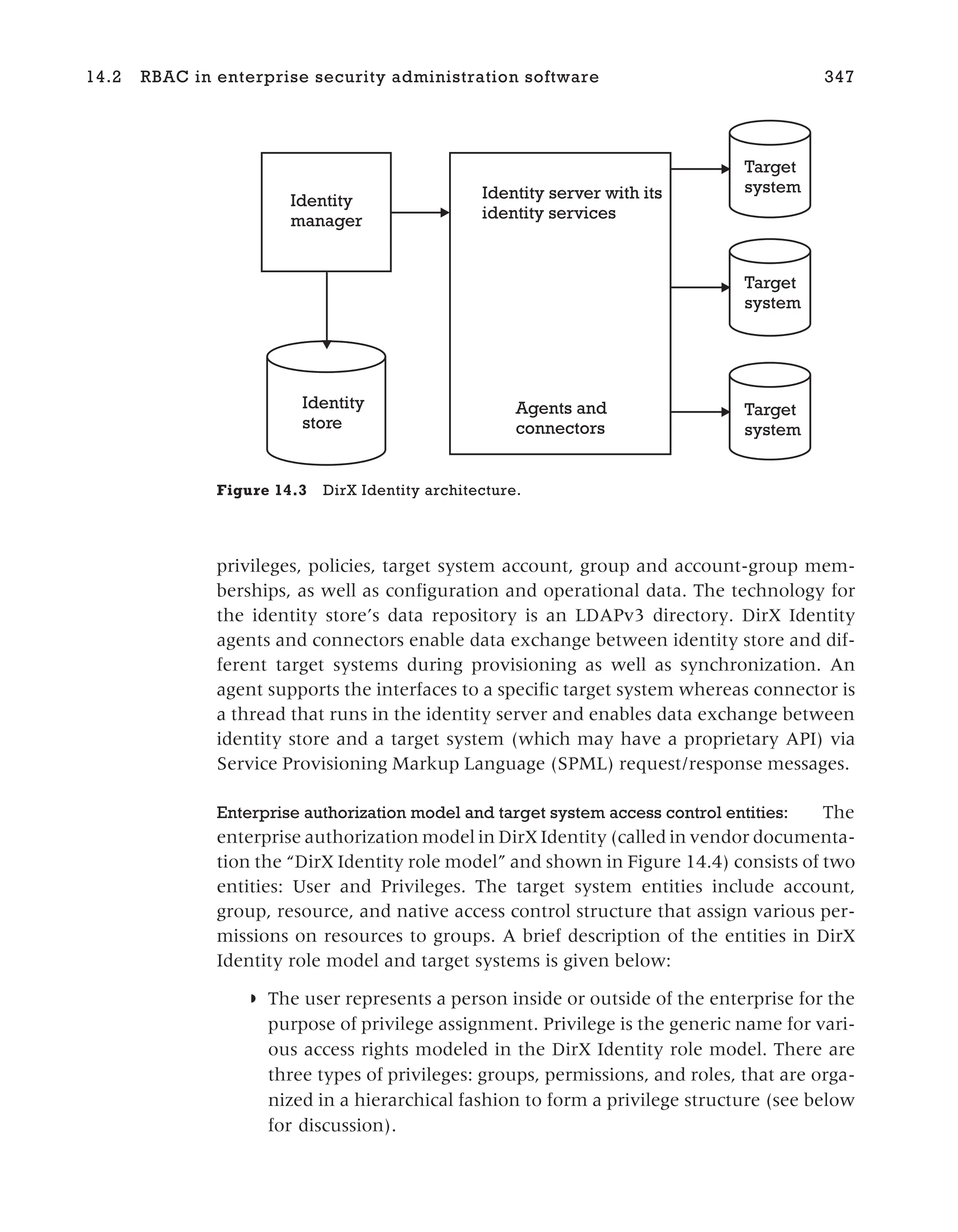
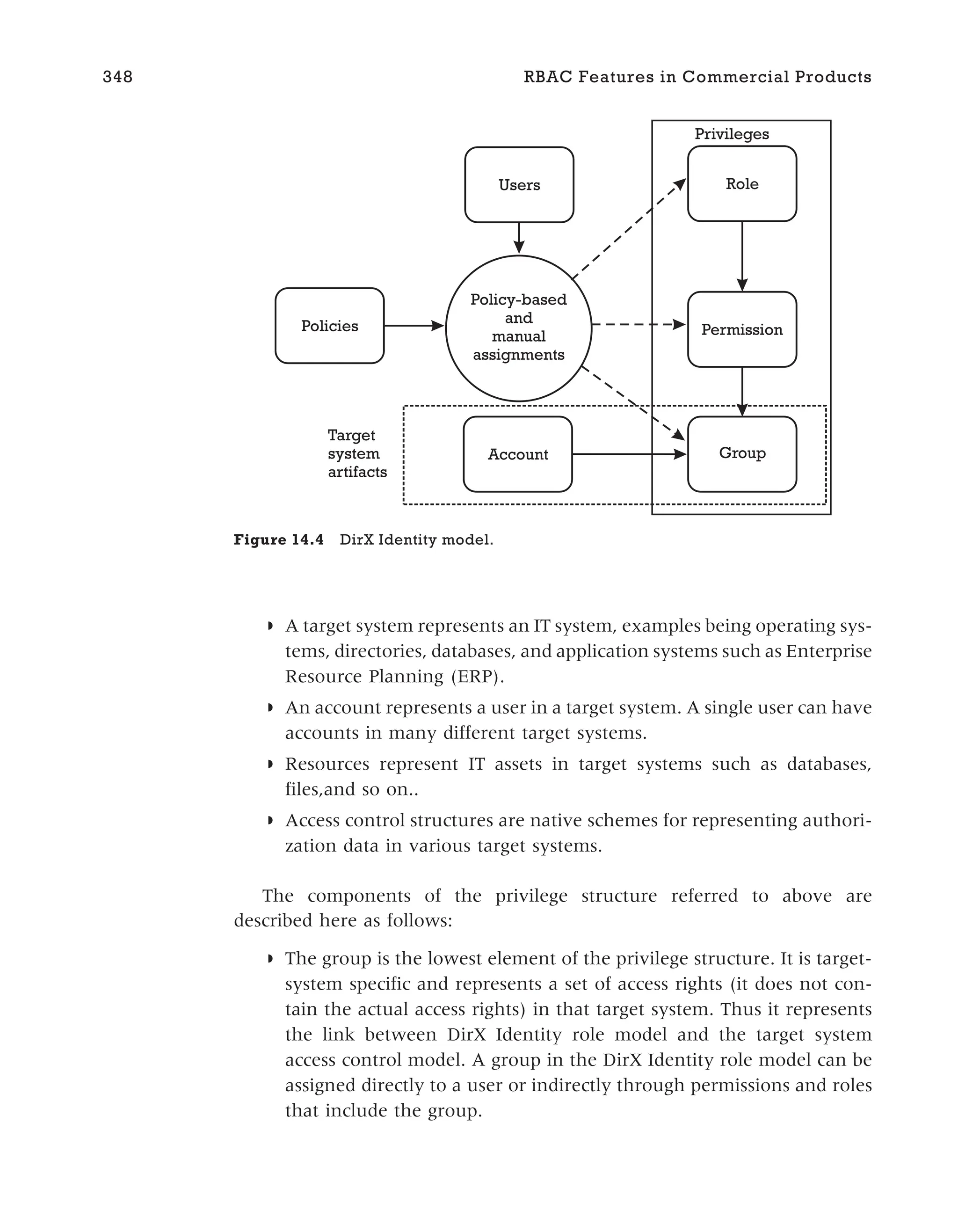
![access rights to the target systems either immediately or through a sched-
uled batch run.
14.2.3 SAM Jupiter (Beta Systems)
SAM Jupiter is an identity management solution from Beta Systems Soft-
ware AG [8]. It provides a central point of administration for several secu-
rity systems (target systems) deployed across the enterprise. SAM’s support
of target systems include those on mainframe platforms such as RACF,
ACF2 and TopSecret, on UNIX platforms (AIX, Solaris, and HP-UX), on
Windows Domain (Windows NT, Win2003), on DBMS products (Oracle
and DB2), on directory systems (Active Directory, LDAP and Netware), as
well as on standard applications (SAP).
SAM Jupiter has a three-tier architecture consisting of presentation,
application, and communication layers with the following components (see
Figure 14.5):
◗ SAM client;
◗ SAM server;
◗ SAM provisioning engine;
◗ Bulk processing interface;
◗ SAM repository;
14.2 RBAC in enterprise security administration software 351
SAM client
SAM server
SAM repository
Presentation
layer
Application layer
Communication
layer
Agentless
connector
SAM
provisioning
engine
Bulk
processing
Master courier
Target
system
Target
system
Target
system
Agent Agent
Figure 14.5 Sam Jupiter architecture.](https://image.slidesharecdn.com/role-basedaccesscontrolsecondeditionpdfdrive-250311062434-2e3fc82e/75/Role-Based-Access-Control-Second-Edition-PDFDrive-pdf-372-2048.jpg)
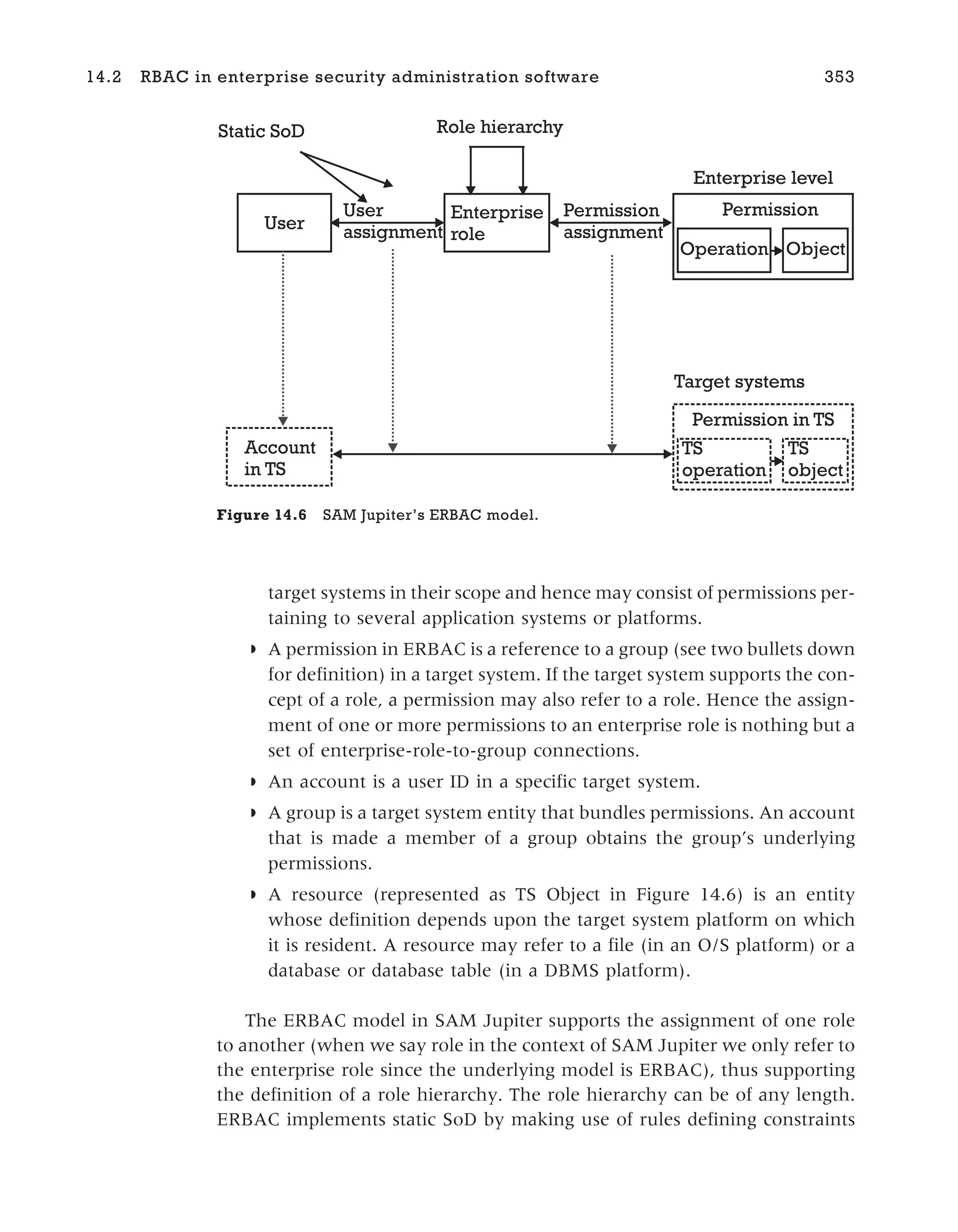
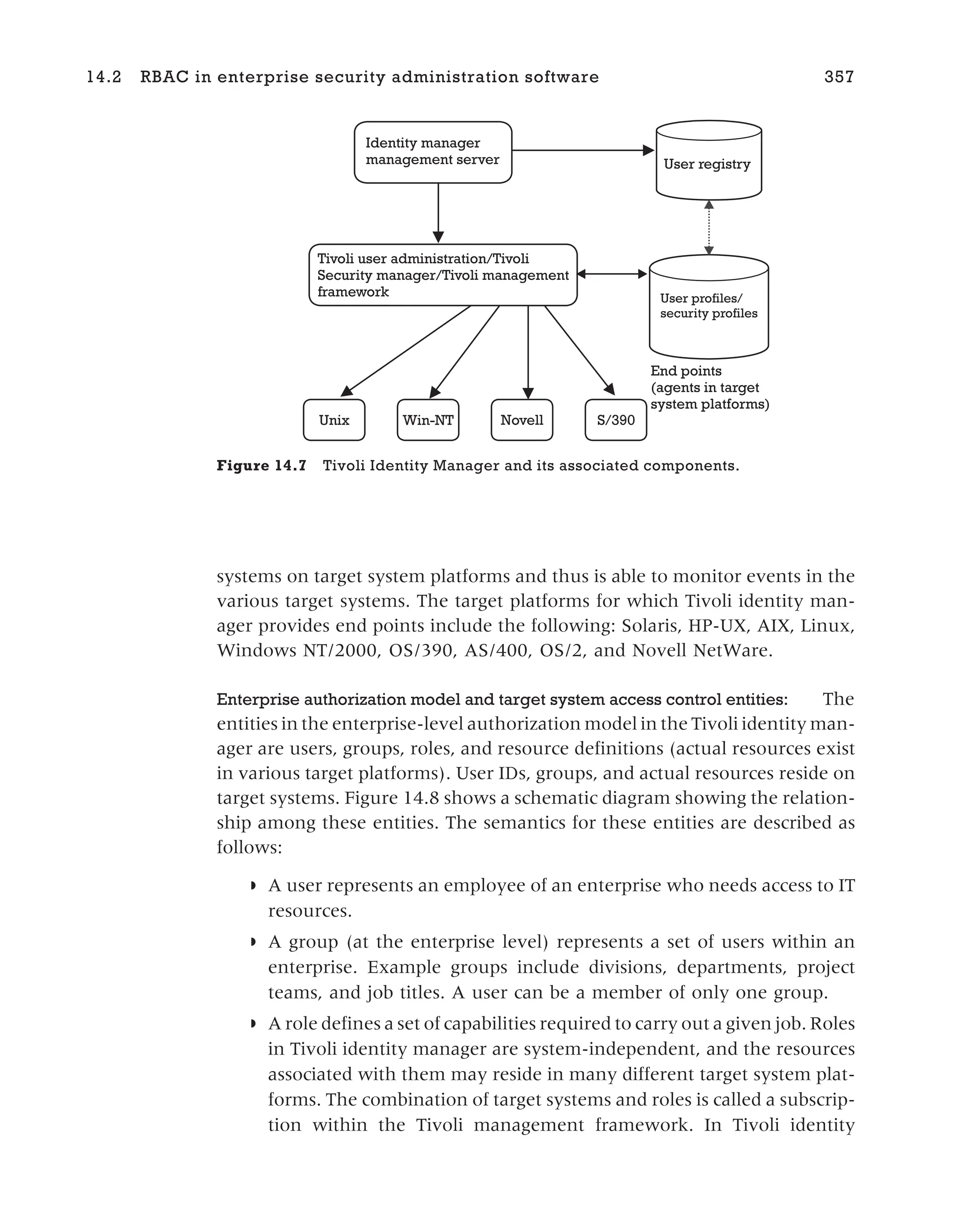
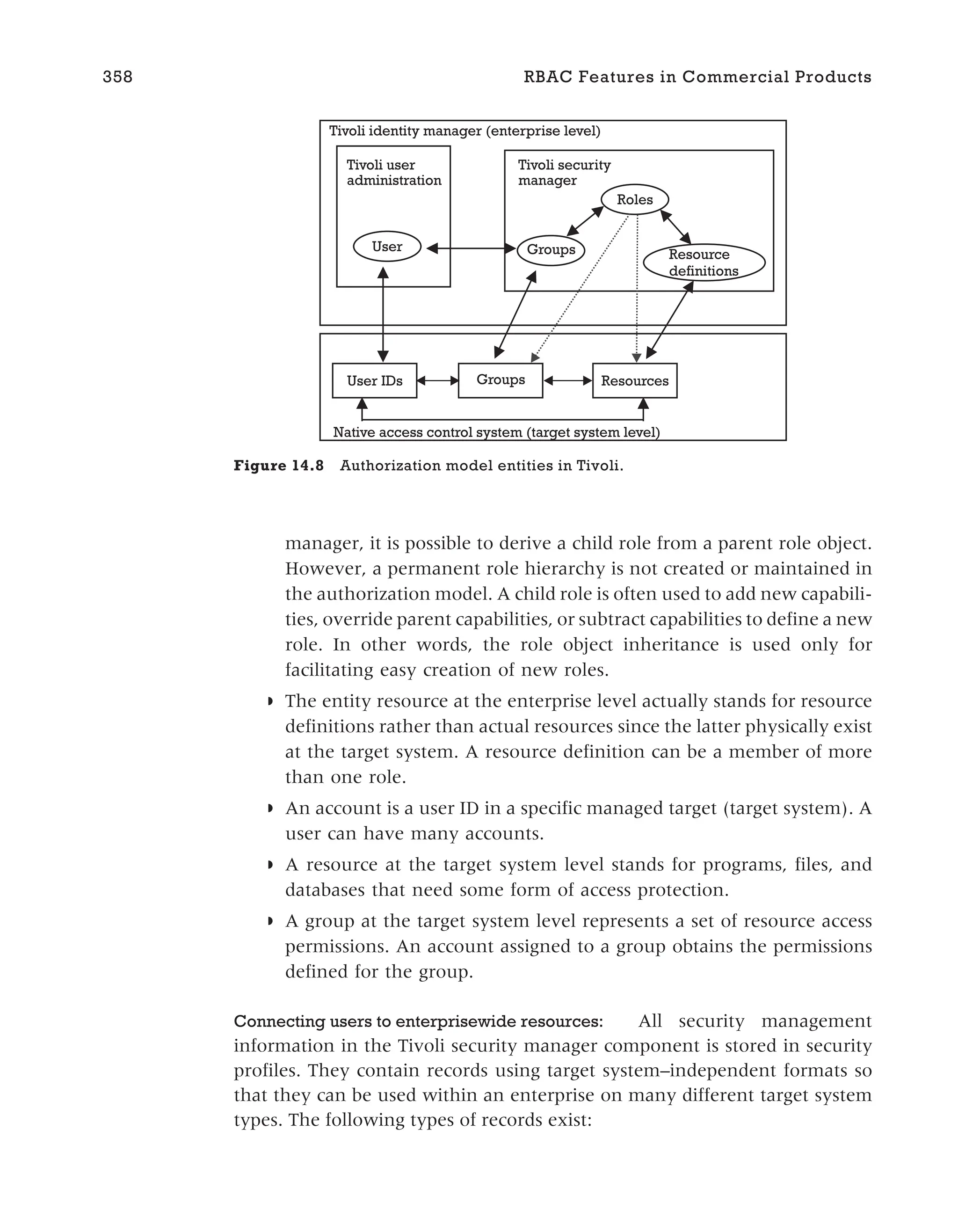
![the relevant target system groups to roles, and assigning users to roles. The
functions relating to propagating the enterprise-level authorization infor-
mation to various target systems is done automatically using middleware
products.
References
[1] Informix Guide to SQL: Reference, Version 8.3/9.3.
[2] Administrator’s Guide for Informix Dynamic Server, Version 9.3.
[3] Informix Guide to Database Design and Implementation, Version 8.3/9.3.
[4] Oracle Database (10g Release 2) Security Guide.
[5] Adaptive Server® Enterprise 15.0—System Administration Guide: Volumes 1
& II.
[6] Enterprise Security Station—User Guide (Windows GUI)—BMC Software Inc.
[7] DirX Identity 7.0, http://solutions.fujitsu-siemens.com/software, catalog/
product.php?id=200006280&lang=en&platform=all.
[8] http://www.betasystems.com/e_beta.nsf/(Docs)/0240070501.
[9] Enterprise Security Architecture Using IBM Tivoli Security Solutions, IBM
Corporation, 2002.
[10] Tivoli Security Management Design Guide (2002)—IBM Corporation.
360 RBAC Features in Commercial Products](https://image.slidesharecdn.com/role-basedaccesscontrolsecondeditionpdfdrive-250311062434-2e3fc82e/75/Role-Based-Access-Control-Second-Edition-PDFDrive-pdf-381-2048.jpg)
![Appendix A
XML Schema for the RBAC Model
<?xml version="1.0" encoding="UTF-8"?>
<! edited with XML Spy v4.2 (http://www.xmlspy.com) by Ramaswamy
Chandramouli (NIST) >
<xs:schema xmlns:xs="http://www.w3.org/2001/XMLSchema"
xmlns:sch="http://www.ascc.net/xml/schematron" elementFormDefault="qualified"
attributeFormDefault="unqualified">
<xs:element name="Bank_RBAC_Model" type="BankRBACModelType"/>
<xs:element name="user" type="userType"/>
<xs:element name="role" type="roleType"/>
<xs:element name="privilege" type="privilegeType"/>
<xs:element name="role_inherit" type="InheritType"/>
<xs:element name="UserRoleAssignment" type="URAType"/>
<xs:element name="RolePrivilegeAssignment" type="RPAType"/>
<xs:complexType name="BankRBACModelType">
<xs:annotation>
<xs:appinfo>
<sch:pattern name="Role Assignment Rules">
<sch:rule context="Bank_RBAC_Model">
sch:assert test="UserRoleAssignment[count(role[text ( )= TEL ])= 1]"
>There should be an assignment for Teller Role
</sch:assert>
</sch:rule>
</sch:pattern>
</xs:appinfo>
</xs:annotation>
361](https://image.slidesharecdn.com/role-basedaccesscontrolsecondeditionpdfdrive-250311062434-2e3fc82e/75/Role-Based-Access-Control-Second-Edition-PDFDrive-pdf-382-2048.jpg)
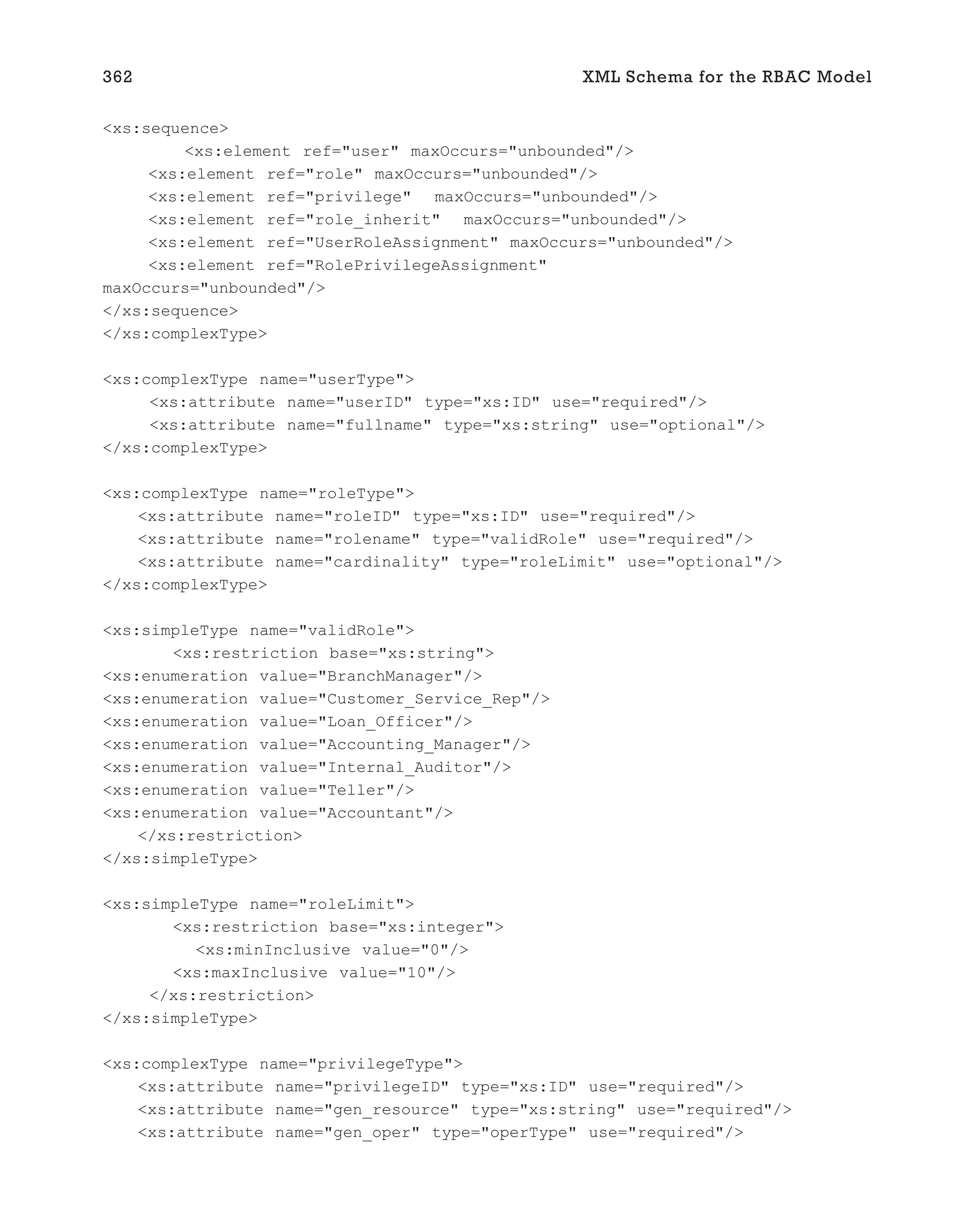
![</xs:complexType>
<xs:simpleType name="operType">
<xs:restriction base="xs:string">
<xs:enumeration value="Open"/>
<xs:enumeration value="Close"/>
<xs:enumeration value="Debit"/>
<xs:enumeration value="Credit"/>
</xs:restriction>
</xs:simpleType>
<xs:complexType name="InheritType">
<xs:sequence>
<xs:element name="FromRole" type="validRole" minOccurs="1"
maxOccurs="1"/>
<xs:element name="ToRole" type="validRole" minOccurs="1"
maxOccurs="1"/>
</xs:sequence>
</xs:complexType>
<xs:complexType name="URAType">
<xs:annotation>
<xs:appinfo>
<sch:pattern name="Role Assignment Rules">
<sch:rule context="UserRoleAssignment[role[text ( ) = BRM ]]">
<sch:assert test="count(user)= 1" diagnostics="MUST_BRM">
There should be only a single user assigned to
Branch Manager
</sch:assert>
</sch:rule>
</sch:pattern>
<sch:diagnostics>
<sch:diagnostic id="MUST_BRM">The actual number assigned is:
<sch:value-of select="count(user)"/>
</sch:diagnostic>
</sch:diagnostics>
</xs:appinfo>
</xs:annotation>
<xs:sequence>
<xs:element name="role" type="xs:IDREF"/>
<xs:element name="user" type="xs:IDREF" maxOccurs="10"/>
</xs:sequence>
</xs:complexType>
XML Schema for the RBAC Model 363](https://image.slidesharecdn.com/role-basedaccesscontrolsecondeditionpdfdrive-250311062434-2e3fc82e/75/Role-Based-Access-Control-Second-Edition-PDFDrive-pdf-384-2048.jpg)
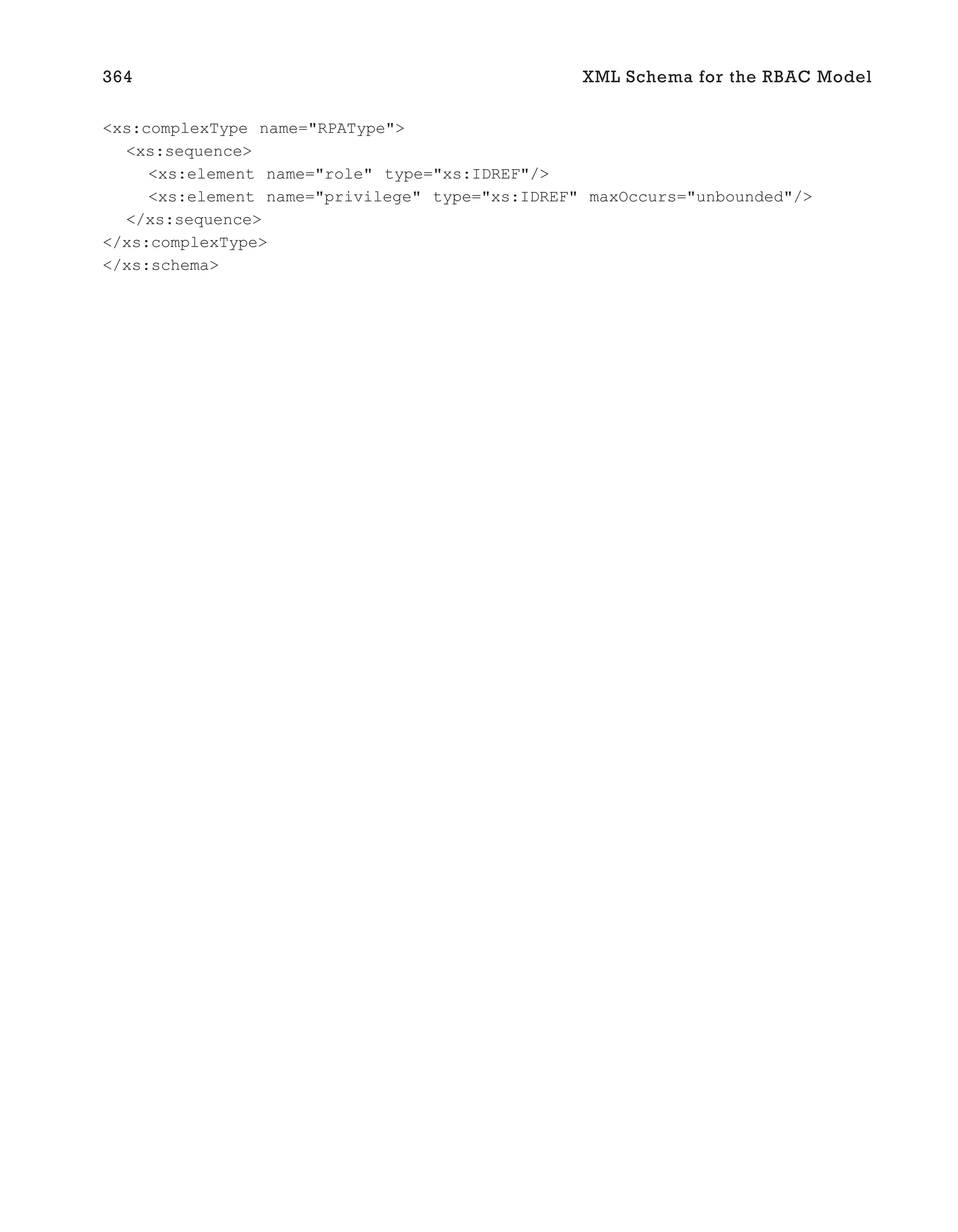
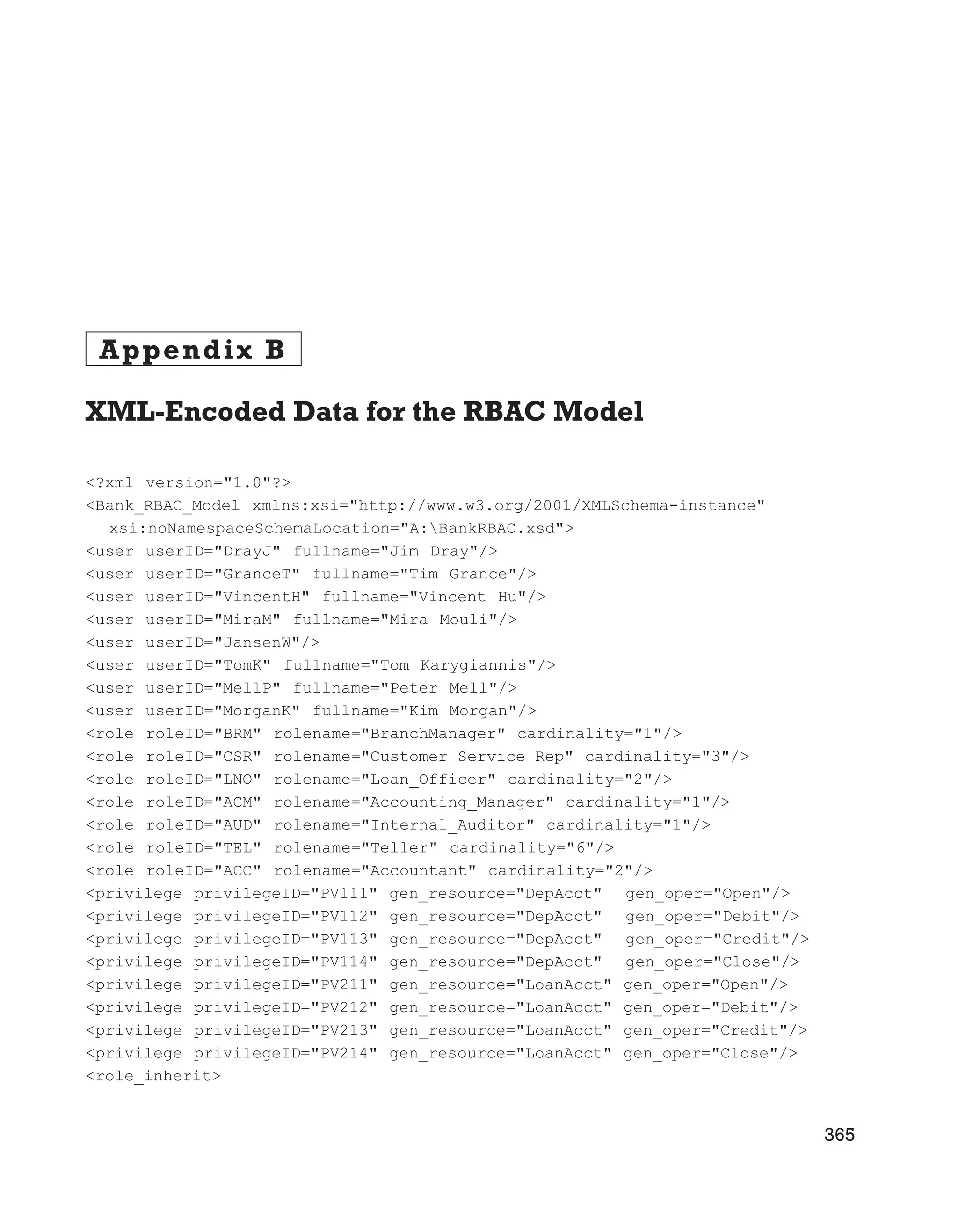
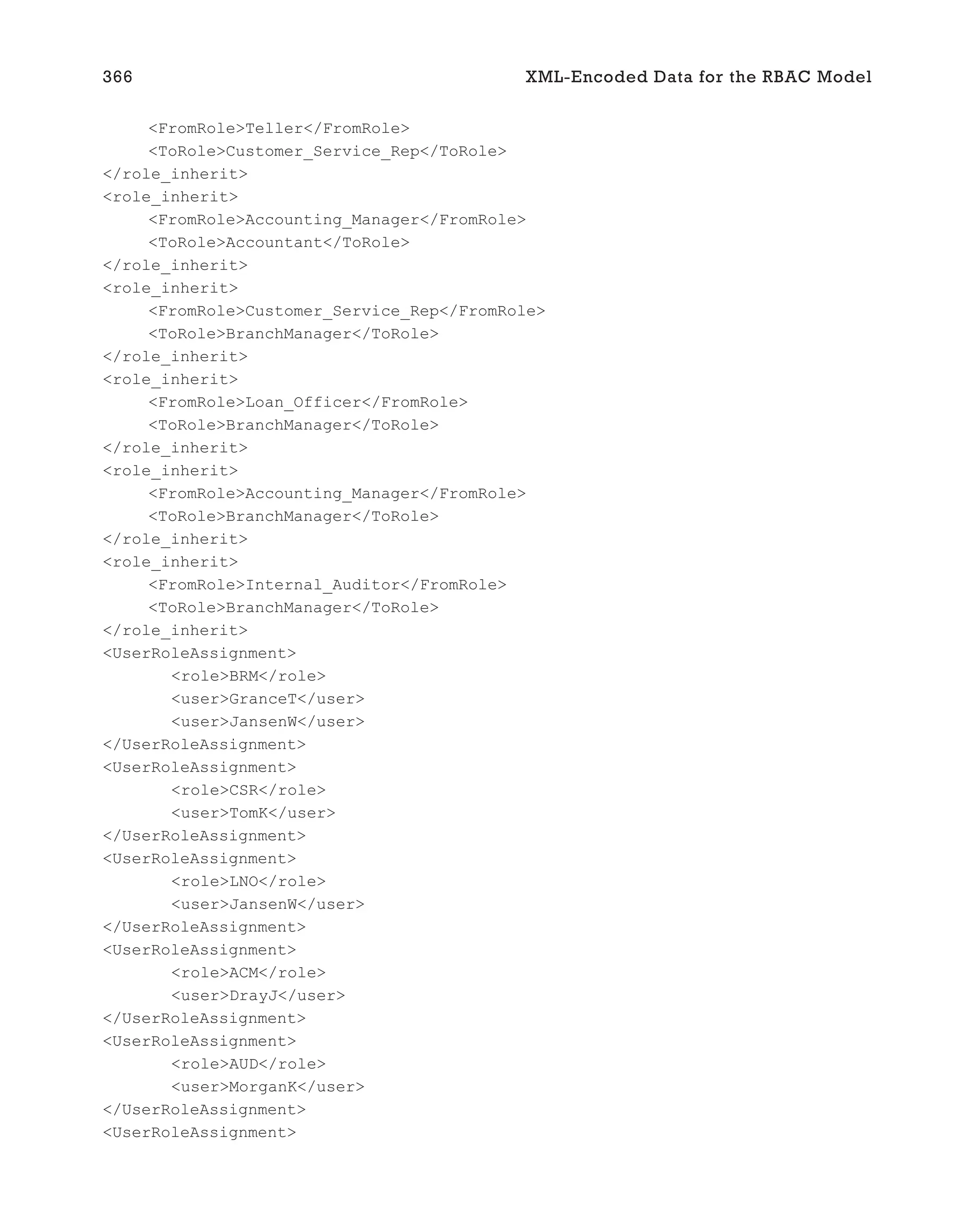
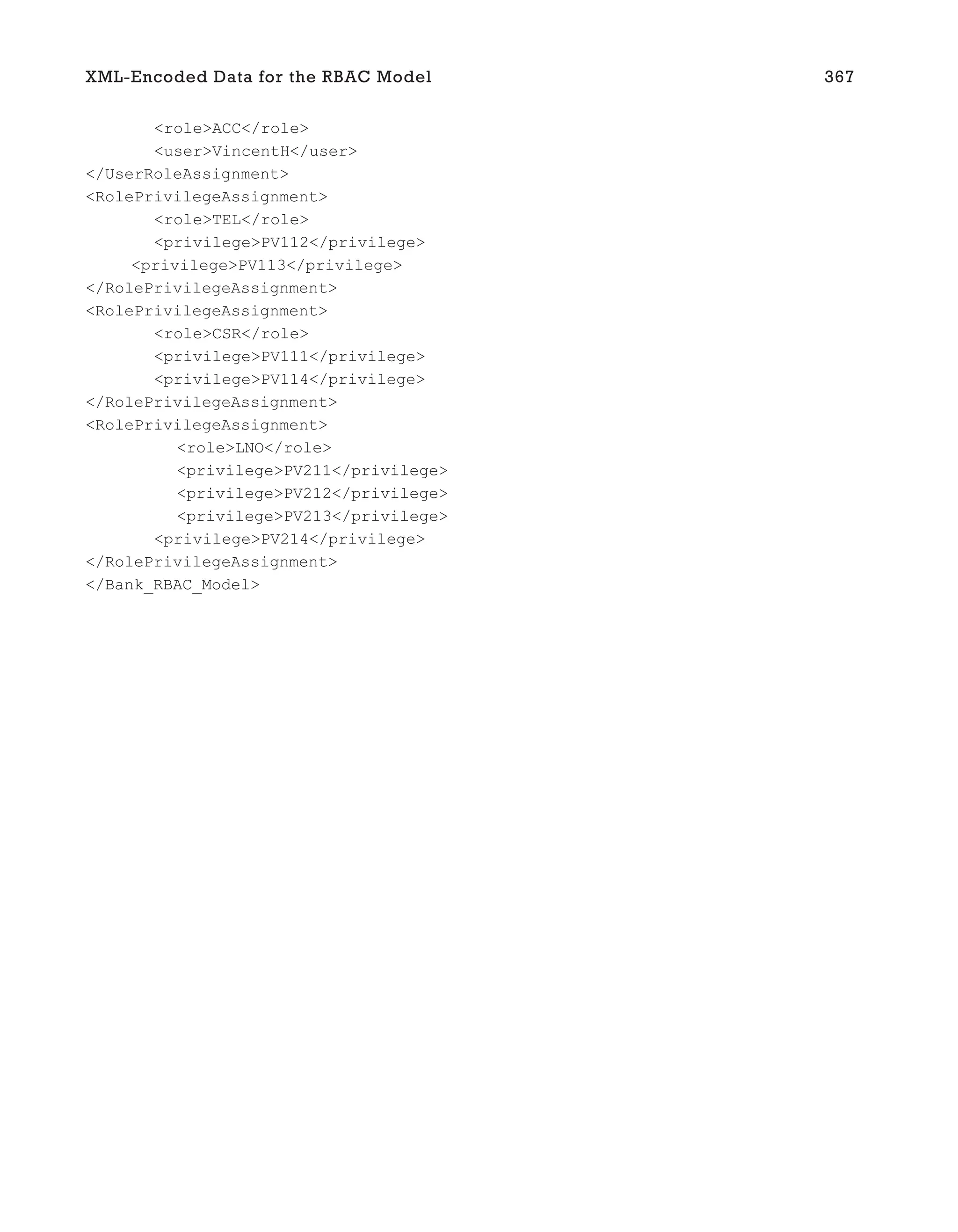




![[DSC Europe 22] Lakehouse architecture with Delta Lake and Databricks - Draga...](https://cdn.slidesharecdn.com/ss_thumbnails/draganberic-lakehousearchitecturewithdeltalakeanddatabricks-221130080712-6e817e95-thumbnail.jpg?width=640&height=640&fit=bounds)


