.lusoftware verification & validation
VVS
Metamorphic Security Testing
for Web Systems
Phu X. Mai*, Fabrizio Pastore*, Arda Goknil*, Lionel Briand*#
* SnT Centre, University of Luxembourg
#School of EECS, University of Ottawa
The Oracle Problem
in Web Systems Security Testing
2
Security vulnerabilities are subtle
Discovered when testing with many inputs
Specifying expected results is infeasible
3
Metamorphic Testing
Alleviates the Oracle Problem
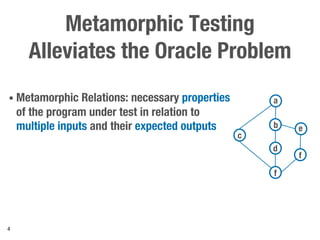
• Metamorphic Relations: necessary properties
of the program under test in relation to
multiple inputs and their expected outputs
4
x1=(G,a,f) ∧ x2=(G,f,a) len(shortPath(x1))=len(shortPath(x2))
a
b
c
d
e
f
fSource
input
Follow-up
input
Combined with
an automated strategy
to select source inputs,
metamorphic relations enable
automated testing
5
Metamorphic Security Testing
of Web Systems
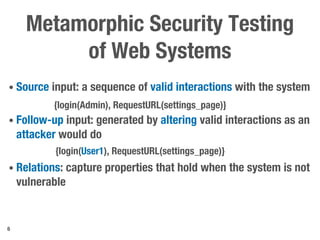
• Source input: a sequence of valid interactions with the system
• Follow-up input: generated by altering valid interactions as an
attacker would do
• Relations: capture properties that hold when the system is not
vulnerable
6
{login(Admin), RequestURL(settings_page)}
{login(User1), RequestURL(settings_page)}
Metamorphic Security Testing
of Web Systems
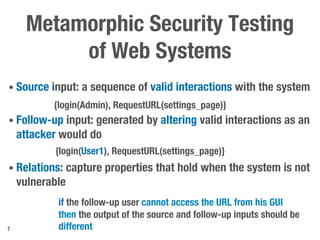
• Source input: a sequence of valid interactions with the system
• Follow-up input: generated by altering valid interactions as an
attacker would do
• Relations: capture properties that hold when the system is not
vulnerable
7
{login(Admin), RequestURL(settings_page)}
{login(User1), RequestURL(settings_page)}
if the follow-up user cannot access the URL from his GUI
then the output of the source and follow-up inputs should be
different
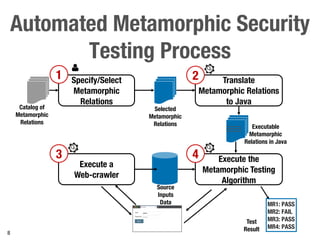
Automated Metamorphic Security
Testing Process
8
Catalog of
Metamorphic
Relations
Selected
Metamorphic
Relations
Translate
Metamorphic Relations
to Java
2
Execute a
Web-crawler
3
Specify/Select
Metamorphic
Relations
1
Executable
Metamorphic
Relations in Java
Source
Inputs
Data
Execute the
Metamorphic Testing
Algorithm
4
MR1: PASS
MR2: FAIL
MR3: PASS
MR4: PASS
Test
Result
Security Metamorphic Relation
Language (SMRL)
9
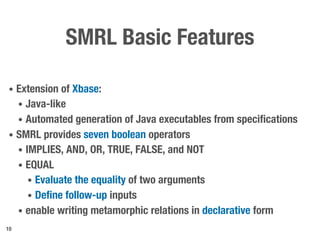
SMRL Basic Features
• Extension of Xbase:
• Java-like
• Automated generation of Java executables from specifications
• SMRL provides seven boolean operators
• IMPLIES, AND, OR, TRUE, FALSE, and NOT
• EQUAL
• Evaluate the equality of two arguments
• Define follow-up inputs
• enable writing metamorphic relations in declarative form
10
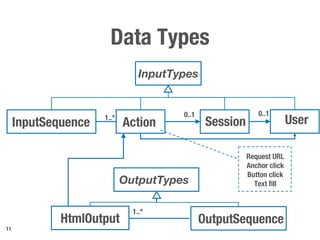
Data Types
11
InputSequence
InputTypes
OutputSequence
OutputTypes
Action1..* 0..1
Session User
0..1
HtmlOutput
1..*
Request URL
Anchor click
Button click
Text fill
12
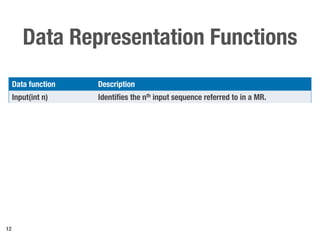
Data Representation Functions
Data function Description
Input(int n) Identifies the nth input sequence referred to in a MR.
User(int n) Identifies the nth user referred in a MR.
User() Identifies the 1st user referred in a MR.
Action(int n) Identifies the nth input action referred in a MR.
Session(int n) Identifies the nth Web session referred in a MR.
Output(Input n) Identifies the sequence of outputs generated by the nth input.
Output(Input n, int i) Identifies the output generated by the ith action of the nth input.
…
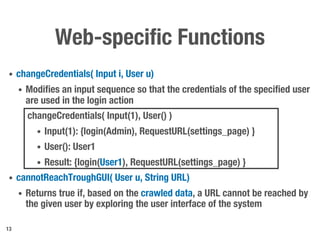
Web-specific Functions
• changeCredentials( Input i, User u)
• Modifies an input sequence so that the credentials of the specified user
are used in the login action
changeCredentials( Input(1), User() )
• Input(1): {login(Admin), RequestURL(settings_page) }
• User(): User1
• Result: {login(User1), RequestURL(settings_page) }
• cannotReachTroughGUI( User u, String URL)
• Returns true if, based on the crawled data, a URL cannot be reached by
the given user by exploring the user interface of the system
13
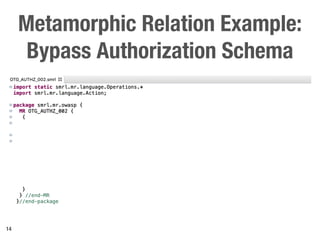
Metamorphic Relation Example:
Bypass Authorization Schema
14
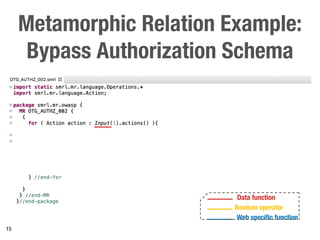
Metamorphic Relation Example:
Bypass Authorization Schema
15
Data function
Boolean operator
Web specific function
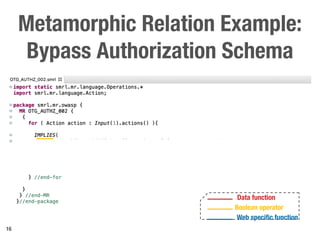
Metamorphic Relation Example:
Bypass Authorization Schema
16
Data function
Boolean operator
Web specific function
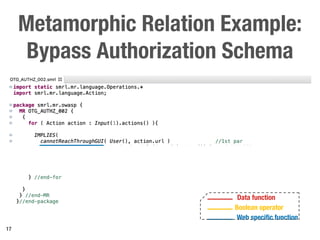
Metamorphic Relation Example:
Bypass Authorization Schema
17
Data function
Boolean operator
Web specific function
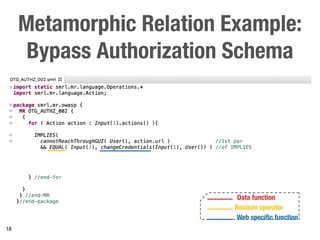
Metamorphic Relation Example:
Bypass Authorization Schema
18
Data function
Boolean operator
Web specific function
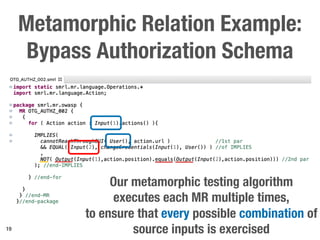
Metamorphic Relation Example:
Bypass Authorization Schema
19
Our metamorphic testing algorithm
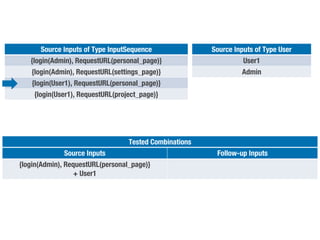
executes each MR multiple times,
to ensure that every possible combination of
source inputs is exercised
20
Source Inputs of Type InputSequence
{login(Admin), RequestURL(personal_page)}
{login(Admin), RequestURL(settings_page)}
{login(User1), RequestURL(personal_page)}
{login(User1), RequestURL(project_page)}
Source Inputs of Type User
User1
Admin
Tested Combinations
Source Inputs Follow-up Inputs
{login(Admin), RequestURL(personal_page)}
+ User1
/
{login(Admin), RequestURL(settings_page)}
+ User1
{login(User1), RequestURL(settings_page)}
{login(User1), RequestURL(personal_page)}
+ Admin
/
{login(User1), RequestURL(project_page)} {login(Admin), RequestURL(personal_page)}
Java Integration
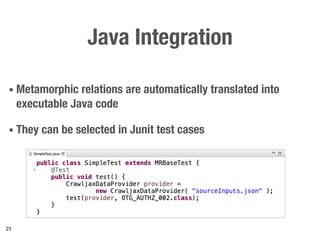
• Metamorphic relations are automatically translated into
executable Java code
• They can be selected in Junit test cases
21
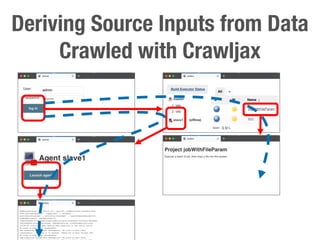
Deriving Source Inputs from Data
Crawled with Crawljax
Deriving Source Inputs from
Test Scripts
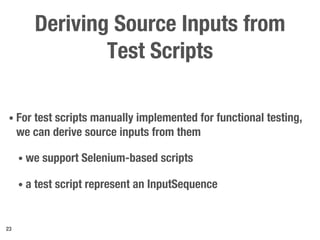
• For test scripts manually implemented for functional testing,
we can derive source inputs from them
• we support Selenium-based scripts
• a test script represent an InputSequence
23
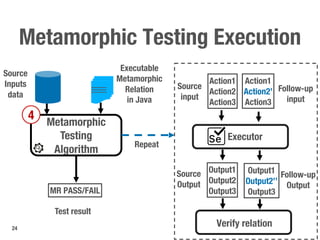
24
Executable
Metamorphic
Relation
in Java
Source
Inputs
data
Metamorphic
Testing
Algorithm
4
Follow-up
input
Test result
Executor
Verify relation
Metamorphic Testing Execution
Source
input
Action1
Action2
Action3
Action1
Action2’
Action3
Follow-up
Output
Source
Output
Output1
Output2
Output3
Output1
Output2’’
Output3MR PASS/FAIL
Repeat
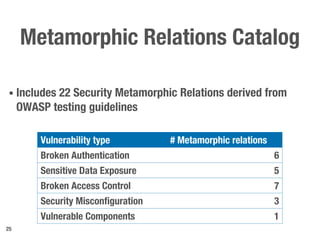
Metamorphic Relations Catalog
• Includes 22 Security Metamorphic Relations derived from
OWASP testing guidelines
25
Vulnerability type # Metamorphic relations
Broken Authentication 6
Sensitive Data Exposure 5
Broken Access Control 7
Security Misconfiguration 3
Vulnerable Components 1
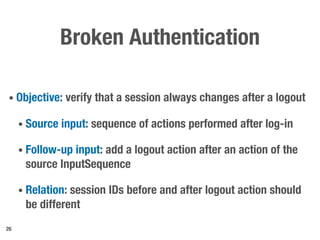
Broken Authentication
• Objective: verify that a session always changes after a logout
• Source input: sequence of actions performed after log-in
• Follow-up input: add a logout action after an action of the
source InputSequence
• Relation: session IDs before and after logout action should
be different
26
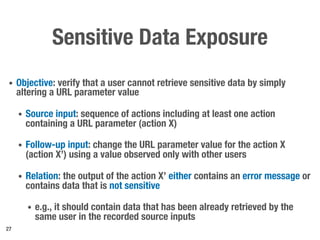
Sensitive Data Exposure
• Objective: verify that a user cannot retrieve sensitive data by simply
altering a URL parameter value
• Source input: sequence of actions including at least one action
containing a URL parameter (action X)
• Follow-up input: change the URL parameter value for the action X
(action X’) using a value observed only with other users
• Relation: the output of the action X’ either contains an error message or
contains data that is not sensitive
• e.g., it should contain data that has been already retrieved by the
same user in the recorded source inputs
27
Evaluation
• RQ1. To what extent can metamorphic testing address the oracle
problem in the context of Web security testing?
• Determine which types of security testing activities can be
automated by our solution to address the oracle problem
• RQ2. Is the proposed solution effective?
• Determine if the proposed solution enables the automated
detection of security vulnerabilities
30
Evaluation
• RQ1. To what extent can metamorphic testing address the oracle
problem in the context of Web security testing?
• Determine which types of security testing activities can be
automated by our solution to address the oracle problem
• RQ2. Is the proposed solution effective?
• Determine if the proposed solution enables the automated
detection of security vulnerabilities
31
RQ2 - Case Studies
• Case studies
• Commercial system developed in an EU project (EDLAH2)
• four vulnerabilities
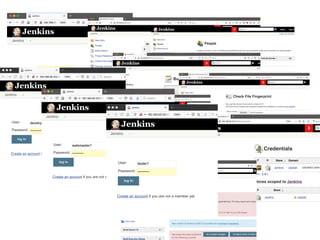
• Jenkins 2.121.1
• Considered the vulnerabilities discovered in the 2nd half of
2018 that are targeted by our approach
• eight vulnerabilities
32
RQ2 - Setup
• Data collection:
• Executed Crawljax against the two systems for a maximum of
five hours or till exploration is exhausted
• Implemented manual test scripts that exercise features not
exercised by Crawljax
• Testing:
• Considered 11 MRs covering the type of vulnerabilities affecting
the system
33
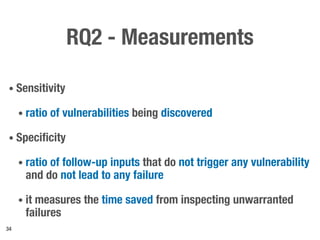
RQ2 - Measurements
• Sensitivity
• ratio of vulnerabilities being discovered
• Specificity
• ratio of follow-up inputs that do not trigger any vulnerability
and do not lead to any failure
• it measures the time saved from inspecting unwarranted
failures
34
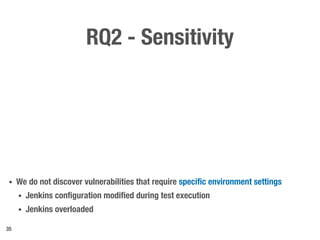
RQ2 - Sensitivity
• We do not discover vulnerabilities that require specific environment settings
• Jenkins configuration modified during test execution
• Jenkins overloaded
Case
study
Total
Vulnerabilities
Discovered vulnerabilities Sensitivity
Crawljax Crawljax &
Manual
Crawljax Crawljax &
Manual
EDLAH2 4 3 4 75% 100%
Jenkins 8 4 6 50% 75%
Total 12 7 10 58.33% 83.33%
35
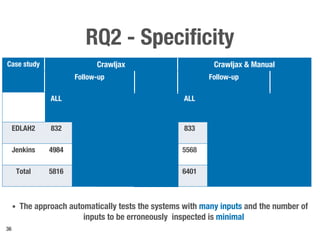
RQ2 - Specificity
• Run 11 metamorphic relations
Case study Crawljax Crawljax & Manual
Follow-up Follow-up
ALL FP TP or
No alarm
Sensitivity ALL FP TP or
No alarm
Sensitivity
EDLAH2 832 0 832 100% 833 0 833 100%
Jenkins 4984 33 4951 99.34% 5568 32 5536 99.43%
Total 5816 33 5783 99.43% 6401 32 6369 99.50%
36
• The approach automatically tests the systems with many inputs and the number of
inputs to be erroneously inspected is minimal
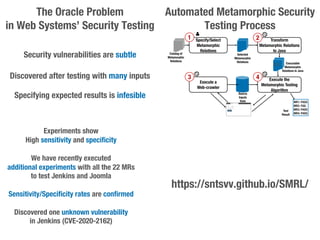
The Oracle Problem
in Web Systems’ Security Testing
2
Security vulnerabilities are subtle
Discovered after testing with many inputs
Specifying expected results is infesible
Automated Metamorphic Security
Testing Process
8
Catalog of
Metamorphic
Relations
Selected
Metamorphic
Relations
Transform
Metamorphic Relations
to Java
2
Execute a
Web-crawler
3
Specify/Select
Metamorphic
Relations
1
Executable
Metamorphic
Relations in Java
Source
Inputs
Data
Execute the
Metamorphic Testing
Algorithm
4
MR1: PASS
MR2: FAIL
MR3: PASS
MR4: PASS
Test
Result
Experiments show
High sensitivity and specificity
We have recently executed
additional experiments with all the 22 MRs
to test Jenkins and Joomla
Sensitivity/Specificity rates are confirmed
Discovered one unknown vulnerability
in Jenkins (CVE-2020-2162)
https://sntsvv.github.io/SMRL/

Metamorphic Security Testing for Web Systems

  • 1.
    .lusoftware verification &validation VVS Metamorphic Security Testing for Web Systems Phu X. Mai*, Fabrizio Pastore*, Arda Goknil*, Lionel Briand*# * SnT Centre, University of Luxembourg #School of EECS, University of Ottawa
  • 2.
    The Oracle Problem inWeb Systems Security Testing 2 Security vulnerabilities are subtle Discovered when testing with many inputs Specifying expected results is infeasible
  • 3.
  • 4.
    Metamorphic Testing Alleviates theOracle Problem • Metamorphic Relations: necessary properties of the program under test in relation to multiple inputs and their expected outputs 4 x1=(G,a,f) ∧ x2=(G,f,a) len(shortPath(x1))=len(shortPath(x2)) a b c d e f fSource input Follow-up input
  • 5.
    Combined with an automatedstrategy to select source inputs, metamorphic relations enable automated testing 5
  • 6.
    Metamorphic Security Testing ofWeb Systems • Source input: a sequence of valid interactions with the system • Follow-up input: generated by altering valid interactions as an attacker would do • Relations: capture properties that hold when the system is not vulnerable 6 {login(Admin), RequestURL(settings_page)} {login(User1), RequestURL(settings_page)}
  • 7.
    Metamorphic Security Testing ofWeb Systems • Source input: a sequence of valid interactions with the system • Follow-up input: generated by altering valid interactions as an attacker would do • Relations: capture properties that hold when the system is not vulnerable 7 {login(Admin), RequestURL(settings_page)} {login(User1), RequestURL(settings_page)} if the follow-up user cannot access the URL from his GUI then the output of the source and follow-up inputs should be different
  • 8.
    Automated Metamorphic Security TestingProcess 8 Catalog of Metamorphic Relations Selected Metamorphic Relations Translate Metamorphic Relations to Java 2 Execute a Web-crawler 3 Specify/Select Metamorphic Relations 1 Executable Metamorphic Relations in Java Source Inputs Data Execute the Metamorphic Testing Algorithm 4 MR1: PASS MR2: FAIL MR3: PASS MR4: PASS Test Result
  • 9.
  • 10.
    SMRL Basic Features •Extension of Xbase: • Java-like • Automated generation of Java executables from specifications • SMRL provides seven boolean operators • IMPLIES, AND, OR, TRUE, FALSE, and NOT • EQUAL • Evaluate the equality of two arguments • Define follow-up inputs • enable writing metamorphic relations in declarative form 10
  • 11.
    Data Types 11 InputSequence InputTypes OutputSequence OutputTypes Action1..* 0..1 SessionUser 0..1 HtmlOutput 1..* Request URL Anchor click Button click Text fill
  • 12.
    12 Data Representation Functions Datafunction Description Input(int n) Identifies the nth input sequence referred to in a MR. User(int n) Identifies the nth user referred in a MR. User() Identifies the 1st user referred in a MR. Action(int n) Identifies the nth input action referred in a MR. Session(int n) Identifies the nth Web session referred in a MR. Output(Input n) Identifies the sequence of outputs generated by the nth input. Output(Input n, int i) Identifies the output generated by the ith action of the nth input. …
  • 13.
    Web-specific Functions • changeCredentials(Input i, User u) • Modifies an input sequence so that the credentials of the specified user are used in the login action changeCredentials( Input(1), User() ) • Input(1): {login(Admin), RequestURL(settings_page) } • User(): User1 • Result: {login(User1), RequestURL(settings_page) } • cannotReachTroughGUI( User u, String URL) • Returns true if, based on the crawled data, a URL cannot be reached by the given user by exploring the user interface of the system 13
  • 14.
    Metamorphic Relation Example: BypassAuthorization Schema 14
  • 15.
    Metamorphic Relation Example: BypassAuthorization Schema 15 Data function Boolean operator Web specific function
  • 16.
    Metamorphic Relation Example: BypassAuthorization Schema 16 Data function Boolean operator Web specific function
  • 17.
    Metamorphic Relation Example: BypassAuthorization Schema 17 Data function Boolean operator Web specific function
  • 18.
    Metamorphic Relation Example: BypassAuthorization Schema 18 Data function Boolean operator Web specific function
  • 19.
    Metamorphic Relation Example: BypassAuthorization Schema 19 Our metamorphic testing algorithm executes each MR multiple times, to ensure that every possible combination of source inputs is exercised
  • 20.
    20 Source Inputs ofType InputSequence {login(Admin), RequestURL(personal_page)} {login(Admin), RequestURL(settings_page)} {login(User1), RequestURL(personal_page)} {login(User1), RequestURL(project_page)} Source Inputs of Type User User1 Admin Tested Combinations Source Inputs Follow-up Inputs {login(Admin), RequestURL(personal_page)} + User1 / {login(Admin), RequestURL(settings_page)} + User1 {login(User1), RequestURL(settings_page)} {login(User1), RequestURL(personal_page)} + Admin / {login(User1), RequestURL(project_page)} {login(Admin), RequestURL(personal_page)}
  • 21.
    Java Integration • Metamorphicrelations are automatically translated into executable Java code • They can be selected in Junit test cases 21
  • 22.
    Deriving Source Inputsfrom Data Crawled with Crawljax
  • 23.
    Deriving Source Inputsfrom Test Scripts • For test scripts manually implemented for functional testing, we can derive source inputs from them • we support Selenium-based scripts • a test script represent an InputSequence 23
  • 24.
    24 Executable Metamorphic Relation in Java Source Inputs data Metamorphic Testing Algorithm 4 Follow-up input Test result Executor Verifyrelation Metamorphic Testing Execution Source input Action1 Action2 Action3 Action1 Action2’ Action3 Follow-up Output Source Output Output1 Output2 Output3 Output1 Output2’’ Output3MR PASS/FAIL Repeat
  • 25.
    Metamorphic Relations Catalog •Includes 22 Security Metamorphic Relations derived from OWASP testing guidelines 25 Vulnerability type # Metamorphic relations Broken Authentication 6 Sensitive Data Exposure 5 Broken Access Control 7 Security Misconfiguration 3 Vulnerable Components 1
  • 26.
    Broken Authentication • Objective:verify that a session always changes after a logout • Source input: sequence of actions performed after log-in • Follow-up input: add a logout action after an action of the source InputSequence • Relation: session IDs before and after logout action should be different 26
  • 27.
    Sensitive Data Exposure •Objective: verify that a user cannot retrieve sensitive data by simply altering a URL parameter value • Source input: sequence of actions including at least one action containing a URL parameter (action X) • Follow-up input: change the URL parameter value for the action X (action X’) using a value observed only with other users • Relation: the output of the action X’ either contains an error message or contains data that is not sensitive • e.g., it should contain data that has been already retrieved by the same user in the recorded source inputs 27
  • 28.
    Evaluation • RQ1. Towhat extent can metamorphic testing address the oracle problem in the context of Web security testing? • Determine which types of security testing activities can be automated by our solution to address the oracle problem • RQ2. Is the proposed solution effective? • Determine if the proposed solution enables the automated detection of security vulnerabilities 30
  • 29.
    Evaluation • RQ1. Towhat extent can metamorphic testing address the oracle problem in the context of Web security testing? • Determine which types of security testing activities can be automated by our solution to address the oracle problem • RQ2. Is the proposed solution effective? • Determine if the proposed solution enables the automated detection of security vulnerabilities 31
  • 30.
    RQ2 - CaseStudies • Case studies • Commercial system developed in an EU project (EDLAH2) • four vulnerabilities • Jenkins 2.121.1 • Considered the vulnerabilities discovered in the 2nd half of 2018 that are targeted by our approach • eight vulnerabilities 32
  • 31.
    RQ2 - Setup •Data collection: • Executed Crawljax against the two systems for a maximum of five hours or till exploration is exhausted • Implemented manual test scripts that exercise features not exercised by Crawljax • Testing: • Considered 11 MRs covering the type of vulnerabilities affecting the system 33
  • 32.
    RQ2 - Measurements •Sensitivity • ratio of vulnerabilities being discovered • Specificity • ratio of follow-up inputs that do not trigger any vulnerability and do not lead to any failure • it measures the time saved from inspecting unwarranted failures 34
  • 33.
    RQ2 - Sensitivity •We do not discover vulnerabilities that require specific environment settings • Jenkins configuration modified during test execution • Jenkins overloaded Case study Total Vulnerabilities Discovered vulnerabilities Sensitivity Crawljax Crawljax & Manual Crawljax Crawljax & Manual EDLAH2 4 3 4 75% 100% Jenkins 8 4 6 50% 75% Total 12 7 10 58.33% 83.33% 35
  • 34.
    RQ2 - Specificity •Run 11 metamorphic relations Case study Crawljax Crawljax & Manual Follow-up Follow-up ALL FP TP or No alarm Sensitivity ALL FP TP or No alarm Sensitivity EDLAH2 832 0 832 100% 833 0 833 100% Jenkins 4984 33 4951 99.34% 5568 32 5536 99.43% Total 5816 33 5783 99.43% 6401 32 6369 99.50% 36 • The approach automatically tests the systems with many inputs and the number of inputs to be erroneously inspected is minimal
  • 35.
    The Oracle Problem inWeb Systems’ Security Testing 2 Security vulnerabilities are subtle Discovered after testing with many inputs Specifying expected results is infesible Automated Metamorphic Security Testing Process 8 Catalog of Metamorphic Relations Selected Metamorphic Relations Transform Metamorphic Relations to Java 2 Execute a Web-crawler 3 Specify/Select Metamorphic Relations 1 Executable Metamorphic Relations in Java Source Inputs Data Execute the Metamorphic Testing Algorithm 4 MR1: PASS MR2: FAIL MR3: PASS MR4: PASS Test Result Experiments show High sensitivity and specificity We have recently executed additional experiments with all the 22 MRs to test Jenkins and Joomla Sensitivity/Specificity rates are confirmed Discovered one unknown vulnerability in Jenkins (CVE-2020-2162) https://sntsvv.github.io/SMRL/