Unit- 8
The d & f block elements
RAJESH KUMAR G
PGT CHEMISTRY
JNV KOLLAM,KERALA
HYDERABAD REGION
The transition elements
(d-block)
Introduction
d-block elements:
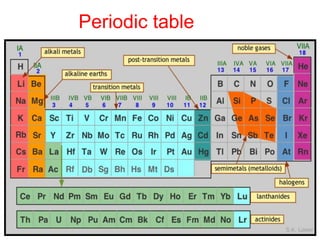
•Elements belonging to group 3 to12 of the
periodic table are known as d-block elements.
•In these elements last electron enter in to
penultimate d-orbital.
•d-block elements lie between s and p-block
elements.
Outline
• Transition series
• General electronic configuration
• General characteristics
 M.p & B.p  Atomic and ionic size
 Ionisation enthalpy  Oxidation state
 Reactivity  Magnetic properties
 Standard electrode
potential.
Periodic table
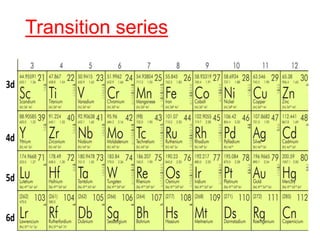
Transition series
Transition series
• d-block consists of four transition series
• 1st Transition series or 3d series 21Sc to 30Zn
• 2nd Transition series or 4d series 39Y to 48Cd
• 3rd Transition series or 5d series 57La, 72Hf to
80Hg
• 4th Transition series or 6d series 89Ac, 104Rf to
112Cn
Transition Elements
Transition elements:
• Element which has partially filled penultimate d-
subshell in ground state or most common oxidation
state are known as transition elements.
• All d-block elements are not transition elements but all
transition elements are d- block elements.
• Transition elements have partially filled d- subshell in
ground state or most common oxidation state .But all d-
block elements not follow this.
• Zn, Cd & Hg are not considered as transition metals.
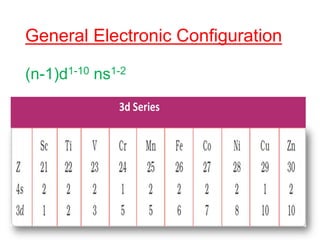
General Electronic Configuration
(n-1)d1-10 ns1-2
General properties of transition elements
• Magnetic properties.
• Coloured ions.
• Formation of complexes
• Catalytic properties
• Formation of interstitial
compounds.
• Oxide formation.
• M.p & B.p
• Atomic and ionic size
• Ionisation enthalpy
• Oxidation state
• Standard electrode
potential.
• Reactivity
Melting and Boiling Point
Melting and Boiling Point: Generally High
• d block elements have large no. of unpaired electrons
hence they form strong metallic bond. Their melting
and boiling points are high.
Specific cases:
• Exceptionally Zn ,Cd and Hg have low melting and
boiling point.
• Mn and Tc have abnormally low m.p.
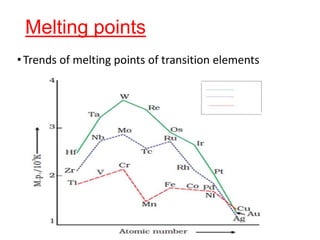
• Group 6 elements have highest m.p in corresponding
period (Cr, Mo, W).
• Tungsten has highest m.p among metals.
Melting points
•Trends of melting points of transition elements
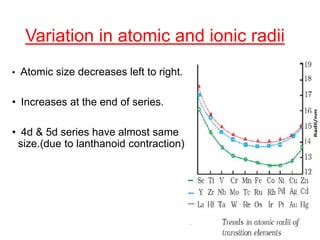
Variation in atomic and ionic radii
• Atomic size decreases left to right.
• Increases at the end of series.
• 4d & 5d series have almost same
size.(due to lanthanoid contraction)
Ionisation Enthalpy
• Generally increases due to increases in nuclear charge
from left to right in series .
• IE1<IE2< IE3 in each group due to positive charge on
them.
• IE1 of 5d series is much higher than those of 4d and 3d
due to weak shielding by 4f electrons.
Oxidation State
• Transition elements have variable oxidation state , due
to very small energy difference between(n-1)d and ns
subshell . Electrons from both the subshell take part in
bonding.
• No. of Oxidation states α no. of unpaired electrons.
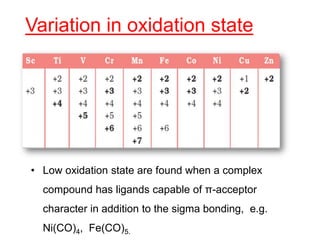
• Mn shows all oxidation states from +2 to +7 .
Variation in oxidation state
• Low oxidation state are found when a complex
compound has ligands capable of π-acceptor
character in addition to the sigma bonding, e.g.
Ni(CO)4, Fe(CO)5.
Standard electrode potential
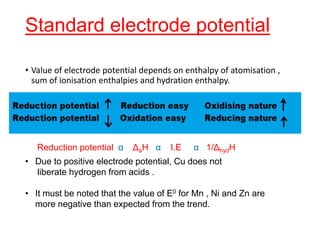
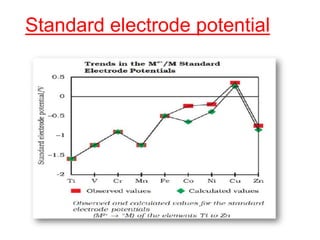
• Value of electrode potential depends on enthalpy of atomisation ,
sum of ionisation enthalpies and hydration enthalpy.
Reduction potential α ΔaH α I.E α 1/ΔhydH
• Due to positive electrode potential, Cu does not
liberate hydrogen from acids .
• It must be noted that the value of E0 for Mn , Ni and Zn are
more negative than expected from the trend.
Standard electrode potential
Reactivity
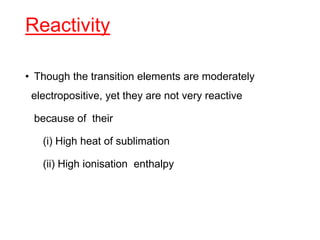
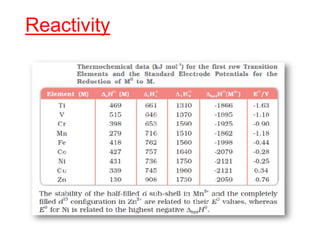
• Though the transition elements are moderately
electropositive, yet they are not very reactive
because of their
(i) High heat of sublimation
(ii) High ionisation enthalpy
Reactivity
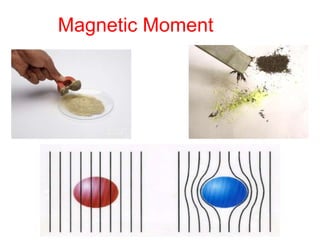
Magnetic Moment
• Transition metals and compounds are paramagnetic due to the
presence of unpaired electrons in their d-subshell.
• Substances which do not contain unpaired electrons and repel by
magnetic field are dia-magnetic.
• Weakly attracted-----Paramagnetic
• Strongly attracted-----Ferromagnetic
• The spin only magnetic moment can be calculated by the formula
µ=√ n(n+2) BM where n is the no .of unpaired electrons.
Magnetic Moment
General Properties of
d-Block elements
Outline
 General characteristics of d-Block elements:
• Formation of coloured ions.
• Formation of complex compound.
• Catalytic property.
• Formation of interstitial compounds.
• Alloy formation.
Formation of Coloured
compounds
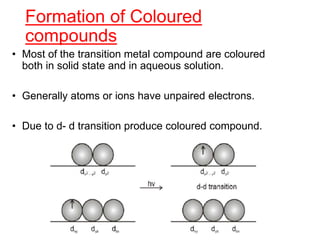
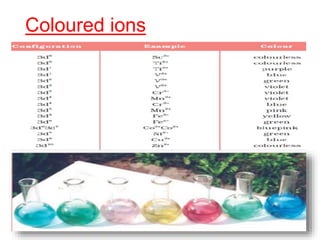
• Most of the transition metal compound are coloured
both in solid state and in aqueous solution.
• Generally atoms or ions have unpaired electrons.
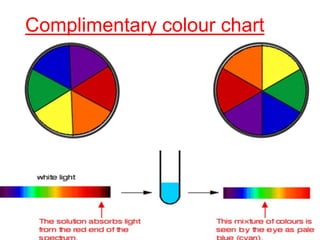
• Due to d- d transition produce coloured compound.
Coloured ions
Complimentary colour chart
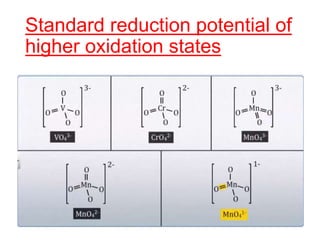
Standard reduction potential of
higher oxidation states
Complex Formation
• The tendency to form complex compounds is due to-
• Small size of the ion
• High charge on the transition metal ion.
• The availability of d orbitals for accommodating
electrons donated by the ligands.
• Cu2+ (aq) + 4 NH3 (aq)  [Cu(NH3)4]2+ (aq)
(blue) (deep blue)
• AgCl (s) + 2 NH3 (aq) → [Ag (NH3)2]Cl (aq)
(white ppt) (Colourless )
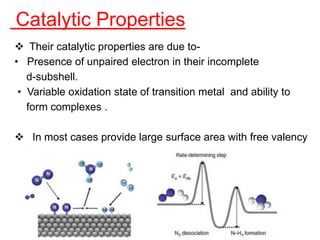
Catalytic Properties
 Their catalytic properties are due to-
• Presence of unpaired electron in their incomplete
d-subshell.
• Variable oxidation state of transition metal and ability to
form complexes .
 In most cases provide large surface area with free valency
.
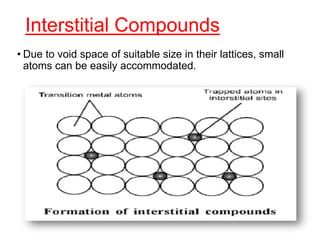
Interstitial Compounds
• Due to void space of suitable size in their lattices, small
atoms can be easily accommodated.
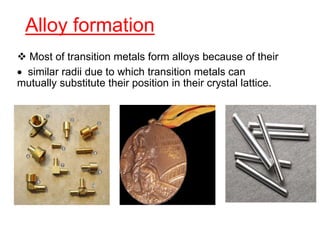
Alloy formation
 Most of transition metals form alloys because of their
 similar radii due to which transition metals can
mutually substitute their position in their crystal lattice.
Formation of Oxides
 Transition metals form oxides of general
composition MO, M2O3, MO2 and MO6, etc.
 Lower oxidation state: Basic
Higher oxidation state: Amphoteric or Acidic
MnO Mn2O3,Mn3O4,MnO2 Mn2O7
Basic Amphoteric Acidic
Some important compounds
of transition elements
Outline
 Potassium dichromate:
Methods of preparation , Properties and Uses.
 Potassium permanganate:
Methods of preparation , Properties and Uses.
 Structure of Permanganate and Dichromate ions.
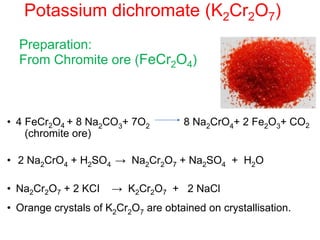
Potassium dichromate (K2Cr2O7)
Preparation:
From Chromite ore (FeCr2O4)
• 4 FeCr2O4 + 8 Na2CO3+ 7O2 8 Na2CrO4+ 2 Fe2O3+ CO2
(chromite ore)
• 2 Na2CrO4 + H2SO4 → Na2Cr2O7 + Na2SO4 + H2O
• Na2Cr2O7 + 2 KCI → K2Cr2O7 + 2 NaCl
• Orange crystals of K2Cr2O7 are obtained on crystallisation.
Properties of potassium
dichromate
 Physical Properties:
•Orange-red coloured crystalline compound.
•Moderately soluble in cold water but freely soluble in
hot water.
•It melts at 398°C.
• K2Cr2O7 is preferred over Na2Cr2O7 as a primary
standard in volumetric estimation because Na2Cr2O7
is hygroscopic in nature but K2Cr2O7 is not.
Effect of pH on Potassium
dichromate
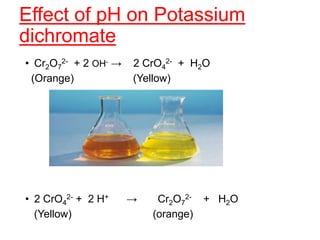
• Cr2O7
2- + 2 OH- → 2 CrO4
2- + H2O
(Orange) (Yellow)
• 2 CrO4
2- + 2 H+ → Cr2O7
2- + H2O
(Yellow) (orange)
Oxidising nature of Potassium
dichromate
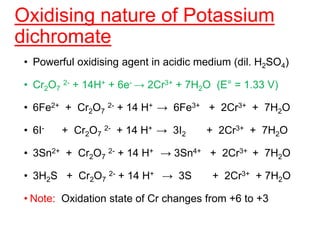
• Powerful oxidising agent in acidic medium (dil. H2SO4)
• Cr2O7
2- + 14H+ + 6e- → 2Cr3+ + 7H2O (E° = 1.33 V)
• 6Fe2+ + Cr2O7
2- + 14 H+ → 6Fe3+ + 2Cr3+ + 7H2O
• 6I- + Cr2O7
2- + 14 H+ → 3I2 + 2Cr3+ + 7H2O
• 3Sn2+ + Cr2O7
2- + 14 H+ → 3Sn4+ + 2Cr3+ + 7H2O
• 3H2S + Cr2O7
2- + 14 H+ → 3S + 2Cr3+ + 7H2O
• Note: Oxidation state of Cr changes from +6 to +3
Uses Of Potassium Dichromate
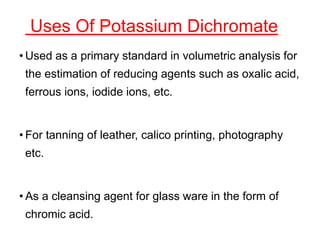
• Used as a primary standard in volumetric analysis for
the estimation of reducing agents such as oxalic acid,
ferrous ions, iodide ions, etc.
• For tanning of leather, calico printing, photography
etc.
• As a cleansing agent for glass ware in the form of
chromic acid.
POTASSIUM
PERMANGANATE (KMnO4)
• POTASSIUM PERMANGANATE (KMnO4)
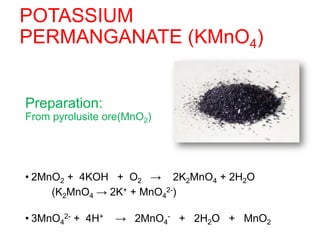
Preparation:
From pyrolusite ore(MnO2)
• 2MnO2 + 4KOH + O2 → 2K2MnO4 + 2H2O
(K2MnO4 → 2K+ + MnO4
2-)
• 3MnO4
2- + 4H+ → 2MnO4
- + 2H2O + MnO2
Properties
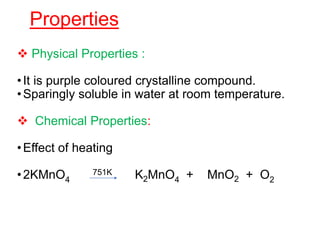
 Physical Properties :
•It is purple coloured crystalline compound.
•Sparingly soluble in water at room temperature.
 Chemical Properties:
•Effect of heating
•2KMnO4
751K K2MnO4 + MnO2 + O2
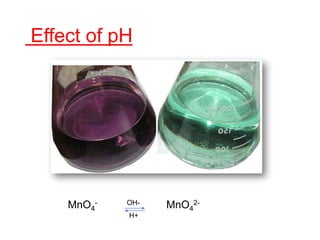
Effect of pH
MnO4
- OH- MnO4
2-
H+
Oxidising nature of KMnO4
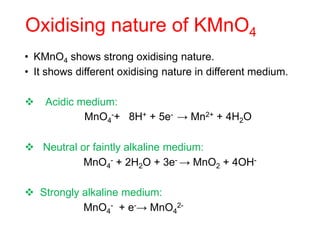
• KMnO4 shows strong oxidising nature.
• It shows different oxidising nature in different medium.
 Acidic medium:
MnO4
-+ 8H+ + 5e- → Mn2+ + 4H2O
 Neutral or faintly alkaline medium:
MnO4
- + 2H2O + 3e- → MnO2 + 4OH-
 Strongly alkaline medium:
MnO4
- + e-→ MnO4
2-
Oxidising nature of KMnO4
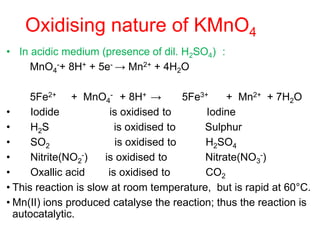
• In acidic medium (presence of dil. H2SO4) :
MnO4
-+ 8H+ + 5e- → Mn2+ + 4H2O
5Fe2+ + MnO4
- + 8H+ → 5Fe3+ + Mn2+ + 7H2O
• Iodide is oxidised to Iodine
• H2S is oxidised to Sulphur
• SO2 is oxidised to H2SO4
• Nitrite(NO2
-) is oxidised to Nitrate(NO3
-)
• Oxallic acid is oxidised to CO2
• This reaction is slow at room temperature, but is rapid at 60°C.
• Mn(II) ions produced catalyse the reaction; thus the reaction is
autocatalytic.
Oxidising nature of KMnO4
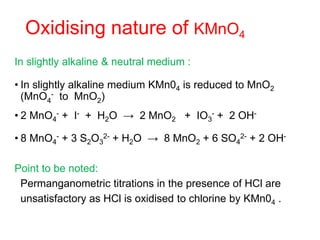
In slightly alkaline & neutral medium :
• In slightly alkaline medium KMn04 is reduced to MnO2
(MnO4
- to MnO2)
• 2 MnO4
- + I- + H2O → 2 MnO2 + IO3
- + 2 OH-
• 8 MnO4
- + 3 S2O3
2- + H2O → 8 MnO2 + 6 SO4
2- + 2 OH-
Point to be noted:
Permanganometric titrations in the presence of HCl are
unsatisfactory as HCl is oxidised to chlorine by KMn04 .
Uses of KMnO4
• Used as an oxidising agent in laboratory and industry.
• Alkaline potassium permanganate is called Bayer's reagent.
This reagent is used in organic chemistry for testing
unsaturation.
• KMnO4 is used in the manufacture of saccharin, benzoic
acid, acetaldehyde,etc.
• KMnO4 is used as a reagent in qualitative analysis and as
primary standard in quantitative analysis.
• KMnO4 is used as an antiseptic
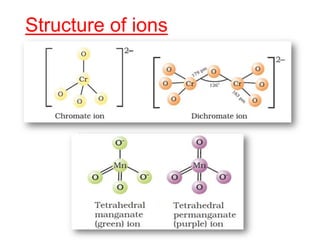
Structure of ions
The Inner transition
elements(f-block)
OUTLINE
• General electronic configuration.
• General properties of inner transition elements.
• Lanthanide and Actinide contraction.
• Properties of lanthanides and Actinides
• Uses of Lanthanides and Actinides
• Difference between lanthanides and actinides
Introduction of f-block
elements
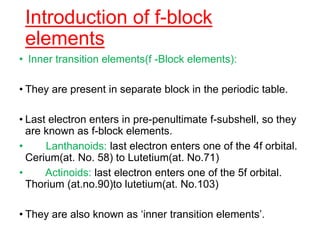
• Inner transition elements(f -Block elements):
• They are present in separate block in the periodic table.
• Last electron enters in pre-penultimate f-subshell, so they
are known as f-block elements.
• Lanthanoids: last electron enters one of the 4f orbital.
Cerium(at. No. 58) to Lutetium(at. No.71)
• Actinoids: last electron enters one of the 5f orbital.
Thorium (at.no.90)to lutetium(at. No.103)
• They are also known as ‘inner transition elements’.
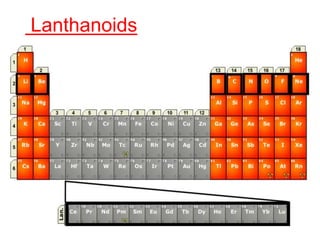
Lanthanoids
Lanthanoids
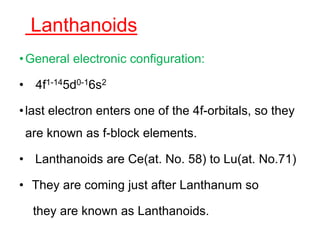
•General electronic configuration:
• 4f1-145d0-16s2
•last electron enters one of the 4f-orbitals, so they
are known as f-block elements.
• Lanthanoids are Ce(at. No. 58) to Lu(at. No.71)
• They are coming just after Lanthanum so
they are known as Lanthanoids.
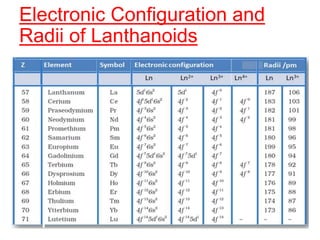
Electronic Configuration and
Radii of Lanthanoids
Lanthanoid Contraction
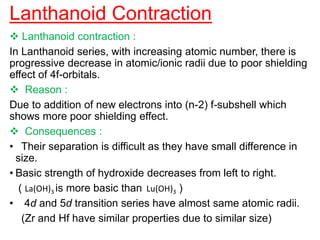
 Lanthanoid contraction :
In Lanthanoid series, with increasing atomic number, there is
progressive decrease in atomic/ionic radii due to poor shielding
effect of 4f-orbitals.
 Reason :
Due to addition of new electrons into (n-2) f-subshell which
shows more poor shielding effect.
 Consequences :
• Their separation is difficult as they have small difference in
size.
• Basic strength of hydroxide decreases from left to right.
( La(OH)3 is more basic than Lu(OH)3 )
• 4d and 5d transition series have almost same atomic radii.
(Zr and Hf have similar properties due to similar size)
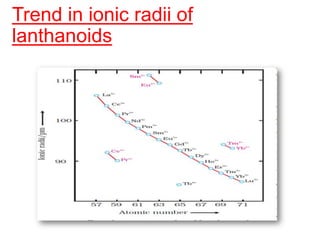
Trend in ionic radii of
lanthanoids
Physical properties of
Lanthanoids
• The lanthanoids are highly dense metals.
• They have high melting points.
• They form alloys easily with other metals.
• They are soft, malleable and ductile with low
tensile strength.
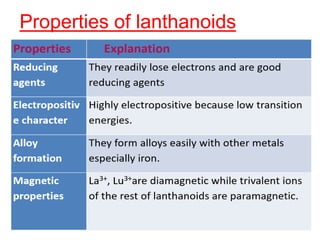
Properties of lanthanoids
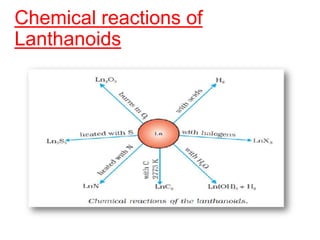
Chemical reactions of
Lanthanoids
Uses of lanthanoids
•Used in mischmetal an alloy of a lanthanoid
( 95%) with iron ( 5%) and traces of S, C, Ca & Al.
•It is used to make tracer bells, shells and lighter
flints.
Actinoids
• The actinoids include the fourteen elements from
Th(at.no.90) to Lr(at.no.103)
•The actinoids are radioactive elements.
•The earlier members have relatively long half-
lives, latter ones have half life values ranging
from a day to 3 minutes for lawrencium (Z =103).
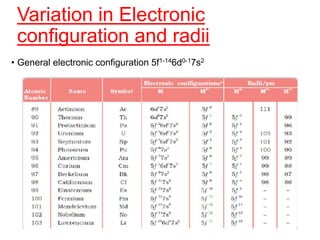
Variation in Electronic
configuration and radii
• General electronic configuration 5f1-146d0-17s2
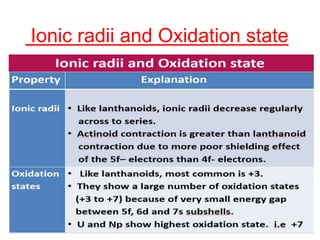
Ionic radii and Oxidation state
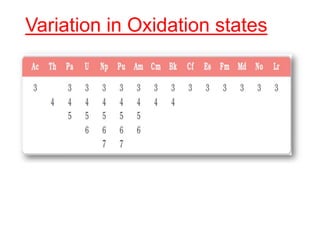
Variation in Oxidation states
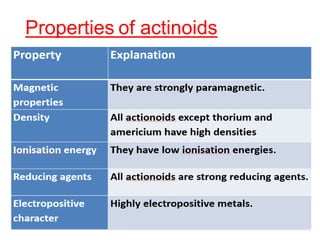
Properties of actinoids
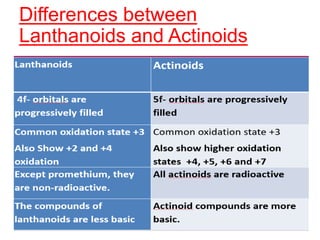
Differences between
Lanthanoids and Actinoids
Uses
• Uses of actinoids :
• Th is used in atomic reactor and
treatment of cancer.
• U and Pu are used as fuel in nuclear
reactor.
Summary
• Transition (d- block ) elements.
• Transition series.
• General electronic configuration.
• Trends of properties in series.
• General characteristics
 General characteristics of d-Block elements:
• Formation of coloured ions.
• Formation of complex compound.
• Catalytic property.
• Formation of interstitial compounds.
• Alloy formation.
 Potassium dichromate:
Methods of preparation , Properties and Uses.
 Potassium permanganate:
Methods of preparation , Properties and Uses.
 Structure of Permanganate and Dichromate ions.
• General properties of inner transition elements.
• General electronic configuration.
• Lanthanoid and Actinoids contraction.
• Properties of lanthanoids and Actinoids
• Uses of Lanthanoids and Actinoids
• Differences between lanthanoids and Actinoids
Home Assignment
Account for the following:
• Transition elements exhibit higher enthalpies of atomization.
• Transition metals show paramagnetic behaviour.
• Transition metal ions form complexs .
• Transition metals form interstitial compounds.
• Most of the transition metals form alloys.
• Transition element form generally coloured compounds
• Transition elements show variable oxidation state.
• How Potassium dichromate is prepare from Chromite
ore.
• Write the chemical reactions involved in the preparation
of potassium permanganate.
• The chromates and dichromates are interconvertible in
aqueous solution depending upon pH of solution. Give
reactions.
• What is meant by ‘disproportionation of an oxidation
state ? Give two example.
• Give reasons for the following questions:
• Chemistry of all the lanthanoids are quite similar.
• Size of trivalent lanthanoid cations decreases with increase
in the atomic number.
• It is difficult to separate lanthanoid elements in pure state.
• Ce4+ in aqueous solution is a good oxidizing agent.
• Ce3+ can be easily oxidized to Ce4+.
• d-block elements exhibit more oxidation states than
f - block elements
THANK YOU

d and f block elements.pptx

  • 1.
    Unit- 8 The d& f block elements RAJESH KUMAR G PGT CHEMISTRY JNV KOLLAM,KERALA HYDERABAD REGION
  • 2.
    The transition elements (d-block) Introduction d-blockelements: •Elements belonging to group 3 to12 of the periodic table are known as d-block elements. •In these elements last electron enter in to penultimate d-orbital. •d-block elements lie between s and p-block elements.
  • 3.
    Outline • Transition series •General electronic configuration • General characteristics  M.p & B.p  Atomic and ionic size  Ionisation enthalpy  Oxidation state  Reactivity  Magnetic properties  Standard electrode potential.
  • 4.
  • 5.
  • 6.
    Transition series • d-blockconsists of four transition series • 1st Transition series or 3d series 21Sc to 30Zn • 2nd Transition series or 4d series 39Y to 48Cd • 3rd Transition series or 5d series 57La, 72Hf to 80Hg • 4th Transition series or 6d series 89Ac, 104Rf to 112Cn
  • 7.
    Transition Elements Transition elements: •Element which has partially filled penultimate d- subshell in ground state or most common oxidation state are known as transition elements. • All d-block elements are not transition elements but all transition elements are d- block elements. • Transition elements have partially filled d- subshell in ground state or most common oxidation state .But all d- block elements not follow this. • Zn, Cd & Hg are not considered as transition metals.
  • 8.
  • 9.
    General properties oftransition elements • Magnetic properties. • Coloured ions. • Formation of complexes • Catalytic properties • Formation of interstitial compounds. • Oxide formation. • M.p & B.p • Atomic and ionic size • Ionisation enthalpy • Oxidation state • Standard electrode potential. • Reactivity
  • 10.
    Melting and BoilingPoint Melting and Boiling Point: Generally High • d block elements have large no. of unpaired electrons hence they form strong metallic bond. Their melting and boiling points are high. Specific cases: • Exceptionally Zn ,Cd and Hg have low melting and boiling point. • Mn and Tc have abnormally low m.p. • Group 6 elements have highest m.p in corresponding period (Cr, Mo, W). • Tungsten has highest m.p among metals.
  • 11.
    Melting points •Trends ofmelting points of transition elements
  • 12.
    Variation in atomicand ionic radii • Atomic size decreases left to right. • Increases at the end of series. • 4d & 5d series have almost same size.(due to lanthanoid contraction)
  • 13.
    Ionisation Enthalpy • Generallyincreases due to increases in nuclear charge from left to right in series . • IE1<IE2< IE3 in each group due to positive charge on them. • IE1 of 5d series is much higher than those of 4d and 3d due to weak shielding by 4f electrons.
  • 14.
    Oxidation State • Transitionelements have variable oxidation state , due to very small energy difference between(n-1)d and ns subshell . Electrons from both the subshell take part in bonding. • No. of Oxidation states α no. of unpaired electrons. • Mn shows all oxidation states from +2 to +7 .
  • 15.
    Variation in oxidationstate • Low oxidation state are found when a complex compound has ligands capable of π-acceptor character in addition to the sigma bonding, e.g. Ni(CO)4, Fe(CO)5.
  • 16.
    Standard electrode potential •Value of electrode potential depends on enthalpy of atomisation , sum of ionisation enthalpies and hydration enthalpy. Reduction potential α ΔaH α I.E α 1/ΔhydH • Due to positive electrode potential, Cu does not liberate hydrogen from acids . • It must be noted that the value of E0 for Mn , Ni and Zn are more negative than expected from the trend.
  • 17.
  • 18.
    Reactivity • Though thetransition elements are moderately electropositive, yet they are not very reactive because of their (i) High heat of sublimation (ii) High ionisation enthalpy
  • 19.
  • 20.
    Magnetic Moment • Transitionmetals and compounds are paramagnetic due to the presence of unpaired electrons in their d-subshell. • Substances which do not contain unpaired electrons and repel by magnetic field are dia-magnetic. • Weakly attracted-----Paramagnetic • Strongly attracted-----Ferromagnetic • The spin only magnetic moment can be calculated by the formula µ=√ n(n+2) BM where n is the no .of unpaired electrons.
  • 21.
  • 22.
  • 23.
    Outline  General characteristicsof d-Block elements: • Formation of coloured ions. • Formation of complex compound. • Catalytic property. • Formation of interstitial compounds. • Alloy formation.
  • 24.
    Formation of Coloured compounds •Most of the transition metal compound are coloured both in solid state and in aqueous solution. • Generally atoms or ions have unpaired electrons. • Due to d- d transition produce coloured compound.
  • 25.
  • 26.
  • 27.
    Standard reduction potentialof higher oxidation states
  • 28.
    Complex Formation • Thetendency to form complex compounds is due to- • Small size of the ion • High charge on the transition metal ion. • The availability of d orbitals for accommodating electrons donated by the ligands. • Cu2+ (aq) + 4 NH3 (aq)  [Cu(NH3)4]2+ (aq) (blue) (deep blue) • AgCl (s) + 2 NH3 (aq) → [Ag (NH3)2]Cl (aq) (white ppt) (Colourless )
  • 29.
    Catalytic Properties  Theircatalytic properties are due to- • Presence of unpaired electron in their incomplete d-subshell. • Variable oxidation state of transition metal and ability to form complexes .  In most cases provide large surface area with free valency .
  • 30.
    Interstitial Compounds • Dueto void space of suitable size in their lattices, small atoms can be easily accommodated.
  • 31.
    Alloy formation  Mostof transition metals form alloys because of their  similar radii due to which transition metals can mutually substitute their position in their crystal lattice.
  • 32.
    Formation of Oxides Transition metals form oxides of general composition MO, M2O3, MO2 and MO6, etc.  Lower oxidation state: Basic Higher oxidation state: Amphoteric or Acidic MnO Mn2O3,Mn3O4,MnO2 Mn2O7 Basic Amphoteric Acidic
  • 33.
    Some important compounds oftransition elements
  • 34.
    Outline  Potassium dichromate: Methodsof preparation , Properties and Uses.  Potassium permanganate: Methods of preparation , Properties and Uses.  Structure of Permanganate and Dichromate ions.
  • 35.
    Potassium dichromate (K2Cr2O7) Preparation: FromChromite ore (FeCr2O4) • 4 FeCr2O4 + 8 Na2CO3+ 7O2 8 Na2CrO4+ 2 Fe2O3+ CO2 (chromite ore) • 2 Na2CrO4 + H2SO4 → Na2Cr2O7 + Na2SO4 + H2O • Na2Cr2O7 + 2 KCI → K2Cr2O7 + 2 NaCl • Orange crystals of K2Cr2O7 are obtained on crystallisation.
  • 36.
    Properties of potassium dichromate Physical Properties: •Orange-red coloured crystalline compound. •Moderately soluble in cold water but freely soluble in hot water. •It melts at 398°C. • K2Cr2O7 is preferred over Na2Cr2O7 as a primary standard in volumetric estimation because Na2Cr2O7 is hygroscopic in nature but K2Cr2O7 is not.
  • 37.
    Effect of pHon Potassium dichromate • Cr2O7 2- + 2 OH- → 2 CrO4 2- + H2O (Orange) (Yellow) • 2 CrO4 2- + 2 H+ → Cr2O7 2- + H2O (Yellow) (orange)
  • 38.
    Oxidising nature ofPotassium dichromate • Powerful oxidising agent in acidic medium (dil. H2SO4) • Cr2O7 2- + 14H+ + 6e- → 2Cr3+ + 7H2O (E° = 1.33 V) • 6Fe2+ + Cr2O7 2- + 14 H+ → 6Fe3+ + 2Cr3+ + 7H2O • 6I- + Cr2O7 2- + 14 H+ → 3I2 + 2Cr3+ + 7H2O • 3Sn2+ + Cr2O7 2- + 14 H+ → 3Sn4+ + 2Cr3+ + 7H2O • 3H2S + Cr2O7 2- + 14 H+ → 3S + 2Cr3+ + 7H2O • Note: Oxidation state of Cr changes from +6 to +3
  • 39.
    Uses Of PotassiumDichromate • Used as a primary standard in volumetric analysis for the estimation of reducing agents such as oxalic acid, ferrous ions, iodide ions, etc. • For tanning of leather, calico printing, photography etc. • As a cleansing agent for glass ware in the form of chromic acid.
  • 40.
    POTASSIUM PERMANGANATE (KMnO4) • POTASSIUMPERMANGANATE (KMnO4) Preparation: From pyrolusite ore(MnO2) • 2MnO2 + 4KOH + O2 → 2K2MnO4 + 2H2O (K2MnO4 → 2K+ + MnO4 2-) • 3MnO4 2- + 4H+ → 2MnO4 - + 2H2O + MnO2
  • 41.
    Properties  Physical Properties: •It is purple coloured crystalline compound. •Sparingly soluble in water at room temperature.  Chemical Properties: •Effect of heating •2KMnO4 751K K2MnO4 + MnO2 + O2
  • 42.
    Effect of pH MnO4 -OH- MnO4 2- H+
  • 43.
    Oxidising nature ofKMnO4 • KMnO4 shows strong oxidising nature. • It shows different oxidising nature in different medium.  Acidic medium: MnO4 -+ 8H+ + 5e- → Mn2+ + 4H2O  Neutral or faintly alkaline medium: MnO4 - + 2H2O + 3e- → MnO2 + 4OH-  Strongly alkaline medium: MnO4 - + e-→ MnO4 2-
  • 44.
    Oxidising nature ofKMnO4 • In acidic medium (presence of dil. H2SO4) : MnO4 -+ 8H+ + 5e- → Mn2+ + 4H2O 5Fe2+ + MnO4 - + 8H+ → 5Fe3+ + Mn2+ + 7H2O • Iodide is oxidised to Iodine • H2S is oxidised to Sulphur • SO2 is oxidised to H2SO4 • Nitrite(NO2 -) is oxidised to Nitrate(NO3 -) • Oxallic acid is oxidised to CO2 • This reaction is slow at room temperature, but is rapid at 60°C. • Mn(II) ions produced catalyse the reaction; thus the reaction is autocatalytic.
  • 45.
    Oxidising nature ofKMnO4 In slightly alkaline & neutral medium : • In slightly alkaline medium KMn04 is reduced to MnO2 (MnO4 - to MnO2) • 2 MnO4 - + I- + H2O → 2 MnO2 + IO3 - + 2 OH- • 8 MnO4 - + 3 S2O3 2- + H2O → 8 MnO2 + 6 SO4 2- + 2 OH- Point to be noted: Permanganometric titrations in the presence of HCl are unsatisfactory as HCl is oxidised to chlorine by KMn04 .
  • 46.
    Uses of KMnO4 •Used as an oxidising agent in laboratory and industry. • Alkaline potassium permanganate is called Bayer's reagent. This reagent is used in organic chemistry for testing unsaturation. • KMnO4 is used in the manufacture of saccharin, benzoic acid, acetaldehyde,etc. • KMnO4 is used as a reagent in qualitative analysis and as primary standard in quantitative analysis. • KMnO4 is used as an antiseptic
  • 47.
  • 48.
  • 49.
    OUTLINE • General electronicconfiguration. • General properties of inner transition elements. • Lanthanide and Actinide contraction. • Properties of lanthanides and Actinides • Uses of Lanthanides and Actinides • Difference between lanthanides and actinides
  • 50.
    Introduction of f-block elements •Inner transition elements(f -Block elements): • They are present in separate block in the periodic table. • Last electron enters in pre-penultimate f-subshell, so they are known as f-block elements. • Lanthanoids: last electron enters one of the 4f orbital. Cerium(at. No. 58) to Lutetium(at. No.71) • Actinoids: last electron enters one of the 5f orbital. Thorium (at.no.90)to lutetium(at. No.103) • They are also known as ‘inner transition elements’.
  • 51.
  • 52.
    Lanthanoids •General electronic configuration: •4f1-145d0-16s2 •last electron enters one of the 4f-orbitals, so they are known as f-block elements. • Lanthanoids are Ce(at. No. 58) to Lu(at. No.71) • They are coming just after Lanthanum so they are known as Lanthanoids.
  • 53.
  • 54.
    Lanthanoid Contraction  Lanthanoidcontraction : In Lanthanoid series, with increasing atomic number, there is progressive decrease in atomic/ionic radii due to poor shielding effect of 4f-orbitals.  Reason : Due to addition of new electrons into (n-2) f-subshell which shows more poor shielding effect.  Consequences : • Their separation is difficult as they have small difference in size. • Basic strength of hydroxide decreases from left to right. ( La(OH)3 is more basic than Lu(OH)3 ) • 4d and 5d transition series have almost same atomic radii. (Zr and Hf have similar properties due to similar size)
  • 55.
    Trend in ionicradii of lanthanoids
  • 56.
    Physical properties of Lanthanoids •The lanthanoids are highly dense metals. • They have high melting points. • They form alloys easily with other metals. • They are soft, malleable and ductile with low tensile strength.
  • 57.
  • 58.
  • 59.
    Uses of lanthanoids •Usedin mischmetal an alloy of a lanthanoid ( 95%) with iron ( 5%) and traces of S, C, Ca & Al. •It is used to make tracer bells, shells and lighter flints.
  • 60.
    Actinoids • The actinoidsinclude the fourteen elements from Th(at.no.90) to Lr(at.no.103) •The actinoids are radioactive elements. •The earlier members have relatively long half- lives, latter ones have half life values ranging from a day to 3 minutes for lawrencium (Z =103).
  • 61.
    Variation in Electronic configurationand radii • General electronic configuration 5f1-146d0-17s2
  • 62.
    Ionic radii andOxidation state
  • 63.
  • 64.
  • 65.
  • 66.
    Uses • Uses ofactinoids : • Th is used in atomic reactor and treatment of cancer. • U and Pu are used as fuel in nuclear reactor.
  • 67.
    Summary • Transition (d-block ) elements. • Transition series. • General electronic configuration. • Trends of properties in series. • General characteristics
  • 68.
     General characteristicsof d-Block elements: • Formation of coloured ions. • Formation of complex compound. • Catalytic property. • Formation of interstitial compounds. • Alloy formation.
  • 69.
     Potassium dichromate: Methodsof preparation , Properties and Uses.  Potassium permanganate: Methods of preparation , Properties and Uses.  Structure of Permanganate and Dichromate ions.
  • 70.
    • General propertiesof inner transition elements. • General electronic configuration. • Lanthanoid and Actinoids contraction. • Properties of lanthanoids and Actinoids • Uses of Lanthanoids and Actinoids • Differences between lanthanoids and Actinoids
  • 71.
    Home Assignment Account forthe following: • Transition elements exhibit higher enthalpies of atomization. • Transition metals show paramagnetic behaviour. • Transition metal ions form complexs . • Transition metals form interstitial compounds. • Most of the transition metals form alloys. • Transition element form generally coloured compounds • Transition elements show variable oxidation state.
  • 72.
    • How Potassiumdichromate is prepare from Chromite ore. • Write the chemical reactions involved in the preparation of potassium permanganate. • The chromates and dichromates are interconvertible in aqueous solution depending upon pH of solution. Give reactions. • What is meant by ‘disproportionation of an oxidation state ? Give two example.
  • 73.
    • Give reasonsfor the following questions: • Chemistry of all the lanthanoids are quite similar. • Size of trivalent lanthanoid cations decreases with increase in the atomic number. • It is difficult to separate lanthanoid elements in pure state. • Ce4+ in aqueous solution is a good oxidizing agent. • Ce3+ can be easily oxidized to Ce4+. • d-block elements exhibit more oxidation states than f - block elements
  • 74.