Periodic Table Periodicity
Period 3 In this chapter we are required to know the periodicity of period 3 elements
These will mainly consist of Physical properties Chemical properties
Physical properties include Atomic radius & ionic radius Mpt Electrical conductivity I.E
Chemical properties include Reaction of elements with oxygen, chlorine and water Variation in oxidn num of oxides and chlorides Reacn of these oxides with water Acid/base behaviour of these oxides and corresponding hydroxides
The value of the atomic radius of an element gives a measure of its size
The size of an atom has an influence on its ionisation energy, which is the min energy requires to remove one or more of the outermost electrons.
In turn, the ionisation energy influences the valency of an elemnet expressed as the oxidation num.
The values of these 3 interlinked attributes: Atomic radius,ionisation energy & oxidn no All show clear trends as the atomic num of the elements increase acrossa  period
Atomic radius & ionic radius In the period 3, we will be dealing with the foll elements: 0.181 0.099 P [Mg]3p5 Cl 0.184 0.104 P [Mg]3p4 S 0.212 0.110 P [Mg]3p3 P 0.041 0.117 P [Mg]3p2 Si 0.050 0.143 P [Mg]3p1 Al 0.065 0.160 S [Ne]3s2 Mg 0.095 0.186 S [Ne]3s1 Na I.R/nm A.R/nm S/P E.C Name
What is noticed??? As atomic no increases, there is a general decrease in the atomic and ionic radii.
Shielding  Each successive elements across a period contains one more p & e. The extra e might be expected to  shield is ( cancel out the attraction) of the extra p. This shielding is only partially successful. Electron density is smeared out whereas the p are definitely located in the nucleus.
This lack of perfect shielding means that the  effective nuclear charge  experienced by an e increases acros a period, the increasing nuclear charge outwieghs the effect of an extra electron in the  same shell.
Mpt  The mpt of an element gives a direct indication of the forces bet the particles that make up the solid element. A high mpt  indicates metallic bonding or the presence of a giant covalent structure. A lower mpt is associated with covalently bonded  molecules  held in a solid lattice by weak dispersion forces. An extremely low mpt suggests a structure consisting of separate  atoms  held together by dispersing forces only.
Trend across period 3 From Na to Si:   there is a steady upward trend From Si to P:   sharp fall From P to Ar:  an overall more gradual decline. Remember: Na,Mg,Al:  metals Si:metalloid P,S,Cl,Ar:non-metals:{P&S have mpts significantly >r Cl&Ar}
Mpt of metals:Na,Mg & Al The 3 elements have metallic structures consisting of a regular lattice of metal ions. These ions are surrounded by delocalised valence electrons.
The metalloid silicon The atoms in solid silicon are bonded together covalently, with atoms arranged in the diamond structure. Each Si atom is bonded to 4 other Si atoms. Melting os si requires breaking of all these  covalent  bonds, meaning a large amount of energy is required to overcome these forces. Si:  highest mpt;1410degrees celcius.
Phosphorous  Exists in several crystalline forms:allotropes. Red P{consists of chains of P atoms} & white P {consists of P 4  molecules}. The bonds within these small tetrahedral molecules are very strained, which make the white P very reactive. White P must be stored under water because it ignites spontaneously in the air above 35 degrees celcius.
sulphur 2 allotropes: a) rhombic sulphur b) monoclinic sulphur Both are composed of S8 crown-shaped molecules and differ only in the arrangement in which the molecules are packed.
At temps slightly above the mpt, liquid sulphur consists of separate crown-shaped ring molecules. The dispersion forces holding the S mols are stronger that those of P because there is virtually double the no of e s. As a result sulphur melts at a higher temp than P. Sulphur occurs as the element in volcanic areas, including those found on one of the moon of Jupiter.
Chlorine  Solid Cl consists of covalently bonded Cl 2  molecules held in a regular lattice by dispersion forces. The mpt is low because these dispersion forces are weak.
Argon Solid Ar consists of separate atoms held in a regular lattice by dispersion forces. These forces are extremely weak, so ar has a very low mpt.
Electrical conductivity - 3.2 negligible Cl Brittle 2.6 10^-22 S Brittle 2.2 10^-16 P Brittle 1.9 16 Si Good 1.6 64 Al Good 1.3 38 Mg Good 0.9 37 Na malleability Electro-vity Elec cond element
From these data we can inteprete that: The metals have high electrical conductivities And the non-metals have extremely low or negligible elec cond. Si being a metalloid is a semiconductor having moderate conductivity.
Ionisation energy Atomic size decreases across a period as atomic no increases. It is therefore reasonable to expect the 1 st  I.E to increase as the valence e becomes closer to the nucleus. This is generally true; still there are some anomalies or “dips” at gps 3 & 6.
Anomalies  The 1 st  IE of Al &S are lower than expected. @) pair of Mg/Al @) pair of P/S.
pair of Mg/Al In the case of these pair of elements, the e that is removed in Al is from the 3p subshell, which is further from the nucleus than the 3s e that is removed from Mg. It therefore requires less energy to remove this e during ionisation
Pair of P & S In this case, the 3d e of P all occupy separate orbitals. The 4 th  p e in S must enter 1 of these orbitals, resulting in increased e-repulsion and a lower IE than otherwise expected.
Reacns of the elements with O 2 ,Cl 2 ,&H 2 O The period 3 elements react with oxygen to form oxides, with Cl 2  to form chlorides and with water to form hydrides.
Oxides of period 3 elements All the period 3 elements react directly with oxygen to form oxides except Si & Cl. E.g 4Na+O 2  Na 2 O Other oxides: Na 2 O,MgO,Al 2 O 3 ,SiO 2 ,P 4 O 6 ,P 4 O 10 ,SO 2 ,SO 3, Cl 2 O
Oxidation nums of oxides The formulae of the oxides show a smooth increase in the highest Oxid num as atomic num increases across the period. The highest oxid no is equal to the no of valence e s  in the element; i.e,the max oxidn num is the sam as the gp num.
Mpts of the oxides Sharp initaial rise followed by a steady decline. Remember that high mpts are associated with ionic, or giant covalent structures, and low mpts with solids consisting of simple covalent molecules.
Metal oxides Predominantly ionic with extent of covalent characteristics increasing frm Na to Al, in line with the increasing charge density of the ions. Mpts relatively high Use as refractory linings
Silicon dioxide  Called  silica Giant covalent structure. Yellow sand: silica with impurities such as iron(ii)oxide.
The oxides of P May be treated as molecules of formulae P4O6 & P4O10 Because the molecules are quite large, te dispersion forces are sufficiently strong for both oxides to exist as solids at rt. { remember that dispersion forces are approximately proportional to the num of es in the molecules}
Oxides of sulphur SO2 exists as individual molecules. The dipole-dipole and dispersion forces bet SO2 molecules are weak, so sulphur dioxide is a gas at rt. SO3 is composed of rings of 3 mols & chains whose length are not fixed. Below 17dgrees sulphur trioxide exists as solid held by dispersion forces bet the rings.
Oxides of Cl2 Highly reactive Unstable Exist as separate mols So, have low mpts  Exists as gases at rtp.
Chlorides of period 3 All period 3 elements react directly with Cl to form chlorides. The metallic form ionic chlorides and non metallic form covalent chlorides.
Oxidn nums of chlorides Increases frm +1 to +5 in the sequence from NaCl to PCl5.
NaCl & MgCl2 Formed by heating the metal in air until it burns and then lowering it into a vessel containing chlorine. Both continue to burn in the chlorine with a white product coating the walls of the reacting vessel.
AlCl3 Reacts readily with water, so it must be synthesised under anhydrous condns. The steam of dry Cl is passed over heated Al. The product vaporises and condensesas a white product.
Acid-Base character of oxides As atomic num increases, there is a clear trend in the acid-base character of the oxides. The metal oxides are basic{LHS} The ones on the RHS are acidic.
Reactions of oxides with water Many oxides of the period 3 elements react with water to form aq solns. The oxides of non metals form a range of covalent oxoacids.
Na2O,NaOH White solid Reacts with water to give a strongly basic aq NaOH with pH about 14. Na2O(s)+H2O   2NaOH(aq) The oxide reacts vigorously with acids producing an aq soln of a salt Na2O(s)+H2SO4   Na2SO4(aq)+H2O(l)
NaOH Strong base Dissolves readily in water Ionises fully to give soln of pH 14
MgO White powder Slightly soluble in water Soln weakly basic; pH 10 MgO + H2O    Mg(OH)2 Oxide reacts readily with acids producing aq soln of salt MgO+2HCl   MgCl2+H2O These reacns show MgO to be a  basic  oxide.
Magnesium hydroxide Only partially ionised in aq soln. The low OH- ion concn results in a soln of pH 10
Al2O3 White solid Very insoluble in water Hydrated oxide behaves as if it had approx formula Al(OH)3. Acts as base on reactin with acids Al(OH)3+OH-    Al3+ +3H2O Acts as acid on reacn with aq NaOH to form a complex ion called the tetrahydroxoaluminate{aluminate ion}  [Al(OH)4]- Amphoteric oxide
Silica  Giant covalent structure Highly insoluble in water Reacts only with conc alkalis or at high temp. Eg: silica reacts with molten NaOH at 35 degrees to form sodium silicate SiO2 + 2NaOH    Na2SiO3 +H2O
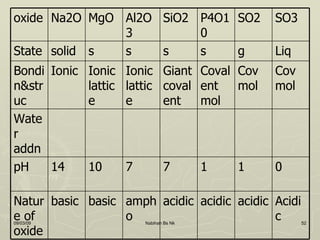
Oxides of phosphorus & sulphur To refer to table
Oxides of chlorine Chemical properties dominated by their tendency to explode. However abt 100 000 tonnes of ClO2 are manufactured each yr. Explosive yellow gas used to blaeach wood pulp in paper-making industry. Produces good whiteness without destroyin the fibrous texture Other chlorine oxides reacts with water to give oxoacids
Acidic acidic acidic acidic ampho basic basic Nature of oxide 0 1 1 7 7 10 14 pH Water addn Cov mol Cov mol Covalent mol Giant covalent Ionic lattice Ionic lattice Ionic  Bondin&struc Liq g s s s s solid State  SO3 SO2 P4O10 SiO2 Al2O3 MgO Na2O oxide

Periodic Table

  • 1.
  • 2.
    Period 3 Inthis chapter we are required to know the periodicity of period 3 elements
  • 3.
    These will mainlyconsist of Physical properties Chemical properties
  • 4.
    Physical properties includeAtomic radius & ionic radius Mpt Electrical conductivity I.E
  • 5.
    Chemical properties includeReaction of elements with oxygen, chlorine and water Variation in oxidn num of oxides and chlorides Reacn of these oxides with water Acid/base behaviour of these oxides and corresponding hydroxides
  • 6.
    The value ofthe atomic radius of an element gives a measure of its size
  • 7.
    The size ofan atom has an influence on its ionisation energy, which is the min energy requires to remove one or more of the outermost electrons.
  • 8.
    In turn, theionisation energy influences the valency of an elemnet expressed as the oxidation num.
  • 9.
    The values ofthese 3 interlinked attributes: Atomic radius,ionisation energy & oxidn no All show clear trends as the atomic num of the elements increase acrossa period
  • 10.
    Atomic radius &ionic radius In the period 3, we will be dealing with the foll elements: 0.181 0.099 P [Mg]3p5 Cl 0.184 0.104 P [Mg]3p4 S 0.212 0.110 P [Mg]3p3 P 0.041 0.117 P [Mg]3p2 Si 0.050 0.143 P [Mg]3p1 Al 0.065 0.160 S [Ne]3s2 Mg 0.095 0.186 S [Ne]3s1 Na I.R/nm A.R/nm S/P E.C Name
  • 11.
    What is noticed???As atomic no increases, there is a general decrease in the atomic and ionic radii.
  • 12.
    Shielding Eachsuccessive elements across a period contains one more p & e. The extra e might be expected to shield is ( cancel out the attraction) of the extra p. This shielding is only partially successful. Electron density is smeared out whereas the p are definitely located in the nucleus.
  • 13.
    This lack ofperfect shielding means that the effective nuclear charge experienced by an e increases acros a period, the increasing nuclear charge outwieghs the effect of an extra electron in the same shell.
  • 14.
    Mpt Thempt of an element gives a direct indication of the forces bet the particles that make up the solid element. A high mpt  indicates metallic bonding or the presence of a giant covalent structure. A lower mpt is associated with covalently bonded molecules held in a solid lattice by weak dispersion forces. An extremely low mpt suggests a structure consisting of separate atoms held together by dispersing forces only.
  • 15.
    Trend across period3 From Na to Si:  there is a steady upward trend From Si to P:  sharp fall From P to Ar:  an overall more gradual decline. Remember: Na,Mg,Al:  metals Si:metalloid P,S,Cl,Ar:non-metals:{P&S have mpts significantly >r Cl&Ar}
  • 16.
    Mpt of metals:Na,Mg& Al The 3 elements have metallic structures consisting of a regular lattice of metal ions. These ions are surrounded by delocalised valence electrons.
  • 17.
    The metalloid siliconThe atoms in solid silicon are bonded together covalently, with atoms arranged in the diamond structure. Each Si atom is bonded to 4 other Si atoms. Melting os si requires breaking of all these covalent bonds, meaning a large amount of energy is required to overcome these forces. Si:  highest mpt;1410degrees celcius.
  • 18.
    Phosphorous Existsin several crystalline forms:allotropes. Red P{consists of chains of P atoms} & white P {consists of P 4 molecules}. The bonds within these small tetrahedral molecules are very strained, which make the white P very reactive. White P must be stored under water because it ignites spontaneously in the air above 35 degrees celcius.
  • 19.
    sulphur 2 allotropes:a) rhombic sulphur b) monoclinic sulphur Both are composed of S8 crown-shaped molecules and differ only in the arrangement in which the molecules are packed.
  • 20.
    At temps slightlyabove the mpt, liquid sulphur consists of separate crown-shaped ring molecules. The dispersion forces holding the S mols are stronger that those of P because there is virtually double the no of e s. As a result sulphur melts at a higher temp than P. Sulphur occurs as the element in volcanic areas, including those found on one of the moon of Jupiter.
  • 21.
    Chlorine SolidCl consists of covalently bonded Cl 2 molecules held in a regular lattice by dispersion forces. The mpt is low because these dispersion forces are weak.
  • 22.
    Argon Solid Arconsists of separate atoms held in a regular lattice by dispersion forces. These forces are extremely weak, so ar has a very low mpt.
  • 23.
    Electrical conductivity -3.2 negligible Cl Brittle 2.6 10^-22 S Brittle 2.2 10^-16 P Brittle 1.9 16 Si Good 1.6 64 Al Good 1.3 38 Mg Good 0.9 37 Na malleability Electro-vity Elec cond element
  • 24.
    From these datawe can inteprete that: The metals have high electrical conductivities And the non-metals have extremely low or negligible elec cond. Si being a metalloid is a semiconductor having moderate conductivity.
  • 25.
    Ionisation energy Atomicsize decreases across a period as atomic no increases. It is therefore reasonable to expect the 1 st I.E to increase as the valence e becomes closer to the nucleus. This is generally true; still there are some anomalies or “dips” at gps 3 & 6.
  • 26.
    Anomalies The1 st IE of Al &S are lower than expected. @) pair of Mg/Al @) pair of P/S.
  • 27.
    pair of Mg/AlIn the case of these pair of elements, the e that is removed in Al is from the 3p subshell, which is further from the nucleus than the 3s e that is removed from Mg. It therefore requires less energy to remove this e during ionisation
  • 28.
    Pair of P& S In this case, the 3d e of P all occupy separate orbitals. The 4 th p e in S must enter 1 of these orbitals, resulting in increased e-repulsion and a lower IE than otherwise expected.
  • 29.
    Reacns of theelements with O 2 ,Cl 2 ,&H 2 O The period 3 elements react with oxygen to form oxides, with Cl 2 to form chlorides and with water to form hydrides.
  • 30.
    Oxides of period3 elements All the period 3 elements react directly with oxygen to form oxides except Si & Cl. E.g 4Na+O 2  Na 2 O Other oxides: Na 2 O,MgO,Al 2 O 3 ,SiO 2 ,P 4 O 6 ,P 4 O 10 ,SO 2 ,SO 3, Cl 2 O
  • 31.
    Oxidation nums ofoxides The formulae of the oxides show a smooth increase in the highest Oxid num as atomic num increases across the period. The highest oxid no is equal to the no of valence e s in the element; i.e,the max oxidn num is the sam as the gp num.
  • 32.
    Mpts of theoxides Sharp initaial rise followed by a steady decline. Remember that high mpts are associated with ionic, or giant covalent structures, and low mpts with solids consisting of simple covalent molecules.
  • 33.
    Metal oxides Predominantlyionic with extent of covalent characteristics increasing frm Na to Al, in line with the increasing charge density of the ions. Mpts relatively high Use as refractory linings
  • 34.
    Silicon dioxide Called silica Giant covalent structure. Yellow sand: silica with impurities such as iron(ii)oxide.
  • 35.
    The oxides ofP May be treated as molecules of formulae P4O6 & P4O10 Because the molecules are quite large, te dispersion forces are sufficiently strong for both oxides to exist as solids at rt. { remember that dispersion forces are approximately proportional to the num of es in the molecules}
  • 36.
    Oxides of sulphurSO2 exists as individual molecules. The dipole-dipole and dispersion forces bet SO2 molecules are weak, so sulphur dioxide is a gas at rt. SO3 is composed of rings of 3 mols & chains whose length are not fixed. Below 17dgrees sulphur trioxide exists as solid held by dispersion forces bet the rings.
  • 37.
    Oxides of Cl2Highly reactive Unstable Exist as separate mols So, have low mpts Exists as gases at rtp.
  • 38.
    Chlorides of period3 All period 3 elements react directly with Cl to form chlorides. The metallic form ionic chlorides and non metallic form covalent chlorides.
  • 39.
    Oxidn nums ofchlorides Increases frm +1 to +5 in the sequence from NaCl to PCl5.
  • 40.
    NaCl & MgCl2Formed by heating the metal in air until it burns and then lowering it into a vessel containing chlorine. Both continue to burn in the chlorine with a white product coating the walls of the reacting vessel.
  • 41.
    AlCl3 Reacts readilywith water, so it must be synthesised under anhydrous condns. The steam of dry Cl is passed over heated Al. The product vaporises and condensesas a white product.
  • 42.
    Acid-Base character ofoxides As atomic num increases, there is a clear trend in the acid-base character of the oxides. The metal oxides are basic{LHS} The ones on the RHS are acidic.
  • 43.
    Reactions of oxideswith water Many oxides of the period 3 elements react with water to form aq solns. The oxides of non metals form a range of covalent oxoacids.
  • 44.
    Na2O,NaOH White solidReacts with water to give a strongly basic aq NaOH with pH about 14. Na2O(s)+H2O  2NaOH(aq) The oxide reacts vigorously with acids producing an aq soln of a salt Na2O(s)+H2SO4  Na2SO4(aq)+H2O(l)
  • 45.
    NaOH Strong baseDissolves readily in water Ionises fully to give soln of pH 14
  • 46.
    MgO White powderSlightly soluble in water Soln weakly basic; pH 10 MgO + H2O  Mg(OH)2 Oxide reacts readily with acids producing aq soln of salt MgO+2HCl  MgCl2+H2O These reacns show MgO to be a basic oxide.
  • 47.
    Magnesium hydroxide Onlypartially ionised in aq soln. The low OH- ion concn results in a soln of pH 10
  • 48.
    Al2O3 White solidVery insoluble in water Hydrated oxide behaves as if it had approx formula Al(OH)3. Acts as base on reactin with acids Al(OH)3+OH-  Al3+ +3H2O Acts as acid on reacn with aq NaOH to form a complex ion called the tetrahydroxoaluminate{aluminate ion}  [Al(OH)4]- Amphoteric oxide
  • 49.
    Silica Giantcovalent structure Highly insoluble in water Reacts only with conc alkalis or at high temp. Eg: silica reacts with molten NaOH at 35 degrees to form sodium silicate SiO2 + 2NaOH  Na2SiO3 +H2O
  • 50.
    Oxides of phosphorus& sulphur To refer to table
  • 51.
    Oxides of chlorineChemical properties dominated by their tendency to explode. However abt 100 000 tonnes of ClO2 are manufactured each yr. Explosive yellow gas used to blaeach wood pulp in paper-making industry. Produces good whiteness without destroyin the fibrous texture Other chlorine oxides reacts with water to give oxoacids
  • 52.
    Acidic acidic acidicacidic ampho basic basic Nature of oxide 0 1 1 7 7 10 14 pH Water addn Cov mol Cov mol Covalent mol Giant covalent Ionic lattice Ionic lattice Ionic Bondin&struc Liq g s s s s solid State SO3 SO2 P4O10 SiO2 Al2O3 MgO Na2O oxide