EMILE DURKHEIM
AS
ENVIRONMENTAL
SOCIOLOGIST
Presenters
• M.USAMA MANSOOR 110603010
• SHAYAN SHOUKAT 13010003004
Environmental Commentator
• Out of three founding Figures in sociology,
Durkheim is probably the least likely to be
recognized as an environmental
commentator.
Facts of Lower Order
• In large part, this reflects his deliberate
decision to elevate social facts over ‘facts
of lower order’ (that is, psychological,
biological).
A Social Fact
• For Durkheim, a social fact is ‘any way of
acting, whether fixed or not, capable
exerting over the individual an external
constraint’ (2002 [1895]: 117)
Constraint is normally Manifested
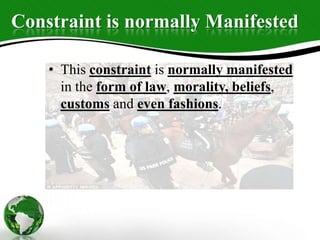
• This constraint is normally manifested
in the form of law, morality, beliefs,
customs and even fashions.
Examining an Experience that is
Characteristic
• We can verify the existence of a social
fact, Durkheim ventured, by examining
an experience that is characteristic.
For Example
• Children are compelled to adopt ways of
seeing, thinking and acting that they
otherwise would not have arrived at
spontaneously.
Social Phenomena Cannot Be
Explained
• Social phenomena cannot be explained
through the lens of individual psychology.
Central Rule of the Sociological
Method
• It is a central rule of the sociological
method that ‘the determining cause of a
social fact must be sought among
antecedent social facts and not among
the states of individual consciousness’ (p.
125).
Advocates of Individualism
• This rule may infuriate strong advocates
of individualism, but no matter.
Proper Field of Sociology
• Social Facts, Durkheim insists ‘are
consequently the proper field of
sociology’ (p. 112)
Theoretical Independence of Sociology
• While this vigorous defence of social
facts and collective consciousness most
certainly buttressed the theoretical
independence of sociology
Non-Sociological Approaches
• It also had the affect of warning off
members of the new discipline from non
sociological approaches that were
reductionist in nature (that is, they
reduced explanation to biological and
psychological factors).
Theory of Societal Transformation
• Nevertheless, Durkheim himself
frequently utilised biological concepts
and metaphors in presenting his theory of
societal transformation.
Theory Inspired by Darwinian
Evolutionary Model
• Furthermore, this theory was most
certainly inspired by the Darwinian
evolutionary model that was popular
among intellectuals in the late nineteenth
century.
Mechanical Solidarity
• In The Division of Labour in Society
(1893), he describes the evolution of
modern societies from a state of
mechanical solidarity, where in social
solidarity is a product of shared cultured
values.
Organic Solidarity
• Organic solidarity, where the social
bond is a function of interdependence,
most notably that arising out of an
increasingly complex division of labour.
Ecological Crises of Rising Population
• Catton (2002:2) proposes that Durkheim's
theory was very much an attempt to
devise a solution to what is essentially an
ecological crises of rising population
paired with scarce resources.
Engage in Agriculture
• As societies became larger and denser, it
would have been disastrous if everyone
had continued to engage in agriculture.
Technological Innovation
• Increasingly, occupational specialisation
meant that the competition over arable
land was lessened even as that land
became more productive thanks to
technological innovation.
Ecology and Evolution
• Alas, Durkheim was doubly hobbled,
Catton says, both by his narrowly
selective reading of Darwin and by the
unavailability in the 1880s of our
knowledge of ecology and evolution
(2002:93)
Increasing Diversity
• In the first instance, he erroneously
supposed that Darwin believed that
increasing diversity to be a way of
minimising competition for scarce
resources.
Co-Evolution
• Rather, Darwin cautioned the co-evolution
(two species involving at the same time)
could, in some cases, increase their
resemblance to one another or result in
one species bringing the other to
extinction.
Lessening Rivalries and Increasing
Mutual Interdependence
• In short, Darwin viewed specialisation as
a way in which one species could gain
competitive advantage over
another, not, as Durkheim believed, as a
way of lessening revelries and increasing
mutual interdependence.
Insights of Modern Ecology
• Durkheim could not have privy to the
insights of modern ecology, which did not
emerge as a sub-field of biology until next
century.
Mutual Dependence was Symbiotic
• Most crucially, no one in Durkheim’s
time recognised that mutual dependence
was symbiotic but not necessarily
balanced.
Predators and Parasites
• That is, some interaction in nature benefit
both member populations (mutualism) but
others benefit one without either harming
or benefiting the other (commensalism);
and yet others are beneficial to one and
determinal to the other, as with
predators and parasites (Catton 2002:93).
Human Ecological Communities
• The latter gives rise to power differences,
something especially significant when you
are dealing with human ecological
communities.
Profound Process of Change
• What are we left with then is chiefly
speculation on what might have been.
Citing Talcott Parsons (1987:217),
Jarvikowski (1996:82) ventures that
Durkheim would likely to have written in
different way today about the
relationships between the social and
physical environment because biological
theory has undergone a profound
process of change.

Emile durkheim

  • 1.
  • 2.
    Presenters • M.USAMA MANSOOR110603010 • SHAYAN SHOUKAT 13010003004
  • 3.
    Environmental Commentator • Outof three founding Figures in sociology, Durkheim is probably the least likely to be recognized as an environmental commentator.
  • 4.
    Facts of LowerOrder • In large part, this reflects his deliberate decision to elevate social facts over ‘facts of lower order’ (that is, psychological, biological).
  • 5.
    A Social Fact •For Durkheim, a social fact is ‘any way of acting, whether fixed or not, capable exerting over the individual an external constraint’ (2002 [1895]: 117)
  • 6.
    Constraint is normallyManifested • This constraint is normally manifested in the form of law, morality, beliefs, customs and even fashions.
  • 7.
    Examining an Experiencethat is Characteristic • We can verify the existence of a social fact, Durkheim ventured, by examining an experience that is characteristic.
  • 8.
    For Example • Childrenare compelled to adopt ways of seeing, thinking and acting that they otherwise would not have arrived at spontaneously.
  • 9.
    Social Phenomena CannotBe Explained • Social phenomena cannot be explained through the lens of individual psychology.
  • 10.
    Central Rule ofthe Sociological Method • It is a central rule of the sociological method that ‘the determining cause of a social fact must be sought among antecedent social facts and not among the states of individual consciousness’ (p. 125).
  • 11.
    Advocates of Individualism •This rule may infuriate strong advocates of individualism, but no matter.
  • 12.
    Proper Field ofSociology • Social Facts, Durkheim insists ‘are consequently the proper field of sociology’ (p. 112)
  • 13.
    Theoretical Independence ofSociology • While this vigorous defence of social facts and collective consciousness most certainly buttressed the theoretical independence of sociology
  • 14.
    Non-Sociological Approaches • Italso had the affect of warning off members of the new discipline from non sociological approaches that were reductionist in nature (that is, they reduced explanation to biological and psychological factors).
  • 15.
    Theory of SocietalTransformation • Nevertheless, Durkheim himself frequently utilised biological concepts and metaphors in presenting his theory of societal transformation.
  • 16.
    Theory Inspired byDarwinian Evolutionary Model • Furthermore, this theory was most certainly inspired by the Darwinian evolutionary model that was popular among intellectuals in the late nineteenth century.
  • 17.
    Mechanical Solidarity • InThe Division of Labour in Society (1893), he describes the evolution of modern societies from a state of mechanical solidarity, where in social solidarity is a product of shared cultured values.
  • 18.
    Organic Solidarity • Organicsolidarity, where the social bond is a function of interdependence, most notably that arising out of an increasingly complex division of labour.
  • 19.
    Ecological Crises ofRising Population • Catton (2002:2) proposes that Durkheim's theory was very much an attempt to devise a solution to what is essentially an ecological crises of rising population paired with scarce resources.
  • 20.
    Engage in Agriculture •As societies became larger and denser, it would have been disastrous if everyone had continued to engage in agriculture.
  • 21.
    Technological Innovation • Increasingly,occupational specialisation meant that the competition over arable land was lessened even as that land became more productive thanks to technological innovation.
  • 22.
    Ecology and Evolution •Alas, Durkheim was doubly hobbled, Catton says, both by his narrowly selective reading of Darwin and by the unavailability in the 1880s of our knowledge of ecology and evolution (2002:93)
  • 23.
    Increasing Diversity • Inthe first instance, he erroneously supposed that Darwin believed that increasing diversity to be a way of minimising competition for scarce resources.
  • 24.
    Co-Evolution • Rather, Darwincautioned the co-evolution (two species involving at the same time) could, in some cases, increase their resemblance to one another or result in one species bringing the other to extinction.
  • 25.
    Lessening Rivalries andIncreasing Mutual Interdependence • In short, Darwin viewed specialisation as a way in which one species could gain competitive advantage over another, not, as Durkheim believed, as a way of lessening revelries and increasing mutual interdependence.
  • 26.
    Insights of ModernEcology • Durkheim could not have privy to the insights of modern ecology, which did not emerge as a sub-field of biology until next century.
  • 27.
    Mutual Dependence wasSymbiotic • Most crucially, no one in Durkheim’s time recognised that mutual dependence was symbiotic but not necessarily balanced.
  • 28.
    Predators and Parasites •That is, some interaction in nature benefit both member populations (mutualism) but others benefit one without either harming or benefiting the other (commensalism); and yet others are beneficial to one and determinal to the other, as with predators and parasites (Catton 2002:93).
  • 29.
    Human Ecological Communities •The latter gives rise to power differences, something especially significant when you are dealing with human ecological communities.
  • 30.
    Profound Process ofChange • What are we left with then is chiefly speculation on what might have been. Citing Talcott Parsons (1987:217), Jarvikowski (1996:82) ventures that Durkheim would likely to have written in different way today about the relationships between the social and physical environment because biological theory has undergone a profound process of change.