RURAL DEVELOPMENT
• SYLLABUS
 Concept of Rural Development: Definition and scope
of Rural Development; impact and significance of
Rural Development; components of Rural
Development.
VIEW OF DEVELOPMENT
• Our view of development is a process by which one’s overall personality is
enhanced.
 This is so for the society where identity is collective. Thus, development for
society means development of the collective personality of the society.
 Development thus defined is a multivariate quantitative and qualitative
change and may not be immediately measurable cardinally.
• The Individual and collective:
 The individual and collective might be thought to have conflicting
interests. Our concept of the collective rules it out.
 The collective exists to the extent that individuals acquiesce in its
sovereignty and develops as individuals acquire more of this collective
spirit.
 Thus, a nation is “self-seekers” may be collective only in the sense that its
members have agreed to hold a common passport, if there is no more of
the ‘collective spirit’ it would be a very week collective indeed.
Aspiration Frontier
 Within the framework of the above philosophy, development
has to have its operational objectives.
1) One of these is growth of the collective spirit.
2) Stimulating the spirit of cooperation is another, by means
of which the collective consciousness may be promoted
and the quantity of social goods to be produced may be
raised.
3) Creativity and innovativeness and problem-solving
approach to life are essential attributes of a dynamic
personality and have to be cultivated.
4) Improvement of knowledge is a base requirement.
5) A will to develop and faith in the collective creative
potentials of man are fundamental pre-requisites with
which society must equipped.
Concept of Rural Development
• Introduction:
 Rural development (RD) is a concept and theoretical construct that
came to the lime light in earlier 1970.
 In the most development countries, as critics observes, RD emerged
as a development dogma during the 1970.
 Theoretical framework on RD was still at the nascent stage and
various assumptions were not even empirically validated.
 Even satisfactory body of relevant theory for the systematic study
of rural development is still missing.
 Not may see it from the same angle or agree as to its nature and
context.
 However, many authorities that have had practical experience and
theoretical ideas and define rural development in their own way.
Definition of Rural Development
 The extent of rural development which will take place in
a country and the rate at which it proceed will, along
other things, depend on quality, vigor and outlook of its
people and the social conditions under which they live.
 The task of bringing about rural development in modern
society is not very difficult in a country where the people
are energetic, enterprising, industrious and adaptable to
new ideas of techniques and where the social institutions
are favorable. But the third world societies are almost
stagnant. Rural life is a sufficiently complex
phenomenon.
Definition Continue--------
 Concern for the rural areas is not something very
new but the concept of Rural Development in its
various facts is, historically a rather recent
phenomenon.
 The third world countries are increasingly realizing
that their overall economic as well as national
advancement would largely depend on the
formulation and effective implementation of policies
or programs for confronting the problems of their
rural areas. In true sense, this relates to building up
of strategies relation to rural development.
Definition continued--------
 Spencer D. Hatch: The aim of rural reconstruction is to
bring about a complete upward development towards
more abundant life for rural people.
 HSM Ishaque: Rural development is a movement to give
the masses a new consciousness, to awaken in them;
a) a sense to self reliance;
b) Self respect and self-help;
c) To educate and organize them in active cooperation and
voluntary join effort, to create the sense of good citizenship;
build better houses, better villages and material advancement
of the rural communities as a whole.
Definition Continued-----
 M K Gandhi: If my dream is fulfilled and every one of
the seven lakhs of villagers become a living republic
in which no one is idle for want of work, in which
everyone is usefully occupied and has nourishing
food, well-ventilated dwellings and sufficient
conditions of hygiene and sanitation.
 Cambridge Conference 1948: Rural development is a
movement to promote better living for whole
community, with the active participation and if
possible on the initiative of the community itself.
Definition Continue-------
 World Bank: Rural development is a strategy
designed to improve the economic and social life of a
specific group of people, the rural poor.
a) It involves, extending the benefits of development to the
poorest among those who seek a livelihood in the rural
areas;
b) The objectives of rural development encompass
improved productivity, increased employment and thus
higher incomes to target group as well as minimum
acceptable labels of food, shelter, education and health.
Definition Continue--------
The United Nations defines Rural Development as:
 Rural Development is a process of change, by
which the efforts of the people themselves are
united, those of government authorities to improve
their economic, social and cultural conditions of
communities in to the life of the nation and to
enable them to contribute fully to national
program.
 Rural Development is a process of bringing
change among rural community from the
traditional way of living to progressive way of living.
It is also expressed as a movement for progress.
Definition Continue--------
 Arther T. Mosher: Rural Development is a trend in the technologies,
organizations, activities and values of the society that:
1) Increase the opportunities of all its rural people for vigorous health,
broadening mental horizons, increasing knowledge and skill, and
expanding opportunities to participate both constructively and
pleasurably in the activities of their culture;
2) Progressively provides more effective means for adjusting as peacefully
as possible the conflicts and injustices that invariably arise as
technological and cultural changes take place;
Maintenance of progressively approaches on optimum balance between
each rural person’s opportunities for freely-chosen which he lives;
1) Increasingly brings all present and potential farmland into most
effective use, all without irreparable change to the earth’s ecosystem.
Definition Continue-------
Such a working definition is giving below:
Rural Development refers to
• The economic, social and political process that go on inside the rural
society;
• The ways in which process influence and interact with each other and are
influenced by process by the society at large; and
• The outcome of these processes in terms of transformation of the rural
society.
 This definition is inadequate to explain the entire concept of rural
development.
 To define rural development, the following questions are to be made clear:
1) What we want in Rural Development?
2) How to attain those wants?
 From this angle, Rural Development can be defined as a process under which
the management of an ideal personality which insures the fulfillment of :
• Basic needs of the people of all levels; and
• That play a strong role in the overall development of the nation.
Definition Continues-----------
 There are at least three important aspects of the above definition:
1) Basic needs of the people of levels;
2) Role should play into the overall development of the nation; and
3) The process should run under the guidance of an ideal personality.
 The first one is the nature of the demand;
 The second is the process; and
 The third is the management of fulfilling the demand.
 From the view point of developing countries, basic needs include:
1) Food
2) Clothing
3) Shelter
4) Fresh drinking water
5) Education; and
6) Health.
Scope and Importance of Rural Development
• Rural development is a dynamic process, which is mainly concerned with the rural
areas. These include agricultural growth, putting up of economic and social
infrastructure, fair wages as also housing and house sites for the landless, village
planning, public health, education and functional literacy, communication etc.
• Rural development is a national necessity and has considerable importance in
Bangladesh because of the following reasons.
1. More than three-fourth of total population of Bangladesh live in rural areas,
thus rural development is needed to develop nation as whole.
2. Nearly 20% the country's national income is derived from agriculture,
which is major occupation of rural Bangladesh.
3. Around 80% of our population gets employment through agriculture.
4. Bulks of raw materials for industries come from agriculture and rural sector.
5. Increase in industrial population can be justified only in rural population's
motivation and increasing the purchasing power to buy industrial goods.
6. Growing disparity between the urban elite and the rural poor can lead to
political instability.
Objectives of Rural Development
 The main objective of the rural development
program is to raise the economic and social level of
the rural people.
 The specific objectives are:
1)To develop farm, home, public service and village
community.
2)To bring improvement in producing of crops and animals
living condition.
3)To improve health and education condition etc.
improvement of the rural people.
4) To improve villagers with their own efforts.
5) To improve village communication.
Community
 A community is a group of people, who live in a
geographical area and have an interest in each other
for the purpose of making a living. It is a form of social
organization existing between the family and state.
 The people with common interests living in a particular
area
 An interacting population of various kinds of
individuals (as species) in a common location
 A group of people with a common characteristic or
interest living together within a larger society
Community Contd.-------
Development: The term development
connotes growth or maturation. It implies
gradual and sequential phase of change.
Community Development: Community
development is encompassing any and
every efforts towards the advance of
community interests.
Need and Importance of rural development
• Rural development is a national necessity and has considerable
importance in Bangladesh and other LDCs because of the following
reasons:
1) To develop rural areas as a whole in terms of culture, society,
economy, technology and health.
2) To develop living standard of rural mass.
3) To develop rural youths, children and women.
4) To develop and empower human resource of rural area in
terms of their psychology, skill, knowledge, attitude and other
abilities.
5) To develop infrastructure facility of rural area.
6) To provide minimum facility to rural mass in terms of drinking
water, education, transport, electricity and communication.
Need and Importance of rural development
7) To develop rural institutions like local government organizations,
cooperatives, post office, banking and credit.
8) To provide financial assistance to develop the artisans in the rural
areas, farmers and agrarian unskilled labor, small and big rural
entrepreneurs to improve their economy.
9) To develop rural industries through the development of
handicrafts, small scale industries, village industries, rural crafts,
cottage industries and other related economic operations in the rural
sector.
10) To develop agriculture, animal husbandry and other agricultural
related areas.
11) To restore uncultivated land, provide irrigation facilities and
motivate farmers to adopt improved seed, fertilizers, package of
practices of crop cultivation and soil conservation methods.
12) To develop entertainment and recreational facility for rural mass.
Need and Importance of rural development
13) To develop leadership quality of rural area.
14) To improve rural marketing facility.
15) To minimize gap between the urban and rural in terms of facilities
availed.
16) To introduce the sustainable development program in rural area.
17) To eliminate rural poverty.
18) To improve rural peoples participation in the development of regions
and nation as whole.
19) To improve scopes of employment for rural mass.
20) To solve the problems faced by the rural mass for their development.
Impact and Significance
• In the past decades different governments have started realization the
importance of developing societies.
 The United nations, the complex of international organization and other
regional arrangements have developed extensive programs aimed helping
the underdeveloped nations to speed up the modernization of their
traditional rural societies.
 Already many of the developing societies are plagued with population
problem taking a serious turn due to lack of social progress compiled with
backward economy the humor of which is backward agriculture which
fails to cope with the growing population.
 It is true that birth rate of the country-side of the developing world is
much higher then the cities. Forth fifth of the people of developing
societies almost live in villages where population control program could
not pick up as expected due to absence of rural development
infrastructure indispensable for going a touch modernity to the rural life.
Impact and Significance contd.
• Awakening of rural population to the desired level depends upon the
development of rural areas.
 It needs restructuring rural life on a new pattern that can face up to the
growing needs of the expanded rural societies.
 Hunger and poverty are the direct outcome of under development of
society as well as under utilization of the resources of a given country.
 It is true that there has been a growing concern for rural development to
ensure benefits to the rural people.
 It is felt that development of the country and its economy solely on the
development of the villages.
Impact and Significance contd.
• Rural development needs building up of nation-building which means to
integrate the different classes of people under our national goal.
 Nation-building means the assimilation of classes or building them under
one nation. In other words, to create the sense of loyalty i.e. the sense of
belongingness, citizenship, national culture and language, particularistic
affiliation. We know lack of consensus the lack of confidence which results
the ultimate degeneration of the country.
 Accordingly, the government should developed some ideologies or slogans
which have underline by the scholars to achieve rural as well as national
development. All these feature should integrate under one nation for the
betterment of the society.
Impact and Significance contd.-----
• The production of food and other raw materials is the basic function of
rural societies.
 Indeed, in modern society, the survival of urban is dependent upon the
effective conduct of those function.
 Historically, rural society has functioned as a supplier of people in the
cities, the relative importance of that rural to urban migration is probably
greatest in societies that are undergoing modernization.
 In respect of social crisis there has been a tendency for rural society to
perform a ‘security’ function as represented by urban to rural postpond
rural to urban migration. In addition, economic function ancillary to
independent of the primary or field activities are characteristically found
in rural areas in some form and in some degree but are not considered as
distinctive function of rural society.
Impact and Significance contd.-----
 Realizing the imperatives of the hour, more and more developing societies
have been paying greater attention to reconstruction of rural life with such
programs that can help the involvement of rural people in a large number.
 The progress of the developing societies will be seriously impeded of the
quality of life in the rural areas cannot he lettered by pursuing dynamic
policies and programs.
 Self-sufficiency or attaining desired level of social development cannot be
possible without stimulation rural economy.
 In fact, the village of the third world is the only prop to support overall
national development program.
 It call for reinvigorating rural economy. It means that the disadvantaged
sections of the rural population have to be made economically self-supporting
by awakening them to the new responsibility laying ahead of them.
 Overall development has no piecemeal solution. Development in its entirely
must encompass all segments of the rural population.
Impact and Significance contd.-----
 Development brings in its wake better realization on the part of the rural
community to grapple with all other minor problems affecting them such as
rural sanitation, cooperatives, small handicrafts and all other inter-related
problems affecting the rural life.
 The vast natural prospects laying untapped are yet to be exploited. This can be
utilized when the village people of third world on their own take the initiative
backed up by institutional agencies dedicated to a single purpose of
ameliorating the rural conditions.
 The factors which are absolutely needed for the development can be divided
into two groups:
a) Economic factors
b) Non-economic factors
 Both the factors are to be mobilized for the development purpose by setting
up institutions. So, the institutional framework can play an important role in
the development of he economy which helps to achieve rural as well as
national development.
Components of Rural Development
• It is to be appreciated that social change has the logic that of its history---
• A history which is the sum of that of political, economic, social and cultural movements
motivated by the people at the leadership in these major sector.
• Rural sector is the real foundation of all the forces of changes
• If social change/revolution is conceived a period of cutting away from the old age
traditional pattern of social-economic life in a decisive manner but in a planned manner.
This would eventually shape out like the concept of industrial revolution.
• Many development programs in the developing society including Bangladesh, are being
extended to the rural development purpose.
• Many to these programs are facing so many problems which impinge upon their
success.
• What is lacking in this respect? Here the question of the operational components of
Rural Development arise.
 The technological advancement that take place in the last century put an important
contribution in agricultural as well as in rural development.
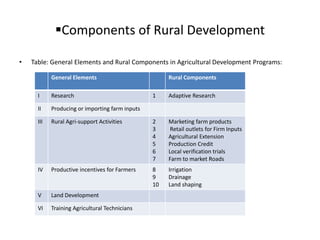
Components of Rural Development
• Table: General Elements and Rural Components in Agricultural Development Programs:
General Elements Rural Components
I Research 1 Adaptive Research
II Producing or importing farm inputs
III Rural Agri-support Activities 2
3
4
5
6
7
Marketing farm products
Retail outlets for Firm Inputs
Agricultural Extension
Production Credit
Local verification trials
Farm to market Roads
IV Productive incentives for Farmers 8
9
10
Irrigation
Drainage
Land shaping
V Land Development
VI Training Agricultural Technicians
Components of Rural Development Contd----
• These components contribute both directly and indirectly towards the
improvement and achievement of other aspects of rural development as
well .
• These elements are all essential, but they cannot and need not be
perceived through activities actually conducted in rural areas.
• The program components that must be provided for in rural areas are
listed in the right-hand column. This includes adaptive research and
various agri-support activities such as - marketing facilities, distribution of
farm inputs , extension, credit, local verifications trials and farm to market
roads, and various types of land development – irrigation, drainage and
/or land shaping.
Components of Rural Development Contd----
• These can be fully effective only if the other elements of agricultural
development are also receive attention.
 These general elements are: Centralized research, production and importaion of farm
inputs , production incentives for farmers and training of agricultural technicians. But
those are provided through centralized agencies, usually in or near urban centers and
hence it is suggested to include elements into administratively integrated rural
programs.
• End-Product and Contributions Through Participation:
 The end - product that is sought through all agricultural program
components is more effective use of farm lands which is itself a major
aspect of rural development.
 The components also contribute, both directly and indirectly, toward
achievement of other aspects fo rural development as well.
Components of Rural Development Contd----
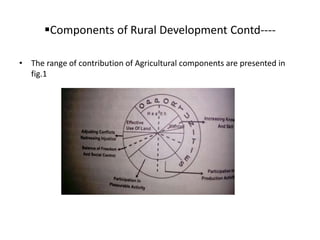
• The range of contribution of Agricultural components are presented in
fig.1
Components of Rural Development Contd----
• In pursuing agricultural development nearly all components broaden
mental horizons, increase knowledge and skills, and provide opportunities
for the participation in community affairs – such as extension meeting,
cooperative societies, or the informal joint maintenance or irrigation
channels – for the rural people who participate in, or are affected by those
program components.
• The impact of agricultural development on health its primarily through its
end products of more effective use of land – leading to the availability of
more food, or more income, or both.
• Its effects on the balance between freedom and social control comes
about through what eve may be done about allowable size of firms and
about freedom of restrictions on how the land controlled it actually
contributed.
Components of Rural Development Contd----
• The multiple imparts of agricultural program components both through
their end products and through the experience of participating in them,
on various aspect of rural development remains.
• Popular participation in rural development programs has frequently been
urged, but the reasons have usually been phrased in terms of achieving
more realistic planning or more enthusiastic implementation.
• Non-agricultural Components:
 Certain non-agricultural activities that can contribute to rural
development are already well established, such as rural schools and
clinics.
 Rural industries obviously hold as potential for increasing employment,
and they make part-time farming more feasible for families with access to
only small amounts of land.
Components of Rural Development Contd----
• Family-planning programs are importance. Unlike the program
components, however, the probably are most effective when combined
with other activities.
• There are three non-agricultural program components that today deserve
greatly increased attention. These are:
1) Home-life-important extension services;
2) Rural understanding of the population problem;
3) Encouraging group activities to tackle locally-felt needs:
a) Cooperatives
b) Local initiatives
c) Education
d) Organization
Components of Rural Development Contd----
• Some other components of non-agricultural activities are also important
for achieving rural development in the society. These are discussed below:
 I. Local Planning: Rural development through deliberate planning or not
will add up to nothing unless it can motivate /mobilize the rural people
politically and make them call conscious. For this one would have to lay
the foundation of sharpening the contribution in the rural society, so that
the outcome of better class struggle that will follow be in favor of the
oppressed millions that is the rural proletariat including small and
marginal farmers.
 Here the system of local or regional planning through local institutions
comes.
 The local planning must be centered around the oppressed groups in the
rural society whose standard of living needs to be improved if they are to
be rescued from what we can call the ‘Below poverty level equilibrium’.
Components of Rural Development Contd----
 In this context, it must be emphasized that to the extent of all planning exercises deal
with human elements, the local institutions organization should arrange open
discussion of every component of it as possible.
 Mass debates wil bring about sense of participation among all and it will also ensure
that the planned targets are commensurate with the aspirations of the common people
while at the same time being drawn up within the feasible set.
 However, there is no double that such open debates and decision making through mass
consensus cannot be institutionalized without establishing people’s democracy in the
society.
 II. Population : Of the entire component that one which can be accounted for the major
and the root of all other component is the alarming population growth rate. At present,
no other problem has become a greater threat to the prospect for economic sand social
progress in rural areas than this population explosion up to now, such organized
attention as the population problem received, has been limited almost exclusively to
espousal of training in technique of voluntary family planning.
 All efforts at socio-economic development in developing societies are eaten-up by the
ever growing mass of population every-year.
Components of Rural Development Contd----
 Prime need in this respect is to find a solution of this population boom,
otherwise all the efforts to vanish the curse of poverty, illiteracy, ill-
health, and better standard of living will be frustrated.
 This population growth rate, if unchanged, is sure to eat up the prugress
made all fronts.
 So, some way must be found to reduce the rate of population growth rapidly in the very
near futrte.
 To that end, it is imperative that rural people themselves gain a much increase
understanding of the dimensions of this problem.
 It is only through wide-spread participation of rural mass in discussing the problem that
the obstruction and the facilitative influences in implementing effective policies and
programs are likely to be accurately identified.
Problems in Rural Development
• People related:
• Traditional way of thinking.
• Poor understanding.
• Low level of education to understand developmental
efforts and new technology.
• Deprived psychology and scientific orientation.
• Lack of confidence.
• Poor awareness.
• Low level of education.
• Existence of unfelt needs.
• Personal ego.
Problems Contd.-----
• Agricultural related problems:
• Lack of expected awareness, knowledge, skill and
attitude.
• Unavailability of inputs.
• Poor marketing facility.
• Insufficient extension staff and services.
• Multidimensional tasks to extension personnel.
• Small size of land holding.
• Division of land.
• Unwillingness to work and stay in rural areas.
Problems Contd.-----
• Infrastructure related problems:
• Poor infrastructure facilities like water,
electricity, transport, educational
institutions,
• communication, health, storage facility etc.
Problems Contd.-----
• Economic problems:
• Unfavorable economic condition to adopt high
cost technology.
• High cost of inputs.
• Underprivileged rural industries
Problems Contd.-----
• Social and Cultural problems:
• Cultural norms and traditions
• Conflict within and between groups, castes,
religions, regions, languages.
Problems Contd.-----
• Leadership related problems:
• Leadership among the hands of inactive and
incompetent people.
• Malafied interest of leaders.
• Biased political will.
Problems Contd.-----
• Administrative problems:
• Earlier, majority of the programmes were
planning based on top to bottom approach
and were target oriented.
• Political interference.
• Lack of motivation and interest.
• Unwillingness to work in rural area.
• Improper utilization of budget.
Rural Development strategy
• A Rural Development as a strategy consists of deliberately designed
components within a comprehensive systematic policy framework, Plan
and Long term perspective.
 The prime aim of the Rural Development (RD) is to uplift the
socioeconomic and political conditions of the rural folk within the
comprehensive national development framework.
• Therefore, RD strategy is a component of the total development
perspective plan of a country.
• Rural development thus defined as strategies which aim to achieve
1) Desired increase in farm output at minimum cost;
2) Make the possible wide spread improvement in the welfare of
the rural population;
3) Contribute the transformation of a pre-dominant agrarian
economy; and
4) Facilities a broader process of social modernization.
Strategy Continue---------
• A rural development strategy is based on coverage
and intervention. In a general sense, it attempts to
make strategic interventions:
 In the rural economy through change in production,
pricing, fiscal, monetary and credit policies, and in rural
institutions .

RURAL_Chapt1.pptx

  • 1.
    RURAL DEVELOPMENT • SYLLABUS Concept of Rural Development: Definition and scope of Rural Development; impact and significance of Rural Development; components of Rural Development.
  • 2.
    VIEW OF DEVELOPMENT •Our view of development is a process by which one’s overall personality is enhanced.  This is so for the society where identity is collective. Thus, development for society means development of the collective personality of the society.  Development thus defined is a multivariate quantitative and qualitative change and may not be immediately measurable cardinally. • The Individual and collective:  The individual and collective might be thought to have conflicting interests. Our concept of the collective rules it out.  The collective exists to the extent that individuals acquiesce in its sovereignty and develops as individuals acquire more of this collective spirit.  Thus, a nation is “self-seekers” may be collective only in the sense that its members have agreed to hold a common passport, if there is no more of the ‘collective spirit’ it would be a very week collective indeed.
  • 3.
    Aspiration Frontier  Withinthe framework of the above philosophy, development has to have its operational objectives. 1) One of these is growth of the collective spirit. 2) Stimulating the spirit of cooperation is another, by means of which the collective consciousness may be promoted and the quantity of social goods to be produced may be raised. 3) Creativity and innovativeness and problem-solving approach to life are essential attributes of a dynamic personality and have to be cultivated. 4) Improvement of knowledge is a base requirement. 5) A will to develop and faith in the collective creative potentials of man are fundamental pre-requisites with which society must equipped.
  • 4.
    Concept of RuralDevelopment • Introduction:  Rural development (RD) is a concept and theoretical construct that came to the lime light in earlier 1970.  In the most development countries, as critics observes, RD emerged as a development dogma during the 1970.  Theoretical framework on RD was still at the nascent stage and various assumptions were not even empirically validated.  Even satisfactory body of relevant theory for the systematic study of rural development is still missing.  Not may see it from the same angle or agree as to its nature and context.  However, many authorities that have had practical experience and theoretical ideas and define rural development in their own way.
  • 5.
    Definition of RuralDevelopment  The extent of rural development which will take place in a country and the rate at which it proceed will, along other things, depend on quality, vigor and outlook of its people and the social conditions under which they live.  The task of bringing about rural development in modern society is not very difficult in a country where the people are energetic, enterprising, industrious and adaptable to new ideas of techniques and where the social institutions are favorable. But the third world societies are almost stagnant. Rural life is a sufficiently complex phenomenon.
  • 6.
    Definition Continue--------  Concernfor the rural areas is not something very new but the concept of Rural Development in its various facts is, historically a rather recent phenomenon.  The third world countries are increasingly realizing that their overall economic as well as national advancement would largely depend on the formulation and effective implementation of policies or programs for confronting the problems of their rural areas. In true sense, this relates to building up of strategies relation to rural development.
  • 7.
    Definition continued--------  SpencerD. Hatch: The aim of rural reconstruction is to bring about a complete upward development towards more abundant life for rural people.  HSM Ishaque: Rural development is a movement to give the masses a new consciousness, to awaken in them; a) a sense to self reliance; b) Self respect and self-help; c) To educate and organize them in active cooperation and voluntary join effort, to create the sense of good citizenship; build better houses, better villages and material advancement of the rural communities as a whole.
  • 8.
    Definition Continued-----  MK Gandhi: If my dream is fulfilled and every one of the seven lakhs of villagers become a living republic in which no one is idle for want of work, in which everyone is usefully occupied and has nourishing food, well-ventilated dwellings and sufficient conditions of hygiene and sanitation.  Cambridge Conference 1948: Rural development is a movement to promote better living for whole community, with the active participation and if possible on the initiative of the community itself.
  • 9.
    Definition Continue-------  WorldBank: Rural development is a strategy designed to improve the economic and social life of a specific group of people, the rural poor. a) It involves, extending the benefits of development to the poorest among those who seek a livelihood in the rural areas; b) The objectives of rural development encompass improved productivity, increased employment and thus higher incomes to target group as well as minimum acceptable labels of food, shelter, education and health.
  • 10.
    Definition Continue-------- The UnitedNations defines Rural Development as:  Rural Development is a process of change, by which the efforts of the people themselves are united, those of government authorities to improve their economic, social and cultural conditions of communities in to the life of the nation and to enable them to contribute fully to national program.  Rural Development is a process of bringing change among rural community from the traditional way of living to progressive way of living. It is also expressed as a movement for progress.
  • 11.
    Definition Continue--------  ArtherT. Mosher: Rural Development is a trend in the technologies, organizations, activities and values of the society that: 1) Increase the opportunities of all its rural people for vigorous health, broadening mental horizons, increasing knowledge and skill, and expanding opportunities to participate both constructively and pleasurably in the activities of their culture; 2) Progressively provides more effective means for adjusting as peacefully as possible the conflicts and injustices that invariably arise as technological and cultural changes take place; Maintenance of progressively approaches on optimum balance between each rural person’s opportunities for freely-chosen which he lives; 1) Increasingly brings all present and potential farmland into most effective use, all without irreparable change to the earth’s ecosystem.
  • 12.
    Definition Continue------- Such aworking definition is giving below: Rural Development refers to • The economic, social and political process that go on inside the rural society; • The ways in which process influence and interact with each other and are influenced by process by the society at large; and • The outcome of these processes in terms of transformation of the rural society.  This definition is inadequate to explain the entire concept of rural development.  To define rural development, the following questions are to be made clear: 1) What we want in Rural Development? 2) How to attain those wants?  From this angle, Rural Development can be defined as a process under which the management of an ideal personality which insures the fulfillment of : • Basic needs of the people of all levels; and • That play a strong role in the overall development of the nation.
  • 13.
    Definition Continues-----------  Thereare at least three important aspects of the above definition: 1) Basic needs of the people of levels; 2) Role should play into the overall development of the nation; and 3) The process should run under the guidance of an ideal personality.  The first one is the nature of the demand;  The second is the process; and  The third is the management of fulfilling the demand.  From the view point of developing countries, basic needs include: 1) Food 2) Clothing 3) Shelter 4) Fresh drinking water 5) Education; and 6) Health.
  • 14.
    Scope and Importanceof Rural Development • Rural development is a dynamic process, which is mainly concerned with the rural areas. These include agricultural growth, putting up of economic and social infrastructure, fair wages as also housing and house sites for the landless, village planning, public health, education and functional literacy, communication etc. • Rural development is a national necessity and has considerable importance in Bangladesh because of the following reasons. 1. More than three-fourth of total population of Bangladesh live in rural areas, thus rural development is needed to develop nation as whole. 2. Nearly 20% the country's national income is derived from agriculture, which is major occupation of rural Bangladesh. 3. Around 80% of our population gets employment through agriculture. 4. Bulks of raw materials for industries come from agriculture and rural sector. 5. Increase in industrial population can be justified only in rural population's motivation and increasing the purchasing power to buy industrial goods. 6. Growing disparity between the urban elite and the rural poor can lead to political instability.
  • 15.
    Objectives of RuralDevelopment  The main objective of the rural development program is to raise the economic and social level of the rural people.  The specific objectives are: 1)To develop farm, home, public service and village community. 2)To bring improvement in producing of crops and animals living condition. 3)To improve health and education condition etc. improvement of the rural people. 4) To improve villagers with their own efforts. 5) To improve village communication.
  • 16.
    Community  A communityis a group of people, who live in a geographical area and have an interest in each other for the purpose of making a living. It is a form of social organization existing between the family and state.  The people with common interests living in a particular area  An interacting population of various kinds of individuals (as species) in a common location  A group of people with a common characteristic or interest living together within a larger society
  • 17.
    Community Contd.------- Development: Theterm development connotes growth or maturation. It implies gradual and sequential phase of change. Community Development: Community development is encompassing any and every efforts towards the advance of community interests.
  • 18.
    Need and Importanceof rural development • Rural development is a national necessity and has considerable importance in Bangladesh and other LDCs because of the following reasons: 1) To develop rural areas as a whole in terms of culture, society, economy, technology and health. 2) To develop living standard of rural mass. 3) To develop rural youths, children and women. 4) To develop and empower human resource of rural area in terms of their psychology, skill, knowledge, attitude and other abilities. 5) To develop infrastructure facility of rural area. 6) To provide minimum facility to rural mass in terms of drinking water, education, transport, electricity and communication.
  • 19.
    Need and Importanceof rural development 7) To develop rural institutions like local government organizations, cooperatives, post office, banking and credit. 8) To provide financial assistance to develop the artisans in the rural areas, farmers and agrarian unskilled labor, small and big rural entrepreneurs to improve their economy. 9) To develop rural industries through the development of handicrafts, small scale industries, village industries, rural crafts, cottage industries and other related economic operations in the rural sector. 10) To develop agriculture, animal husbandry and other agricultural related areas. 11) To restore uncultivated land, provide irrigation facilities and motivate farmers to adopt improved seed, fertilizers, package of practices of crop cultivation and soil conservation methods. 12) To develop entertainment and recreational facility for rural mass.
  • 20.
    Need and Importanceof rural development 13) To develop leadership quality of rural area. 14) To improve rural marketing facility. 15) To minimize gap between the urban and rural in terms of facilities availed. 16) To introduce the sustainable development program in rural area. 17) To eliminate rural poverty. 18) To improve rural peoples participation in the development of regions and nation as whole. 19) To improve scopes of employment for rural mass. 20) To solve the problems faced by the rural mass for their development.
  • 21.
    Impact and Significance •In the past decades different governments have started realization the importance of developing societies.  The United nations, the complex of international organization and other regional arrangements have developed extensive programs aimed helping the underdeveloped nations to speed up the modernization of their traditional rural societies.  Already many of the developing societies are plagued with population problem taking a serious turn due to lack of social progress compiled with backward economy the humor of which is backward agriculture which fails to cope with the growing population.  It is true that birth rate of the country-side of the developing world is much higher then the cities. Forth fifth of the people of developing societies almost live in villages where population control program could not pick up as expected due to absence of rural development infrastructure indispensable for going a touch modernity to the rural life.
  • 22.
    Impact and Significancecontd. • Awakening of rural population to the desired level depends upon the development of rural areas.  It needs restructuring rural life on a new pattern that can face up to the growing needs of the expanded rural societies.  Hunger and poverty are the direct outcome of under development of society as well as under utilization of the resources of a given country.  It is true that there has been a growing concern for rural development to ensure benefits to the rural people.  It is felt that development of the country and its economy solely on the development of the villages.
  • 23.
    Impact and Significancecontd. • Rural development needs building up of nation-building which means to integrate the different classes of people under our national goal.  Nation-building means the assimilation of classes or building them under one nation. In other words, to create the sense of loyalty i.e. the sense of belongingness, citizenship, national culture and language, particularistic affiliation. We know lack of consensus the lack of confidence which results the ultimate degeneration of the country.  Accordingly, the government should developed some ideologies or slogans which have underline by the scholars to achieve rural as well as national development. All these feature should integrate under one nation for the betterment of the society.
  • 24.
    Impact and Significancecontd.----- • The production of food and other raw materials is the basic function of rural societies.  Indeed, in modern society, the survival of urban is dependent upon the effective conduct of those function.  Historically, rural society has functioned as a supplier of people in the cities, the relative importance of that rural to urban migration is probably greatest in societies that are undergoing modernization.  In respect of social crisis there has been a tendency for rural society to perform a ‘security’ function as represented by urban to rural postpond rural to urban migration. In addition, economic function ancillary to independent of the primary or field activities are characteristically found in rural areas in some form and in some degree but are not considered as distinctive function of rural society.
  • 25.
    Impact and Significancecontd.-----  Realizing the imperatives of the hour, more and more developing societies have been paying greater attention to reconstruction of rural life with such programs that can help the involvement of rural people in a large number.  The progress of the developing societies will be seriously impeded of the quality of life in the rural areas cannot he lettered by pursuing dynamic policies and programs.  Self-sufficiency or attaining desired level of social development cannot be possible without stimulation rural economy.  In fact, the village of the third world is the only prop to support overall national development program.  It call for reinvigorating rural economy. It means that the disadvantaged sections of the rural population have to be made economically self-supporting by awakening them to the new responsibility laying ahead of them.  Overall development has no piecemeal solution. Development in its entirely must encompass all segments of the rural population.
  • 26.
    Impact and Significancecontd.-----  Development brings in its wake better realization on the part of the rural community to grapple with all other minor problems affecting them such as rural sanitation, cooperatives, small handicrafts and all other inter-related problems affecting the rural life.  The vast natural prospects laying untapped are yet to be exploited. This can be utilized when the village people of third world on their own take the initiative backed up by institutional agencies dedicated to a single purpose of ameliorating the rural conditions.  The factors which are absolutely needed for the development can be divided into two groups: a) Economic factors b) Non-economic factors  Both the factors are to be mobilized for the development purpose by setting up institutions. So, the institutional framework can play an important role in the development of he economy which helps to achieve rural as well as national development.
  • 27.
    Components of RuralDevelopment • It is to be appreciated that social change has the logic that of its history--- • A history which is the sum of that of political, economic, social and cultural movements motivated by the people at the leadership in these major sector. • Rural sector is the real foundation of all the forces of changes • If social change/revolution is conceived a period of cutting away from the old age traditional pattern of social-economic life in a decisive manner but in a planned manner. This would eventually shape out like the concept of industrial revolution. • Many development programs in the developing society including Bangladesh, are being extended to the rural development purpose. • Many to these programs are facing so many problems which impinge upon their success. • What is lacking in this respect? Here the question of the operational components of Rural Development arise.  The technological advancement that take place in the last century put an important contribution in agricultural as well as in rural development.
  • 28.
    Components of RuralDevelopment • Table: General Elements and Rural Components in Agricultural Development Programs: General Elements Rural Components I Research 1 Adaptive Research II Producing or importing farm inputs III Rural Agri-support Activities 2 3 4 5 6 7 Marketing farm products Retail outlets for Firm Inputs Agricultural Extension Production Credit Local verification trials Farm to market Roads IV Productive incentives for Farmers 8 9 10 Irrigation Drainage Land shaping V Land Development VI Training Agricultural Technicians
  • 29.
    Components of RuralDevelopment Contd---- • These components contribute both directly and indirectly towards the improvement and achievement of other aspects of rural development as well . • These elements are all essential, but they cannot and need not be perceived through activities actually conducted in rural areas. • The program components that must be provided for in rural areas are listed in the right-hand column. This includes adaptive research and various agri-support activities such as - marketing facilities, distribution of farm inputs , extension, credit, local verifications trials and farm to market roads, and various types of land development – irrigation, drainage and /or land shaping.
  • 30.
    Components of RuralDevelopment Contd---- • These can be fully effective only if the other elements of agricultural development are also receive attention.  These general elements are: Centralized research, production and importaion of farm inputs , production incentives for farmers and training of agricultural technicians. But those are provided through centralized agencies, usually in or near urban centers and hence it is suggested to include elements into administratively integrated rural programs. • End-Product and Contributions Through Participation:  The end - product that is sought through all agricultural program components is more effective use of farm lands which is itself a major aspect of rural development.  The components also contribute, both directly and indirectly, toward achievement of other aspects fo rural development as well.
  • 31.
    Components of RuralDevelopment Contd---- • The range of contribution of Agricultural components are presented in fig.1
  • 32.
    Components of RuralDevelopment Contd---- • In pursuing agricultural development nearly all components broaden mental horizons, increase knowledge and skills, and provide opportunities for the participation in community affairs – such as extension meeting, cooperative societies, or the informal joint maintenance or irrigation channels – for the rural people who participate in, or are affected by those program components. • The impact of agricultural development on health its primarily through its end products of more effective use of land – leading to the availability of more food, or more income, or both. • Its effects on the balance between freedom and social control comes about through what eve may be done about allowable size of firms and about freedom of restrictions on how the land controlled it actually contributed.
  • 33.
    Components of RuralDevelopment Contd---- • The multiple imparts of agricultural program components both through their end products and through the experience of participating in them, on various aspect of rural development remains. • Popular participation in rural development programs has frequently been urged, but the reasons have usually been phrased in terms of achieving more realistic planning or more enthusiastic implementation. • Non-agricultural Components:  Certain non-agricultural activities that can contribute to rural development are already well established, such as rural schools and clinics.  Rural industries obviously hold as potential for increasing employment, and they make part-time farming more feasible for families with access to only small amounts of land.
  • 34.
    Components of RuralDevelopment Contd---- • Family-planning programs are importance. Unlike the program components, however, the probably are most effective when combined with other activities. • There are three non-agricultural program components that today deserve greatly increased attention. These are: 1) Home-life-important extension services; 2) Rural understanding of the population problem; 3) Encouraging group activities to tackle locally-felt needs: a) Cooperatives b) Local initiatives c) Education d) Organization
  • 35.
    Components of RuralDevelopment Contd---- • Some other components of non-agricultural activities are also important for achieving rural development in the society. These are discussed below:  I. Local Planning: Rural development through deliberate planning or not will add up to nothing unless it can motivate /mobilize the rural people politically and make them call conscious. For this one would have to lay the foundation of sharpening the contribution in the rural society, so that the outcome of better class struggle that will follow be in favor of the oppressed millions that is the rural proletariat including small and marginal farmers.  Here the system of local or regional planning through local institutions comes.  The local planning must be centered around the oppressed groups in the rural society whose standard of living needs to be improved if they are to be rescued from what we can call the ‘Below poverty level equilibrium’.
  • 36.
    Components of RuralDevelopment Contd----  In this context, it must be emphasized that to the extent of all planning exercises deal with human elements, the local institutions organization should arrange open discussion of every component of it as possible.  Mass debates wil bring about sense of participation among all and it will also ensure that the planned targets are commensurate with the aspirations of the common people while at the same time being drawn up within the feasible set.  However, there is no double that such open debates and decision making through mass consensus cannot be institutionalized without establishing people’s democracy in the society.  II. Population : Of the entire component that one which can be accounted for the major and the root of all other component is the alarming population growth rate. At present, no other problem has become a greater threat to the prospect for economic sand social progress in rural areas than this population explosion up to now, such organized attention as the population problem received, has been limited almost exclusively to espousal of training in technique of voluntary family planning.  All efforts at socio-economic development in developing societies are eaten-up by the ever growing mass of population every-year.
  • 37.
    Components of RuralDevelopment Contd----  Prime need in this respect is to find a solution of this population boom, otherwise all the efforts to vanish the curse of poverty, illiteracy, ill- health, and better standard of living will be frustrated.  This population growth rate, if unchanged, is sure to eat up the prugress made all fronts.  So, some way must be found to reduce the rate of population growth rapidly in the very near futrte.  To that end, it is imperative that rural people themselves gain a much increase understanding of the dimensions of this problem.  It is only through wide-spread participation of rural mass in discussing the problem that the obstruction and the facilitative influences in implementing effective policies and programs are likely to be accurately identified.
  • 38.
    Problems in RuralDevelopment • People related: • Traditional way of thinking. • Poor understanding. • Low level of education to understand developmental efforts and new technology. • Deprived psychology and scientific orientation. • Lack of confidence. • Poor awareness. • Low level of education. • Existence of unfelt needs. • Personal ego.
  • 39.
    Problems Contd.----- • Agriculturalrelated problems: • Lack of expected awareness, knowledge, skill and attitude. • Unavailability of inputs. • Poor marketing facility. • Insufficient extension staff and services. • Multidimensional tasks to extension personnel. • Small size of land holding. • Division of land. • Unwillingness to work and stay in rural areas.
  • 40.
    Problems Contd.----- • Infrastructurerelated problems: • Poor infrastructure facilities like water, electricity, transport, educational institutions, • communication, health, storage facility etc.
  • 41.
    Problems Contd.----- • Economicproblems: • Unfavorable economic condition to adopt high cost technology. • High cost of inputs. • Underprivileged rural industries
  • 42.
    Problems Contd.----- • Socialand Cultural problems: • Cultural norms and traditions • Conflict within and between groups, castes, religions, regions, languages.
  • 43.
    Problems Contd.----- • Leadershiprelated problems: • Leadership among the hands of inactive and incompetent people. • Malafied interest of leaders. • Biased political will.
  • 44.
    Problems Contd.----- • Administrativeproblems: • Earlier, majority of the programmes were planning based on top to bottom approach and were target oriented. • Political interference. • Lack of motivation and interest. • Unwillingness to work in rural area. • Improper utilization of budget.
  • 45.
    Rural Development strategy •A Rural Development as a strategy consists of deliberately designed components within a comprehensive systematic policy framework, Plan and Long term perspective.  The prime aim of the Rural Development (RD) is to uplift the socioeconomic and political conditions of the rural folk within the comprehensive national development framework. • Therefore, RD strategy is a component of the total development perspective plan of a country. • Rural development thus defined as strategies which aim to achieve 1) Desired increase in farm output at minimum cost; 2) Make the possible wide spread improvement in the welfare of the rural population; 3) Contribute the transformation of a pre-dominant agrarian economy; and 4) Facilities a broader process of social modernization.
  • 46.
    Strategy Continue--------- • Arural development strategy is based on coverage and intervention. In a general sense, it attempts to make strategic interventions:  In the rural economy through change in production, pricing, fiscal, monetary and credit policies, and in rural institutions .

Editor's Notes