
Subject: Operations Research
Topic: Rules for Network Construction
By
A. Raja
Network Diagram
• A Network is a graphic representation of a project’s
operations and is composed of activities and events
that must be completed to reach the end objective of a
project.
• A Project network consists of a number of nodes
(shown as small circles or rectangles) and a number of
arcs(shown as arrows) that connect two different
nodes.
Rules of Network Construction
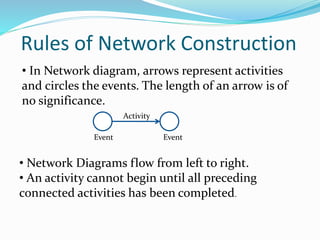
• In Network diagram, arrows represent activities
and circles the events. The length of an arrow is of
no significance.
Event Event
Activity
• Network Diagrams flow from left to right.
• An activity cannot begin until all preceding
connected activities has been completed.
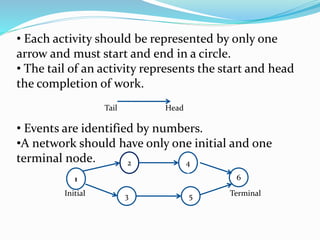
• Each activity should be represented by only one
arrow and must start and end in a circle.
• The tail of an activity represents the start and head
the completion of work.
• Events are identified by numbers.
•A network should have only one initial and one
terminal node.
Tail Head
6
5
4
4
3
2
1
Initial Terminal
• The general rule for numbering the event is that
the head event should always be numbered larger
than that at its tail.
• An event number should not get repeated or
duplicated.
• A dummy activity does not consume either any
resource of time.
• Parallel activities can not accepted between the
events.
1 2
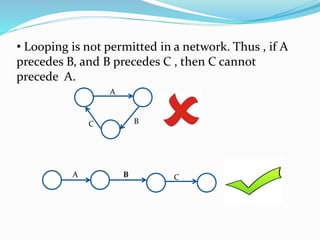
• Looping is not permitted in a network. Thus , if A
precedes B, and B precedes C , then C cannot
precede A.
A
BC
BA C
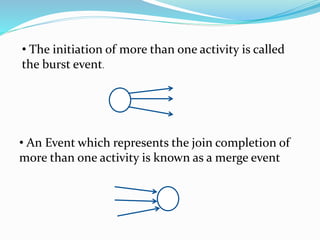
• The initiation of more than one activity is called
the burst event.
• An Event which represents the join completion of
more than one activity is known as a merge event
Thank you

Rules for Network Construction

  • 1.
    Subject: Operations Research Topic:Rules for Network Construction By A. Raja
  • 2.
    Network Diagram • ANetwork is a graphic representation of a project’s operations and is composed of activities and events that must be completed to reach the end objective of a project. • A Project network consists of a number of nodes (shown as small circles or rectangles) and a number of arcs(shown as arrows) that connect two different nodes.
  • 3.
    Rules of NetworkConstruction • In Network diagram, arrows represent activities and circles the events. The length of an arrow is of no significance. Event Event Activity • Network Diagrams flow from left to right. • An activity cannot begin until all preceding connected activities has been completed.
  • 4.
    • Each activityshould be represented by only one arrow and must start and end in a circle. • The tail of an activity represents the start and head the completion of work. • Events are identified by numbers. •A network should have only one initial and one terminal node. Tail Head 6 5 4 4 3 2 1 Initial Terminal
  • 5.
    • The generalrule for numbering the event is that the head event should always be numbered larger than that at its tail. • An event number should not get repeated or duplicated. • A dummy activity does not consume either any resource of time. • Parallel activities can not accepted between the events. 1 2
  • 6.
    • Looping isnot permitted in a network. Thus , if A precedes B, and B precedes C , then C cannot precede A. A BC BA C
  • 7.
    • The initiationof more than one activity is called the burst event. • An Event which represents the join completion of more than one activity is known as a merge event
  • 8.