
SUBJECT : MANAGERIAL ECONOMICS
TOPIC : TYPES OF MARKET STRUCTURE
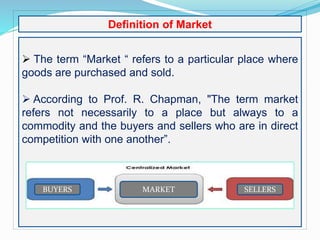
Definition of Market
 The term “Market “ refers to a particular place where
goods are purchased and sold.
 According to Prof. R. Chapman, "The term market
refers not necessarily to a place but always to a
commodity and the buyers and sellers who are in direct
competition with one another”.
BUYERS SELLERSMARKET
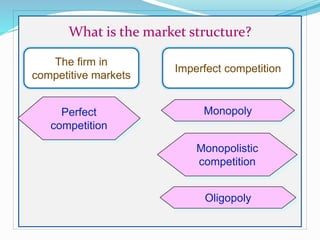
What is the market structure?
Perfect
competition
Oligopoly
Monopoly
Monopolistic
competition
The firm in
competitive markets
Imperfect competition
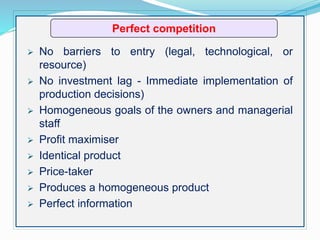
Perfect competition
 No barriers to entry (legal, technological, or
resource)
 No investment lag - Immediate implementation of
production decisions)
 Homogeneous goals of the owners and managerial
staff
 Profit maximiser
 Identical product
 Price-taker
 Produces a homogeneous product
 Perfect information
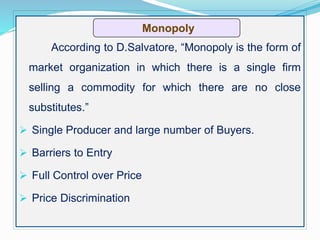
According to D.Salvatore, “Monopoly is the form of
market organization in which there is a single firm
selling a commodity for which there are no close
substitutes.”
 Single Producer and large number of Buyers.
 Barriers to Entry
 Full Control over Price
 Price Discrimination
Monopoly
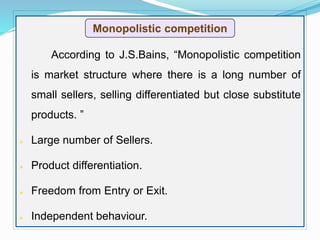
According to J.S.Bains, “Monopolistic competition
is market structure where there is a long number of
small sellers, selling differentiated but close substitute
products. ”
 Large number of Sellers.
 Product differentiation.
 Freedom from Entry or Exit.
 Independent behaviour.
Monopolistic competition
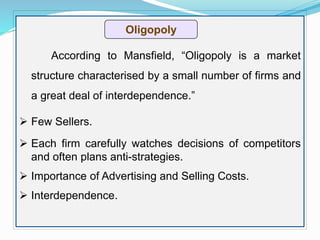
Оligopoly
According to Mansfield, “Oligopoly is a market
structure characterised by a small number of firms and
a great deal of interdependence.”
 Few Sellers.
 Each firm carefully watches decisions of competitors
and often plans anti-strategies.
 Importance of Advertising and Selling Costs.
 Interdependence.
THANK YOU

Types of Market Structure

  • 1.
    SUBJECT : MANAGERIALECONOMICS TOPIC : TYPES OF MARKET STRUCTURE
  • 2.
    Definition of Market The term “Market “ refers to a particular place where goods are purchased and sold.  According to Prof. R. Chapman, "The term market refers not necessarily to a place but always to a commodity and the buyers and sellers who are in direct competition with one another”. BUYERS SELLERSMARKET
  • 3.
    What is themarket structure? Perfect competition Oligopoly Monopoly Monopolistic competition The firm in competitive markets Imperfect competition
  • 4.
    Perfect competition  Nobarriers to entry (legal, technological, or resource)  No investment lag - Immediate implementation of production decisions)  Homogeneous goals of the owners and managerial staff  Profit maximiser  Identical product  Price-taker  Produces a homogeneous product  Perfect information
  • 5.
    According to D.Salvatore,“Monopoly is the form of market organization in which there is a single firm selling a commodity for which there are no close substitutes.”  Single Producer and large number of Buyers.  Barriers to Entry  Full Control over Price  Price Discrimination Monopoly
  • 6.
    According to J.S.Bains,“Monopolistic competition is market structure where there is a long number of small sellers, selling differentiated but close substitute products. ”  Large number of Sellers.  Product differentiation.  Freedom from Entry or Exit.  Independent behaviour. Monopolistic competition
  • 7.
    Оligopoly According to Mansfield,“Oligopoly is a market structure characterised by a small number of firms and a great deal of interdependence.”  Few Sellers.  Each firm carefully watches decisions of competitors and often plans anti-strategies.  Importance of Advertising and Selling Costs.  Interdependence.
  • 8.