SOME OF THE BASIC IMPORTANT CONCEPTS
1. Father Of Management - Peter F. Drucker
2. Father Of Economics - Adam Smith
3. Father Of Computer- Charles Babbage
4. Father Of Scientific Management- Frederick Winslow Taylor
5. Father Of Administrative Management- Fayol
6. Father Of Bureaucracy- Max Weber
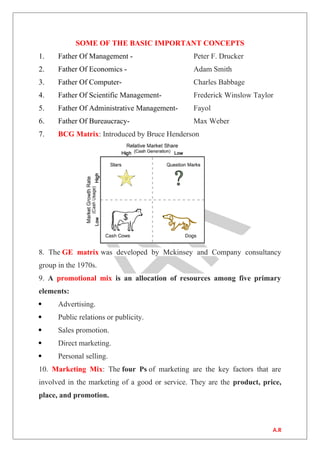
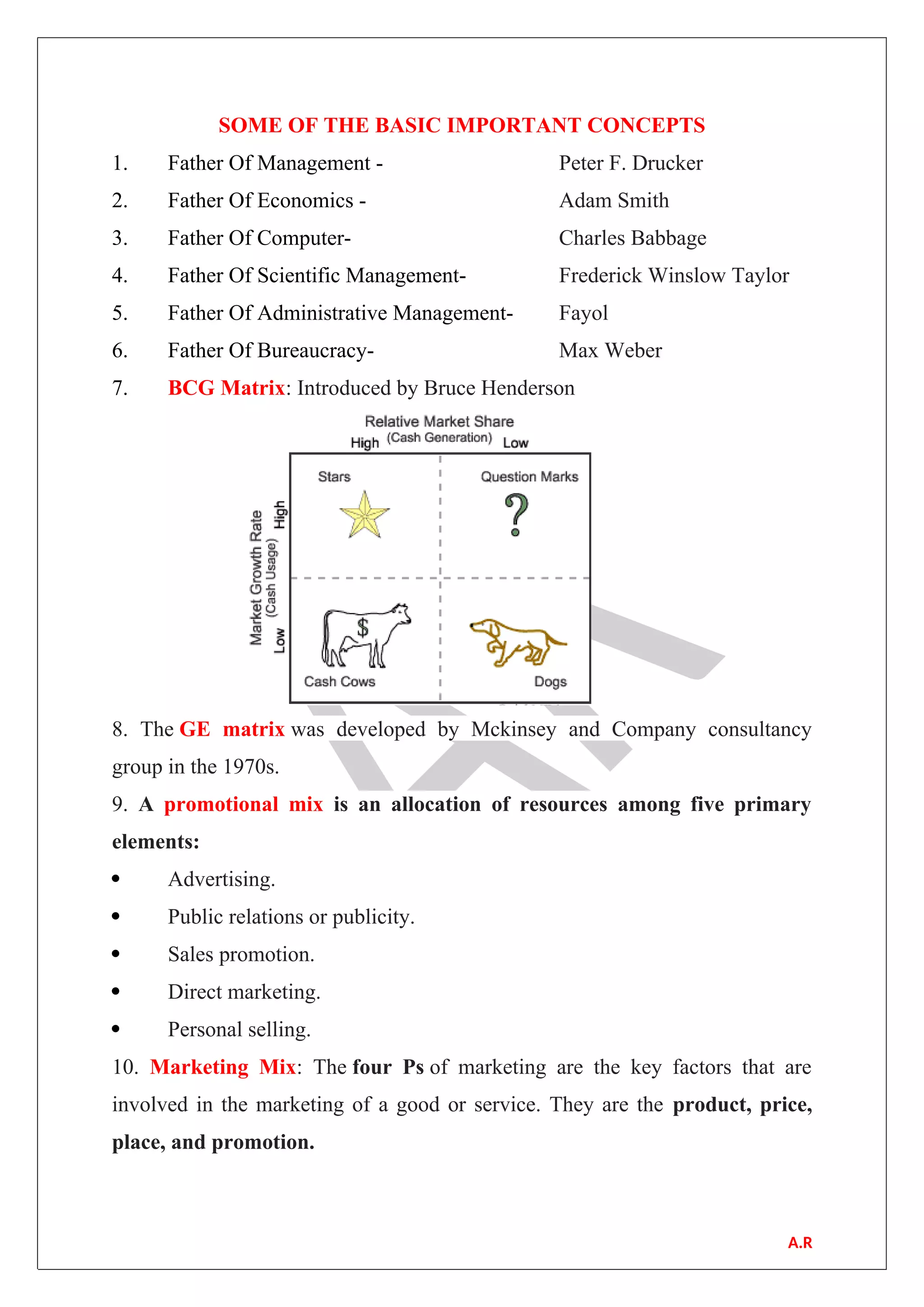
7. BCG Matrix: Introduced by Bruce Henderson
8. The GE matrix was developed by Mckinsey and Company consultancy
group in the 1970s.
9. A promotional mix is an allocation of resources among five primary
elements:
 Advertising.
 Public relations or publicity.
 Sales promotion.
 Direct marketing.
 Personal selling.
10. Marketing Mix: The four Ps of marketing are the key factors that are
involved in the marketing of a good or service. They are the product, price,
place, and promotion.
A.R
11. Service marketing mix is a phrase used to describe seven factors used
when marketing services: product, price, place, promotion, people, process
and physical evidence.
12. Product mix, also known as product assortment or product portfolio, refers
to the complete set of products and/or services offered by a firm.
13. A product line is a group of related products all marketed under a single
brand name that is sold by the same company.
14. Product Width: refers to number of separate product lines offered by a
company. For example, the product width of Toyota may be 3, one each
for product lines of sedans, pick-ups and SUVs.
15. Product Depth: refers to the number of sub-categories within
a product line.
16. Positioning refers to the place that a brand occupies in the minds of the
customers and how it is distinguished from the products of the competitors.
17. Total quality management (TQM) is the continual process of detecting
and reducing or eliminating errors in manufacturing, streamlining supply chain
management, improving the customer experience, and ensuring that employees
are up to speed with training.
18. Benchmarking is a process of measuring the performance of a company's
products, services, or processes against those of another business considered to
be the best in the industry, aka “best in class.”
19. Six Sigma is a disciplined, statistical-based, data-driven approach and
continuous improvement methodology for eliminating defects in a product,
process or service. ... Six Sigma can also be thought of as a measure of process
performance, with Six Sigma being the goal, based on the defects per million.
20. Just in time (JIT) inventory is a strategy to increase efficiency and
decrease waste by receiving goods only as they are needed in the production
process, thereby reducing inventory costs.
A.R
21. Layoff: An occasion when company stops employing someone, sometimes
temporarily, because the company does not have enough money or enough
work.
22. Retrenchment is a form of dismissal due to no fault of the employee. It is a
process whereby the employer reviews its business needs in order to increase
profits or limit losses, which leads to reducing its employees.
23. Downsizing is the permanent reduction of a company's labour force through
the elimination of unproductive workers or divisions. Downsizing is a
common organizational practice, usually associated with economic downturns
and failing businesses.
24. Rightsizing is the process of a company restructuring or reorganizing itself
by reducing its workforce, cost-cutting, or rearranging its upper management.
The aim is to streamline the business so that it can make a profit more
effectively.
25. Succession is - the order in which or the conditions under which one person
after another succeeds to a property, dignity, title.
26. Job analysis is a systematic process of collecting all information about the
job.
27. Job Description that describes the general tasks, or other related duties,
and responsibilities of a position.
28. Job specification is a written statement of educational qualifications,
specific qualities, level of experience, physical, emotional, technical and
communication skills required to perform a job, responsibilities involved in
a job.
29. Job enlargement is adding additional activities within the same level to an
existing role. This means that a person will do more, different activities in their
current job.
30. Job enrichment is a common motivational technique used by organizations
to give an employee greater satisfaction in his work. It means giving an
A.R
employee additional responsibilities previously reserved for his manager or
other higher-ranking positions.
31. on the job Training Methods:
 Job Instruction Training (JIT)
 Coaching.
 Mentoring.
 Job Rotation.
 Apprenticeship Training.
 Committee Assignments.
32. McKinsey 7s model is a tool that analyzes firm's organizational design by
looking at 7 key internal elements: strategy, structure, systems, shared values,
style, staff and skills.
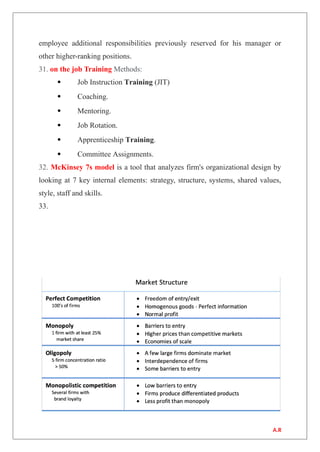
33.
A.R
34. Kaizen is a Japanese term meaning "change for the better" or "continuous
improvement." It is a Japanese business philosophy regarding the processes that
continuously improve operations and involve all employees.
35. The Turnaround Strategy is a retrenchment strategy followed by an
organization when it feels that the decision made earlier is wrong and needs to
be undone before it damages the profitability of the company.
36. Transactional analysis (TA) is a psychoanalytic theory and method of
therapy wherein social transactions are analyzed to determine the ego state of
the communicator (whether parent-like, childlike, or adult-like) as a basis for
understanding behaviour - Dr. Eric Berne
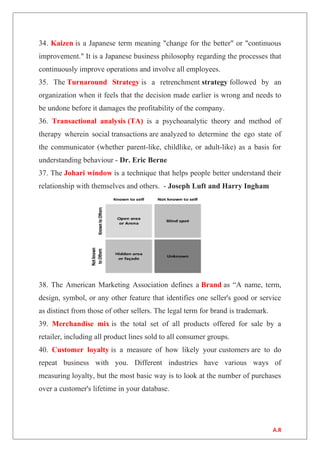
37. The Johari window is a technique that helps people better understand their
relationship with themselves and others. - Joseph Luft and Harry Ingham
38. The American Marketing Association defines a Brand as “A name, term,
design, symbol, or any other feature that identifies one seller's good or service
as distinct from those of other sellers. The legal term for brand is trademark.
39. Merchandise mix is the total set of all products offered for sale by a
retailer, including all product lines sold to all consumer groups.
40. Customer loyalty is a measure of how likely your customers are to do
repeat business with you. Different industries have various ways of
measuring loyalty, but the most basic way is to look at the number of purchases
over a customer's lifetime in your database.
A.R
41. Non-verbal communication includes facial expressions, the tone and pitch
of the voice, gestures displayed through body language (kinesics) and the
physical distance between the communicators (proxemics).
42. The "halo effect" is when one trait of a person or thing is used to make an
overall judgment of that person or thing.
43. Price elasticity of demand formula would be the percentage of change in
the quantity in demand divided by the percentage change in price.
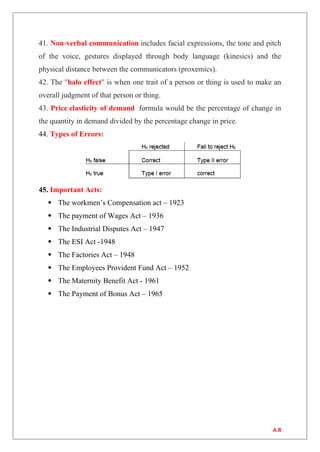
44. Types of Errors:
45. Important Acts:
 The workmen’s Compensation act – 1923
 The payment of Wages Act – 1936
 The Industrial Disputes Act – 1947
 The ESI Act -1948
 The Factories Act – 1948
 The Employees Provident Fund Act – 1952
 The Maternity Benefit Act - 1961
 The Payment of Bonus Act – 1965
A.R

Some of the Basic Important Concepts in MBA

  • 1.
    SOME OF THEBASIC IMPORTANT CONCEPTS 1. Father Of Management - Peter F. Drucker 2. Father Of Economics - Adam Smith 3. Father Of Computer- Charles Babbage 4. Father Of Scientific Management- Frederick Winslow Taylor 5. Father Of Administrative Management- Fayol 6. Father Of Bureaucracy- Max Weber 7. BCG Matrix: Introduced by Bruce Henderson 8. The GE matrix was developed by Mckinsey and Company consultancy group in the 1970s. 9. A promotional mix is an allocation of resources among five primary elements:  Advertising.  Public relations or publicity.  Sales promotion.  Direct marketing.  Personal selling. 10. Marketing Mix: The four Ps of marketing are the key factors that are involved in the marketing of a good or service. They are the product, price, place, and promotion. A.R
  • 2.
    11. Service marketingmix is a phrase used to describe seven factors used when marketing services: product, price, place, promotion, people, process and physical evidence. 12. Product mix, also known as product assortment or product portfolio, refers to the complete set of products and/or services offered by a firm. 13. A product line is a group of related products all marketed under a single brand name that is sold by the same company. 14. Product Width: refers to number of separate product lines offered by a company. For example, the product width of Toyota may be 3, one each for product lines of sedans, pick-ups and SUVs. 15. Product Depth: refers to the number of sub-categories within a product line. 16. Positioning refers to the place that a brand occupies in the minds of the customers and how it is distinguished from the products of the competitors. 17. Total quality management (TQM) is the continual process of detecting and reducing or eliminating errors in manufacturing, streamlining supply chain management, improving the customer experience, and ensuring that employees are up to speed with training. 18. Benchmarking is a process of measuring the performance of a company's products, services, or processes against those of another business considered to be the best in the industry, aka “best in class.” 19. Six Sigma is a disciplined, statistical-based, data-driven approach and continuous improvement methodology for eliminating defects in a product, process or service. ... Six Sigma can also be thought of as a measure of process performance, with Six Sigma being the goal, based on the defects per million. 20. Just in time (JIT) inventory is a strategy to increase efficiency and decrease waste by receiving goods only as they are needed in the production process, thereby reducing inventory costs. A.R
  • 3.
    21. Layoff: Anoccasion when company stops employing someone, sometimes temporarily, because the company does not have enough money or enough work. 22. Retrenchment is a form of dismissal due to no fault of the employee. It is a process whereby the employer reviews its business needs in order to increase profits or limit losses, which leads to reducing its employees. 23. Downsizing is the permanent reduction of a company's labour force through the elimination of unproductive workers or divisions. Downsizing is a common organizational practice, usually associated with economic downturns and failing businesses. 24. Rightsizing is the process of a company restructuring or reorganizing itself by reducing its workforce, cost-cutting, or rearranging its upper management. The aim is to streamline the business so that it can make a profit more effectively. 25. Succession is - the order in which or the conditions under which one person after another succeeds to a property, dignity, title. 26. Job analysis is a systematic process of collecting all information about the job. 27. Job Description that describes the general tasks, or other related duties, and responsibilities of a position. 28. Job specification is a written statement of educational qualifications, specific qualities, level of experience, physical, emotional, technical and communication skills required to perform a job, responsibilities involved in a job. 29. Job enlargement is adding additional activities within the same level to an existing role. This means that a person will do more, different activities in their current job. 30. Job enrichment is a common motivational technique used by organizations to give an employee greater satisfaction in his work. It means giving an A.R
  • 4.
    employee additional responsibilitiespreviously reserved for his manager or other higher-ranking positions. 31. on the job Training Methods:  Job Instruction Training (JIT)  Coaching.  Mentoring.  Job Rotation.  Apprenticeship Training.  Committee Assignments. 32. McKinsey 7s model is a tool that analyzes firm's organizational design by looking at 7 key internal elements: strategy, structure, systems, shared values, style, staff and skills. 33. A.R
  • 5.
    34. Kaizen isa Japanese term meaning "change for the better" or "continuous improvement." It is a Japanese business philosophy regarding the processes that continuously improve operations and involve all employees. 35. The Turnaround Strategy is a retrenchment strategy followed by an organization when it feels that the decision made earlier is wrong and needs to be undone before it damages the profitability of the company. 36. Transactional analysis (TA) is a psychoanalytic theory and method of therapy wherein social transactions are analyzed to determine the ego state of the communicator (whether parent-like, childlike, or adult-like) as a basis for understanding behaviour - Dr. Eric Berne 37. The Johari window is a technique that helps people better understand their relationship with themselves and others. - Joseph Luft and Harry Ingham 38. The American Marketing Association defines a Brand as “A name, term, design, symbol, or any other feature that identifies one seller's good or service as distinct from those of other sellers. The legal term for brand is trademark. 39. Merchandise mix is the total set of all products offered for sale by a retailer, including all product lines sold to all consumer groups. 40. Customer loyalty is a measure of how likely your customers are to do repeat business with you. Different industries have various ways of measuring loyalty, but the most basic way is to look at the number of purchases over a customer's lifetime in your database. A.R
  • 6.
    41. Non-verbal communicationincludes facial expressions, the tone and pitch of the voice, gestures displayed through body language (kinesics) and the physical distance between the communicators (proxemics). 42. The "halo effect" is when one trait of a person or thing is used to make an overall judgment of that person or thing. 43. Price elasticity of demand formula would be the percentage of change in the quantity in demand divided by the percentage change in price. 44. Types of Errors: 45. Important Acts:  The workmen’s Compensation act – 1923  The payment of Wages Act – 1936  The Industrial Disputes Act – 1947  The ESI Act -1948  The Factories Act – 1948  The Employees Provident Fund Act – 1952  The Maternity Benefit Act - 1961  The Payment of Bonus Act – 1965 A.R