Diphtheria
Danielle, Matt, Kelsey, Joe
          Table 3
   Period 3 Anatomy
History
• Diphtheria comes from the Greek word Dipthera,
  meaning leather.
  This refers to the leathery, grayish membrane that
  grows on the tonsils, throat and in the nose.
• It was named by French physician, Pierre
  Bretonneau, in 1826.
• It is most common in children and adolescents.
• Between 1735 and 1740, the New England
  colonies experienced deadly outbreaks, claiming
  the lives of 13,000 to 15,000 children.
Diphtheria: An Overview
• Diphtheria is an acute infectious disease of the
  mucus membrane or the skin.
• It is caused by Corynebacterium Diphtheriae
  and Corynebacterium Ulcerans bacteria.
• The bacteria usually affect the tonsils, throat,
  nose, skin and very rarely the heart and the
  nerves.
Characteristics of the
Diphtheria Bacteria
Aerobic,

Non-motile,

Gram-positive,

Rod shaped,

Produces toxins


                  This photomicrograph
     depicted a number of Gram-positive
    Corynebacterium diphtheriae bacteria,
        which had been stained using the
               methylene blue technique.
Spread of Diphtheria
• It spreads when people are in close contact
  with discharges from an infected person's
  mouth, nose, throat, or skin.
• Communicability may last 4 weeks.
Signs and Symptoms
•   Sore throat may range from mild to severe with painful swallowing
    and hoarseness of the voice.

•   Drooling which indicates the obstruction of the airway passage.

•   Fever and chills.

•   Bloody, watery serosanguineous drainage from the nose.

•   Croup-like coughing.

•   Stridor, difficulty in breathing or sometimes-rapid breathing.

•   Apnea may occur.

•   Bluish coloration of the skin may be caused due to lack of oxygen.

•   Skin lesions can be seen in cutaneous diphtheria.

•   Swollen glands due to the enlarged lymph nodes in the neck (bull
    neck).


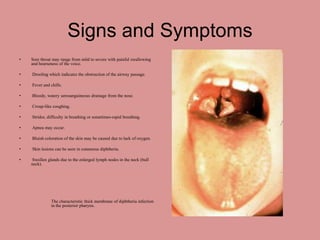
              The characteristic thick membrane of diphtheria infection
              in the posterior pharynx.
Diagnosis
• Diphtheria can be diagnosed usually by proper
  clinical examination, throat culture from the
  infected area and blood tests
Treatment
• The patient has to be given treatment immediately after
  the disease is suspected. A delay in treatment can result
  in death or long-term heart disease. In severe cases
  there is obstruction of the throat, which may require
  intubation or a tracheostomy.
• Antibiotics are used in patients or carriers to destroy C.
  diphtheriae and prevent its transmission to others. Some
  example include:
   – Erythromycin that is given orally or by injection for 14
     days.
   – Procaine Penicillin G given intramuscularly for 14 days.
Prevention
• Diphtheria is easily prevented with the use of a
  safe and effective vaccine.
• Most people receive their first vaccination for
  the disease as children. This is know as the
  DTP vaccine (diphtheria-tetanus-pertussis).
Resources
Diphtheria. (n.d.). Retrieved from Medindia website:
http://www.medindia.net/patients/patientinfo/diphtheria.htm

Cheever, F. S., M.D. (2004). Diphtheria. In Encyclopedia Americana (Vol. 9, p. 140). Danbury, CT: Scholastic Library Publishing. (Original work published
1829)

MacGregor RR. Corynebacterium diphtheriae. In: Mandell GL, Bennett JE, Dolan R, eds. Mandell, Douglas, and Bennett’s Principles and Practice of
Infectious Diseases. 7th ed. Orlando, FL: Saunders Elsevier; 2009:chap 205.


Images:

Slide 1
The Historical Medical Library of The College of Physicians of Philadelphia. Koplik, Henry, MD. The Diseases of Infancy and Childhood, 4th ed. Philadelphia: Lea & Febiger, 1918.

Slide 6
Guy, A. M., M.D. (n.d.). Diphtheria in Emergency Medicine. Retrieved from
  http://emedicine.medscape.com/article/782051-overview


Slide 4
Diphtheria. (n.d.). Retrieved from http://www.rightdiagnosis.com/phil/html/
  diphtheria/7323.html

Diphtheria

  • 1.
    Diphtheria Danielle, Matt, Kelsey,Joe Table 3 Period 3 Anatomy
  • 2.
    History • Diphtheria comesfrom the Greek word Dipthera, meaning leather. This refers to the leathery, grayish membrane that grows on the tonsils, throat and in the nose. • It was named by French physician, Pierre Bretonneau, in 1826. • It is most common in children and adolescents. • Between 1735 and 1740, the New England colonies experienced deadly outbreaks, claiming the lives of 13,000 to 15,000 children.
  • 3.
    Diphtheria: An Overview •Diphtheria is an acute infectious disease of the mucus membrane or the skin. • It is caused by Corynebacterium Diphtheriae and Corynebacterium Ulcerans bacteria. • The bacteria usually affect the tonsils, throat, nose, skin and very rarely the heart and the nerves.
  • 4.
    Characteristics of the DiphtheriaBacteria Aerobic, Non-motile, Gram-positive, Rod shaped, Produces toxins This photomicrograph depicted a number of Gram-positive Corynebacterium diphtheriae bacteria, which had been stained using the methylene blue technique.
  • 5.
    Spread of Diphtheria •It spreads when people are in close contact with discharges from an infected person's mouth, nose, throat, or skin. • Communicability may last 4 weeks.
  • 6.
    Signs and Symptoms • Sore throat may range from mild to severe with painful swallowing and hoarseness of the voice. • Drooling which indicates the obstruction of the airway passage. • Fever and chills. • Bloody, watery serosanguineous drainage from the nose. • Croup-like coughing. • Stridor, difficulty in breathing or sometimes-rapid breathing. • Apnea may occur. • Bluish coloration of the skin may be caused due to lack of oxygen. • Skin lesions can be seen in cutaneous diphtheria. • Swollen glands due to the enlarged lymph nodes in the neck (bull neck). The characteristic thick membrane of diphtheria infection in the posterior pharynx.
  • 7.
    Diagnosis • Diphtheria canbe diagnosed usually by proper clinical examination, throat culture from the infected area and blood tests
  • 8.
    Treatment • The patienthas to be given treatment immediately after the disease is suspected. A delay in treatment can result in death or long-term heart disease. In severe cases there is obstruction of the throat, which may require intubation or a tracheostomy. • Antibiotics are used in patients or carriers to destroy C. diphtheriae and prevent its transmission to others. Some example include: – Erythromycin that is given orally or by injection for 14 days. – Procaine Penicillin G given intramuscularly for 14 days.
  • 9.
    Prevention • Diphtheria iseasily prevented with the use of a safe and effective vaccine. • Most people receive their first vaccination for the disease as children. This is know as the DTP vaccine (diphtheria-tetanus-pertussis).
  • 10.
    Resources Diphtheria. (n.d.). Retrievedfrom Medindia website: http://www.medindia.net/patients/patientinfo/diphtheria.htm Cheever, F. S., M.D. (2004). Diphtheria. In Encyclopedia Americana (Vol. 9, p. 140). Danbury, CT: Scholastic Library Publishing. (Original work published 1829) MacGregor RR. Corynebacterium diphtheriae. In: Mandell GL, Bennett JE, Dolan R, eds. Mandell, Douglas, and Bennett’s Principles and Practice of Infectious Diseases. 7th ed. Orlando, FL: Saunders Elsevier; 2009:chap 205. Images: Slide 1 The Historical Medical Library of The College of Physicians of Philadelphia. Koplik, Henry, MD. The Diseases of Infancy and Childhood, 4th ed. Philadelphia: Lea & Febiger, 1918. Slide 6 Guy, A. M., M.D. (n.d.). Diphtheria in Emergency Medicine. Retrieved from http://emedicine.medscape.com/article/782051-overview Slide 4 Diphtheria. (n.d.). Retrieved from http://www.rightdiagnosis.com/phil/html/ diphtheria/7323.html