Technical Seminar Presentation
On
“Real Time Operating Systems”
Submitted By
Chetan M Mudenoor
CONTENTS
– What is RTOS?

– Types of RTOS
– RTOS Kernel
– Task Scheduling
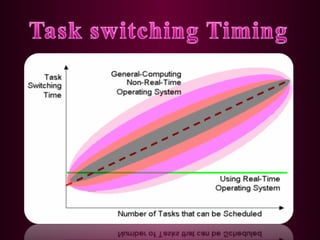
– Task switching timing
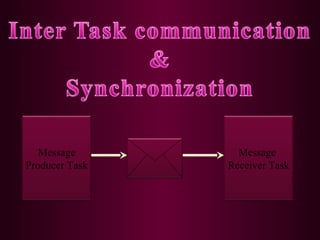
– Inter task communication and synchronization
– Dynamic memory allocation
– Difference b/w RTOS & GPOS
– Where can real time systems to be found? or
Advantages
– Application of RTOS
•Real time Operating Systems are very fast and quick
respondent systems. These systems are used in an
environment where a large number of events
(generally external) must be accepted and processed in
a short time.
• In real time operating system there is a little
swapping of programs between primary and
secondary memory. Most of the time, processes remain
in primary memory in order to provide quick
response, therefore, memory management in real time
system is less demanding compared to other systems.
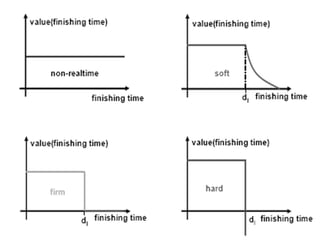
• Hard real time
• Soft real time
• Firm real time
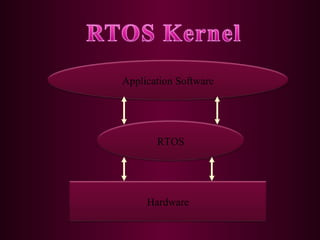
Application Software

RTOS

Hardware
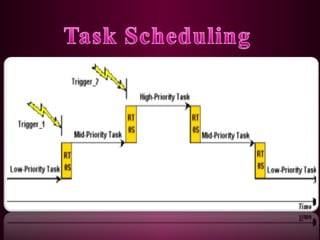
•Most RTOSs do their scheduling of tasks using a scheme called
“priority-based preemptive scheduling”. Each task in a software
application must be assigned a priority, with higher priority values
representing the need for quicker responsiveness. Very quick
responsiveness is made possible by the “preemptive” nature of the
task scheduling. “Preemptive” means that the scheduler is allowed
to stop any task at any point in its execution, if it determines that
another task needs to run immediately.
•The basic rule that governs priority-based preemptive scheduling is
that at every moment in time, “The Highest Priority Task that is
Ready to Run, will be the Task that Must be Running”. In other
words, if both a low-priority task and a higher-priority task are
ready to run, the scheduler will allow the higher-priority task to run
first. The low-priority task will only get to run after the higherpriority task has finished with its current work.
Message
Producer Task

Message
Receiver Task
Many (but not all) RTOS kernels provide Dynamic
Memory Allocation services. This category of services
allows tasks to “borrow” chunks of RAM memory for
temporary use in application software. Often these
chunks of memory are then passed from task to task,
as a means of quickly communicating large amounts of
data between tasks. Some very small RTOS kernels
that are intended for tightly memory-limited
environments, do not offer Dynamic Memory Allocation
services.
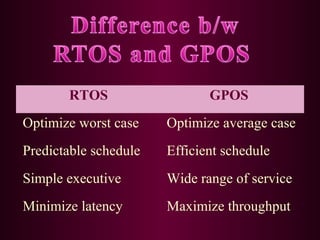
RTOS

GPOS

Optimize worst case

Optimize average case

Predictable schedule

Efficient schedule

Simple executive

Wide range of service

Minimize latency

Maximize throughput
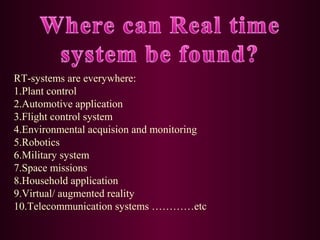
RT-systems are everywhere:
1.Plant control
2.Automotive application
3.Flight control system
4.Environmental acquision and monitoring
5.Robotics
6.Military system
7.Space missions
8.Household application
9.Virtual/ augmented reality
10.Telecommunication systems …………etc
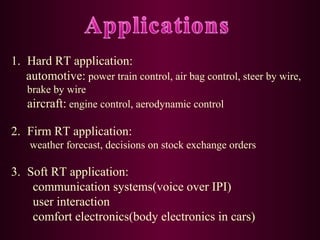
1. Hard RT application:
automotive: power train control, air bag control, steer by wire,
brake by wire
aircraft: engine control, aerodynamic control

2. Firm RT application:
weather forecast, decisions on stock exchange orders

3. Soft RT application:
communication systems(voice over IPI)
user interaction
comfort electronics(body electronics in cars)
Conclusion
This presentation has addressed the past
and present design techniques for RTOS but future
design tend to be moving some tasks that usually reside
slowly on the microprocessor to field programmable
gate array (EPGA) device.
presentation on real time operating system(RTOS's)

presentation on real time operating system(RTOS's)

  • 1.
    Technical Seminar Presentation On “RealTime Operating Systems” Submitted By Chetan M Mudenoor
  • 2.
    CONTENTS – What isRTOS? – Types of RTOS – RTOS Kernel – Task Scheduling – Task switching timing – Inter task communication and synchronization – Dynamic memory allocation – Difference b/w RTOS & GPOS – Where can real time systems to be found? or Advantages – Application of RTOS
  • 3.
    •Real time OperatingSystems are very fast and quick respondent systems. These systems are used in an environment where a large number of events (generally external) must be accepted and processed in a short time. • In real time operating system there is a little swapping of programs between primary and secondary memory. Most of the time, processes remain in primary memory in order to provide quick response, therefore, memory management in real time system is less demanding compared to other systems.
  • 4.
    • Hard realtime • Soft real time • Firm real time
  • 6.
  • 10.
    •Most RTOSs dotheir scheduling of tasks using a scheme called “priority-based preemptive scheduling”. Each task in a software application must be assigned a priority, with higher priority values representing the need for quicker responsiveness. Very quick responsiveness is made possible by the “preemptive” nature of the task scheduling. “Preemptive” means that the scheduler is allowed to stop any task at any point in its execution, if it determines that another task needs to run immediately. •The basic rule that governs priority-based preemptive scheduling is that at every moment in time, “The Highest Priority Task that is Ready to Run, will be the Task that Must be Running”. In other words, if both a low-priority task and a higher-priority task are ready to run, the scheduler will allow the higher-priority task to run first. The low-priority task will only get to run after the higherpriority task has finished with its current work.
  • 11.
  • 12.
    Many (but notall) RTOS kernels provide Dynamic Memory Allocation services. This category of services allows tasks to “borrow” chunks of RAM memory for temporary use in application software. Often these chunks of memory are then passed from task to task, as a means of quickly communicating large amounts of data between tasks. Some very small RTOS kernels that are intended for tightly memory-limited environments, do not offer Dynamic Memory Allocation services.
  • 13.
    RTOS GPOS Optimize worst case Optimizeaverage case Predictable schedule Efficient schedule Simple executive Wide range of service Minimize latency Maximize throughput
  • 14.
    RT-systems are everywhere: 1.Plantcontrol 2.Automotive application 3.Flight control system 4.Environmental acquision and monitoring 5.Robotics 6.Military system 7.Space missions 8.Household application 9.Virtual/ augmented reality 10.Telecommunication systems …………etc
  • 15.
    1. Hard RTapplication: automotive: power train control, air bag control, steer by wire, brake by wire aircraft: engine control, aerodynamic control 2. Firm RT application: weather forecast, decisions on stock exchange orders 3. Soft RT application: communication systems(voice over IPI) user interaction comfort electronics(body electronics in cars)
  • 17.
    Conclusion This presentation hasaddressed the past and present design techniques for RTOS but future design tend to be moving some tasks that usually reside slowly on the microprocessor to field programmable gate array (EPGA) device.