UNIT-III
PLANNING AND CONTROL
DR.ANJALATCHI MUTHUKUMARAN
VICE PRINCIPAL
ERA COLLEGE OF NURSING
LEANING OBJECTIVES
Content related to planning
• Introduction
• Definition
• Principles of planning
• Steps of planning
• advantages
• Disadvantages
•
Controlling
• Introduction
• Definition
• Controlling process
• Steps of controlling process
• forwarded control
• Concurrent control
• Feed back control
• Summary
• Conclusion
• Refernces
INTRODUCTION
• “Planning is preparing a blueprint” , and is a
future –oriented process.
• It decides in advance what is to be done, how it
is to be done, when to do it , who is to do it and
where it is to be done. What will be the outcome
of work.
What is planning?
• Planning is a process of setting objectives and
determining how to accomplish them .
• Planning refers to thinking ahead of time and
formulating preliminary thoughts.
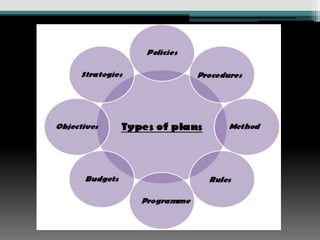
Types of plans
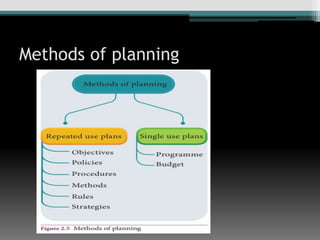
Methods of planning
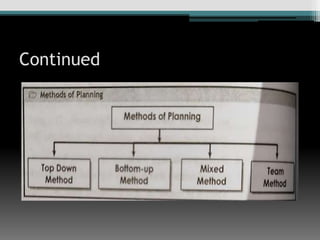
Continued
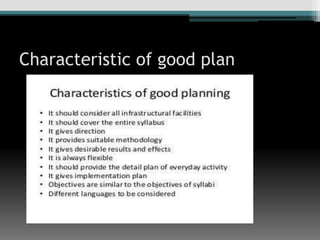
Characteristic of good plan
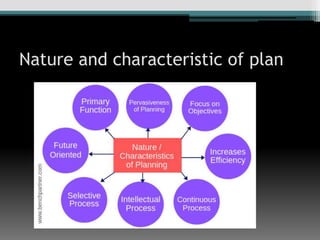
Nature and characteristic of plan
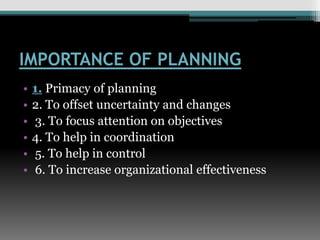
IMPORTANCE OF PLANNING
• 1. Primacy of planning
• 2. To offset uncertainty and changes
• 3. To focus attention on objectives
• 4. To help in coordination
• 5. To help in control
• 6. To increase organizational effectiveness
PRINCIPLES OF PLANNING
• Contribution of objectives
• Efficiency in plans
• Primacy of planning
• Planning premises
• Policy framework
• Timing
• Alternatives
• Commitments
• Flexibility
• Competitive strategies
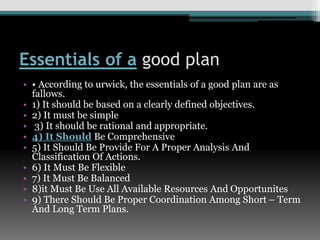
Essentials of a good plan
• • According to urwick, the essentials of a good plan are as
fallows.
• 1) It should be based on a clearly defined objectives.
• 2) It must be simple
• 3) It should be rational and appropriate.
• 4) It Should Be Comprehensive
• 5) It Should Be Provide For A Proper Analysis And
Classification Of Actions.
• 6) It Must Be Flexible
• 7) It Must Be Balanced
• 8)it Must Be Use All Available Resources And Opportunites
• 9) There Should Be Proper Coordination Among Short – Term
And Long Term Plans.
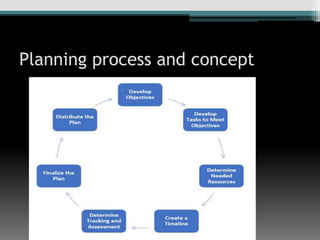
Planning process and concept
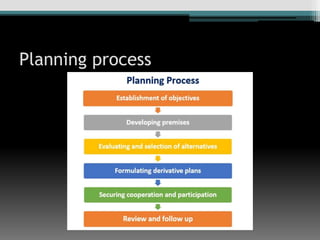
Planning process
STEPS of planning
• Stating The Orgnizational Objectives List
• The Altrnative Channel Of Reaching
• The Objectives Develop Permises On Which
Each Alternative Is Listed Select
• The Best Alternative Which Fits Into
Organizational Objectives
Prepare A Sound Plan
• Prepare A Sound Plan Out Of Selected
Alternative.
• This Will Be A Master Plan Which Contains
Various Functional Plans
• Implement The Designed Plan
Planning Methods Standing/
Repeated
• Use Single
• Use Plans Plans
• 1) Objectives
• 1) Programmes
• 2) Polices
• 3) Budgets
• 4) Procedures
• 5) Methods
• 6) Rules
• 7) Strategies
STEPS IN PLANNING PROCESS
• Determination of the objectives
• Collection and forecasting of information
• Development of planning premises
• Discovering alternatives courses of action
• Formulation of derivative plans
• Communicating the plan
• Follow up measures
ADVANTAGES OF PLANNING
• Increasing Complexity In Modern Business
• Help In Coordination
• Help In Exercising Effective Controls
• Helps In The Proper Utilization Of The Company
Resources
• Facilitate Unity Of Action
• Help In Avoiding Business Failure
• Focuses Attention On The Organizations Goals
• Improve Competitive Strength
• Improve Adaptation
• Guides Decision Making
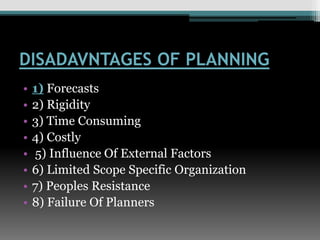
DISADAVNTAGES OF PLANNING
• 1) Forecasts
• 2) Rigidity
• 3) Time Consuming
• 4) Costly
• 5) Influence Of External Factors
• 6) Limited Scope Specific Organization
• 7) Peoples Resistance
• 8) Failure Of Planners
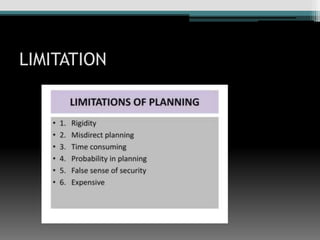
LIMITATION
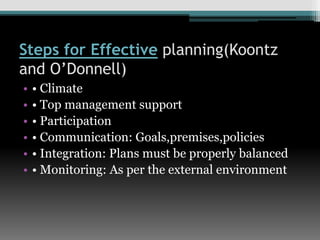
Steps for Effective planning(Koontz
and O’Donnell)
• • Climate
• • Top management support
• • Participation
• • Communication: Goals,premises,policies
• • Integration: Plans must be properly balanced
• • Monitoring: As per the external environment
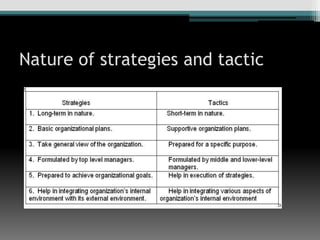
Nature of strategies and tactic
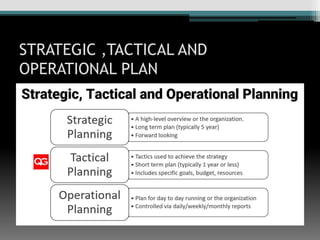
STRATEGIC ,TACTICAL AND
OPERATIONAL PLAN
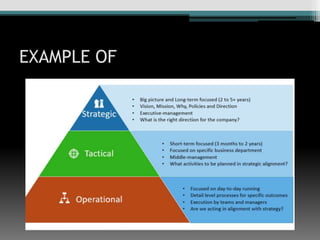
EXAMPLE OF
Strategic and tactical plan
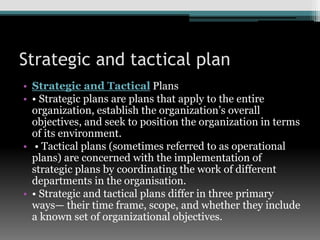
• Strategic and Tactical Plans
• • Strategic plans are plans that apply to the entire
organization, establish the organization’s overall
objectives, and seek to position the organization in terms
of its environment.
• • Tactical plans (sometimes referred to as operational
plans) are concerned with the implementation of
strategic plans by coordinating the work of different
departments in the organisation.
• • Strategic and tactical plans differ in three primary
ways— their time frame, scope, and whether they include
a known set of organizational objectives.
Continued
• Short-term and Long-term Plans • Short-
term plans are plans that cover less than one
year. • Long-term plans are plans that extend
beyond five years. • Their differences lie in the
length of future commitments and the degree of
variability organizations face.
Continued
• Specific and Directional Plans • Specific plans
have clearly defined objectives and leave no room
for misinterpretation. • Directional plans are flexible
plans that set out general guidelines.
• Single-use and Standing Plans • Single-use
plans are used to meet the needs of particular or
unique situation. e.g.development of a product. •
Standing plans are ongoing, and provide guidance
for repeatedly performed actions in an organization.
Planning process
• • Establishing objectives:
• identify goals, internal as well as external conditions,
Objectives should state what is to achieved, where action
needs to be taken, who is to perform it, how it is
undertaken , when it is to be accomplished.
• • Developing premises: assumptions about the
environment in which plans are made.
• • Evaluating alternatives and selection
• • Formulating derivative plans: The plan derived for
various departments, units, activities etc in a detailed
manner.
• • Securing cooperation and participation of employees.
CONTROLLING
• The process of measuring performance and
taking action to ensure desired results.
• Has a positive and necessary role in the
management process.
• Ensures that the right things happen, in the right
way, at the right time.
What is the control process?
• Steps in the control process :
• • Step 1— establish objectives and standards – •
Step 2— measure actual performance
• • Step 3— compare results with objectives and
standards
• • Step 4— take corrective action as needed
CONTROLE PROCESS
What is the control process?
Step 1—establishing objectives and
standards
• Output standards
Measure performance results in terms of quantity,
quality, cost, or time.
• Input standards
Measure effort in terms of amount of work
expended in task performance.
Step 2—measuring actual performance
• Goal is accurate measurement of actual results
on output and/or input standards.
• Effective control requires measurement.
Step 3—comparing results with
objectives and standards
Step 3—comparing results with objectives and
standards
• Control equation
• Need for action reflects the difference between
desired performance and actual performance
• Methods of comparing desired and actual
performance
1) Historical comparison
2) 2) Relative comparison
3) 3)Engineering comparison
4) Benchmarking using different comparison
methods
• Step 4—taking corrective action
Step 4—taking corrective action
– Taking action when a discrepancy exists
between desired and actual performance.
– Management by exception
• Giving priority attention to situations showing
the greatest need for action.
• Types of exceptions –
1)Problem situation –
2)Opportunity situation
FEED FORWARD CONTROLS.
Employed before a work activity begins.
Ensures that:
1) Objectives are clear.
2) Proper directions are established.
3) Right resources are available.
Focuses on quality of resources.
CONCURRENT CONTROLS
• Focus on what happens during work process.
• Monitor ongoing operations to make sure they
are being done according to plan.
• Can reduce waste in unacceptable finished
products or services.
Feedback controls
• Take place after work is completed.
• Focus on quality of end results.
• Provide useful information for improving future
operations.
Summary
• Till now we have discussed about the panning ,
meaning, purpose, objective, importance, good
characteristic, planning process, etc.
• controlling like introduction, definition, process
, step of controlling process , types of controlling
process etc.
Conclusion
• I hope understand the planning and controlling
process in health care services and nursing
management work in clinical area. If you got
chance to do planning in nursing services , will
you able to apply the this knowledge in future
confidently.
Assignment
• .write a assignment on “Preparation of budget
estimate, revised estimate and performance
budget” in college of nursing 2022-23 plan ,
submit on 16.5.23 at 9am , in HOD office .
Question related to topic
• Define the planning ?
• List out th eobjectives of planning ?
• discuss the characteristic of planning ?
• Describe the good design of plan ?
• Enumerate the types of plan
• Discuss in detail about types of plan ?
• Write the steps of planning process?
• define control ?
• Discuss the process of controlling ?
• What are the step of controlling process ?
Reference *:
• BesseiL.Marquise Carol J.Huston ,Leadership and Management functions in
• Nursing-Theory & application ,2nd Edition, Lippincott, Philadelphia.
• Stephen P.Robbins and Mary Coultar, Management,5thEdition,Printice Hall ,Inc,
New jersey.
• AnnMarriner-Tomey, Guide to Nursing Management, 4th Edition, Moseby
• Yearbook, Philadelphia.
• Kochuthresiamma,T(2001) Nursing Management and Administration, Medical
works.
• Heinz Weihrich and Harold Koontz ,Management –A Global perspective,10th Edition,
Mc Grawhill International Edition, Singapore.
• ElsVanOoijen,Clinical Supervision,2000,Churchill Livingston,London.
• Joseph L Massie,Essentials of Management,4thEdition,Printice Hall ,New Delhi.
• Sakti Gupta,SunilKant,Hospital and Health Care administration-Appraisal &
• Referral Treatise,1998,Jaypee Brothers,New Delhi.
• Roberta StrassleAbruzzese,Nursing Staff Development-Strategies for Success,2nd
• Edition, Mosby Publication,London.