BY C SETTLEY
Importance of Nursing Theories
1. In the early part of nursing’s history,
knowledge was extremely limited and almost
entirely task oriented.
2. The integration of theory into practice is the
basis for professional nursing.
3. The literature about the relationship between
theory and nursing care yields many
interpretations in terms of the role each
component plays in the health care environment.
4. Theories are mental powers or constructs
created to help understand and find meaning
from experience, organize and articulate our
knowing, and ask questions leading to new
insights.
5. Nursing theories provide a framework for
thought in which to examine situations. As new
situations are encountered, this framework
provides a structure for organization, analysis,
and decision making.
6. Nursing theories provide a structure for
communicating with other nurses and with other
members of the health care team.
7. Nursing theories assist the discipline of
nursing in clarifying beliefs, values, and goals,
and they help to define the unique contribution
of nursing in the care of clients.
16/07/2019 COMPILEDBY C SETTLEY 2
Virginia Henderson’s Nursing Need Theory
•She identified fourteen basic needs .
•She postulated that the unique function of the nurse is to
assist the clients, sick or well, in the performance of those
activities contributing to health or its recovery, that clients
would perform unaided if they had the necessary strength, will
or knowledge.
•The theory focuses on the importance of increasing the
patient’s independence to hasten their progress in the
hospital.
16/07/2019 COMPILEDBY C SETTLEY 3
Assumptions of
Virginia Henderson’s Nursing Need Theory
•(1) Nurses care for patients until they can care for themselves
once again.
•Although not precisely explained, (2) patients desire to return to
health.
•(3) Nurses are willing to serve and that “nurses will devote
themselves to the patient day and night.”
•(4) Henderson also believes that the “mind and body are
inseparable and are interrelated.”
16/07/2019 COMPILEDBY C SETTLEY 4
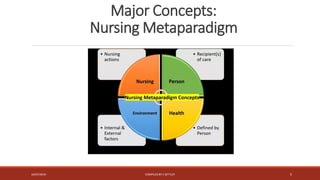
Major Concepts:
Nursing Metaparadigm
16/07/2019 COMPILEDBY C SETTLEY 5
Major Concepts:
Nursing Metaparadigm
•Health
• Although not explicitly defined in Henderson’s theory, health was taken to mean
balance in all realms of human life.
• It is equated with the independence or ability to perform activities without any
aid in the 14 components or basic human needs.
• Nurses, on the other hand, are key persons in promoting health, prevention of
illness and being able to cure.
• According to Henderson, a good health is a challenge because it is affected by
numerous factors such as age, cultural background, emotional balance, and
others.
16/07/2019 COMPILEDBY C SETTLEY 6
Major Concepts:
Nursing Metaparadigm
•Nursing
• Henderson wrote her definition of nursing before the development of theoretical
nursing.
• She defined nursing as “the unique function of the nurse is to assist the individual,
sick or well, in the performance of those activities contributing to health or its
recovery that he would perform unaided if he had the necessary strength, will or
knowledge. And to do this in such a way as to help him gain independence as rapidly
as possible.”
• The nurse’s goal is to make the patient complete, whole, or independent. In turn, the
nurse collaborates with the physician’s therapeutic plan.
16/07/2019 COMPILEDBY C SETTLEY 7
Major Concepts:
Nursing Metaparadigm
•Nursing
• Nurses temporarily assist an individual who lacks the necessary
strength, will, and knowledge to satisfy one or more of the 14 basic
needs.
• She states: “The nurse is temporarily the consciousness of the
unconscious, the love life for the suicidal, the leg of the amputee, the
eyes of the newly blind, a means of locomotion for the infant,
knowledge and confidence of the young mother, the mouthpiece for
those too weak or withdrawn to speak”
16/07/2019 COMPILEDBY C SETTLEY 8
Major Concepts:
Nursing Metaparadigm
•Nursing
• Additionally, she stated that “…the nurse does for others what they
would do for themselves if they had the strength, the will, and the
knowledge. But I go on to say that the nurse makes the patient
independent of him or her as soon as possible.”
• Her definition of nursing distinguished the role of a nurse in health care:
The nurse is expected to carry out a physician’s therapeutic plan, but
individualized care is result of the nurse’s creativity in planning for care.
16/07/2019 COMPILEDBY C SETTLEY 9
Major Concepts:
Nursing Metaparadigm
•Nursing
• The nurse should be an independent practitioner able to make independent
judgment.
• In her work Nature of Nursing, she states the a nurse’s role is “to get inside the
patient’s skin and supplement his strength, will or knowledge according to his
needs.”
• The nurse has the responsibility to assess the needs of the patient, help him or
her meet health needs, and provide an environment in which the patient can
perform activity unaided.
16/07/2019 COMPILEDBY C SETTLEY 10
Major Concepts:
Nursing Metaparadigm
•Individual
• Henderson states that individuals have basic needs that are component of health and
require assistance to achieve health and independence or a peaceful death.
• According to her, an individual achieves wholeness by maintaining physiological and
emotional balance.
• She defined the patient as someone who needs nursing care, but did not limit nursing to
illness care.
• Her theory presented the patient as a sum of parts with bio psychosocial needs and the
mind and body are inseparable and interrelated.
16/07/2019 COMPILEDBY C SETTLEY 11
Major Concepts:
Nursing Metaparadigm
•Environment
• Although the Need Theory did not explicitly define the environment, Henderson
stated that maintaining a supportive environment conducive for health is one of
the elements of her 14 activities for client assistance.
• She believes that society wants and expects the nurse’s service of acting for
individuals who are unable to function independently.
16/07/2019 COMPILEDBY C SETTLEY 12
16/07/2019 COMPILEDBY C SETTLEY 13
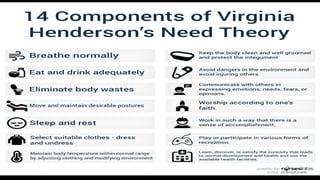
Physiological Components
•1. Breathe normally
•2. Eat and drink adequately
•3. Eliminate body wastes
•4. Move and maintain desirable postures
•5. Sleep and rest
•6. Select suitable clothes – dress and undress
•7. Maintain body temperature within normal range by adjusting clothing and modifying environment
•8. Keep the body clean and well groomed and protect the integument
•9. Avoid dangers in the environment and avoid injuring others
16/07/2019 COMPILEDBY C SETTLEY 14
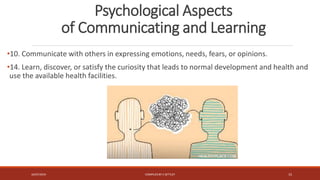
Psychological Aspects
of Communicating and Learning
•10. Communicate with others in expressing emotions, needs, fears, or opinions.
•14. Learn, discover, or satisfy the curiosity that leads to normal development and health and
use the available health facilities.
16/07/2019 COMPILEDBY C SETTLEY 15
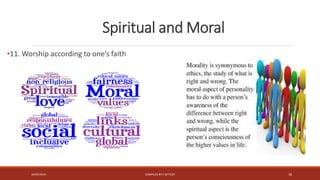
Spiritual and Moral
•11. Worship according to one’s faith
16/07/2019 COMPILEDBY C SETTLEY 16
Sociologically Oriented
to Occupation and Recreation
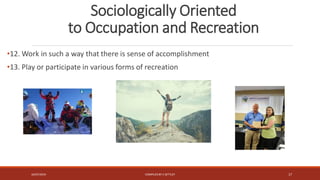
•12. Work in such a way that there is sense of accomplishment
•13. Play or participate in various forms of recreation
16/07/2019 COMPILEDBY C SETTLEY 17
16/07/2019 COMPILEDBY C SETTLEY 18
Strengths & Weaknesses
•Henderson’s concept of nursing is widely accepted in nursing practice
today. Her theory and 14 components are relatively simple, logical, and
can be applied to individuals of all ages.
•On assisting the individual in the dying process, there is a little explanation
of what the nurse does to provide “peaceful death.”
16/07/2019 COMPILEDBY C SETTLEY 19
Abraham Maslow
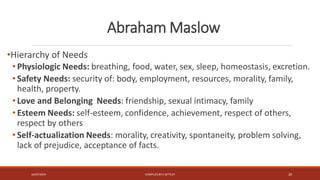
•Hierarchy of Needs
• Physiologic Needs: breathing, food, water, sex, sleep, homeostasis, excretion.
• Safety Needs: security of: body, employment, resources, morality, family,
health, property.
• Love and Belonging Needs: friendship, sexual intimacy, family
• Esteem Needs: self-esteem, confidence, achievement, respect of others,
respect by others
• Self-actualization Needs: morality, creativity, spontaneity, problem solving,
lack of prejudice, acceptance of facts.
16/07/2019 COMPILEDBY C SETTLEY 20
Adolf Meyer
•Believes in totality of man or the holistic approach to man.
•Patients could best be understood through consideration of their life
situations.
•Meyer's main contribution was in his ideas of psychobiology, where he focused
on addressing all biological, social and psychological factors and symptoms
pertaining to a patient.
•Meyer coined the term "ergasiology“- "working" and "doing", as another way to
classify psychobiology.
•One of his ideas was that mental illnesses were a product of a dysfunctional
personality and not from the pathology of the brain.
16/07/2019 COMPILEDBY C SETTLEY 21
Adolf Meyer
•He also stressed the idea that social and biological factors that affect someone
throughout their entire life should be heavily considered when diagnosing and
treating a patient.
•He thought there was an important connection between the activities of an
individual and their mental health.
•Taking this into consideration he looked for community based activities and
services to aid people with everyday living skills.
16/07/2019 COMPILEDBY C SETTLEY 22
Martha E. Rogers’
Theory of Unitary Human Beings
•Assumptions
• (1) Man is a unified whole possessing his own integrity and manifesting
characteristics that are more than and different from the sum of his
parts.
• (2) Man and environment are continuously exchanging matter and energy
with one another.
• (3) The life process evolves irreversibly and unidirectionally along the
space-time continuum.
• (4) Pattern and organization identify man and reflect his innovative
wholeness.
• And lastly, (5) Man is characterized by the capacity for abstraction and
imagery, language and thought, sensation and emotion.
16/07/2019 COMPILEDBY C SETTLEY 23
Martha E. Rogers’
Theory of Unitary Human Beings
•Major Concepts
• Human-unitary human beings
• A person is also a unified whole, having its own distinct characteristics that can’t be viewed by
looking at, describing, or summarizing the parts.
• Health
• Rogers defines health as an expression of the life process. It is the characteristics and behavior
coming from the mutual, simultaneous interaction of the human and environmental fields, and
health and illness are part of the same continuum. The multiple events occurring during the life
process show the extent to which a person is achieving his or her maximum health potential.
The events vary in their expressions from greatest health to those conditions that are
incompatible with the maintaining life process.
16/07/2019 COMPILEDBY C SETTLEY 24
Martha E. Rogers’
Theory of Unitary Human Beings
•Major Concepts
• Nursing
• It is the study of unitary, irreducible, indivisible human and environmental fields: people and
their world.
• Rogers claims that nursing exists to serve people, and the safe practice of nursing depends on
the nature and amount of scientific nursing knowledge the nurse brings to his or her practice
• Scope of Nursing
• Nursing aims to assist people in achieving their maximum health potential.
• Maintenance and promotion of health, prevention of disease, nursing diagnosis, intervention,
and rehabilitation encompass the scope of nursing’s goals.
• Nursing is concerned with people-all people-well and sick, rich and poor, young and old.
16/07/2019 COMPILEDBY C SETTLEY 25
Martha E. Rogers’
Theory of Unitary Human Beings
•Major Concepts
• Environmental Field
• “An irreducible, indivisible, pan dimensional energy field identified by pattern and integral with
the human field.”
• Energy Field
• The energy field is the fundamental unit of both the living and the non-living.
• It provides a way to view people and the environment as irreducible wholes.
• The energy fields continuously vary in intensity, density, and extent.
16/07/2019 COMPILEDBY C SETTLEY 26
Martha E. Rogers’
Theory of Unitary Human Beings
•Subconcepts
• Openness
• There are no boundaries that stop energy flow between the human and environmental fields, which is the openness in Rogers’ theory. It refers to
qualities exhibited by open systems; human beings and their environment are open systems.
• Pandimensional
• Pan-dimensionality is defined as “non-linear domain without spatial or temporal attributes.” The parameters that humans use in language to describe
events are arbitrary, and the present is relative; there is no temporal ordering of lives.
• Synergy is defined as the unique behavior of whole systems, unpredicted by any behaviors of their component
functions taken separately.
• Pattern
• Rogers defined pattern as the distinguishing characteristic of an energy field seen as a single wave. It is an abstraction, and gives identity to the field.
• Principles of Homeodynamics
• Homeodynamics should be understood as a dynamic version of homeostasis (a relatively steady state of internal operation in the living system).
16/07/2019 COMPILEDBY C SETTLEY 27
Martha E. Rogers’
Theory of Unitary Human Beings
•Subconcepts
• Principle of Reciprocity
• Postulates the inseparability of man and environment and predicts that sequential changes in life process are
continuous, probabilistic revisions occurring out of the interactions between man and environment.
• Principle of Synchrony
• This principle predicts that change in human behavior will be determined by the simultaneous interaction of the
actual state of the human field and the actual state of the environmental field at any given point in space-time.
• Principle of Integrality (Synchrony + Reciprocy)
• Because of the inseparability of human beings and their environment, sequential changes in the life processes are
continuous revisions occurring from the interactions between human beings and their environment.
• Between the two entities, there is a constant mutual interaction and mutual change whereby simultaneous molding
is taking place in both at the same time.
16/07/2019 COMPILEDBY C SETTLEY 28
Martha E. Rogers’
Theory of Unitary Human Beings
•Subconcepts
• Principle of Resonance
• It speaks to the nature of the change occurring between human and environmental fields. The
life process in human beings is a symphony of rhythmical vibrations oscillating at various
frequencies.
• It is the identification of the human field and the environmental field by wave patterns
manifesting continuous change from longer waves of lower frequency to shorter waves of higher
frequency.
• Principle of Helicy
• The human-environment field is a dynamic, open system in which change is continuous due to the
constant interchange between the human and environment.
16/07/2019 COMPILEDBY C SETTLEY 29
Martha E. Rogers’
Theory of Unitary Human Beings
•Mutual patterning of the human and environmental fields includes:
• sharing knowledge
• offering choices
• empowering the patient
• fostering patterning
• evaluation
• repeat pattern appraisal, which includes nutrition, work/leisure activities, wake/sleep
cycles, relationships, pain, and fear/hopes
• identify dissonance and harmony
• validate appraisal with the patient
• self-reflection for the patient
16/07/2019 COMPILEDBY C SETTLEY 30
Dorothea E. Orem’ Self-Care Theory
•Orem's vision of health is a state characterized by wholeness of
developed human structures and of bodily and mental
functioning. It includes physical, psychological, interpersonal
and social aspects. Her major assumptions included that
people should be self-reliant and responsible for their own
care and the care of others in their family. She said that a
person's knowledge of potential health problems is necessary
for promoting self-care behaviors. Orem defined nursing as an
art, a helping service and a technology.
16/07/2019 COMPILEDBY C SETTLEY 31
Betty Neuman: The System Model
•Focuses on the response of the client system to actual or potential
environmental stressors and the use of several levels of nursing
prevention intervention for attaining, retaining and maintaining
optimal client system wellness.
•Neuman defines the concern of nursing is preventing stress invasion.
•If stress is not prevented then the nurse should protect the client's
basic structure and obtain or maintain a maximum level of wellness.
•Nurses provide care through primary, secondary and tertiary
prevention modes.
16/07/2019 COMPILEDBY C SETTLEY 32
Hildegard Peplau’s Interpersonal Theory
•She defines the nurse/patient relationship evolving through
orientation, identification, exploitation and resolution.
•She views nursing as a maturing force that is realized as the
personality develops through educational, therapeutic, and
interpersonal processes.
•Nurses enter into a personal relationship with an individual
when a felt need is present.
•Peplau's model is still very popular with clinicians working with
individuals who have psychological problems.
16/07/2019 COMPILEDBY C SETTLEY 33
Madeleine Leininger’s Transcultural
Nursing theory
•According to Leininger, the goal of nursing is to provide care
congruent with cultural values, beliefs, and practices.
•Leininger states that care is the essence of nursing and the
dominant, distinctive and unifying feature.
•She says there can be no cure without caring, but that there may be
caring with curing.
•Health care personnel should work towards an understanding of
care and the values, health beliefs, and life-styles of different
cultures, which will form the basis for providing culture-specific
care.
16/07/2019 COMPILEDBY C SETTLEY 34
Patricia Benner’s From Novice to Expert
•Benner describes five levels of nursing experience: novice, advanced
beginner, competent, proficient and expert.
•The levels reflect a movement from reliance on abstract principles to the
use of past concrete experience.
•She proposes that a nurse could gain knowledge and skills without ever
learning the theory.
•Each step builds on the previous one as the learner gains clinical
expertise.
•Simply put, Benner says experience is a prerequisite for becoming an
expert.
16/07/2019 COMPILEDBY C SETTLEY 35
Other theories:
Johnson’s Behavioural system model
Imogene King’s theory
Roy’s adaptation model
Peplau’s theory of interpersonal relations
Watson’s theory of human caring
Orlando’s theory of the deliberate nursing
process
Maternal Role Attainment Theory by Ramona
Mercer
Self-Efficacy Theory by Alberta Bandura
Tidal Model Theory by Phil Barker
Life Perspective Rhythm Model by Joyce
Fitzpatrick
Theory of Comfort by Katharine Kolcaba
Four Conservation Principles by Myra Levine
16/07/2019 COMPILEDBY C SETTLEY 36
Other theories:
Change Theory by Kurt Lewin
Health Promotion Model by Nola Pender
Twenty-One Nursing Problems Theory by Faye
Abdellah
The Goal Attainment Theory by Imogene King
Energy Theory by Carl O. Helvie
Helping Art of Clinical Nursing Model by
Ernestine Wiedenbach
Helping and Human Relationships Theory by
Robert R. Carkhuff
Activities of Living Nursing Model by Roper-
Logan-Tierney
Humanistic Nursing Theory by Paterson &
Zderad
Birth Order Theory by Alfred Adler
The Core, Care and Cure Theory by Lydia E.
Hall
16/07/2019 COMPILEDBY C SETTLEY 37
Reference list
•https://nurseslabs.com/virginia-hendersons-need-theory/
•George B. Julia (2010). Nursing Theories: The Base for Professional Nursing Practice. Pearson
Higher Ed USA.
•Meleis Ibrahim Afaf (1997). Theoretical Nursing : Development & Progress 3rd ed. Philadelphia,
Lippincott.
•Rogers, M. E. (1989). An Introduction to the Theoretical Basis of Nursing. Philadelphia: F. A. Davis
•https://www.nursebuff.com/nursing-models-and-theories/
•http://www.nursing-theory.org/theories-and-models/
•https://www.ukessays.com/essays/nursing/theories-compare-and-contrast-nursing-essay.php
16/07/2019 COMPILEDBY C SETTLEY 38

Nursing theories and models

  • 1.
  • 2.
    Importance of NursingTheories 1. In the early part of nursing’s history, knowledge was extremely limited and almost entirely task oriented. 2. The integration of theory into practice is the basis for professional nursing. 3. The literature about the relationship between theory and nursing care yields many interpretations in terms of the role each component plays in the health care environment. 4. Theories are mental powers or constructs created to help understand and find meaning from experience, organize and articulate our knowing, and ask questions leading to new insights. 5. Nursing theories provide a framework for thought in which to examine situations. As new situations are encountered, this framework provides a structure for organization, analysis, and decision making. 6. Nursing theories provide a structure for communicating with other nurses and with other members of the health care team. 7. Nursing theories assist the discipline of nursing in clarifying beliefs, values, and goals, and they help to define the unique contribution of nursing in the care of clients. 16/07/2019 COMPILEDBY C SETTLEY 2
  • 3.
    Virginia Henderson’s NursingNeed Theory •She identified fourteen basic needs . •She postulated that the unique function of the nurse is to assist the clients, sick or well, in the performance of those activities contributing to health or its recovery, that clients would perform unaided if they had the necessary strength, will or knowledge. •The theory focuses on the importance of increasing the patient’s independence to hasten their progress in the hospital. 16/07/2019 COMPILEDBY C SETTLEY 3
  • 4.
    Assumptions of Virginia Henderson’sNursing Need Theory •(1) Nurses care for patients until they can care for themselves once again. •Although not precisely explained, (2) patients desire to return to health. •(3) Nurses are willing to serve and that “nurses will devote themselves to the patient day and night.” •(4) Henderson also believes that the “mind and body are inseparable and are interrelated.” 16/07/2019 COMPILEDBY C SETTLEY 4
  • 5.
  • 6.
    Major Concepts: Nursing Metaparadigm •Health •Although not explicitly defined in Henderson’s theory, health was taken to mean balance in all realms of human life. • It is equated with the independence or ability to perform activities without any aid in the 14 components or basic human needs. • Nurses, on the other hand, are key persons in promoting health, prevention of illness and being able to cure. • According to Henderson, a good health is a challenge because it is affected by numerous factors such as age, cultural background, emotional balance, and others. 16/07/2019 COMPILEDBY C SETTLEY 6
  • 7.
    Major Concepts: Nursing Metaparadigm •Nursing •Henderson wrote her definition of nursing before the development of theoretical nursing. • She defined nursing as “the unique function of the nurse is to assist the individual, sick or well, in the performance of those activities contributing to health or its recovery that he would perform unaided if he had the necessary strength, will or knowledge. And to do this in such a way as to help him gain independence as rapidly as possible.” • The nurse’s goal is to make the patient complete, whole, or independent. In turn, the nurse collaborates with the physician’s therapeutic plan. 16/07/2019 COMPILEDBY C SETTLEY 7
  • 8.
    Major Concepts: Nursing Metaparadigm •Nursing •Nurses temporarily assist an individual who lacks the necessary strength, will, and knowledge to satisfy one or more of the 14 basic needs. • She states: “The nurse is temporarily the consciousness of the unconscious, the love life for the suicidal, the leg of the amputee, the eyes of the newly blind, a means of locomotion for the infant, knowledge and confidence of the young mother, the mouthpiece for those too weak or withdrawn to speak” 16/07/2019 COMPILEDBY C SETTLEY 8
  • 9.
    Major Concepts: Nursing Metaparadigm •Nursing •Additionally, she stated that “…the nurse does for others what they would do for themselves if they had the strength, the will, and the knowledge. But I go on to say that the nurse makes the patient independent of him or her as soon as possible.” • Her definition of nursing distinguished the role of a nurse in health care: The nurse is expected to carry out a physician’s therapeutic plan, but individualized care is result of the nurse’s creativity in planning for care. 16/07/2019 COMPILEDBY C SETTLEY 9
  • 10.
    Major Concepts: Nursing Metaparadigm •Nursing •The nurse should be an independent practitioner able to make independent judgment. • In her work Nature of Nursing, she states the a nurse’s role is “to get inside the patient’s skin and supplement his strength, will or knowledge according to his needs.” • The nurse has the responsibility to assess the needs of the patient, help him or her meet health needs, and provide an environment in which the patient can perform activity unaided. 16/07/2019 COMPILEDBY C SETTLEY 10
  • 11.
    Major Concepts: Nursing Metaparadigm •Individual •Henderson states that individuals have basic needs that are component of health and require assistance to achieve health and independence or a peaceful death. • According to her, an individual achieves wholeness by maintaining physiological and emotional balance. • She defined the patient as someone who needs nursing care, but did not limit nursing to illness care. • Her theory presented the patient as a sum of parts with bio psychosocial needs and the mind and body are inseparable and interrelated. 16/07/2019 COMPILEDBY C SETTLEY 11
  • 12.
    Major Concepts: Nursing Metaparadigm •Environment •Although the Need Theory did not explicitly define the environment, Henderson stated that maintaining a supportive environment conducive for health is one of the elements of her 14 activities for client assistance. • She believes that society wants and expects the nurse’s service of acting for individuals who are unable to function independently. 16/07/2019 COMPILEDBY C SETTLEY 12
  • 13.
  • 14.
    Physiological Components •1. Breathenormally •2. Eat and drink adequately •3. Eliminate body wastes •4. Move and maintain desirable postures •5. Sleep and rest •6. Select suitable clothes – dress and undress •7. Maintain body temperature within normal range by adjusting clothing and modifying environment •8. Keep the body clean and well groomed and protect the integument •9. Avoid dangers in the environment and avoid injuring others 16/07/2019 COMPILEDBY C SETTLEY 14
  • 15.
    Psychological Aspects of Communicatingand Learning •10. Communicate with others in expressing emotions, needs, fears, or opinions. •14. Learn, discover, or satisfy the curiosity that leads to normal development and health and use the available health facilities. 16/07/2019 COMPILEDBY C SETTLEY 15
  • 16.
    Spiritual and Moral •11.Worship according to one’s faith 16/07/2019 COMPILEDBY C SETTLEY 16
  • 17.
    Sociologically Oriented to Occupationand Recreation •12. Work in such a way that there is sense of accomplishment •13. Play or participate in various forms of recreation 16/07/2019 COMPILEDBY C SETTLEY 17
  • 18.
  • 19.
    Strengths & Weaknesses •Henderson’sconcept of nursing is widely accepted in nursing practice today. Her theory and 14 components are relatively simple, logical, and can be applied to individuals of all ages. •On assisting the individual in the dying process, there is a little explanation of what the nurse does to provide “peaceful death.” 16/07/2019 COMPILEDBY C SETTLEY 19
  • 20.
    Abraham Maslow •Hierarchy ofNeeds • Physiologic Needs: breathing, food, water, sex, sleep, homeostasis, excretion. • Safety Needs: security of: body, employment, resources, morality, family, health, property. • Love and Belonging Needs: friendship, sexual intimacy, family • Esteem Needs: self-esteem, confidence, achievement, respect of others, respect by others • Self-actualization Needs: morality, creativity, spontaneity, problem solving, lack of prejudice, acceptance of facts. 16/07/2019 COMPILEDBY C SETTLEY 20
  • 21.
    Adolf Meyer •Believes intotality of man or the holistic approach to man. •Patients could best be understood through consideration of their life situations. •Meyer's main contribution was in his ideas of psychobiology, where he focused on addressing all biological, social and psychological factors and symptoms pertaining to a patient. •Meyer coined the term "ergasiology“- "working" and "doing", as another way to classify psychobiology. •One of his ideas was that mental illnesses were a product of a dysfunctional personality and not from the pathology of the brain. 16/07/2019 COMPILEDBY C SETTLEY 21
  • 22.
    Adolf Meyer •He alsostressed the idea that social and biological factors that affect someone throughout their entire life should be heavily considered when diagnosing and treating a patient. •He thought there was an important connection between the activities of an individual and their mental health. •Taking this into consideration he looked for community based activities and services to aid people with everyday living skills. 16/07/2019 COMPILEDBY C SETTLEY 22
  • 23.
    Martha E. Rogers’ Theoryof Unitary Human Beings •Assumptions • (1) Man is a unified whole possessing his own integrity and manifesting characteristics that are more than and different from the sum of his parts. • (2) Man and environment are continuously exchanging matter and energy with one another. • (3) The life process evolves irreversibly and unidirectionally along the space-time continuum. • (4) Pattern and organization identify man and reflect his innovative wholeness. • And lastly, (5) Man is characterized by the capacity for abstraction and imagery, language and thought, sensation and emotion. 16/07/2019 COMPILEDBY C SETTLEY 23
  • 24.
    Martha E. Rogers’ Theoryof Unitary Human Beings •Major Concepts • Human-unitary human beings • A person is also a unified whole, having its own distinct characteristics that can’t be viewed by looking at, describing, or summarizing the parts. • Health • Rogers defines health as an expression of the life process. It is the characteristics and behavior coming from the mutual, simultaneous interaction of the human and environmental fields, and health and illness are part of the same continuum. The multiple events occurring during the life process show the extent to which a person is achieving his or her maximum health potential. The events vary in their expressions from greatest health to those conditions that are incompatible with the maintaining life process. 16/07/2019 COMPILEDBY C SETTLEY 24
  • 25.
    Martha E. Rogers’ Theoryof Unitary Human Beings •Major Concepts • Nursing • It is the study of unitary, irreducible, indivisible human and environmental fields: people and their world. • Rogers claims that nursing exists to serve people, and the safe practice of nursing depends on the nature and amount of scientific nursing knowledge the nurse brings to his or her practice • Scope of Nursing • Nursing aims to assist people in achieving their maximum health potential. • Maintenance and promotion of health, prevention of disease, nursing diagnosis, intervention, and rehabilitation encompass the scope of nursing’s goals. • Nursing is concerned with people-all people-well and sick, rich and poor, young and old. 16/07/2019 COMPILEDBY C SETTLEY 25
  • 26.
    Martha E. Rogers’ Theoryof Unitary Human Beings •Major Concepts • Environmental Field • “An irreducible, indivisible, pan dimensional energy field identified by pattern and integral with the human field.” • Energy Field • The energy field is the fundamental unit of both the living and the non-living. • It provides a way to view people and the environment as irreducible wholes. • The energy fields continuously vary in intensity, density, and extent. 16/07/2019 COMPILEDBY C SETTLEY 26
  • 27.
    Martha E. Rogers’ Theoryof Unitary Human Beings •Subconcepts • Openness • There are no boundaries that stop energy flow between the human and environmental fields, which is the openness in Rogers’ theory. It refers to qualities exhibited by open systems; human beings and their environment are open systems. • Pandimensional • Pan-dimensionality is defined as “non-linear domain without spatial or temporal attributes.” The parameters that humans use in language to describe events are arbitrary, and the present is relative; there is no temporal ordering of lives. • Synergy is defined as the unique behavior of whole systems, unpredicted by any behaviors of their component functions taken separately. • Pattern • Rogers defined pattern as the distinguishing characteristic of an energy field seen as a single wave. It is an abstraction, and gives identity to the field. • Principles of Homeodynamics • Homeodynamics should be understood as a dynamic version of homeostasis (a relatively steady state of internal operation in the living system). 16/07/2019 COMPILEDBY C SETTLEY 27
  • 28.
    Martha E. Rogers’ Theoryof Unitary Human Beings •Subconcepts • Principle of Reciprocity • Postulates the inseparability of man and environment and predicts that sequential changes in life process are continuous, probabilistic revisions occurring out of the interactions between man and environment. • Principle of Synchrony • This principle predicts that change in human behavior will be determined by the simultaneous interaction of the actual state of the human field and the actual state of the environmental field at any given point in space-time. • Principle of Integrality (Synchrony + Reciprocy) • Because of the inseparability of human beings and their environment, sequential changes in the life processes are continuous revisions occurring from the interactions between human beings and their environment. • Between the two entities, there is a constant mutual interaction and mutual change whereby simultaneous molding is taking place in both at the same time. 16/07/2019 COMPILEDBY C SETTLEY 28
  • 29.
    Martha E. Rogers’ Theoryof Unitary Human Beings •Subconcepts • Principle of Resonance • It speaks to the nature of the change occurring between human and environmental fields. The life process in human beings is a symphony of rhythmical vibrations oscillating at various frequencies. • It is the identification of the human field and the environmental field by wave patterns manifesting continuous change from longer waves of lower frequency to shorter waves of higher frequency. • Principle of Helicy • The human-environment field is a dynamic, open system in which change is continuous due to the constant interchange between the human and environment. 16/07/2019 COMPILEDBY C SETTLEY 29
  • 30.
    Martha E. Rogers’ Theoryof Unitary Human Beings •Mutual patterning of the human and environmental fields includes: • sharing knowledge • offering choices • empowering the patient • fostering patterning • evaluation • repeat pattern appraisal, which includes nutrition, work/leisure activities, wake/sleep cycles, relationships, pain, and fear/hopes • identify dissonance and harmony • validate appraisal with the patient • self-reflection for the patient 16/07/2019 COMPILEDBY C SETTLEY 30
  • 31.
    Dorothea E. Orem’Self-Care Theory •Orem's vision of health is a state characterized by wholeness of developed human structures and of bodily and mental functioning. It includes physical, psychological, interpersonal and social aspects. Her major assumptions included that people should be self-reliant and responsible for their own care and the care of others in their family. She said that a person's knowledge of potential health problems is necessary for promoting self-care behaviors. Orem defined nursing as an art, a helping service and a technology. 16/07/2019 COMPILEDBY C SETTLEY 31
  • 32.
    Betty Neuman: TheSystem Model •Focuses on the response of the client system to actual or potential environmental stressors and the use of several levels of nursing prevention intervention for attaining, retaining and maintaining optimal client system wellness. •Neuman defines the concern of nursing is preventing stress invasion. •If stress is not prevented then the nurse should protect the client's basic structure and obtain or maintain a maximum level of wellness. •Nurses provide care through primary, secondary and tertiary prevention modes. 16/07/2019 COMPILEDBY C SETTLEY 32
  • 33.
    Hildegard Peplau’s InterpersonalTheory •She defines the nurse/patient relationship evolving through orientation, identification, exploitation and resolution. •She views nursing as a maturing force that is realized as the personality develops through educational, therapeutic, and interpersonal processes. •Nurses enter into a personal relationship with an individual when a felt need is present. •Peplau's model is still very popular with clinicians working with individuals who have psychological problems. 16/07/2019 COMPILEDBY C SETTLEY 33
  • 34.
    Madeleine Leininger’s Transcultural Nursingtheory •According to Leininger, the goal of nursing is to provide care congruent with cultural values, beliefs, and practices. •Leininger states that care is the essence of nursing and the dominant, distinctive and unifying feature. •She says there can be no cure without caring, but that there may be caring with curing. •Health care personnel should work towards an understanding of care and the values, health beliefs, and life-styles of different cultures, which will form the basis for providing culture-specific care. 16/07/2019 COMPILEDBY C SETTLEY 34
  • 35.
    Patricia Benner’s FromNovice to Expert •Benner describes five levels of nursing experience: novice, advanced beginner, competent, proficient and expert. •The levels reflect a movement from reliance on abstract principles to the use of past concrete experience. •She proposes that a nurse could gain knowledge and skills without ever learning the theory. •Each step builds on the previous one as the learner gains clinical expertise. •Simply put, Benner says experience is a prerequisite for becoming an expert. 16/07/2019 COMPILEDBY C SETTLEY 35
  • 36.
    Other theories: Johnson’s Behaviouralsystem model Imogene King’s theory Roy’s adaptation model Peplau’s theory of interpersonal relations Watson’s theory of human caring Orlando’s theory of the deliberate nursing process Maternal Role Attainment Theory by Ramona Mercer Self-Efficacy Theory by Alberta Bandura Tidal Model Theory by Phil Barker Life Perspective Rhythm Model by Joyce Fitzpatrick Theory of Comfort by Katharine Kolcaba Four Conservation Principles by Myra Levine 16/07/2019 COMPILEDBY C SETTLEY 36
  • 37.
    Other theories: Change Theoryby Kurt Lewin Health Promotion Model by Nola Pender Twenty-One Nursing Problems Theory by Faye Abdellah The Goal Attainment Theory by Imogene King Energy Theory by Carl O. Helvie Helping Art of Clinical Nursing Model by Ernestine Wiedenbach Helping and Human Relationships Theory by Robert R. Carkhuff Activities of Living Nursing Model by Roper- Logan-Tierney Humanistic Nursing Theory by Paterson & Zderad Birth Order Theory by Alfred Adler The Core, Care and Cure Theory by Lydia E. Hall 16/07/2019 COMPILEDBY C SETTLEY 37
  • 38.
    Reference list •https://nurseslabs.com/virginia-hendersons-need-theory/ •George B.Julia (2010). Nursing Theories: The Base for Professional Nursing Practice. Pearson Higher Ed USA. •Meleis Ibrahim Afaf (1997). Theoretical Nursing : Development & Progress 3rd ed. Philadelphia, Lippincott. •Rogers, M. E. (1989). An Introduction to the Theoretical Basis of Nursing. Philadelphia: F. A. Davis •https://www.nursebuff.com/nursing-models-and-theories/ •http://www.nursing-theory.org/theories-and-models/ •https://www.ukessays.com/essays/nursing/theories-compare-and-contrast-nursing-essay.php 16/07/2019 COMPILEDBY C SETTLEY 38