by
Mahesh Jaiwantrao Patil
M.A (Political Science), M.Phil, NET, SET,
Narayanrao Chavan Law College, Nanded
(Maharashtra)
India.431602 Cell.No.09860816313
The Qur’an
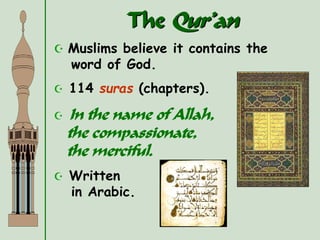
 Muslims believe it contains the
word of God.
 114 suras (chapters).
 In the name of Allah,
the compassionate,
the merciful.
 Written
in Arabic.
Features of Islam Concept
of State
 Muhammad as the final messenger of
Allah and acceptance of the Quran as the
ultimate and unalterable word of God.
 Muslims believe in Qur’an, is the word
of God.
What is Islam State ?
The Islam State is a Government of the
Muslim, by the Muslims and for the Muslim.
 every muslim believes that Sharia is
based on the Quran & it is the structure of
Muslim Law.
• The association of divinity and kingship
is not to be found in Quran.
• There should be one ruler (Muslim
King). He is a Khalifa. Human
representative of God on the earth.
• Islamic state is based on the unity of
God.
• Tauhid stands for equality , solidarity
and freedom .
• The Islamic Shariat (Islamic Law)
abolishes all discrimination.
• It promotes the concept of human
equality.
• It is based idea of Unity of God, equality
of all , solidarity of people and freedom
of individuals.
• It is based on script (Holy Quran), one
Sovereign (Imam) and one nation
(Muslim)
• Islam State in India became an
institution of King. It was military in
character .
State under Delhi Sultanate
• The Sultan was the Head of State.
• Monarchy was not essentially hereditary.
• It was based on military force.
• Sultan had to work with the help of
ministries.
• The Wazir was the Prime Minister and
also the head of the finance department.
• Diwan -i- Arz was the minister of
Military affairs.
• Diwan –i-Isha was the minister in
charge of records and royal
proclamation.
• Diwan-i-Rasalat was the minister in
charge of foreign affairs.
• Sadar-us-sadur was the minister of
judicial affairs.
Mughal Rule in India
• Mughal rulers Believed in the theory of
divine monarchy and consider
themselves as a part of God.
• The Mughal emperor was the shadow Of
God .
• The authority of king was absolute.
• There was no legal process against the
King,. If he violated Islam law, God
would punish him.

Islamic concept of state

  • 1.
    by Mahesh Jaiwantrao Patil M.A(Political Science), M.Phil, NET, SET, Narayanrao Chavan Law College, Nanded (Maharashtra) India.431602 Cell.No.09860816313
  • 2.
    The Qur’an  Muslimsbelieve it contains the word of God.  114 suras (chapters).  In the name of Allah, the compassionate, the merciful.  Written in Arabic.
  • 3.
    Features of IslamConcept of State  Muhammad as the final messenger of Allah and acceptance of the Quran as the ultimate and unalterable word of God.  Muslims believe in Qur’an, is the word of God. What is Islam State ? The Islam State is a Government of the Muslim, by the Muslims and for the Muslim.  every muslim believes that Sharia is based on the Quran & it is the structure of Muslim Law.
  • 4.
    • The associationof divinity and kingship is not to be found in Quran. • There should be one ruler (Muslim King). He is a Khalifa. Human representative of God on the earth. • Islamic state is based on the unity of God. • Tauhid stands for equality , solidarity and freedom . • The Islamic Shariat (Islamic Law) abolishes all discrimination.
  • 5.
    • It promotesthe concept of human equality. • It is based idea of Unity of God, equality of all , solidarity of people and freedom of individuals. • It is based on script (Holy Quran), one Sovereign (Imam) and one nation (Muslim) • Islam State in India became an institution of King. It was military in character .
  • 6.
    State under DelhiSultanate • The Sultan was the Head of State. • Monarchy was not essentially hereditary. • It was based on military force. • Sultan had to work with the help of ministries. • The Wazir was the Prime Minister and also the head of the finance department. • Diwan -i- Arz was the minister of Military affairs.
  • 7.
    • Diwan –i-Ishawas the minister in charge of records and royal proclamation. • Diwan-i-Rasalat was the minister in charge of foreign affairs. • Sadar-us-sadur was the minister of judicial affairs.
  • 8.
    Mughal Rule inIndia • Mughal rulers Believed in the theory of divine monarchy and consider themselves as a part of God. • The Mughal emperor was the shadow Of God . • The authority of king was absolute. • There was no legal process against the King,. If he violated Islam law, God would punish him.