1
Root – Locus Technique
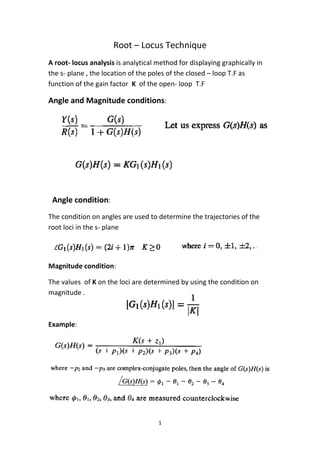
A root- locus analysis is analytical method for displaying graphically in
the s- plane , the location of the poles of the closed – loop T.F as
function of the gain factor K of the open- loop T.F
Angle and Magnitude conditions:
Angle condition:
The condition on angles are used to determine the trajectories of the
root loci in the s- plane
Magnitude condition:
The values of K on the loci are determined by using the condition on
magnitude .
Example:
2
Construction of the root loci:
1 - Each locus starts at an open- loop pole when k = 0 and finishes either
at an open – loop zero or ∞ , when k = ∞
2 - The number of branches of the root loci is equal to the order system
3 - Points of the root –locus on the real axis lie to the left of an odd
number of finite poles and zeros for k>0.Loci either move along the real
axis or occur as complex conjugate pairs of loci
4 - The root loci are symmetrical with respect to the real axis of plane
5 – Angle and center of asymptotes:
3
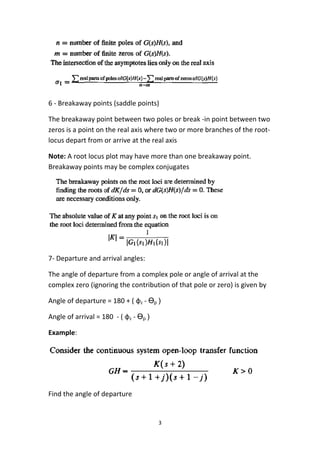
6 - Breakaway points (saddle points)
The breakaway point between two poles or break -in point between two
zeros is a point on the real axis where two or more branches of the root-
locus depart from or arrive at the real axis
Note: A root locus plot may have more than one breakaway point.
Breakaway points may be complex conjugates
7- Departure and arrival angles:
The angle of departure from a complex pole or angle of arrival at the
complex zero (ignoring the contribution of that pole or zero) is given by
Angle of departure = 180 + ( ɸz - Өp )
Angle of arrival = 180 - ( ɸz - Өp )
Example:
Find the angle of departure
4
Solution: 180 + (45 – 90) = 135
8 – Intersection of the root loci with the imaginary axis and calculation of
k and frequency of oscillation ω
The limiting value of k for stability may be found using the routh array
on the characteristic equation
Example: Consider the system shown in figure below . Sketch the root –
locus plot and then determine the value of k such that the damping
ratio of a pair of dominant poles is 0.5
Solution:
The open – loop T.F G(s) H(s) =
Number of open – loop poles n= 3
Number of open – loop zeros m=0
3rd
order system, The number of loci (branches) = n =3
number of asymptotes = n-m = 3-0=3
The number of asymptotes angles = n -m =3-0=3
5
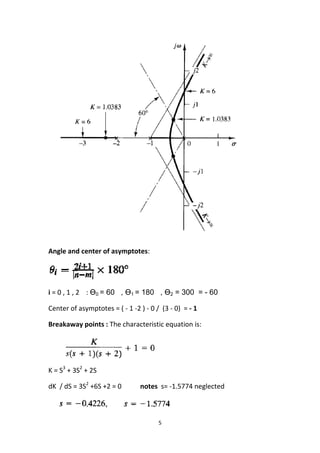
Angle and center of asymptotes:
i = 0 , 1 , 2 : Ө0 = 60 , Ө1 = 180 , Ө2 = 300 = - 60
Center of asymptotes = ( - 1 -2 ) - 0 / (3 - 0) = - 1
Breakaway points : The characteristic equation is:
K = S3
+ 3S2
+ 2S
dK / dS = 3S2
+6S +2 = 0 notes s= -1.5774 neglected
6
The crossing points on the imaginary axis
The characteristic equation is:
The routh array becomes
The value of K at breakaway points s = - 0.4226 is 0.384
0<K<0.384 overdamped , K =0.384 critical damped , 0.384<K<6 underdamped
K = 6 critical stable , K > 6 unstable system
7
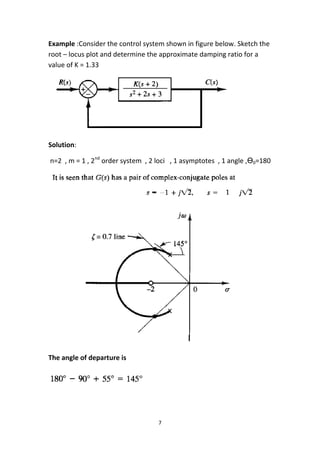
Example :Consider the control system shown in figure below. Sketch the
root – locus plot and determine the approximate damping ratio for a
value of K = 1.33
Solution:
n=2 , m = 1 , 2nd
order system , 2 loci , 1 asymptotes , 1 angle ,Ө0=180
The angle of departure is
8
The characteristic equation is:
S2
+ ( 2 + K ) S + 3 + 2K = 0 , for K = 1.33
S2
+ 3.33 S + 5.66 = 0 , S1 = - 1.665 + J 1.699 , ω = 1.699 , α =1.665
ө = tan -1
= ω/ α = 450
, ζ =0.707
Example: Sketch the root – locus plot for the system shown in figure below
Solution:
9
10
11
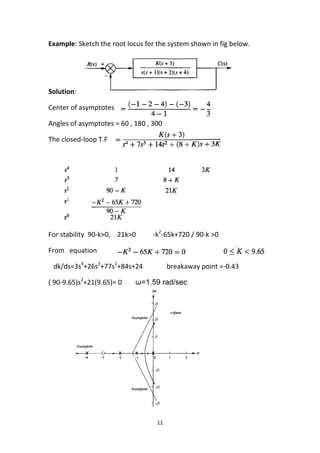
Example: Sketch the root locus for the system shown in fig below.
Solution:
Center of asymptotes
Angles of asymptotes = 60 , 180 , 300
The closed-loop T.F
For stability 90-k>0, 21k>0 -k2
-65k+720 / 90-k >0
From equation
dk/ds=3s4
+26s3
+77s2
+84s+24 breakaway point =-0.43
( 90-9.65)s2
+21(9.65)= 0 ω=1.59 rad/sec

root locus 1.pdf

  • 1.
    1 Root – LocusTechnique A root- locus analysis is analytical method for displaying graphically in the s- plane , the location of the poles of the closed – loop T.F as function of the gain factor K of the open- loop T.F Angle and Magnitude conditions: Angle condition: The condition on angles are used to determine the trajectories of the root loci in the s- plane Magnitude condition: The values of K on the loci are determined by using the condition on magnitude . Example:
  • 2.
    2 Construction of theroot loci: 1 - Each locus starts at an open- loop pole when k = 0 and finishes either at an open – loop zero or ∞ , when k = ∞ 2 - The number of branches of the root loci is equal to the order system 3 - Points of the root –locus on the real axis lie to the left of an odd number of finite poles and zeros for k>0.Loci either move along the real axis or occur as complex conjugate pairs of loci 4 - The root loci are symmetrical with respect to the real axis of plane 5 – Angle and center of asymptotes:
  • 3.
    3 6 - Breakawaypoints (saddle points) The breakaway point between two poles or break -in point between two zeros is a point on the real axis where two or more branches of the root- locus depart from or arrive at the real axis Note: A root locus plot may have more than one breakaway point. Breakaway points may be complex conjugates 7- Departure and arrival angles: The angle of departure from a complex pole or angle of arrival at the complex zero (ignoring the contribution of that pole or zero) is given by Angle of departure = 180 + ( ɸz - Өp ) Angle of arrival = 180 - ( ɸz - Өp ) Example: Find the angle of departure
  • 4.
    4 Solution: 180 +(45 – 90) = 135 8 – Intersection of the root loci with the imaginary axis and calculation of k and frequency of oscillation ω The limiting value of k for stability may be found using the routh array on the characteristic equation Example: Consider the system shown in figure below . Sketch the root – locus plot and then determine the value of k such that the damping ratio of a pair of dominant poles is 0.5 Solution: The open – loop T.F G(s) H(s) = Number of open – loop poles n= 3 Number of open – loop zeros m=0 3rd order system, The number of loci (branches) = n =3 number of asymptotes = n-m = 3-0=3 The number of asymptotes angles = n -m =3-0=3
  • 5.
    5 Angle and centerof asymptotes: i = 0 , 1 , 2 : Ө0 = 60 , Ө1 = 180 , Ө2 = 300 = - 60 Center of asymptotes = ( - 1 -2 ) - 0 / (3 - 0) = - 1 Breakaway points : The characteristic equation is: K = S3 + 3S2 + 2S dK / dS = 3S2 +6S +2 = 0 notes s= -1.5774 neglected
  • 6.
    6 The crossing pointson the imaginary axis The characteristic equation is: The routh array becomes The value of K at breakaway points s = - 0.4226 is 0.384 0<K<0.384 overdamped , K =0.384 critical damped , 0.384<K<6 underdamped K = 6 critical stable , K > 6 unstable system
  • 7.
    7 Example :Consider thecontrol system shown in figure below. Sketch the root – locus plot and determine the approximate damping ratio for a value of K = 1.33 Solution: n=2 , m = 1 , 2nd order system , 2 loci , 1 asymptotes , 1 angle ,Ө0=180 The angle of departure is
  • 8.
    8 The characteristic equationis: S2 + ( 2 + K ) S + 3 + 2K = 0 , for K = 1.33 S2 + 3.33 S + 5.66 = 0 , S1 = - 1.665 + J 1.699 , ω = 1.699 , α =1.665 ө = tan -1 = ω/ α = 450 , ζ =0.707 Example: Sketch the root – locus plot for the system shown in figure below Solution:
  • 9.
  • 10.
  • 11.
    11 Example: Sketch theroot locus for the system shown in fig below. Solution: Center of asymptotes Angles of asymptotes = 60 , 180 , 300 The closed-loop T.F For stability 90-k>0, 21k>0 -k2 -65k+720 / 90-k >0 From equation dk/ds=3s4 +26s3 +77s2 +84s+24 breakaway point =-0.43 ( 90-9.65)s2 +21(9.65)= 0 ω=1.59 rad/sec