What is Root Locus?
• The root locus is the path of the roots of the
characteristic equation traced out in the s-plane
as a system parameter varies from zero to infinity.
How to Sketch root locus?
• One way is to compute the roots of the
characteristic equation for all possible values
of K.
K
s
K
s
R
s
C



1
)
(
)
(
K Pole
0.5 -1.5
1 -2
2 -3
3 -4
5 -6
10 -11
15 -16
How to Sketch root locus?
• Computing the roots for all values of K might
be tedious for higher order systems.
K
s
s
s
s
K
s
R
s
C





)
20
)(
10
)(
1
(
)
(
)
(
K Pole
0.5 ?
1 ?
2 ?
3 ?
5 ?
10 ?
15 ?
Construction of Root Loci
• Finding the roots of the characteristic equation of degree
higher than 3 is laborious and will need computer solution.
• A simple method for finding the roots of the characteristic
equation has been developed by W. R. Evans and used
extensively in control engineering.
• This method, called the root-locus method, is one in which
the roots of the characteristic equation are plotted for all
values of a system parameter.
Construction of Root Loci
• The roots corresponding to a particular value of this
parameter can then be located on the resulting
graph.
• Note that the parameter is usually the gain, but any
other variable of the open-loop transfer function
may be used.
• By using the root-locus method the designer can
predict the effects on the location of the closed-loop
poles of varying the gain value or adding open-loop
poles and/or open-loop zeros.
Angle & Magnitude Conditions
• In constructing the root loci angle and magnitude
conditions are important.
• Consider the system shown in following figure.
• The closed loop transfer function is
)
(
)
(
1
)
(
)
(
)
(
s
H
s
G
s
G
s
R
s
C


Construction of Root Loci
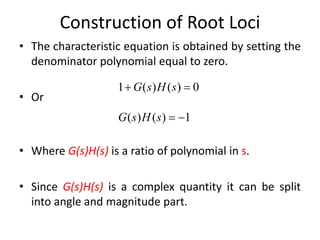
• The characteristic equation is obtained by setting the
denominator polynomial equal to zero.
• Or
• Where G(s)H(s) is a ratio of polynomial in s.
• Since G(s)H(s) is a complex quantity it can be split
into angle and magnitude part.
0
)
(
)
(
1 
 s
H
s
G
1
)
(
)
( 

s
H
s
G
Angle & Magnitude Conditions
• The angle of G(s)H(s)=-1 is
• Where k=1,2,3…
• The magnitude of G(s)H(s)=-1 is
)
1
2
(
180
)
(
)
(
1
)
(
)
(








k
s
H
s
G
s
H
s
G

1
)
(
)
(
1
)
(
)
(



s
H
s
G
s
H
s
G
Angle & Magnitude Conditions
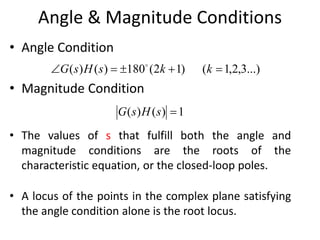
• Angle Condition
• Magnitude Condition
• The values of s that fulfill both the angle and
magnitude conditions are the roots of the
characteristic equation, or the closed-loop poles.
• A locus of the points in the complex plane satisfying
the angle condition alone is the root locus.
...)
3
,
2
,
1
(
)
1
2
(
180
)
(
)
( 



 k
k
s
H
s
G 
1
)
(
)
( 
s
H
s
G
Construction of root loci
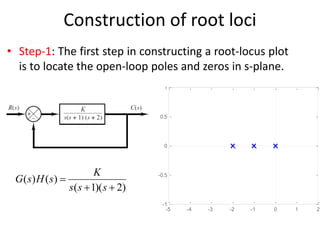
• Step-1: The first step in constructing a root-locus plot
is to locate the open-loop poles and zeros in s-plane.
)
2
)(
1
(
)
(
)
(



s
s
s
K
s
H
s
G
-5 -4 -3 -2 -1 0 1 2
-1
-0.5
0
0.5
1
Pole-Zero Map
Real Axis
Imaginary
Axis
-5 -4 -3 -2 -1 0 1 2
-1
-0.5
0
0.5
1
Pole-Zero Map
Real Axis
Imaginary
Axis
Construction of root loci
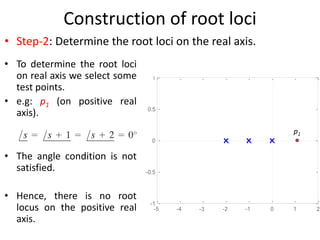
• Step-2: Determine the root loci on the real axis.
p1
• To determine the root loci
on real axis we select some
test points.
• e.g: p1 (on positive real
axis).
• The angle condition is not
satisfied.
• Hence, there is no root
locus on the positive real
axis.
-5 -4 -3 -2 -1 0 1 2
-1
-0.5
0
0.5
1
Pole-Zero Map
Real Axis
Imaginary
Axis
Construction of root loci
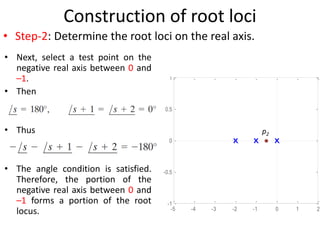
• Step-2: Determine the root loci on the real axis.
p2
• Next, select a test point on the
negative real axis between 0 and
–1.
• Then
• Thus
• The angle condition is satisfied.
Therefore, the portion of the
negative real axis between 0 and
–1 forms a portion of the root
locus.
-5 -4 -3 -2 -1 0 1 2
-1
-0.5
0
0.5
1
Pole-Zero Map
Real Axis
Imaginary
Axis
Construction of root loci
• Step-2: Determine the root loci on the real axis.
p3
• Now, select a test point on the
negative real axis between -1 and
–2.
• Then
• Thus
• The angle condition is not
satisfied. Therefore, the negative
real axis between -1 and –2 is not
a part of the root locus.
-5 -4 -3 -2 -1 0 1 2
-1
-0.5
0
0.5
1
Pole-Zero Map
Real Axis
Imaginary
Axis
Construction of root loci
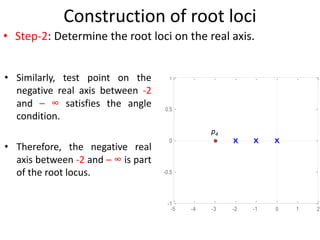
• Step-2: Determine the root loci on the real axis.
p4
• Similarly, test point on the
negative real axis between -2
and – ∞ satisfies the angle
condition.
• Therefore, the negative real
axis between -2 and – ∞ is part
of the root locus.
-5 -4 -3 -2 -1 0 1 2
-1
-0.5
0
0.5
1
Pole-Zero Map
Imaginary
Axis Construction of root loci
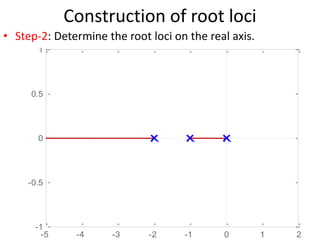
• Step-2: Determine the root loci on the real axis.
Construction of root loci
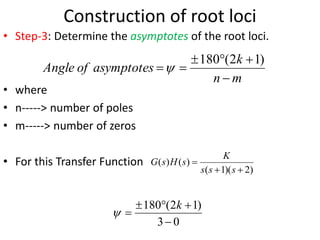
• Step-3: Determine the asymptotes of the root loci.
Asymptote is the straight line approximation of a curve
Actual Curve
Asymptotic Approximation
𝜎
Ψ
𝜎 𝐶𝑒𝑛𝑡𝑟𝑜𝑖𝑑 𝑜𝑓 𝐴𝑠𝑦𝑚𝑝𝑡𝑜𝑡𝑒𝑠
Ψ 𝐴𝑛𝑔𝑙𝑒 𝑜𝑓 𝐴𝑠𝑦𝑚𝑝𝑡𝑜𝑡𝑒𝑠
Construction of root loci
• Step-3: Determine the asymptotes of the root loci.
• where
• n-----> number of poles
• m-----> number of zeros
• For this Transfer Function
m
n
k
asymptotes
of
Angle






)
1
2
(
180

)
2
)(
1
(
)
(
)
(



s
s
s
K
s
H
s
G
0
3
)
1
2
(
180





k

Construction of root loci
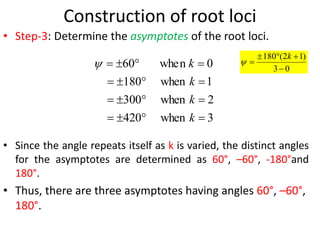
• Step-3: Determine the asymptotes of the root loci.
• Since the angle repeats itself as k is varied, the distinct angles
for the asymptotes are determined as 60°, –60°, -180°and
180°.
• Thus, there are three asymptotes having angles 60°, –60°,
180°.
3
when
420
2
when
300
1
when
180
0
n
whe
60
















k
k
k
k
 0
3
)
1
2
(
180





k

Construction of root loci
• Step-3: Determine the asymptotes of the root loci.
• Before we can draw these asymptotes in the complex
plane, we must find the point where they intersect the
real axis.
• Point of intersection of asymptotes on real axis (or
centroid of asymptotes) can be find as out
m
n
zeros
poles






Construction of root loci
• Step-3: Determine the asymptotes of the root loci.
• For
0
3
0
)
2
1
0
(






)
2
)(
1
(
)
(
)
(



s
s
s
K
s
H
s
G
1
3
3





Construction of root loci
• Step-3: Determine the asymptotes of the root loci.
-5 -4 -3 -2 -1 0 1 2
-1
-0.5
0
0.5
1
Pole-Zero Map
Real Axis
Imaginary
Axis


60

 60

180




 180
,
60
,
60

1



Home Work
• Consider following unity feedback system.
• Determine
– Root loci on real axis
– Angle of asymptotes
– Centroid of asymptotes
Construction of root loci
• Step-4: Determine the breakaway point.
• The breakaway point
corresponds to a point
in the s plane where
multiple roots of the
characteristic equation
occur.
• It is the point from
which the root locus
branches leaves real
axis and enter in
complex plane. -5 -4 -3 -2 -1 0 1 2
-1
-0.5
0
0.5
1
Pole-Zero Map
Real Axis
Imaginary
Axis
Construction of root loci
• Step-4: Determine the break-in point.
• The break-in point
corresponds to a point
in the s plane where
multiple roots of the
characteristic equation
occur.
• It is the point where the
root locus branches
arrives at real axis.
-5 -4 -3 -2 -1 0 1 2
-1
-0.5
0
0.5
1
Pole-Zero Map
Real Axis
Imaginary
Axis
Construction of root loci
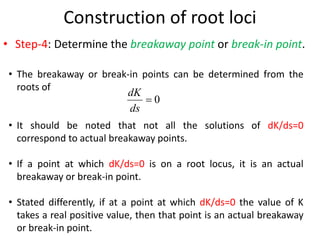
• Step-4: Determine the breakaway point or break-in point.
• The breakaway or break-in points can be determined from the
roots of
• It should be noted that not all the solutions of dK/ds=0
correspond to actual breakaway points.
• If a point at which dK/ds=0 is on a root locus, it is an actual
breakaway or break-in point.
• Stated differently, if at a point at which dK/ds=0 the value of K
takes a real positive value, then that point is an actual breakaway
or break-in point.
0

ds
dK
Construction of root loci
• Step-4: Determine the breakaway point or break-in point.
• The characteristic equation of the system is
• The breakaway point can now be determined as
)
2
)(
1
(
)
(
)
(



s
s
s
K
s
H
s
G
0
)
2
)(
1
(
1
)
(
)
(
1 





s
s
s
K
s
H
s
G
1
)
2
)(
1
(



 s
s
s
K
 
)
2
)(
1
( 


 s
s
s
K
 
)
2
)(
1
( 


 s
s
s
ds
d
ds
dK
Construction of root loci
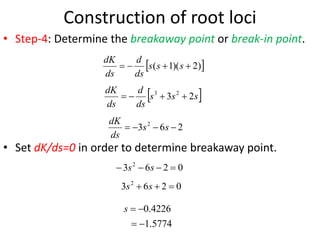
• Step-4: Determine the breakaway point or break-in point.
• Set dK/ds=0 in order to determine breakaway point.
 
)
2
)(
1
( 


 s
s
s
ds
d
ds
dK
 
s
s
s
ds
d
ds
dK
2
3 2
3




2
6
3 2



 s
s
ds
dK
0
2
6
3 2



 s
s
0
2
6
3 2


 s
s
5774
.
1
4226
.
0




s
Construction of root loci
• Step-4: Determine the breakaway point or break-in point.
• Since the breakaway point must lie on a root locus between 0
and –1, it is clear that s=–0.4226 corresponds to the actual
breakaway point.
• Point s=–1.5774 is not on the root locus. Hence, this point is
not an actual breakaway or break-in point.
• In fact, evaluation of the values of K corresponding to s=–
0.4226 and s=–1.5774 yields
5774
.
1
4226
.
0




s
)
2
)(
1
(
)
(
)
(



s
s
s
K
s
H
s
G
Construction of root loci
• Step-4: Determine the breakaway point.
-5 -4 -3 -2 -1 0 1 2
-1
-0.5
0
0.5
1
Pole-Zero Map
Real Axis
Imaginary
Axis


60

 60

180
4226
.
0


s
Construction of root loci
• Step-4: Determine the breakaway point.
4226
.
0


s
-5 -4 -3 -2 -1 0 1 2
-1
-0.5
0
0.5
1
Pole-Zero Map
Real Axis
Imaginary
Axis
Home Work
• Determine the Breakaway and break in points
Solution
• Differentiating K with respect to s and setting the derivative equal to zero yields;
Hence, solving for s, we find the
break-away and break-in points; s = -1.45 and 3.82
1
2
3
)
15
8
(
2
2






s
s
s
s
K
)
15
8
(
)
2
3
(
2
2






s
s
s
s
K
0
)
15
8
(
)]
8
2
)(
2
3
(
)
3
2
)(
15
8
[(
2
2
2
2












s
s
s
s
s
s
s
s
ds
dK
0
61
26
11 2


 s
s
Solution
-1.45 3.82
Construction of root loci
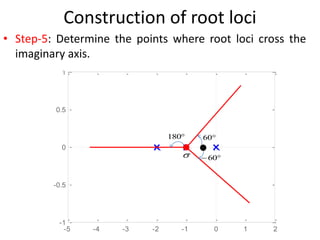
• Step-5: Determine the points where root loci cross the
imaginary axis.
-5 -4 -3 -2 -1 0 1 2
-1
-0.5
0
0.5
1
Pole-Zero Map
Imaginary
Axis


60

 60

180
Construction of root loci
• Step-5: Determine the points where root loci cross the
imaginary axis.
– These points can be found by use of Routh’s stability criterion.
– Since the characteristic equation for the present system is
– The Routh Array Becomes
Construction of root loci
• Step-5: Determine the points where root loci cross the
imaginary axis.
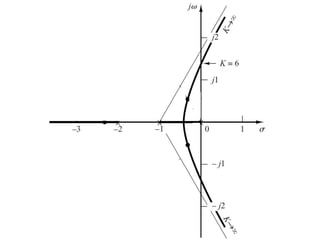
• The value(s) of K that makes the system
marginally stable is 6.
• The crossing points on the imaginary
axis can then be found by solving the
auxiliary equation obtained from the
s2 row, that is,
• Which yields
Construction of root loci
• Step-5: Determine the points where root loci cross the
imaginary axis.
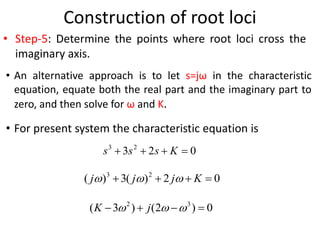
• An alternative approach is to let s=jω in the characteristic
equation, equate both the real part and the imaginary part to
zero, and then solve for ω and K.
• For present system the characteristic equation is
0
2
3 2
3



 K
s
s
s
0
2
)
(
3
)
( 2
3



 K
j
j
j 


0
)
2
(
)
3
( 3
2



 

 j
K
Construction of root loci
• Step-5: Determine the points where root loci cross the
imaginary axis.
• Equating both real and imaginary parts of this equation
to zero
• Which yields
0
)
2
(
)
3
( 3
2



 

 j
K
0
)
3
( 2

 
K
0
)
2
( 3



-7 -6 -5 -4 -3 -2 -1 0 1 2
-5
-4
-3
-2
-1
0
1
2
3
4
5
Root Locus
Real Axis
Imaginary
Axis

control Systems for Biomedical lect.pptx

  • 1.
    What is RootLocus? • The root locus is the path of the roots of the characteristic equation traced out in the s-plane as a system parameter varies from zero to infinity.
  • 2.
    How to Sketchroot locus? • One way is to compute the roots of the characteristic equation for all possible values of K. K s K s R s C    1 ) ( ) ( K Pole 0.5 -1.5 1 -2 2 -3 3 -4 5 -6 10 -11 15 -16
  • 3.
    How to Sketchroot locus? • Computing the roots for all values of K might be tedious for higher order systems. K s s s s K s R s C      ) 20 )( 10 )( 1 ( ) ( ) ( K Pole 0.5 ? 1 ? 2 ? 3 ? 5 ? 10 ? 15 ?
  • 4.
    Construction of RootLoci • Finding the roots of the characteristic equation of degree higher than 3 is laborious and will need computer solution. • A simple method for finding the roots of the characteristic equation has been developed by W. R. Evans and used extensively in control engineering. • This method, called the root-locus method, is one in which the roots of the characteristic equation are plotted for all values of a system parameter.
  • 5.
    Construction of RootLoci • The roots corresponding to a particular value of this parameter can then be located on the resulting graph. • Note that the parameter is usually the gain, but any other variable of the open-loop transfer function may be used. • By using the root-locus method the designer can predict the effects on the location of the closed-loop poles of varying the gain value or adding open-loop poles and/or open-loop zeros.
  • 6.
    Angle & MagnitudeConditions • In constructing the root loci angle and magnitude conditions are important. • Consider the system shown in following figure. • The closed loop transfer function is ) ( ) ( 1 ) ( ) ( ) ( s H s G s G s R s C  
  • 7.
    Construction of RootLoci • The characteristic equation is obtained by setting the denominator polynomial equal to zero. • Or • Where G(s)H(s) is a ratio of polynomial in s. • Since G(s)H(s) is a complex quantity it can be split into angle and magnitude part. 0 ) ( ) ( 1   s H s G 1 ) ( ) (   s H s G
  • 8.
    Angle & MagnitudeConditions • The angle of G(s)H(s)=-1 is • Where k=1,2,3… • The magnitude of G(s)H(s)=-1 is ) 1 2 ( 180 ) ( ) ( 1 ) ( ) (         k s H s G s H s G  1 ) ( ) ( 1 ) ( ) (    s H s G s H s G
  • 9.
    Angle & MagnitudeConditions • Angle Condition • Magnitude Condition • The values of s that fulfill both the angle and magnitude conditions are the roots of the characteristic equation, or the closed-loop poles. • A locus of the points in the complex plane satisfying the angle condition alone is the root locus. ...) 3 , 2 , 1 ( ) 1 2 ( 180 ) ( ) (      k k s H s G  1 ) ( ) (  s H s G
  • 10.
    Construction of rootloci • Step-1: The first step in constructing a root-locus plot is to locate the open-loop poles and zeros in s-plane. ) 2 )( 1 ( ) ( ) (    s s s K s H s G -5 -4 -3 -2 -1 0 1 2 -1 -0.5 0 0.5 1 Pole-Zero Map Real Axis Imaginary Axis
  • 11.
    -5 -4 -3-2 -1 0 1 2 -1 -0.5 0 0.5 1 Pole-Zero Map Real Axis Imaginary Axis Construction of root loci • Step-2: Determine the root loci on the real axis. p1 • To determine the root loci on real axis we select some test points. • e.g: p1 (on positive real axis). • The angle condition is not satisfied. • Hence, there is no root locus on the positive real axis.
  • 12.
    -5 -4 -3-2 -1 0 1 2 -1 -0.5 0 0.5 1 Pole-Zero Map Real Axis Imaginary Axis Construction of root loci • Step-2: Determine the root loci on the real axis. p2 • Next, select a test point on the negative real axis between 0 and –1. • Then • Thus • The angle condition is satisfied. Therefore, the portion of the negative real axis between 0 and –1 forms a portion of the root locus.
  • 13.
    -5 -4 -3-2 -1 0 1 2 -1 -0.5 0 0.5 1 Pole-Zero Map Real Axis Imaginary Axis Construction of root loci • Step-2: Determine the root loci on the real axis. p3 • Now, select a test point on the negative real axis between -1 and –2. • Then • Thus • The angle condition is not satisfied. Therefore, the negative real axis between -1 and –2 is not a part of the root locus.
  • 14.
    -5 -4 -3-2 -1 0 1 2 -1 -0.5 0 0.5 1 Pole-Zero Map Real Axis Imaginary Axis Construction of root loci • Step-2: Determine the root loci on the real axis. p4 • Similarly, test point on the negative real axis between -2 and – ∞ satisfies the angle condition. • Therefore, the negative real axis between -2 and – ∞ is part of the root locus.
  • 15.
    -5 -4 -3-2 -1 0 1 2 -1 -0.5 0 0.5 1 Pole-Zero Map Imaginary Axis Construction of root loci • Step-2: Determine the root loci on the real axis.
  • 16.
    Construction of rootloci • Step-3: Determine the asymptotes of the root loci. Asymptote is the straight line approximation of a curve Actual Curve Asymptotic Approximation 𝜎 Ψ 𝜎 𝐶𝑒𝑛𝑡𝑟𝑜𝑖𝑑 𝑜𝑓 𝐴𝑠𝑦𝑚𝑝𝑡𝑜𝑡𝑒𝑠 Ψ 𝐴𝑛𝑔𝑙𝑒 𝑜𝑓 𝐴𝑠𝑦𝑚𝑝𝑡𝑜𝑡𝑒𝑠
  • 17.
    Construction of rootloci • Step-3: Determine the asymptotes of the root loci. • where • n-----> number of poles • m-----> number of zeros • For this Transfer Function m n k asymptotes of Angle       ) 1 2 ( 180  ) 2 )( 1 ( ) ( ) (    s s s K s H s G 0 3 ) 1 2 ( 180      k 
  • 18.
    Construction of rootloci • Step-3: Determine the asymptotes of the root loci. • Since the angle repeats itself as k is varied, the distinct angles for the asymptotes are determined as 60°, –60°, -180°and 180°. • Thus, there are three asymptotes having angles 60°, –60°, 180°. 3 when 420 2 when 300 1 when 180 0 n whe 60                 k k k k  0 3 ) 1 2 ( 180      k 
  • 19.
    Construction of rootloci • Step-3: Determine the asymptotes of the root loci. • Before we can draw these asymptotes in the complex plane, we must find the point where they intersect the real axis. • Point of intersection of asymptotes on real axis (or centroid of asymptotes) can be find as out m n zeros poles      
  • 20.
    Construction of rootloci • Step-3: Determine the asymptotes of the root loci. • For 0 3 0 ) 2 1 0 (       ) 2 )( 1 ( ) ( ) (    s s s K s H s G 1 3 3     
  • 21.
    Construction of rootloci • Step-3: Determine the asymptotes of the root loci. -5 -4 -3 -2 -1 0 1 2 -1 -0.5 0 0.5 1 Pole-Zero Map Real Axis Imaginary Axis   60   60  180      180 , 60 , 60  1   
  • 22.
    Home Work • Considerfollowing unity feedback system. • Determine – Root loci on real axis – Angle of asymptotes – Centroid of asymptotes
  • 23.
    Construction of rootloci • Step-4: Determine the breakaway point. • The breakaway point corresponds to a point in the s plane where multiple roots of the characteristic equation occur. • It is the point from which the root locus branches leaves real axis and enter in complex plane. -5 -4 -3 -2 -1 0 1 2 -1 -0.5 0 0.5 1 Pole-Zero Map Real Axis Imaginary Axis
  • 24.
    Construction of rootloci • Step-4: Determine the break-in point. • The break-in point corresponds to a point in the s plane where multiple roots of the characteristic equation occur. • It is the point where the root locus branches arrives at real axis. -5 -4 -3 -2 -1 0 1 2 -1 -0.5 0 0.5 1 Pole-Zero Map Real Axis Imaginary Axis
  • 25.
    Construction of rootloci • Step-4: Determine the breakaway point or break-in point. • The breakaway or break-in points can be determined from the roots of • It should be noted that not all the solutions of dK/ds=0 correspond to actual breakaway points. • If a point at which dK/ds=0 is on a root locus, it is an actual breakaway or break-in point. • Stated differently, if at a point at which dK/ds=0 the value of K takes a real positive value, then that point is an actual breakaway or break-in point. 0  ds dK
  • 26.
    Construction of rootloci • Step-4: Determine the breakaway point or break-in point. • The characteristic equation of the system is • The breakaway point can now be determined as ) 2 )( 1 ( ) ( ) (    s s s K s H s G 0 ) 2 )( 1 ( 1 ) ( ) ( 1       s s s K s H s G 1 ) 2 )( 1 (     s s s K   ) 2 )( 1 (     s s s K   ) 2 )( 1 (     s s s ds d ds dK
  • 27.
    Construction of rootloci • Step-4: Determine the breakaway point or break-in point. • Set dK/ds=0 in order to determine breakaway point.   ) 2 )( 1 (     s s s ds d ds dK   s s s ds d ds dK 2 3 2 3     2 6 3 2     s s ds dK 0 2 6 3 2     s s 0 2 6 3 2    s s 5774 . 1 4226 . 0     s
  • 28.
    Construction of rootloci • Step-4: Determine the breakaway point or break-in point. • Since the breakaway point must lie on a root locus between 0 and –1, it is clear that s=–0.4226 corresponds to the actual breakaway point. • Point s=–1.5774 is not on the root locus. Hence, this point is not an actual breakaway or break-in point. • In fact, evaluation of the values of K corresponding to s=– 0.4226 and s=–1.5774 yields 5774 . 1 4226 . 0     s ) 2 )( 1 ( ) ( ) (    s s s K s H s G
  • 29.
    Construction of rootloci • Step-4: Determine the breakaway point. -5 -4 -3 -2 -1 0 1 2 -1 -0.5 0 0.5 1 Pole-Zero Map Real Axis Imaginary Axis   60   60  180 4226 . 0   s
  • 30.
    Construction of rootloci • Step-4: Determine the breakaway point. 4226 . 0   s -5 -4 -3 -2 -1 0 1 2 -1 -0.5 0 0.5 1 Pole-Zero Map Real Axis Imaginary Axis
  • 31.
    Home Work • Determinethe Breakaway and break in points
  • 32.
    Solution • Differentiating Kwith respect to s and setting the derivative equal to zero yields; Hence, solving for s, we find the break-away and break-in points; s = -1.45 and 3.82 1 2 3 ) 15 8 ( 2 2       s s s s K ) 15 8 ( ) 2 3 ( 2 2       s s s s K 0 ) 15 8 ( )] 8 2 )( 2 3 ( ) 3 2 )( 15 8 [( 2 2 2 2             s s s s s s s s ds dK 0 61 26 11 2    s s
  • 33.
  • 34.
    Construction of rootloci • Step-5: Determine the points where root loci cross the imaginary axis. -5 -4 -3 -2 -1 0 1 2 -1 -0.5 0 0.5 1 Pole-Zero Map Imaginary Axis   60   60  180
  • 35.
    Construction of rootloci • Step-5: Determine the points where root loci cross the imaginary axis. – These points can be found by use of Routh’s stability criterion. – Since the characteristic equation for the present system is – The Routh Array Becomes
  • 36.
    Construction of rootloci • Step-5: Determine the points where root loci cross the imaginary axis. • The value(s) of K that makes the system marginally stable is 6. • The crossing points on the imaginary axis can then be found by solving the auxiliary equation obtained from the s2 row, that is, • Which yields
  • 37.
    Construction of rootloci • Step-5: Determine the points where root loci cross the imaginary axis. • An alternative approach is to let s=jω in the characteristic equation, equate both the real part and the imaginary part to zero, and then solve for ω and K. • For present system the characteristic equation is 0 2 3 2 3     K s s s 0 2 ) ( 3 ) ( 2 3     K j j j    0 ) 2 ( ) 3 ( 3 2        j K
  • 38.
    Construction of rootloci • Step-5: Determine the points where root loci cross the imaginary axis. • Equating both real and imaginary parts of this equation to zero • Which yields 0 ) 2 ( ) 3 ( 3 2        j K 0 ) 3 ( 2    K 0 ) 2 ( 3   
  • 40.
    -7 -6 -5-4 -3 -2 -1 0 1 2 -5 -4 -3 -2 -1 0 1 2 3 4 5 Root Locus Real Axis Imaginary Axis